Beyond the Sun: The
Science of Finding
Distant Planets
Presented By:- Science Club
Introduction
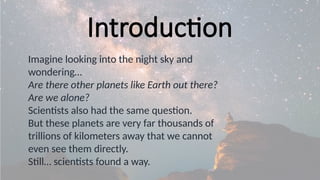
Imagine looking into the night sky and
wondering…
Are there other planets like Earth out there?
Are we alone?
Scientists also had the same question.
But these planets are very far thousands of
trillions of kilometers away that we cannot
even see them directly.
Still… scientists found a way.
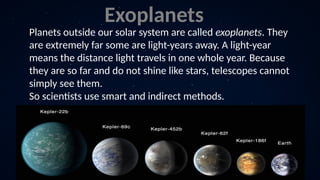
Planets outside our solar system are called exoplanets. They
are extremely far some are light-years away. A light-year
means the distance light travels in one whole year. Because
they are so far and do not shine like stars, telescopes cannot
simply see them.
So scientists use smart and indirect methods.
Exoplanets
Method 1: Transit Method
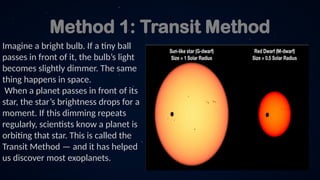
Imagine a bright bulb. If a tiny ball
passes in front of it, the bulb’s light
becomes slightly dimmer. The same
thing happens in space.
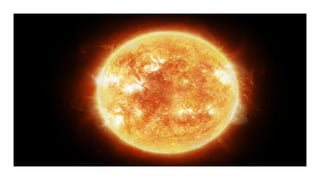
When a planet passes in front of its
star, the star’s brightness drops for a
moment. If this dimming repeats
regularly, scientists know a planet is
orbiting that star. This is called the
Transit Method — and it has helped
us discover most exoplanets.
What Transit Method
Reveals
This method reveals :-
1.Planet size
2.Orbit time
3.Whether planet is rocky or gaseous
5.If it’s in the habitable zone!
HD 209458 b: The first
planet discovered by this
method, notable for being
the first for which an
atmosphere's composition
was measured.
Example
Note:- Please play the video in the next slide
Method 2: The Wobble Method
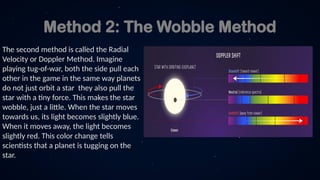
The second method is called the Radial
Velocity or Doppler Method. Imagine
playing tug-of-war, both the side pull each
other in the game in the same way planets
do not just orbit a star they also pull the
star with a tiny force. This makes the star
wobble, just a little. When the star moves
towards us, its light becomes slightly blue.
When it moves away, the light becomes
slightly red. This color change tells
scientists that a planet is tugging on the
star.
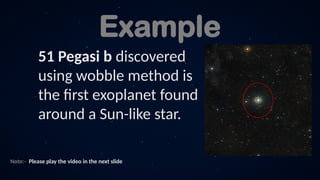
Example
51 Pegasi b discovered
using wobble method is
the first exoplanet found
around a Sun-like star.
Note:- Please play the video in the next slide
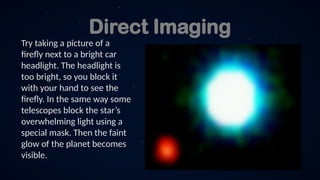
Direct Imaging
Try taking a picture of a
firefly next to a bright car
headlight. The headlight is
too bright, so you block it
with your hand to see the
firefly. In the same way some
telescopes block the star’s
overwhelming light using a
special mask. Then the faint
glow of the planet becomes
visible.
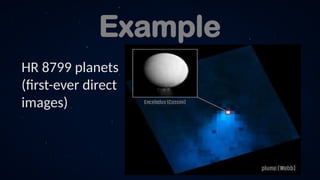
Example
HR 8799 planets
(first-ever direct
images)
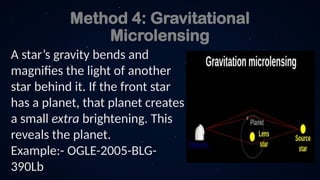
Method 4: Gravitational
Microlensing
A star’s gravity bends and
magnifies the light of another
star behind it. If the front star
has a planet, that planet creates
a small extra brightening. This
reveals the planet.
Example:- OGLE-2005-BLG-
390Lb
CONCLUSION
Ultimately, scientists find planets light-years away not by seeing the
planets directly, but by observing how stars behave. When a planet
moves in front of its star, the star becomes a little dimmer. By
measuring this tiny change in brightness-and by studying the star's
wobble-astronomers can discover new worlds that are impossible
to see with our eyes. These methods remind us that even the
tiniest clues in the universe can show something huge. And who
knows-someday one of these far-off planets may be capable of
supporting life. So keep exploring, keep asking questions, and keep
your curiosity alive. Because science always starts with curiosity.
Exoplanets Science club.pptx FOR CLASS 10

Exoplanets Science club.pptx FOR CLASS 10

  • 1.
    Beyond the Sun:The Science of Finding Distant Planets Presented By:- Science Club
  • 2.
    Introduction Imagine looking intothe night sky and wondering… Are there other planets like Earth out there? Are we alone? Scientists also had the same question. But these planets are very far thousands of trillions of kilometers away that we cannot even see them directly. Still… scientists found a way.
  • 3.
    Planets outside oursolar system are called exoplanets. They are extremely far some are light-years away. A light-year means the distance light travels in one whole year. Because they are so far and do not shine like stars, telescopes cannot simply see them. So scientists use smart and indirect methods. Exoplanets
  • 4.
    Method 1: TransitMethod Imagine a bright bulb. If a tiny ball passes in front of it, the bulb’s light becomes slightly dimmer. The same thing happens in space. When a planet passes in front of its star, the star’s brightness drops for a moment. If this dimming repeats regularly, scientists know a planet is orbiting that star. This is called the Transit Method — and it has helped us discover most exoplanets.
  • 5.
    What Transit Method Reveals Thismethod reveals :- 1.Planet size 2.Orbit time 3.Whether planet is rocky or gaseous 5.If it’s in the habitable zone!
  • 6.
    HD 209458 b:The first planet discovered by this method, notable for being the first for which an atmosphere's composition was measured. Example Note:- Please play the video in the next slide
  • 8.
    Method 2: TheWobble Method The second method is called the Radial Velocity or Doppler Method. Imagine playing tug-of-war, both the side pull each other in the game in the same way planets do not just orbit a star they also pull the star with a tiny force. This makes the star wobble, just a little. When the star moves towards us, its light becomes slightly blue. When it moves away, the light becomes slightly red. This color change tells scientists that a planet is tugging on the star.
  • 9.
    Example 51 Pegasi bdiscovered using wobble method is the first exoplanet found around a Sun-like star. Note:- Please play the video in the next slide
  • 11.
    Direct Imaging Try takinga picture of a firefly next to a bright car headlight. The headlight is too bright, so you block it with your hand to see the firefly. In the same way some telescopes block the star’s overwhelming light using a special mask. Then the faint glow of the planet becomes visible.
  • 12.
  • 13.
    Method 4: Gravitational Microlensing Astar’s gravity bends and magnifies the light of another star behind it. If the front star has a planet, that planet creates a small extra brightening. This reveals the planet. Example:- OGLE-2005-BLG- 390Lb
  • 14.
    CONCLUSION Ultimately, scientists findplanets light-years away not by seeing the planets directly, but by observing how stars behave. When a planet moves in front of its star, the star becomes a little dimmer. By measuring this tiny change in brightness-and by studying the star's wobble-astronomers can discover new worlds that are impossible to see with our eyes. These methods remind us that even the tiniest clues in the universe can show something huge. And who knows-someday one of these far-off planets may be capable of supporting life. So keep exploring, keep asking questions, and keep your curiosity alive. Because science always starts with curiosity.