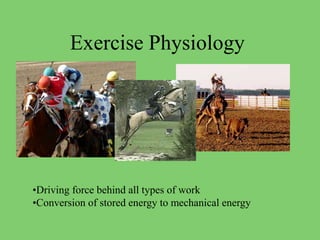
Exercise Physiology
•Driving force behind all types of work
•Conversion of stored energy to mechanical energy
What Influences Athletic Ability?
• Genetics
• Training
• Training
methodology
• Environment
• Nutrition
• Track/Arena
Surfaces
• Shoes
• Jockey
• Etc.
ATHLETIC
ABILITY
Heart size
Skeletal muscle
properties
Anaerobic
capacity
Gas exchange
Hemoglobin
concentration
Biomechanics
ENERGY
• Sources
– Carbohydrates
– Fats
• Effect on performance
– ↓ energy = ↓ performance
– Must meet energy requirement
– Monitor body condition
• ↓ body condition = negative energy balance
Energy Metabolism
• Aerobic
– With oxygen
– Carbohydrate & fat
– CO2, H2O & ATP
• Anaerobic
– Without oxygen
– Carbohydrate
(glycolysis)
– Lactate & ATP
Muscle
Glycogen
Blood Glucose
Anaerobic
Glycolysis
Oxidative
Metabolism
Pyruvate Lactate
ATP
Free-Fatty
Acids
Creatine
Phosphate
Myokinase
and CPK
Reactions
CO2and
Water
Lipolysis
Oxygen
Synthesis of ATP from aerobic and anaerobic metabolism.
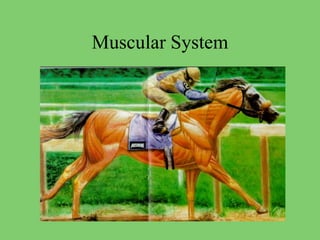
Muscular System
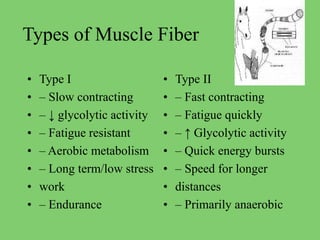
Types of Muscle Fiber
• Type I
• – Slow contracting
• – ↓ glycolytic activity
• – Fatigue resistant
• – Aerobic metabolism
• – Long term/low stress
• work
• – Endurance
• Type II
• – Fast contracting
• – Fatigue quickly
• – ↑ Glycolytic activity
• – Quick energy bursts
• – Speed for longer
• distances
• – Primarily anaerobic
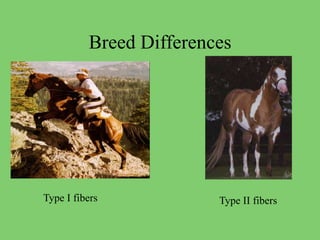
Breed Differences
Type I fibers Type II fibers
Energy For Muscle Contraction
• Walking
– Slow contractions
– Primarily type I
fibers
– Fat primary energy
source (very
efficient)
Energy For Muscle Contraction
• Trot and Canter
– Increased contractions
• Increased contractions
require more ATP
• Type II fibers
• Fat cannot be
metabolized
anaerobically
Anaerobic Glycolysis
• Fastest way to
produce ATP
• Less efficient than
aerobic glycolysis
– Less ATP
– Lactic acid produced
– Decrease muscle pH
– Fatigue/tying up
Horses that can generate a higher
proportion of energy aerobically will
outperform horses with lower
aerobic capacity
Estimated Types Of
Energy Used
Event Preformed
Energy
Anaerobic Aerobic
Racing QH 80% 18% 2%
Racing 1000 m 25% 70% 5%
Racing 1600 m 10% 80% 10%
Racing 2400 m 5% 70% 25%
Racing 3200 m 5% 55% 40%
Polo 5% 50% 45%
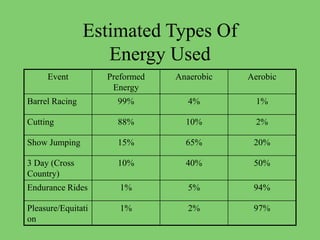
Estimated Types Of
Energy Used
Event Preformed
Energy
Anaerobic Aerobic
Barrel Racing 99% 4% 1%
Cutting 88% 10% 2%
Show Jumping 15% 65% 20%
3 Day (Cross
Country)
10% 40% 50%
Endurance Rides 1% 5% 94%
Pleasure/Equitati
on
1% 2% 97%
Cardiovascular System
• Delivers blood to
body
– O2 from lungs
– Nutrients from
GI tract
Cardiovascular System
• Heart rate (HR)
– Resting 30-45
– Exercising – 240 bpm max
• Stroke Volume (SV)
– Volume of blood pumped per
beat
– 800 – 900 mls
• HR X SV = Cardiac Output
– Can pump > 250 li/min
– Equivalent to 55 gal drum
Affect of Exercise On
The Cardiovascular
System
• ↑ metabolic activity in limbs = ↑ blood flow
• Three ways to increase blood flow
– Increase cardiac output
• HR and CO proportional to running speed
• Cannot ↑ HR beyond max
– Increase O2 carried in blood
• Splenic dumping can double O2 carrying capacity
– Redistribute blood flow
• ↑ to locomotive muscle
• ↓ to kidneys and small intestines
Respiratory System
• Respiratory Rate
– Resting - 8-20 breaths per min
• Exercise
– ↑ O2 consumption
– ↑ CO2 emission
• To increase air exchange
– ↑ Respiratory rate
• RR linked to stride freq.
• ↑ Tidal Volume (TV)
– Air inhaled or
exhaled in a breath
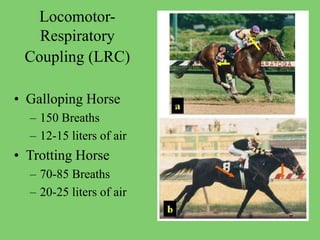
Locomotor-
Respiratory
Coupling (LRC)
• Galloping Horse
– 150 Breaths
– 12-15 liters of air
• Trotting Horse
– 70-85 Breaths
– 20-25 liters of air
Respiratory Problems
• Laryngeal hemiplegia
– Partial paralysis of larynx
– Inadequate gas exchange
– Surgical treatment
• Chronic Obstructive Pulmonary
Disease
– Decreases respiratory rate
– Hyperallerginc response to dust,
mold, irritants
– House outdoors
• Exercise Induced Pulmonary
Hemorrhage
– Bleeding in lungs
– Speeds above 14 m/s
– Variable effects
– Furosemide (Lasix)
Thermoregulation
• Importance
– Evaporative Cooling
(Sweating)
– Most important route
of heat dissipation
– Requires ample
blood flow to carry
heat from core to
surface
• Thoroughbred (race)
– 2.5 gal
• Endurance horse (50-
100 miles)
– 6-12 gal
• Three day event
(dressage/cross
country)
– 5-6 gal
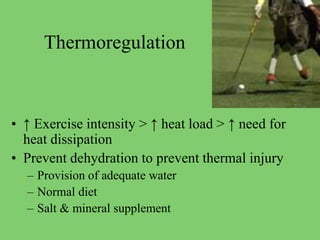
Thermoregulation
• ↑ Exercise intensity > ↑ heat load > ↑ need for
heat dissipation
• Prevent dehydration to prevent thermal injury
– Provision of adequate water
– Normal diet
– Salt & mineral supplement
Thermoregulation
• Dehydration
– Electrolyte & pH disturbances
– Fatigue
– Gait incoordination (ataxia)
– ↑ risk of orthopedic injury
– Muscle damage
– Death
• Supplement electrolytes
– Beginning training program
– Adjusting to high temperature
Types of Training
• Endurance
– Enhances aerobic
system
• High intensity/Quick
burst
– Increases muscle mass
– Strength training
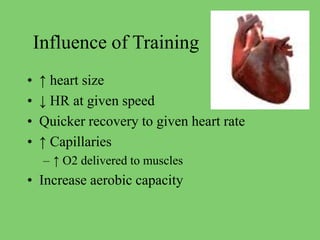
Influence of Training
• ↑ heart size
• ↓ HR at given speed
• Quicker recovery to given heart rate
• ↑ Capillaries
– ↑ O2 delivered to muscles
• Increase aerobic capacity
Influence of Training
• ↑ Muscle Cell Mitochondria
– ↑ O2 utilization per unit of muscle
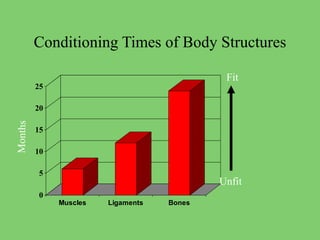
• Muscle has quickest adaptation
to training of all body tissues
Conditioning Times of Body Structures
0
5
10
15
20
25
Muscles Ligaments Bones
Unfit
Fit
Signs of Fatigue
• Respiration rate > heart rate
– Inversion
– Hyperventilating
– Shallow breathing
– Shock
• Muscle soreness (lactic acid buildup)
• Ataxia
• Deydration
Conditioning is A Process That
Occurs Over Time

Exercise physiology

  • 1.
    Exercise Physiology •Driving forcebehind all types of work •Conversion of stored energy to mechanical energy
  • 2.
    What Influences AthleticAbility? • Genetics • Training • Training methodology • Environment • Nutrition • Track/Arena Surfaces • Shoes • Jockey • Etc.
  • 3.
  • 4.
    ENERGY • Sources – Carbohydrates –Fats • Effect on performance – ↓ energy = ↓ performance – Must meet energy requirement – Monitor body condition • ↓ body condition = negative energy balance
  • 5.
    Energy Metabolism • Aerobic –With oxygen – Carbohydrate & fat – CO2, H2O & ATP • Anaerobic – Without oxygen – Carbohydrate (glycolysis) – Lactate & ATP
  • 6.
    Muscle Glycogen Blood Glucose Anaerobic Glycolysis Oxidative Metabolism Pyruvate Lactate ATP Free-Fatty Acids Creatine Phosphate Myokinase andCPK Reactions CO2and Water Lipolysis Oxygen Synthesis of ATP from aerobic and anaerobic metabolism.
  • 7.
  • 8.
    Types of MuscleFiber • Type I • – Slow contracting • – ↓ glycolytic activity • – Fatigue resistant • – Aerobic metabolism • – Long term/low stress • work • – Endurance • Type II • – Fast contracting • – Fatigue quickly • – ↑ Glycolytic activity • – Quick energy bursts • – Speed for longer • distances • – Primarily anaerobic
  • 9.
    Breed Differences Type Ifibers Type II fibers
  • 10.
    Energy For MuscleContraction • Walking – Slow contractions – Primarily type I fibers – Fat primary energy source (very efficient)
  • 11.
    Energy For MuscleContraction • Trot and Canter – Increased contractions • Increased contractions require more ATP • Type II fibers • Fat cannot be metabolized anaerobically
  • 12.
    Anaerobic Glycolysis • Fastestway to produce ATP • Less efficient than aerobic glycolysis – Less ATP – Lactic acid produced – Decrease muscle pH – Fatigue/tying up
  • 13.
    Horses that cangenerate a higher proportion of energy aerobically will outperform horses with lower aerobic capacity
  • 14.
    Estimated Types Of EnergyUsed Event Preformed Energy Anaerobic Aerobic Racing QH 80% 18% 2% Racing 1000 m 25% 70% 5% Racing 1600 m 10% 80% 10% Racing 2400 m 5% 70% 25% Racing 3200 m 5% 55% 40% Polo 5% 50% 45%
  • 15.
    Estimated Types Of EnergyUsed Event Preformed Energy Anaerobic Aerobic Barrel Racing 99% 4% 1% Cutting 88% 10% 2% Show Jumping 15% 65% 20% 3 Day (Cross Country) 10% 40% 50% Endurance Rides 1% 5% 94% Pleasure/Equitati on 1% 2% 97%
  • 16.
    Cardiovascular System • Deliversblood to body – O2 from lungs – Nutrients from GI tract
  • 17.
    Cardiovascular System • Heartrate (HR) – Resting 30-45 – Exercising – 240 bpm max • Stroke Volume (SV) – Volume of blood pumped per beat – 800 – 900 mls • HR X SV = Cardiac Output – Can pump > 250 li/min – Equivalent to 55 gal drum
  • 18.
    Affect of ExerciseOn The Cardiovascular System • ↑ metabolic activity in limbs = ↑ blood flow • Three ways to increase blood flow – Increase cardiac output • HR and CO proportional to running speed • Cannot ↑ HR beyond max – Increase O2 carried in blood • Splenic dumping can double O2 carrying capacity – Redistribute blood flow • ↑ to locomotive muscle • ↓ to kidneys and small intestines
  • 19.
    Respiratory System • RespiratoryRate – Resting - 8-20 breaths per min • Exercise – ↑ O2 consumption – ↑ CO2 emission • To increase air exchange – ↑ Respiratory rate • RR linked to stride freq. • ↑ Tidal Volume (TV) – Air inhaled or exhaled in a breath
  • 20.
    Locomotor- Respiratory Coupling (LRC) • GallopingHorse – 150 Breaths – 12-15 liters of air • Trotting Horse – 70-85 Breaths – 20-25 liters of air
  • 21.
    Respiratory Problems • Laryngealhemiplegia – Partial paralysis of larynx – Inadequate gas exchange – Surgical treatment • Chronic Obstructive Pulmonary Disease – Decreases respiratory rate – Hyperallerginc response to dust, mold, irritants – House outdoors • Exercise Induced Pulmonary Hemorrhage – Bleeding in lungs – Speeds above 14 m/s – Variable effects – Furosemide (Lasix)
  • 22.
    Thermoregulation • Importance – EvaporativeCooling (Sweating) – Most important route of heat dissipation – Requires ample blood flow to carry heat from core to surface • Thoroughbred (race) – 2.5 gal • Endurance horse (50- 100 miles) – 6-12 gal • Three day event (dressage/cross country) – 5-6 gal
  • 23.
    Thermoregulation • ↑ Exerciseintensity > ↑ heat load > ↑ need for heat dissipation • Prevent dehydration to prevent thermal injury – Provision of adequate water – Normal diet – Salt & mineral supplement
  • 24.
    Thermoregulation • Dehydration – Electrolyte& pH disturbances – Fatigue – Gait incoordination (ataxia) – ↑ risk of orthopedic injury – Muscle damage – Death • Supplement electrolytes – Beginning training program – Adjusting to high temperature
  • 25.
    Types of Training •Endurance – Enhances aerobic system • High intensity/Quick burst – Increases muscle mass – Strength training
  • 26.
    Influence of Training •↑ heart size • ↓ HR at given speed • Quicker recovery to given heart rate • ↑ Capillaries – ↑ O2 delivered to muscles • Increase aerobic capacity
  • 27.
    Influence of Training •↑ Muscle Cell Mitochondria – ↑ O2 utilization per unit of muscle • Muscle has quickest adaptation to training of all body tissues
  • 28.
    Conditioning Times ofBody Structures 0 5 10 15 20 25 Muscles Ligaments Bones Unfit Fit
  • 29.
    Signs of Fatigue •Respiration rate > heart rate – Inversion – Hyperventilating – Shallow breathing – Shock • Muscle soreness (lactic acid buildup) • Ataxia • Deydration
  • 30.
    Conditioning is AProcess That Occurs Over Time