Executive learning & development review – Implications for developing executive
                                 human capital

                                         Solomon Akrofi MBA, PMP, MSP


This report presents a refreshing insight into executive learning and development based on a survey of
182 executives from America, Africa, Europe, Middle East, Pacific Region and Asia (above map indicates
the geographical locations of respondents). Participants were also drawn from a diverse range of sectors
/ industries such as the services, aerospace and aviation, financial services, manufacturing, retailing,
education, mining and heavy industrials. The table below provides job functions / profiles of participants.


                 Primary Job function of participants                    No            Percent
                 Management (Senior/Corporate)                                    34      18.7%
                 Human resources management                                       33      18.1%
                 Sales/Marketing                                                  13       7.1%
                 Consulting                                                       12       6.6%
                 Other                                                             8       4.4%
                 Operations/Logistics                                              7       3.8%
                 Accounting/Finance/Banking                                        5       2.7%
                 Education                                                         4       2.2%
                 Science/Technology/Programming                                    4       2.2%
                 Buying/Purchasing                                                 3       1.6%
                 Planning (Meeting, Events, etc.)                                  2       1.1%
                 Research                                                          2       1.1%
                 Customer Service                                                  1       0.5%
                 Unspecified                                                      60      33.0%
                 Total Responses:                                                182     100.0%


The deployed survey instrument measured executive learning and development from 6 perspectives
(strategic, experiential, networking, self-directed, structured and participative dimensions) reflecting a
holistic consideration of the competencies required for the effective discharge the executive. Highlights
of the results are briefly discussed with recommendations offered to aid organisational development of
executive human capital.


                              May 2010                                  Page 1 of 6
Logarithmic scale comparison of the 6 Executive L & D dimensions

        100


         10


          1
                 Strongly      Moderately       Slightly       Neutral       Slightly agree       Moderately      Strongly
                 disagree       disagree       disagree                                             agree          agree


              Experiential      Structured         Netw orking           Participative        Self-directed           Strategic


        Fig 1 – Comparison of the 6 executive Learning & development dimensions
Figure 1, above depicts a roll-up summary and comparison of the six executive learning and development
components. Of the six dimensions, four of these; strategic, networking, experiential and participative
were considered highly prevalent by participants amongst executives in their organisations. On the other
hand, self-directed and structured learning and development were found to be due to a number of
factors. Whilst this outcome remains unclear and falls outside the scope of this study, it is possible to
propound some assumptions. It could be that these two components have low priority, underestimated or
even considered irrelevance to the discharge of the executive job scope. This may warrant further
investigation to unearth the possible causalities.

                         Average Scores for the 6 dimentions of executive L & D


          5

        4.5

          4

        3.5

          3

        2.5

          2

        1.5

          1

        0.5

          0

                   Strategic    Experiential     Netw orking      Participative          Self -directed        Structured


                                  May 2010                                          Page 2 of 6
Fig 2 – Average scores of the 6 executive learning & development components

Alternatively analysis is presented by normalising the results according to average scores which offers a
slightly different slant as depicted in figure 2 above. But again, the incidence of strategic, experiential
and networking in organisations is quite high whilst participative, self-directed and structure learning and
development attract lower support from respondents.


It is quite obvious that the ability to craft and implement effective strategies is a key enabler of
organisational value creation and therefore the zenith of the executive job scope. It is therefore not
surprising that it attracted the highest scores compared to the other dimensions of executive learning and
development examined in the study. Furthermore, this could suggest that organisations and for that
matter executives are placing a higher premium on developing and maintaining strategic competencies
required to deliver business results. Equally well, the higher scores attributed to networking related
learning and development is a possible indication that executives are becoming more reliant on
networking ties as a means of navigating organisational challenges and problems. In effect interactions
that occur amongst internal and external executive peers are becoming a vital source of executive
intellectual capital creation. Also, the high incidence of experiential learning and development could
suggest higher levels of emotional intelligence which may be important for the effective discharge of
executive level duties.


                  External networking input into organisational strategy formulation &
                                           Implementation

          35

          30

          25

          20

          15

          10

           5

           0
          Strongly        Moderately     Slightly   Neutral   Slightly agree   Moderately   Strongly
          disagree         dis agree    dis agree                                agree       agree


        Fig 3 – Executive reliance of external networking as a source of shaping organisational strategies

Whilst some organisations may not attach significant importance to executive networking activities
(internal and external) it has been confirmed through this study that networking is becoming a crucial
source of intellectual capital that perhaps influences the whole cycle of strategy formulation and
implementation within organisations (See figure 3 above). This outcome highlights the greater need for
executives to broaden their wider industry knowledge, develop stronger networking ties and seek
                                  May 2010                             Page 3 of 6
opportunities to cross fertilise ideas generated from peers from other industries sectors by employing
networking as a critical conduit for enhancing strategic capabilities. Needless to say that information
acquired from such sources should be subjected to the appropriate rigor of risk assessment to mitigate
exposure to possible strategic or operational failures.

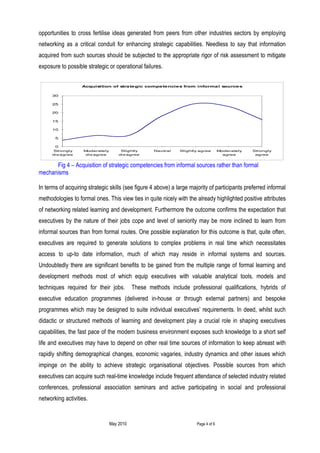
                   Acquisition of stra tegic competencies from informa l source s

      30

      25

      20

      15

      10

       5

       0
      Strongly      Moderately        Slightly      Neutral    Slightly agree        Moderately   Strongly
      dis agree      dis agree       dis agree                                         agree       agree


      Fig 4 – Acquisition of strategic competencies from informal sources rather than formal
mechanisms

In terms of acquiring strategic skills (see figure 4 above) a large majority of participants preferred informal
methodologies to formal ones. This view ties in quite nicely with the already highlighted positive attributes
of networking related learning and development. Furthermore the outcome confirms the expectation that
executives by the nature of their jobs cope and level of seniority may be more inclined to learn from
informal sources than from formal routes. One possible explanation for this outcome is that, quite often,
executives are required to generate solutions to complex problems in real time which necessitates
access to up-to date information, much of which may reside in informal systems and sources.
Undoubtedly there are significant benefits to be gained from the multiple range of formal learning and
development methods most of which equip executives with valuable analytical tools, models and
techniques required for their jobs.         These methods include professional qualifications, hybrids of
executive education programmes (delivered in-house or through external partners) and bespoke
programmes which may be designed to suite individual executives’ requirements. In deed, whilst such
didactic or structured methods of learning and development play a crucial role in shaping executives
capabilities, the fast pace of the modern business environment exposes such knowledge to a short self
life and executives may have to depend on other real time sources of information to keep abreast with
rapidly shifting demographical changes, economic vagaries, industry dynamics and other issues which
impinge on the ability to achieve strategic organisational objectives. Possible sources from which
executives can acquire such real-time knowledge include frequent attendance of selected industry related
conferences, professional association seminars and active participating in social and professional
networking activities.


                                 May 2010                              Page 4 of 6
Alignment of Executive Development to organisational goals & strategic
                                               business direction
          25


          20


          15


          10


           5


           0
           Strongly        Moderately   Slightly disagree   Neutral   Slightly agree    Moderately   Strongly agree
           disagree         disagree                                                      agree

                                 Alignment of Exec Development to organisational goals
                                 Alignment of Exec Development to strategic business needs


Executive development strategies according to the study are becoming more aligned to organisation
goals and business implying that organisations are becoming smarter at designing effective executive
learning and development programmes commensurate with changing executive needs. It must be
cautioned that generalising such a notion could be problematic as the actual details in terms of content,
breadth, and quality consideration of individual organisation’s executive learning development activities.


Support for the view that executive human capital is a critical source of distinctive capability is
widespread and is often underpinned by a number of theories which includes the top echelon and the
resource based view concept. Hence the need for a systematic development and deployment of the
entire executive stock cannot be overemphasised. But most executive learning and development whether
formal or informal requires some level of financial investment and in the face of competing organisational
cost such investments needs to be properly justified.


In response to this, organisations should be exploring smarter approaches to developing their executives
stock by focusing much more on informal learning and development avenues augmented by carefully
selected, structured and defined formal interventions. To this end, organisations may benefit significantly
by undertaking rigorous gap analysis by measuring, monitoring and benchmarking executive learning and
development activities with industry peers.


This will allow specific interventions to be design and implement rather than deploying blanket
development interventions which although meet strategic objects come at exorbitant costs. This “lean”

                                   May 2010                                    Page 5 of 6
approach to executive learning and development could offer organisations a more cost effective
proposition in the current this financial melt down and beyond.


 If you are interested in monitoring and benchmarking your organisation’s
 executive learning & development with other organisations contact the author at
 sakrofi@yahoo.com / +447976367314


                              May 2010                            Page 6 of 6

Executive Learning And Development Review 2010

  • 1.
    Executive learning &development review – Implications for developing executive human capital Solomon Akrofi MBA, PMP, MSP This report presents a refreshing insight into executive learning and development based on a survey of 182 executives from America, Africa, Europe, Middle East, Pacific Region and Asia (above map indicates the geographical locations of respondents). Participants were also drawn from a diverse range of sectors / industries such as the services, aerospace and aviation, financial services, manufacturing, retailing, education, mining and heavy industrials. The table below provides job functions / profiles of participants. Primary Job function of participants No Percent Management (Senior/Corporate) 34 18.7% Human resources management 33 18.1% Sales/Marketing 13 7.1% Consulting 12 6.6% Other 8 4.4% Operations/Logistics 7 3.8% Accounting/Finance/Banking 5 2.7% Education 4 2.2% Science/Technology/Programming 4 2.2% Buying/Purchasing 3 1.6% Planning (Meeting, Events, etc.) 2 1.1% Research 2 1.1% Customer Service 1 0.5% Unspecified 60 33.0% Total Responses: 182 100.0% The deployed survey instrument measured executive learning and development from 6 perspectives (strategic, experiential, networking, self-directed, structured and participative dimensions) reflecting a holistic consideration of the competencies required for the effective discharge the executive. Highlights of the results are briefly discussed with recommendations offered to aid organisational development of executive human capital. May 2010 Page 1 of 6
  • 2.
    Logarithmic scale comparisonof the 6 Executive L & D dimensions 100 10 1 Strongly Moderately Slightly Neutral Slightly agree Moderately Strongly disagree disagree disagree agree agree Experiential Structured Netw orking Participative Self-directed Strategic Fig 1 – Comparison of the 6 executive Learning & development dimensions Figure 1, above depicts a roll-up summary and comparison of the six executive learning and development components. Of the six dimensions, four of these; strategic, networking, experiential and participative were considered highly prevalent by participants amongst executives in their organisations. On the other hand, self-directed and structured learning and development were found to be due to a number of factors. Whilst this outcome remains unclear and falls outside the scope of this study, it is possible to propound some assumptions. It could be that these two components have low priority, underestimated or even considered irrelevance to the discharge of the executive job scope. This may warrant further investigation to unearth the possible causalities. Average Scores for the 6 dimentions of executive L & D 5 4.5 4 3.5 3 2.5 2 1.5 1 0.5 0 Strategic Experiential Netw orking Participative Self -directed Structured May 2010 Page 2 of 6
  • 3.
    Fig 2 –Average scores of the 6 executive learning & development components Alternatively analysis is presented by normalising the results according to average scores which offers a slightly different slant as depicted in figure 2 above. But again, the incidence of strategic, experiential and networking in organisations is quite high whilst participative, self-directed and structure learning and development attract lower support from respondents. It is quite obvious that the ability to craft and implement effective strategies is a key enabler of organisational value creation and therefore the zenith of the executive job scope. It is therefore not surprising that it attracted the highest scores compared to the other dimensions of executive learning and development examined in the study. Furthermore, this could suggest that organisations and for that matter executives are placing a higher premium on developing and maintaining strategic competencies required to deliver business results. Equally well, the higher scores attributed to networking related learning and development is a possible indication that executives are becoming more reliant on networking ties as a means of navigating organisational challenges and problems. In effect interactions that occur amongst internal and external executive peers are becoming a vital source of executive intellectual capital creation. Also, the high incidence of experiential learning and development could suggest higher levels of emotional intelligence which may be important for the effective discharge of executive level duties. External networking input into organisational strategy formulation & Implementation 35 30 25 20 15 10 5 0 Strongly Moderately Slightly Neutral Slightly agree Moderately Strongly disagree dis agree dis agree agree agree Fig 3 – Executive reliance of external networking as a source of shaping organisational strategies Whilst some organisations may not attach significant importance to executive networking activities (internal and external) it has been confirmed through this study that networking is becoming a crucial source of intellectual capital that perhaps influences the whole cycle of strategy formulation and implementation within organisations (See figure 3 above). This outcome highlights the greater need for executives to broaden their wider industry knowledge, develop stronger networking ties and seek May 2010 Page 3 of 6
  • 4.
    opportunities to crossfertilise ideas generated from peers from other industries sectors by employing networking as a critical conduit for enhancing strategic capabilities. Needless to say that information acquired from such sources should be subjected to the appropriate rigor of risk assessment to mitigate exposure to possible strategic or operational failures. Acquisition of stra tegic competencies from informa l source s 30 25 20 15 10 5 0 Strongly Moderately Slightly Neutral Slightly agree Moderately Strongly dis agree dis agree dis agree agree agree Fig 4 – Acquisition of strategic competencies from informal sources rather than formal mechanisms In terms of acquiring strategic skills (see figure 4 above) a large majority of participants preferred informal methodologies to formal ones. This view ties in quite nicely with the already highlighted positive attributes of networking related learning and development. Furthermore the outcome confirms the expectation that executives by the nature of their jobs cope and level of seniority may be more inclined to learn from informal sources than from formal routes. One possible explanation for this outcome is that, quite often, executives are required to generate solutions to complex problems in real time which necessitates access to up-to date information, much of which may reside in informal systems and sources. Undoubtedly there are significant benefits to be gained from the multiple range of formal learning and development methods most of which equip executives with valuable analytical tools, models and techniques required for their jobs. These methods include professional qualifications, hybrids of executive education programmes (delivered in-house or through external partners) and bespoke programmes which may be designed to suite individual executives’ requirements. In deed, whilst such didactic or structured methods of learning and development play a crucial role in shaping executives capabilities, the fast pace of the modern business environment exposes such knowledge to a short self life and executives may have to depend on other real time sources of information to keep abreast with rapidly shifting demographical changes, economic vagaries, industry dynamics and other issues which impinge on the ability to achieve strategic organisational objectives. Possible sources from which executives can acquire such real-time knowledge include frequent attendance of selected industry related conferences, professional association seminars and active participating in social and professional networking activities. May 2010 Page 4 of 6
  • 5.
    Alignment of ExecutiveDevelopment to organisational goals & strategic business direction 25 20 15 10 5 0 Strongly Moderately Slightly disagree Neutral Slightly agree Moderately Strongly agree disagree disagree agree Alignment of Exec Development to organisational goals Alignment of Exec Development to strategic business needs Executive development strategies according to the study are becoming more aligned to organisation goals and business implying that organisations are becoming smarter at designing effective executive learning and development programmes commensurate with changing executive needs. It must be cautioned that generalising such a notion could be problematic as the actual details in terms of content, breadth, and quality consideration of individual organisation’s executive learning development activities. Support for the view that executive human capital is a critical source of distinctive capability is widespread and is often underpinned by a number of theories which includes the top echelon and the resource based view concept. Hence the need for a systematic development and deployment of the entire executive stock cannot be overemphasised. But most executive learning and development whether formal or informal requires some level of financial investment and in the face of competing organisational cost such investments needs to be properly justified. In response to this, organisations should be exploring smarter approaches to developing their executives stock by focusing much more on informal learning and development avenues augmented by carefully selected, structured and defined formal interventions. To this end, organisations may benefit significantly by undertaking rigorous gap analysis by measuring, monitoring and benchmarking executive learning and development activities with industry peers. This will allow specific interventions to be design and implement rather than deploying blanket development interventions which although meet strategic objects come at exorbitant costs. This “lean” May 2010 Page 5 of 6
  • 6.
    approach to executivelearning and development could offer organisations a more cost effective proposition in the current this financial melt down and beyond. If you are interested in monitoring and benchmarking your organisation’s executive learning & development with other organisations contact the author at sakrofi@yahoo.com / +447976367314 May 2010 Page 6 of 6