© BPI2
©BPIgroup
BPI group has established this Executive Employment Trends Report to offer visibility into the current
executive job market. We are committed to quality and results in our outplacement programs, and believe
that keeping a careful eye on trends in the market is an important way to ensure that we are meeting the
needs of our career transition clients. The findings of this report are based on a survey of our executive
clients who began their job search from Q1 2015 through Q2 2016.
The Executive Employment Trends Report includes analysis of the following executive employment trends:
– Average length of the executive job search
– How the length of the job search is impacted by various factors, including:
• Base Salary Level
• Education Level
• Age
We look forward to continuing to share the latest trends in executive employment. If you would like to learn
more about our approach to executive outplacement services, please call +1.800.323.0206.
Executive Employment Trends Report Q3 2016
© BPI3
©BPIgroup
Q3 Reflections on Executive Employment Trends
We pride ourselves on how quickly our executive clients find new positions. It is always rewarding to see our support translate to
results that consistently exceed national averages, industry norms, and most importantly, the expectations of our clients. In this
quarter, our executives spent an average of 4.3 months in the job search, well lower than the national average of 6.3 months
1
.
Length of the job search is important to us because it is important to our clients, but it is certainly not the only factor that counts,
and not how we measure our performance as a firm.
At BPI group, we work to help our clients find the best outcome for them, on a timeline that meets their personal goals and unique
circumstances. Not everyone transitions to a new position within an organization; in fact, 12% of those surveyed this quarter
decided to start their own businesses. Of those executives who started a new job with an organization, 81% reported a
compensation package that met or exceeded their previous position. These results underscore our philosophy on outplacement, as
not only support in finding a new job, but an opportunity to reflect, develop your career strategy, and take the best next step
forward.
EXECUTIVE EMPLOYMENT TRENDS REPORT Q3 2016
Patricia Siderius
Managing Director, Executive Outplacement Services
psiderius@bpi-group.us, +1.630.613-6373
1
Bureau of Labor Statistics, U.S. Department of Labor. “Table A-12. Unemployed persons by
duration of unemployment.” http://www.bls.gov/news.release/empsit.t12.htm
By analyzing and publishing this executive job search data, we gain tremendous insight into our
clients’ experiences in the market, and how we need to adapt to best serve them. While the data
is useful, I admit I am much more moved by the individual stories behind each of those data points,
which simply cannot be captured in a report. From the adventurous executive who moves cross-
country for an exciting new role at a startup, to the seasoned leader stepping out to launch her
own business, each client’s goals and journey are unique – and it is their definition of success to
which we are so passionately committed.
© BPI4
©BPIgroup
About Our Executive Outplacement Clients
EXECUTIVE EMPLOYMENT TRENDS REPORT Q3 2016
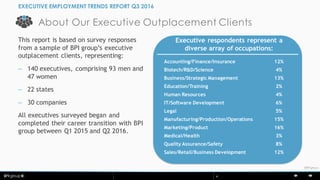
This report is based on survey responses
from a sample of BPI group’s executive
outplacement clients, representing:
– 140 executives, comprising 93 men and
47 women
– 22 states
– 30 companies
All executives surveyed began and
completed their career transition with BPI
group between Q1 2015 and Q2 2016.
Accounting/Finance/Insurance 12%
Biotech/R&D/Science 4%
Business/Strategic Management 13%
Education/Training 2%
Human Resources 4%
IT/Software Development 6%
Legal 5%
Manufacturing/Production/Operations 15%
Marketing/Product 16%
Medical/Health 3%
Quality Assurance/Safety 8%
Sales/Retail/Business Development 12%
Executive respondents represent a
diverse array of occupations:
© BPI5
©BPIgroup
Executive Outplacement Program Outcome
EXECUTIVE EMPLOYMENT TRENDS REPORT Q3 2016
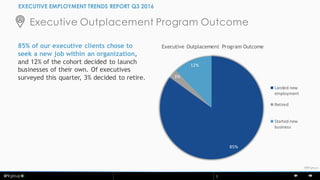
85% of our executive clients chose to
seek a new job within an organization,
and 12% of the cohort decided to launch
businesses of their own. Of executives
surveyed this quarter, 3% decided to retire.
85%
3%
12%
Executive Outplacement Program Outcome
Landed new
employment
Retired
Started new
business
© BPI6
©BPIgroup
Length of Job Search
EXECUTIVE EMPLOYMENT TRENDS REPORT Q3 2016
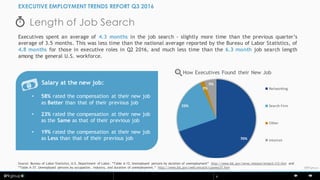
Executives spent an average of 4.3 months in the job search - slightly more time than the previous quarter’s
average of 3.5 months. This was less time than the national average reported by the Bureau of Labor Statistics, of
4.8 months for those in executive roles in Q2 2016, and much less time than the 6.3 month job search length
among the general U.S. workforce.
Salary at the new job:
• 58% rated the compensation at their new job
as Better than that of their previous job
• 23% rated the compensation at their new job
as the Same as that of their previous job
• 19% rated the compensation at their new job
as Less than that of their previous job 70%
23%
2%
5%
How Executives Found their New Job
Networking
Search Firm
Other
Internet
Source: Bureau of Labor Statistics, U.S. Department of Labor. “Table A-12. Unemployed persons by duration of unemployment” http://www.bls.gov/news.release/empsit.t12.htm and
“Table A-37. Unemployed persons by occupation, industry, and duration of unemployment.” http://www.bls.gov/web/empsit/cpseea37.htm
© BPI7
©BPIgroup
Base Salary
EXECUTIVE EMPLOYMENT TRENDS REPORT Q3 2016
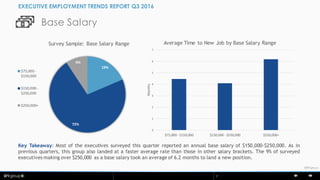
Key Takeaway: Most of the executives surveyed this quarter reported an annual base salary of $150,000-$250,000. As in
previous quarters, this group also landed at a faster average rate than those in other salary brackets. The 9% of surveyed
executives making over $250,000 as a base salary took an average of 6.2 months to land a new position.
19%
72%
9%
Survey Sample: Base Salary Range
$75,000 -
$150,000
$150,000 -
$250,000
$250,000+
0
1
2
3
4
5
6
7
$75,000 - $150,000 $150,000 - $250,000 $250,000+
Months
Average Time to New Job by Base Salary Range
© BPI8
©BPIgroup
Education Level
EXECUTIVE EMPLOYMENT TRENDS REPORT Q3 2016
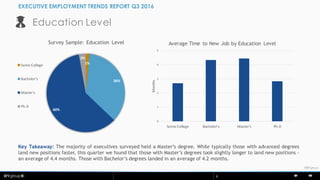
Key Takeaway: The majority of executives surveyed held a Master’s degree. While typically those with advanced degrees
land new positions faster, this quarter we found that those with Master’s degrees took slightly longer to land new positions -
an average of 4.4 months. Those with Bachelor’s degrees landed in an average of 4.2 months.
1%
36%
60%
3%
Survey Sample: Education Level
Some College
Bachelor's
Master's
Ph.D
0
1
2
3
4
5
Some College Bachelor's Master's Ph.D
Months
Average Time to New Job by Education Level
© BPI9
©BPIgroup
Age Group
EXECUTIVE EMPLOYMENT TRENDS REPORT Q3 2016
Key Takeaway: The vast majority of those surveyed were between 41-50 (52%) or 51-60 (41%) years old. These two
demographics landed new positions at roughly the same rate, an average of 4.2 months. Executives between 31 and 40
years of age, representing 6% of the survey sample, took an average of 5.8 months.
6%
52%
41%
1%
Survey Sample: Age Range
31-40
41-50
51-60
61+
0
1
2
3
4
5
6
31-40 41-50 51-60 61+
Months
Average Time to New Job by Age Range
© BPI10
©BPIgroup
About Executive Outplacement Services
EXECUTIVE EMPLOYMENT TRENDS REPORT Q3 2016
BPI group offers a local boutique touch with a global network of resources
to ensure long-term career success for our executive outplacement clients.
In addition to job search coaching, clients may also choose to focus on
entrepreneurial ventures, preparing for retirement, or other work
alternatives.
Each client works with a personal career coach to develop a customized,
winning services plan, helping them to:
• Focus on developing the next step in their career, leveraging assessment
tools and professional consulting to establish short and long-term career
direction.
• Learn how to effectively job search and thrive in the new world of
work.
• Search for the next opportunity, be it a new job, a business acquisition
or start-up, or a part-time career.
• Connect to high-quality job opportunities, through technology, a team
of job developers, social networks, in-person networking events,
personal introductions, and direct placement activities.
• Succeed in their new role, by developing a 90-day onboarding plan.
Interested in learning more?
Call +1.800.323.0206.
My coach provided a sounding board, someone I could vent to,
support, compassion, and most importantly, sound, pragmatic
suggestions and solutions...[my coach] is simply the best.
- Gary, landed as Chief Executive Officer
at an energy service solutions company
A weekly session with my coach was a great shot in the arm, as
he provided me with useful guidance, support, and an
opportunity to laugh while reminding me that I’m on the right
track…I couldn’t be more pleased with the professional and
personal support I received from BPI group. I felt very fortunate
when I compared notes with colleagues of mine who did not work
with BPI group.
- Matthew, landed as Vice President of Marketing
with a manufacturing holding company
© BPI11
©BPIgroup
About BPI group
EXECUTIVE EMPLOYMENT TRENDS REPORT Q3 2016
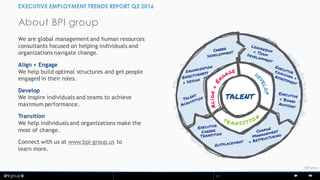
We are global management and human resources
consultants focused on helping individuals and
organizations navigate change.
Align + Engage
We help build optimal structures and get people
engaged in their roles.
Develop
We inspire individuals and teams to achieve
maximum performance.
Transition
We help individuals and organizations make the
most of change.
Connect with us at www.bpi-group.us to
learn more.

Executive Employment Trends Report Q3 2016

  • 2.
    © BPI2 ©BPIgroup BPI grouphas established this Executive Employment Trends Report to offer visibility into the current executive job market. We are committed to quality and results in our outplacement programs, and believe that keeping a careful eye on trends in the market is an important way to ensure that we are meeting the needs of our career transition clients. The findings of this report are based on a survey of our executive clients who began their job search from Q1 2015 through Q2 2016. The Executive Employment Trends Report includes analysis of the following executive employment trends: – Average length of the executive job search – How the length of the job search is impacted by various factors, including: • Base Salary Level • Education Level • Age We look forward to continuing to share the latest trends in executive employment. If you would like to learn more about our approach to executive outplacement services, please call +1.800.323.0206. Executive Employment Trends Report Q3 2016
  • 3.
    © BPI3 ©BPIgroup Q3 Reflectionson Executive Employment Trends We pride ourselves on how quickly our executive clients find new positions. It is always rewarding to see our support translate to results that consistently exceed national averages, industry norms, and most importantly, the expectations of our clients. In this quarter, our executives spent an average of 4.3 months in the job search, well lower than the national average of 6.3 months 1 . Length of the job search is important to us because it is important to our clients, but it is certainly not the only factor that counts, and not how we measure our performance as a firm. At BPI group, we work to help our clients find the best outcome for them, on a timeline that meets their personal goals and unique circumstances. Not everyone transitions to a new position within an organization; in fact, 12% of those surveyed this quarter decided to start their own businesses. Of those executives who started a new job with an organization, 81% reported a compensation package that met or exceeded their previous position. These results underscore our philosophy on outplacement, as not only support in finding a new job, but an opportunity to reflect, develop your career strategy, and take the best next step forward. EXECUTIVE EMPLOYMENT TRENDS REPORT Q3 2016 Patricia Siderius Managing Director, Executive Outplacement Services psiderius@bpi-group.us, +1.630.613-6373 1 Bureau of Labor Statistics, U.S. Department of Labor. “Table A-12. Unemployed persons by duration of unemployment.” http://www.bls.gov/news.release/empsit.t12.htm By analyzing and publishing this executive job search data, we gain tremendous insight into our clients’ experiences in the market, and how we need to adapt to best serve them. While the data is useful, I admit I am much more moved by the individual stories behind each of those data points, which simply cannot be captured in a report. From the adventurous executive who moves cross- country for an exciting new role at a startup, to the seasoned leader stepping out to launch her own business, each client’s goals and journey are unique – and it is their definition of success to which we are so passionately committed.
  • 4.
    © BPI4 ©BPIgroup About OurExecutive Outplacement Clients EXECUTIVE EMPLOYMENT TRENDS REPORT Q3 2016 This report is based on survey responses from a sample of BPI group’s executive outplacement clients, representing: – 140 executives, comprising 93 men and 47 women – 22 states – 30 companies All executives surveyed began and completed their career transition with BPI group between Q1 2015 and Q2 2016. Accounting/Finance/Insurance 12% Biotech/R&D/Science 4% Business/Strategic Management 13% Education/Training 2% Human Resources 4% IT/Software Development 6% Legal 5% Manufacturing/Production/Operations 15% Marketing/Product 16% Medical/Health 3% Quality Assurance/Safety 8% Sales/Retail/Business Development 12% Executive respondents represent a diverse array of occupations:
  • 5.
    © BPI5 ©BPIgroup Executive OutplacementProgram Outcome EXECUTIVE EMPLOYMENT TRENDS REPORT Q3 2016 85% of our executive clients chose to seek a new job within an organization, and 12% of the cohort decided to launch businesses of their own. Of executives surveyed this quarter, 3% decided to retire. 85% 3% 12% Executive Outplacement Program Outcome Landed new employment Retired Started new business
  • 6.
    © BPI6 ©BPIgroup Length ofJob Search EXECUTIVE EMPLOYMENT TRENDS REPORT Q3 2016 Executives spent an average of 4.3 months in the job search - slightly more time than the previous quarter’s average of 3.5 months. This was less time than the national average reported by the Bureau of Labor Statistics, of 4.8 months for those in executive roles in Q2 2016, and much less time than the 6.3 month job search length among the general U.S. workforce. Salary at the new job: • 58% rated the compensation at their new job as Better than that of their previous job • 23% rated the compensation at their new job as the Same as that of their previous job • 19% rated the compensation at their new job as Less than that of their previous job 70% 23% 2% 5% How Executives Found their New Job Networking Search Firm Other Internet Source: Bureau of Labor Statistics, U.S. Department of Labor. “Table A-12. Unemployed persons by duration of unemployment” http://www.bls.gov/news.release/empsit.t12.htm and “Table A-37. Unemployed persons by occupation, industry, and duration of unemployment.” http://www.bls.gov/web/empsit/cpseea37.htm
  • 7.
    © BPI7 ©BPIgroup Base Salary EXECUTIVEEMPLOYMENT TRENDS REPORT Q3 2016 Key Takeaway: Most of the executives surveyed this quarter reported an annual base salary of $150,000-$250,000. As in previous quarters, this group also landed at a faster average rate than those in other salary brackets. The 9% of surveyed executives making over $250,000 as a base salary took an average of 6.2 months to land a new position. 19% 72% 9% Survey Sample: Base Salary Range $75,000 - $150,000 $150,000 - $250,000 $250,000+ 0 1 2 3 4 5 6 7 $75,000 - $150,000 $150,000 - $250,000 $250,000+ Months Average Time to New Job by Base Salary Range
  • 8.
    © BPI8 ©BPIgroup Education Level EXECUTIVEEMPLOYMENT TRENDS REPORT Q3 2016 Key Takeaway: The majority of executives surveyed held a Master’s degree. While typically those with advanced degrees land new positions faster, this quarter we found that those with Master’s degrees took slightly longer to land new positions - an average of 4.4 months. Those with Bachelor’s degrees landed in an average of 4.2 months. 1% 36% 60% 3% Survey Sample: Education Level Some College Bachelor's Master's Ph.D 0 1 2 3 4 5 Some College Bachelor's Master's Ph.D Months Average Time to New Job by Education Level
  • 9.
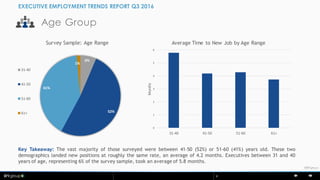
    © BPI9 ©BPIgroup Age Group EXECUTIVEEMPLOYMENT TRENDS REPORT Q3 2016 Key Takeaway: The vast majority of those surveyed were between 41-50 (52%) or 51-60 (41%) years old. These two demographics landed new positions at roughly the same rate, an average of 4.2 months. Executives between 31 and 40 years of age, representing 6% of the survey sample, took an average of 5.8 months. 6% 52% 41% 1% Survey Sample: Age Range 31-40 41-50 51-60 61+ 0 1 2 3 4 5 6 31-40 41-50 51-60 61+ Months Average Time to New Job by Age Range
  • 10.
    © BPI10 ©BPIgroup About ExecutiveOutplacement Services EXECUTIVE EMPLOYMENT TRENDS REPORT Q3 2016 BPI group offers a local boutique touch with a global network of resources to ensure long-term career success for our executive outplacement clients. In addition to job search coaching, clients may also choose to focus on entrepreneurial ventures, preparing for retirement, or other work alternatives. Each client works with a personal career coach to develop a customized, winning services plan, helping them to: • Focus on developing the next step in their career, leveraging assessment tools and professional consulting to establish short and long-term career direction. • Learn how to effectively job search and thrive in the new world of work. • Search for the next opportunity, be it a new job, a business acquisition or start-up, or a part-time career. • Connect to high-quality job opportunities, through technology, a team of job developers, social networks, in-person networking events, personal introductions, and direct placement activities. • Succeed in their new role, by developing a 90-day onboarding plan. Interested in learning more? Call +1.800.323.0206. My coach provided a sounding board, someone I could vent to, support, compassion, and most importantly, sound, pragmatic suggestions and solutions...[my coach] is simply the best. - Gary, landed as Chief Executive Officer at an energy service solutions company A weekly session with my coach was a great shot in the arm, as he provided me with useful guidance, support, and an opportunity to laugh while reminding me that I’m on the right track…I couldn’t be more pleased with the professional and personal support I received from BPI group. I felt very fortunate when I compared notes with colleagues of mine who did not work with BPI group. - Matthew, landed as Vice President of Marketing with a manufacturing holding company
  • 11.
    © BPI11 ©BPIgroup About BPIgroup EXECUTIVE EMPLOYMENT TRENDS REPORT Q3 2016 We are global management and human resources consultants focused on helping individuals and organizations navigate change. Align + Engage We help build optimal structures and get people engaged in their roles. Develop We inspire individuals and teams to achieve maximum performance. Transition We help individuals and organizations make the most of change. Connect with us at www.bpi-group.us to learn more.

Editor's Notes

  • #4 Executive clients surveyed for our Q2 2016 report spent an average of 3.5 months in the job search, a much faster rate than the national average. According to the Bureau of Labor Statistics’ March 2016 jobs report, those in “management, professional, and related occupations” took an average of 7.4 months to land a new position.1 The executives surveyed for this report were special in a few respects. With nearly 70% at 50 years old or younger, the group was uncharacteristically young relative to previous reports. Moreover, many of these younger executives were highly educated, high-potential employees who had benefited from ongoing internal training and mentoring at their previous organizations. As a result, they were well-positioned for a successful, relatively short job search. 80% of executives surveyed accepted jobs offering compensation equal to or greater than that of their previous positions. Credit must also be given to the talented career coaches who partner with our executives to support them in both the short and long-term. Our proprietary Listen to the MarketSM strategy helps each job seeker determine how her skills, background, and career aspirations situate in the market, empowering her to effectively promote herself with a clear grasp of her unique value proposition. These more intangible benefits of our services are difficult to quantify in a report — but the results are clear. We believe that a successful transition is not merely one that yields a new job in an acceptable period of time, but one in which each person gains a renewed sense of self and purpose in an ever-changing employment landscape.
  • #6 In Q4 of 2015, 100% of our executive clients chose to seek a new job within an organization, whether on a full-time (83%) or contract (17%) basis. Of note, none of the executives surveyed decided to start their own business in Q4. The proportion of those starting a business has roughly halved each quarter this year, from 17% in Q1, to 9% in Q2, to 4% in Q3. None of the executives surveyed chose to retire in 2015, a marked difference from 2014, when the rate of retirement ranged from 2% to 9% each quarter.
  • #7 Q1 2016: 3.5 Q4 2015 5.6 months Q3 2015 5.2 months
  • #8 From Q2: Key Takeaway: The vast majority of those surveyed this quarter fell into the $150,000-$250,000 base salary range, and this group tended to land new jobs at the fastest rate: an average of 3.4 months. The 8% of those making over $250,000 as a base salary took the most time to land, an average of 5 months. Key Takeaway: Executives in the $150,000-$250,000 base salary range and those making over $250,000 landed new positions at comparable rates of 5.5 and 5.4 months, respectively. The 15% of the sample in the $75,000-$150,000 base salary range landed in an average of 6.4 months.
  • #9 Key Takeaway Q2 2016: 66% of executives surveyed this quarter held a Master’s degree or Ph.D. While we normally observe an inverse relationship between level of education and time to new job, this quarter’s survey results upended that expectation. The 33% of those surveyed with a Bachelor’s degree landed in an average of 3.1 months, while those with a Master’s degree had an average landing rate of 3.7 months — not a dramatic increase, yet unusual nevertheless. Key Takeaway: The education level of executives surveyed this quarter were almost evenly split between those with Bachelor’s and Master’s degrees. These two groups landed new positions at similar rates: an average of 5.6 months for those with Bachelor’s degrees, and an average of 5.3 months for those with a Master’s. We normally observe shorter average landing times for those with advanced degrees compared to those with a Bachelor’s degree or less.
  • #10 Q2 takeaway: The majority of executives surveyed were between the ages of 41 and 50, landing new positions in an average of 3.2 months. Those aged 51-60 — 30% of the cohort — took slightly more time to land, at an average of 4.6 months. ____ Executives between the ages of 51 and 60 - half of those surveyed - reported an average job search length of 5.4 months. Those in the 31-40 age group landed more quickly, in an average of 4.6 months, while the small minority of those 61 and over took the greatest time to land a new position.