Lecture 5
Exclusive Economic Zone
(EEZ)
S M Masum Billah (PhD, Wellington)
Professor of Law
Jagannath University
Introduction
1. UNCLOS III: Invention or nurture of the concept of EEZ.
2. 21 Articles (from Article 55 to 75).
3. EEZ discussion occupied much of time of UNCLOS, although the concept itself found ready approval.
4. RW Smith: EEZ has revolutionized the law of the sea.
5. The ICJ in the Continental Shelf (Tunisia-Libya) Case, ICJ 1982: EEZ is a settled part of international law.
6. The ICJ, in the Libya/Malta case of 1985: ‘[T]he institution of the exclusive economic zone, with its rule on
entitlement by reason of distance, is shown by the practice of States to have become a part of customary
law’.
7. The EEZ is a multi-purpose artificial zone having sui-generis status subject to specific legal regime established by
the convention.
8. Chile and Peru (1947), Kenya (1972), Bangladesh (1974).
Purpose of the Lecture
1. What is Exclusive Economic Zone (EEZ)? What is it’s breadth?
2. What are the rights, jurisdiction and duties of the coastal state in EEZ?
3. What are the resources of EEZ?
4. How EEZ boundary is delimited?
5. Rights and duties of other states in EEZ.
6. Criticism/Evaluation of EEZ.
•
What is EEZ?
The EEZ is an area beyond and adjacent to the territorial sea,
subject to the specific legal regime established by the
convention, under which the rights and jurisdiction of the coastal
state and the rights and freedom of other states are governed by
the relevant provision of LOS Convention (Article 55).
Rights, Jurisdiction and Duties of Coastal State in EEZ
• Rights: In the EEZ, the coastal state has
– Sovereign rights for the purpose of exploring and exploiting, conserving and
managing the natural resources, whether living or non-living, of the waters
superjacent to the sea bed and of the sea bed and subsoil, and with regard to
other activities for the economic exploitation and exploration of the zone, such
as the production of energy from the water, currents and winds. (Art: 56)
– Exclusive right to construct and to authorize and regulate the construction and
use of (a) artificial islands (b) Installations and structures for the purpose of
exercising its allowable rights and economic purposes as well.
– Coastal state shall have jurisdiction over such artificial islands, installations
and structures, including jurisdiction with regard to customs, fiscal, health,
safety and immigration, laws and regulations.
Contd.
I. establishment and use of artificial islands, installations and
structures
II. Marine scientific research
III. The protection and preservation of the marine environment.
•Coastal state can take necessary measure for compliance of its
laws.
• i.e. arrest, detain, penalties, judicial proceedings etc [Art 73
(1)].
Duties of Coastal State in EEZ (Art 56)
• Coastal state shall have due regard to the rights and duties of other sates:
•
• It shall act in a manner compatible with the provision of the LOS Convention
• It shall determine the allowable catch of the living resources in the EEZ.
•
• Taking into account the best scientific evidence available to it, the coastal state shall ensure through
proper conservation and management that the living resources of the EEZ are not endangered by
over exploitation.
• The coastal state shall promote the objective of optimum utilization of the living resources in the
EEZ.
• Coastal state shall give due notice of conservation and management of laws and regulations.
Breadth of EEZ (Art 57)
• The EEZ shall not extend beyond 200 n.m. from the base lines from
which the breadth of the territorial sea is measured.
• Where two opposite states has sea are equal to 400 or more then this
statement is true.
• But if it is less than 200 n.m., then question of delimitation of EEZ
becomes imperative by negotiation.
Rights and Duties of Other States in the EEZ
1. Freedom of navigation and over flight.
2. Laying submarine cables and pipelines.
3. Other internationally lawful uses of the sea i.e. operation of ships, air
craft and submarine cables and pipelines.
4. States shall have due regard to the rights and duties of the coastal
state and shall comply with the laws and regulations of that state.
Resolving EEZ Disputes (Art 59)
• If a conflict arises between interests of Coastal State and other
state/s and the UNCLOS is silent about the attributes of the states,
that conflict should be resolved on the basis of equity and in light of
all the relevant circumstances, taking into account the respective
importance of the interests involved to the parties as well as to the
international community as a whole.
Case Example:
• 1999 M/V Saiga (No. 2) case between Saint Vincent and the Grenadines and
Guinea:
• Whether or not Guinea was entitled to apply its customs law in its EEZ.
• ITLOS held: Whilst the CS has jurisdiction to apply customs laws and regulations in
respect of artificial islands, installations and structures in the EEZ pursuant to
Article 60(2) of the LOSC, the Convention does not empower CS to apply its
customs laws in respect of any other parts of the EEZ not mentioned in that
provision.
Resources of EEZ
• Resources of EEZ are mainly of two categories: living and non-living.
1. Fish, shrimps, all other marine animals
2. Highly migratory species
3. Marine mammals
4. Anadromous stocks
5. Catadromous species
6. Sedentary species etc.
7. Fishery, Mari culture, sea weeds, chemicals, minerals, polly-mettalic nodule, manganese nodule,
Power, Energy, Phytoplankton, zooplankton
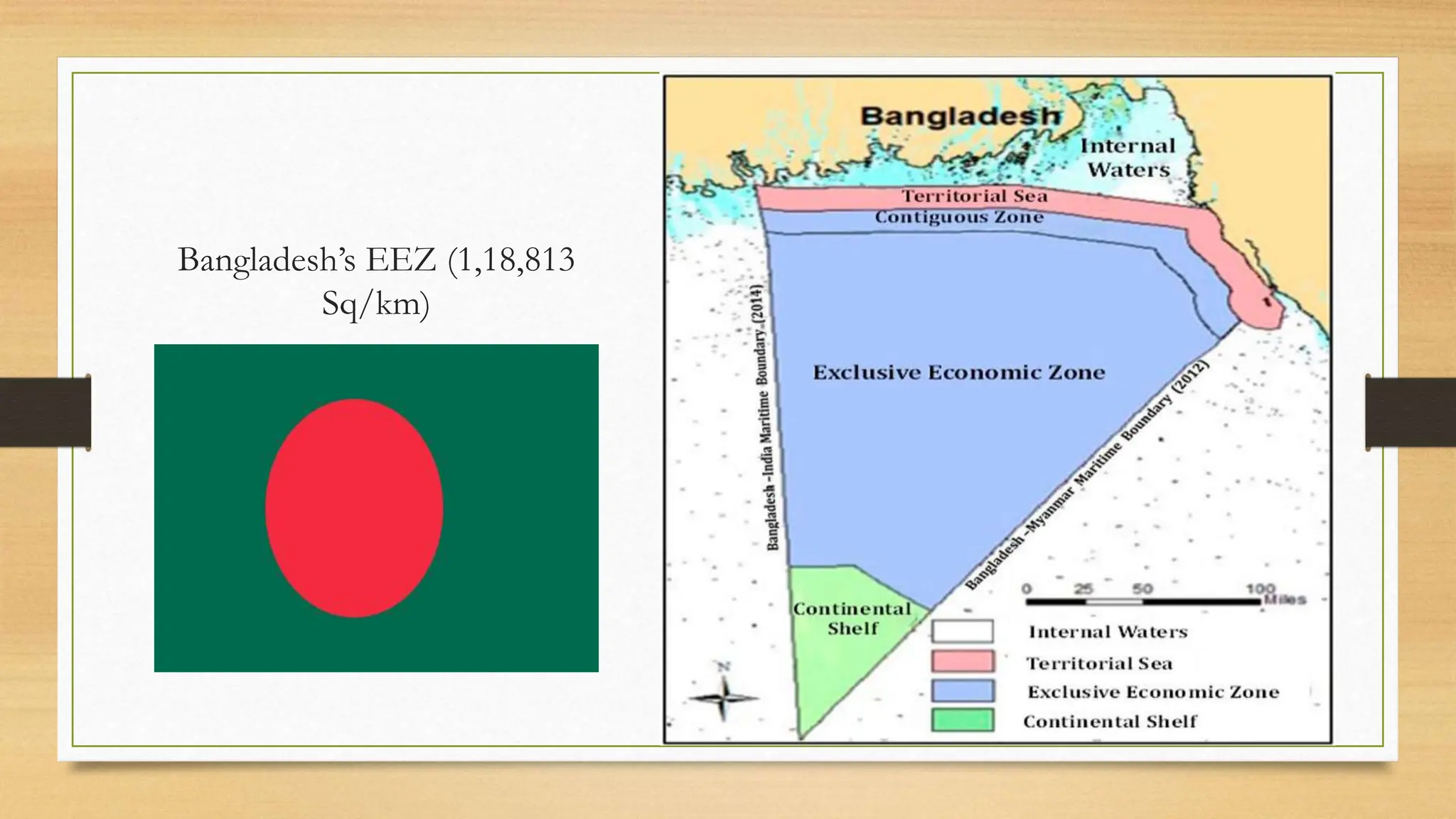
Bangladesh’s EEZ (1,18,813
Sq/km)
EEZ Resources
Delimitation of EEZ (Art 74)
• The delimitation of EEZ between states with opposite or adjacent coasts shall be effected
by agreement on the basis of international law in order to achieve an equitable solution.
• Where there is an agreement, all questions relating to delimitation shall be settled as per the
provisions of such agreement.
•
• If no agreement can be reached within a reasonable period of time, the states concerned
shall resort to settlement of dispute provisions.
• However, transitional arrangements of practical nature should be adopted by the states in a
spirit of understanding and co-operation unless a final agreement is reached.
•
Resolved Disputes
• 1. The Cod Wars between the United Kingdom and Iceland occurred periodically over many decades, until they were resolved with
a final agreement in 1976.
• 2. In 1992, the Canada–France Maritime Boundary Case, which centred on the EEZ around the French islands of Saint Pierre and
Miquelon, was decided by an arbitral tribunal which concurred on the whole with the arguments put forth by Canada. France was
awarded 18% of the area it had originally claimed.
• 3. In 1999, following the Hanish Islands conflict, the Permanent Court of Arbitration ruled that the EEZs of Yemen and Eritrea
should be demarcated equidistantly between the mainlands of the two nations, without taking account of sovereignty over the
islands.
• 3. In 2009, in a dispute between Romania and Ukraine over Snake Island, the UN International Court of Justice decided that
Snake Island has no EEZ beyond 12 nautical miles of its own land.
• 4. In 2010 the Norway and Russia dispute of both territorial sea and EEZ with regard to the Svalbard archipelago as it affects
Russia's EEZ due to its unique treaty status was resolved. A treaty was agreed in principle in April 2010 between the two states and
subsequently officially ratified, resolving this demarcation dispute.
• 5. In 2014, the Netherlands and Germany resolved an old border dispute regarding the exact location of the border in
the Dollart Bay.
The Case Concerning Maritime
Delimitation in the Black Sea (Romania v
Ukraine) [2009]
The ICJ found that Snake Island did not form part of
Ukraine's coastal configuration, explaining that “to
count [Snake] Island as a relevant part of the coast
would amount to grafting an extraneous element onto
Ukraine's coastline; the consequence would be a
judicial refashioning of Geography”.
For fact: https://en.wikipedia.org/wiki/Maritime_Delimitation_in_the_Black_Sea_case
A Critical View
• It is said that the 200-mile EEZ amounts to some 35–36 per cent of the
oceans as a whole. Seven leading beneficiaries of the EEZ are: the USA,
France, Indonesia, New Zealand, Australia, Russia and Japan. 16 It is ironic
that leading EEZ beneficiaries are essentially the developed States.
A Critical View
• Regime of EEZ can not assure rights of other states in the exploitation of living
resources. Other states can not be sure of overcoming coastal sates unscrupulous
attempt unless a portion of the ‘allowable catch’ is reserved for them.
• EEZ becomes only applicable to living resources at the presence of CS.
• 200 Nautical Mile encloses a significant portion of the global ocean. It may turn
into a paraphrase of mare clausum regime. Actually, a state that is technologically and
scientifically developed will be more and more benefited from 200 n.m. EEZ. So, it
is apprehended that the new emerging law of the sea will only make the rich richer,
and the poor poorer.
•
Thank you

Exclusive Economic Zone and Sustainable Ocean.pptx

  • 1.
    Lecture 5 Exclusive EconomicZone (EEZ) S M Masum Billah (PhD, Wellington) Professor of Law Jagannath University
  • 2.
    Introduction 1. UNCLOS III:Invention or nurture of the concept of EEZ. 2. 21 Articles (from Article 55 to 75). 3. EEZ discussion occupied much of time of UNCLOS, although the concept itself found ready approval. 4. RW Smith: EEZ has revolutionized the law of the sea. 5. The ICJ in the Continental Shelf (Tunisia-Libya) Case, ICJ 1982: EEZ is a settled part of international law. 6. The ICJ, in the Libya/Malta case of 1985: ‘[T]he institution of the exclusive economic zone, with its rule on entitlement by reason of distance, is shown by the practice of States to have become a part of customary law’. 7. The EEZ is a multi-purpose artificial zone having sui-generis status subject to specific legal regime established by the convention. 8. Chile and Peru (1947), Kenya (1972), Bangladesh (1974).
  • 3.
    Purpose of theLecture 1. What is Exclusive Economic Zone (EEZ)? What is it’s breadth? 2. What are the rights, jurisdiction and duties of the coastal state in EEZ? 3. What are the resources of EEZ? 4. How EEZ boundary is delimited? 5. Rights and duties of other states in EEZ. 6. Criticism/Evaluation of EEZ. •
  • 4.
    What is EEZ? TheEEZ is an area beyond and adjacent to the territorial sea, subject to the specific legal regime established by the convention, under which the rights and jurisdiction of the coastal state and the rights and freedom of other states are governed by the relevant provision of LOS Convention (Article 55).
  • 5.
    Rights, Jurisdiction andDuties of Coastal State in EEZ • Rights: In the EEZ, the coastal state has – Sovereign rights for the purpose of exploring and exploiting, conserving and managing the natural resources, whether living or non-living, of the waters superjacent to the sea bed and of the sea bed and subsoil, and with regard to other activities for the economic exploitation and exploration of the zone, such as the production of energy from the water, currents and winds. (Art: 56) – Exclusive right to construct and to authorize and regulate the construction and use of (a) artificial islands (b) Installations and structures for the purpose of exercising its allowable rights and economic purposes as well. – Coastal state shall have jurisdiction over such artificial islands, installations and structures, including jurisdiction with regard to customs, fiscal, health, safety and immigration, laws and regulations.
  • 6.
    Contd. I. establishment anduse of artificial islands, installations and structures II. Marine scientific research III. The protection and preservation of the marine environment. •Coastal state can take necessary measure for compliance of its laws. • i.e. arrest, detain, penalties, judicial proceedings etc [Art 73 (1)].
  • 7.
    Duties of CoastalState in EEZ (Art 56) • Coastal state shall have due regard to the rights and duties of other sates: • • It shall act in a manner compatible with the provision of the LOS Convention • It shall determine the allowable catch of the living resources in the EEZ. • • Taking into account the best scientific evidence available to it, the coastal state shall ensure through proper conservation and management that the living resources of the EEZ are not endangered by over exploitation. • The coastal state shall promote the objective of optimum utilization of the living resources in the EEZ. • Coastal state shall give due notice of conservation and management of laws and regulations.
  • 8.
    Breadth of EEZ(Art 57) • The EEZ shall not extend beyond 200 n.m. from the base lines from which the breadth of the territorial sea is measured. • Where two opposite states has sea are equal to 400 or more then this statement is true. • But if it is less than 200 n.m., then question of delimitation of EEZ becomes imperative by negotiation.
  • 9.
    Rights and Dutiesof Other States in the EEZ 1. Freedom of navigation and over flight. 2. Laying submarine cables and pipelines. 3. Other internationally lawful uses of the sea i.e. operation of ships, air craft and submarine cables and pipelines. 4. States shall have due regard to the rights and duties of the coastal state and shall comply with the laws and regulations of that state.
  • 10.
    Resolving EEZ Disputes(Art 59) • If a conflict arises between interests of Coastal State and other state/s and the UNCLOS is silent about the attributes of the states, that conflict should be resolved on the basis of equity and in light of all the relevant circumstances, taking into account the respective importance of the interests involved to the parties as well as to the international community as a whole.
  • 11.
    Case Example: • 1999M/V Saiga (No. 2) case between Saint Vincent and the Grenadines and Guinea: • Whether or not Guinea was entitled to apply its customs law in its EEZ. • ITLOS held: Whilst the CS has jurisdiction to apply customs laws and regulations in respect of artificial islands, installations and structures in the EEZ pursuant to Article 60(2) of the LOSC, the Convention does not empower CS to apply its customs laws in respect of any other parts of the EEZ not mentioned in that provision.
  • 12.
    Resources of EEZ •Resources of EEZ are mainly of two categories: living and non-living. 1. Fish, shrimps, all other marine animals 2. Highly migratory species 3. Marine mammals 4. Anadromous stocks 5. Catadromous species 6. Sedentary species etc. 7. Fishery, Mari culture, sea weeds, chemicals, minerals, polly-mettalic nodule, manganese nodule, Power, Energy, Phytoplankton, zooplankton
  • 13.
  • 15.
  • 16.
    Delimitation of EEZ(Art 74) • The delimitation of EEZ between states with opposite or adjacent coasts shall be effected by agreement on the basis of international law in order to achieve an equitable solution. • Where there is an agreement, all questions relating to delimitation shall be settled as per the provisions of such agreement. • • If no agreement can be reached within a reasonable period of time, the states concerned shall resort to settlement of dispute provisions. • However, transitional arrangements of practical nature should be adopted by the states in a spirit of understanding and co-operation unless a final agreement is reached. •
  • 17.
    Resolved Disputes • 1.The Cod Wars between the United Kingdom and Iceland occurred periodically over many decades, until they were resolved with a final agreement in 1976. • 2. In 1992, the Canada–France Maritime Boundary Case, which centred on the EEZ around the French islands of Saint Pierre and Miquelon, was decided by an arbitral tribunal which concurred on the whole with the arguments put forth by Canada. France was awarded 18% of the area it had originally claimed. • 3. In 1999, following the Hanish Islands conflict, the Permanent Court of Arbitration ruled that the EEZs of Yemen and Eritrea should be demarcated equidistantly between the mainlands of the two nations, without taking account of sovereignty over the islands. • 3. In 2009, in a dispute between Romania and Ukraine over Snake Island, the UN International Court of Justice decided that Snake Island has no EEZ beyond 12 nautical miles of its own land. • 4. In 2010 the Norway and Russia dispute of both territorial sea and EEZ with regard to the Svalbard archipelago as it affects Russia's EEZ due to its unique treaty status was resolved. A treaty was agreed in principle in April 2010 between the two states and subsequently officially ratified, resolving this demarcation dispute. • 5. In 2014, the Netherlands and Germany resolved an old border dispute regarding the exact location of the border in the Dollart Bay.
  • 18.
    The Case ConcerningMaritime Delimitation in the Black Sea (Romania v Ukraine) [2009] The ICJ found that Snake Island did not form part of Ukraine's coastal configuration, explaining that “to count [Snake] Island as a relevant part of the coast would amount to grafting an extraneous element onto Ukraine's coastline; the consequence would be a judicial refashioning of Geography”. For fact: https://en.wikipedia.org/wiki/Maritime_Delimitation_in_the_Black_Sea_case
  • 19.
    A Critical View •It is said that the 200-mile EEZ amounts to some 35–36 per cent of the oceans as a whole. Seven leading beneficiaries of the EEZ are: the USA, France, Indonesia, New Zealand, Australia, Russia and Japan. 16 It is ironic that leading EEZ beneficiaries are essentially the developed States.
  • 20.
    A Critical View •Regime of EEZ can not assure rights of other states in the exploitation of living resources. Other states can not be sure of overcoming coastal sates unscrupulous attempt unless a portion of the ‘allowable catch’ is reserved for them. • EEZ becomes only applicable to living resources at the presence of CS. • 200 Nautical Mile encloses a significant portion of the global ocean. It may turn into a paraphrase of mare clausum regime. Actually, a state that is technologically and scientifically developed will be more and more benefited from 200 n.m. EEZ. So, it is apprehended that the new emerging law of the sea will only make the rich richer, and the poor poorer. •
  • 21.