1| P a g e
The Maritime Zones in UNCLOS
Prepared by Dr. Zeyad Jaffal
Associate professor of Public international law
Al Ain University, UAE
Nov.2019
The Zone Breadth Legal regime
Internal waters Waters on the landward side of the baseline of the
territorial sea.
Coastal state has full sovereignty
over this area.
Territorial Sea Every State has the right to establish the breadth of its
territorial sea up to a limit not exceeding 12 nautical miles,
measured from baselines.
Sovereignty extends to the air
space, water column, seabed and
subsoil allowing for the right of
innocent passage.
The innocent passage is the right to
pass through the territorial sea, but
not internal waters, for the purpose
of entering port or merely passing in
a continuous and expeditious
manner. Such passage is only
innocent provided it is not
prejudicial to the peace, good order
or security of the coastal state.
Transit passage is a concept of
the Law of the Sea, which allows
a vessel or aircraft the freedom of
navigation or overflight solely for
the purpose of continuous and
expeditious transit of a strait
between one part of the
high seas or exclusive economic
zone and another.
Passage of a foreign ship shall be
considered to be prejudicial to the
peace, good order or security of the
coastal State if in the territorial sea
it engages in any of the following
activities:
(a) any threat or use of
force against the
sovereignty, territorial
integrity or political
independence of the
coastal State, or in any
other manner in
violation of the
principles of
international law
embodied in the
Charter of the United
Nations;
2| P a g e
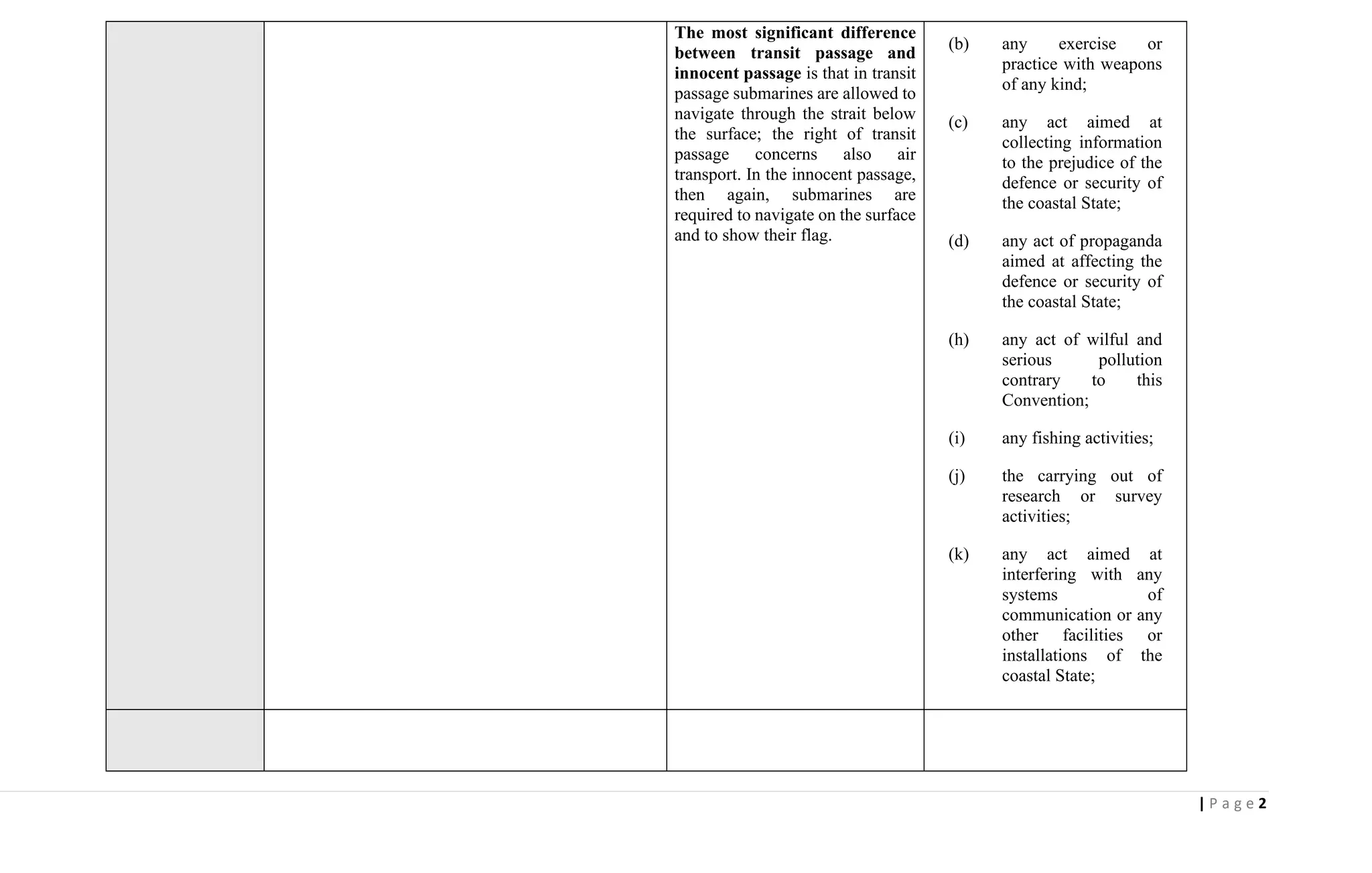
The most significant difference
between transit passage and
innocent passage is that in transit
passage submarines are allowed to
navigate through the strait below
the surface; the right of transit
passage concerns also air
transport. In the innocent passage,
then again, submarines are
required to navigate on the surface
and to show their flag.
(b) any exercise or
practice with weapons
of any kind;
(c) any act aimed at
collecting information
to the prejudice of the
defence or security of
the coastal State;
(d) any act of propaganda
aimed at affecting the
defence or security of
the coastal State;
(h) any act of wilful and
serious pollution
contrary to this
Convention;
(i) any fishing activities;
(j) the carrying out of
research or survey
activities;
(k) any act aimed at
interfering with any
systems of
communication or any
other facilities or
installations of the
coastal State;
3| P a g e
Ccontiguous zone It is a zone contiguous to the territorial waters of the
Coastal state.
The contiguous zone may not extend beyond 24
nautical miles from the baselines from which the
breadth of the territorial sea is measured.
The coastal State may exercise the
control necessary to:
(a) prevent infringement
of its customs, fiscal,
immigration or
sanitary laws and
regulations within its
territory or territorial
sea;
(b) punish infringement
of the above laws and
regulations
committed within its
territory or territorial
sea.
It is a limited
enforcement zone
which makes it a "hot
pursuit area".
The hot pursuit of a
foreign ship may be
undertaken in the high
seas when the
competent authorities
of the coastal State
have good reason to
believe that the ship
has violated the laws
and regulations of that
State.
Exclusive
Economic zone
(EEZ)
The exclusive economic zone is an area beyond and
adjacent to the territorial sea
It shall not extend beyond 200 nautical miles from the
baselines from which the breadth of the territorial sea is
measured.
In the exclusive economic zone,
the coastal State has:
(a) sovereign rights for the
purpose of exploring and
In the exclusive economic zone, all
States, whether coastal or land-
locked, enjoy the freedoms of
navigation and overflight and of
the laying of submarine cables and
4| P a g e
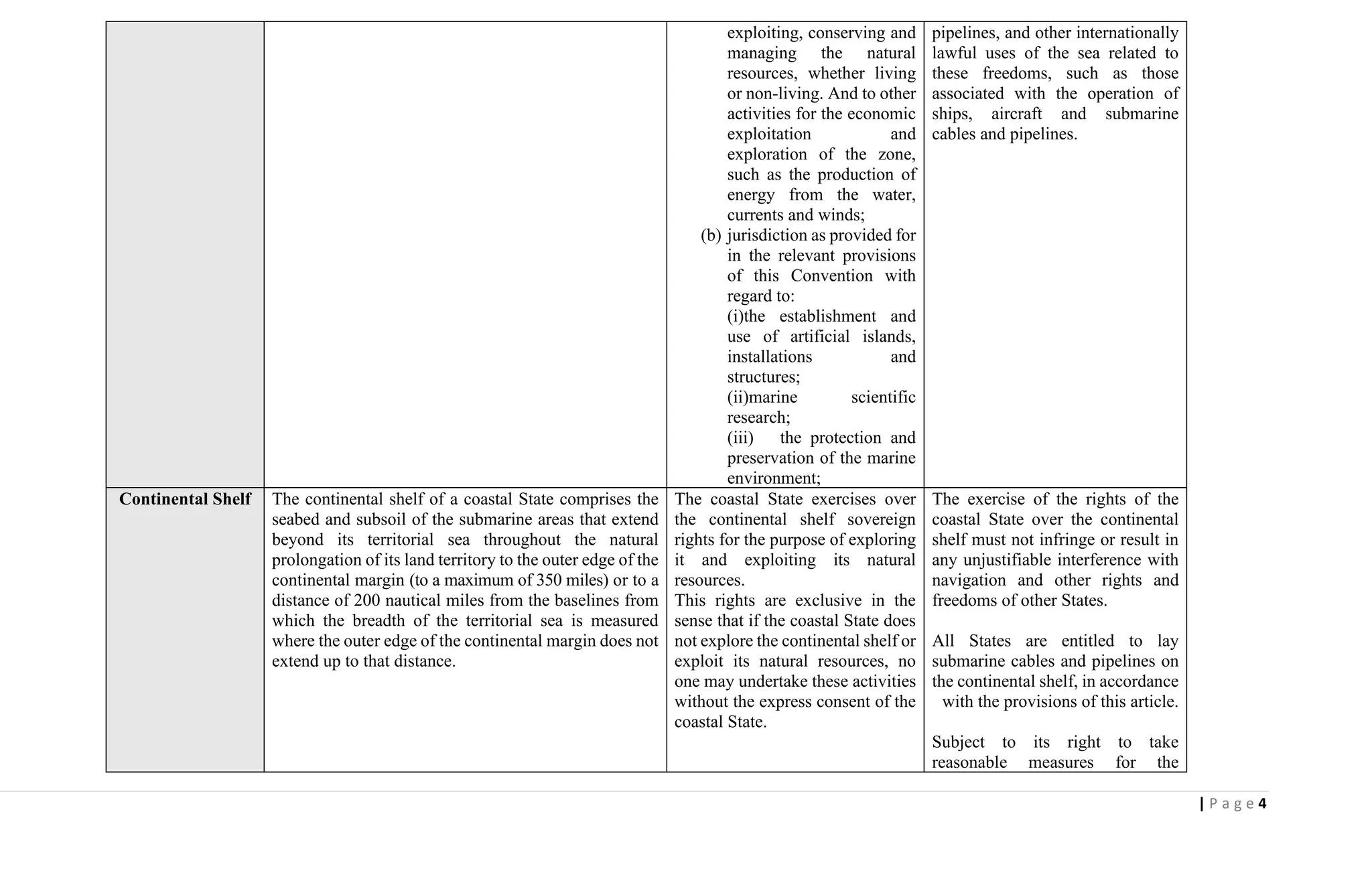
exploiting, conserving and
managing the natural
resources, whether living
or non-living. And to other
activities for the economic
exploitation and
exploration of the zone,
such as the production of
energy from the water,
currents and winds;
(b) jurisdiction as provided for
in the relevant provisions
of this Convention with
regard to:
(i)the establishment and
use of artificial islands,
installations and
structures;
(ii)marine scientific
research;
(iii) the protection and
preservation of the marine
environment;
pipelines, and other internationally
lawful uses of the sea related to
these freedoms, such as those
associated with the operation of
ships, aircraft and submarine
cables and pipelines.
Continental Shelf The continental shelf of a coastal State comprises the
seabed and subsoil of the submarine areas that extend
beyond its territorial sea throughout the natural
prolongation of its land territory to the outer edge of the
continental margin (to a maximum of 350 miles) or to a
distance of 200 nautical miles from the baselines from
which the breadth of the territorial sea is measured
where the outer edge of the continental margin does not
extend up to that distance.
The coastal State exercises over
the continental shelf sovereign
rights for the purpose of exploring
it and exploiting its natural
resources.
This rights are exclusive in the
sense that if the coastal State does
not explore the continental shelf or
exploit its natural resources, no
one may undertake these activities
without the express consent of the
coastal State.
The exercise of the rights of the
coastal State over the continental
shelf must not infringe or result in
any unjustifiable interference with
navigation and other rights and
freedoms of other States.
All States are entitled to lay
submarine cables and pipelines on
the continental shelf, in accordance
with the provisions of this article.
Subject to its right to take
reasonable measures for the
5| P a g e
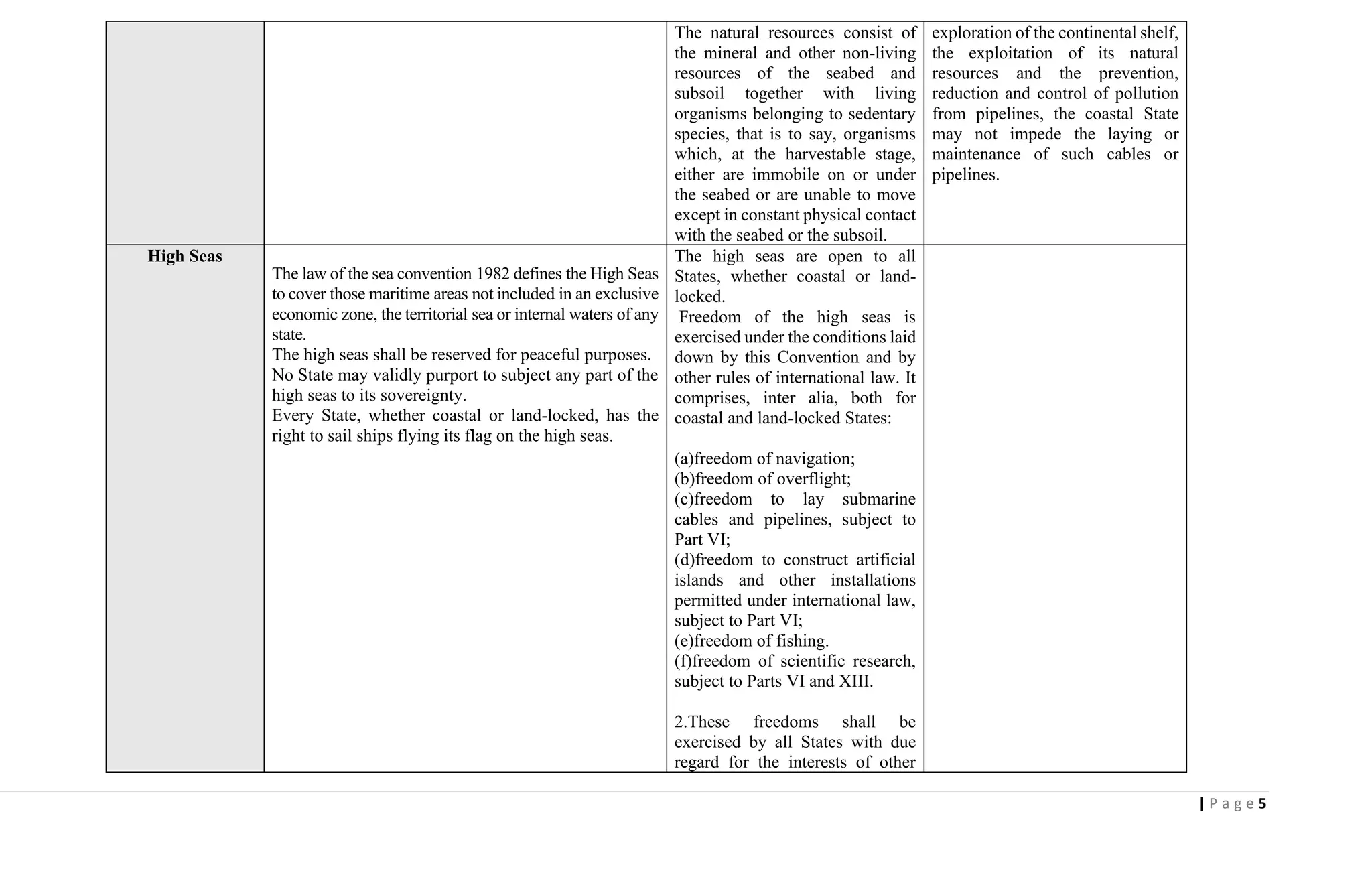
The natural resources consist of
the mineral and other non-living
resources of the seabed and
subsoil together with living
organisms belonging to sedentary
species, that is to say, organisms
which, at the harvestable stage,
either are immobile on or under
the seabed or are unable to move
except in constant physical contact
with the seabed or the subsoil.
exploration of the continental shelf,
the exploitation of its natural
resources and the prevention,
reduction and control of pollution
from pipelines, the coastal State
may not impede the laying or
maintenance of such cables or
pipelines.
High Seas
The law of the sea convention 1982 defines the High Seas
to cover those maritime areas not included in an exclusive
economic zone, the territorial sea or internal waters of any
state.
The high seas shall be reserved for peaceful purposes.
No State may validly purport to subject any part of the
high seas to its sovereignty.
Every State, whether coastal or land-locked, has the
right to sail ships flying its flag on the high seas.
The high seas are open to all
States, whether coastal or land-
locked.
Freedom of the high seas is
exercised under the conditions laid
down by this Convention and by
other rules of international law. It
comprises, inter alia, both for
coastal and land-locked States:
(a)freedom of navigation;
(b)freedom of overflight;
(c)freedom to lay submarine
cables and pipelines, subject to
Part VI;
(d)freedom to construct artificial
islands and other installations
permitted under international law,
subject to Part VI;
(e)freedom of fishing.
(f)freedom of scientific research,
subject to Parts VI and XIII.
2.These freedoms shall be
exercised by all States with due
regard for the interests of other
6| P a g e
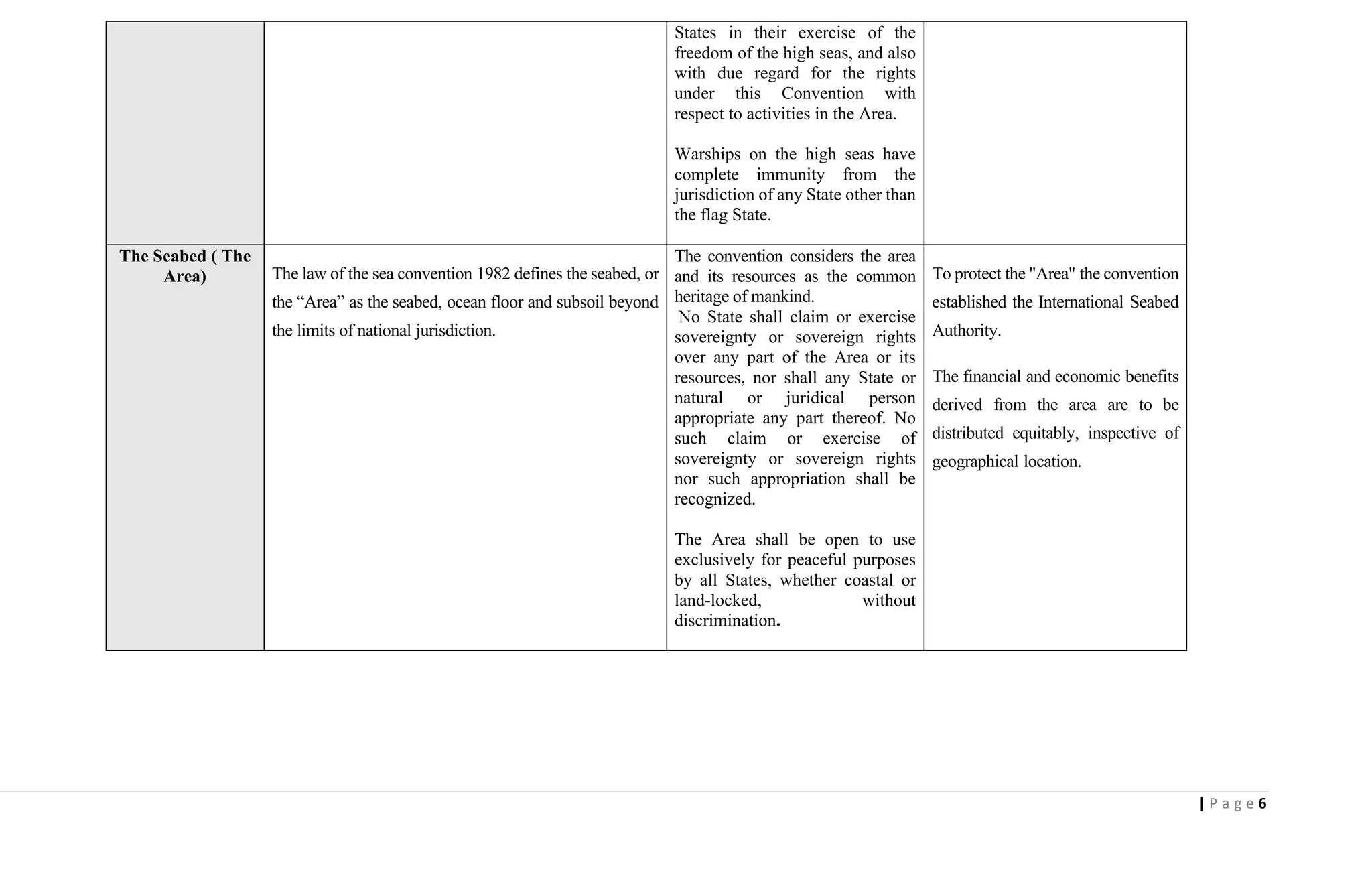
States in their exercise of the
freedom of the high seas, and also
with due regard for the rights
under this Convention with
respect to activities in the Area.
Warships on the high seas have
complete immunity from the
jurisdiction of any State other than
the flag State.
The Seabed ( The
Area) The law of the sea convention 1982 defines the seabed, or
the “Area” as the seabed, ocean floor and subsoil beyond
the limits of national jurisdiction.
The convention considers the area
and its resources as the common
heritage of mankind.
No State shall claim or exercise
sovereignty or sovereign rights
over any part of the Area or its
resources, nor shall any State or
natural or juridical person
appropriate any part thereof. No
such claim or exercise of
sovereignty or sovereign rights
nor such appropriation shall be
recognized.
The Area shall be open to use
exclusively for peaceful purposes
by all States, whether coastal or
land-locked, without
discrimination.
To protect the "Area" the convention
established the International Seabed
Authority.
The financial and economic benefits
derived from the area are to be
distributed equitably, inspective of
geographical location.
7| P a g e

Table of the maritime zones in unclos by Dr.Zeyad Jaffal, Al Ain University, UAE

  • 1.
    1| P ag e The Maritime Zones in UNCLOS Prepared by Dr. Zeyad Jaffal Associate professor of Public international law Al Ain University, UAE Nov.2019 The Zone Breadth Legal regime Internal waters Waters on the landward side of the baseline of the territorial sea. Coastal state has full sovereignty over this area. Territorial Sea Every State has the right to establish the breadth of its territorial sea up to a limit not exceeding 12 nautical miles, measured from baselines. Sovereignty extends to the air space, water column, seabed and subsoil allowing for the right of innocent passage. The innocent passage is the right to pass through the territorial sea, but not internal waters, for the purpose of entering port or merely passing in a continuous and expeditious manner. Such passage is only innocent provided it is not prejudicial to the peace, good order or security of the coastal state. Transit passage is a concept of the Law of the Sea, which allows a vessel or aircraft the freedom of navigation or overflight solely for the purpose of continuous and expeditious transit of a strait between one part of the high seas or exclusive economic zone and another. Passage of a foreign ship shall be considered to be prejudicial to the peace, good order or security of the coastal State if in the territorial sea it engages in any of the following activities: (a) any threat or use of force against the sovereignty, territorial integrity or political independence of the coastal State, or in any other manner in violation of the principles of international law embodied in the Charter of the United Nations;
  • 2.
    2| P ag e The most significant difference between transit passage and innocent passage is that in transit passage submarines are allowed to navigate through the strait below the surface; the right of transit passage concerns also air transport. In the innocent passage, then again, submarines are required to navigate on the surface and to show their flag. (b) any exercise or practice with weapons of any kind; (c) any act aimed at collecting information to the prejudice of the defence or security of the coastal State; (d) any act of propaganda aimed at affecting the defence or security of the coastal State; (h) any act of wilful and serious pollution contrary to this Convention; (i) any fishing activities; (j) the carrying out of research or survey activities; (k) any act aimed at interfering with any systems of communication or any other facilities or installations of the coastal State;
  • 3.
    3| P ag e Ccontiguous zone It is a zone contiguous to the territorial waters of the Coastal state. The contiguous zone may not extend beyond 24 nautical miles from the baselines from which the breadth of the territorial sea is measured. The coastal State may exercise the control necessary to: (a) prevent infringement of its customs, fiscal, immigration or sanitary laws and regulations within its territory or territorial sea; (b) punish infringement of the above laws and regulations committed within its territory or territorial sea. It is a limited enforcement zone which makes it a "hot pursuit area". The hot pursuit of a foreign ship may be undertaken in the high seas when the competent authorities of the coastal State have good reason to believe that the ship has violated the laws and regulations of that State. Exclusive Economic zone (EEZ) The exclusive economic zone is an area beyond and adjacent to the territorial sea It shall not extend beyond 200 nautical miles from the baselines from which the breadth of the territorial sea is measured. In the exclusive economic zone, the coastal State has: (a) sovereign rights for the purpose of exploring and In the exclusive economic zone, all States, whether coastal or land- locked, enjoy the freedoms of navigation and overflight and of the laying of submarine cables and
  • 4.
    4| P ag e exploiting, conserving and managing the natural resources, whether living or non-living. And to other activities for the economic exploitation and exploration of the zone, such as the production of energy from the water, currents and winds; (b) jurisdiction as provided for in the relevant provisions of this Convention with regard to: (i)the establishment and use of artificial islands, installations and structures; (ii)marine scientific research; (iii) the protection and preservation of the marine environment; pipelines, and other internationally lawful uses of the sea related to these freedoms, such as those associated with the operation of ships, aircraft and submarine cables and pipelines. Continental Shelf The continental shelf of a coastal State comprises the seabed and subsoil of the submarine areas that extend beyond its territorial sea throughout the natural prolongation of its land territory to the outer edge of the continental margin (to a maximum of 350 miles) or to a distance of 200 nautical miles from the baselines from which the breadth of the territorial sea is measured where the outer edge of the continental margin does not extend up to that distance. The coastal State exercises over the continental shelf sovereign rights for the purpose of exploring it and exploiting its natural resources. This rights are exclusive in the sense that if the coastal State does not explore the continental shelf or exploit its natural resources, no one may undertake these activities without the express consent of the coastal State. The exercise of the rights of the coastal State over the continental shelf must not infringe or result in any unjustifiable interference with navigation and other rights and freedoms of other States. All States are entitled to lay submarine cables and pipelines on the continental shelf, in accordance with the provisions of this article. Subject to its right to take reasonable measures for the
  • 5.
    5| P ag e The natural resources consist of the mineral and other non-living resources of the seabed and subsoil together with living organisms belonging to sedentary species, that is to say, organisms which, at the harvestable stage, either are immobile on or under the seabed or are unable to move except in constant physical contact with the seabed or the subsoil. exploration of the continental shelf, the exploitation of its natural resources and the prevention, reduction and control of pollution from pipelines, the coastal State may not impede the laying or maintenance of such cables or pipelines. High Seas The law of the sea convention 1982 defines the High Seas to cover those maritime areas not included in an exclusive economic zone, the territorial sea or internal waters of any state. The high seas shall be reserved for peaceful purposes. No State may validly purport to subject any part of the high seas to its sovereignty. Every State, whether coastal or land-locked, has the right to sail ships flying its flag on the high seas. The high seas are open to all States, whether coastal or land- locked. Freedom of the high seas is exercised under the conditions laid down by this Convention and by other rules of international law. It comprises, inter alia, both for coastal and land-locked States: (a)freedom of navigation; (b)freedom of overflight; (c)freedom to lay submarine cables and pipelines, subject to Part VI; (d)freedom to construct artificial islands and other installations permitted under international law, subject to Part VI; (e)freedom of fishing. (f)freedom of scientific research, subject to Parts VI and XIII. 2.These freedoms shall be exercised by all States with due regard for the interests of other
  • 6.
    6| P ag e States in their exercise of the freedom of the high seas, and also with due regard for the rights under this Convention with respect to activities in the Area. Warships on the high seas have complete immunity from the jurisdiction of any State other than the flag State. The Seabed ( The Area) The law of the sea convention 1982 defines the seabed, or the “Area” as the seabed, ocean floor and subsoil beyond the limits of national jurisdiction. The convention considers the area and its resources as the common heritage of mankind. No State shall claim or exercise sovereignty or sovereign rights over any part of the Area or its resources, nor shall any State or natural or juridical person appropriate any part thereof. No such claim or exercise of sovereignty or sovereign rights nor such appropriation shall be recognized. The Area shall be open to use exclusively for peaceful purposes by all States, whether coastal or land-locked, without discrimination. To protect the "Area" the convention established the International Seabed Authority. The financial and economic benefits derived from the area are to be distributed equitably, inspective of geographical location.
  • 7.
    7| P ag e