THE MEDICINAL AND
TOILETRY PREPARATIONS
(THE EXCISE DUTIES ACT 1955
& RULES 1976)
CONTENTS
 Introduction
 Excise
 Manufacture of Alcoholic preparations
 Manufacture In-bond
 Manufacture Outside bond
 Warehousing of Alcoholic preparations
 Inter-state transport
 Export
 Procedures
 Offences and Penalties
 References
INTRODUCTION
• Alcohol has always been a fascinating friend of the
mankind.
• Drinking alcohol for pleasure‟s sake is an abuse.
• Use of alcohol for preparation of medicines is
necessity.
• Alcohol used either for drinking or manufacture of
perfumes is subjected to higher duties than that of
used in medicine preparation.
• Affordability of alcohol is to be controlled.
• This is the reason to take this Act in existence.
Cont…..
• The Excise Duties Act came in force in 1955.
• For excise duty to be an effective alcohol control
measure, duty increases need to increase annually in
relation to inflation and income.
• It has found that increasing the level of a minimum
price per unit leads to steep reductions in alcohol
consumption and related harms.
What is an Excise?
• An excise or excise tax is an inland tax.
• It is different from Customs duties.
• In other words, an excise is considered an indirect tax.
• In common terminology (but not necessarily in law), an excise
is distinguished from a sales tax or VAT in three ways:
• (i) an excise typically applies to a narrower range of products;
• (ii) an excise is typically heavier, accounting for a higher fraction of
the retail price of the targeted products; and
• (iii) an excise is typically a per unit tax, costing a specific amount
for a volume or unit of the item purchased, whereas a sales tax or
VAT is an ad valorem tax and proportional to the price of the good.
• In India, an excise is described as an indirect tax levied
and collected on the goods manufactured in India.
• The Act is extended throughout India.
• The Excise Duties Act is sometimes referred as “Sin tax”
 Types of Excise duty
o Basic
o Additional
o Special
 Excisable Goods
The term 'excisable goods' means the goods which are
specified in the first schedule and the second
schedule to the Central Excise Tariff Act, 1985, as
being subject to a duty of excise
 There are three types of parties who can be
considered as manufacturers:
• Those who personally manufacture the goods in question
• Those who get the goods manufactured by employing
hired labor
• Those who get the goods manufactured by other parties
 A minimum price for the sale of alcohol should be set at no
less than 50p per unit.
 The term „unit‟ is used to quantify alcohol content. A unit
corresponds to approximately eight grams, or 10millilitres
of alcohol (ethanol).
 A unit is around the amount of alcohol the average adult
can process in an hour.
Quantity in dutiable units
• The quantity in dutiable units is the amount or
volume of product that you are claiming a
remission for.
• The following are examples of dutiable units:
o sticks of cigarettes or cigars
o kilograms of tobacco or compressed natural gas
o litres of fuel (other than blended fuels)
o litres of alcohol.
 Excise duty is not payable on the first 1.15% of
alcohol content in beer
 Total litres of beer x (Alcohol strength - 1.15%) =
dutiable quantity
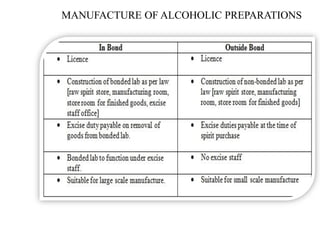
MANUFACTURE OF ALCOHOLIC PREPARATIONS
Manufacture In-Bond
• Licence
• The following fees must accompany each application for
licence
 Where , consumption of alcohol < 4000 L.P. A. litre/annum
Rs.100
 Where, consumption is likely to be 4000 L.P. A. litre/annum
Rs.200
 Manufacture for sale of Ayurvedic or Unani medicines
containing self generated alcohol Rs.25
• Design and construction of bonded lab
• Manufacture of preparations in bonded lab
Duty on Medicinal and Toilet preparations
Pure alcohol content means alcohol expressed as 100% ethyl alcohol at 150C.
Manufacture Outside bond
• LICENCE
 The following fees are required to be paid for obtaining a licence for non-bonded
manufactory.
• Where consumption of alcohol is 125 L.P. litres or less per annum Rs.10
• Where consumption of alcohol per annum is more than 125 but less than 500 L.P.
litres Rs.25
• For manufacture of Ayurvedic or Unani preparations containing self-generated
alcohol produced by distillation
• DESIGN AND CONSTRUCTION OF NON-BONDED LAB
• MANUFACTURE IN NON-BONDED LAB
 The following categories of preparations are exempt from excise duty
• Hospitals and dispensaries working under the supervision of Central Govt.
or a State Govt.
• Hospitals and dispensaries subsidized by the Central Govt. or State Govt.
• Charitable hospitals and dispensaries under the Administrative control and
management of local body.
• Medical Store depot, Central Govt. or State Govt.
• Every other institution certified by the principal Medical Officer of the
district in which such institution is situated, which distributes drugs to poor
for free.
Warehousing of Alcoholic preparations
• The manufacturers and dealers in alcoholic preparations are
allowed to establish warehouses anywhere in India for the
purpose of depositing spirituous goods on which duty has not
been paid.
• Those wishing to establish such a warehouse should obtain a
licence for the purpose from the Excise Commissioner of the
State, by making application to him with a fee of Rs.25.
• MOVEMENT OF GOODS FROM ONE WAREHOUSE TO
ANOTHER
• RETURNS
The licensee must, within 7 days of the expiry of each month, submit
details of the transactions made in the warehoused goods and such other
details as may be prescribed by the State Govt. in this behalf.
• INTER-STATE TRANSPORT OF ALCOHOLIC GOODS
• EXPORT OF ALCOHOLIC PREPARATIONS
1. Under bond (directly from a bonded laboratory without payment
of duty)
2. Under claim for rebate of duty
PROCEDURES
• INSPECTION
• ENTRY, SEARCH AND SEIZURE
• DETENTION AND DISPOSAL OF PERSON AND
ARTICLES
 Excise officers dully empowered in this behalf by the
state govt. may stop and detain any person found
carrying goods, for the transport of which a permit is
required
 The articles seized by the officers should be disposed
off speedily according to the provisions of the law. In
the case of seizure of an animal, the owner of the
animal should provide for its day-to-day keep, failing
which the animal may be sold by public auction and
the expenses incurred in keeping the animal realize
from the proceeds of the sale.
• SUMMONS BY EXCISE OFFICERS
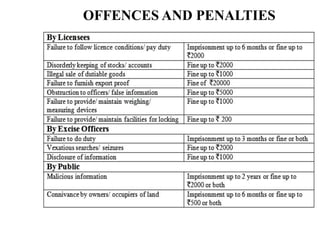
OFFENCES AND PENALTIES
Excise duties or taxes often serve political as well as financial ends. Public
safety and health, public morals, environmental protection, and national
defense are all legitimate rationales for the imposition of an excise.
• Public safety and health – deter individuals from harming their health by
abusing substances such as tobacco and alcohol, thus making excise a kind
of sumptuary tax
• Environmental protection - deter individuals or organizations from
harming the general environment, including curbing activities which
contribute to pollution, or which harm the natural environment.
• Defense - including taxation directly levied on other countries' militaries
and/or governments, such as the UK's taxation on "visiting forces"
• Punitive - Many US states taxes on drugs, as well as the UK government
impose excise on money laundering and on "visiting forces" (i.e.,
occupying military forces). These taxes are not considered revenue sources,
but rather exist to allow governments greater leverage for punishments and
reparations/war reparations - based mainly around tax evasion - which can
be imposed in the event that the perpetrator is caught and tried.
REFERENCES
A Textbook of Forensic Pharmacy, by B.M. Mithal,
Vallabh Prakashan, page no.48-72
 Pharmaceutical Jurisprudence, by B.S. Kuchekar,
Nirali Prakashan, page no.153-170
http://www.ato.gov.au/government/content

Excise duties act 1955 & rules 1976

  • 1.
    THE MEDICINAL AND TOILETRYPREPARATIONS (THE EXCISE DUTIES ACT 1955 & RULES 1976)
  • 2.
    CONTENTS  Introduction  Excise Manufacture of Alcoholic preparations  Manufacture In-bond  Manufacture Outside bond  Warehousing of Alcoholic preparations  Inter-state transport  Export  Procedures  Offences and Penalties  References
  • 3.
    INTRODUCTION • Alcohol hasalways been a fascinating friend of the mankind. • Drinking alcohol for pleasure‟s sake is an abuse. • Use of alcohol for preparation of medicines is necessity. • Alcohol used either for drinking or manufacture of perfumes is subjected to higher duties than that of used in medicine preparation. • Affordability of alcohol is to be controlled. • This is the reason to take this Act in existence.
  • 4.
    Cont….. • The ExciseDuties Act came in force in 1955. • For excise duty to be an effective alcohol control measure, duty increases need to increase annually in relation to inflation and income. • It has found that increasing the level of a minimum price per unit leads to steep reductions in alcohol consumption and related harms.
  • 5.
    What is anExcise? • An excise or excise tax is an inland tax. • It is different from Customs duties. • In other words, an excise is considered an indirect tax. • In common terminology (but not necessarily in law), an excise is distinguished from a sales tax or VAT in three ways: • (i) an excise typically applies to a narrower range of products; • (ii) an excise is typically heavier, accounting for a higher fraction of the retail price of the targeted products; and • (iii) an excise is typically a per unit tax, costing a specific amount for a volume or unit of the item purchased, whereas a sales tax or VAT is an ad valorem tax and proportional to the price of the good.
  • 6.
    • In India,an excise is described as an indirect tax levied and collected on the goods manufactured in India. • The Act is extended throughout India. • The Excise Duties Act is sometimes referred as “Sin tax”  Types of Excise duty o Basic o Additional o Special  Excisable Goods The term 'excisable goods' means the goods which are specified in the first schedule and the second schedule to the Central Excise Tariff Act, 1985, as being subject to a duty of excise
  • 7.
     There arethree types of parties who can be considered as manufacturers: • Those who personally manufacture the goods in question • Those who get the goods manufactured by employing hired labor • Those who get the goods manufactured by other parties  A minimum price for the sale of alcohol should be set at no less than 50p per unit.  The term „unit‟ is used to quantify alcohol content. A unit corresponds to approximately eight grams, or 10millilitres of alcohol (ethanol).  A unit is around the amount of alcohol the average adult can process in an hour.
  • 8.
    Quantity in dutiableunits • The quantity in dutiable units is the amount or volume of product that you are claiming a remission for. • The following are examples of dutiable units: o sticks of cigarettes or cigars o kilograms of tobacco or compressed natural gas o litres of fuel (other than blended fuels) o litres of alcohol.  Excise duty is not payable on the first 1.15% of alcohol content in beer  Total litres of beer x (Alcohol strength - 1.15%) = dutiable quantity
  • 9.
  • 10.
    Manufacture In-Bond • Licence •The following fees must accompany each application for licence  Where , consumption of alcohol < 4000 L.P. A. litre/annum Rs.100  Where, consumption is likely to be 4000 L.P. A. litre/annum Rs.200  Manufacture for sale of Ayurvedic or Unani medicines containing self generated alcohol Rs.25 • Design and construction of bonded lab • Manufacture of preparations in bonded lab
  • 11.
    Duty on Medicinaland Toilet preparations Pure alcohol content means alcohol expressed as 100% ethyl alcohol at 150C.
  • 12.
    Manufacture Outside bond •LICENCE  The following fees are required to be paid for obtaining a licence for non-bonded manufactory. • Where consumption of alcohol is 125 L.P. litres or less per annum Rs.10 • Where consumption of alcohol per annum is more than 125 but less than 500 L.P. litres Rs.25 • For manufacture of Ayurvedic or Unani preparations containing self-generated alcohol produced by distillation • DESIGN AND CONSTRUCTION OF NON-BONDED LAB • MANUFACTURE IN NON-BONDED LAB  The following categories of preparations are exempt from excise duty • Hospitals and dispensaries working under the supervision of Central Govt. or a State Govt. • Hospitals and dispensaries subsidized by the Central Govt. or State Govt. • Charitable hospitals and dispensaries under the Administrative control and management of local body. • Medical Store depot, Central Govt. or State Govt. • Every other institution certified by the principal Medical Officer of the district in which such institution is situated, which distributes drugs to poor for free.
  • 13.
    Warehousing of Alcoholicpreparations • The manufacturers and dealers in alcoholic preparations are allowed to establish warehouses anywhere in India for the purpose of depositing spirituous goods on which duty has not been paid. • Those wishing to establish such a warehouse should obtain a licence for the purpose from the Excise Commissioner of the State, by making application to him with a fee of Rs.25. • MOVEMENT OF GOODS FROM ONE WAREHOUSE TO ANOTHER • RETURNS The licensee must, within 7 days of the expiry of each month, submit details of the transactions made in the warehoused goods and such other details as may be prescribed by the State Govt. in this behalf. • INTER-STATE TRANSPORT OF ALCOHOLIC GOODS • EXPORT OF ALCOHOLIC PREPARATIONS 1. Under bond (directly from a bonded laboratory without payment of duty) 2. Under claim for rebate of duty
  • 14.
    PROCEDURES • INSPECTION • ENTRY,SEARCH AND SEIZURE • DETENTION AND DISPOSAL OF PERSON AND ARTICLES  Excise officers dully empowered in this behalf by the state govt. may stop and detain any person found carrying goods, for the transport of which a permit is required  The articles seized by the officers should be disposed off speedily according to the provisions of the law. In the case of seizure of an animal, the owner of the animal should provide for its day-to-day keep, failing which the animal may be sold by public auction and the expenses incurred in keeping the animal realize from the proceeds of the sale. • SUMMONS BY EXCISE OFFICERS
  • 15.
  • 16.
    Excise duties ortaxes often serve political as well as financial ends. Public safety and health, public morals, environmental protection, and national defense are all legitimate rationales for the imposition of an excise. • Public safety and health – deter individuals from harming their health by abusing substances such as tobacco and alcohol, thus making excise a kind of sumptuary tax • Environmental protection - deter individuals or organizations from harming the general environment, including curbing activities which contribute to pollution, or which harm the natural environment. • Defense - including taxation directly levied on other countries' militaries and/or governments, such as the UK's taxation on "visiting forces" • Punitive - Many US states taxes on drugs, as well as the UK government impose excise on money laundering and on "visiting forces" (i.e., occupying military forces). These taxes are not considered revenue sources, but rather exist to allow governments greater leverage for punishments and reparations/war reparations - based mainly around tax evasion - which can be imposed in the event that the perpetrator is caught and tried.
  • 17.
    REFERENCES A Textbook ofForensic Pharmacy, by B.M. Mithal, Vallabh Prakashan, page no.48-72  Pharmaceutical Jurisprudence, by B.S. Kuchekar, Nirali Prakashan, page no.153-170 http://www.ato.gov.au/government/content