PHARMACY ACT
1948
Prepared by,
Tejaswini H M
Ph.Jurisprudence
Dept of pharmacology
SCS College of pharmacy
Harapanahalli
The Pharmacy Act 1948
Introduction:
Before independence there were no regulations for Profession & Practice of
Pharmacy,
Persons having no knowledge and having no education in pharmacy was
compounding, mixing, & dispensing of medicines, This system was causing
great harm to the health of people by wrong compounding, mixing or
dispensing.
Drug enquiry committee & Health survey and development committee,
recommended that persons practicing pharmacy should have a proper
educational background.
Hence the Pharmacy Act 1948 came into force in March 1948.
Objective
To regulate the profession of Pharmacy
To raise the status of Pharmacy in India To achieve this objective
The act provides the formation of (Central council) PCI. (Responsible for
evolving educational standards and regulations for the Diploma course in
Pharmacy through Education Regulations.)
The act also provides formation of (State council) State Pharmacy
Council.(For registration of Pharmacist and for regulating their
professional activities)
Definitions;
• Central council: The Pharmacy Council of India
• Central Register: Register of Pharmacist maintained by Central
Council Registered
• Pharmacist: A person whose name is entered in the register of
Pharmacist of the state.
• Medical Practitioner:
■ A person holding qualification of Indian Medical Degree
■ A person registered in Medical register of India
■ A person engaged in practices of veterinary medicine
• UGC: University Grant Commission established under sec 4 of
UGC act 1956
• 1. Central Council: The pharmacy council of India.
• 2. Central Register: Register of Pharmacist maintained by the central
council.
• 3. Registered Pharmacist: A person whose name for time being entered
in the register of pharmacist of the state, in which he is for the time being
residing or carrying on his profession or business of pharmacy.
• 4. University Grant Commission: It means the University grant
commission established under section 4 of the university grant
commission act, 1956
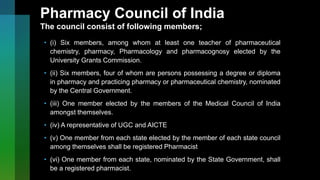
Pharmacy Council of India
The council consist of following members;
• (i) Six members, among whom at least one teacher of pharmaceutical
chemistry, pharmacy, Pharmacology and pharmacognosy elected by the
University Grants Commission.
• (ii) Six members, four of whom are persons possessing a degree or diploma
in pharmacy and practicing pharmacy or pharmaceutical chemistry, nominated
by the Central Government.
• (iii) One member elected by the members of the Medical Council of India
amongst themselves.
• (iv) A representative of UGC and AICTE
• (v) One member from each state elected by the member of each state council
among themselves shall be registered Pharmacist
• (vi) One member from each state, nominated by the State Government, shall
be a registered pharmacist.
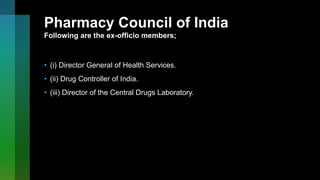
Pharmacy Council of India
Following are the ex-officio members;
• (i) Director General of Health Services.
• (ii) Drug Controller of India.
• (iii) Director of the Central Drugs Laboratory.
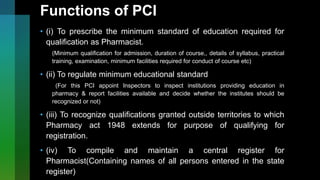
Functions of PCI
• (i) To prescribe the minimum standard of education required for
qualification as Pharmacist.
(Minimum qualification for admission, duration of course,, details of syllabus, practical
training, examination, minimum facilities required for conduct of course etc)
• (ii) To regulate minimum educational standard
(For this PCI appoint Inspectors to inspect institutions providing education in
pharmacy & report facilities available and decide whether the institutes should be
recognized or not)
• (iii) To recognize qualifications granted outside territories to which
Pharmacy act 1948 extends for purpose of qualifying for
registration.
• (iv) To compile and maintain a central register for
Pharmacist(Containing names of all persons entered in the state
register)
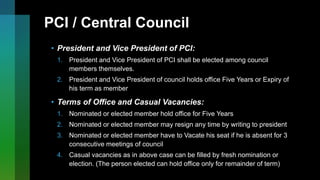
PCI / Central Council
• President and Vice President of PCI:
1. President and Vice President of PCI shall be elected among council
members themselves.
2. President and Vice President of council holds office Five Years or Expiry of
his term as member
• Terms of Office and Casual Vacancies:
1. Nominated or elected member hold office for Five Years
2. Nominated or elected member may resign any time by writing to president
3. Nominated or elected member have to Vacate his seat if he is absent for 3
consecutive meetings of council
4. Casual vacancies as in above case can be filled by fresh nomination or
election. (The person elected can hold office only for remainder of term)
PCI / Central Council
• Staff remuneration and Allowance:
The central council may;
• Appoint a registrar who can act as secretary or Treasurer
• Appoint such other officer and servants as consider necessary.
• From registrar to servant council may take security for the due
performance of his duties as council may consider necessary.
• With Previous sanction of the Central Govt, Council may fix,
• Remuneration and Allowances for Presidents and Vice
President, and other staff members
• Pay and Allowances and other service conditions of officers and
servants of council
• The Executive committee:
• The executive committee consists of the;
• Ex. Officio members.
• Presidents (Who shall be the chairman of the committee)
• Vice president
• Five other members elected by central council among its
members.
The members of executive committee hold office until the expiry
of his term as a member of central council.
Approval of Institutions or
Authorities Providing Courses of
Study andExaminations:
• Institutions: That Conducts course of study (eg.
Pharmacy Colleges)
• Authorities: That Holds an examinations (eg. MSBTE)
The Pharmacy Act 1948
Education Regulations:
• As per section 10 of Pharmacy Act 1948
• After approval from Central Government, Central council may make
regulations.
• Regulations prescribing minimum standards of education required for
qualification as Pharmacist is called Education Regulations
Education regulations
• The central council make regulations under section
10 of the pharmacy act 1948 to called education
regulations.
• By the approval of central govt. Prescribe the
minimum standards of education required for
qualification as a pharmacist.
Education regulations: prescribes
• Minimum qualification for Admission to the course
• Nature and period of course of study.
• Nature and period of study and practical training (not less
than 75 hours covered in a minimum of three months in an
Institution, Hospital, Pharmacy or dispensary recognized by
central council).
• The equipment and facilities to be provided for students
undertaking approved course of study.
• The subjects of examination and the standards therein to be
attained:;
• Conditions to be fulfilled by institutions giving practical
training.
• Conditions to be fulfilled by authorities holding approved
examinations
Education regulations; how it is finalized
• After peparing Any education regulations
• Central council before Submitting the ER or any amendments to central
Govt for approval,sends copies of draft of ER to all states Govt. and
takes their Suggestion within 3 months.
• Then the ER is published in the official gazette of central council.
• The executive committee from time to time reports to central council on
the efficacy of ER and recommended such amendments to central
council.
Application of Education Regulations
to states; (Implementation of ER to states)
• After State Govt consult with state council about ER, then by notification
in Official gazette declare that ER shall take effect in state.
• If no such declaration has been made, ER shall take effect in the state
after 3 years from date of constitution of state council.
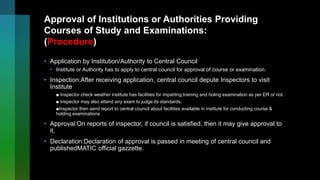
Approval of Institutions or Authorities Providing
Courses of Study and Examinations:
(Procedure)
• Application by Institution/Authority to Central Council
• Institute or Authority has to apply to central council for approval of course or examination.
• Inspection:After receiving application, central council depute Inspectors to visit
Institute
■ Inspector check weather institute has facilities for imparting training and holing examination as per ER or not.
■ Inspector may also attend any exam to judge its standards.
■Inspector then send report to central council about facilities available in institute for conducting course &
holding examinations
• Approval:On reports of inspector, if council is satisfied, then it may give approval to
it.
• Declaration:Declaration of approval is passed in meeting of central council and
publishedMATIC official gazzette.
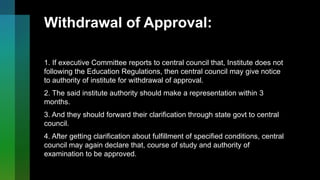
Withdrawal of Approval:
1. If executive Committee reports to central council that, Institute does not
following the Education Regulations, then central council may give notice
to authority of institute for withdrawal of approval.
2. The said institute authority should make a representation within 3
months.
3. And they should forward their clarification through state govt to central
council.
4. After getting clarification about fulfillment of specified conditions, central
council may again declare that, course of study and authority of
examination to be approved.
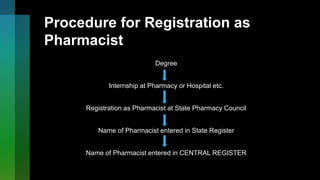
Procedure for Registration as
Pharmacist
Degree
Internship at Pharmacy or Hospital etc.
Registration as Pharmacist at State Pharmacy Council
Name of Pharmacist entered in State Register
Name of Pharmacist entered in CENTRAL REGISTER
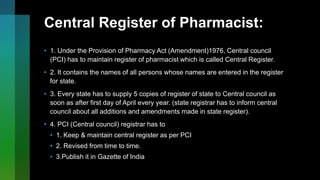
Central Register of Pharmacist:
• 1. Under the Provision of Pharmacy Act (Amendment)1976, Central council
(PCI) has to maintain register of pharmacist which is called Central Register.
• 2. It contains the names of all persons whose names are entered in the register
for state.
• 3. Every state has to supply 5 copies of register of state to Central council as
soon as after first day of April every year. (state registrar has to inform central
council about all additions and amendments made in state register).
• 4. PCI (Central council) registrar has to
• 1. Keep & maintain central register as per PCI
• 2. Revised from time to time.
• 3.Publish it in Gazette of India
State Pharmacy Council
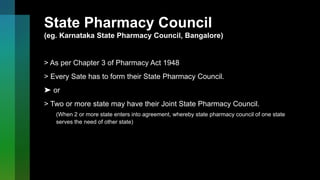
(eg. Karnataka State Pharmacy Council, Bangalore)
> As per Chapter 3 of Pharmacy Act 1948
> Every Sate has to form their State Pharmacy Council.
➤ or
> Two or more state may have their Joint State Pharmacy Council.
(When 2 or more state enters into agreement, whereby state pharmacy council of one state
serves the need of other state)
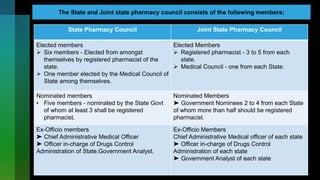
State Pharmacy Council Joint State Pharmacy Council
Elected members
 Six members - Elected from amongst
themselves by registered pharmacist of the
state.
 One member elected by the Medical Council of
State among themselves.
Elected Members
 Registered pharmacist - 3 to 5 from each
state.
 Medical Council - one from each State.
Nominated members
• Five members - nominated by the State Govt
of whom at least 3 shall be registered
pharmacist.
Nominated Members
➤ Government Nominees 2 to 4 from each State
of whom more than half should be registered
pharmacist.
Ex-Officio members
➤ Chief Administrative Medical Officer
➤ Officer in-charge of Drugs Control
Administration of State.Government Analyst.
Ex-Officio Members
Chief Administrative Medical officer of each state
➤ Officer in-charge of Drugs Control
Administration of each state
➤ Government Analyst of each state
The State and Joint state pharmacy council consists of the following members;
State Pharmacy Council
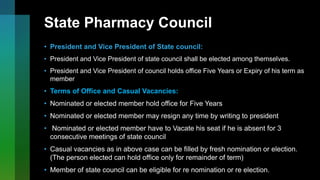
• President and Vice President of State council:
• President and Vice President of state council shall be elected among themselves.
• President and Vice President of council holds office Five Years or Expiry of his term as
member
• Terms of Office and Casual Vacancies:
• Nominated or elected member hold office for Five Years
• Nominated or elected member may resign any time by writing to president
• Nominated or elected member have to Vacate his seat if he is absent for 3
consecutive meetings of state council
• Casual vacancies as in above case can be filled by fresh nomination or election.
(The person elected can hold office only for remainder of term)
• Member of state council can be eligible for re nomination or re election.
State Pharmacy Council
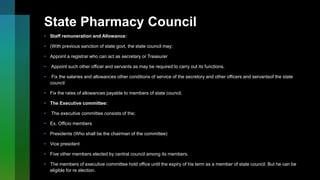
• Staff remuneration and Allowance:
• (With previous sanction of state govt, the state council may;
• Appoint a registrar who can act as secretary or Treasurer
• Appoint such other officer and servants as may be required to carry out its functions.
• Fix the salaries and allowances other conditions of service of the secretory and other officers and servantsof the state
council
• Fix the rates of allowances payable to members of state council.
• The Executive committee:
• The executive committee consists of the;
• Ex. Officio members
• Presidents (Who shall be the chairman of the committee)
• Vice president
• Five other members elected by central council among its members.
• The members of executive committee hold office until the expiry of his term as a member of state council. But he can be
eligible for re election.
Functions of State Pharmacy
Council
• 1. Inspection by State Council:
• The State Pharmacy Council appoints suitable number of Inspectors to,
➤Inspect premises where drugs are compounded or dispensed.
➤Inquire regarding the Registration of a person.
➤Investigate Complaints.
►Institute Prosecution.
Registration of Pharmacists:
□ State council prepare and maintain the register.The register shall include;
■ Full name and residential address of registered person
■ Date of his first entry in register
■ Qualification
■ Professional address (& if he is employed by any person, the name of
such person)
Preparation of First register:
• State govt (by notification in official gazette) constitute a Registration Tribunal.
• Registration Tribunal consist of 3 persons and a Registrar (who act as Secretary)
• State Govt Give Date of Application
• (State Govt by notification, Specify date on or before which application of
registration along with fee is made to Registration Tribunal.)
• Registration Tribunal Examine every application
• If Satisfied, Name of Applicant is registered in Register.
• The first registered so prepared is published. (Appeal within 60 days)
• The registrar issues certificate of registration (Whose name is entered in
register)
• After formation of state council, state govt hand over this register & application fees
to state council.
Qualification for entry on First
register:
• A person having age 18 years, paid fee should have following qualification;
1. Degree or Diploma in Pharmacy or Chemist & Druggist diploma of Indian
University or prescribed qualification granted by an authority outside India
2. A degree of and Indian University other than degree in Pharmacy & Has been
engaged in Compounding of drug in hospital or dispensary or other in which drugs
are regularly dispensed on Prescription of Medical Practitioner for total period of
Not less than 3 years.
3. Has passed examination recognized as adequate by the state govt for
compounders and dispensers.
4. Has not less than 5 years of experience of compounding drug etc, prior to the
date notified by the registration tribunal for receipt of applications for entry of
names on first register.
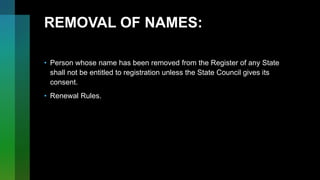
REMOVAL OF NAMES:
• Person whose name has been removed from the Register of any State
shall not be entitled to registration unless the State Council gives its
consent.
• Renewal Rules.
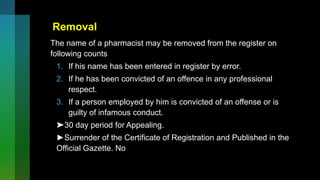
Removal
The name of a pharmacist may be removed from the register on
following counts
1. If his name has been entered in register by error.
2. If he has been convicted of an offence in any professional
respect.
3. If a person employed by him is convicted of an offense or is
guilty of infamous conduct.
➤30 day period for Appealing.
►Surrender of the Certificate of Registration and Published in the
Official Gazette. No
Pharmacy act 1948

Pharmacy act 1948

  • 1.
    PHARMACY ACT 1948 Prepared by, TejaswiniH M Ph.Jurisprudence Dept of pharmacology SCS College of pharmacy Harapanahalli
  • 2.
    The Pharmacy Act1948 Introduction: Before independence there were no regulations for Profession & Practice of Pharmacy, Persons having no knowledge and having no education in pharmacy was compounding, mixing, & dispensing of medicines, This system was causing great harm to the health of people by wrong compounding, mixing or dispensing. Drug enquiry committee & Health survey and development committee, recommended that persons practicing pharmacy should have a proper educational background. Hence the Pharmacy Act 1948 came into force in March 1948.
  • 3.
    Objective To regulate theprofession of Pharmacy To raise the status of Pharmacy in India To achieve this objective The act provides the formation of (Central council) PCI. (Responsible for evolving educational standards and regulations for the Diploma course in Pharmacy through Education Regulations.) The act also provides formation of (State council) State Pharmacy Council.(For registration of Pharmacist and for regulating their professional activities)
  • 4.
    Definitions; • Central council:The Pharmacy Council of India • Central Register: Register of Pharmacist maintained by Central Council Registered • Pharmacist: A person whose name is entered in the register of Pharmacist of the state. • Medical Practitioner: ■ A person holding qualification of Indian Medical Degree ■ A person registered in Medical register of India ■ A person engaged in practices of veterinary medicine • UGC: University Grant Commission established under sec 4 of UGC act 1956
  • 5.
    • 1. CentralCouncil: The pharmacy council of India. • 2. Central Register: Register of Pharmacist maintained by the central council. • 3. Registered Pharmacist: A person whose name for time being entered in the register of pharmacist of the state, in which he is for the time being residing or carrying on his profession or business of pharmacy. • 4. University Grant Commission: It means the University grant commission established under section 4 of the university grant commission act, 1956
  • 6.
    Pharmacy Council ofIndia The council consist of following members; • (i) Six members, among whom at least one teacher of pharmaceutical chemistry, pharmacy, Pharmacology and pharmacognosy elected by the University Grants Commission. • (ii) Six members, four of whom are persons possessing a degree or diploma in pharmacy and practicing pharmacy or pharmaceutical chemistry, nominated by the Central Government. • (iii) One member elected by the members of the Medical Council of India amongst themselves. • (iv) A representative of UGC and AICTE • (v) One member from each state elected by the member of each state council among themselves shall be registered Pharmacist • (vi) One member from each state, nominated by the State Government, shall be a registered pharmacist.
  • 7.
    Pharmacy Council ofIndia Following are the ex-officio members; • (i) Director General of Health Services. • (ii) Drug Controller of India. • (iii) Director of the Central Drugs Laboratory.
  • 8.
    Functions of PCI •(i) To prescribe the minimum standard of education required for qualification as Pharmacist. (Minimum qualification for admission, duration of course,, details of syllabus, practical training, examination, minimum facilities required for conduct of course etc) • (ii) To regulate minimum educational standard (For this PCI appoint Inspectors to inspect institutions providing education in pharmacy & report facilities available and decide whether the institutes should be recognized or not) • (iii) To recognize qualifications granted outside territories to which Pharmacy act 1948 extends for purpose of qualifying for registration. • (iv) To compile and maintain a central register for Pharmacist(Containing names of all persons entered in the state register)
  • 9.
    PCI / CentralCouncil • President and Vice President of PCI: 1. President and Vice President of PCI shall be elected among council members themselves. 2. President and Vice President of council holds office Five Years or Expiry of his term as member • Terms of Office and Casual Vacancies: 1. Nominated or elected member hold office for Five Years 2. Nominated or elected member may resign any time by writing to president 3. Nominated or elected member have to Vacate his seat if he is absent for 3 consecutive meetings of council 4. Casual vacancies as in above case can be filled by fresh nomination or election. (The person elected can hold office only for remainder of term)
  • 10.
    PCI / CentralCouncil • Staff remuneration and Allowance: The central council may; • Appoint a registrar who can act as secretary or Treasurer • Appoint such other officer and servants as consider necessary. • From registrar to servant council may take security for the due performance of his duties as council may consider necessary. • With Previous sanction of the Central Govt, Council may fix, • Remuneration and Allowances for Presidents and Vice President, and other staff members • Pay and Allowances and other service conditions of officers and servants of council
  • 11.
    • The Executivecommittee: • The executive committee consists of the; • Ex. Officio members. • Presidents (Who shall be the chairman of the committee) • Vice president • Five other members elected by central council among its members. The members of executive committee hold office until the expiry of his term as a member of central council.
  • 12.
    Approval of Institutionsor Authorities Providing Courses of Study andExaminations: • Institutions: That Conducts course of study (eg. Pharmacy Colleges) • Authorities: That Holds an examinations (eg. MSBTE)
  • 13.
    The Pharmacy Act1948 Education Regulations: • As per section 10 of Pharmacy Act 1948 • After approval from Central Government, Central council may make regulations. • Regulations prescribing minimum standards of education required for qualification as Pharmacist is called Education Regulations
  • 14.
    Education regulations • Thecentral council make regulations under section 10 of the pharmacy act 1948 to called education regulations. • By the approval of central govt. Prescribe the minimum standards of education required for qualification as a pharmacist.
  • 15.
    Education regulations: prescribes •Minimum qualification for Admission to the course • Nature and period of course of study. • Nature and period of study and practical training (not less than 75 hours covered in a minimum of three months in an Institution, Hospital, Pharmacy or dispensary recognized by central council). • The equipment and facilities to be provided for students undertaking approved course of study. • The subjects of examination and the standards therein to be attained:; • Conditions to be fulfilled by institutions giving practical training. • Conditions to be fulfilled by authorities holding approved examinations
  • 16.
    Education regulations; howit is finalized • After peparing Any education regulations • Central council before Submitting the ER or any amendments to central Govt for approval,sends copies of draft of ER to all states Govt. and takes their Suggestion within 3 months. • Then the ER is published in the official gazette of central council. • The executive committee from time to time reports to central council on the efficacy of ER and recommended such amendments to central council.
  • 17.
    Application of EducationRegulations to states; (Implementation of ER to states) • After State Govt consult with state council about ER, then by notification in Official gazette declare that ER shall take effect in state. • If no such declaration has been made, ER shall take effect in the state after 3 years from date of constitution of state council.
  • 18.
    Approval of Institutionsor Authorities Providing Courses of Study and Examinations: (Procedure) • Application by Institution/Authority to Central Council • Institute or Authority has to apply to central council for approval of course or examination. • Inspection:After receiving application, central council depute Inspectors to visit Institute ■ Inspector check weather institute has facilities for imparting training and holing examination as per ER or not. ■ Inspector may also attend any exam to judge its standards. ■Inspector then send report to central council about facilities available in institute for conducting course & holding examinations • Approval:On reports of inspector, if council is satisfied, then it may give approval to it. • Declaration:Declaration of approval is passed in meeting of central council and publishedMATIC official gazzette.
  • 19.
    Withdrawal of Approval: 1.If executive Committee reports to central council that, Institute does not following the Education Regulations, then central council may give notice to authority of institute for withdrawal of approval. 2. The said institute authority should make a representation within 3 months. 3. And they should forward their clarification through state govt to central council. 4. After getting clarification about fulfillment of specified conditions, central council may again declare that, course of study and authority of examination to be approved.
  • 20.
    Procedure for Registrationas Pharmacist Degree Internship at Pharmacy or Hospital etc. Registration as Pharmacist at State Pharmacy Council Name of Pharmacist entered in State Register Name of Pharmacist entered in CENTRAL REGISTER
  • 21.
    Central Register ofPharmacist: • 1. Under the Provision of Pharmacy Act (Amendment)1976, Central council (PCI) has to maintain register of pharmacist which is called Central Register. • 2. It contains the names of all persons whose names are entered in the register for state. • 3. Every state has to supply 5 copies of register of state to Central council as soon as after first day of April every year. (state registrar has to inform central council about all additions and amendments made in state register). • 4. PCI (Central council) registrar has to • 1. Keep & maintain central register as per PCI • 2. Revised from time to time. • 3.Publish it in Gazette of India
  • 22.
    State Pharmacy Council (eg.Karnataka State Pharmacy Council, Bangalore) > As per Chapter 3 of Pharmacy Act 1948 > Every Sate has to form their State Pharmacy Council. ➤ or > Two or more state may have their Joint State Pharmacy Council. (When 2 or more state enters into agreement, whereby state pharmacy council of one state serves the need of other state)
  • 23.
    State Pharmacy CouncilJoint State Pharmacy Council Elected members  Six members - Elected from amongst themselves by registered pharmacist of the state.  One member elected by the Medical Council of State among themselves. Elected Members  Registered pharmacist - 3 to 5 from each state.  Medical Council - one from each State. Nominated members • Five members - nominated by the State Govt of whom at least 3 shall be registered pharmacist. Nominated Members ➤ Government Nominees 2 to 4 from each State of whom more than half should be registered pharmacist. Ex-Officio members ➤ Chief Administrative Medical Officer ➤ Officer in-charge of Drugs Control Administration of State.Government Analyst. Ex-Officio Members Chief Administrative Medical officer of each state ➤ Officer in-charge of Drugs Control Administration of each state ➤ Government Analyst of each state The State and Joint state pharmacy council consists of the following members;
  • 24.
    State Pharmacy Council •President and Vice President of State council: • President and Vice President of state council shall be elected among themselves. • President and Vice President of council holds office Five Years or Expiry of his term as member • Terms of Office and Casual Vacancies: • Nominated or elected member hold office for Five Years • Nominated or elected member may resign any time by writing to president • Nominated or elected member have to Vacate his seat if he is absent for 3 consecutive meetings of state council • Casual vacancies as in above case can be filled by fresh nomination or election. (The person elected can hold office only for remainder of term) • Member of state council can be eligible for re nomination or re election.
  • 25.
    State Pharmacy Council •Staff remuneration and Allowance: • (With previous sanction of state govt, the state council may; • Appoint a registrar who can act as secretary or Treasurer • Appoint such other officer and servants as may be required to carry out its functions. • Fix the salaries and allowances other conditions of service of the secretory and other officers and servantsof the state council • Fix the rates of allowances payable to members of state council. • The Executive committee: • The executive committee consists of the; • Ex. Officio members • Presidents (Who shall be the chairman of the committee) • Vice president • Five other members elected by central council among its members. • The members of executive committee hold office until the expiry of his term as a member of state council. But he can be eligible for re election.
  • 26.
    Functions of StatePharmacy Council • 1. Inspection by State Council: • The State Pharmacy Council appoints suitable number of Inspectors to, ➤Inspect premises where drugs are compounded or dispensed. ➤Inquire regarding the Registration of a person. ➤Investigate Complaints. ►Institute Prosecution.
  • 27.
    Registration of Pharmacists: □State council prepare and maintain the register.The register shall include; ■ Full name and residential address of registered person ■ Date of his first entry in register ■ Qualification ■ Professional address (& if he is employed by any person, the name of such person)
  • 28.
    Preparation of Firstregister: • State govt (by notification in official gazette) constitute a Registration Tribunal. • Registration Tribunal consist of 3 persons and a Registrar (who act as Secretary) • State Govt Give Date of Application • (State Govt by notification, Specify date on or before which application of registration along with fee is made to Registration Tribunal.) • Registration Tribunal Examine every application • If Satisfied, Name of Applicant is registered in Register. • The first registered so prepared is published. (Appeal within 60 days) • The registrar issues certificate of registration (Whose name is entered in register) • After formation of state council, state govt hand over this register & application fees to state council.
  • 29.
    Qualification for entryon First register: • A person having age 18 years, paid fee should have following qualification; 1. Degree or Diploma in Pharmacy or Chemist & Druggist diploma of Indian University or prescribed qualification granted by an authority outside India 2. A degree of and Indian University other than degree in Pharmacy & Has been engaged in Compounding of drug in hospital or dispensary or other in which drugs are regularly dispensed on Prescription of Medical Practitioner for total period of Not less than 3 years. 3. Has passed examination recognized as adequate by the state govt for compounders and dispensers. 4. Has not less than 5 years of experience of compounding drug etc, prior to the date notified by the registration tribunal for receipt of applications for entry of names on first register.
  • 30.
    REMOVAL OF NAMES: •Person whose name has been removed from the Register of any State shall not be entitled to registration unless the State Council gives its consent. • Renewal Rules.
  • 31.
    Removal The name ofa pharmacist may be removed from the register on following counts 1. If his name has been entered in register by error. 2. If he has been convicted of an offence in any professional respect. 3. If a person employed by him is convicted of an offense or is guilty of infamous conduct. ➤30 day period for Appealing. ►Surrender of the Certificate of Registration and Published in the Official Gazette. No