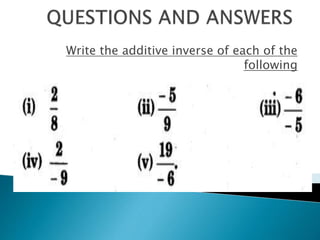
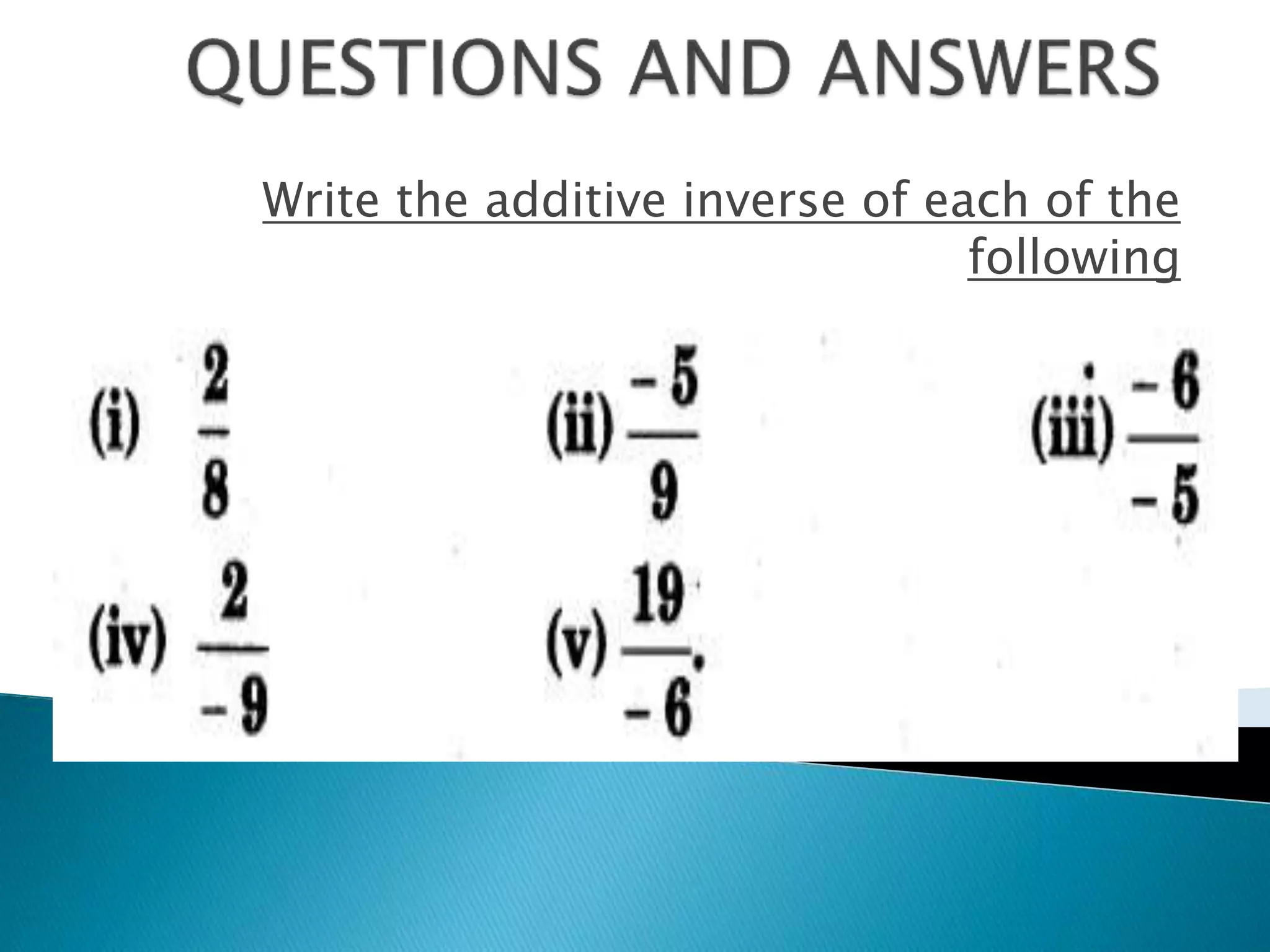
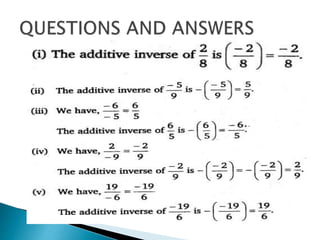
Write the additive inverse of each of the
following
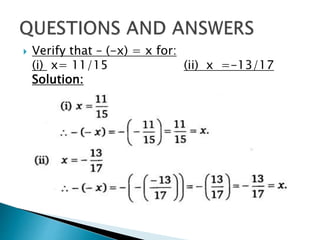
 Verify that – (-x) = x for:
(i) x= 11/15 (ii) x =-13/17
Solution:
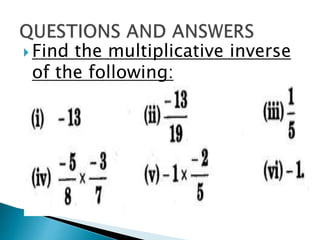
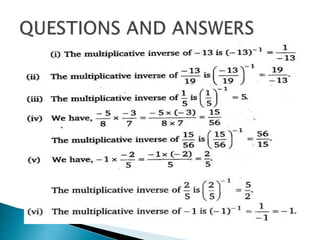
 Find the multiplicative inverse
of the following:
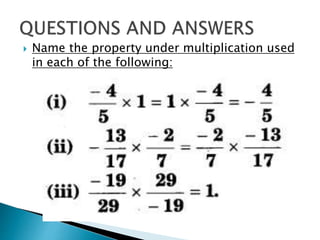
 Name the property under multiplication used
in each of the following:
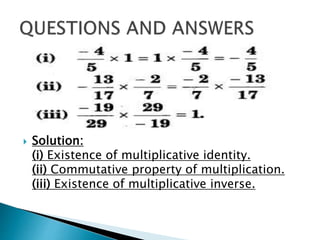
 Solution:
(i) Existence of multiplicative identity.
(ii) Commutative property of multiplication.
(iii) Existence of multiplicative inverse.
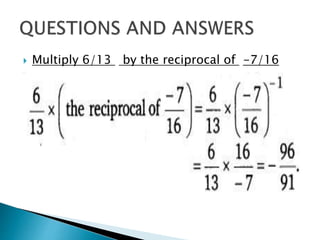
 Multiply 6/13 by the reciprocal of -7/16
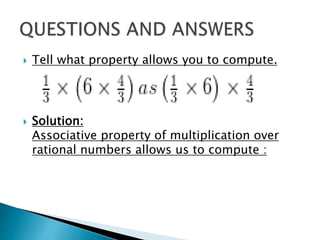
 Tell what property allows you to compute.
 Solution:
Associative property of multiplication over
rational numbers allows us to compute :
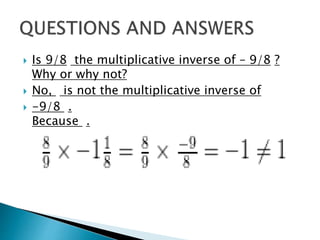
 Is 9/8 the multiplicative inverse of – 9/8 ?
Why or why not?
 No, is not the multiplicative inverse of
 -9/8 .
Because .
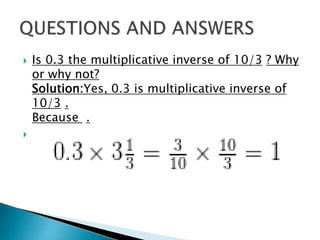
 Is 0.3 the multiplicative inverse of 10/3 ? Why
or why not?
Solution:Yes, 0.3 is multiplicative inverse of
10/3 .
Because .

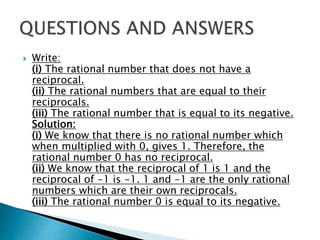
 Write:
(i) The rational number that does not have a
reciprocal.
(ii) The rational numbers that are equal to their
reciprocals.
(iii) The rational number that is equal to its negative.
Solution:
(i) We know that there is no rational number which
when multiplied with 0, gives 1. Therefore, the
rational number 0 has no reciprocal.
(ii) We know that the reciprocal of 1 is 1 and the
reciprocal of -1 is -1. 1 and -1 are the only rational
numbers which are their own reciprocals.
(iii) The rational number 0 is equal to its negative.
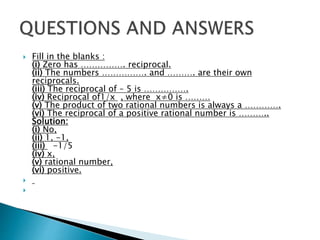
 Fill in the blanks :
(i) Zero has ……………. reciprocal.
(ii) The numbers ……………. and ………. are their own
reciprocals.
(iii) The reciprocal of – 5 is …………….
(iv) Reciprocal of1/x , where x≠0 is ………
(v) The product of two rational numbers is always a ………….
(vi) The reciprocal of a positive rational number is ………..
Solution:
(i) No,
(ii) 1, -1,
(iii) -1/5
(iv) x,
(v) rational number,
(vi) positive.


Example questions on Rational number

Example questions on Rational number

  • 1.
    Write the additiveinverse of each of the following
  • 3.
     Verify that– (-x) = x for: (i) x= 11/15 (ii) x =-13/17 Solution:
  • 4.
     Find themultiplicative inverse of the following:
  • 6.
     Name theproperty under multiplication used in each of the following:
  • 7.
     Solution: (i) Existenceof multiplicative identity. (ii) Commutative property of multiplication. (iii) Existence of multiplicative inverse.
  • 8.
     Multiply 6/13by the reciprocal of -7/16
  • 9.
     Tell whatproperty allows you to compute.  Solution: Associative property of multiplication over rational numbers allows us to compute :
  • 10.
     Is 9/8the multiplicative inverse of – 9/8 ? Why or why not?  No, is not the multiplicative inverse of  -9/8 . Because .
  • 11.
     Is 0.3the multiplicative inverse of 10/3 ? Why or why not? Solution:Yes, 0.3 is multiplicative inverse of 10/3 . Because . 
  • 12.
     Write: (i) Therational number that does not have a reciprocal. (ii) The rational numbers that are equal to their reciprocals. (iii) The rational number that is equal to its negative. Solution: (i) We know that there is no rational number which when multiplied with 0, gives 1. Therefore, the rational number 0 has no reciprocal. (ii) We know that the reciprocal of 1 is 1 and the reciprocal of -1 is -1. 1 and -1 are the only rational numbers which are their own reciprocals. (iii) The rational number 0 is equal to its negative.
  • 13.
     Fill inthe blanks : (i) Zero has ……………. reciprocal. (ii) The numbers ……………. and ………. are their own reciprocals. (iii) The reciprocal of – 5 is ……………. (iv) Reciprocal of1/x , where x≠0 is ……… (v) The product of two rational numbers is always a …………. (vi) The reciprocal of a positive rational number is ……….. Solution: (i) No, (ii) 1, -1, (iii) -1/5 (iv) x, (v) rational number, (vi) positive.  