This is an example and protected under copyright laws 2
TABLE OF
CONTENTS
3 VALUE PROPOSITION
3 Objectives
3 Define the Market Segment
3 Illustrate the Strategyzer.com
Approach
4 Provide a Sample Value
Proposition
4 Color Team Formation
4 Customer Profile Instructions
5 Ranking Hobs
6 Ranking Pains
7 Ranking Gains
8 Consolidation of Customer
Jobs
8 Consolidation of Customer
Pains
8 Consolidation of Customer
Gains
9 Value Map Instructions
10 Consolidation of Products and
Services
10 Consolidation of Pain
Relievers
10 Consolidation of Gain
Creators
11 Develop Value Proposition
for the Targeted Segment
13 Validate the Value
Proposition Fit
16 TRIGGER QUESTIONS
FOR CUSTOMER PAINS
17 TRIGGER QUESTIONS
FOR CUSTOMER GAINS
18 TRIGGER QUESTIONS
FOR GAIN CREATORS
19 TRIGGER QUESTIONS
FOR PAIN RELIEVERS
This is an example and protected under copyright laws 3
VALUE PROPOSITION PROCESS
Objectives
1. To develop a Static Value Proposition Targeted at a Specific Market Segment
2. To create a shared language of value creation in your organization
Define the Market Segment
1. The Coordinator engages all participants in a discussion to define the Market Segment for which
a Value Proposition is to be designed.
 Key questions to determine if a market fits the designation of a segment.
 Does this customer group need justify a distinct offer?
 Are they reached through different distribution channels?
 Do they require different types of relationships/agreements?
 Do they have substantially different profit and/or revenue models?
 Are they willing to pay for different aspects of the offer?
Value Proposition Explanation
1. A Value Proposition describes the benefits (value) Customers can expect from your solutions,
which are derived from your products and services.
Illustrate the Stategyzer.com Approach
1. Explain the Customer Profile
2. Explain the Value Map
3. The “fit” on paper,in the marketplace, and at the bank
4. Display the Strategyzer.com approach for all to view during the entire value proposition design
exercise.
Provide a Sample Value Proposition
1. ViVA helps Small and Medium-size Enterprises (SMEs) accelerate growth by reducing
organizational impediments, dramatically increasing the number of qualified leads and
effectively converting to actual sales.
This is an example and protected under copyright laws 4
2. Provide the build-up of ViVA’s Customer Profile
3. Provide the build-up of ViVA’s Value Map
4. Demonstrate ViVA’s Value Proposition Fit
Color Team Formation
1. Organize the participants into Color Teams of 3 to 5 players each
2. Ensure that each Team is composed of players from different corporate functions
3. Choose Group Leaders randomly (i.e., <5 years with the company, those with the longest
commute to the office, etc.)
4. Distribute a flip chart to each Team
5. Distribute different color marker and a roll of masking tape to each Team Leader
6. Distribute ‘red dot’ stickers to each participant
Customer Profile Instructions
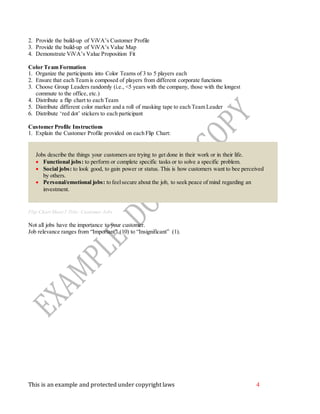
1. Explain the Customer Profile provided on each Flip Chart:
Flip Chart Sheet 1 Title: Customer Jobs
Not all jobs have the importance to your customer.
Job relevance ranges from “Important” (10) to “Insignificant” (1).
Jobs describe the things your customers are trying to get done in their work or in their life.
 Functional jobs: to perform or complete specific tasks or to solve a specific problem.
 Social jobs: to look good, to gain power or status. This is how customers want to bee perceived
by others.
 Personal/emotional jobs: to feelsecure about the job, to seek peace of mind regarding an
investment.
This is an example and protected under copyright laws 5
Ranking Jobs1
Flip
Chart
Sheet 2
Title:
Customer Pains
Pains relevance can be “Extreme” (10) or “Moderate” (1)
1
Source: Value PropositionDesign, Strategyzer Series – www.strategyzer.com
Improve skill set
and advance career
+
Important
-
Insignificant
Run “day job” well
Improve or build
a great business
Look good with
colleagues, boss and
Make decisions
with confidence
Communicate
and sell ideas
Make things people want
Convince other about
preferred methods
Stay up to date
Assess and reduce risk
Collaborate with others or
help them
Find, learn and apply
methods
Pains describe anything that annoys your customers before,during, and after trying to get a
job done. Pains describe risks or bad outcomes related to getting the job done badly or not at
all.
 Undesired outcomes and problems
 Obstacles
 Risks (undesired potential outcomes)
This is an example and protected under copyright laws 6
Ranking Pains2
Flip
Chart
Sheet 2
Title:
Customer Pains
Pains relevance can be “Extreme” (10) or “Moderate” (1)
2
Source: Value PropositionDesign, Strategyzer Series – www.strategyzer.com
Getting stuck in career of
jeopardizing it
+
Extreme
-
Moderate
Going down the wrong
path
Management “not getting
it”
Being associated with a
big failure
Lack of sufficient budget
Making things nobody
wants
Lack of time
No clear path to applying
method
Boring content that’s hard
to work through
Dealing with risk and
uncertainty
Wasting time with ideas
that don’t work
Too much theory
Pains describe anything that annoys your customers before,during, and after trying to get a
job done. Pains describe risks or bad outcomes related to getting the job done badly or not at
all.
 Undesired outcomes and problems
 Obstacles
 Risks (undesired potential outcomes)
This is an example and protected under copyright laws 7
Ranking Gains3
1. Allow the Teams 15 minutes to list on Sheet 1 of their
respective Flip Chart the Customer Jobs fromthe Customer’s
perspective
2. Allow the Teams 15 minutes to list on Sheet 2 of their respective Flip Chart the Customer Pains
fromthe Customer’s perspective
3. Allow the Teams 15 minutes to list on Sheet 3 of their respective Flip Chart the Customer Gains
fromthe Customer’s perspective
3
Source: Value PropositionDesign, Strategyzer Series – www.strategyzer.com
Helps with promotion or
pay raise
+
Essential
-
Nice to have
Buy-in from leadership
and team
Get recognized by team
Being associated with a
big failure
Lack of sufficient budget
Making things nobody
wants
Lack of time
No clear path to applying
method
Boring content that’s hard
to work through
Help when stuck
Applicable ideas
Can apply with
confidence
Easy to understand
This is an example and protected under copyright laws 8
Consolidation ofCustomer Jobs
1. Ask the Team leaders to post their respective “Customer Jobs”
(Sheet 1) on the wall
2. Each Team leader provides a description and/or an explanation
of their perceived Customer Jobs
3. The Value Proposition Coordinator engages all the participants
in crossing out duplicate Customer Jobs or in consolidating
closely related Customer Jobs
4. The Value Proposition Coordinator creates a new consolidated
numbered list of Customer Jobs
Consolidation ofCustomer Pains
1. Ask the Team leaders to post their respective “Customer Pains” (Sheet 2) on the wall
2. Each Team leader provide a description and/or an explanation of their perceived Customer Pains
3. The Value Proposition Coordinator engages all the participants
in crossing out duplicate Customer Pains or in consolidating
closely related Customer Pains
4. The Value Proposition Coordinator creates a new consolidated
numbered list of Customer Pains
Consolidation ofCustomer Pains
1. Ask the Team leaders to post their respective “Customer
Gains” (Sheet 3) on the wall
2. Each Team leader provide a description and/or an explanation of their perceived Customer Gains
3. The Value Proposition Coordinator engages all the participants in crossing out duplicate
Customer Gains or in consolidating closely related Customer Gains
4. The Value Proposition Coordinator creates a new consolidated numbered list of Customer Gains
Number Customer Jobs
1 Job…
2 Job…
3 Job…
4 Job…
5 Job…
6 Job…
Number Customer Pains
1 Pain…
2 Pain…
3 Pain…
4 Pain…
5 Pain…
6 Pain…
Number Customer Gains
1 Gain…
2 Gain…
3 Gain…
4 Gain…
5 Gain…
6 Gain…
This is an example and protected under copyright laws 9
Value Map Instructions
1. Explain the Value Map provided on each Flip Chart:
Flip Chart Sheet 4 Title: Products and Services
Not all products and services have the same relevance to your customers. They range from
“Essential” (10) to “ Nice to have” (1).
2. Flip Chart Sheet 5 Title: Pain Relievers
A pain reliever can be more or less valuable to the customer. Differentiate between “Essential” (10)
and “Nice to have” (1). Essential pain relievers address extreme issues (pains) and create a lot of
value.
3. Flip Chart Sheet 6 Title: Gain Creators
A gain creator can produce more or less relevant outcomes and benefits for your customers.
Differentiate between “Essential” (10) and “Nice to have” (1).
 Allow the Teams 15 minutes to list the Products and Services on Sheet 4 of their respective
Flip Chart
 Allow the Teams 15 minutes to list the Pain Relievers on Sheet 5 of their respective Flip
Chart
 Allow the Teams 15 minutes to list the Gains Creators on Sheet 6 of their respective Flip
Chart
Products and services form the basis upon which your value proposition is built.
 Physical/tangible (i.e., manufactured products)
 Intangible (i.e., software license, services,etc.)
 Digital (i.e., music downloads, online services)
 Financial (i.e., insurance, funds, equity, etc.)
Pain relievers describe how your products and services alleviate customer pains.
Gain Creators describe how your products and services create customer gains.
This is an example and protected under copyright laws 10
Consolidation ofProducts and Services
1. Ask the Team leaders to post their respective “Products and Services” (Sheet 4) on the wall
2. Each Team leader provide a description and/or an
explanation of their Products and Services or Solutions4
3. The Value Proposition Coordinator engages all the
participants in crossing out duplicate Products and
Services or in consolidating closely related Products and
Services
4. The Value Proposition Coordinator creates a new
consolidated numbered list of Products and Services
Consolidation ofPains Relievers
1. Ask the Team leaders to post their respective “Pain Relievers” (Sheet 5) on the wall
2. Each Team leader provide a description and/or an explanation of their perceived Pain Relievers
3. The Value Proposition Coordinator engages all the participants in crossing out duplicate Pain
Relievers or in consolidating closely related Pain Relievers
4. The Value Proposition Coordinator creates a new
consolidated numbered list of Pain Relievers
Consolidation ofGain Creators
1. Ask the Team leaders to post their respective “Gain
Creators” (Sheet 6) on the wall
2. Each Team leader provide a description and/or an
explanation of their perceived Gains Creators
3. The Value Proposition Coordinator engages all the
participants in crossing out duplicate Gain Creators or
in consolidating closely related Gain Creators
4. The Value Proposition Coordinator creates a new
consolidated numbered list of Gain Creators
4
A Solution represents a combination ofproduct/service for a specific need.
Number Products and Services
1 Product/Service…
2 Product/Service…
3 Product/Service…
4 Product/Service…
5 Product/Service…
6 Product/Service…
7 Product/Service…
Number Pain Relievers
1 Pain Reliever…
2 Pain Reliever…
3 Pain Reliever…
4 Pain Reliever…
5 Pain Reliever…
6 Pain Reliever…
7 Pain Reliever…
Number Gain Creators
1 Gain Creator…
2 Gain Creator…
3 Gain Creator…
4 Gain Creator…
5 Gain Creator…
6 Gain Creator…
7 Gain Creator…
This is an example and protected under copyright laws 11
Energy Heat Mapping Exercise
– Customer Profile
1. Customer Jobs: Each participant is given an
opportunity to place 4 red dots on their own top
rated Customer Jobs5
2. The Coordinator engages all the participants in
reviewing and numerically ranking the Customer
Jobs based on the energy created by the red dot
positions
3. Customer Pains: participant is given an opportunity to place 4 red dots on their own top rated
Customer Pains
4. The Coordinator engages all the participants in
reviewing and numerically ranking the Customer
Pains based on the energy created by the red dot
positions
5. Customer Gains: participant is given an opportunity
to place 4 red dots on their own top rated Customer
Gains
6. The Coordinator engages all the participants in
reviewing and numerically ranking the Customer
Gains based on the energy created by the red dot
positions
5
Jobs shouldbe prioritizedby importance to customerandvalidatedagainst our own offeringspace.
Number Customer Jobs Number of Red Dots
1 Job… 12
2 Job… 2
3 Job… 10
4 Job… 6
5 Job… 2
6 Job… 3
7 Job… 1
[3 Teams with 3 participants and4 red dots each=36 dots]
Number Customer Pains Number of Red Dots
1 Pain… 14
2 Pain… 1
3 Pain… 8
4 Pain… 5
5 Pain… 5
6 Pain… 1
7 Pain… 1
[3 Teams with 3 participants and4 red dots each=36 dots]
Number Customer Gains Number of Red Dots
1 Gain… 7
2 Gain… 10
3 Gain… 8
4 Gain… 3
5 Gain… 2
6 Gain… 4
7 Gain… 2
[3 Teams with 3 participants and4 red dots each=36 dots]
This is an example and protected under copyright laws 12
Value Map Matching Exercise6
1. Products and Services: Team Leaders engage their respective team members in matching the
Products and Services with the prioritized (i.e., the top 3 as
in 14.2 above) Customer Jobs.
2. The Coordinator engages all the participants in reviewing
and ranking the Products and Services based on the energy
created by the red dot positions
3. Insert Products and Services List, number each
Top Jobs: Number Top Rated Jobs (Red Dots)
P&S/Jobs
Matches
1 2 3 4 5 6 7
1 Job…(12) 1 2 4 5 7
3 Job…(10) 1 3 4 6
4 Job…(6) 1 3 4 5
4. Pains Relievers: Team Leaders engage their respective team members in matching the Pain
Relievers with the prioritized (i.e., the top 5 as in 14.4 above) Customer Pains
5. The Coordinator engages all the participants in reviewing and ranking the Customer Pains based
on the energy created by the red dot positions
Pains: Priority Top Rated Pains (Red Dots)
Pain Relievers/ Pains
Matches
1 2 3 4 5 6 7
1 Pain…(14) 1 2 4 5 6 7
3 Pain…(8) 2 3 4 5 7
4 Pain…(5) 1 2 3 5 6
5 Pain… (5) 3 4 5 6 7
6
This exercise is appropriateforunexploredmarket segments where insufficient data is available. Forexistingmarkets, use historical
sales data.
Number Products and Services
1 Product/Service
2 Product/Service
3 Product/Service
4 Product/Service
5 Product/Service
6 Product/Service
7 Product/Service
Number Pain Relievers
1 Pain Reliever
2 Pain Reliever
3 Pain Reliever
4 Pain Reliever
5 Pain Reliever
6 Pain Reliever
7 Pain Reliever
Number Gain Creators
This is an example and protected under copyright laws 13
6. Gain Creators: Team Leaders engage their respective team
members in matching the Pain Relievers with the
prioritized (i.e., the top 3 as in 14.6 above) Customer
Gains
7. The Coordinator engages all the participants in reviewing
and ranking the Customer Gains based on the energy
created by the red dot positions
Gains: Priority Top Rated Gains (Red Dots)
Gain Creators/ Gains
Matches
1 2 3 4 5 6 7
1 Gain…(14) 1 2 3 5 6
3 Gain…(8) 1 4 5 6 7
4 Gain…(5) 1 3 4 5 6
Develop Value Proposition for the Targeted Segment
Our help(s) who want to
by and .
Products and services Customer segment Jobs to be done
Your own verb
(reducing,
avoiding, etc.)
Your own verb
(increasing,
enabling, etc.)
1 Gain Creator…
2 Gain Creator…
3 Gain Creator…
4 Gain Creator…
5 Gain Creator…
6 Gain Creator…
7 Gain Creator…
This is an example and protected under copyright laws 14
Validate the Value Proposition Fit
You achieve fit when customers get excited about your value proposition, which happens when you
address important jobs, alleviate extreme pains, and create essentialgains that customers care about.
 Customers expect and desire a lot from products and services. Yet,they also know they cant’
have it all. Focus on those gains that matter most to customers and make a difference
 Customers have a lot of pains. No organization can reasonably address all of them. Focus on
those headaches that matter most and are insufficiently addressed.
 Your customers are the judge, jury, and executioner of your value proposition. They will be
merciless if you don’t find fit!
On Paper: the Problem-Solution Fit. This is today’s exercise.
At this stage you don’t yet have evidence that customers actually care about your value proposition.
However,if you can match your products and services to the most important jobs, and link your
gain creators to the most essential gains and your pain relievers to the most extreme pains – you
have a fit on paper.
This is an example and protected under copyright laws 15
In the Market: Product-Market Fit. Are we creating qualified leads?
Product-market fit takes place when you…
 Have evidence that your products and services,pain relievers, and gain creators are actually
creating customer value and getting traction in the market
Adjustment of your value proposition will be necessary as you validate or invalidate your market fit
over time.
At the Bank (Sales): BusinessModel Fit. Are we new generating sales?
Business model fit takes place when you…
 Have evidence that your value proposition can be embedded in a profitable and scalable
business model.
This is an example and protected under copyright laws 16
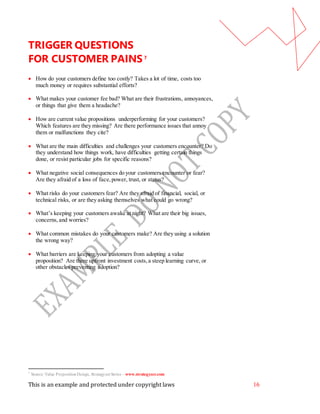
TRIGGER QUESTIONS
FOR CUSTOMER PAINS7
 How do your customers define too costly? Takes a lot of time, costs too
much money or requires substantial efforts?
 What makes your customer fee bad? What are their frustrations, annoyances,
or things that give them a headache?
 How are current value propositions underperforming for your customers?
Which features are they missing? Are there performance issues that annoy
them or malfunctions they cite?
 What are the main difficulties and challenges your customers encounter? Do
they understand how things work, have difficulties getting certain things
done, or resist particular jobs for specific reasons?
 What negative social consequences do your customers encounter or fear?
Are they afraid of a loss of face,power, trust, or status?
 What risks do your customers fear? Are they afraid of financial, social, or
technical risks, or are they asking themselves what could go wrong?
 What’s keeping your customers awake at night? What are their big issues,
concerns, and worries?
 What common mistakes do your customers make? Are they using a solution
the wrong way?
 What barriers are keeping your customers from adopting a value
proposition? Are there upfront investment costs,a steep learning curve, or
other obstacles preventing adoption?
7
Source: Value PropositionDesign, StrategyzerSeries – www.strategyzer.com
This is an example and protected under copyright laws 17
TRIGGER QUESTIONS
FOR CUSTOMER GAINS 8
 Which savings would make your customers happy? Which savings in terms
of time, money, and effort would they value?
 What quality levels do they expect, and what would they wish for more or
less of?
 How do current value propositions delight your customers? Which specific
features do they enjoy? What performance and quality do they expect?
 What would make your customers’ jobs or lives easier? Could there be a
flatter learning curve, more services, or lower costs of ownership?
 What positive social consequences do your customers desire? What makes
them look good? What increases their power or their status?
 What are customers looking for most? Are they searching for good design,
guarantees,specific or more features?
 What do customers dream about? What do they aspire to achieve, or what
would be a big relief to them?
 How do yours customers measure success and failure? How do they gauge
performance or cost?
 What would increase your customers’ likelihood of adopting a value
proposition? Do they desire lower costs, less investment, lower risk, or better
quality?
8
Source: Value PropositionDesign, StrategyzerSeries – www.strategyzer.com
This is an example and protected under copyright laws 18
TRIGGER QUESTIONS
FOR GAIN CREATORS9
Could your Productsand Services…
 Which savings would make your customers happy? Which savings in terms
of time, money, and effort would they value?
 What quality levels do they expect, and what would they wish for more or
less of?
 How do current value propositions delight your customers? Which specific
features do they enjoy? What performance and quality do they expect?
 What would make your customers’ jobs or lives easier? Could there be a
flatter learning curve, more services, or lower costs of ownership?
 What positive social consequences do your customers desire? What makes
them look good? What increases their power or their status?
 What are customers looking for most? Are they searching for good design,
guarantees,specific or more features?
 What do customers dream about? What do they aspire to achieve, or what
would be a big relief to them?
 How do yours customers measure success and failure? How do they gauge
performance or cost?
 What would increase your customers’ likelihood of adopting a value
proposition? Do they desire lower costs, less investment, lower risk, or better
quality?
9
Source: Value PropositionDesign, StrategyzerSeries – www.strategyzer.com
This is an example and protected under copyright laws 19
TRIGGER QUESTIONS
FOR PAIN RELIEVERS10
Could your Productsand Services…
 Produce savings – in terms of time, money, or efforts?
 Make your customers feelbetter – by killing frustrations, annoyances, and
other things that give customers a headache?
 Fix underperforming solutions – by introducing new features,better
performance or enhanced quality?
 Put an end to difficulties and challenges your customers encounter – by
making things easier or eliminating obstacles?
 Wipe out negative social consequences your customers encounter or fear – in
terms of loss of face or lost power, trust, or status?
 Eliminate risks your customers fear – in terms of financial, social, technical
risks, or things that could potentially go wrong?
 Help your customers sleep better at night – by addressing significant issues,
diminishing concerns,or eliminating worries?
 Limit or eradicate common mistakes customers make – by helping them use
a solution the right way?
 Eliminate barriers that are keeping your customer from adopting value
propositions – introducing lower or no upfront investment costs,a flatter
learning curve, or eliminating other obstacles prevent adoption?
10
Source: Value PropositionDesign, StrategyzerSeries – www.strategyzer.com
This is an example and protected under copyright laws 20
CUSTOMER PROFILES IN B2B
Value proposition in business-to-business (B2B) transactions typically involve several stakeholders
in the search,evaluation, purchase,and use of a product or service.
Each one has a different profile with different jobs, pains, and gains. Stakeholders can tilt the
purchasing decision in one direction or another.
Identify the most important ones and sketch out a Value Proposition Canvas for each one of them.
Stakeholders
1. Influencers
2. Recommenders
3. Economic Buyers
4. Decision Makers
5. End Users
6. Saboteurs
This is an example and protected under copyright laws 21
10 CHARACTERISTICS
OF GREAT VALUE PROPOSITIONS
1. Are embedded in great business models
2. Focus on the jobs, pains, and gains that matter most to customers
3. Focus on unsatisfied jobs, unresolved pains, and unrealized gains
4. Target few jobs, pains, and gains, but do so extremely well
5. Go beyond functional jobs and address emotional and social jobs
6. Align with how customers measure success
7. Focus on jobs, pains, and gains that a lot of people have or for which some will pay a lot of
money
8. Differentiate from competition on jobs, pains, and gains that customers care about
9. Outperform competition substantially on at least one dimension
10. Are difficult to copy

example 4

  • 2.
    This is anexample and protected under copyright laws 2 TABLE OF CONTENTS 3 VALUE PROPOSITION 3 Objectives 3 Define the Market Segment 3 Illustrate the Strategyzer.com Approach 4 Provide a Sample Value Proposition 4 Color Team Formation 4 Customer Profile Instructions 5 Ranking Hobs 6 Ranking Pains 7 Ranking Gains 8 Consolidation of Customer Jobs 8 Consolidation of Customer Pains 8 Consolidation of Customer Gains 9 Value Map Instructions 10 Consolidation of Products and Services 10 Consolidation of Pain Relievers 10 Consolidation of Gain Creators 11 Develop Value Proposition for the Targeted Segment 13 Validate the Value Proposition Fit 16 TRIGGER QUESTIONS FOR CUSTOMER PAINS 17 TRIGGER QUESTIONS FOR CUSTOMER GAINS 18 TRIGGER QUESTIONS FOR GAIN CREATORS 19 TRIGGER QUESTIONS FOR PAIN RELIEVERS
  • 3.
    This is anexample and protected under copyright laws 3 VALUE PROPOSITION PROCESS Objectives 1. To develop a Static Value Proposition Targeted at a Specific Market Segment 2. To create a shared language of value creation in your organization Define the Market Segment 1. The Coordinator engages all participants in a discussion to define the Market Segment for which a Value Proposition is to be designed.  Key questions to determine if a market fits the designation of a segment.  Does this customer group need justify a distinct offer?  Are they reached through different distribution channels?  Do they require different types of relationships/agreements?  Do they have substantially different profit and/or revenue models?  Are they willing to pay for different aspects of the offer? Value Proposition Explanation 1. A Value Proposition describes the benefits (value) Customers can expect from your solutions, which are derived from your products and services. Illustrate the Stategyzer.com Approach 1. Explain the Customer Profile 2. Explain the Value Map 3. The “fit” on paper,in the marketplace, and at the bank 4. Display the Strategyzer.com approach for all to view during the entire value proposition design exercise. Provide a Sample Value Proposition 1. ViVA helps Small and Medium-size Enterprises (SMEs) accelerate growth by reducing organizational impediments, dramatically increasing the number of qualified leads and effectively converting to actual sales.
  • 4.
    This is anexample and protected under copyright laws 4 2. Provide the build-up of ViVA’s Customer Profile 3. Provide the build-up of ViVA’s Value Map 4. Demonstrate ViVA’s Value Proposition Fit Color Team Formation 1. Organize the participants into Color Teams of 3 to 5 players each 2. Ensure that each Team is composed of players from different corporate functions 3. Choose Group Leaders randomly (i.e., <5 years with the company, those with the longest commute to the office, etc.) 4. Distribute a flip chart to each Team 5. Distribute different color marker and a roll of masking tape to each Team Leader 6. Distribute ‘red dot’ stickers to each participant Customer Profile Instructions 1. Explain the Customer Profile provided on each Flip Chart: Flip Chart Sheet 1 Title: Customer Jobs Not all jobs have the importance to your customer. Job relevance ranges from “Important” (10) to “Insignificant” (1). Jobs describe the things your customers are trying to get done in their work or in their life.  Functional jobs: to perform or complete specific tasks or to solve a specific problem.  Social jobs: to look good, to gain power or status. This is how customers want to bee perceived by others.  Personal/emotional jobs: to feelsecure about the job, to seek peace of mind regarding an investment.
  • 5.
    This is anexample and protected under copyright laws 5 Ranking Jobs1 Flip Chart Sheet 2 Title: Customer Pains Pains relevance can be “Extreme” (10) or “Moderate” (1) 1 Source: Value PropositionDesign, Strategyzer Series – www.strategyzer.com Improve skill set and advance career + Important - Insignificant Run “day job” well Improve or build a great business Look good with colleagues, boss and Make decisions with confidence Communicate and sell ideas Make things people want Convince other about preferred methods Stay up to date Assess and reduce risk Collaborate with others or help them Find, learn and apply methods Pains describe anything that annoys your customers before,during, and after trying to get a job done. Pains describe risks or bad outcomes related to getting the job done badly or not at all.  Undesired outcomes and problems  Obstacles  Risks (undesired potential outcomes)
  • 6.
    This is anexample and protected under copyright laws 6 Ranking Pains2 Flip Chart Sheet 2 Title: Customer Pains Pains relevance can be “Extreme” (10) or “Moderate” (1) 2 Source: Value PropositionDesign, Strategyzer Series – www.strategyzer.com Getting stuck in career of jeopardizing it + Extreme - Moderate Going down the wrong path Management “not getting it” Being associated with a big failure Lack of sufficient budget Making things nobody wants Lack of time No clear path to applying method Boring content that’s hard to work through Dealing with risk and uncertainty Wasting time with ideas that don’t work Too much theory Pains describe anything that annoys your customers before,during, and after trying to get a job done. Pains describe risks or bad outcomes related to getting the job done badly or not at all.  Undesired outcomes and problems  Obstacles  Risks (undesired potential outcomes)
  • 7.
    This is anexample and protected under copyright laws 7 Ranking Gains3 1. Allow the Teams 15 minutes to list on Sheet 1 of their respective Flip Chart the Customer Jobs fromthe Customer’s perspective 2. Allow the Teams 15 minutes to list on Sheet 2 of their respective Flip Chart the Customer Pains fromthe Customer’s perspective 3. Allow the Teams 15 minutes to list on Sheet 3 of their respective Flip Chart the Customer Gains fromthe Customer’s perspective 3 Source: Value PropositionDesign, Strategyzer Series – www.strategyzer.com Helps with promotion or pay raise + Essential - Nice to have Buy-in from leadership and team Get recognized by team Being associated with a big failure Lack of sufficient budget Making things nobody wants Lack of time No clear path to applying method Boring content that’s hard to work through Help when stuck Applicable ideas Can apply with confidence Easy to understand
  • 8.
    This is anexample and protected under copyright laws 8 Consolidation ofCustomer Jobs 1. Ask the Team leaders to post their respective “Customer Jobs” (Sheet 1) on the wall 2. Each Team leader provides a description and/or an explanation of their perceived Customer Jobs 3. The Value Proposition Coordinator engages all the participants in crossing out duplicate Customer Jobs or in consolidating closely related Customer Jobs 4. The Value Proposition Coordinator creates a new consolidated numbered list of Customer Jobs Consolidation ofCustomer Pains 1. Ask the Team leaders to post their respective “Customer Pains” (Sheet 2) on the wall 2. Each Team leader provide a description and/or an explanation of their perceived Customer Pains 3. The Value Proposition Coordinator engages all the participants in crossing out duplicate Customer Pains or in consolidating closely related Customer Pains 4. The Value Proposition Coordinator creates a new consolidated numbered list of Customer Pains Consolidation ofCustomer Pains 1. Ask the Team leaders to post their respective “Customer Gains” (Sheet 3) on the wall 2. Each Team leader provide a description and/or an explanation of their perceived Customer Gains 3. The Value Proposition Coordinator engages all the participants in crossing out duplicate Customer Gains or in consolidating closely related Customer Gains 4. The Value Proposition Coordinator creates a new consolidated numbered list of Customer Gains Number Customer Jobs 1 Job… 2 Job… 3 Job… 4 Job… 5 Job… 6 Job… Number Customer Pains 1 Pain… 2 Pain… 3 Pain… 4 Pain… 5 Pain… 6 Pain… Number Customer Gains 1 Gain… 2 Gain… 3 Gain… 4 Gain… 5 Gain… 6 Gain…
  • 9.
    This is anexample and protected under copyright laws 9 Value Map Instructions 1. Explain the Value Map provided on each Flip Chart: Flip Chart Sheet 4 Title: Products and Services Not all products and services have the same relevance to your customers. They range from “Essential” (10) to “ Nice to have” (1). 2. Flip Chart Sheet 5 Title: Pain Relievers A pain reliever can be more or less valuable to the customer. Differentiate between “Essential” (10) and “Nice to have” (1). Essential pain relievers address extreme issues (pains) and create a lot of value. 3. Flip Chart Sheet 6 Title: Gain Creators A gain creator can produce more or less relevant outcomes and benefits for your customers. Differentiate between “Essential” (10) and “Nice to have” (1).  Allow the Teams 15 minutes to list the Products and Services on Sheet 4 of their respective Flip Chart  Allow the Teams 15 minutes to list the Pain Relievers on Sheet 5 of their respective Flip Chart  Allow the Teams 15 minutes to list the Gains Creators on Sheet 6 of their respective Flip Chart Products and services form the basis upon which your value proposition is built.  Physical/tangible (i.e., manufactured products)  Intangible (i.e., software license, services,etc.)  Digital (i.e., music downloads, online services)  Financial (i.e., insurance, funds, equity, etc.) Pain relievers describe how your products and services alleviate customer pains. Gain Creators describe how your products and services create customer gains.
  • 10.
    This is anexample and protected under copyright laws 10 Consolidation ofProducts and Services 1. Ask the Team leaders to post their respective “Products and Services” (Sheet 4) on the wall 2. Each Team leader provide a description and/or an explanation of their Products and Services or Solutions4 3. The Value Proposition Coordinator engages all the participants in crossing out duplicate Products and Services or in consolidating closely related Products and Services 4. The Value Proposition Coordinator creates a new consolidated numbered list of Products and Services Consolidation ofPains Relievers 1. Ask the Team leaders to post their respective “Pain Relievers” (Sheet 5) on the wall 2. Each Team leader provide a description and/or an explanation of their perceived Pain Relievers 3. The Value Proposition Coordinator engages all the participants in crossing out duplicate Pain Relievers or in consolidating closely related Pain Relievers 4. The Value Proposition Coordinator creates a new consolidated numbered list of Pain Relievers Consolidation ofGain Creators 1. Ask the Team leaders to post their respective “Gain Creators” (Sheet 6) on the wall 2. Each Team leader provide a description and/or an explanation of their perceived Gains Creators 3. The Value Proposition Coordinator engages all the participants in crossing out duplicate Gain Creators or in consolidating closely related Gain Creators 4. The Value Proposition Coordinator creates a new consolidated numbered list of Gain Creators 4 A Solution represents a combination ofproduct/service for a specific need. Number Products and Services 1 Product/Service… 2 Product/Service… 3 Product/Service… 4 Product/Service… 5 Product/Service… 6 Product/Service… 7 Product/Service… Number Pain Relievers 1 Pain Reliever… 2 Pain Reliever… 3 Pain Reliever… 4 Pain Reliever… 5 Pain Reliever… 6 Pain Reliever… 7 Pain Reliever… Number Gain Creators 1 Gain Creator… 2 Gain Creator… 3 Gain Creator… 4 Gain Creator… 5 Gain Creator… 6 Gain Creator… 7 Gain Creator…
  • 11.
    This is anexample and protected under copyright laws 11 Energy Heat Mapping Exercise – Customer Profile 1. Customer Jobs: Each participant is given an opportunity to place 4 red dots on their own top rated Customer Jobs5 2. The Coordinator engages all the participants in reviewing and numerically ranking the Customer Jobs based on the energy created by the red dot positions 3. Customer Pains: participant is given an opportunity to place 4 red dots on their own top rated Customer Pains 4. The Coordinator engages all the participants in reviewing and numerically ranking the Customer Pains based on the energy created by the red dot positions 5. Customer Gains: participant is given an opportunity to place 4 red dots on their own top rated Customer Gains 6. The Coordinator engages all the participants in reviewing and numerically ranking the Customer Gains based on the energy created by the red dot positions 5 Jobs shouldbe prioritizedby importance to customerandvalidatedagainst our own offeringspace. Number Customer Jobs Number of Red Dots 1 Job… 12 2 Job… 2 3 Job… 10 4 Job… 6 5 Job… 2 6 Job… 3 7 Job… 1 [3 Teams with 3 participants and4 red dots each=36 dots] Number Customer Pains Number of Red Dots 1 Pain… 14 2 Pain… 1 3 Pain… 8 4 Pain… 5 5 Pain… 5 6 Pain… 1 7 Pain… 1 [3 Teams with 3 participants and4 red dots each=36 dots] Number Customer Gains Number of Red Dots 1 Gain… 7 2 Gain… 10 3 Gain… 8 4 Gain… 3 5 Gain… 2 6 Gain… 4 7 Gain… 2 [3 Teams with 3 participants and4 red dots each=36 dots]
  • 12.
    This is anexample and protected under copyright laws 12 Value Map Matching Exercise6 1. Products and Services: Team Leaders engage their respective team members in matching the Products and Services with the prioritized (i.e., the top 3 as in 14.2 above) Customer Jobs. 2. The Coordinator engages all the participants in reviewing and ranking the Products and Services based on the energy created by the red dot positions 3. Insert Products and Services List, number each Top Jobs: Number Top Rated Jobs (Red Dots) P&S/Jobs Matches 1 2 3 4 5 6 7 1 Job…(12) 1 2 4 5 7 3 Job…(10) 1 3 4 6 4 Job…(6) 1 3 4 5 4. Pains Relievers: Team Leaders engage their respective team members in matching the Pain Relievers with the prioritized (i.e., the top 5 as in 14.4 above) Customer Pains 5. The Coordinator engages all the participants in reviewing and ranking the Customer Pains based on the energy created by the red dot positions Pains: Priority Top Rated Pains (Red Dots) Pain Relievers/ Pains Matches 1 2 3 4 5 6 7 1 Pain…(14) 1 2 4 5 6 7 3 Pain…(8) 2 3 4 5 7 4 Pain…(5) 1 2 3 5 6 5 Pain… (5) 3 4 5 6 7 6 This exercise is appropriateforunexploredmarket segments where insufficient data is available. Forexistingmarkets, use historical sales data. Number Products and Services 1 Product/Service 2 Product/Service 3 Product/Service 4 Product/Service 5 Product/Service 6 Product/Service 7 Product/Service Number Pain Relievers 1 Pain Reliever 2 Pain Reliever 3 Pain Reliever 4 Pain Reliever 5 Pain Reliever 6 Pain Reliever 7 Pain Reliever Number Gain Creators
  • 13.
    This is anexample and protected under copyright laws 13 6. Gain Creators: Team Leaders engage their respective team members in matching the Pain Relievers with the prioritized (i.e., the top 3 as in 14.6 above) Customer Gains 7. The Coordinator engages all the participants in reviewing and ranking the Customer Gains based on the energy created by the red dot positions Gains: Priority Top Rated Gains (Red Dots) Gain Creators/ Gains Matches 1 2 3 4 5 6 7 1 Gain…(14) 1 2 3 5 6 3 Gain…(8) 1 4 5 6 7 4 Gain…(5) 1 3 4 5 6 Develop Value Proposition for the Targeted Segment Our help(s) who want to by and . Products and services Customer segment Jobs to be done Your own verb (reducing, avoiding, etc.) Your own verb (increasing, enabling, etc.) 1 Gain Creator… 2 Gain Creator… 3 Gain Creator… 4 Gain Creator… 5 Gain Creator… 6 Gain Creator… 7 Gain Creator…
  • 14.
    This is anexample and protected under copyright laws 14 Validate the Value Proposition Fit You achieve fit when customers get excited about your value proposition, which happens when you address important jobs, alleviate extreme pains, and create essentialgains that customers care about.  Customers expect and desire a lot from products and services. Yet,they also know they cant’ have it all. Focus on those gains that matter most to customers and make a difference  Customers have a lot of pains. No organization can reasonably address all of them. Focus on those headaches that matter most and are insufficiently addressed.  Your customers are the judge, jury, and executioner of your value proposition. They will be merciless if you don’t find fit! On Paper: the Problem-Solution Fit. This is today’s exercise. At this stage you don’t yet have evidence that customers actually care about your value proposition. However,if you can match your products and services to the most important jobs, and link your gain creators to the most essential gains and your pain relievers to the most extreme pains – you have a fit on paper.
  • 15.
    This is anexample and protected under copyright laws 15 In the Market: Product-Market Fit. Are we creating qualified leads? Product-market fit takes place when you…  Have evidence that your products and services,pain relievers, and gain creators are actually creating customer value and getting traction in the market Adjustment of your value proposition will be necessary as you validate or invalidate your market fit over time. At the Bank (Sales): BusinessModel Fit. Are we new generating sales? Business model fit takes place when you…  Have evidence that your value proposition can be embedded in a profitable and scalable business model.
  • 16.
    This is anexample and protected under copyright laws 16 TRIGGER QUESTIONS FOR CUSTOMER PAINS7  How do your customers define too costly? Takes a lot of time, costs too much money or requires substantial efforts?  What makes your customer fee bad? What are their frustrations, annoyances, or things that give them a headache?  How are current value propositions underperforming for your customers? Which features are they missing? Are there performance issues that annoy them or malfunctions they cite?  What are the main difficulties and challenges your customers encounter? Do they understand how things work, have difficulties getting certain things done, or resist particular jobs for specific reasons?  What negative social consequences do your customers encounter or fear? Are they afraid of a loss of face,power, trust, or status?  What risks do your customers fear? Are they afraid of financial, social, or technical risks, or are they asking themselves what could go wrong?  What’s keeping your customers awake at night? What are their big issues, concerns, and worries?  What common mistakes do your customers make? Are they using a solution the wrong way?  What barriers are keeping your customers from adopting a value proposition? Are there upfront investment costs,a steep learning curve, or other obstacles preventing adoption? 7 Source: Value PropositionDesign, StrategyzerSeries – www.strategyzer.com
  • 17.
    This is anexample and protected under copyright laws 17 TRIGGER QUESTIONS FOR CUSTOMER GAINS 8  Which savings would make your customers happy? Which savings in terms of time, money, and effort would they value?  What quality levels do they expect, and what would they wish for more or less of?  How do current value propositions delight your customers? Which specific features do they enjoy? What performance and quality do they expect?  What would make your customers’ jobs or lives easier? Could there be a flatter learning curve, more services, or lower costs of ownership?  What positive social consequences do your customers desire? What makes them look good? What increases their power or their status?  What are customers looking for most? Are they searching for good design, guarantees,specific or more features?  What do customers dream about? What do they aspire to achieve, or what would be a big relief to them?  How do yours customers measure success and failure? How do they gauge performance or cost?  What would increase your customers’ likelihood of adopting a value proposition? Do they desire lower costs, less investment, lower risk, or better quality? 8 Source: Value PropositionDesign, StrategyzerSeries – www.strategyzer.com
  • 18.
    This is anexample and protected under copyright laws 18 TRIGGER QUESTIONS FOR GAIN CREATORS9 Could your Productsand Services…  Which savings would make your customers happy? Which savings in terms of time, money, and effort would they value?  What quality levels do they expect, and what would they wish for more or less of?  How do current value propositions delight your customers? Which specific features do they enjoy? What performance and quality do they expect?  What would make your customers’ jobs or lives easier? Could there be a flatter learning curve, more services, or lower costs of ownership?  What positive social consequences do your customers desire? What makes them look good? What increases their power or their status?  What are customers looking for most? Are they searching for good design, guarantees,specific or more features?  What do customers dream about? What do they aspire to achieve, or what would be a big relief to them?  How do yours customers measure success and failure? How do they gauge performance or cost?  What would increase your customers’ likelihood of adopting a value proposition? Do they desire lower costs, less investment, lower risk, or better quality? 9 Source: Value PropositionDesign, StrategyzerSeries – www.strategyzer.com
  • 19.
    This is anexample and protected under copyright laws 19 TRIGGER QUESTIONS FOR PAIN RELIEVERS10 Could your Productsand Services…  Produce savings – in terms of time, money, or efforts?  Make your customers feelbetter – by killing frustrations, annoyances, and other things that give customers a headache?  Fix underperforming solutions – by introducing new features,better performance or enhanced quality?  Put an end to difficulties and challenges your customers encounter – by making things easier or eliminating obstacles?  Wipe out negative social consequences your customers encounter or fear – in terms of loss of face or lost power, trust, or status?  Eliminate risks your customers fear – in terms of financial, social, technical risks, or things that could potentially go wrong?  Help your customers sleep better at night – by addressing significant issues, diminishing concerns,or eliminating worries?  Limit or eradicate common mistakes customers make – by helping them use a solution the right way?  Eliminate barriers that are keeping your customer from adopting value propositions – introducing lower or no upfront investment costs,a flatter learning curve, or eliminating other obstacles prevent adoption? 10 Source: Value PropositionDesign, StrategyzerSeries – www.strategyzer.com
  • 20.
    This is anexample and protected under copyright laws 20 CUSTOMER PROFILES IN B2B Value proposition in business-to-business (B2B) transactions typically involve several stakeholders in the search,evaluation, purchase,and use of a product or service. Each one has a different profile with different jobs, pains, and gains. Stakeholders can tilt the purchasing decision in one direction or another. Identify the most important ones and sketch out a Value Proposition Canvas for each one of them. Stakeholders 1. Influencers 2. Recommenders 3. Economic Buyers 4. Decision Makers 5. End Users 6. Saboteurs
  • 21.
    This is anexample and protected under copyright laws 21 10 CHARACTERISTICS OF GREAT VALUE PROPOSITIONS 1. Are embedded in great business models 2. Focus on the jobs, pains, and gains that matter most to customers 3. Focus on unsatisfied jobs, unresolved pains, and unrealized gains 4. Target few jobs, pains, and gains, but do so extremely well 5. Go beyond functional jobs and address emotional and social jobs 6. Align with how customers measure success 7. Focus on jobs, pains, and gains that a lot of people have or for which some will pay a lot of money 8. Differentiate from competition on jobs, pains, and gains that customers care about 9. Outperform competition substantially on at least one dimension 10. Are difficult to copy