
Copyright © 2017, Oracle and/or its affiliates. All rights reserved. |
Exadata: Architecture
and Internals
Gurmeet Goindi
Master Product Manager, Exadata
Twitter: @ExadataPM
Copyright © 2017, Oracle and/or its affiliates. All rights reserved. |
Safe Harbor Statement
The following is intended to outline our general product direction. It is intended for
information purposes only, and may not be incorporated into any contract. It is not a
commitment to deliver any material, code, or functionality, and should not be relied upon
in making purchasing decisions. The development, release, and timing of any features or
functionality described for Oracle’s products remains at the sole discretion of Oracle.
2
Copyright © 2017, Oracle and/or its affiliates. All rights reserved. |
Exadata Database Machine
3
Performance, Availability and Security
Best Platform for Oracle Databases
on-premises and in the Cloud
Enabled by:
• Single-vendor accountability
• Exclusive focus on databases
• Deep h/w and s/w integration
• Revolutionary approach to storage
Copyright © 2017, Oracle and/or its affiliates. All rights reserved. |
Proven at Thousands of Critical Deployments since 2008
OLTP – Analytics – Data Warehousing – Mixed Workloads
Best for all Workloads
• Petabyte Warehouses
• Online Financial Trading
• Business Applications
– SAP, Oracle, Siebel, PSFT, …
• Massive DB Consolidation
• Public SaaS Clouds
4
4 OF THE TOP 5
BANKS, TELCOS, RETAILERS RUN EXADATA
Copyright © 2017, Oracle and/or its affiliates. All rights reserved. | 5
Exadata Deployment Models
Public Cloud Service
Cloud at Customer
X7-2 X7-8
On-Premises
Customer Data Center
Purchased
Customer Managed
Customer Data Center
Subscription
Oracle Managed
Oracle Cloud
Subscription
Oracle Managed
Copyright © 2017, Oracle and/or its affiliates. All rights reserved. |
Introducing Exadata X7
State-of-the-Art Hardware Integrated
with Smart Database Software
6
Copyright © 2017, Oracle and/or its affiliates. All rights reserved. |
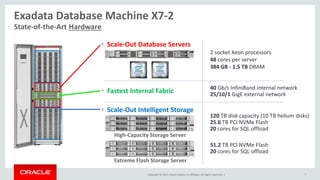
Exadata Database Machine X7-2
7
State-of-the-Art Hardware
120 TB disk capacity (10 TB helium disks)
25.6 TB PCI NVMe Flash
20 cores for SQL offload
51.2 TB PCI NVMe Flash
20 cores for SQL offload
40 Gb/s InfiniBand internal network
25/10/1 GigE external network
2 socket Xeon processors
48 cores per server
384 GB - 1.5 TB DRAM
• Scale-Out Database Servers
• Fastest Internal Fabric
• Scale-Out Intelligent Storage
High-Capacity Storage Server
Extreme Flash Storage Server
Copyright © 2017, Oracle and/or its affiliates. All rights reserved. |
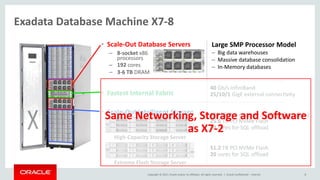
Exadata Database Machine X7-8
8
Large SMP Processor Model
– Big data warehouses
– Massive database consolidation
– In-Memory databases
Oracle Confidential – Internal
120 TB disk capacity (10 TB helium disks)
25.6 TB PCI NVMe Flash
20 cores for SQL offload
51.2 TB PCI NVMe Flash
20 cores for SQL offload
40 Gb/s InfiniBand
25/10/1 GigE external connectivity
• Scale-Out Database Servers
– 8-socket x86
processors
– 192 cores
– 3-6 TB DRAM
• Fastest Internal Fabric
• Scale-Out Intelligent Storage
High-Capacity Storage Server
Extreme Flash Storage Server
Same Networking, Storage and Software
as X7-2
Copyright © 2017, Oracle and/or its affiliates. All rights reserved. |
Configure Servers to Match Your Workload
10
Elastic Hardware Configurations
Capacity-on-Demand Software Licensing
• Enable compute cores as needed, subject to minimums
• License Oracle software for enabled cores only
*14 cores minimum per DB server (max 48 cores)
*8 cores minimum per Eighth Rack DB server (max 24 cores)
X7-2 Eighth Rack Quarter Rack
Eighth to
Qtr
Upgrade
Add
Servers
as
needed*
Full Rack
Add
racks to
continue
scaling*
* Expand older
racks with
new servers
and multi-rack
old and new
racks together
X7-8 Elastic Configuration
Copyright © 2017, Oracle and/or its affiliates. All rights reserved. |
Hot Swappable Hardware for Online Maintenance
• Flash
• Disks
• M.2 boot drive
• Power supplies
• Fans
• InfiniBand switch
• Not Hot Swappable:
– PCI cards (network, IB, HBA), CPU, Memory (bad sectors will be disabled)
11
Copyright © 2017, Oracle and/or its affiliates. All rights reserved. | 12
Exadata Smart Software
Unique Differentiators for Analytics,
OLTP and Consolidation
Copyright © 2017, Oracle and/or its affiliates. All rights reserved. |
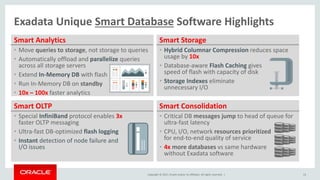
Smart Analytics
• Move queries to storage, not storage to queries
• Automatically offload and parallelize queries
across all storage servers
• Extend In-Memory DB with flash
• Run In-Memory DB on standby
• 10x – 100x faster analytics
Smart Storage
• Hybrid Columnar Compression reduces space
usage by 10x
• Database-aware Flash Caching gives
speed of flash with capacity of disk
• Storage Indexes eliminate
unnecessary I/O
13
Smart OLTP
• Special InfiniBand protocol enables 3x
faster OLTP messaging
• Ultra-fast DB-optimized flash logging
• Instant detection of node failure and
I/O issues
Smart Consolidation
• Critical DB messages jump to head of queue for
ultra-fast latency
• CPU, I/O, network resources prioritized
for end-to-end quality of service
• 4x more databases vs same hardware
without Exadata software
Exadata Unique Smart Database Software Highlights
Copyright © 2017, Oracle and/or its affiliates. All rights reserved. |
Dozens of Additional Smart Database Capabilities
14
Smart Analytics
• Storage Index data skipping
• Storage offload for min/max
operations
• Data mining storage offload
• Storage offload for LOBs and CLOBs
• Auto flash caching for table scans
• Reverse offload to DB servers
• Offload index fast full scans
• Offloads scans on encrypted data,
with FIPS compliance
• Active bonding of InfiniBand
• Instant data file creation
Smart OLTP
• Smart network packet prioritization
• I/O Prioritization by DB, User, or
workload to ensure QOS
• Active AWR includes storage stats for
end to end monitoring
• Write-back Flash Cache
• Cell-to-cell rebalance preserving Flash
Cache
• Secure disk and flash erase
• Database scoped security
• Full-stack security scanning
• Exachk full-stack validation
• NVMe flash interface for lowest
latency I/O
Smart Availability
• In-Memory fault tolerance
• Offload backups to storage
• Prioritize rebalance of critical files
• Elimination of false drive failures
• Flash and disk life cycle mgmt alert
• Avoid reading predictive failed
disks
• Cell software transparent restart
• I/O hang hardening
• Prevent shutdown if mirror server
is down
• Confinement of temporarily poor
performing drives
Copyright © 2017, Oracle and/or its affiliates. All rights reserved. |
Best Performance
15
Copyright © 2017, Oracle and/or its affiliates. All rights reserved. |
Exadata X7-2 and X7-8 Performance Improvements
• 350 GB/sec I/O Throughput
– 17% more (vs Exadata X6)
• 5.97 Million OLTP Read IOPS
– 50% more IOPS (vs Exadata X6) under 250 µsec = 3.5M
• 40% CPU improvement for Analytics
• 20% CPU improvement for OLTP
– 40% on X7-8 (vs Exadata X6-8)
• Dramatically faster than leading all-flash arrays in
every metric
16
Each rack has up to:
• 1.7 PB Disk
• 720 TB NVMe Flash
Copyright © 2017, Oracle and/or its affiliates. All rights reserved. |
Best Data Warehouse
17
Copyright © 2017, Oracle and/or its affiliates. All rights reserved. |
Latest Flash Creates Giant Bottleneck for Shared Storage
18
SAN Link = 40 Gb/s
5 GB/sec
Less than 1 Flash card
But Should Achieve
5.5GB * 480 Drives = 2,640 GB/sec
Latest PCIe Flash
5.5 GB/sec
480 Flash Drive EMC Array
38 GB/sec
Copyright © 2017, Oracle and/or its affiliates. All rights reserved. |
Exadata Approaches Memory Speed with Shared Flash
• Architecturally, storage arrays can share Flash capacity but
not Flash performance
– Even with next gen scale-out, PCIe networks, or NVMe over fabric
– Network is the bottleneck
• Must move compute to data to achieve full Flash potential
– Requires owning full stack; can’t be solved in storage alone
• Exadata X7 delivers 350 GB/s Flash bandwidth to any server
– Approaches 800 GB/s aggregate DRAM bandwidth of DB servers
19
Exadata
DB Servers
Exadata
Smart Storage
InfiniBand Query
Offload
Copyright © 2017, Oracle and/or its affiliates. All rights reserved. |
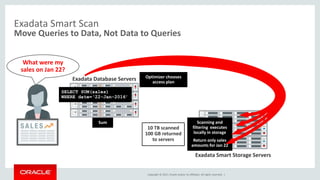
What were my
sales on Jan 22?
Exadata Database Servers
Exadata Smart Storage Servers
Scanning and
filtering executes
locally in storage
Return only sales
amounts for Jan 22
10 TB scanned
100 GB returned
to servers
Sum
SELECT SUM(sales)
WHERE date=‘22-Jan-2016’
Optimizer chooses
access plan
Exadata Smart Scan
Move Queries to Data, Not Data to Queries
Copyright © 2017, Oracle and/or its affiliates. All rights reserved. |
Benefits of Exadata Smart Scan
• Intelligent storage reduces communication traffic by orders of magnitude
– Eliminates all three bottlenecks: getting data out of storage, across SAN, and into any server
• CPU cost of scanning, decrypting, decompressing, filtering, and projecting data is
offloaded to storage
• Queries are parallelized across all storage servers for further speedup
• End result is Exadata achieves over 300 GB/s query throughput from flash per rack
– Dramatically more than fastest all-flash scale-out storage
21
Copyright © 2017, Oracle and/or its affiliates. All rights reserved. |
Exadata Smart Scan – Not Just Query Offloading
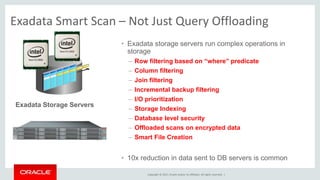
• Exadata storage servers run complex operations in
storage
– Row filtering based on “where” predicate
– Column filtering
– Join filtering
– Incremental backup filtering
– I/O prioritization
– Storage Indexing
– Database level security
– Offloaded scans on encrypted data
– Smart File Creation
• 10x reduction in data sent to DB servers is common
Exadata Storage Servers
Copyright © 2017, Oracle and/or its affiliates. All rights reserved. |
What can’t be off-loaded?
• Most table scans are off-loadable
– Limitations on large number of columns for row-major tables
– In 11.2, no LOBs
• Inline LOBs are supported in 12.1
– Functions that need RDBMS support
• PL/SQL, system functions, aggregates, analytics
• v$sqlfn_metadata, offloadable = ‘NO’
– BUT still get some benefit from offload if some offloadable predicates
• Also with no predicates but few columns selected
• Even Select * with HCC because decompression is offloaded
Copyright © 2017, Oracle and/or its affiliates. All rights reserved. |
Storage Index - Motivation
A B C D
3
1
2
9
8
8
6
7
5
Min B = 1
Max B = 3
Min B = 8
Max B = 9
Min B = 5
Max B = 7
• Smart Scans:
– DB sends list of table extents along with the
predicate to the Exadata storage cells
– Exadata cells read the table extents, apply predicate
on the read data and only return back filtered
results
– Network IO (as perceived by Database) is reduced
drastically – DB CPU usage also reduces
– But we are still performing disk IO on Exadata
storage cells
• Can we reduce disk IO too ?
Select * from table where B=6
Copyright © 2017, Oracle and/or its affiliates. All rights reserved. |
Storage (Anti)- Index
A B C
9 3
10 1
8 2
11 9
10 8
10 8
Min B = 5
Max B = 7
• Storage Index helps filter out data on disk
(whereas Index helps find data)
• Array on –in-memory entries (called region
Indexes)
• Each region index stores column summaries
(eg min/max) for 1MB region on disk
• Transparent to the database and maintained
automatically
• Min/Max can help eliminate IOs if data cannot
match the where clause
Select * from table where B=6
Region Index
A B C D
3
1
2
9
8
8
6
7
5
Min B = 8
Max B = 9
Min B = 1
Max B = 3
Copyright © 2017, Oracle and/or its affiliates. All rights reserved. |
Exadata Smart Flash Cache
• Understands different types of I/Os from database
– Skips caching I/Os to backups, data pump I/O, archive logs, tablespace
formatting
– Caches Control File Reads and Writes, file headers, data and index blocks
• Immediately adapts to changing workloads
– Unlike tiering that relies on historical statistics and is slow to move
– Tiering caches yesterday’s hot data not today’s
– Tiering uses large chunks (1MB) while cache responds faster with 64KB chunks
• Write-back flash cache
– Caches writes from the database not just reads
• RAC-aware from day one
• Doesn’t need to mirror in flash for read intensive workloads
26
Copyright © 2017, Oracle and/or its affiliates. All rights reserved. |
Exadata I/O Elimination
Copyright © 2017, Oracle and/or its affiliates. All rights reserved. |
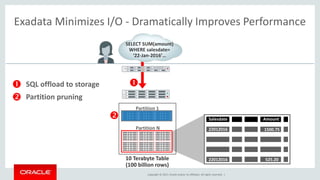
1. SQL offload to storage
Exadata Minimizes I/O - Dramatically Improves Performance
22012016 1500.75
22012016 525.20
Partition 1
Partition N
Salesdate Amount

SELECT SUM(amount)
WHERE salesdate=
‘22-Jan-2016’…

10 Terabyte Table
(100 billion rows)
Salesdate Amount
Copyright © 2017, Oracle and/or its affiliates. All rights reserved. |
Exadata Minimizes I/O - Dramatically Improves Performance
22012016 1500.75
22012016 525.20
Partition 1
Partition N

 Salesdate Amount
1. SQL offload to storage
2. Partition pruning
SELECT SUM(amount)
WHERE salesdate=
‘22-Jan-2016’…


10 Terabyte Table
(100 billion rows)
Copyright © 2017, Oracle and/or its affiliates. All rights reserved. |
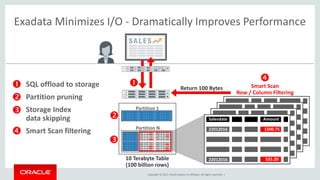
Exadata Minimizes I/O - Dramatically Improves Performance
1. SQL offload to storage
2. Partition pruning
3. Storage Index
data skipping
22012016 1500.75
22012016 525.20
Partition 1
Partition N


 Salesdate Amount
SELECT SUM(amount)
WHERE salesdate=
‘22-Jan-2016’…



10 Terabyte Table
(100 billion rows)
Salesdate Amount
Copyright © 2017, Oracle and/or its affiliates. All rights reserved. |
Exadata Minimizes I/O - Dramatically Improves Performance
1. SQL offload to storage
2. Partition pruning
3. Storage Index
data skipping
4. Smart Scan filtering 22012016 1500.75
22012016 525.20
Smart Scan
Row / Column Filtering
10 Terabyte Table
(100 billion rows)




Return 100 Bytes
Salesdate Amount
Partition 1
Partition N




Salesdate Amount
Copyright © 2017, Oracle and/or its affiliates. All rights reserved. |
Benefits Multiply with Parallel Architecture
SELECT SUM(amount)
WHERE salesdate=
‘22-Jan-2016’…
Exadata Scale-Out Storage
Copyright © 2017, Oracle and/or its affiliates. All rights reserved. |
Exadata Flash Delivers Lowest Latency in the Industry
SELECT SUM(amount)
WHERE salesdate=
‘22-Jan-2016’…
12.8 TB
Flash Cache
36 TB Disk
Usable Capacity
36 TB Disk
Usable Capacity
36 TB Disk
Usable Capacity
12.8 TB
Flash Cache
12.8 TB
Flash Cache
NVMe NVMe
Smart Flash Cache
algorithms optimize
flash capacity based
on type of I/O
Copyright © 2017, Oracle and/or its affiliates. All rights reserved. |
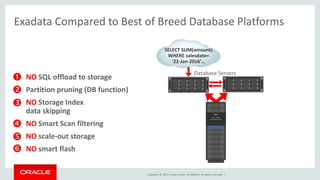
Exadata Compared to Best of Breed Database Platforms
SELECT SUM(amount)
WHERE salesdate=
‘22-Jan-2016’…
Database Servers
1. NO SQL offload to storage
2. Partition pruning (DB function)
3. NO Storage Index
data skipping
4. NO Smart Scan filtering
5. NO scale-out storage
6. NO smart flash






Copyright © 2017, Oracle and/or its affiliates. All rights reserved. |
Columnar Formats Are Great for Analytics and Compression
• Columnar format stores the data in each column together
rather than the data in each row
• Columnar format is great for Analytics
– Enables fast scans of columns relevant to a query
• Columnar format is great for Compression
– Values within a column are much more similar than
across
• Pure Columnar format is horrible for Random Row Access
– Requires an I/O for each column in a row rather than
a single I/O for the entire row
– 100x slower random row access – Columnar Cliff
35
Column Format Data
Copyright © 2017, Oracle and/or its affiliates. All rights reserved. |
Hybrid Columnar Compression Overview
• Organize columns into sets of a few thousand rows
– Compression Units (CUs)
• Within CU, data is organized by column, then compressed
– Get all the compression benefits of full columnar format
– For analytics, compression greatly reduces I/O, and
the columnar format reduces CPU
• Each CU is small enough to be read from storage in a
small number of I/O operations (usually 2)
– Random row access requires one or two I/Os per row,
instead of one I/O for each column
CU
CU
CU
Copyright © 2017, Oracle and/or its affiliates. All rights reserved. |
Benefits of Hybrid Columnar Compression
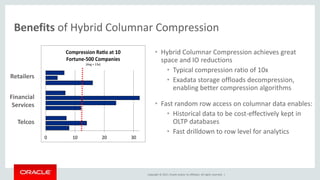
• Hybrid Columnar Compression achieves great
space and IO reductions
• Typical compression ratio of 10x
• Exadata storage offloads decompression,
enabling better compression algorithms
• Fast random row access on columnar data enables:
• Historical data to be cost-effectively kept in
OLTP databases
• Fast drilldown to row level for analytics
Retailers
Telcos
Financial
Services
Copyright © 2017, Oracle and/or its affiliates. All rights reserved. |
Hybrid Columnar Compression
• Fully supported with…
– B-Tree, Bitmap Indexes, Text indexes
– Materialized Views
– Exadata Server and Cells including offload
– Partitioning
– Parallel Query, PDML, PDDL
– Schema Evolution support, online, metadata-only add/drop columns
– Data Guard Physical Standby Support
38
Business as Usual
Copyright © 2017, Oracle and/or its affiliates. All rights reserved. |
Compression Benefits Multiply Across Stack
• 10x less Storage
• 10x better Disk Bandwidth
• 10x more data in Flash Cache
• 10x more data in Database DRAM Cache
• 10x smaller Test DB, Dev DB, DR DB
• 10x smaller Backup
Test Dev DR
Storage Array Compression
Only Achieves a Fraction of
These Benefits
Copyright © 2017, Oracle and/or its affiliates. All rights reserved. |
Seamless Integration of Big Data, NoSQL and Relational Data
40
Pushes Data Filtering to Each Store
• Like Exadata Smart Scan
• Not restricted to Oracle Hardware
Big Data SQL
• Data Warehouses are being supplemented by
specialized Multi-model Big Data stores
– Creates silos of isolated data and incompatible access
• Oracle Big Data SQL provides Transparent,
Massively Parallel Queries across Oracle, NoSQL and
Hadoop/Spark
– Full Oracle SQL capabilities across data stores
– Much faster and more expressive than Hadoop/Spark
Copyright © 2017, Oracle and/or its affiliates. All rights reserved. |
Best OLTP
41
Copyright © 2017, Oracle and/or its affiliates. All rights reserved. |
Typical OLTP IO Path
42
Storage Controller Storage Controller
SAN/LAN
Cache Fusion
SCSI
Proprietary
Protocols
and/or SCSI
RDBMS
OS
NW Stack
Device Drivers
HBA/NIC
RDBMS
OS
NW Stack
Device Drivers
HBA/NIC
Switch Fabric
Storage Controller
SW
Storage Controller
SW
Persistent
Storage
Hardware View Software View
Copyright © 2017, Oracle and/or its affiliates. All rights reserved. |
Traditional Networking Stacks Delay OLTP Messages
• OLTP messages are small and relatively simple, so they require little time
to transfer over the network and execute on the destination
• Most of the processing time for OLTP messages is due to the CPU and OS
overhead of traversing the complex multi-layer network protocol stack
– Both on the source and destination
43
Network Stack Hardware
Database
Copyright © 2017, Oracle and/or its affiliates. All rights reserved. |
Exafusion Direct-to-Wire Protocol
44
• Exafusion is a light-weight datagram oriented protocol custom designed for
critical OLTP messages on Exadata’s OS, firmware, and InfiniBand hardware
• Exafusion does not need to support other message types or hardware stacks
– Therefore is able to call InfiniBand hardware directly, bypassing networking stack
Network Stack Hardware
Database
Copyright © 2017, Oracle and/or its affiliates. All rights reserved. |
Mixed Workload Degrade OLTP Response Times
• OLTP often runs concurrently with high
throughput workloads
–Database consolidation, batch, real-time analytics,
reporting, backups
• However, high throughput workloads can
severely degrade OLTP
–They create long network queues, delaying critical
OLTP messages
45
Only OLTP
Mixed Workload
Copyright © 2017, Oracle and/or its affiliates. All rights reserved. |
Exadata Network Resource Management
• Database tags messages that require low-latency
– Log writes, cache-fusion messages, locks, etc.
• Low-latency messages bypass all other messages
– Reporting, backups, batch, etc.
– Even partially sent messages are bypassed
• Exadata accelerates low-latency messages in all layers:
database, network cards, switches, and storage
– Otherwise bottleneck just moves
46
BYPASS LANE
Copyright © 2017, Oracle and/or its affiliates. All rights reserved. |
Exadata Smart Flash Log
• Smart Flash Log uses flash as a parallel
write cache to disk controller cache
• Whichever write completes first wins
(disk or flash)
• Reduces response time and outliers
– “log file parallel write” histogram improves
– Greatly improves “log file sync”
• Uses almost no flash capacity (< 0.1%)
• Completely automatic and transparent
47
Smart Logging = Off
Txn
Response
Time
(ms)
Smart Logging = On
Outliers
Outliers
Outliers
No Outliers
Parallel
Log Writes
(first wins)
Copyright © 2017, Oracle and/or its affiliates. All rights reserved. |
Transferring Hot Database Blocks Slows OLTP
• OLTP workloads can have hot blocks
that are frequently updated
• Before transferring a block between nodes, all
changes to the block must be written to the log
– Ensures changes are not lost due to a node crash
• Waiting for a log write to complete
delays critical OLTP communication
48
1. Issue log write
2. Wait for log
write completion
3. Transfer
block
Copyright © 2017, Oracle and/or its affiliates. All rights reserved. |
New: Smart Fusion Block Transfer
49
• Exadata eliminates the wait for log write
completion before transferring a block
• Destination node can modify block but will wait
at commit time if log write has not completed
– Enabled by Exadata’s unique tracking of log writes
across nodes
1. Issue log write
2. Wait for log
write completion
3. Transfer
block
Exadata Avoids
I/O Wait

Copyright © 2017, Oracle and/or its affiliates. All rights reserved. |
OLTP: Exadata Brings In-Memory OLTP to Storage
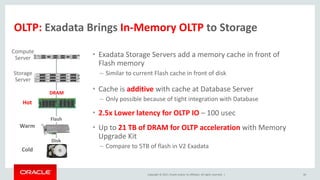
• Exadata Storage Servers add a memory cache in front of
Flash memory
– Similar to current Flash cache in front of disk
• Cache is additive with cache at Database Server
– Only possible because of tight integration with Database
• 2.5x Lower latency for OLTP IO – 100 usec
• Up to 21 TB of DRAM for OLTP acceleration with Memory
Upgrade Kit
– Compare to 5TB of flash in V2 Exadata
50
Compute
Server
Storage
Server
Hot
Warm
Cold
Flash
DRAM
Disk
Copyright © 2017, Oracle and/or its affiliates. All rights reserved. |
In-Memory OLTP Acceleration – Journey of a Database Block
DB Buffer Cache
In-Memory OLTP
Cache
Flash Cache
Hard Disk Drive
Oracle Confidential – Internal 51
DB Buffer Cache
In-Memory OLTP
Cache
Flash Cache
Hard Disk Drive
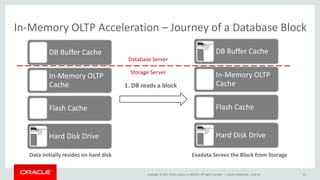
1. DB reads a block
Exadata Serves the Block from Storage
Data initially resides on hard disk
Database Server
Storage Server
Copyright © 2017, Oracle and/or its affiliates. All rights reserved. |
In-Memory OLTP Acceleration – Journey of a Database Block
DB Buffer Cache
In-Memory OLTP
Cache
Flash Cache
Hard Disk Drive
Oracle Confidential – Internal 52
DB Buffer Cache
In-Memory OLTP
Cache
Flash Cache
Hard Disk Drive
2. Flash Cache Gets
Populated
Database Server
Storage Server
Copyright © 2017, Oracle and/or its affiliates. All rights reserved. |
In-Memory OLTP Acceleration – Journey of a Database Block
DB Buffer Cache
In-Memory OLTP
Cache
Flash Cache
Hard Disk Drive
Oracle Confidential – Internal 53
DB Buffer Cache
In-Memory OLTP
Cache
Flash Cache
Hard Disk Drive
3. Database evicts
the block
Exadata Caches the block in In-Memory
OLTP Cache
Database Server
Storage Server
Copyright © 2017, Oracle and/or its affiliates. All rights reserved. |
In-Memory OLTP Acceleration – Journey of a Database Block
DB Buffer Cache
In-Memory OLTP
Cache
Flash Cache
Hard Disk Drive
Oracle Confidential – Internal 54
DB Buffer Cache
In-Memory OLTP
Cache
Flash Cache
Hard Disk Drive
4. Database reads the
same block again
Exadata serves the block from In-
Memory OLTP Cache with 100us latency
Database Server
Storage Server
Copyright © 2017, Oracle and/or its affiliates. All rights reserved. |
In-Memory OLTP Acceleration
DB Buffer Cache
In-Memory OLTP
Cache
Flash Cache
Hard Disk Drive
Oracle Confidential – Internal 55
DB Buffer Cache
In-Memory OLTP
Cache
Flash Cache
Hard Disk Drive
Data is never in DB Buffer Cache or In Memory OLTP Cache at the same time
Database Server
Storage Server
Copyright © 2017, Oracle and/or its affiliates. All rights reserved. |
Best Consolidation
56
Copyright © 2017, Oracle and/or its affiliates. All rights reserved. |
Consolidation Challenges
• Database users apprehensive about consolidation
– Demand performance guarantees
• Workload surges from one application can affect others
– Excessive CPU, memory, or I/O usage
– Surges can originate from heavy application usage or a single runaway query
• DBAs want to control resource usage
– Fair access to resources
– Hosted environments – “get what you pay for”
Copyright © 2017, Oracle and/or its affiliates. All rights reserved. |
Resource Management for Consolidated Workloads
• Instance Caging
– Limits a database instance to a maximum number of CPUs
– Prevents resource hogging when consolidating databases
• CPU Resource Management
– Allocates CPU across different databases
– Allocates CPU across workloads within a database
– Implements parallel execution policies
– Prevents runaway queries
• Network Resource Management
– Automatically prioritizes critical messages on InfiniBand fabric
– Log writes, RAC cluster messages, etc.
• I/O Resource Management (IORM)
– Prioritizes I/O for critical workloads over non-critical workloads
– Allows fair sharing for database consolidation
58
Prioritize System Resources by Database, Workload and Time of Day
I/O I/O I/O
OLTP
TXNS RPTS
BACKUPS
WAREHOUSE
ETL BATCH
AD-HOC
PRIORITY LANE
Copyright © 2017, Oracle and/or its affiliates. All rights reserved. |
Ordinary Storage
Exadata’s Secret Sauce
I/O
On ordinary storage, all I/Os look the same.
Their only properties are their size, read vs write, and their file.
I/O
I/O
I/O
I/O
I/O
I/O
Copyright © 2017, Oracle and/or its affiliates. All rights reserved. |
Exadata Storage
Exadata’s Secret Sauce
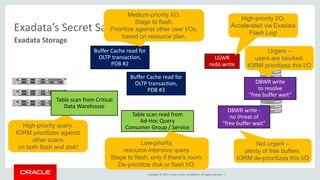
On Exadata storage, each I/O is tagged with:
1. Who issued it
2. What it’s for
3. Its priority
LGWR
redo write
Table scan from Critical
Data Warehouse
DBWR write
to resolve
“free buffer wait”
Buffer Cache read for
OLTP transaction,
PDB #2
Table scan read from
Ad-Hoc Query
Consumer Group / Service
Buffer Cache read for
OLTP transaction,
PDB #3
DBWR write -
no threat of
“free buffer wait”
Copyright © 2017, Oracle and/or its affiliates. All rights reserved. |
Exadata Storage
Exadata’s Secret Sauce
LGWR
redo write
DBWR write
to resolve
“free buffer wait”
Buffer Cache read for
OLTP transaction,
PDB #2
Table scan read from
Ad-Hoc Query
Consumer Group / Service
Buffer Cache read for
OLTP transaction,
PDB #3
High-priority I/O.
Accelerated via Exadata
Flash Log!
Urgent –
users are blocked.
IORM prioritizes this I/O
DBWR write -
no threat of
“free buffer wait”
Not urgent –
plenty of free buffers.
IORM de-prioritizes this I/O
High-priority query.
IORM prioritizes against
other scans
on both flash and disk!
Low-priority,
resource-intensive query.
Stage to flash, only if there’s room.
De-prioritize disk or flash I/O.
Medium-priority I/O.
Stage to flash.
Prioritize against other user I/Os,
based on resource plan.
Table scan from Critical
Data Warehouse
Copyright © 2017, Oracle and/or its affiliates. All rights reserved. |
Exadata Smart Storage
The Philosophy
Disk
Flash
Flash offers great low latency.
Its priority should be OLTP.
Most OLTP I/Os should be serviced from flash.
OLTP SCANS
Some OLTP I/Os will be serviced from disk,
due to flash cache misses, slow flash log writes.
On flash, scans should be 2nd class citizens to OLTP
for both bandwidth and space.
On disk, scans are extremely resource intensive
and need to be regulated.
Copyright © 2017, Oracle and/or its affiliates. All rights reserved. |
Exadata Smart Storage
IORM’s Role
1. IORM enforces how flash space is shared by
databases.
2. IORM controls the impact of scans on OLTP flash
latencies.
3. IORM enforces how the flash bandwidth is shared
by databases for scans.
4. IORM controls the impact of scans on OLTP
disk latencies.
5. IORM enforces how the disk bandwidth is
shared by databases and workloads.
Disk
Flash
OLTP SCANS
Copyright © 2017, Oracle and/or its affiliates. All rights reserved. |
Best Availability
64
Copyright © 2017, Oracle and/or its affiliates. All rights reserved. |
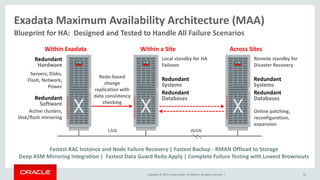
Exadata Maximum Availability Architecture (MAA)
Blueprint for HA: Designed and Tested to Handle All Failure Scenarios
65
Fastest RAC Instance and Node Failure Recovery | Fastest Backup - RMAN Offload to Storage
Deep ASM Mirroring Integration | Fastest Data Guard Redo Apply | Complete Failure Testing with Lowest Brownouts
Local standby for HA
Failover
Redo-based
change
replication with
data consistency
checking
Online patching,
reconfiguration,
expansion
LAN WAN
Servers, Disks,
Flash, Network,
Power
Active clusters,
Disk/flash mirroring
Within Exadata Within a Site
Remote standby for
Disaster Recovery
Across Sites
DATABASE
IN-MEMORY
DATABASE
IN-MEMORY
DATABASE
IN-MEMORY
Redundant
Software
Redundant
Hardware
Redundant
Systems
Redundant
Databases
Redundant
Systems
Redundant
Databases
Copyright © 2017, Oracle and/or its affiliates. All rights reserved. |
Fault Tolerant Availability
Only other AL4 Systems
• IBM - z Systems
• HPE - Integrity NonStop &
Superdome
• Fujitsu – GS & BS2000
• NEC – FT Server/320 Series
• Stratus ftServer & V Series
• Unisys – Dorado
“Exadata and SuperCluster
both achieve AL4 fault
tolerance in a Maximum
Availability Architecture*
configuration”
FIVE NINES
5X9
99.999%
A New Gold Standard
66
*Gold or Platinum reference architecture
Copyright © 2017, Oracle and/or its affiliates. All rights reserved. |
Better Monitoring and Manageability
67
Copyright © 2017, Oracle and/or its affiliates. All rights reserved. |
NEW: Automated Cloud Scale Software Updates
• Automation updates all Exadata infrastructure
software on full fleet
– 600+ components per full rack
– Storage Server downloads new software in the
background (18.1 release or later)
– User schedules time of software upgrade
– Storage Servers automatically upgrade in rolling
fashion online or offline in parallel
– Oracle Cloud updates hundreds of racks in a weekend
• Server update times reduced
– 5x speedup in Storage Server updates
– 40% faster Database node update
– More parallelism, fewer reboots
| Oracle Confidential – Highly Restricted 68
P
A
R
A
L
L
E
L
R
O
L
L
I
N
G
Update
Tool
FLEET UPDATES
Copyright © 2017, Oracle and/or its affiliates. All rights reserved. |
Best Database Cloud
69
Copyright © 2017, Oracle and/or its affiliates. All rights reserved. |
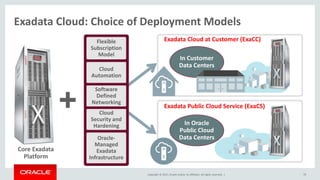
Exadata Cloud: Choice of Deployment Models
70
Core Exadata
Platform
In Customer
Data Centers
Exadata Cloud at Customer (ExaCC)
In Oracle
Public Cloud
Data Centers
Exadata Public Cloud Service (ExaCS)
Cloud
Automation
Flexible
Subscription
Model
Oracle-
Managed
Exadata
Infrastructure
Cloud
Security and
Hardening
Software
Defined
Networking
Copyright © 2017, Oracle and/or its affiliates. All rights reserved. |
Exadata Cloud Enterprise Edition Extreme Performance
Most Powerful Database + Platform
71
All Exadata
DB Machine
Innovations
All Oracle
Database
Innovations
Multitenant
In-Memory DB
Real Application
Clusters
Active Data Guard
Partitioning
Advanced
Compression
Advanced Security,
Label Security, DB Vault
Real Application
Testing
Advanced Analytics,
Spatial and Graph
Management Packs for
Oracle Database
InfiniBand Fabric
Columnar Flash Cache
HCC
10:1
I/O I/O I/O
Storage Indexes
Hybrid Columnar
Compression
I/O Resource
Management
Exafusion
Direct-to-Wire Protocol
Offload SQL to Storage
Network Resource
Management
In-Memory Fault
Tolerance
PCI Flash
Smart Flash Cache, Log
Copyright © 2017, Oracle and/or its affiliates. All rights reserved. |
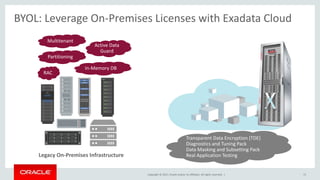
BYOL: Leverage On-Premises Licenses with Exadata Cloud
RAC
Partitioning
In-Memory DB
Multitenant
Active Data
Guard
Legacy On-Premises Infrastructure
Transparent Data Encryption (TDE)
Diagnostics and Tuning Pack
Data Masking and Subsetting Pack
Real Application Testing
72
Copyright © 2017, Oracle and/or its affiliates. All rights reserved. |
Exadata Cloud at Customer
• Available at customers’ data centers
– Customer responsible for data center infrastructure
– Oracle manages all Exadata infrastructure
• Bringing the Oracle Cloud to you
• Five ideal customer profiles
– Subject to data regulatory, data sovereignty and data residency laws or policies
– Apps require the throughput or latency of a local LAN rather than a WAN
– Databases are too tightly-coupled with existing applications and infrastructure to move to public cloud
– Want the benefits of a database cloud, but organizationally not ready to move to a public cloud
– Need cloud deployments with familiar, on-premises security controls
73
Customer Data Centers
Copyright © 2017, Oracle and/or its affiliates. All rights reserved. | 74
Exadata architecture and internals presentation

Exadata architecture and internals presentation

  • 1.
    Copyright © 2017,Oracle and/or its affiliates. All rights reserved. | Exadata: Architecture and Internals Gurmeet Goindi Master Product Manager, Exadata Twitter: @ExadataPM
  • 2.
    Copyright © 2017,Oracle and/or its affiliates. All rights reserved. | Safe Harbor Statement The following is intended to outline our general product direction. It is intended for information purposes only, and may not be incorporated into any contract. It is not a commitment to deliver any material, code, or functionality, and should not be relied upon in making purchasing decisions. The development, release, and timing of any features or functionality described for Oracle’s products remains at the sole discretion of Oracle. 2
  • 3.
    Copyright © 2017,Oracle and/or its affiliates. All rights reserved. | Exadata Database Machine 3 Performance, Availability and Security Best Platform for Oracle Databases on-premises and in the Cloud Enabled by: • Single-vendor accountability • Exclusive focus on databases • Deep h/w and s/w integration • Revolutionary approach to storage
  • 4.
    Copyright © 2017,Oracle and/or its affiliates. All rights reserved. | Proven at Thousands of Critical Deployments since 2008 OLTP – Analytics – Data Warehousing – Mixed Workloads Best for all Workloads • Petabyte Warehouses • Online Financial Trading • Business Applications – SAP, Oracle, Siebel, PSFT, … • Massive DB Consolidation • Public SaaS Clouds 4 4 OF THE TOP 5 BANKS, TELCOS, RETAILERS RUN EXADATA
  • 5.
    Copyright © 2017,Oracle and/or its affiliates. All rights reserved. | 5 Exadata Deployment Models Public Cloud Service Cloud at Customer X7-2 X7-8 On-Premises Customer Data Center Purchased Customer Managed Customer Data Center Subscription Oracle Managed Oracle Cloud Subscription Oracle Managed
  • 6.
    Copyright © 2017,Oracle and/or its affiliates. All rights reserved. | Introducing Exadata X7 State-of-the-Art Hardware Integrated with Smart Database Software 6
  • 7.
    Copyright © 2017,Oracle and/or its affiliates. All rights reserved. | Exadata Database Machine X7-2 7 State-of-the-Art Hardware 120 TB disk capacity (10 TB helium disks) 25.6 TB PCI NVMe Flash 20 cores for SQL offload 51.2 TB PCI NVMe Flash 20 cores for SQL offload 40 Gb/s InfiniBand internal network 25/10/1 GigE external network 2 socket Xeon processors 48 cores per server 384 GB - 1.5 TB DRAM • Scale-Out Database Servers • Fastest Internal Fabric • Scale-Out Intelligent Storage High-Capacity Storage Server Extreme Flash Storage Server
  • 8.
    Copyright © 2017,Oracle and/or its affiliates. All rights reserved. | Exadata Database Machine X7-8 8 Large SMP Processor Model – Big data warehouses – Massive database consolidation – In-Memory databases Oracle Confidential – Internal 120 TB disk capacity (10 TB helium disks) 25.6 TB PCI NVMe Flash 20 cores for SQL offload 51.2 TB PCI NVMe Flash 20 cores for SQL offload 40 Gb/s InfiniBand 25/10/1 GigE external connectivity • Scale-Out Database Servers – 8-socket x86 processors – 192 cores – 3-6 TB DRAM • Fastest Internal Fabric • Scale-Out Intelligent Storage High-Capacity Storage Server Extreme Flash Storage Server Same Networking, Storage and Software as X7-2
  • 9.
    Copyright © 2017,Oracle and/or its affiliates. All rights reserved. | Configure Servers to Match Your Workload 10 Elastic Hardware Configurations Capacity-on-Demand Software Licensing • Enable compute cores as needed, subject to minimums • License Oracle software for enabled cores only *14 cores minimum per DB server (max 48 cores) *8 cores minimum per Eighth Rack DB server (max 24 cores) X7-2 Eighth Rack Quarter Rack Eighth to Qtr Upgrade Add Servers as needed* Full Rack Add racks to continue scaling* * Expand older racks with new servers and multi-rack old and new racks together X7-8 Elastic Configuration
  • 10.
    Copyright © 2017,Oracle and/or its affiliates. All rights reserved. | Hot Swappable Hardware for Online Maintenance • Flash • Disks • M.2 boot drive • Power supplies • Fans • InfiniBand switch • Not Hot Swappable: – PCI cards (network, IB, HBA), CPU, Memory (bad sectors will be disabled) 11
  • 11.
    Copyright © 2017,Oracle and/or its affiliates. All rights reserved. | 12 Exadata Smart Software Unique Differentiators for Analytics, OLTP and Consolidation
  • 12.
    Copyright © 2017,Oracle and/or its affiliates. All rights reserved. | Smart Analytics • Move queries to storage, not storage to queries • Automatically offload and parallelize queries across all storage servers • Extend In-Memory DB with flash • Run In-Memory DB on standby • 10x – 100x faster analytics Smart Storage • Hybrid Columnar Compression reduces space usage by 10x • Database-aware Flash Caching gives speed of flash with capacity of disk • Storage Indexes eliminate unnecessary I/O 13 Smart OLTP • Special InfiniBand protocol enables 3x faster OLTP messaging • Ultra-fast DB-optimized flash logging • Instant detection of node failure and I/O issues Smart Consolidation • Critical DB messages jump to head of queue for ultra-fast latency • CPU, I/O, network resources prioritized for end-to-end quality of service • 4x more databases vs same hardware without Exadata software Exadata Unique Smart Database Software Highlights
  • 13.
    Copyright © 2017,Oracle and/or its affiliates. All rights reserved. | Dozens of Additional Smart Database Capabilities 14 Smart Analytics • Storage Index data skipping • Storage offload for min/max operations • Data mining storage offload • Storage offload for LOBs and CLOBs • Auto flash caching for table scans • Reverse offload to DB servers • Offload index fast full scans • Offloads scans on encrypted data, with FIPS compliance • Active bonding of InfiniBand • Instant data file creation Smart OLTP • Smart network packet prioritization • I/O Prioritization by DB, User, or workload to ensure QOS • Active AWR includes storage stats for end to end monitoring • Write-back Flash Cache • Cell-to-cell rebalance preserving Flash Cache • Secure disk and flash erase • Database scoped security • Full-stack security scanning • Exachk full-stack validation • NVMe flash interface for lowest latency I/O Smart Availability • In-Memory fault tolerance • Offload backups to storage • Prioritize rebalance of critical files • Elimination of false drive failures • Flash and disk life cycle mgmt alert • Avoid reading predictive failed disks • Cell software transparent restart • I/O hang hardening • Prevent shutdown if mirror server is down • Confinement of temporarily poor performing drives
  • 14.
    Copyright © 2017,Oracle and/or its affiliates. All rights reserved. | Best Performance 15
  • 15.
    Copyright © 2017,Oracle and/or its affiliates. All rights reserved. | Exadata X7-2 and X7-8 Performance Improvements • 350 GB/sec I/O Throughput – 17% more (vs Exadata X6) • 5.97 Million OLTP Read IOPS – 50% more IOPS (vs Exadata X6) under 250 µsec = 3.5M • 40% CPU improvement for Analytics • 20% CPU improvement for OLTP – 40% on X7-8 (vs Exadata X6-8) • Dramatically faster than leading all-flash arrays in every metric 16 Each rack has up to: • 1.7 PB Disk • 720 TB NVMe Flash
  • 16.
    Copyright © 2017,Oracle and/or its affiliates. All rights reserved. | Best Data Warehouse 17
  • 17.
    Copyright © 2017,Oracle and/or its affiliates. All rights reserved. | Latest Flash Creates Giant Bottleneck for Shared Storage 18 SAN Link = 40 Gb/s 5 GB/sec Less than 1 Flash card But Should Achieve 5.5GB * 480 Drives = 2,640 GB/sec Latest PCIe Flash 5.5 GB/sec 480 Flash Drive EMC Array 38 GB/sec
  • 18.
    Copyright © 2017,Oracle and/or its affiliates. All rights reserved. | Exadata Approaches Memory Speed with Shared Flash • Architecturally, storage arrays can share Flash capacity but not Flash performance – Even with next gen scale-out, PCIe networks, or NVMe over fabric – Network is the bottleneck • Must move compute to data to achieve full Flash potential – Requires owning full stack; can’t be solved in storage alone • Exadata X7 delivers 350 GB/s Flash bandwidth to any server – Approaches 800 GB/s aggregate DRAM bandwidth of DB servers 19 Exadata DB Servers Exadata Smart Storage InfiniBand Query Offload
  • 19.
    Copyright © 2017,Oracle and/or its affiliates. All rights reserved. | What were my sales on Jan 22? Exadata Database Servers Exadata Smart Storage Servers Scanning and filtering executes locally in storage Return only sales amounts for Jan 22 10 TB scanned 100 GB returned to servers Sum SELECT SUM(sales) WHERE date=‘22-Jan-2016’ Optimizer chooses access plan Exadata Smart Scan Move Queries to Data, Not Data to Queries
  • 20.
    Copyright © 2017,Oracle and/or its affiliates. All rights reserved. | Benefits of Exadata Smart Scan • Intelligent storage reduces communication traffic by orders of magnitude – Eliminates all three bottlenecks: getting data out of storage, across SAN, and into any server • CPU cost of scanning, decrypting, decompressing, filtering, and projecting data is offloaded to storage • Queries are parallelized across all storage servers for further speedup • End result is Exadata achieves over 300 GB/s query throughput from flash per rack – Dramatically more than fastest all-flash scale-out storage 21
  • 21.
    Copyright © 2017,Oracle and/or its affiliates. All rights reserved. | Exadata Smart Scan – Not Just Query Offloading • Exadata storage servers run complex operations in storage – Row filtering based on “where” predicate – Column filtering – Join filtering – Incremental backup filtering – I/O prioritization – Storage Indexing – Database level security – Offloaded scans on encrypted data – Smart File Creation • 10x reduction in data sent to DB servers is common Exadata Storage Servers
  • 22.
    Copyright © 2017,Oracle and/or its affiliates. All rights reserved. | What can’t be off-loaded? • Most table scans are off-loadable – Limitations on large number of columns for row-major tables – In 11.2, no LOBs • Inline LOBs are supported in 12.1 – Functions that need RDBMS support • PL/SQL, system functions, aggregates, analytics • v$sqlfn_metadata, offloadable = ‘NO’ – BUT still get some benefit from offload if some offloadable predicates • Also with no predicates but few columns selected • Even Select * with HCC because decompression is offloaded
  • 23.
    Copyright © 2017,Oracle and/or its affiliates. All rights reserved. | Storage Index - Motivation A B C D 3 1 2 9 8 8 6 7 5 Min B = 1 Max B = 3 Min B = 8 Max B = 9 Min B = 5 Max B = 7 • Smart Scans: – DB sends list of table extents along with the predicate to the Exadata storage cells – Exadata cells read the table extents, apply predicate on the read data and only return back filtered results – Network IO (as perceived by Database) is reduced drastically – DB CPU usage also reduces – But we are still performing disk IO on Exadata storage cells • Can we reduce disk IO too ? Select * from table where B=6
  • 24.
    Copyright © 2017,Oracle and/or its affiliates. All rights reserved. | Storage (Anti)- Index A B C 9 3 10 1 8 2 11 9 10 8 10 8 Min B = 5 Max B = 7 • Storage Index helps filter out data on disk (whereas Index helps find data) • Array on –in-memory entries (called region Indexes) • Each region index stores column summaries (eg min/max) for 1MB region on disk • Transparent to the database and maintained automatically • Min/Max can help eliminate IOs if data cannot match the where clause Select * from table where B=6 Region Index A B C D 3 1 2 9 8 8 6 7 5 Min B = 8 Max B = 9 Min B = 1 Max B = 3
  • 25.
    Copyright © 2017,Oracle and/or its affiliates. All rights reserved. | Exadata Smart Flash Cache • Understands different types of I/Os from database – Skips caching I/Os to backups, data pump I/O, archive logs, tablespace formatting – Caches Control File Reads and Writes, file headers, data and index blocks • Immediately adapts to changing workloads – Unlike tiering that relies on historical statistics and is slow to move – Tiering caches yesterday’s hot data not today’s – Tiering uses large chunks (1MB) while cache responds faster with 64KB chunks • Write-back flash cache – Caches writes from the database not just reads • RAC-aware from day one • Doesn’t need to mirror in flash for read intensive workloads 26
  • 26.
    Copyright © 2017,Oracle and/or its affiliates. All rights reserved. | Exadata I/O Elimination
  • 27.
    Copyright © 2017,Oracle and/or its affiliates. All rights reserved. | 1. SQL offload to storage Exadata Minimizes I/O - Dramatically Improves Performance 22012016 1500.75 22012016 525.20 Partition 1 Partition N Salesdate Amount  SELECT SUM(amount) WHERE salesdate= ‘22-Jan-2016’…  10 Terabyte Table (100 billion rows) Salesdate Amount
  • 28.
    Copyright © 2017,Oracle and/or its affiliates. All rights reserved. | Exadata Minimizes I/O - Dramatically Improves Performance 22012016 1500.75 22012016 525.20 Partition 1 Partition N   Salesdate Amount 1. SQL offload to storage 2. Partition pruning SELECT SUM(amount) WHERE salesdate= ‘22-Jan-2016’…   10 Terabyte Table (100 billion rows)
  • 29.
    Copyright © 2017,Oracle and/or its affiliates. All rights reserved. | Exadata Minimizes I/O - Dramatically Improves Performance 1. SQL offload to storage 2. Partition pruning 3. Storage Index data skipping 22012016 1500.75 22012016 525.20 Partition 1 Partition N    Salesdate Amount SELECT SUM(amount) WHERE salesdate= ‘22-Jan-2016’…    10 Terabyte Table (100 billion rows) Salesdate Amount
  • 30.
    Copyright © 2017,Oracle and/or its affiliates. All rights reserved. | Exadata Minimizes I/O - Dramatically Improves Performance 1. SQL offload to storage 2. Partition pruning 3. Storage Index data skipping 4. Smart Scan filtering 22012016 1500.75 22012016 525.20 Smart Scan Row / Column Filtering 10 Terabyte Table (100 billion rows)     Return 100 Bytes Salesdate Amount Partition 1 Partition N     Salesdate Amount
  • 31.
    Copyright © 2017,Oracle and/or its affiliates. All rights reserved. | Benefits Multiply with Parallel Architecture SELECT SUM(amount) WHERE salesdate= ‘22-Jan-2016’… Exadata Scale-Out Storage
  • 32.
    Copyright © 2017,Oracle and/or its affiliates. All rights reserved. | Exadata Flash Delivers Lowest Latency in the Industry SELECT SUM(amount) WHERE salesdate= ‘22-Jan-2016’… 12.8 TB Flash Cache 36 TB Disk Usable Capacity 36 TB Disk Usable Capacity 36 TB Disk Usable Capacity 12.8 TB Flash Cache 12.8 TB Flash Cache NVMe NVMe Smart Flash Cache algorithms optimize flash capacity based on type of I/O
  • 33.
    Copyright © 2017,Oracle and/or its affiliates. All rights reserved. | Exadata Compared to Best of Breed Database Platforms SELECT SUM(amount) WHERE salesdate= ‘22-Jan-2016’… Database Servers 1. NO SQL offload to storage 2. Partition pruning (DB function) 3. NO Storage Index data skipping 4. NO Smart Scan filtering 5. NO scale-out storage 6. NO smart flash      
  • 34.
    Copyright © 2017,Oracle and/or its affiliates. All rights reserved. | Columnar Formats Are Great for Analytics and Compression • Columnar format stores the data in each column together rather than the data in each row • Columnar format is great for Analytics – Enables fast scans of columns relevant to a query • Columnar format is great for Compression – Values within a column are much more similar than across • Pure Columnar format is horrible for Random Row Access – Requires an I/O for each column in a row rather than a single I/O for the entire row – 100x slower random row access – Columnar Cliff 35 Column Format Data
  • 35.
    Copyright © 2017,Oracle and/or its affiliates. All rights reserved. | Hybrid Columnar Compression Overview • Organize columns into sets of a few thousand rows – Compression Units (CUs) • Within CU, data is organized by column, then compressed – Get all the compression benefits of full columnar format – For analytics, compression greatly reduces I/O, and the columnar format reduces CPU • Each CU is small enough to be read from storage in a small number of I/O operations (usually 2) – Random row access requires one or two I/Os per row, instead of one I/O for each column CU CU CU
  • 36.
    Copyright © 2017,Oracle and/or its affiliates. All rights reserved. | Benefits of Hybrid Columnar Compression • Hybrid Columnar Compression achieves great space and IO reductions • Typical compression ratio of 10x • Exadata storage offloads decompression, enabling better compression algorithms • Fast random row access on columnar data enables: • Historical data to be cost-effectively kept in OLTP databases • Fast drilldown to row level for analytics Retailers Telcos Financial Services
  • 37.
    Copyright © 2017,Oracle and/or its affiliates. All rights reserved. | Hybrid Columnar Compression • Fully supported with… – B-Tree, Bitmap Indexes, Text indexes – Materialized Views – Exadata Server and Cells including offload – Partitioning – Parallel Query, PDML, PDDL – Schema Evolution support, online, metadata-only add/drop columns – Data Guard Physical Standby Support 38 Business as Usual
  • 38.
    Copyright © 2017,Oracle and/or its affiliates. All rights reserved. | Compression Benefits Multiply Across Stack • 10x less Storage • 10x better Disk Bandwidth • 10x more data in Flash Cache • 10x more data in Database DRAM Cache • 10x smaller Test DB, Dev DB, DR DB • 10x smaller Backup Test Dev DR Storage Array Compression Only Achieves a Fraction of These Benefits
  • 39.
    Copyright © 2017,Oracle and/or its affiliates. All rights reserved. | Seamless Integration of Big Data, NoSQL and Relational Data 40 Pushes Data Filtering to Each Store • Like Exadata Smart Scan • Not restricted to Oracle Hardware Big Data SQL • Data Warehouses are being supplemented by specialized Multi-model Big Data stores – Creates silos of isolated data and incompatible access • Oracle Big Data SQL provides Transparent, Massively Parallel Queries across Oracle, NoSQL and Hadoop/Spark – Full Oracle SQL capabilities across data stores – Much faster and more expressive than Hadoop/Spark
  • 40.
    Copyright © 2017,Oracle and/or its affiliates. All rights reserved. | Best OLTP 41
  • 41.
    Copyright © 2017,Oracle and/or its affiliates. All rights reserved. | Typical OLTP IO Path 42 Storage Controller Storage Controller SAN/LAN Cache Fusion SCSI Proprietary Protocols and/or SCSI RDBMS OS NW Stack Device Drivers HBA/NIC RDBMS OS NW Stack Device Drivers HBA/NIC Switch Fabric Storage Controller SW Storage Controller SW Persistent Storage Hardware View Software View
  • 42.
    Copyright © 2017,Oracle and/or its affiliates. All rights reserved. | Traditional Networking Stacks Delay OLTP Messages • OLTP messages are small and relatively simple, so they require little time to transfer over the network and execute on the destination • Most of the processing time for OLTP messages is due to the CPU and OS overhead of traversing the complex multi-layer network protocol stack – Both on the source and destination 43 Network Stack Hardware Database
  • 43.
    Copyright © 2017,Oracle and/or its affiliates. All rights reserved. | Exafusion Direct-to-Wire Protocol 44 • Exafusion is a light-weight datagram oriented protocol custom designed for critical OLTP messages on Exadata’s OS, firmware, and InfiniBand hardware • Exafusion does not need to support other message types or hardware stacks – Therefore is able to call InfiniBand hardware directly, bypassing networking stack Network Stack Hardware Database
  • 44.
    Copyright © 2017,Oracle and/or its affiliates. All rights reserved. | Mixed Workload Degrade OLTP Response Times • OLTP often runs concurrently with high throughput workloads –Database consolidation, batch, real-time analytics, reporting, backups • However, high throughput workloads can severely degrade OLTP –They create long network queues, delaying critical OLTP messages 45 Only OLTP Mixed Workload
  • 45.
    Copyright © 2017,Oracle and/or its affiliates. All rights reserved. | Exadata Network Resource Management • Database tags messages that require low-latency – Log writes, cache-fusion messages, locks, etc. • Low-latency messages bypass all other messages – Reporting, backups, batch, etc. – Even partially sent messages are bypassed • Exadata accelerates low-latency messages in all layers: database, network cards, switches, and storage – Otherwise bottleneck just moves 46 BYPASS LANE
  • 46.
    Copyright © 2017,Oracle and/or its affiliates. All rights reserved. | Exadata Smart Flash Log • Smart Flash Log uses flash as a parallel write cache to disk controller cache • Whichever write completes first wins (disk or flash) • Reduces response time and outliers – “log file parallel write” histogram improves – Greatly improves “log file sync” • Uses almost no flash capacity (< 0.1%) • Completely automatic and transparent 47 Smart Logging = Off Txn Response Time (ms) Smart Logging = On Outliers Outliers Outliers No Outliers Parallel Log Writes (first wins)
  • 47.
    Copyright © 2017,Oracle and/or its affiliates. All rights reserved. | Transferring Hot Database Blocks Slows OLTP • OLTP workloads can have hot blocks that are frequently updated • Before transferring a block between nodes, all changes to the block must be written to the log – Ensures changes are not lost due to a node crash • Waiting for a log write to complete delays critical OLTP communication 48 1. Issue log write 2. Wait for log write completion 3. Transfer block
  • 48.
    Copyright © 2017,Oracle and/or its affiliates. All rights reserved. | New: Smart Fusion Block Transfer 49 • Exadata eliminates the wait for log write completion before transferring a block • Destination node can modify block but will wait at commit time if log write has not completed – Enabled by Exadata’s unique tracking of log writes across nodes 1. Issue log write 2. Wait for log write completion 3. Transfer block Exadata Avoids I/O Wait 
  • 49.
    Copyright © 2017,Oracle and/or its affiliates. All rights reserved. | OLTP: Exadata Brings In-Memory OLTP to Storage • Exadata Storage Servers add a memory cache in front of Flash memory – Similar to current Flash cache in front of disk • Cache is additive with cache at Database Server – Only possible because of tight integration with Database • 2.5x Lower latency for OLTP IO – 100 usec • Up to 21 TB of DRAM for OLTP acceleration with Memory Upgrade Kit – Compare to 5TB of flash in V2 Exadata 50 Compute Server Storage Server Hot Warm Cold Flash DRAM Disk
  • 50.
    Copyright © 2017,Oracle and/or its affiliates. All rights reserved. | In-Memory OLTP Acceleration – Journey of a Database Block DB Buffer Cache In-Memory OLTP Cache Flash Cache Hard Disk Drive Oracle Confidential – Internal 51 DB Buffer Cache In-Memory OLTP Cache Flash Cache Hard Disk Drive 1. DB reads a block Exadata Serves the Block from Storage Data initially resides on hard disk Database Server Storage Server
  • 51.
    Copyright © 2017,Oracle and/or its affiliates. All rights reserved. | In-Memory OLTP Acceleration – Journey of a Database Block DB Buffer Cache In-Memory OLTP Cache Flash Cache Hard Disk Drive Oracle Confidential – Internal 52 DB Buffer Cache In-Memory OLTP Cache Flash Cache Hard Disk Drive 2. Flash Cache Gets Populated Database Server Storage Server
  • 52.
    Copyright © 2017,Oracle and/or its affiliates. All rights reserved. | In-Memory OLTP Acceleration – Journey of a Database Block DB Buffer Cache In-Memory OLTP Cache Flash Cache Hard Disk Drive Oracle Confidential – Internal 53 DB Buffer Cache In-Memory OLTP Cache Flash Cache Hard Disk Drive 3. Database evicts the block Exadata Caches the block in In-Memory OLTP Cache Database Server Storage Server
  • 53.
    Copyright © 2017,Oracle and/or its affiliates. All rights reserved. | In-Memory OLTP Acceleration – Journey of a Database Block DB Buffer Cache In-Memory OLTP Cache Flash Cache Hard Disk Drive Oracle Confidential – Internal 54 DB Buffer Cache In-Memory OLTP Cache Flash Cache Hard Disk Drive 4. Database reads the same block again Exadata serves the block from In- Memory OLTP Cache with 100us latency Database Server Storage Server
  • 54.
    Copyright © 2017,Oracle and/or its affiliates. All rights reserved. | In-Memory OLTP Acceleration DB Buffer Cache In-Memory OLTP Cache Flash Cache Hard Disk Drive Oracle Confidential – Internal 55 DB Buffer Cache In-Memory OLTP Cache Flash Cache Hard Disk Drive Data is never in DB Buffer Cache or In Memory OLTP Cache at the same time Database Server Storage Server
  • 55.
    Copyright © 2017,Oracle and/or its affiliates. All rights reserved. | Best Consolidation 56
  • 56.
    Copyright © 2017,Oracle and/or its affiliates. All rights reserved. | Consolidation Challenges • Database users apprehensive about consolidation – Demand performance guarantees • Workload surges from one application can affect others – Excessive CPU, memory, or I/O usage – Surges can originate from heavy application usage or a single runaway query • DBAs want to control resource usage – Fair access to resources – Hosted environments – “get what you pay for”
  • 57.
    Copyright © 2017,Oracle and/or its affiliates. All rights reserved. | Resource Management for Consolidated Workloads • Instance Caging – Limits a database instance to a maximum number of CPUs – Prevents resource hogging when consolidating databases • CPU Resource Management – Allocates CPU across different databases – Allocates CPU across workloads within a database – Implements parallel execution policies – Prevents runaway queries • Network Resource Management – Automatically prioritizes critical messages on InfiniBand fabric – Log writes, RAC cluster messages, etc. • I/O Resource Management (IORM) – Prioritizes I/O for critical workloads over non-critical workloads – Allows fair sharing for database consolidation 58 Prioritize System Resources by Database, Workload and Time of Day I/O I/O I/O OLTP TXNS RPTS BACKUPS WAREHOUSE ETL BATCH AD-HOC PRIORITY LANE
  • 58.
    Copyright © 2017,Oracle and/or its affiliates. All rights reserved. | Ordinary Storage Exadata’s Secret Sauce I/O On ordinary storage, all I/Os look the same. Their only properties are their size, read vs write, and their file. I/O I/O I/O I/O I/O I/O
  • 59.
    Copyright © 2017,Oracle and/or its affiliates. All rights reserved. | Exadata Storage Exadata’s Secret Sauce On Exadata storage, each I/O is tagged with: 1. Who issued it 2. What it’s for 3. Its priority LGWR redo write Table scan from Critical Data Warehouse DBWR write to resolve “free buffer wait” Buffer Cache read for OLTP transaction, PDB #2 Table scan read from Ad-Hoc Query Consumer Group / Service Buffer Cache read for OLTP transaction, PDB #3 DBWR write - no threat of “free buffer wait”
  • 60.
    Copyright © 2017,Oracle and/or its affiliates. All rights reserved. | Exadata Storage Exadata’s Secret Sauce LGWR redo write DBWR write to resolve “free buffer wait” Buffer Cache read for OLTP transaction, PDB #2 Table scan read from Ad-Hoc Query Consumer Group / Service Buffer Cache read for OLTP transaction, PDB #3 High-priority I/O. Accelerated via Exadata Flash Log! Urgent – users are blocked. IORM prioritizes this I/O DBWR write - no threat of “free buffer wait” Not urgent – plenty of free buffers. IORM de-prioritizes this I/O High-priority query. IORM prioritizes against other scans on both flash and disk! Low-priority, resource-intensive query. Stage to flash, only if there’s room. De-prioritize disk or flash I/O. Medium-priority I/O. Stage to flash. Prioritize against other user I/Os, based on resource plan. Table scan from Critical Data Warehouse
  • 61.
    Copyright © 2017,Oracle and/or its affiliates. All rights reserved. | Exadata Smart Storage The Philosophy Disk Flash Flash offers great low latency. Its priority should be OLTP. Most OLTP I/Os should be serviced from flash. OLTP SCANS Some OLTP I/Os will be serviced from disk, due to flash cache misses, slow flash log writes. On flash, scans should be 2nd class citizens to OLTP for both bandwidth and space. On disk, scans are extremely resource intensive and need to be regulated.
  • 62.
    Copyright © 2017,Oracle and/or its affiliates. All rights reserved. | Exadata Smart Storage IORM’s Role 1. IORM enforces how flash space is shared by databases. 2. IORM controls the impact of scans on OLTP flash latencies. 3. IORM enforces how the flash bandwidth is shared by databases for scans. 4. IORM controls the impact of scans on OLTP disk latencies. 5. IORM enforces how the disk bandwidth is shared by databases and workloads. Disk Flash OLTP SCANS
  • 63.
    Copyright © 2017,Oracle and/or its affiliates. All rights reserved. | Best Availability 64
  • 64.
    Copyright © 2017,Oracle and/or its affiliates. All rights reserved. | Exadata Maximum Availability Architecture (MAA) Blueprint for HA: Designed and Tested to Handle All Failure Scenarios 65 Fastest RAC Instance and Node Failure Recovery | Fastest Backup - RMAN Offload to Storage Deep ASM Mirroring Integration | Fastest Data Guard Redo Apply | Complete Failure Testing with Lowest Brownouts Local standby for HA Failover Redo-based change replication with data consistency checking Online patching, reconfiguration, expansion LAN WAN Servers, Disks, Flash, Network, Power Active clusters, Disk/flash mirroring Within Exadata Within a Site Remote standby for Disaster Recovery Across Sites DATABASE IN-MEMORY DATABASE IN-MEMORY DATABASE IN-MEMORY Redundant Software Redundant Hardware Redundant Systems Redundant Databases Redundant Systems Redundant Databases
  • 65.
    Copyright © 2017,Oracle and/or its affiliates. All rights reserved. | Fault Tolerant Availability Only other AL4 Systems • IBM - z Systems • HPE - Integrity NonStop & Superdome • Fujitsu – GS & BS2000 • NEC – FT Server/320 Series • Stratus ftServer & V Series • Unisys – Dorado “Exadata and SuperCluster both achieve AL4 fault tolerance in a Maximum Availability Architecture* configuration” FIVE NINES 5X9 99.999% A New Gold Standard 66 *Gold or Platinum reference architecture
  • 66.
    Copyright © 2017,Oracle and/or its affiliates. All rights reserved. | Better Monitoring and Manageability 67
  • 67.
    Copyright © 2017,Oracle and/or its affiliates. All rights reserved. | NEW: Automated Cloud Scale Software Updates • Automation updates all Exadata infrastructure software on full fleet – 600+ components per full rack – Storage Server downloads new software in the background (18.1 release or later) – User schedules time of software upgrade – Storage Servers automatically upgrade in rolling fashion online or offline in parallel – Oracle Cloud updates hundreds of racks in a weekend • Server update times reduced – 5x speedup in Storage Server updates – 40% faster Database node update – More parallelism, fewer reboots | Oracle Confidential – Highly Restricted 68 P A R A L L E L R O L L I N G Update Tool FLEET UPDATES
  • 68.
    Copyright © 2017,Oracle and/or its affiliates. All rights reserved. | Best Database Cloud 69
  • 69.
    Copyright © 2017,Oracle and/or its affiliates. All rights reserved. | Exadata Cloud: Choice of Deployment Models 70 Core Exadata Platform In Customer Data Centers Exadata Cloud at Customer (ExaCC) In Oracle Public Cloud Data Centers Exadata Public Cloud Service (ExaCS) Cloud Automation Flexible Subscription Model Oracle- Managed Exadata Infrastructure Cloud Security and Hardening Software Defined Networking
  • 70.
    Copyright © 2017,Oracle and/or its affiliates. All rights reserved. | Exadata Cloud Enterprise Edition Extreme Performance Most Powerful Database + Platform 71 All Exadata DB Machine Innovations All Oracle Database Innovations Multitenant In-Memory DB Real Application Clusters Active Data Guard Partitioning Advanced Compression Advanced Security, Label Security, DB Vault Real Application Testing Advanced Analytics, Spatial and Graph Management Packs for Oracle Database InfiniBand Fabric Columnar Flash Cache HCC 10:1 I/O I/O I/O Storage Indexes Hybrid Columnar Compression I/O Resource Management Exafusion Direct-to-Wire Protocol Offload SQL to Storage Network Resource Management In-Memory Fault Tolerance PCI Flash Smart Flash Cache, Log
  • 71.
    Copyright © 2017,Oracle and/or its affiliates. All rights reserved. | BYOL: Leverage On-Premises Licenses with Exadata Cloud RAC Partitioning In-Memory DB Multitenant Active Data Guard Legacy On-Premises Infrastructure Transparent Data Encryption (TDE) Diagnostics and Tuning Pack Data Masking and Subsetting Pack Real Application Testing 72
  • 72.
    Copyright © 2017,Oracle and/or its affiliates. All rights reserved. | Exadata Cloud at Customer • Available at customers’ data centers – Customer responsible for data center infrastructure – Oracle manages all Exadata infrastructure • Bringing the Oracle Cloud to you • Five ideal customer profiles – Subject to data regulatory, data sovereignty and data residency laws or policies – Apps require the throughput or latency of a local LAN rather than a WAN – Databases are too tightly-coupled with existing applications and infrastructure to move to public cloud – Want the benefits of a database cloud, but organizationally not ready to move to a public cloud – Need cloud deployments with familiar, on-premises security controls 73 Customer Data Centers
  • 73.
    Copyright © 2017,Oracle and/or its affiliates. All rights reserved. | 74

Editor's Notes

  • #2 All Speaker Notes are Oracle Confidential – Internal Only Analogy to Exadata being “in the lead”
  • #3 This is a Safe Harbor Front slide, one of two Safe Harbor Statement slides included in this template. One of the Safe Harbor slides must be used if your presentation covers material affected by Oracle’s Revenue Recognition Policy To learn more about this policy, e-mail: Revrec-americasiebc_us@oracle.com For internal communication, Safe Harbor Statements are not required. However, there is an applicable disclaimer (Exhibit E) that should be used, found in the Oracle Revenue Recognition Policy for Future Product Communications. Copy and paste this link into a web browser, to find out more information.   http://my.oracle.com/site/fin/gfo/GlobalProcesses/cnt452504.pdf For all external communications such as press release, roadmaps, PowerPoint presentations, Safe Harbor Statements are required. You can refer to the link mentioned above to find out additional information/disclaimers required depending on your audience.
  • #5 Banks (Reibanks list) ICBC HSBC CCBC BNP JPMC Ag Bank of China Bank of China Credit Agricole Barclays Deutsche Bank JPMC Retailers (Forbes list) Walmart CVS Home Depot Walgreens Target Costco Carrefour Tesco Telcos (GSMA list) China Mobile Vodafone Group China Unicom Telefonica Group America Movil Group Orange AT&T China Telecom Airtel SingTel Axiata
  • #17 SSB DBM mentiones as In-Memory Analytic Benchmark
  • #19 VMAX 950 F 2 V Brick 8 Vbricks ~ 150 GB/s 2 Vbricks = 37.5 GB/s Each Vbrick has 240 drives 2 Vbricks = 480 drives
  • #46 How to ignore blocks based on the values of any column? Without introducing overhead Hint: partition/indexing help with only 1 column
  • #73 Yes. When a customer brings a Database Enterprise Edition license entitlement to Oracle PaaS, they are granted the rights to use Diagnostics Pack, Tuning Pack, Data Masking and Subsetting Pack, and Real Application Testing without having on-premises license entitlements for those Database Options. Database BYOL to PaaS customers also have access to TDE and HCC. This a significant advantage for customers who BYOL to Oracle PaaS versus AWS IaaS or AWS RDS
  • #74 Residency laws that require data to be stored within a corporate entity or a political territory, and not in a public cloud data center Agility, simplicity, elasticity, and subscription based benefits of a database cloud