PREPARED BY
FACULTY OFCIVIL DEPARTMENT
MVJCE
Approved by AICTE |Affiliated to VTU | Recognized by UGC with 2(f) & 12(B) status |Accredited by NBA and NAAC
An Autonomous Institute
DEPARTMENT OF CIVIL ENGINEERING
ENVIRONMENTAL STUDIES
MVJ20ENV59
2.
COURSE OUTCOMES
After studyingthis course, students will be able to:
CO1-Describe the principles of ecology and environmental issues that apply to air,
land, and water issues on a global scale.
CO2 -Develop critical thinking and/or observation skills, and apply them to the
analysis of a problem or question related to the environment.
CO3-Demonstrate ecology knowledge of a complex relationship between biotic and a
biotic components.
CO4-Apply their ecological knowledge to illustrate and graph a problem and describe
the realities that managers face when dealing with complex issues.
3.
Module-1
Introduction to environmentalstudies: Multidisciplinary
nature of environmental studies; Scope and importance;
Concept of sustainability and sustainable development.
Ecosystems (Structure and Function): Forest, Desert,
Wetlands, Rivers, Ocean and Lake.
Biodiversity: Types, Hot-spots; Threats and Conservation of
biodiversity, Forest Wealth, and Deforestation.
4.
Ecosystems
What is Biodiversity?
•Biodiversity is a term used to describe the enormous variety of life on
Earth. It can be used more specifically to refer to all of the species in one
region or ecosystem.
• Biodiversity refers to every living thing, including plants, bacteria,
animals, and humans. Scientists have estimated that there are around 8.7
million species of plants and animals in existence. However, only around
1.2 million species have been identified and described so far, most of
which are insects.
• This means that millions of other organisms remain a complete mystery.
5.
Ecosystems
• Over generations,all of the species that are currently alive today have
evolved unique traits that make them distinct from other species. These
differences are what scientists use to tell one species from another.
• Organisms that have evolved to be so different from one another that they
can no longer reproduce with each other are considered different species.
• All organisms that can reproduce with each other fall into one species.
• Ecosystems that host the most biodiversity tend to have ideal
environmental conditions for plant growth, like the warm and wet climate
of tropical regions.
• Ecosystems can also contain species too small to see with the naked eye.
6.
Ecosystems
• Some areasin the world, such as areas of Mexico, South Africa, Brazil,
the southwestern United States, and Madagascar, have more biodiversity
than others.
• Areas with extremely high levels of biodiversity are called hotspots.
Endemic species—species that are only found in one particular location
—are also found in hotspots.
7.
Ecosystems
Types of Biodiversity
Thereare three different types of biodiversity:
1. Genetic Biodiversity
2. Species Biodiversity
3. Ecological Biodiversity
8.
Ecosystems
1. Genetic diversity:It refers to the variations among the genetic
resources of the organisms. Every individual of a particular species
differs from each other in their genetic constitution. That is why every
human looks different from each other. Similarly, there are different
varieties in the same species of rice, wheat, maize, barley, etc.
2. Species diversity: Species diversity refers to the variety of different
types of species found in a particular area. It is the biodiversity at the
most basic level. It includes all the species ranging from plants to
different microorganisms.No two individuals of the same species are
exactly similar. For example, humans show a lot of diversity among
themselves.
9.
Ecosystems
3. Ecological diversity:An ecosystem is a collection of living and non-
living organisms and their interaction with each other. Ecological
biodiversity refers to the variations in the plant and animal species
living together and connected by food chains and food webs.It is the
diversity observed among the different ecosystems in a region.
Diversity in different ecosystems like deserts, rainforests, mangroves,
etc., include ecological diversity.
10.
Ecosystems
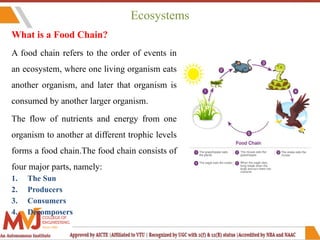
What is aFood Chain?
A food chain refers to the order of events in
an ecosystem, where one living organism eats
another organism, and later that organism is
consumed by another larger organism.
The flow of nutrients and energy from one
organism to another at different trophic levels
forms a food chain.The food chain consists of
four major parts, namely:
1. The Sun
2. Producers
3. Consumers
4. Decomposers
11.
Ecosystems
What is aFood web?
• Several interconnected food chains
form a food web. A food web is similar
to a food chain but the food web is
comparatively larger than a food chain.
• When there are more cross-interactions
between different food chains, the food
web gets more complex. This
complexity in a food web leads to a
more sustainable ecosystem.
12.
Ecosystems
Why Biodiversity isImportant?
• Ecological Stability: Every species has a specific role in an ecosystem. They
capture and store energy and also produce and decompose organic matter. The
ecosystem supports the services without which humans cannot survive. A diverse
ecosystem is more productive and can withstand environmental stress.
• Economic Importance: Biodiversity is a reservoir of resources for the
manufacture of food, cosmetic products and pharmaceuticals.Crops livestock,
fishery, and forests are a rich sources of food.Wild plants such as Cinchona and
Foxglove plant are used for medicinal purposes.Wood, fibres, perfumes, lubricants,
rubber, resins, poison and cork are all derived from different plant species.The
national parks and sanctuaries are a source of tourism. They are a source of beauty
and joy for many people.
13.
Ecosystems
• Ethical Importance:All species have a right to exist. Humans should not cause
their voluntary extinction. Biodiversity preserves different cultures and spiritual
heritage. Therefore, it is very important to conserve biodiversity.
• Biodiversity in India: India is one of the most diverse nations in the world. It
ranks ninth in terms of plant species richness. Two of the world’s 25 biodiversity
hotspots are found in India. It is the origin of important crop species such as pigeon
pea, eggplant, cucumber, cotton and sesame. India is also a centre of various
domesticated species such as millets, cereals, legumes, vegetables, medicinal and
aromatic crops, etc.India is equally diverse in its faunal wealth. There are about
91000 animal species found here.However, diversity is depleting at a drastic rate
and various programmes on biodiversity conservation are being launched to
conserve nature.
14.
Ecosystems
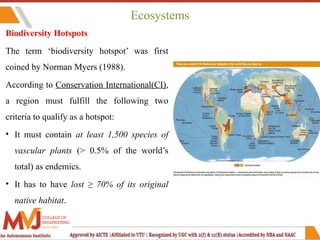
Biodiversity Hotspots
The term‘biodiversity hotspot’ was first
coined by Norman Myers (1988).
According to Conservation International(CI),
a region must fulfill the following two
criteria to qualify as a hotspot:
• It must contain at least 1,500 species of
vascular plants (> 0.5% of the world’s
total) as endemics.
• It has to have lost ≥ 70% of its original
native habitat.
15.
Ecosystems
Biodiversity hotspots inIndia
Out of the 36 biodiversity hotspots in the world, 4 are in India. These hotspots are
1. the Himalayas,
2. the Western Ghats,
3. the Indo-Burma region and
4. the Sundaland.
16.
Ecosystems
1. The Himalayas
•Overall, the Himalayas comprises North-East India, Bhutan, Central and Eastern
parts of Nepal.
• These Himalayan Mountains are the highest in the world and hosts some of the
highest peaks of the world including Mount Everest and K2.
• It also includes some of the major rivers of the world like Indus and Ganga.
• Himalayas hosts almost 163 endangered species including one-horned rhinoceros,
wild Asian water buffalo and as many as 45 mammals, 50 birds, 12 amphibians, 17
reptiles, 3 invertebrates and 36 plant species.
17.
Ecosystems
2. The WesternGhats
• These hills are found along the western edge of peninsular India.
• As the region is mountainous and oceanic, it receives a good amount of rainfall.
• Around 77% of the amphibians and 62% of the reptiles are endemic.
• Moreover, the region is also home to around 450 species of birds, 140 mammals,
260 reptiles and 175 amphibians.
18.
Ecosystems
3. Indo-Burma region
•This region consists of various countries including North-Eastern India (to the
south of the Brahmaputra River), Myanmar, and China’s Yunnan provinces, Lao
People’s Democratic Republic, Vietnam, Cambodia, and Thailand.
• Almost 13,500 plant species can be spotted in the region, half of which are
endemic and cannot be found in any other place in the world.
• Although this region is quite rich in its biodiversity, the situation has been
worsening over the past few decades.
19.
Ecosystems
4. Sundaland
• Thisregion lies in South-East Asia and includes Thailand, Singapore, Indonesia,
Brunei, and Malaysia.
• Nicobar region represents India in this hotspot.
• UNESCO declared this region as the world biosphere reserve in 2013.
• These islands have a rich terrestrial as well as marine ecosystem including
mangroves, seagrass beds, and coral reefs.
20.
Ecosystems
Endangered Species ofIndia
According to the International Union for Conservation of Nature, “India accounts for
7-8% of all recorded species, including over 45,000 species of plants and 91,000
species of animals’’. But with the rapid loss of biodiversity, many species are
becoming extinct or at risk of becoming critically endangered. The species that are at
risk of extinction due to the sudden decrease in their population and habitat are known
as endangered species.The top 5 endangered species (Flora and Fauna) in India are
listed in the table below:
21.
Ecosystems
Various Threats toBiodiversity and Their Solutions
1. Habitat loss and deforestation
2. Climate change
3. Overexploitation of resources
4. Nutrient loading
5. Environmental pollution
6. Invasive species
22.
Ecosystems
1. Habitat lossand Deforestation
The dramatic alteration of habitats directly threatens biodiversity. When such habitats
are lost due to deforestation and other anthropogenic activities such as mining, the
respective environments are unable to provide shelter, food, water, or breeding
grounds for the living organisms. In other words, it leads to unhealthy and unbalanced
ecosystems that result in the loss of biodiversity and extinction.
Solution: Governments and regulatory agencies should also take the lead in ensuring
the enactment of stronger forest protection laws and policies. Individuals and
organizations can also participate by support environmental conservation through
charities and creating awareness.
23.
Ecosystems
2. Climate Change
Theglobal climatic changes throughout the history of the plant have definitely
modified life and ecosystems in the planet. As an outcome, crucial habitats have been
destroyed and a number of species have gone extinct with a huge majority at the verge
of extinction.
Solution: Climate change is mostly exacerbated because of human activities with
regards to destroying carbon sinks and their dependency on using fossil fuels. Hence,
if effective actions can be taken to reduce the amount of carbon footprint, the world
can be assured of a better tomorrow and less worries about climate change.
24.
Ecosystems
3. Overexploitation ofResources
On the account of the ever rising human population, there has been a correlational
increase in demand for manufactured products, essential goods and services. The high
demands of these things have resulted in overfishing, overhunting, over-harvesting
and excessive mineral resource extraction which has highly contributed to biodiversity
loss.
It has also altered natural habits therefore destroying food chains and interfering with
the ecological balance.
Solution: Continued awareness creation and conservation are the main strategies for
managing overexploitation.Relevant environmental protection agencies and
governments also need to implement rules curtailing practices that cause
overexploitation of resources. Individual effort should aim towards being mindful of
the products we consume and buy.
25.
Ecosystems
4. Nutrient Loading
Theuse of fertilizers beyond limits has contributed to increased level of nitrogen and
phosphorous nutrients in the natural ecosystems.Particularly, the survival of species
that flourish in phosphorous or nitrogen-poor environments are increasingly
threatened.Furthermore, leaches and entry into water systems have resulted in
increased eutrophication and the creation of anoxic (oxygen deficient) zones in marine
habitats.
Solution: The artificial production of fertilizers should not only aim at meeting the
global food demands but also decreasing environmental problems.
Farmers should also reduce their dependency on using high quantities of nutrient
fertilizer and seek alternatives
26.
Ecosystems
5.Environmental Pollution
Pollution hascontinued to harm the biosphere by releasing and depositing toxic
chemicals into the atmospheric, terrestrial and marine systems. With the high levels of
pollution every year, it is gradually disrupting the Earth’s ecosystems as the chemicals
released potentially influences species’ habits and ecosystems.
Solution: There are a number of ways for curbing pollution. Anti-pollution laws and
policies at the local, state and international level are the most practical for curbing
pollution as they play a critical role in restricting pollution. Individuals can also take a
number of initiatives to fight water, air and land pollution by embracing effective
actions such as conserving energy at home, recycling, use of safe and non-toxic
products, and using public transport.
27.
Ecosystems
6.Invasive Species
Invasive speciesare the non-native species that invade normal and healthy ecosystems
and threaten the survival of the native species either by attacking them or competing
for the habitat’s resources. Accordingly, they upset the native biota and ecosystems
thereby causing extinctions and massive threats to biodiversity.
Solution:Local authorities and states need to establish systems to manage and prevent
invasive alien species through risk assessments as a strategy of predicting the
possibility of species becoming invasive. The assessments should also aim at
determining the potential ecological damages and put in place effective preventive
measures to counter the likely environmental impacts.
28.
Ecosystems
Biodiversity and itsConservation Methods
Biodiversity refers to the variability of life on earth. It can be conserved in the
following ways:
• In-situ Conservation
• Ex-situ Conservation
29.
Ecosystems
In-situ Conservation
In-situ conservationof biodiversity is the conservation of species within their natural
habitat. In this method, the natural ecosystem is maintained and protected.
Following are the important advantages of in-situ conservation:
1. It is a cost-effective and convenient method of conserving biodiversity.
2. A large number of living organisms can be conserved simultaneously.
3. Since the organisms are in a natural ecosystem, they can evolve better and can
easily adjust to different environmental conditions.
Certain protected areas where in-situ conservation takes place include national parks,
wildlife sanctuaries and biosphere reserves.
30.
Ecosystems
Ex-situ Conservation
Ex-situ conservationof biodiversity involves the breeding and maintenance of
endangered species in artificial ecosystems such as zoos, nurseries, botanical gardens,
gene banks, etc. There is less competition for food, water and space among the
organisms.
Ex-situ conservation has the following advantages:
1. The animals are provided with a longer time and breeding activity.
2. The species bred in captivity can be reintroduced in the wild.
3. Genetic techniques can be used for the preservation of endangered species.
31.
Ecosystems
Forest Wealth:
Forests areone of the most important natural resources on this earth. Covering the
earth like a green blanket these forests not only produce innumerable material goods,
but also provide several environmental services which are essential for life. Forests
are of immense value to us.They are not only useful for industry but also for rural
economic growth. They offer huge potential for reducing poverty while also
conserving their valuable key resources.Some of the major uses of forest wealth are as
follows:
1. Economic Uses
2. Ecological Uses like
i. Production of oxygen ii. Reducing global warming iii. Wildlife habitat iv. Regulation of
hydrological cycle v. Soil conservation vi. Pollution moderators
32.
Ecosystems
What Is Deforestation?
Deforestationrefers to the decrease in forest areas across the world that are lost for
other uses such as agricultural croplands, urbanization, or mining activities. Greatly
accelerated by human activities since 1960, deforestation has been negatively
affecting natural ecosystems, biodiversity, and the climate. The UN’s Food and
Agriculture Organization estimates the annual rate of deforestation to be around 1.3
million km2
per decade.
Causes of Deforestation: Why Is Deforestation Happening?
1. Agriculture is the Number 1 Cause of Deforestation (~80%)
2. Deforestation Caused By New Constructions (~15%)
3. Urbanization Causing Deforestation (~5%)
33.
Ecosystems
How Can WeStop Deforestation?
1 – Eating Less Meat Helps Stop Deforestation:According to the WWF, livestock-
caused deforestation is responsible for the discharge of 3.4% of current global
emissions of carbon to the atmosphere every year. That’s why the late 2018 IPCC
report stood out that reducing meat consumption by 90% is the single biggest way to
reduce global warming.
2 – Consuming Less and More Consciously Helps Stop Deforestation:As
consumers we can choose to buy less industrial and transformed products such as
cookies, crips, noodles or cosmetics that use plenty of palm oil. Instead, we can go for
a home-made approach with fewer chemicals and food preservatives which is better
for both the planet and our health.
34.
Ecosystems
3 – ToStop Deforestation, When You Consume: Use, Use, Use: Your smartphone,
your laptop or your car, to name a few, are all made of aluminium, plastic and rare
Earth minerals, among other materials.
4 – Leaving Fossil Fuels and Palm Oil Behind: Nearly half of UE’s imports of palm
oil are used as biofuels – although proposals to ban subsidies are currently under
debate. Since diesel and petrol are mixed with biofuels, choosing other transportation
methods such as walking, cycling or car-sharing can be good ways of reducing palm
oil importations (and production) and to help stop deforestation.
5 – Lead by Example and Spread Awareness: Teach your family, friends or
colleagues what deforestation is and why it is happening, the causes and
consequences of deforestation, and what solutions individuals, consumers and
organizations can adopt.





![4 [Biodiversity 1] - Latest Res (1).ppt](https://cdn.slidesharecdn.com/ss_thumbnails/4biodiversity1-latestres1-231230050500-829153a6-thumbnail.jpg?width=640&height=640&fit=bounds)


