Evonik’s Performance
Evonik’
Envelope of Fuel- and
Cost-efficient Solutions
for Your Driveline Fluids
Torsten Stoehr, Boris Eisenberg,
Justin Mills, Thorsten Bartels,
Aidan Rose
1. Mission Fuel Economy
2. VISCOPLEX® 12-199 Comb Polymer for
Your Fuel Economy ATF
3. VISCOBASE® 11-522 is
Your Cost-efficient Alternative for Axle Oils

2013-04-20 | Evonik’s Performance Envelope ...

Page | 2
1. Mission Fuel Economy
2. VISCOPLEX® 12-199 Comb Polymer for
Your Fuel Economy ATF
3. VISCOBASE® 11-522 is
Your Cost-efficient Alternative for Axle Oils

2013-04-20 | Evonik’s Performance Envelope ...

Page | 3
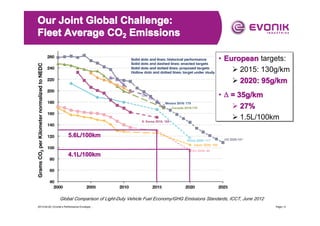
Our Joint Global Challenge:
Fleet Average CO2 Emissions
• European targets:
• European targets:
� 2015: 130g/km
� 2020: 95g/km
2020: 95g/km
• ∆ = 35g/km
• ∆ = 35g/km
� 27%
27%
� 1.5L/100km
5.6L/100km
4.1L/100km

Global Comparison of Light-Duty Vehicle Fuel Economy/GHG Emissions Standards, ICCT, June 2012
2013-04-20 | Evonik’s Performance Envelope ...

Page | 4
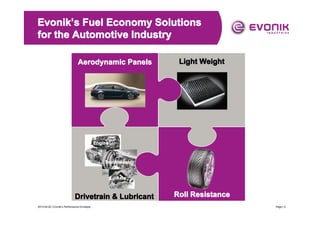
Evonik’s Fuel Economy Solutions
Evonik’
for the Automotive Industry
Aerodynamic Panels

Light Weight

Engine

Transmission

Axle

Drivetrain & Lubricant
2013-04-20 | Evonik’s Performance Envelope ...

Roll Resistance
Page | 5
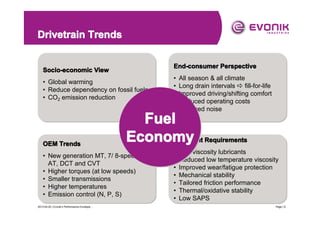
Drivetrain Trends
End-consumer Perspective

Socio-economic View
Socio-economic View
•
•
•
•
•
•

Global warming
Global warming
Reduce dependency on fossil fuels
CO2 emission reduction

OEM Trends
OEM Trends

All season & all climate
Long drain intervals � fill-for-life
Improved driving/shifting comfort
Reduced operating costs
Reduced noise
Reduced noise

•
•
•
•
•
•
•
•
•
•
•
•
•
•

Low viscosity lubricants
Reduced low temperature viscosity
Improved wear/fatigue protection
Mechanical stability
Tailored friction performance
Thermal/oxidative stability
Low SAPS
Low SAPS

Fuel
Economy Requirements
Lubricant Requirements
Lubricant

• New generation MT, 7/ 8-speed
AT, DCT and CVT
AT, DCT and CVT
• Higher torques (at low speeds)
• Smaller transmissions
• Higher temperatures
• Emission control (N, P, S)
2013-04-20 | Evonik’s Performance Envelope ...

•
•
•
•
•
•
•
•
•
•

Page | 6
contracted
VII

Log Log viscosity

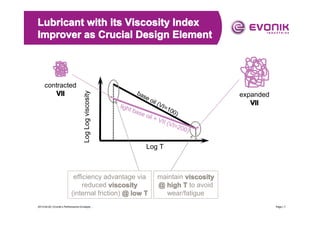
Lubricant with its Viscosity Index
Improver as Crucial Design Element

ba
se
oil
(VI
ligh
=1
t ba
00
se o
)
il +
VII
(VI=
200
)

expanded
VII

Log T

efficiency advantage via
reduced viscosity
(internal friction) @ low T
2013-04-20 | Evonik’s Performance Envelope ...

maintain viscosity
@ high T to avoid
wear/fatigue
Page | 7
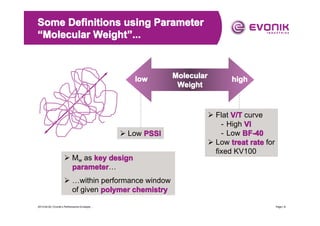
Some Definitions using Parameter
“Molecular Weight”...
Weight”

low

� Low PSSI
� Mw as key design
parameter…

Molecular
Weight

high

� Flat V/T curve
- High VI
- Low BF-40
� Low treat rate for
fixed KV100

� …within performance window
of given polymer chemistry
2013-04-20 | Evonik’s Performance Envelope ...

Page | 8
Polymer Chemistry
Polyolefins

Ester-funtional polymers

� Poly(isobutylene) PIB
� Olefin copolymers OCP
� Hydrogenated styrene / diene
copolymers HSD
� Poly(α-olefin) PAO

� Poly(alkyl methacrylate) PAMA
� Styrene / fumarate copolymers
� α-Olefin / fumarate copolymers
-Olefin

CxHy

� Low treat rate
2013-04-20 | Evonik’s Performance Envelope ...

Polymer
Chemistry

C=O
I

OR

� Flat V/T curve
� Low PSSI
Page | 9
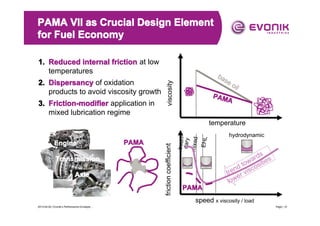
PAMA VII as Crucial Design Element
for Fuel Economy
1. Reduced internal friction at low
temperatures

3. Friction-modifier application in
mixed lubrication regime

viscosity

2. Dispersancy of oxidation
products to avoid viscosity growth

ba

se

oil

PAM
A

Transmission
Axle

EH L

PAMA

boundary
mixed

Engine

friction coefficient

temperature

PAMA

hydrodynamic

s
ard ies
tow osit
d
ren r visc
t
e
low

speed x viscosity / load
2013-04-20 | Evonik’s Performance Envelope ...

Page | 10
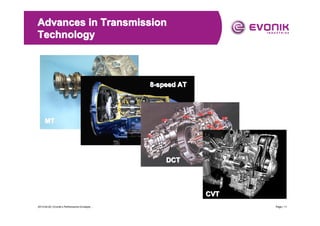
Advances in Transmission
Technology

8-speed AT

MT

DCT

CVT
2013-04-20 | Evonik’s Performance Envelope ...

Page | 11
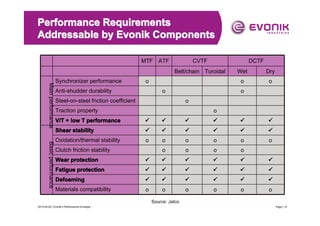
Performance Requirements
Addressable by Evonik Components
MTF ATF

CVTF

DCTF

Belt/chain Toroidal
Main performance

Synchronizer performance
Anti-shudder durability

o

Steel-on-steel friction coefficient

Dry

o

o

Wet

o

o
o

Traction property

o

Basic performance

V/T + low T performance

�

�

�

�

�

�

Shear stability

�

�

�

�

�

�

Oxidation/thermal stability

o

o

o

o

o

o

o

o

o

o

Clutch friction stability
Wear protection

�

�

�

�

�

�

Fatigue protection

�

�

�

�

�

�

Defoaming

�

�

�

�

�

�

Materials compatibility

o

o

o

o

o

o

Source: Jatco
2013-04-20 | Evonik’s Performance Envelope ...

Page | 12
1. Mission Fuel Economy
2. VISCOPLEX® 12-199 Comb Polymer for
Your Fuel Economy ATF
3. VISCOBASE® 11-522 is
Your Cost-efficient Alternative for Axle Oils

2013-04-20 | Evonik’s Performance Envelope ...

Page | 13
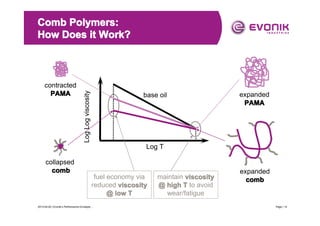
contracted
PAMA

Log Log viscosity

Comb Polymers:
How Does it Work?

base oil

expanded
PAMA

Log T
collapsed
comb

fuel economy via
reduced viscosity
@ low T

2013-04-20 | Evonik’s Performance Envelope ...

maintain viscosity
@ high T to avoid
wear/fatigue

expanded
comb

Page | 14
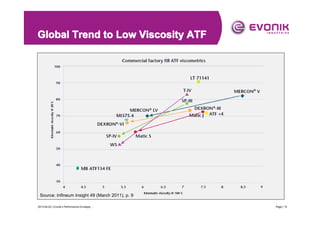
Global Trend to Low Viscosity ATF

Source: Infineum Insight 49 (March 2011), p. 9
2013-04-20 | Evonik’s Performance Envelope ...

Page | 15
ATF Formulations
6.0cSt
Conventional
PAMA

6.0cSt
VISCOPLEX®
12-199 (Comb)

4.5cSt
VISCOPLEX®
12-199 (Comb)

VII [%]

8.5

5.7

3.5

VISCOPLEX® 1-180 [%]

0.3

0.3

0.3

DI package [%]

15.0

15.0

15.0

Nexbase 3030 [%]

76.2

79.0

30.0

Nexbase 3020 [%]

-

-

51.2

KV100 [mm²/s]

6.03

6.02

4.48

5.46

KV40 [mm²/s]

28.4

24.7

17.1

26.0

VI

166

210

193

152

BF [mPas]

10,200

6,600

2,900

7,900

PP [°C]

-48

-48

< -48

-45

KV100KRL20 [mm²/s]

5.71

5.70

4.35

5.35

KV100 loss [%]

5.3

5.4

2.9

2.1

PSSI

18

18

15

-

2013-04-20 | Evonik’s Performance Envelope ...

5.5cSt
Hyundai
SP-IV FF/SF

Page | 16
Fuel Economy Study at ISP
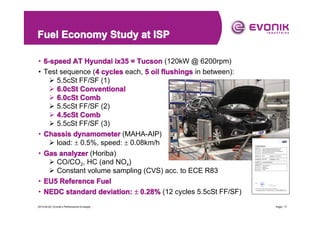
• 6-speed AT Hyundai ix35 = Tucson (120kW @ 6200rpm)
4
• Test sequence (4 cycles each, 5 oil flushings in between):
� 5.5cSt FF/SF (1)
� 6.0cSt Conventional
� 6.0cSt Comb
� 5.5cSt FF/SF (2)
� 4.5cSt Comb
� 5.5cSt FF/SF (3)
• Chassis dynamometer (MAHA-AIP)
� load: ± 0.5%, speed: ± 0.08km/h
• Gas analyzer (Horiba)
� CO/CO2, HC (and NOx)
� Constant volume sampling (CVS) acc. to ECE R83
• EU5 Reference Fuel
• NEDC standard deviation: ± 0.28% (12 cycles 5.5cSt FF/SF)
2013-04-20 | Evonik’s Performance Envelope ...

Page | 17
New European Driving Cycle (NEDC)
80

150
ECE* 3+4
Urban Driving
Cycles

EUDC Extra
Urban Driving
Cycle

60
100
40
5.5cSt FF/SF (2)
50
20

0
0

200

400

600

800

1000

Vehicle speed [km/h]

Transmission oil temperature [

]

ECE* 1+2
Urban Driving
Cycles

0
1200

Time [s]
* ECE = Economic Commission for Europe
2013-04-20 | Evonik’s Performance Envelope ...

Page | 18
Fuel Consumption by Sub-cycle

12
.8
12 7
.8
12 3
.5
3

14
6.0cSt Conventional
6.0cSt Comb
4.5cSt Comb
5.5cSt FF/SF

12

10

8.
62
8.
52
8.
49
8.
54

11

10
.2
10 9
.1
10 9
.1
2

9

88
6.
78
6.
83

8
6.

Fuel consumption [L/100km]

13

7

• Comb polymer (in
parallel to KV100
lowering) reduces
fuel consumption
in NEDC and its
ECE sub-cycles
• In EUDC, the 4.5cSt
fluid shows
increased fuel
consumption due to
mixed lubrication

6
ECE 1+2
2013-04-20 | Evonik’s Performance Envelope ...

ECE 3+4

EUDC

NEDC
Page | 19
NEDC Fuel Economy
2.0

2.0

1.5

NEDC FE vs. 5.5cSt
SF/FF [%]

NEDC FE vs. 6cSt
Conventional [%]

1.6
1.2

1.0
0.5
0.0
6.0cSt Comb

4.5cSt Comb

• 6.0cSt Comb delivers 1.2% FE vs
6.0cSt Conventional
• Lowering KV100 to 4.5cSt results
in 1.6% FE totally (mixed
lubrication!)
2013-04-20 | Evonik’s Performance Envelope ...

1.5
1.0
0.5

0.3

0.0
6.0cSt Comb

• 6.0cSt Comb delivers 0.3% FE vs
5.5cSt FF/SF, but at higher KV100
implying higher wear and fatigue
protection
Page | 20
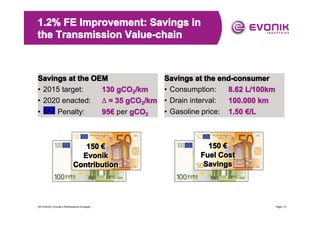
1.2% FE Improvement: Savings in
the Transmission Value-chain

Savings at the OEM
• 2015 target:
130 gCO2/km
• 2020 enacted: ∆ = 35 gCO2/km
•
Penalty:
95€ per gCO2
95€

Savings at the end-consumer
• Consumption:
8.62 L/100km
• Drain interval:
100.000 km
• Gasoline price: 1.50 €/L

150 €
150 €
Evonik
Evonik
Contribution
Contribution

150 €
150 €
Fuel Cost
Fuel Cost
Savings
Savings

2013-04-20 | Evonik’s Performance Envelope ...

Page | 21
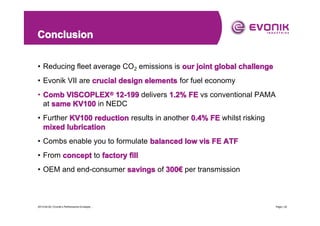
Conclusion
• Reducing fleet average CO2 emissions is our joint global challenge
• Evonik VII are crucial design elements for fuel economy
• Comb VISCOPLEX ® 12-199 delivers 1.2% FE vs conventional PAMA
at same KV100 in NEDC
• Further KV100 reduction results in another 0.4% FE whilst risking
mixed lubrication
• Combs enable you to formulate balanced low vis FE ATF
• From concept to factory fill
• OEM and end-consumer savings of 300€ per transmission
300€

2013-04-20 | Evonik’s Performance Envelope ...

Page | 22
1. Mission Fuel Economy
2. VISCOPLEX® 12-199 Comb Polymer for
Your Fuel Economy ATF
3. VISCOBASE® 11-522 is
Your Cost-efficient Alternative for Axle Oils

2013-04-20 | Evonik’s Performance Envelope ...

Page | 23
75W-140 Formulations
75W-140 w/
VISCOBASE®
11-522

75W-140 w/
PAO100

80W-90 Intertek
Reference

SAE J306 JUN2005

Base stock [%]

47.0

57.0

DI package [%]

4.0

4.0

PAO4 [%]

29.0

19.0

Ester, 3.6cSt [%]

20.0

20.0

KV100 [mm²/s]

25.8

25.3

13.7 (non
stay-in-grade)

13.5-18.5 (80W-90)
24-32.5 (75W-140)

KV40 [mm²/s]

170

183

117

VI

187

171

114

BF [mPas]

89,400 (-40°C)

128,000 (-40°C)

35,900 (-26°C)

<150,000

KV100KRL20 [mm²/s]

24.7

25.0

12.0

13.5-18.5 (80W-90)
24-32.5 (75W-140)

KV100 loss [%]

4.3

1.0

11.8

PSSI

5.1

1.1

2013-04-20 | Evonik’s Performance Envelope ...

Page | 24
Bench Testing: MTM Mixed
Lubrication & EHL Modes
0.10

0.05

75W-140 VISCOBASE ® 11-522
75W-140 PAO100

30N
2000mm/s
0.04

120

Friction coefficient

Friction coefficient

0.08

®

®
75W-140 VISCOBASE 11-522
75W-140 PAO100

0.06
25
0.04
30N
50%SRR

0.02
0.00

0.03

25

40

60

0.02

80
100

120

0.01
0.00

1

10

100

1000

Mean speed [mm/s]

10000

0

10

20

30

40

50

SRR [%]

• Note highly resolved y-axes!
• VISCOBASE® 11-522 and
PAO100 show same friction
coefficient in MTM mixed
lubrication and EHL modes
2013-04-20 | Evonik’s Performance Envelope ...

Page | 25
Bench Testing:
FZG Efficiency and ARKL
10

80

®

®
75W-140 VISCOBASE 11-522: feff = 0.97
75W-140 PAO100: f eff = 0.97

]

60

6

Temperature [

Torque loss [Nm]

8

20

4
44
90

2

feffciency = 1 -

torque /
temperature,
load stage

100

200
Torque [Nm]

20

75W-140 VISCOBASE? 11-522: Tequ = 62
75W-140 PAO100: T equ = 64

loss

temperature,
load stage

0
0

40

300

0
0

100

200

300

400

Time [min]

• VISCOBASE® 11-522 and
PAO100 show same
performance in FZG
efficiency and ARKL tests
2013-04-20 | Evonik’s Performance Envelope ...

Page | 26
GM 900 Axle Efficiency Test
at Intertek
800
28 kW 51 kW
16 kW

600

91 kW

165 kW

#29

Torque [Nm]

#17

Potential
operating
range

400
9 kW

Typical operating
range acc. to CAFE
(Corporate Average
Fuel Economy)

5 kW

200

3 kW
1 kW

0
0

#15

#3
1000

2000

3000

Pinion speed [rpm]
“29/20 Schedule”
Schedule”
• 29 stages over 8 constant power lines, 9 calibration stages outside of window
• 20 stages used for analysis, focus on stages #3, #15, #17, #29
• Each point held for 10 min (efficiency computed from last 5 min)
2013-04-20 | Evonik’s Performance Envelope ...

Page | 27
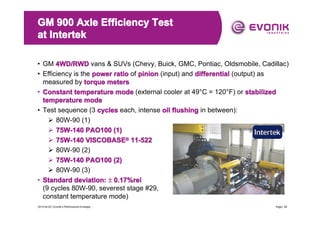
GM 900 Axle Efficiency Test
at Intertek
• GM 4WD/RWD vans & SUVs (Chevy, Buick, GMC, Pontiac, Oldsmobile, Cadillac)
• Efficiency is the power ratio of pinion (input) and differential (output) as
measured by torque meters
• Constant temperature mode (external cooler at 49°C = 120°F) or stabilized
temperature mode
• Test sequence (3 cycles each, intense oil flushing in between):
� 80W-90 (1)
� 75W-140 PAO100 (1)
� 75W-140 VISCOBASE® 11-522
� 80W-90 (2)
� 75W-140 PAO100 (2)
� 80W-90 (3)
• Standard deviation: ± 0.17%rel
(9 cycles 80W-90, severest stage #29,
constant temperature mode)
2013-04-20 | Evonik’s Performance Envelope ...

Page | 28
Constant Temperature Mode (49°C)
(49°
100
75W-140 VISCOBASE? 11-522
98.4

75W-140 PAO100

98.4

98.5

98.6

98

Efficiency [%]

96.1
96

96.0

• VISCOBASE®
11-522 and
PAO100 show
same efficiency
throughout all
stages

94

92

91.2

91.3

90
#3 (54Nm,
500rpm)

2013-04-20 | Evonik’s Performance Envelope ...

#15 (54Nm,
2900rpm)

#17 (542Nm,
500rpm)

#29 (542 Nm,
2900rpm)

Page | 29
Stabilized Temperature Mode
100
75W-140 VISCOBASE? 11-522

98.6 98.6 98.5

99.0 99.0

75W-140 PAO100
98

97.4

80W-90 Reference

Efficiency [%]

96.3
96

95.3 95.5

94

93.5
92.9 92.9

92

90
120

#3 (54Nm,
500rpm)

#15 (54Nm,
2900rpm)

#17 (542Nm,
500rpm)

#29 (542 Nm,
107 105 105
2900rpm)

Stabilized temperature [

]

100

80
66

58

60

40

66

36

34

54

54

• VISCOBASE® 11-522 and
PAO100 show same
efficiency throughout all
stages
• GM 900 Axle Efficiency
Test discriminates
precisely (80W-90 shows
expected behavior
compared to 75W-140)

51

33

20

0
#3 (54Nm,
500rpm)
2013-04-20 | Evonik’s Performance Envelope ...

#15 (54Nm,
2900rpm)

#17 (542Nm,
500rpm)

#29 (542 Nm,
2900rpm)
Page | 30
Spin-loss Experiment
• Torque required to overcome axle
resistance, i.e. the friction due to
� oil churning (splashing) losses
� shaft seal losses
� windage losses

• No load
• Constant temperature at 48.9°C
• Speed range as in 29/20 schedule
• VISCOBASE® 11-522 and PAO100
show same spin-loss induced
torque

4
Spin-loss induced torque [Nm]

• Same axle as in efficiency test, but
use of high precision (low torque)
meters

75W-140
PAO100

75W-140
®
VISCOBASE
11-522

3

80W-90
Reference
2

1
0

1000

2000

3000

4000

Pinion speed [rpm]
2013-04-20 | Evonik’s Performance Envelope ...

Page | 31
Oxidative Stability
VISCOBASE® 11-522
+ 0.6% aminic/
as is
phenolic mixed AO
486

BV100 [mPas]
US Steel @121°C
(ASTM D2893-B)

PAO100
101

548 (13%)

536 (11%)

208 (106%)

∆TAN [mgKOH/g]
Pressurized DSC
(ASTM D6186)
Induction time @…

BV100’ [mPas]

0.12

0.0

14.2

…155°C [min]

>120

65

…180°C [min]

>120

<10

…210°C [min]

10

100
80

• VISCOBASE® 11-522
w/o detriments vs
PAO100

TGA weight [%]

140

160

180

60
40
?
75W-140 VISCOPLEX 11-522: 82.1%
75W-140 PAO100: 87.9%

20
0
2013-04-20 | Evonik’s Performance Envelope ...

0

60

120
Time [min]

180

Page | 32
Conclusion
• VISCOBASE® 11-522 and PAO100 show same …
� … friction coefficient in MTM mixed lubrication and EHL modes
� … performance in FZG efficiency and ARKL tests
� … efficiency throughout all stages of the GM 900 Axle Efficiency
Test (both in constant and stabilized temperature modes)
� … spin-loss induced torque
• No detriments in oxidative stability
• Last but not least: axle cost credit

2013-04-20 | Evonik’s Performance Envelope ...

Page | 33
Summary
VISCOPLEX® 12-199
Comb Polymer for
Your Fuel Economy ATF

VISCOBASE® 11-522 is
Your Cost-efficient
Alternative for Axle Oils
100
75W-140 VISCOBASE? 11-522
98.4

75W-140 PAO100

98.4

98.5

98.6

98

1.2% FE

Efficiency [%]

96.1
96

96.0

94

92

91.2

91.3

90
#3 (54Nm,
500rpm)

2013-04-20 | Evonik’s Performance Envelope ...

#15 (54Nm,
2900rpm)

#17 (542Nm,
500rpm)

#29 (542 Nm,
2900rpm)

Page | 34
Disclaimer
This information and all further technical advice is based on our present knowledge and experience. However, they imply no liability or other legal responsibility on
our part, including with regard to existing third party intellectual property rights, especially patent rights. In particular, no warranty, whether express or implied, or
guarantee of product properties in the legal sense is intended or implied. We reserve the right to make any changes according to technological progress or further
developments. The customer is not released from the obligation to conduct careful inspection and testing of incoming goods. Performance of the product described
herein should be verified by testing, which should be carried out only by qualified experts in the sole responsibility of the customer. Reference to trade names used
by other companies is neither a recommendation, nor does it imply that similar products could not be used.
VISCOPLEX® , VISCOBASE® and DynaVIs® are registered trademarks of Evonik Industries AG

Evonik driveline cost efficient 2013

  • 1.
    Evonik’s Performance Evonik’ Envelope ofFuel- and Cost-efficient Solutions for Your Driveline Fluids Torsten Stoehr, Boris Eisenberg, Justin Mills, Thorsten Bartels, Aidan Rose
  • 2.
    1. Mission FuelEconomy 2. VISCOPLEX® 12-199 Comb Polymer for Your Fuel Economy ATF 3. VISCOBASE® 11-522 is Your Cost-efficient Alternative for Axle Oils 2013-04-20 | Evonik’s Performance Envelope ... Page | 2
  • 3.
    1. Mission FuelEconomy 2. VISCOPLEX® 12-199 Comb Polymer for Your Fuel Economy ATF 3. VISCOBASE® 11-522 is Your Cost-efficient Alternative for Axle Oils 2013-04-20 | Evonik’s Performance Envelope ... Page | 3
  • 4.
    Our Joint GlobalChallenge: Fleet Average CO2 Emissions • European targets: • European targets: � 2015: 130g/km � 2020: 95g/km 2020: 95g/km • ∆ = 35g/km • ∆ = 35g/km � 27% 27% � 1.5L/100km 5.6L/100km 4.1L/100km Global Comparison of Light-Duty Vehicle Fuel Economy/GHG Emissions Standards, ICCT, June 2012 2013-04-20 | Evonik’s Performance Envelope ... Page | 4
  • 5.
    Evonik’s Fuel EconomySolutions Evonik’ for the Automotive Industry Aerodynamic Panels Light Weight Engine Transmission Axle Drivetrain & Lubricant 2013-04-20 | Evonik’s Performance Envelope ... Roll Resistance Page | 5
  • 6.
    Drivetrain Trends End-consumer Perspective End-consumerPerspective Socio-economic View Socio-economic View • • • • • • Global warming Global warming Reduce dependency on fossil fuels Reduce dependency on fossil fuels CO2 emission reduction CO2 emission reduction OEM Trends OEM Trends All season & all climate All season & all climate Long drain intervals � fill-for-life Long drain intervals � fill-for-life Improved driving/shifting comfort Improved driving/shifting comfort Reduced operating costs Reduced operating costs Reduced noise Reduced noise • • • • • • • • • • • • • • Low viscosity lubricants Low viscosity lubricants Reduced low temperature viscosity Reduced low temperature viscosity Improved wear/fatigue protection Improved wear/fatigue protection Mechanical stability Mechanical stability Tailored friction performance Tailored friction performance Thermal/oxidative stability Thermal/oxidative stability Low SAPS Low SAPS Fuel Economy Requirements Lubricant Requirements Lubricant • New generation MT, 7/ 8-speed • New generation MT, 7/ 8-speed AT, DCT and CVT AT, DCT and CVT • Higher torques (at low speeds) • Higher torques (at low speeds) • Smaller transmissions • Smaller transmissions • Higher temperatures • Higher temperatures • Emission control (N, P, S) • Emission control (N, P, S) 2013-04-20 | Evonik’s Performance Envelope ... • • • • • • • • • • Page | 6
  • 7.
    contracted VII Log Log viscosity Lubricantwith its Viscosity Index Improver as Crucial Design Element ba se oil (VI ligh =1 t ba 00 se o ) il + VII (VI= 200 ) expanded VII Log T efficiency advantage via reduced viscosity (internal friction) @ low T 2013-04-20 | Evonik’s Performance Envelope ... maintain viscosity @ high T to avoid wear/fatigue Page | 7
  • 8.
    Some Definitions usingParameter “Molecular Weight”... Weight” low � Low PSSI � Mw as key design parameter… Molecular Weight high � Flat V/T curve - High VI - Low BF-40 � Low treat rate for fixed KV100 � …within performance window of given polymer chemistry 2013-04-20 | Evonik’s Performance Envelope ... Page | 8
  • 9.
    Polymer Chemistry Polyolefins Ester-funtional polymers �Poly(isobutylene) PIB � Olefin copolymers OCP � Hydrogenated styrene / diene copolymers HSD � Poly(α-olefin) PAO � Poly(alkyl methacrylate) PAMA � Styrene / fumarate copolymers � α-Olefin / fumarate copolymers -Olefin CxHy � Low treat rate 2013-04-20 | Evonik’s Performance Envelope ... Polymer Chemistry C=O I OR � Flat V/T curve � Low PSSI Page | 9
  • 10.
    PAMA VII asCrucial Design Element for Fuel Economy 1. Reduced internal friction at low temperatures 3. Friction-modifier application in mixed lubrication regime viscosity 2. Dispersancy of oxidation products to avoid viscosity growth ba se oil PAM A Transmission Axle EH L PAMA boundary mixed Engine friction coefficient temperature PAMA hydrodynamic s ard ies tow osit d ren r visc t e low speed x viscosity / load 2013-04-20 | Evonik’s Performance Envelope ... Page | 10
  • 11.
    Advances in Transmission Technology 8-speedAT MT DCT CVT 2013-04-20 | Evonik’s Performance Envelope ... Page | 11
  • 12.
    Performance Requirements Addressable byEvonik Components MTF ATF CVTF DCTF Belt/chain Toroidal Main performance Synchronizer performance Anti-shudder durability o Steel-on-steel friction coefficient Dry o o Wet o o o Traction property o Basic performance V/T + low T performance � � � � � � Shear stability � � � � � � Oxidation/thermal stability o o o o o o o o o o Clutch friction stability Wear protection � � � � � � Fatigue protection � � � � � � Defoaming � � � � � � Materials compatibility o o o o o o Source: Jatco 2013-04-20 | Evonik’s Performance Envelope ... Page | 12
  • 13.
    1. Mission FuelEconomy 2. VISCOPLEX® 12-199 Comb Polymer for Your Fuel Economy ATF 3. VISCOBASE® 11-522 is Your Cost-efficient Alternative for Axle Oils 2013-04-20 | Evonik’s Performance Envelope ... Page | 13
  • 14.
    contracted PAMA Log Log viscosity CombPolymers: How Does it Work? base oil expanded PAMA Log T collapsed comb fuel economy via reduced viscosity @ low T 2013-04-20 | Evonik’s Performance Envelope ... maintain viscosity @ high T to avoid wear/fatigue expanded comb Page | 14
  • 15.
    Global Trend toLow Viscosity ATF Source: Infineum Insight 49 (March 2011), p. 9 2013-04-20 | Evonik’s Performance Envelope ... Page | 15
  • 16.
    ATF Formulations 6.0cSt Conventional PAMA 6.0cSt VISCOPLEX® 12-199 (Comb) 4.5cSt VISCOPLEX® 12-199(Comb) VII [%] 8.5 5.7 3.5 VISCOPLEX® 1-180 [%] 0.3 0.3 0.3 DI package [%] 15.0 15.0 15.0 Nexbase 3030 [%] 76.2 79.0 30.0 Nexbase 3020 [%] - - 51.2 KV100 [mm²/s] 6.03 6.02 4.48 5.46 KV40 [mm²/s] 28.4 24.7 17.1 26.0 VI 166 210 193 152 BF [mPas] 10,200 6,600 2,900 7,900 PP [°C] -48 -48 < -48 -45 KV100KRL20 [mm²/s] 5.71 5.70 4.35 5.35 KV100 loss [%] 5.3 5.4 2.9 2.1 PSSI 18 18 15 - 2013-04-20 | Evonik’s Performance Envelope ... 5.5cSt Hyundai SP-IV FF/SF Page | 16
  • 17.
    Fuel Economy Studyat ISP • 6-speed AT Hyundai ix35 = Tucson (120kW @ 6200rpm) 4 • Test sequence (4 cycles each, 5 oil flushings in between): � 5.5cSt FF/SF (1) � 6.0cSt Conventional � 6.0cSt Comb � 5.5cSt FF/SF (2) � 4.5cSt Comb � 5.5cSt FF/SF (3) • Chassis dynamometer (MAHA-AIP) � load: ± 0.5%, speed: ± 0.08km/h • Gas analyzer (Horiba) � CO/CO2, HC (and NOx) � Constant volume sampling (CVS) acc. to ECE R83 • EU5 Reference Fuel • NEDC standard deviation: ± 0.28% (12 cycles 5.5cSt FF/SF) 2013-04-20 | Evonik’s Performance Envelope ... Page | 17
  • 18.
    New European DrivingCycle (NEDC) 80 150 ECE* 3+4 Urban Driving Cycles EUDC Extra Urban Driving Cycle 60 100 40 5.5cSt FF/SF (2) 50 20 0 0 200 400 600 800 1000 Vehicle speed [km/h] Transmission oil temperature [ ] ECE* 1+2 Urban Driving Cycles 0 1200 Time [s] * ECE = Economic Commission for Europe 2013-04-20 | Evonik’s Performance Envelope ... Page | 18
  • 19.
    Fuel Consumption bySub-cycle 12 .8 12 7 .8 12 3 .5 3 14 6.0cSt Conventional 6.0cSt Comb 4.5cSt Comb 5.5cSt FF/SF 12 10 8. 62 8. 52 8. 49 8. 54 11 10 .2 10 9 .1 10 9 .1 2 9 88 6. 78 6. 83 8 6. Fuel consumption [L/100km] 13 7 • Comb polymer (in parallel to KV100 lowering) reduces fuel consumption in NEDC and its ECE sub-cycles • In EUDC, the 4.5cSt fluid shows increased fuel consumption due to mixed lubrication 6 ECE 1+2 2013-04-20 | Evonik’s Performance Envelope ... ECE 3+4 EUDC NEDC Page | 19
  • 20.
    NEDC Fuel Economy 2.0 2.0 1.5 NEDCFE vs. 5.5cSt SF/FF [%] NEDC FE vs. 6cSt Conventional [%] 1.6 1.2 1.0 0.5 0.0 6.0cSt Comb 4.5cSt Comb • 6.0cSt Comb delivers 1.2% FE vs 6.0cSt Conventional • Lowering KV100 to 4.5cSt results in 1.6% FE totally (mixed lubrication!) 2013-04-20 | Evonik’s Performance Envelope ... 1.5 1.0 0.5 0.3 0.0 6.0cSt Comb • 6.0cSt Comb delivers 0.3% FE vs 5.5cSt FF/SF, but at higher KV100 implying higher wear and fatigue protection Page | 20
  • 21.
    1.2% FE Improvement:Savings in the Transmission Value-chain Savings at the OEM • 2015 target: 130 gCO2/km • 2020 enacted: ∆ = 35 gCO2/km • Penalty: 95€ per gCO2 95€ Savings at the end-consumer • Consumption: 8.62 L/100km • Drain interval: 100.000 km • Gasoline price: 1.50 €/L 150 € 150 € Evonik Evonik Contribution Contribution 150 € 150 € Fuel Cost Fuel Cost Savings Savings 2013-04-20 | Evonik’s Performance Envelope ... Page | 21
  • 22.
    Conclusion • Reducing fleetaverage CO2 emissions is our joint global challenge • Evonik VII are crucial design elements for fuel economy • Comb VISCOPLEX ® 12-199 delivers 1.2% FE vs conventional PAMA at same KV100 in NEDC • Further KV100 reduction results in another 0.4% FE whilst risking mixed lubrication • Combs enable you to formulate balanced low vis FE ATF • From concept to factory fill • OEM and end-consumer savings of 300€ per transmission 300€ 2013-04-20 | Evonik’s Performance Envelope ... Page | 22
  • 23.
    1. Mission FuelEconomy 2. VISCOPLEX® 12-199 Comb Polymer for Your Fuel Economy ATF 3. VISCOBASE® 11-522 is Your Cost-efficient Alternative for Axle Oils 2013-04-20 | Evonik’s Performance Envelope ... Page | 23
  • 24.
    75W-140 Formulations 75W-140 w/ VISCOBASE® 11-522 75W-140w/ PAO100 80W-90 Intertek Reference SAE J306 JUN2005 Base stock [%] 47.0 57.0 DI package [%] 4.0 4.0 PAO4 [%] 29.0 19.0 Ester, 3.6cSt [%] 20.0 20.0 KV100 [mm²/s] 25.8 25.3 13.7 (non stay-in-grade) 13.5-18.5 (80W-90) 24-32.5 (75W-140) KV40 [mm²/s] 170 183 117 VI 187 171 114 BF [mPas] 89,400 (-40°C) 128,000 (-40°C) 35,900 (-26°C) <150,000 KV100KRL20 [mm²/s] 24.7 25.0 12.0 13.5-18.5 (80W-90) 24-32.5 (75W-140) KV100 loss [%] 4.3 1.0 11.8 PSSI 5.1 1.1 2013-04-20 | Evonik’s Performance Envelope ... Page | 24
  • 25.
    Bench Testing: MTMMixed Lubrication & EHL Modes 0.10 0.05 75W-140 VISCOBASE ® 11-522 75W-140 PAO100 30N 2000mm/s 0.04 120 Friction coefficient Friction coefficient 0.08 ® ® 75W-140 VISCOBASE 11-522 75W-140 PAO100 0.06 25 0.04 30N 50%SRR 0.02 0.00 0.03 25 40 60 0.02 80 100 120 0.01 0.00 1 10 100 1000 Mean speed [mm/s] 10000 0 10 20 30 40 50 SRR [%] • Note highly resolved y-axes! • VISCOBASE® 11-522 and PAO100 show same friction coefficient in MTM mixed lubrication and EHL modes 2013-04-20 | Evonik’s Performance Envelope ... Page | 25
  • 26.
    Bench Testing: FZG Efficiencyand ARKL 10 80 ® ® 75W-140 VISCOBASE 11-522: feff = 0.97 75W-140 PAO100: f eff = 0.97 ] 60 6 Temperature [ Torque loss [Nm] 8 20 4 44 90 2 feffciency = 1 - torque / temperature, load stage 100 200 Torque [Nm] 20 75W-140 VISCOBASE? 11-522: Tequ = 62 75W-140 PAO100: T equ = 64 loss temperature, load stage 0 0 40 300 0 0 100 200 300 400 Time [min] • VISCOBASE® 11-522 and PAO100 show same performance in FZG efficiency and ARKL tests 2013-04-20 | Evonik’s Performance Envelope ... Page | 26
  • 27.
    GM 900 AxleEfficiency Test at Intertek 800 28 kW 51 kW 16 kW 600 91 kW 165 kW #29 Torque [Nm] #17 Potential operating range 400 9 kW Typical operating range acc. to CAFE (Corporate Average Fuel Economy) 5 kW 200 3 kW 1 kW 0 0 #15 #3 1000 2000 3000 Pinion speed [rpm] “29/20 Schedule” Schedule” • 29 stages over 8 constant power lines, 9 calibration stages outside of window • 20 stages used for analysis, focus on stages #3, #15, #17, #29 • Each point held for 10 min (efficiency computed from last 5 min) 2013-04-20 | Evonik’s Performance Envelope ... Page | 27
  • 28.
    GM 900 AxleEfficiency Test at Intertek • GM 4WD/RWD vans & SUVs (Chevy, Buick, GMC, Pontiac, Oldsmobile, Cadillac) • Efficiency is the power ratio of pinion (input) and differential (output) as measured by torque meters • Constant temperature mode (external cooler at 49°C = 120°F) or stabilized temperature mode • Test sequence (3 cycles each, intense oil flushing in between): � 80W-90 (1) � 75W-140 PAO100 (1) � 75W-140 VISCOBASE® 11-522 � 80W-90 (2) � 75W-140 PAO100 (2) � 80W-90 (3) • Standard deviation: ± 0.17%rel (9 cycles 80W-90, severest stage #29, constant temperature mode) 2013-04-20 | Evonik’s Performance Envelope ... Page | 28
  • 29.
    Constant Temperature Mode(49°C) (49° 100 75W-140 VISCOBASE? 11-522 98.4 75W-140 PAO100 98.4 98.5 98.6 98 Efficiency [%] 96.1 96 96.0 • VISCOBASE® 11-522 and PAO100 show same efficiency throughout all stages 94 92 91.2 91.3 90 #3 (54Nm, 500rpm) 2013-04-20 | Evonik’s Performance Envelope ... #15 (54Nm, 2900rpm) #17 (542Nm, 500rpm) #29 (542 Nm, 2900rpm) Page | 29
  • 30.
    Stabilized Temperature Mode 100 75W-140VISCOBASE? 11-522 98.6 98.6 98.5 99.0 99.0 75W-140 PAO100 98 97.4 80W-90 Reference Efficiency [%] 96.3 96 95.3 95.5 94 93.5 92.9 92.9 92 90 120 #3 (54Nm, 500rpm) #15 (54Nm, 2900rpm) #17 (542Nm, 500rpm) #29 (542 Nm, 107 105 105 2900rpm) Stabilized temperature [ ] 100 80 66 58 60 40 66 36 34 54 54 • VISCOBASE® 11-522 and PAO100 show same efficiency throughout all stages • GM 900 Axle Efficiency Test discriminates precisely (80W-90 shows expected behavior compared to 75W-140) 51 33 20 0 #3 (54Nm, 500rpm) 2013-04-20 | Evonik’s Performance Envelope ... #15 (54Nm, 2900rpm) #17 (542Nm, 500rpm) #29 (542 Nm, 2900rpm) Page | 30
  • 31.
    Spin-loss Experiment • Torquerequired to overcome axle resistance, i.e. the friction due to � oil churning (splashing) losses � shaft seal losses � windage losses • No load • Constant temperature at 48.9°C • Speed range as in 29/20 schedule • VISCOBASE® 11-522 and PAO100 show same spin-loss induced torque 4 Spin-loss induced torque [Nm] • Same axle as in efficiency test, but use of high precision (low torque) meters 75W-140 PAO100 75W-140 ® VISCOBASE 11-522 3 80W-90 Reference 2 1 0 1000 2000 3000 4000 Pinion speed [rpm] 2013-04-20 | Evonik’s Performance Envelope ... Page | 31
  • 32.
    Oxidative Stability VISCOBASE® 11-522 +0.6% aminic/ as is phenolic mixed AO 486 BV100 [mPas] US Steel @121°C (ASTM D2893-B) PAO100 101 548 (13%) 536 (11%) 208 (106%) ∆TAN [mgKOH/g] Pressurized DSC (ASTM D6186) Induction time @… BV100’ [mPas] 0.12 0.0 14.2 …155°C [min] >120 65 …180°C [min] >120 <10 …210°C [min] 10 100 80 • VISCOBASE® 11-522 w/o detriments vs PAO100 TGA weight [%] 140 160 180 60 40 ? 75W-140 VISCOPLEX 11-522: 82.1% 75W-140 PAO100: 87.9% 20 0 2013-04-20 | Evonik’s Performance Envelope ... 0 60 120 Time [min] 180 Page | 32
  • 33.
    Conclusion • VISCOBASE® 11-522and PAO100 show same … � … friction coefficient in MTM mixed lubrication and EHL modes � … performance in FZG efficiency and ARKL tests � … efficiency throughout all stages of the GM 900 Axle Efficiency Test (both in constant and stabilized temperature modes) � … spin-loss induced torque • No detriments in oxidative stability • Last but not least: axle cost credit 2013-04-20 | Evonik’s Performance Envelope ... Page | 33
  • 34.
    Summary VISCOPLEX® 12-199 Comb Polymerfor Your Fuel Economy ATF VISCOBASE® 11-522 is Your Cost-efficient Alternative for Axle Oils 100 75W-140 VISCOBASE? 11-522 98.4 75W-140 PAO100 98.4 98.5 98.6 98 1.2% FE Efficiency [%] 96.1 96 96.0 94 92 91.2 91.3 90 #3 (54Nm, 500rpm) 2013-04-20 | Evonik’s Performance Envelope ... #15 (54Nm, 2900rpm) #17 (542Nm, 500rpm) #29 (542 Nm, 2900rpm) Page | 34
  • 35.
    Disclaimer This information andall further technical advice is based on our present knowledge and experience. However, they imply no liability or other legal responsibility on our part, including with regard to existing third party intellectual property rights, especially patent rights. In particular, no warranty, whether express or implied, or guarantee of product properties in the legal sense is intended or implied. We reserve the right to make any changes according to technological progress or further developments. The customer is not released from the obligation to conduct careful inspection and testing of incoming goods. Performance of the product described herein should be verified by testing, which should be carried out only by qualified experts in the sole responsibility of the customer. Reference to trade names used by other companies is neither a recommendation, nor does it imply that similar products could not be used. VISCOPLEX® , VISCOBASE® and DynaVIs® are registered trademarks of Evonik Industries AG