
EVOLVE MEKONG BASIN DISEASE SURVEILLANCE (MBDS)  INFORMATION COMMUNICATION AND TECHNOLOGY FORUM APRIL 2 ND –3 RD , 2009, MUKDAHAN PROVINCE, THAILAND Taha Kass-Hout, MD, MS Director, Global Public Health and Informatics Innovative Support to Emergencies, Diseases, and Disasters
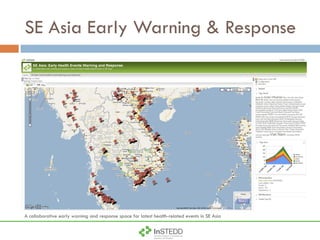
SE Asia Early Warning & Response A collaborative early warning and response space for latest health-related events in SE Asia
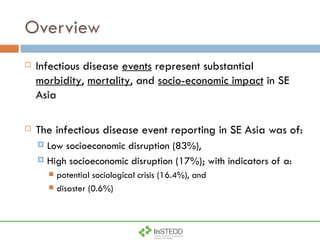
Overview Infectious disease  events  represent substantial  morbidity ,  mortality , and  socio-economic impact  in SE Asia The infectious disease event reporting in SE Asia was of: Low socioeconomic disruption (83%),  High socioeconomic disruption (17%); with indicators of a: potential sociological crisis (16.4%), and  disaster (0.6%)
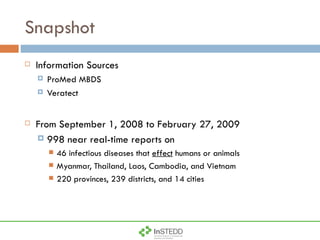
Snapshot Information Sources ProMed MBDS Veratect From September 1, 2008 to February 27, 2009 998 near real-time reports on 46 infectious diseases that  effect  humans or animals Myanmar, Thailand, Laos, Cambodia, and Vietnam 220 provinces, 239 districts, and 14 cities
Indicators and Insights Approximations of Epidemiological Features Response Local Public Community Reaction (Public and Responders) Infrastructure Infectious Disease Disaster
Apprx. of Epidemiological Features What diseases were reported to have  affected different age groups  in SE Asia Reports of  mortal outcomes  for all age groups Which of the infectious disease events presented as  single cases, apparently localized clusters (approximation of an “ outbreak ”), and  apparent multiple cases in multiple locations (approximation of an “ epidemic ”)
Response what level of government and non-governmental organization became involved in response by disease event
Local Public Community Reaction Reaction of the public The term ‘panic’ is not indicative of true panic but rather a proxy for social concern ‘ Panic with behavior’ is where we have documented non-routine public behavior such as panic buying, hoarding of medications, and so on, where concern has elicited non-routine action ‘ Flight’ is the ultimate outcome where a community’s inhabitants abandon their community and for a period of time, social disintegration is observed. This is the end point of infectious disease event damage from a sociological perspective, where a community ceases (transiently) to be an integrated social unit engaged in routine daily activities Evacuation due to biological events is a rare phenomenon, but one for which we maintain a baseline for what diseases in what countries provoke such a reaction
Local Public Community Reaction Reaction of responders Responder anxiety, which follows the same conceptual framework as public anxiety Here it is key to note those events where healthcare workers refuse to perform their duties or participate in response due to fear of exposure, illness, or death Responder avoidance of duties is a rare phenomenon
Infrastructure The infrastructure types affected (compromised) by infectious disease events in SE Asia either due to absenteeism,  contamination,  work overload (i.e., response), or any combination of the above
Infectious Disease Disaster The most socially disruptive events in SE Asia, by country and disease that are assessed to be potential disasters 0.6% of all disease reports in SE Asia
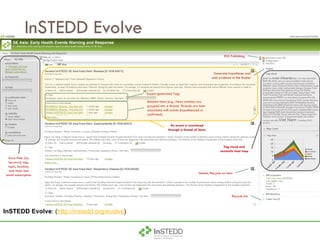
InSTEDD Evolve Related items (e.g., News articles) are grouped into a thread. Threads are later associated with events (hypothesized or confirmed). InSTEDD Evolve : ( http://instedd.org/evolve ) Tag cloud and semantic heat map Delete/Recycle an Item Expert-generated Tags RSS Publishing Generate hypotheses and add evidence to the Basket Save filter (by keyword, tag, topic, location, and time) and email subscription Recycle bin An event is monitored through a thread of items
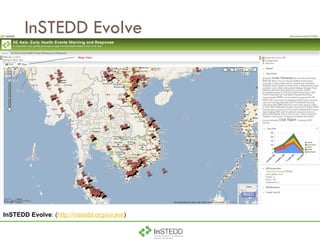
InSTEDD Evolve InSTEDD Evolve : ( http://instedd.org/evolve ) Map view
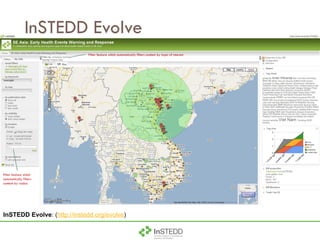
InSTEDD Evolve Filter feature which automatically filters content by topic of interest Filter feature which automatically filters content by radius InSTEDD Evolve : ( http://instedd.org/evolve )
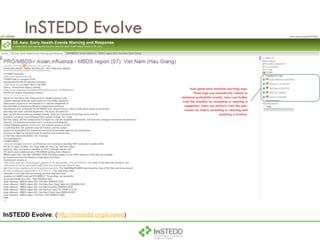
InSTEDD Evolve Auto-generated (machine-learning) tags. These tags are semantically ranked (a statistical probability match). Users can further train the classifier by accepting or rejecting a suggestion. Users can similarly train the geo-locator by simply accepting or rejecting and updating a location. InSTEDD Evolve : ( http://instedd.org/evolve )
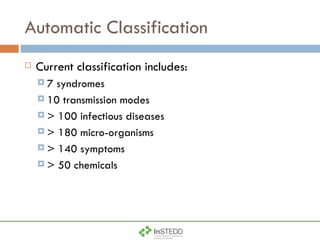
Automatic Classification Current classification includes:  7 syndromes 10 transmission modes > 100 infectious diseases > 180 micro-organisms > 140 symptoms > 50 chemicals
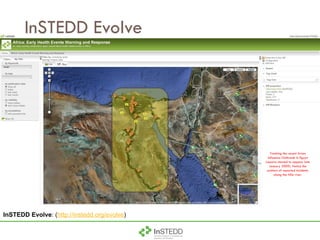
InSTEDD Evolve InSTEDD Evolve : ( http://instedd.org/evolve ) Tracking the recent Avian Influenza Outbreak in Egypt (reports started to appear late January 2009). Notice the pattern of reported incidents along the Nile river.
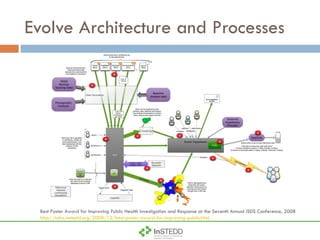
Evolve Architecture and Processes Best Poster Award for Improving Public Health Investigation and Response at the Seventh Annual ISDS Conference, 2008 http://taha.instedd.org/2008/12/best-poster-award-for-improving-public.html
Acknowledgment
Through Funding from…
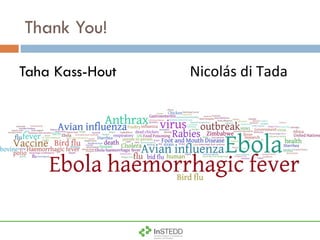
Thank You! Taha Kass-Hout Nicolás di Tada
Thank You! InSTEDD 400 Hamilton Avenue, Suite 120 Palo Alto, CA 94301, USA +1.650.353.4440 +1.877.650.4440 (toll-free in the US) [email_address] Cambodia, Photo taken by Taha Kass-Hout, October 2008  “ this pic says it all- our kids are all the same- they deserve the same ”,  Comment by Robert Gregg on Facebook, October 2008

Evolve

  • 1.
    EVOLVE MEKONG BASINDISEASE SURVEILLANCE (MBDS) INFORMATION COMMUNICATION AND TECHNOLOGY FORUM APRIL 2 ND –3 RD , 2009, MUKDAHAN PROVINCE, THAILAND Taha Kass-Hout, MD, MS Director, Global Public Health and Informatics Innovative Support to Emergencies, Diseases, and Disasters
  • 2.
    SE Asia EarlyWarning & Response A collaborative early warning and response space for latest health-related events in SE Asia
  • 3.
    Overview Infectious disease events represent substantial morbidity , mortality , and socio-economic impact in SE Asia The infectious disease event reporting in SE Asia was of: Low socioeconomic disruption (83%), High socioeconomic disruption (17%); with indicators of a: potential sociological crisis (16.4%), and disaster (0.6%)
  • 4.
    Snapshot Information SourcesProMed MBDS Veratect From September 1, 2008 to February 27, 2009 998 near real-time reports on 46 infectious diseases that effect humans or animals Myanmar, Thailand, Laos, Cambodia, and Vietnam 220 provinces, 239 districts, and 14 cities
  • 5.
    Indicators and InsightsApproximations of Epidemiological Features Response Local Public Community Reaction (Public and Responders) Infrastructure Infectious Disease Disaster
  • 6.
    Apprx. of EpidemiologicalFeatures What diseases were reported to have affected different age groups in SE Asia Reports of mortal outcomes for all age groups Which of the infectious disease events presented as single cases, apparently localized clusters (approximation of an “ outbreak ”), and apparent multiple cases in multiple locations (approximation of an “ epidemic ”)
  • 7.
    Response what levelof government and non-governmental organization became involved in response by disease event
  • 8.
    Local Public CommunityReaction Reaction of the public The term ‘panic’ is not indicative of true panic but rather a proxy for social concern ‘ Panic with behavior’ is where we have documented non-routine public behavior such as panic buying, hoarding of medications, and so on, where concern has elicited non-routine action ‘ Flight’ is the ultimate outcome where a community’s inhabitants abandon their community and for a period of time, social disintegration is observed. This is the end point of infectious disease event damage from a sociological perspective, where a community ceases (transiently) to be an integrated social unit engaged in routine daily activities Evacuation due to biological events is a rare phenomenon, but one for which we maintain a baseline for what diseases in what countries provoke such a reaction
  • 9.
    Local Public CommunityReaction Reaction of responders Responder anxiety, which follows the same conceptual framework as public anxiety Here it is key to note those events where healthcare workers refuse to perform their duties or participate in response due to fear of exposure, illness, or death Responder avoidance of duties is a rare phenomenon
  • 10.
    Infrastructure The infrastructuretypes affected (compromised) by infectious disease events in SE Asia either due to absenteeism, contamination, work overload (i.e., response), or any combination of the above
  • 11.
    Infectious Disease DisasterThe most socially disruptive events in SE Asia, by country and disease that are assessed to be potential disasters 0.6% of all disease reports in SE Asia
  • 12.
    InSTEDD Evolve Relateditems (e.g., News articles) are grouped into a thread. Threads are later associated with events (hypothesized or confirmed). InSTEDD Evolve : ( http://instedd.org/evolve ) Tag cloud and semantic heat map Delete/Recycle an Item Expert-generated Tags RSS Publishing Generate hypotheses and add evidence to the Basket Save filter (by keyword, tag, topic, location, and time) and email subscription Recycle bin An event is monitored through a thread of items
  • 13.
    InSTEDD Evolve InSTEDDEvolve : ( http://instedd.org/evolve ) Map view
  • 14.
    InSTEDD Evolve Filterfeature which automatically filters content by topic of interest Filter feature which automatically filters content by radius InSTEDD Evolve : ( http://instedd.org/evolve )
  • 15.
    InSTEDD Evolve Auto-generated(machine-learning) tags. These tags are semantically ranked (a statistical probability match). Users can further train the classifier by accepting or rejecting a suggestion. Users can similarly train the geo-locator by simply accepting or rejecting and updating a location. InSTEDD Evolve : ( http://instedd.org/evolve )
  • 16.
    Automatic Classification Currentclassification includes: 7 syndromes 10 transmission modes > 100 infectious diseases > 180 micro-organisms > 140 symptoms > 50 chemicals
  • 17.
    InSTEDD Evolve InSTEDDEvolve : ( http://instedd.org/evolve ) Tracking the recent Avian Influenza Outbreak in Egypt (reports started to appear late January 2009). Notice the pattern of reported incidents along the Nile river.
  • 18.
    Evolve Architecture andProcesses Best Poster Award for Improving Public Health Investigation and Response at the Seventh Annual ISDS Conference, 2008 http://taha.instedd.org/2008/12/best-poster-award-for-improving-public.html
  • 19.
  • 20.
  • 21.
    Thank You! TahaKass-Hout Nicolás di Tada
  • 22.
    Thank You! InSTEDD400 Hamilton Avenue, Suite 120 Palo Alto, CA 94301, USA +1.650.353.4440 +1.877.650.4440 (toll-free in the US) [email_address] Cambodia, Photo taken by Taha Kass-Hout, October 2008 “ this pic says it all- our kids are all the same- they deserve the same ”, Comment by Robert Gregg on Facebook, October 2008