
Taha Kass-Hout, MD, MS Nicolás di Tada October 2008 Using Open-Source Software for Public Health
OPEN SOURCE AND FREE SOFTWARE “ Open Source” was coined to avoid the confusion with economic context Emphasis is on freedom to use, modify and distribute the source code Open Source does not mean free “ Free” refers to  no cost and the freedom to use the software There are several license models
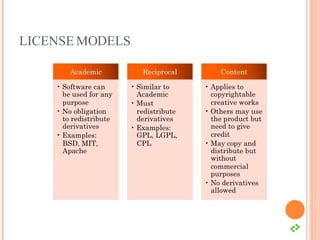
LICENSE MODELS
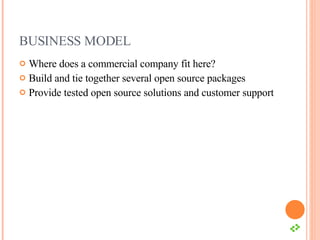
BUSINESS MODEL Where does a commercial company fit here? Build and tie together several open source packages Provide tested open source solutions and customer support
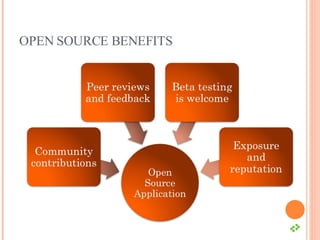
OPEN SOURCE BENEFITS
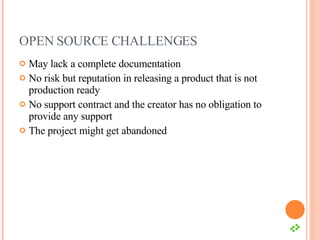
OPEN SOURCE CHALLENGES May lack a complete documentation No risk but reputation in releasing a product that is not production ready No support contract and the creator has no obligation to provide any support The project might get abandoned
WHAT TO LOOK FOR? Commercial companies giving implementations, consulting and support Community activity Project history and reputation Success stories Documentation
OPEN SOURCE SAMPLE APPLICATIONS IN PUBLIC HEALTH
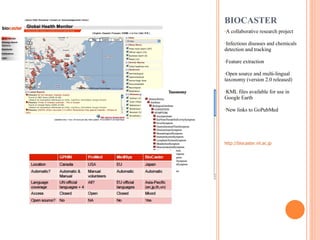
BIOCASTER A collaborative research project Infectious diseases and chemicals detection and tracking Feature extraction Open source and multi-lingual taxonomy (version 2.0 released) KML files available for use in Google Earth New links to GoPubMed http://biocaster.nii.ac.jp
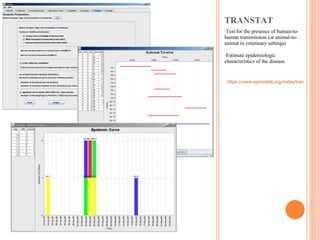
TRANSTAT Test for the presence of human-to-human transmission (or animal-to-animal in veterinary settings)  Estimate epidemiologic characteristics of the disease https://www.epimodels.org/midas/transtat.do
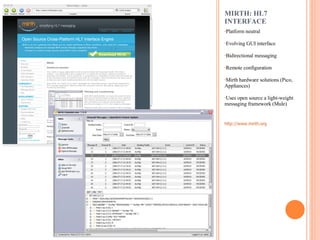
MIRTH: HL7 INTERFACE Platform neutral Evolving GUI interface Bidirectional messaging Remote configuration Mirth hardware solutions (Pico, Appliances) Uses open source a light-weight messaging framework (Mule) http://www.mirth.org
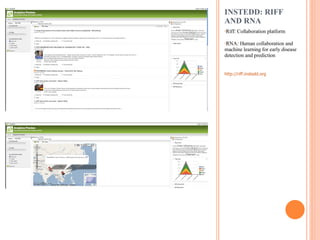
INSTEDD: RIFF AND RNA Riff: Collaboration platform RNA: Human collaboration and machine learning for early disease detection and prediction http://riff.instedd.org
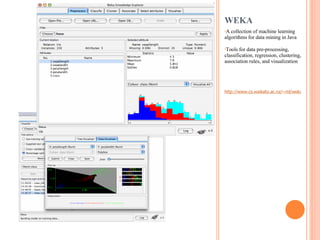
WEKA A collection of machine learning algorithms for data mining in Java Tools for data pre-processing, classification, regression, clustering, association rules, and visualization  http://www.cs.waikato.ac.nz/~ml/weka
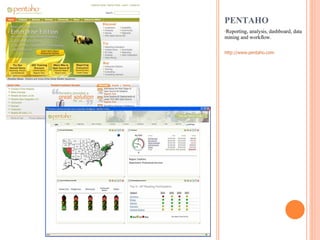
PENTAHO Reporting, analysis, dashboard, data mining and workflow. http://www.pentaho.com
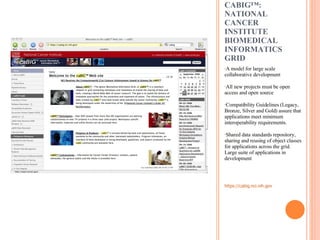
CABIG™: NATIONAL CANCER INSTITUTE BIOMEDICAL INFORMATICS GRID  A model for large scale collaborative development All new projects must be open access and open source Compatibility Guidelines (Legacy, Bronze, Silver and Gold) assure that applications meet minimum interoperability requirements.  Shared data standards repository, sharing and reusing of object classes for applications across the grid. Large suite of applications in development https://cabig.nci.nih.gov
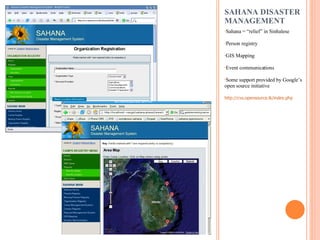
SAHANA DISASTER MANAGEMENT Sahana = “relief” in Sinhalese Person registry GIS Mapping Event communications Some support provided by Google’s open source initiative http://cvs.opensource.lk/index.php
Q&A
THANK YOU! Taha Kass-Hout, MD, MS http://www.instedd.org   [email_address] http://taha.instedd.org   Nicolás di Tada http://www.manas.com.ar [email_address] http://weblogs.manas.com.ar/ndt/
REFERENCES Open Source License References http://www.opensource.org/licenses   http://openacs.org/about/licensing/open-source-licensing   Open Source References http://www.lifehack.org/articles/technology/open-source-life-how-the-open-movement-will-change-everything.html   http://en.wikipedia.org/wiki/Open_source   http://www.opensource.org/   Open Source and Public Health References Open Source Development for Public Health: A Primer with Examples of Existing Enterprise Ready Open Source Applications in Turner (2006) http://www.ibiblio.org/pjones/wiki/index.php/Open_Source_Software_for_Public_Health   http://en.wikipedia.org/wiki/List_of_open_source_healthcare_software   http://www.epha.org/a/320   A Quick Survey of Open Source Software for Public Health Organizations in Mirabito and Kass-Hout (2007)

Using Open Source Software For Public Health Kass-Hout Di Tada

  • 1.
    Taha Kass-Hout, MD,MS Nicolás di Tada October 2008 Using Open-Source Software for Public Health
  • 2.
    OPEN SOURCE ANDFREE SOFTWARE “ Open Source” was coined to avoid the confusion with economic context Emphasis is on freedom to use, modify and distribute the source code Open Source does not mean free “ Free” refers to no cost and the freedom to use the software There are several license models
  • 3.
  • 4.
    BUSINESS MODEL Wheredoes a commercial company fit here? Build and tie together several open source packages Provide tested open source solutions and customer support
  • 5.
  • 6.
    OPEN SOURCE CHALLENGESMay lack a complete documentation No risk but reputation in releasing a product that is not production ready No support contract and the creator has no obligation to provide any support The project might get abandoned
  • 7.
    WHAT TO LOOKFOR? Commercial companies giving implementations, consulting and support Community activity Project history and reputation Success stories Documentation
  • 8.
    OPEN SOURCE SAMPLEAPPLICATIONS IN PUBLIC HEALTH
  • 9.
    BIOCASTER A collaborativeresearch project Infectious diseases and chemicals detection and tracking Feature extraction Open source and multi-lingual taxonomy (version 2.0 released) KML files available for use in Google Earth New links to GoPubMed http://biocaster.nii.ac.jp
  • 10.
    TRANSTAT Test forthe presence of human-to-human transmission (or animal-to-animal in veterinary settings) Estimate epidemiologic characteristics of the disease https://www.epimodels.org/midas/transtat.do
  • 11.
    MIRTH: HL7 INTERFACEPlatform neutral Evolving GUI interface Bidirectional messaging Remote configuration Mirth hardware solutions (Pico, Appliances) Uses open source a light-weight messaging framework (Mule) http://www.mirth.org
  • 12.
    INSTEDD: RIFF ANDRNA Riff: Collaboration platform RNA: Human collaboration and machine learning for early disease detection and prediction http://riff.instedd.org
  • 13.
    WEKA A collectionof machine learning algorithms for data mining in Java Tools for data pre-processing, classification, regression, clustering, association rules, and visualization http://www.cs.waikato.ac.nz/~ml/weka
  • 14.
    PENTAHO Reporting, analysis,dashboard, data mining and workflow. http://www.pentaho.com
  • 15.
    CABIG™: NATIONAL CANCERINSTITUTE BIOMEDICAL INFORMATICS GRID A model for large scale collaborative development All new projects must be open access and open source Compatibility Guidelines (Legacy, Bronze, Silver and Gold) assure that applications meet minimum interoperability requirements. Shared data standards repository, sharing and reusing of object classes for applications across the grid. Large suite of applications in development https://cabig.nci.nih.gov
  • 16.
    SAHANA DISASTER MANAGEMENTSahana = “relief” in Sinhalese Person registry GIS Mapping Event communications Some support provided by Google’s open source initiative http://cvs.opensource.lk/index.php
  • 17.
  • 18.
    THANK YOU! TahaKass-Hout, MD, MS http://www.instedd.org [email_address] http://taha.instedd.org Nicolás di Tada http://www.manas.com.ar [email_address] http://weblogs.manas.com.ar/ndt/
  • 19.
    REFERENCES Open SourceLicense References http://www.opensource.org/licenses http://openacs.org/about/licensing/open-source-licensing Open Source References http://www.lifehack.org/articles/technology/open-source-life-how-the-open-movement-will-change-everything.html http://en.wikipedia.org/wiki/Open_source http://www.opensource.org/   Open Source and Public Health References Open Source Development for Public Health: A Primer with Examples of Existing Enterprise Ready Open Source Applications in Turner (2006) http://www.ibiblio.org/pjones/wiki/index.php/Open_Source_Software_for_Public_Health http://en.wikipedia.org/wiki/List_of_open_source_healthcare_software http://www.epha.org/a/320 A Quick Survey of Open Source Software for Public Health Organizations in Mirabito and Kass-Hout (2007)