{	
Evolvability of Designs and Computation
with Porphyrins-based Nano-tiles
N. Krasnogor
ICOS Research Group
Newcastle University
Visit to the University of Granada, Spain - 2015
Presentation in collaboration with German
Terrazas & Hector Zenil
Outline	
•  Introduction
Unconventional computing
Self-assembly
Key problems on self-assembly
•  Instance of the backward problem
Self-assembly Wang tiles system
Evolutionary design optimisation
•  Instance of forward problem
Tiles as model of porphyrin molecules
kMC porphyrin tiles system
Computational Analysis of Self-Assembly Structures
•  Kolmogorov Complexity of & Information Processing
during self-assembly
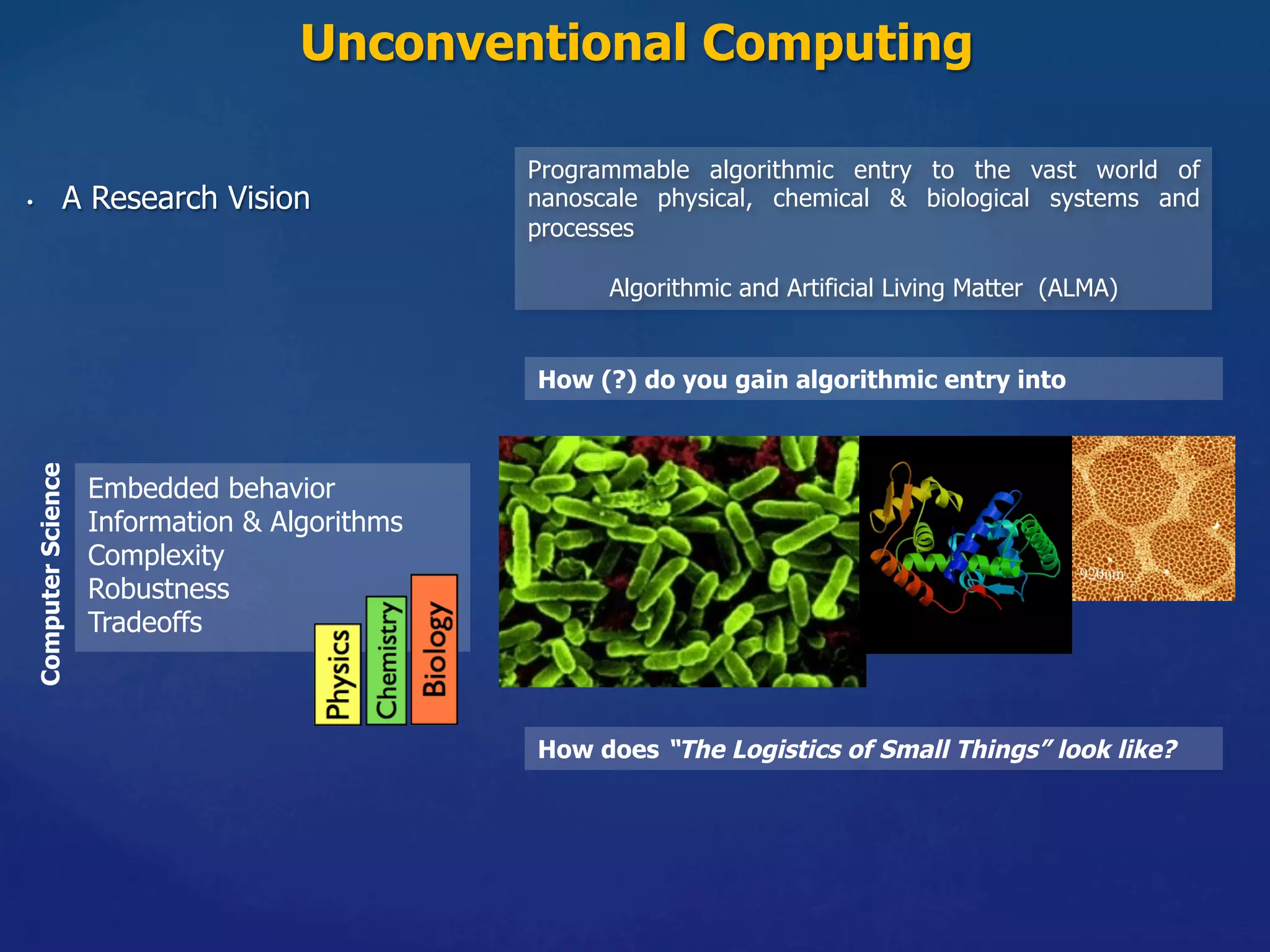
Unconventional Computing
•  A Research Vision
Programmable algorithmic entry to the vast world of
nanoscale physical, chemical & biological systems and
processes
Algorithmic and Artificial Living Matter (ALMA)
ComputerScience
Embedded behavior
Information & Algorithms
Complexity
Robustness
Tradeoffs
How does “The Logistics of Small Things” look like?
How (?) do you gain algorithmic entry into
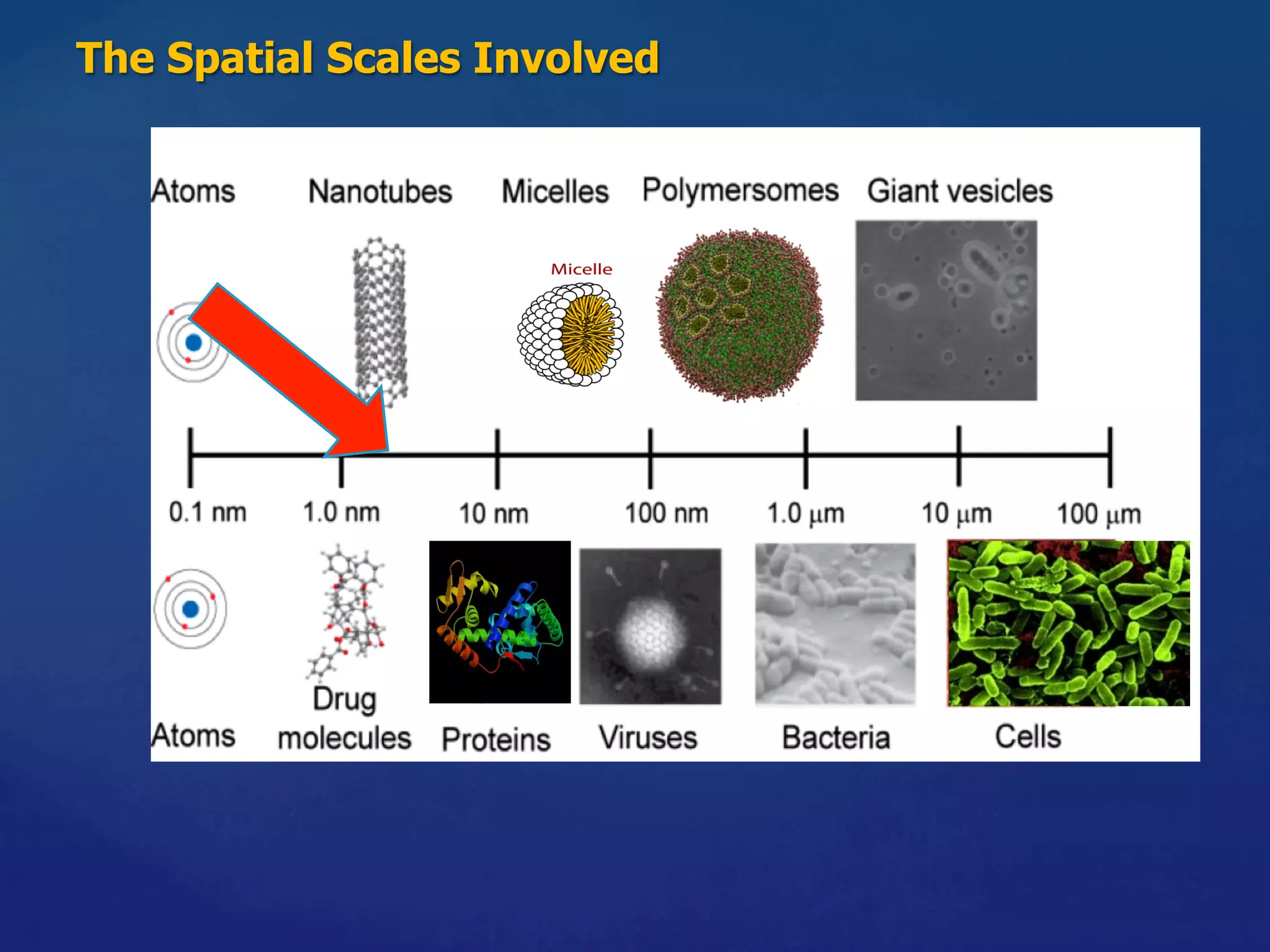
The Spatial Scales Involved
•  Forward problem (prediction): given a set of self-assembling entities + environmental
conditions , how the final aggregates looks like?
•  Backward problem (programmability): given a final desired outcome of a self-assembly
process, how the self-assembly entities + environmental conditions should be
programmed?
•  Yield problem (production/control): given a self-assembling system, how many of the
desired aggregates one can expect and how to maximise it ?
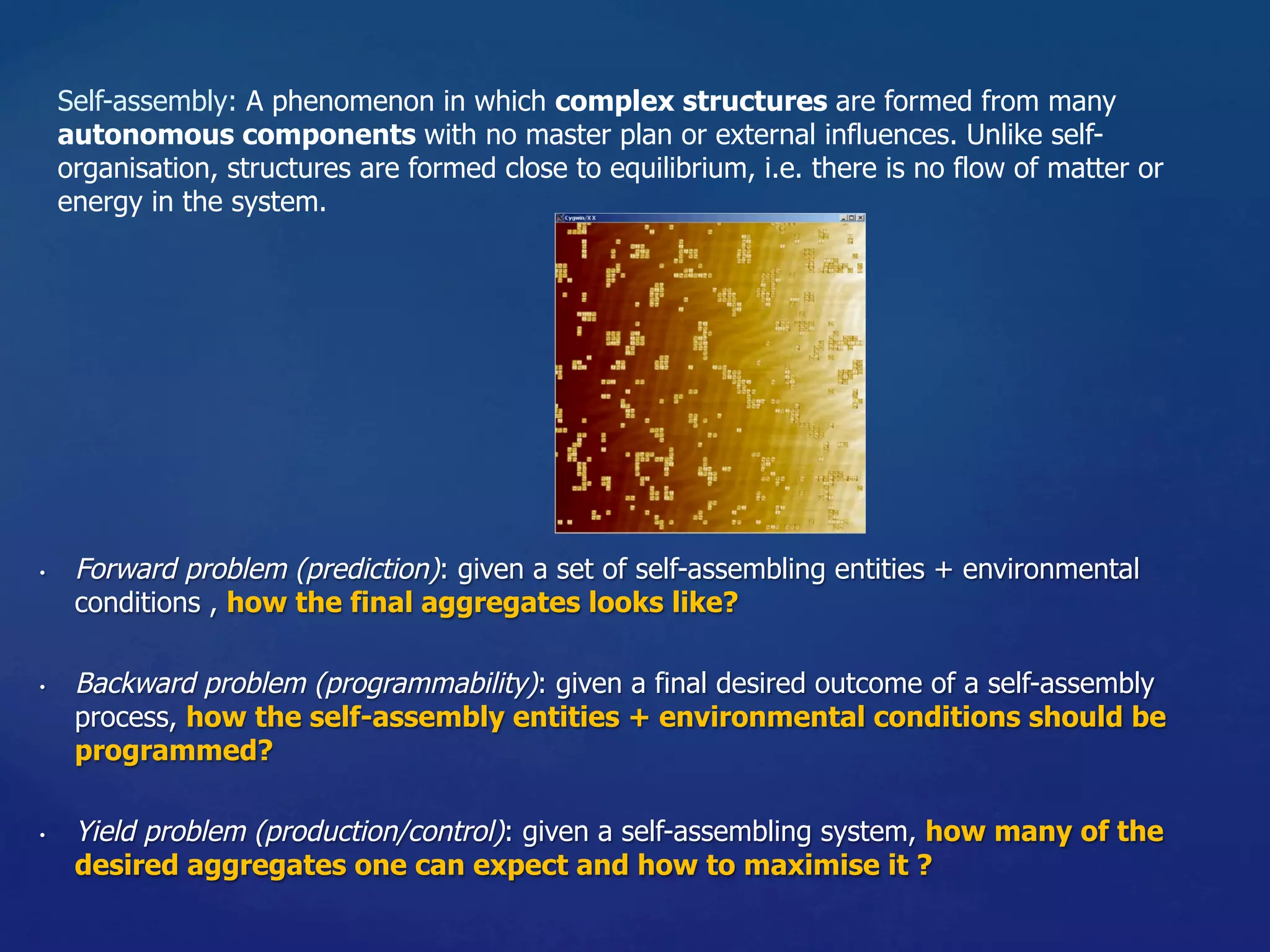
Self-assembly: A phenomenon in which complex structures are formed from many
autonomous components with no master plan or external influences. Unlike self-
organisation, structures are formed close to equilibrium, i.e. there is no flow of matter or
energy in the system.
Backward Problem Instance
Self-assembly Wang Tiles Programmability	 Self-Assembly Wang Tiles
Target structures: square-like shapes
N tiles
Ntiles
Tiles System
•  Finite size
square-site lattice
(300x300)
•  Fixed T = 4
•  Fixed M
Q: Is it possible to program
the family tiles needed to
obtain arbitrary structures by
means of SA ?
M [color, color] : strength
1	 3	 7	 5	 2	
3	 5	 4	 7	 1	
7	 4	 8	 2	 9	
5	 7	 2	 3	 8	
2	 1	 9	 8	 2
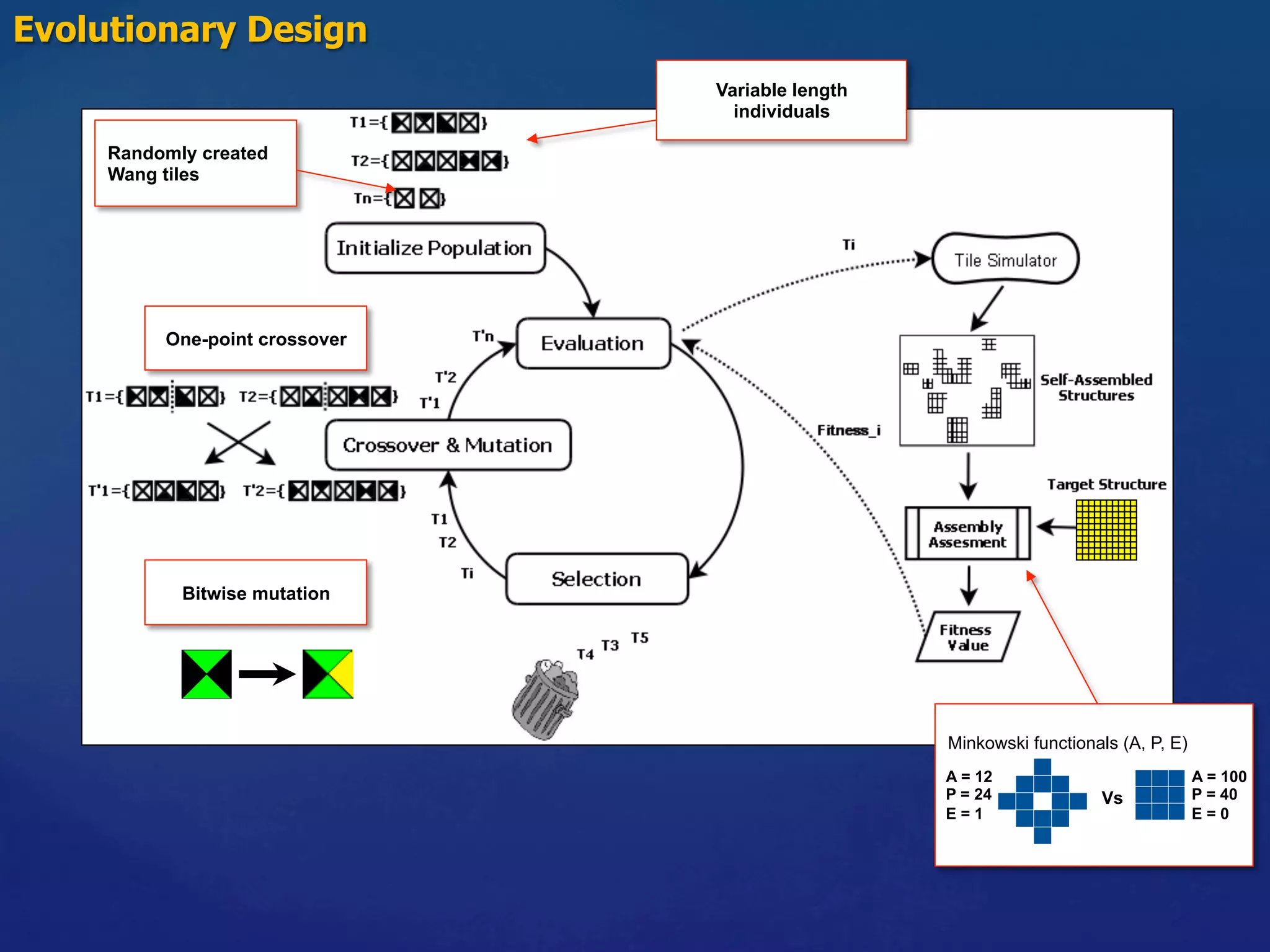
Minkowski functionals (A, P, E)
A = 12
P = 24
E = 1
A = 100
P = 40
E = 0
Evolutionary Design
Variable length
individuals
Randomly created
Wang tiles
Bitwise mutation
Vs
One-point crossover
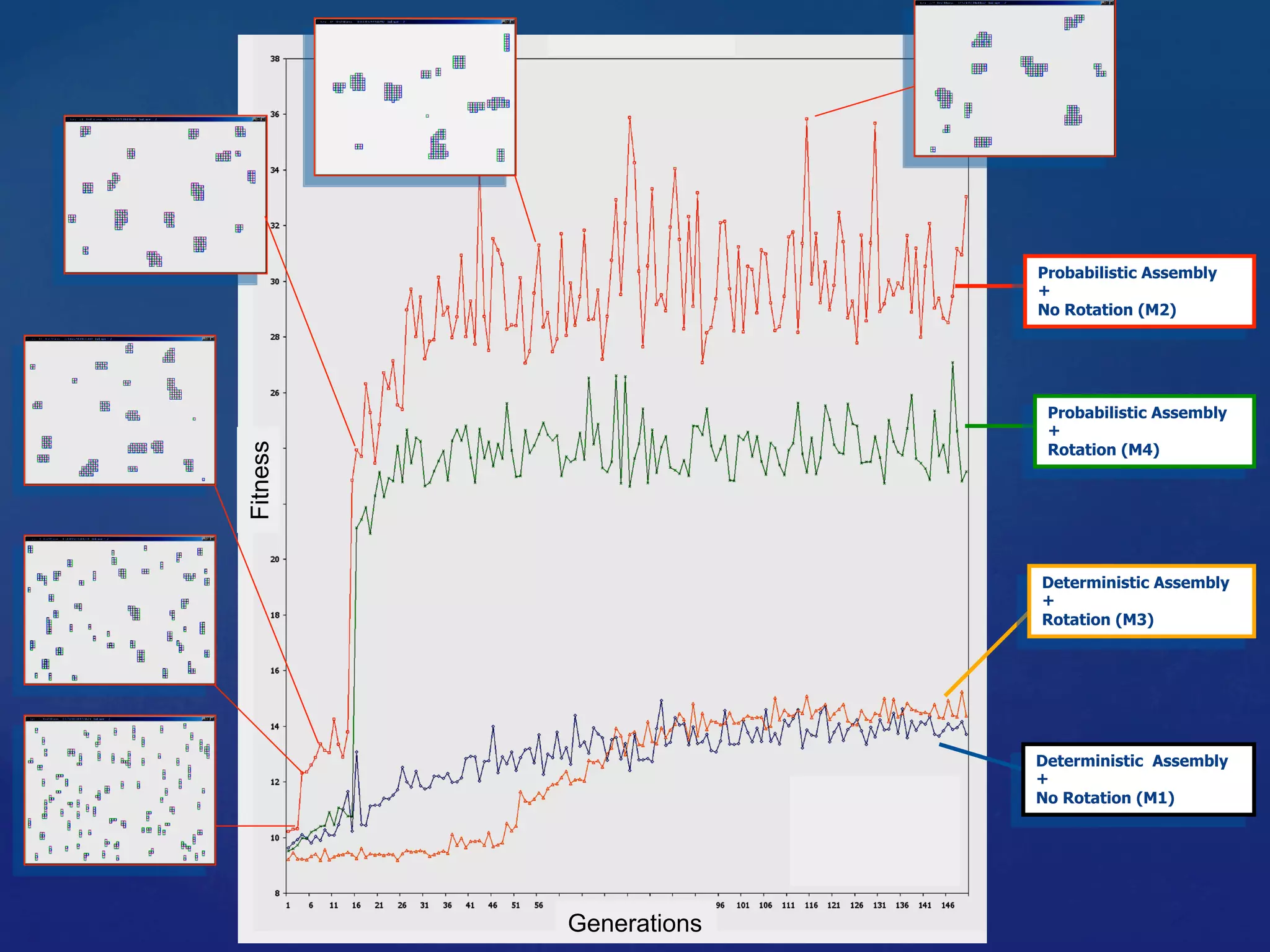
Probabilistic Assembly
+
No Rotation (M2)
Probabilistic Assembly
+
Rotation (M4)
Deterministic Assembly
+
Rotation (M3)
Deterministic Assembly
+
No Rotation (M1)
Generations
Fitness
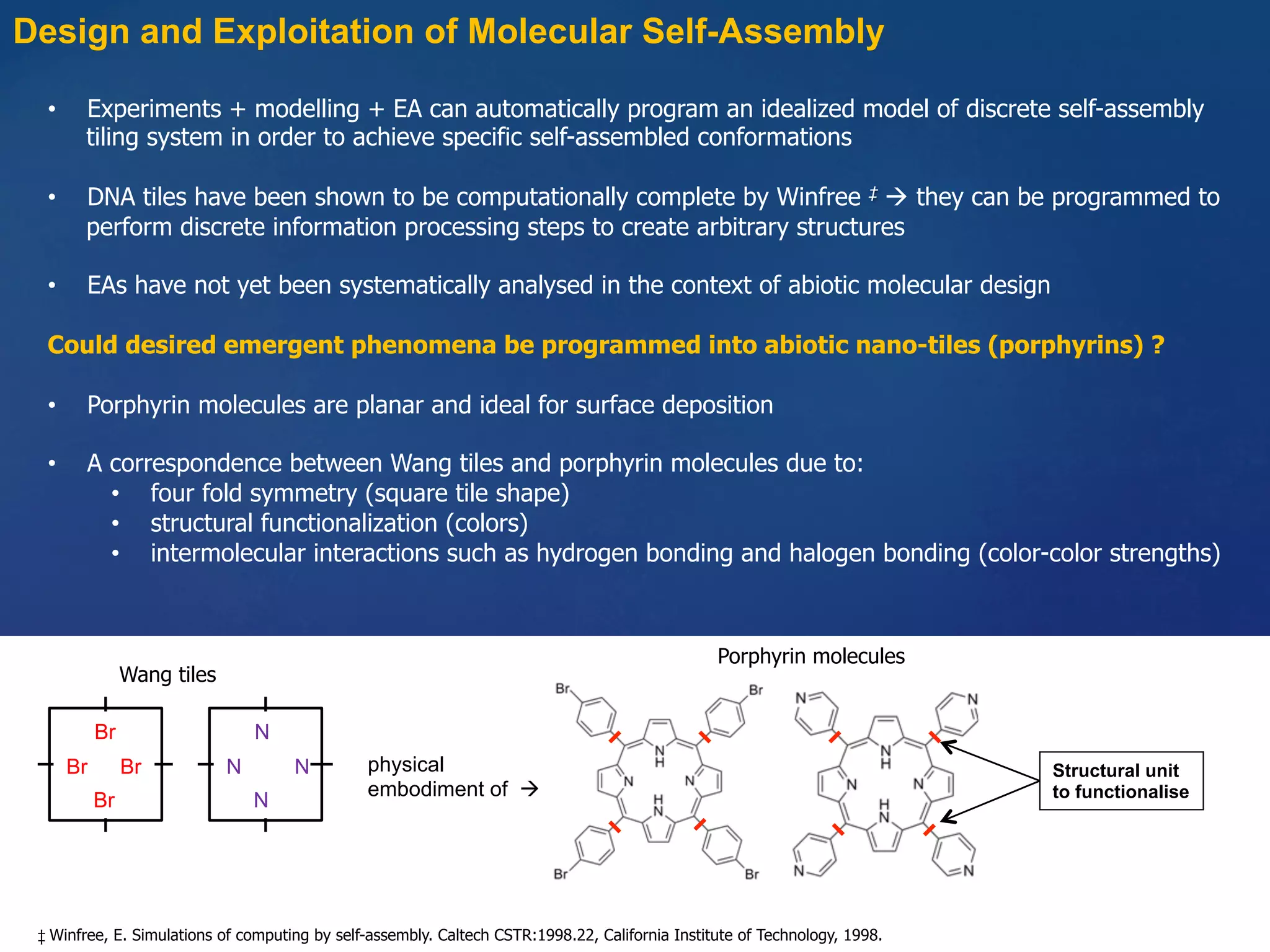
Design and Exploitation of Molecular Self-Assembly
•  Experiments + modelling + EA can automatically program an idealized model of discrete self-assembly
tiling system in order to achieve specific self-assembled conformations
•  DNA tiles have been shown to be computationally complete by Winfree ‡ à they can be programmed to
perform discrete information processing steps to create arbitrary structures
•  EAs have not yet been systematically analysed in the context of abiotic molecular design
Could desired emergent phenomena be programmed into abiotic nano-tiles (porphyrins) ?
•  Porphyrin molecules are planar and ideal for surface deposition
•  A correspondence between Wang tiles and porphyrin molecules due to:
•  four fold symmetry (square tile shape)
•  structural functionalization (colors)
•  intermolecular interactions such as hydrogen bonding and halogen bonding (color-color strengths)
‡ Winfree, E. Simulations of computing by self-assembly. Caltech CSTR:1998.22, California Institute of Technology, 1998.
R3
R2R4
R1Br
Br
Br Br
R3
R2R4
R1N
N
N N physical
embodiment of à
Structural unit
to functionalise
Wang tiles
Porphyrin molecules
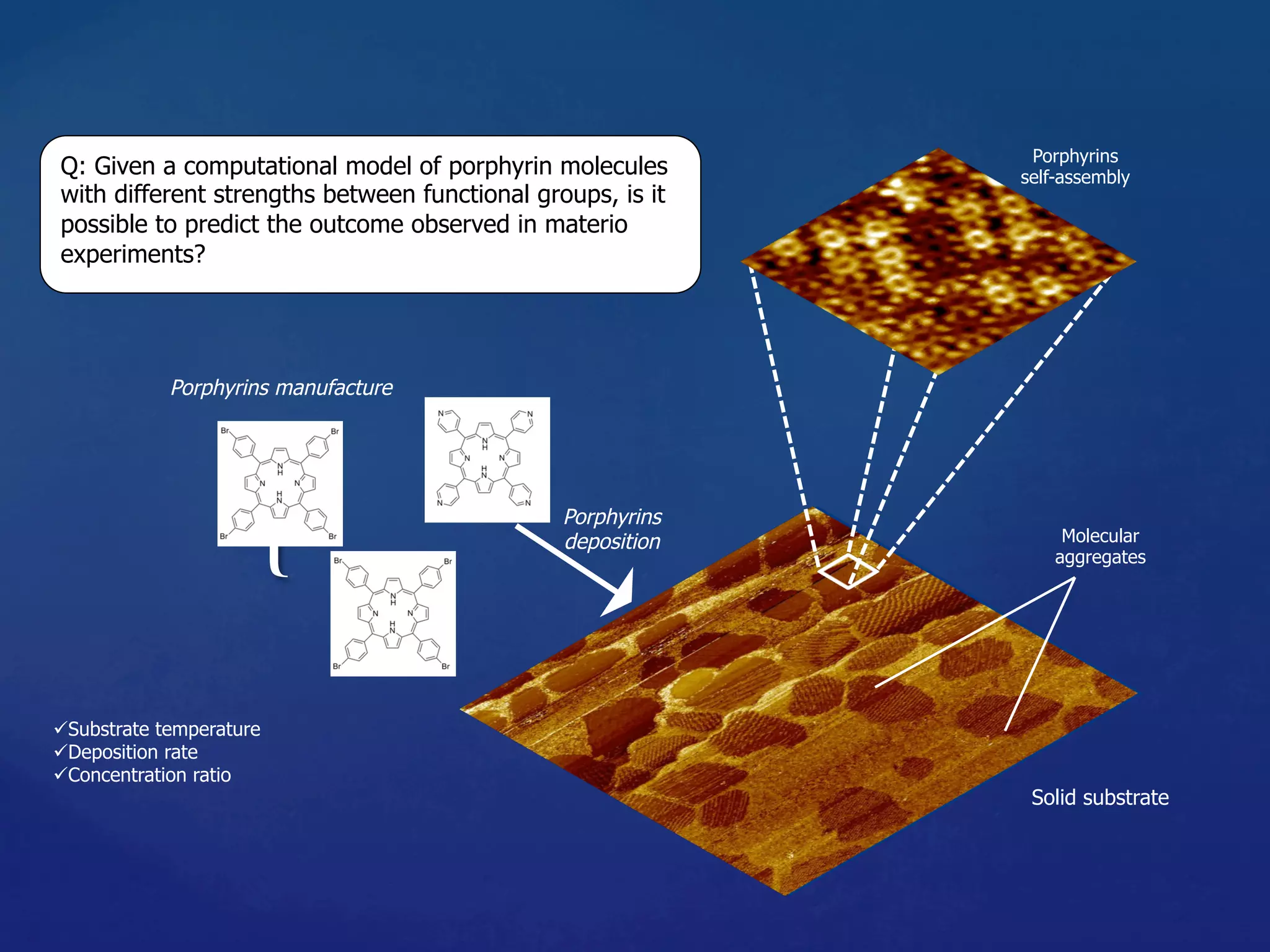
Forward Problem Instance
{	 Porphyrins
deposition
Porphyrins
self-assembly
Solid substrate
Porphyrins manufacture
Molecular
aggregates
ü Substrate temperature
ü Deposition rate
ü Concentration ratio
Q: Given a computational model of porphyrin molecules
with different strengths between functional groups, is it
possible to predict the outcome observed in materio
experiments?
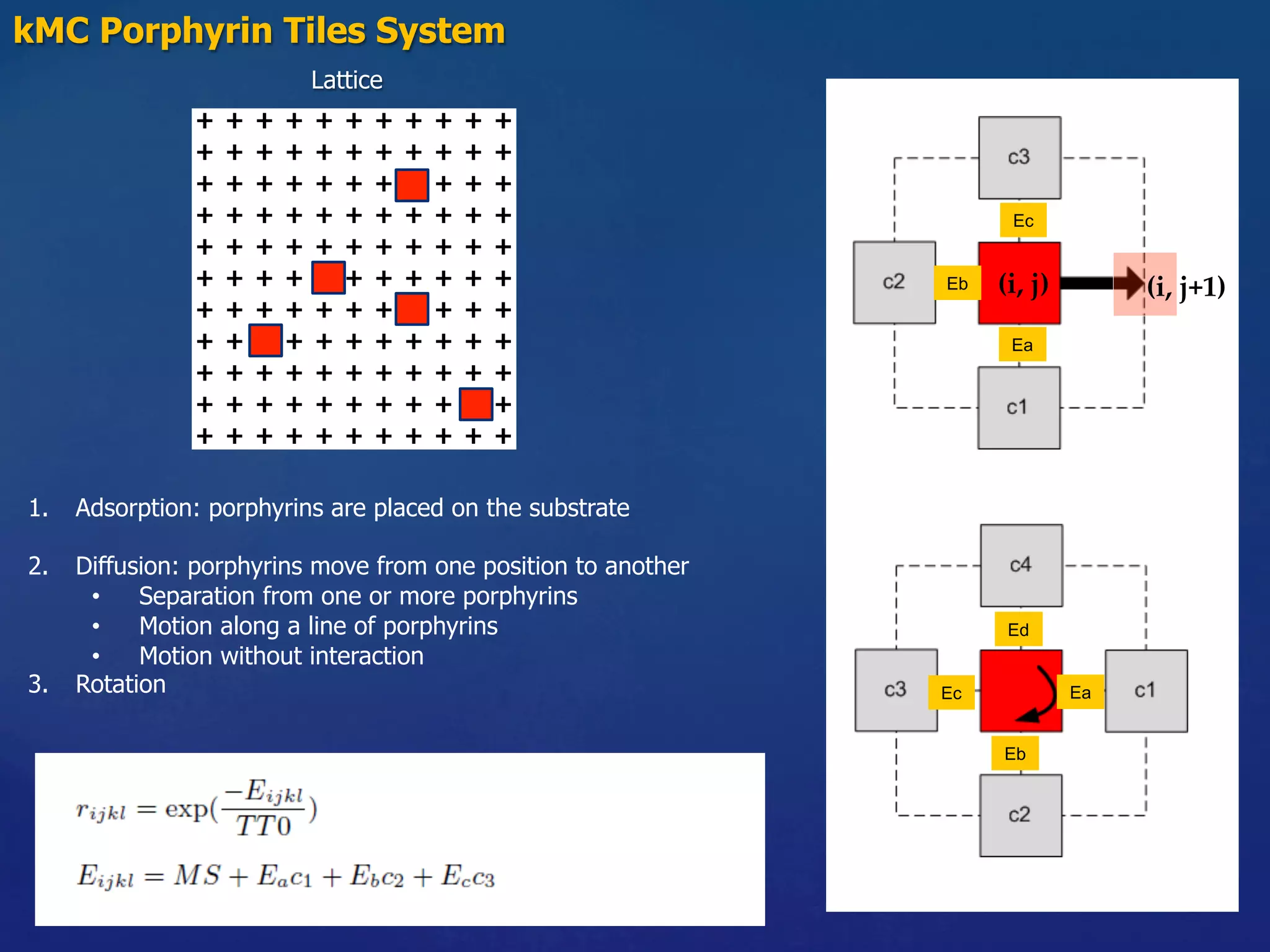
Lattice
1.  Adsorption: porphyrins are placed on the substrate
2.  Diffusion: porphyrins move from one position to another
•  Separation from one or more porphyrins
•  Motion along a line of porphyrins
•  Motion without interaction
3.  Rotation
Ea
Eb
Ec
Eb
EaEc
Ed
kMC Porphyrin Tiles System	
(i, j)	 (i, j+1)
Molecule types: m1, m2	
	
Fixed Parameters 	
	
Substrate: 256 x 256	
Coverage: 25%	
	
	
Variable Parameters	
	
Molecule-Substrate (MS) = [0.5, 1.0] res. 0.1 eV	
	
Binding strength (BE11) = [0.1, 1.0] res. 0.1 eV	
	
Binding strength (BE22) = [0.1, 1.0] res. 0.1 eV	
	
Binding strength (BE12) = [0.1, 1.0] res. 0.1 eV	
m1	
1	
1	
1	
1	
2	
m2	 2	
2	
2	
Experiments	
m1	 m1	
m2	 m2	
m1	 m2
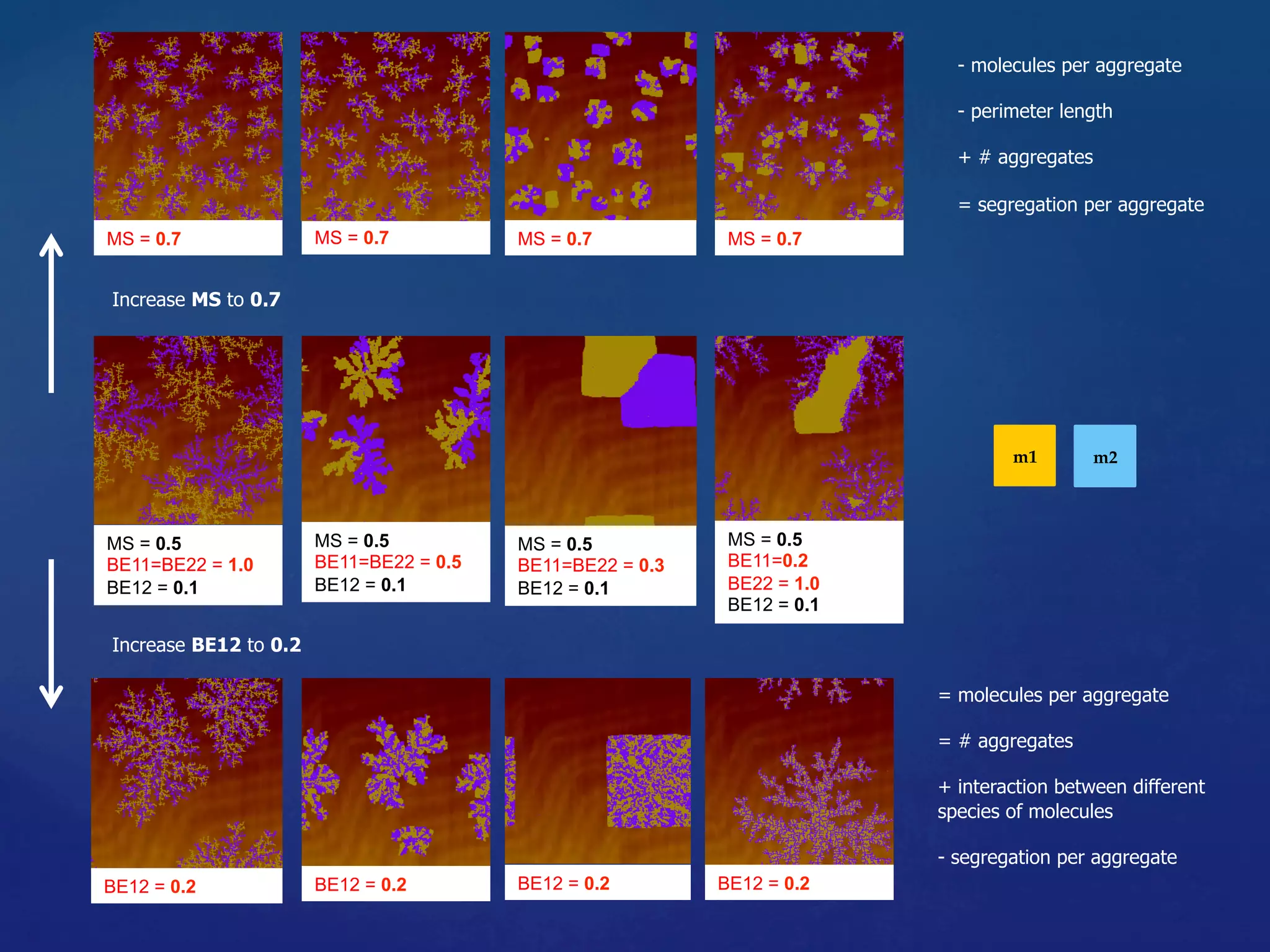
MS = 0.5
BE11=BE22 = 1.0
BE12 = 0.1
MS = 0.5
BE11=BE22 = 0.5
BE12 = 0.1
MS = 0.5
BE11=0.2
BE22 = 1.0
BE12 = 0.1
MS = 0.5
BE11=BE22 = 0.3
BE12 = 0.1
BE12 = 0.2 BE12 = 0.2 BE12 = 0.2BE12 = 0.2
= molecules per aggregate
= # aggregates
+ interaction between different
species of molecules
- segregation per aggregate
Increase BE12 to 0.2
MS = 0.7 MS = 0.7MS = 0.7
- molecules per aggregate
- perimeter length
+ # aggregates
= segregation per aggregate
Increase MS to 0.7
MS = 0.7
m1	 m2
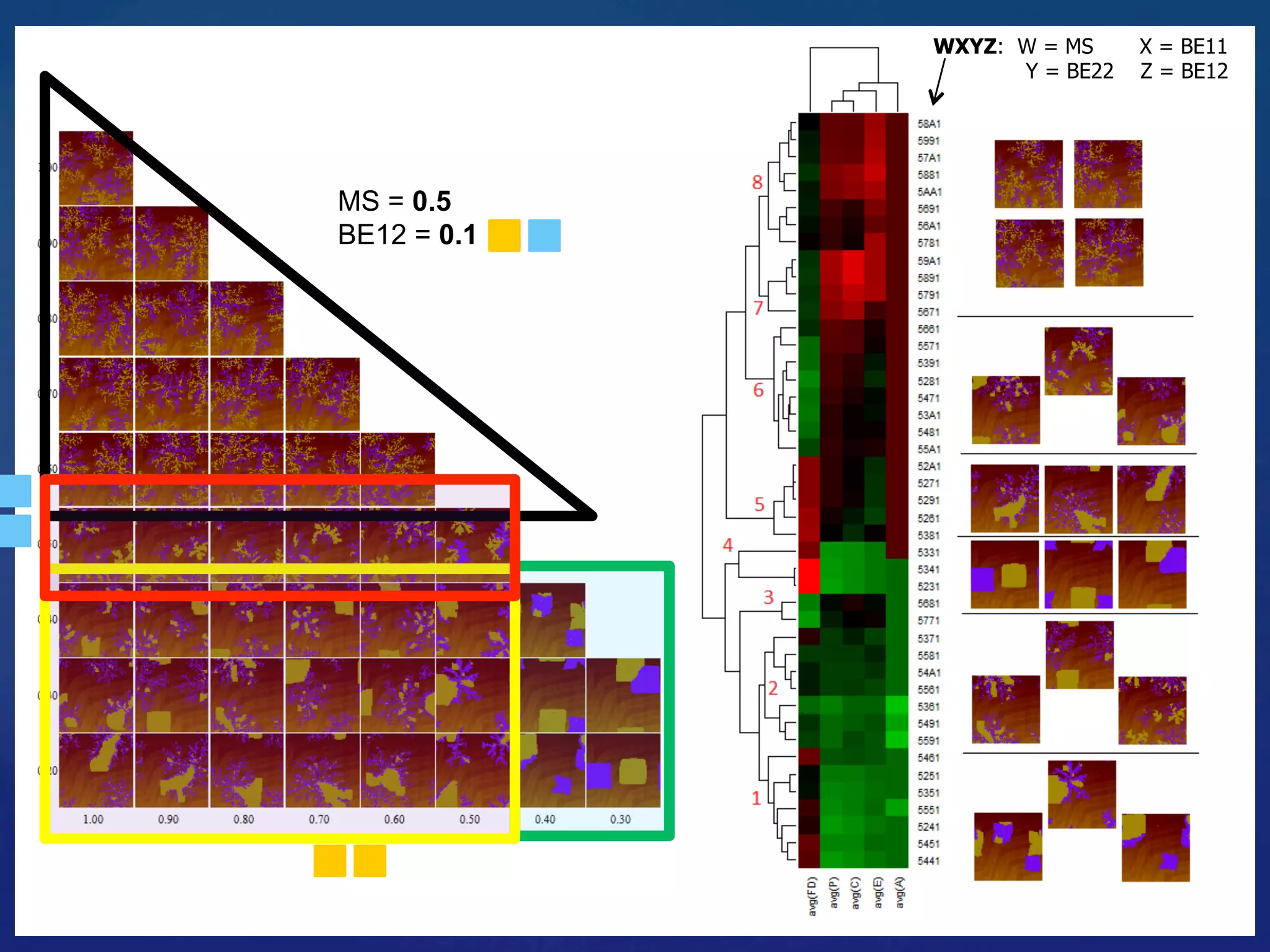
WXYZ: W = MS X = BE11
Y = BE22 Z = BE12
MS = 0.5
BE12 = 0.1
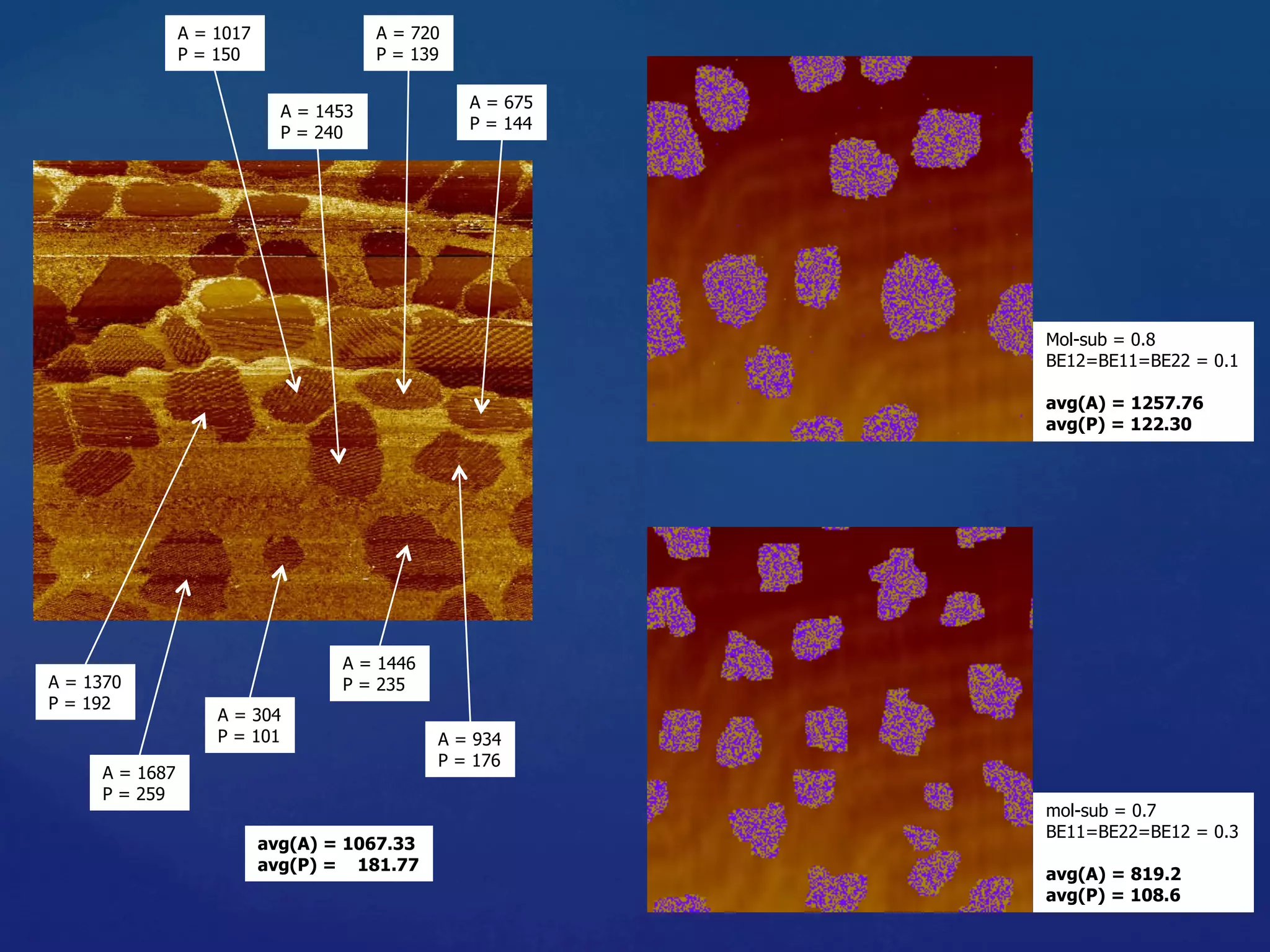
A = 1370
P = 192
A = 1687
P = 259
A = 304
P = 101
A = 1017
P = 150
A = 720
P = 139
A = 675
P = 144
A = 1453
P = 240
A = 934
P = 176
A = 1446
P = 235
avg(A) = 1067.33
avg(P) = 181.77
Mol-sub = 0.8
BE12=BE11=BE22 = 0.1
avg(A) = 1257.76
avg(P) = 122.30
mol-sub = 0.7
BE11=BE22=BE12 = 0.3
avg(A) = 819.2
avg(P) = 108.6
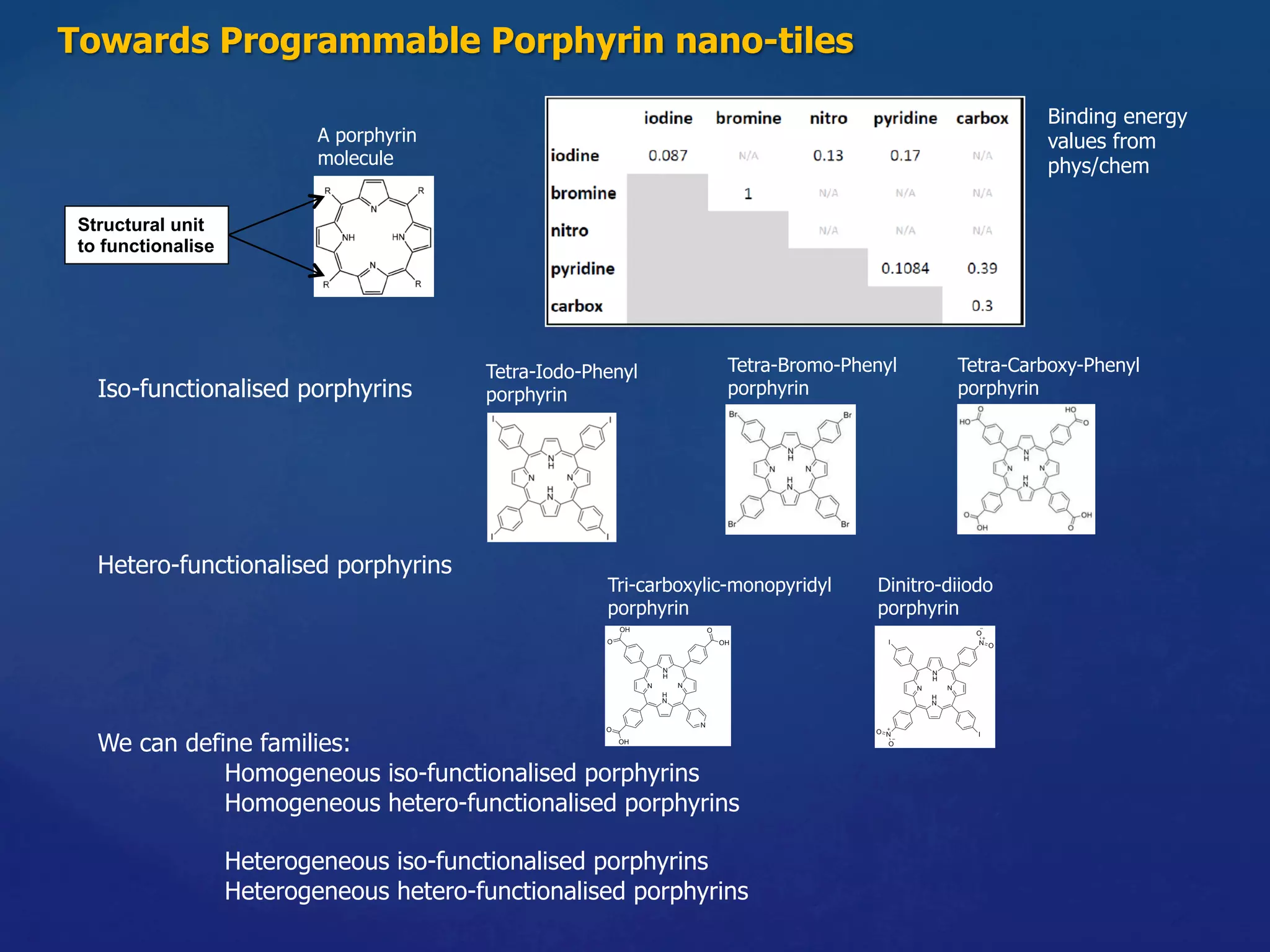
Iso-functionalised porphyrins
Hetero-functionalised porphyrins
We can define families:
Homogeneous iso-functionalised porphyrins
Homogeneous hetero-functionalised porphyrins
Heterogeneous iso-functionalised porphyrins
Heterogeneous hetero-functionalised porphyrins
Towards Programmable Porphyrin nano-tiles
A porphyrin
molecule
Tetra-Iodo-Phenyl
porphyrin
Tetra-Bromo-Phenyl
porphyrin 	
Tetra-Carboxy-Phenyl
porphyrin 	
Tri-carboxylic-monopyridyl
porphyrin
Dinitro-diiodo
porphyrin
Structural unit
to functionalise
Binding energy
values from
phys/chem
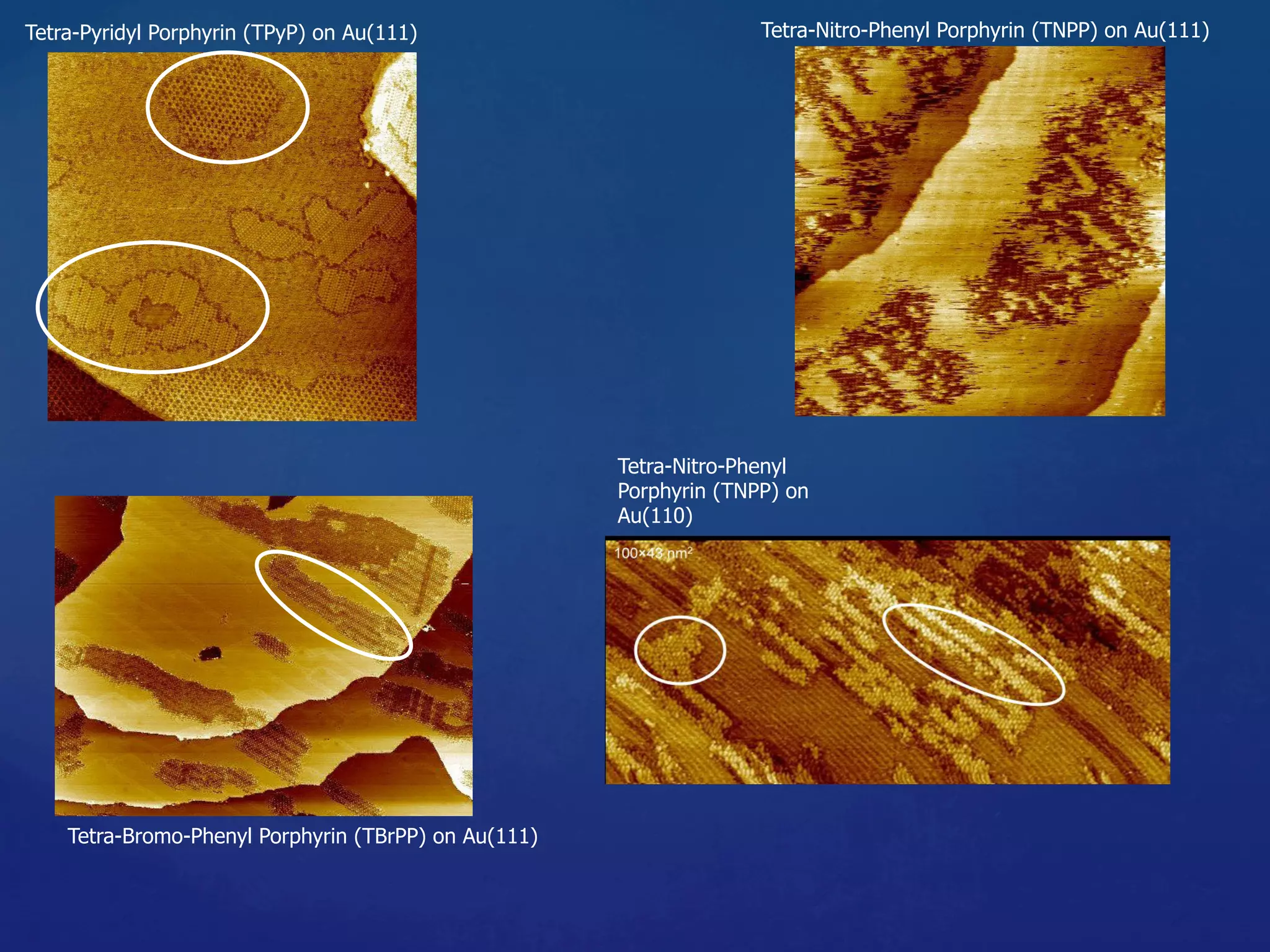
Tetra-Pyridyl Porphyrin (TPyP) on Au(111) Tetra-Nitro-Phenyl Porphyrin (TNPP) on Au(111)
Tetra-Nitro-Phenyl
Porphyrin (TNPP) on
Au(110)
Tetra-Bromo-Phenyl Porphyrin (TBrPP) on Au(111)
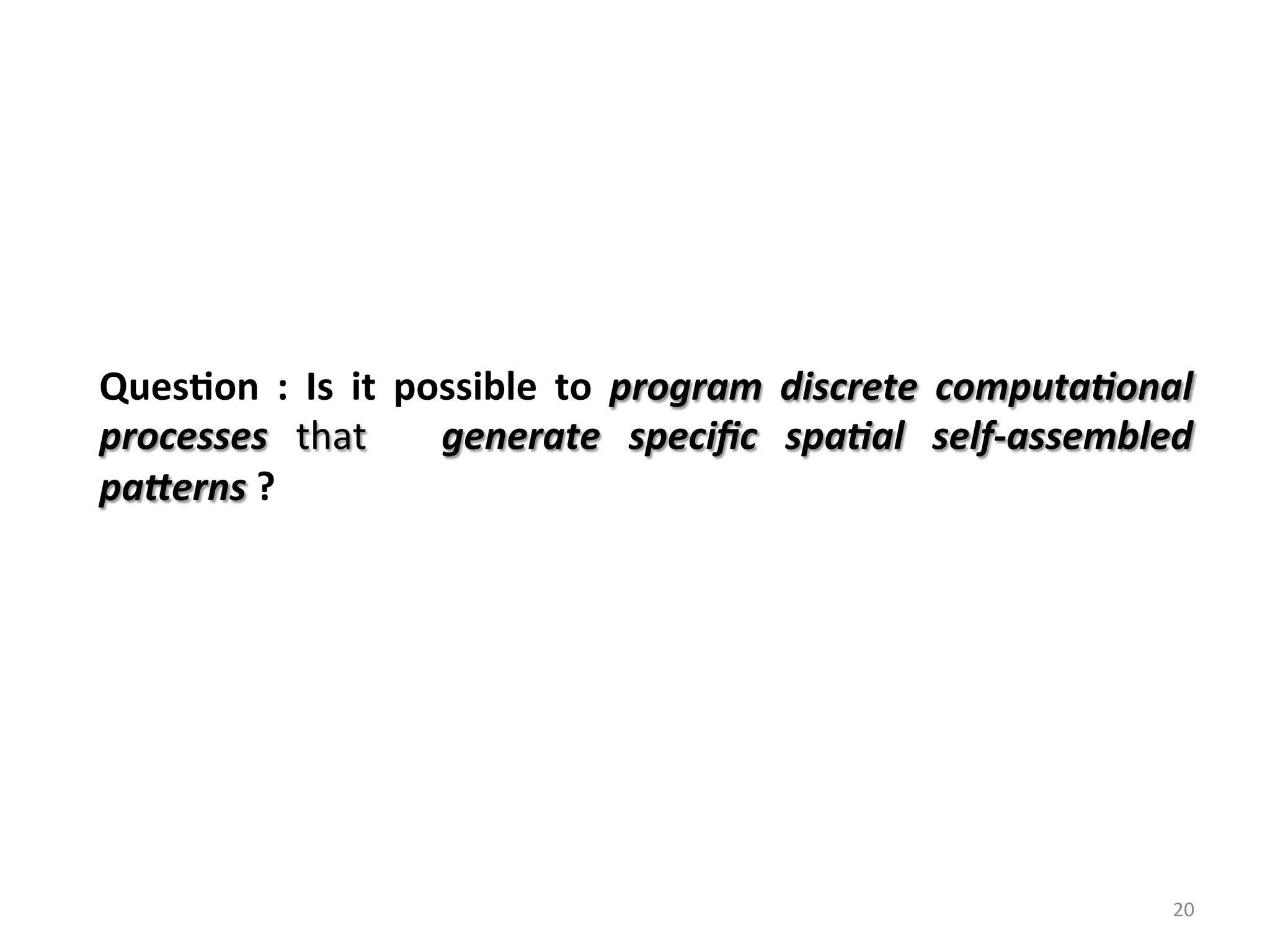
Ques%on	 :	 Is	 it	 possible	 to	 program	 discrete	 computa/onal	
processes	 that	 	 generate	 specific	 spa/al	 self-assembled	
pa6erns	?	
20
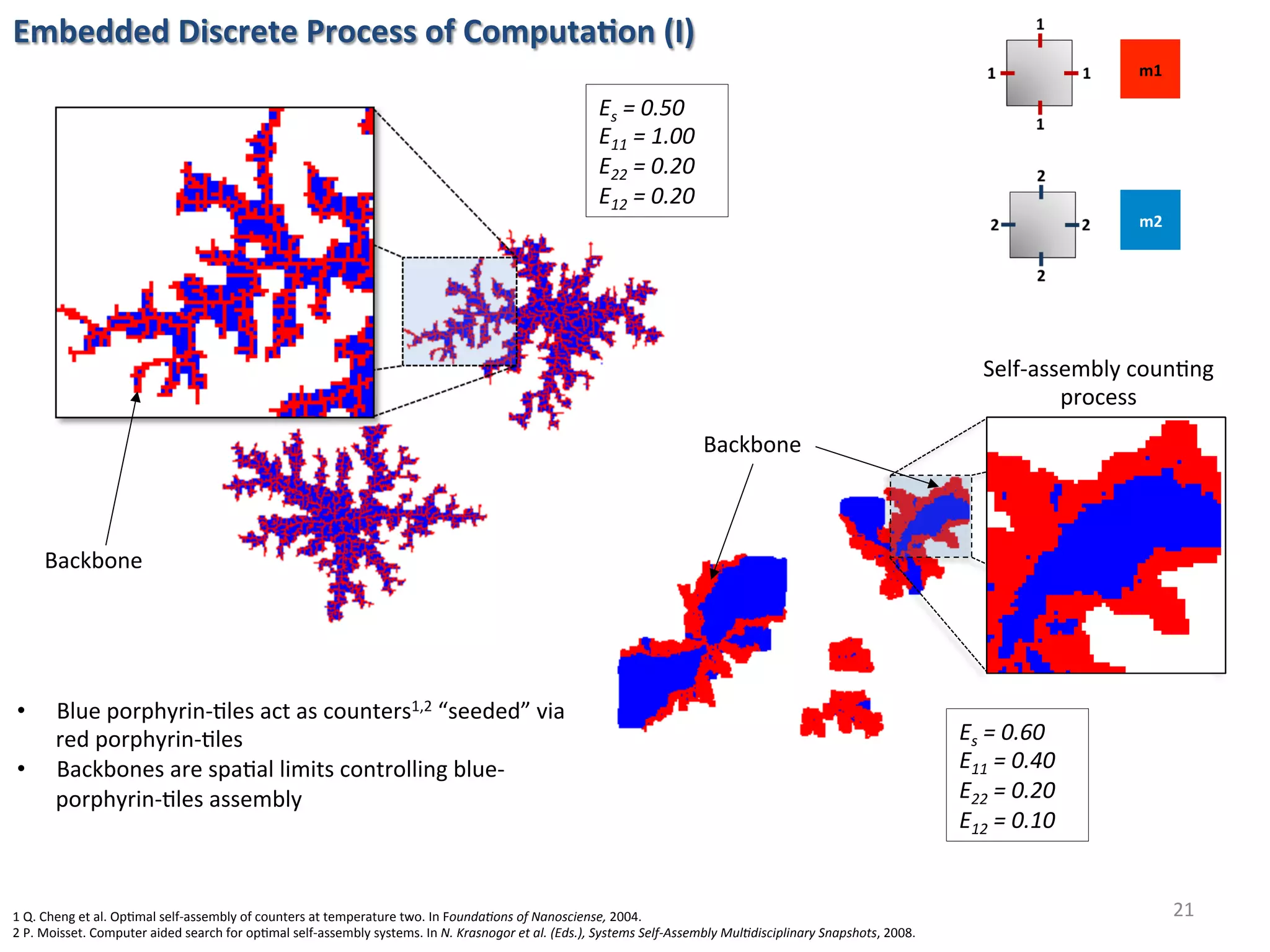
Backbone	
Self-assembly	coun6ng	
process	
•  Blue	porphyrin-6les	act	as	counters1,2	“seeded”	via	
red	porphyrin-6les	
•  Backbones	are	spa6al	limits	controlling	blue-
porphyrin-6les	assembly	
1	Q.	Cheng	et	al.	Op6mal	self-assembly	of	counters	at	temperature	two.	In	Founda&ons	of	Nanosciense,	2004.	
2	P.	Moisset.	Computer	aided	search	for	op6mal	self-assembly	systems.	In	N.	Krasnogor	et	al.	(Eds.),	Systems	Self-Assembly	Mul&disciplinary	Snapshots,	2008.	
m1	
m2	
Embedded	Discrete	Process	of	Computa%on	(I)	
21	
Backbone	
Es	=	0.50			
E11	=	1.00			
E22	=	0.20			
E12	=	0.20	
Es	=	0.60			
E11	=	0.40			
E22	=	0.20			
E12	=	0.10
Embedded	Discrete	Process	of	Computa%on	(II)	
22	
Checkers	paLern	
(spa6al	interac6ons)	
•  Highly	ordered	self-assembled	structure	
•  Spontaneous	internal	arrangements	
•  Globally	complex	shape	with	locally	
simple	organisa6on	
λ	(y)	
λ	(y)	
(x)	
(ε)	 (ε)	
(x)	
q1	
q2	
ε,	x,	y	Є	[0,	1]	
ε	+	x	+	y	=	1	
x	>>	ε	>>	y	
Computed	by	a	finite	state	
machine-like	process	
ε:	probability	of	mistaking	symbol	
λ:	new	diagonal	begins
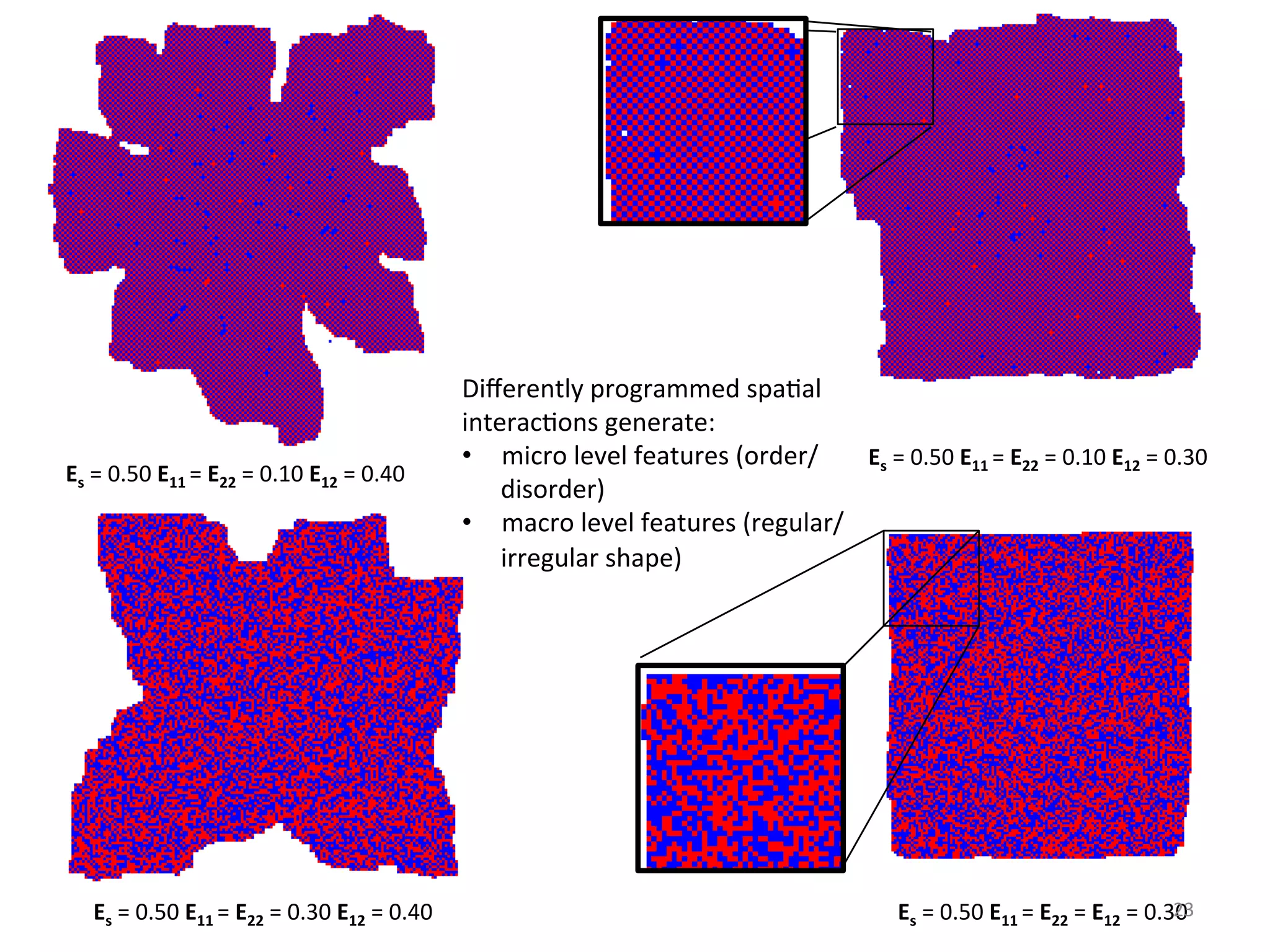
Es	=	0.50	E11	=	E22	=	0.10	E12	=	0.40	
Es	=	0.50	E11	=	E22	=	0.10	E12	=	0.30	
Es	=	0.50	E11	=	E22	=	0.30	E12	=	0.40	 Es	=	0.50	E11	=	E22	=	E12	=	0.30	
Differently	programmed	spa6al	
interac6ons	generate:	
•  micro	level	features	(order/
disorder)		
•  macro	level	features	(regular/
irregular	shape)	
23
Fixed	Parameters		
Substrate:	64	x	64	
Coverage:	25%	
	
	
Variable	Parameters	
Molecule-Substrate		(ES)						=	[0.5,	…,	0.7]	res.	0.1	eV	
Binding	strength	(E11,	E22)				=	[0.1,	…,	0.5]	res.	0.025	eV	
Binding	strength	(E12)												=	[0.1,	…,	0.5]	res.	0.1	eV	
24	
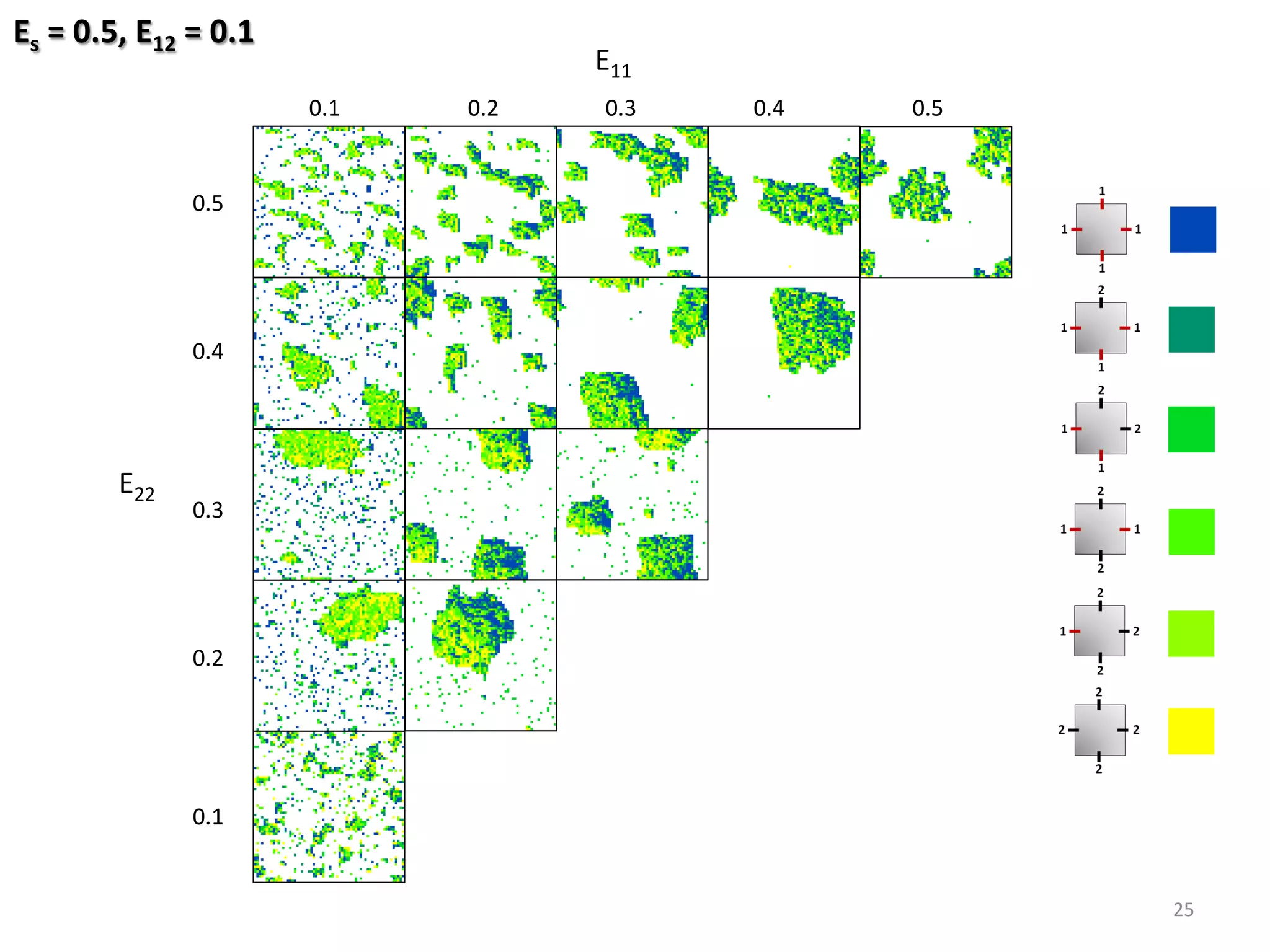
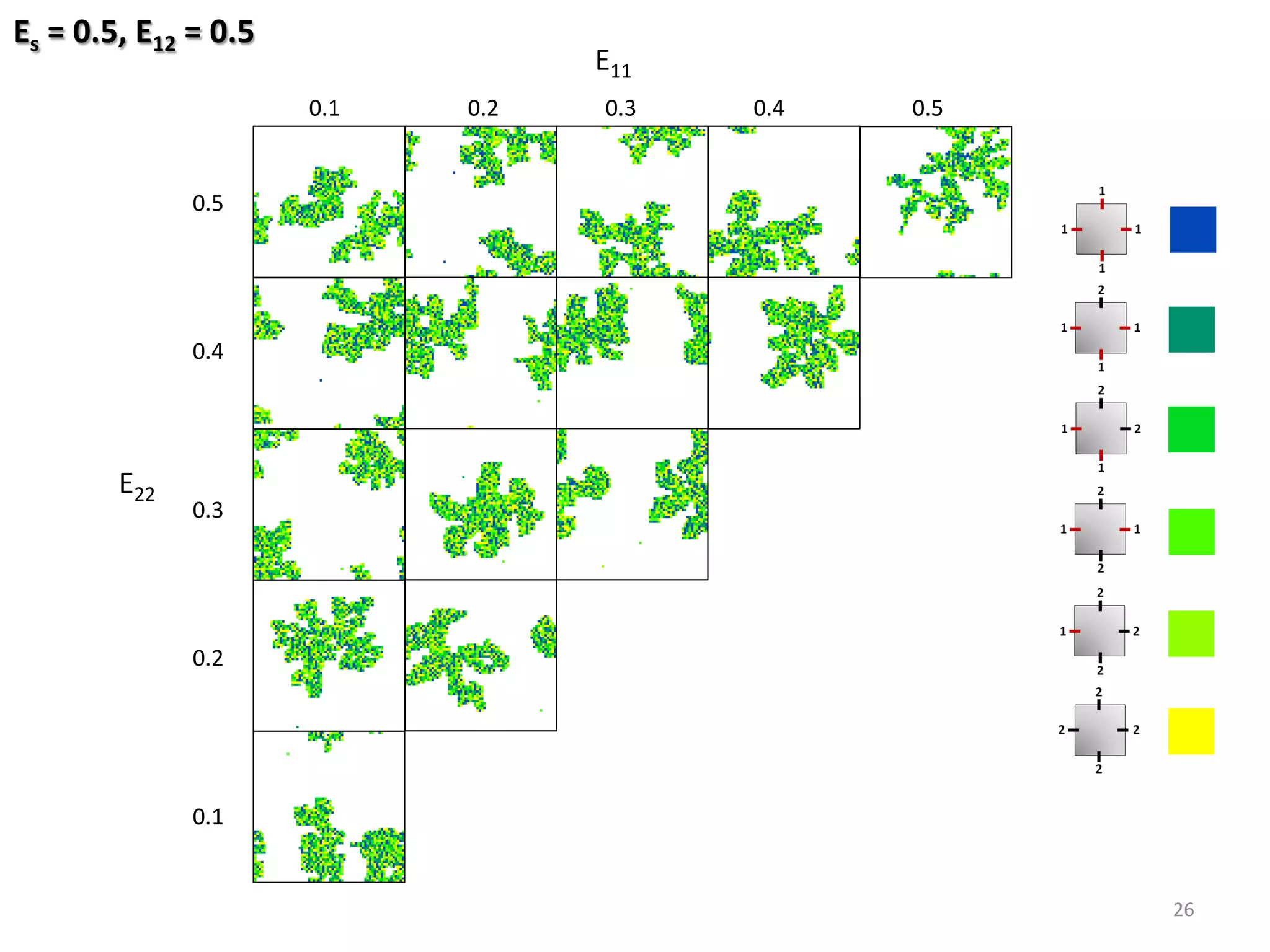
Hetero-func/onalised	Porphyrin-%les	Species:
Es	=	0.5,	E12	=	0.1	
25	
E11	
E22	
0.1	 0.2	 0.3	 0.4	 0.5	
0.1	
0.2	
0.3	
0.4	
0.5
Es	=	0.5,	E12	=	0.5	
26	
E11	
E22	
0.1	 0.2	 0.3	 0.4	 0.5	
0.1	
0.2	
0.3	
0.4	
0.5
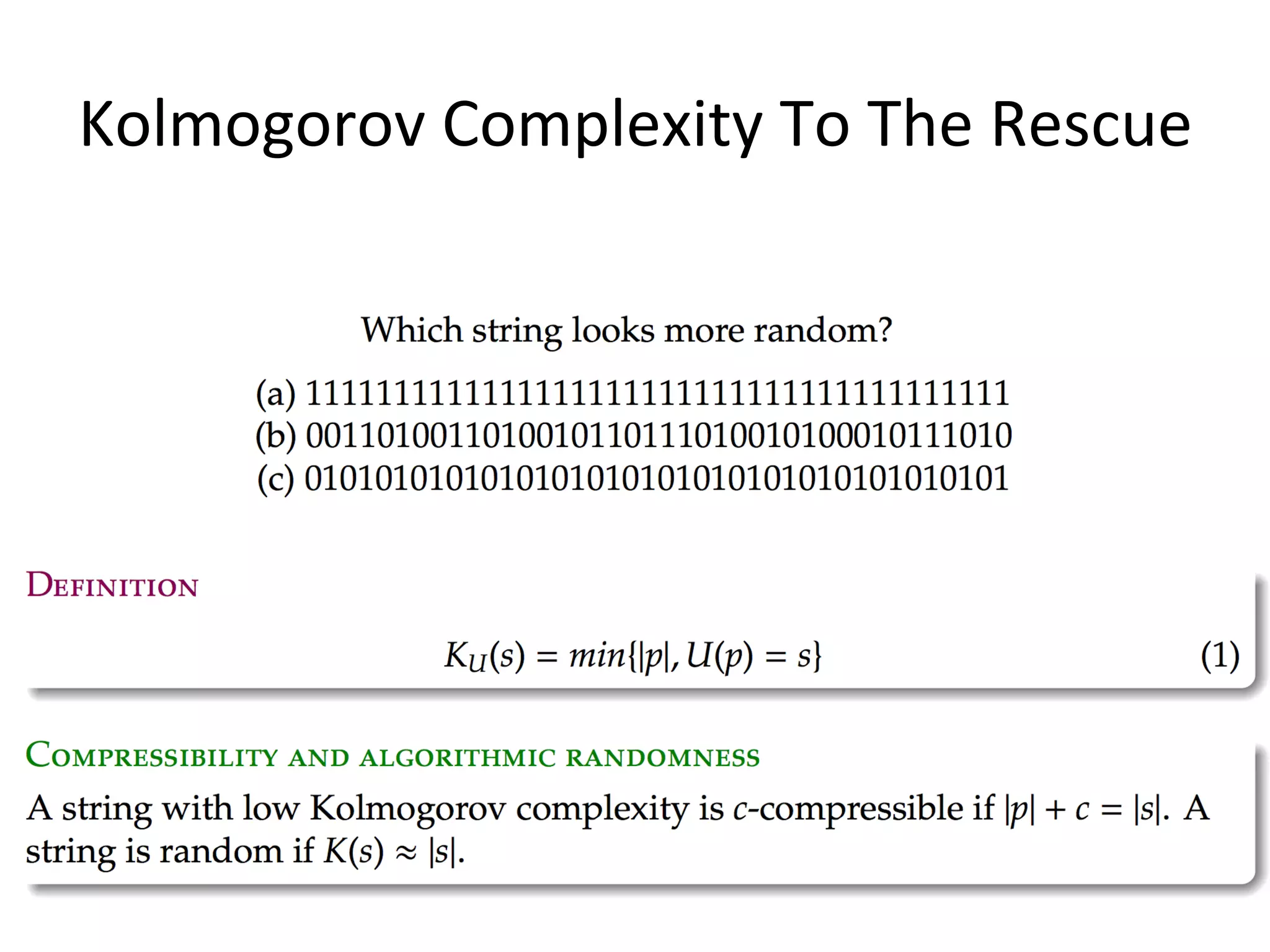
Kolmogorov	Complexity	To	The	Rescue	
27
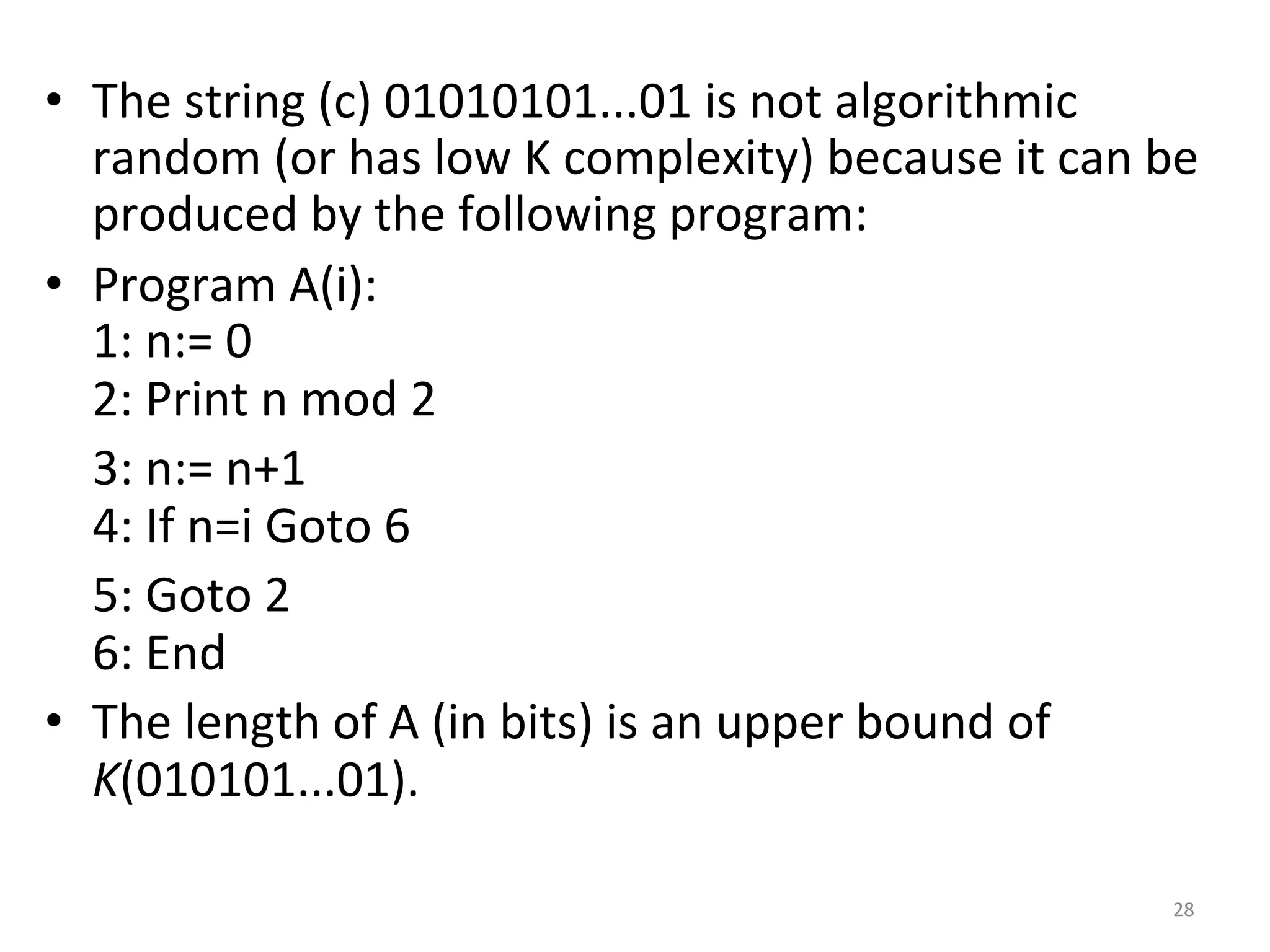
•  The	string	(c)	01010101...01	is	not	algorithmic	
random	(or	has	low	K	complexity)	because	it	can	be	
produced	by	the	following	program:		
•  Program	A(i):	
1:	n:=	0	
2:	Print	n	mod	2		
				3:	n:=	n+1	
				4:	If	n=i	Goto	6		
				5:	Goto	2	
				6:	End		
•  The	length	of	A	(in	bits)	is	an	upper	bound	of	
K(010101...01).		
28
Algorithmic	Informa6on	Content	
•  Algorithmic	Complexity	of	a	string	s,	K(s),	
	The	length	of	the	shortest	program,	p,	that	could	generate	
the	string.	
•  K	is	an	uncomputable	func6on.	A	prac6cal	way	to	
approximate	K	is	using	lossless	compression	algorithms.	
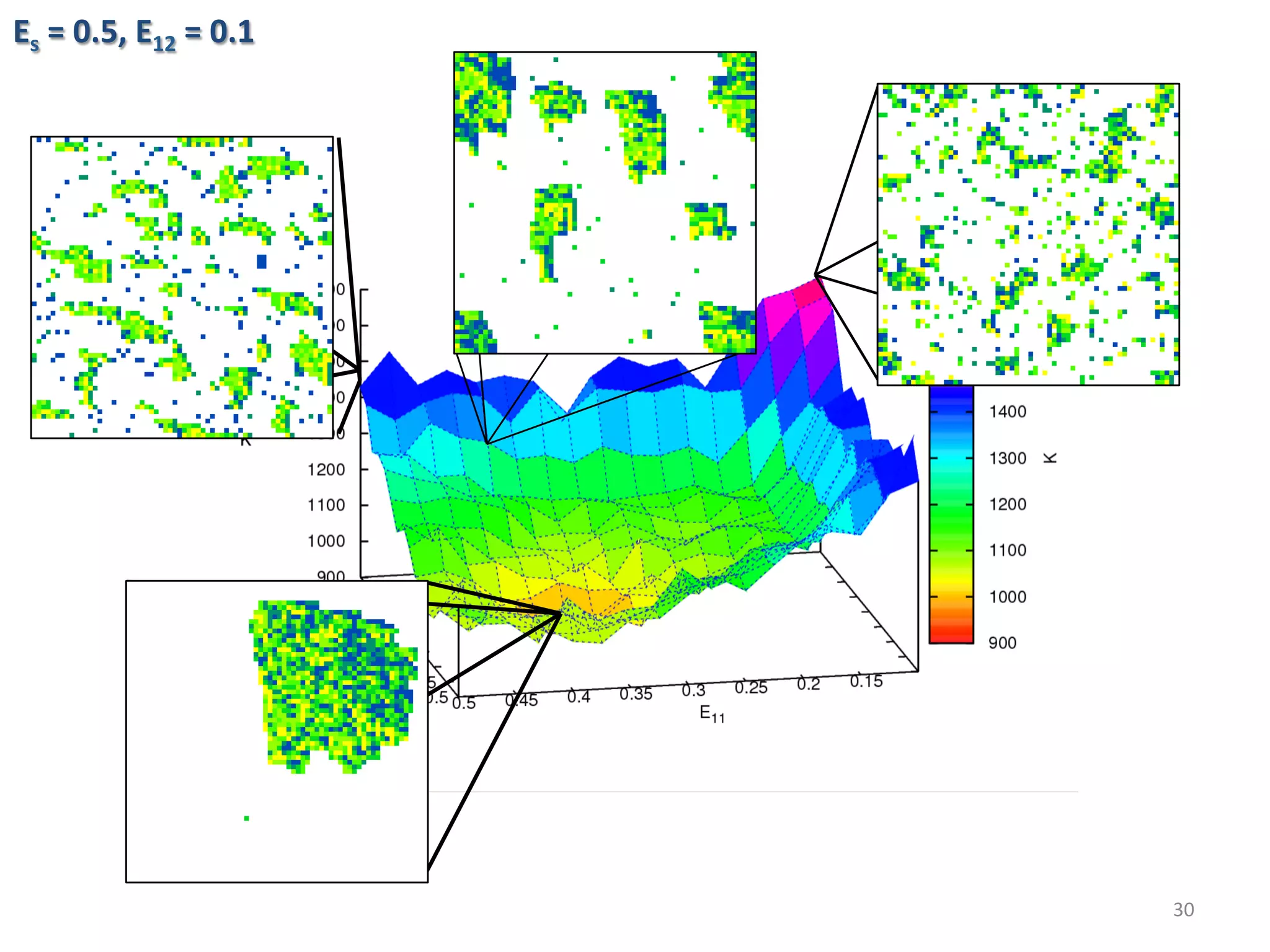
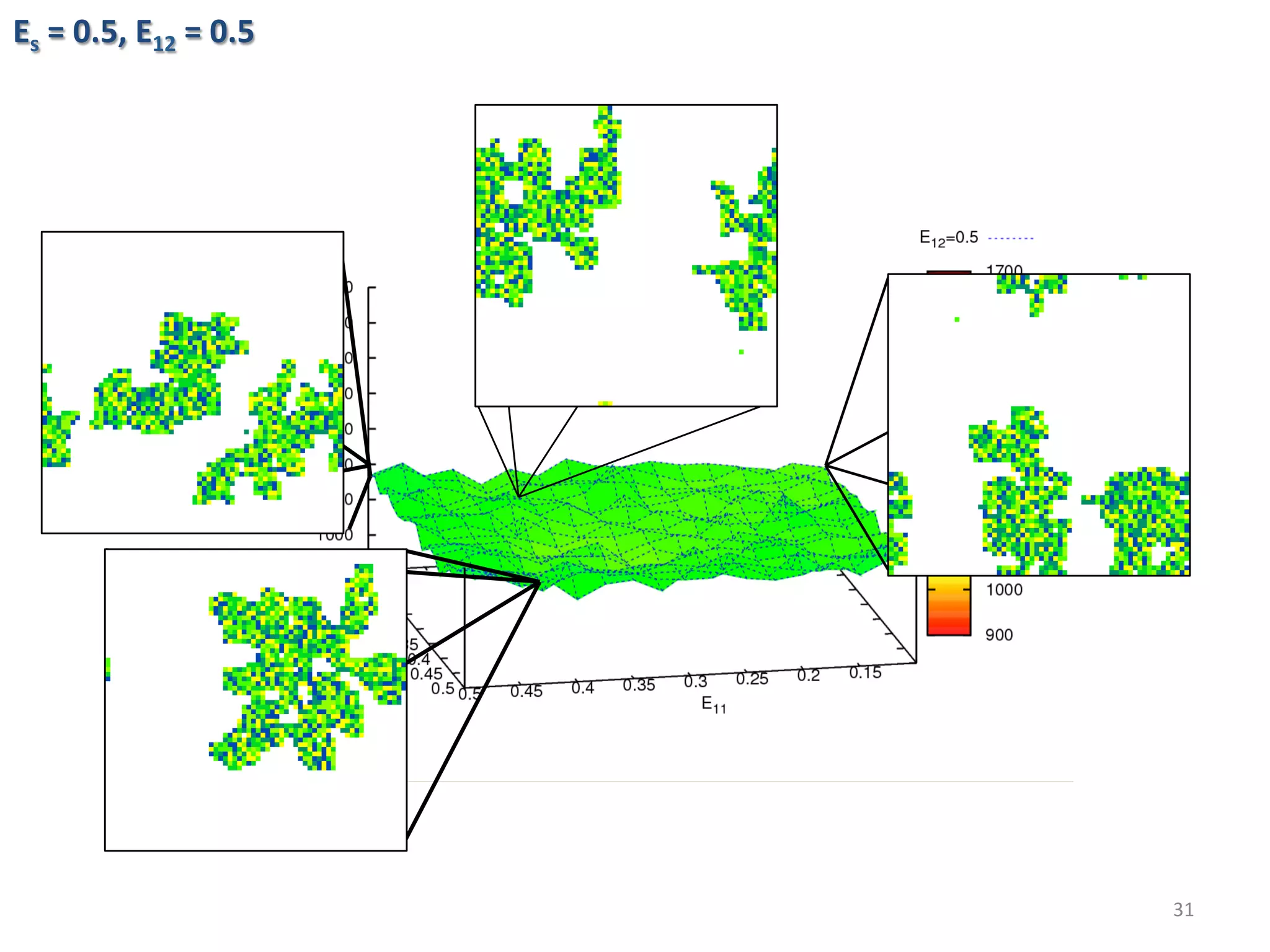
•  The	outputs	of	the	simula6ons	are	converted	into	PNG	
images	then	compressed	using	PNGcrush.	The	compressed	
size	of	the	images	are	the	es6mated	algorithmic	complexity	
of	the	outputs.	
	
	 29	
)})(],[Length{min()( spUpsK ==
Es	=	0.5,	E12	=	0.1	
30
Es	=	0.5,	E12	=	0.5	
31
•  Complexity Measurement Based on Information Theory and Kolmogorov Complexity
LT Lui, G Terrazas, H Zenil, C Alexander, N Krasnogor. Artificial Life, 2015
Exploring programmable self-assembly in non-DNA based molecular computing, G Terrazas, H Zenil, N Krasnogor.
Natural Computing 12 (4), 499-515, 2015
•  Blind optimisation problem instance classification via enhanced universal similarity metric. I Contreras, I Arnaldo, N
Krasnogor, JI Hidalgo. Memetic Computing 6 (4), 263-276, 2014.
•  Is There an Optimal Level of Open-Endedness in Prebiotic Evolution? O Markovitch, D Sorek, LT Lui, D Lancet, N
Krasnogor. Origins of Life and Evolution of Biospheres 42 (5), 469-474, 2014
•  Genotype-Fitness Correlation Analysis for Evolutionary Design of Self-Assembly Wang Tiles. G. Terrazas and N.
Krasnogor. In Pelta et al. editors, Studies in Computational Intelligence, v 387, NICSO 2011, pp. 73–84.
Springer-Verlag Berlin Heidelberg 2011.
•  Automated Self-Assembling Programming. L. Li, P. Siepmann, J. Smaldon, G. Terrazas and N. Krasnogor. In N.
Krasnogor, S. Gustafson, D. Pelta, and J. L. Verdegay, editors, Systems Self-Assembly: Multidisciplinary
Snapshots. Elsevier 2008.
•  Evolving Tiles for Automated Self-Assembly Design. G. Terrazas, M. Gheorghe, G. Kendall and N.Krasnogor. In IEEE
Congress on Evolutionary Computation, pp. 2001–2008. IEEE Press 2007.
•  ProCKSI: a decision support system for protein (structure) comparison, knowledge, similarity and information.D
Barthel, J Hirst, J Błażewicz, E Burke, N Krasnogor. BMC bioinformatics 8 (1), 416, 2007.
•  An Evolutionary Methodology for the Automated Design of Cellular Automaton-based Complex Systems. G. Terrazas,
P. Siepmann, G. Kendall and N. Krasnogor. Journal of Cellular Automata, 2(1):77–102, 2007, v 2, pp. 77–102.
OCP Science 2007
•  Evolutionary Design for the Behaviour of Cellular Automaton-Based Complex Systems. P. Siepmann, G. Terrazas, N.
Krasnogor. In Adaptive Computing in Design and Manufacture, pp. 199–208. The Institute for People-centred
Computation 2006.
•  Automated Tile Design for Self-Assembly Conformations. G. Terrazas, N. Krasnogor, G. Kendall and M. Gheorghe. In
IEEE Congress on Evolutionary Computation, v 2, pp. 1808–1814. IEEE Press, 2005.
•  A Critical View of Evolutionary Design of Self-Assembly System. N. Krasnogor, G. Terrazas, D. Pelta, G. Ochoa. In
Conference on Artificial Evolution, v 3871, pp. 179–188. Springer 2005.
•  Measuring the similarity of protein structures by means of the universal similarity metric. N Krasnogor, DA Pelta.
Bioinformatics 20 (7), 1015-1021, 2004
Thank you Prof. Pelta & Prof. Verdegay for
invitation and amazing hospitality!!

Evolvability of Designs and Computation with Porphyrins-based Nano-tiles