





Finding Leads in the
Digital Age
How to Turn the Radical Shift
in B2B Buying into a
Competitive Advantage
What We’ll Cover
How to:
q  Navigate the changing buying cycle.
q  Capture quality leads from your
website.
q  Turn leads into sales opportunities.
q  Get marketing and sales on the
same page.
The World Has Changed.

WHAT’S GOING ON?
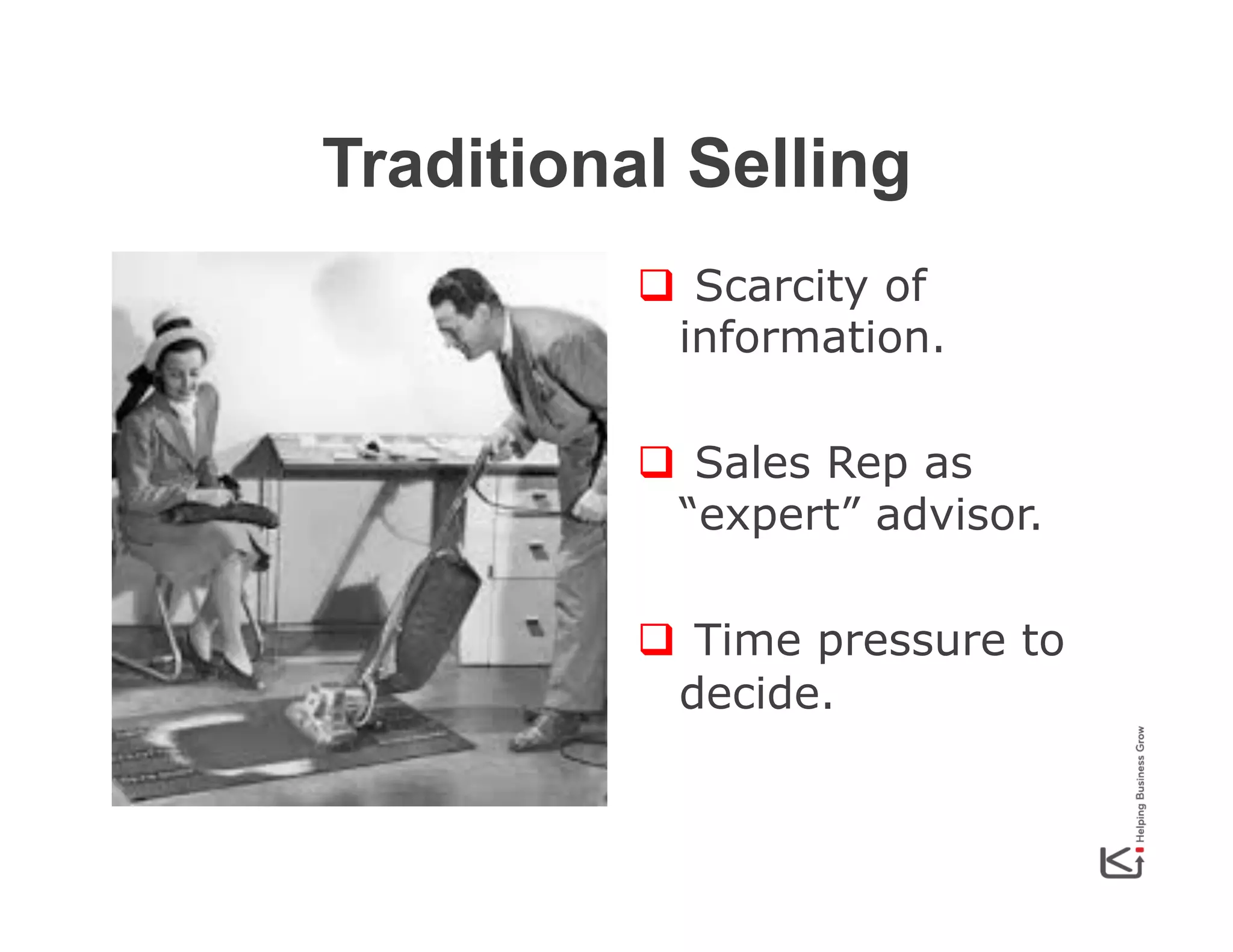
Traditional Selling
q  Scarcity of
information.
q  Sales Rep as
“expert” advisor.
q  Time pressure to
decide.
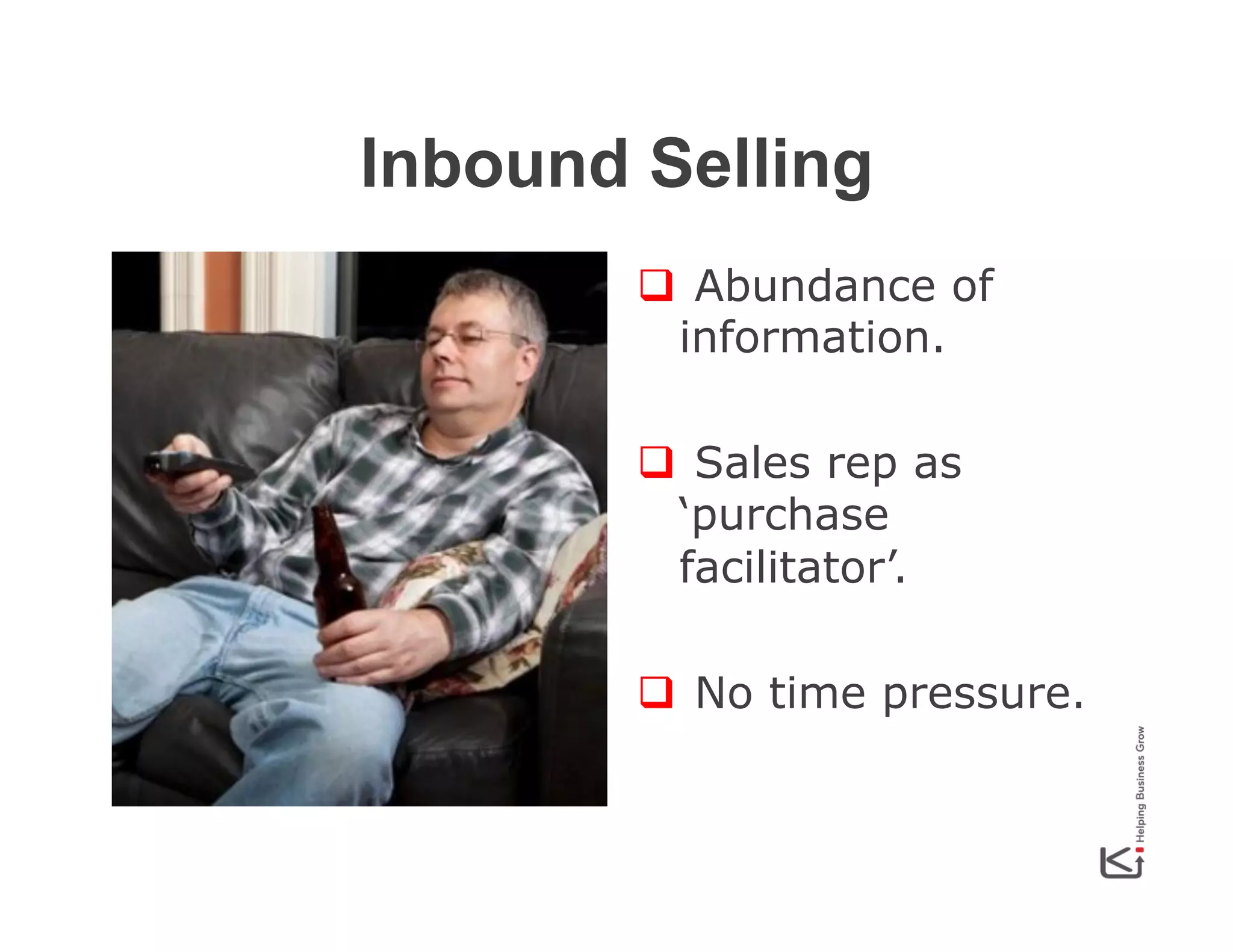
Inbound Selling
q  Abundance of
information.
q  Sales rep as
‘purchase
facilitator’.
q  No time pressure.
What it Feels Like
Businesses used to operating as a trusted advisor
suddenly feel like vendors hawking goods at the market
and battling with customers over price.
The Buyer Is In Control.

GOOD BYE SALES FUNNEL
Disintermediation
Getting Rid of the Monkey in the Middle
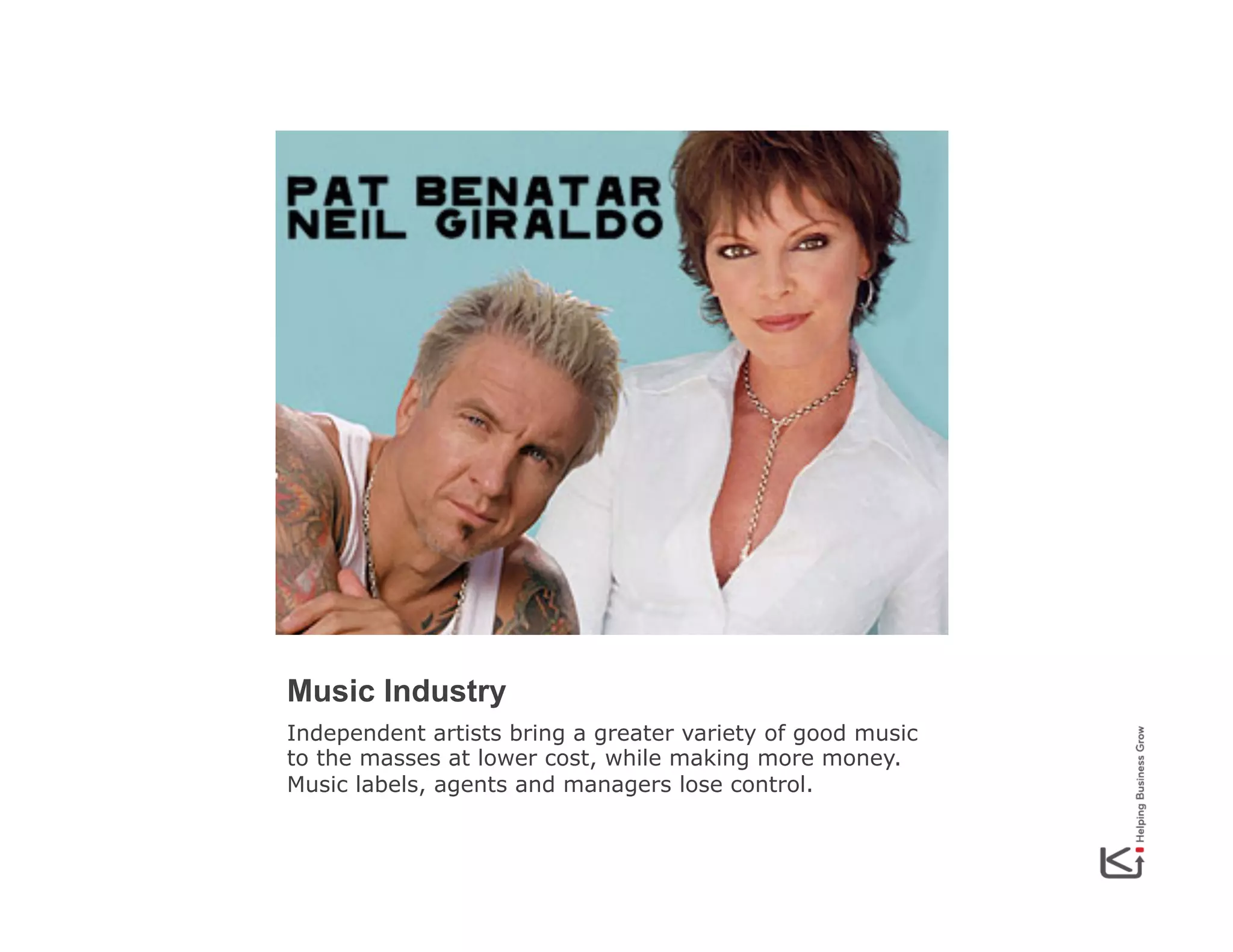
Music Industry
Independent artists bring a greater variety of good music
to the masses at lower cost, while making more money.
Music labels, agents and managers lose control.
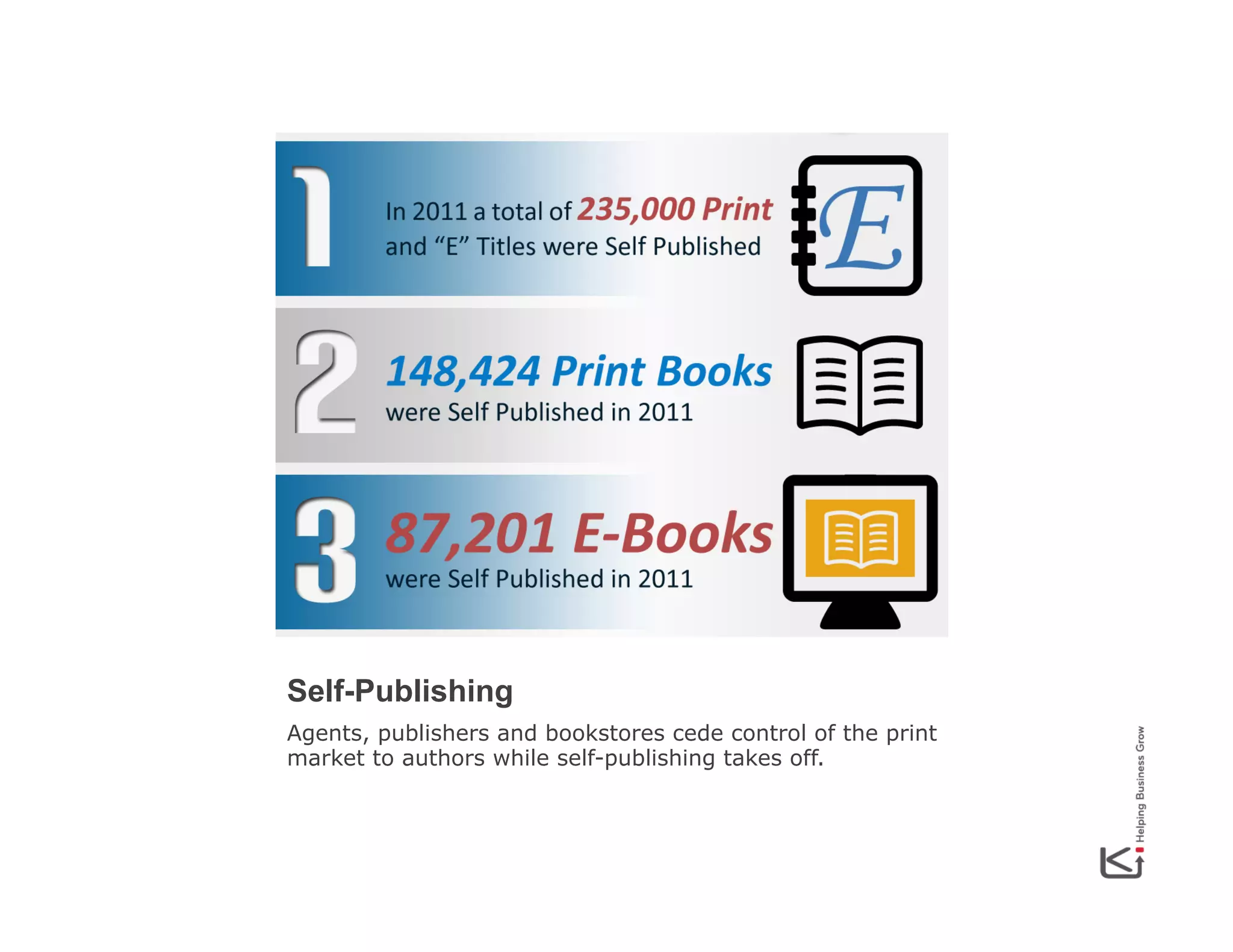
Self-Publishing
Agents, publishers and bookstores cede control of the print
market to authors while self-publishing takes off.
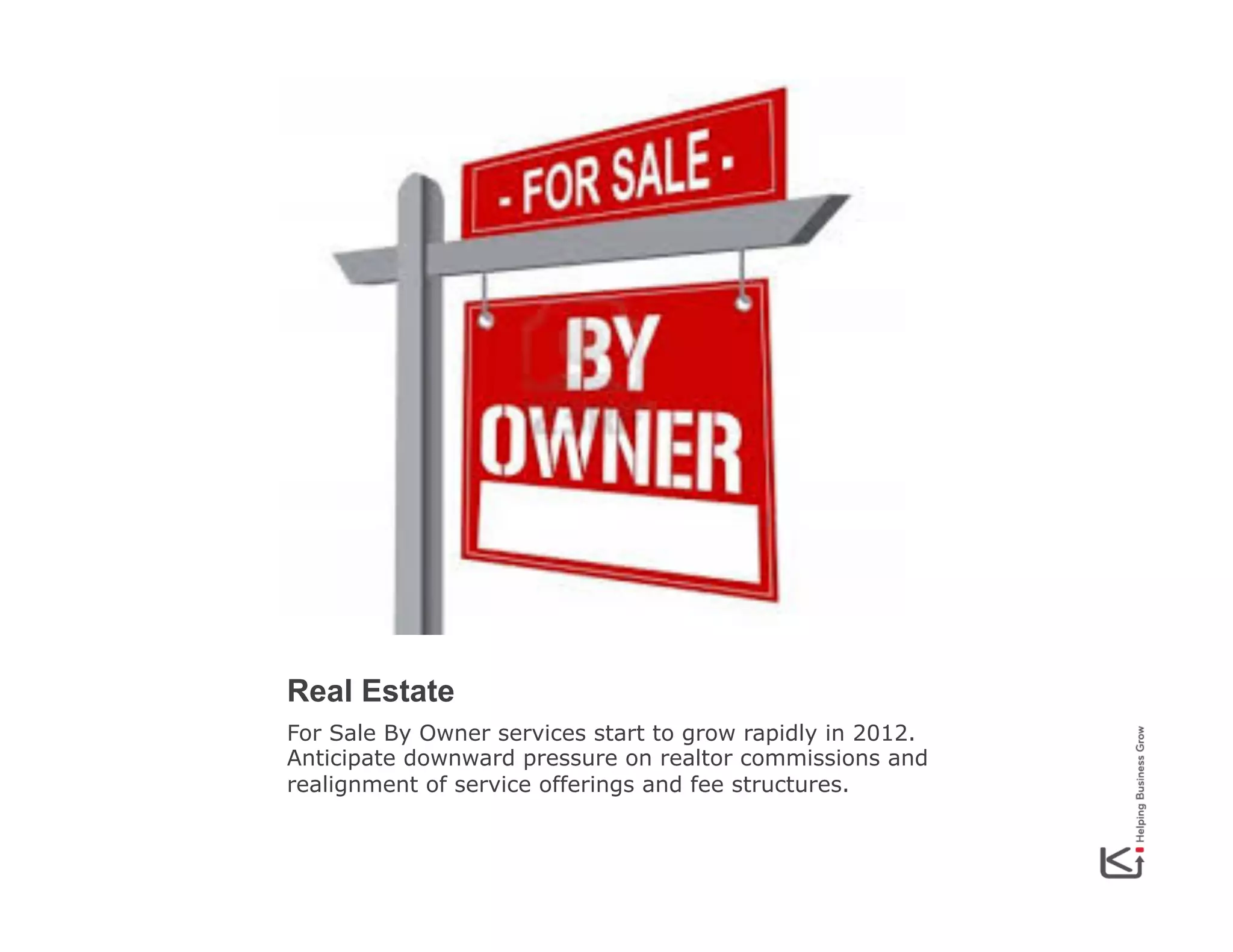
Real Estate
For Sale By Owner services start to grow rapidly in 2012.
Anticipate downward pressure on realtor commissions and
realignment of service offerings and fee structures.
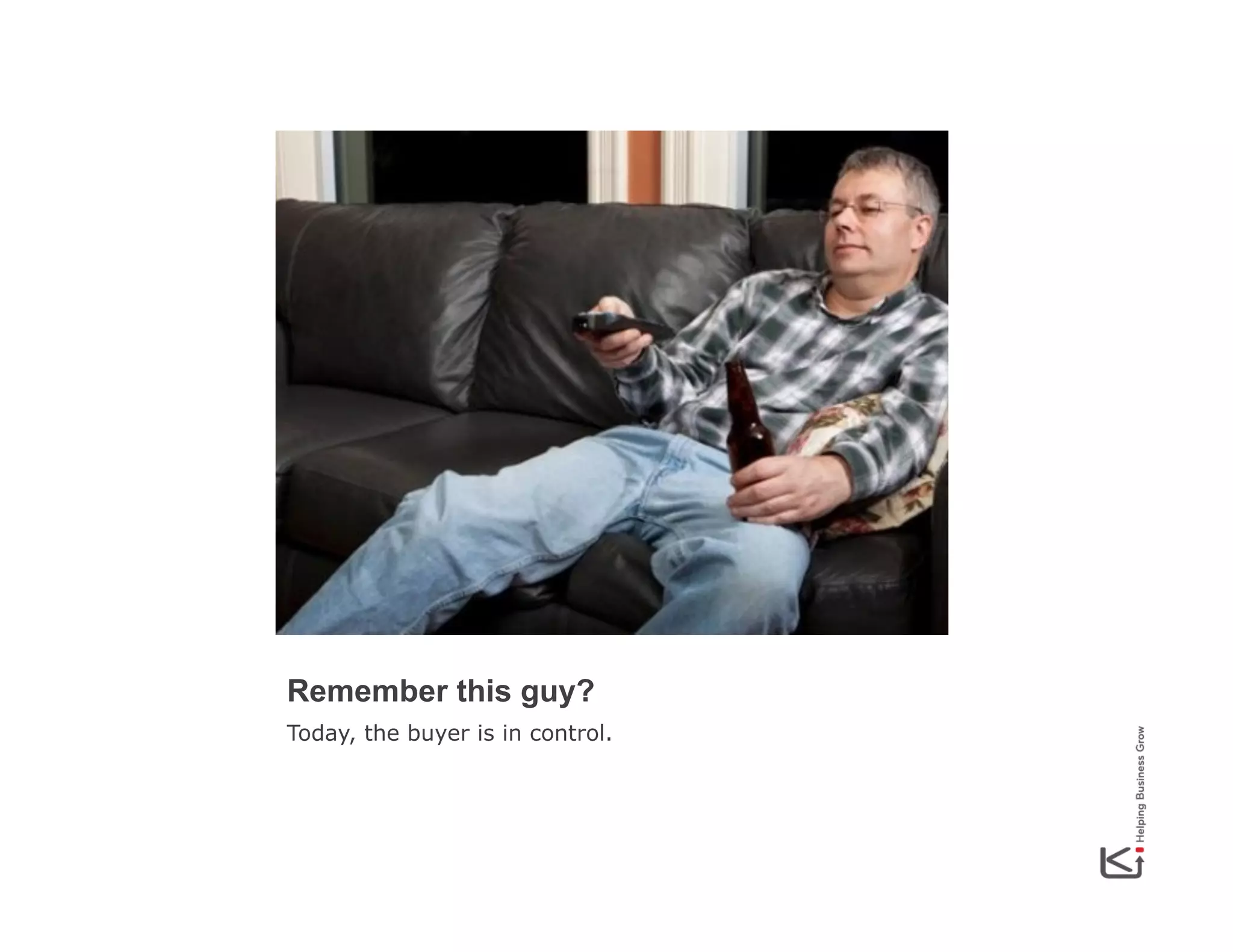
Remember this guy?
Today, the buyer is in control.
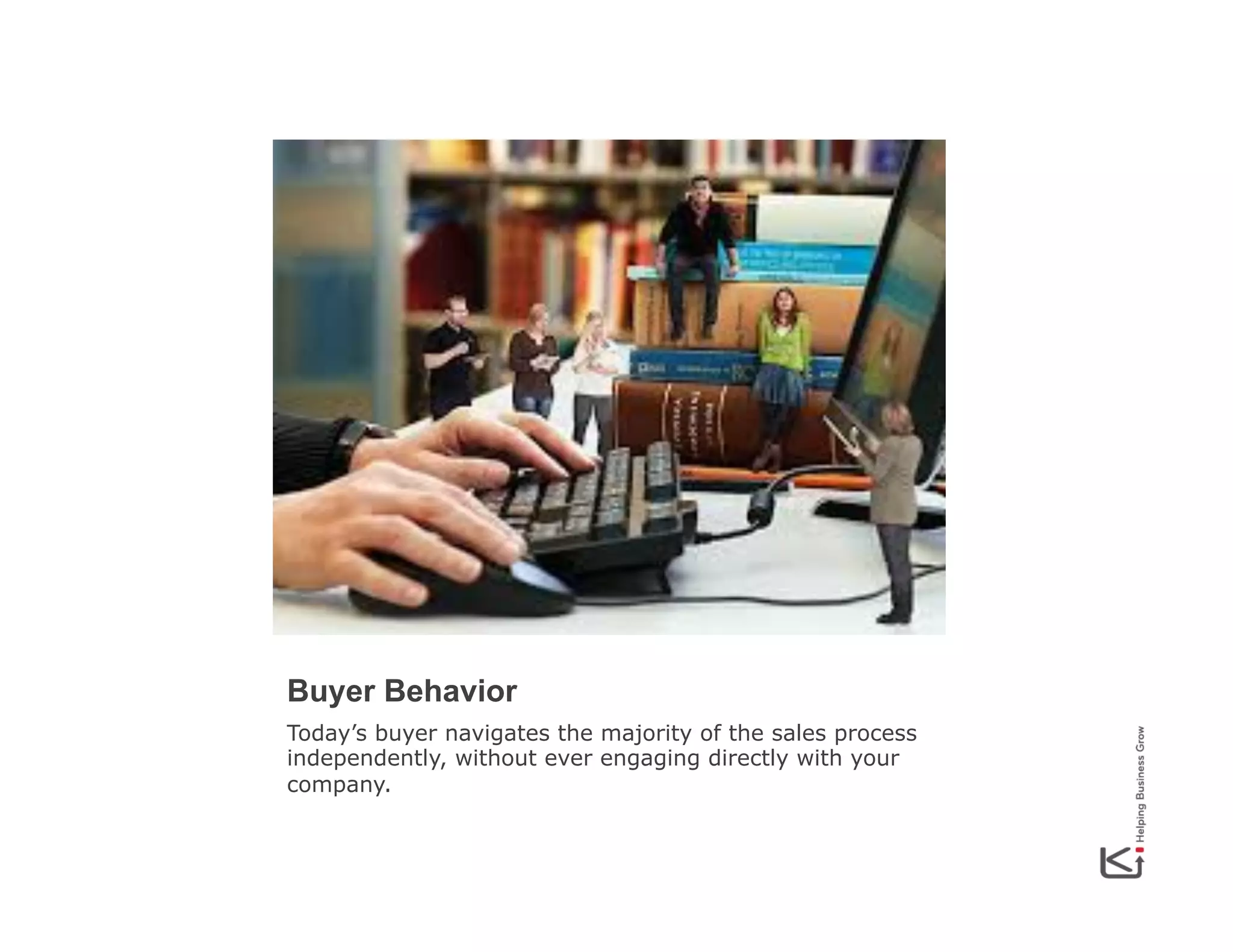
Buyer Behavior
Today’s buyer navigates the majority of the sales process
independently, without ever engaging directly with your
company.
Buyers’ Changing Expectations
“I already know what I need, how much it should cost and
what quantity I will buy. I’m looking to you to validate my
decision and help me make it happen.”
The New Professional Sales Person.

TOUR GUIDE
It’s a Jungle Out There
The buyer isn’t confident that he has absorbed all of the
information, or even the right information. But he has
constructed a story to help him organize it. Your job is to align
your company with that story.
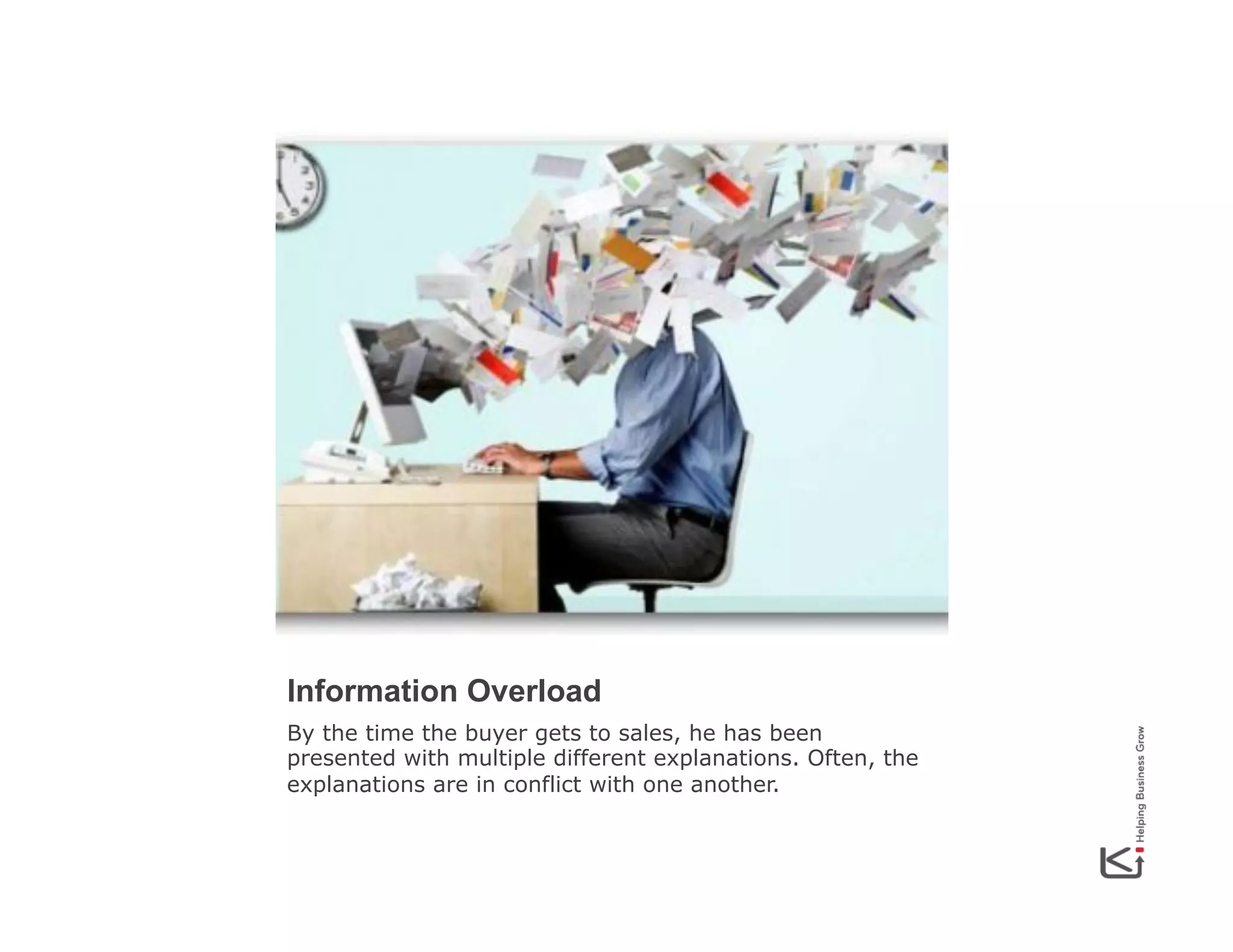
Information Overload
By the time the buyer gets to sales, he has been
presented with multiple different explanations. Often, the
explanations are in conflict with one another.
PAC4E Yourself
Selling is a marathon, not a sprint.
Aligning Sales & Marketing.

BUYER PERSONAS
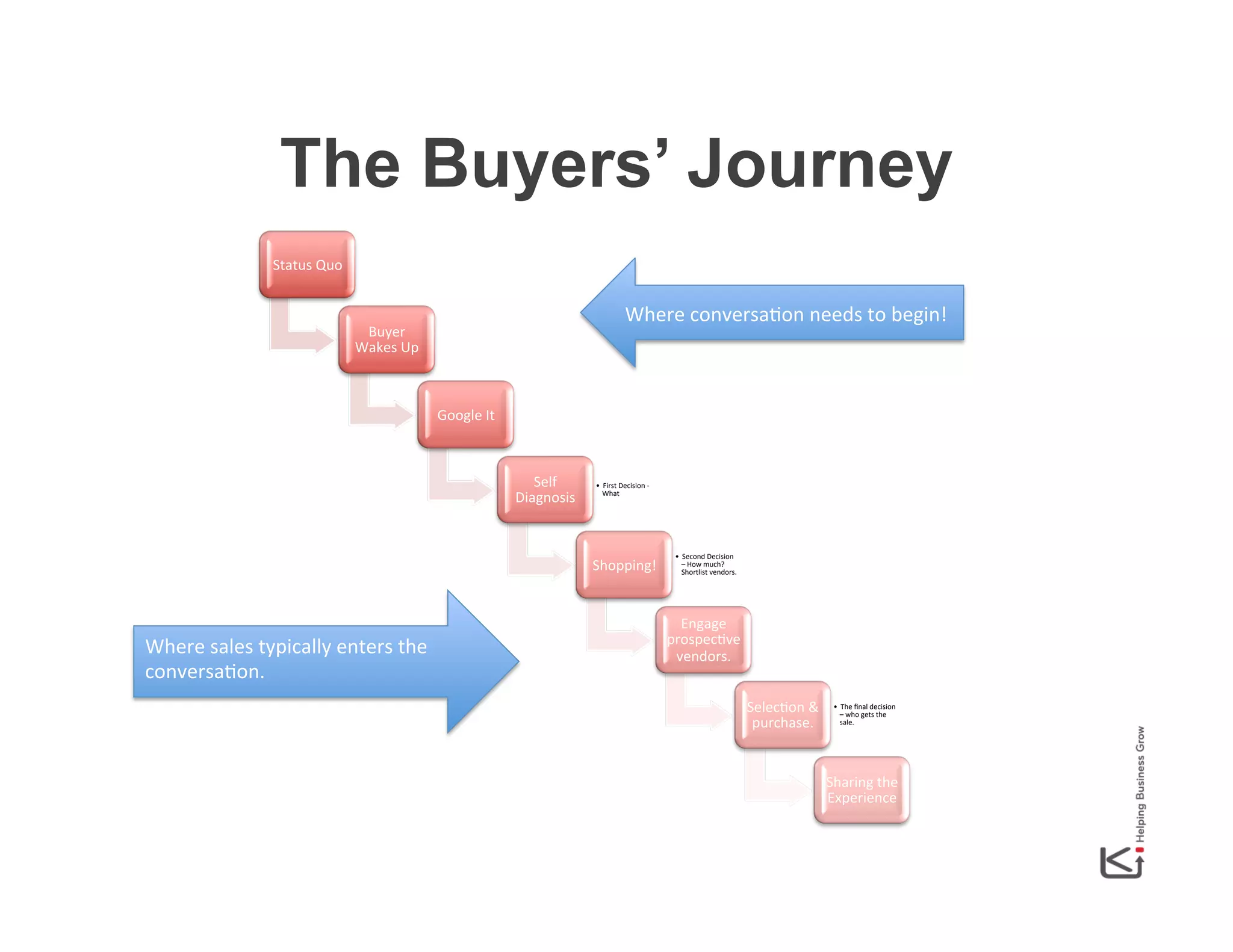
The Buyers’ Journey
Status	
  Quo	
  

Where	
  conversaHon	
  needs	
  to	
  begin!	
  

Buyer	
  
Wakes	
  Up	
  

Google	
  It	
  

Self	
  
Diagnosis	
  

•  First	
  Decision	
  -­‐	
  
What	
  

Shopping!	
  

Where	
  sales	
  typically	
  enters	
  the	
  
conversaHon.	
  

•  Second	
  Decision	
  
–	
  How	
  much?	
  
Shortlist	
  vendors.	
  

Engage	
  
prospecHve	
  
vendors.	
  
SelecHon	
  &	
  
purchase.	
  

•  The	
  final	
  decision	
  
–	
  who	
  gets	
  the	
  
sale.	
  

Sharing	
  the	
  
Experience	
  
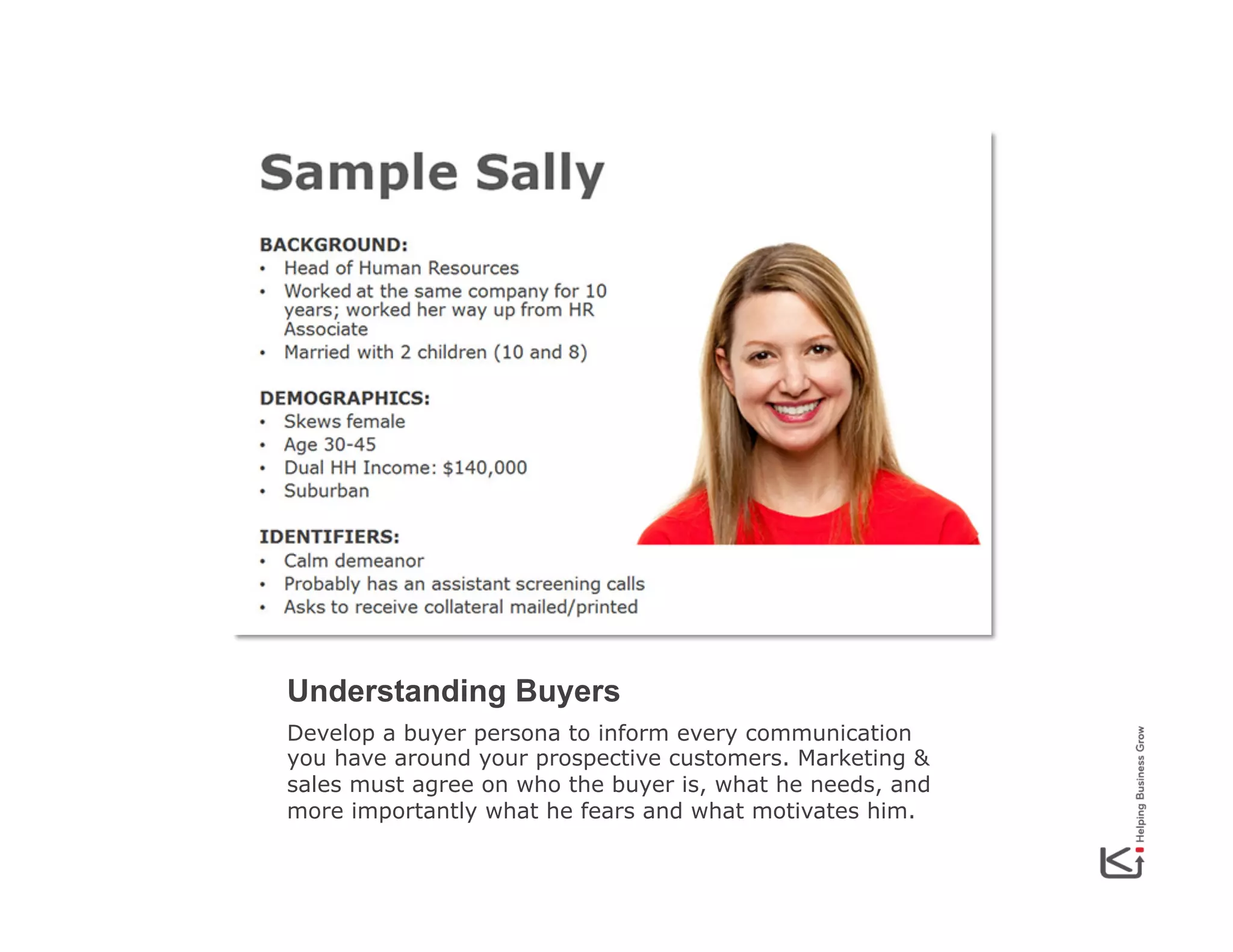
Understanding Buyers
Develop a buyer persona to inform every communication
you have around your prospective customers. Marketing &
sales must agree on who the buyer is, what he needs, and
more importantly what he fears and what motivates him.
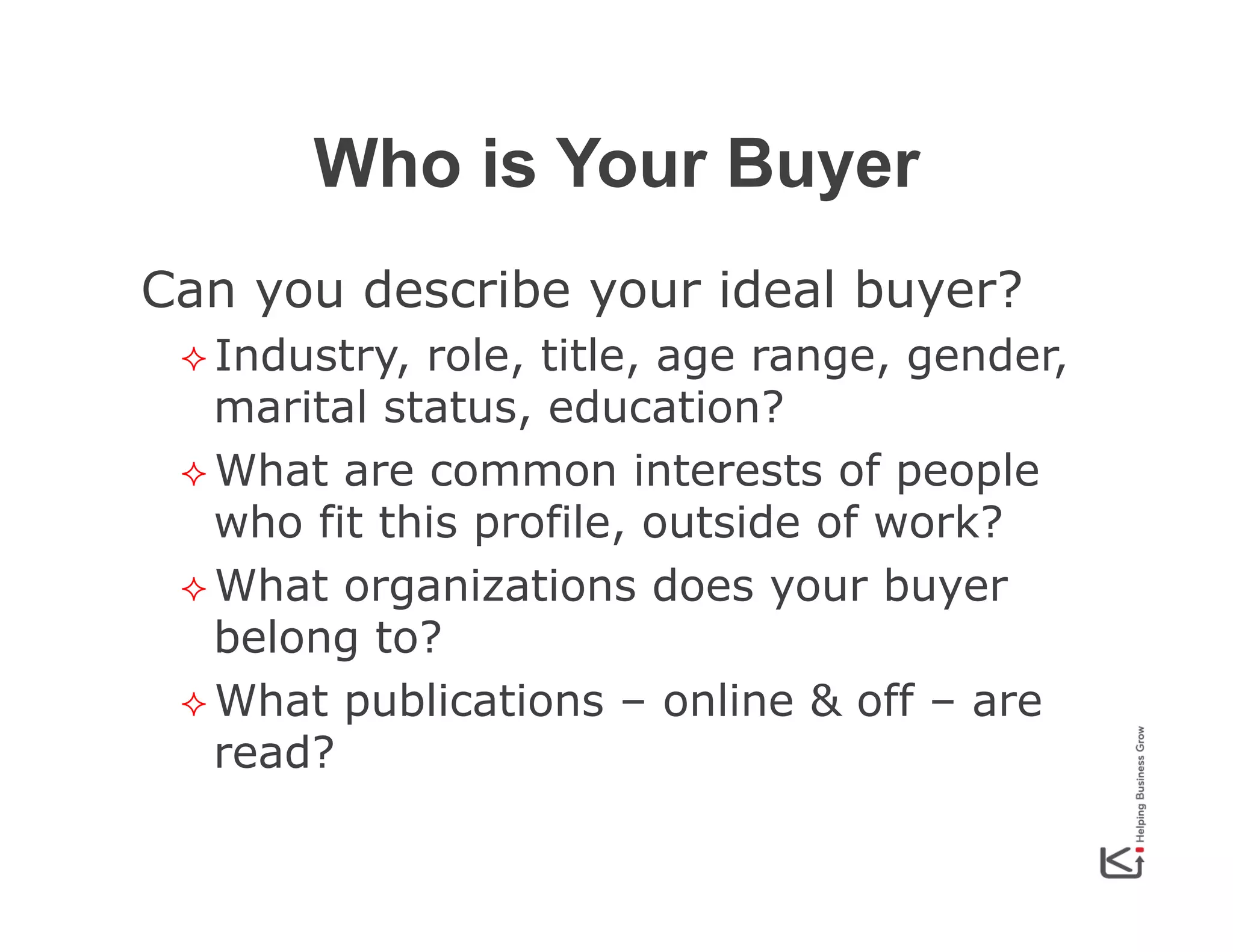
Who is Your Buyer
Can you describe your ideal buyer?
²  Industry,

role, title, age range, gender,
marital status, education?
²  What are common interests of people
who fit this profile, outside of work?
²  What organizations does your buyer
belong to?
²  What publications – online & off – are
read?
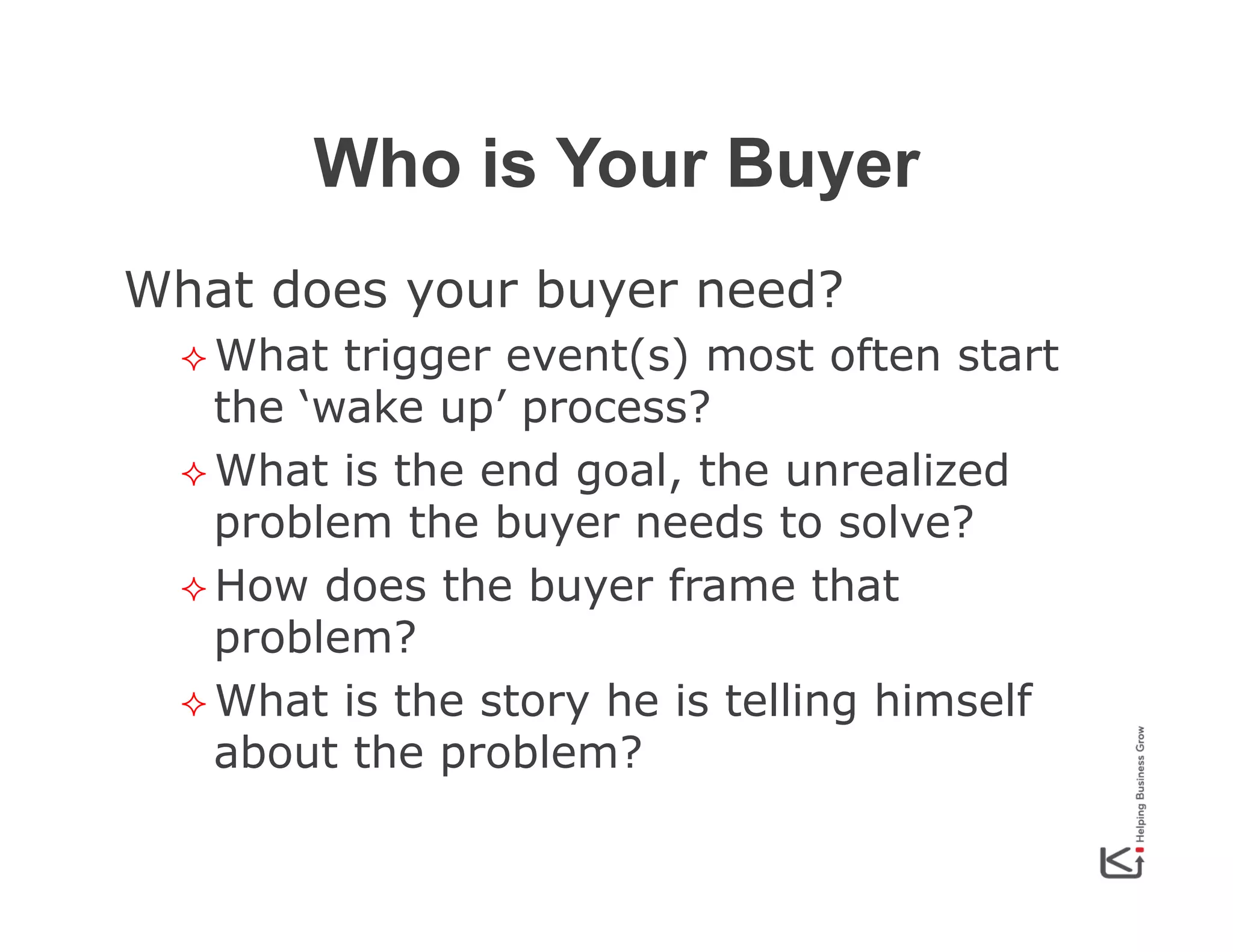
Who is Your Buyer
What does your buyer need?
²  What

trigger event(s) most often start
the ‘wake up’ process?
²  What is the end goal, the unrealized
problem the buyer needs to solve?
²  How does the buyer frame that
problem?
²  What is the story he is telling himself
about the problem?
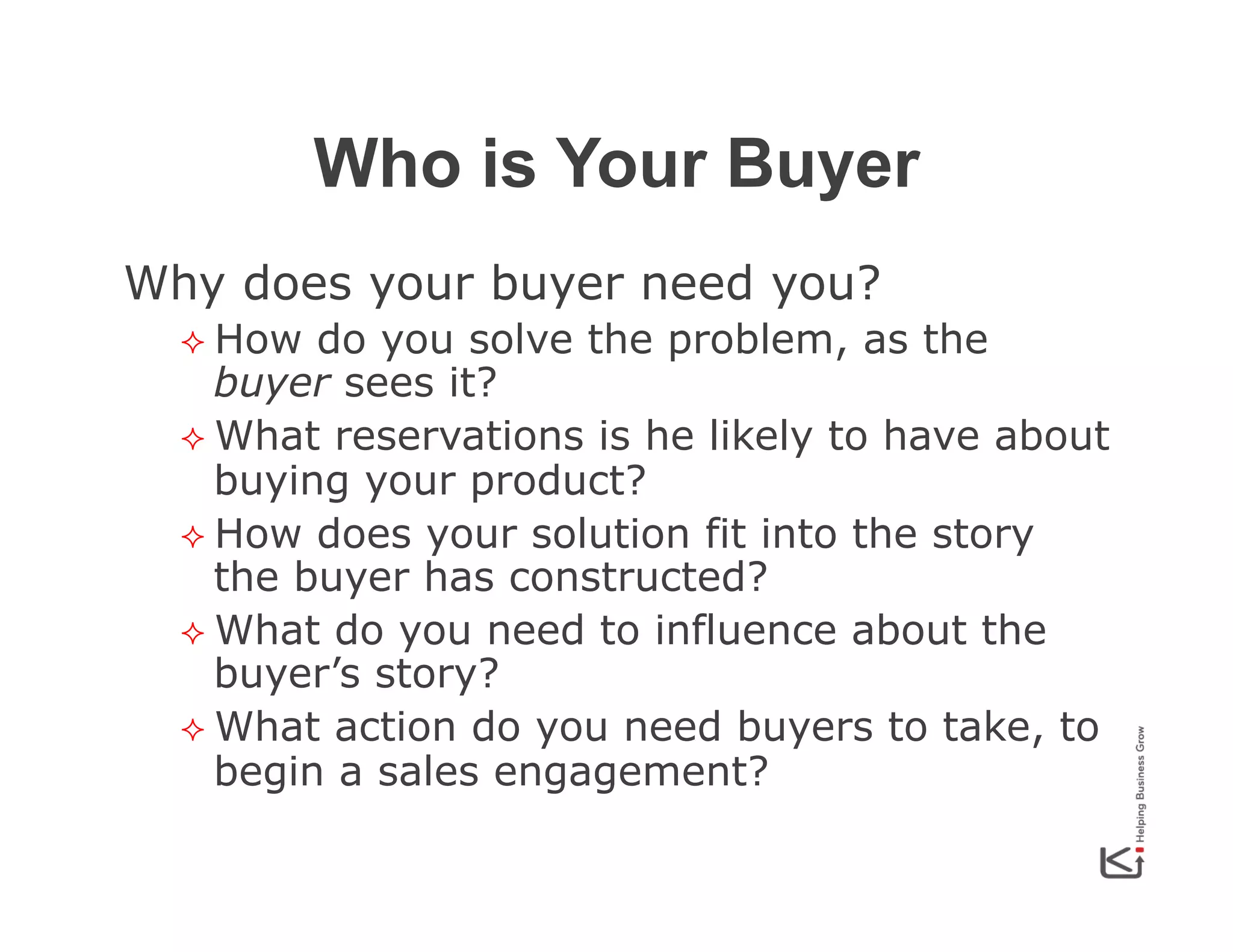
Who is Your Buyer
Why does your buyer need you?
²  How

do you solve the problem, as the
buyer sees it?
²  What reservations is he likely to have about
buying your product?
²  How does your solution fit into the story
the buyer has constructed?
²  What do you need to influence about the
buyer’s story?
²  What action do you need buyers to take, to
begin a sales engagement?
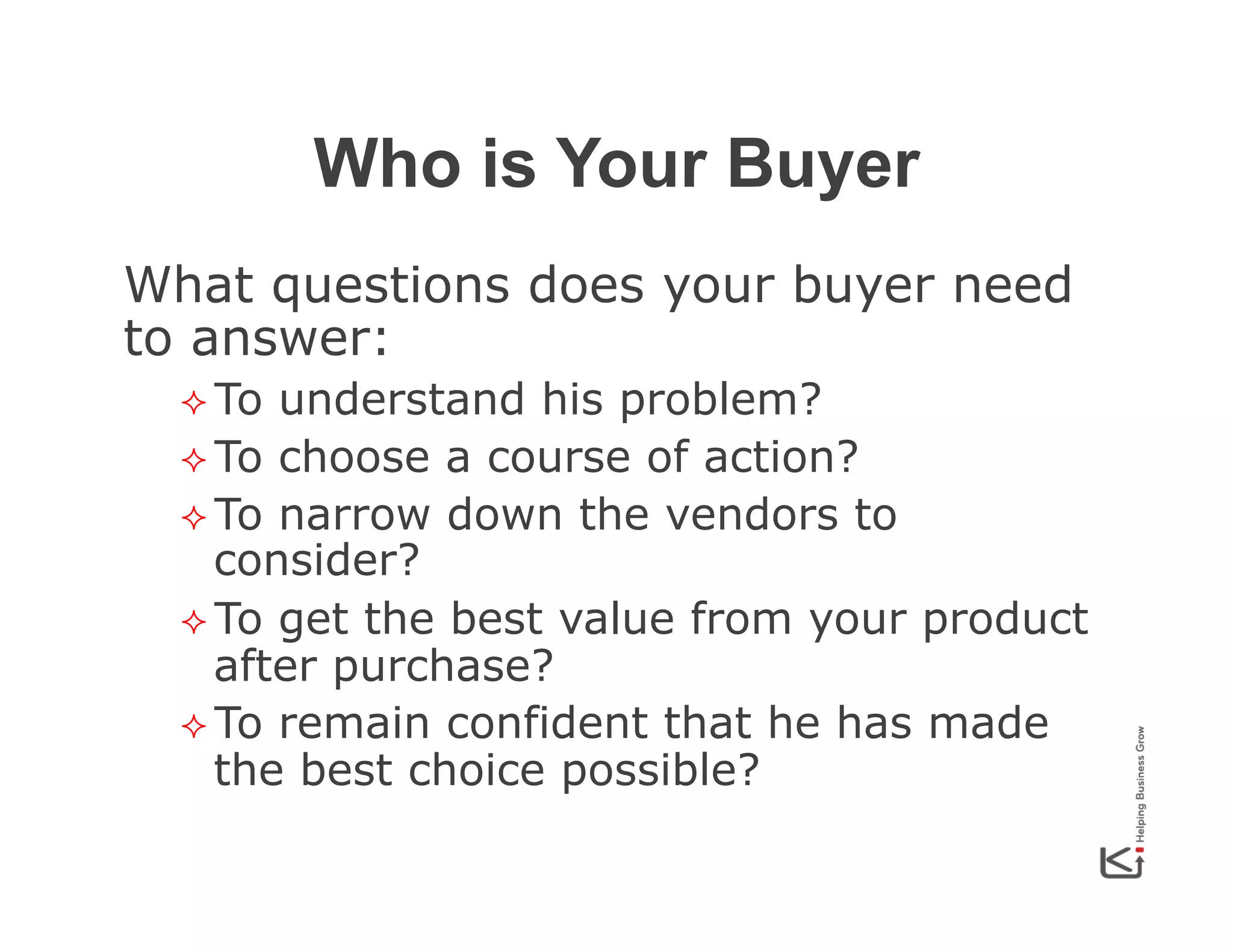
Who is Your Buyer
What questions does your buyer need
to answer:
²  To

understand his problem?
²  To choose a course of action?
²  To narrow down the vendors to
consider?
²  To get the best value from your product
after purchase?
²  To remain confident that he has made
the best choice possible?
Next, answer each of these questions:
q Using the same language as the buyer
q In a manner consistent with the lens through
which the buyer sees the world
q At the exact moment the buyer needs the
answer
q Without appearing too pushy or salesy
q While presenting multiple non-threatening
options to engage with a human being.
Inbound Sales & Marketing.

THE PAC4E SYSTEM
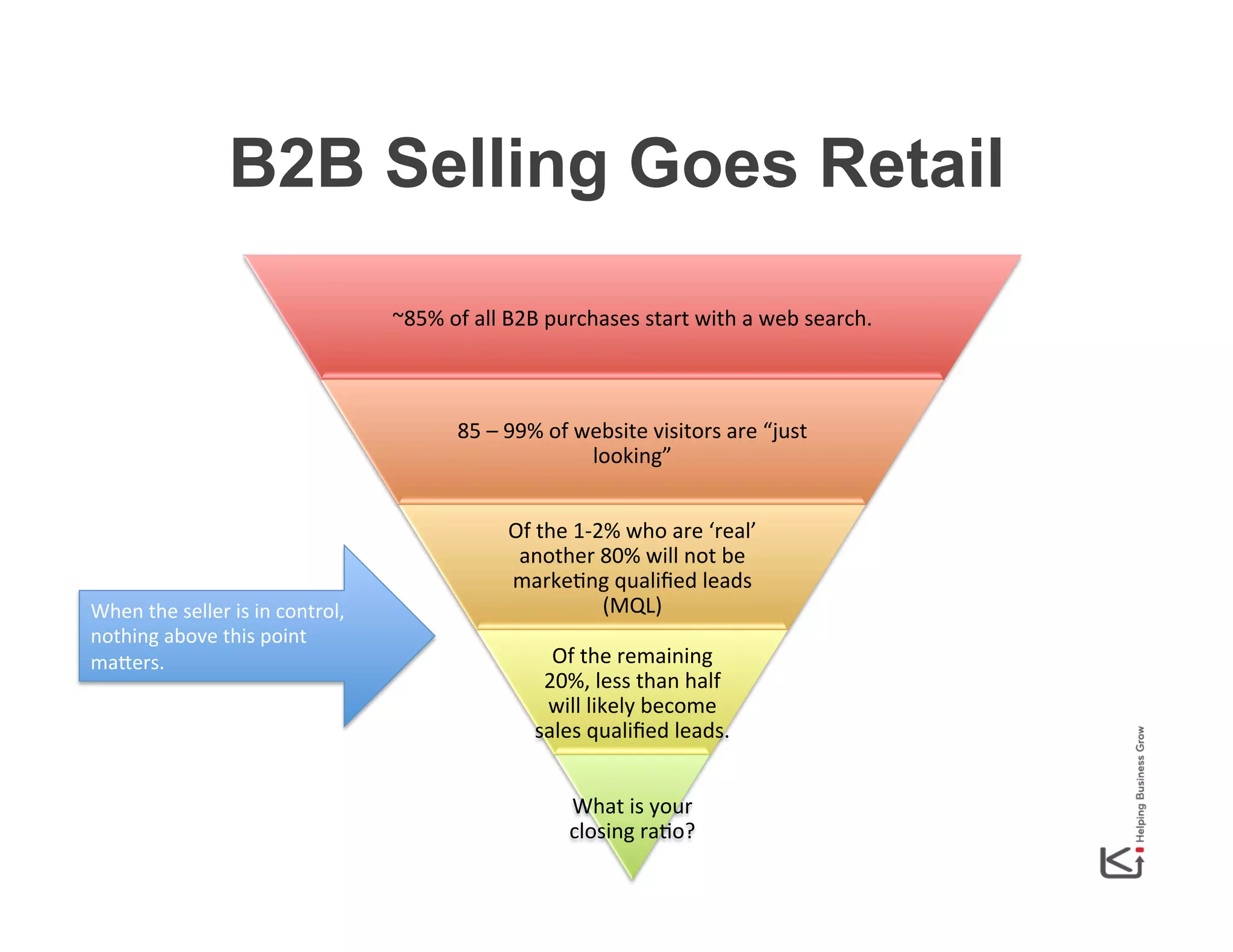
B2B Selling Goes Retail
~85%	
  of	
  all	
  B2B	
  purchases	
  start	
  with	
  a	
  web	
  search.	
  

85	
  –	
  99%	
  of	
  website	
  visitors	
  are	
  “just	
  
looking”	
  

When	
  the	
  seller	
  is	
  in	
  control,	
  
nothing	
  above	
  this	
  point	
  
mabers.	
  

Of	
  the	
  1-­‐2%	
  who	
  are	
  ‘real’	
  
another	
  80%	
  will	
  not	
  be	
  
markeHng	
  qualified	
  leads	
  
(MQL)	
  
Of	
  the	
  remaining	
  
20%,	
  less	
  than	
  half	
  
will	
  likely	
  become	
  
sales	
  qualified	
  leads.	
  
What	
  is	
  your	
  
closing	
  raHo?	
  
Selling is a marathon, not a sprint.
You don’t want to be this guy!
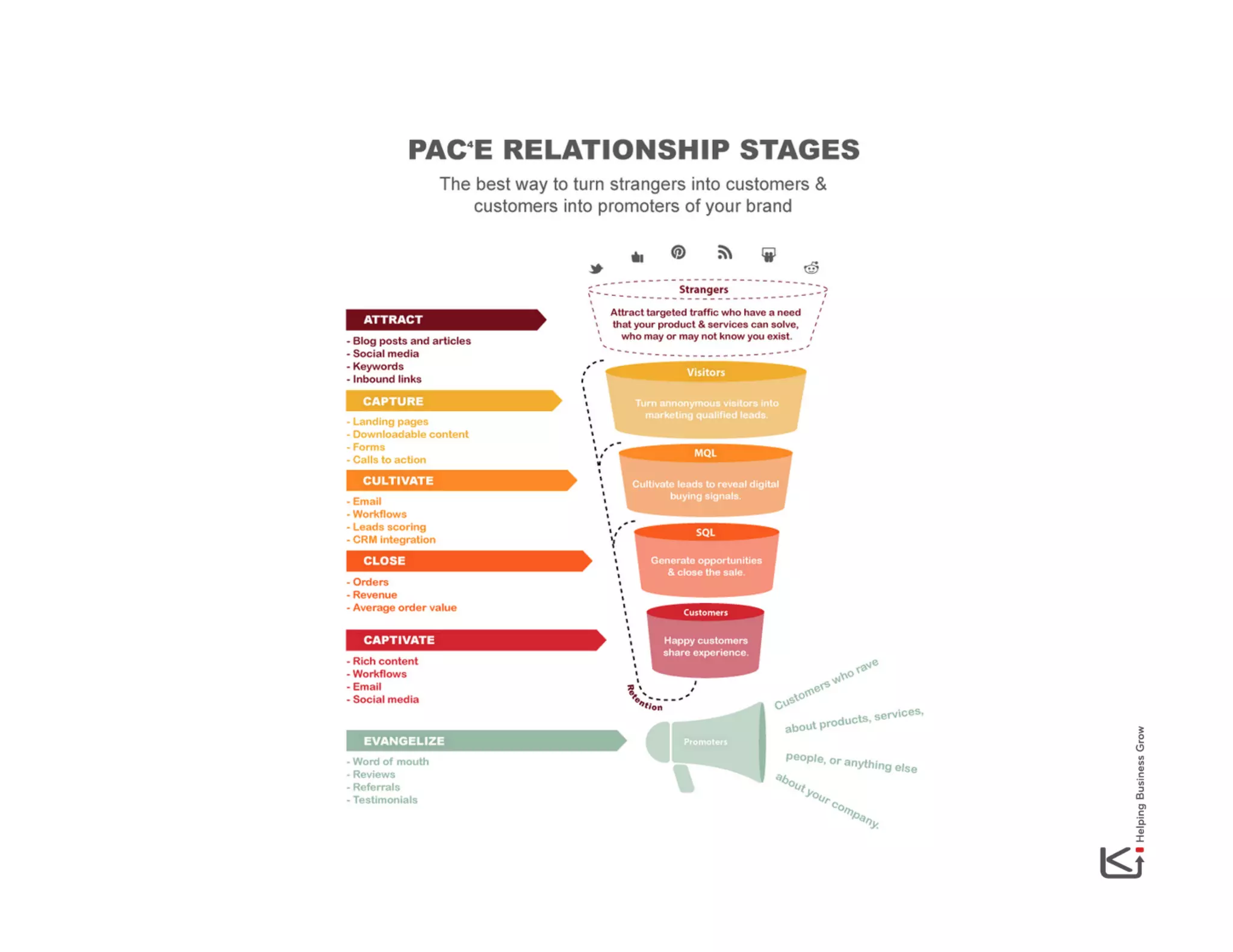
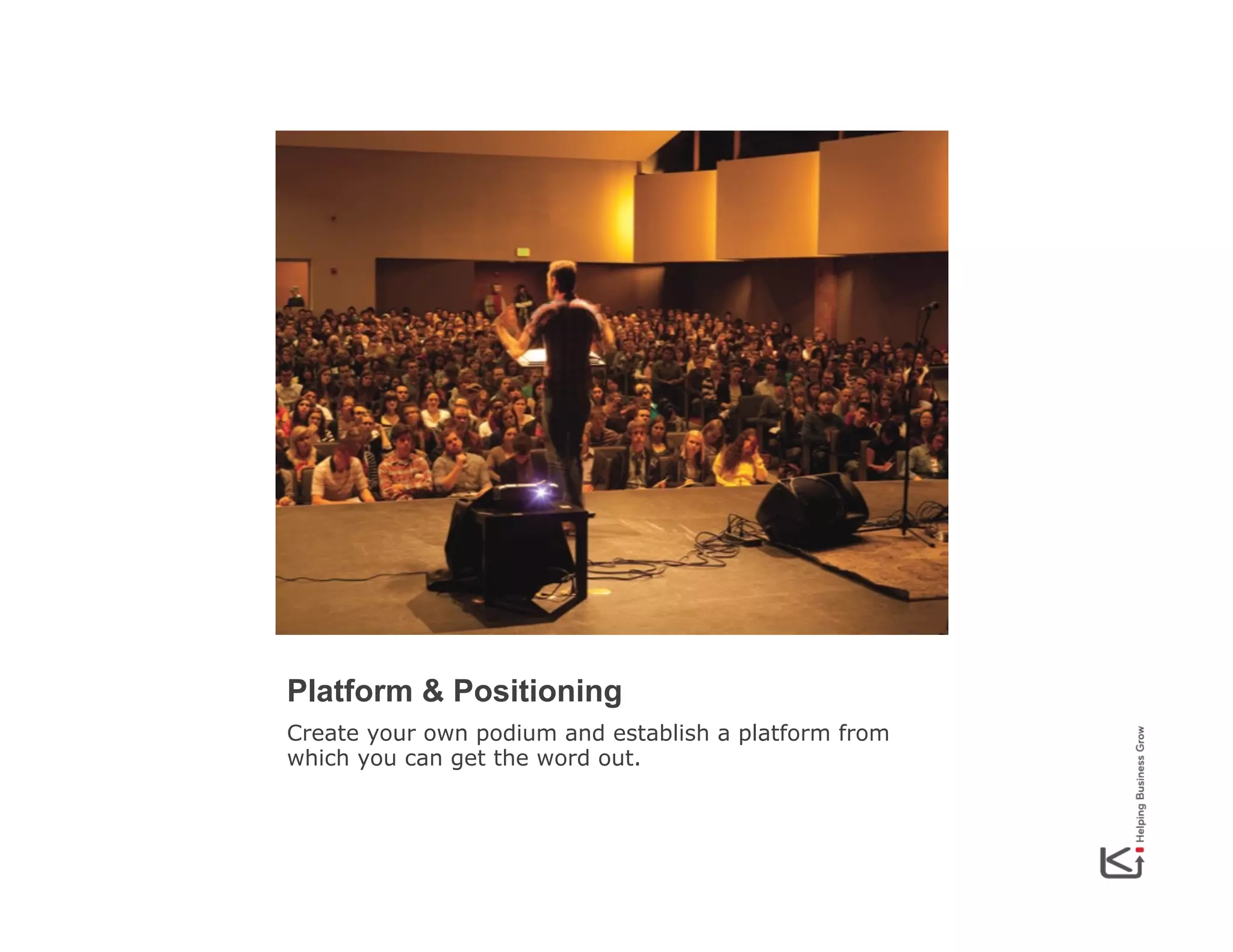
Platform & Positioning
Create your own podium and establish a platform from
which you can get the word out.
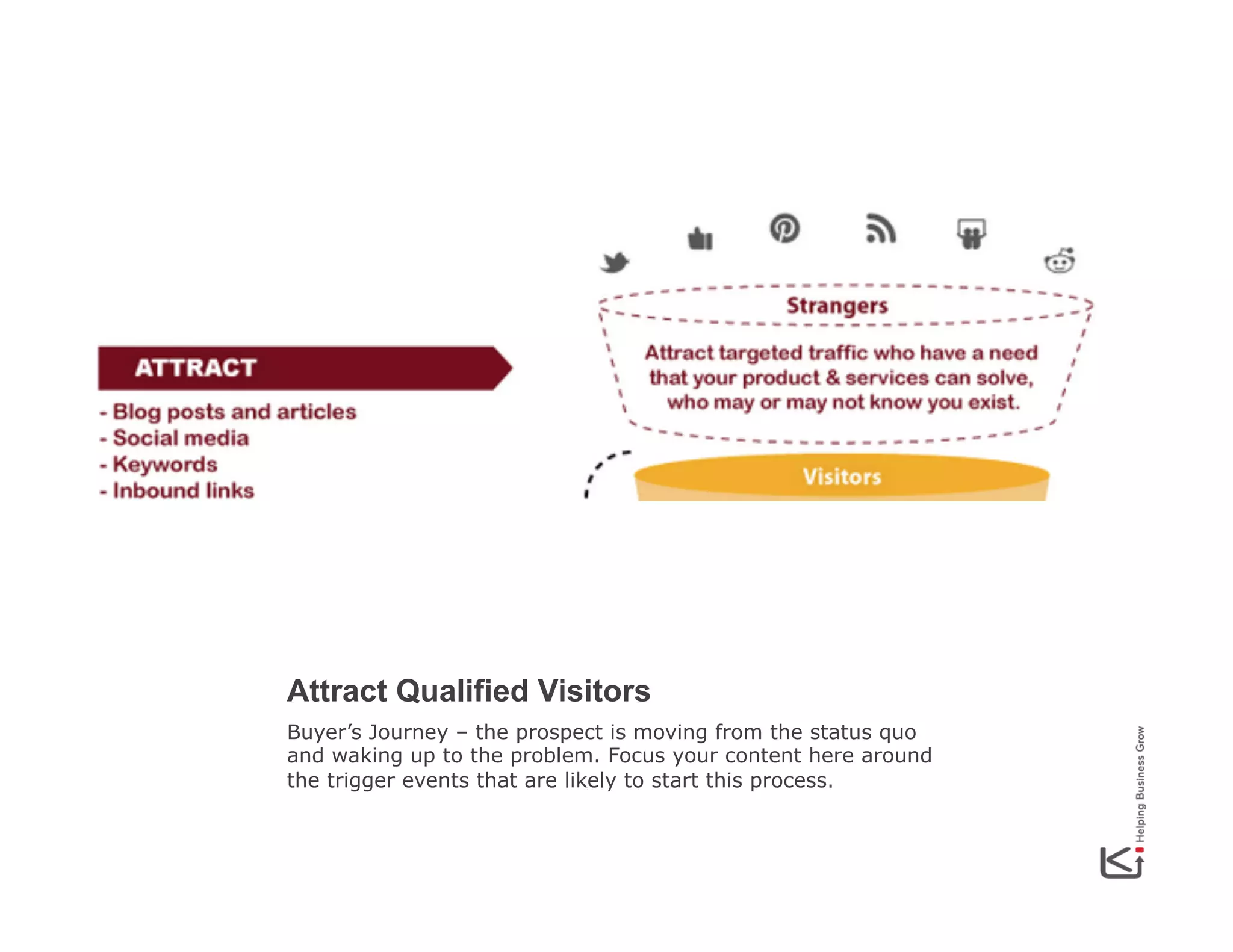
Attract Qualified Visitors
Buyer’s Journey – the prospect is moving from the status quo
and waking up to the problem. Focus your content here around
the trigger events that are likely to start this process.
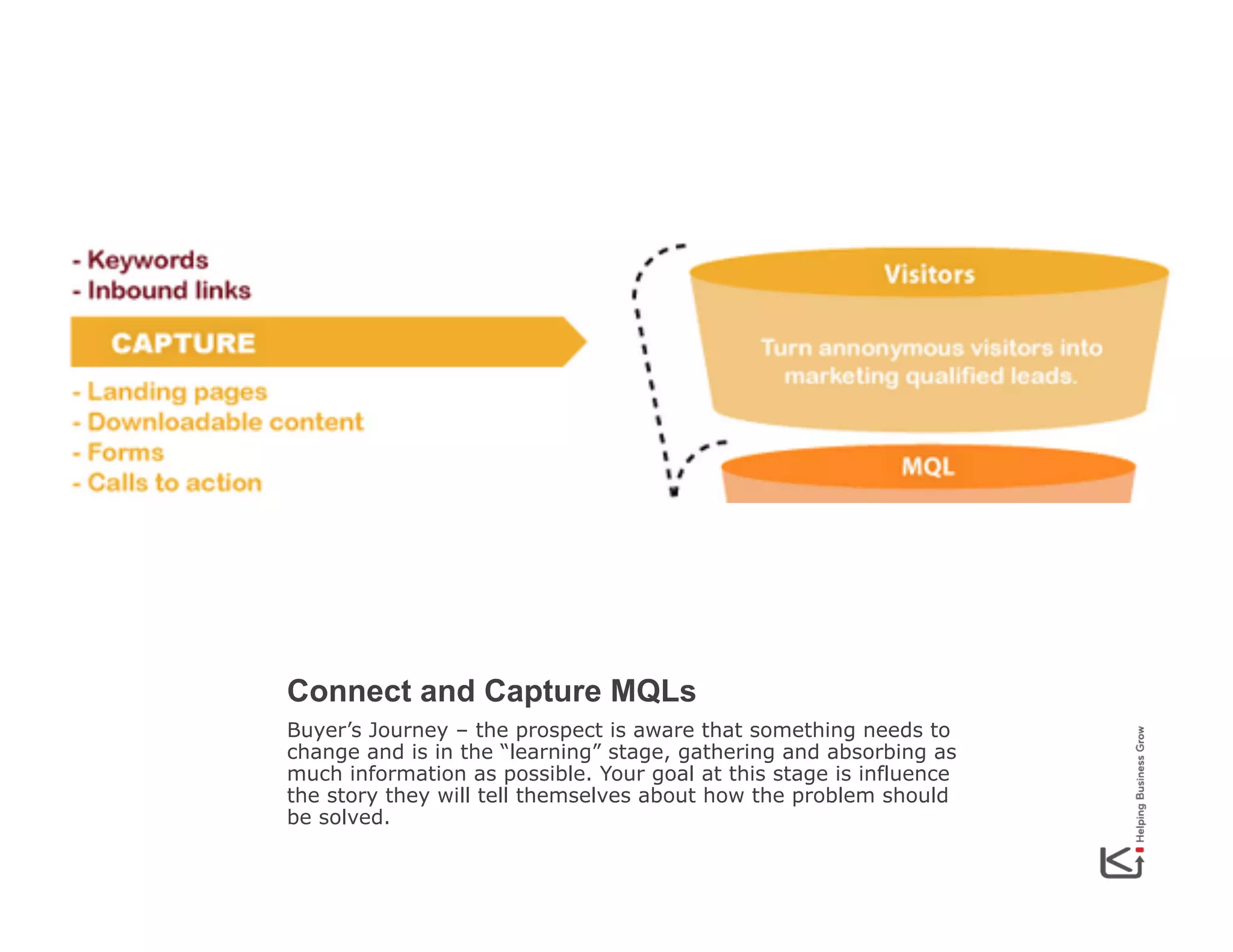
Connect and Capture MQLs
Buyer’s Journey – the prospect is aware that something needs to
change and is in the “learning” stage, gathering and absorbing as
much information as possible. Your goal at this stage is influence
the story they will tell themselves about how the problem should
be solved.
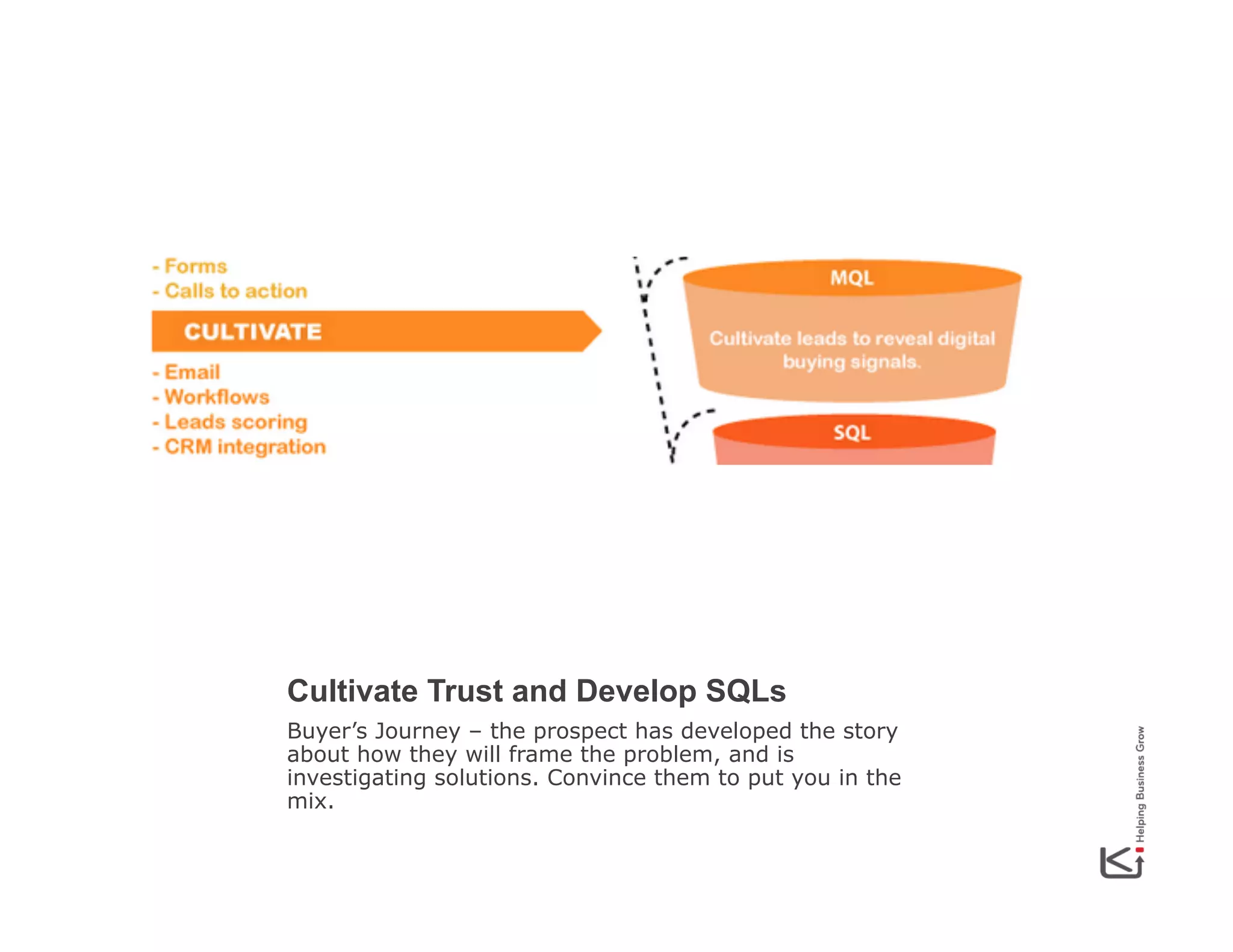
Cultivate Trust and Develop SQLs
Buyer’s Journey – the prospect has developed the story
about how they will frame the problem, and is
investigating solutions. Convince them to put you in the
mix.
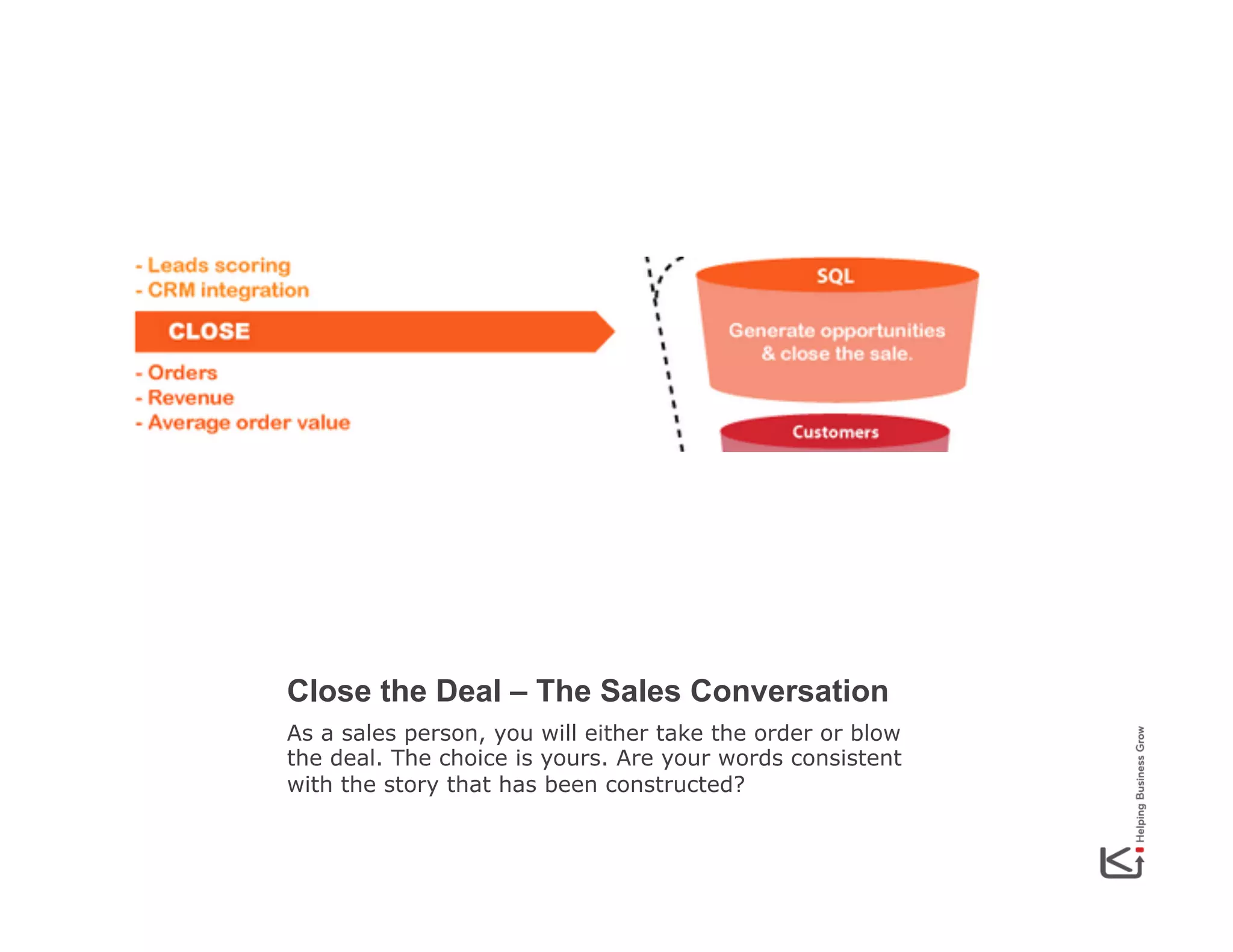
Close the Deal – The Sales Conversation
As a sales person, you will either take the order or blow
the deal. The choice is yours. Are your words consistent
with the story that has been constructed?
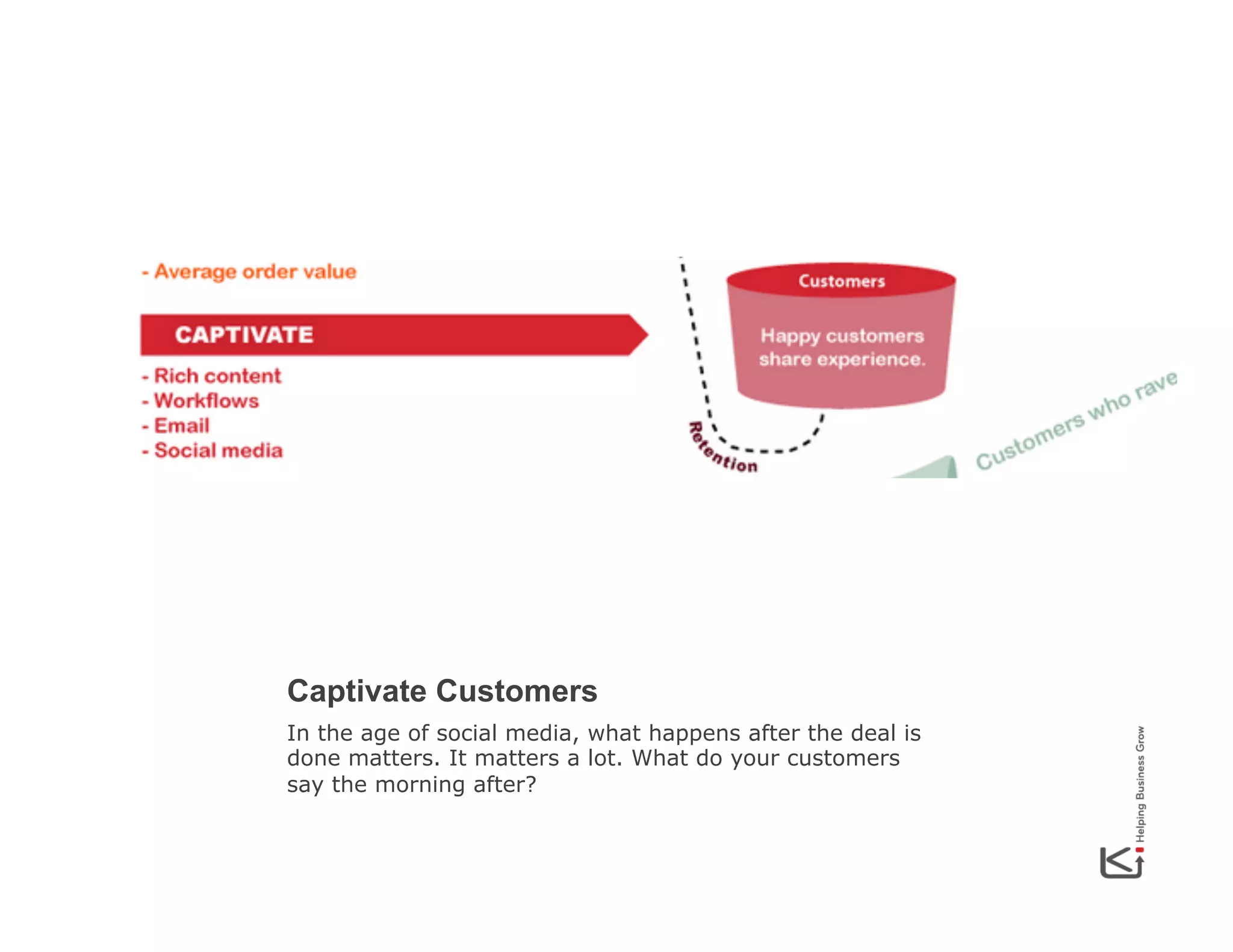
Captivate Customers
In the age of social media, what happens after the deal is
done matters. It matters a lot. What do your customers
say the morning after?
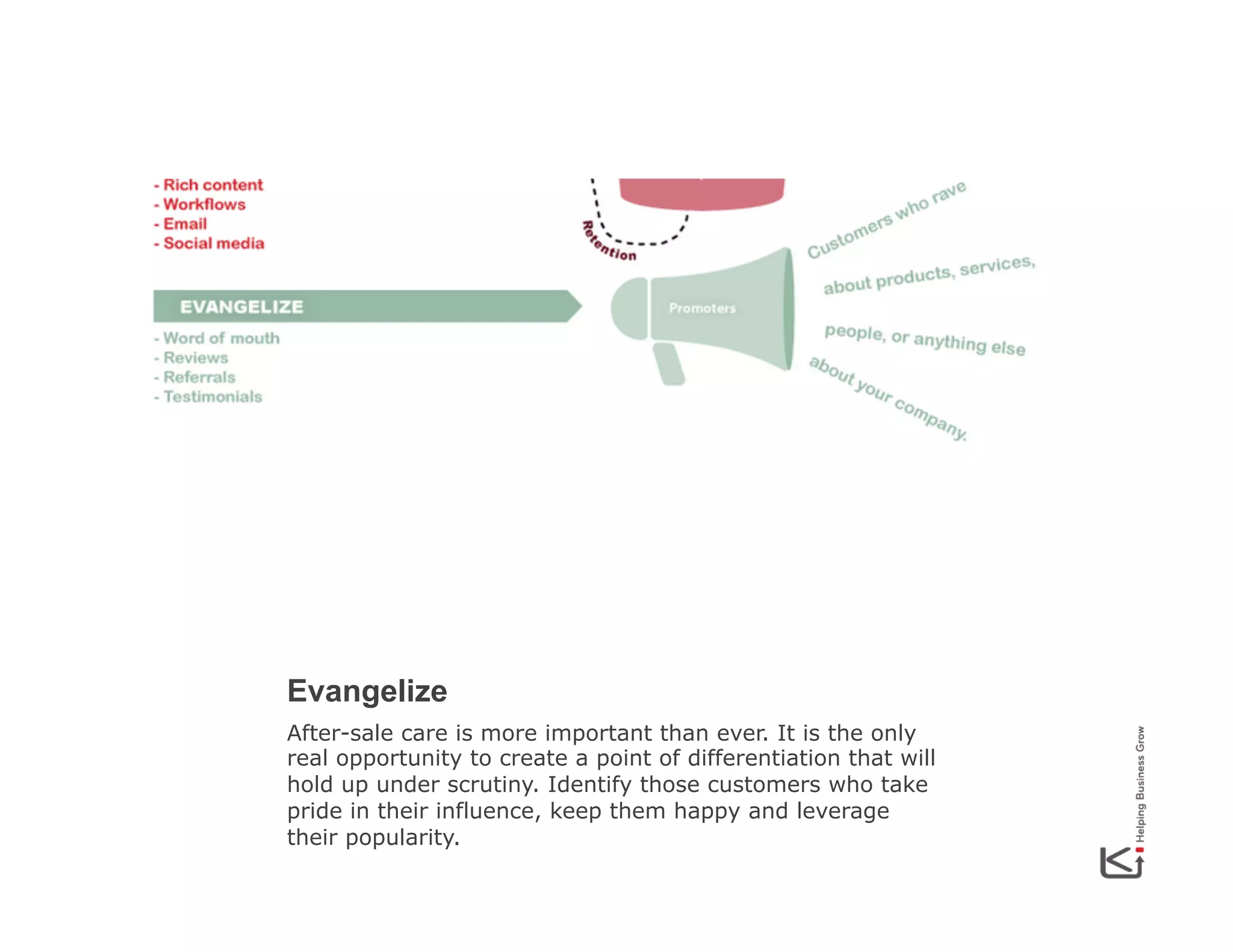
Evangelize
After-sale care is more important than ever. It is the only
real opportunity to create a point of differentiation that will
hold up under scrutiny. Identify those customers who take
pride in their influence, keep them happy and leverage
their popularity.
In a Nutshell
q Know your buyer.
q Develop answers to his questions at each stage
of the buying process.
q Create content to answer specific questions &
make it freely available.
q Automate information delivery.
q Collect contact details in exchange for
information.
q Use lead scoring to shape sales response and
personalize automated communications.
q Maintain contact post-sale.
Thank You
Paula Skaper
KinetixMedia.com
pskaper@kinetixmedia.com

Finding Leads in the Digital Age

  • 1.
    Finding Leads inthe Digital Age How to Turn the Radical Shift in B2B Buying into a Competitive Advantage
  • 2.
    What We’ll Cover Howto: q  Navigate the changing buying cycle. q  Capture quality leads from your website. q  Turn leads into sales opportunities. q  Get marketing and sales on the same page.
  • 3.
    The World HasChanged. WHAT’S GOING ON?
  • 4.
    Traditional Selling q  Scarcityof information. q  Sales Rep as “expert” advisor. q  Time pressure to decide.
  • 5.
    Inbound Selling q  Abundanceof information. q  Sales rep as ‘purchase facilitator’. q  No time pressure.
  • 6.
    What it FeelsLike Businesses used to operating as a trusted advisor suddenly feel like vendors hawking goods at the market and battling with customers over price.
  • 7.
    The Buyer IsIn Control. GOOD BYE SALES FUNNEL
  • 8.
    Disintermediation Getting Rid ofthe Monkey in the Middle
  • 9.
    Music Industry Independent artistsbring a greater variety of good music to the masses at lower cost, while making more money. Music labels, agents and managers lose control.
  • 10.
    Self-Publishing Agents, publishers andbookstores cede control of the print market to authors while self-publishing takes off.
  • 11.
    Real Estate For SaleBy Owner services start to grow rapidly in 2012. Anticipate downward pressure on realtor commissions and realignment of service offerings and fee structures.
  • 12.
    Remember this guy? Today,the buyer is in control.
  • 13.
    Buyer Behavior Today’s buyernavigates the majority of the sales process independently, without ever engaging directly with your company.
  • 14.
    Buyers’ Changing Expectations “Ialready know what I need, how much it should cost and what quantity I will buy. I’m looking to you to validate my decision and help me make it happen.”
  • 15.
    The New ProfessionalSales Person. TOUR GUIDE
  • 16.
    It’s a JungleOut There The buyer isn’t confident that he has absorbed all of the information, or even the right information. But he has constructed a story to help him organize it. Your job is to align your company with that story.
  • 17.
    Information Overload By thetime the buyer gets to sales, he has been presented with multiple different explanations. Often, the explanations are in conflict with one another.
  • 18.
    PAC4E Yourself Selling isa marathon, not a sprint.
  • 19.
    Aligning Sales &Marketing. BUYER PERSONAS
  • 20.
    The Buyers’ Journey Status  Quo   Where  conversaHon  needs  to  begin!   Buyer   Wakes  Up   Google  It   Self   Diagnosis   •  First  Decision  -­‐   What   Shopping!   Where  sales  typically  enters  the   conversaHon.   •  Second  Decision   –  How  much?   Shortlist  vendors.   Engage   prospecHve   vendors.   SelecHon  &   purchase.   •  The  final  decision   –  who  gets  the   sale.   Sharing  the   Experience  
  • 21.
    Understanding Buyers Develop abuyer persona to inform every communication you have around your prospective customers. Marketing & sales must agree on who the buyer is, what he needs, and more importantly what he fears and what motivates him.
  • 22.
    Who is YourBuyer Can you describe your ideal buyer? ²  Industry, role, title, age range, gender, marital status, education? ²  What are common interests of people who fit this profile, outside of work? ²  What organizations does your buyer belong to? ²  What publications – online & off – are read?
  • 23.
    Who is YourBuyer What does your buyer need? ²  What trigger event(s) most often start the ‘wake up’ process? ²  What is the end goal, the unrealized problem the buyer needs to solve? ²  How does the buyer frame that problem? ²  What is the story he is telling himself about the problem?
  • 24.
    Who is YourBuyer Why does your buyer need you? ²  How do you solve the problem, as the buyer sees it? ²  What reservations is he likely to have about buying your product? ²  How does your solution fit into the story the buyer has constructed? ²  What do you need to influence about the buyer’s story? ²  What action do you need buyers to take, to begin a sales engagement?
  • 25.
    Who is YourBuyer What questions does your buyer need to answer: ²  To understand his problem? ²  To choose a course of action? ²  To narrow down the vendors to consider? ²  To get the best value from your product after purchase? ²  To remain confident that he has made the best choice possible?
  • 26.
    Next, answer eachof these questions: q Using the same language as the buyer q In a manner consistent with the lens through which the buyer sees the world q At the exact moment the buyer needs the answer q Without appearing too pushy or salesy q While presenting multiple non-threatening options to engage with a human being.
  • 27.
    Inbound Sales &Marketing. THE PAC4E SYSTEM
  • 28.
    B2B Selling GoesRetail ~85%  of  all  B2B  purchases  start  with  a  web  search.   85  –  99%  of  website  visitors  are  “just   looking”   When  the  seller  is  in  control,   nothing  above  this  point   mabers.   Of  the  1-­‐2%  who  are  ‘real’   another  80%  will  not  be   markeHng  qualified  leads   (MQL)   Of  the  remaining   20%,  less  than  half   will  likely  become   sales  qualified  leads.   What  is  your   closing  raHo?  
  • 29.
    Selling is amarathon, not a sprint. You don’t want to be this guy!
  • 31.
    Platform & Positioning Createyour own podium and establish a platform from which you can get the word out.
  • 32.
    Attract Qualified Visitors Buyer’sJourney – the prospect is moving from the status quo and waking up to the problem. Focus your content here around the trigger events that are likely to start this process.
  • 33.
    Connect and CaptureMQLs Buyer’s Journey – the prospect is aware that something needs to change and is in the “learning” stage, gathering and absorbing as much information as possible. Your goal at this stage is influence the story they will tell themselves about how the problem should be solved.
  • 34.
    Cultivate Trust andDevelop SQLs Buyer’s Journey – the prospect has developed the story about how they will frame the problem, and is investigating solutions. Convince them to put you in the mix.
  • 35.
    Close the Deal– The Sales Conversation As a sales person, you will either take the order or blow the deal. The choice is yours. Are your words consistent with the story that has been constructed?
  • 36.
    Captivate Customers In theage of social media, what happens after the deal is done matters. It matters a lot. What do your customers say the morning after?
  • 37.
    Evangelize After-sale care ismore important than ever. It is the only real opportunity to create a point of differentiation that will hold up under scrutiny. Identify those customers who take pride in their influence, keep them happy and leverage their popularity.
  • 38.
    In a Nutshell q Knowyour buyer. q Develop answers to his questions at each stage of the buying process. q Create content to answer specific questions & make it freely available. q Automate information delivery. q Collect contact details in exchange for information. q Use lead scoring to shape sales response and personalize automated communications. q Maintain contact post-sale.
  • 39.