General Concepts
• EVIDENCEis the means, sanctioned by the Rules of Court, of
ascertaining in a judicial proceeding the truth respecting a matter of fact.
(Sec 1, Rule 128 ROC)
• “sanctioned by the Rules of Court” – pertains to Rules 128 to 133 as
amended by A.M. No. 19-08-15-SC.
4.
Cases Covered bythe Rules of Court
• It govern the procedure to be observed in actions, civil or criminal, and
special proceedings.
a. A civil action is one by which a party sues another for the enforcement or protection
of a right, or the prevention or redress of a wrong.
• A civil action may either be ordinary or special. Both are governed by the rules for ordinary
civil actions, subject to the specific rules prescribed for a special civil action.
b. A criminal action is one by which the State prosecutes a person for an act or
omission punishable by law.
c. A special proceeding is a remedy by which a party seeks to establish a status, a right,
or a particular fact. (Sec 3, Rule 1 ROC)
5.
PRINCIPLE OF UNIFORMITY
•The Rules of Evidence shall be the same in all courts and in all trial and
hearings, except as otherwise provided by law or by the Rules of Court. (Sec
2, Rule 128 ROC)
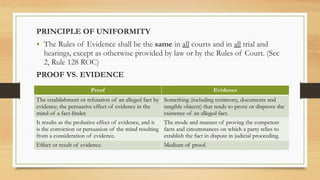
PROOF VS. EVIDENCE
Proof Evidence
The establishment or refutation of an alleged fact by
evidence; the persuasive effect of evidence in the
mind of a fact-finder.
Something (including testimony, documents and
tangible objects) that tends to prove or disprove the
existence of an alleged fact.
It results as the probative effect of evidence, and it
is the conviction or persuasion of the mind resulting
from a consideration of evidence.
The mode and manner of proving the competent
facts and circumstances on which a party relies to
establish the fact in dispute in judicial proceeding.
Effect or result of evidence. Medium of proof.
6.
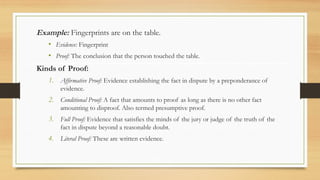
Example: Fingerprints areon the table.
• Evidence: Fingerprint
• Proof: The conclusion that the person touched the table.
Kinds of Proof:
1. Affirmative Proof: Evidence establishing the fact in dispute by a preponderance of
evidence.
2. Conditional Proof: A fact that amounts to proof as long as there is no other fact
amounting to disproof. Also termed presumptive proof.
3. Full Proof: Evidence that satisfies the minds of the jury or judge of the truth of the
fact in dispute beyond a reasonable doubt.
4. Literal Proof: These are written evidence.
7.
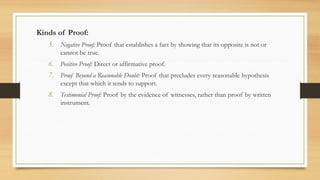
Kinds of Proof:
5.Negative Proof: Proof that establishes a fact by showing that its opposite is not or
cannot be true.
6. Positive Proof: Direct or affirmative proof.
7. Proof Beyond a Reasonable Doubt: Proof that precludes every reasonable hypothesis
except that which it tends to support.
8. Testimonial Proof: Proof by the evidence of witnesses, rather than proof by written
instrument.
8.
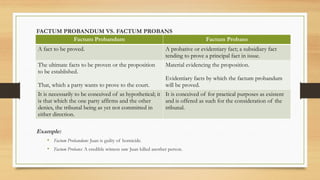
FACTUM PROBANDUM VS.FACTUM PROBANS
Example:
• Factum Probandum: Juan is guilty of homicide.
• Factum Probans: A credible witness saw Juan killed another person.
Factum Probandum Factum Probans
A fact to be proved. A probative or evidentiary fact; a subsidiary fact
tending to prove a principal fact in issue.
The ultimate facts to be proven or the proposition
to be established.
That, which a party wants to prove to the court.
Material evidencing the proposition.
Evidentiary facts by which the factum probandum
will be proved.
It is necessarily to be conceived of as hypothetical; it
is that which the one party affirms and the other
denies, the tribunal being as yet not committed in
either direction.
It is conceived of for practical purposes as existent
and is offered as such for the consideration of the
tribunal.
9.
CLASSES OF EVIDENCE
1.Relevant and Competent Evidence
2. Object, Testimonial and Documentary Evidence
3. Direct and Circumstantial Evidence
4. Positive and Negative Evidence
5. Primary and Secondary Evidence
6. Cumulative and Corroborative Evidence
7. Prima facie and Conclusive Evidence
10.
• Relevant Evidence:Evidence is relevant if it has a relation to the fact in
issue as to induce a belief in its existence or nonexistence.
• Example: The murder weapon, such as firearm, is relevant in the crime of murder.
• Competent Evidence: Evidence is competent if it is not excluded by the
law, Constitution or by the Rules of Court.
• Example: If the murder weapon was found without securing a valid search warrant,
which is a violation of the constitutional right of the person, then such evidence is not
competent.
• Direct Evidence: Direct evidence proves a challenged fact without drawing
any inference. The probative value of direct evidence is generally neither
greater than nor superior to circumstantial evidence.
• Example: A witness saw the accused killing the victim.
11.
• Circumstantial Evidence:Circumstantial evidence has been defined as that
which "goes to prove a fact or series of facts other than the facts in issue,
which, if proved, may tend by inference to establish a fact in issue."
• Example: One witness testified that he saw the accused buying a knife. One witness
testified that at the time the victim was killed, he saw the accused coming out of the
house of the victim. One witness testified that the accused and the victim had a fight a
day before the killing. In totality, these testimonies are circumstantial evidence.
• Positive Evidence: Evidence is positive when the witness affirms that a fact
did or did not occur. All other things being equal, positive evidence is
stronger than negative evidence.
• Example: Pedro testified that on March 1, there is no fight between Juan and Jose.
12.
• Negative Evidence:An evidence is negative when the witness states that he did not
see or know the occurrence. It is a testimony that a fact did not exist, that a thing
was not done, that no one did not hear.
• Example: Denial and alibi
• Primary Evidence: It is an authentic document or item that is offered as proof in a
lawsuit, as contrasted with a copy of, or substitute for, the original. Primary evidence,
more commonly known as best evidence, is the best available substantiation of the
existence of an object because it is the actual item.
• Example: The original copy of a document.
• Secondary Evidence: Evidence that is inferior to the primary or best evidence and
that becomes admissible when the primary or best evidence (original document) is
lost or inaccessible.
• Example: Photocopy of a document
13.
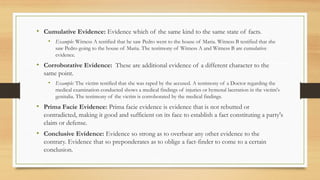
• Cumulative Evidence:Evidence which of the same kind to the same state of facts.
• Example: Witness A testified that he saw Pedro went to the house of Maria. Witness B testified that she
saw Pedro going to the house of Maria. The testimony of Witness A and Witness B are cumulative
evidence.
• Corroborative Evidence: These are additional evidence of a different character to the
same point.
• Example: The victim testified that she was raped by the accused. A testimony of a Doctor regarding the
medical examination conducted shows a medical findings of injuries or hymenal laceration in the victim's
genitalia. The testimony of the victim is corroborated by the medical findings.
• Prima Facie Evidence: Prima facie evidence is evidence that is not rebutted or
contradicted, making it good and sufficient on its face to establish a fact constituting a party's
claim or defense.
• Conclusive Evidence: Evidence so strong as to overbear any other evidence to the
contrary. Evidence that so preponderates as to oblige a fact-finder to come to a certain
conclusion.
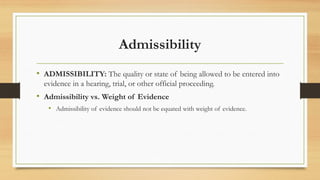
Admissibility
• ADMISSIBILITY: Thequality or state of being allowed to be entered into
evidence in a hearing, trial, or other official proceeding.
• Admissibility vs. Weight of Evidence
• Admissibility of evidence should not be equated with weight of evidence.
16.
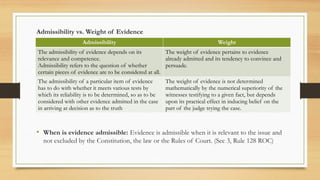
Admissibility vs. Weightof Evidence
• When is evidence admissible: Evidence is admissible when it is relevant to the issue and
not excluded by the Constitution, the law or the Rules of Court. (Sec 3, Rule 128 ROC)
Admissibility Weight
The admissibility of evidence depends on its
relevance and competence.
Admissibility refers to the question of whether
certain pieces of evidence are to be considered at all.
The weight of evidence pertains to evidence
already admitted and its tendency to convince and
persuade.
The admissibility of a particular item of evidence
has to do with whether it meets various tests by
which its reliability is to be determined, so as to be
considered with other evidence admitted in the case
in arriving at decision as to the truth
The weight of evidence is not determined
mathematically by the numerical superiority of the
witnesses testifying to a given fact, but depends
upon its practical effect in inducing belief on the
part of the judge trying the case.
17.
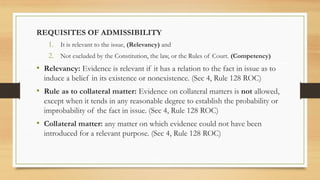
REQUISITES OF ADMISSIBILITY
1.It is relevant to the issue, (Relevancy) and
2. Not excluded by the Constitution, the law, or the Rules of Court. (Competency)
• Relevancy: Evidence is relevant if it has a relation to the fact in issue as to
induce a belief in its existence or nonexistence. (Sec 4, Rule 128 ROC)
• Rule as to collateral matter: Evidence on collateral matters is not allowed,
except when it tends in any reasonable degree to establish the probability or
improbability of the fact in issue. (Sec 4, Rule 128 ROC)
• Collateral matter: any matter on which evidence could not have been
introduced for a relevant purpose. (Sec 4, Rule 128 ROC)
18.
• Collateral mattersare matters other than the facts in issue and which are
offered as a basis for inference as to the existence or non-existence of the
facts in issue.
• Example: Motive. Motive is not an element of a crime and thus, immaterial.
• Motive becomes important when the evidence of the commission of the crime is
purely circumstantial.
• Competency: Evidence is competent if it is not excluded by the
Constitution, the law or by the Rules of Court.
19.
EXCLUSIONARY RULE
• Definition:A rule that excludes or suppresses evidence obtained in violation
of an accused person's constitutional rights.
• According to case law, the exclusionary rule is the "practical means of
enforcing the constitutional injunction against unreasonable searches and
seizures."
• In simple terms, the purpose of the exclusionary rule is to deter law
enforcement in engaging in fishing expeditions, and ultimately, protect the
right of the people against unreasonable searches and seizures.
20.
Fruit of thePoisonous Tree Doctrine
• Under this doctrine's metaphors, the poisonous tree is evidence directly
obtained as a result of a constitutional violation; the fruit is the derivative
evidence obtained because of knowledge gained from the first illegal search,
arrest, confrontation, or interrogation.
• Under this doctrine, for example, a murder weapon is inadmissible if the
map showing its location and used to find it was seized during an illegal
search.
• Poisonous tree: the map which was seized during the illegal arrest
• Fruit of the poisonous tree: the murder weapon
21.
Evidence Excluded bythe Constitution
1. Evidence obtained in violation of the right against unreasonable search and
seizure;
2. Evidence obtained in violation of the privacy of communication and
correspondence, except upon lawful order of the court or when public
safety or order requires otherwise;
3. Evidence consisting of extra-judicial confessions which are uncounseled, or
when the confessant was not properly informed of his constitutional rights,
or the right to counsel was not properly waived (waiver must be in writing)
or when the confession was coerced;
4. Evidence obtained in violation of the right against self-incrimination.
22.
Kinds of Admissibility
1.Multiple admissibility
2. Curative Admissibility
3. Conditional Admissibility
• Multiple Admissibility: The evidentiary rule that, although a piece of evidence is
inadmissible under one rule for the purpose given in offering it, it is nevertheless
admissible if relevant and offered for some other purpose not forbidden by the
rules of evidence.
• Example: Juan admitted in court that he and Pedro killed Antonio. Here, the Supreme Court
held that even if the accused's (Juan) confession may not be competent as against his co-
accused (Pedro, being hearsay as to the latter, or to prove conspiracy between them without the
conspiracy being established by other evidence, the confession of the accused (Juan) was,
nevertheless, admissible as evidence of the declarant's own guilt, and should have been
admitted as such.
23.
• Curative Admissibility:The rule that an inadmissible piece of evidence
may be admitted if offered to cure or counteract the effect of some similar
piece of the opponent's evidence that itself should not have been admitted.
• Conditional Admissibility: The evidentiary rule that when a piece of
evidence is not itself admissible, but is admissible if certain other facts make
it relevant, the evidence becomes admissible on condition that counsel later
introduce the connecting facts.
• If counsel does not satisfy this condition, the opponent is entitled to have
the conditionally admitted piece of evidence struck from the record.
24.
JUDICIAL NOTICE
• Judicialnotice is the cognizance of certain facts that judges may properly
take and act on without proof because these facts are already known to
them. Put differently, it is the assumption by a court of a fact without need
of further traditional evidentiary support.
• The principle is based on convenience and expediency in securing and
introducing evidence on matters which are not ordinarily capable of dispute
and are not bona fide disputed.
Kinds of Judicial Notice:
1. Mandatory Judicial Notice
2. Discretionary Judicial Notice
25.
• Mandatory JudicialNotice. In a mandatory judicial notice, the court shall take the
judicial notice, without the introduction of evidence.
• When judicial notice is mandatory:
1. Existence and territorial extent of states;
2. Political history, forms of government and symbols of nationality;
3. Law of nations;
4. Admiralty and maritime courts of the world and their seals;
5. Political constitution and history of the Philippines;
6. Official acts of legislative, executive and judicial departments of the National Government of the
Philippines;
7. Laws of nature;
8. Measure of time; and
9. Geographical divisions. (Sec. 1, Rule 129, 2019 Amendments to the Revised Rules on Evidence)
26.
• Rules; JudicialNotice of Municipal or City Ordinance:
• Municipal Trial Courts (MTC): it may, and should, take judicial notice of the municipal
ordinances in force in the municipality or city wherein it sits.
• Regional Trial Courts or appellate courts: It may take judicial notice of municipal ordinances
in force in the municipality wherein the case originated, and to that end may adopt the
findings and conclusions of the MTC in that regard as developed by the record, in the
absence of affirmative proof that such findings and conclusions are erroneous.
• Judicial Notice of Foreign Laws:
• General Rule: foreign laws may not be taken judicial notice of and have to be proven like
any other fact in dispute between the parties in any proceeding.
• Exception: in instances when the said laws are already within the actual knowledge of the
court, such as when they are well and generally known or they have been actually ruled
upon in other cases before it and none of the parties concerned do not claim otherwise.
27.
• Judicial Notice:Records of other cases in the same court or other
branch
• General Rule: courts are not authorized to take judicial notice of the contents of the
records of other cases.
• Exception: in the absence of objection and as a matter of convenience to all parties, a
court may properly treat all or any part of the original record of the case filed in its
archives as read into the records of a case pending before it, when with the knowledge
of the opposing party, reference is made to it, by name and number or in some other
manner by which it is sufficiently designated.
28.
• Discretionary JudicialNotice
• A court may take judicial notice of matters which are of:
1. Public knowledge, or
2. Capable of unquestionable demonstration, or
3. Ought to be known to judges because of their judicial functions.
• Matters which are of public (common) knowledge:
• Things of "common knowledge," of which courts take judicial notice, may be matters coming
to the knowledge of men generally in the course of the ordinary experiences of life, or they
may be matters which are generally accepted by mankind as true and are capable of ready and
unquestioned demonstration.
• Thus, facts which are universally known, and which may be found in encyclopedias, dictionaries
or other publications, are judicially noticed, provided they are of such universal notoriety and so
generally understood that they may be regarded as forming part of the common knowledge of
every person.
29.
• Example: theRegional Trial Court issued a decision on the basis of an article that came
from the internet, a particular website for that matter.
• The Supreme Court in the case of Juan vs. Juan states that "The article in the
website cited by the RTC patently lacks a requisite for it to be of judicial
notice to the court because such article is not well and authoritatively settled
and is doubtful or uncertain. It must be remembered that some articles
appearing in the internet or on websites are easily edited and their sources are
unverifiable, thus, sole reliance on those articles is greatly discouraged."
30.
• Matters whichare capable of unquestionable demonstration:
• In this realm fall most of the facts, theories, and conclusions which have come
to be established and accepted by the specialists in the areas of natural science,
natural phenomena, chronology, technology, history, geography, statistical
facts, and other fields of professional and scientific knowledge.
• Example: The fact that a poison can kill or seriously injure a person.
• Ought to be known to judges because of their judicial functions:
• Judicial notice is not judicial knowledge. The mere personal knowledge of the
judge is not the judicial knowledge of the court, and he is not authorized to
make his individual knowledge of a fact, not generally or professionally
known, the basis of his action. Judicial cognizance is taken only of those
matters which are "commonly" known.
31.
• Requisites forthe application of the principle of discretionary judicial
notice
1) the matter must be one of common and general knowledge;
2) it must be well and authoritatively settled and not doubtful or uncertain; and
3) it must be known to be within the limits of the jurisdiction of the court.
• When judicial notice of a fact may be taken, with necessity of hearing:
1. During the pre-trial and the trial - the court shall hear the parties on the propriety of
taking judicial notice of any matter.
2. Before judgment or on appeal - the court may take judicial notice of any matter and
shall hear the parties thereon if such matter is decisive of a material issue in the case.
(Sec. 3, Rule 129, 2019 Amendments to the Revised Rules on Evidence)
32.
ADMISSIONS
Two Kinds ofAdmissions:
1. Judicial Admission
2. Extra Judicial Admissions
• Judicial Admissions
• These are admissions, verbal or written made by the party in the course of the proceedings in the
same case, which dispenses with the need for proof with respect to the matter or fact admitted.
• How judicial admissions are made:
1. Verbally
• Verbal manifestation or stipulations
2. In writing
• Pleadings filed by the parties, depositions, written interrogatories or requests for admission.
33.
• Grounds forcontradicting judicial admissions:
1. It was made through palpable mistake or
2. That the imputed admission was not, in fact,made.
• The latter exception allows one to contradict an admission by denying that he made such
an admission.
• The following are NOT admissible in evidence:
• Plea of guilty later withdrawn or an unaccepted offer of a plea of guilty to a lesser offense
• Any statement made in the course of plea bargaining with the prosecution, which does
not result in a plea of guilty or which results in a plea of guilty later withdrawn
• An offer to pay, or the payment of medical, hospital, or other expenses occasioned by an
injury. (Section 28, Rule 130, Revised Rules on Evidence)
• These are not admissions thus not admissible as evidence.
34.
• Extrajudicial Admissions
•Extrajudicial admission means an admission made in proceedings outside court.
• Admissions made in amended pleadings:
• Admissions made in amended pleadings are considered extra-judicial admissions.
• Pleadings that have been amended disappear from the record, lose their status as
pleadings and cease to be judicial admissions. While they may nonetheless be utilized
against the pleader as extra-judicial admissions, they must, in order to have such effect,
be formally offered in evidence.
Object (Real)Evidence
• DEFINITION
•Objects as evidence are those addressed to the senses of the court. When an
object is relevant to the fact in issue, it may be exhibited to, examined or viewed
by the court. (Sec 1, Rule 130, Revised Rules on Evidence)
• Physical evidence is a mute but eloquent manifestation of truth, and it ranks
high in our hierarchy of trustworthy evidence.
• Where the physical evidence on record runs counter to the testimonial evidence
of the prosecution witnesses, the physical evidence should prevail.

 Most read