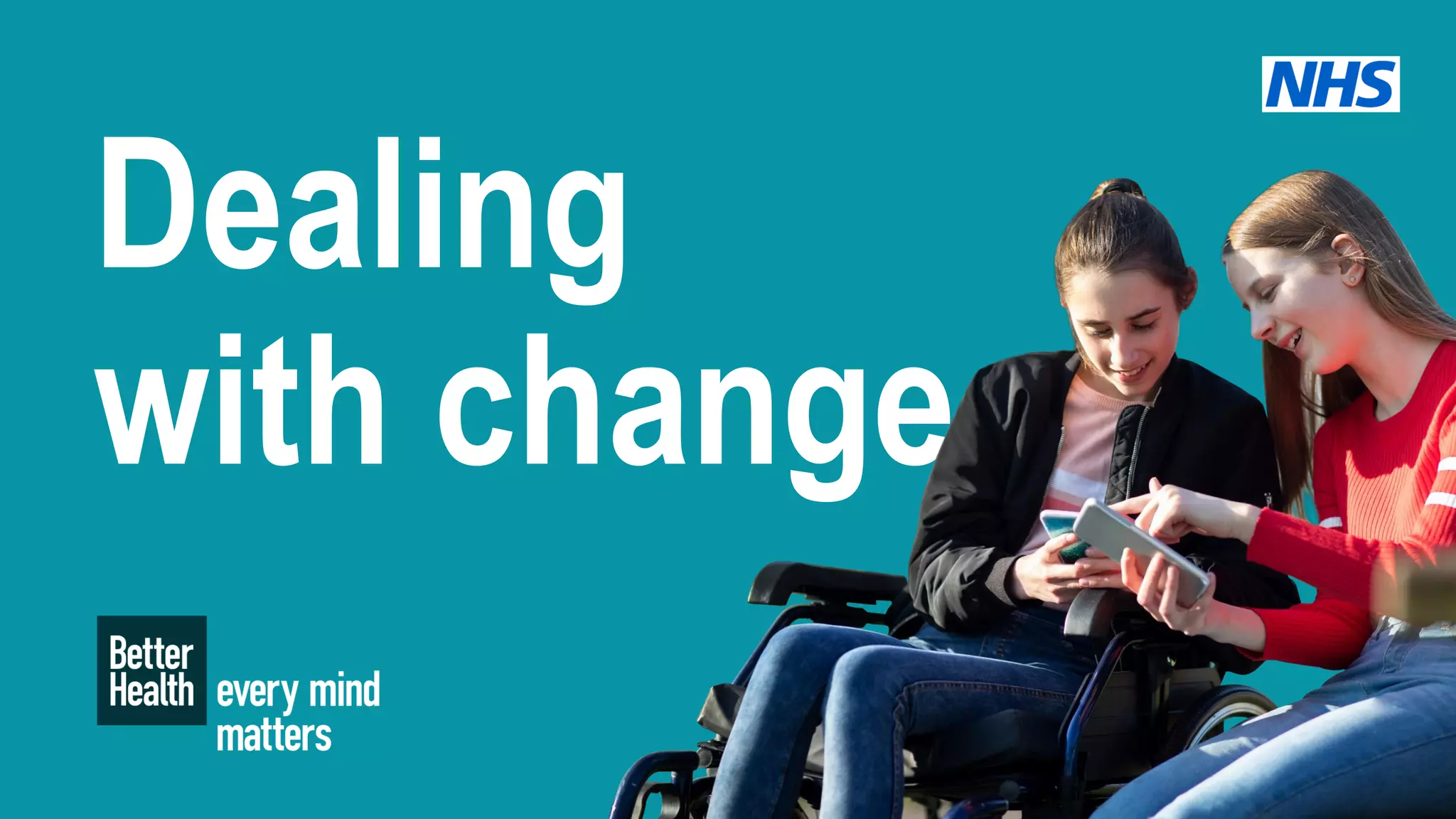
Dealing
with change
Dealing with Change | 2
Overview
In this lesson, students will explore the nature of both expected and unexpected change,
identify some of the challenges that can arise in managing changing situations and relationships,
and learn where to get support if needed.
Recommended age group
Education providers for ages 11-16 (KS3/KS4)
Time
45 minutes approximately
Preparation
Before delivering the lesson:
• consider cross-curricular links and how this could
be related to other content such as the Every Mind Matters
resources on puberty and positive relationships
• familiarise yourself with the film content on slides 8 and 11 of this
PowerPoint
• read through the Every Mind Matters classroom tips on slide 3.
Resources
• PowerPoint presentation
• Blank A4 paper and pens
• Sticky-notes
Key vocabulary
Change, new, transition (moving), routine (usual), challenge (hard),
expected (known), unexpected (not known), support (help)
Follow up
You may wish to extend students’ learning with one
of the extended learning projects on slide 18.
Dealing with Change | 3
Classroom tips
Climate for learning
Read through Guidance for Learning in a Safe Environment.
This includes advice on:
• developing and revisiting effective ground rules drawn up with
students
• familiarity with your school’s safeguarding policy and procedures,
including Child Protection and other relevant policies
• being prepared in case students make a disclosure
• including and protecting vulnerable students
• using distancing techniques so that students can discuss
sensitive issues without being encouraged to make a disclosure
• handling sensitive questions
• involving students with special educational needs
and disabilities (SEND) and autism
You may also wish to familiarise yourself with any schemes or offers
available in your school, organisation or local area to support young
people’s mental health.
Anonymous question box
Place a question box or envelope somewhere in the classroom.
Students write down any questions that occur to them during the
lesson and submit them anonymously. You can address these
questions in the next lesson or in form time.
Dealing with Change | 4
Social distancing
Preparation
Returning to school and managing the changes that have come about
in their lives because of Covid-19 will have posed many different
challenges for young people. It will have affected every young person
differently and it will be more important than ever before for students to
have a safe space to explore their feelings and experiences.
This lesson has a scenario related to Covid-19 and this may be
particularly sensitive for any students who have experienced
significant distress, loss or trauma prior to Covid-19 or during this time.
There is clear guidance for teaching sensitive issues in the Guidance
for Learning in a Safe Environment document and it is important that
this is read before delivering this lesson.
Adapting lessons to social distancing
• Please refer to the Government guidelines and your own school’s
advice
• Where pair or small group discussions aren’t possible, replace with
personal reflections or individual contributions to whole class
discussions
• Activity 1 (Slide 8): Dealing with change – students could draw out
their answers individually on A3 paper and then hold up their mind-
maps to share with the person in front or behind them
Dealing with Change 5
What are we learning?
Learning
objectives
We are learning about
change and how to
deal with some of the
challenges that can
arise with change.
Learning outcomes
• identify expected and
unexpected changes
• describe the impact
that change can have
• explain different
ways of managing
change and where
to seek support
Key vocabulary
• change
• new
• transition (moving)
• routine (usual)
• challenge (hard)
• expected (known)
• unexpected (not known)
• support (help)
Dealing with Change 6
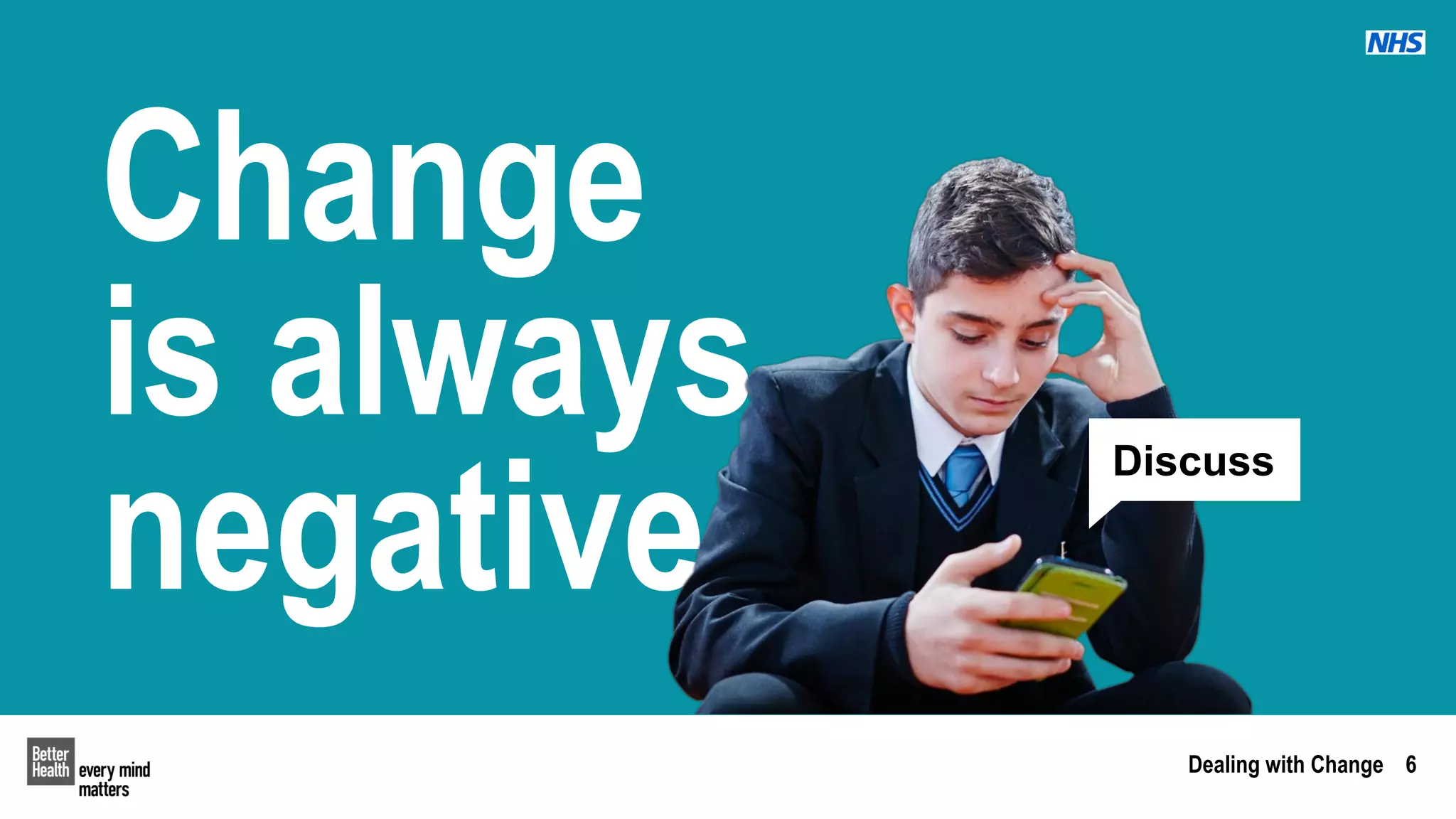
Change
is always
negative
Discuss
Dealing with Change 7
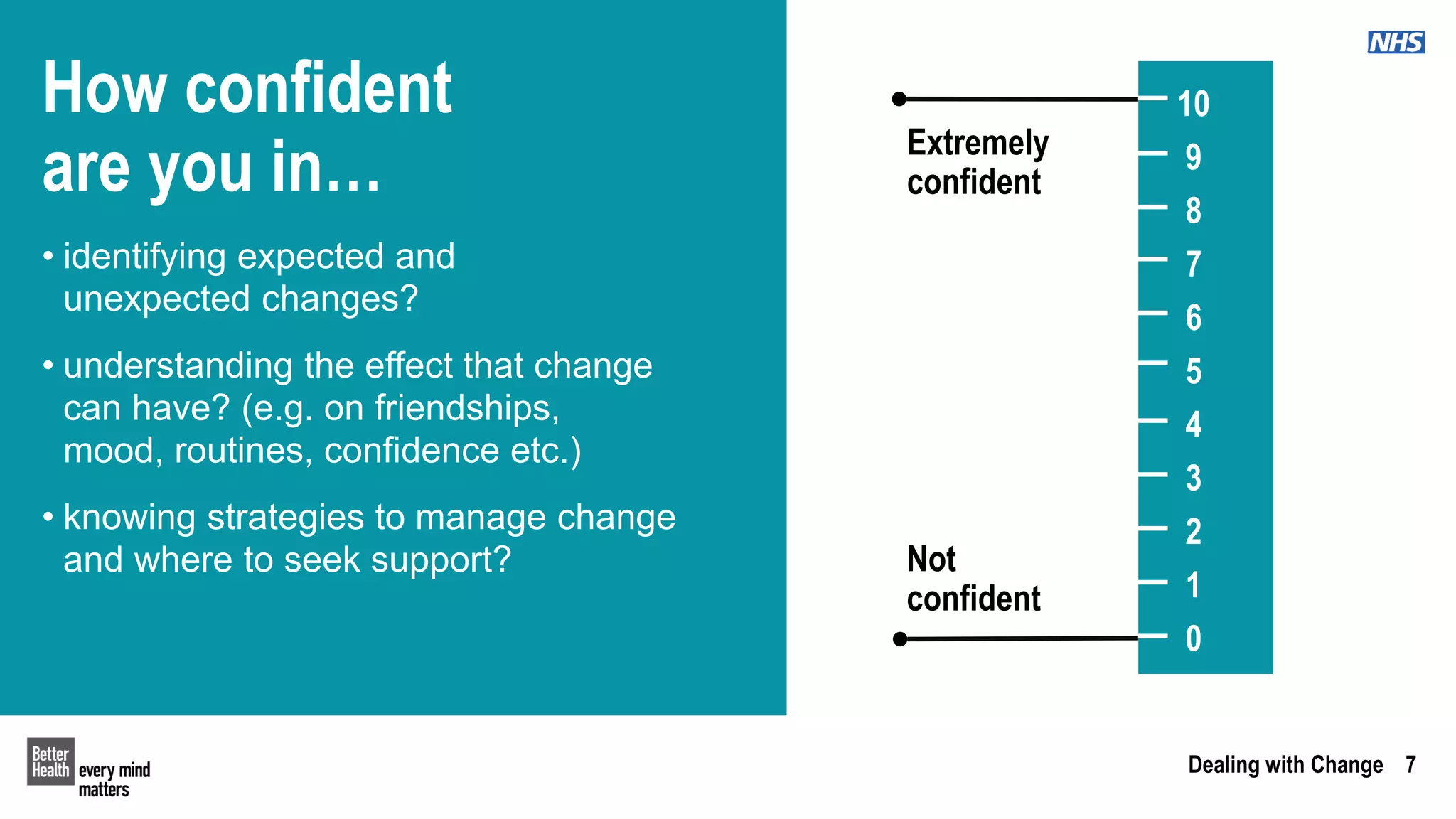
How confident
are you in…
• identifying expected and
unexpected changes?
• understanding the effect that change
can have? (e.g. on friendships,
mood, routines, confidence etc.)
• knowing strategies to manage change
and where to seek support?
Extremely
confident
10
9
8
7
6
5
4
3
2
1
0
Not
confident
Dealing with Change 8
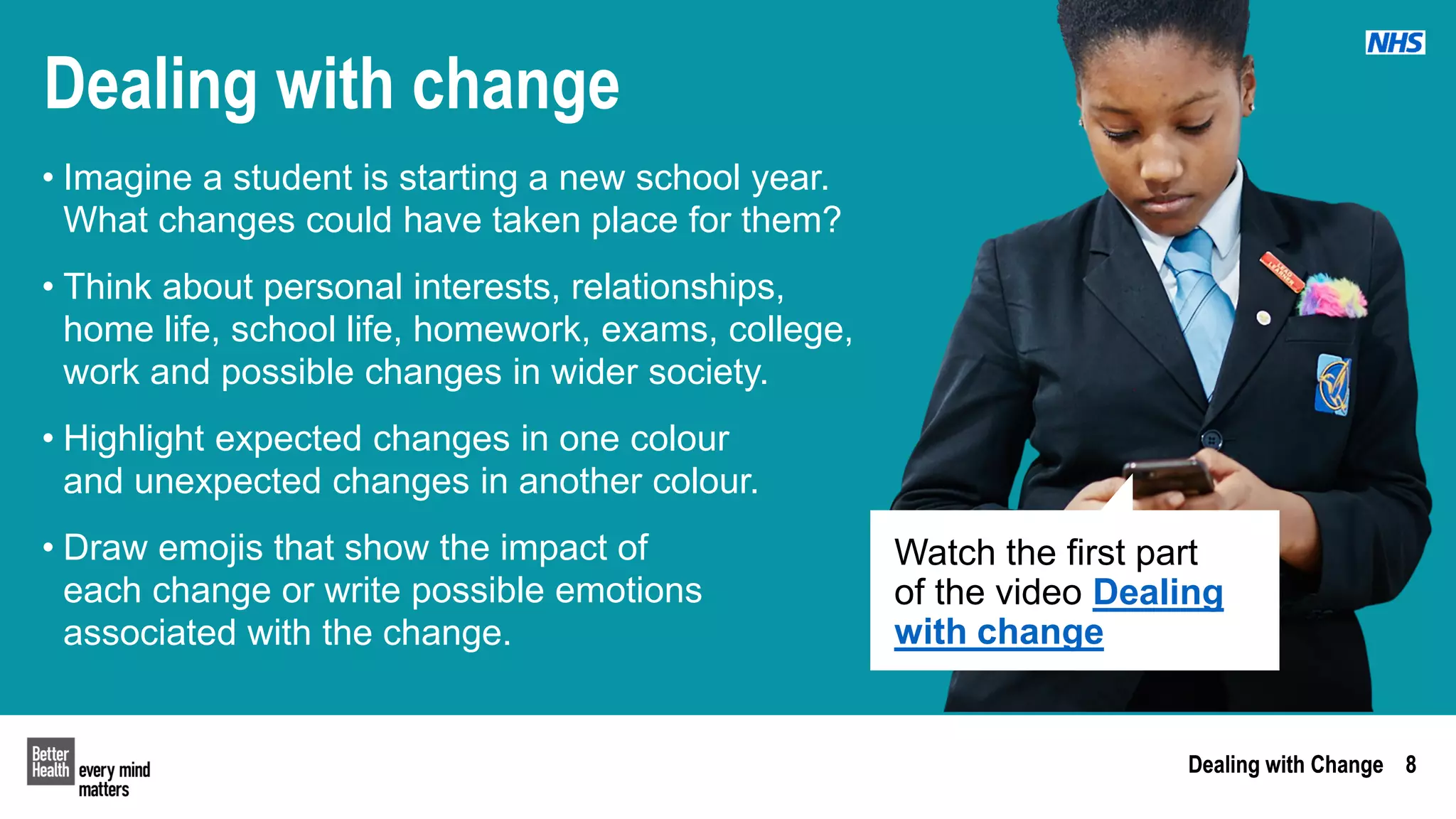
Dealing with change
• Imagine a student is starting a new school year.
What changes could have taken place for them?
• Think about personal interests, relationships,
home life, school life, homework, exams, college,
work and possible changes in wider society.
• Highlight expected changes in one colour
and unexpected changes in another colour.
• Draw emojis that show the impact of
each change or write possible emotions
associated with the change.
Watch the first part
of the video Dealing
with change
Dealing with Change 9
Discuss
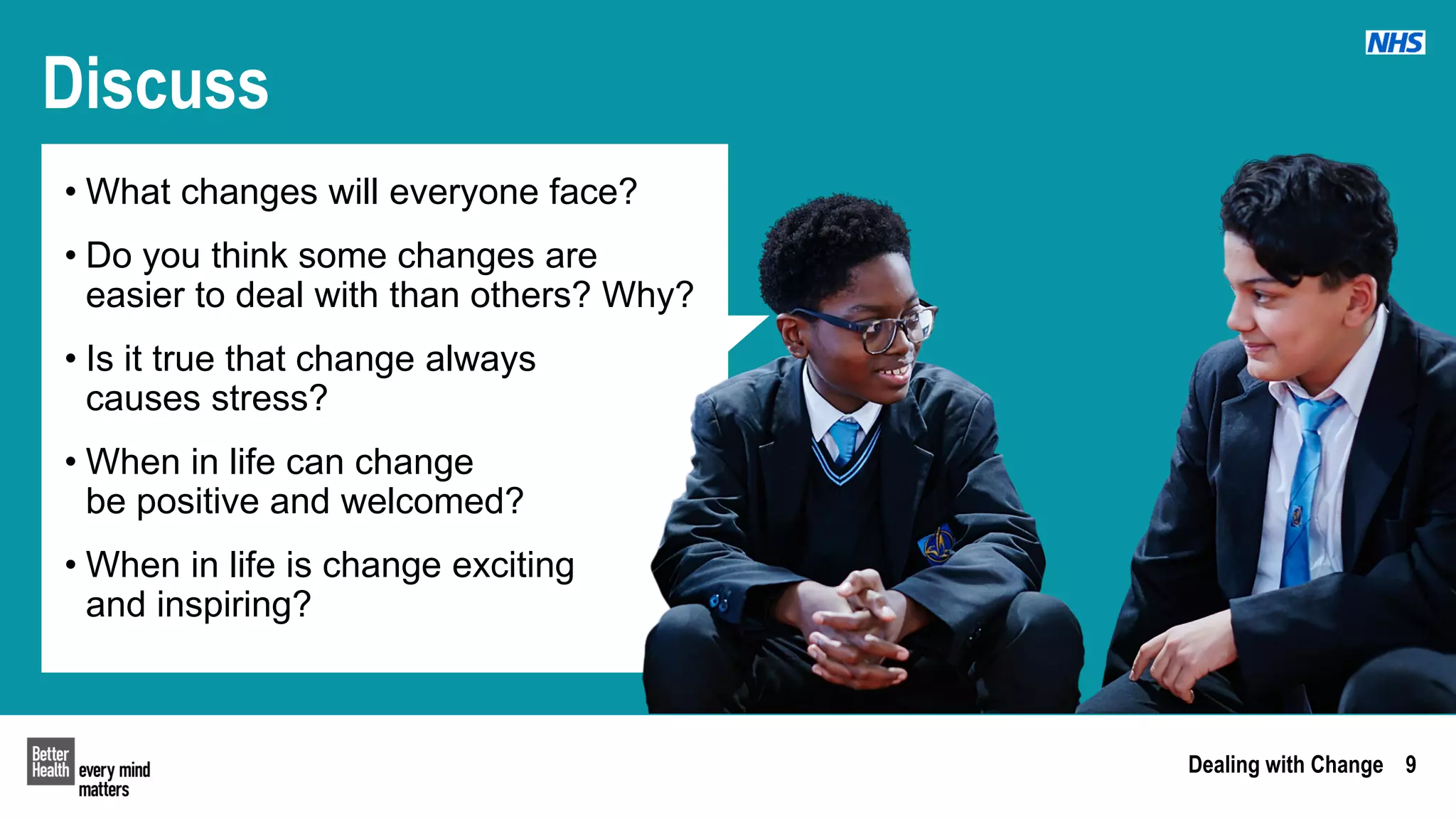
• What changes will everyone face?
• Do you think some changes are
easier to deal with than others? Why?
• Is it true that change always
causes stress?
• When in life can change
be positive and welcomed?
• When in life is change exciting
and inspiring?
Dealing with Change 10
Further challenge
Which life changes
are expected?
What might be the
impact of a life change
being expected?
Which life changes
are unexpected?
What might be the
impact of a life change
being unexpected?
What qualities
and strengths might
someone gain from
having to manage
unexpected change?
Dealing with Change 11
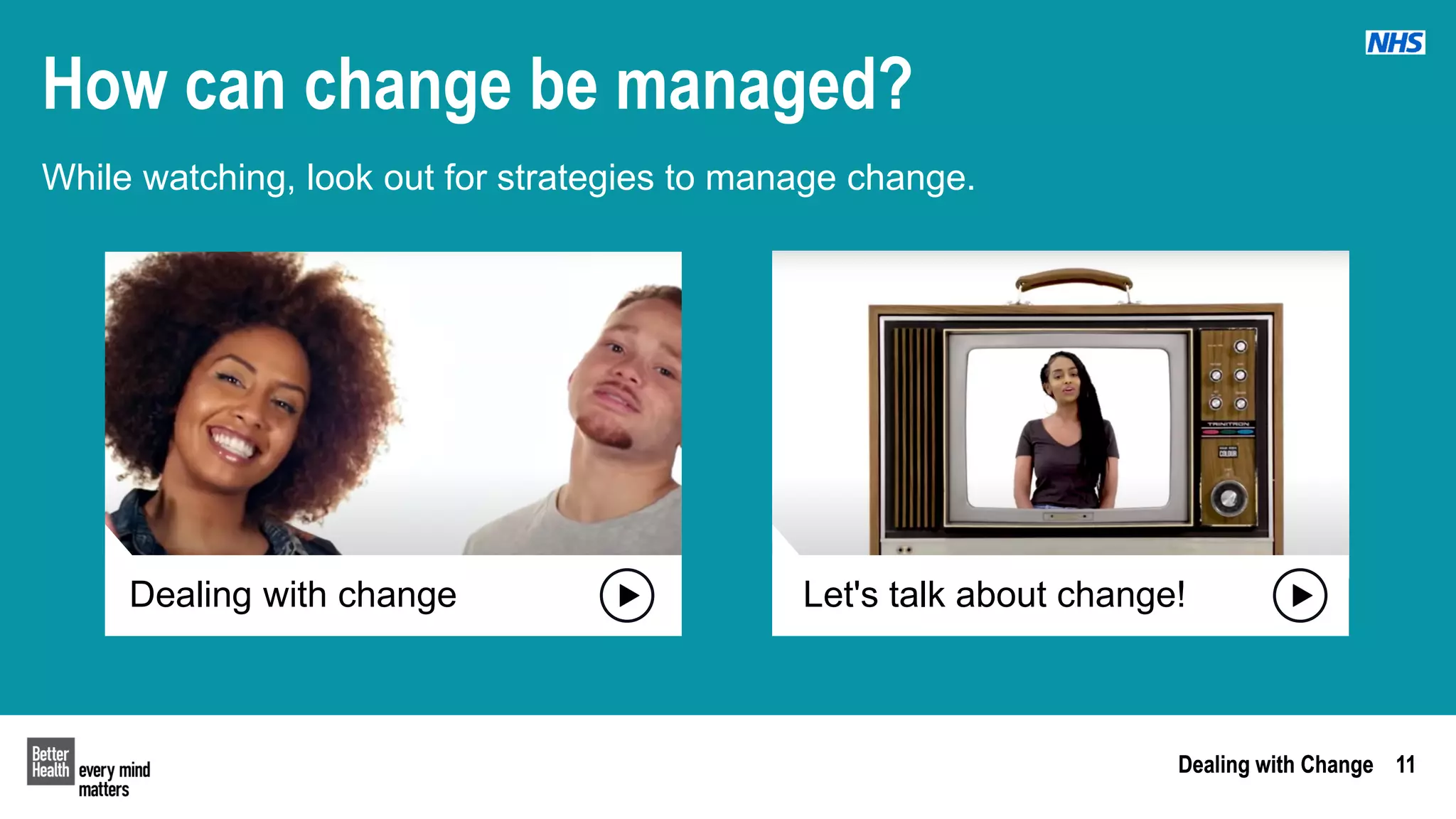
How can change be managed?
While watching, look out for strategies to manage change.
Dealing with change Let's talk about change!
Dealing with Change 12
Scenarios
Read the scenarios 1-5
What advice would you give to each of
the students? You can use strategies from
your own list or the list on the next slide.
Challenge
In 2020, Covid-19 resulted in a lockdown.
This was a major and unexpected change
affecting many parts of people’s lives. What
would be your top three pieces of advice for
a young person experiencing this?
1
Someone who has just
moved to this country
2
Someone who
is starting a new
school or job
3
Someone
whose parents
are separating
4
Someone who
has experienced
a change in their
friendship group
5
Someone who
is going through
physical changes
(e.g. puberty)
Dealing with Change 13
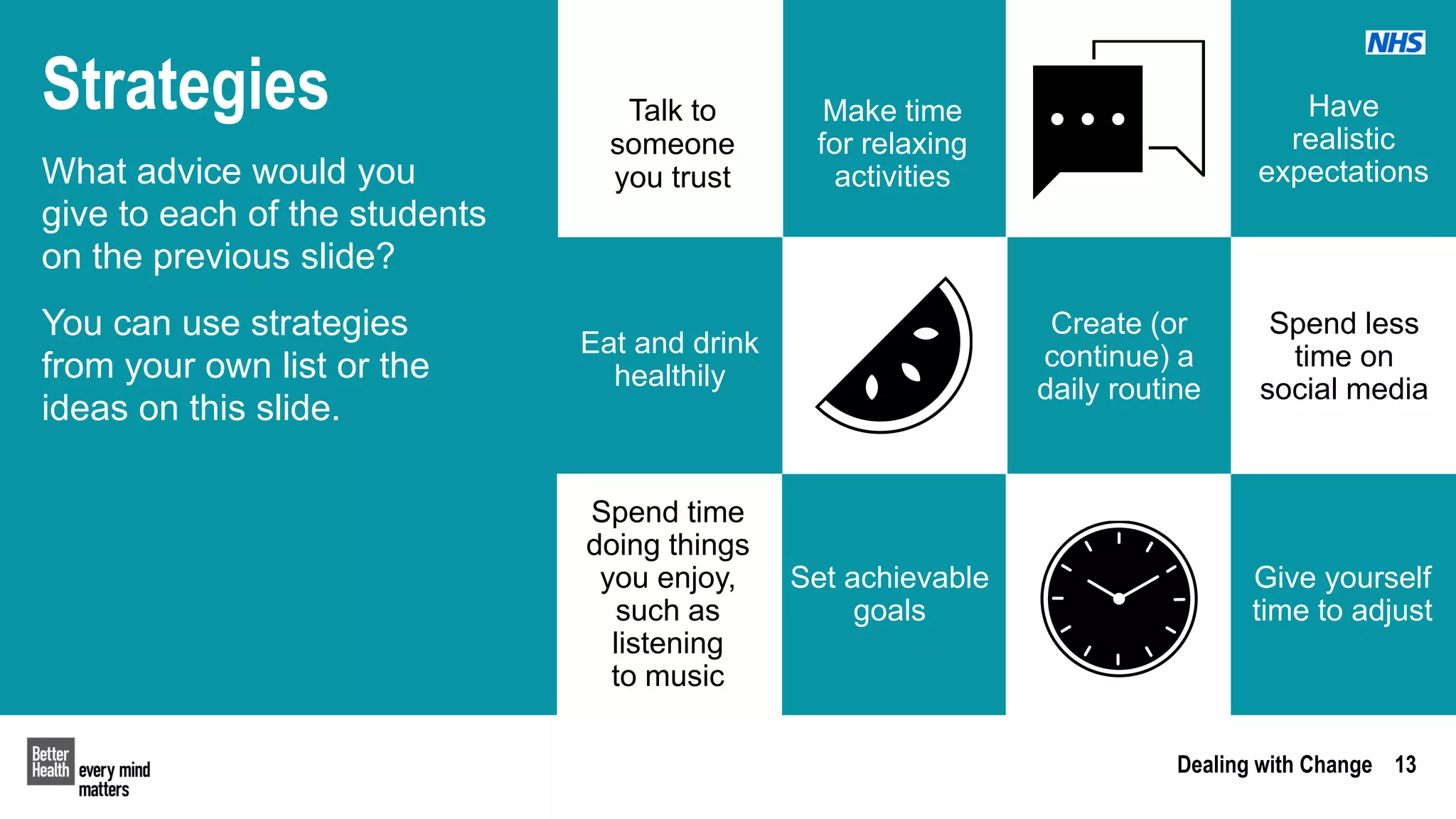
Strategies
What advice would you
give to each of the students
on the previous slide?
You can use strategies
from your own list or the
ideas on this slide.
Talk to
someone
you trust
Make time
for relaxing
activities
Have
realistic
expectations
Eat and drink
healthily
Create (or
continue) a
daily routine
Spend less
time on
social media
Spend time
doing things
you enjoy,
such as
listening
to music
Set achievable
goals
Give yourself
time to adjust
Dealing with Change 14
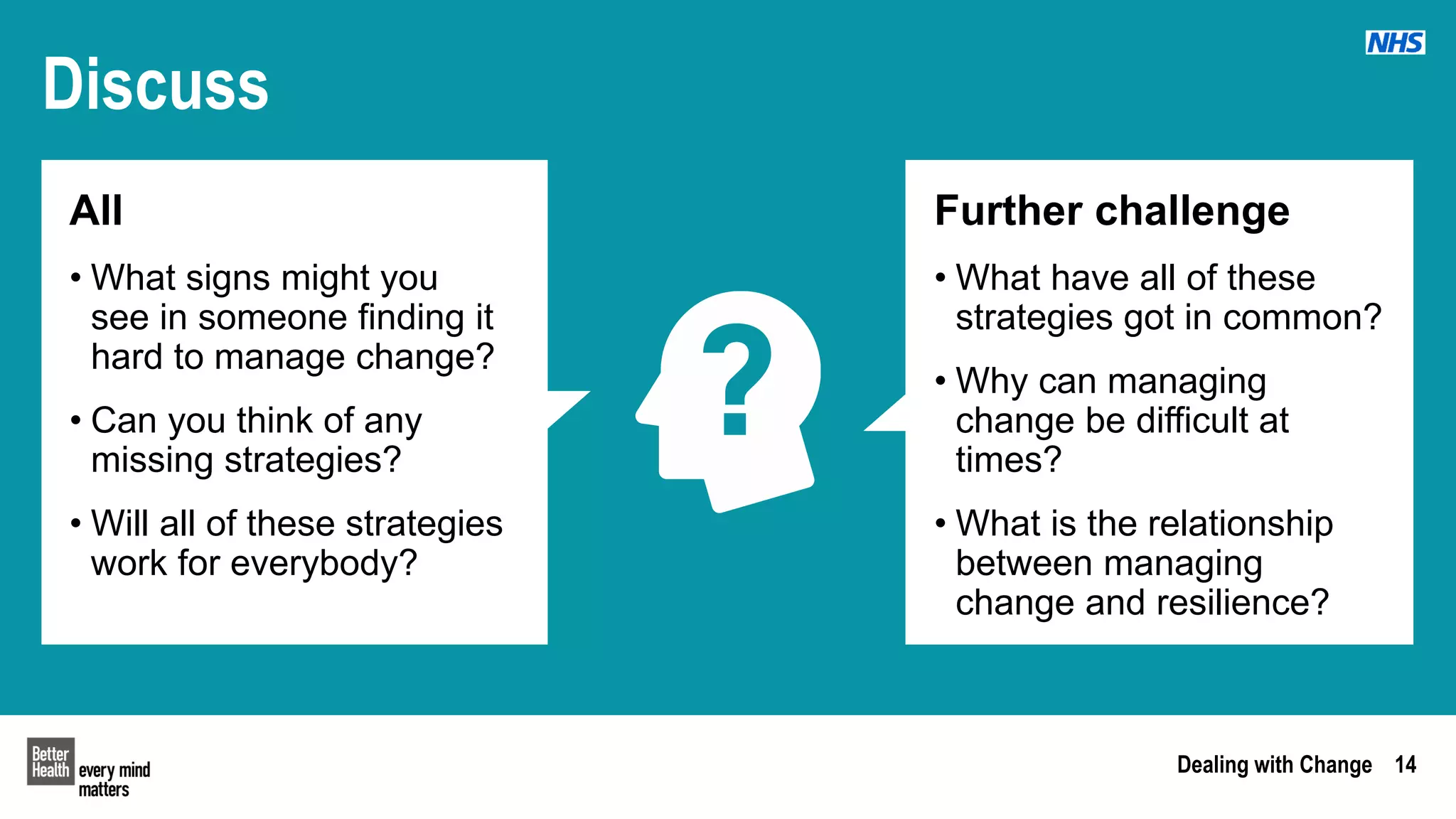
Discuss
All
• What signs might you
see in someone finding it
hard to manage change?
• Can you think of any
missing strategies?
• Will all of these strategies
work for everybody?
Further challenge
• What have all of these
strategies got in common?
• Why can managing
change be difficult at
times?
• What is the relationship
between managing
change and resilience?
Dealing with Change 15
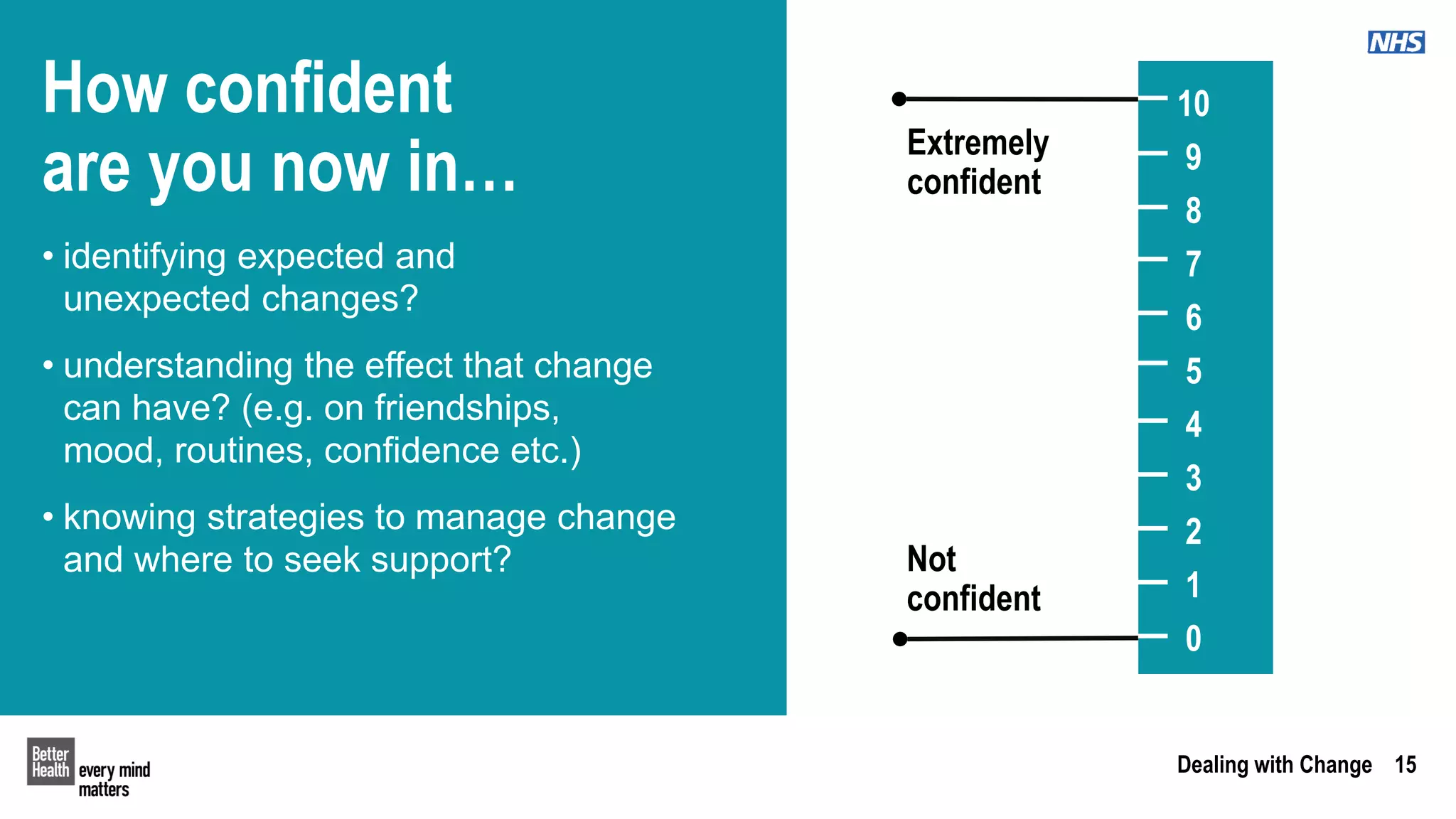
How confident
are you now in…
• identifying expected and
unexpected changes?
• understanding the effect that change
can have? (e.g. on friendships,
mood, routines, confidence etc.)
• knowing strategies to manage change
and where to seek support?
Extremely
confident
10
9
8
7
6
5
4
3
2
1
0
Not
confident
Dealing with Change 16
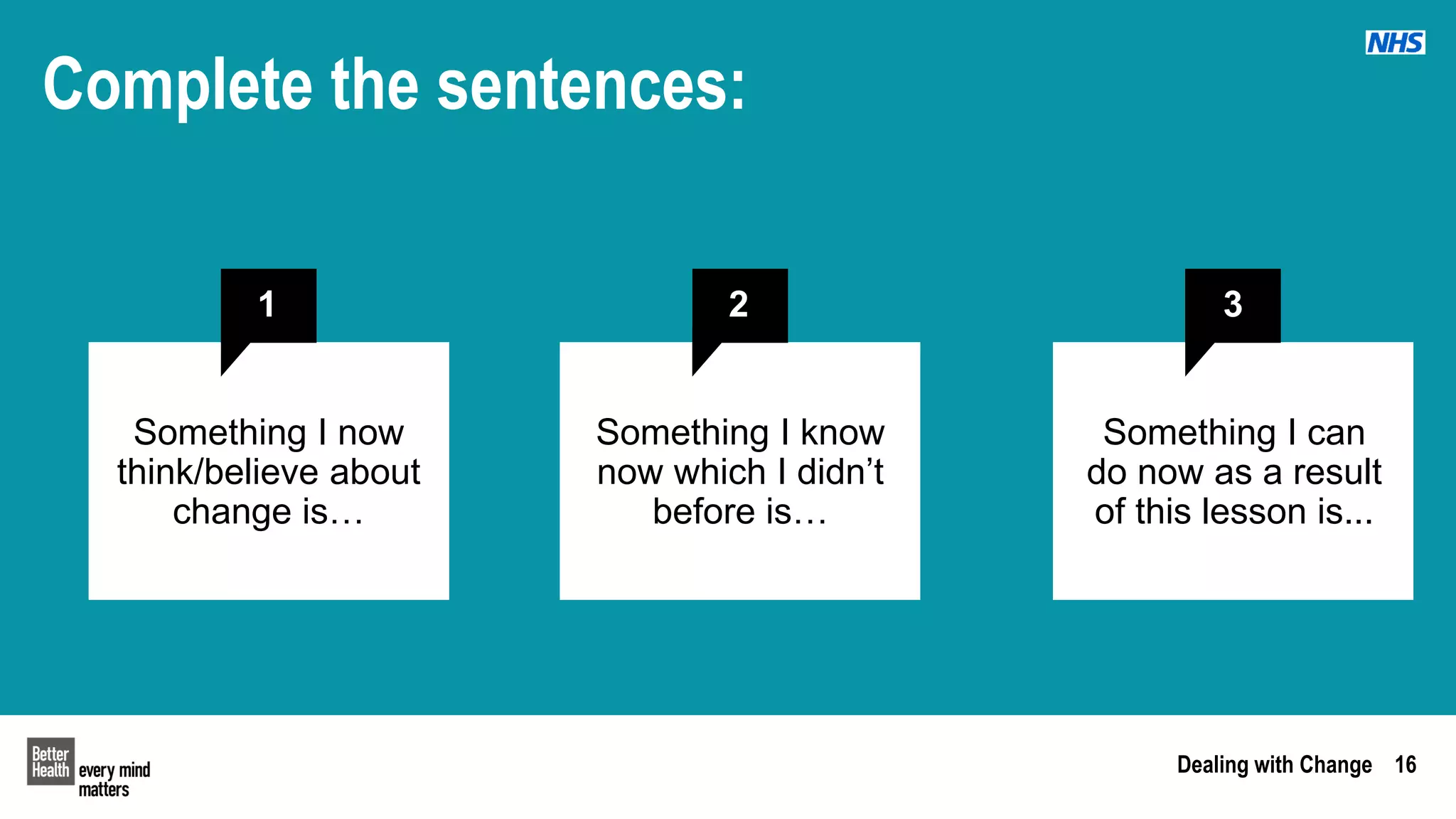
Complete the sentences:
1
Something I now
think/believe about
change is…
2
Something I know
now which I didn’t
before is…
3
Something I can
do now as a result
of this lesson is...
Dealing with Change 17
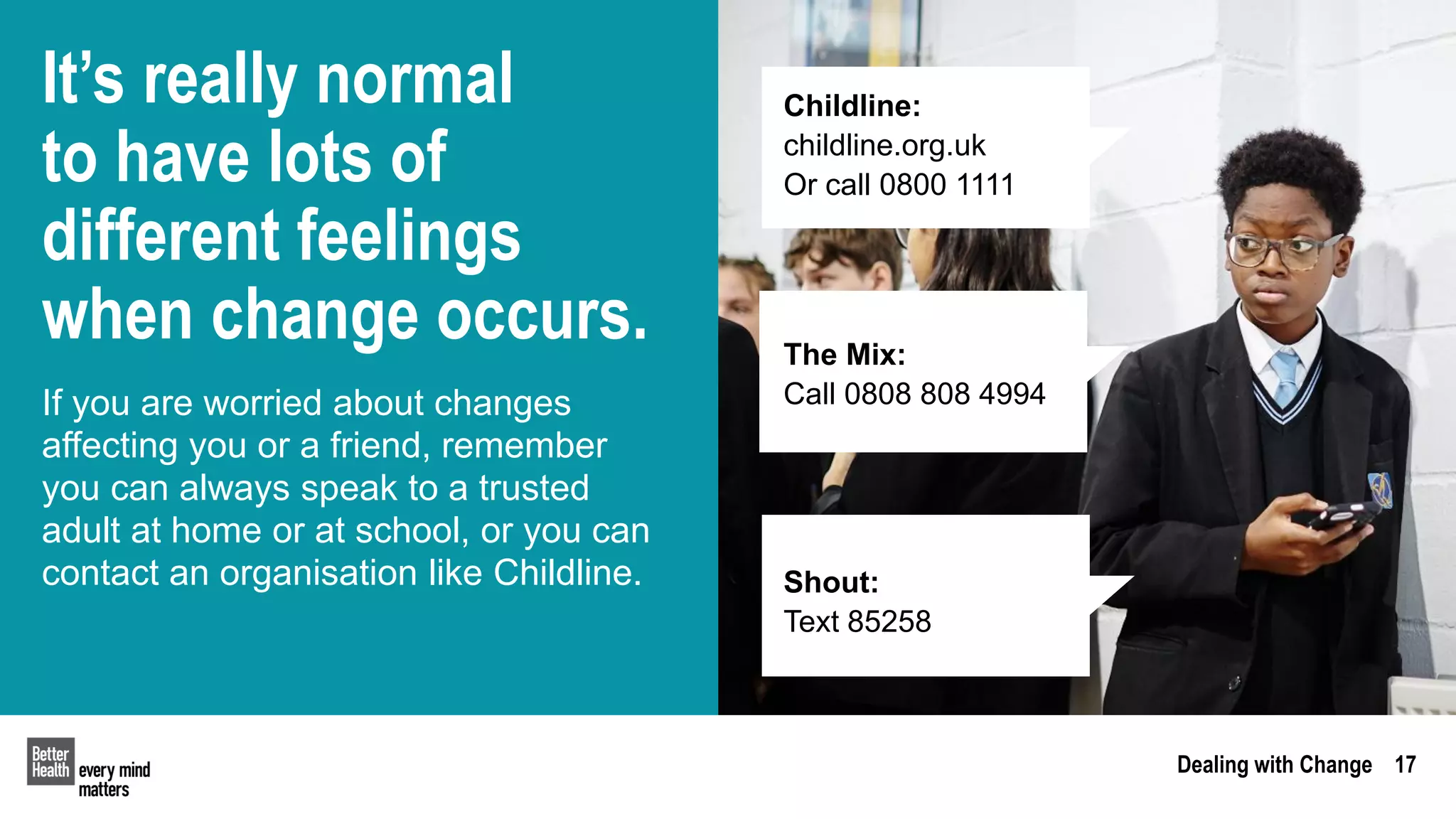
It’s really normal
to have lots of
different feelings
when change occurs.
If you are worried about changes
affecting you or a friend, remember
you can always speak to a trusted
adult at home or at school, or you can
contact an organisation like Childline.
Childline:
childline.org.uk
Or call 0800 1111
Shout:
Text 85258
The Mix:
Call 0808 808 4994
Dealing with Change | 18
Extended learning
KS3
1. Create a vlog or write an article for your school
website on managing change.
2. In groups, prepare a transition lesson for Year 6
students to be delivered in a local primary school
on the theme of positively managing change.
Particularly highlight the opportunities of change.
3. Design a ‘change box’ with items that could help
someone if unexpected change occurs. Design
what the box would look like, what would go in the
box and include a description of why each item in
the box could be useful in dealing with change.
KS4
1. In groups, prepare a transition workshop for KS3
students on the theme of positively managing
change. Particularly highlight the opportunities of
change and strategies for managing change.
2. Design a podcast for a new Year 7 class on the
subject of managing change.

Every_Mind_Matters_Dealing_with_change_KS34_presentation.pdf

  • 1.
  • 2.
    Dealing with Change| 2 Overview In this lesson, students will explore the nature of both expected and unexpected change, identify some of the challenges that can arise in managing changing situations and relationships, and learn where to get support if needed. Recommended age group Education providers for ages 11-16 (KS3/KS4) Time 45 minutes approximately Preparation Before delivering the lesson: • consider cross-curricular links and how this could be related to other content such as the Every Mind Matters resources on puberty and positive relationships • familiarise yourself with the film content on slides 8 and 11 of this PowerPoint • read through the Every Mind Matters classroom tips on slide 3. Resources • PowerPoint presentation • Blank A4 paper and pens • Sticky-notes Key vocabulary Change, new, transition (moving), routine (usual), challenge (hard), expected (known), unexpected (not known), support (help) Follow up You may wish to extend students’ learning with one of the extended learning projects on slide 18.
  • 3.
    Dealing with Change| 3 Classroom tips Climate for learning Read through Guidance for Learning in a Safe Environment. This includes advice on: • developing and revisiting effective ground rules drawn up with students • familiarity with your school’s safeguarding policy and procedures, including Child Protection and other relevant policies • being prepared in case students make a disclosure • including and protecting vulnerable students • using distancing techniques so that students can discuss sensitive issues without being encouraged to make a disclosure • handling sensitive questions • involving students with special educational needs and disabilities (SEND) and autism You may also wish to familiarise yourself with any schemes or offers available in your school, organisation or local area to support young people’s mental health. Anonymous question box Place a question box or envelope somewhere in the classroom. Students write down any questions that occur to them during the lesson and submit them anonymously. You can address these questions in the next lesson or in form time.
  • 4.
    Dealing with Change| 4 Social distancing Preparation Returning to school and managing the changes that have come about in their lives because of Covid-19 will have posed many different challenges for young people. It will have affected every young person differently and it will be more important than ever before for students to have a safe space to explore their feelings and experiences. This lesson has a scenario related to Covid-19 and this may be particularly sensitive for any students who have experienced significant distress, loss or trauma prior to Covid-19 or during this time. There is clear guidance for teaching sensitive issues in the Guidance for Learning in a Safe Environment document and it is important that this is read before delivering this lesson. Adapting lessons to social distancing • Please refer to the Government guidelines and your own school’s advice • Where pair or small group discussions aren’t possible, replace with personal reflections or individual contributions to whole class discussions • Activity 1 (Slide 8): Dealing with change – students could draw out their answers individually on A3 paper and then hold up their mind- maps to share with the person in front or behind them
  • 5.
    Dealing with Change5 What are we learning? Learning objectives We are learning about change and how to deal with some of the challenges that can arise with change. Learning outcomes • identify expected and unexpected changes • describe the impact that change can have • explain different ways of managing change and where to seek support Key vocabulary • change • new • transition (moving) • routine (usual) • challenge (hard) • expected (known) • unexpected (not known) • support (help)
  • 6.
    Dealing with Change6 Change is always negative Discuss
  • 7.
    Dealing with Change7 How confident are you in… • identifying expected and unexpected changes? • understanding the effect that change can have? (e.g. on friendships, mood, routines, confidence etc.) • knowing strategies to manage change and where to seek support? Extremely confident 10 9 8 7 6 5 4 3 2 1 0 Not confident
  • 8.
    Dealing with Change8 Dealing with Change 8 Dealing with change • Imagine a student is starting a new school year. What changes could have taken place for them? • Think about personal interests, relationships, home life, school life, homework, exams, college, work and possible changes in wider society. • Highlight expected changes in one colour and unexpected changes in another colour. • Draw emojis that show the impact of each change or write possible emotions associated with the change. Watch the first part of the video Dealing with change
  • 9.
    Dealing with Change9 Discuss • What changes will everyone face? • Do you think some changes are easier to deal with than others? Why? • Is it true that change always causes stress? • When in life can change be positive and welcomed? • When in life is change exciting and inspiring?
  • 10.
    Dealing with Change10 Further challenge Which life changes are expected? What might be the impact of a life change being expected? Which life changes are unexpected? What might be the impact of a life change being unexpected? What qualities and strengths might someone gain from having to manage unexpected change?
  • 11.
    Dealing with Change11 Dealing with Change 11 How can change be managed? While watching, look out for strategies to manage change. Dealing with change Let's talk about change!
  • 12.
    Dealing with Change12 Scenarios Read the scenarios 1-5 What advice would you give to each of the students? You can use strategies from your own list or the list on the next slide. Challenge In 2020, Covid-19 resulted in a lockdown. This was a major and unexpected change affecting many parts of people’s lives. What would be your top three pieces of advice for a young person experiencing this? 1 Someone who has just moved to this country 2 Someone who is starting a new school or job 3 Someone whose parents are separating 4 Someone who has experienced a change in their friendship group 5 Someone who is going through physical changes (e.g. puberty)
  • 13.
    Dealing with Change13 Strategies What advice would you give to each of the students on the previous slide? You can use strategies from your own list or the ideas on this slide. Talk to someone you trust Make time for relaxing activities Have realistic expectations Eat and drink healthily Create (or continue) a daily routine Spend less time on social media Spend time doing things you enjoy, such as listening to music Set achievable goals Give yourself time to adjust
  • 14.
    Dealing with Change14 Discuss All • What signs might you see in someone finding it hard to manage change? • Can you think of any missing strategies? • Will all of these strategies work for everybody? Further challenge • What have all of these strategies got in common? • Why can managing change be difficult at times? • What is the relationship between managing change and resilience?
  • 15.
    Dealing with Change15 How confident are you now in… • identifying expected and unexpected changes? • understanding the effect that change can have? (e.g. on friendships, mood, routines, confidence etc.) • knowing strategies to manage change and where to seek support? Extremely confident 10 9 8 7 6 5 4 3 2 1 0 Not confident
  • 16.
    Dealing with Change16 Complete the sentences: 1 Something I now think/believe about change is… 2 Something I know now which I didn’t before is… 3 Something I can do now as a result of this lesson is...
  • 17.
    Dealing with Change17 It’s really normal to have lots of different feelings when change occurs. If you are worried about changes affecting you or a friend, remember you can always speak to a trusted adult at home or at school, or you can contact an organisation like Childline. Childline: childline.org.uk Or call 0800 1111 Shout: Text 85258 The Mix: Call 0808 808 4994
  • 18.
    Dealing with Change| 18 Extended learning KS3 1. Create a vlog or write an article for your school website on managing change. 2. In groups, prepare a transition lesson for Year 6 students to be delivered in a local primary school on the theme of positively managing change. Particularly highlight the opportunities of change. 3. Design a ‘change box’ with items that could help someone if unexpected change occurs. Design what the box would look like, what would go in the box and include a description of why each item in the box could be useful in dealing with change. KS4 1. In groups, prepare a transition workshop for KS3 students on the theme of positively managing change. Particularly highlight the opportunities of change and strategies for managing change. 2. Design a podcast for a new Year 7 class on the subject of managing change.