TEST-1
Venkat Subramaniam
7. Object-Oriented Design
Principles
TEST-2
Venkat Subramaniam
The Pillars of the Paradigm
• Abstraction
• Encapsulation
• Hierarchy
– Association, Aggregation
– Inheritance
• Polymorphism
TEST-3
Venkat Subramaniam
What’s OO?
• Is it using Objects?
• Is it using C++, Java, C#, Smalltalk?
• No, its got to be using UML?! 
• What makes a program OO?
• How do you measure good design?
TEST-4
Venkat Subramaniam
Measuring Quality
of an Abstraction
Designing Classes & Objects
•An incremental, iterative process
•Difficult to design right the first time
TEST-5
Venkat Subramaniam
Metrics for class design
• Coupling
– inheritance Vs. coupling
– Strong coupling complicates a system
– design for weakest possible coupling
• Cohesion
– degree of connectivity among the elements
of a single module/class
– coincidental cohesion: all elements related
undesirable
– Functional cohesion: work together to
provide well-bounded behavior
TEST-6
Venkat Subramaniam
Law of Demeter
“Methods of a class should not depend in
any way on the structure of any class,
except the immediate structure of their
own class. Further, each method should
send messages to objects belonging to a
very limited set of classes only.”
TEST-7
Venkat Subramaniam
Bad design
• Perils of a bad design
– Rigidity
• Hard to change, results in cascade of changes
– Fragility
• Breaks easily and often
– Immobility
• Hard to reuse (due to coupling)
– Viscosity
• Easy to do wrong things, hard to do right things
– Needless Complexity
• Complicated class design, overly generalized
– Needless Repetition
• Copy and Paste away
– Opacity
• Hard to understand
TEST-8
Venkat Subramaniam
Principles
• Guiding Principles that help develop
better systems
• Use principles only where they apply
• You must see the symptoms to apply
them
• If you apply arbitrarily, the code ends up
with Needless Complexity
TEST-9
Venkat Subramaniam
DRY
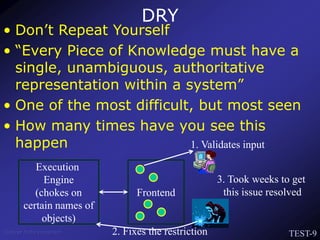
• Don’t Repeat Yourself
• “Every Piece of Knowledge must have a
single, unambiguous, authoritative
representation within a system”
• One of the most difficult, but most seen
• How many times have you see this
happen
Execution
Engine
(chokes on
certain names of
objects)
Frontend
1. Validates input
2. Fixes the restriction
3. Took weeks to get
this issue resolved
TEST-10
Venkat Subramaniam
DRY
• Some times hard to realize this
• It is much easier to copy, paste and
modify code to get it working the way
you want it, isn’t it
• Duplicating code results in
– Poor maintainability
– Expensive to fix bugs/errors
– Hard to keep up with change
TEST-11
Venkat Subramaniam
SRP
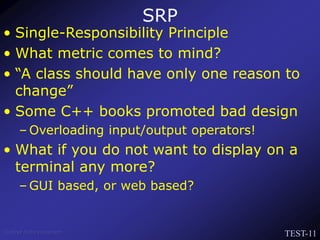
• Single-Responsibility Principle
• What metric comes to mind?
• “A class should have only one reason to
change”
• Some C++ books promoted bad design
– Overloading input/output operators!
• What if you do not want to display on a
terminal any more?
– GUI based, or web based?
TEST-12
Venkat Subramaniam
SRP…
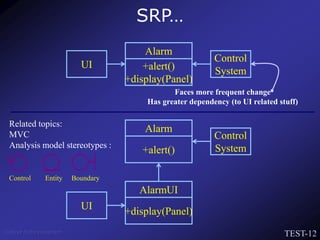
Alarm
+alert()
UI
Control
System
AlarmUI
+display(Panel)
Alarm
+alert()
+display(Panel)
UI
Control
System
Faces more frequent change
Has greater dependency (to UI related stuff)
Related topics:
MVC
Analysis model stereotypes :
Control Entity Boundary
TEST-13
Venkat Subramaniam
SRP at Module Level
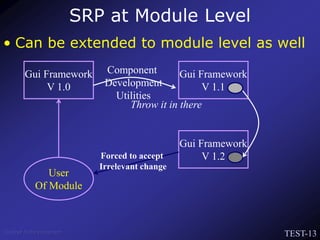
• Can be extended to module level as well
Gui Framework
V 1.0
Gui Framework
V 1.1
Component
Development
Utilities
Throw it in there
Gui Framework
V 1.2
User
Of Module
Forced to accept
Irrelevant change
TEST-14
Venkat Subramaniam
SRP affects Reuse
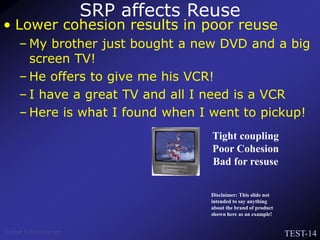
• Lower cohesion results in poor reuse
– My brother just bought a new DVD and a big
screen TV!
– He offers to give me his VCR!
– I have a great TV and all I need is a VCR
– Here is what I found when I went to pickup!
Tight coupling
Poor Cohesion
Bad for resuse
Disclaimer: This slide not
intended to say anything
about the brand of product
shown here as an example!
TEST-15
Venkat Subramaniam
Nature of code
• “Software Systems change during their life
time”
• Both better designs and poor designs have to
face the changes; good designs are stable
TEST-16
Venkat Subramaniam
OCP…
Bertrand Meyer:
“Software Entities (Classes,
Modules, Functions, etc.) should
be open for extension, but closed
for modification”
TEST-17
Venkat Subramaniam
• Characteristics of a poor design:
– Single change results in cascade of
changes
– Program is fragile, rigid and
unpredictable
• Characteristics of good design:
– Modules never change
– Extend Module’s behavior by adding new
code, not changing existing code
OCP…
TEST-18
Venkat Subramaniam
• Software Modules must
– be open for extension
•module’s behavior can be extended
– closed for modification
•source code for the module must not be
changed
OCP…
TEST-19
Venkat Subramaniam
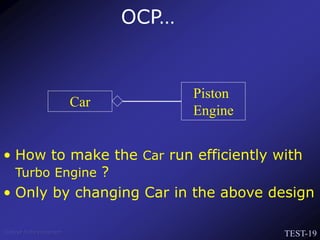
• How to make the Car run efficiently with
Turbo Engine ?
• Only by changing Car in the above design
OCP…
Car
Piston
Engine
TEST-20
Venkat Subramaniam
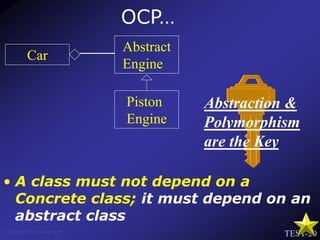
• A class must not depend on a
Concrete class; it must depend on an
abstract class
Abstraction &
Polymorphism
are the Key
OCP…
Car
Abstract
Engine
Piston
Engine
TEST-21
Venkat Subramaniam
Strategic Closure:
No program can be 100% closed
There will always be changes against which the
module is not closed
Closure is not complete - it is strategic
Designer must decide what kinds of changes to
close the design for.
This is where the experience and problem
domain knowledge of the designer comes in
OCP…
TEST-22
Venkat Subramaniam
Heuristics and Conventions that arise from
OCP
• Make all member variables private
– encapsulation: All classes/code that depend on my
class are closed from change to the variable names
or their implementation within my class. Member
functions of my class are never closed from these
changes
– Further, if this were public, no class will be closed
against improper changes made by any other class
• No global variables
OCP…
TEST-23
Venkat Subramaniam
Heuristics and Conventions that arise from
OCP...
• RTTI is ugly and dangerous
– If a module tries to dynamically cast a base
class pointer to several derived classes, any
time you extend the inheritance hierarchy,
you need to change the module
Not all these situations violate OCP all the
time
OCP…
TEST-24
Venkat Subramaniam
• Inheritance is used to realize Abstraction
and Polymorphism which are key to OCP
• How do we measure the quality of
inheritance?
• LSP:
“Functions that use pointers or
references to base classes must be
able to use objects of derived classes
without knowing it”
Liskov Substitution Principle
TEST-25
Venkat Subramaniam
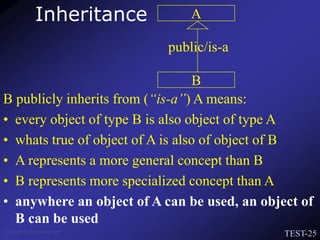
B publicly inherits from (“is-a”) A means:
• every object of type B is also object of type A
• whats true of object of A is also of object of B
• A represents a more general concept than B
• B represents more specialized concept than A
• anywhere an object of A can be used, an object of
B can be used
A
B
public/is-a
Inheritance
TEST-26
Venkat Subramaniam
Advertised Behavior of an object
• Advertised Requirements (Pre-Condition)
• Advertised Promise (Post Condition)
Stack and eStack example
Behavior
TEST-27
Venkat Subramaniam
Design by Contract
Advertised Behavior of the
Derived class is Substitutable for that of
the Base class
Substitutability: Derived class Services
Require no more and promise no less
than the specifications of the
corresponding services in the base class
Design by Contract
TEST-28
Venkat Subramaniam
“Any Derived class object must be
substitutable where ever a Base
class object is used, without the
need for the user to know the
difference”
LSP
TEST-29
Venkat Subramaniam
LSP in Java?
• LSP is being used in Java at least in two
places
• Overriding methods can not throw new
unrelated exceptions
• Overriding method’s access can’t be more
restrictive than the overridden method
– for instance you can’t override a public
method as protected or private in derived
class
TEST-30
Venkat Subramaniam
• Bad Design is one that is
–Rigid - hard to change since changes
affect too many parts
–Fragile - unexpected parts break upon
change
–Immobile - hard to separate from current
application for reuse in another
Nature of Bad Design
TEST-31
Venkat Subramaniam
Ramifications
Controller Clock
Depends
for Alarm
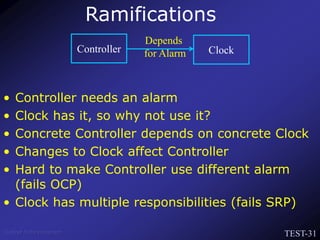
• Controller needs an alarm
• Clock has it, so why not use it?
• Concrete Controller depends on concrete Clock
• Changes to Clock affect Controller
• Hard to make Controller use different alarm
(fails OCP)
• Clock has multiple responsibilities (fails SRP)
TEST-32
Venkat Subramaniam
Alternate Design
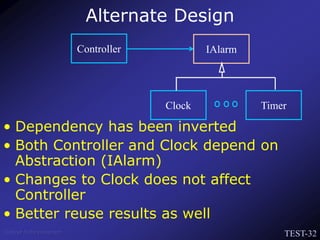
• Dependency has been inverted
• Both Controller and Clock depend on
Abstraction (IAlarm)
• Changes to Clock does not affect
Controller
• Better reuse results as well
Controller
Clock
IAlarm
Timer
TEST-33
Venkat Subramaniam
• Dependency Inversion Principle
“High level modules should not depend
upon low level modules. Both should
depend upon abstractions.”
“Abstractions should not depend upon
details.
Details should depend upon abstractions.”
DIP
TEST-34
Venkat Subramaniam
The Founding Principles
• The three principles are closely related
• Violating either LSP or DIP invariably
results in violating OCP
• It is important to keep in mind these
principles to get the most out of OO
development
TEST-35
Venkat Subramaniam
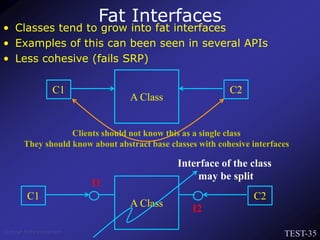
Fat Interfaces
• Classes tend to grow into fat interfaces
• Examples of this can been seen in several APIs
• Less cohesive (fails SRP)
A Class
Interface of the class
may be split
C1 C2
I1
I2
A Class
C1 C2
Clients should not know this as a single class
They should know about abstract base classes with cohesive interfaces
TEST-36
Venkat Subramaniam
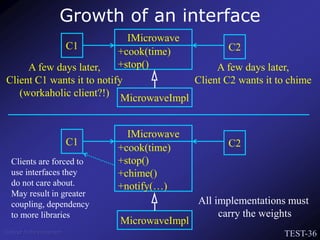
Growth of an interface
IMicrowave
+cook(time)
+stop()
C1 C2
MicrowaveImpl
A few days later,
Client C2 wants it to chime
A few days later,
Client C1 wants it to notify
(workaholic client?!)
IMicrowave
+cook(time)
+stop()
+chime()
+notify(…)
C1 C2
MicrowaveImpl
Clients are forced to
use interfaces they
do not care about.
May result in greater
coupling, dependency
to more libraries
All implementations must
carry the weights
TEST-37
Venkat Subramaniam
ISP
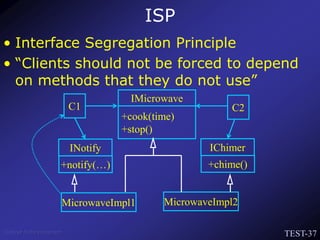
• Interface Segregation Principle
• “Clients should not be forced to depend
on methods that they do not use”
IMicrowave
+cook(time)
+stop()
C1 C2
MicrowaveImpl2
IChimer
+chime()
INotify
+notify(…)
MicrowaveImpl1
TEST-38
Venkat Subramaniam
“The granularity of reuse is the same as
the granularity of release. Only
components that are released through a
tracking system can be effectively
reused.”
Reuse/Release
Equivalency Principle
TEST-39
Venkat Subramaniam
• Release
–A class generally collaborates with other
classes
–For a class to be reused, you need also
the classes that this class depends on
–All related classes must be released
together
Reuse/Release
Equivalency Principle
TEST-40
Venkat Subramaniam
• Tracking
–A class being reused must not change
in an uncontrolled manner
–Code copying is a poor form of reuse
Software must be released in small chunks
- components
Each chunk must have a version number
Reusers may decide on an appropriate
time to use a newer version of a
component release
Reuse/Release
Equivalency Principle
TEST-41
Venkat Subramaniam
“Classes within a released component
should share common closure. If one
need to be changed, they all are likely to
need to be changed. What affects one,
affect all.”
Common Closure
Principle
TEST-42
Venkat Subramaniam
• A change must not cause modification to all
released components
• Change must affect smallest possible number
of released components
• Classes within a component must be cohesive
• Given a particular kind of change, either all
classes in a component must be modified or no
class needs to be modified
• Reduces frequency of re-release of component
Common Closure
Principle...
TEST-43
Venkat Subramaniam
“Classes within a released component
should be reused together. That is, it
must be impossible to separate the
component in order to reuse less than
the total.”
Common Reuse
Principle
TEST-44
Venkat Subramaniam
• Components must be focused
• Component must not contain classes that
an user is not likely to reuse
–user may be forced to accept a new
release due to changes to unused
classes
• Component must be narrow
Common Reuse
Principle...
TEST-45
Venkat Subramaniam
“The dependency structure for released
component must be a Directed Acyclic
Graph. There can be no cycles.”
Acyclic Dependency
Principle
TEST-46
Venkat Subramaniam
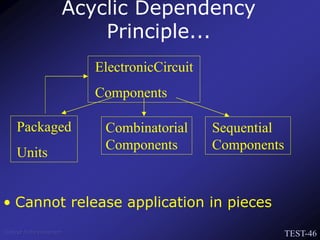
• Cannot release application in pieces
ElectronicCircuit
Components
Packaged
Units
Combinatorial
Components
Sequential
Components
Acyclic Dependency
Principle...
TEST-47
Venkat Subramaniam
ElectronicCircuit
Components
Packaged
Units
Combinatorial
Components
Sequential
Components
Connectors
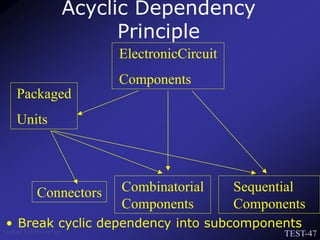
• Break cyclic dependency into subcomponents
Acyclic Dependency
Principle
TEST-48
Venkat Subramaniam
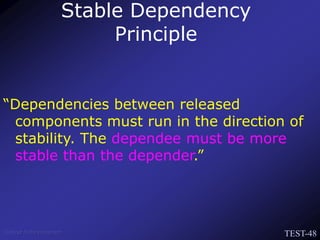
“Dependencies between released
components must run in the direction of
stability. The dependee must be more
stable than the depender.”
Stable Dependency
Principle
TEST-49
Venkat Subramaniam
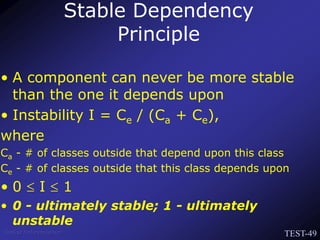
• A component can never be more stable
than the one it depends upon
• Instability I = Ce / (Ca + Ce),
where
Ca - # of classes outside that depend upon this class
Ce - # of classes outside that this class depends upon
• 0  I  1
• 0 - ultimately stable; 1 - ultimately
unstable
Stable Dependency
Principle
TEST-50
Venkat Subramaniam
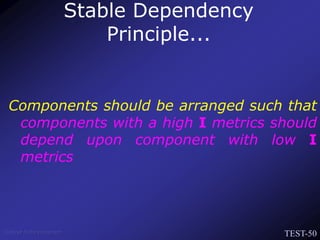
Components should be arranged such that
components with a high I metrics should
depend upon component with low I
metrics
Stable Dependency
Principle...
TEST-51
Venkat Subramaniam
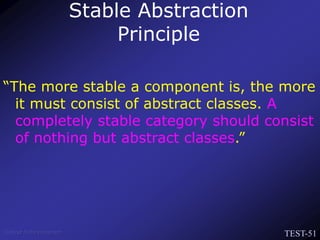
“The more stable a component is, the more
it must consist of abstract classes. A
completely stable category should consist
of nothing but abstract classes.”
Stable Abstraction
Principle
TEST-52
Venkat Subramaniam
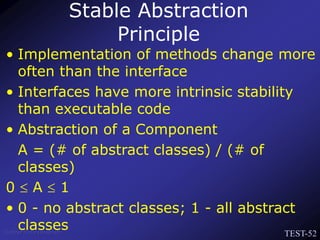
• Implementation of methods change more
often than the interface
• Interfaces have more intrinsic stability
than executable code
• Abstraction of a Component
A = (# of abstract classes) / (# of
classes)
0  A  1
• 0 - no abstract classes; 1 - all abstract
classes
Stable Abstraction
Principle
TEST-53
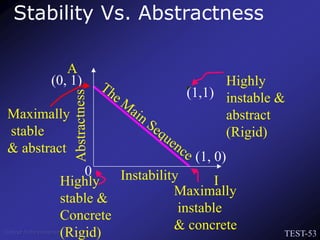
Venkat Subramaniam
Stability Vs. Abstractness
A
I
Instability
(0, 1)
(1, 0)
0
Maximally
stable
& abstract
Maximally
instable
& concrete
Highly
stable &
Concrete
(Rigid)
(1,1)
Highly
instable &
abstract
(Rigid)
TEST-54
Venkat Subramaniam
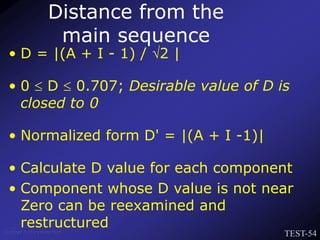
Distance from the
main sequence
• D = |(A + I - 1) / 2 |
• 0  D  0.707; Desirable value of D is
closed to 0
• Normalized form D' = |(A + I -1)|
• Calculate D value for each component
• Component whose D value is not near
Zero can be reexamined and
restructured
TEST-55
Venkat Subramaniam
Applying the Principles
• Developing with OO is more than
– Using a certain language
– Creating objects
– Drawing UML
• It tends to elude even experienced
developers
• Following the principles while developing
code helps attain agility
• Use of each principle should be justified
at each occurrence, however

session07.ppt

  • 1.
  • 2.
    TEST-2 Venkat Subramaniam The Pillarsof the Paradigm • Abstraction • Encapsulation • Hierarchy – Association, Aggregation – Inheritance • Polymorphism
  • 3.
    TEST-3 Venkat Subramaniam What’s OO? •Is it using Objects? • Is it using C++, Java, C#, Smalltalk? • No, its got to be using UML?!  • What makes a program OO? • How do you measure good design?
  • 4.
    TEST-4 Venkat Subramaniam Measuring Quality ofan Abstraction Designing Classes & Objects •An incremental, iterative process •Difficult to design right the first time
  • 5.
    TEST-5 Venkat Subramaniam Metrics forclass design • Coupling – inheritance Vs. coupling – Strong coupling complicates a system – design for weakest possible coupling • Cohesion – degree of connectivity among the elements of a single module/class – coincidental cohesion: all elements related undesirable – Functional cohesion: work together to provide well-bounded behavior
  • 6.
    TEST-6 Venkat Subramaniam Law ofDemeter “Methods of a class should not depend in any way on the structure of any class, except the immediate structure of their own class. Further, each method should send messages to objects belonging to a very limited set of classes only.”
  • 7.
    TEST-7 Venkat Subramaniam Bad design •Perils of a bad design – Rigidity • Hard to change, results in cascade of changes – Fragility • Breaks easily and often – Immobility • Hard to reuse (due to coupling) – Viscosity • Easy to do wrong things, hard to do right things – Needless Complexity • Complicated class design, overly generalized – Needless Repetition • Copy and Paste away – Opacity • Hard to understand
  • 8.
    TEST-8 Venkat Subramaniam Principles • GuidingPrinciples that help develop better systems • Use principles only where they apply • You must see the symptoms to apply them • If you apply arbitrarily, the code ends up with Needless Complexity
  • 9.
    TEST-9 Venkat Subramaniam DRY • Don’tRepeat Yourself • “Every Piece of Knowledge must have a single, unambiguous, authoritative representation within a system” • One of the most difficult, but most seen • How many times have you see this happen Execution Engine (chokes on certain names of objects) Frontend 1. Validates input 2. Fixes the restriction 3. Took weeks to get this issue resolved
  • 10.
    TEST-10 Venkat Subramaniam DRY • Sometimes hard to realize this • It is much easier to copy, paste and modify code to get it working the way you want it, isn’t it • Duplicating code results in – Poor maintainability – Expensive to fix bugs/errors – Hard to keep up with change
  • 11.
    TEST-11 Venkat Subramaniam SRP • Single-ResponsibilityPrinciple • What metric comes to mind? • “A class should have only one reason to change” • Some C++ books promoted bad design – Overloading input/output operators! • What if you do not want to display on a terminal any more? – GUI based, or web based?
  • 12.
    TEST-12 Venkat Subramaniam SRP… Alarm +alert() UI Control System AlarmUI +display(Panel) Alarm +alert() +display(Panel) UI Control System Faces morefrequent change Has greater dependency (to UI related stuff) Related topics: MVC Analysis model stereotypes : Control Entity Boundary
  • 13.
    TEST-13 Venkat Subramaniam SRP atModule Level • Can be extended to module level as well Gui Framework V 1.0 Gui Framework V 1.1 Component Development Utilities Throw it in there Gui Framework V 1.2 User Of Module Forced to accept Irrelevant change
  • 14.
    TEST-14 Venkat Subramaniam SRP affectsReuse • Lower cohesion results in poor reuse – My brother just bought a new DVD and a big screen TV! – He offers to give me his VCR! – I have a great TV and all I need is a VCR – Here is what I found when I went to pickup! Tight coupling Poor Cohesion Bad for resuse Disclaimer: This slide not intended to say anything about the brand of product shown here as an example!
  • 15.
    TEST-15 Venkat Subramaniam Nature ofcode • “Software Systems change during their life time” • Both better designs and poor designs have to face the changes; good designs are stable
  • 16.
    TEST-16 Venkat Subramaniam OCP… Bertrand Meyer: “SoftwareEntities (Classes, Modules, Functions, etc.) should be open for extension, but closed for modification”
  • 17.
    TEST-17 Venkat Subramaniam • Characteristicsof a poor design: – Single change results in cascade of changes – Program is fragile, rigid and unpredictable • Characteristics of good design: – Modules never change – Extend Module’s behavior by adding new code, not changing existing code OCP…
  • 18.
    TEST-18 Venkat Subramaniam • SoftwareModules must – be open for extension •module’s behavior can be extended – closed for modification •source code for the module must not be changed OCP…
  • 19.
    TEST-19 Venkat Subramaniam • Howto make the Car run efficiently with Turbo Engine ? • Only by changing Car in the above design OCP… Car Piston Engine
  • 20.
    TEST-20 Venkat Subramaniam • Aclass must not depend on a Concrete class; it must depend on an abstract class Abstraction & Polymorphism are the Key OCP… Car Abstract Engine Piston Engine
  • 21.
    TEST-21 Venkat Subramaniam Strategic Closure: Noprogram can be 100% closed There will always be changes against which the module is not closed Closure is not complete - it is strategic Designer must decide what kinds of changes to close the design for. This is where the experience and problem domain knowledge of the designer comes in OCP…
  • 22.
    TEST-22 Venkat Subramaniam Heuristics andConventions that arise from OCP • Make all member variables private – encapsulation: All classes/code that depend on my class are closed from change to the variable names or their implementation within my class. Member functions of my class are never closed from these changes – Further, if this were public, no class will be closed against improper changes made by any other class • No global variables OCP…
  • 23.
    TEST-23 Venkat Subramaniam Heuristics andConventions that arise from OCP... • RTTI is ugly and dangerous – If a module tries to dynamically cast a base class pointer to several derived classes, any time you extend the inheritance hierarchy, you need to change the module Not all these situations violate OCP all the time OCP…
  • 24.
    TEST-24 Venkat Subramaniam • Inheritanceis used to realize Abstraction and Polymorphism which are key to OCP • How do we measure the quality of inheritance? • LSP: “Functions that use pointers or references to base classes must be able to use objects of derived classes without knowing it” Liskov Substitution Principle
  • 25.
    TEST-25 Venkat Subramaniam B publiclyinherits from (“is-a”) A means: • every object of type B is also object of type A • whats true of object of A is also of object of B • A represents a more general concept than B • B represents more specialized concept than A • anywhere an object of A can be used, an object of B can be used A B public/is-a Inheritance
  • 26.
    TEST-26 Venkat Subramaniam Advertised Behaviorof an object • Advertised Requirements (Pre-Condition) • Advertised Promise (Post Condition) Stack and eStack example Behavior
  • 27.
    TEST-27 Venkat Subramaniam Design byContract Advertised Behavior of the Derived class is Substitutable for that of the Base class Substitutability: Derived class Services Require no more and promise no less than the specifications of the corresponding services in the base class Design by Contract
  • 28.
    TEST-28 Venkat Subramaniam “Any Derivedclass object must be substitutable where ever a Base class object is used, without the need for the user to know the difference” LSP
  • 29.
    TEST-29 Venkat Subramaniam LSP inJava? • LSP is being used in Java at least in two places • Overriding methods can not throw new unrelated exceptions • Overriding method’s access can’t be more restrictive than the overridden method – for instance you can’t override a public method as protected or private in derived class
  • 30.
    TEST-30 Venkat Subramaniam • BadDesign is one that is –Rigid - hard to change since changes affect too many parts –Fragile - unexpected parts break upon change –Immobile - hard to separate from current application for reuse in another Nature of Bad Design
  • 31.
    TEST-31 Venkat Subramaniam Ramifications Controller Clock Depends forAlarm • Controller needs an alarm • Clock has it, so why not use it? • Concrete Controller depends on concrete Clock • Changes to Clock affect Controller • Hard to make Controller use different alarm (fails OCP) • Clock has multiple responsibilities (fails SRP)
  • 32.
    TEST-32 Venkat Subramaniam Alternate Design •Dependency has been inverted • Both Controller and Clock depend on Abstraction (IAlarm) • Changes to Clock does not affect Controller • Better reuse results as well Controller Clock IAlarm Timer
  • 33.
    TEST-33 Venkat Subramaniam • DependencyInversion Principle “High level modules should not depend upon low level modules. Both should depend upon abstractions.” “Abstractions should not depend upon details. Details should depend upon abstractions.” DIP
  • 34.
    TEST-34 Venkat Subramaniam The FoundingPrinciples • The three principles are closely related • Violating either LSP or DIP invariably results in violating OCP • It is important to keep in mind these principles to get the most out of OO development
  • 35.
    TEST-35 Venkat Subramaniam Fat Interfaces •Classes tend to grow into fat interfaces • Examples of this can been seen in several APIs • Less cohesive (fails SRP) A Class Interface of the class may be split C1 C2 I1 I2 A Class C1 C2 Clients should not know this as a single class They should know about abstract base classes with cohesive interfaces
  • 36.
    TEST-36 Venkat Subramaniam Growth ofan interface IMicrowave +cook(time) +stop() C1 C2 MicrowaveImpl A few days later, Client C2 wants it to chime A few days later, Client C1 wants it to notify (workaholic client?!) IMicrowave +cook(time) +stop() +chime() +notify(…) C1 C2 MicrowaveImpl Clients are forced to use interfaces they do not care about. May result in greater coupling, dependency to more libraries All implementations must carry the weights
  • 37.
    TEST-37 Venkat Subramaniam ISP • InterfaceSegregation Principle • “Clients should not be forced to depend on methods that they do not use” IMicrowave +cook(time) +stop() C1 C2 MicrowaveImpl2 IChimer +chime() INotify +notify(…) MicrowaveImpl1
  • 38.
    TEST-38 Venkat Subramaniam “The granularityof reuse is the same as the granularity of release. Only components that are released through a tracking system can be effectively reused.” Reuse/Release Equivalency Principle
  • 39.
    TEST-39 Venkat Subramaniam • Release –Aclass generally collaborates with other classes –For a class to be reused, you need also the classes that this class depends on –All related classes must be released together Reuse/Release Equivalency Principle
  • 40.
    TEST-40 Venkat Subramaniam • Tracking –Aclass being reused must not change in an uncontrolled manner –Code copying is a poor form of reuse Software must be released in small chunks - components Each chunk must have a version number Reusers may decide on an appropriate time to use a newer version of a component release Reuse/Release Equivalency Principle
  • 41.
    TEST-41 Venkat Subramaniam “Classes withina released component should share common closure. If one need to be changed, they all are likely to need to be changed. What affects one, affect all.” Common Closure Principle
  • 42.
    TEST-42 Venkat Subramaniam • Achange must not cause modification to all released components • Change must affect smallest possible number of released components • Classes within a component must be cohesive • Given a particular kind of change, either all classes in a component must be modified or no class needs to be modified • Reduces frequency of re-release of component Common Closure Principle...
  • 43.
    TEST-43 Venkat Subramaniam “Classes withina released component should be reused together. That is, it must be impossible to separate the component in order to reuse less than the total.” Common Reuse Principle
  • 44.
    TEST-44 Venkat Subramaniam • Componentsmust be focused • Component must not contain classes that an user is not likely to reuse –user may be forced to accept a new release due to changes to unused classes • Component must be narrow Common Reuse Principle...
  • 45.
    TEST-45 Venkat Subramaniam “The dependencystructure for released component must be a Directed Acyclic Graph. There can be no cycles.” Acyclic Dependency Principle
  • 46.
    TEST-46 Venkat Subramaniam • Cannotrelease application in pieces ElectronicCircuit Components Packaged Units Combinatorial Components Sequential Components Acyclic Dependency Principle...
  • 47.
  • 48.
    TEST-48 Venkat Subramaniam “Dependencies betweenreleased components must run in the direction of stability. The dependee must be more stable than the depender.” Stable Dependency Principle
  • 49.
    TEST-49 Venkat Subramaniam • Acomponent can never be more stable than the one it depends upon • Instability I = Ce / (Ca + Ce), where Ca - # of classes outside that depend upon this class Ce - # of classes outside that this class depends upon • 0  I  1 • 0 - ultimately stable; 1 - ultimately unstable Stable Dependency Principle
  • 50.
    TEST-50 Venkat Subramaniam Components shouldbe arranged such that components with a high I metrics should depend upon component with low I metrics Stable Dependency Principle...
  • 51.
    TEST-51 Venkat Subramaniam “The morestable a component is, the more it must consist of abstract classes. A completely stable category should consist of nothing but abstract classes.” Stable Abstraction Principle
  • 52.
    TEST-52 Venkat Subramaniam • Implementationof methods change more often than the interface • Interfaces have more intrinsic stability than executable code • Abstraction of a Component A = (# of abstract classes) / (# of classes) 0  A  1 • 0 - no abstract classes; 1 - all abstract classes Stable Abstraction Principle
  • 53.
    TEST-53 Venkat Subramaniam Stability Vs.Abstractness A I Instability (0, 1) (1, 0) 0 Maximally stable & abstract Maximally instable & concrete Highly stable & Concrete (Rigid) (1,1) Highly instable & abstract (Rigid)
  • 54.
    TEST-54 Venkat Subramaniam Distance fromthe main sequence • D = |(A + I - 1) / 2 | • 0  D  0.707; Desirable value of D is closed to 0 • Normalized form D' = |(A + I -1)| • Calculate D value for each component • Component whose D value is not near Zero can be reexamined and restructured
  • 55.
    TEST-55 Venkat Subramaniam Applying thePrinciples • Developing with OO is more than – Using a certain language – Creating objects – Drawing UML • It tends to elude even experienced developers • Following the principles while developing code helps attain agility • Use of each principle should be justified at each occurrence, however