Evaluation 
socio-technical environments 
integrated frameworks 
Chronis Kynigos, CTI 
MCSquared FP7 Project 610467, 1st Review Meeting, 06 November, 2014, Utrecht, Netherlands 1
‘Evaluation’ in mc2 project 
Focus Approach 
•Social creativity in the 
design of educational 
resources for CMT 
•the two ‘creativities’ 
•social creativity in design 
•Creative mathematical 
thinking 
•Design-based research paradigm 
•Creativity as 
•process 
•product 
•context 
•Bottom-up / theory-driven 
•Formative/ summative 
•Integrative 
•3 cycles of work 
•4 (x3) empirical studies 
•meta-analysis & synthesis 
MCSquared FP7 Project 610467, 1st Review Meeting, 06 November, 2014, Utrecht, Netherlands 2
Socio-technical environments 
consist of a community of individuals engaged 
in a joint enterprise, whose creative 
performance is mediated through 
interactions with a particular ‘technical’ 
environment designed to amplify the 
outcome of their collaborative efforts 
MCSquared FP7 Project 610467, 1st Review Meeting, 06 November, 2014, Utrecht, Netherlands 3
Integrated Frameworks 
• The medium integrates 
• narrative/reading with 
• expressivity/constructionism 
• The evaluation integrates 
• DG and BC to understand SC and 
CMT affordances 
• Diverse operationalizations of 
DG/BC integrations 
MCSquared FP7 Project 610467, 1st Review Meeting, 06 November, 2014, Utrecht, Netherlands 4
Communities of Interest 
• heterogeneity, diverse expertise in 
their members 
• Bringing representations from 
diverse CoP 
• fueled by a culture of participation 
• exemplified in social processes, 
practices and mediations 
• leading to novel/new, useful and 
desirable outputs 
MCSquared FP7 Project 610467, 1st Review Meeting, 06 November, 2014, Utrecht, Netherlands 5
CoI as SC enhancers 
• Heterogenous (members are representatives of CoPs) 
• to solve a design problem of common concern (joint “interest”) that 
requires the combination of multiple knowledge systems 
• a rich environment for interconnectedness, different perspective-taking, 
knowledge exchange and integration between diverse 
domains and more opportunities for creative thinking and learning 
• CoI members may be participants in more than one CoPs 
• One community can exhibit characteristics of both a CoI and a 
CoP 
• can integrate aspects of both a CoI and a CoP its type may shift 
over time due to external factors 
MCSquared FP7 Project 610467, 1st Review Meeting, 06 November, 2014, Utrecht, Netherlands 6
Collaborative design: 
DG and BO 
Documentational genesis 
• Living documents 
• Instrumentation and 
instrumentalization 
Digital artifacts as boundary 
objects 
• Boundary crossings 
• Improvable objects 
MCSquared FP7 Project 610467, 1st Review Meeting, 06 November, 2014, Utrecht, Netherlands 7
Integrations 
CoI Diversity in operationalization of the integration between DG 
and BC 
MCSquared FP7 Project 610467, 1st Review Meeting, 06 November, 2014, Utrecht, Netherlands 8
Starting points for S-C and CMT 
• Narrative activity model (Vygotsky) 
Exploration, inspiration, production, sharing 
• Creative thinking spiral (Resnick) 
Imagination Creation, Play, Sharing, Reflection, imagination 
• Lateral, out of the box, playfulness, humor, imagination (Ackerman, 
DeCortis et al) 
• Model of Collaborative Creativity (Aragon, Williams) 
Focus, Frame, Create, Complete 
• Product-process, general-specific, solving-posing problems interplay, ill 
structured open problems (Shriki, Jamir-Leikin) 
• Creativity in techno-mathematical literacies and the importance of 
modeling and boundary crossings and artifacts as boundary objects 
(Hoyles-Noss) 
MCSquared FP7 Project 610467, 1st Review Meeting, 06 November, 2014, Utrecht, Netherlands 9
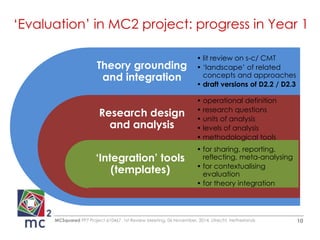
‘Evaluation’ in MC2 project: progress in Year 1 
Theory grounding 
and integration 
Research design 
and analysis 
‘Integration’ tools 
(templates) 
• lit review on s-c/ CMT 
• ‘landscape’ of related 
concepts and approaches 
• draft versions of D2.2 / D2.3 
• operational definition 
• research questions 
• units of analysis 
• levels of analysis 
• methodological tools 
• for sharing, reporting, 
reflecting, meta-analysing 
• for contextualising 
evaluation 
• for theory integration 
MCSquared FP7 Project 610467, 1st Review Meeting, 06 November, 2014, Utrecht, Netherlands 10
Evaluating social creativity in Cycle 1: 
theory grounding and integration 
Social creativity in 
design 
(Fischer, 1997, 2007) 
Boundary 
crossing 
approach 
(Akkerman & 
Bakker, 2011) 
Documentational 
approach 
(Gueudet & 
Trouche, 2009) 
The 3 theory strands 
A landscape of related concepts 
MCSquared FP7 Project 610467, 1st Review Meeting, 06 November, 2014, Utrecht, Netherlands 11
Operational definition of ‘social creativity’ 
 a design activity: 
• structured, intentional (create edu resources for CMT) 
• collective, participative 
 embedded and nurtured within a socio-technical environment 
• CoI (collective of professionals involved in the design of math edu 
resources) 
• C-book technology (authoring tool, widget factories, data-analytics 
engine, CoICode) 
 involving a set of processes and interactions: 
• socio-cognitive / group processes (within the CoI) 
• and the CoI with the C-book technology 
 aiming at/ resulting in the production of ‘creative’ outputs: 
• ideas born/ shaped in the interactions, and 
• c-book units, which are: 
 novel/new 
 useful 
 elaborate 
 appropriate, w/r to the joint goal, and for the end-users 
MCSquared FP7 Project 610467, 1st Review Meeting, 06 November, 2014, Utrecht, Netherlands 12
Evaluation studies of social creativity in 
Cycle 1: research design and analysis 
Common research 
questions 
• CRQ.1: How is s-c 
stimulated/ enabled in 
mc2 S-T env? 
• CRQ.1: What kinds of s-c 
emerge from the 
interactions between CoI 
and C-book tech? 
Categories of data 
collected 
• Asynchronous discussion 
transcripts from CoiCode 
• Recorded conversations 
from f-2-f / skype meetings 
• CoiCode graphs, system 
logs, user entries 
• The c-book units 
MCSquared FP7 Project 610467, 1st Review Meeting, 06 November, 2014, Utrecht, Netherlands 13
Evaluation studies of social creativity in 
Cycle 1: focus of analysis 
Focus of analysis 
Selected segments of an 
activity with a single theme 
as a focus, highlighting an 
aspect of social creativity 
‘critical episodes’ of social creativity 
 a first lens to filter collected data 
 a mechanism to bring to the fore the 
different approaches by the research teams 
 a contribution to our understanding of s-c 
MCSquared FP7 Project 610467, 1st Review Meeting, 06 November, 2014, Utrecht, Netherlands 14
Evaluating social creativity in Cycle 1: analysis 
of critical episodes 
foci of critical episodes 
• the ‘idea’ concept 
• stages in the creative 
process 
• interactions within S-T 
environments 
• the c-book unit’s 
function 
main and recurrent themes 
identified 
• prevalence of an idea if linked to 
a widget instance 
• enablers of s-c: 
• CoI synthesis (knowledge and 
expertise complementarity) 
• role of ‘boundary brokers’ 
• the c-book unit’s unified structure 
• the c-book unit serving as a 
‘boundary object’, encompassing 
various considerations (math, ped, 
tech, context) 
MCSquared FP7 Project 610467, 1st Review Meeting, 06 November, 2014, Utrecht, Netherlands 15
Refining evaluation design for Cycles 2, 3: 
units – levels – tools of analysis 
•The creative 
path of an 
idea 
•CMT 
affordances 
of the c-book 
unit 
•The identity 
of a 
creative 
idea 
•Modes of 
interactions 
with the C-book 
tech 
the idea the idea 
the c-book 
the c-book 
MCSquared FP7 Project 610467, 1st Review Meeting, 06 November, 2014, Utrecht, Netherlands 16
“The c-idea ID card” 
The ID card of an idea 
Idea “theme” What the idea refers to: e.g. a mathematical 
idea, negotiation of the age of the students, 
the nature of the narrative of the c-book unit, 
e.t.c. 
Idea initiator 
Number of idea 
commentators 
Duration of discussion 
MCSquared FP7 Project 610467, 1st Review Meeting, 06 November, 2014, Utrecht, Netherlands 17
“The creative idea indicators checklist” 
Creative	idea	indicators	 YES	 NO	 Comments	 
The	idea	is	supported	by	a	widget.		 	 	 	 
If	yes,	when	(at	what	point	in	the	discussion,	for	example:	third	post	of	the	initiator)	does	the	widget		 
	 	 	 
appear?	 
The	idea	is	“native”	to	the	CoI	(an	emerging	product	of	CoI	discussion,	not	previously	used	in		 
another	resource	system).	 
	 	 	 
The	idea	is	“immigrant”	to	the	CoI	(has	been	previously	used	by	the	initiator	in	another	context	/	comes	 
from	an	alien	resource	system).	 
	 	 	 
The	idea	is	integrated	in	the	CoI	resource	system,	leading	to	some	reorganisation.	 	 	 	 
(If	no),	when	is	the	idea	abandoned?	 	 	 	 
(If	yes),	number	of	consequent	evolving	versions	of	the	same	idea.	 	 	 	 
(If	yes),	how	many	CoI	members	were	involved	in	the	elaboration	of	the	idea?	 	 	 	 
(If	yes),	time	elapsed	from	the	introduction	of	the	initial	idea	till	the	common	approval	of	its	last	version	 	 	 	 
Socio-cognitive	processes	processes	employed	by	the	CoI	members	in	the	deployment	of	the	idea	from	 
	 	 	 
its	first	wording	to	its	final	development		 
One	or	more	CoI	members	have	explicictly	characterised	the	idea	as	novel,	unusual	or	new,	at	some	 
point	in	the	discussion.	 
	 	 	 
One	or	more	CoI	members	have	explicitly	characterised	the	idea	as	appropriate	(conforming	to	the	 
users’	requirements),	at	some	point	in	the	discussion.	 
	 	 	 
The	discussion	of	the	idea	is	continuous	(discussion	flows	in	non-interrupted	threads).	 	 	 	 
The	discussion	of	the	idea	includes	the	element	of	questioning	/	challenging	/	disagreement.	 	 	 	 
The	discussion	of	the	idea	indicates	elements	of	one	or	more	processes	of	boundary	crossing.	 	 	 	 
	 
MCSquared FP7 Project 610467, 1st Review Meeting, 06 November, 2014, Utrecht, Netherlands 18
“The CMT affordances evaluation grid” 
The CMT affordances evaluation grid 
Does the c-book unit engage the ‘reader’ in enough learning situations 
involving… 
YES NO JUSTIFY (when 
necessary) 
• open problems/open questions ? 
• problem-posing ? 
• simulation ? 
• the application of other (non-mathematical) subject domains ? 
• the combination of more than one mathematical areas(or concepts) ? 
• alternative uses of familiar digital tools ? 
• real-life mathematics ? 
• the combination of more than one available widgets ? 
• multiple representations ? 
• constructionist activities ? 
Does the c-book unit trigger in the ‘reader’ a sense of … 
• pleasure/ amusement/ enthusiasm ? 
• being motivated / challenged ? 
• gamification/ playfulness ? 
• beauty in mathematics ? 
• personal engagement ? 
Does the c-book unit give the ‘reader’ enough opportunities for… 
• collaboration/ communication/ Interaction with others ? 
• discussion ? 
• free-choice learning ? 
• competition ? 
• exploration ? 
• creating a “story”? 
• experimentation ? 
Does the c-book unit allow / engage/ faciltate the ‘reader’ to… 
• formulate her own mathematical assumptions ? 
• take initiatives ? 
• to find multiple solutions to the same problem ? 
• to use multiple paths/ strategies to get to the solution ? 
• to apply various forms of reasoning ? 
• to get to unexpected solutions ? 
• to create new products/ original ideas ? 
• to apply various math techniques ? 
• to reflect on the solution ? 
MCSquared FP7 Project 610467, 1st Review Meeting, 06 November, 2014, Utrecht, Netherlands 19
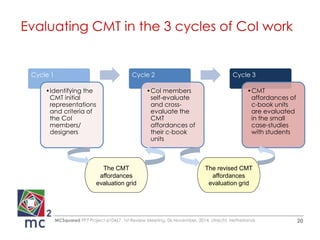
Evaluating CMT in the 3 cycles of CoI work 
MCSquared FP7 Project 610467, 1st Review Meeting, 06 November, 2014, Utrecht, Netherlands 20 
Cycle 1 
•Identifying the 
CMT initial 
representations 
and criteria of 
the CoI 
members/ 
designers 
Cycle 2 
•CoI members 
self-evaluate 
and cross-evaluate 
the 
CMT 
affordances of 
their c-book 
units 
Cycle 3 
•CMT 
affordances of 
c-book units 
are evaluated 
in the small 
case-studies 
with students 
The CMT 
affordances 
evaluation grid 
The revised CMT 
affordances 
evaluation grid
The ‘templates’: tools for supporting evaluation, 
for meta-evaluation and theory integration 
The 7 ‘templates’: 5 (wp6), 1 (wp7) and 1 (wp5) 
Purpose and intended use 
• Description tools 
• Support partners to 
• design and report work 
• externalise, exchange, 
and reflect on their 
approaches 
• ‘Living documents’ 
• ‘Boundary objects’ 
• Analysis and integration tools 
• Completed templates are 
used as raw material 
• for meta-analysing and 
contextualising the 
evaluation studies (across 
the 4 CoIs/ research teams) 
• for explicitation of research 
perspectives and synthesis 
of evaluation findings 
MCSquared FP7 Project 610467, 1st Review Meeting, 06 November, 2014, Utrecht, Netherlands 21
The ‘templates’: tools for supporting evaluation, 
meta-evaluation and theory integration 
CoI 
constitution/ 
function 
The CoI profile 
template 
The CoI 
moderation 
template 
CoI activity 
report 
The c-book unit 
description 
template 
The cross-case 
analyses 
template 
Evaluation of 
the two 
‘creativities’ 
The S-C 
evaluation 
template 
The CMT 
evaluation 
template 
Evaluation of 
the C-book 
affordances 
The c-book 
analytics 
requirements 
template 
MCSquared FP7 Project 610467, 1st Review Meeting, 06 November, 2014, Utrecht, Netherlands 22
The “CoI profile” template: 
Structure and rationale: 
• The CoI identity 
• membership, diversity and 
size of the CoI 
• configuration of the CoI 
• CoI 'interest' and 
sustainability 
• The CoI role and workplan 
in Cycle 1 (or 2, 3 ) 
• intended role of the CoI 
• aspired work plan of the 
CoI 
MCSquared FP7 Project 610467, 1st Review Meeting, 06 November, 2014, Utrecht, Netherlands 23
Excerpts: membership & configuration of the CoIs 
Communities of Practice Number of 
representatives 
1. Researchers in Education & Mathematics Education 5 
2. School teachers & Teacher trainers 4 
3. Technology developers and users in Education 3 
4. ‘Experts’ on the dissemination of knowledge 2 
5. Creative Industry 2 
6. ‘Experts’ outside Maths Education 2 
Spanish CoI 
The Community of Interest (CoI) is 
composed, on the one hand, of several 
communities of practice (CoPs) involved in 
the teaching and learning of Mathematics 
and, on the other hand, of external groups 
outside Maths Education. This last CoP 
gives rise to different contexts link to other 
fields of knowledge, promoting an 
interdisciplinary and creative interaction. 
Communities of Practice Number of 
representatives 
1. Researchers in Education & Mathematics Education 6 
2. Teacher educators 6 
3. Game developers 1 
4. Teachers 6 
5. Mathematicians 1 
6. Computer Scientists 2 
UK CoI 
The final CoI represents various groups 
involved and interested in themes involving 
maths education, teaching, research, 
design and creative industries. There is 
some overlap in the various roles. Each 
CoP will eventually be represented by at 
least two, CoP active, unique people. 
MCSquared FP7 Project 610467, 1st Review Meeting, 06 November, 2014, Utrecht, Netherlands 24
The “Social creativity evaluation” template 
Structure and rationale: 
1. Operational definition for 
Social Creativity 
2. Common Research Questions 
3. Specific Research Questions 
4. Theoretical grounding of the 
study 
5. Research approach towards 
Social Creativity 
6. Context of each CoI-specific 
study 
7. Categories of data and data-collection 
techniques 
8. Data analysis techniques 
MCSquared FP7 Project 610467, 1st Review Meeting, 06 November, 2014, Utrecht, Netherlands 25
Excerpts from the completed templates - 1 
Research Approach to Social Creativity 
The UK CoI will use c-books as 
‘improvable boundary objects’. 
Therefore, one could first typify it as a 
product approach. However, because 
every actor involved in the evolution of 
every c-book, from embryonic stage to 
first version to later versions, records 
his/her activities every ‘product’ is 
accompanied by a ‘process’ 
describing exactly how the c-book 
evolved. This product/ process 
combination is documented by a rich 
multimodal description. 
To analyze social creativity we propose to 
use the “componential theory of 
creativity” from T.M. Amabile, 2012: “The 
componential theory of creativity is a 
comprehensive model of the social and 
psychological components necessary for 
an individual to produce creative work. […]. 
In this theory, four components are 
necessary for any creative response: three 
components within the individual - 
domain-relevant skills, creativity-relevant 
processes, and intrinsic task motivation - 
and one component outside the individual - 
the social environment in which the 
UK research team individual is working.” 
French research team 
MCSquared FP7 Project 610467, 1st Review Meeting, 06 November, 2014, Utrecht, Netherlands 26
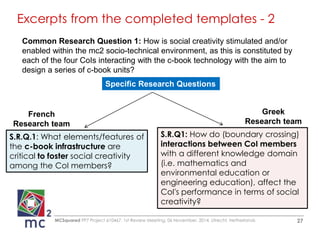
Excerpts from the completed templates - 2 
Common Research Question 1: How is social creativity stimulated and/or 
enabled within the mc2 socio-technical environment, as this is constituted by 
each of the four CoIs interacting with the c-book technology with the aim to 
design a series of c-book units? 
Specific Research Questions 
Greek 
Research team 
S.R.Q1: How do (boundary crossing) 
interactions between CoI members 
with a different knowledge domain 
(i.e. mathematics and 
environmental education or 
engineering education), affect the 
CoI's performance in terms of social 
creativity? 
French 
Research team 
S.R.Q.1: What elements/features of 
the c-book infrastructure are 
critical to foster social creativity 
among the CoI members? 
MCSquared FP7 Project 610467, 1st Review Meeting, 06 November, 2014, Utrecht, Netherlands 27

Evaluation socio-technical environments integrated frameworks

  • 1.
    Evaluation socio-technical environments integrated frameworks Chronis Kynigos, CTI MCSquared FP7 Project 610467, 1st Review Meeting, 06 November, 2014, Utrecht, Netherlands 1
  • 2.
    ‘Evaluation’ in mc2project Focus Approach •Social creativity in the design of educational resources for CMT •the two ‘creativities’ •social creativity in design •Creative mathematical thinking •Design-based research paradigm •Creativity as •process •product •context •Bottom-up / theory-driven •Formative/ summative •Integrative •3 cycles of work •4 (x3) empirical studies •meta-analysis & synthesis MCSquared FP7 Project 610467, 1st Review Meeting, 06 November, 2014, Utrecht, Netherlands 2
  • 3.
    Socio-technical environments consistof a community of individuals engaged in a joint enterprise, whose creative performance is mediated through interactions with a particular ‘technical’ environment designed to amplify the outcome of their collaborative efforts MCSquared FP7 Project 610467, 1st Review Meeting, 06 November, 2014, Utrecht, Netherlands 3
  • 4.
    Integrated Frameworks •The medium integrates • narrative/reading with • expressivity/constructionism • The evaluation integrates • DG and BC to understand SC and CMT affordances • Diverse operationalizations of DG/BC integrations MCSquared FP7 Project 610467, 1st Review Meeting, 06 November, 2014, Utrecht, Netherlands 4
  • 5.
    Communities of Interest • heterogeneity, diverse expertise in their members • Bringing representations from diverse CoP • fueled by a culture of participation • exemplified in social processes, practices and mediations • leading to novel/new, useful and desirable outputs MCSquared FP7 Project 610467, 1st Review Meeting, 06 November, 2014, Utrecht, Netherlands 5
  • 6.
    CoI as SCenhancers • Heterogenous (members are representatives of CoPs) • to solve a design problem of common concern (joint “interest”) that requires the combination of multiple knowledge systems • a rich environment for interconnectedness, different perspective-taking, knowledge exchange and integration between diverse domains and more opportunities for creative thinking and learning • CoI members may be participants in more than one CoPs • One community can exhibit characteristics of both a CoI and a CoP • can integrate aspects of both a CoI and a CoP its type may shift over time due to external factors MCSquared FP7 Project 610467, 1st Review Meeting, 06 November, 2014, Utrecht, Netherlands 6
  • 7.
    Collaborative design: DGand BO Documentational genesis • Living documents • Instrumentation and instrumentalization Digital artifacts as boundary objects • Boundary crossings • Improvable objects MCSquared FP7 Project 610467, 1st Review Meeting, 06 November, 2014, Utrecht, Netherlands 7
  • 8.
    Integrations CoI Diversityin operationalization of the integration between DG and BC MCSquared FP7 Project 610467, 1st Review Meeting, 06 November, 2014, Utrecht, Netherlands 8
  • 9.
    Starting points forS-C and CMT • Narrative activity model (Vygotsky) Exploration, inspiration, production, sharing • Creative thinking spiral (Resnick) Imagination Creation, Play, Sharing, Reflection, imagination • Lateral, out of the box, playfulness, humor, imagination (Ackerman, DeCortis et al) • Model of Collaborative Creativity (Aragon, Williams) Focus, Frame, Create, Complete • Product-process, general-specific, solving-posing problems interplay, ill structured open problems (Shriki, Jamir-Leikin) • Creativity in techno-mathematical literacies and the importance of modeling and boundary crossings and artifacts as boundary objects (Hoyles-Noss) MCSquared FP7 Project 610467, 1st Review Meeting, 06 November, 2014, Utrecht, Netherlands 9
  • 10.
    ‘Evaluation’ in MC2project: progress in Year 1 Theory grounding and integration Research design and analysis ‘Integration’ tools (templates) • lit review on s-c/ CMT • ‘landscape’ of related concepts and approaches • draft versions of D2.2 / D2.3 • operational definition • research questions • units of analysis • levels of analysis • methodological tools • for sharing, reporting, reflecting, meta-analysing • for contextualising evaluation • for theory integration MCSquared FP7 Project 610467, 1st Review Meeting, 06 November, 2014, Utrecht, Netherlands 10
  • 11.
    Evaluating social creativityin Cycle 1: theory grounding and integration Social creativity in design (Fischer, 1997, 2007) Boundary crossing approach (Akkerman & Bakker, 2011) Documentational approach (Gueudet & Trouche, 2009) The 3 theory strands A landscape of related concepts MCSquared FP7 Project 610467, 1st Review Meeting, 06 November, 2014, Utrecht, Netherlands 11
  • 12.
    Operational definition of‘social creativity’  a design activity: • structured, intentional (create edu resources for CMT) • collective, participative  embedded and nurtured within a socio-technical environment • CoI (collective of professionals involved in the design of math edu resources) • C-book technology (authoring tool, widget factories, data-analytics engine, CoICode)  involving a set of processes and interactions: • socio-cognitive / group processes (within the CoI) • and the CoI with the C-book technology  aiming at/ resulting in the production of ‘creative’ outputs: • ideas born/ shaped in the interactions, and • c-book units, which are:  novel/new  useful  elaborate  appropriate, w/r to the joint goal, and for the end-users MCSquared FP7 Project 610467, 1st Review Meeting, 06 November, 2014, Utrecht, Netherlands 12
  • 13.
    Evaluation studies ofsocial creativity in Cycle 1: research design and analysis Common research questions • CRQ.1: How is s-c stimulated/ enabled in mc2 S-T env? • CRQ.1: What kinds of s-c emerge from the interactions between CoI and C-book tech? Categories of data collected • Asynchronous discussion transcripts from CoiCode • Recorded conversations from f-2-f / skype meetings • CoiCode graphs, system logs, user entries • The c-book units MCSquared FP7 Project 610467, 1st Review Meeting, 06 November, 2014, Utrecht, Netherlands 13
  • 14.
    Evaluation studies ofsocial creativity in Cycle 1: focus of analysis Focus of analysis Selected segments of an activity with a single theme as a focus, highlighting an aspect of social creativity ‘critical episodes’ of social creativity  a first lens to filter collected data  a mechanism to bring to the fore the different approaches by the research teams  a contribution to our understanding of s-c MCSquared FP7 Project 610467, 1st Review Meeting, 06 November, 2014, Utrecht, Netherlands 14
  • 15.
    Evaluating social creativityin Cycle 1: analysis of critical episodes foci of critical episodes • the ‘idea’ concept • stages in the creative process • interactions within S-T environments • the c-book unit’s function main and recurrent themes identified • prevalence of an idea if linked to a widget instance • enablers of s-c: • CoI synthesis (knowledge and expertise complementarity) • role of ‘boundary brokers’ • the c-book unit’s unified structure • the c-book unit serving as a ‘boundary object’, encompassing various considerations (math, ped, tech, context) MCSquared FP7 Project 610467, 1st Review Meeting, 06 November, 2014, Utrecht, Netherlands 15
  • 16.
    Refining evaluation designfor Cycles 2, 3: units – levels – tools of analysis •The creative path of an idea •CMT affordances of the c-book unit •The identity of a creative idea •Modes of interactions with the C-book tech the idea the idea the c-book the c-book MCSquared FP7 Project 610467, 1st Review Meeting, 06 November, 2014, Utrecht, Netherlands 16
  • 17.
    “The c-idea IDcard” The ID card of an idea Idea “theme” What the idea refers to: e.g. a mathematical idea, negotiation of the age of the students, the nature of the narrative of the c-book unit, e.t.c. Idea initiator Number of idea commentators Duration of discussion MCSquared FP7 Project 610467, 1st Review Meeting, 06 November, 2014, Utrecht, Netherlands 17
  • 18.
    “The creative ideaindicators checklist” Creative idea indicators YES NO Comments The idea is supported by a widget. If yes, when (at what point in the discussion, for example: third post of the initiator) does the widget appear? The idea is “native” to the CoI (an emerging product of CoI discussion, not previously used in another resource system). The idea is “immigrant” to the CoI (has been previously used by the initiator in another context / comes from an alien resource system). The idea is integrated in the CoI resource system, leading to some reorganisation. (If no), when is the idea abandoned? (If yes), number of consequent evolving versions of the same idea. (If yes), how many CoI members were involved in the elaboration of the idea? (If yes), time elapsed from the introduction of the initial idea till the common approval of its last version Socio-cognitive processes processes employed by the CoI members in the deployment of the idea from its first wording to its final development One or more CoI members have explicictly characterised the idea as novel, unusual or new, at some point in the discussion. One or more CoI members have explicitly characterised the idea as appropriate (conforming to the users’ requirements), at some point in the discussion. The discussion of the idea is continuous (discussion flows in non-interrupted threads). The discussion of the idea includes the element of questioning / challenging / disagreement. The discussion of the idea indicates elements of one or more processes of boundary crossing. MCSquared FP7 Project 610467, 1st Review Meeting, 06 November, 2014, Utrecht, Netherlands 18
  • 19.
    “The CMT affordancesevaluation grid” The CMT affordances evaluation grid Does the c-book unit engage the ‘reader’ in enough learning situations involving… YES NO JUSTIFY (when necessary) • open problems/open questions ? • problem-posing ? • simulation ? • the application of other (non-mathematical) subject domains ? • the combination of more than one mathematical areas(or concepts) ? • alternative uses of familiar digital tools ? • real-life mathematics ? • the combination of more than one available widgets ? • multiple representations ? • constructionist activities ? Does the c-book unit trigger in the ‘reader’ a sense of … • pleasure/ amusement/ enthusiasm ? • being motivated / challenged ? • gamification/ playfulness ? • beauty in mathematics ? • personal engagement ? Does the c-book unit give the ‘reader’ enough opportunities for… • collaboration/ communication/ Interaction with others ? • discussion ? • free-choice learning ? • competition ? • exploration ? • creating a “story”? • experimentation ? Does the c-book unit allow / engage/ faciltate the ‘reader’ to… • formulate her own mathematical assumptions ? • take initiatives ? • to find multiple solutions to the same problem ? • to use multiple paths/ strategies to get to the solution ? • to apply various forms of reasoning ? • to get to unexpected solutions ? • to create new products/ original ideas ? • to apply various math techniques ? • to reflect on the solution ? MCSquared FP7 Project 610467, 1st Review Meeting, 06 November, 2014, Utrecht, Netherlands 19
  • 20.
    Evaluating CMT inthe 3 cycles of CoI work MCSquared FP7 Project 610467, 1st Review Meeting, 06 November, 2014, Utrecht, Netherlands 20 Cycle 1 •Identifying the CMT initial representations and criteria of the CoI members/ designers Cycle 2 •CoI members self-evaluate and cross-evaluate the CMT affordances of their c-book units Cycle 3 •CMT affordances of c-book units are evaluated in the small case-studies with students The CMT affordances evaluation grid The revised CMT affordances evaluation grid
  • 21.
    The ‘templates’: toolsfor supporting evaluation, for meta-evaluation and theory integration The 7 ‘templates’: 5 (wp6), 1 (wp7) and 1 (wp5) Purpose and intended use • Description tools • Support partners to • design and report work • externalise, exchange, and reflect on their approaches • ‘Living documents’ • ‘Boundary objects’ • Analysis and integration tools • Completed templates are used as raw material • for meta-analysing and contextualising the evaluation studies (across the 4 CoIs/ research teams) • for explicitation of research perspectives and synthesis of evaluation findings MCSquared FP7 Project 610467, 1st Review Meeting, 06 November, 2014, Utrecht, Netherlands 21
  • 22.
    The ‘templates’: toolsfor supporting evaluation, meta-evaluation and theory integration CoI constitution/ function The CoI profile template The CoI moderation template CoI activity report The c-book unit description template The cross-case analyses template Evaluation of the two ‘creativities’ The S-C evaluation template The CMT evaluation template Evaluation of the C-book affordances The c-book analytics requirements template MCSquared FP7 Project 610467, 1st Review Meeting, 06 November, 2014, Utrecht, Netherlands 22
  • 23.
    The “CoI profile”template: Structure and rationale: • The CoI identity • membership, diversity and size of the CoI • configuration of the CoI • CoI 'interest' and sustainability • The CoI role and workplan in Cycle 1 (or 2, 3 ) • intended role of the CoI • aspired work plan of the CoI MCSquared FP7 Project 610467, 1st Review Meeting, 06 November, 2014, Utrecht, Netherlands 23
  • 24.
    Excerpts: membership &configuration of the CoIs Communities of Practice Number of representatives 1. Researchers in Education & Mathematics Education 5 2. School teachers & Teacher trainers 4 3. Technology developers and users in Education 3 4. ‘Experts’ on the dissemination of knowledge 2 5. Creative Industry 2 6. ‘Experts’ outside Maths Education 2 Spanish CoI The Community of Interest (CoI) is composed, on the one hand, of several communities of practice (CoPs) involved in the teaching and learning of Mathematics and, on the other hand, of external groups outside Maths Education. This last CoP gives rise to different contexts link to other fields of knowledge, promoting an interdisciplinary and creative interaction. Communities of Practice Number of representatives 1. Researchers in Education & Mathematics Education 6 2. Teacher educators 6 3. Game developers 1 4. Teachers 6 5. Mathematicians 1 6. Computer Scientists 2 UK CoI The final CoI represents various groups involved and interested in themes involving maths education, teaching, research, design and creative industries. There is some overlap in the various roles. Each CoP will eventually be represented by at least two, CoP active, unique people. MCSquared FP7 Project 610467, 1st Review Meeting, 06 November, 2014, Utrecht, Netherlands 24
  • 25.
    The “Social creativityevaluation” template Structure and rationale: 1. Operational definition for Social Creativity 2. Common Research Questions 3. Specific Research Questions 4. Theoretical grounding of the study 5. Research approach towards Social Creativity 6. Context of each CoI-specific study 7. Categories of data and data-collection techniques 8. Data analysis techniques MCSquared FP7 Project 610467, 1st Review Meeting, 06 November, 2014, Utrecht, Netherlands 25
  • 26.
    Excerpts from thecompleted templates - 1 Research Approach to Social Creativity The UK CoI will use c-books as ‘improvable boundary objects’. Therefore, one could first typify it as a product approach. However, because every actor involved in the evolution of every c-book, from embryonic stage to first version to later versions, records his/her activities every ‘product’ is accompanied by a ‘process’ describing exactly how the c-book evolved. This product/ process combination is documented by a rich multimodal description. To analyze social creativity we propose to use the “componential theory of creativity” from T.M. Amabile, 2012: “The componential theory of creativity is a comprehensive model of the social and psychological components necessary for an individual to produce creative work. […]. In this theory, four components are necessary for any creative response: three components within the individual - domain-relevant skills, creativity-relevant processes, and intrinsic task motivation - and one component outside the individual - the social environment in which the UK research team individual is working.” French research team MCSquared FP7 Project 610467, 1st Review Meeting, 06 November, 2014, Utrecht, Netherlands 26
  • 27.
    Excerpts from thecompleted templates - 2 Common Research Question 1: How is social creativity stimulated and/or enabled within the mc2 socio-technical environment, as this is constituted by each of the four CoIs interacting with the c-book technology with the aim to design a series of c-book units? Specific Research Questions Greek Research team S.R.Q1: How do (boundary crossing) interactions between CoI members with a different knowledge domain (i.e. mathematics and environmental education or engineering education), affect the CoI's performance in terms of social creativity? French Research team S.R.Q.1: What elements/features of the c-book infrastructure are critical to foster social creativity among the CoI members? MCSquared FP7 Project 610467, 1st Review Meeting, 06 November, 2014, Utrecht, Netherlands 27

Editor's Notes

  • #3 The focus of Evaluation in mc2 is On assessing whether and how these specially designed mc2 socio-tech env facilitate and enhance social creativity in the design of ed res for CMT The focus is therefore squared: on s-c and CMT How could we describe the general approach to evaluation followed in mc2? It falls within the design-based research paradigm, and examines creativity in a combined way, as a creative process, product, and as a creative context It employs bottom-up and theory driven approaches and procedures in a balanced way It serves both formative and summative purposes, by providing feedback to improve design and performance, and by providing an overall measure of the creative potential of the proposed methodology and technology at the end of this 3 years project Finally, it is integrative in nature by building up on the experience gained from three consecutive cycles of work, gathering and combining information from 4 studies per cycle, and using all these cases as raw material for meta-analysis and synthesis into new knowledge.