Looking back at your preliminary
task, what do you feel you have
learnt in the progression from it to
the full product?
Question 7
Since completing the ancillary project, my ability to use the correct lighting when taking a
photograph has improved dramatically. The main image on my ancillary project cover is
blurred and appears flat against the page due to the ISO setting of my camera and the
natural light. After practising using a Digital SLR camera and soft box lighting in a studio, I
have been able to create photographs which are bright, in focus and stand out against
the page. Another way in which my photography as improved is through my use of
composition and direct address. The image on my ancillary project does not address my
reader through eye contact because the camera prop covers the model’s face. Since
completing market research and analysing existing band images, I have found that by
using direct address, you are involving your audience in your magazine, therefore I
ensured that nothing was obscuring my model’s faces on my final product so that I could
address my readers in this way.
My ability to manipulate text and images through
Photoshop is another skill that I have improved
since composing my ancillary product. In
particular, I have learned to use the Polygonal
Lasso Tool to successfully remove the
background from my images. I have developed
this skill from the ancillary project by altering
how feathered the edges were to produce a
more clean cut and refined finish. This allowed
me to edit my images to a higher quality.
I have also developed the way in which I use and
manipulate font so that it is specific to the genre
of my magazine, for example, serif font for a rock
genre. In the ancillary project, I used the basic
fonts provided by Photoshop which were
inappropriate to a magazine cover because they
were thin and did not stand out from the page.
For my final product, I have taken fonts from
dafont.com and manipulated them using the
Stroke Tool before applying them to my
magazine. By doing this, I have produced text
that stands out and works well alongside the
images and genre of my magazine. Examples of the font from my ancillary
project (top) and final cover page (bottom)
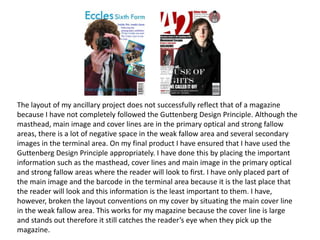
The layout of my ancillary project does not successfully reflect that of a magazine
because I have not completely followed the Guttenberg Design Principle. Although the
masthead, main image and cover lines are in the primary optical and strong fallow
areas, there is a lot of negative space in the weak fallow area and several secondary
images in the terminal area. On my final product I have ensured that I have used the
Guttenberg Design Principle appropriately. I have done this by placing the important
information such as the masthead, cover lines and main image in the primary optical
and strong fallow areas where the reader will look to first. I have only placed part of
the main image and the barcode in the terminal area because it is the last place that
the reader will look and this information is the least important to them. I have,
however, broken the layout conventions on my cover by situating the main cover line
in the weak fallow area. This works for my magazine because the cover line is large
and stands out therefore it still catches the reader’s eye when they pick up the
magazine.

Evaluation question 7

  • 1.
    Looking back atyour preliminary task, what do you feel you have learnt in the progression from it to the full product? Question 7
  • 2.
    Since completing theancillary project, my ability to use the correct lighting when taking a photograph has improved dramatically. The main image on my ancillary project cover is blurred and appears flat against the page due to the ISO setting of my camera and the natural light. After practising using a Digital SLR camera and soft box lighting in a studio, I have been able to create photographs which are bright, in focus and stand out against the page. Another way in which my photography as improved is through my use of composition and direct address. The image on my ancillary project does not address my reader through eye contact because the camera prop covers the model’s face. Since completing market research and analysing existing band images, I have found that by using direct address, you are involving your audience in your magazine, therefore I ensured that nothing was obscuring my model’s faces on my final product so that I could address my readers in this way.
  • 3.
    My ability tomanipulate text and images through Photoshop is another skill that I have improved since composing my ancillary product. In particular, I have learned to use the Polygonal Lasso Tool to successfully remove the background from my images. I have developed this skill from the ancillary project by altering how feathered the edges were to produce a more clean cut and refined finish. This allowed me to edit my images to a higher quality. I have also developed the way in which I use and manipulate font so that it is specific to the genre of my magazine, for example, serif font for a rock genre. In the ancillary project, I used the basic fonts provided by Photoshop which were inappropriate to a magazine cover because they were thin and did not stand out from the page. For my final product, I have taken fonts from dafont.com and manipulated them using the Stroke Tool before applying them to my magazine. By doing this, I have produced text that stands out and works well alongside the images and genre of my magazine. Examples of the font from my ancillary project (top) and final cover page (bottom)
  • 4.
    The layout ofmy ancillary project does not successfully reflect that of a magazine because I have not completely followed the Guttenberg Design Principle. Although the masthead, main image and cover lines are in the primary optical and strong fallow areas, there is a lot of negative space in the weak fallow area and several secondary images in the terminal area. On my final product I have ensured that I have used the Guttenberg Design Principle appropriately. I have done this by placing the important information such as the masthead, cover lines and main image in the primary optical and strong fallow areas where the reader will look to first. I have only placed part of the main image and the barcode in the terminal area because it is the last place that the reader will look and this information is the least important to them. I have, however, broken the layout conventions on my cover by situating the main cover line in the weak fallow area. This works for my magazine because the cover line is large and stands out therefore it still catches the reader’s eye when they pick up the magazine.