Alex KissEvaluation of magazine
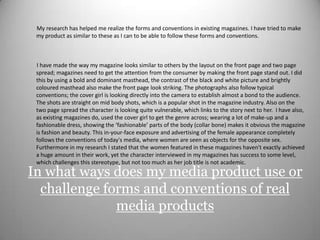
         My research has helped me realize the forms and conventions in existing magazines. I have tried to make my product as similar to these as I can to be able to follow these forms and conventions.          I have made the way my magazine looks similar to others by the layout on the front page and two page spread; magazines need to get the attention from the consumer by making the front page stand out. I did this by using a bold and dominant masthead, the contrast of the black and white picture and brightly coloured masthead also make the front page look striking. The photographs also follow typical conventions; the cover girl is looking directly into the camera to establish almost a bond to the audience. The shots are straight on mid body shots, which is a popular shot in the magazine industry. Also on the two page spread the character is looking quite vulnerable, which links to the story next to her.  I have also, as existing magazines do, used the cover girl to get the genre across; wearing a lot of make-up and a fashionable dress, showing the ‘fashionable’ parts of the body (collar bone) makes it obvious the magazine is fashion and beauty. This in-your-face exposure and advertising of the female appearance completely follows the conventions of today's media, where women are seen as objects for the opposite sex. Furthermore in my research I stated that the women featured in these magazines haven't exactly achieved a huge amount in their work, yet the character interviewed in my magazines has success to some level, which challenges this stereotype, but not too much as her job title is not academic. In what ways does my media product use or challenge forms and conventions of real media products
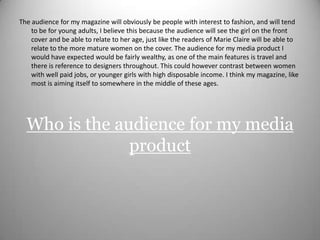
The audience for my magazine will obviously be people with interest to fashion, and will tend to be for young adults, I believe this because the audience will see the girl on the front cover and be able to relate to her age, just like the readers of Marie Claire will be able to relate to the more mature women on the cover. The audience for my media product I would have expected would be fairly wealthy, as one of the main features is travel and there is reference to designers throughout. This could however contrast between women with well paid jobs, or younger girls with high disposable income. I think my magazine, like most is aiming itself to somewhere in the middle of these ages. Who is the audience for my media product
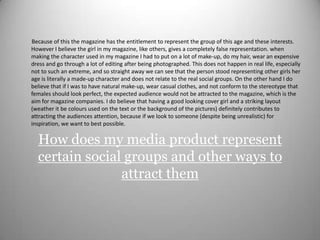
         Because of this the magazine has the entitlement to represent the group of this age and these interests. However I believe the girl in my magazine, like others, gives a completely false representation. when making the character used in my magazine I had to put on a lot of make-up, do my hair, wear an expensive dress and go through a lot of editing after being photographed. This does not happen in real life, especially not to such an extreme, and so straight away we can see that the person stood representing other girls her age is literally a made-up character and does not relate to the real social groups. On the other hand I do believe that if I was to have natural make-up, wear casual clothes, and not conform to the stereotype that females should look perfect, the expected audience would not be attracted to the magazine, which is the aim for magazine companies. I do believe that having a good looking cover girl and a striking layout (weather it be colours used on the text or the background of the pictures) definitely contributes to attracting the audiences attention, because if we look to someone (despite being unrealistic) for inspiration, we want to best possible. How does my media product represent certain social groups and other ways to attract them
        In comparison to my preliminary task I can see obvious differences from where I have learnt more into the production of magazines. I could have done a fashion magazine for my preliminary task however I thought I would learn more I worked on different genres.  I knew the basics of getting the genre across and getting the audience’s attention, but from my research I have learnt the general codes and conventions you have to consider with making a magazine, especially in fashion magazines. I have learnt to consider the group I am representing in my magazine and ways in which I can represent them. I have learnt about the the strong stereotypical view of women in today’s society, and also used this in my magazine.  I have also found better ways of making my magazine stand out to get the public’s attention. The text on my mock-up magazine is hard to see, yet after trying different approaches and looking at how well established magazines put their text on the front cover, I developed my knowledge and was able to make my front page easy to see and look reasonably attractive, I did this by making the masthead stand out (making the image black and white and using a contrasting and bold colour for the title) and also made the subtitles easy to see (if on a dark part of the picture use white font, and if on light parts use black font).        I have learnt the procedures the editors have to go through in order to make the pages and above all, make the models look how they do. For example I didn’t have a necessarily good Photoshop to use but yet there were many imperfections in my pictures yet I did manipulate them quite a bit. The one thing I didn’t learn is how to make a contents page work properly, I was happy with my mock up contents template but I completely disregarded this when making my real contents page; I tried to get a graphic feel to it but instead it just looked bare. Looking back at preliminary task, what do I feel I have learnt in progression from it to the full product and what I have learnt about technologies within this process

Evaluation

  • 1.
  • 2.
    My research has helped me realize the forms and conventions in existing magazines. I have tried to make my product as similar to these as I can to be able to follow these forms and conventions. I have made the way my magazine looks similar to others by the layout on the front page and two page spread; magazines need to get the attention from the consumer by making the front page stand out. I did this by using a bold and dominant masthead, the contrast of the black and white picture and brightly coloured masthead also make the front page look striking. The photographs also follow typical conventions; the cover girl is looking directly into the camera to establish almost a bond to the audience. The shots are straight on mid body shots, which is a popular shot in the magazine industry. Also on the two page spread the character is looking quite vulnerable, which links to the story next to her. I have also, as existing magazines do, used the cover girl to get the genre across; wearing a lot of make-up and a fashionable dress, showing the ‘fashionable’ parts of the body (collar bone) makes it obvious the magazine is fashion and beauty. This in-your-face exposure and advertising of the female appearance completely follows the conventions of today's media, where women are seen as objects for the opposite sex. Furthermore in my research I stated that the women featured in these magazines haven't exactly achieved a huge amount in their work, yet the character interviewed in my magazines has success to some level, which challenges this stereotype, but not too much as her job title is not academic. In what ways does my media product use or challenge forms and conventions of real media products
  • 3.
    The audience formy magazine will obviously be people with interest to fashion, and will tend to be for young adults, I believe this because the audience will see the girl on the front cover and be able to relate to her age, just like the readers of Marie Claire will be able to relate to the more mature women on the cover. The audience for my media product I would have expected would be fairly wealthy, as one of the main features is travel and there is reference to designers throughout. This could however contrast between women with well paid jobs, or younger girls with high disposable income. I think my magazine, like most is aiming itself to somewhere in the middle of these ages. Who is the audience for my media product
  • 4.
    Because of this the magazine has the entitlement to represent the group of this age and these interests. However I believe the girl in my magazine, like others, gives a completely false representation. when making the character used in my magazine I had to put on a lot of make-up, do my hair, wear an expensive dress and go through a lot of editing after being photographed. This does not happen in real life, especially not to such an extreme, and so straight away we can see that the person stood representing other girls her age is literally a made-up character and does not relate to the real social groups. On the other hand I do believe that if I was to have natural make-up, wear casual clothes, and not conform to the stereotype that females should look perfect, the expected audience would not be attracted to the magazine, which is the aim for magazine companies. I do believe that having a good looking cover girl and a striking layout (weather it be colours used on the text or the background of the pictures) definitely contributes to attracting the audiences attention, because if we look to someone (despite being unrealistic) for inspiration, we want to best possible. How does my media product represent certain social groups and other ways to attract them
  • 5.
    In comparison to my preliminary task I can see obvious differences from where I have learnt more into the production of magazines. I could have done a fashion magazine for my preliminary task however I thought I would learn more I worked on different genres.  I knew the basics of getting the genre across and getting the audience’s attention, but from my research I have learnt the general codes and conventions you have to consider with making a magazine, especially in fashion magazines. I have learnt to consider the group I am representing in my magazine and ways in which I can represent them. I have learnt about the the strong stereotypical view of women in today’s society, and also used this in my magazine.  I have also found better ways of making my magazine stand out to get the public’s attention. The text on my mock-up magazine is hard to see, yet after trying different approaches and looking at how well established magazines put their text on the front cover, I developed my knowledge and was able to make my front page easy to see and look reasonably attractive, I did this by making the masthead stand out (making the image black and white and using a contrasting and bold colour for the title) and also made the subtitles easy to see (if on a dark part of the picture use white font, and if on light parts use black font). I have learnt the procedures the editors have to go through in order to make the pages and above all, make the models look how they do. For example I didn’t have a necessarily good Photoshop to use but yet there were many imperfections in my pictures yet I did manipulate them quite a bit. The one thing I didn’t learn is how to make a contents page work properly, I was happy with my mock up contents template but I completely disregarded this when making my real contents page; I tried to get a graphic feel to it but instead it just looked bare. Looking back at preliminary task, what do I feel I have learnt in progression from it to the full product and what I have learnt about technologies within this process