In what ways does
your media product
use, develop or
challenge forms and
conventions of real
media products?
By Tom Jenkins

S
•

Our product conforms to many different conventions of real media
products. As the product is a hybrid of two different types of product
there are many generic conventions that appear.

•

Our product is a Nature channel for Young children, aged 5-12.
There are currently no channels like this but there are many
television shows of this genre.

•

In our research we have used a mixture of the two genre types,
using Nature websites such as Animal Planet, then using Finger Tips
as our children’s website.
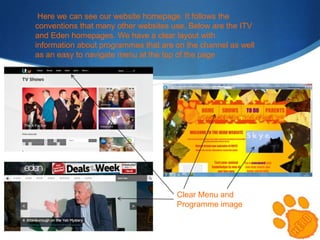
Here we can see our website homepage. It follows the
conventions that many other websites use. Below are the ITV
and Eden homepages. We have a clear layout with
information about programmes that are on the channel as well
as an easy to navigate menu at the top of the page

Clear Menu and
Programme image
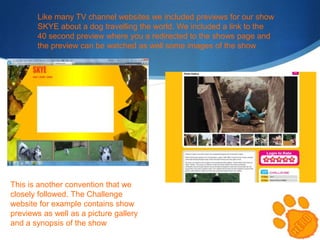
Like many TV channel websites we included previews for our show
SKYE about a dog travelling the world. We included a link to the
40 second preview where you a redirected to the shows page and
the preview can be watched as well some images of the show

This is another convention that we
closely followed. The Challenge
website for example contains show
previews as well as a picture gallery
and a synopsis of the show
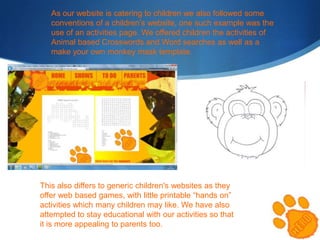
As our website is catering to children we also followed some
conventions of a children’s website, one such example was the
use of an activities page. We offered children the activities of
Animal based Crosswords and Word searches as well as a
make your own monkey mask template.

This also differs to generic children's websites as they
offer web based games, with little printable “hands on”
activities which many children may like. We have also
attempted to stay educational with our activities so that
it is more appealing to parents too.
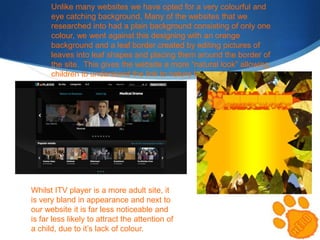
Unlike many websites we have opted for a very colourful and
eye catching background. Many of the websites that we
researched into had a plain background consisting of only one
colour, we went against this designing with an orange
background and a leaf border created by editing pictures of
leaves into leaf shapes and placing them around the border of
the site. This gives the website a more “natural look” allowing
children to understand the link to nature better.

Whilst ITV player is a more adult site, it
is very bland in appearance and next to
our website it is far less noticeable and
is far less likely to attract the attention of
a child, due to it’s lack of colour.
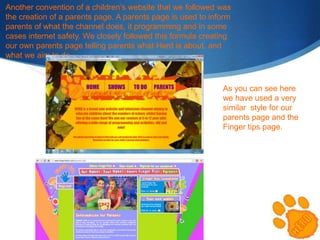
Another convention of a children’s website that we followed was
the creation of a parents page. A parents page is used to inform
parents of what the channel does, it programming and in some
cases internet safety. We closely followed this formula creating
our own parents page telling parents what Herd is about, and
what we aim to do .

As you can see here
we have used a very
similar style for our
parents page and the
Finger tips page.
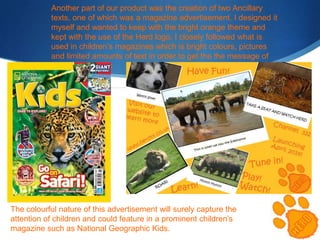
Another part of our product was the creation of two Ancillary
texts, one of which was a magazine advertisement. I designed it
myself and wanted to keep with the bright orange theme and
kept with the use of the Herd logo. I closely followed what is
used in children’s magazines which is bright colours, pictures
and limited amounts of text in order to get the the message of
the advert across

The colourful nature of this advertisement will surely capture the
attention of children and could feature in a prominent children’s
magazine such as National Geographic Kids.
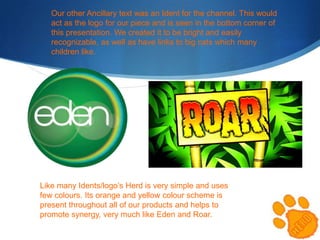
Our other Ancillary text was an Ident for the channel. This would
act as the logo for our piece and is seen in the bottom corner of
this presentation. We created it to be bright and easily
recognizable, as well as have links to big cats which many
children like.

Like many Idents/logo’s Herd is very simple and uses
few colours. Its orange and yellow colour scheme is
present throughout all of our products and helps to
promote synergy, very much like Eden and Roar.
Overall our products both challenge and follow conventions of
real media text. As our product is for children it uses
conventions of both standard television websites and children’s
websites too.
Our use of bright and eye catching design for our website really
challenges the conventions of a normal television channel
website which really appeals to our target audience.
The simple design used was a convention that we wanted to
follow closely as it does not only look appealing but it will also
help our target audience to use the website as they may have
little experience with a computer.
The use of a video preview was also a convention we followed
as it gives people an indication of what the website and the
channel has to offer. It also gave us the opportunity to show the
Ident off further promoting the Synergy that we want to convey
with the Herd logo.
I believe that we had a balanced use of conventions and
challenging them, and this worked for the best as we had the
simplicity of the website, mixed with the vibrancy and brand
recognition which will appeal to children and make them want to

Evaluation 1

  • 1.
    In what waysdoes your media product use, develop or challenge forms and conventions of real media products? By Tom Jenkins S
  • 2.
    • Our product conformsto many different conventions of real media products. As the product is a hybrid of two different types of product there are many generic conventions that appear. • Our product is a Nature channel for Young children, aged 5-12. There are currently no channels like this but there are many television shows of this genre. • In our research we have used a mixture of the two genre types, using Nature websites such as Animal Planet, then using Finger Tips as our children’s website.
  • 3.
    Here we cansee our website homepage. It follows the conventions that many other websites use. Below are the ITV and Eden homepages. We have a clear layout with information about programmes that are on the channel as well as an easy to navigate menu at the top of the page Clear Menu and Programme image
  • 4.
    Like many TVchannel websites we included previews for our show SKYE about a dog travelling the world. We included a link to the 40 second preview where you a redirected to the shows page and the preview can be watched as well some images of the show This is another convention that we closely followed. The Challenge website for example contains show previews as well as a picture gallery and a synopsis of the show
  • 5.
    As our websiteis catering to children we also followed some conventions of a children’s website, one such example was the use of an activities page. We offered children the activities of Animal based Crosswords and Word searches as well as a make your own monkey mask template. This also differs to generic children's websites as they offer web based games, with little printable “hands on” activities which many children may like. We have also attempted to stay educational with our activities so that it is more appealing to parents too.
  • 6.
    Unlike many websiteswe have opted for a very colourful and eye catching background. Many of the websites that we researched into had a plain background consisting of only one colour, we went against this designing with an orange background and a leaf border created by editing pictures of leaves into leaf shapes and placing them around the border of the site. This gives the website a more “natural look” allowing children to understand the link to nature better. Whilst ITV player is a more adult site, it is very bland in appearance and next to our website it is far less noticeable and is far less likely to attract the attention of a child, due to it’s lack of colour.
  • 7.
    Another convention ofa children’s website that we followed was the creation of a parents page. A parents page is used to inform parents of what the channel does, it programming and in some cases internet safety. We closely followed this formula creating our own parents page telling parents what Herd is about, and what we aim to do . As you can see here we have used a very similar style for our parents page and the Finger tips page.
  • 8.
    Another part ofour product was the creation of two Ancillary texts, one of which was a magazine advertisement. I designed it myself and wanted to keep with the bright orange theme and kept with the use of the Herd logo. I closely followed what is used in children’s magazines which is bright colours, pictures and limited amounts of text in order to get the the message of the advert across The colourful nature of this advertisement will surely capture the attention of children and could feature in a prominent children’s magazine such as National Geographic Kids.
  • 9.
    Our other Ancillarytext was an Ident for the channel. This would act as the logo for our piece and is seen in the bottom corner of this presentation. We created it to be bright and easily recognizable, as well as have links to big cats which many children like. Like many Idents/logo’s Herd is very simple and uses few colours. Its orange and yellow colour scheme is present throughout all of our products and helps to promote synergy, very much like Eden and Roar.
  • 10.
    Overall our productsboth challenge and follow conventions of real media text. As our product is for children it uses conventions of both standard television websites and children’s websites too. Our use of bright and eye catching design for our website really challenges the conventions of a normal television channel website which really appeals to our target audience. The simple design used was a convention that we wanted to follow closely as it does not only look appealing but it will also help our target audience to use the website as they may have little experience with a computer. The use of a video preview was also a convention we followed as it gives people an indication of what the website and the channel has to offer. It also gave us the opportunity to show the Ident off further promoting the Synergy that we want to convey with the Herd logo. I believe that we had a balanced use of conventions and challenging them, and this worked for the best as we had the simplicity of the website, mixed with the vibrancy and brand recognition which will appeal to children and make them want to