Europe:
Physical
Geography
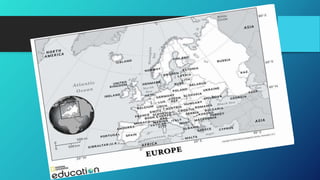
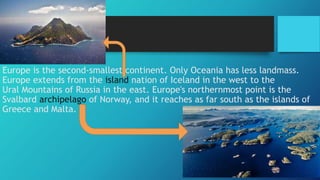
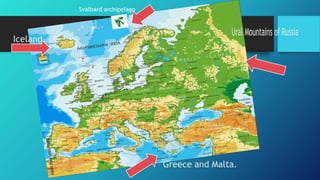
Europe is the second-smallest continent. Only Oceania has less landmass.
Europe extends from the island nation of Iceland in the west to the
Ural Mountains of Russia in the east. Europe's northernmost point is the
Svalbard archipelago of Norway, and it reaches as far south as the islands of
Greece and Malta.
Svalbard archipelago
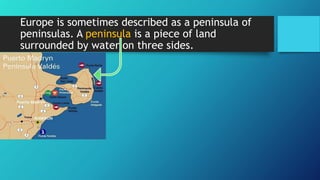
Europe is sometimes described as a peninsula of
peninsulas. A peninsula is a piece of land
surrounded by water on three sides.
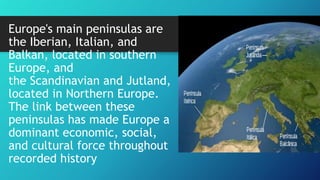
Europe's main peninsulas are
the Iberian, Italian, and
Balkan, located in southern
Europe, and
the Scandinavian and Jutland,
located in Northern Europe.
The link between these
peninsulas has made Europe a
dominant economic, social,
and cultural force throughout
recorded history
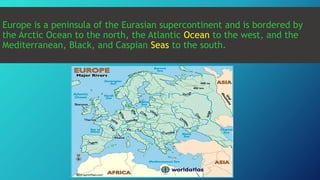
Europe is a peninsula of the Eurasian supercontinent and is bordered by
the Arctic Ocean to the north, the Atlantic Ocean to the west, and the
Mediterranean, Black, and Caspian Seas to the south.
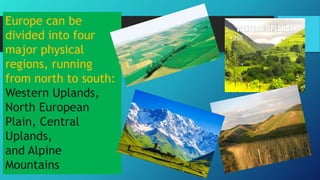
Europe can be
divided into four
major physical
regions, running
from north to south:
Western Uplands,
North European
Plain, Central
Uplands,
and Alpine
Mountains
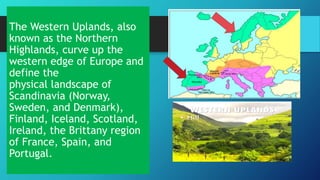
The Western Uplands, also
known as the Northern
Highlands, curve up the
western edge of Europe and
define the
physical landscape of
Scandinavia (Norway,
Sweden, and Denmark),
Finland, Iceland, Scotland,
Ireland, the Brittany region
of France, Spain, and
Portugal.
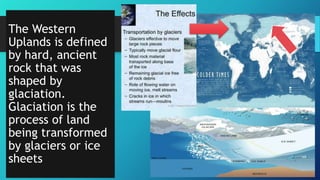
The Western
Uplands is defined
by hard, ancient
rock that was
shaped by
glaciation.
Glaciation is the
process of land
being transformed
by glaciers or ice
sheets
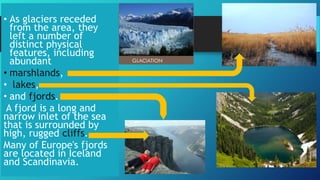
• As glaciers receded
from the area, they
left a number of
distinct physical
features, including
abundant
• marshlands,
• lakes,
• and fjords.
A fjord is a long and
narrow inlet of the sea
that is surrounded by
high, rugged cliffs.
Many of Europe's fjords
are located in Iceland
and Scandinavia.
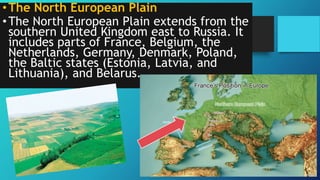
•The North European Plain
•The North European Plain extends from the
southern United Kingdom east to Russia. It
includes parts of France, Belgium, the
Netherlands, Germany, Denmark, Poland,
the Baltic states (Estonia, Latvia, and
Lithuania), and Belarus.
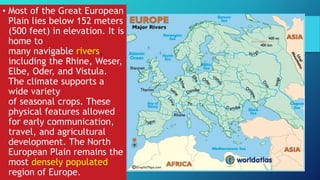
• Most of the Great European
Plain lies below 152 meters
(500 feet) in elevation. It is
home to
many navigable rivers,
including the Rhine, Weser,
Elbe, Oder, and Vistula.
The climate supports a
wide variety
of seasonal crops. These
physical features allowed
for early communication,
travel, and agricultural
development. The North
European Plain remains the
most densely populated
region of Europe.
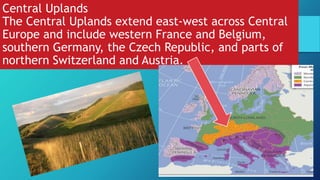
Central Uplands
The Central Uplands extend east-west across Central
Europe and include western France and Belgium,
southern Germany, the Czech Republic, and parts of
northern Switzerland and Austria.
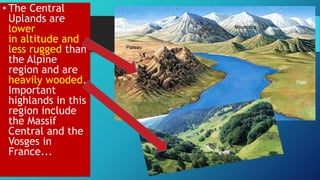
• The Central
Uplands are
lower
in altitude and
less rugged than
the Alpine
region and are
heavily wooded.
Important
highlands in this
region include
the Massif
Central and the
Vosges in
France...
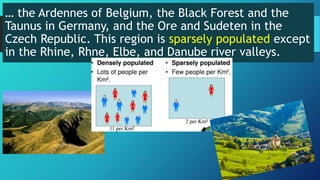
… the Ardennes of Belgium, the Black Forest and the
Taunus in Germany, and the Ore and Sudeten in the
Czech Republic. This region is sparsely populated except
in the Rhine, Rhne, Elbe, and Danube river valleys.
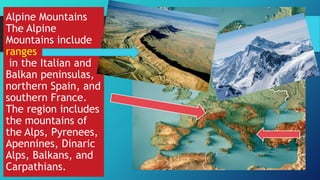
Alpine Mountains
The Alpine
Mountains include
ranges
in the Italian and
Balkan peninsulas,
northern Spain, and
southern France.
The region includes
the mountains of
the Alps, Pyrenees,
Apennines, Dinaric
Alps, Balkans, and
Carpathians.
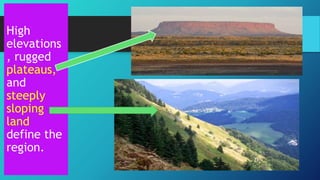
High
elevations
, rugged
plateaus,
and
steeply
sloping
land
define the
region.
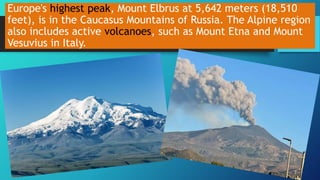
Europe's highest peak, Mount Elbrus at 5,642 meters (18,510
feet), is in the Caucasus Mountains of Russia. The Alpine region
also includes active volcanoes, such as Mount Etna and Mount
Vesuvius in Italy.

Europe Geography.pptx

  • 1.
  • 3.
    Europe is thesecond-smallest continent. Only Oceania has less landmass. Europe extends from the island nation of Iceland in the west to the Ural Mountains of Russia in the east. Europe's northernmost point is the Svalbard archipelago of Norway, and it reaches as far south as the islands of Greece and Malta.
  • 4.
  • 5.
    Europe is sometimesdescribed as a peninsula of peninsulas. A peninsula is a piece of land surrounded by water on three sides.
  • 6.
    Europe's main peninsulasare the Iberian, Italian, and Balkan, located in southern Europe, and the Scandinavian and Jutland, located in Northern Europe. The link between these peninsulas has made Europe a dominant economic, social, and cultural force throughout recorded history
  • 7.
    Europe is apeninsula of the Eurasian supercontinent and is bordered by the Arctic Ocean to the north, the Atlantic Ocean to the west, and the Mediterranean, Black, and Caspian Seas to the south.
  • 8.
    Europe can be dividedinto four major physical regions, running from north to south: Western Uplands, North European Plain, Central Uplands, and Alpine Mountains
  • 9.
    The Western Uplands,also known as the Northern Highlands, curve up the western edge of Europe and define the physical landscape of Scandinavia (Norway, Sweden, and Denmark), Finland, Iceland, Scotland, Ireland, the Brittany region of France, Spain, and Portugal.
  • 10.
    The Western Uplands isdefined by hard, ancient rock that was shaped by glaciation. Glaciation is the process of land being transformed by glaciers or ice sheets
  • 11.
    • As glaciersreceded from the area, they left a number of distinct physical features, including abundant • marshlands, • lakes, • and fjords. A fjord is a long and narrow inlet of the sea that is surrounded by high, rugged cliffs. Many of Europe's fjords are located in Iceland and Scandinavia.
  • 12.
    •The North EuropeanPlain •The North European Plain extends from the southern United Kingdom east to Russia. It includes parts of France, Belgium, the Netherlands, Germany, Denmark, Poland, the Baltic states (Estonia, Latvia, and Lithuania), and Belarus.
  • 13.
    • Most ofthe Great European Plain lies below 152 meters (500 feet) in elevation. It is home to many navigable rivers, including the Rhine, Weser, Elbe, Oder, and Vistula. The climate supports a wide variety of seasonal crops. These physical features allowed for early communication, travel, and agricultural development. The North European Plain remains the most densely populated region of Europe.
  • 14.
    Central Uplands The CentralUplands extend east-west across Central Europe and include western France and Belgium, southern Germany, the Czech Republic, and parts of northern Switzerland and Austria.
  • 15.
    • The Central Uplandsare lower in altitude and less rugged than the Alpine region and are heavily wooded. Important highlands in this region include the Massif Central and the Vosges in France...
  • 16.
    … the Ardennesof Belgium, the Black Forest and the Taunus in Germany, and the Ore and Sudeten in the Czech Republic. This region is sparsely populated except in the Rhine, Rhne, Elbe, and Danube river valleys.
  • 17.
    Alpine Mountains The Alpine Mountainsinclude ranges in the Italian and Balkan peninsulas, northern Spain, and southern France. The region includes the mountains of the Alps, Pyrenees, Apennines, Dinaric Alps, Balkans, and Carpathians.
  • 18.
  • 19.
    Europe's highest peak,Mount Elbrus at 5,642 meters (18,510 feet), is in the Caucasus Mountains of Russia. The Alpine region also includes active volcanoes, such as Mount Etna and Mount Vesuvius in Italy.