EU-US TRADE
Significance
 EU-US trade played an important role in
bringing close the former enemies US,
Germans and France.
 It helped to build Western Europe into an
economic fortification against the Soviet Bloc.
 A net positive economic impact on the world
economy
Framework of EU-US Trade
 U.S.-EU economic relations exist within a framework of
economic, political, and security factors.
 The U.S.-EU combined economic benefits dominates the
world economy(combined GDP=40% of world GDP).
 EU countries and US are roughly equivalent in economic
development.
 Intra-industry trade on advanced technologies and services
PastAreas of Economic Cooperation
 NATO (22 EU countries) deal with a number of
issues that pertain to foreign trade
 WTO and GATT play critical role in EU-U.S.
bilateral economic framework
 To lesser extent OECD is also an important
element in the U.S.-EU framework
 EU-US policies and practises are another
element of the bilateral economic framework.
Facts and Figures of Trade
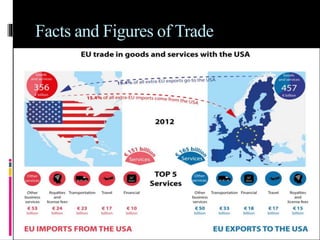
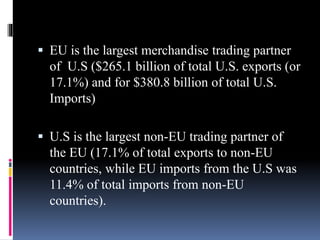
 EU is the largest merchandise trading partner
of U.S ($265.1 billion of total U.S. exports (or
17.1%) and for $380.8 billion of total U.S.
Imports)
 U.S is the largest non-EU trading partner of
the EU (17.1% of total exports to non-EU
countries, while EU imports from the U.S was
11.4% of total imports from non-EU
countries).
Future prospects of Economic ties
o Transatlantic Trade and Investment
Partnership (TTIP)
• Objectives
 Reaching a reasonable and balanced trade agreement
between the EU and US to eliminate customs duties.
 Making progress towards mutual recognition of EU / US
product standards or working towards transatlantic
standards
Conclusion
Foreign trade and investment data depict
strong, interdependent, and significant U.S.-
EU bilateral economic relationship. But at the
same time brings some challenges as well
(agricultural and agricultural-related
products).Therefore U.S. and EU policy
makers, have the to manage the increasingly
complex bilateral economic relationship in
ways that maximize benefits and keep
frictions to a minimum.

EU-US Trade

  • 1.
  • 3.
    Significance  EU-US tradeplayed an important role in bringing close the former enemies US, Germans and France.  It helped to build Western Europe into an economic fortification against the Soviet Bloc.  A net positive economic impact on the world economy
  • 4.
    Framework of EU-USTrade  U.S.-EU economic relations exist within a framework of economic, political, and security factors.  The U.S.-EU combined economic benefits dominates the world economy(combined GDP=40% of world GDP).  EU countries and US are roughly equivalent in economic development.  Intra-industry trade on advanced technologies and services
  • 5.
    PastAreas of EconomicCooperation  NATO (22 EU countries) deal with a number of issues that pertain to foreign trade  WTO and GATT play critical role in EU-U.S. bilateral economic framework  To lesser extent OECD is also an important element in the U.S.-EU framework  EU-US policies and practises are another element of the bilateral economic framework.
  • 6.
  • 7.
     EU isthe largest merchandise trading partner of U.S ($265.1 billion of total U.S. exports (or 17.1%) and for $380.8 billion of total U.S. Imports)  U.S is the largest non-EU trading partner of the EU (17.1% of total exports to non-EU countries, while EU imports from the U.S was 11.4% of total imports from non-EU countries).
  • 9.
    Future prospects ofEconomic ties o Transatlantic Trade and Investment Partnership (TTIP) • Objectives  Reaching a reasonable and balanced trade agreement between the EU and US to eliminate customs duties.  Making progress towards mutual recognition of EU / US product standards or working towards transatlantic standards
  • 10.
    Conclusion Foreign trade andinvestment data depict strong, interdependent, and significant U.S.- EU bilateral economic relationship. But at the same time brings some challenges as well (agricultural and agricultural-related products).Therefore U.S. and EU policy makers, have the to manage the increasingly complex bilateral economic relationship in ways that maximize benefits and keep frictions to a minimum.