The EU-US Transatlantic Trade and 
Investment Partnership 
(TTIP) 
Thae Nu Phoo Wai g5629046 
Zaw Zaw Oo g5639007
Introduction 
• TTIP is a trade agreement that is currently 
being negotiated between the United States 
and the European Union. 
• Partnership – designed to reduce barriers to 
trade between the two.
Timing 
• On February 13th 2013 the European Union 
and United States launched discussion on a 
Transatlantic Trade and Investment 
• 1stround of negotiations (July 2013) 
• 2nd round 7-10 October 
• 3rd round December 
• 4th round (March 2014 ) 
• 5th round May 2014 talks completed
European union(28 member states)
What countries are involved with TTIP? 
TTIP 
High Level Working Group 
United States Trade Representative Ambassador 
Michael Froman
TTIP is being hailed as one of the largest trade 
agreements in history . What kinds of number 
are we talking about? 
• World's largest trade market 
– 50% of world GDP and 30% of world trade 
– €1.8 billion/day and €723 billion/year of goods and 
services traded 
• 15 million transatlantic jobs 
• €2,4 trillion of mutual investment stocks
What exactly would TTIP do? 
• eliminate all trade tariffs and reduce non-tariff 
barriers 
• Tariffs between the U.S. and EU are already lower 
than an average of 4 percent 
• Non-tariff barriers is a main focus of the 
negotiations 
• Want to expand market access for trade in 
services 
• Industries got benefit from non-tariff barriers to 
market access.
EU imports from USA(2013) Source:http://trade.ec.europa.eu/doclib/ 
html/113465.htm
EU exports from USA(2013)
Objectives 
The main goal of TTIP is 
to remove regulatory ‘barriers’: 
• labor rights, 
• food safety rules, 
• the use of toxic chemicals, 
• digital privacy laws 
• new banking safeguards(to prevent a repeat 
of 2008 financial crisis)
Significance of TTIP 
Market integration, harmonization of 
standard 
• Estimated gains for the EU (€120 billion) 
and the US (€95 billion),once fully 
implemented. 
• EU exports to the US would go up by 
28%, (€187 billion worth of exports of EU 
goods and services). EU imports from the 
US would increase by €159 billion. 
• Estimated millions of Euros of savings, 
hundreds of thousands of jobs created. 
• Higher national income. 
• Boost trade by creating increased 
demand and supply without having to 
increase public spending or borrowing. 
•Decrease value added in production. 
•More difficult to access to EU-US market 
with mandatory standards and rules of 
origin. 
•Developing-country firms are hurt more 
by an increase in the stringency of 
standards and benefit less from 
economies of scale in integrated 
markets. 
For US 
and EU 
For the 
rest of 
the 
world
Raise one issue 
ISSUE: The U.S. is seen as having stronger rules 
in financial services, thus there may be more 
regulation to lose than gain in trade talks, while 
Europe touts its rules as superior in food safety 
and other sectors.
Raise one issue 
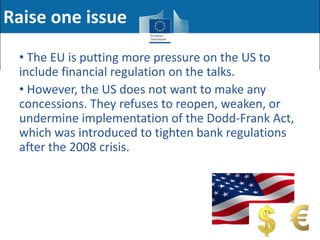
• The EU is putting more pressure on the US to 
include financial regulation on the talks. 
• However, the US does not want to make any 
concessions. They refuses to reopen, weaken, or 
undermine implementation of the Dodd-Frank Act, 
which was introduced to tighten bank regulations 
after the 2008 crisis.
Raise one issue 
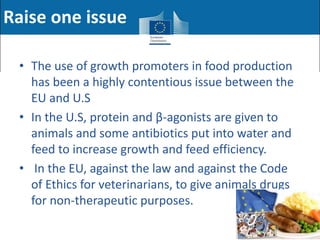
• The use of growth promoters in food production 
has been a highly contentious issue between the 
EU and U.S 
• In the U.S, protein and β-agonists are given to 
animals and some antibiotics put into water and 
feed to increase growth and feed efficiency. 
• In the EU, against the law and against the Code 
of Ethics for veterinarians, to give animals drugs 
for non-therapeutic purposes.
References 
• http://europa.eu/about-eu/ 
countries/member-countries/ 
index_en.htm 
• http://ec.europa.eu/trade/policy/in-focus/ 
ttip/about-ttip/ 
• http://www.faegrebd.com/20356 
• http://www.waronwant.org/campaigns/trade-justice/ 
more/inform/18078-what-is-ttip

TTIP

  • 1.
    The EU-US TransatlanticTrade and Investment Partnership (TTIP) Thae Nu Phoo Wai g5629046 Zaw Zaw Oo g5639007
  • 2.
    Introduction • TTIPis a trade agreement that is currently being negotiated between the United States and the European Union. • Partnership – designed to reduce barriers to trade between the two.
  • 3.
    Timing • OnFebruary 13th 2013 the European Union and United States launched discussion on a Transatlantic Trade and Investment • 1stround of negotiations (July 2013) • 2nd round 7-10 October • 3rd round December • 4th round (March 2014 ) • 5th round May 2014 talks completed
  • 4.
  • 5.
    What countries areinvolved with TTIP? TTIP High Level Working Group United States Trade Representative Ambassador Michael Froman
  • 6.
    TTIP is beinghailed as one of the largest trade agreements in history . What kinds of number are we talking about? • World's largest trade market – 50% of world GDP and 30% of world trade – €1.8 billion/day and €723 billion/year of goods and services traded • 15 million transatlantic jobs • €2,4 trillion of mutual investment stocks
  • 7.
    What exactly wouldTTIP do? • eliminate all trade tariffs and reduce non-tariff barriers • Tariffs between the U.S. and EU are already lower than an average of 4 percent • Non-tariff barriers is a main focus of the negotiations • Want to expand market access for trade in services • Industries got benefit from non-tariff barriers to market access.
  • 8.
    EU imports fromUSA(2013) Source:http://trade.ec.europa.eu/doclib/ html/113465.htm
  • 9.
    EU exports fromUSA(2013)
  • 10.
    Objectives The maingoal of TTIP is to remove regulatory ‘barriers’: • labor rights, • food safety rules, • the use of toxic chemicals, • digital privacy laws • new banking safeguards(to prevent a repeat of 2008 financial crisis)
  • 11.
    Significance of TTIP Market integration, harmonization of standard • Estimated gains for the EU (€120 billion) and the US (€95 billion),once fully implemented. • EU exports to the US would go up by 28%, (€187 billion worth of exports of EU goods and services). EU imports from the US would increase by €159 billion. • Estimated millions of Euros of savings, hundreds of thousands of jobs created. • Higher national income. • Boost trade by creating increased demand and supply without having to increase public spending or borrowing. •Decrease value added in production. •More difficult to access to EU-US market with mandatory standards and rules of origin. •Developing-country firms are hurt more by an increase in the stringency of standards and benefit less from economies of scale in integrated markets. For US and EU For the rest of the world
  • 12.
    Raise one issue ISSUE: The U.S. is seen as having stronger rules in financial services, thus there may be more regulation to lose than gain in trade talks, while Europe touts its rules as superior in food safety and other sectors.
  • 13.
    Raise one issue • The EU is putting more pressure on the US to include financial regulation on the talks. • However, the US does not want to make any concessions. They refuses to reopen, weaken, or undermine implementation of the Dodd-Frank Act, which was introduced to tighten bank regulations after the 2008 crisis.
  • 14.
    Raise one issue • The use of growth promoters in food production has been a highly contentious issue between the EU and U.S • In the U.S, protein and β-agonists are given to animals and some antibiotics put into water and feed to increase growth and feed efficiency. • In the EU, against the law and against the Code of Ethics for veterinarians, to give animals drugs for non-therapeutic purposes.
  • 15.
    References • http://europa.eu/about-eu/ countries/member-countries/ index_en.htm • http://ec.europa.eu/trade/policy/in-focus/ ttip/about-ttip/ • http://www.faegrebd.com/20356 • http://www.waronwant.org/campaigns/trade-justice/ more/inform/18078-what-is-ttip