EU Food Law
Institutional structure and basic principles
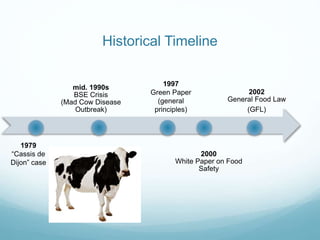
Historical Timeline
mid. 1990s
BSE Crisis
(Mad Cow Disease
Outbreak)
2000
White Paper on Food
Safety
2002
General Food Law
(GFL)
1979
“Cassis de
Dijon” case
1997
Green Paper
(general
principles)
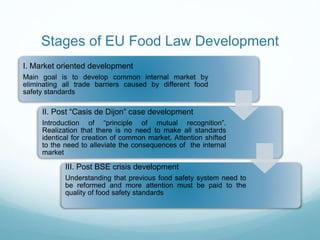
Stages of EU Food Law Development
I. Market oriented development
Main goal is to develop common internal market by
eliminating all trade barriers caused by different food
safety standards
II. Post “Casis de Dijon” case development
Introduction of “principle of mutual recognition”.
Realization that there is no need to make all standards
identical for creation of common market. Attention shifted
to the need to alleviate the consequences of the internal
market
III. Post BSE crisis development
Understanding that previous food safety system need to
be reformed and more attention must be paid to the
quality of food safety standards
Institutional structure
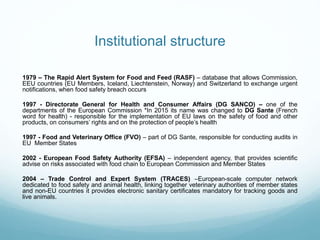
1979 – The Rapid Alert System for Food and Feed (RASF) – database that allows Commission,
EEU countries (EU Members, Iceland, Liechtenstein, Norway) and Switzerland to exchange urgent
notifications, when food safety breach occurs
1997 - Directorate General for Health and Consumer Affairs (DG SANCO) – one of the
departments of the European Commission *In 2015 its name was changed to DG Sante (French
word for health) - responsible for the implementation of EU laws on the safety of food and other
products, on consumers’ rights and on the protection of people’s health
1997 - Food and Veterinary Office (FVO) – part of DG Sante, responsible for conducting audits in
EU Member States
2002 - European Food Safety Authority (EFSA) – independent agency, that provides scientific
advise on risks associated with food chain to European Commission and Member States
2004 – Trade Control and Expert System (TRACES) –European-scale computer network
dedicated to food safety and animal health, linking together veterinary authorities of member states
and non-EU countries it provides electronic sanitary certificates mandatory for tracking goods and
live animals.
Institutional structure
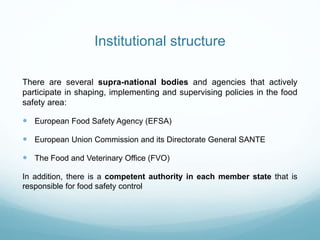
There are several supra-national bodies and agencies that actively
participate in shaping, implementing and supervising policies in the food
safety area:
 European Food Safety Agency (EFSA)
 European Union Commission and its Directorate General SANTE
 The Food and Veterinary Office (FVO)
In addition, there is a competent authority in each member state that is
responsible for food safety control
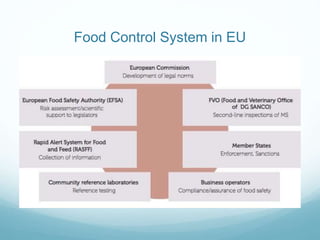
Food Control System in EU
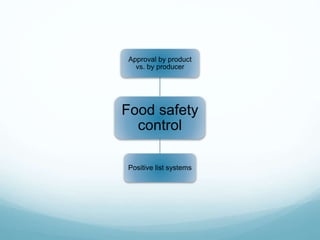
Food safety
control
Approval by product
vs. by producer
Positive list systems
General Food Law
(Regulation 178/2002 dated 28 January 2002)
 Established the European Food Safety Authority (EFSA)
 Listed general principles of the EU Food law
 Established common definition of food
Legal instruments
There are three main types of legal acts used in the European Union:
 Regulations - legal acts that are directly applicable in member states, have the
power of laws and supersede national laws; they incorporate implementation
mechanisms
 Directives establish objectives that are compulsory to member states, but require
transposition into national law as they do not include implementation mechanisms
 Decisions can be addressed to both member states and specific entities; they are
directly applicable but usually cover a narrow topic or issue
In recent years, the European Union has moved to the control of food safety through
regulations (earlier – mostly directives)
That way, all the most important aspects of food control are regulated through
regulations thus creating a high level of harmonization and uniformity in the member
states.
Definition of Food (Article 2 GFL)
‘Food’ (or ‘foodstuff’) means any substance or product, whether processed,
partially processed or unprocessed, intended to be, or reasonably expected
to be ingested by humans. ‘Food’ includes drink, chewing gum and any
substance, including water, intentionally incorporated into the food during its
manufacture, preparation or treatment. (…) ‘Food’ shall not include: (a) feed;
(b) live animals unless they are prepared for placing on the market for human
consumption33; (c) plants prior to harvesting; (d) medicinal products (…) (e)
cosmetics (…) (f) tobacco and tobacco products (…) (g) narcotic or
psychotropic substances within the meaning of the United Nations Single
Convention on Narcotic Drugs, 1961, and the United Nations Convention on
Psychotropic Substances, 1971; (h) residues and contaminants.
 In contrast to the US legislation EU’s definition of food does not include
animal feed
Main principles (Art.5-7 GFL)
 Science-based risk assessment
 Precautionary principle
 Conformation with international standards
 Transparency
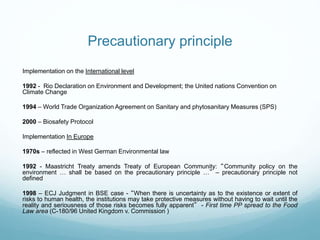
Precautionary principle
Implementation on the International level
1992 - Rio Declaration on Environment and Development; the United nations Convention on
Climate Change
1994 – World Trade Organization Agreement on Sanitary and phytosanitary Measures (SPS)
2000 – Biosafety Protocol
Implementation In Europe
1970s – reflected in West German Environmental law
1992 - Maastricht Treaty amends Treaty of European Community: “Community policy on the
environment … shall be based on the precautionary principle …” – precautionary principle not
defined
1998 – ECJ Judgment in BSE case - “When there is uncertainty as to the existence or extent of
risks to human health, the institutions may take protective measures without having to wait until the
reality and seriousness of those risks becomes fully apparent” - First time PP spread to the Food
Law area (C-180/96 United Kingdom v. Commission )
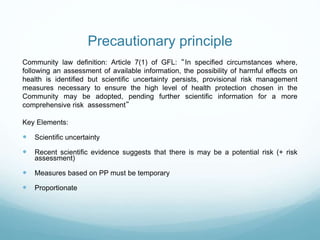
Precautionary principle
Community law definition: Article 7(1) of GFL: “In specified circumstances where,
following an assessment of available information, the possibility of harmful effects on
health is identified but scientific uncertainty persists, provisional risk management
measures necessary to ensure the high level of health protection chosen in the
Community may be adopted, pending further scientific information for a more
comprehensive risk assessment”
Key Elements:
 Scientific uncertainty
 Recent scientific evidence suggests that there is may be a potential risk (+ risk
assessment)
 Measures based on PP must be temporary
 Proportionate
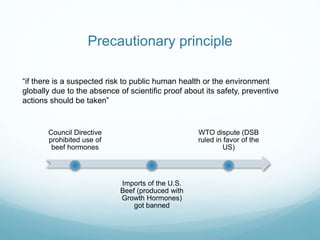
Precautionary principle
“if there is a suspected risk to public human health or the environment
globally due to the absence of scientific proof about its safety, preventive
actions should be taken”
Council Directive
prohibited use of
beef hormones
Imports of the U.S.
Beef (produced with
Growth Hormones)
got banned
WTO dispute (DSB
ruled in favor of the
US)
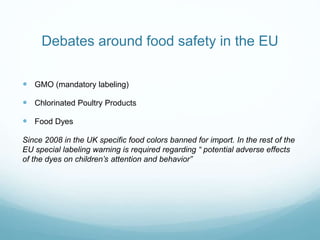
Debates around food safety in the EU
 GMO (mandatory labeling)
 Chlorinated Poultry Products
 Food Dyes
Since 2008 in the UK specific food colors banned for import. In the rest of the
EU special labeling warning is required regarding “ potential adverse effects
of the dyes on children’s attention and behavior”
Implementation of risk-based approach
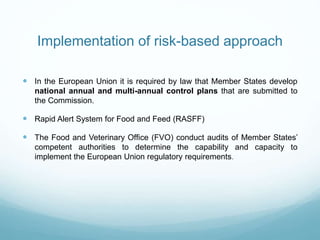
 In the European Union it is required by law that Member States develop
national annual and multi-annual control plans that are submitted to
the Commission.
 Rapid Alert System for Food and Feed (RASFF)
 The Food and Veterinary Office (FVO) conduct audits of Member States’
competent authorities to determine the capability and capacity to
implement the European Union regulatory requirements.
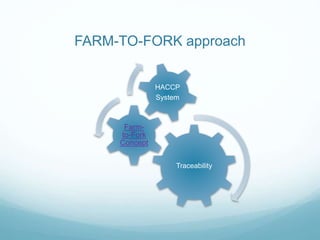
FARM-TO-FORK approach
Traceability
Farm-
to-Fork
Concept
HACCP
System
Recent developments
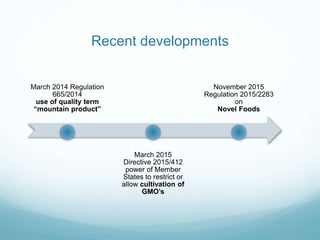
March 2014 Regulation
665/2014
use of quality term
“mountain product”
March 2015
Directive 2015/412
power of Member
States to restrict or
allow cultivation of
GMO’s
November 2015
Regulation 2015/2283
on
Novel Foods

EU Food Law part I

  • 1.
    EU Food Law Institutionalstructure and basic principles
  • 2.
    Historical Timeline mid. 1990s BSECrisis (Mad Cow Disease Outbreak) 2000 White Paper on Food Safety 2002 General Food Law (GFL) 1979 “Cassis de Dijon” case 1997 Green Paper (general principles)
  • 3.
    Stages of EUFood Law Development I. Market oriented development Main goal is to develop common internal market by eliminating all trade barriers caused by different food safety standards II. Post “Casis de Dijon” case development Introduction of “principle of mutual recognition”. Realization that there is no need to make all standards identical for creation of common market. Attention shifted to the need to alleviate the consequences of the internal market III. Post BSE crisis development Understanding that previous food safety system need to be reformed and more attention must be paid to the quality of food safety standards
  • 4.
    Institutional structure 1979 –The Rapid Alert System for Food and Feed (RASF) – database that allows Commission, EEU countries (EU Members, Iceland, Liechtenstein, Norway) and Switzerland to exchange urgent notifications, when food safety breach occurs 1997 - Directorate General for Health and Consumer Affairs (DG SANCO) – one of the departments of the European Commission *In 2015 its name was changed to DG Sante (French word for health) - responsible for the implementation of EU laws on the safety of food and other products, on consumers’ rights and on the protection of people’s health 1997 - Food and Veterinary Office (FVO) – part of DG Sante, responsible for conducting audits in EU Member States 2002 - European Food Safety Authority (EFSA) – independent agency, that provides scientific advise on risks associated with food chain to European Commission and Member States 2004 – Trade Control and Expert System (TRACES) –European-scale computer network dedicated to food safety and animal health, linking together veterinary authorities of member states and non-EU countries it provides electronic sanitary certificates mandatory for tracking goods and live animals.
  • 5.
    Institutional structure There areseveral supra-national bodies and agencies that actively participate in shaping, implementing and supervising policies in the food safety area:  European Food Safety Agency (EFSA)  European Union Commission and its Directorate General SANTE  The Food and Veterinary Office (FVO) In addition, there is a competent authority in each member state that is responsible for food safety control
  • 6.
  • 7.
    Food safety control Approval byproduct vs. by producer Positive list systems
  • 8.
    General Food Law (Regulation178/2002 dated 28 January 2002)  Established the European Food Safety Authority (EFSA)  Listed general principles of the EU Food law  Established common definition of food
  • 9.
    Legal instruments There arethree main types of legal acts used in the European Union:  Regulations - legal acts that are directly applicable in member states, have the power of laws and supersede national laws; they incorporate implementation mechanisms  Directives establish objectives that are compulsory to member states, but require transposition into national law as they do not include implementation mechanisms  Decisions can be addressed to both member states and specific entities; they are directly applicable but usually cover a narrow topic or issue In recent years, the European Union has moved to the control of food safety through regulations (earlier – mostly directives) That way, all the most important aspects of food control are regulated through regulations thus creating a high level of harmonization and uniformity in the member states.
  • 10.
    Definition of Food(Article 2 GFL) ‘Food’ (or ‘foodstuff’) means any substance or product, whether processed, partially processed or unprocessed, intended to be, or reasonably expected to be ingested by humans. ‘Food’ includes drink, chewing gum and any substance, including water, intentionally incorporated into the food during its manufacture, preparation or treatment. (…) ‘Food’ shall not include: (a) feed; (b) live animals unless they are prepared for placing on the market for human consumption33; (c) plants prior to harvesting; (d) medicinal products (…) (e) cosmetics (…) (f) tobacco and tobacco products (…) (g) narcotic or psychotropic substances within the meaning of the United Nations Single Convention on Narcotic Drugs, 1961, and the United Nations Convention on Psychotropic Substances, 1971; (h) residues and contaminants.  In contrast to the US legislation EU’s definition of food does not include animal feed
  • 11.
    Main principles (Art.5-7GFL)  Science-based risk assessment  Precautionary principle  Conformation with international standards  Transparency
  • 12.
    Precautionary principle Implementation onthe International level 1992 - Rio Declaration on Environment and Development; the United nations Convention on Climate Change 1994 – World Trade Organization Agreement on Sanitary and phytosanitary Measures (SPS) 2000 – Biosafety Protocol Implementation In Europe 1970s – reflected in West German Environmental law 1992 - Maastricht Treaty amends Treaty of European Community: “Community policy on the environment … shall be based on the precautionary principle …” – precautionary principle not defined 1998 – ECJ Judgment in BSE case - “When there is uncertainty as to the existence or extent of risks to human health, the institutions may take protective measures without having to wait until the reality and seriousness of those risks becomes fully apparent” - First time PP spread to the Food Law area (C-180/96 United Kingdom v. Commission )
  • 13.
    Precautionary principle Community lawdefinition: Article 7(1) of GFL: “In specified circumstances where, following an assessment of available information, the possibility of harmful effects on health is identified but scientific uncertainty persists, provisional risk management measures necessary to ensure the high level of health protection chosen in the Community may be adopted, pending further scientific information for a more comprehensive risk assessment” Key Elements:  Scientific uncertainty  Recent scientific evidence suggests that there is may be a potential risk (+ risk assessment)  Measures based on PP must be temporary  Proportionate
  • 14.
    Precautionary principle “if thereis a suspected risk to public human health or the environment globally due to the absence of scientific proof about its safety, preventive actions should be taken” Council Directive prohibited use of beef hormones Imports of the U.S. Beef (produced with Growth Hormones) got banned WTO dispute (DSB ruled in favor of the US)
  • 15.
    Debates around foodsafety in the EU  GMO (mandatory labeling)  Chlorinated Poultry Products  Food Dyes Since 2008 in the UK specific food colors banned for import. In the rest of the EU special labeling warning is required regarding “ potential adverse effects of the dyes on children’s attention and behavior”
  • 16.
    Implementation of risk-basedapproach  In the European Union it is required by law that Member States develop national annual and multi-annual control plans that are submitted to the Commission.  Rapid Alert System for Food and Feed (RASFF)  The Food and Veterinary Office (FVO) conduct audits of Member States’ competent authorities to determine the capability and capacity to implement the European Union regulatory requirements.
  • 17.
  • 18.
    Recent developments March 2014Regulation 665/2014 use of quality term “mountain product” March 2015 Directive 2015/412 power of Member States to restrict or allow cultivation of GMO’s November 2015 Regulation 2015/2283 on Novel Foods

Editor's Notes

  • #18 Regulation 178/2002 outlines the general principles of food law and requires that all food businesses must have in place a traceability system. The regulation is minimal in its description of what is required and it would in no way reflect what is considered to be best practice. The legal minimum is a system in which a food business records what ingredients/food products it receives and from who (including contact details) together with what product it dispatches to which customers (including their details) with the only exception being direct supply to final consumers. Food business operators subject to S.I. No. 747 of 2007 as amended, must maintain traceability records for all food at least until it can be reasonably assumed that the food has been consumed. For food of animal origin the traceability information must be updated on a daily basis. It must be made clearly and unequivocally available to and retrievable by the food business operator to whom the food is supplied. For sprouts and seeds intended for the production of sprouts the food business must also update the records and transmit the relevant information on a daily basis  Food business operators registered or approved under S.I. No. 432 of 2009 (generally processors, manufacturers and cold stores handing foods of animal origin including seafood), must maintain records for three years in all cases