Ethnography in The Everyday
Simone Belli1
Kathleen A. Steeves2
Patrick G. Watson2
1Yachay Tech, Ecuador
2McMaster University, Canada
Assignment
Go south of the conference site and conduct a ‘spot ethnography’ in a multicultural
supermarket
Spend (about) two hours in the field, in an effort to ‘demystify’ ethnography
Background
Belli - Social Psychology of Emotions; Human-Computer Interaction; Innovation;
Multimodal Analysis of Socio-Tech
Steeves - Sociology of Religions; Interactionism; Deities; Women in Clergyhood
Watson - Sociology of Knowledge; Science, Technology and Society; Evidence in
Socio-Legal Studies; Ethnomethodology & Ethnography
Starting Points…?
Interest in video and ethnography - could we record some aspects of
supermarket interaction that avail themselves to analysis?
Could we examine the multi-modality of supermarket interaction through cross-
cultural exchanges?
Could we examine mobilizations/manifestations of culture in an institution
claiming unique multicultural status?
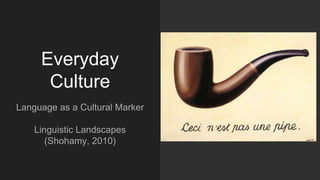
Everyday
Culture
Language as a Cultural Marker
Linguistic Landscapes
(Shohamy, 2010)
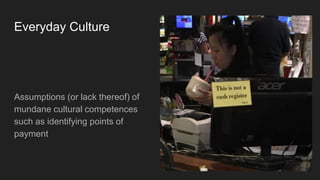
Everyday Culture
Assumptions (or lack thereof) of
mundane cultural competences
such as identifying points of
payment
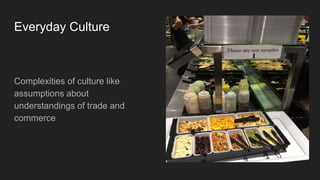
Everyday Culture
Complexities of culture like
assumptions about
understandings of trade and
commerce
Everyday Culture
Different cultures, different orientations to space and
objects
Advisors for different use of the same place.
Everyday Culture
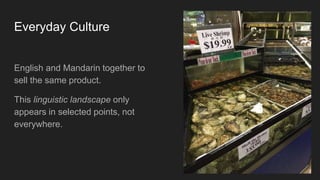
English and Mandarin together to
sell the same product.
This linguistic landscape only
appears in selected points, not
everywhere.
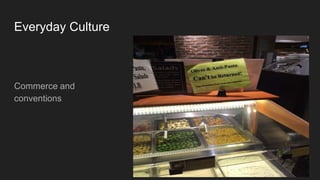
Commerce and
conventions
Everyday Culture
Everyday Culture
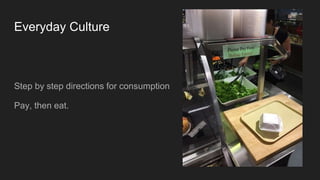
Step by step directions for consumption
Pay, then eat.
Shopping
Culture
Specific Practices In Food
Selection
Tasting, smelling, etc.
The customer's expertise
But where does the
camera go when the
shopper raises his
head from the
melons?
Ethnographic Culture?
Ethnography as the ‘view from mars’, ‘finding the strange in the everyday’, ‘the
world in a grain of sand’, etc…
Ethnographic culture as an abdication of ‘local’ or ‘domestic’ culture - partaking
in a series of ‘culturally strange’ activities such as awkwardly observing,
videoing, note-taking, occupying shopping space while not conducting shopping
activities, etc…
Abdication of conventional Ethnographic culture – no no recourse to
gatekeepers, no interaction with respondents, no IRB, etc...
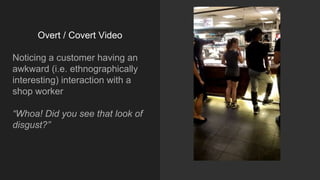
Overt / Covert Video
Noticing a customer having an
awkward (i.e. ethnographically
interesting) interaction with a
shop worker
“Whoa! Did you see that look of
disgust?”
Overt / Covert Video
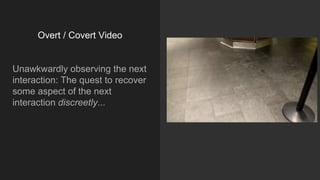
Unawkwardly observing the next
interaction: The quest to recover
some aspect of the next
interaction discreetly...
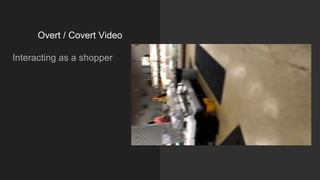
Overt / Covert Video
Interacting as a shopper
“When we do our science we think and speak scientifically.
When we move around the mundane world, we speak and
think commonsensically. Such classification systems are
normative, regulative, and hence pre-structure the world for
us, but in ways which enable us to make it our own.”
(Anderson & Sharrock, 1993, p. 147, emphasis original)
Conclusions
Everyday markers of culture, but also markers that indicate areas where an
assumed shared culture has (evidently) gone missing
But Ethnographer-in-Culture is a distinctly non-everyday experience - even this
ethnography is a departure from conventional ethnographic norms/culture
A-Welcomed Ethnography (not welcomed, not unwelcomed)
Is ‘demystifying’ ethnography even a desirable outcome, or should ethnography
always feel strange, even for experienced ethnographers?
Thanks!
sbelli@yachaytech.edu.ec
steeveka@mcmaster.ca
watsonp@mcmaster.ca
@pgwphd

Ethnography in the everyday

  • 1.
    Ethnography in TheEveryday Simone Belli1 Kathleen A. Steeves2 Patrick G. Watson2 1Yachay Tech, Ecuador 2McMaster University, Canada
  • 2.
    Assignment Go south ofthe conference site and conduct a ‘spot ethnography’ in a multicultural supermarket Spend (about) two hours in the field, in an effort to ‘demystify’ ethnography
  • 3.
    Background Belli - SocialPsychology of Emotions; Human-Computer Interaction; Innovation; Multimodal Analysis of Socio-Tech Steeves - Sociology of Religions; Interactionism; Deities; Women in Clergyhood Watson - Sociology of Knowledge; Science, Technology and Society; Evidence in Socio-Legal Studies; Ethnomethodology & Ethnography
  • 4.
    Starting Points…? Interest invideo and ethnography - could we record some aspects of supermarket interaction that avail themselves to analysis? Could we examine the multi-modality of supermarket interaction through cross- cultural exchanges? Could we examine mobilizations/manifestations of culture in an institution claiming unique multicultural status?
  • 6.
    Everyday Culture Language as aCultural Marker Linguistic Landscapes (Shohamy, 2010)
  • 7.
    Everyday Culture Assumptions (orlack thereof) of mundane cultural competences such as identifying points of payment
  • 8.
    Everyday Culture Complexities ofculture like assumptions about understandings of trade and commerce
  • 9.
    Everyday Culture Different cultures,different orientations to space and objects Advisors for different use of the same place.
  • 10.
    Everyday Culture English andMandarin together to sell the same product. This linguistic landscape only appears in selected points, not everywhere.
  • 12.
  • 13.
    Everyday Culture Step bystep directions for consumption Pay, then eat.
  • 14.
    Shopping Culture Specific Practices InFood Selection Tasting, smelling, etc. The customer's expertise
  • 15.
    But where doesthe camera go when the shopper raises his head from the melons?
  • 16.
    Ethnographic Culture? Ethnography asthe ‘view from mars’, ‘finding the strange in the everyday’, ‘the world in a grain of sand’, etc… Ethnographic culture as an abdication of ‘local’ or ‘domestic’ culture - partaking in a series of ‘culturally strange’ activities such as awkwardly observing, videoing, note-taking, occupying shopping space while not conducting shopping activities, etc… Abdication of conventional Ethnographic culture – no no recourse to gatekeepers, no interaction with respondents, no IRB, etc...
  • 17.
    Overt / CovertVideo Noticing a customer having an awkward (i.e. ethnographically interesting) interaction with a shop worker “Whoa! Did you see that look of disgust?”
  • 18.
    Overt / CovertVideo Unawkwardly observing the next interaction: The quest to recover some aspect of the next interaction discreetly...
  • 19.
    Overt / CovertVideo Interacting as a shopper
  • 20.
    “When we doour science we think and speak scientifically. When we move around the mundane world, we speak and think commonsensically. Such classification systems are normative, regulative, and hence pre-structure the world for us, but in ways which enable us to make it our own.” (Anderson & Sharrock, 1993, p. 147, emphasis original)
  • 21.
    Conclusions Everyday markers ofculture, but also markers that indicate areas where an assumed shared culture has (evidently) gone missing But Ethnographer-in-Culture is a distinctly non-everyday experience - even this ethnography is a departure from conventional ethnographic norms/culture A-Welcomed Ethnography (not welcomed, not unwelcomed) Is ‘demystifying’ ethnography even a desirable outcome, or should ethnography always feel strange, even for experienced ethnographers?
  • 22.

Editor's Notes

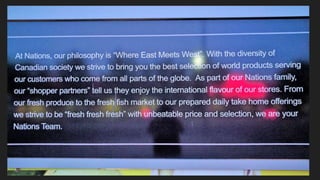
  • #6 Nations isn’t just any supermarket, it’s one that is relatively new and caters specifically to a multicultural clientele Overtones of Edward Said’s ‘Orientalism’ (Where East meets West and the implied difference of the two, i.e. cultural distinction).
  • #8 Culture becoming evident through apparent breaches of assumed cultural norms
  • #17 Ethnography’s history is of learning a new culture (i.e. Mead, Evans Pritchard, Mauss, etc…) However it’s adoption in Sociology involved a suspension or bracketing of presumed shared cultural norms – observing as the viewer from Mars, etc…. Ethnographic culture means stepping out of or bracketing the domestic culture and engaging in culturally peculiar practices But on top of that, we’re doing a particularly weird ethnography, one without a strongly defined research question, without a
  • #18 The ethnographic urge to say something of interest – what can we make of what we’re observing in this environment that’s worthy of story telling/explanation?
  • #20 Where am I shooting this from? How is Kathleen interacting with the shop keeper? – as a customer, not as an ethnographer What does this say about our collective orientation to the task of conducting an ethnography? But note Kathleen’s choice of topics, the killing and cleaning of live fish, in relation to her sociological interest in Everette Hughes (1962) Good People and Dirty Work as opposed to some ‘genuine’ interest in the mundane work of fish mongering.
  • #21 Certainly no problem in doing ‘ethnography’ through awkward or a-typical circumstances. However, here, we organize our interactions as ‘participants as shoppers’ as opposed to ‘participants as participant observers’ - not letting on that we’re not really here to buy fish...
  • #22 In a space that makes every effort to be multicultural, Ethnographic norms - gatekeepers, informants, IRBs, informed consent, interaction with participants, well defined research question or at least field site, etc... A-welcomed as mirroring ‘amorality’ moral = welcome, unmoral = unwelcome, amoral = a-welcome Can we demystify ethnography? Why would we want to?