 UNIVERSITI UTARA MALAYSIA
 Ungku Intan Dianna Binti Ungku A Bakar
 Noorul Ashikin Binti Zulkarnain
 Mohammed Rezaul Karim
 Chwa See Chew
 Wong Chee Leong
A Discourse in the difference ethnic group
 to study the history of Sabah and Sarawak.
 to identify the background of certain ethnic in
Sabah and Sarawak.
 to identify the similarities and difference
between those ethnics.
 to highlights the ethnic relationship in Sabah
and Sarawak.
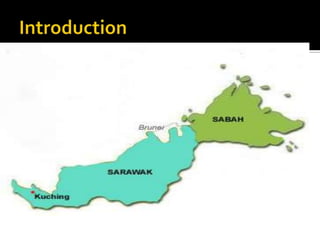
 The Brooke dynasty ruled Sarawak for a
hundred years
 James Brooke was appointed Raja by the
Sultan of Brunei on 18 August 1842
 Sarawak was officially granted independence
on 22 July 1963 (joined with Malaya, Sabah,
and Singapore, in the federation of Malaysia.)
 home to 27 ethnic groups, each with own
distinct language and culture.
The various Orang Ulu ethnics together make up
roughly 6% of Sarawak's population.
Major tribes making up the Orang Ulu group
include:
 Kayan
 Lun Bawang
 Kelabit
 Kenyah
 Penan
 Bisaya
 close ties to the Lun Bawang
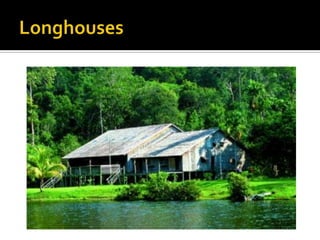
 live in inherited longhouses and practice a
generations-old form of agriculture.
 Population:approximately 5,000 people.
 Ethnic group received visits from Christian
missionaries.The Kelabit are now
predominantlyChristian
 sometimes referred as “Land Dayaks”.
 second largest Dayak ethnic group in
Sarawak.
 worked by rotational agriculture and hunting
based around farms.
 Today, almost all the traditional longhouse-
villages have been replaced by individual
houses.
 Fruit trees especially Durian remain
important property of market.
 known as “Sea Dayaks” by British.
 largest people group in Sarawak
 main indigenous people group in Brunei
 main occupation is farming, hunt wild animal in the
jungle.
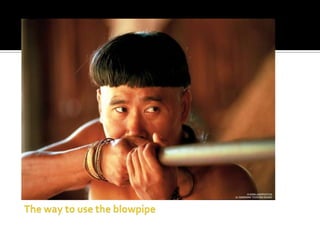
 the weapons used are the blowpipe. Nowadays, they
trained dog to run down their prey.
 lived in longhouses.
 Nowadays, begin to abandon the longhouse style of
living
 No longer rely on the forest’s resources to survive.
Instead, they are migrating to the cities.
 they are mostly Christians and Muslim
 Malanau are considered among the earliest
settlers in Sarawak.
 They make up about 6% of Sarawak’s total
population.
 They have never called themselves as Malanau
until recently.
 They call themselves ‘alikou’ meaning people of
the river.
 Then, where is the name Malanau come from?
 Most of them are farmers, fisherman, sago
producers, and traders.
 They have abandoned their original religion-Liko.
Nowadays, Majority of them are either Christians
or Muslims.
 originally migrated from Sumatra.
 Basically, speak language (called Bahasa
Melayu Sarawak)
 lived along the coast and worked as
fishermen.
 Definitely, they are Muslim...
 Huge majority of the Malays in Sarawak were
not actually Malays but ethnics of Indonesian
origin
 1761- Alexander Dalrymple,concluded an agreement
with the Sultan of Sulu.
 1846 -the island of Labuan, in theWest Coast of
Sabah, was ceded to Britain by the Sultan of Brunei
 1848 - it became a British Crown Colony.
 Following the series of transfers, the rights to North
Borneo were transferred to Alfred Dent, whom in 1881
formed the British North Borneo Provisional
Association
 In the following year, British North Borneo Company
was formed and Kudat was made its capital.
 Originally from the Cocos (Keeling) Islands
 Scottish and Malay decent.
 The Orang Cocos of Sabah are mostly living in
Lahad Datu, Kunak, Sandakan and in Tawau.
 The Cocos Malays are originated from the
descendents of Malays settler from the British
colonies.
 Most of Malays follow the Sunni branches of
Islam.
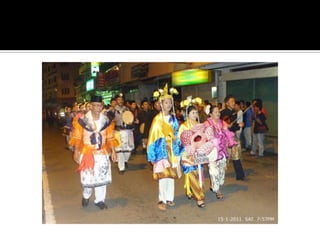
 other cultural element : marriage ritual, dances,
social gathering and traditional delicacies.
 Their ancestors in Cocos Island worked in
coconut plantations owned by the English.
 indigenous to the highlands of east
Kalimantan, Brunei, SouthWest of Sabah and
Northern of Sarawak.
 In Sarawak, Lun Dayeh are officially recognized
by the Constitution as the native of Sarawak
(categorized under the Orang Ulu people)
 Lun Dayeh are related to the rice plantation and
they cultivate both rice on hill and on the paddy
field.
 Practiced an ancient tradition of secondary
treatment of the dead.
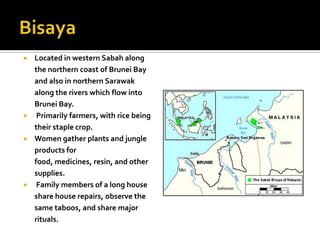
 Located in western Sabah along
the northern coast of Brunei Bay
and also in northern Sarawak
along the rivers which flow into
Brunei Bay.
 Primarily farmers, with rice being
their staple crop.
 Women gather plants and jungle
products for
food, medicines, resin, and other
supplies.
 Family members of a long house
share house repairs, observe the
same taboos, and share major
rituals.
 largest ethnic
 culture that revolves heavily around the
cultivation of rice
 various delicacies and alcoholic drinks using
rice
 ‘Bobohizan’
 ‘Tadau Ka’amatan’
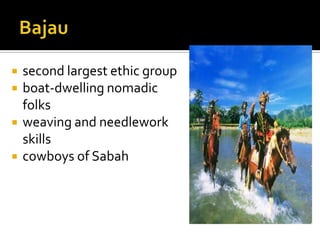
 second largest ethic group
 boat-dwelling nomadic
folks
 weaving and needlework
skills
 cowboys of Sabah
 third largest ethic group
 'hillpeople‘
 Interior Division:Tenom, Keningau and
Pensiangan
 communal longhouses
 Hunting with blowpipe
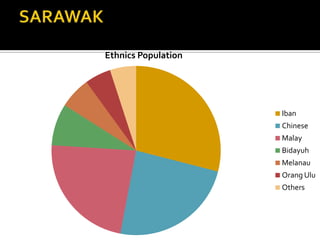
Ethnics Population
Iban
Chinese
Malay
Bidayuh
Melanau
Orang Ulu
Others
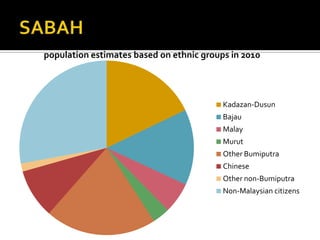
population estimates based on ethnic groups in 2010
Kadazan-Dusun
Bajau
Malay
Murut
Other Bumiputra
Chinese
Other non-Bumiputra
Non-Malaysian citizens
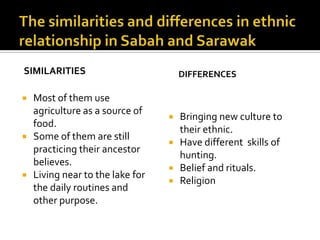
SIMILARITIES
 Most of them use
agriculture as a source of
food.
 Some of them are still
practicing their ancestor
believes.
 Living near to the lake for
the daily routines and
other purpose.
DIFFERENCES
 Bringing new culture to
their ethnic.
 Have different skills of
hunting.
 Belief and rituals.
 Religion
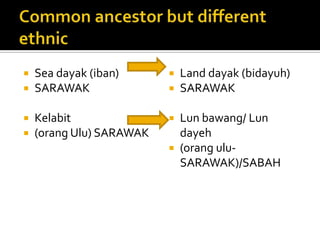
 Sea dayak (iban)
 SARAWAK
 Kelabit
 (orang Ulu) SARAWAK
 Land dayak (bidayuh)
 SARAWAK
 Lun bawang/ Lun
dayeh
 (orang ulu-
SARAWAK)/SABAH
 playing the critical role that represents
Malaysia’s richness in culture and, of
course, unity in diversity.
 different background and development process
led them to practice different religious and
beliefs.
 resulting many kinds of lifestyles available all
over Malaysia
 Sarawak consists of more than 40 ethnic groups
 Sabah has more than 32 recognized ethnics
group

ethnic relation in Sabah

  • 1.
     UNIVERSITI UTARAMALAYSIA  Ungku Intan Dianna Binti Ungku A Bakar  Noorul Ashikin Binti Zulkarnain  Mohammed Rezaul Karim  Chwa See Chew  Wong Chee Leong
  • 2.
    A Discourse inthe difference ethnic group
  • 4.
     to studythe history of Sabah and Sarawak.  to identify the background of certain ethnic in Sabah and Sarawak.  to identify the similarities and difference between those ethnics.  to highlights the ethnic relationship in Sabah and Sarawak.
  • 6.
     The Brookedynasty ruled Sarawak for a hundred years  James Brooke was appointed Raja by the Sultan of Brunei on 18 August 1842  Sarawak was officially granted independence on 22 July 1963 (joined with Malaya, Sabah, and Singapore, in the federation of Malaysia.)  home to 27 ethnic groups, each with own distinct language and culture.
  • 7.
    The various OrangUlu ethnics together make up roughly 6% of Sarawak's population. Major tribes making up the Orang Ulu group include:  Kayan  Lun Bawang  Kelabit  Kenyah  Penan  Bisaya
  • 8.
     close tiesto the Lun Bawang  live in inherited longhouses and practice a generations-old form of agriculture.  Population:approximately 5,000 people.  Ethnic group received visits from Christian missionaries.The Kelabit are now predominantlyChristian
  • 9.
     sometimes referredas “Land Dayaks”.  second largest Dayak ethnic group in Sarawak.  worked by rotational agriculture and hunting based around farms.  Today, almost all the traditional longhouse- villages have been replaced by individual houses.  Fruit trees especially Durian remain important property of market.
  • 10.
     known as“Sea Dayaks” by British.  largest people group in Sarawak  main indigenous people group in Brunei  main occupation is farming, hunt wild animal in the jungle.  the weapons used are the blowpipe. Nowadays, they trained dog to run down their prey.  lived in longhouses.  Nowadays, begin to abandon the longhouse style of living  No longer rely on the forest’s resources to survive. Instead, they are migrating to the cities.  they are mostly Christians and Muslim
  • 12.
     Malanau areconsidered among the earliest settlers in Sarawak.  They make up about 6% of Sarawak’s total population.  They have never called themselves as Malanau until recently.  They call themselves ‘alikou’ meaning people of the river.  Then, where is the name Malanau come from?  Most of them are farmers, fisherman, sago producers, and traders.  They have abandoned their original religion-Liko. Nowadays, Majority of them are either Christians or Muslims.
  • 14.
     originally migratedfrom Sumatra.  Basically, speak language (called Bahasa Melayu Sarawak)  lived along the coast and worked as fishermen.  Definitely, they are Muslim...  Huge majority of the Malays in Sarawak were not actually Malays but ethnics of Indonesian origin
  • 15.
     1761- AlexanderDalrymple,concluded an agreement with the Sultan of Sulu.  1846 -the island of Labuan, in theWest Coast of Sabah, was ceded to Britain by the Sultan of Brunei  1848 - it became a British Crown Colony.  Following the series of transfers, the rights to North Borneo were transferred to Alfred Dent, whom in 1881 formed the British North Borneo Provisional Association  In the following year, British North Borneo Company was formed and Kudat was made its capital.
  • 16.
     Originally fromthe Cocos (Keeling) Islands  Scottish and Malay decent.  The Orang Cocos of Sabah are mostly living in Lahad Datu, Kunak, Sandakan and in Tawau.  The Cocos Malays are originated from the descendents of Malays settler from the British colonies.  Most of Malays follow the Sunni branches of Islam.  other cultural element : marriage ritual, dances, social gathering and traditional delicacies.  Their ancestors in Cocos Island worked in coconut plantations owned by the English.
  • 18.
     indigenous tothe highlands of east Kalimantan, Brunei, SouthWest of Sabah and Northern of Sarawak.  In Sarawak, Lun Dayeh are officially recognized by the Constitution as the native of Sarawak (categorized under the Orang Ulu people)  Lun Dayeh are related to the rice plantation and they cultivate both rice on hill and on the paddy field.  Practiced an ancient tradition of secondary treatment of the dead.
  • 19.
     Located inwestern Sabah along the northern coast of Brunei Bay and also in northern Sarawak along the rivers which flow into Brunei Bay.  Primarily farmers, with rice being their staple crop.  Women gather plants and jungle products for food, medicines, resin, and other supplies.  Family members of a long house share house repairs, observe the same taboos, and share major rituals.
  • 20.
     largest ethnic culture that revolves heavily around the cultivation of rice  various delicacies and alcoholic drinks using rice  ‘Bobohizan’  ‘Tadau Ka’amatan’
  • 21.
     second largestethic group  boat-dwelling nomadic folks  weaving and needlework skills  cowboys of Sabah
  • 22.
     third largestethic group  'hillpeople‘  Interior Division:Tenom, Keningau and Pensiangan  communal longhouses  Hunting with blowpipe
  • 23.
  • 24.
    population estimates basedon ethnic groups in 2010 Kadazan-Dusun Bajau Malay Murut Other Bumiputra Chinese Other non-Bumiputra Non-Malaysian citizens
  • 25.
    SIMILARITIES  Most ofthem use agriculture as a source of food.  Some of them are still practicing their ancestor believes.  Living near to the lake for the daily routines and other purpose. DIFFERENCES  Bringing new culture to their ethnic.  Have different skills of hunting.  Belief and rituals.  Religion
  • 26.
     Sea dayak(iban)  SARAWAK  Kelabit  (orang Ulu) SARAWAK  Land dayak (bidayuh)  SARAWAK  Lun bawang/ Lun dayeh  (orang ulu- SARAWAK)/SABAH
  • 28.
     playing thecritical role that represents Malaysia’s richness in culture and, of course, unity in diversity.  different background and development process led them to practice different religious and beliefs.  resulting many kinds of lifestyles available all over Malaysia  Sarawak consists of more than 40 ethnic groups  Sabah has more than 32 recognized ethnics group