I
NTRODUCTION TO
ETHI
CAL HACKI
NG:A
COMPREHENSIVE
BEGI
NNER'S GUI
DE
Introduction
Ethical hacking is a legal way of
finding vulnerabilities in
computer systems.This
presentation will provide a
comprehensive guide for
beginners to understand the
basics of ethical hacking and its
importance in today's digital
world.
WHAT I
S ETHI
CAL HACKI
NG?
Ethical hacking involves
identifying and exploiting
vulnerabilities in computer
systems with the owner's
permission.It's used to help
organizations improve their
security and prevent cyber
attacks.An ethical hacker
must have technical skills,
creativity, and critical
thinking abilities.
TYPES OF HACKI
NG
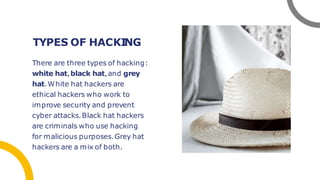
There are three types of hacking:
white hat,black hat,and grey
hat.White hat hackers are
ethical hackers who work to
improve security and prevent
cyber attacks.Black hat hackers
are criminals who use hacking
for malicious purposes.Grey hat
hackers are a mix of both.
COMMON HACKING
TECHNIQUES
Common hacking techniques include
phishing, social engineering, brute-
force attacks,and SQL injection.
Phishing is when a hacker sends a
fake email or message to trick
someone into giving them sensitive
information. Social engineering is
when a hacker manipulates someone
into giving them access.Brute-force
attacks involve guessing passwords.
SQL injection is when a hacker injects
malicious code into a website's
database.
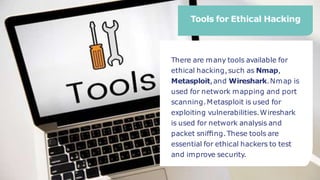
Tools for Ethical Hacking
There are many tools available for
ethical hacking,such as Nmap,
Metasploit,and Wireshark.Nmap is
used for network mapping and port
scanning.Metasploit is used for
exploiting vulnerabilities.Wireshark
is used for network analysis and
packet sniffing.These tools are
essential for ethical hackers to test
and improve security.
ETHICALHACKINGTUT
ORIAL– A
BEGINNER'S GUIDE
Ethical hacking is a crucial aspect of
cybersecurity. Ithelps organizations identify
and fix vulnerabilities before they can be
exploited by malicious hackers. With the right
skills and tools, anyone can become an
ethical hacker. Remember to always use your
powers for good and follow ethical guidelines.
CONCLUSI
ON
THANKS

ethical hacking tutorial a beginners guide.pptx

  • 1.
  • 2.
    Introduction Ethical hacking isa legal way of finding vulnerabilities in computer systems.This presentation will provide a comprehensive guide for beginners to understand the basics of ethical hacking and its importance in today's digital world.
  • 3.
    WHAT I S ETHI CALHACKI NG? Ethical hacking involves identifying and exploiting vulnerabilities in computer systems with the owner's permission.It's used to help organizations improve their security and prevent cyber attacks.An ethical hacker must have technical skills, creativity, and critical thinking abilities.
  • 4.
    TYPES OF HACKI NG Thereare three types of hacking: white hat,black hat,and grey hat.White hat hackers are ethical hackers who work to improve security and prevent cyber attacks.Black hat hackers are criminals who use hacking for malicious purposes.Grey hat hackers are a mix of both.
  • 5.
    COMMON HACKING TECHNIQUES Common hackingtechniques include phishing, social engineering, brute- force attacks,and SQL injection. Phishing is when a hacker sends a fake email or message to trick someone into giving them sensitive information. Social engineering is when a hacker manipulates someone into giving them access.Brute-force attacks involve guessing passwords. SQL injection is when a hacker injects malicious code into a website's database.
  • 6.
    Tools for EthicalHacking There are many tools available for ethical hacking,such as Nmap, Metasploit,and Wireshark.Nmap is used for network mapping and port scanning.Metasploit is used for exploiting vulnerabilities.Wireshark is used for network analysis and packet sniffing.These tools are essential for ethical hackers to test and improve security.
  • 7.
  • 8.
    Ethical hacking isa crucial aspect of cybersecurity. Ithelps organizations identify and fix vulnerabilities before they can be exploited by malicious hackers. With the right skills and tools, anyone can become an ethical hacker. Remember to always use your powers for good and follow ethical guidelines. CONCLUSI ON
  • 9.