The Complete Guide to Ethical
Hacking: Learn the Skills and Tools
By Ayan / December 27, 2024
In today’s interconnected world, the demand for cybersecurity experts is growing at
an unprecedented rate. Ethical hacking, often referred to as “white-hat hacking,” is a
critical part of securing systems, protecting sensitive data, and combating cyber
threats. If you’re eager to dive into this dynamic field, this complete guide will equip
you with the foundational skills, tools, and practical steps to get started.
What is Ethical Hacking?
Ethical hacking is the practice of identifying vulnerabilities in computer systems,
networks, and software with the permission of their owners. Unlike malicious
hackers, ethical hackers work to prevent cyberattacks by proactively testing and
securing systems. They use the same techniques as black-hat hackers but adhere to
strict ethical and legal guidelines.
Why Ethical Hacking is Important
1. Prevents Data Breaches: By identifying weaknesses, ethical hackers prevent
sensitive data from being exploited.
2. Protects Financial Assets: Organizations rely on ethical hackers to prevent
financial fraud and secure online transactions.
3. Enhances Cybersecurity Posture: Ethical hacking helps organizations stay
ahead of evolving cyber threats.
4. Complies with Regulations: Many industries require penetration testing to
meet legal and regulatory standards.
Skills Needed to Become an Ethical Hacker
1. Networking Fundamentals
● Understanding TCP/IP, DNS, HTTP, and other protocols is essential.
● Learn how firewalls, routers, and switches work.
● Practical Resource: Use tools like Wireshark to analyze network traffic.
2. Operating System Knowledge
● Master Linux (especially Kali Linux), Windows, and macOS.
● Practical Task: Set up a virtual machine to practice on different
operating systems.
3. Programming Skills
● Learn programming languages like Python, JavaScript, and Bash
scripting.
● Practical Task: Write a simple Python script to scan open ports on a
network.
4. Web Application Security
● Understand vulnerabilities like SQL injection, cross-site scripting (XSS),
and cross-site request forgery (CSRF).
● Practical Task: Use DVWA (Damn Vulnerable Web Application) to
practice finding vulnerabilities.
5. Familiarity with Tools
● Learn tools like Nmap, Metasploit, and Burp Suite for scanning,
exploiting, and testing.
6. Analytical Thinking
● Ethical hacking involves problem-solving and thinking like an attacker.
● Practical Task: Simulate a penetration test by identifying and patching
vulnerabilities.
Step-by-Step Practical Guide to Ethical Hacking
Step 1: Set Up Your Lab Environment
To practice ethical hacking legally and safely, you need a controlled environment.
Requirements:
● A computer with virtualization software (VMware or VirtualBox).
● Install Kali Linux, a penetration-testing operating system.
● Create a target environment using vulnerable virtual machines like
Metasploitable or OWASP’s Broken Web Applications Project.
Commands to Get Started:
● sudo apt-get install virtualbox
● sudo apt install kali-linux
Step 2: Reconnaissance (Information Gathering)
The first step in hacking is gathering information about the target system.
Tools to Use:
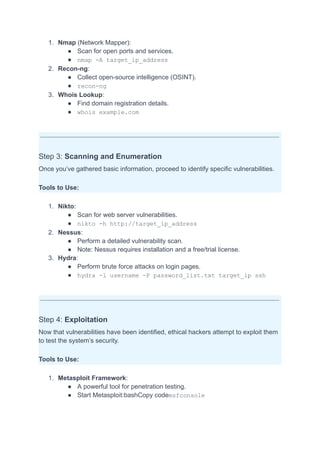
1. Nmap (Network Mapper):
● Scan for open ports and services.
● nmap -A target_ip_address
2. Recon-ng:
● Collect open-source intelligence (OSINT).
● recon-ng
3. Whois Lookup:
● Find domain registration details.
● whois example.com
Step 3: Scanning and Enumeration
Once you’ve gathered basic information, proceed to identify specific vulnerabilities.
Tools to Use:
1. Nikto:
● Scan for web server vulnerabilities.
● nikto -h http://target_ip_address
2. Nessus:
● Perform a detailed vulnerability scan.
● Note: Nessus requires installation and a free/trial license.
3. Hydra:
● Perform brute force attacks on login pages.
● hydra -l username -P password_list.txt target_ip ssh
Step 4: Exploitation
Now that vulnerabilities have been identified, ethical hackers attempt to exploit them
to test the system’s security.
Tools to Use:
1. Metasploit Framework:
● A powerful tool for penetration testing.
● Start Metasploit:bashCopy codemsfconsole
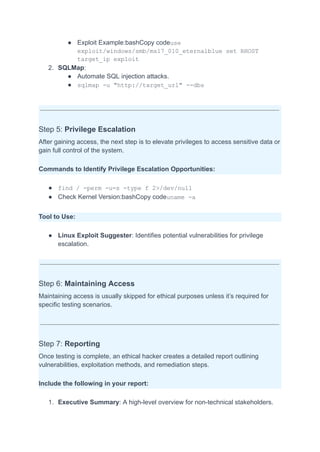
● Exploit Example:bashCopy codeuse
exploit/windows/smb/ms17_010_eternalblue set RHOST
target_ip exploit
2. SQLMap:
● Automate SQL injection attacks.
● sqlmap -u "http://target_url" --dbs
Step 5: Privilege Escalation
After gaining access, the next step is to elevate privileges to access sensitive data or
gain full control of the system.
Commands to Identify Privilege Escalation Opportunities:
● find / -perm -u=s -type f 2>/dev/null
● Check Kernel Version:bashCopy codeuname -a
Tool to Use:
● Linux Exploit Suggester: Identifies potential vulnerabilities for privilege
escalation.
Step 6: Maintaining Access
Maintaining access is usually skipped for ethical purposes unless it’s required for
specific testing scenarios.
Step 7: Reporting
Once testing is complete, an ethical hacker creates a detailed report outlining
vulnerabilities, exploitation methods, and remediation steps.
Include the following in your report:
1. Executive Summary: A high-level overview for non-technical stakeholders.
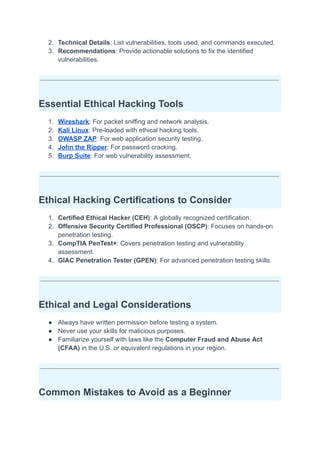
2. Technical Details: List vulnerabilities, tools used, and commands executed.
3. Recommendations: Provide actionable solutions to fix the identified
vulnerabilities.
Essential Ethical Hacking Tools
1. Wireshark: For packet sniffing and network analysis.
2. Kali Linux: Pre-loaded with ethical hacking tools.
3. OWASP ZAP: For web application security testing.
4. John the Ripper: For password cracking.
5. Burp Suite: For web vulnerability assessment.
Ethical Hacking Certifications to Consider
1. Certified Ethical Hacker (CEH): A globally recognized certification.
2. Offensive Security Certified Professional (OSCP): Focuses on hands-on
penetration testing.
3. CompTIA PenTest+: Covers penetration testing and vulnerability
assessment.
4. GIAC Penetration Tester (GPEN): For advanced penetration testing skills.
Ethical and Legal Considerations
● Always have written permission before testing a system.
● Never use your skills for malicious purposes.
● Familiarize yourself with laws like the Computer Fraud and Abuse Act
(CFAA) in the U.S. or equivalent regulations in your region.
Common Mistakes to Avoid as a Beginner
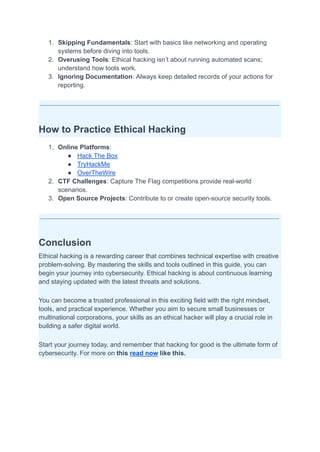
1. Skipping Fundamentals: Start with basics like networking and operating
systems before diving into tools.
2. Overusing Tools: Ethical hacking isn’t about running automated scans;
understand how tools work.
3. Ignoring Documentation: Always keep detailed records of your actions for
reporting.
How to Practice Ethical Hacking
1. Online Platforms:
● Hack The Box
● TryHackMe
● OverTheWire
2. CTF Challenges: Capture The Flag competitions provide real-world
scenarios.
3. Open Source Projects: Contribute to or create open-source security tools.
Conclusion
Ethical hacking is a rewarding career that combines technical expertise with creative
problem-solving. By mastering the skills and tools outlined in this guide, you can
begin your journey into cybersecurity. Ethical hacking is about continuous learning
and staying updated with the latest threats and solutions.
You can become a trusted professional in this exciting field with the right mindset,
tools, and practical experience. Whether you aim to secure small businesses or
multinational corporations, your skills as an ethical hacker will play a crucial role in
building a safer digital world.
Start your journey today, and remember that hacking for good is the ultimate form of
cybersecurity. For more on this read now like this.

Master Ethical Hacking Basics Like a Pro

  • 1.
    The Complete Guideto Ethical Hacking: Learn the Skills and Tools By Ayan / December 27, 2024 In today’s interconnected world, the demand for cybersecurity experts is growing at an unprecedented rate. Ethical hacking, often referred to as “white-hat hacking,” is a critical part of securing systems, protecting sensitive data, and combating cyber threats. If you’re eager to dive into this dynamic field, this complete guide will equip you with the foundational skills, tools, and practical steps to get started.
  • 2.
    What is EthicalHacking? Ethical hacking is the practice of identifying vulnerabilities in computer systems, networks, and software with the permission of their owners. Unlike malicious hackers, ethical hackers work to prevent cyberattacks by proactively testing and securing systems. They use the same techniques as black-hat hackers but adhere to strict ethical and legal guidelines. Why Ethical Hacking is Important 1. Prevents Data Breaches: By identifying weaknesses, ethical hackers prevent sensitive data from being exploited. 2. Protects Financial Assets: Organizations rely on ethical hackers to prevent financial fraud and secure online transactions. 3. Enhances Cybersecurity Posture: Ethical hacking helps organizations stay ahead of evolving cyber threats. 4. Complies with Regulations: Many industries require penetration testing to meet legal and regulatory standards. Skills Needed to Become an Ethical Hacker 1. Networking Fundamentals ● Understanding TCP/IP, DNS, HTTP, and other protocols is essential. ● Learn how firewalls, routers, and switches work. ● Practical Resource: Use tools like Wireshark to analyze network traffic. 2. Operating System Knowledge ● Master Linux (especially Kali Linux), Windows, and macOS. ● Practical Task: Set up a virtual machine to practice on different operating systems. 3. Programming Skills ● Learn programming languages like Python, JavaScript, and Bash scripting. ● Practical Task: Write a simple Python script to scan open ports on a network. 4. Web Application Security
  • 3.
    ● Understand vulnerabilitieslike SQL injection, cross-site scripting (XSS), and cross-site request forgery (CSRF). ● Practical Task: Use DVWA (Damn Vulnerable Web Application) to practice finding vulnerabilities. 5. Familiarity with Tools ● Learn tools like Nmap, Metasploit, and Burp Suite for scanning, exploiting, and testing. 6. Analytical Thinking ● Ethical hacking involves problem-solving and thinking like an attacker. ● Practical Task: Simulate a penetration test by identifying and patching vulnerabilities. Step-by-Step Practical Guide to Ethical Hacking Step 1: Set Up Your Lab Environment To practice ethical hacking legally and safely, you need a controlled environment. Requirements: ● A computer with virtualization software (VMware or VirtualBox). ● Install Kali Linux, a penetration-testing operating system. ● Create a target environment using vulnerable virtual machines like Metasploitable or OWASP’s Broken Web Applications Project. Commands to Get Started: ● sudo apt-get install virtualbox ● sudo apt install kali-linux Step 2: Reconnaissance (Information Gathering) The first step in hacking is gathering information about the target system. Tools to Use:
  • 4.
    1. Nmap (NetworkMapper): ● Scan for open ports and services. ● nmap -A target_ip_address 2. Recon-ng: ● Collect open-source intelligence (OSINT). ● recon-ng 3. Whois Lookup: ● Find domain registration details. ● whois example.com Step 3: Scanning and Enumeration Once you’ve gathered basic information, proceed to identify specific vulnerabilities. Tools to Use: 1. Nikto: ● Scan for web server vulnerabilities. ● nikto -h http://target_ip_address 2. Nessus: ● Perform a detailed vulnerability scan. ● Note: Nessus requires installation and a free/trial license. 3. Hydra: ● Perform brute force attacks on login pages. ● hydra -l username -P password_list.txt target_ip ssh Step 4: Exploitation Now that vulnerabilities have been identified, ethical hackers attempt to exploit them to test the system’s security. Tools to Use: 1. Metasploit Framework: ● A powerful tool for penetration testing. ● Start Metasploit:bashCopy codemsfconsole
  • 5.
    ● Exploit Example:bashCopycodeuse exploit/windows/smb/ms17_010_eternalblue set RHOST target_ip exploit 2. SQLMap: ● Automate SQL injection attacks. ● sqlmap -u "http://target_url" --dbs Step 5: Privilege Escalation After gaining access, the next step is to elevate privileges to access sensitive data or gain full control of the system. Commands to Identify Privilege Escalation Opportunities: ● find / -perm -u=s -type f 2>/dev/null ● Check Kernel Version:bashCopy codeuname -a Tool to Use: ● Linux Exploit Suggester: Identifies potential vulnerabilities for privilege escalation. Step 6: Maintaining Access Maintaining access is usually skipped for ethical purposes unless it’s required for specific testing scenarios. Step 7: Reporting Once testing is complete, an ethical hacker creates a detailed report outlining vulnerabilities, exploitation methods, and remediation steps. Include the following in your report: 1. Executive Summary: A high-level overview for non-technical stakeholders.
  • 6.
    2. Technical Details:List vulnerabilities, tools used, and commands executed. 3. Recommendations: Provide actionable solutions to fix the identified vulnerabilities. Essential Ethical Hacking Tools 1. Wireshark: For packet sniffing and network analysis. 2. Kali Linux: Pre-loaded with ethical hacking tools. 3. OWASP ZAP: For web application security testing. 4. John the Ripper: For password cracking. 5. Burp Suite: For web vulnerability assessment. Ethical Hacking Certifications to Consider 1. Certified Ethical Hacker (CEH): A globally recognized certification. 2. Offensive Security Certified Professional (OSCP): Focuses on hands-on penetration testing. 3. CompTIA PenTest+: Covers penetration testing and vulnerability assessment. 4. GIAC Penetration Tester (GPEN): For advanced penetration testing skills. Ethical and Legal Considerations ● Always have written permission before testing a system. ● Never use your skills for malicious purposes. ● Familiarize yourself with laws like the Computer Fraud and Abuse Act (CFAA) in the U.S. or equivalent regulations in your region. Common Mistakes to Avoid as a Beginner
  • 7.
    1. Skipping Fundamentals:Start with basics like networking and operating systems before diving into tools. 2. Overusing Tools: Ethical hacking isn’t about running automated scans; understand how tools work. 3. Ignoring Documentation: Always keep detailed records of your actions for reporting. How to Practice Ethical Hacking 1. Online Platforms: ● Hack The Box ● TryHackMe ● OverTheWire 2. CTF Challenges: Capture The Flag competitions provide real-world scenarios. 3. Open Source Projects: Contribute to or create open-source security tools. Conclusion Ethical hacking is a rewarding career that combines technical expertise with creative problem-solving. By mastering the skills and tools outlined in this guide, you can begin your journey into cybersecurity. Ethical hacking is about continuous learning and staying updated with the latest threats and solutions. You can become a trusted professional in this exciting field with the right mindset, tools, and practical experience. Whether you aim to secure small businesses or multinational corporations, your skills as an ethical hacker will play a crucial role in building a safer digital world. Start your journey today, and remember that hacking for good is the ultimate form of cybersecurity. For more on this read now like this.