Ethical HackerKeri Michalski-SmithBryant & Stratton CollegeINFT 242  Network & PC Security FundamentalsAugust 1st, 2009
Ethical Hacker Defined	∙ Use their expertise and skills to protect a    company’s information security∙ Purpose is to reveal system inadequacies and   penetrate defenses∙ Results used to implement additional tools to    defend against intrusion∙ Goal is to find system vulnerabilities before a   malicious hacker∙ Always in need as security threats are continual   and ever-changing
Ethical Hacker Job Function∙ Obtains explicit written permission from system   owner in regards to systems tested, methods to   be used, and any limitations∙ Conducts tests based upon three type of   attackers: outsider, outsider with limited access,  and internal user∙ Systematically documents processes used and   recommendations in detailed report
Tools Used By Ethical hacker Intrusion detecting monitoring software and tools  used to:∙ Scan log files∙ Detect port scans∙ Ethernet sniffing∙ Network mapping∙ Scan registry or configuration files
Ethical Hacker Testing conducted on:∙ Internet access to connect to firewalls,   web servers, routers, and filters∙  Internal attack on firewalls, web servers,    server, and e-mail systems∙ Social engineering attack utilizing staff’s job  functions and helpfulness to obtain confidential   information∙ Fraud through physical access impersonating as  employee∙ Theft of key employee’s laptop revealing   confidential information
Importance of Ethical Hacker:∙ Considered a necessity not a luxury given   today’s exposure to attacks∙ Valuable method for counteracting intrusion   along with security policies already in place∙ Expertise and familiarity with latest network   attack strategies∙ Contracted Ethical Hacker from outside source   considered better due to lack of bias, as they   have no preconceived notions about system   strengths or weaknesses
Phases of Ethical hackingPlanning Stage   ∙ Time and cost considerations determine what      will be tested   ∙ Determinations made upon which information      exposure poses the greatest risks
Phases of Ethical hackingDiscovery PhaseInformation gathered about company through ∙ Company website ∙ Press releases ∙ Job listings that often reveal employee names, e-mail addresses and even network diagrams  ∙ Blogs and discussion forums revealing specific technical issues and methodologies used by company’s IT department ∙ Hardware and software toolsAll information gathered used to find vulnerabilities in company’s architecture, policies, and processes to reveal weak configurations and unsecure systems
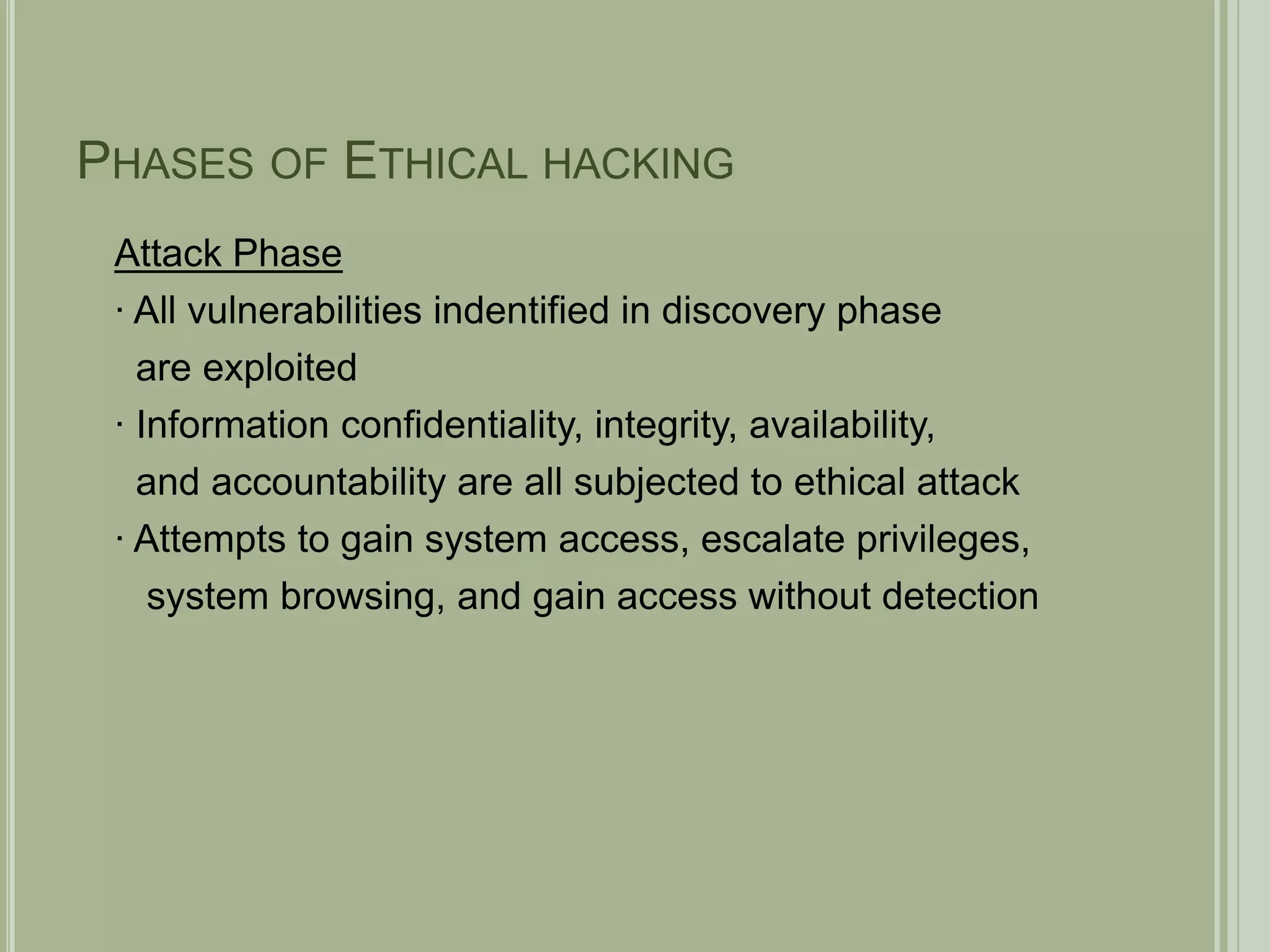
Phases of Ethical hackingAttack Phase∙ All vulnerabilities indentified in discovery phase  are exploited∙ Information confidentiality, integrity, availability,  and accountability are all subjected to ethical attack∙ Attempts to gain system access, escalate privileges,    system browsing, and gain access without detection
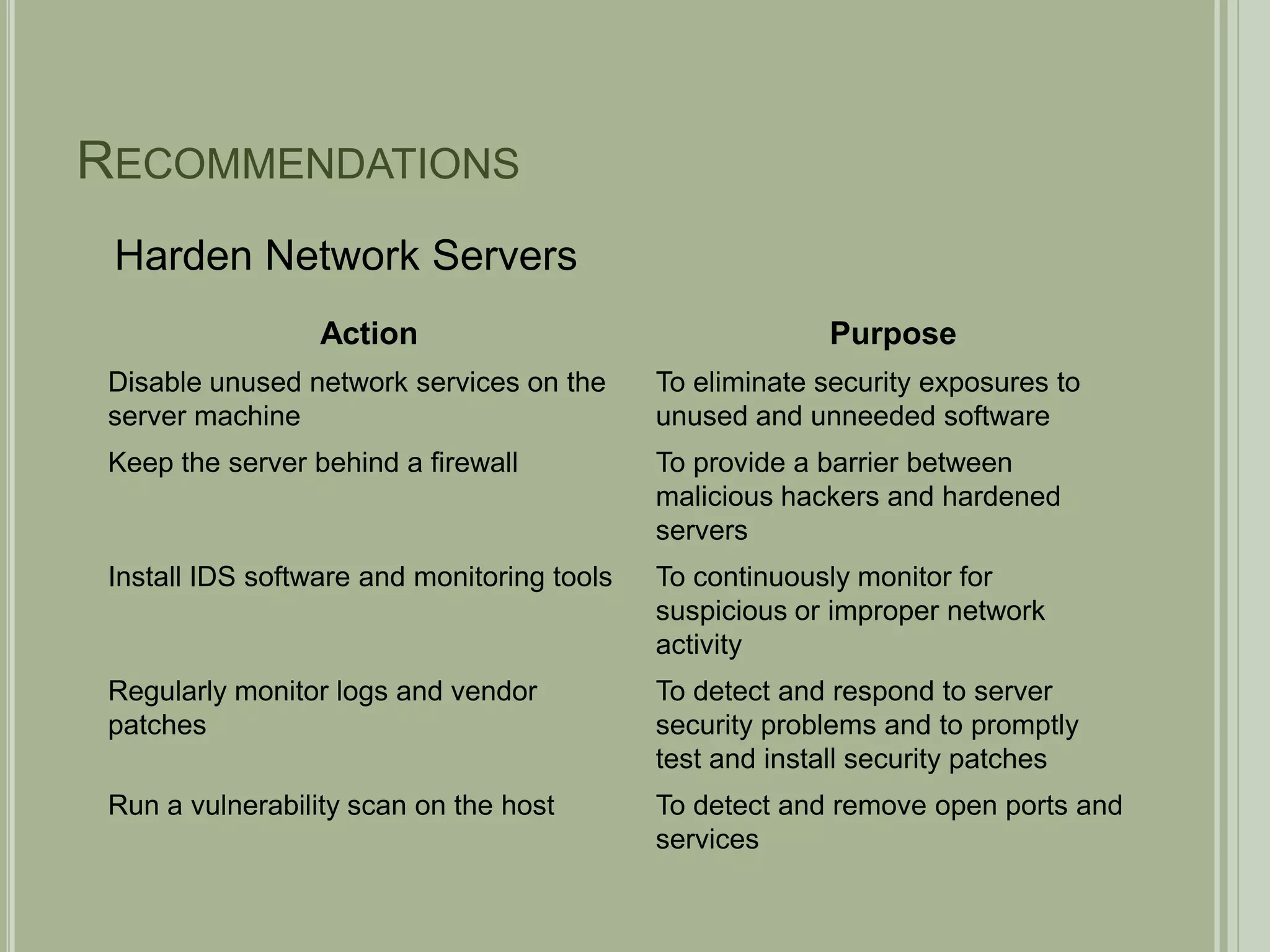
RecommendationsHarden Network Servers
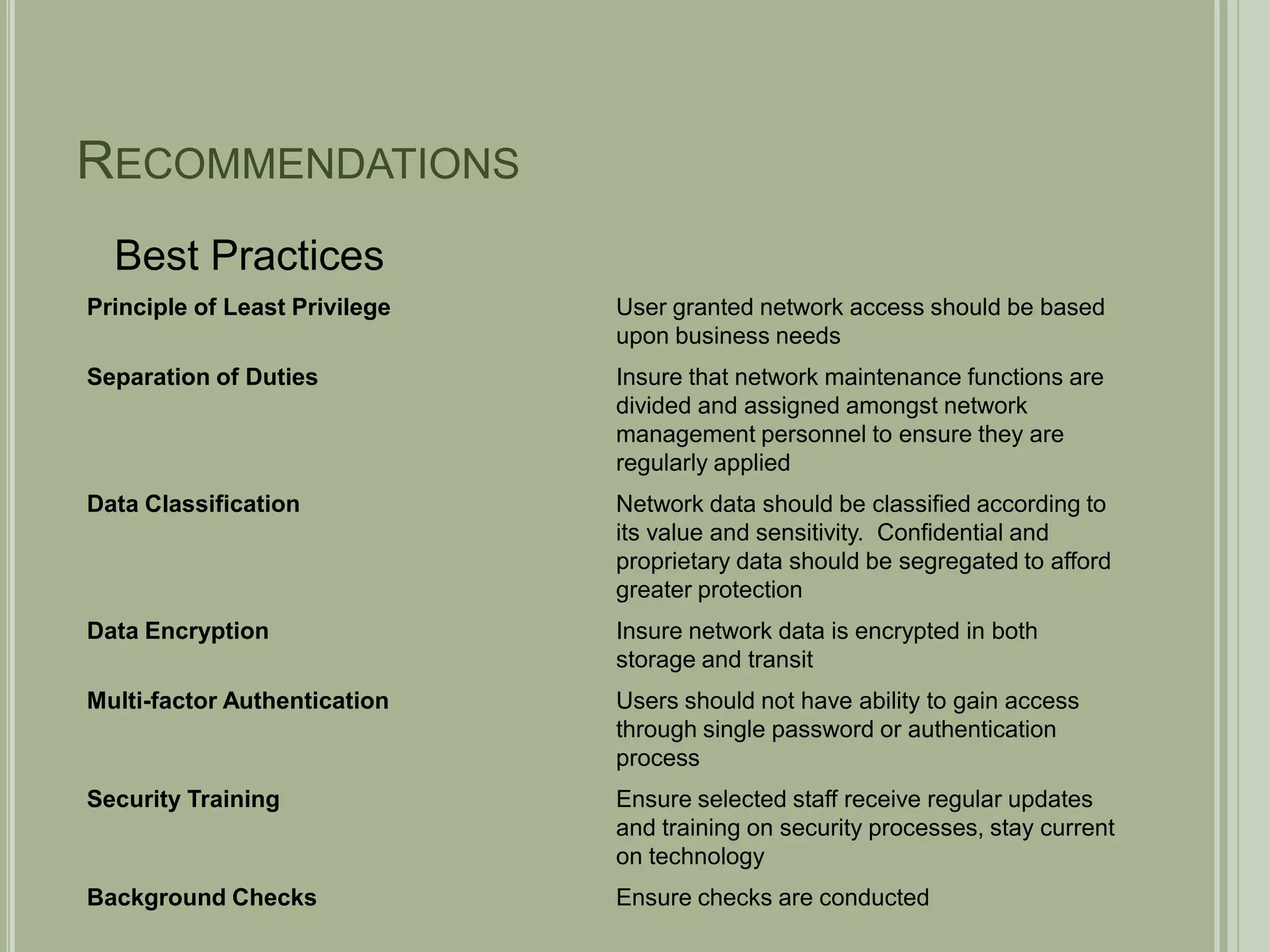
RecommendationsBest Practices
Ethical hacker- THE END-Keri Michalski-SmithBryant & Stratton CollegeINFT 242 - Network & PC Security FundamentalsAugust 1st, 2009

Ethical Hacker

  • 1.
    Ethical HackerKeri Michalski-SmithBryant& Stratton CollegeINFT 242 Network & PC Security FundamentalsAugust 1st, 2009
  • 2.
    Ethical Hacker Defined ∙Use their expertise and skills to protect a company’s information security∙ Purpose is to reveal system inadequacies and penetrate defenses∙ Results used to implement additional tools to defend against intrusion∙ Goal is to find system vulnerabilities before a malicious hacker∙ Always in need as security threats are continual and ever-changing
  • 3.
    Ethical Hacker JobFunction∙ Obtains explicit written permission from system owner in regards to systems tested, methods to be used, and any limitations∙ Conducts tests based upon three type of attackers: outsider, outsider with limited access, and internal user∙ Systematically documents processes used and recommendations in detailed report
  • 4.
    Tools Used ByEthical hacker Intrusion detecting monitoring software and tools used to:∙ Scan log files∙ Detect port scans∙ Ethernet sniffing∙ Network mapping∙ Scan registry or configuration files
  • 5.
    Ethical Hacker Testingconducted on:∙ Internet access to connect to firewalls, web servers, routers, and filters∙ Internal attack on firewalls, web servers, server, and e-mail systems∙ Social engineering attack utilizing staff’s job functions and helpfulness to obtain confidential information∙ Fraud through physical access impersonating as employee∙ Theft of key employee’s laptop revealing confidential information
  • 6.
    Importance of EthicalHacker:∙ Considered a necessity not a luxury given today’s exposure to attacks∙ Valuable method for counteracting intrusion along with security policies already in place∙ Expertise and familiarity with latest network attack strategies∙ Contracted Ethical Hacker from outside source considered better due to lack of bias, as they have no preconceived notions about system strengths or weaknesses
  • 7.
    Phases of EthicalhackingPlanning Stage ∙ Time and cost considerations determine what will be tested ∙ Determinations made upon which information exposure poses the greatest risks
  • 8.
    Phases of EthicalhackingDiscovery PhaseInformation gathered about company through ∙ Company website ∙ Press releases ∙ Job listings that often reveal employee names, e-mail addresses and even network diagrams ∙ Blogs and discussion forums revealing specific technical issues and methodologies used by company’s IT department ∙ Hardware and software toolsAll information gathered used to find vulnerabilities in company’s architecture, policies, and processes to reveal weak configurations and unsecure systems
  • 9.
    Phases of EthicalhackingAttack Phase∙ All vulnerabilities indentified in discovery phase are exploited∙ Information confidentiality, integrity, availability, and accountability are all subjected to ethical attack∙ Attempts to gain system access, escalate privileges, system browsing, and gain access without detection
  • 10.
  • 11.
  • 12.
    Ethical hacker- THEEND-Keri Michalski-SmithBryant & Stratton CollegeINFT 242 - Network & PC Security FundamentalsAugust 1st, 2009