ETHICAL DECISION MAKING
• Learning objectives:
• After completing module , participants are expected to
be able to:
• Define ethical dilemma
• Identify situation when ethical dilemma occurs
• Define moral distress
• Understand the processes involved in ethical decision
making
• Define code of ethics
• Understand the four fundamental responsibilities of
nurses
• Define communication
• Apply communication skills
• Ethical dilemma
• Defined as a problem involving a choice between
equally desirable or equally unsatisfactory
alternatives to the different or competitive assignment
of priorities and responsibilities, or to a problem
without a satisfactory solution (George & Grypdonck,
2002).
(Wolf & Zuzelo, 2006)
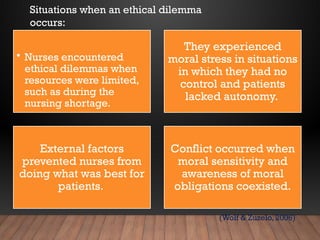
• Nurses encountered
ethical dilemmas when
resources were limited,
such as during the
nursing shortage.
They experienced
moral stress in situations
in which they had no
control and patients
lacked autonomy.
External factors
prevented nurses from
doing what was best for
patients.
Conflict occurred when
moral sensitivity and
awareness of moral
obligations coexisted.
(Wolf & Zuzelo, 2006)
Situations when an ethical dilemma
occurs:
• Moral distress is defined as “a psychological disequilibrium and
negative feeling state experienced when a person makes a moral
decision but does not follow through by performing the moral
behavior indicated by that decision” (Wilkinson, 1988, p. 16)
• The phenomenon of moral distress incorporates the
• situation and the moral situation
• the moral decision about the right action
• the perceived inability to act, with resultant painful feelings
• psychological disequilibrium
• Moral distress brings about coping behaviors, influenced by the
frequency of cases nurses encounter and affects nurses’ wholeness
and patient care.
(Wolf & Zuzelo, 2006)
Purpose of nursing ethics
• to inspire questions and examine what would be the ethically
right action in health care situations demanding a choice between
at least two undesirable alternatives.
• Ethics deals with the construction of criteria for judging a person’s
behavior.
• Yet, it also deals with the validation of those criteria, that is, their
meaning and whether it is appropriate to abide by them.
(Toren & Wagner, 2010)
• Steps and criteria that can be used to analyze and resolve any
ethical dilemma
1. Define the ethical dilemma;
2. Clarify the personal and professional values, ethical
principles, and laws involved;
3. Identify the alternatives for action;
4. Choose an action;
5. Initiate discussion about unresolved issues;
6. Generalize the solution to other similar cases.
Ethical decision-making model: a tool for the analysis and
resolution of dilemmas
(Toren & Wagner, 2010)
• 1. Define the ethical dilemma
• In order to identify the contradictory values, and to
recognize the key components of a dilemma
situation, the dilemma must be defined.
• This definition is sometimes confused with
summarizing the story.
• Questions need to be raised about the meaning of
the situation to all the participants and how the
behavior of the nurse and the decision of the
manager will affect them.
(Toren & Wagner, 2010)
• 2. Clarify the personal and professional values, ethical
principles, and laws involved
• Personal values are based on what you value as important in
the dilemma situation: for example,
• ‘keeping a promise, doing no harm, maintaining
professional integrity, etc.’.
• Professional values are based on nursing codes of ethics and
on the values, principles, and responsibilities that are relevant
to the dilemma situation.
• Country laws and regulations are related to health care
systems, patients’ rights, etc.
(Toren & Wagner, 2010)
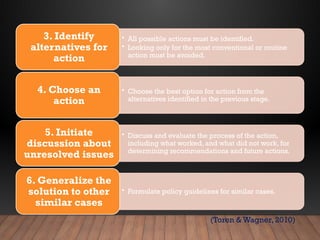
• All possible actions must be identified.
• Looking only for the most conventional or routine
action must be avoided.
3. Identify
alternatives for
action
• Choose the best option for action from the
alternatives identified in the previous stage.
4. Choose an
action
• Discuss and evaluate the process of the action,
including what worked, and what did not work, for
determining recommendations and future actions.
5. Initiate
discussion about
unresolved issues
• Formulate policy guidelines for similar cases.
6. Generalize the
solution to other
similar cases
(Toren & Wagner, 2010)
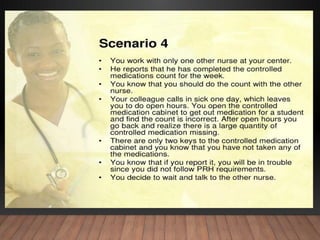
• You are working in a busy paediatric unit, and one day you
arrive late for work.
• Your colleague who was working at night tells you he is in a
hurry and has already counted and controlled the scheduled
drugs for the day.
• One of your registered nurses calls in sick, which leaves you to
work on your own
• You open the controlled drug cupboard to give the 4th
-year
student and notice that the count is incorrect. At the end of your
shift, you do the count and notice that a large quantity of
scheduled substances is missing
• You know you will be in trouble if you report it, because you
did not follow the guidelines, so you decide to wait for the
other nurse
• Identify the ethical dilemma?
• What will be the best way to handle the situation?
References Ethics in Community-Oriented Nursing Practice.
Chap 6.
http://www.library.armstrong.edu/eres/docs/er
es/NURS4005-1_MAHAN/500006dunCh6.pdf
ETHICAL DECISION-MAKING FRAMEWORKS FOR NURSES

ETHICAL DECISION-MAKING FRAMEWORKS FOR NURSES

  • 1.
  • 2.
    • Learning objectives: •After completing module , participants are expected to be able to: • Define ethical dilemma • Identify situation when ethical dilemma occurs • Define moral distress • Understand the processes involved in ethical decision making • Define code of ethics • Understand the four fundamental responsibilities of nurses • Define communication • Apply communication skills
  • 3.
    • Ethical dilemma •Defined as a problem involving a choice between equally desirable or equally unsatisfactory alternatives to the different or competitive assignment of priorities and responsibilities, or to a problem without a satisfactory solution (George & Grypdonck, 2002). (Wolf & Zuzelo, 2006)
  • 4.
    • Nurses encountered ethicaldilemmas when resources were limited, such as during the nursing shortage. They experienced moral stress in situations in which they had no control and patients lacked autonomy. External factors prevented nurses from doing what was best for patients. Conflict occurred when moral sensitivity and awareness of moral obligations coexisted. (Wolf & Zuzelo, 2006) Situations when an ethical dilemma occurs:
  • 5.
    • Moral distressis defined as “a psychological disequilibrium and negative feeling state experienced when a person makes a moral decision but does not follow through by performing the moral behavior indicated by that decision” (Wilkinson, 1988, p. 16) • The phenomenon of moral distress incorporates the • situation and the moral situation • the moral decision about the right action • the perceived inability to act, with resultant painful feelings • psychological disequilibrium • Moral distress brings about coping behaviors, influenced by the frequency of cases nurses encounter and affects nurses’ wholeness and patient care. (Wolf & Zuzelo, 2006)
  • 6.
    Purpose of nursingethics • to inspire questions and examine what would be the ethically right action in health care situations demanding a choice between at least two undesirable alternatives. • Ethics deals with the construction of criteria for judging a person’s behavior. • Yet, it also deals with the validation of those criteria, that is, their meaning and whether it is appropriate to abide by them. (Toren & Wagner, 2010)
  • 7.
    • Steps andcriteria that can be used to analyze and resolve any ethical dilemma 1. Define the ethical dilemma; 2. Clarify the personal and professional values, ethical principles, and laws involved; 3. Identify the alternatives for action; 4. Choose an action; 5. Initiate discussion about unresolved issues; 6. Generalize the solution to other similar cases. Ethical decision-making model: a tool for the analysis and resolution of dilemmas (Toren & Wagner, 2010)
  • 8.
    • 1. Definethe ethical dilemma • In order to identify the contradictory values, and to recognize the key components of a dilemma situation, the dilemma must be defined. • This definition is sometimes confused with summarizing the story. • Questions need to be raised about the meaning of the situation to all the participants and how the behavior of the nurse and the decision of the manager will affect them. (Toren & Wagner, 2010)
  • 9.
    • 2. Clarifythe personal and professional values, ethical principles, and laws involved • Personal values are based on what you value as important in the dilemma situation: for example, • ‘keeping a promise, doing no harm, maintaining professional integrity, etc.’. • Professional values are based on nursing codes of ethics and on the values, principles, and responsibilities that are relevant to the dilemma situation. • Country laws and regulations are related to health care systems, patients’ rights, etc. (Toren & Wagner, 2010)
  • 10.
    • All possibleactions must be identified. • Looking only for the most conventional or routine action must be avoided. 3. Identify alternatives for action • Choose the best option for action from the alternatives identified in the previous stage. 4. Choose an action • Discuss and evaluate the process of the action, including what worked, and what did not work, for determining recommendations and future actions. 5. Initiate discussion about unresolved issues • Formulate policy guidelines for similar cases. 6. Generalize the solution to other similar cases (Toren & Wagner, 2010)
  • 11.
    • You areworking in a busy paediatric unit, and one day you arrive late for work. • Your colleague who was working at night tells you he is in a hurry and has already counted and controlled the scheduled drugs for the day. • One of your registered nurses calls in sick, which leaves you to work on your own • You open the controlled drug cupboard to give the 4th -year student and notice that the count is incorrect. At the end of your shift, you do the count and notice that a large quantity of scheduled substances is missing • You know you will be in trouble if you report it, because you did not follow the guidelines, so you decide to wait for the other nurse
  • 14.
    • Identify theethical dilemma? • What will be the best way to handle the situation?
  • 15.
    References Ethics inCommunity-Oriented Nursing Practice. Chap 6. http://www.library.armstrong.edu/eres/docs/er es/NURS4005-1_MAHAN/500006dunCh6.pdf