Smart contract.
Writing “Hello world” in Ethereum
What is Ethereum?
Ethereum is an open-source, public,
blockchain-based distributed computing
platform featuring smart contract (scripting)
functionality. It provides a decentralized
Turing-complete virtual machine, the
Ethereum Virtual Machine (EVM), which can
execute scripts using an international network
of public nodes.
Released at 31 July 2015 by Ethereum
Foundation
Smart contracts
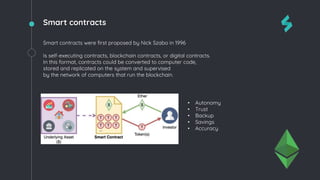
Smart contracts were first proposed by Nick Szabo in 1996
Is self-executing contracts, blockchain contracts, or digital contracts.
In this format, contracts could be converted to computer code,
stored and replicated on the system and supervised
by the network of computers that run the blockchain.
• Autonomy
• Trust
• Backup
• Savings
• Accuracy
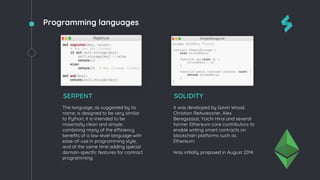
Programming languages
SERPENT
The language, as suggested by its
name, is designed to be very similar
to Python; it is intended to be
maximally clean and simple,
combining many of the efficiency
benefits of a low-level language with
ease-of-use in programming style,
and at the same time adding special
domain-specific features for contract
programming.
SOLIDITY
It was developed by Gavin Wood,
Christian Reitwiessner, Alex
Beregszaszi, Yoichi Hirai and several
former Ethereum core contributors to
enable writing smart contracts on
blockchain platforms such as
Ethereum.
Was initially proposed in August 2014.
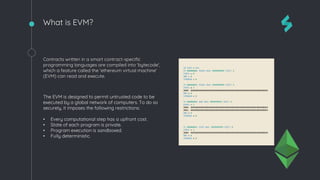
What is EVM?
Contracts written in a smart contract-specific
programming languages are compiled into 'bytecode',
which a feature called the 'ethereum virtual machine'
(EVM) can read and execute.
The EVM is designed to permit untrusted code to be
executed by a global network of computers. To do so
securely, it imposes the following restrictions:
• Every computational step has a upfront cost.
• State of each program is private.
• Program execution is sandboxed.
• Fully deterministic.
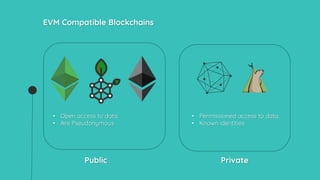
Public Private
EVM Compatible Blockchains
• Open access to data.
• Are Pseudonymous
• Permissioned access to data.
• Known identities
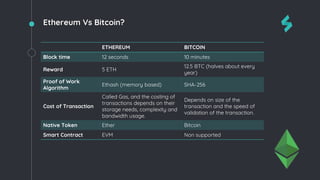
Ethereum Vs Bitcoin?
ETHEREUM BITCOIN
Block time 12 seconds 10 minutes
Reward 5 ETH
12.5 BTC (halves about every
year)
Proof of Work
Algorithm
Ethash (memory based) SHA-256
Cost of Transaction
Called Gas, and the costing of
transactions depends on their
storage needs, complexity and
bandwidth usage.
Depends on size of the
transaction and the speed of
validation of the transaction.
Native Token Ether Bitcoin
Smart Contract EVM Non supported

Ethereum Smart contract

  • 1.
  • 2.
    What is Ethereum? Ethereumis an open-source, public, blockchain-based distributed computing platform featuring smart contract (scripting) functionality. It provides a decentralized Turing-complete virtual machine, the Ethereum Virtual Machine (EVM), which can execute scripts using an international network of public nodes. Released at 31 July 2015 by Ethereum Foundation
  • 3.
    Smart contracts Smart contractswere first proposed by Nick Szabo in 1996 Is self-executing contracts, blockchain contracts, or digital contracts. In this format, contracts could be converted to computer code, stored and replicated on the system and supervised by the network of computers that run the blockchain. • Autonomy • Trust • Backup • Savings • Accuracy
  • 4.
    Programming languages SERPENT The language,as suggested by its name, is designed to be very similar to Python; it is intended to be maximally clean and simple, combining many of the efficiency benefits of a low-level language with ease-of-use in programming style, and at the same time adding special domain-specific features for contract programming. SOLIDITY It was developed by Gavin Wood, Christian Reitwiessner, Alex Beregszaszi, Yoichi Hirai and several former Ethereum core contributors to enable writing smart contracts on blockchain platforms such as Ethereum. Was initially proposed in August 2014.
  • 5.
    What is EVM? Contractswritten in a smart contract-specific programming languages are compiled into 'bytecode', which a feature called the 'ethereum virtual machine' (EVM) can read and execute. The EVM is designed to permit untrusted code to be executed by a global network of computers. To do so securely, it imposes the following restrictions: • Every computational step has a upfront cost. • State of each program is private. • Program execution is sandboxed. • Fully deterministic.
  • 6.
    Public Private EVM CompatibleBlockchains • Open access to data. • Are Pseudonymous • Permissioned access to data. • Known identities
  • 7.
    Ethereum Vs Bitcoin? ETHEREUMBITCOIN Block time 12 seconds 10 minutes Reward 5 ETH 12.5 BTC (halves about every year) Proof of Work Algorithm Ethash (memory based) SHA-256 Cost of Transaction Called Gas, and the costing of transactions depends on their storage needs, complexity and bandwidth usage. Depends on size of the transaction and the speed of validation of the transaction. Native Token Ether Bitcoin Smart Contract EVM Non supported