8. Native Currency vs. Token
KC Tam
Reach KC on LinkedIn: https://www.linkedin.com/in/ktam1/
Objective
In this section we introduce token, and compare the
implementation of token and of the native currency.
Source: screenshot from coinmarketcap.com at a randomly selected time
Note: these two are selected just for comparison between native currency and token. There is no comparison on their price and
performance from investment perspective. No investment recommendation on anything is made.
While both of them use ledger to keep the balance, they are implemented differently. We call
Ethereum a native currency, while EOS is a token.
To investors, these are just two different investment products.
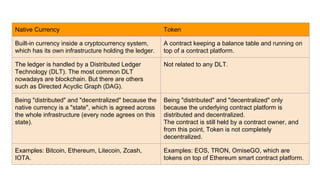
Native Currency Token
Built-in currency inside a cryptocurrency system,
which has its own infrastructure holding the ledger.
A contract keeping a balance table and running on
top of a contract platform.
The ledger is handled by a Distributed Ledger
Technology (DLT). The most common DLT
nowadays are blockchain. But there are others
such as Directed Acyclic Graph (DAG).
Not related to any DLT.
Being "distributed" and "decentralized" because the
native currency is a "state", which is agreed across
the whole infrastructure (every node agrees on this
state).
Being "distributed" and "decentralized" only
because the underlying contract platform is
distributed and decentralized.
The contract is still held by a contract owner, and
from this point, Token is not completely
decentralized.
Examples: Bitcoin, Ethereum, Litecoin, Zcash,
IOTA.
Examples: EOS, TRON, OmiseGO, which are
tokens on top of Ethereum smart contract platform.
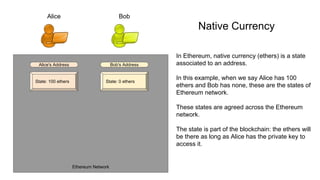
Ethereum Network
Alice Bob
Alice's Address Bob's Address
State: 100 ethers State: 0 ethers
In Ethereum, native currency (ethers) is a state
associated to an address.
In this example, when we say Alice has 100
ethers and Bob has none, these are the states of
Ethereum network.
These states are agreed across the Ethereum
network.
The state is part of the blockchain: the ethers will
be there as long as Alice has the private key to
access it.
Native Currency
Ethereum Network
Alice Bob
Alice's Address Bob's Address
State: 100 ethers State: 0 ethers
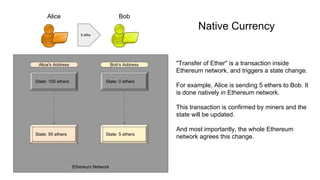
"Transfer of Ether" is a transaction inside
Ethereum network, and triggers a state change.
For example, Alice is sending 5 ethers to Bob. It
is done natively in Ethereum network.
This transaction is confirmed by miners and the
state will be updated.
And most importantly, the whole Ethereum
network agrees this change.
5 eths
State: 95 ethers State: 5 ethers
Native Currency
Ethereum Network
Alice Bob
Alice's Address Bob's Address
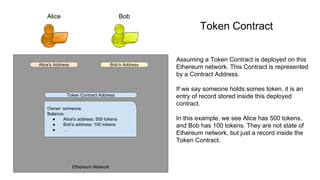
Assuming a Token Contract is deployed on this
Ethereum network. This Contract is represented
by a Contract Address.
If we say someone holds somes token, it is an
entry of record stored inside this deployed
contract.
In this example, we see Alice has 500 tokens,
and Bob has 100 tokens. They are not state of
Ethereum network, but just a record inside the
Token Contract.
Token Contract Address
Token Contract
Owner: someone
Balance:
● Alice's address: 500 tokens
● Bob's address: 100 tokens
● …
Ethereum Network
Alice Bob
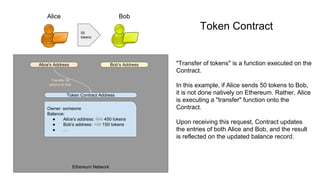
Alice's Address Bob's Address "Transfer of tokens" is a function executed on the
Contract.
In this example, if Alice sends 50 tokens to Bob,
it is not done natively on Ethereum. Rather, Alice
is executing a "transfer" function onto the
Contract.
Upon receiving this request, Contract updates
the entries of both Alice and Bob, and the result
is reflected on the updated balance record.
50
tokens
Transfer 50
tokens to Bob
Token Contract
Token Contract Address
Owner: someone
Balance:
● Alice's address: 500 450 tokens
● Bob's address: 100 150 tokens
● …
Token Summary
Token is issued by Token Issuer (no limit on number of issuers in Ethereum, and therefore no limit on the
number of tokens issued on Ethereum)
Token Issuer determines token name and token quantity and the mechanism of token distribution (through
ICO or private placement)
Each token is a Deployed Contract on Contract Platform, and therefore identified by a Contract Address
● Ethereum by far is the most common Contract Platform
● Standard interface (e.g. ERC20) is defined for ease of use token
Every user (identified by its address) can own multiple tokens. There is no limit on number of tokens a
user can own
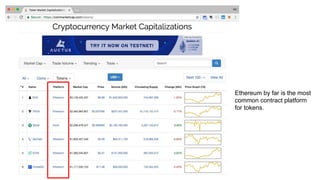
Ethereum by far is the most
common contract platform
for tokens.
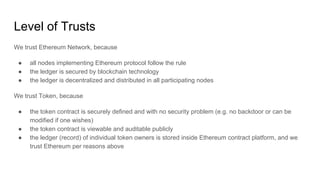
Level of Trusts
We trust Ethereum Network, because
● all nodes implementing Ethereum protocol follow the rule
● the ledger is secured by blockchain technology
● the ledger is decentralized and distributed in all participating nodes
We trust Token, because
● the token contract is securely defined and with no security problem (e.g. no backdoor or can be
modified if one wishes)
● the token contract is viewable and auditable publicly
● the ledger (record) of individual token owners is stored inside Ethereum contract platform, and we
trust Ethereum per reasons above
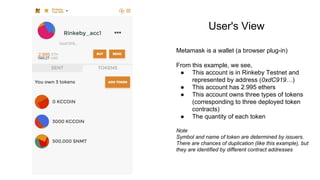
Metamask is a wallet (a browser plug-in)
From this example, we see,
● This account is in Rinkeby Testnet and
represented by address (0xdC919…)
● This account has 2.995 ethers
● This account owns three types of tokens
(corresponding to three deployed token
contracts)
● The quantity of each token
Note
Symbol and name of token are determined by issuers.
There are chances of duplication (like this example), but
they are identified by different contract addresses
User's View
Summary
We have compared tokens with native currency (ethereum),
and see how the mechanism of transfering is different
between them.

Ethereum: Native Currency and Token

  • 1.
    8. Native Currencyvs. Token KC Tam Reach KC on LinkedIn: https://www.linkedin.com/in/ktam1/
  • 2.
    Objective In this sectionwe introduce token, and compare the implementation of token and of the native currency.
  • 3.
    Source: screenshot fromcoinmarketcap.com at a randomly selected time Note: these two are selected just for comparison between native currency and token. There is no comparison on their price and performance from investment perspective. No investment recommendation on anything is made. While both of them use ledger to keep the balance, they are implemented differently. We call Ethereum a native currency, while EOS is a token. To investors, these are just two different investment products.
  • 4.
    Native Currency Token Built-incurrency inside a cryptocurrency system, which has its own infrastructure holding the ledger. A contract keeping a balance table and running on top of a contract platform. The ledger is handled by a Distributed Ledger Technology (DLT). The most common DLT nowadays are blockchain. But there are others such as Directed Acyclic Graph (DAG). Not related to any DLT. Being "distributed" and "decentralized" because the native currency is a "state", which is agreed across the whole infrastructure (every node agrees on this state). Being "distributed" and "decentralized" only because the underlying contract platform is distributed and decentralized. The contract is still held by a contract owner, and from this point, Token is not completely decentralized. Examples: Bitcoin, Ethereum, Litecoin, Zcash, IOTA. Examples: EOS, TRON, OmiseGO, which are tokens on top of Ethereum smart contract platform.
  • 5.
    Ethereum Network Alice Bob Alice'sAddress Bob's Address State: 100 ethers State: 0 ethers In Ethereum, native currency (ethers) is a state associated to an address. In this example, when we say Alice has 100 ethers and Bob has none, these are the states of Ethereum network. These states are agreed across the Ethereum network. The state is part of the blockchain: the ethers will be there as long as Alice has the private key to access it. Native Currency
  • 6.
    Ethereum Network Alice Bob Alice'sAddress Bob's Address State: 100 ethers State: 0 ethers "Transfer of Ether" is a transaction inside Ethereum network, and triggers a state change. For example, Alice is sending 5 ethers to Bob. It is done natively in Ethereum network. This transaction is confirmed by miners and the state will be updated. And most importantly, the whole Ethereum network agrees this change. 5 eths State: 95 ethers State: 5 ethers Native Currency
  • 7.
    Ethereum Network Alice Bob Alice'sAddress Bob's Address Assuming a Token Contract is deployed on this Ethereum network. This Contract is represented by a Contract Address. If we say someone holds somes token, it is an entry of record stored inside this deployed contract. In this example, we see Alice has 500 tokens, and Bob has 100 tokens. They are not state of Ethereum network, but just a record inside the Token Contract. Token Contract Address Token Contract Owner: someone Balance: ● Alice's address: 500 tokens ● Bob's address: 100 tokens ● …
  • 8.
    Ethereum Network Alice Bob Alice'sAddress Bob's Address "Transfer of tokens" is a function executed on the Contract. In this example, if Alice sends 50 tokens to Bob, it is not done natively on Ethereum. Rather, Alice is executing a "transfer" function onto the Contract. Upon receiving this request, Contract updates the entries of both Alice and Bob, and the result is reflected on the updated balance record. 50 tokens Transfer 50 tokens to Bob Token Contract Token Contract Address Owner: someone Balance: ● Alice's address: 500 450 tokens ● Bob's address: 100 150 tokens ● …
  • 9.
    Token Summary Token isissued by Token Issuer (no limit on number of issuers in Ethereum, and therefore no limit on the number of tokens issued on Ethereum) Token Issuer determines token name and token quantity and the mechanism of token distribution (through ICO or private placement) Each token is a Deployed Contract on Contract Platform, and therefore identified by a Contract Address ● Ethereum by far is the most common Contract Platform ● Standard interface (e.g. ERC20) is defined for ease of use token Every user (identified by its address) can own multiple tokens. There is no limit on number of tokens a user can own
  • 10.
    Ethereum by faris the most common contract platform for tokens.
  • 11.
    Level of Trusts Wetrust Ethereum Network, because ● all nodes implementing Ethereum protocol follow the rule ● the ledger is secured by blockchain technology ● the ledger is decentralized and distributed in all participating nodes We trust Token, because ● the token contract is securely defined and with no security problem (e.g. no backdoor or can be modified if one wishes) ● the token contract is viewable and auditable publicly ● the ledger (record) of individual token owners is stored inside Ethereum contract platform, and we trust Ethereum per reasons above
  • 12.
    Metamask is awallet (a browser plug-in) From this example, we see, ● This account is in Rinkeby Testnet and represented by address (0xdC919…) ● This account has 2.995 ethers ● This account owns three types of tokens (corresponding to three deployed token contracts) ● The quantity of each token Note Symbol and name of token are determined by issuers. There are chances of duplication (like this example), but they are identified by different contract addresses User's View
  • 13.
    Summary We have comparedtokens with native currency (ethereum), and see how the mechanism of transfering is different between them.