(eTextbook PDF) for Customer Relationship
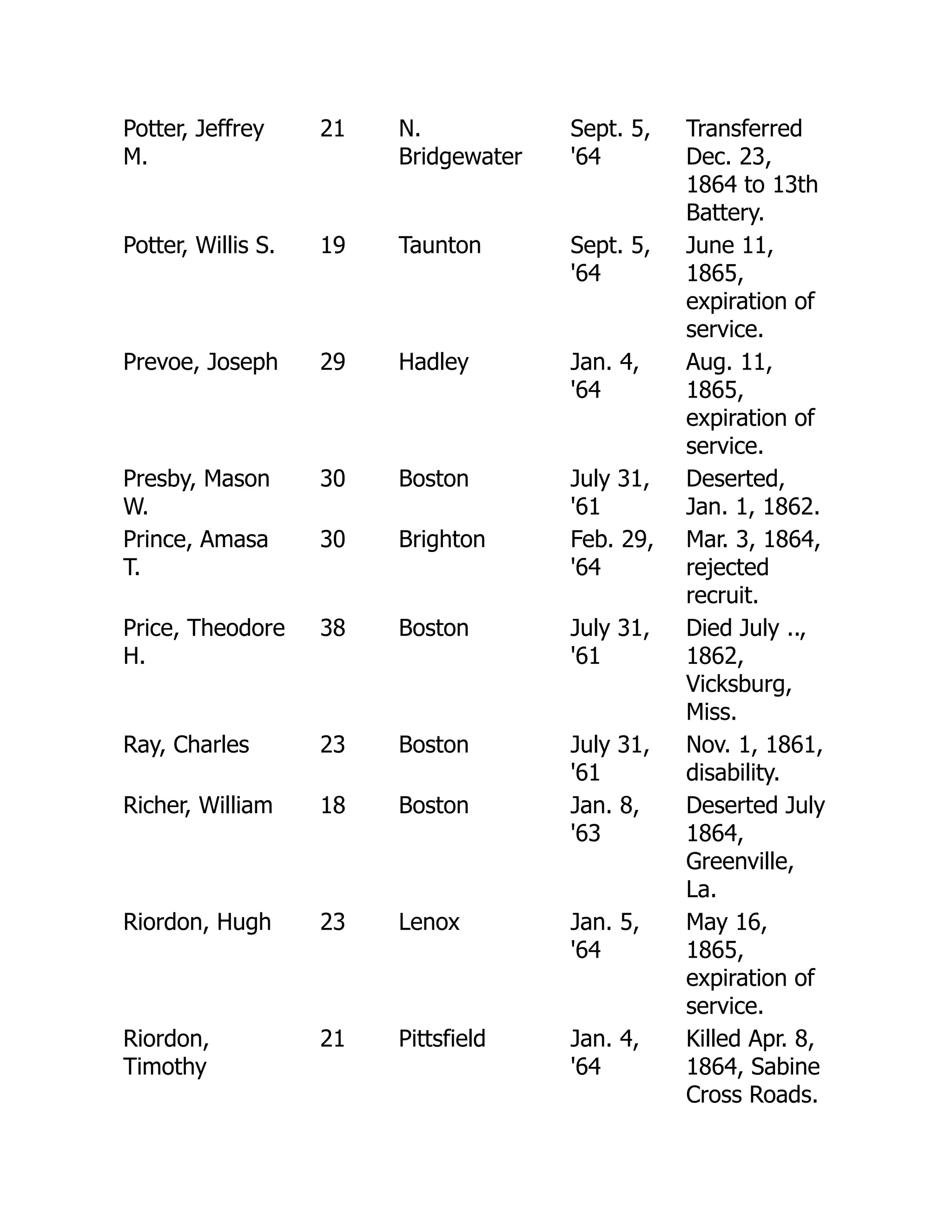
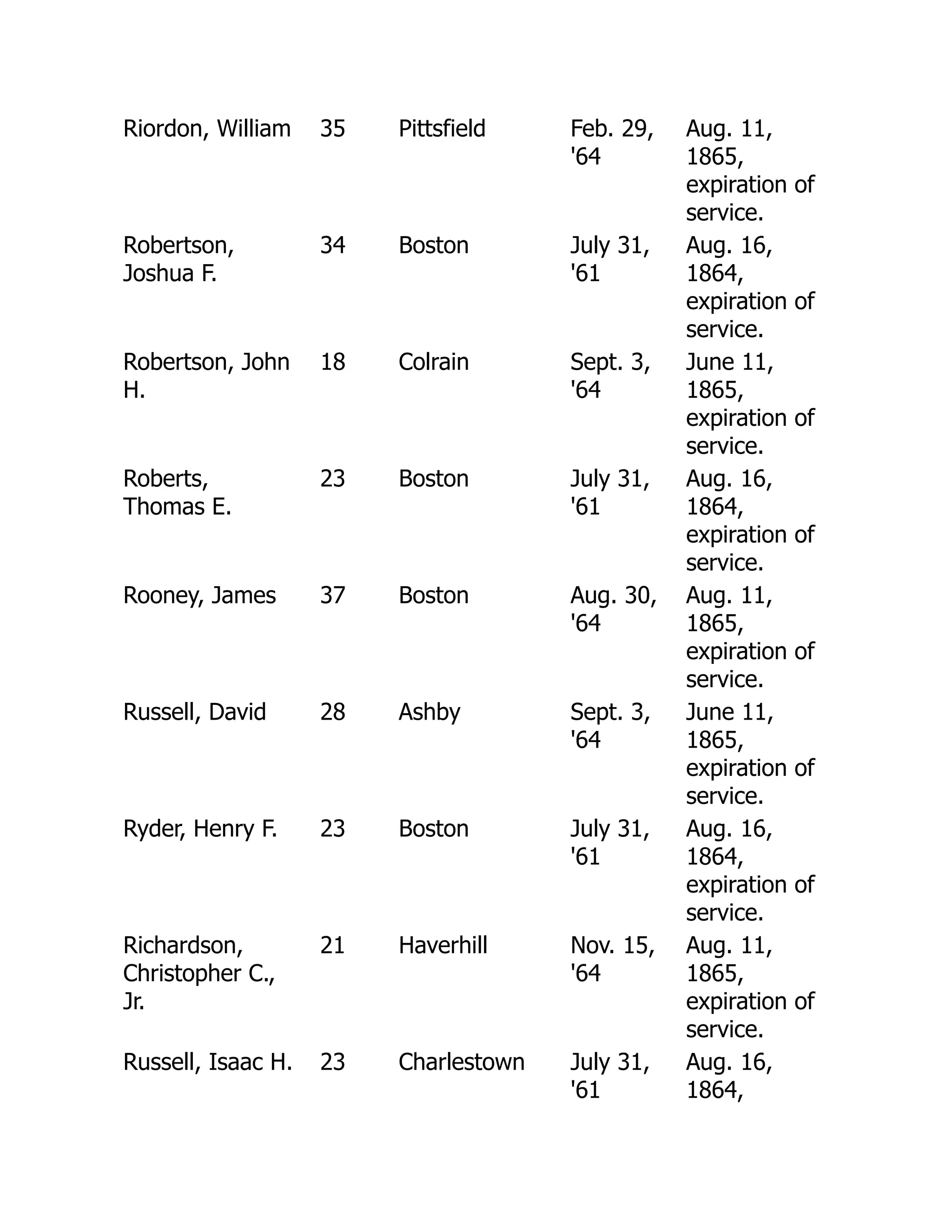
Management: Concepts and Technologies 4th Edition
download pdf
https://ebookmass.com/product/etextbook-pdf-for-customer-relationship-
management-concepts-and-technologies-4th-edition/
Visit ebookmass.com today to download the complete set of
ebook or textbook!
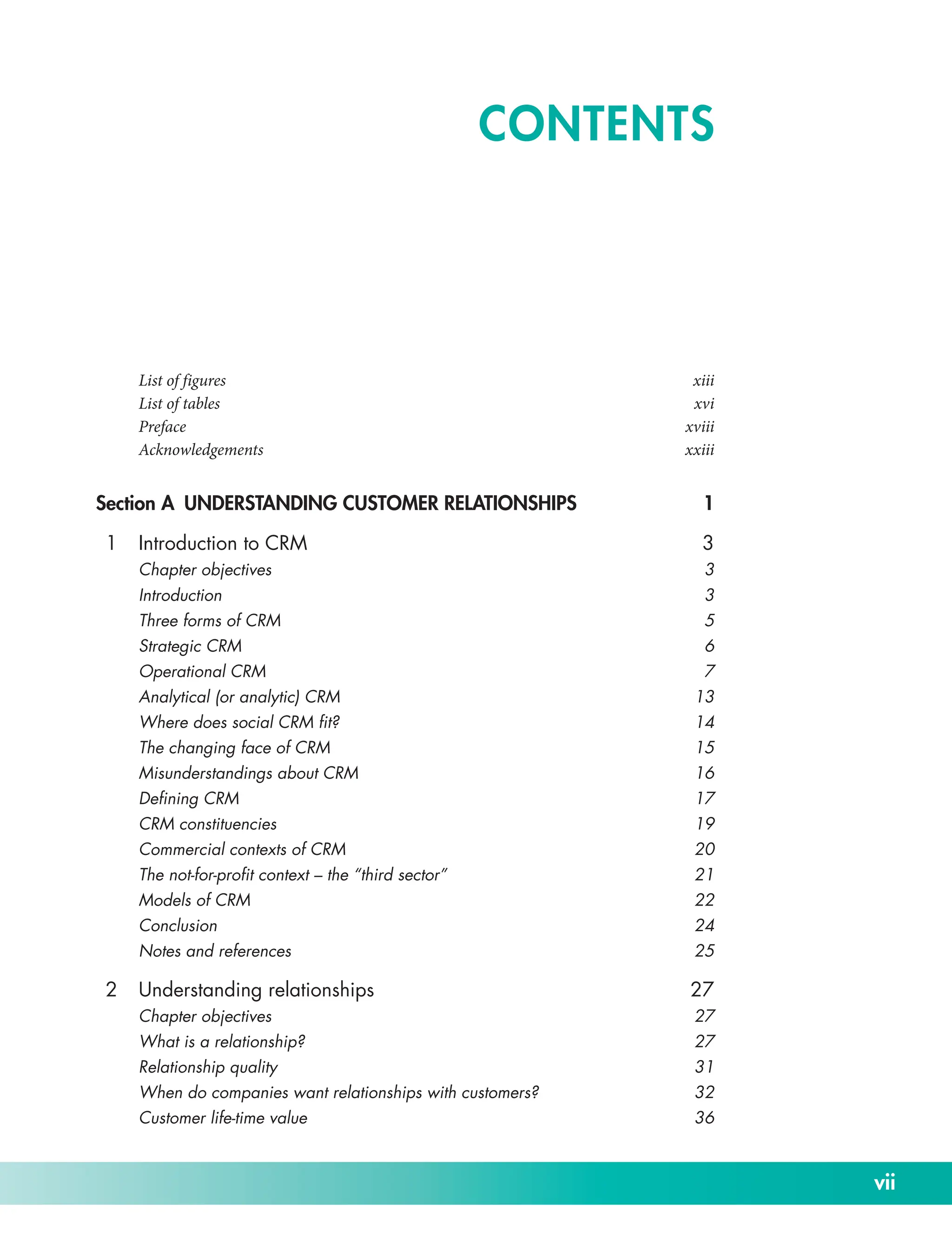
vii
List of figures xiii
List of tables xvi
Prefacexviii
Acknowledgementsxxiii
Section A UNDERSTANDING CUSTOMER RELATIONSHIPS 1
1 Introduction to CRM 3
Chapter objectives 3
Introduction3
Three forms of CRM 5
Strategic CRM 6
Operational CRM 7
Analytical (or analytic) CRM 13
Where does social CRM fit? 14
The changing face of CRM 15
Misunderstandings about CRM 16
Defining CRM 17
CRM constituencies 19
Commercial contexts of CRM 20
The not-­for-­profit context – the “third sector” 21
Models of CRM 22
Conclusion24
Notes and references 25
2 Understanding relationships 27
Chapter objectives 27
What is a relationship? 27
Relationship quality 31
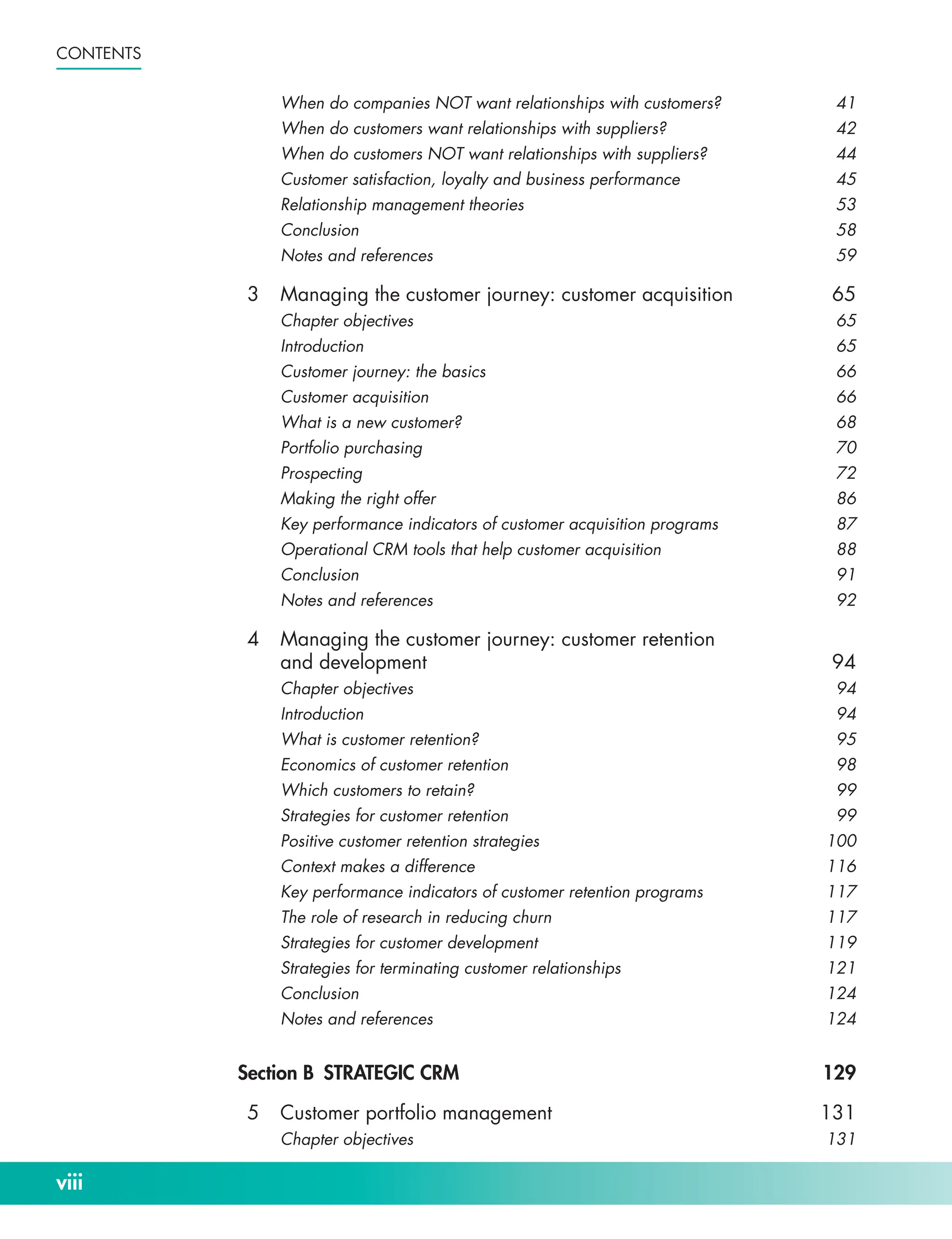
When do companies want relationships with customers? 32
Customer life-­
time value 36
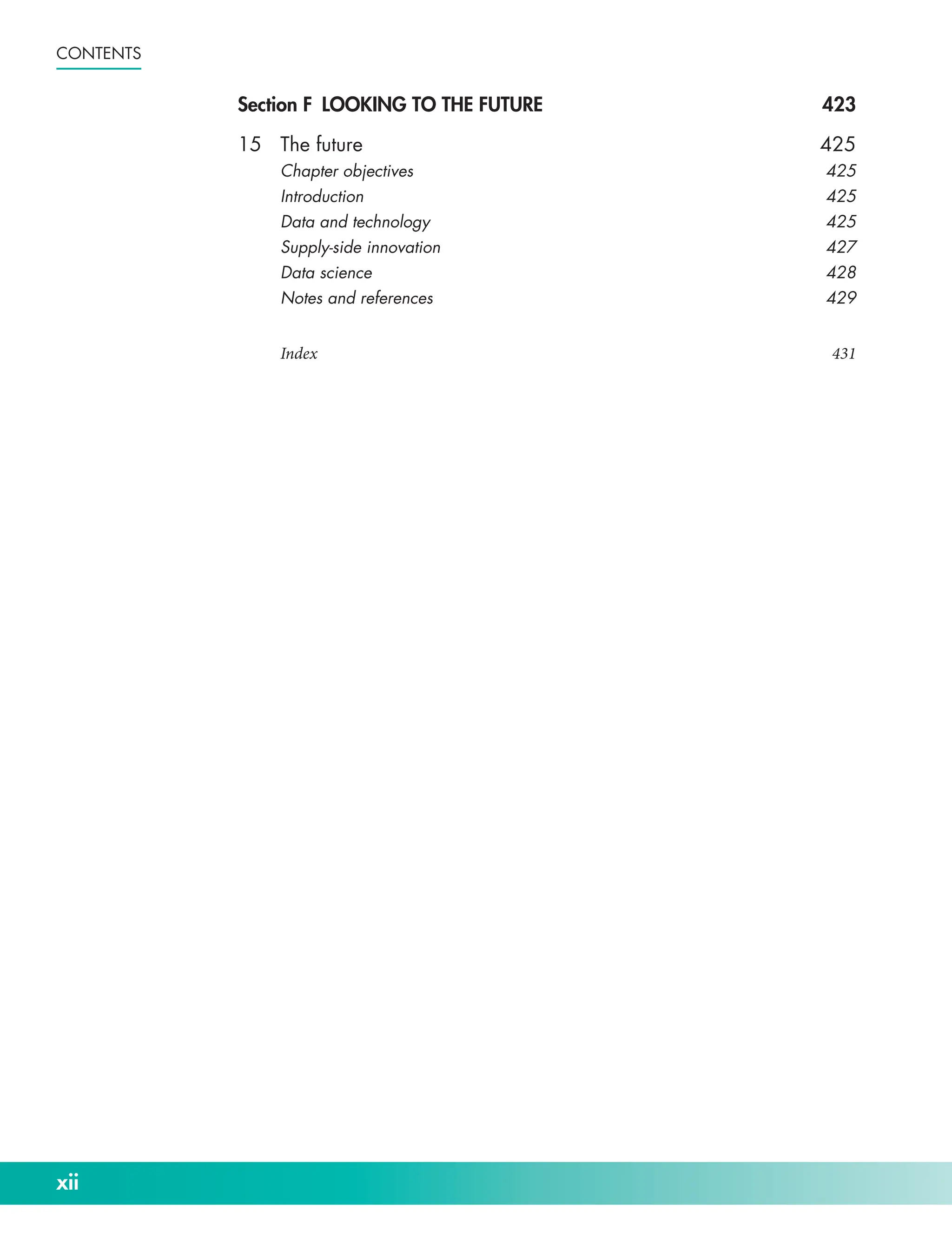
CONTENTS
viii
Contents
When do companies NOT want relationships with customers? 41
When do customers want relationships with suppliers? 42
When do customers NOT want relationships with suppliers? 44
Customer satisfaction, loyalty and business performance 45
Relationship management theories 53
Conclusion58
Notes and references 59
3 Managing the customer journey: customer acquisition 65
Chapter objectives 65
Introduction65
Customer journey: the basics 66
Customer acquisition 66
What is a new customer? 68
Portfolio purchasing 70
Prospecting72
Making the right offer 86
Key performance indicators of customer acquisition programs 87
Operational CRM tools that help customer acquisition 88
Conclusion91
Notes and references 92
4 Managing the customer journey: customer retention
and development 94
Chapter objectives 94
Introduction94
What is customer retention? 95
Economics of customer retention 98
Which customers to retain? 99
Strategies for customer retention 99
Positive customer retention strategies 100
Context makes a difference 116
Key performance indicators of customer retention programs 117
The role of research in reducing churn 117
Strategies for customer development 119
Strategies for terminating customer relationships 121
Conclusion124
Notes and references 124
Section B STRATEGIC CRM 129
5 Customer portfolio management 131
Chapter objectives 131
ix
Contents
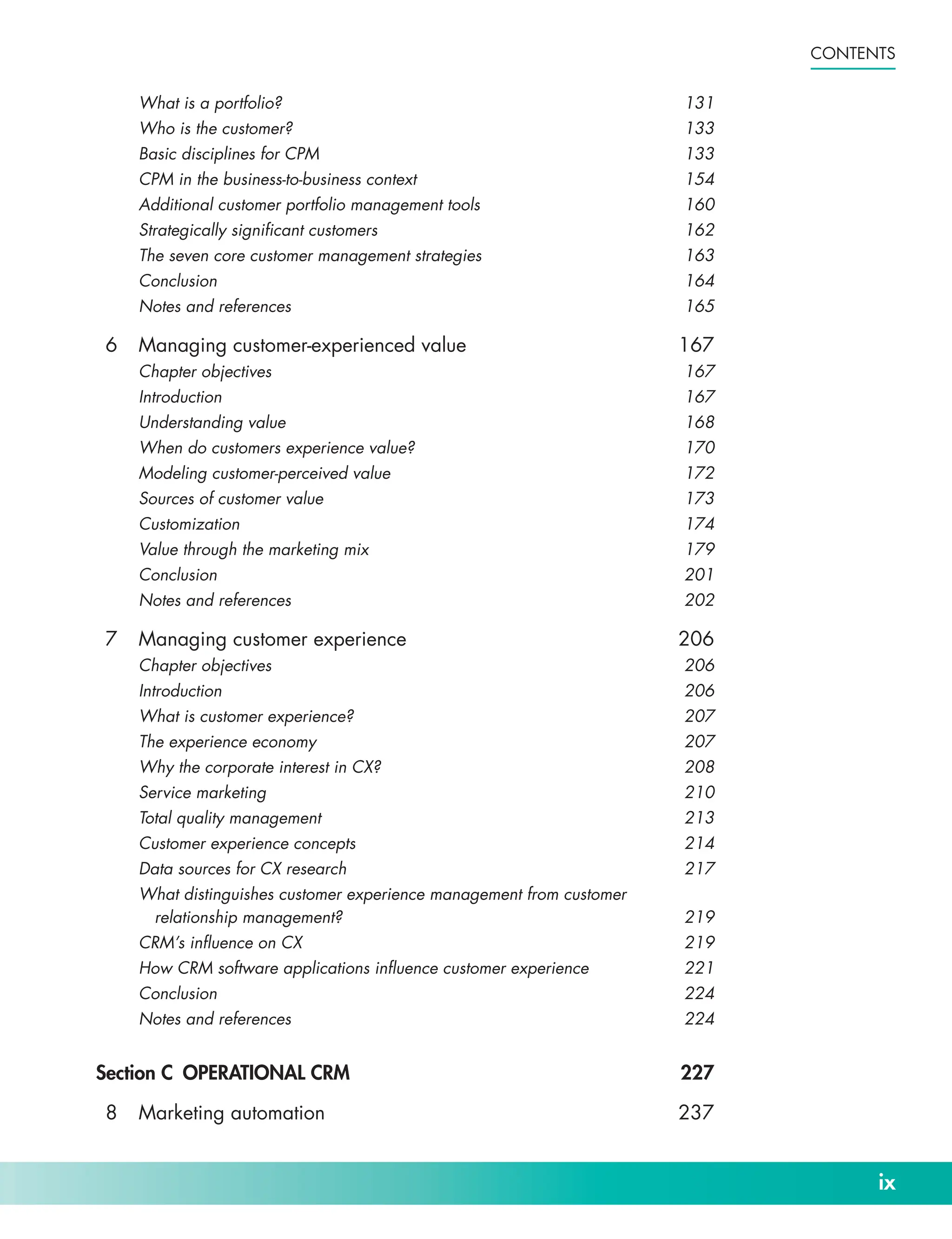
What is a portfolio? 131
Who is the customer? 133
Basic disciplines for CPM 133
CPM in the business-­
to-­
business context 154
Additional customer portfolio management tools 160
Strategically significant customers 162
The seven core customer management strategies 163
Conclusion164
Notes and references 165
6 Managing customer-­
experienced value 167
Chapter objectives 167
Introduction167
Understanding value 168
When do customers experience value? 170
Modeling customer-­
perceived value 172
Sources of customer value 173
Customization174
Value through the marketing mix 179
Conclusion201
Notes and references 202
7 Managing customer experience 206
Chapter objectives 206
Introduction206
What is customer experience? 207
The experience economy 207
Why the corporate interest in CX? 208
Service marketing 210
Total quality management 213
Customer experience concepts 214
Data sources for CX research 217
What distinguishes customer experience management from customer
relationship management? 219
CRM’s influence on CX 219
How CRM software applications influence customer experience 221
Conclusion224
Notes and references 224
Section C OPERATIONAL CRM 227
8 Marketing automation 237
x
Contents
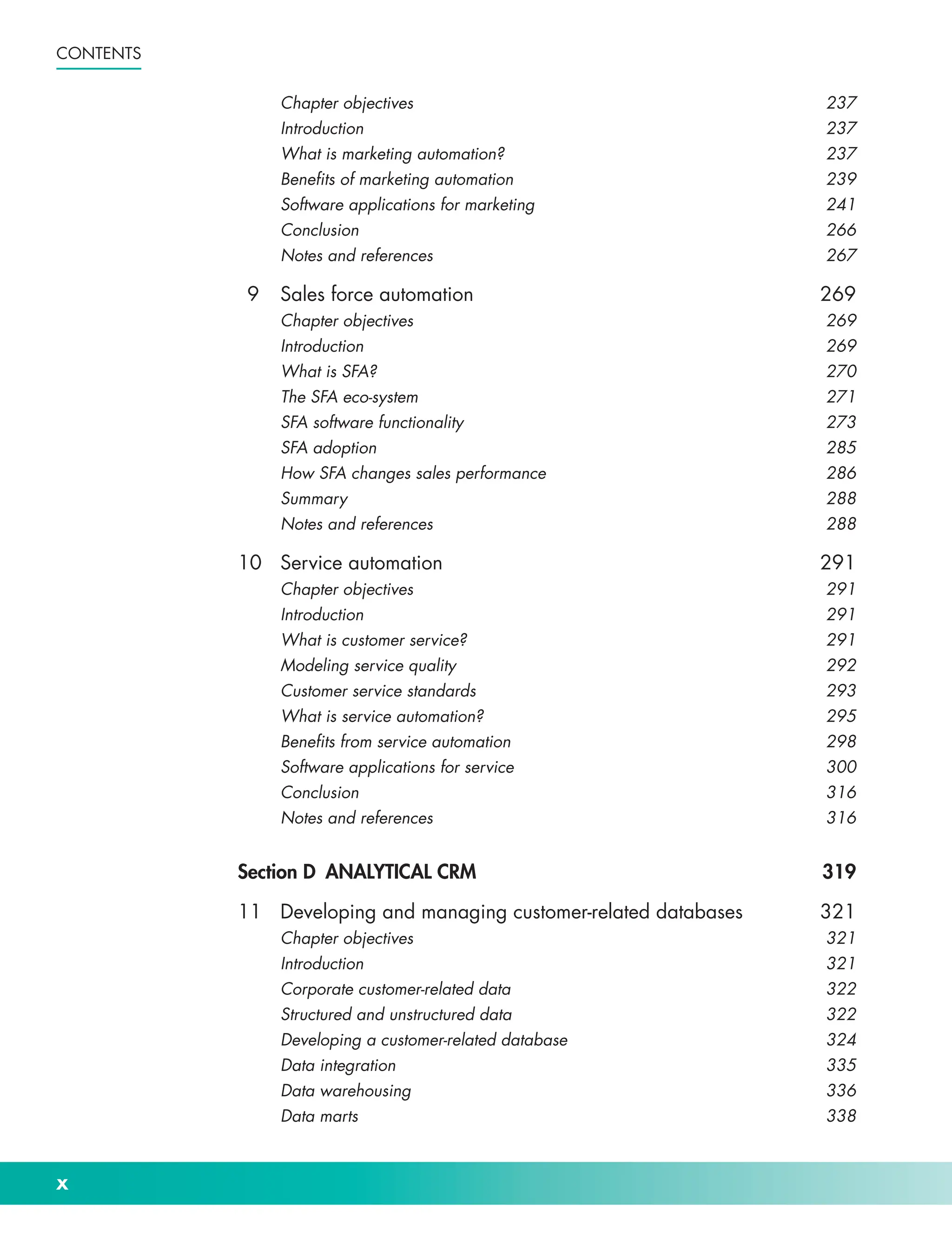
Chapter objectives 237
Introduction237
What is marketing automation? 237
Benefits of marketing automation 239
Software applications for marketing 241
Conclusion266
Notes and references 267
9	Sales force automation 269
Chapter objectives 269
Introduction269
What is SFA? 270
The SFA eco-­
system 271
SFA software functionality 273
SFA adoption 285
How SFA changes sales performance 286
Summary288
Notes and references 288
10	Service automation 291
Chapter objectives 291
Introduction291
What is customer service? 291
Modeling service quality 292
Customer service standards 293
What is service automation? 295
Benefits from service automation 298
Software applications for service 300
Conclusion316
Notes and references 316
Section D ANALYTICAL CRM 319
11 Developing and managing customer-­
related databases 321
Chapter objectives 321
Introduction321
Corporate customer-­
related data 322
Structured and unstructured data 322
Developing a customer-­
related database 324
Data integration 335
Data warehousing 336
Data marts 338
xi
Contents
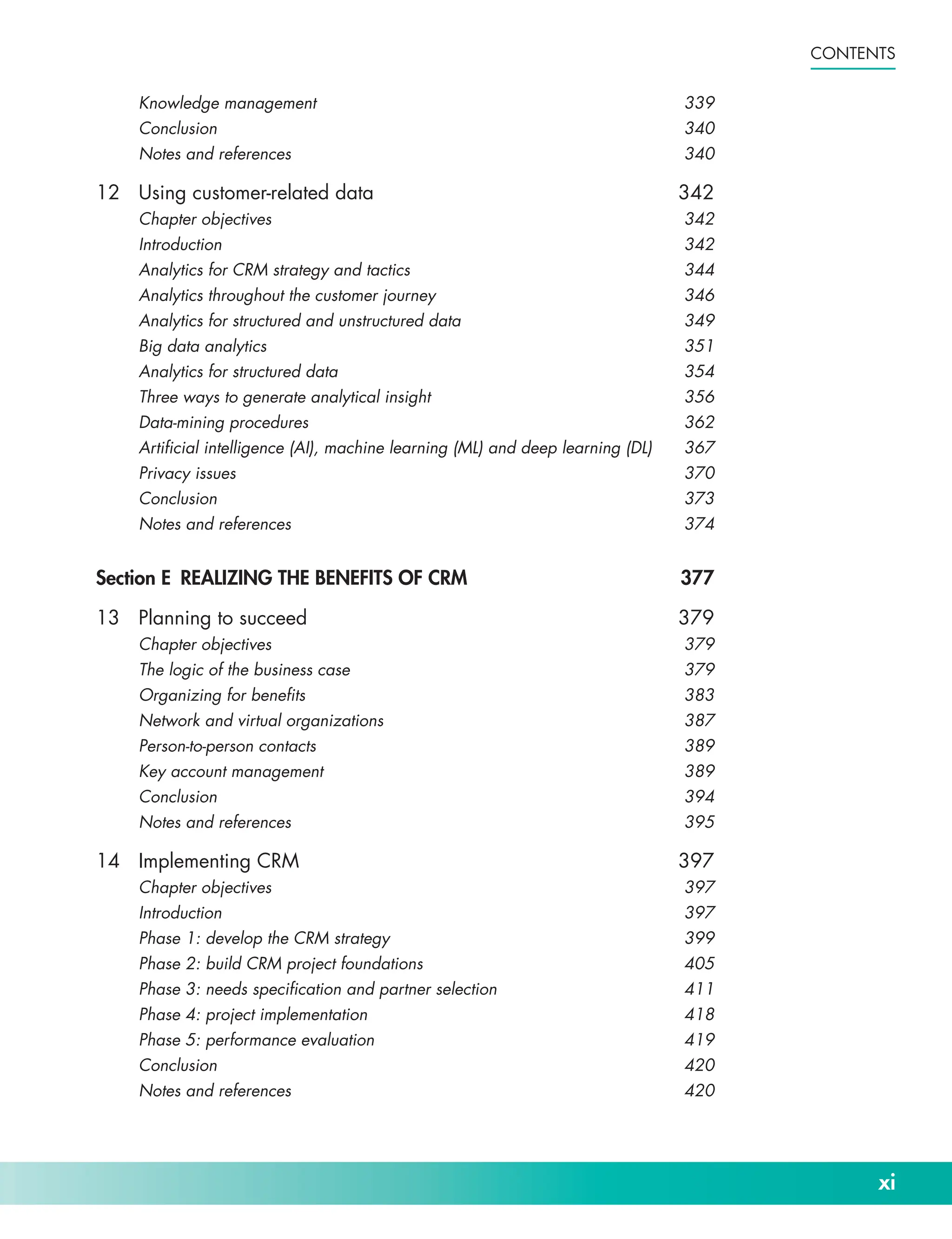
Knowledge management 339
Conclusion340
Notes and references 340
12 Using customer-­related data 342
Chapter objectives 342
Introduction342
Analytics for CRM strategy and tactics 344
Analytics throughout the customer journey 346
Analytics for structured and unstructured data 349
Big data analytics 351
Analytics for structured data 354
Three ways to generate analytical insight 356
Data-­mining procedures 362
Artificial intelligence (AI), machine learning (ML) and deep learning (DL) 367
Privacy issues 370
Conclusion373
Notes and references 374
Section E REALIZING THE BENEFITS OF CRM 377
13 Planning to succeed 379
Chapter objectives 379
The logic of the business case 379
Organizing for benefits 383
Network and virtual organizations 387
Person-­to-­person contacts 389
Key account management 389
Conclusion394
Notes and references 395
14 Implementing CRM 397
Chapter objectives 397
Introduction397
Phase 1: develop the CRM strategy 399
Phase 2: build CRM project foundations 405
Phase 3: needs specification and partner selection 411
Phase 4: project implementation 418
Phase 5: performance evaluation 419
Conclusion420
Notes and references 420
xii
Contents
Section F LOOKING TO THE FUTURE 423
15 The future 425
Chapter objectives 425
Introduction425
Data and technology 425
Supply-­side innovation 427
Data science 428
Notes and references 429
Index431
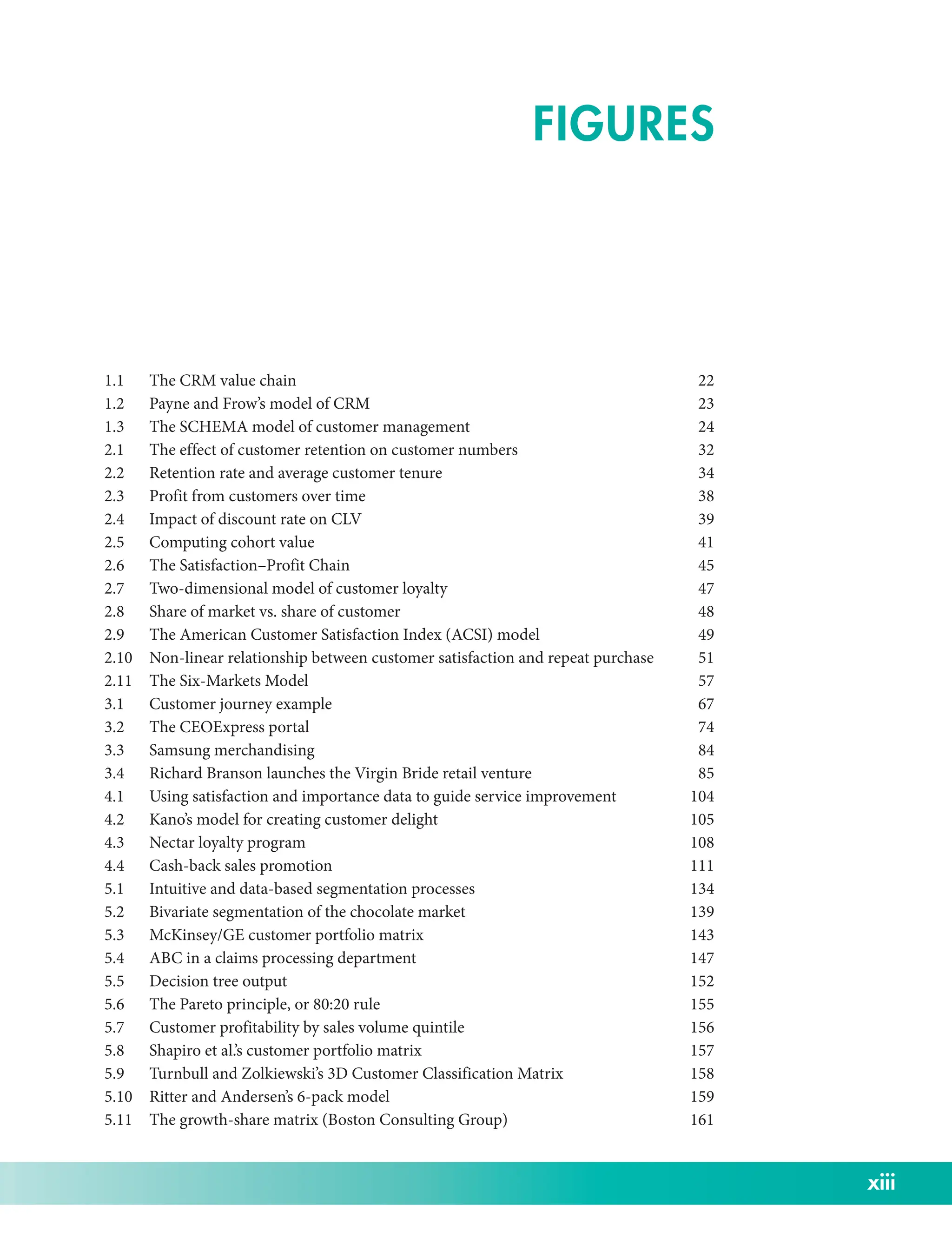
xiii
1.1 The CRM value chain 22
1.2 Payne and Frow’s model of CRM 23
1.3 The SCHEMA model of customer management 24
2.1 The effect of customer retention on customer numbers 32
2.2 Retention rate and average customer tenure 34
2.3 Profit from customers over time 38
2.4 Impact of discount rate on CLV 39
2.5 Computing cohort value 41
2.6 The Satisfaction–Profit Chain 45
2.7 Two-­
dimensional model of customer loyalty 47
2.8 Share of market vs. share of customer 48
2.9 The American Customer Satisfaction Index (ACSI) model 49
2.10 Non-­
linear relationship between customer satisfaction and repeat purchase 51
2.11 The Six-­
Markets Model 57
3.1 Customer journey example 67
3.2 The CEOExpress portal 74
3.3 Samsung merchandising 84
3.4 Richard Branson launches the Virgin Bride retail venture 85
4.1 Using satisfaction and importance data to guide service improvement 104
4.2 Kano’s model for creating customer delight 105
4.3 Nectar loyalty program 108
4.4 Cash-­
back sales promotion 111
5.1 Intuitive and data-­
based segmentation processes 134
5.2 Bivariate segmentation of the chocolate market 139
5.3 McKinsey/­
GE customer portfolio matrix 143
5.4 ABC in a claims processing department 147
5.5 Decision tree output 152
5.6 The Pareto principle, or 80:20 rule 155
5.7 Customer profitability by sales volume quintile 156
5.8 Shapiro et al.’s customer portfolio matrix 157
5.9 Turnbull and Zolkiewski’s 3D Customer Classification Matrix 158
5.10 Ritter and Andersen’s 6-­
pack model 159
5.11 The growth-­
share matrix (Boston Consulting Group) 161
FIGURES
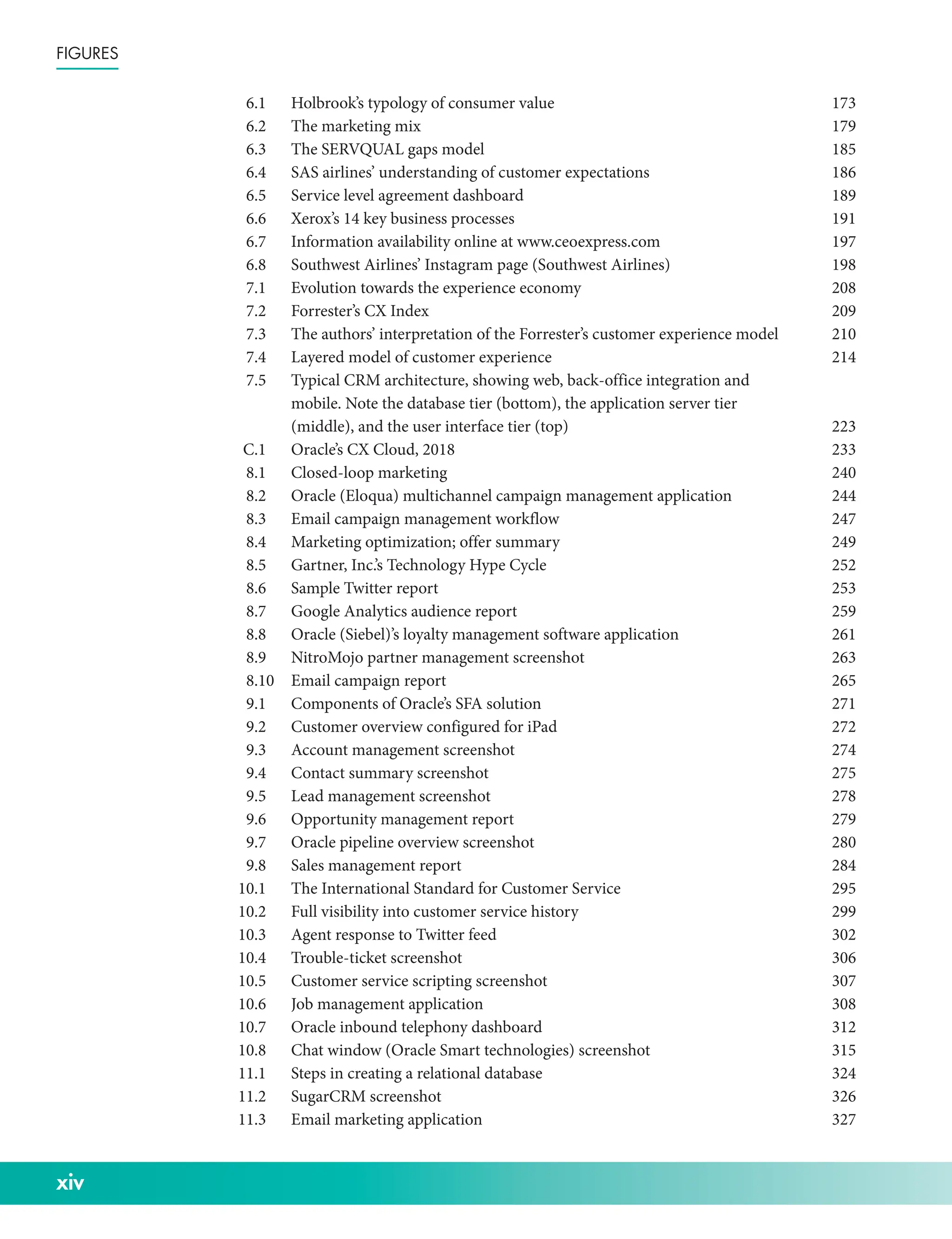
xiv
Figures
6.1 Holbrook’s typology of consumer value 173
6.2 The marketing mix 179
6.3 The SERVQUAL gaps model 185
6.4 SAS airlines’ understanding of customer expectations 186
6.5 Service level agreement dashboard 189
6.6 Xerox’s 14 key business processes 191
6.7 Information availability online at www.ceoexpress.com 197
6.8 Southwest Airlines’ Instagram page (Southwest Airlines) 198
7.1 Evolution towards the experience economy 208
7.2 Forrester’s CX Index 209
7.3 The authors’ interpretation of the Forrester’s customer experience model 210
7.4 Layered model of customer experience 214
7.5 Typical CRM architecture, showing web, back-­
office integration and
mobile. Note the database tier (bottom), the application server tier
(middle), and the user interface tier (top) 223
C.1 Oracle’s CX Cloud, 2018 233
8.1 Closed-­loop marketing 240
8.2 Oracle (Eloqua) multichannel campaign management application 244
8.3 Email campaign management workflow 247
8.4 Marketing optimization; offer summary 249
8.5 Gartner, Inc.’s Technology Hype Cycle 252
8.6 Sample Twitter report 253
8.7 Google Analytics audience report 259
8.8 Oracle (Siebel)’s loyalty management software application 261
8.9 NitroMojo partner management screenshot 263
8.10 Email campaign report 265
9.1 Components of Oracle’s SFA solution 271
9.2 Customer overview configured for iPad 272
9.3 Account management screenshot 274
9.4 Contact summary screenshot 275
9.5 Lead management screenshot 278
9.6 Opportunity management report 279
9.7 Oracle pipeline overview screenshot 280
9.8 Sales management report 284
10.1 The International Standard for Customer Service 295
10.2 Full visibility into customer service history 299
10.3 Agent response to Twitter feed 302
10.4 Trouble-­ticket screenshot 306
10.5 Customer service scripting screenshot 307
10.6 Job management application 308
10.7 Oracle inbound telephony dashboard 312
10.8 Chat window (Oracle Smart technologies) screenshot 315
11.1 Steps in creating a relational database 324
11.2 SugarCRM screenshot 326
11.3 Email marketing application 327
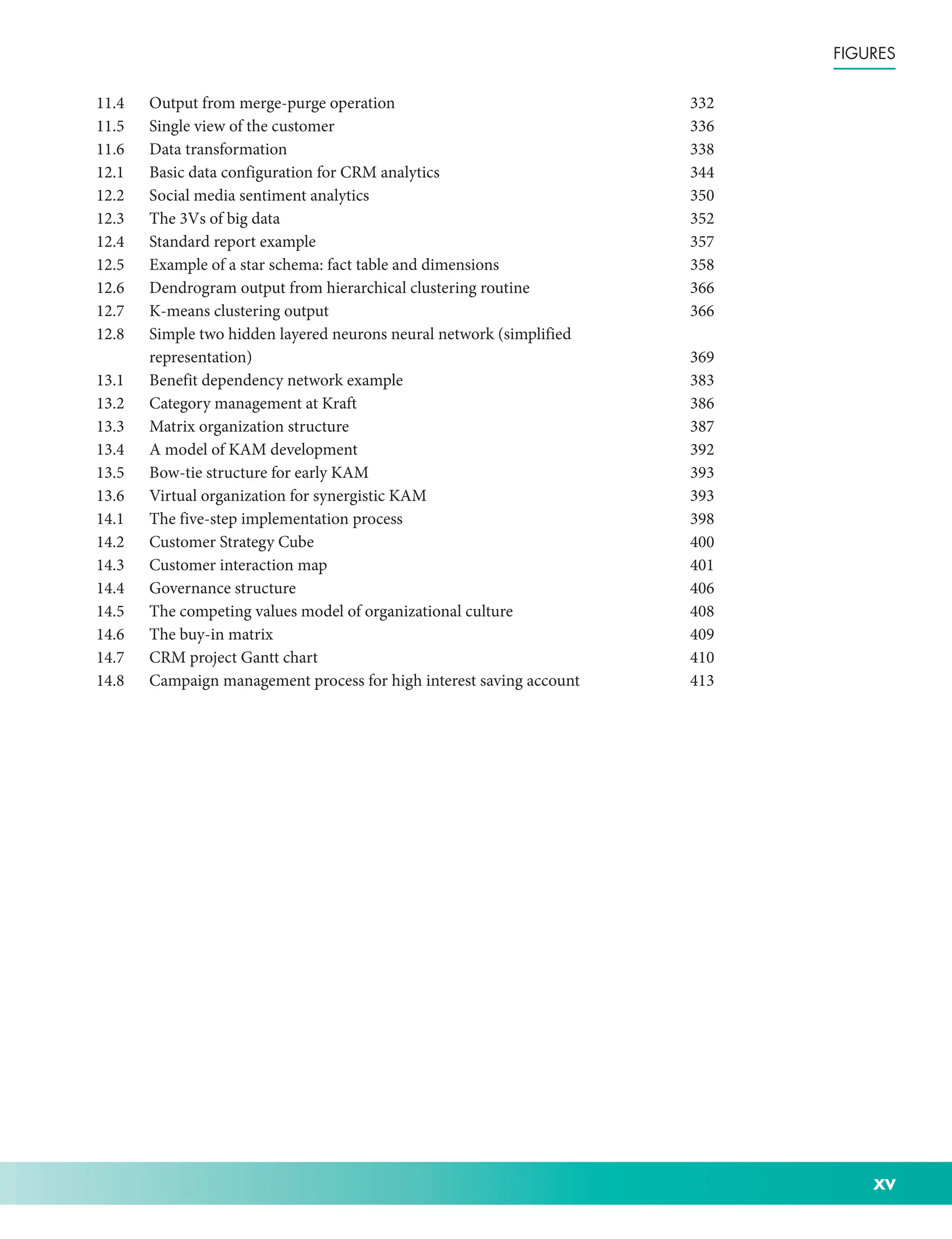
xv
Figures
11.4 Output from merge-­
purge operation 332
11.5 Single view of the customer 336
11.6 Data transformation 338
12.1 Basic data configuration for CRM analytics 344
12.2 Social media sentiment analytics 350
12.3 The 3Vs of big data 352
12.4 Standard report example 357
12.5 Example of a star schema: fact table and dimensions 358
12.6 Dendrogram output from hierarchical clustering routine 366
12.7 K-­
means clustering output 366
12.8 Simple two hidden layered neurons neural network (simplified
representation)369
13.1 Benefit dependency network example 383
13.2 Category management at Kraft 386
13.3 Matrix organization structure 387
13.4 A model of KAM development 392
13.5 Bow-­
tie structure for early KAM 393
13.6 Virtual organization for synergistic KAM 393
14.1 The five-­
step implementation process 398
14.2 Customer Strategy Cube 400
14.3 Customer interaction map 401
14.4 Governance structure 406
14.5 The competing values model of organizational culture 408
14.6 The buy-­
in matrix 409
14.7 CRM project Gantt chart 410
14.8 Campaign management process for high interest saving account 413
Visit https://ebookmass.com today to explore
a vast collection of ebooks across various
genres, available in popular formats like
PDF, EPUB, and MOBI, fully compatible with
all devices. Enjoy a seamless reading
experience and effortlessly download high-
quality materials in just a few simple steps.
Plus, don’t miss out on exciting offers that
let you access a wealth of knowledge at the
best prices!
xvi
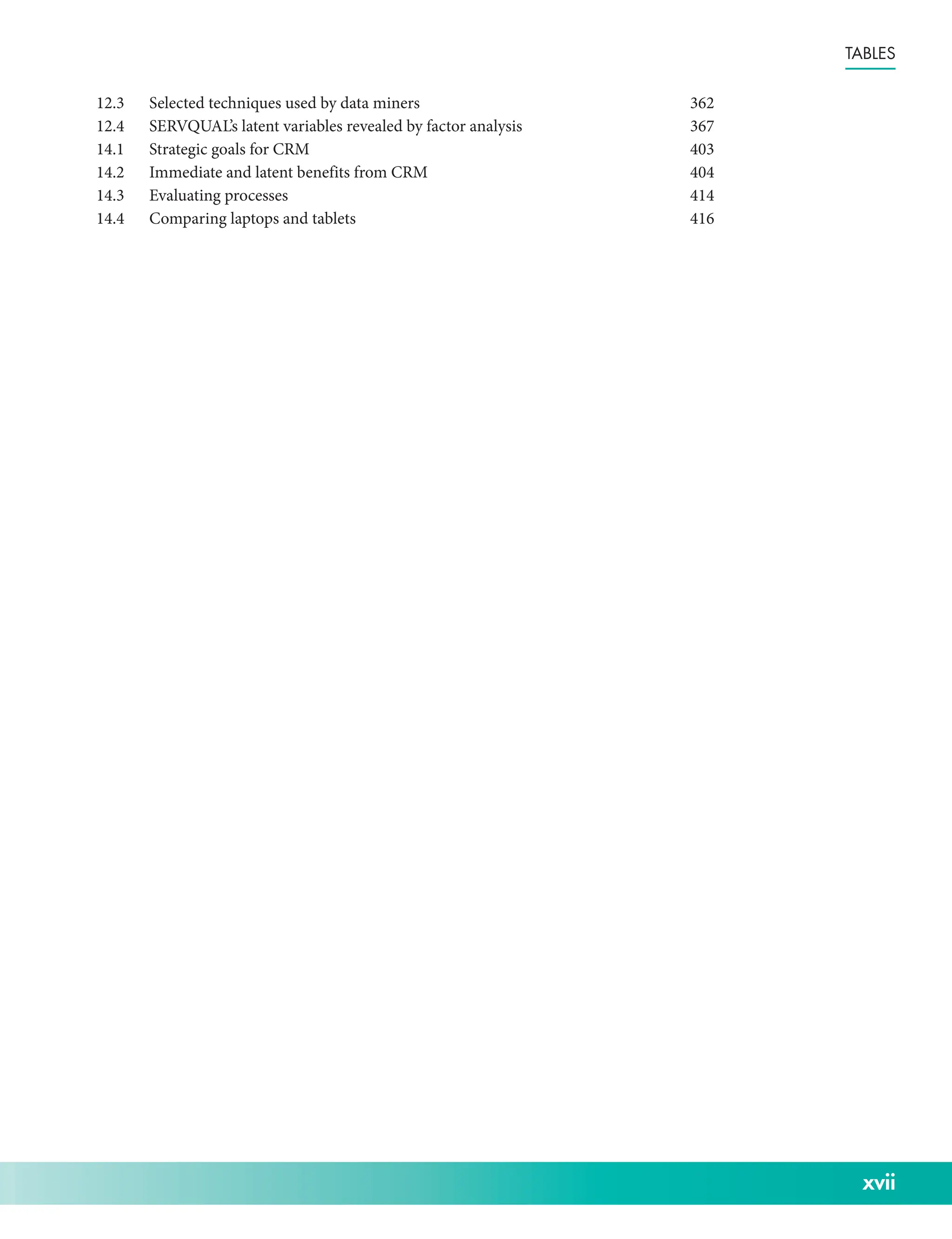
1.1 Definitions of CRM 4
1.2 Types of CRM 6
1.3 Operational CRM – some applications 9
1.4 How CRM has changed over time 16
2.1 The customer journey or loyalty ladder 35
5.1 Criteria for segmenting consumer markets 136
5.2 ACORN geo-­
demographic household classification (UK) 137
5.3 How business markets are segmented 139
5.4 Examples of ISIC codes 140
5.5 Criteria for appraising segmentation opportunities 142
5.6 Sales forecasting using moving averages 144
5.7 Margin multiples 148
5.8 Credit risk training set 151
5.9 Cross-­
tabulation of dependent and independent variables 151
5.10 How costs vary between customers 157
6.1 Different forms of mass customization 176
6.2 Grönroos model of service quality 184
6.3 SERVQUAL components 184
7.1 Touchpoints along the customer journey 215
7.2 The 4 “I”s of customer engagement 217
C.1 Components of Oracle’s CX cloud 234
8.1 Functionality offered by MA software 242
8.2 Technology support for tele-­
marketing 249
8.3 Product lifecycle management software functionality 263
9.1 Classification of SFA vendors (sample only) 271
9.2 Functionality offered by SFA software 274
9.3 Examples of reports available from SFA software 283
9.4 Motivations for implementing SFA 286
9.5 Determinants of perceived usefulness in the Technology Acceptance Model 287
10.1 Customer Service Excellence standard criteria and elements 294
10.2 Functionality offered by service automation software 300
12.1 CRM strategic goals (bold) and related tactics (not bold) 345
12.2 Sample criteria used in prospect scoring 346
TABLES
xvii
Tables
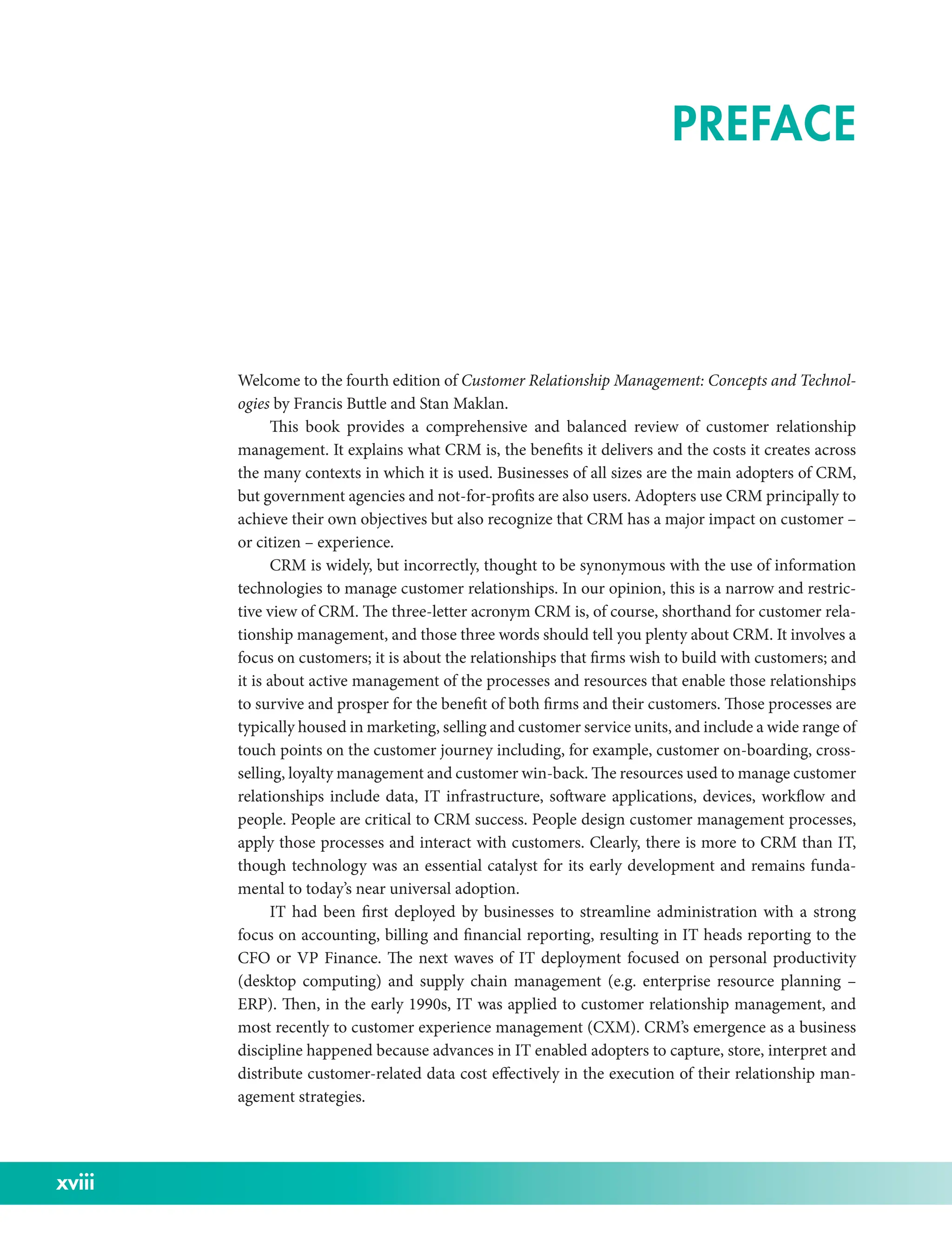
12.3 Selected techniques used by data miners 362
12.4 SERVQUAL’s latent variables revealed by factor analysis 367
14.1 Strategic goals for CRM 403
14.2 Immediate and latent benefits from CRM 404
14.3 Evaluating processes 414
14.4 Comparing laptops and tablets 416
xviii
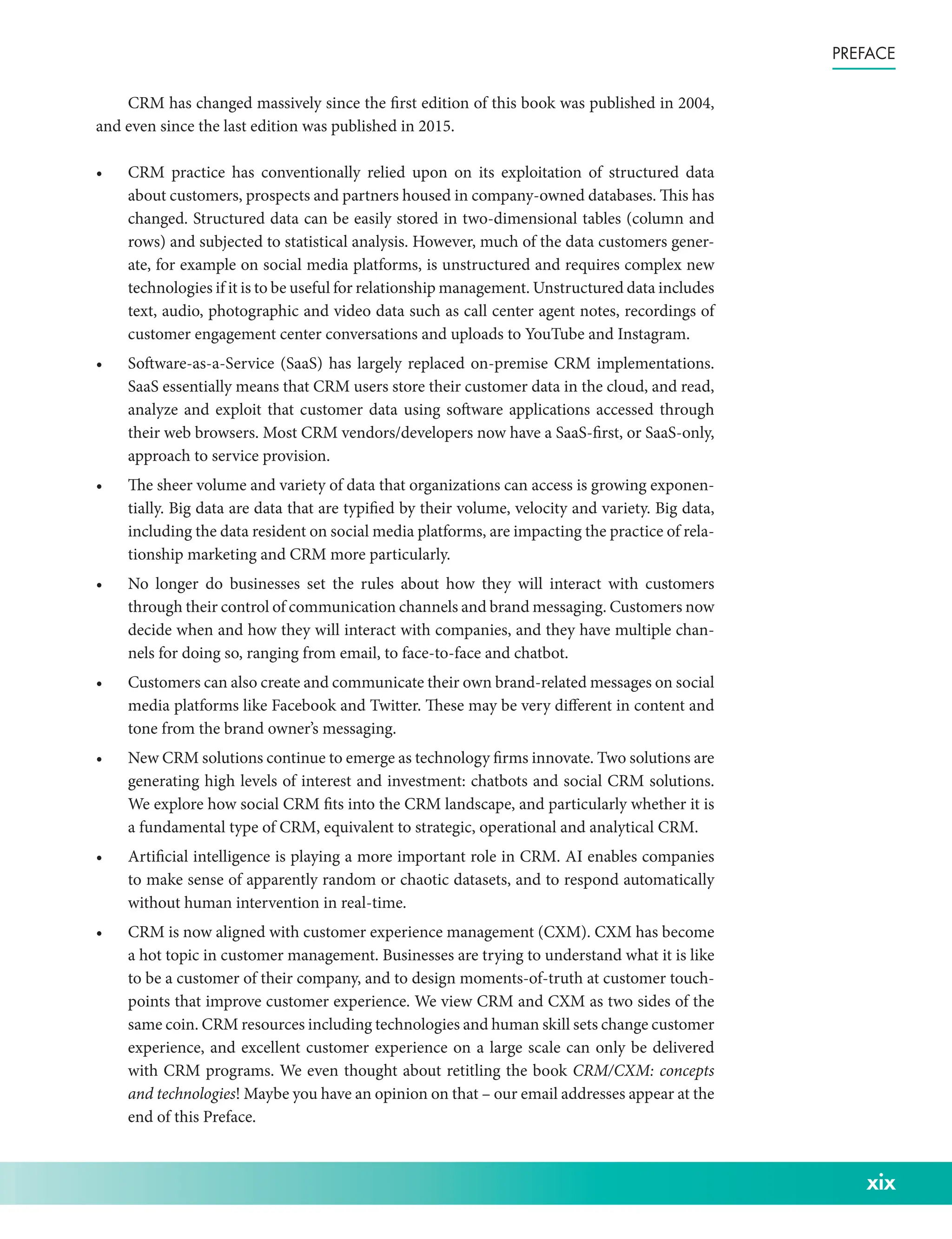
Welcome to the fourth edition of Customer Relationship Management: Concepts and Technol-
ogies by Francis Buttle and Stan Maklan.
This book provides a comprehensive and balanced review of customer relationship
management. It explains what CRM is, the benefits it delivers and the costs it creates across
the many contexts in which it is used. Businesses of all sizes are the main adopters of CRM,
but government agencies and not-­
for-­
profits are also users. Adopters use CRM principally to
achieve their own objectives but also recognize that CRM has a major impact on customer –
or citizen – experience.
CRM is widely, but incorrectly, thought to be synonymous with the use of information
technologies to manage customer relationships. In our opinion, this is a narrow and restric-
tive view of CRM. The three-­
letter acronym CRM is, of course, shorthand for customer rela-
tionship management, and those three words should tell you plenty about CRM. It involves a
focus on customers; it is about the relationships that firms wish to build with customers; and
it is about active management of the processes and resources that enable those relationships
to survive and prosper for the benefit of both firms and their customers. Those processes are
typically housed in marketing, selling and customer service units, and include a wide range of
touch points on the customer journey including, for example, customer on-­
boarding, cross-­
selling, loyalty management and customer win-­back. The resources used to manage customer
relationships include data, IT infrastructure, software applications, devices, workflow and
people. People are critical to CRM success. People design customer management processes,
apply those processes and interact with customers. Clearly, there is more to CRM than IT,
though technology was an essential catalyst for its early development and remains funda-
mental to today’s near universal adoption.
IT had been first deployed by businesses to streamline administration with a strong
focus on accounting, billing and financial reporting, resulting in IT heads reporting to the
CFO or VP Finance. The next waves of IT deployment focused on personal productivity
(desktop computing) and supply chain management (e.g. enterprise resource planning –
ERP). Then, in the early 1990s, IT was applied to customer relationship management, and
most recently to customer experience management (CXM). CRM’s emergence as a business
discipline happened because advances in IT enabled adopters to capture, store, interpret and
distribute customer-­
related data cost effectively in the execution of their relationship man-
agement strategies.
PREFACE
xix
Preface
CRM has changed massively since the first edition of this book was published in 2004,
and even since the last edition was published in 2015.
• CRM practice has conventionally relied upon on its exploitation of structured data
about customers, prospects and partners housed in company-­
owned databases. This has
changed. Structured data can be easily stored in two-­
dimensional tables (column and
rows) and subjected to statistical analysis. However, much of the data customers gener-
ate, for example on social media platforms, is unstructured and requires complex new
technologies if it is to be useful for relationship management. Unstructured data includes
text, audio, photographic and video data such as call center agent notes, recordings of
customer engagement center conversations and uploads to YouTube and Instagram.
• Software-­
as-­
a-­
Service (SaaS) has largely replaced on-­
premise CRM implementations.
SaaS essentially means that CRM users store their customer data in the cloud, and read,
analyze and exploit that customer data using software applications accessed through
their web browsers. Most CRM vendors/­
developers now have a SaaS-­
first, or SaaS-­
only,
approach to service provision.
• The sheer volume and variety of data that organizations can access is growing exponen-
tially. Big data are data that are typified by their volume, velocity and variety. Big data,
including the data resident on social media platforms, are impacting the practice of rela-
tionship marketing and CRM more particularly.
• No longer do businesses set the rules about how they will interact with customers
through their control of communication channels and brand messaging. Customers now
decide when and how they will interact with companies, and they have multiple chan-
nels for doing so, ranging from email, to face-­
to-­
face and chatbot.
• Customers can also create and communicate their own brand-­related messages on social
media platforms like Facebook and Twitter. These may be very different in content and
tone from the brand owner’s messaging.
• New CRM solutions continue to emerge as technology firms innovate. Two solutions are
generating high levels of interest and investment: chatbots and social CRM solutions.
We explore how social CRM fits into the CRM landscape, and particularly whether it is
a fundamental type of CRM, equivalent to strategic, operational and analytical CRM.
• Artificial intelligence is playing a more important role in CRM. AI enables companies
to make sense of apparently random or chaotic datasets, and to respond automatically
without human intervention in real-­
time.
• CRM is now aligned with customer experience management (CXM). CXM has become
a hot topic in customer management. Businesses are trying to understand what it is like
to be a customer of their company, and to design moments-­
of-­
truth at customer touch-
points that improve customer experience. We view CRM and CXM as two sides of the
same coin. CRM resources including technologies and human skill sets change customer
experience, and excellent customer experience on a large scale can only be delivered
with CRM programs. We even thought about retitling the book CRM/­CXM: concepts
and technologies! Maybe you have an opinion on that – our email addresses appear at the
end of this Preface.
xx
Preface
• Privacy and data security have become very important issues for regulators, and, in turn,
for CRM practitioners. Questions about data ownership and use have become critical as
customers surrender personal information, in particular to online entities such as Ama-
zon and Facebook.
• We are seeing the emergence of the next wave of technology-­
supported innovation
in CRM featuring new business models founded on real-­
time, mobile data, particu-
larly customer-­
generated data. CRM, the most mature of the IT-­
enabled customer-­
facing management disciplines, has an enhanced role in such an environment and
we believe remains the cornerstone for marketing, sales and customer service in the
future.
In producing this fourth edition we knew we had to reflect this evolving landscape, and
in true, customer-­
oriented manner, we also surveyed readers and adopters of the previous
edition. They told us what they wanted in this revision, and we have followed their guidance.
We have also refined the focus of the book. We have removed content that was not valued
by readers and adopters and streamlined and updated what has been retained. This fourth
edition continues to draw on academic and independent research to ensure that it is both
theoretically sound and managerially relevant. Research from a wide range of academic dis-
ciplines contributes to the book. These include marketing, sales, customer service, human
resources, technology management, strategy, change management, project management,
leadership, operations, management accounting, finance and organizational behavior. Sup-
plementing these academic credentials, the book also makes use of research conducted by
independent analysts such as Gartner and Forrester, two organizations that conduct leading
edge, state-­
of-­
the-­
art research into CRM and related areas.
AUDIENCE FOR THE BOOK
This book has been written for a number of audiences, all of whom share an interest in
improving their understanding of CRM.
• MBA and master’s students, and upper-­
level undergraduates studying CRM or related
advanced courses such as relationship marketing, database marketing, digital marketing,
social media marketing, customer management, customer portfolio management, cus-
tomer experience management, sales management, key account management, strategic
management, customer value management and customer service management.
• Students or independent learners seeking CRM education or certification through orga-
nizations such as AARM (Association for the Advancement of Relationship Marketing)
and CRMAA (CRM Academy of Asia).
• Those pursuing professional qualifications or accreditation in marketing through inter-
national organizations such as the Chartered Institute of Marketing, the Digital Market-
ing Institute, and the Institute of Direct and Digital Marketing, or national bodies such
as the Marketing Institute of Ireland or the Canadian Institute of Marketing.
xxi
Preface
• Senior and mid-­
level managers who are involved in CRM programs and system imple-
mentations, whether in a marketing department, the sales force or service center.
• Students pursuing professional qualifications or accreditation through international
organizations such as the Institute of Sales  Marketing Management, or corporate-­
based sales academies.
• CRM users who want a better understanding of this complex area. CRM tools are
deployed across all customer-­facing parts of organizations. Users include sales represen-
tatives and account managers, marketing managers, market analysts, campaign manag-
ers, market managers, customer relationship managers, and customer service managers.
These users are exposed to just a fragment of the CRM universe. This book can put their
role into broader context.
KEY FEATURES OF THE BOOK
• The book provides a helicopter view, an overview, of the domain of CRM. As an impar-
tial review of the field, it is not tied to any particular perspective on CRM. Indeed, the
book identifies a number of holistic models that provide different and competing over-
views of CRM.
• Although CRM is in widespread use, there is still some misunderstanding about what
CRM is. The book identifies three different types of CRM – strategic, operational and
analytical. The book is structured so that the chapters on each of these types of CRM are
clustered together. Several chapters are dedicated to each type of CRM.
• The book defines CRM as the core business strategy that aims to create and maintain prof-
itable relationships with customers, by designing and delivering superior value proposi-
tions. It is grounded on high-­
quality customer-­
related data and enabled by information
technology. This definition serves as a central point-­
of-­
reference throughout the book.
• We don’t assume that customers want relationships with suppliers. If CRM is about
developing and maintaining relationships with customers, it is important to have clear
understanding of what a relationship looks like, and how, if at all, it can be managed. We
discuss what is meant by “relationship” and question whether customers want relation-
ships with suppliers and vice versa. We also identify attributes of successful relationships
and review five different schools of thought that have influenced relationship manage-
ment in a business context.
• The book emphasizes a managerial perspective on CRM. Although there is plenty of
content on technology, it is not a book about technology, per se. The technology content
of the book has been written so that readers who are unfamiliar with technology, or who
are technophobes, can still understand what CRM technologies can deliver. Technology
is secondary to management throughout the book. You don’t need a degree in informa-
tion systems to benefit from the book!
• The book has a strong academic foundation provided by research from a number of
disciplines.
xxii
Preface
• The book contains many examples of CRM solutions and their application in marketing,
selling or service function. Screenshots from CRM applications are a feature of the book.
• Every chapter contains case illustrations. These are not problem-­
based cases, but exam-
ples of CRM in practice, so that readers can better appreciate how CRM is deployed.
• All chapters follow a common format: learning objectives, text, case illustrations, sum-
mary and references.
xxiii
We would like to acknowledge the contributions of many people to the production and pub-
lication of this book. We thank the editorial team at Taylor  Francis for their confidence in
commissioning this fourth edition, their editorial diligence, and the detailed work of tracking
down copyright owners and obtaining permission to use their materials. We thank the own-
ers of all copyright materials for those permissions. We have made every effort to track down
copyright owners, and to cite them correctly in footnotes or in the text. If we have failed to
identify and cite any copyright material correctly, we apologize and advise copyright owners
to contact the publishers so corrections can be made in future editions.
We thank the stars of the academic and business worlds that have graciously endorsed
and lent their authority to our book. We thank our clients and students on whom many of our
ideas have been stress tested. We thank our colleagues who have given moral and practical
support to this writing venture.
We thank colleagues, associates, clients and other experts from around the world who
have read drafts of chapters and made helpful suggestions. You were brilliant, all of you. You
know who you are, but in case you don’t here are some names: Lawrence Ang, Sergio Big-
gemann, Susan Bond, Jamie Burton, Emma Buttle, Lewis Buttle, Benadetta Crisafulli, Abdul
Hamid Ebrahim (Oracle), Helene Gabrielsson, Bill Gates, Lars Groeger, Jan Hofmeyr, Linda
Hollebeek, Bob Knox, Fred Lemke, Claude Liu, Nilex AB Sweden, John Murphy, Oracle Cor-
poration, Dan Prior, Smaply, Ross Smith, John Turnbull, Marc Warner (ASI) and Martin
Williams.
Finally, we thank our families who have put up with long periods of absence from family
duty as we worked to keep to our publication deadline.
We hope you enjoy the book and find it a satisfying read. Writing a book is a little like
painting a picture or tending a garden. You never reach a point where you can safely say that
the job is finished. There is always more you can do. With that in mind, we invite you to write
to us at francis@francisbuttle.com.au and stanmaklan@gmail.com or s.maklan@cranfield.
ac.uk. We look forward to hearing from you.
Francis Buttle, Sydney
Stan Maklan, London
ACKNOWLEDGEMENTS
Section A
UNDERSTANDING
CUSTOMER
RELATIONSHIPS
Visit https://ebookmass.com today to explore
a vast collection of ebooks across various
genres, available in popular formats like
PDF, EPUB, and MOBI, fully compatible with
all devices. Enjoy a seamless reading
experience and effortlessly download high-
quality materials in just a few simple steps.
Plus, don’t miss out on exciting offers that
let you access a wealth of knowledge at the
best prices!
Exploring the Variety of Random
Documents with Different Content
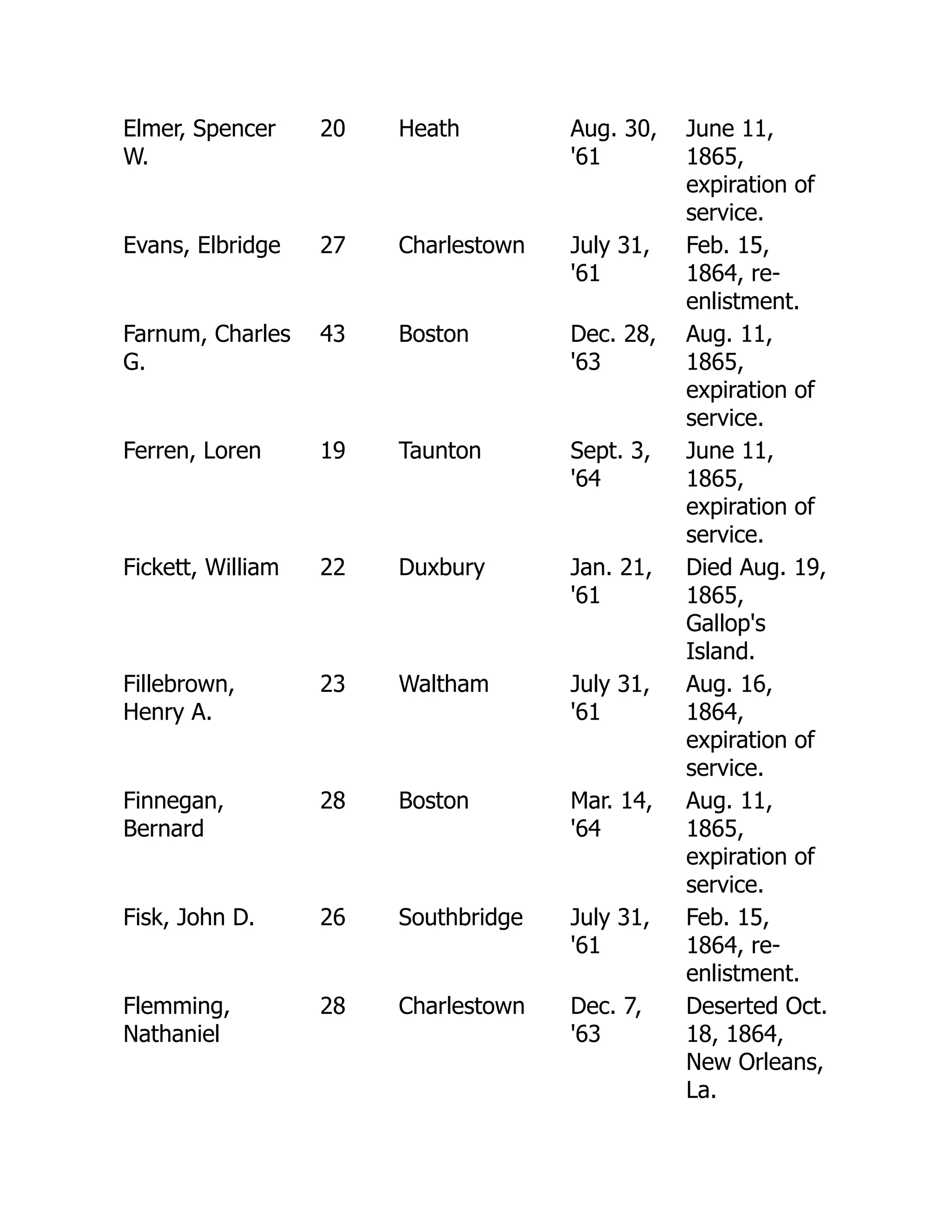
Elmer, Spencer
W.
20 Heath Aug. 30,
'61
June 11,
1865,
expiration of
service.
Evans, Elbridge 27 Charlestown July 31,
'61
Feb. 15,
1864, re-
enlistment.
Farnum, Charles
G.
43 Boston Dec. 28,
'63
Aug. 11,
1865,
expiration of
service.
Ferren, Loren 19 Taunton Sept. 3,
'64
June 11,
1865,
expiration of
service.
Fickett, William 22 Duxbury Jan. 21,
'61
Died Aug. 19,
1865,
Gallop's
Island.
Fillebrown,
Henry A.
23 Waltham July 31,
'61
Aug. 16,
1864,
expiration of
service.
Finnegan,
Bernard
28 Boston Mar. 14,
'64
Aug. 11,
1865,
expiration of
service.
Fisk, John D. 26 Southbridge July 31,
'61
Feb. 15,
1864, re-
enlistment.
Flemming,
Nathaniel
28 Charlestown Dec. 7,
'63
Deserted Oct.
18, 1864,
New Orleans,
La.
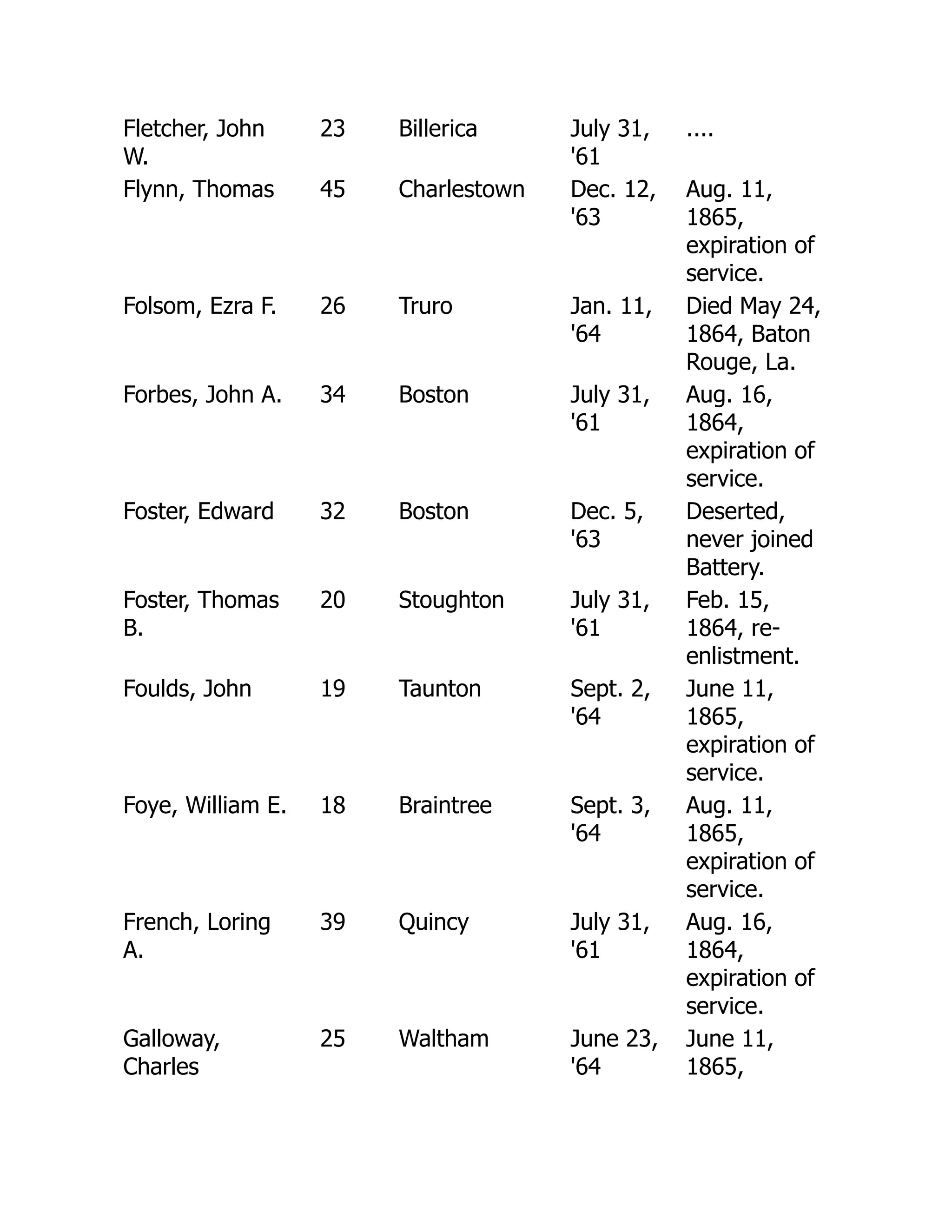
Fletcher, John
W.
23 Billerica July 31,
'61
....
Flynn, Thomas 45 Charlestown Dec. 12,
'63
Aug. 11,
1865,
expiration of
service.
Folsom, Ezra F. 26 Truro Jan. 11,
'64
Died May 24,
1864, Baton
Rouge, La.
Forbes, John A. 34 Boston July 31,
'61
Aug. 16,
1864,
expiration of
service.
Foster, Edward 32 Boston Dec. 5,
'63
Deserted,
never joined
Battery.
Foster, Thomas
B.
20 Stoughton July 31,
'61
Feb. 15,
1864, re-
enlistment.
Foulds, John 19 Taunton Sept. 2,
'64
June 11,
1865,
expiration of
service.
Foye, William E. 18 Braintree Sept. 3,
'64
Aug. 11,
1865,
expiration of
service.
French, Loring
A.
39 Quincy July 31,
'61
Aug. 16,
1864,
expiration of
service.
Galloway,
Charles
25 Waltham June 23,
'64
June 11,
1865,
expiration of
service.
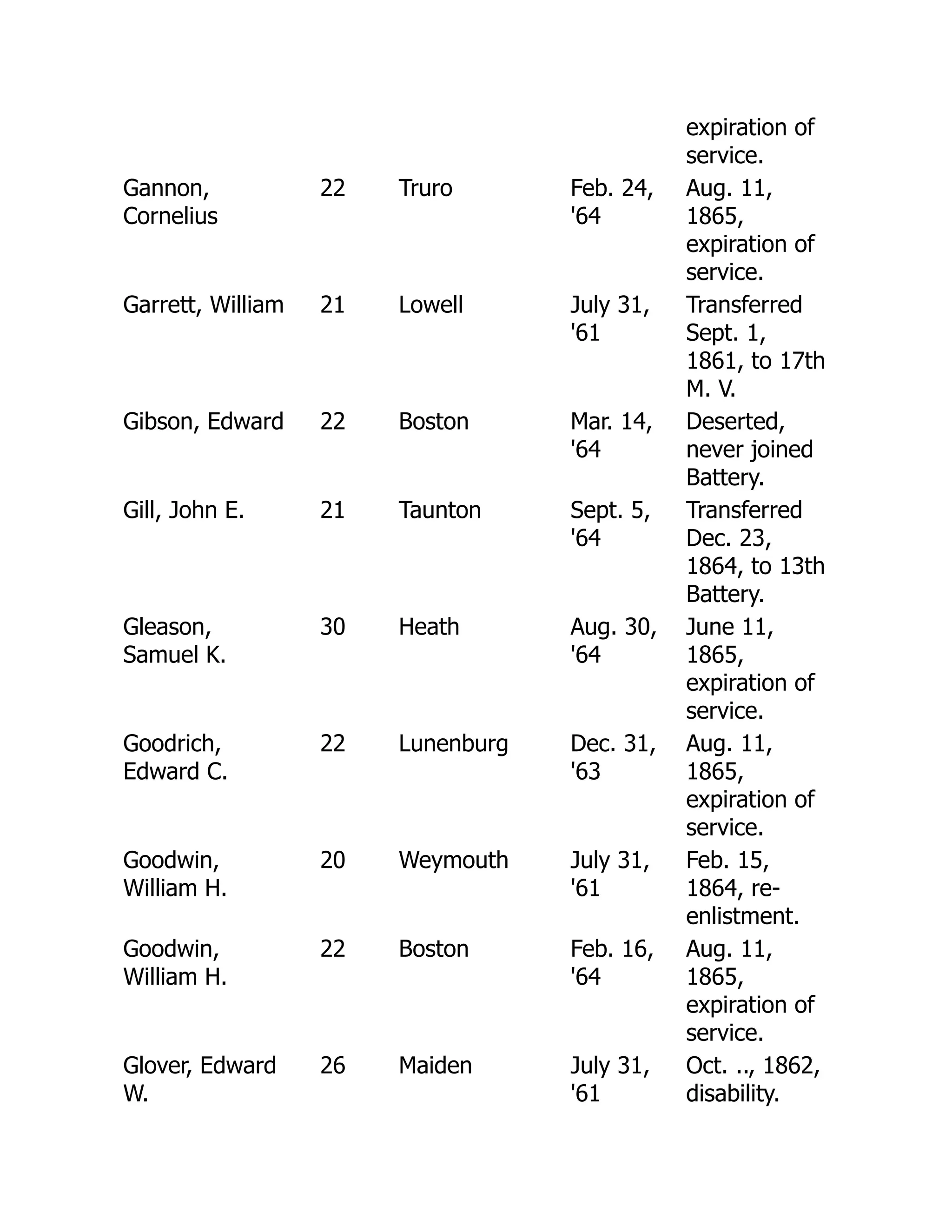
Gannon,
Cornelius
22 Truro Feb. 24,
'64
Aug. 11,
1865,
expiration of
service.
Garrett, William 21 Lowell July 31,
'61
Transferred
Sept. 1,
1861, to 17th
M. V.
Gibson, Edward 22 Boston Mar. 14,
'64
Deserted,
never joined
Battery.
Gill, John E. 21 Taunton Sept. 5,
'64
Transferred
Dec. 23,
1864, to 13th
Battery.
Gleason,
Samuel K.
30 Heath Aug. 30,
'64
June 11,
1865,
expiration of
service.
Goodrich,
Edward C.
22 Lunenburg Dec. 31,
'63
Aug. 11,
1865,
expiration of
service.
Goodwin,
William H.
20 Weymouth July 31,
'61
Feb. 15,
1864, re-
enlistment.
Goodwin,
William H.
22 Boston Feb. 16,
'64
Aug. 11,
1865,
expiration of
service.
Glover, Edward
W.
26 Maiden July 31,
'61
Oct. .., 1862,
disability.
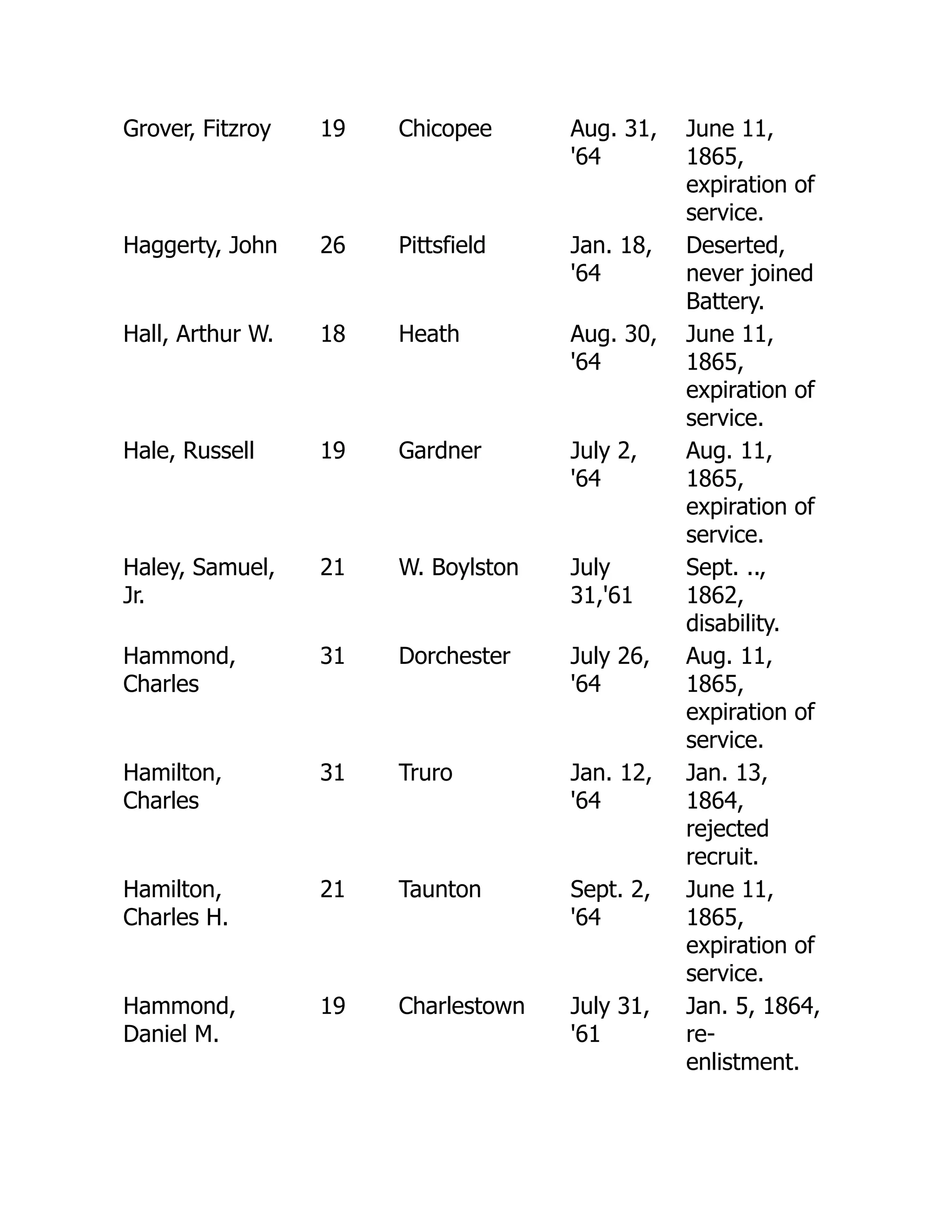
Grover, Fitzroy 19 Chicopee Aug. 31,
'64
June 11,
1865,
expiration of
service.
Haggerty, John 26 Pittsfield Jan. 18,
'64
Deserted,
never joined
Battery.
Hall, Arthur W. 18 Heath Aug. 30,
'64
June 11,
1865,
expiration of
service.
Hale, Russell 19 Gardner July 2,
'64
Aug. 11,
1865,
expiration of
service.
Haley, Samuel,
Jr.
21 W. Boylston July
31,'61
Sept. ..,
1862,
disability.
Hammond,
Charles
31 Dorchester July 26,
'64
Aug. 11,
1865,
expiration of
service.
Hamilton,
Charles
31 Truro Jan. 12,
'64
Jan. 13,
1864,
rejected
recruit.
Hamilton,
Charles H.
21 Taunton Sept. 2,
'64
June 11,
1865,
expiration of
service.
Hammond,
Daniel M.
19 Charlestown July 31,
'61
Jan. 5, 1864,
re-
enlistment.
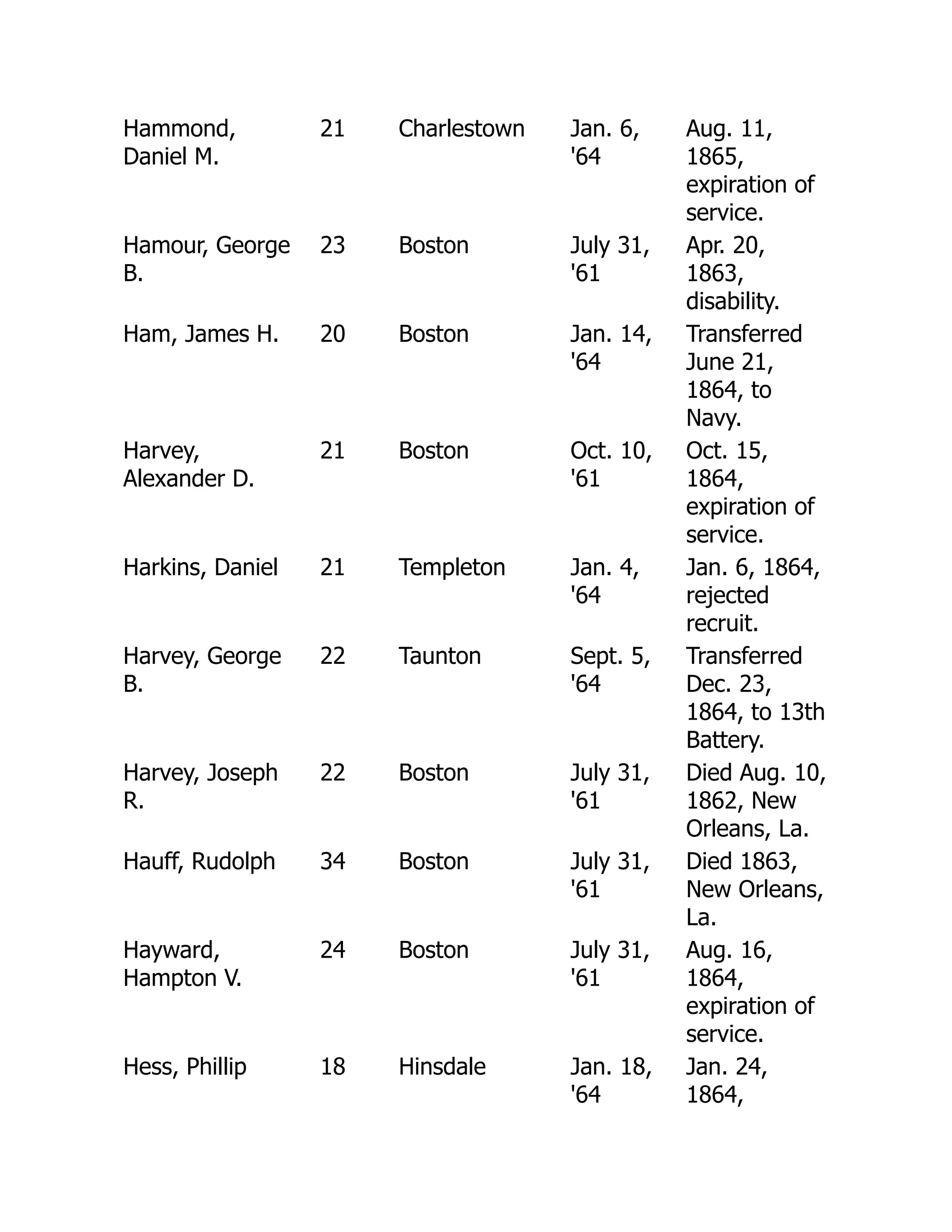
Hammond,
Daniel M.
21 Charlestown Jan. 6,
'64
Aug. 11,
1865,
expiration of
service.
Hamour, George
B.
23 Boston July 31,
'61
Apr. 20,
1863,
disability.
Ham, James H. 20 Boston Jan. 14,
'64
Transferred
June 21,
1864, to
Navy.
Harvey,
Alexander D.
21 Boston Oct. 10,
'61
Oct. 15,
1864,
expiration of
service.
Harkins, Daniel 21 Templeton Jan. 4,
'64
Jan. 6, 1864,
rejected
recruit.
Harvey, George
B.
22 Taunton Sept. 5,
'64
Transferred
Dec. 23,
1864, to 13th
Battery.
Harvey, Joseph
R.
22 Boston July 31,
'61
Died Aug. 10,
1862, New
Orleans, La.
Hauff, Rudolph 34 Boston July 31,
'61
Died 1863,
New Orleans,
La.
Hayward,
Hampton V.
24 Boston July 31,
'61
Aug. 16,
1864,
expiration of
service.
Hess, Phillip 18 Hinsdale Jan. 18,
'64
Jan. 24,
1864,
rejected
recruit.
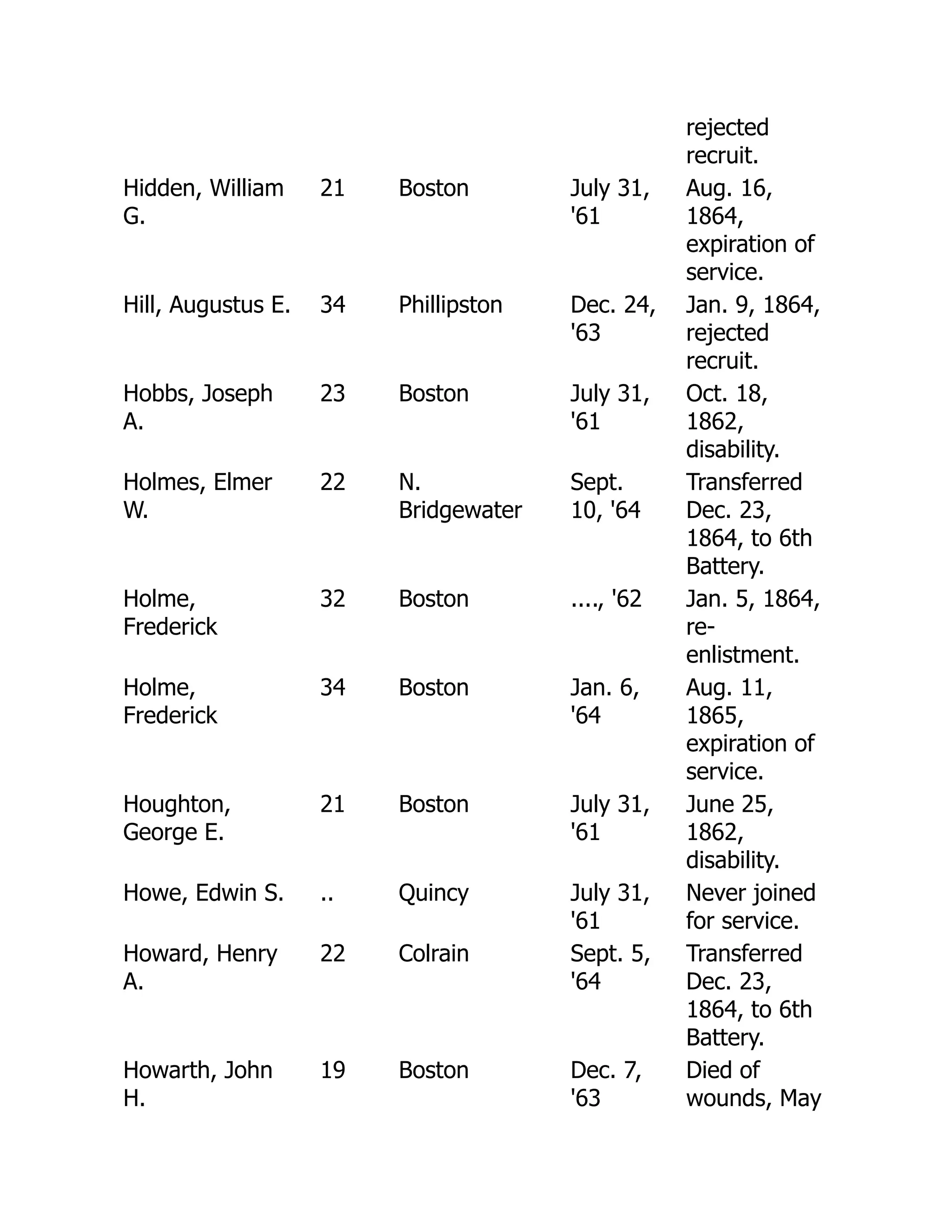
Hidden, William
G.
21 Boston July 31,
'61
Aug. 16,
1864,
expiration of
service.
Hill, Augustus E. 34 Phillipston Dec. 24,
'63
Jan. 9, 1864,
rejected
recruit.
Hobbs, Joseph
A.
23 Boston July 31,
'61
Oct. 18,
1862,
disability.
Holmes, Elmer
W.
22 N.
Bridgewater
Sept.
10, '64
Transferred
Dec. 23,
1864, to 6th
Battery.
Holme,
Frederick
32 Boston ...., '62 Jan. 5, 1864,
re-
enlistment.
Holme,
Frederick
34 Boston Jan. 6,
'64
Aug. 11,
1865,
expiration of
service.
Houghton,
George E.
21 Boston July 31,
'61
June 25,
1862,
disability.
Howe, Edwin S. .. Quincy July 31,
'61
Never joined
for service.
Howard, Henry
A.
22 Colrain Sept. 5,
'64
Transferred
Dec. 23,
1864, to 6th
Battery.
Howarth, John
H.
19 Boston Dec. 7,
'63
Died of
wounds, May
2, 1864,
Mansfield, La.
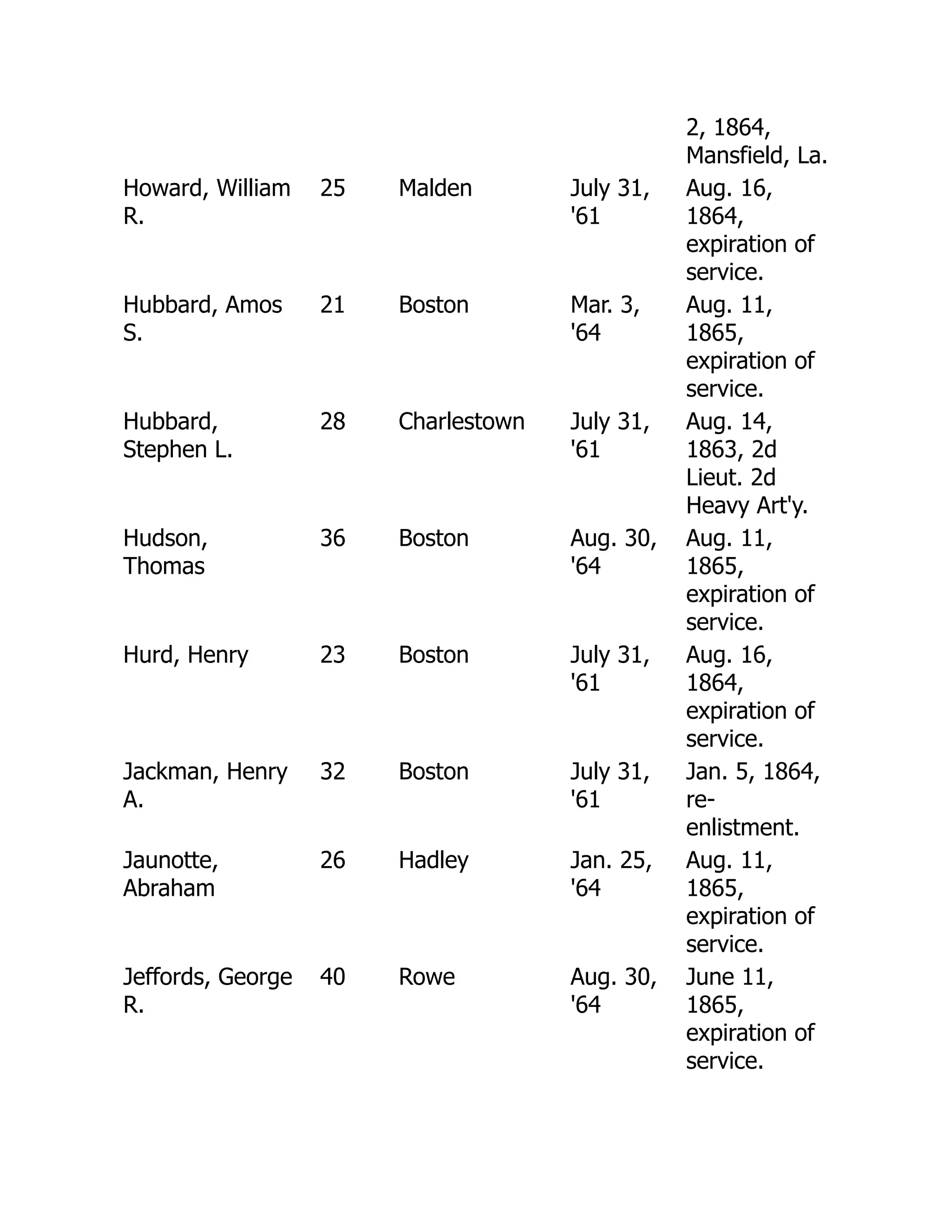
Howard, William
R.
25 Malden July 31,
'61
Aug. 16,
1864,
expiration of
service.
Hubbard, Amos
S.
21 Boston Mar. 3,
'64
Aug. 11,
1865,
expiration of
service.
Hubbard,
Stephen L.
28 Charlestown July 31,
'61
Aug. 14,
1863, 2d
Lieut. 2d
Heavy Art'y.
Hudson,
Thomas
36 Boston Aug. 30,
'64
Aug. 11,
1865,
expiration of
service.
Hurd, Henry 23 Boston July 31,
'61
Aug. 16,
1864,
expiration of
service.
Jackman, Henry
A.
32 Boston July 31,
'61
Jan. 5, 1864,
re-
enlistment.
Jaunotte,
Abraham
26 Hadley Jan. 25,
'64
Aug. 11,
1865,
expiration of
service.
Jeffords, George
R.
40 Rowe Aug. 30,
'64
June 11,
1865,
expiration of
service.
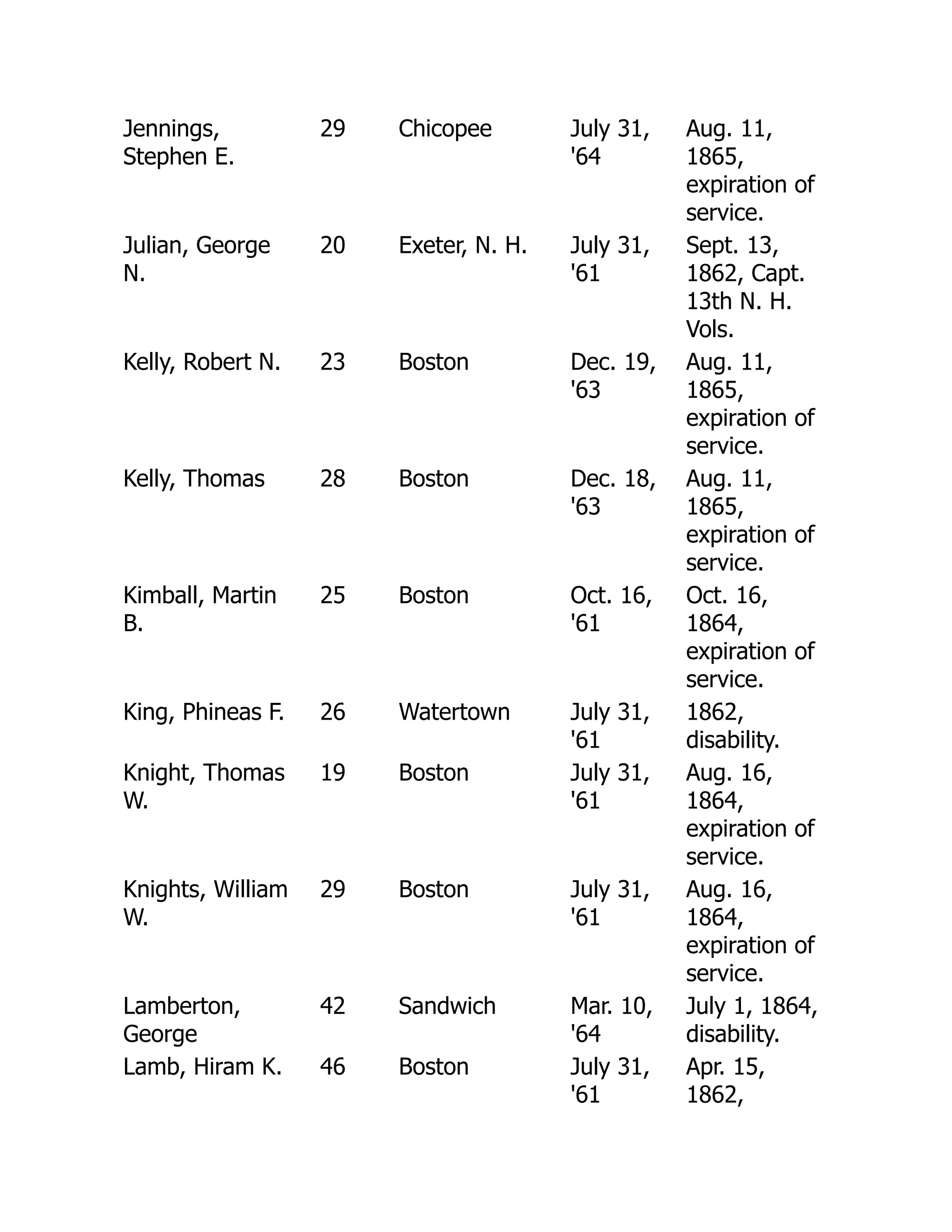
Jennings,
Stephen E.
29 Chicopee July 31,
'64
Aug. 11,
1865,
expiration of
service.
Julian, George
N.
20 Exeter, N. H. July 31,
'61
Sept. 13,
1862, Capt.
13th N. H.
Vols.
Kelly, Robert N. 23 Boston Dec. 19,
'63
Aug. 11,
1865,
expiration of
service.
Kelly, Thomas 28 Boston Dec. 18,
'63
Aug. 11,
1865,
expiration of
service.
Kimball, Martin
B.
25 Boston Oct. 16,
'61
Oct. 16,
1864,
expiration of
service.
King, Phineas F. 26 Watertown July 31,
'61
1862,
disability.
Knight, Thomas
W.
19 Boston July 31,
'61
Aug. 16,
1864,
expiration of
service.
Knights, William
W.
29 Boston July 31,
'61
Aug. 16,
1864,
expiration of
service.
Lamberton,
George
42 Sandwich Mar. 10,
'64
July 1, 1864,
disability.
Lamb, Hiram K. 46 Boston July 31,
'61
Apr. 15,
1862,
disability.
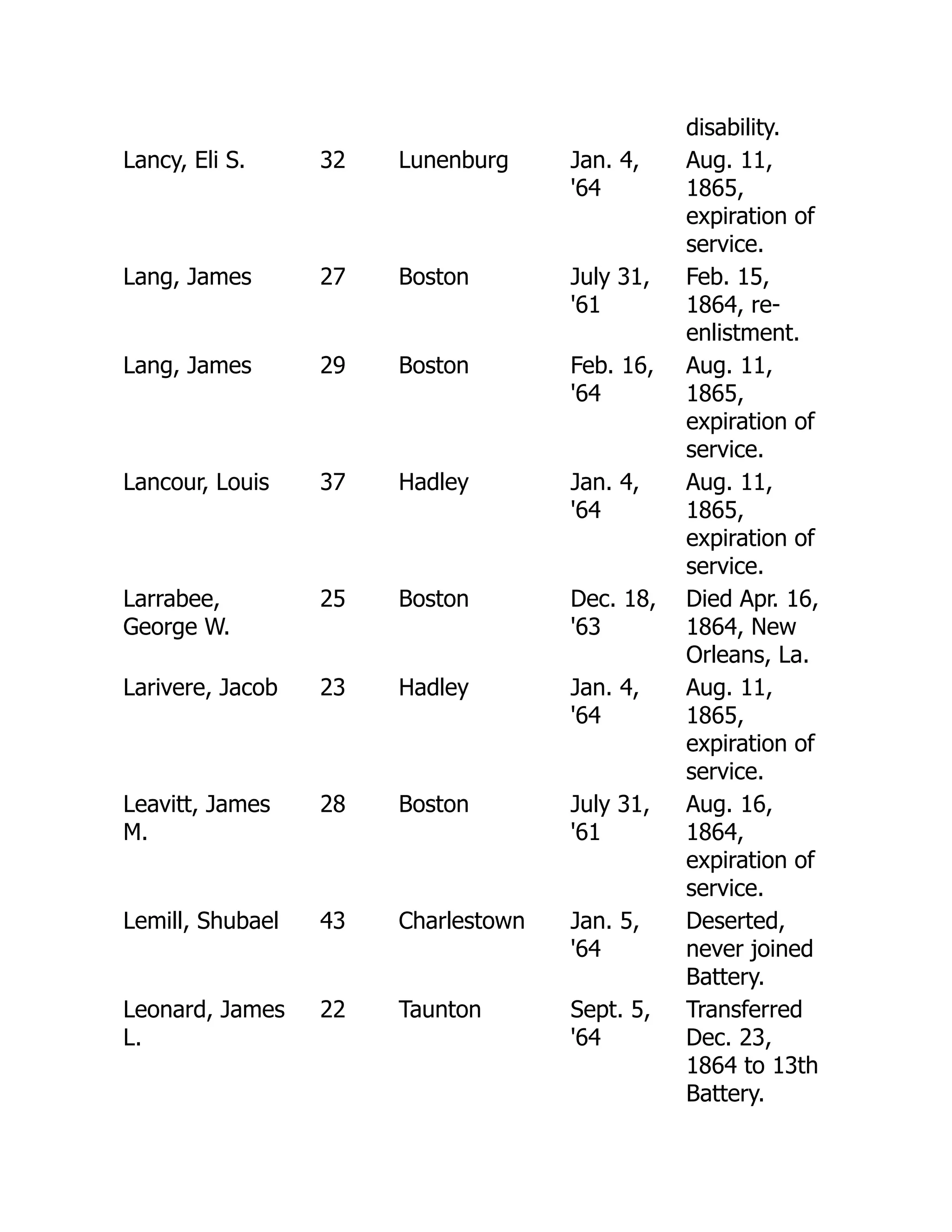
Lancy, Eli S. 32 Lunenburg Jan. 4,
'64
Aug. 11,
1865,
expiration of
service.
Lang, James 27 Boston July 31,
'61
Feb. 15,
1864, re-
enlistment.
Lang, James 29 Boston Feb. 16,
'64
Aug. 11,
1865,
expiration of
service.
Lancour, Louis 37 Hadley Jan. 4,
'64
Aug. 11,
1865,
expiration of
service.
Larrabee,
George W.
25 Boston Dec. 18,
'63
Died Apr. 16,
1864, New
Orleans, La.
Larivere, Jacob 23 Hadley Jan. 4,
'64
Aug. 11,
1865,
expiration of
service.
Leavitt, James
M.
28 Boston July 31,
'61
Aug. 16,
1864,
expiration of
service.
Lemill, Shubael 43 Charlestown Jan. 5,
'64
Deserted,
never joined
Battery.
Leonard, James
L.
22 Taunton Sept. 5,
'64
Transferred
Dec. 23,
1864 to 13th
Battery.
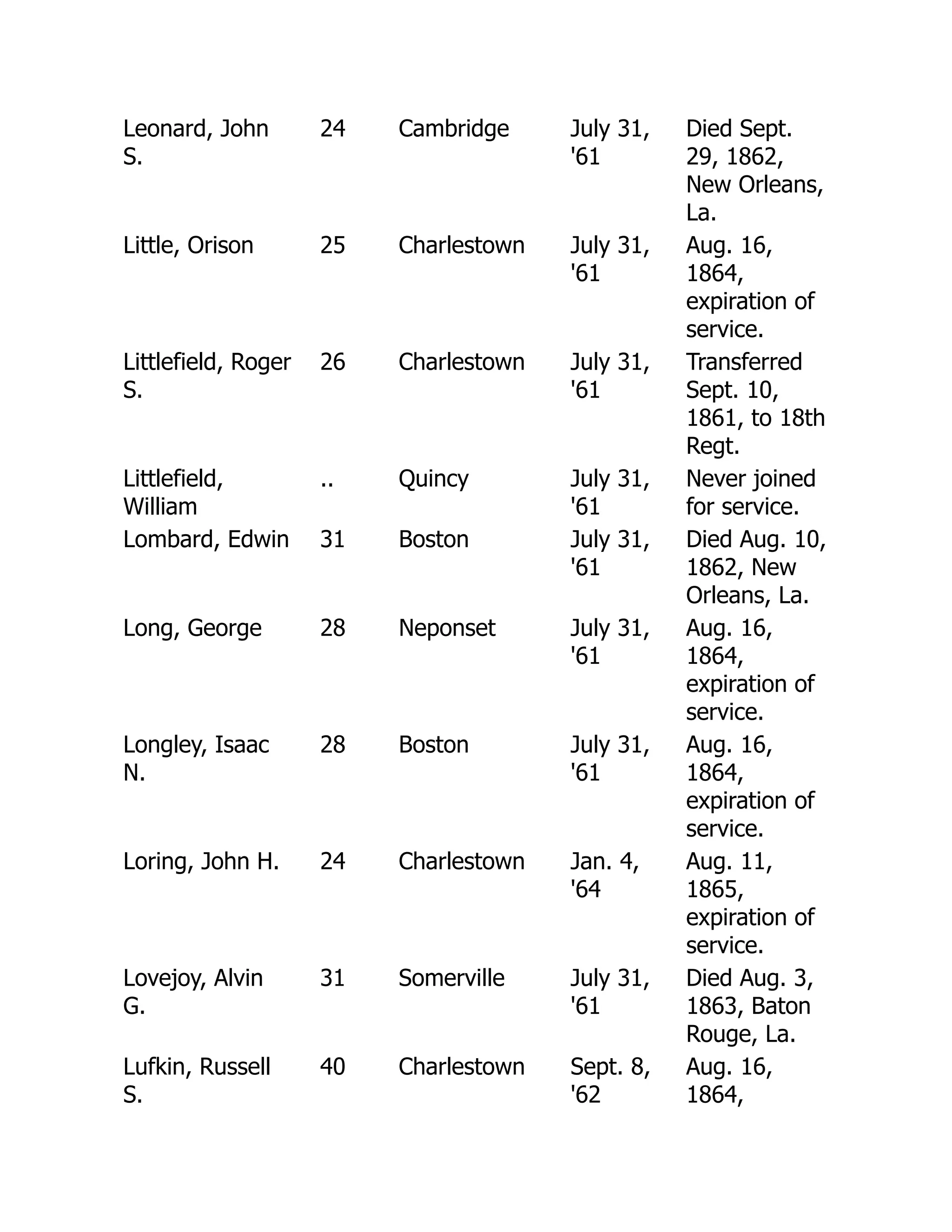
Leonard, John
S.
24 Cambridge July 31,
'61
Died Sept.
29, 1862,
New Orleans,
La.
Little, Orison 25 Charlestown July 31,
'61
Aug. 16,
1864,
expiration of
service.
Littlefield, Roger
S.
26 Charlestown July 31,
'61
Transferred
Sept. 10,
1861, to 18th
Regt.
Littlefield,
William
.. Quincy July 31,
'61
Never joined
for service.
Lombard, Edwin 31 Boston July 31,
'61
Died Aug. 10,
1862, New
Orleans, La.
Long, George 28 Neponset July 31,
'61
Aug. 16,
1864,
expiration of
service.
Longley, Isaac
N.
28 Boston July 31,
'61
Aug. 16,
1864,
expiration of
service.
Loring, John H. 24 Charlestown Jan. 4,
'64
Aug. 11,
1865,
expiration of
service.
Lovejoy, Alvin
G.
31 Somerville July 31,
'61
Died Aug. 3,
1863, Baton
Rouge, La.
Lufkin, Russell
S.
40 Charlestown Sept. 8,
'62
Aug. 16,
1864,
expiration of
service.
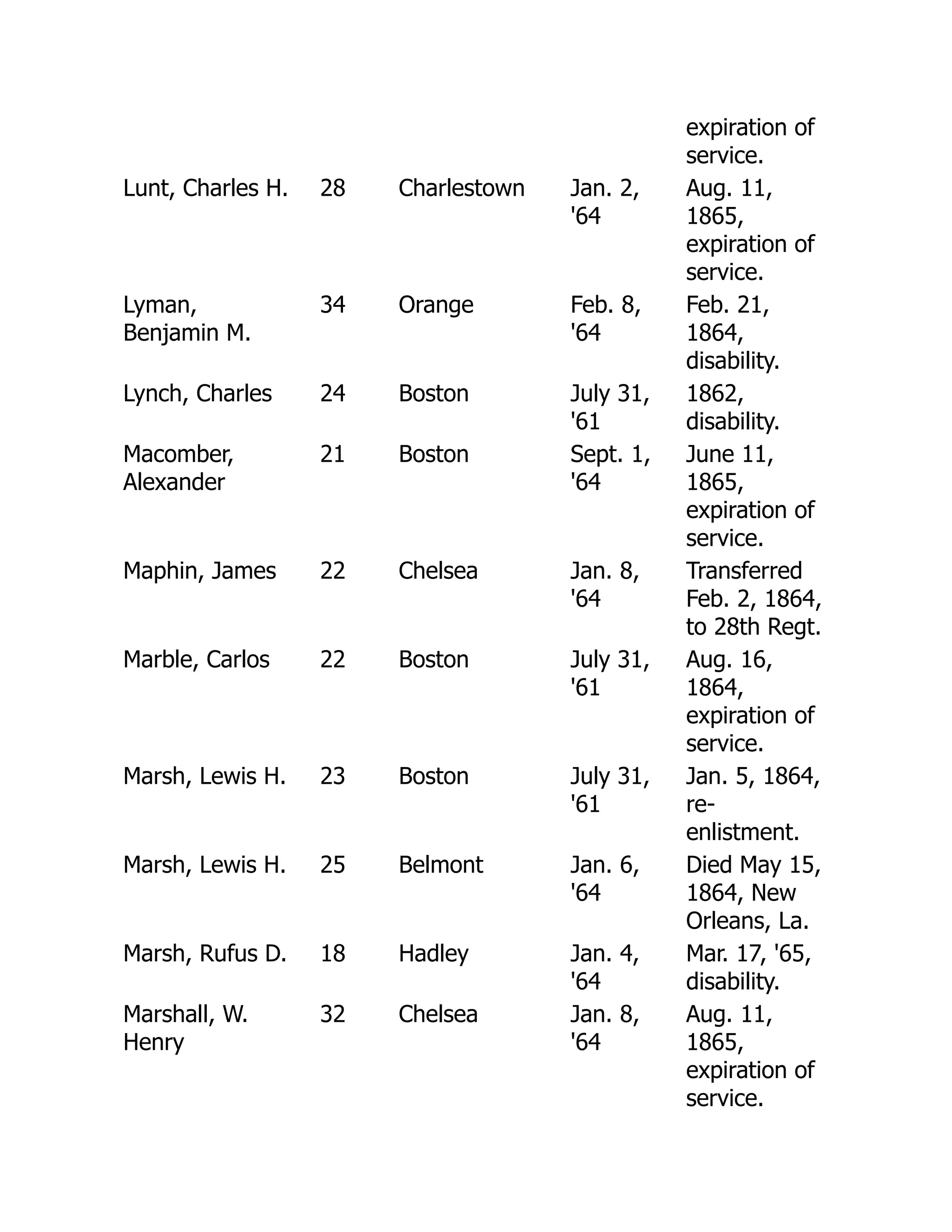
Lunt, Charles H. 28 Charlestown Jan. 2,
'64
Aug. 11,
1865,
expiration of
service.
Lyman,
Benjamin M.
34 Orange Feb. 8,
'64
Feb. 21,
1864,
disability.
Lynch, Charles 24 Boston July 31,
'61
1862,
disability.
Macomber,
Alexander
21 Boston Sept. 1,
'64
June 11,
1865,
expiration of
service.
Maphin, James 22 Chelsea Jan. 8,
'64
Transferred
Feb. 2, 1864,
to 28th Regt.
Marble, Carlos 22 Boston July 31,
'61
Aug. 16,
1864,
expiration of
service.
Marsh, Lewis H. 23 Boston July 31,
'61
Jan. 5, 1864,
re-
enlistment.
Marsh, Lewis H. 25 Belmont Jan. 6,
'64
Died May 15,
1864, New
Orleans, La.
Marsh, Rufus D. 18 Hadley Jan. 4,
'64
Mar. 17, '65,
disability.
Marshall, W.
Henry
32 Chelsea Jan. 8,
'64
Aug. 11,
1865,
expiration of
service.
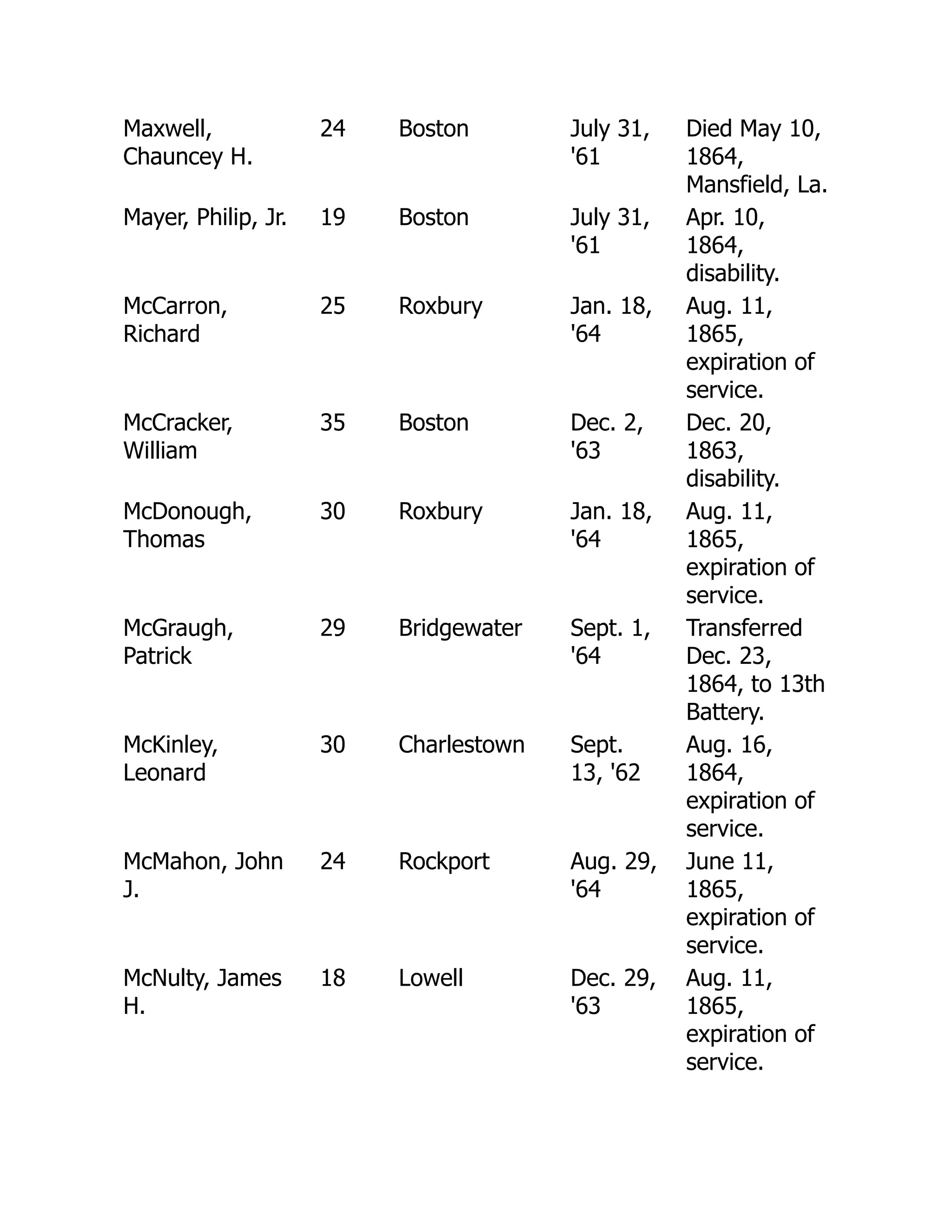
Maxwell,
Chauncey H.
24 Boston July 31,
'61
Died May 10,
1864,
Mansfield, La.
Mayer, Philip, Jr. 19 Boston July 31,
'61
Apr. 10,
1864,
disability.
McCarron,
Richard
25 Roxbury Jan. 18,
'64
Aug. 11,
1865,
expiration of
service.
McCracker,
William
35 Boston Dec. 2,
'63
Dec. 20,
1863,
disability.
McDonough,
Thomas
30 Roxbury Jan. 18,
'64
Aug. 11,
1865,
expiration of
service.
McGraugh,
Patrick
29 Bridgewater Sept. 1,
'64
Transferred
Dec. 23,
1864, to 13th
Battery.
McKinley,
Leonard
30 Charlestown Sept.
13, '62
Aug. 16,
1864,
expiration of
service.
McMahon, John
J.
24 Rockport Aug. 29,
'64
June 11,
1865,
expiration of
service.
McNulty, James
H.
18 Lowell Dec. 29,
'63
Aug. 11,
1865,
expiration of
service.
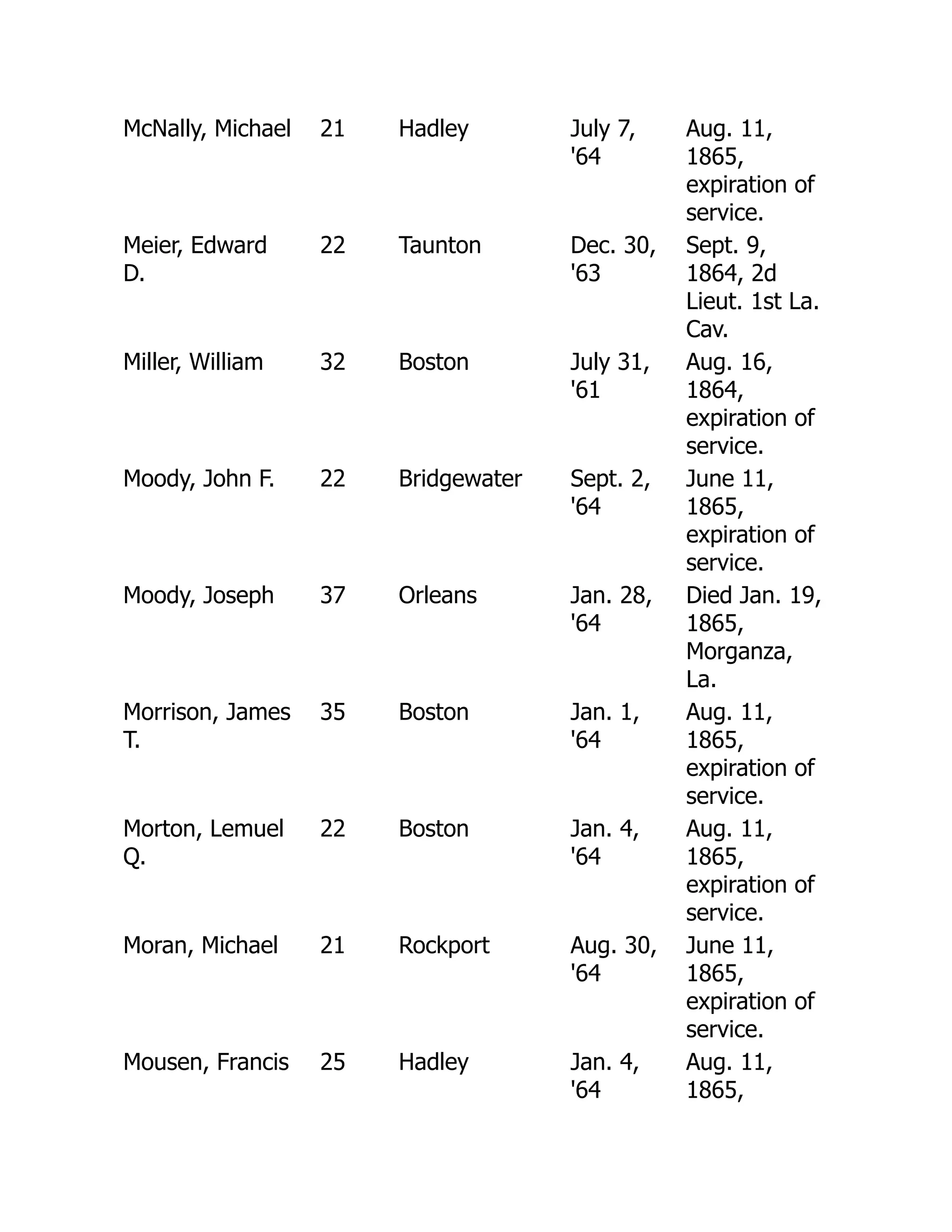
McNally, Michael 21 Hadley July 7,
'64
Aug. 11,
1865,
expiration of
service.
Meier, Edward
D.
22 Taunton Dec. 30,
'63
Sept. 9,
1864, 2d
Lieut. 1st La.
Cav.
Miller, William 32 Boston July 31,
'61
Aug. 16,
1864,
expiration of
service.
Moody, John F. 22 Bridgewater Sept. 2,
'64
June 11,
1865,
expiration of
service.
Moody, Joseph 37 Orleans Jan. 28,
'64
Died Jan. 19,
1865,
Morganza,
La.
Morrison, James
T.
35 Boston Jan. 1,
'64
Aug. 11,
1865,
expiration of
service.
Morton, Lemuel
Q.
22 Boston Jan. 4,
'64
Aug. 11,
1865,
expiration of
service.
Moran, Michael 21 Rockport Aug. 30,
'64
June 11,
1865,
expiration of
service.
Mousen, Francis 25 Hadley Jan. 4,
'64
Aug. 11,
1865,
expiration of
service.
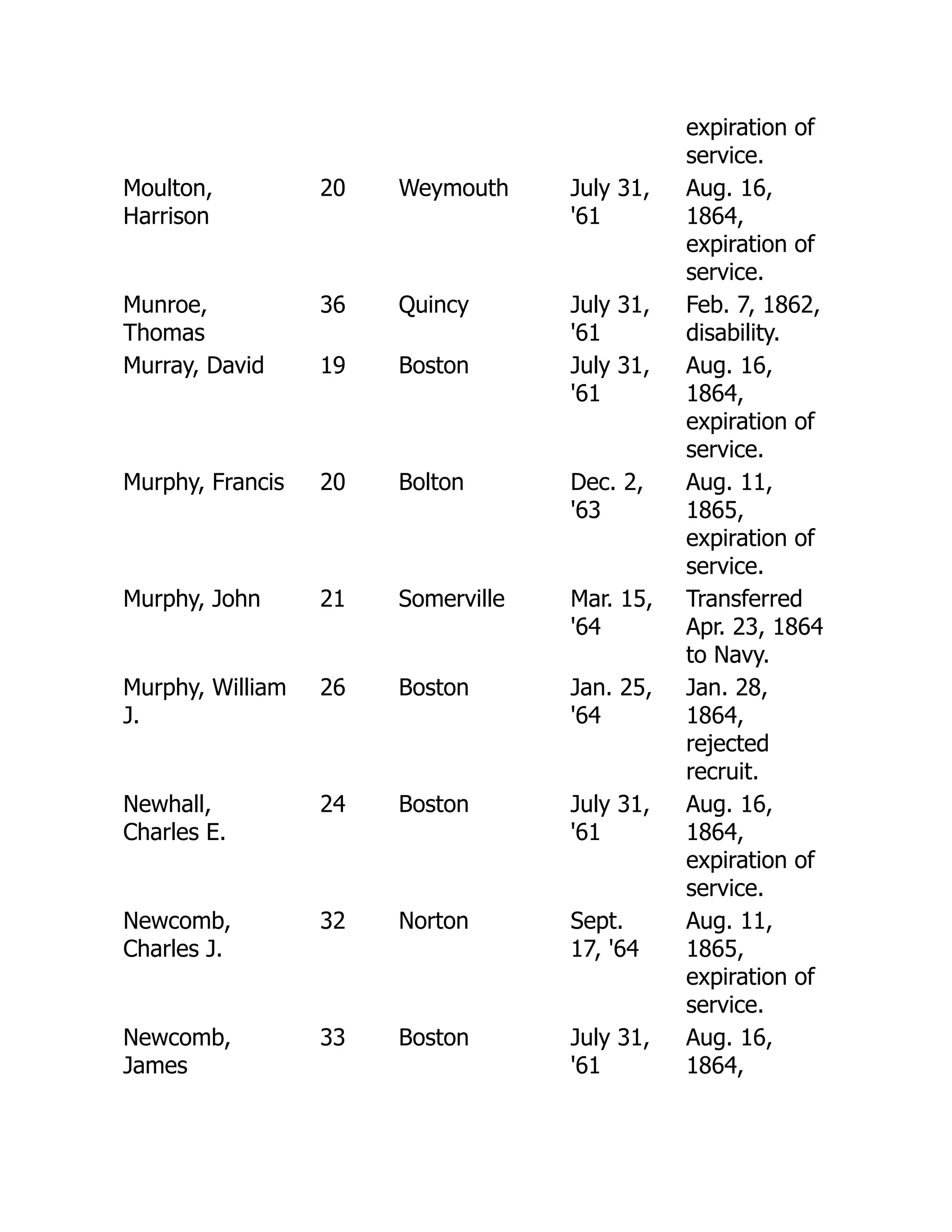
Moulton,
Harrison
20 Weymouth July 31,
'61
Aug. 16,
1864,
expiration of
service.
Munroe,
Thomas
36 Quincy July 31,
'61
Feb. 7, 1862,
disability.
Murray, David 19 Boston July 31,
'61
Aug. 16,
1864,
expiration of
service.
Murphy, Francis 20 Bolton Dec. 2,
'63
Aug. 11,
1865,
expiration of
service.
Murphy, John 21 Somerville Mar. 15,
'64
Transferred
Apr. 23, 1864
to Navy.
Murphy, William
J.
26 Boston Jan. 25,
'64
Jan. 28,
1864,
rejected
recruit.
Newhall,
Charles E.
24 Boston July 31,
'61
Aug. 16,
1864,
expiration of
service.
Newcomb,
Charles J.
32 Norton Sept.
17, '64
Aug. 11,
1865,
expiration of
service.
Newcomb,
James
33 Boston July 31,
'61
Aug. 16,
1864,
expiration of
service.
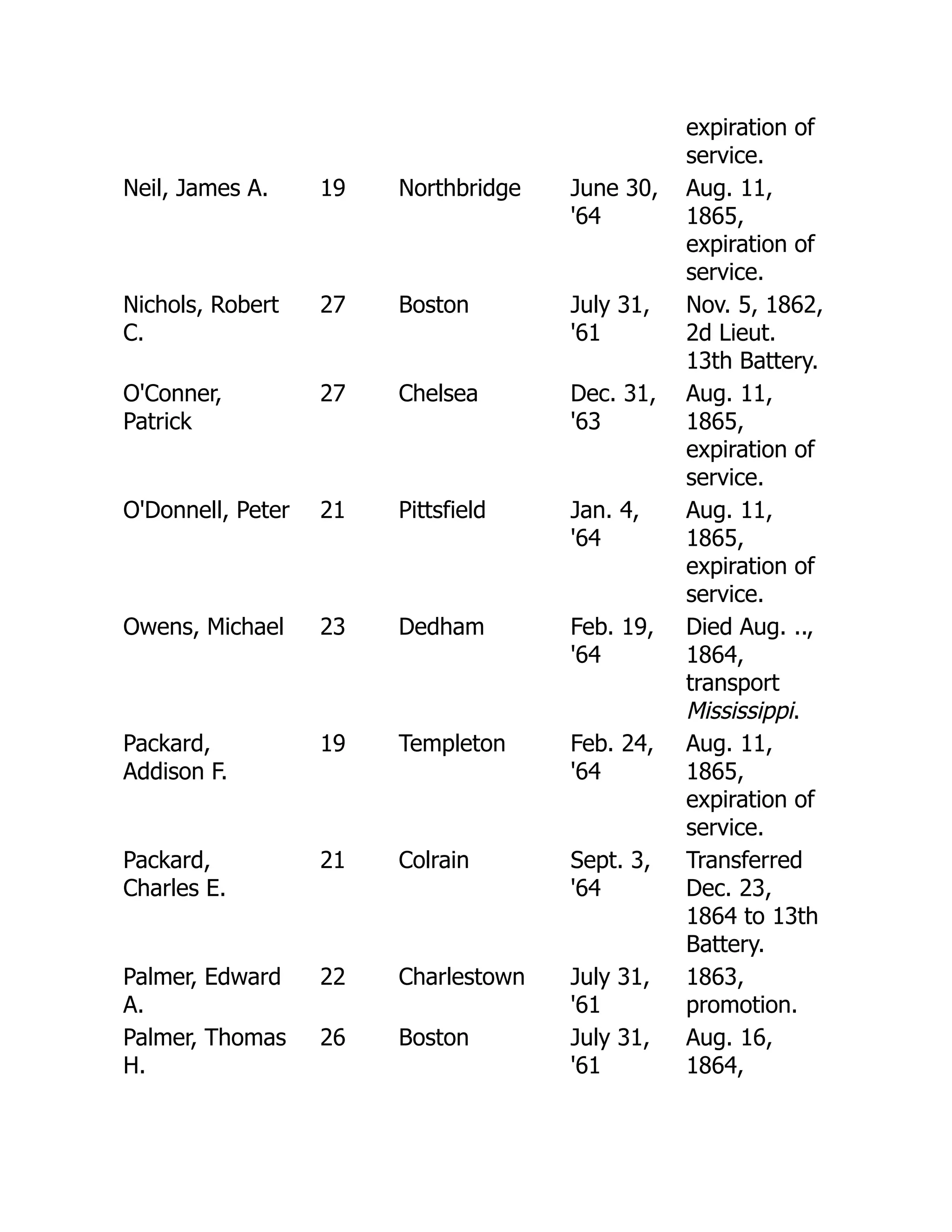
Neil, James A. 19 Northbridge June 30,
'64
Aug. 11,
1865,
expiration of
service.
Nichols, Robert
C.
27 Boston July 31,
'61
Nov. 5, 1862,
2d Lieut.
13th Battery.
O'Conner,
Patrick
27 Chelsea Dec. 31,
'63
Aug. 11,
1865,
expiration of
service.
O'Donnell, Peter 21 Pittsfield Jan. 4,
'64
Aug. 11,
1865,
expiration of
service.
Owens, Michael 23 Dedham Feb. 19,
'64
Died Aug. ..,
1864,
transport
Mississippi.
Packard,
Addison F.
19 Templeton Feb. 24,
'64
Aug. 11,
1865,
expiration of
service.
Packard,
Charles E.
21 Colrain Sept. 3,
'64
Transferred
Dec. 23,
1864 to 13th
Battery.
Palmer, Edward
A.
22 Charlestown July 31,
'61
1863,
promotion.
Palmer, Thomas
H.
26 Boston July 31,
'61
Aug. 16,
1864,
expiration of
service.
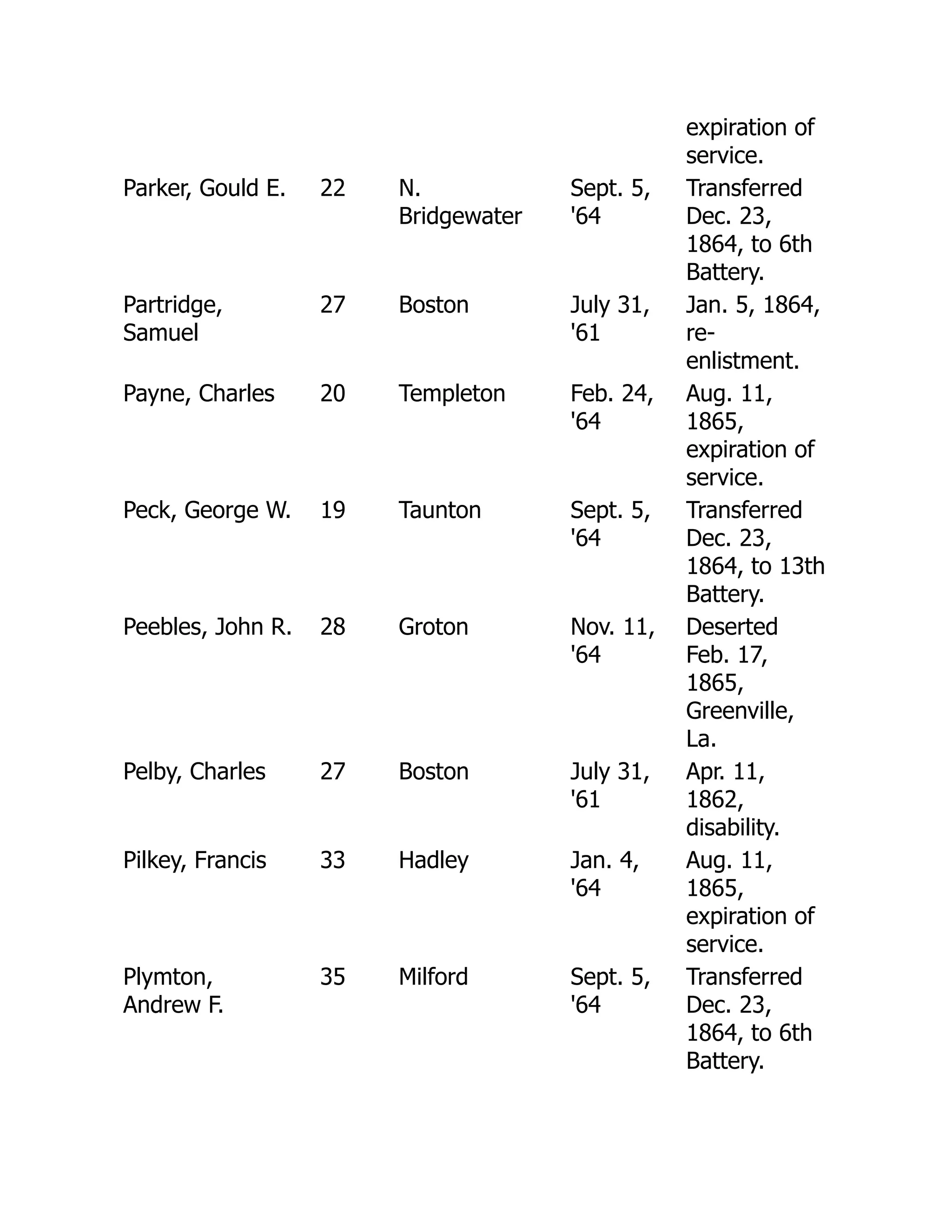
Parker, Gould E. 22 N.
Bridgewater
Sept. 5,
'64
Transferred
Dec. 23,
1864, to 6th
Battery.
Partridge,
Samuel
27 Boston July 31,
'61
Jan. 5, 1864,
re-
enlistment.
Payne, Charles 20 Templeton Feb. 24,
'64
Aug. 11,
1865,
expiration of
service.
Peck, George W. 19 Taunton Sept. 5,
'64
Transferred
Dec. 23,
1864, to 13th
Battery.
Peebles, John R. 28 Groton Nov. 11,
'64
Deserted
Feb. 17,
1865,
Greenville,
La.
Pelby, Charles 27 Boston July 31,
'61
Apr. 11,
1862,
disability.
Pilkey, Francis 33 Hadley Jan. 4,
'64
Aug. 11,
1865,
expiration of
service.
Plymton,
Andrew F.
35 Milford Sept. 5,
'64
Transferred
Dec. 23,
1864, to 6th
Battery.
Potter, Jeffrey
M.
21 N.
Bridgewater
Sept. 5,
'64
Transferred
Dec. 23,
1864 to 13th
Battery.
Potter, Willis S. 19 Taunton Sept. 5,
'64
June 11,
1865,
expiration of
service.
Prevoe, Joseph 29 Hadley Jan. 4,
'64
Aug. 11,
1865,
expiration of
service.
Presby, Mason
W.
30 Boston July 31,
'61
Deserted,
Jan. 1, 1862.
Prince, Amasa
T.
30 Brighton Feb. 29,
'64
Mar. 3, 1864,
rejected
recruit.
Price, Theodore
H.
38 Boston July 31,
'61
Died July ..,
1862,
Vicksburg,
Miss.
Ray, Charles 23 Boston July 31,
'61
Nov. 1, 1861,
disability.
Richer, William 18 Boston Jan. 8,
'63
Deserted July
1864,
Greenville,
La.
Riordon, Hugh 23 Lenox Jan. 5,
'64
May 16,
1865,
expiration of
service.
Riordon,
Timothy
21 Pittsfield Jan. 4,
'64
Killed Apr. 8,
1864, Sabine
Cross Roads.
Riordon, William 35 Pittsfield Feb. 29,
'64
Aug. 11,
1865,
expiration of
service.
Robertson,
Joshua F.
34 Boston July 31,
'61
Aug. 16,
1864,
expiration of
service.
Robertson, John
H.
18 Colrain Sept. 3,
'64
June 11,
1865,
expiration of
service.
Roberts,
Thomas E.
23 Boston July 31,
'61
Aug. 16,
1864,
expiration of
service.
Rooney, James 37 Boston Aug. 30,
'64
Aug. 11,
1865,
expiration of
service.
Russell, David 28 Ashby Sept. 3,
'64
June 11,
1865,
expiration of
service.
Ryder, Henry F. 23 Boston July 31,
'61
Aug. 16,
1864,
expiration of
service.
Richardson,
Christopher C.,
Jr.
21 Haverhill Nov. 15,
'64
Aug. 11,
1865,
expiration of
service.
Russell, Isaac H. 23 Charlestown July 31,
'61
Aug. 16,
1864,
expiration of
service.
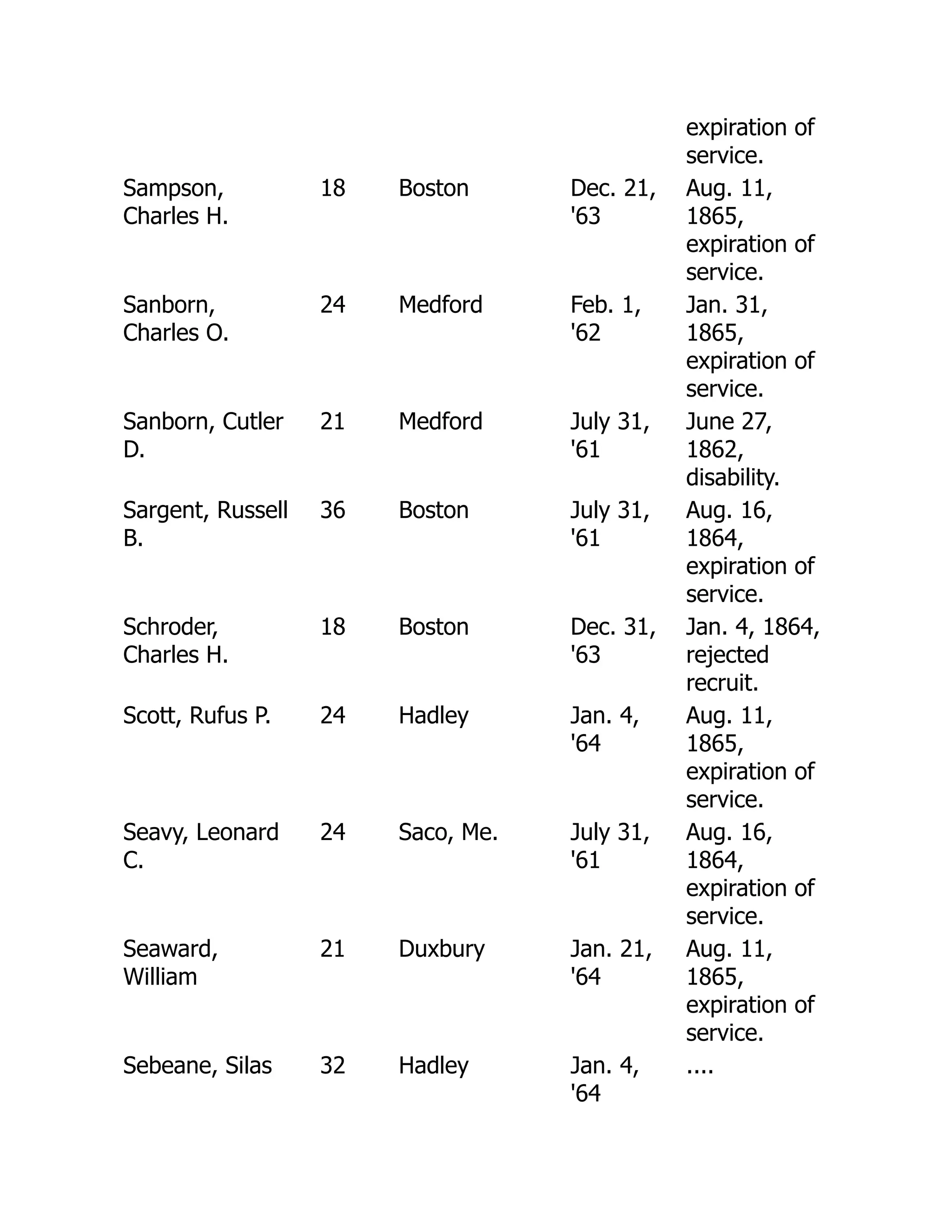
Sampson,
Charles H.
18 Boston Dec. 21,
'63
Aug. 11,
1865,
expiration of
service.
Sanborn,
Charles O.
24 Medford Feb. 1,
'62
Jan. 31,
1865,
expiration of
service.
Sanborn, Cutler
D.
21 Medford July 31,
'61
June 27,
1862,
disability.
Sargent, Russell
B.
36 Boston July 31,
'61
Aug. 16,
1864,
expiration of
service.
Schroder,
Charles H.
18 Boston Dec. 31,
'63
Jan. 4, 1864,
rejected
recruit.
Scott, Rufus P. 24 Hadley Jan. 4,
'64
Aug. 11,
1865,
expiration of
service.
Seavy, Leonard
C.
24 Saco, Me. July 31,
'61
Aug. 16,
1864,
expiration of
service.
Seaward,
William
21 Duxbury Jan. 21,
'64
Aug. 11,
1865,
expiration of
service.
Sebeane, Silas 32 Hadley Jan. 4,
'64
....
Senter, Charles
H.
28 Lynn July 31,
'61
....
Shaw, James 25 Charlestown Sept. 8,
'62
....
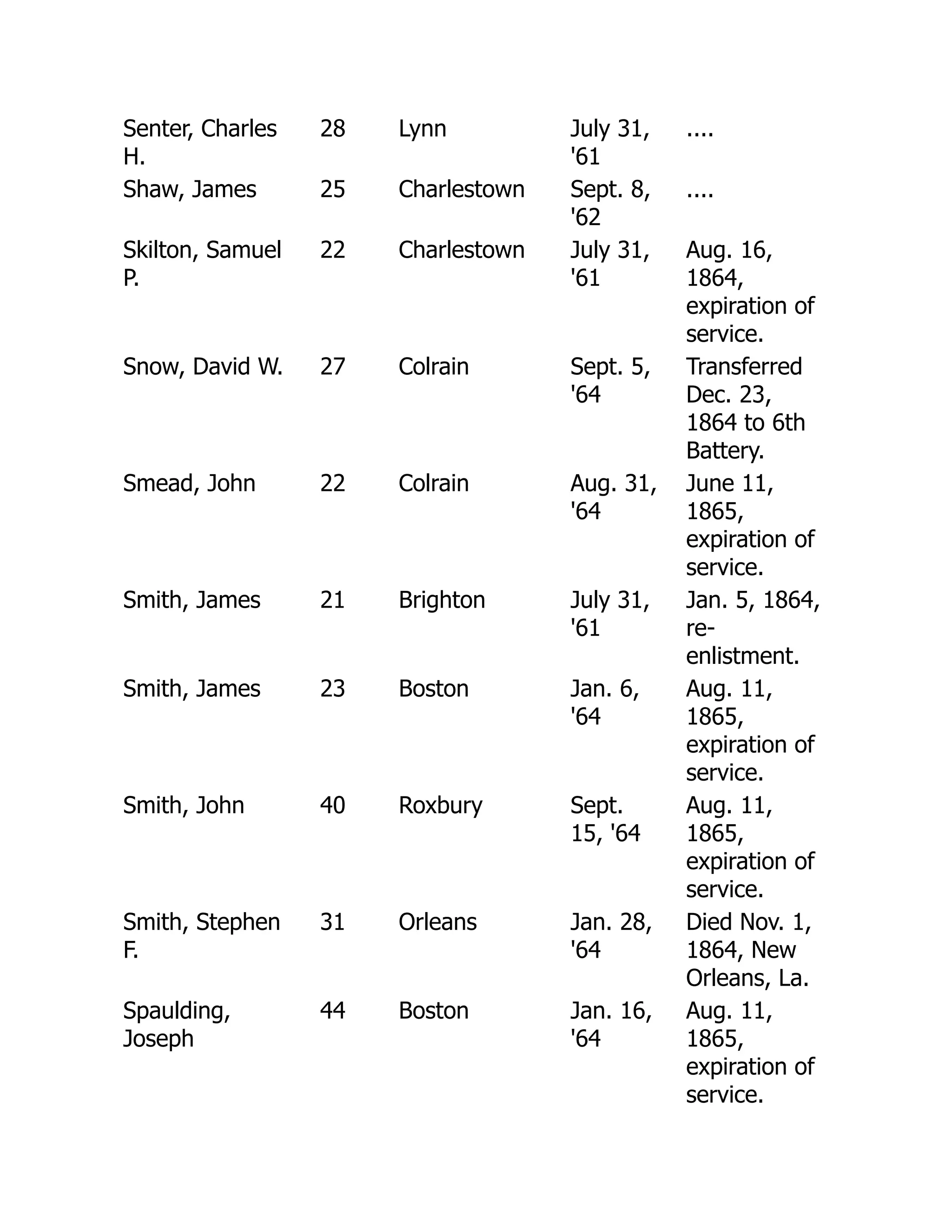
Skilton, Samuel
P.
22 Charlestown July 31,
'61
Aug. 16,
1864,
expiration of
service.
Snow, David W. 27 Colrain Sept. 5,
'64
Transferred
Dec. 23,
1864 to 6th
Battery.
Smead, John 22 Colrain Aug. 31,
'64
June 11,
1865,
expiration of
service.
Smith, James 21 Brighton July 31,
'61
Jan. 5, 1864,
re-
enlistment.
Smith, James 23 Boston Jan. 6,
'64
Aug. 11,
1865,
expiration of
service.
Smith, John 40 Roxbury Sept.
15, '64
Aug. 11,
1865,
expiration of
service.
Smith, Stephen
F.
31 Orleans Jan. 28,
'64
Died Nov. 1,
1864, New
Orleans, La.
Spaulding,
Joseph
44 Boston Jan. 16,
'64
Aug. 11,
1865,
expiration of
service.
Welcome to our website – the perfect destination for book lovers and
knowledge seekers. We believe that every book holds a new world,
offering opportunities for learning, discovery, and personal growth.
That’s why we are dedicated to bringing you a diverse collection of
books, ranging from classic literature and specialized publications to
self-development guides and children's books.
More than just a book-buying platform, we strive to be a bridge
connecting you with timeless cultural and intellectual values. With an
elegant, user-friendly interface and a smart search system, you can
quickly find the books that best suit your interests. Additionally,
our special promotions and home delivery services help you save time
and fully enjoy the joy of reading.
Join us on a journey of knowledge exploration, passion nurturing, and
personal growth every day!
ebookmasss.com

(eTextbook PDF) for Customer Relationship Management: Concepts and Technologies 4th Edition
  • 1.
    (eTextbook PDF) forCustomer Relationship Management: Concepts and Technologies 4th Edition download pdf https://ebookmass.com/product/etextbook-pdf-for-customer-relationship- management-concepts-and-technologies-4th-edition/ Visit ebookmass.com today to download the complete set of ebook or textbook!
  • 3.
    vii List of figuresxiii List of tables xvi Prefacexviii Acknowledgementsxxiii Section A UNDERSTANDING CUSTOMER RELATIONSHIPS 1 1 Introduction to CRM 3 Chapter objectives 3 Introduction3 Three forms of CRM 5 Strategic CRM 6 Operational CRM 7 Analytical (or analytic) CRM 13 Where does social CRM fit? 14 The changing face of CRM 15 Misunderstandings about CRM 16 Defining CRM 17 CRM constituencies 19 Commercial contexts of CRM 20 The not-­for-­profit context – the “third sector” 21 Models of CRM 22 Conclusion24 Notes and references 25 2 Understanding relationships 27 Chapter objectives 27 What is a relationship? 27 Relationship quality 31 When do companies want relationships with customers? 32 Customer life-­ time value 36 CONTENTS
  • 4.
    viii Contents When do companiesNOT want relationships with customers? 41 When do customers want relationships with suppliers? 42 When do customers NOT want relationships with suppliers? 44 Customer satisfaction, loyalty and business performance 45 Relationship management theories 53 Conclusion58 Notes and references 59 3 Managing the customer journey: customer acquisition 65 Chapter objectives 65 Introduction65 Customer journey: the basics 66 Customer acquisition 66 What is a new customer? 68 Portfolio purchasing 70 Prospecting72 Making the right offer 86 Key performance indicators of customer acquisition programs 87 Operational CRM tools that help customer acquisition 88 Conclusion91 Notes and references 92 4 Managing the customer journey: customer retention and development 94 Chapter objectives 94 Introduction94 What is customer retention? 95 Economics of customer retention 98 Which customers to retain? 99 Strategies for customer retention 99 Positive customer retention strategies 100 Context makes a difference 116 Key performance indicators of customer retention programs 117 The role of research in reducing churn 117 Strategies for customer development 119 Strategies for terminating customer relationships 121 Conclusion124 Notes and references 124 Section B STRATEGIC CRM 129 5 Customer portfolio management 131 Chapter objectives 131
  • 5.
    ix Contents What is aportfolio? 131 Who is the customer? 133 Basic disciplines for CPM 133 CPM in the business-­ to-­ business context 154 Additional customer portfolio management tools 160 Strategically significant customers 162 The seven core customer management strategies 163 Conclusion164 Notes and references 165 6 Managing customer-­ experienced value 167 Chapter objectives 167 Introduction167 Understanding value 168 When do customers experience value? 170 Modeling customer-­ perceived value 172 Sources of customer value 173 Customization174 Value through the marketing mix 179 Conclusion201 Notes and references 202 7 Managing customer experience 206 Chapter objectives 206 Introduction206 What is customer experience? 207 The experience economy 207 Why the corporate interest in CX? 208 Service marketing 210 Total quality management 213 Customer experience concepts 214 Data sources for CX research 217 What distinguishes customer experience management from customer relationship management? 219 CRM’s influence on CX 219 How CRM software applications influence customer experience 221 Conclusion224 Notes and references 224 Section C OPERATIONAL CRM 227 8 Marketing automation 237
  • 6.
    x Contents Chapter objectives 237 Introduction237 Whatis marketing automation? 237 Benefits of marketing automation 239 Software applications for marketing 241 Conclusion266 Notes and references 267 9 Sales force automation 269 Chapter objectives 269 Introduction269 What is SFA? 270 The SFA eco-­ system 271 SFA software functionality 273 SFA adoption 285 How SFA changes sales performance 286 Summary288 Notes and references 288 10 Service automation 291 Chapter objectives 291 Introduction291 What is customer service? 291 Modeling service quality 292 Customer service standards 293 What is service automation? 295 Benefits from service automation 298 Software applications for service 300 Conclusion316 Notes and references 316 Section D ANALYTICAL CRM 319 11 Developing and managing customer-­ related databases 321 Chapter objectives 321 Introduction321 Corporate customer-­ related data 322 Structured and unstructured data 322 Developing a customer-­ related database 324 Data integration 335 Data warehousing 336 Data marts 338
  • 7.
    xi Contents Knowledge management 339 Conclusion340 Notesand references 340 12 Using customer-­related data 342 Chapter objectives 342 Introduction342 Analytics for CRM strategy and tactics 344 Analytics throughout the customer journey 346 Analytics for structured and unstructured data 349 Big data analytics 351 Analytics for structured data 354 Three ways to generate analytical insight 356 Data-­mining procedures 362 Artificial intelligence (AI), machine learning (ML) and deep learning (DL) 367 Privacy issues 370 Conclusion373 Notes and references 374 Section E REALIZING THE BENEFITS OF CRM 377 13 Planning to succeed 379 Chapter objectives 379 The logic of the business case 379 Organizing for benefits 383 Network and virtual organizations 387 Person-­to-­person contacts 389 Key account management 389 Conclusion394 Notes and references 395 14 Implementing CRM 397 Chapter objectives 397 Introduction397 Phase 1: develop the CRM strategy 399 Phase 2: build CRM project foundations 405 Phase 3: needs specification and partner selection 411 Phase 4: project implementation 418 Phase 5: performance evaluation 419 Conclusion420 Notes and references 420
  • 8.
    xii Contents Section F LOOKINGTO THE FUTURE 423 15 The future 425 Chapter objectives 425 Introduction425 Data and technology 425 Supply-­side innovation 427 Data science 428 Notes and references 429 Index431
  • 9.
    xiii 1.1 The CRMvalue chain 22 1.2 Payne and Frow’s model of CRM 23 1.3 The SCHEMA model of customer management 24 2.1 The effect of customer retention on customer numbers 32 2.2 Retention rate and average customer tenure 34 2.3 Profit from customers over time 38 2.4 Impact of discount rate on CLV 39 2.5 Computing cohort value 41 2.6 The Satisfaction–Profit Chain 45 2.7 Two-­ dimensional model of customer loyalty 47 2.8 Share of market vs. share of customer 48 2.9 The American Customer Satisfaction Index (ACSI) model 49 2.10 Non-­ linear relationship between customer satisfaction and repeat purchase 51 2.11 The Six-­ Markets Model 57 3.1 Customer journey example 67 3.2 The CEOExpress portal 74 3.3 Samsung merchandising 84 3.4 Richard Branson launches the Virgin Bride retail venture 85 4.1 Using satisfaction and importance data to guide service improvement 104 4.2 Kano’s model for creating customer delight 105 4.3 Nectar loyalty program 108 4.4 Cash-­ back sales promotion 111 5.1 Intuitive and data-­ based segmentation processes 134 5.2 Bivariate segmentation of the chocolate market 139 5.3 McKinsey/­ GE customer portfolio matrix 143 5.4 ABC in a claims processing department 147 5.5 Decision tree output 152 5.6 The Pareto principle, or 80:20 rule 155 5.7 Customer profitability by sales volume quintile 156 5.8 Shapiro et al.’s customer portfolio matrix 157 5.9 Turnbull and Zolkiewski’s 3D Customer Classification Matrix 158 5.10 Ritter and Andersen’s 6-­ pack model 159 5.11 The growth-­ share matrix (Boston Consulting Group) 161 FIGURES
  • 10.
    xiv Figures 6.1 Holbrook’s typologyof consumer value 173 6.2 The marketing mix 179 6.3 The SERVQUAL gaps model 185 6.4 SAS airlines’ understanding of customer expectations 186 6.5 Service level agreement dashboard 189 6.6 Xerox’s 14 key business processes 191 6.7 Information availability online at www.ceoexpress.com 197 6.8 Southwest Airlines’ Instagram page (Southwest Airlines) 198 7.1 Evolution towards the experience economy 208 7.2 Forrester’s CX Index 209 7.3 The authors’ interpretation of the Forrester’s customer experience model 210 7.4 Layered model of customer experience 214 7.5 Typical CRM architecture, showing web, back-­ office integration and mobile. Note the database tier (bottom), the application server tier (middle), and the user interface tier (top) 223 C.1 Oracle’s CX Cloud, 2018 233 8.1 Closed-­loop marketing 240 8.2 Oracle (Eloqua) multichannel campaign management application 244 8.3 Email campaign management workflow 247 8.4 Marketing optimization; offer summary 249 8.5 Gartner, Inc.’s Technology Hype Cycle 252 8.6 Sample Twitter report 253 8.7 Google Analytics audience report 259 8.8 Oracle (Siebel)’s loyalty management software application 261 8.9 NitroMojo partner management screenshot 263 8.10 Email campaign report 265 9.1 Components of Oracle’s SFA solution 271 9.2 Customer overview configured for iPad 272 9.3 Account management screenshot 274 9.4 Contact summary screenshot 275 9.5 Lead management screenshot 278 9.6 Opportunity management report 279 9.7 Oracle pipeline overview screenshot 280 9.8 Sales management report 284 10.1 The International Standard for Customer Service 295 10.2 Full visibility into customer service history 299 10.3 Agent response to Twitter feed 302 10.4 Trouble-­ticket screenshot 306 10.5 Customer service scripting screenshot 307 10.6 Job management application 308 10.7 Oracle inbound telephony dashboard 312 10.8 Chat window (Oracle Smart technologies) screenshot 315 11.1 Steps in creating a relational database 324 11.2 SugarCRM screenshot 326 11.3 Email marketing application 327
  • 11.
    xv Figures 11.4 Output frommerge-­ purge operation 332 11.5 Single view of the customer 336 11.6 Data transformation 338 12.1 Basic data configuration for CRM analytics 344 12.2 Social media sentiment analytics 350 12.3 The 3Vs of big data 352 12.4 Standard report example 357 12.5 Example of a star schema: fact table and dimensions 358 12.6 Dendrogram output from hierarchical clustering routine 366 12.7 K-­ means clustering output 366 12.8 Simple two hidden layered neurons neural network (simplified representation)369 13.1 Benefit dependency network example 383 13.2 Category management at Kraft 386 13.3 Matrix organization structure 387 13.4 A model of KAM development 392 13.5 Bow-­ tie structure for early KAM 393 13.6 Virtual organization for synergistic KAM 393 14.1 The five-­ step implementation process 398 14.2 Customer Strategy Cube 400 14.3 Customer interaction map 401 14.4 Governance structure 406 14.5 The competing values model of organizational culture 408 14.6 The buy-­ in matrix 409 14.7 CRM project Gantt chart 410 14.8 Campaign management process for high interest saving account 413
  • 12.
    Visit https://ebookmass.com todayto explore a vast collection of ebooks across various genres, available in popular formats like PDF, EPUB, and MOBI, fully compatible with all devices. Enjoy a seamless reading experience and effortlessly download high- quality materials in just a few simple steps. Plus, don’t miss out on exciting offers that let you access a wealth of knowledge at the best prices!
  • 13.
    xvi 1.1 Definitions ofCRM 4 1.2 Types of CRM 6 1.3 Operational CRM – some applications 9 1.4 How CRM has changed over time 16 2.1 The customer journey or loyalty ladder 35 5.1 Criteria for segmenting consumer markets 136 5.2 ACORN geo-­ demographic household classification (UK) 137 5.3 How business markets are segmented 139 5.4 Examples of ISIC codes 140 5.5 Criteria for appraising segmentation opportunities 142 5.6 Sales forecasting using moving averages 144 5.7 Margin multiples 148 5.8 Credit risk training set 151 5.9 Cross-­ tabulation of dependent and independent variables 151 5.10 How costs vary between customers 157 6.1 Different forms of mass customization 176 6.2 Grönroos model of service quality 184 6.3 SERVQUAL components 184 7.1 Touchpoints along the customer journey 215 7.2 The 4 “I”s of customer engagement 217 C.1 Components of Oracle’s CX cloud 234 8.1 Functionality offered by MA software 242 8.2 Technology support for tele-­ marketing 249 8.3 Product lifecycle management software functionality 263 9.1 Classification of SFA vendors (sample only) 271 9.2 Functionality offered by SFA software 274 9.3 Examples of reports available from SFA software 283 9.4 Motivations for implementing SFA 286 9.5 Determinants of perceived usefulness in the Technology Acceptance Model 287 10.1 Customer Service Excellence standard criteria and elements 294 10.2 Functionality offered by service automation software 300 12.1 CRM strategic goals (bold) and related tactics (not bold) 345 12.2 Sample criteria used in prospect scoring 346 TABLES
  • 14.
    xvii Tables 12.3 Selected techniquesused by data miners 362 12.4 SERVQUAL’s latent variables revealed by factor analysis 367 14.1 Strategic goals for CRM 403 14.2 Immediate and latent benefits from CRM 404 14.3 Evaluating processes 414 14.4 Comparing laptops and tablets 416
  • 15.
    xviii Welcome to thefourth edition of Customer Relationship Management: Concepts and Technol- ogies by Francis Buttle and Stan Maklan. This book provides a comprehensive and balanced review of customer relationship management. It explains what CRM is, the benefits it delivers and the costs it creates across the many contexts in which it is used. Businesses of all sizes are the main adopters of CRM, but government agencies and not-­ for-­ profits are also users. Adopters use CRM principally to achieve their own objectives but also recognize that CRM has a major impact on customer – or citizen – experience. CRM is widely, but incorrectly, thought to be synonymous with the use of information technologies to manage customer relationships. In our opinion, this is a narrow and restric- tive view of CRM. The three-­ letter acronym CRM is, of course, shorthand for customer rela- tionship management, and those three words should tell you plenty about CRM. It involves a focus on customers; it is about the relationships that firms wish to build with customers; and it is about active management of the processes and resources that enable those relationships to survive and prosper for the benefit of both firms and their customers. Those processes are typically housed in marketing, selling and customer service units, and include a wide range of touch points on the customer journey including, for example, customer on-­ boarding, cross-­ selling, loyalty management and customer win-­back. The resources used to manage customer relationships include data, IT infrastructure, software applications, devices, workflow and people. People are critical to CRM success. People design customer management processes, apply those processes and interact with customers. Clearly, there is more to CRM than IT, though technology was an essential catalyst for its early development and remains funda- mental to today’s near universal adoption. IT had been first deployed by businesses to streamline administration with a strong focus on accounting, billing and financial reporting, resulting in IT heads reporting to the CFO or VP Finance. The next waves of IT deployment focused on personal productivity (desktop computing) and supply chain management (e.g. enterprise resource planning – ERP). Then, in the early 1990s, IT was applied to customer relationship management, and most recently to customer experience management (CXM). CRM’s emergence as a business discipline happened because advances in IT enabled adopters to capture, store, interpret and distribute customer-­ related data cost effectively in the execution of their relationship man- agement strategies. PREFACE
  • 16.
    xix Preface CRM has changedmassively since the first edition of this book was published in 2004, and even since the last edition was published in 2015. • CRM practice has conventionally relied upon on its exploitation of structured data about customers, prospects and partners housed in company-­ owned databases. This has changed. Structured data can be easily stored in two-­ dimensional tables (column and rows) and subjected to statistical analysis. However, much of the data customers gener- ate, for example on social media platforms, is unstructured and requires complex new technologies if it is to be useful for relationship management. Unstructured data includes text, audio, photographic and video data such as call center agent notes, recordings of customer engagement center conversations and uploads to YouTube and Instagram. • Software-­ as-­ a-­ Service (SaaS) has largely replaced on-­ premise CRM implementations. SaaS essentially means that CRM users store their customer data in the cloud, and read, analyze and exploit that customer data using software applications accessed through their web browsers. Most CRM vendors/­ developers now have a SaaS-­ first, or SaaS-­ only, approach to service provision. • The sheer volume and variety of data that organizations can access is growing exponen- tially. Big data are data that are typified by their volume, velocity and variety. Big data, including the data resident on social media platforms, are impacting the practice of rela- tionship marketing and CRM more particularly. • No longer do businesses set the rules about how they will interact with customers through their control of communication channels and brand messaging. Customers now decide when and how they will interact with companies, and they have multiple chan- nels for doing so, ranging from email, to face-­ to-­ face and chatbot. • Customers can also create and communicate their own brand-­related messages on social media platforms like Facebook and Twitter. These may be very different in content and tone from the brand owner’s messaging. • New CRM solutions continue to emerge as technology firms innovate. Two solutions are generating high levels of interest and investment: chatbots and social CRM solutions. We explore how social CRM fits into the CRM landscape, and particularly whether it is a fundamental type of CRM, equivalent to strategic, operational and analytical CRM. • Artificial intelligence is playing a more important role in CRM. AI enables companies to make sense of apparently random or chaotic datasets, and to respond automatically without human intervention in real-­ time. • CRM is now aligned with customer experience management (CXM). CXM has become a hot topic in customer management. Businesses are trying to understand what it is like to be a customer of their company, and to design moments-­ of-­ truth at customer touch- points that improve customer experience. We view CRM and CXM as two sides of the same coin. CRM resources including technologies and human skill sets change customer experience, and excellent customer experience on a large scale can only be delivered with CRM programs. We even thought about retitling the book CRM/­CXM: concepts and technologies! Maybe you have an opinion on that – our email addresses appear at the end of this Preface.
  • 17.
    xx Preface • Privacy anddata security have become very important issues for regulators, and, in turn, for CRM practitioners. Questions about data ownership and use have become critical as customers surrender personal information, in particular to online entities such as Ama- zon and Facebook. • We are seeing the emergence of the next wave of technology-­ supported innovation in CRM featuring new business models founded on real-­ time, mobile data, particu- larly customer-­ generated data. CRM, the most mature of the IT-­ enabled customer-­ facing management disciplines, has an enhanced role in such an environment and we believe remains the cornerstone for marketing, sales and customer service in the future. In producing this fourth edition we knew we had to reflect this evolving landscape, and in true, customer-­ oriented manner, we also surveyed readers and adopters of the previous edition. They told us what they wanted in this revision, and we have followed their guidance. We have also refined the focus of the book. We have removed content that was not valued by readers and adopters and streamlined and updated what has been retained. This fourth edition continues to draw on academic and independent research to ensure that it is both theoretically sound and managerially relevant. Research from a wide range of academic dis- ciplines contributes to the book. These include marketing, sales, customer service, human resources, technology management, strategy, change management, project management, leadership, operations, management accounting, finance and organizational behavior. Sup- plementing these academic credentials, the book also makes use of research conducted by independent analysts such as Gartner and Forrester, two organizations that conduct leading edge, state-­ of-­ the-­ art research into CRM and related areas. AUDIENCE FOR THE BOOK This book has been written for a number of audiences, all of whom share an interest in improving their understanding of CRM. • MBA and master’s students, and upper-­ level undergraduates studying CRM or related advanced courses such as relationship marketing, database marketing, digital marketing, social media marketing, customer management, customer portfolio management, cus- tomer experience management, sales management, key account management, strategic management, customer value management and customer service management. • Students or independent learners seeking CRM education or certification through orga- nizations such as AARM (Association for the Advancement of Relationship Marketing) and CRMAA (CRM Academy of Asia). • Those pursuing professional qualifications or accreditation in marketing through inter- national organizations such as the Chartered Institute of Marketing, the Digital Market- ing Institute, and the Institute of Direct and Digital Marketing, or national bodies such as the Marketing Institute of Ireland or the Canadian Institute of Marketing.
  • 18.
    xxi Preface • Senior andmid-­ level managers who are involved in CRM programs and system imple- mentations, whether in a marketing department, the sales force or service center. • Students pursuing professional qualifications or accreditation through international organizations such as the Institute of Sales Marketing Management, or corporate-­ based sales academies. • CRM users who want a better understanding of this complex area. CRM tools are deployed across all customer-­facing parts of organizations. Users include sales represen- tatives and account managers, marketing managers, market analysts, campaign manag- ers, market managers, customer relationship managers, and customer service managers. These users are exposed to just a fragment of the CRM universe. This book can put their role into broader context. KEY FEATURES OF THE BOOK • The book provides a helicopter view, an overview, of the domain of CRM. As an impar- tial review of the field, it is not tied to any particular perspective on CRM. Indeed, the book identifies a number of holistic models that provide different and competing over- views of CRM. • Although CRM is in widespread use, there is still some misunderstanding about what CRM is. The book identifies three different types of CRM – strategic, operational and analytical. The book is structured so that the chapters on each of these types of CRM are clustered together. Several chapters are dedicated to each type of CRM. • The book defines CRM as the core business strategy that aims to create and maintain prof- itable relationships with customers, by designing and delivering superior value proposi- tions. It is grounded on high-­ quality customer-­ related data and enabled by information technology. This definition serves as a central point-­ of-­ reference throughout the book. • We don’t assume that customers want relationships with suppliers. If CRM is about developing and maintaining relationships with customers, it is important to have clear understanding of what a relationship looks like, and how, if at all, it can be managed. We discuss what is meant by “relationship” and question whether customers want relation- ships with suppliers and vice versa. We also identify attributes of successful relationships and review five different schools of thought that have influenced relationship manage- ment in a business context. • The book emphasizes a managerial perspective on CRM. Although there is plenty of content on technology, it is not a book about technology, per se. The technology content of the book has been written so that readers who are unfamiliar with technology, or who are technophobes, can still understand what CRM technologies can deliver. Technology is secondary to management throughout the book. You don’t need a degree in informa- tion systems to benefit from the book! • The book has a strong academic foundation provided by research from a number of disciplines.
  • 19.
    xxii Preface • The bookcontains many examples of CRM solutions and their application in marketing, selling or service function. Screenshots from CRM applications are a feature of the book. • Every chapter contains case illustrations. These are not problem-­ based cases, but exam- ples of CRM in practice, so that readers can better appreciate how CRM is deployed. • All chapters follow a common format: learning objectives, text, case illustrations, sum- mary and references.
  • 20.
    xxiii We would liketo acknowledge the contributions of many people to the production and pub- lication of this book. We thank the editorial team at Taylor Francis for their confidence in commissioning this fourth edition, their editorial diligence, and the detailed work of tracking down copyright owners and obtaining permission to use their materials. We thank the own- ers of all copyright materials for those permissions. We have made every effort to track down copyright owners, and to cite them correctly in footnotes or in the text. If we have failed to identify and cite any copyright material correctly, we apologize and advise copyright owners to contact the publishers so corrections can be made in future editions. We thank the stars of the academic and business worlds that have graciously endorsed and lent their authority to our book. We thank our clients and students on whom many of our ideas have been stress tested. We thank our colleagues who have given moral and practical support to this writing venture. We thank colleagues, associates, clients and other experts from around the world who have read drafts of chapters and made helpful suggestions. You were brilliant, all of you. You know who you are, but in case you don’t here are some names: Lawrence Ang, Sergio Big- gemann, Susan Bond, Jamie Burton, Emma Buttle, Lewis Buttle, Benadetta Crisafulli, Abdul Hamid Ebrahim (Oracle), Helene Gabrielsson, Bill Gates, Lars Groeger, Jan Hofmeyr, Linda Hollebeek, Bob Knox, Fred Lemke, Claude Liu, Nilex AB Sweden, John Murphy, Oracle Cor- poration, Dan Prior, Smaply, Ross Smith, John Turnbull, Marc Warner (ASI) and Martin Williams. Finally, we thank our families who have put up with long periods of absence from family duty as we worked to keep to our publication deadline. We hope you enjoy the book and find it a satisfying read. Writing a book is a little like painting a picture or tending a garden. You never reach a point where you can safely say that the job is finished. There is always more you can do. With that in mind, we invite you to write to us at francis@francisbuttle.com.au and stanmaklan@gmail.com or s.maklan@cranfield. ac.uk. We look forward to hearing from you. Francis Buttle, Sydney Stan Maklan, London ACKNOWLEDGEMENTS
  • 22.
  • 23.
    Visit https://ebookmass.com todayto explore a vast collection of ebooks across various genres, available in popular formats like PDF, EPUB, and MOBI, fully compatible with all devices. Enjoy a seamless reading experience and effortlessly download high- quality materials in just a few simple steps. Plus, don’t miss out on exciting offers that let you access a wealth of knowledge at the best prices!
  • 24.
    Exploring the Varietyof Random Documents with Different Content
  • 25.
    Elmer, Spencer W. 20 HeathAug. 30, '61 June 11, 1865, expiration of service. Evans, Elbridge 27 Charlestown July 31, '61 Feb. 15, 1864, re- enlistment. Farnum, Charles G. 43 Boston Dec. 28, '63 Aug. 11, 1865, expiration of service. Ferren, Loren 19 Taunton Sept. 3, '64 June 11, 1865, expiration of service. Fickett, William 22 Duxbury Jan. 21, '61 Died Aug. 19, 1865, Gallop's Island. Fillebrown, Henry A. 23 Waltham July 31, '61 Aug. 16, 1864, expiration of service. Finnegan, Bernard 28 Boston Mar. 14, '64 Aug. 11, 1865, expiration of service. Fisk, John D. 26 Southbridge July 31, '61 Feb. 15, 1864, re- enlistment. Flemming, Nathaniel 28 Charlestown Dec. 7, '63 Deserted Oct. 18, 1864, New Orleans, La.
  • 26.
    Fletcher, John W. 23 BillericaJuly 31, '61 .... Flynn, Thomas 45 Charlestown Dec. 12, '63 Aug. 11, 1865, expiration of service. Folsom, Ezra F. 26 Truro Jan. 11, '64 Died May 24, 1864, Baton Rouge, La. Forbes, John A. 34 Boston July 31, '61 Aug. 16, 1864, expiration of service. Foster, Edward 32 Boston Dec. 5, '63 Deserted, never joined Battery. Foster, Thomas B. 20 Stoughton July 31, '61 Feb. 15, 1864, re- enlistment. Foulds, John 19 Taunton Sept. 2, '64 June 11, 1865, expiration of service. Foye, William E. 18 Braintree Sept. 3, '64 Aug. 11, 1865, expiration of service. French, Loring A. 39 Quincy July 31, '61 Aug. 16, 1864, expiration of service. Galloway, Charles 25 Waltham June 23, '64 June 11, 1865,
  • 27.
    expiration of service. Gannon, Cornelius 22 TruroFeb. 24, '64 Aug. 11, 1865, expiration of service. Garrett, William 21 Lowell July 31, '61 Transferred Sept. 1, 1861, to 17th M. V. Gibson, Edward 22 Boston Mar. 14, '64 Deserted, never joined Battery. Gill, John E. 21 Taunton Sept. 5, '64 Transferred Dec. 23, 1864, to 13th Battery. Gleason, Samuel K. 30 Heath Aug. 30, '64 June 11, 1865, expiration of service. Goodrich, Edward C. 22 Lunenburg Dec. 31, '63 Aug. 11, 1865, expiration of service. Goodwin, William H. 20 Weymouth July 31, '61 Feb. 15, 1864, re- enlistment. Goodwin, William H. 22 Boston Feb. 16, '64 Aug. 11, 1865, expiration of service. Glover, Edward W. 26 Maiden July 31, '61 Oct. .., 1862, disability.
  • 28.
    Grover, Fitzroy 19Chicopee Aug. 31, '64 June 11, 1865, expiration of service. Haggerty, John 26 Pittsfield Jan. 18, '64 Deserted, never joined Battery. Hall, Arthur W. 18 Heath Aug. 30, '64 June 11, 1865, expiration of service. Hale, Russell 19 Gardner July 2, '64 Aug. 11, 1865, expiration of service. Haley, Samuel, Jr. 21 W. Boylston July 31,'61 Sept. .., 1862, disability. Hammond, Charles 31 Dorchester July 26, '64 Aug. 11, 1865, expiration of service. Hamilton, Charles 31 Truro Jan. 12, '64 Jan. 13, 1864, rejected recruit. Hamilton, Charles H. 21 Taunton Sept. 2, '64 June 11, 1865, expiration of service. Hammond, Daniel M. 19 Charlestown July 31, '61 Jan. 5, 1864, re- enlistment.
  • 29.
    Hammond, Daniel M. 21 CharlestownJan. 6, '64 Aug. 11, 1865, expiration of service. Hamour, George B. 23 Boston July 31, '61 Apr. 20, 1863, disability. Ham, James H. 20 Boston Jan. 14, '64 Transferred June 21, 1864, to Navy. Harvey, Alexander D. 21 Boston Oct. 10, '61 Oct. 15, 1864, expiration of service. Harkins, Daniel 21 Templeton Jan. 4, '64 Jan. 6, 1864, rejected recruit. Harvey, George B. 22 Taunton Sept. 5, '64 Transferred Dec. 23, 1864, to 13th Battery. Harvey, Joseph R. 22 Boston July 31, '61 Died Aug. 10, 1862, New Orleans, La. Hauff, Rudolph 34 Boston July 31, '61 Died 1863, New Orleans, La. Hayward, Hampton V. 24 Boston July 31, '61 Aug. 16, 1864, expiration of service. Hess, Phillip 18 Hinsdale Jan. 18, '64 Jan. 24, 1864,
  • 30.
    rejected recruit. Hidden, William G. 21 BostonJuly 31, '61 Aug. 16, 1864, expiration of service. Hill, Augustus E. 34 Phillipston Dec. 24, '63 Jan. 9, 1864, rejected recruit. Hobbs, Joseph A. 23 Boston July 31, '61 Oct. 18, 1862, disability. Holmes, Elmer W. 22 N. Bridgewater Sept. 10, '64 Transferred Dec. 23, 1864, to 6th Battery. Holme, Frederick 32 Boston ...., '62 Jan. 5, 1864, re- enlistment. Holme, Frederick 34 Boston Jan. 6, '64 Aug. 11, 1865, expiration of service. Houghton, George E. 21 Boston July 31, '61 June 25, 1862, disability. Howe, Edwin S. .. Quincy July 31, '61 Never joined for service. Howard, Henry A. 22 Colrain Sept. 5, '64 Transferred Dec. 23, 1864, to 6th Battery. Howarth, John H. 19 Boston Dec. 7, '63 Died of wounds, May
  • 31.
    2, 1864, Mansfield, La. Howard,William R. 25 Malden July 31, '61 Aug. 16, 1864, expiration of service. Hubbard, Amos S. 21 Boston Mar. 3, '64 Aug. 11, 1865, expiration of service. Hubbard, Stephen L. 28 Charlestown July 31, '61 Aug. 14, 1863, 2d Lieut. 2d Heavy Art'y. Hudson, Thomas 36 Boston Aug. 30, '64 Aug. 11, 1865, expiration of service. Hurd, Henry 23 Boston July 31, '61 Aug. 16, 1864, expiration of service. Jackman, Henry A. 32 Boston July 31, '61 Jan. 5, 1864, re- enlistment. Jaunotte, Abraham 26 Hadley Jan. 25, '64 Aug. 11, 1865, expiration of service. Jeffords, George R. 40 Rowe Aug. 30, '64 June 11, 1865, expiration of service.
  • 32.
    Jennings, Stephen E. 29 ChicopeeJuly 31, '64 Aug. 11, 1865, expiration of service. Julian, George N. 20 Exeter, N. H. July 31, '61 Sept. 13, 1862, Capt. 13th N. H. Vols. Kelly, Robert N. 23 Boston Dec. 19, '63 Aug. 11, 1865, expiration of service. Kelly, Thomas 28 Boston Dec. 18, '63 Aug. 11, 1865, expiration of service. Kimball, Martin B. 25 Boston Oct. 16, '61 Oct. 16, 1864, expiration of service. King, Phineas F. 26 Watertown July 31, '61 1862, disability. Knight, Thomas W. 19 Boston July 31, '61 Aug. 16, 1864, expiration of service. Knights, William W. 29 Boston July 31, '61 Aug. 16, 1864, expiration of service. Lamberton, George 42 Sandwich Mar. 10, '64 July 1, 1864, disability. Lamb, Hiram K. 46 Boston July 31, '61 Apr. 15, 1862,
  • 33.
    disability. Lancy, Eli S.32 Lunenburg Jan. 4, '64 Aug. 11, 1865, expiration of service. Lang, James 27 Boston July 31, '61 Feb. 15, 1864, re- enlistment. Lang, James 29 Boston Feb. 16, '64 Aug. 11, 1865, expiration of service. Lancour, Louis 37 Hadley Jan. 4, '64 Aug. 11, 1865, expiration of service. Larrabee, George W. 25 Boston Dec. 18, '63 Died Apr. 16, 1864, New Orleans, La. Larivere, Jacob 23 Hadley Jan. 4, '64 Aug. 11, 1865, expiration of service. Leavitt, James M. 28 Boston July 31, '61 Aug. 16, 1864, expiration of service. Lemill, Shubael 43 Charlestown Jan. 5, '64 Deserted, never joined Battery. Leonard, James L. 22 Taunton Sept. 5, '64 Transferred Dec. 23, 1864 to 13th Battery.
  • 34.
    Leonard, John S. 24 CambridgeJuly 31, '61 Died Sept. 29, 1862, New Orleans, La. Little, Orison 25 Charlestown July 31, '61 Aug. 16, 1864, expiration of service. Littlefield, Roger S. 26 Charlestown July 31, '61 Transferred Sept. 10, 1861, to 18th Regt. Littlefield, William .. Quincy July 31, '61 Never joined for service. Lombard, Edwin 31 Boston July 31, '61 Died Aug. 10, 1862, New Orleans, La. Long, George 28 Neponset July 31, '61 Aug. 16, 1864, expiration of service. Longley, Isaac N. 28 Boston July 31, '61 Aug. 16, 1864, expiration of service. Loring, John H. 24 Charlestown Jan. 4, '64 Aug. 11, 1865, expiration of service. Lovejoy, Alvin G. 31 Somerville July 31, '61 Died Aug. 3, 1863, Baton Rouge, La. Lufkin, Russell S. 40 Charlestown Sept. 8, '62 Aug. 16, 1864,
  • 35.
    expiration of service. Lunt, CharlesH. 28 Charlestown Jan. 2, '64 Aug. 11, 1865, expiration of service. Lyman, Benjamin M. 34 Orange Feb. 8, '64 Feb. 21, 1864, disability. Lynch, Charles 24 Boston July 31, '61 1862, disability. Macomber, Alexander 21 Boston Sept. 1, '64 June 11, 1865, expiration of service. Maphin, James 22 Chelsea Jan. 8, '64 Transferred Feb. 2, 1864, to 28th Regt. Marble, Carlos 22 Boston July 31, '61 Aug. 16, 1864, expiration of service. Marsh, Lewis H. 23 Boston July 31, '61 Jan. 5, 1864, re- enlistment. Marsh, Lewis H. 25 Belmont Jan. 6, '64 Died May 15, 1864, New Orleans, La. Marsh, Rufus D. 18 Hadley Jan. 4, '64 Mar. 17, '65, disability. Marshall, W. Henry 32 Chelsea Jan. 8, '64 Aug. 11, 1865, expiration of service.
  • 36.
    Maxwell, Chauncey H. 24 BostonJuly 31, '61 Died May 10, 1864, Mansfield, La. Mayer, Philip, Jr. 19 Boston July 31, '61 Apr. 10, 1864, disability. McCarron, Richard 25 Roxbury Jan. 18, '64 Aug. 11, 1865, expiration of service. McCracker, William 35 Boston Dec. 2, '63 Dec. 20, 1863, disability. McDonough, Thomas 30 Roxbury Jan. 18, '64 Aug. 11, 1865, expiration of service. McGraugh, Patrick 29 Bridgewater Sept. 1, '64 Transferred Dec. 23, 1864, to 13th Battery. McKinley, Leonard 30 Charlestown Sept. 13, '62 Aug. 16, 1864, expiration of service. McMahon, John J. 24 Rockport Aug. 29, '64 June 11, 1865, expiration of service. McNulty, James H. 18 Lowell Dec. 29, '63 Aug. 11, 1865, expiration of service.
  • 37.
    McNally, Michael 21Hadley July 7, '64 Aug. 11, 1865, expiration of service. Meier, Edward D. 22 Taunton Dec. 30, '63 Sept. 9, 1864, 2d Lieut. 1st La. Cav. Miller, William 32 Boston July 31, '61 Aug. 16, 1864, expiration of service. Moody, John F. 22 Bridgewater Sept. 2, '64 June 11, 1865, expiration of service. Moody, Joseph 37 Orleans Jan. 28, '64 Died Jan. 19, 1865, Morganza, La. Morrison, James T. 35 Boston Jan. 1, '64 Aug. 11, 1865, expiration of service. Morton, Lemuel Q. 22 Boston Jan. 4, '64 Aug. 11, 1865, expiration of service. Moran, Michael 21 Rockport Aug. 30, '64 June 11, 1865, expiration of service. Mousen, Francis 25 Hadley Jan. 4, '64 Aug. 11, 1865,
  • 38.
    expiration of service. Moulton, Harrison 20 WeymouthJuly 31, '61 Aug. 16, 1864, expiration of service. Munroe, Thomas 36 Quincy July 31, '61 Feb. 7, 1862, disability. Murray, David 19 Boston July 31, '61 Aug. 16, 1864, expiration of service. Murphy, Francis 20 Bolton Dec. 2, '63 Aug. 11, 1865, expiration of service. Murphy, John 21 Somerville Mar. 15, '64 Transferred Apr. 23, 1864 to Navy. Murphy, William J. 26 Boston Jan. 25, '64 Jan. 28, 1864, rejected recruit. Newhall, Charles E. 24 Boston July 31, '61 Aug. 16, 1864, expiration of service. Newcomb, Charles J. 32 Norton Sept. 17, '64 Aug. 11, 1865, expiration of service. Newcomb, James 33 Boston July 31, '61 Aug. 16, 1864,
  • 39.
    expiration of service. Neil, JamesA. 19 Northbridge June 30, '64 Aug. 11, 1865, expiration of service. Nichols, Robert C. 27 Boston July 31, '61 Nov. 5, 1862, 2d Lieut. 13th Battery. O'Conner, Patrick 27 Chelsea Dec. 31, '63 Aug. 11, 1865, expiration of service. O'Donnell, Peter 21 Pittsfield Jan. 4, '64 Aug. 11, 1865, expiration of service. Owens, Michael 23 Dedham Feb. 19, '64 Died Aug. .., 1864, transport Mississippi. Packard, Addison F. 19 Templeton Feb. 24, '64 Aug. 11, 1865, expiration of service. Packard, Charles E. 21 Colrain Sept. 3, '64 Transferred Dec. 23, 1864 to 13th Battery. Palmer, Edward A. 22 Charlestown July 31, '61 1863, promotion. Palmer, Thomas H. 26 Boston July 31, '61 Aug. 16, 1864,
  • 40.
    expiration of service. Parker, GouldE. 22 N. Bridgewater Sept. 5, '64 Transferred Dec. 23, 1864, to 6th Battery. Partridge, Samuel 27 Boston July 31, '61 Jan. 5, 1864, re- enlistment. Payne, Charles 20 Templeton Feb. 24, '64 Aug. 11, 1865, expiration of service. Peck, George W. 19 Taunton Sept. 5, '64 Transferred Dec. 23, 1864, to 13th Battery. Peebles, John R. 28 Groton Nov. 11, '64 Deserted Feb. 17, 1865, Greenville, La. Pelby, Charles 27 Boston July 31, '61 Apr. 11, 1862, disability. Pilkey, Francis 33 Hadley Jan. 4, '64 Aug. 11, 1865, expiration of service. Plymton, Andrew F. 35 Milford Sept. 5, '64 Transferred Dec. 23, 1864, to 6th Battery.
  • 41.
    Potter, Jeffrey M. 21 N. Bridgewater Sept.5, '64 Transferred Dec. 23, 1864 to 13th Battery. Potter, Willis S. 19 Taunton Sept. 5, '64 June 11, 1865, expiration of service. Prevoe, Joseph 29 Hadley Jan. 4, '64 Aug. 11, 1865, expiration of service. Presby, Mason W. 30 Boston July 31, '61 Deserted, Jan. 1, 1862. Prince, Amasa T. 30 Brighton Feb. 29, '64 Mar. 3, 1864, rejected recruit. Price, Theodore H. 38 Boston July 31, '61 Died July .., 1862, Vicksburg, Miss. Ray, Charles 23 Boston July 31, '61 Nov. 1, 1861, disability. Richer, William 18 Boston Jan. 8, '63 Deserted July 1864, Greenville, La. Riordon, Hugh 23 Lenox Jan. 5, '64 May 16, 1865, expiration of service. Riordon, Timothy 21 Pittsfield Jan. 4, '64 Killed Apr. 8, 1864, Sabine Cross Roads.
  • 42.
    Riordon, William 35Pittsfield Feb. 29, '64 Aug. 11, 1865, expiration of service. Robertson, Joshua F. 34 Boston July 31, '61 Aug. 16, 1864, expiration of service. Robertson, John H. 18 Colrain Sept. 3, '64 June 11, 1865, expiration of service. Roberts, Thomas E. 23 Boston July 31, '61 Aug. 16, 1864, expiration of service. Rooney, James 37 Boston Aug. 30, '64 Aug. 11, 1865, expiration of service. Russell, David 28 Ashby Sept. 3, '64 June 11, 1865, expiration of service. Ryder, Henry F. 23 Boston July 31, '61 Aug. 16, 1864, expiration of service. Richardson, Christopher C., Jr. 21 Haverhill Nov. 15, '64 Aug. 11, 1865, expiration of service. Russell, Isaac H. 23 Charlestown July 31, '61 Aug. 16, 1864,
  • 43.
    expiration of service. Sampson, Charles H. 18Boston Dec. 21, '63 Aug. 11, 1865, expiration of service. Sanborn, Charles O. 24 Medford Feb. 1, '62 Jan. 31, 1865, expiration of service. Sanborn, Cutler D. 21 Medford July 31, '61 June 27, 1862, disability. Sargent, Russell B. 36 Boston July 31, '61 Aug. 16, 1864, expiration of service. Schroder, Charles H. 18 Boston Dec. 31, '63 Jan. 4, 1864, rejected recruit. Scott, Rufus P. 24 Hadley Jan. 4, '64 Aug. 11, 1865, expiration of service. Seavy, Leonard C. 24 Saco, Me. July 31, '61 Aug. 16, 1864, expiration of service. Seaward, William 21 Duxbury Jan. 21, '64 Aug. 11, 1865, expiration of service. Sebeane, Silas 32 Hadley Jan. 4, '64 ....
  • 44.
    Senter, Charles H. 28 LynnJuly 31, '61 .... Shaw, James 25 Charlestown Sept. 8, '62 .... Skilton, Samuel P. 22 Charlestown July 31, '61 Aug. 16, 1864, expiration of service. Snow, David W. 27 Colrain Sept. 5, '64 Transferred Dec. 23, 1864 to 6th Battery. Smead, John 22 Colrain Aug. 31, '64 June 11, 1865, expiration of service. Smith, James 21 Brighton July 31, '61 Jan. 5, 1864, re- enlistment. Smith, James 23 Boston Jan. 6, '64 Aug. 11, 1865, expiration of service. Smith, John 40 Roxbury Sept. 15, '64 Aug. 11, 1865, expiration of service. Smith, Stephen F. 31 Orleans Jan. 28, '64 Died Nov. 1, 1864, New Orleans, La. Spaulding, Joseph 44 Boston Jan. 16, '64 Aug. 11, 1865, expiration of service.
  • 45.
    Welcome to ourwebsite – the perfect destination for book lovers and knowledge seekers. We believe that every book holds a new world, offering opportunities for learning, discovery, and personal growth. That’s why we are dedicated to bringing you a diverse collection of books, ranging from classic literature and specialized publications to self-development guides and children's books. More than just a book-buying platform, we strive to be a bridge connecting you with timeless cultural and intellectual values. With an elegant, user-friendly interface and a smart search system, you can quickly find the books that best suit your interests. Additionally, our special promotions and home delivery services help you save time and fully enjoy the joy of reading. Join us on a journey of knowledge exploration, passion nurturing, and personal growth every day! ebookmasss.com