Read Anytime Anywhere Easy Ebook Downloads at ebookmeta.com
Managing Customer Experience and Relationships: A
Strategic Framework, 4th Edition Don Peppers
https://ebookmeta.com/product/managing-customer-experience-
and-relationships-a-strategic-framework-4th-edition-don-
peppers/
OR CLICK HERE
DOWLOAD EBOOK
Visit and Get More Ebook Downloads Instantly at https://ebookmeta.com
Managing Customer
Experience and Relationships
Managing Customer
Experience and
Relationships
A Strategic Framework
FOURTH EDITION
Don Peppers
Martha Rogers
Copyright © 2022 by Don Peppers and Martha Rogers, Ph.D. All rights reserved.
Published by John Wiley & Sons, Inc., Hoboken, New Jersey.
Published simultaneously in Canada.
No part of this publication may be reproduced, stored in a retrieval system, or transmitted in any
form or by any means, electronic, mechanical, photocopying, recording, scanning, or otherwise,
except as permitted under Section 107 or 108 of the 1976 United States Copyright Act, without
either the prior written permission of the Publisher, or authorization through payment of the
appropriate per-­
copy fee to the Copyright Clearance Center, Inc., 222 Rosewood Drive, Danvers,
MA 01923, (978) 750-­
8400, fax (978) 750-­
4470, or on the web at www.copyright.com. Requests to
the Publisher for permission should be addressed to the Permissions Department, John Wiley &
Sons, Inc., 111 River Street, Hoboken, NJ 07030, (201) 748-­
6011, fax (201) 748-­
6008, or online at
http://www.wiley.com/go/permission.
Limit of Liability/Disclaimer of Warranty: While the publisher and author have used their best
efforts in preparing this book, they make no representations or warranties with respect to the
accuracy or completeness of the contents of this book and specifically disclaim any implied
warranties of merchantability or fitness for a particular purpose. No warranty may be created or
extended by sales representatives or written sales materials. The advice and strategies contained
herein may not be suitable for your situation. You should consult with a professional where
appropriate. Further, readers should be aware that websites listed in this work may have changed
or disappeared between when this work was written and when it is read. Neither the publisher nor
authors shall be liable for any loss of profit or any other commercial damages, including but not
limited to special, incidental, consequential, or other damages.
For general information on our other products and services or for technical support, please contact
our Customer Care Department within the United States at (800) 762-­
2974, outside the United
States at (317) 572-­
3993 or fax (317) 572-­
4002.
Wiley also publishes its books in a variety of electronic formats. Some content that appears in print
may not be available in electronic formats. For more information about Wiley products, visit our
web site at www.wiley.com.
Library of Congress Cataloging-­
in-­
Publication Data is Available:
ISBN 9781119815334 (Hardback)
ISBN 9781119815358 (ePDF)
ISBN 9781119815341 (ePub)
Cover Design: Wiley
Cover Image: © Den Rise/Shutterstock
v
Contents
Foreword by Philip Kotler ix
Preface xiii
Acknowledgments xvii
About the Authors xix
PART I Technology’s Rainbow 1
CHAPTER 1 Evolution of Marketing and the Revolution
of Customer Strategy 3
Roots of Customer Relationships and Experience 6
Initial Assessment: Where Is a Firm on the Customer
Strategy Map? 14
Comparing Market-Share and Share-of-Customer Strategies 16
What Is a Relationship? Is That Different from Customer
Experience? 20
Learning Relationships: The Crux of Building Customer
Value 22
CHAPTER 2 Treat Different Customers Differently:
How Learning Relationships Lead
to Better Experiences and Higher Profit 25
Focus on Relationship Equity 25
The Strategy: Treat Different Customers Differently (TDCD) 26
The Technology Revolution and the Customer Revolution 28
What Characterizes a Relationship? 31
Customer Loyalty: Is It Emotional? Or Behavioral? 34
Customer Retention and Enterprise Profitability 37
CHAPTER 3 Better Customer Experiences for Better
Shareholder Return 49
Frictionless: The Ideal Customer Experience May
Be No Experience at All 49
Product Competence 56
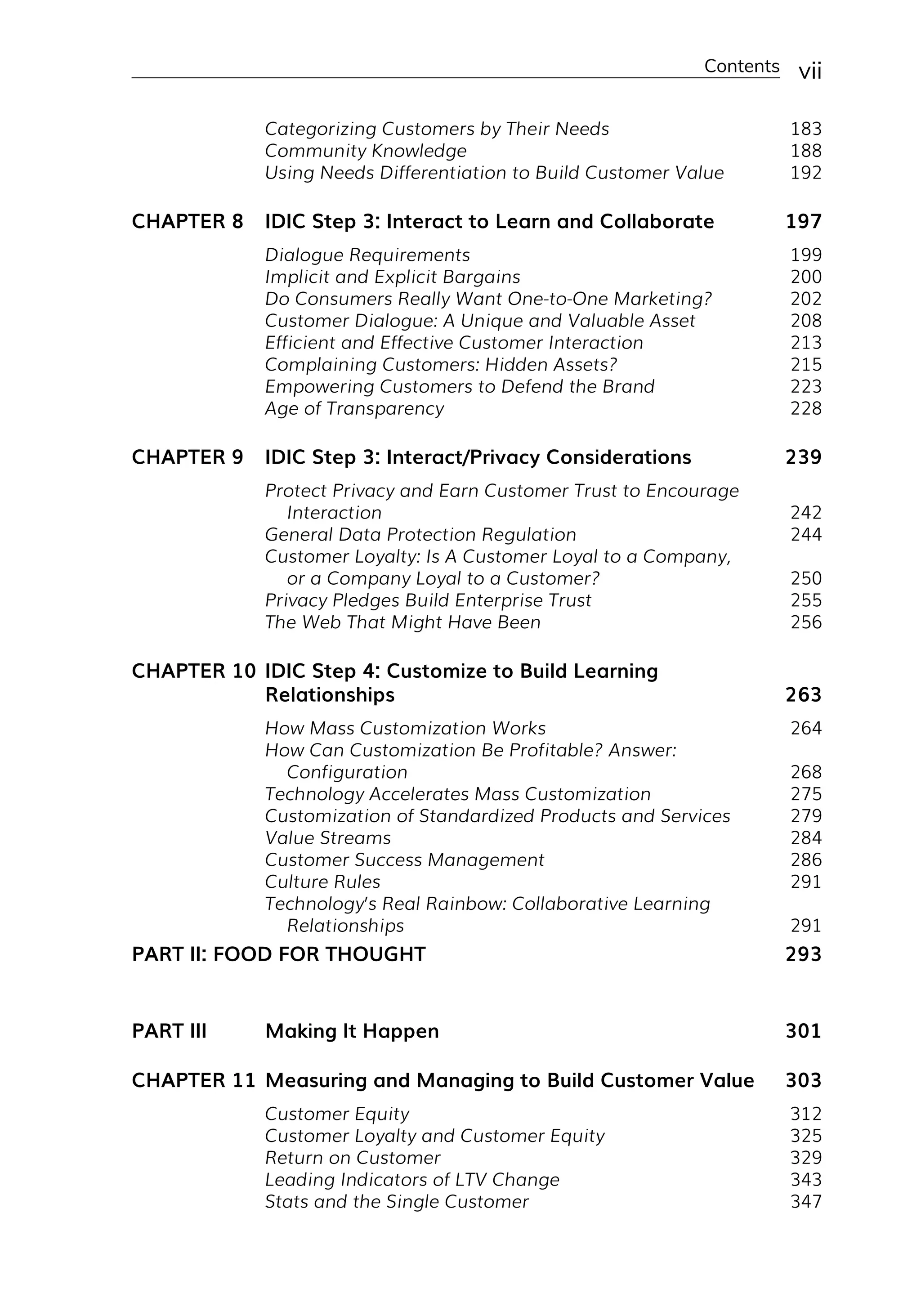
vi Contents
Customer Experience Duality 58
Customer Competence 59
Understanding Customer Experience through
Customer Journey Mapping 62
CHAPTER 4 IDIC and Trustability: Building Blocks
of Customer Relationships 69
IDIC: Four Implementation Tasks for Creating and Managing
Customer Experiences and Relationships 69
How Does Trust Characterize a Learning Relationship? 78
Do Things Right, Do the Right Thing, and Be Proactive 85
Relationships Require Information, but Information
Comes Only with Trust 91
Behind Their Customers’ Backs 94
How Trustable Companies Operate 96
Recovering Lost Trust 97
PART I: FOOD FOR THOUGHT 101
PART II Customer Experience and Relationships:
Trust Is the Foundation and IDIC the Building Blocks 105
CHAPTER 5 IDIC Step 1: Identify Individual Customers 107
Individual Information Requires Customer Recognition 108
The Real Objective of Loyalty Programs 113
What Does Identify Mean? 118
Four Ways to Integrate the Online and Contact-Center
Experience 119
Customer Data Revolution 122
Cookies and Privacy 125
CHAPTER 6 IDIC Step 2: Differentiate Customers by Value 131
Customer Value Is a Future-­
Oriented Variable 133
Customer Lifetime Value 135
Recognizing the Hidden Potential Value in Customers 141
Different Customers Have Different Values 146
Customer Value Categories 149
Customer Referral Value 152
CHAPTER 7 IDIC Step 2: Differentiate Customers
by Needs 167
Differentiating Customers by Need: Definitions
and Examples 168
Understanding Customer Behaviors and Needs 178
Why Doesn’t Every Company Already Differentiate Its
Customers by Needs? 181
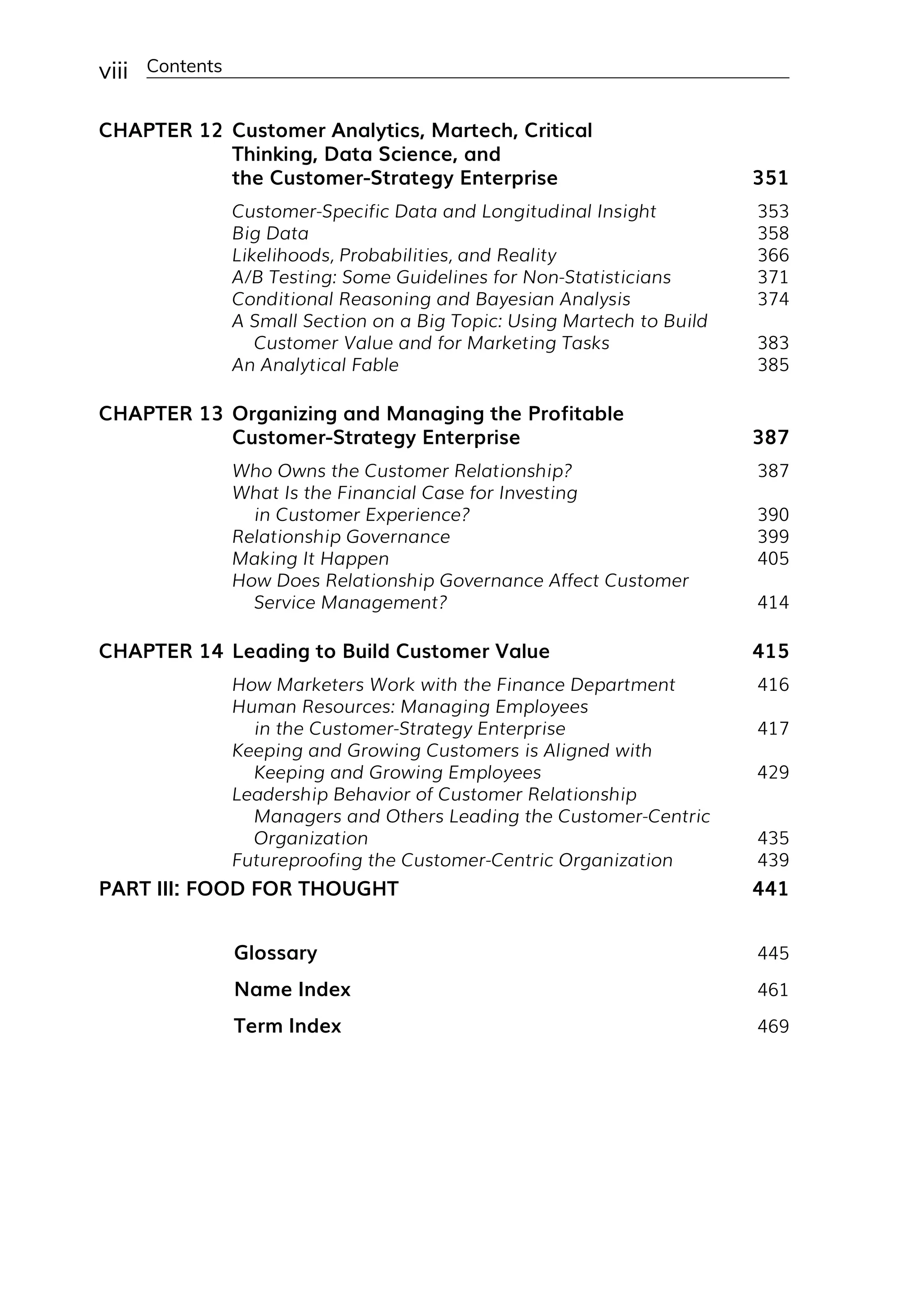
Contents vii
Categorizing Customers by Their Needs 183
Community Knowledge 188
Using Needs Differentiation to Build Customer Value 192
CHAPTER 8 IDIC Step 3: Interact to Learn and Collaborate 197
Dialogue Requirements 199
Implicit and Explicit Bargains 200
Do Consumers Really Want One-­
to-­
One Marketing? 202
Customer Dialogue: A Unique and Valuable Asset 208
Efficient and Effective Customer Interaction 213
Complaining Customers: Hidden Assets? 215
Empowering Customers to Defend the Brand 223
Age of Transparency 228
CHAPTER 9 IDIC Step 3: Interact/Privacy Considerations 239
Protect Privacy and Earn Customer Trust to Encourage
Interaction 242
General Data Protection Regulation 244
Customer Loyalty: Is A Customer Loyal to a Company,
or a Company Loyal to a Customer? 250
Privacy Pledges Build Enterprise Trust 255
The Web That Might Have Been 256
CHAPTER 10 IDIC Step 4: Customize to Build Learning
Relationships 263
How Mass Customization Works 264
How Can Customization Be Profitable? Answer:
Configuration 268
Technology Accelerates Mass Customization 275
Customization of Standardized Products and Services 279
Value Streams 284
Customer Success Management 286
Culture Rules 291
Technology’s Real Rainbow: Collaborative Learning
Relationships 291
PART II: FOOD FOR THOUGHT 293
PART III Making It Happen 301
CHAPTER 11 Measuring and Managing to Build Customer Value 303
Customer Equity 312
Customer Loyalty and Customer Equity 325
Return on Customer 329
Leading Indicators of LTV Change 343
Stats and the Single Customer 347
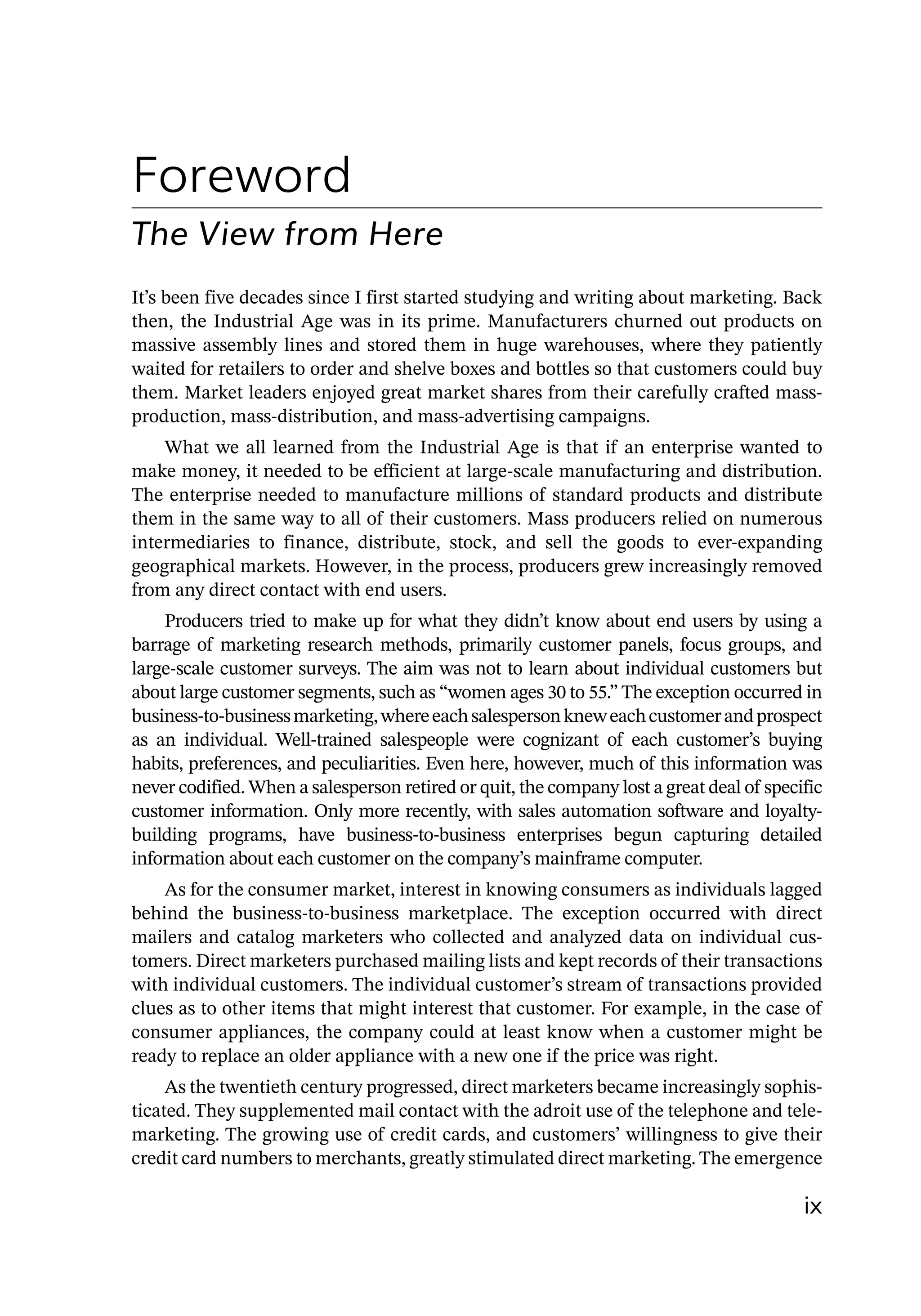
viii Contents
CHAPTER 12 Customer Analytics, Martech, Critical
Thinking, Data Science, and
the Customer-­
Strategy Enterprise 351
Customer-­
Specific Data and Longitudinal Insight 353
Big Data 358
Likelihoods, Probabilities, and Reality 366
A/B Testing: Some Guidelines for Non-Statisticians 371
Conditional Reasoning and Bayesian Analysis 374
A Small Section on a Big Topic: Using Martech to Build
Customer Value and for Marketing Tasks 383
An Analytical Fable 385
CHAPTER 13 Organizing and Managing the Profitable
Customer-­
Strategy Enterprise 387
Who Owns the Customer Relationship? 387
What Is the Financial Case for Investing
in Customer Experience? 390
Relationship Governance 399
Making It Happen 405
How Does Relationship Governance Affect Customer
Service Management? 414
CHAPTER 14 Leading to Build Customer Value 415
How Marketers Work with the Finance Department 416
Human Resources: Managing Employees
in the Customer-­
Strategy Enterprise 417
Keeping and Growing Customers is Aligned with
Keeping and Growing Employees 429
Leadership Behavior of Customer Relationship
Managers and Others Leading the Customer-­
Centric
Organization 435
Futureproofing the Customer-­
Centric Organization 439
PART III: FOOD FOR THOUGHT 441
Glossary 445
Name Index 461
Term Index 469
ix
Foreword
The View from Here
It’s been five decades since I first started studying and writing about marketing. Back
then, the Industrial Age was in its prime. Manufacturers churned out products on
massive assembly lines and stored them in huge warehouses, where they patiently
waited for retailers to order and shelve boxes and bottles so that customers could buy
them. Market leaders enjoyed great market shares from their carefully crafted mass-­
production, mass-­
distribution, and mass-­
advertising campaigns.
What we all learned from the Industrial Age is that if an enterprise wanted to
make money, it needed to be efficient at large-­
scale manufacturing and distribution.
The enterprise needed to manufacture millions of standard products and distribute
them in the same way to all of their customers. Mass producers relied on numerous
intermediaries to finance, distribute, stock, and sell the goods to ever-­
expanding
geographical markets. However, in the process, producers grew increasingly removed
from any direct contact with end users.
Producers tried to make up for what they didn’t know about end users by using a
barrage of marketing research methods, primarily customer panels, focus groups, and
large-­
scale customer surveys. The aim was not to learn about individual customers but
about large customer segments, such as “women ages 30 to 55.” The exception occurred in
business-­
to-­
businessmarketing,whereeachsalespersonkneweachcustomerandprospect
as an individual. Well-­
trained salespeople were cognizant of each customer’s buying
habits, preferences, and peculiarities. Even here, however, much of this information was
never codified. When a salesperson retired or quit, the company lost a great deal of specific
customer information. Only more recently, with sales automation software and loyalty-­
building programs, have business-­
to-­
business enterprises begun capturing detailed
information about each customer on the company’s mainframe computer.
As for the consumer market, interest in knowing consumers as individuals lagged
behind the business-­
to-­
business marketplace. The exception occurred with direct
mailers and catalog marketers who collected and analyzed data on individual cus-
tomers. Direct marketers purchased mailing lists and kept records of their transactions
with individual customers. The individual customer’s stream of transactions provided
clues as to other items that might interest that customer. For example, in the case of
consumer appliances, the company could at least know when a customer might be
ready to replace an older appliance with a new one if the price was right.
As the twentieth century progressed, direct marketers became increasingly sophis-
ticated. They supplemented mail contact with the adroit use of the telephone and tele-
marketing. The growing use of credit cards, and customers’ willingness to give their
credit card numbers to merchants, greatly stimulated direct marketing. The emergence
x Foreword
of fax machines further facilitated the exchange of information and the placing of
orders. The Internet and email facilitated direct marketing. Customers could view
products visually and order them easily over the phone or online, receive confirma-
tion, and know when the goods would arrive.
As the 21st century drove interactivity between customers and companies, and
among each other, even companies that don’t really understand social networking
realize they have to get on board. If 33 million people are in a room, you have to visit
that room.1
But whether a company was ready for customerrelationshipmanagement depended
on more than conducting numerous transactions with individual customers.
Companies needed to build comprehensive customer databases. Companies had been
maintaining product databases, sales force databases, and dealer databases. Now they
needed to build, maintain, mine, and manage a customer database that could be used
by company personnel in sales, marketing, credit, accounting, and other company
functions.
As customer database marketing grew, several different names came to describe it,
including individualized marketing, customer intimacy, technology-­
enabled marketing,
dialogue marketing, interactive marketing, permission marketing, and one-­
to-­
one
marketing.
Modern technology makes it possible for enterprises to learn more about individual
customers, remember those needs, and shape the company’s offerings, services, mes-
sages, and interactions to each valued customer. The new technologies make mass
customization (otherwise an oxymoron) possible.
At the same time, technology is only a partial factor in helping companies do
­
genuine one-­
to-­
one marketing. The following quote about customer relationship
management (CRM) makes this point vividly:
CRM is not a software package. It’s not a database. It’s not a call center or a
Web site. It’s not a loyalty program, a customer service program, a customer
acquisition program, or a win-­
back program. CRM is an entire philosophy.
—­
Steve Silver
Whereas in the Industrial Age, companies focused on winning market share and
new customers, more of today’s companies are focusing on share of customer, namely,
increasing their business with each existing customer. These companies are focusing
on customer retention, customer loyalty, and customer satisfaction as the important
marketing tasks, and customer experience management and increasing customer
value as key management objectives.
1
Juliette Powell, 33 Million People in the Room (Upper Saddle River, NJ: Financial Times Press,
2009), pp. 8–9.
Foreword xi
Various kindred customer-­
focused efforts are more than just an outgrowth of
direct marketing and the advent of new technology. As the Interactive Age progresses,
mass marketing must give way to new principles for targeting, attracting, winning,
serving, and satisfying markets. As advertising costs have risen and mass media has
lost some effectiveness, mass marketing is now more costly and more wasteful.
Companies are better prepared to identify meaningful segments and niches and
address the individual customers within the targeted groups. They are becoming
aware, however, that many customers are uncomfortable about their loss of privacy
and the increase in solicitations by mail, phone, and email. Ultimately, companies will
have to move from an “invasive” approach to prospects and customers to a “permis-
sions” approach. On the flip side, customers—­
now in contact with millions of other
customers—­
have never been more informed or empowered.
Despite being introduced in enterprises large and small over two decades ago, the
full potential of CRM is only beginning to be realized. Of course, every company must
offer great products and services. But now, rather than pursue all types of customers at
great expense only to lose many of them, the objective is to focus only on those
particular customers with current and long-­
term potential in order to preserve and
increase their value to the company.
In this fourth edition of their widely used textbook, Peppers and Rogers offer a
careful context as well as modern thinking on how to grow the value of a company by
growing the value of the customer base, how to increase profits by using modern tech-
nology and behaving ethically, and how to look ahead to what will be coming next.
Philip Kotler
S. C. Johnson Distinguished Professor of International Marketing,
Kellogg School of Management, Northwestern University (Emeritus)
Philip Kotler is widely known as the father of modern marketing. His textbook
Marketing Management, coauthored with Kevin Keller, has become the foundational text
for marketing courses around the globe. First published in 1976 by Prentice Hall, it is now
in its 16th edition. In addition to his many books and university honors, Dr. Kotler has
established the annual international World Marketing Summit, now in electronic format
to reach audiences worldwide.
xiii
Preface
The One to One Future: Building Relationships One Customer at a Time was our very
first book, and we sent it to the publisher in February 1993 (“paper manuscript only,
please; no electronic files allowed”). During the three previous years it took us to write
the book, we often referred to it as a work of “business science fiction,” in which we
were trying to imagine how businesses would compete once interactive technologies
became ubiquitously available. And while we thought the future we were describing
was technologically inevitable, we also judged that it was still 10 or 20 years away and
would most likely arrive when fiber-­
optic cables were finally connected to individual
homes and offices.
On p. 5 of our book, we said that in the 1:1 future:
products will be increasingly tailored to individual tastes, electronic media
will be inexpensively addressed to individual consumers, and many prod-
ucts ordered over the phone will be delivered to the home in eight hours or
less. In the 1:1 future businesses will focus less on short‑term profits derived
from quarterly or annual transaction volumes, and more on the kind of
profits that can be realized from long‑term customer retention and life-
time values.
We went on to describe some of the social implications of truly ubiquitous, always-
­
on interactivity, suggesting that our vision of the 1:1 future:
holds immense implications for individual privacy, social cohesiveness,
and the alienation and fractionalization that could come from the break-
down of mass media. It will change forever how we seek our information,
education, and entertainment, and how we pursue our happiness. In addi-
tion to the “haves” and “have nots,” new class distinctions will be created
between the “theres” and “there nots.” Some people will have jobs that
require them to be there—­
somewhere—­
while others will be able to work
mostly from their homes, without having to be anywhere.
However, while we thought this future was still a decade or two away, the year
after our book was published Netscape released its Navigator web browser, the first
commercial product that truly allowed businesses to participate in a completely new
interactive medium, the World Wide Web. And commercial interest in the World Wide
Web grew explosively.There were just 130 websites at the end of 1993, most operated by
xiv Preface
academic or government entities, but by 1997 there were more than a million, and by
2001 there were nearly 30 million, almost all of which belonged to businesses.1
These businesses all needed advice, help, answers, and suggestions. They wanted
to know what the best policies would be for succeeding in a world where their cus-
tomers were now just a click away from the competition. Our book took off as web-
masters working for companies around the world sought out new strategies and best
practices for interacting with their customers one at a time, now that they could. The
management guru Tom Peters called The One to One Future the “book of the year” in
1993, and in 1994 BusinessWeek called it the “bible of the new marketing.” In 1995 Inc.
magazine put us on its cover, and George Gendron, the magazine’s chief editor, said
“Peters was wrong. This is not the book of the year. It’s not even the book of the decade.
It’s one of the two or three most important business books ever written.”2
So we kept thinking about all this, and we wrote more books, and we began con-
ducting workshops and giving presentations to businesses, associations, and confer-
ences around the world. We formed a consulting company, Peppers  Rogers Group,
all the better to help companies come to grips with the powers and limitations of this
new type of marketing. Over the years we have consulted for, spoken with, and advised
literally hundreds of companies in more than 60 countries around the world, from
Algeria, Argentina, and Bulgaria, to Turkey, the United Kingdom, and Vietnam. We
know what works and what doesn’t, and we also know what works in some cultures
but not so much in others. Moreover, when someone—­
anyone—­
comes up with a
promising new idea in this discipline, we rapidly hear about it. And then we speak
about this new idea, and we write about it.
We created the IDIC framework (identify-­
differentiate-­
interact-­
customize) in the
mid-­
1990s as a part of our consulting methodology. We tested it and refined it during
our consulting work for many different companies before it first appeared in print in
our 1999 book The One to One Fieldbook: The Complete Toolkit for Implementing a
1to1 Marketing Program, which we wrote with the leader of Peppers  Rogers Group’s
consulting practice, Bob Dorf. The Fieldbook included checklists, questionnaires, exer-
cises, and self-­
help tools to guide businesses looking to gain more of the advantages
offered by the internet, mobile phones, customer databases, and mass-­
customization
technologies. By 2004 this IDIC framework had clearly shown its merits, so we used it
as an organizing principle for the first edition of this textbook, and it remains a highly
useful organizing principle today.
As we write these words, companies all over the world are hard at work on their
digital transformations, customer initiatives, and customer experience programs in an
effort that was largely underway, but has been greatly accelerated by the COVID-­
19
crisis, and is likely to remain highly active even after the virus is finally gone. McKinsey
estimated that e-­
commerce penetration levels alone increased so dramatically that in
1
Internet Live Stats, “Total Number of Websites,” https://www.internetlivestats.com/total-­
number-­
of-­
websites/, accessed September 23, 2021.
2
Amazon.com book description, The One to One Future, available at https://www.amazon.com/One-­
Future-­
Don-­
Peppers/dp/0385485662, accessed September 23, 2021.
Preface xv
just the first three months of the COVID-­
19 crisis (2Q, 2020), the United States fully
realized ten years’ worth of e-­
commerce growth,3
virtually at all once. Online penetra-
tion in the U.S. consumer economy has increased by 35%, on average, from the onset
of COVID-­
19 through July 2021,4
and figures from around the world show similar
jumps. Whether you are contemplating a career in marketing, or your own company is
hustling to get its digital act together, or you’re simply trying to survive in a digital
world where every quarter seems to produce a newly disruptive technology, we hope
that the lessons in this revised and updated edition will be invaluable.
We have dramatically increased the emphasis on the financial issues that often con-
found marketers as they try to justify the business value of a better customer experience
that may cost money in the short term. We’ve also radically reshaped the sections on
customer analytics, to empower marketers with the knowledge they need to have intel-
ligent conversations with the quantitative analysts, and to make objective, data-­
driven
decisions without having to write an equation or calculate a standard deviation.
3
Amit Mathradas, “Covid-­
19 Accelerated E-­
Commerce Adoption: What Does It Mean for the
Future?” Forbes, December 29, 2020, at https://www.Forbes.Com/Sites/Forbesbusinesscouncil/
2021/12/29/Covid-­
19-­
Accelerated-­
E-­
Commerce-­
Adoption-­
What-­
Does-­
It-­
Mean-­
For-­
The-­
Future/?Sh=2b6c021a449d, accessed September 23, 2021.
4
“US Consumer Sentiment and Behaviors during the Coronavirus Crisis,” McKinsey  Company,
August 19, 2021, at https://www.mckinsey.com/business-­
functions/marketing-­
and-­
sales/our-­
insights/
survey-­
us-­
consumer-­
sentiment-­
during-­
the-­
coronavirus-­
crisis, accessed September 23, 2021.
How to Use This Book
Each chapter begins with an overview and includes these elements:
• Glossary terms are printed in boldface the first time they appear in a chapter,
and their definitions are located in the full glossary at the end of the book,
and all of the glossary terms are included in the index for a broader reference
of usage in the book.
• Sidebars provide supplemental discussions and real-­
world examples of
chapter concepts and ideas.
• Food for Thought discussion questions for each chapter appear at the end of
Part 1, Part II, and Part III of the book.
We anticipate that this book will be used in one of two ways: Some readers will
start at the beginning and read it through to the end. Others will keep it on hand and
use it as a reference book. For both groups of readers, we have tried to make sure the
index is useful for searching by names of people and companies as well as terms,
acronyms, and concepts.
If you have suggestions about how readers can use this book, please share those
at peppersrogers1@gmail.com.
xvi Preface
One more thing: In The One to One Future we did make one big prediction that has
not come true, at least not yet anyway. Back then, we made this prediction in Chapter 9,
which we titled “Make Money Protecting Privacy, Not Threatening It.” If anything,
recent experience has shown that there are a number of giant, even monopolistic busi-
nesses today that show no intention whatsoever to protect their users’ privacy. Indeed,
some businesses have become very profitable, even though they were built on the
premise that the private, personal data of their users is a commodity to be bought and
sold to the highest bidder (quite literally). And we say users in this case because the
consumers who use platforms like Facebook, Google, or even LinkedIn are not actual
customers at all. Many such social media platforms’ customers are the advertisers and
other businesses that pay to gain access to users’ personal data—­
data about the prod-
ucts or services a user has looked at, or even about the messages a user has exchanged
with friends. As the saying goes, if you think an online product is free, that means
you’re not really the customer—­
you’re the product.
So in this fourth edition we have also added extensively to our discussion of pri-
vacy protection—­
what it means, how it can happen, how it might occur in the future,
what regulations are beginning to enforce it, and so forth. But don’t get us wrong. We
still think that the ultimate future will be one in which the most successful companies
will be trustable—­
proactively trustworthy. They will want to act in their customers’
own interest, because in the long run this will create the most value from each cus-
tomer. We believe that the moral arc of progress continues to point upward—­
that, over
time, more and more enterprises will find it in their own best interest, not just ethically
but financially, to embrace a more socially beneficial purpose and to act in their cus-
tomers’ interest. Moreover, we predict that as more businesses embrace trustability,
consumers will show less and less tolerance for privacy-­
abusing companies, even those
that offer their services absolutely free to their users.
In the future, we believe, business executives will strive to treat every customer the
way they’d like to be treated themselves, if they were the customer. And we very much
hope that you will be one of these future business executives. Enjoy our textbook and
let us know what you think at peppersrogers1@gmail.com.
Don Peppers and Martha Rogers Ph.D.
January 2022
xvii
Acknowledgments
We started the research and planning for the first edition of this book in 2001. Our goal
was to provide a handbook/textbook for students of the customer-­
centric movement to
focus companies on customers and to build the value of an enterprise by building the
value of the customer base. We have made many friends along the way and have had
some interesting debates. We can only begin to scratch the surface in naming those
who have touched the current revision of this book and helped to shape it into a tool
we hope our readers will find useful.
We are indebted to the chorus of contributors and writers whose voices have
helped to make this book what it is. As big as this book is, it is not big enough to
include formally all the great thinking and contributions of the many academicians
and practitioners who wrestle with deeper understanding of how to make companies
more successful by serving customers better. We thank all of you, too, as well as all
those at dozens of universities who have used earlier editions of the book to teach
courses, and all those who have used the book as a reference work to try to make the
world a better marketplace. Please keep us posted on your work!
This book has been greatly strengthened by the critiques from some of the most
knowledgeable minds in this field, who have taken the time to review this book as well
as earlier editions and to share their insights and suggestions with us. This is an enor-
mous undertaking and a huge professional favor, and we owe great thanks to Becky
Carroll, Jeff Gilleland, Mary Jo Bitner, James Ward, Ray Burke, Anthony Davidson,
Susan Geib, Rashi Glazer, Jim Karrh, Neil Lichtman, Charlotte Mason, Janis McFaul,
Ralph Oliva, Phil Pfeifer, Marian Moore, David Reibstein, and Jag Sheth. Thanks to
John Deighton, Jon Anton, Devavrat Purohit, and Preyas Desai for additional insights,
and we also appreciate the support and input from Mary Gros and Corinna Gilbert.
And thanks to Maureen Morrin and to Eric Greenberg, and to John Westman,
­
co-founder of Novellus, Inc. and adjunct professor at the Harvard Extension School
and Boston College Carroll School of Management.
Don’s class of “Markets of One” at Menlo College in Spring 2021 contributed to our
insights on Facebook and trust. Thanks to Dr. Julie Edell Britton, who team-­
taught the
“Managing Customer Value” course at Duke with Martha for many years, and the smart
students there, and to Rick Staelin, who has always supported the work toward this text-
book and the development of this field. Additional thanks to all of the marketing faculty
members at Duke, especially Christine Moorman, Wagner Kamakura, Carl Mela, and
Dan Ariely, and all those who have used and promoted the book and its topics.
Many thanks to David Allison, CEO of Valuegraphics; to Mike Betzer, CEO of
Hypergiant and formerly an executive at Khoros and Lithium; to Guy Nirpaz, founder
xviii Acknowledgments
and CEO of Totango; to Zeynep Manco, formerly a consultant in the Istanbul office of
Peppers  Rogers Group; to Roger McNamee, venture fund executive, early investor in
Peppers  Rogers Group, and author of the book Zucked, for his insightful comments
on the threat that Facebook poses both to individual privacy and to the future of
business competition itself; to Karl Wirth, founder of Evergage (now a part of
Salesforce) and author of One-­
to-­
One Personalization in the Age of Machine Learning;
to Steve White, president and special counsel to CEO at Comcast; to Brooks Bell,
founder of Brooks Bell, a digital marketing agency; and to Karen Ganschow, head of
data sciences at Aware Super in Australia and formerly General Manager Consumer
Marketing and Customer Strategy at National Australia Bank.
Much of this work has been based on the experiences and learning we have
gleaned from our clients and the audiences we have been privileged to encounter in
our work with Peppers  Rogers Group. Dozens and dozens of the talented folks who
have been PRGers over the past years have contributed to our thinking—­
many more
than the ones whose citations appear within this book, and more than we are able to
list here. Our clients, our consulting partners and consultants, and our analysts are the
ones who demonstrate every day that building a customer-­
centric company is difficult
but achievable and very worthwhile financially. Special thanks go to Hamit Hamutcu,
Orkun Oguz, Caglar Gogus, Mounir Ariss, Ozan Bayulgen, Amine Jabali, and Onder
Oguzhan for their thinking and support. We also thank Tulay Idil, Bengu Gun, and
Aysegul Kuyumcu for research. And to Thomas Schmalzl, Annette Webb, Mila
D’Antonio, Elizabeth Glagowski, and Mike Dandrea of the 1to1 Media team, and espe-
cially Marji Chimes, our gratitude for a million things and for putting up with us gen-
erally. We also appreciate the work Tom Lacki has done for this book and our thinking,
as well as the work of Valerie Peck, Alan Pennington, and Deanna Lawrence. Special
additional thanks for ideas in the original edition that have survived to this version to
Elizabeth Stewart, Tom Shimko, Tom Niehaus, Abby Wheeler, Lisa Hayford-­
Goodmaster, Lisa Regelman, and many other Peppers  Rogers Group alumni as well
as professionals who are the winners of the 1to1 Impact Awards and PRG/1to1
Customer Champions, who are best in class at customer value building.
Our executive editor at John Wiley  Sons, Sheck Cho, has been an enthusiastic
supporter of and guide for the project since day one. As always, thanks to our literary
agent, Rafe Sagalyn, for his insight and patience.
We thank the many professors and instructors who are teaching the first customer
strategy or CRM course at their schools and who have shared their course syllabi and
suggestions. By so doing, they have helped us shape what we hope will be a useful
book for them, their students, and all our readers who need a ready reference as we all
continue the journey toward building stronger, more profitable, and more successful
organizations by focusing on growing the value of every customer.
The real secret sauce to finishing the many details has been Amanda Rooker—­
a
truly resourceful researcher and relentlessly encouraging and gifted content editor,
who has patiently and capably assisted in winding us through the morass of secondary
research and minutiae generated by a project of this scope. Cheerfully and brilliantly
finding, handling, resolving, and tracking inconsistencies, errata, and potential prat-
falls is just part of her genius. If there are any errors left, they are our fault, not hers.
As ever, we remain grateful to our patient and supportive spouses, Pamela
Devenney and Dick Cavett.
xix
About the Authors
Don Peppers and Martha Rogers, Ph.D., are often credited with having created,
or at least kickstarted, the whole customer-­
centric approach to business which
became known as customer relationship management (CRM). In their first book
together, The One to One Future: Building Relationships One Customer at a Time, they
called the concept “one-to-one marketing.” Since then, they have written 10 more
books further exploring, elucidating, and expanding the subject (see list at the end of
this section).
Over time, the discipline has evolved, new terminologies have been created, and
many of the practices Peppers and Rogers included as elements of one-to-one marketing
would today be considered to be part of the customer-­
experience-­
management disci-
pline. In the B2B space they would be considered part of the account-­
based marketing
(ABM) or customer success management disciplines.
In 1993 they founded the Peppers  Rogers Group, which became a leading
customer-­
centric management consulting firm with offices and clients on six
­
continents. In 2013 they were inducted into the Direct Marketing Association Hall of
Fame, and in 2016 they were jointly ranked by Satmetrix (now a unit of NICE) as
the world’s number-­
one most influential authorities on customer experience
management.
Much sought after as public speakers, Peppers and Rogers have delivered talks or
workshops in about 60 countries around the world. Whenever they speak, they make
it a point to tailor and adapt their messaging for companies in virtually every business
category imaginable. Today, they have once again joined forces to form CX Speakers,
a business exclusively designed to deliver keynote presentations, instruction, workshops,
and thought-­
leadership consulting focused exclusively on the customer experience
and all its related topics, which range from digital technologies, disruption, and inno-
vation to customer metrics, social selling, customer success, customer advocacy, trust,
and corporate culture.
Prior to his career as an authority on customer-­
centric competition, Don Peppers
served as the CEO of a top-­
20 direct marketing agency, and his book Life’s a Pitch: Then
You Buy (1995) chronicles his exploits as a celebrated new-­
business rainmaker in the
advertising industry. He holds a B.S. in astronautical engineering from the US Air
Force Academy and a master’s in public affairs from Princeton University’s School of
Public and International Affairs. He also has a popular voice in business media and is
LinkedIn’s most widely followed authority on customer experience, with more than
300,000 followers.
xx About the Authors
Martha Rogers is the founder of Trustability Metrix, a firm designed to help
­
companies understand how to measure and improve their levels of trust by customers,
employees, and business partners. After a career in advertising copywriting and
management, Rogers has taught at several universities, most recently as an adjunct
professor at the Fuqua School of Business at Duke University, where she codirected
the Teradata Center for Customer Strategy. Rogers has been widely published in
academic and trade journals, including Harvard Business Review, Journal of Advertising
Research, Journal of Public Policy and Marketing, and Journal of Applied Psychology.
She has been named International Sales and Marketing Executives’ Educator of the
Year. Rogers earned her Ph.D. at the University of Tennessee as a Bickel Fellow.
Books by Don Peppers and Martha Rogers, Ph.D:
• The One to One Future: Building Relationships One Customer at a Time
(Doubleday, 1993).
• Tom Peters: “Book of the Year” (1993)
• BusinessWeek: “Bible of the new marketing” (1994)
• Inc. Magazine: “One of the two or three most important business books
ever written” (1995)
• Enterprise One to One: Tools for Competing in the Interactive Age (Doubleday,
1997).
• Wall Street Journal 5-­
Star Rating
• The One to One Fieldbook: The Complete Toolkit for Implementing a 1 to 1
Marketing Program (Doubleday, 1999), coauthored with Bob Dorf.
• The One to One Manager: Real-­
World Lessons in Customer Relationship
Management (Doubleday, 1999).
• One to One B2B: Customer Development Strategies for the Business-­
to-­
Business
World (Doubleday, 2001).
• New York Times Business Best Seller
• Managing Customer Relationships: A Strategic Framework (Wiley, 2011).
• Return on Customer: Creating Maximum Value from Your Scarcest Resource
(Doubleday, 2005).
• One of Fast Company’s “15 Most Important Reads” of 2005
• One of Fast Company’s “25 Best Business Books” in 2007
• Rules to Break  Laws to Follow: How Your Business Can Beat the Crisis of Short-­
Termism (Wiley, 2008).
• Inaugural title in Microsoft’s “Executive Leadership Series”
• Managing Customer Relationships: A Strategic Framework, Second Edition
(Wiley, 2011).
• Extreme Trust: Honesty as a Competitive Advantage (Penguin, 2012).
About the Authors xxi
• Managing Customer Experience and Relationships: A Strategic Framework, Third
Edition (Wiley, 2016).
• Extreme Trust: Turning Proactive Honesty and Flawless Execution into Long-­
Term
Profits (revised and updated Penguin Paperback, 2016).
Books by Don Peppers:
• Life’s a Pitch: Then You Buy (Doubleday, 1995).
• Customer Experience: What, How, and Why Now (BookBaby, 2016).
1
P A R T I
Technology’s Rainbow
3
No company can succeed without customers. If you don’t have
customers, you don’t have a business. You have a hobby.
—­
Don Peppers and Martha Rogers
Evolution of Marketing and
the Revolution of Customer
Strategy
C H A P T E R 1
There can be no doubt that technological progress has irreversibly transformed the
nature of business competition, giving customers much greater power, making
them ever more knowledgeable, connecting them seamlessly to other customers,
and raising their expectations and demands significantly with respect to the prod-
ucts and services they buy.
New technologies also allow an enterprise to treat different customers dif-
ferently, in contrast to the way business was done for virtually the entire twentieth
century, when an enterprise would treat all its customers in basically the same way.
Except for some high-­
end products and business-­
to-­
business (B2B) services, no
enterprise could afford the time and expense required to pay attention to individual
customers, one customer at a time. Instead, enterprises focused on the most com-
mon needs of their “average” customer, and then publicized their product benefits
and attributes in the same way to everyone, in hopes of persuading some of these
average customers to buy. But because of technology, enterprises can now do busi-
ness in an entirely different way. Using computer databases, an enterprise can easily
identify and remember its individual customers, one customer at a time, even if it
has millions of them, paying close attention to the experience it provides to each
customer and to its ongoing relationship with them. Using the internet, along with
technologies such as Wi-­
Fi and smartphones, an enterprise can now interact
directly with each of its individual customers and prospective customers, respond-
ing to inquiries, posing questions, and making different offers or suggestions to dif-
ferent customers.
4 Chapter 1 Evolution of Marketing
This relatively new task that enterprises are now taking on, treating different cus-
tomers differently, goes by a number of different labels and buzzwords. Some refer to
it as “customer centricity” or “customer engagement.” Others may refer to it as “cus-
tomer management” or “customer focus.” But no matter what term is used, the
central premise is that an enterprise should seek to engage its customers, one at a time,
in long-­
lasting, mutually valuable relationships, based on trust.
Moreover, to do this successfully, an enterprise must be able to see itself through a
customer’s own eyes. It must learn how to experience what each different customer
experiences, and then take steps to ensure that this experience becomes better, easier,
more convenient, and even more enjoyable for the customer, over the lifetime of that
customer’s relationship with the business. And businesses do this because their man-
agers understand, intuitively, that when a customer has a better experience, the
business will be creating more value, which means that the relationship with this cus-
tomer now has a higher likelihood of increased profitability.
The dynamics of the customer-­
enterprise relationship have changed dramatically
over time. Customers have always been at the heart of an enterprise’s long-­
term growth
strategies, marketing and sales efforts, product development, labor and resource allo-
cation, and overall profitability directives. Historically, enterprises have encouraged
the active participation of a sampling of customers in the research and development of
their products and services.
But until recently, enterprises have been structured and managed around the
products and services they create and sell. Driven by assembly-­
line technology, mass
media, and mass distribution, which appeared at the beginning of the twentieth
century, the Industrial Age was dominated by businesses that sought to mass-­
produce
products and to gain a competitive advantage by manufacturing a product that was
perceived by most customers as better than its closest competitor. Product innovation,
therefore, was the important key to business success. To increase its overall market
share, the twentieth-­
century enterprise would use mass marketing and mass adver-
tising to reach the greatest number of potential customers.
As a result, most twentieth-­
century products and services eventually became highly
commoditized. Branding emerged to offset this
And now that enterprises can do these things, competition requires them to do
so. The problem for today’s enterprise is that the old marketing strategies and tac-
tics, having been designed to attract as many average customers as possible for
whatever product or service an enterprise was selling, don’t help much when it
comes to planning the best way to treat different customers differently. Instead, an
enterprise needs a customer strategy, designed to meet different individual cus-
tomers’ different individual needs, and to maximize the amount of business an
enterprise is able to do with each different customer.
The goal of this book is not just to acquaint the reader with the techniques of
managing customer experiences and relationships. The more ambitious goal of
this book is to help the reader understand the essence of customer strategy and how
to apply it to the task of managing a successful enterprise in the 21st century.
(continued)
Evolution of Marketing and the Revolution  5
competitors; in fact, branding from its
beginning was, in a way, an expensive sub-
stitute for relationships companies could
not have with their newly blossomed
masses of customers. Facilitated by lots
and lots of mass-­
media advertising, brands
have helped add value through familiarity,
image, and trust. Historically, brands have
played a critical role in helping customers
distinguish what they deem to be the best
productsandservices.Aprimaryenterprise
goal has been to improve brand awareness
of products and services and to increase
brand preference and brand loyalty among consumers. For many consumers, a brand
name has traditionally testified to the trustworthiness or quality of a product or service.
Today, though, more and more, customers say they value brands, but their opinions are
based on their “relationship with the brand.” As a result, brand reputation is becoming
one and the same with customers’ experience with the brand, product, or company
(including relationships).1
Indeed, consumers are often content as long as they can buy
one brand of a consumer packaged good that they know and respect.
For many years, enterprises depended on gaining the competitive advantage from
the best brands. Brands have been untouchable, immutable, and inflexible parts of
the twentieth-­
century mass-­
marketing era. But in the interactive era of the 21st
century, firms are instead strategizing how to gain sustainable competitive advantage
from the information they gather about customers. As a result, enterprises are creating
a two-­
way brand, one that thrives on customer information and interaction. The two-­
way brand, or branded relationship, transforms itself based on the ongoing dialogue
between the enterprise and the customer. The branded relationship is “aware” of the
customer (giving new meaning to the term brand awareness) and constantly changes
to suit the needs of that particular
individual. In current discussions, the
focus is on ways to redefine the brand rep-
utation as more customer oriented, using
phrases such as “brand engagement with
customer,” “brand relationship with cus-
tomer,” and the customer’s “brand
1
Vikas Kumar, “Building Customer-­
Brand Relationships through Customer Brand Engagement,”
Journal of Promotion Management 26, no. 7 (July 2020), p. 986–1012, doi:http://dx.doi.org/10.1080/
10496491.2020.1746466, accessed June 7, 2021. Also, Christof Binder and Dominique M. Hanssens
report research on brand valuation of a company at the time of merger or acquisition. They discov-
ered that over a 10-­
year period from 2003 to 2013, “brand valuations declined by nearly half (from
18% to 10% [of total company value]) while customer relationship values doubled (climbing from 9%
to 18%). Acquirers have decisively moved from investing into businesses with strong brands to busi-
nesses with strong customer relationships.” See “Why Strong Customer Relationships Trump
Powerful Brands,” Harvard Business Review, April 14, 2015, available at https://hbr.org/2015/04/
why-­
strong-­
customer-­
relationships-­
trump-­
powerful-­
brands, accessed August 17, 2021.
The two-­
way brand, or
branded relationship,
transforms itself based on
the ongoing dialogue
between the enterprise and
the customer. The branded
relationship is “aware” of the
customer (giving new
meaning to the term brand
awareness).
Companies are realizing
that what customers say
about them is more
important than what the
companies say about
themselves.
6 Chapter 1 Evolution of Marketing
experience.” Add to this the transparency
for brands and rampant ratings for prod-
ucts initiated by social media, and it’s
clear why companies are realizing that
what customers say about them is more
important than what the companies say
about themselves.
ROOTS OF CUSTOMER
RELATIONSHIPS AND
EXPERIENCE
Once you strip away all the activities that keep everybody busy every day, the goal of
every enterprise is simply to get, keep, and grow customers (whether those are business-­
to-­
consumer [B2C] customers or enterprise business customers [B2B]). This is true for
nonprofits (where the “customers” may be donors or volunteers) as well as for-­
profits,
for small businesses as well as large, for public as well as private enterprises. It is true
for hospitals, governments, universities, and other institutions as well. What does it
mean for an enterprise to focus on its customers as the key to competitive advantage?
Obviously, it does not mean giving up whatever product edge or operational effi-
ciencies might have provided an advantage in the past. It does mean using new strat-
egies, nearly always requiring new technologies, to focus on growing the value of the
company by deliberately and strategically growing the value of the customer base.
To some executives, customer relationship management (CRM) is a tech-
nology or software solution that helps track data and information about customers to
enable better customer service. Others think of CRM, or one-­
to-­
one, as an elaborate
marketing or customer service discipline. We even recently heard CRM described as
“personalized email.” But it’s far more than that.
Managing customer relationships is what companies do to optimize the value of
each customer, because they understand the customer’s perspective and what it is—­
and should be—­
like to be a customer. This book is about much more than setting up a
business website or redirecting some of the mass-­
media budget into the call-­
center
database or cloud analytics or social networking. It’s about increasing the value of
the company through specific customer strategies (see Exhibit 1.1).
EXHIBIT 1.1 Increasing the Value of the Customer Base
Get Acquire more customers.
Keep Retain profitable customers longer.
Win back profitable customers.
Eliminate unprofitable customers.
Grow Upsell additional products in a solution.
Cross-­
sell other products and services.
Referrals and word-­
of-­
mouth benefits.
Reduce the cost to serve customers.
What does it mean for an
enterprise to focus on
its customers as the key to
competitive advantage? It
means creating new
shareholder value by
deliberately preserving and
growing the value of the
customer base.
Roots of Customer Relationships and Experience 7
Companies determined to build suc-
cessful and profitable customer relation-
ships understand that the process of
becoming an enterprise focused on
building its value by building customer
value doesn’t begin with installing tech-
nology, but instead begins with:
• A strategy or an ongoing process
that helps shift the enterprise from
a focus on traditional selling or
manufacturing to a customer focus
while increasing revenues and
profits in both the current period
and the long term.
• The leadership and commitment
necessary to cascade throughout
the organization, and the thinking
and decision-­
making capability
that puts customer value and rela-
tionships first as the direct path to
increasing shareholder value.
The reality is that becoming a customer-­
strategy enterprise is about using
information to gain a competitive advantage and deliver growth and profit to the firm
by increasing the value of the customer base. In its most generalized form, CRM can be
thought of as a set of business practices designed, simply, to put an enterprise into
closer and closer touch with its customers, in order to learn more about each one and
to deliver greater and greater value to each one, with the overall goal of making each
one more valuable to the firm to increase the value of the enterprise. It is an enterprise-­
wide approach to understanding and influencing customer behavior through mean-
ingful analysis and communications to improve customer acquisition, customer
retention, and customer profitability.2
Customer centricity is distinguishable from
Customer strategy means
increasingthevalueofthe
customer base. CRM can be
thought of as a set of
business practices designed,
simply, to put an enterprise
into closer and closer touch
with its customers, in order
to learn more about each
one and to deliver greater
and greater value to each
one, with the overall goal of
making each one more
valuable to the firm to
increase the value of the
enterprise.
2
Priyanka Meena and Praveen Sahu, “Customer Relationship Management Research from 2000 to
2020: An Academic Literature Review and Classification,” Vision 25, no. 2 (June 2021): 136–58,
https://doi.org/10.1177/0972262920984550; Ju-­
Yeon Lee, Shrihari Sridhar, Conor Henderson, and
Robert W. Palmatier, “Effect of Customer-­
Centric Structure on Firm Performance,” Marketing
Science Institute Working Paper Series, Report No. 12–111, available at https://www.msi.org/
wp-­
content/uploads/2020/06/MSI_Report_12-­
1111.pdf, accessed August 17, 2021; Sunil Gupta and
Donald R. Lehmann, Managing Customers as Investments (Philadelphia: Wharton School Publishing,
2005); Robert S. Kaplan, “A Balanced Scorecard Approach to Measure Customer Profitability,”
Harvard Business School’s Working Knowledge Web site, August 8, 2005, available at: https://hbswk
.hbs.edu/item/a-­
balanced-­
scorecard-­
approach-­
to-­
measure-­
customer-­
profitability, accessed August
17, 2021; Don Peppers and Martha Rogers, The One to One Future (New York: Doubleday Books,
1993); and Fred Reichheld and Rob Markey, The Ultimate Question 2.0: How Net Promoter Companies
Thrive in a Customer Driven World (Cambridge, MA: Harvard Business Review Press, 2011).
8 Chapter 1 Evolution of Marketing
product centricity and from technology
centricity. These differences will be dis-
cussed more in Exhibit 1.3 later in
this chapter.
Defined more precisely, what makes
customer centricity into a truly different
model for doing business and competing
in the marketplace is this: It is an
enterprise-­
wide business strategy for achieving customer-­
specific objectives by taking
customer-­
specific actions. It is enterprise-­
wide because it can’t merely be assigned to
marketing if it is to have any hope of success. Its objectives are customer-­
specific
because the goal is to increase the value of each customer. Therefore, the firm will
take customer-­
specific actions for each customer, often made possible by new
technologies.
In essence, building the value of the customer base requires a business to treat dif-
ferent customers differently. Today, there is a customer-­
focus revolution under way
among businesses. It represents an inevitable—­
literally, irresistible—­
movement. All
businesses will be embracing customer strategies sooner or later, with varying degrees
of enthusiasm and success, for two primary reasons:
1. All customers, in all walks of life, in all industries, all over the world, want to be
individually and personally served.
2. It is simply a more efficient way of doing business.
We find examples of customer-­
specific behavior, and business initiatives driven by
customer-­
specific insights, all around us:3
• An engaged couple receives customized mobile reminders to choose a venue,
select wedding attire, hire a photographer, and other key milestones, all at the
appropriate time.
• A group of three friends open the web page of the same kitchenware company
that they all have ordered from in the past. Each friend views a different offer
featured on the company home page on their device.
• A woman receives an email before her eight-­
month obstetrics appointment that
gives information about what to expect at the appointment and her baby’s stage
of growth. A month later, the same woman receives a notification of her baby’s
immunization appointment that is triggered when she leaves the hospital with
her newborn.
Customer centricity: An
enterprise-­
wide busi­
ness
strategy that achieves
customer-­
specific obje­
ct­
ives
by taking customer-­
specific
actions.
3
Thanks to the SalesForce Marketing Cloud website for inspiring many of these examples; “Marketing
Cloud Customer Stories,” Salesforce, available at https://www.salesforce.com/products/marketing-­
cloud/customer-­
stories/, accessed April 14, 2021.
Roots of Customer Relationships and Experience 9
• An insurance company not only handles a claim for property damage but also
connects the insured party with a contractor in their area who can bypass the
purchasing department and do the repairs directly.
• Instead of sending out the same offer to everyone at the same time, a company
waits for specific trigger behavior from a customer and increases response
rates 25-­
fold.
• When logging in to buy tickets from a website, a father taking his tween daughter
to a concert experiences a very different customer journey than does his twenty-­
something son who logs into the same site.
• Through the same phone app they used to check their flight status, an airline
passenger in the airport waiting to board is offered an upgrade to business class
as an apology for a 45-­
minute departure delay.
• An outdoor gear company sees that their tents are being discussed on a social
channel and sends a free tent as a trial sample to a consistent product supporter.
• A supervisor orders more computer components by going to a web page that
displays the firm’s contract terms, their own spending to date, and the depart-
mental authorizations.
• Sitting in the call center, a service rep sees a “smart dialogue” suggestion (see
Chapter 8) pop onto a monitor during a call with a customer, suggesting a
question the company wants to ask that customer. (The company is not asking
all customers who call that week the same question.)
• A customer service representative sees a complaint a customer has made on
a social channel and, at the same time, is able to view their purchasing history
and order status. The service rep uses that information to reply to the complaint
via the same social channel.
• An online cosmetics customer receives personalized offers when they open the
company website, and promotional coupons are automatically applied to their
shopping cart.
• A business sees that a customer has left their website, abandoning a cart with
selected products before checkout, and makes sure that when the customer calls
up their news online the next day, they get a reminder or a sweetener to go back
and complete the order.
Takingcustomer-­
specificaction,treatingdifferentcustomersdifferently,improving
each customer’s experience with the company or product, building the value of the
customer base, creating and managing relationships with individual customers that go
on through time to get better and deeper—­
that’s what this book is about. Note that in
the case of consumers, this can be conducted in a way that is simultaneously custom-
ized and yet efficiently automated. In the chapters that follow, we will look at lots of
examples. The overall business goal of this strategy is to make the enterprise as profitable
as possible over time by taking steps to increase the value of the customer base. The
enterprise makes itself, its products, and/or its services so satisfying, convenient, or
valuable to the customer that they become more willing to devote their time and
10 Chapter 1 Evolution of Marketing
money to this enterprise than to any com-
petitor. A customer-­
strategy enterprise
interacts directly with an individual cus-
tomer. The customer tells the enterprise
about how they would like to be served.
Based on this interaction, the enterprise,
in turn, modifies its behavior with respect
to this particular customer. In essence, the
concept implies a specific, one-­
customer-­
to-­
one-­
enterprise relationship, as is the case when the customer’s input drives the
enterprise’s output for that particular customer.4
A suite of buzzwords have come to surround this endeavor, in addition to cus-
tomer relationship management (CRM): one-­
to-­
one marketing, customer experi-
ence management, customer value management, customer focus, customer
orientation, customer centricity, customer experience journey mapping,
and more.
You can see it in the titles on the business cards—­
chief marketing officer, of
course, but also a host of others, such as:
• Customer success manager (B2B)
• Chief customer officer (B2C)
• Chief relationship officer
• Customer care leader
• Customer experience manager
• Customer experience advocate
• Director, customer experience and digital design
• Customer value management director
• Chief revenue officer
• Customer revolutionary
As with all new initiatives, this customer approach (different from the strictly
financial approach or product-­
profitability approach of the previous century) suffers
when it is poorly understood, improperly applied, and incorrectly measured and
managed. But by any name, strategies designed to build the value of the customer base
by building relationships with one customer at a time, or with well-­
defined groups of
identifiable customers, are by no means ephemeral trends or fads any more than
­
computers or connectivity are.
The overall business goal
of this strategy is to make
the enterprise as profitable
as possible over time by
taking steps to increase the
value of the customer base.
4
Barton Goldenberg, “CXM: Give Your Customers the Experiences They Want,” CRM Magazine 21,
no. 4 (April 2017): 6; Ranjay Gulati, Reorganize for Resilience: Putting Customers at the Center of Your
Business (Cambridge, MA: Harvard University Press, 2010). Also see Don Peppers and Martha
Rogers, Ph.D., One to One B2B (New York: Doubleday Broadway Books, 2001).
Roots of Customer Relationships and Experience 11
Clearly, customer strategy involves much more than marketing, and it cannot
deliver optimum return on investment of money or customers without integrating
individual customer information into every corporate function, from customer service
to production, logistics, and channel management. A formal change in the organiza-
tional structure usually is necessary to become an enterprise focused on growing cus-
tomer value. As this book shows, customer strategy is both an operational and an
analytical process. Operational CRM focuses on the software installations and the
changes in process affecting the day-­
to-­
day operations of a firm—­
operations that will
produce and deliver different treatments to different customers. Analytical CRM
focuses on the strategic planning needed to build customer value as well as the cultural,
measurement, and organizational changes required to implement that strategy
successfully.
How to Think About Relationships and Customer Experience
as Key to Business Strategy
The move to a customer-­
strategy business model has come of age at a critical junc-
ture in business history, when managers are deeply concerned about declining cus-
tomer loyalty as a result of greater transparency and universal access to information,
declining trust in many large institutions and most businesses, and increasing choices
for customers. As customer loyalty decreases, profit margins decline, too, because the
most frequently used customer acquisition tactic is price cutting. Enterprises are fac-
ing a radically different competitive landscape as the information about their cus-
tomers is becoming more plentiful and as the customers themselves are demanding
more interactions with companies and creating more connections with each other.
Thus, a coordinated effort to get, keep, and grow valuable customers has taken on a
greater and far more relevant role in forging a successful long-­
term, profitable
business strategy.
If the last quarter of the twentieth century heralded the dawn of a new competitive
arena, in which commoditized products and services have become less reliable as the
source for business profitability and success, it is the new computer technologies and
A good example of a business offering that benefits from individual customer rela-
tionships can be seen in online banking services, in which a consumer spends sev-
eral hours, usually spread over several sessions, setting up an online account and
inputting payee addresses and account numbers, in order to be able to pay bills
electronically each month. If a competitor opens a branch in town offering slightly
lower checking fees or higher savings rates, this consumer is unlikely to switch
banks. They have invested time and energy in a relationship with the first bank, and
it is simply more convenient to remain loyal to the first bank than to teach the sec-
ond bank how to serve them in the same way. In this example, it should also be
noted that the bank now has increased the value of the customer to the bank and
has simultaneously reduced the cost of serving the customer, as it costs the bank
less to serve a customer online than at the teller window or by phone.
12 Chapter 1 Evolution of Marketing
applications that have arisen that assist companies in managing their interactions with
customers. These technologies have spawned enterprise-­
wide information systems
that help to harness information about customers, analyze the information, and use
the data to serve customers better. Technologies such as enterprise resource planning
(ERP) systems, supply chain management (SCM) software, enterprise application
integration (EAI) software, data warehousing, sales force automation (SFA),
marketing resource management (MRM), and a host of other enterprise software
applications have helped companies to mass-­
customize their products and services,
literally delivering individually configured communications, products, or services to
unique customers in response to their individual feedback and specifications.
The accessibility of the new technologies is motivating enterprises to reconsider
how they develop and manage customer relationships and map the customer experi-
ence journey. More and more chief executive officers (CEOs) of leading enterprises
have identified shifting to a customer-­
strategy business model as a top business pri-
ority for the 21st century. Technology is making it possible for enterprises to conduct
business at an intimate, individual customer level. Indeed, technology is driving the
shift. Computers can enable enterprises to remember individual customer needs and
estimate the future potential revenue the customer will bring to the enterprise. What’s
clear is that technology is the enabler; it’s the tail, and the one-­
to-­
one customer rela-
tionship is the dog.
Traditional Marketing Redux
Historically, traditional marketing efforts have centered on the four Ps—­product,
price, promotional activity, and place—­
popularized by marketing experts E. Jerome
McCarthya
and Philip Kotler.b
These efforts have been enhanced by our greater (and
deeper) understanding of consumer behavior, organizational behavior, market
research, segmentation, and targeting. In other words, using traditional sampling and
aggregate data, a broad understanding of the market has preceded the application of
the four Ps, which enterprises have deployed in their marketing strategy to bring uni-
form products and services to the mass market for decades.c
In essence, the four Ps are
all about the “get” part of “get, keep, and grow customers.” These terms have been the
focal point for building market share and driving sales of products and services to
consumers. The customer needed to believe that the enterprise’s offerings would be
superior in delivering the “four Cs”: customer value, lower costs, better convenience,
and better communication.d
Marketing strategies have revolved around targeting
broadlydefinedmarketsegmentsthroughheavydosesof advertisingandpromotion.
This approach first began to take shape in the 1950s. Fast-­
growing living stand-
ards and equally fast-­
rising consumer demand made organizations aware of the
effectiveness of a supply-­
driven marketing strategy. By approaching the market on
the strength of the organization’s specific abilities, and creating a product supply in
accordance with those abilities, it was possible for the firm to control and guide the
Roots of Customer Relationships and Experience 13
sales process. Central to the strategic choices taken in the area of marketing were
the—­
now traditional—­
marketing instruments of product, price, place, and
promotion—­
the same instruments that served as the foundation for Philip Kotler’s
theory and the same instruments that still assume an important role in marketing
and customer relations today.
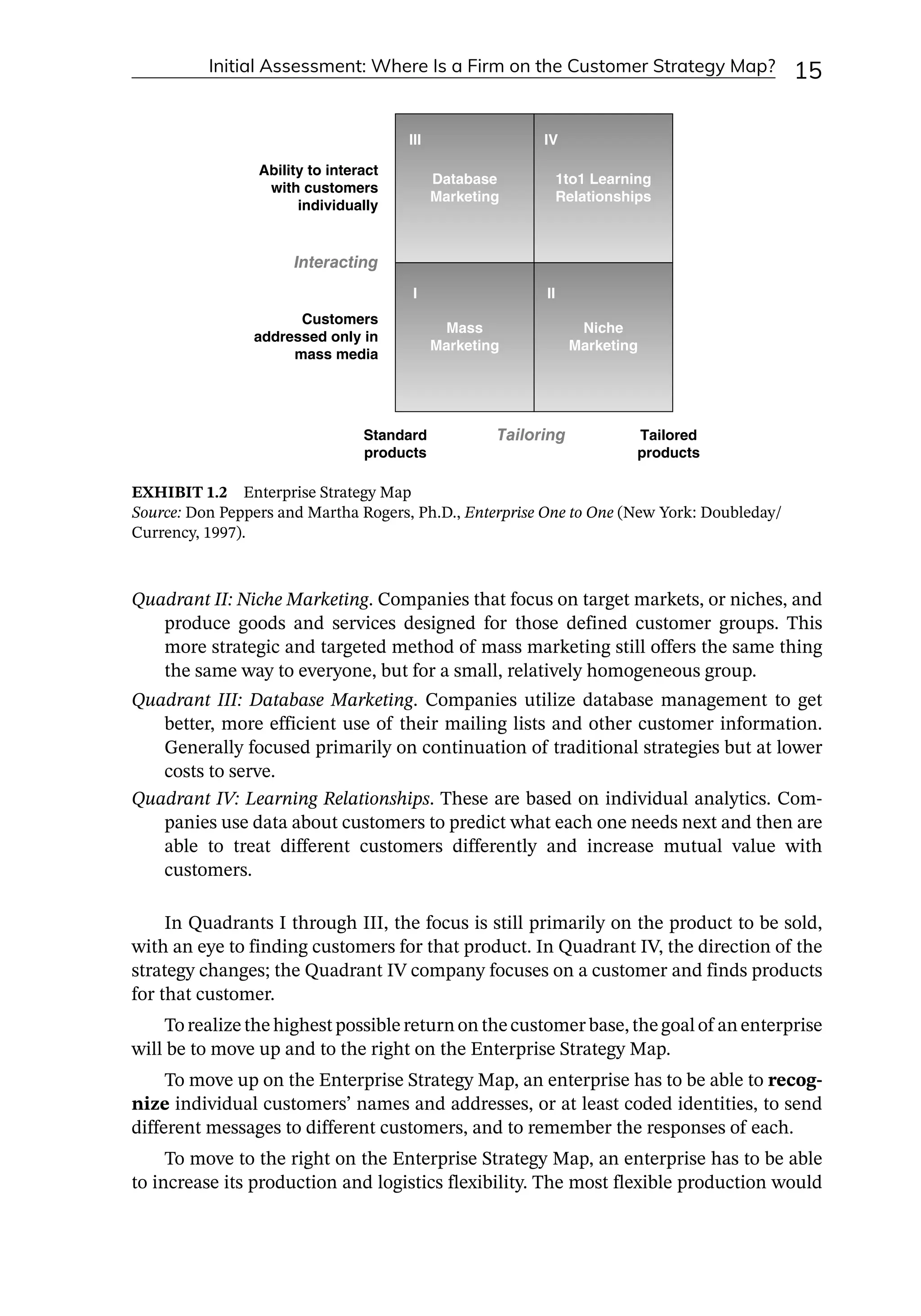
The four Ps all, of course, relate primarily to the aggregate market rather than
to individual customers. The market being considered could be a large mass market
or a smaller niche market, but the four Ps have helped define how an enterprise
should behave toward all the customers within the aggregate market:
1. Product is defined in terms of the average customer—­
what most members
of the aggregate market want or need. This is the product brought to mar-
ket, and it is delivered the same way for every customer in the market. The
definition of product extends to standard variations in size, color, style,
and units of sale as well as customer service and aftermarket service
capabilities.
2. Place is a distribution system or sales channel. How and where is the
product sold? Is it sold in stores? By dealers? Through franchisees? At a
single location or through widely dispersed outlets, such as fast-­
food
stores and ATMs? Can it be delivered directly to the purchaser?
3. Price refers not only to the ultimate retail price a product brings but also
to intermediate prices, beginning with wholesale; and it takes account of
the availability of credit to a customer and the prevailing interest rate. The
price is set at a level designed to “clear the market,” or the highest price
that will sell the product easily and widely, assuming that everyone will
pay the same price—­
which seems only fair because everyone will get the
same product. And even though different customers within a market
actually have different levels of desire for the same product, the market
price will generally be the same for everybody.
4. Promotion has also worked traditionally in a fundamentally nonaddress-
able, noninteractive way. The various customers in a mass market are all
passive recipients of the promotional message, whether it is delivered
through mass media or interpersonally, through salespeople. Marketers
have traditionally recognized the trade-­
off between the cost of delivering
a message and the benefit of personalizing it to a recipient. A sales call can
cost between $300 and $500 (a 2012 Center for Exhibition Industry
Research study put the average cost of a business-­
to-­
business [B2B] sales
call at $596),e
but at least it allows for the personalization of the promo-
tion process. The cost per thousand (CPM) to reach an audience through
mass media is far lower but requires that the same message be sent to
everyone. Ultimately, the way a product is promoted is designed to dif-
ferentiate it from all the other competitive products. Except for different
messages aimed at different segments of the market, promotion doesn’t
change by customer but by product.
(continued)
14 Chapter 1 Evolution of Marketing
Continuing Roles for Mass Media and Branding
• Communicate to nonusers who have not yet raised their hands.
• Build image and brand identity.
• Establish a brand position with nonusers to help users make a statement
about their own image.
(continued)
a
E. Jerome McCarthy, Basic Marketing: A Managerial Approach (Homewood, IL: Irwin, 1958), is
now in its 16th edition, and has been substantially updated.
b
Philip Kotler, S. C. Johnson Distinguished Professor of International Marketing, Kellogg School
of Management, Northwestern University (emeritus), is widely known as the father of modern
marketing. His textbook Marketing Management, coauthored with Kevin Keller, has become the
foundational text for marketing courses around the globe. First published in 1976 by Prentice
Hall, it is now in its 16th edition.
c
Philip Kotler, Marketing Management: Analysis, Planning, Implementation, and Control, 9th ed.
(Upper Saddle River, NJ: Prentice Hall, 1997), pp. 92–93.
d
Philip Kotler, Kotler on Marketing (New York: Free Press, 1999), pp. 116–120.
e
Bloomberg Business, “Sales Moves Beyond Face-­
to-­
Face Deals onto the Web,” January 10, 2013,
available at: https://www.bloomberg.com/news/articles/2013-­
01-­
10/sales-­
moves-­
beyond-­
face-­
to-­
face-­
deals-­
onto-­
the-­
web, accessed August 17, 2021; “The Cost of a Sales Call,” 4D Sales, accessed
February3,2016,availableat:http://4dsales.com/the-­
cost-­
of-­
a-­
sales-­
call/,accessedAugust17,2021.
INITIAL ASSESSMENT: WHERE IS A FIRM ON THE CUSTOMER
STRATEGY MAP?
Recognizing that two families of technology have mandated the competitive approach
of building customer value by building customer relationships, we can map any
organization—­
large or small, public or private, for-­
profit or nonprofit—­
by the level of
its capabilities in the arenas of interacting with customers and tailoring for them. A
company would be rated high on the interactivity dimension if it knows the names of
its individual customers and if it can send different messages to different customers
and can remember the feedback from each one. A low rating would go to a company
that doesn’t know its customers’ identities, or does but continues to send the same
message the same way to everybody. On the tailoring dimension, a firm would rate
highly if it mass-­
customizes in lot sizes of one; it would rate low if it sells the same
thing pretty much the same way to everybody. Based on its rating in these two dimen-
sions, a company can be pinpointed on the Enterprise Strategy Map (see Exhibit 1.2),
which includes four quadrants:
Quadrant I: Traditional Mass Marketing. Companies that compete primarily on cost
efficiencies based on economies of scale and low price. Companies in this quad-
rant are doomed to commoditization and price competition.
Initial Assessment: Where Is a Firm on the Customer Strategy Map? 15
Quadrant II: Niche Marketing. Companies that focus on target markets, or niches, and
produce goods and services designed for those defined customer groups. This
more strategic and targeted method of mass marketing still offers the same thing
the same way to everyone, but for a small, relatively homogeneous group.
Quadrant III: Database Marketing. Companies utilize database management to get
better, more efficient use of their mailing lists and other customer information.
Generally focused primarily on continuation of traditional strategies but at lower
costs to serve.
Quadrant IV: Learning Relationships. These are based on individual analytics. Com-
panies use data about customers to predict what each one needs next and then are
able to treat different customers differently and increase mutual value with
customers.
In Quadrants I through III, the focus is still primarily on the product to be sold,
with an eye to finding customers for that product. In Quadrant IV, the direction of the
strategy changes; the Quadrant IV company focuses on a customer and finds products
for that customer.
To realize the highest possible return on the customer base, the goal of an enterprise
will be to move up and to the right on the Enterprise Strategy Map.
To move up on the Enterprise Strategy Map, an enterprise has to be able to recog-
nize individual customers’ names and addresses, or at least coded identities, to send
different messages to different customers, and to remember the responses of each.
To move to the right on the Enterprise Strategy Map, an enterprise has to be able
to increase its production and logistics flexibility. The most flexible production would
Ability to interact
with customers
individually
Database
Marketing
Mass
Marketing
Niche
Marketing
1to1 Learning
Relationships
I
III
II
IV
Customers
addressed only in
mass media
Standard
products
Tailored
products
Interacting
Tailoring
EXHIBIT 1.2 Enterprise Strategy Map
Source: Don Peppers and Martha Rogers, Ph.D., Enterprise One to One (New York: Doubleday/
Currency, 1997).
16 Chapter 1 Evolution of Marketing
entail customizing and delivering individual products for individual customers. The
least flexible would be mass-­
producing a standardized product or service for a large
market. (We talk more about customization in Chapter 10.)
COMPARING MARKET-SHARE AND SHARE-OF-CUSTOMER
STRATEGIES
The story goes that in 1996, the executives at Barnes  Noble bookstores invited Jeff
Bezos, the founder of a startup named Amazon.com, to lunch, with a proposition.
Amazon.com had not yet made any profit (and would not, for its first 28 quarters in a
row), so the nice guys at the well-­
established bookstore offered, as a favor to Jeff, to buy
him out—­
before they launched barnesandnoble.com, the online version of the book-
store chain. They argued that Jeff’s relatively unknown brand would not stand up to
their highly popular name and that he should make some money on his software and
systems. He declined.
How did that turn out? Twenty-­
five years after that lunch meeting, Barnes  Noble
was acquired by Elliott Management Corporation for US$683 million and Amazon.
com had a market cap of US$1.7 trillion.5
When he stepped down as Amazon’s CEO in
2021, Bezos was the richest man on earth. So whether the lunch ever really took place
or not, the story still serves to illustrate the fundamental difference between a very well
run product-­
oriented company (Barnes  Noble, which has stores to populate with
products and tries to find customers for those products) and a fairly well run customer-­
oriented company (Amazon.com, which got us all as customers to buy books and
DVDs, and now wants to sell each of us everything). Note: One of this book’s authors,
who lives in New York City, found the best selection and service from Amazon.com
when she was looking for a refrigerator to buy and have installed in her Upper West
Side apartment.
A lot can be understood about how traditional, market-­
driven competition is differ-
ent from today’s customer-­
driven competition by examining Exhibit 1.3. The direction
of success for a traditional aggregate-­
market enterprise (i.e., a traditional company that
sees its customers in markets of aggregate groups) is to acquire more customers (widen
the horizontal bar), whereas the direction of success for the customer-­
driven enterprise
is to keep customers longer and grow them bigger (lengthen the vertical bar). The width
of the horizontal bar can be thought of as an enterprise’s market share—­
the proportion
of total customers who have their needs satisfied by a particular enterprise, or the
percentage of total products in an industry sold by this particular firm. But the customer-­
value enterprise focuses on share of customer—­the percentage of this customer’s
5
Colin Dwyer, “Barnes  Noble Set to Be Sold to Elliott Management for about $683 Million,” NPR,
June 7, 2019, available at https://www.npr.org/2019/06/07/730638739/barnes-­
noble-­
set-­
to-­
be-­
sold-­
to-­
elliott-­
management-­
for-­
about-­
683-­
million, accessed August 17, 2021; “Amazon.com, Inc.
Common Stock (AMZN),” Nasdaq, available at https://www.nasdaq.com/market-­
activity/stocks/
amzn, accessed August 17, 2021.
Random documents with unrelated
content Scribd suggests to you:
you say, anything could have happened. But when I make up my
mind to do something I usually go through with it. It's just a matter
of plain common sense. You don't toss aside a decision you've given
a great deal of thought to just because the arguments against it are
weighty, too.
I see. So you're still determined to walk right up to the gate and tell
them you're Stone.
Why not? They've never laid eyes on Stone and they don't know me
from Adam. I won't be wearing this uniform. I'll tell them that
Henley's expecting me, that he left orders for me to join him if he
failed to come back at a specified time. I'll watch the guard's face
and change my story a little—if I have to—as I go along.
It's a very long gamble. I hope you realize that.
It's either that or no gamble at all. And we've got to gamble. We're
holding at least two high cards and a joker. Henley has had the
ground shot right out from under him. He's completely alone, and
the only thing he has left to gamble with is his nearness to Ramsey,
his ability to terrify Ramsey by making him believe that his
daughter's life is still in danger. Ramsey has to be told that Helen
has been freed, has to be warned in time, before he does anything
foolish.
Don't you see? With that threat hanging over him, Ramsey would
never let us get within fifty yards of the Citadel, let alone walk
through the gates. And if Henley finds out that we've got Helen, he'll
know that he has nothing left to gamble with except that desperate
bluff. And he may doubt his ability to win with a bluff. That would be
the worst tragedy of all. He may turn on Ramsey in blind rage, and
kill him. He gets a horrible, pathological pleasure out of killing. I've
told you how he went berserk on the Station.
Drever nodded, and, quite suddenly and unexpectedly, the look of
stubborn opposition was gone from his eyes.
I guess you're right, Lieutenant. You can't always tell how the cards
will fall.
You can never tell, Corriston said. And there are some games
where the important moves can only be made by just one player,
and he usually has to be something of a reckless fool.
22
Corriston left the tractor a hundred and seventy yards from the gate,
well hidden behind a hundred foot dune. The other tractors had
come to a halt a much greater distance from the Citadel, and were
spread out across the desert in a slightly uneven, double line.
He walked slowly forward across the rust-red sand, with a feeling in
his bones that he was going to be lucky. Yet he knew that he'd have
to be convincing, or he wouldn't stand a chance. If there was more
than one guard at the gate he might never get inside. With luck he
might be able to convince two guards—even three—but never four
or five, for you couldn't forge words into persuasive enough
weapons to disarm the suspicion of that many observant men. Not
the kind of men who would be guarding Ramsey, at any rate.
The massiveness of the fortified gate shook his confidence a little as
he drew near to it. It was at least fifty feet in height, a solid oblong
of inches-thick steel with a desert-mirroring surface. He could see
his own reflection as he advanced, but it did nothing to reassure
him.
He knew what he'd have to do, of course. Walk right up to the gate
and trust to luck that he could find some way of announcing his
presence without getting himself killed. How did you gain entrance
to an impregnable fortress? Surely there had to be some way by
which a man could gain admittance without being instantly shot
down as a hostile intruder.
He was surprised by the simplicity of the answer. There was no need
for him to press a bell or a buzzer, to manipulate a mechanism of
any sort. There was not even any need for him to proclaim his arrival
by shouting.
The gate swung inward without a sound, and in the shadows cast by
its moving bulk two figures silently materialized. They were guards,
heavily armed, one tall with shaggy brows and piercing dark eyes,
the other a wiry little man with reddish hair, his expression peculiarly
bland and non-committal.
It was the little man who said: All right, come inside. We've been
expecting you.
It was impossible, but true. There was nothing threatening in the
way the words were uttered, just calm acceptance, just the matter-
of-fact indifference of a man who has a duty to perform and doesn't
care what happens afterwards.
But it would have perhaps been better if Corriston had not moved so
quickly forward, for almost instantly the second guard barred his
passage and laid a firm hand on his arm.
Hold on. Just a minute, the tall guard said. You're Peter Stone,
aren't you?
With a quick pretense of anger Corriston jerked his arm free and
looked the guard up and down. Naturally I'm Stone. Who in hell did
you think I was.
Sorry, the guard said, shrugging. Don't take it out on me. I just
had to be sure.
Well, you're sure now. I guess you know why I'm here.
The guard nodded. Ramsey just phoned down about you. Your
friend is with him now. See that big gray building, the one on the
left with the shuttered windows? There's a guard stationed at the
door, but he won't stop you. He has his orders. Climb two flights of
stairs and go down the long corridor on the third floor. Ramsey and
your friend are in the last room on the left.
Corriston drew a deep breath, wondering if the guard had noticed
the tightening of his facial muscles. He turned away from the gate
slowly, staring out over the interior of the fortress, letting his
emotions of the moment take complete possession of him.
He had entered as if by magic a world apart, a small, shutin world of
massive magnificence, of undreamed of material power and wealth.
There were five buildings within the encircling wall of the fortress,
each monumental in architectural sweep. Each was a citadel alone
and apart, monuments to man's creative genius erected by one man
with a determination to make himself unique.
It was a folly almost beyond belief, a terrifying distortion of human
creativeness that could lead only to ultimate disaster and defeat.
But greedy and cruel and ruthless as Ramsey undoubtedly was,
there still burned in him a little of the spark that had created Athens
in white marble. Had it not been so, he could not have even
commissioned men of creative genius to transport to Mars the
materials for such a project and have taken pleasure in its
completion.
Your friend got here two hours ago, the tall guard said. They've
been talking ever since. He came down to the gate once and said we
should let you in, you and another man. Saddler, I think his name
was. I see he's not with you.
No, Saddler is not with me, Corriston said.
What happened to him?
The big gray building with the shuttered windows, you said. If the
guard tries to stop me, what do I say.
I told you he had his orders.
Corriston looked up at the massive gate swinging shut behind him.
For good or ill, he was completely trapped, completely at the mercy
of the armed guards inside the citadel.
They hadn't taken his gun away from him, but, nevertheless, he was
trapped. What chance would one armed man have against seventy-
five or a hundred guards? They were keeping out of sight, all but the
two at the gate. But at any moment they could converge upon him
and shoot him down. They could choose their own moment,
precisely as a research medical man could choose his own moment
to experiment upon a laboratory animal, knowing that the creature
was safe in its cage and couldn't possibly get away.
Corriston's lips tightened and from a shadowed corner of his mind
came a determination to brush all that aside, to ignore it completely.
The guards at the gate might very well be telling the truth. It stood
to reason that Ramsey would have remained secretive about his
daughter. Kidnappers do not like to have their ransom demands
discussed too openly. If Ramsey had been a complete fool he would
have gone down to the gate and taken the guards completely into
his confidence, but Corriston could not believe that Ramsey was that
much of a fool.
In all probability Henley had threatened Ramsey and provoked him
almost beyond endurance. There had arisen the questions of how
the ransom was to be paid, the girl set free.
Damn it, Corriston thought, the thing for me to do now is to go
straight toward that building and straight up the stairs to the third
floor and straight down the corridor until I'm confronting Ramsey
face to face. I'm Peter Stone. I'm one of the two men who helped
Henley kidnap the girl and I've come to help Henley convince
Ramsey. I've come to help him really put the screws on Ramsey. I
can improvise from that point on.
He moved away from the guards without looking back. Within the
citadel there was silence, stillness, the five massive buildings cutting
a rampart of pure, fragile design across the sky. There was a strange
kind of perfection about the interior of the citadel. It was akin,
somehow, to the perfection of solitude and even the sky seemed
hushed, expectant, remote from reality, as if awaiting the unfolding
of some impossible event, some terrifying drama of violence and
retribution that could take place nowhere else.
But Corriston's reason told him that to believe any such thing would
have been the height of folly. The sky inside the citadel was just as
real, just as cloud-flecked and palely blue as the sky outside, and the
notion that architecture or scenery of any kind could influence
events was absolute nonsense. Things would happen exactly as he
willed them to happen, provided nothing stood in the way of
immediate drastic action and the kind of luck which had saved him
at the gate continued to smile upon him.
The big gray building with the shuttered windows continued to
occupy most of his attention, and he walked very resolutely toward
it, his eyes on the glimmer of pale light which marked its wide
doorway. He was still fifty feet away when he saw the guard,
standing very quietly just inside the door with his hand on his gun
holster.
Corriston's lips tightened, but he did not moderate his stride. He had
a reply ready if the guard challenged him. He preferred to believe
that he would not be challenged, but he had no intention of taking
anything for granted.
He continued on until he reached the doorway and then he stopped
abruptly. He waited for the guard to say something, but the man did
not speak at all. He simply stared quietly at Corriston for an instant,
and then stepped quickly back into the shadows. Corriston went on
past him, and advanced along the wide corridor that stretched
before him.
The wide central staircase that circled up did not seem appropriate
to a building that was not a residence and Corriston found himself
wondering if Ramsey had turned the other four buildings into
similarly unusual expressions of his own strong-willed orientation to
reality.
The buildings had undoubtedly been designed as administrative
units of an industrial empire—a beginning empire in a new world. An
empire predatory, avaricious, merciless. Yet Ramsey had seemingly
allowed his desire for a home to gain dominance here, had allowed
the emotions common to all men to influence his taste in interior
architecture in at least one of the buildings.
Chalk up that much to Ramsey's credit. In that respect at least, he
was superior to Henley. In that respect at least a man of good will
could take sides, all apart from the personal issues involved. Henley
was a predatory vulture on all counts, his talons constantly spread,
constantly crimson-tipped. Ramsey was a vulture too, but in the
depths of his mind he knew it. Part of the agony was shared by him,
and in one desperate, despairing part of his personality he had tried
to be creative.
Corriston ascended the staircase swiftly, casting one brief glance at
some murals and then ignoring them. The second floor landing
stretched away into shadows, bisected by a wide corridor dimly
lighted by overhead lamps. The second floor had an administrative
building aspect and so did the third floor, which seemed in all
respects its exact duplicate.
Corriston's excitement grew as he mounted the stairway. He felt like
a man poised on the brink of a precipice with no assurance that he
would not be hurled to his death; a man aware that tragedy would
not strike him like a thunderbolt at any moment; and yet also like a
man who thought and felt differently from the trapped and the
desperately despairing.
He felt very confident, very sure of himself, and it seemed to him
that there was no danger that he could not surmount, and deep
within him there was something that exulted in the thought and kept
him moving steadily upward.
The third floor was like the second, its long central corridor
dwindling away into shadows. Down it he moved cautiously,
remembering what the guard at the gate had said. The third floor,
the last door on your left.
Ramsey was in conference. But it wasn't a conference of industrial
associates planning a division of spoils. Ramsey was talking to a
killer under duress.
Corriston was half way down the corridor when he heard the shot. It
rang out in the stillness with a terrible clarity, sending echoes
reverberating throughout the building, stopping Corriston in his
tracks.
For an instant the silence remained absolute, as if the shot had
somehow silenced all life within the building. Even Corriston's
breathing was affected by it, so that for an instant he remained like
a man horror-blasted into immobility, frozen, a statue with waxen
features and widely dilated eyes.
Then, abruptly, he ceased to be a statue. He broke into a run,
heading for the door from which the shot had come.
He came to the door and saw that it did not slide open on a panel. It
was massive, with a knob jutting out from it, and when he grasped
the knob it swung inward instantly and soundlessly and he found
himself in a large, blank-walled room brightly illumed by three
circular overhead lamps.
Ramsey was sitting stiff and straight before a desk that was
cluttered with reference files, manuscripts in folders, pens, pencils
and other writing materials. His face was drained of all color, and his
eyes were wide and staring. He was looking directly at Corriston,
and yet he did not seem to see Corriston.
He did not appear to be staring at anything in particular, that small,
shrunken, unimpressive-looking little man with graying temples and
a look of blank incomprehension in his eyes that chilled Corriston to
the core of his being.
Shaking, wishing that the eyes would close or brighten with relief, or
do anything but remain so stonily indifferent, Corriston moved closer
to the desk.
He saw at once that Ramsey was close to death. He had been shot
in the chest. There was a dull red stain on his chest, and even as
Corriston stared it widened, a butterfly pattern of red, like a
Rorschach seen through the eyes of a homicidally inclined psychotic.
Suddenly Ramsey moved. He caught hold of the desk edge, and
swayed a little, but his eyes remained filmed, blankly staring.
Corriston was bending above him when a familiar voice said: He's
done for. Nothing you can do for him. We had an argument and he
lost his head. He just couldn't see it my way. So I made a mistake
and shot him. It was a mistake, all right. I lost my head. Now I've
got nothing to lose by killing you.
Corriston raised his eyes slowly. He had one chance in a hundred
perhaps. He knew it; he sensed it. Henley had somehow managed to
stay out of sight for an instant. The room was very large. There
were shadows in it, and Henley had apparently flattened himself
against the wall behind the desk, in deep shadow.
But now he was standing very straight and still behind the desk,
ignoring the shuddering form of the man he had shot, little dark
deathheads dancing in his eyes.
Henley's nearness did not bother Corriston. Death at ten feet could
be no more final than death at a hundred yards.
Only one thing bothered him. Events could move fast when you
were close to a killer.
He didn't intend to let them move fast. Not for him, at any rate. He
let his eyes rest for an instant on the gun in Henley's hand, his
thoughts racing. He knew that he'd be as good as dead if he made a
single concession.
Don't let him know that the gun worries you. Pretend that the odds
are even, even though he's got the drop on you.
Corriston said: How do you know he's fatally wounded? The
wound's three inches below his heart. You're taking a hell of a lot for
granted. You just said you made a mistake in shooting him. If he's
rushed to a hospital that mistake may not be your last. You'll have a
chance to go to work on him again.
Henley shook his head, his lips tightening. Don't be a fool. He'll be
dead in five minutes.
I'm not being a fool, Corriston said. What will you stand to gain
by shooting me and letting him die? You've got his daughter, but a
dead man won't be able to ransom her.
For a moment, nothing happened. Henley had made no attempt to
draw his gun, and he did not draw it now. He stood very quietly
staring at Corriston, breathing heavily, a strange, withdrawn look in
his eyes.
Perhaps he was thinking over what Corriston had said. Corriston
wondered about that for an instant, and then dismissed it from his
mind. You did not take anything for granted when you were standing
that close to a killer.
It was probably too late to save Ramsey. But for the first time he
was standing very near to Henley with a weapon beneath his hand.
If he drew his gun instantly and shot Henley through the heart
Ramsey might have a chance. Otherwise....
Somehow he couldn't do it; not without giving the other some slight
warning, not without whipping his hand to his gun with a vigor that
was clear and unmistakable. In matters of crime a fair man is at a
disadvantage. He can only deal with a murderer in one way.
He drew a split second ahead of Henley. He shot Henley three times,
the gun blazing in his hands, and it did not seem important to him
that Henley had also drawn his gun. A tight knot reached into his
stomach as Henley's gun blazed, but he kept right on firing.
Henley died missing him, not scoring at all. That was the incredible
thing. Henley, an expert shot, a genius at massacre, had missed him
clearly with five shots and now he was down on the floor, clutching
at his stomach, dragging himself along, while beneath his fingers a
dull red stain grew.
His eyes turned glassy suddenly. He tried twice to raise himself but
he fell back each time. He did not speak at all. Blood from his
punctured lungs flooded up into his mouth, and with a terrible,
convulsive trembling of his entire body he rolled over on his side and
lay still.
Corriston's hands began to sweat beneath the hard, cold gun. He
wanted to drop the weapon, to hurl it from him, but he couldn't
somehow. He had killed Saddler in immediate self-defense. This had
been a little different—a new experience, a frightening experience
and he had been forced to grit his teeth even in firing, and now that
it was all over he was tormented inwardly in a way that left him
badly shaken.
Henley was gone now. Dead and still and forever removed from a
world he had contaminated. Henley had been warped and twisted
largely by circumstances outside himself; nevertheless a deadly
reptile has to be crushed when it is about to strike.
Corriston looked up from the limp form sprawled out on the floor,
and for a moment the tight lines of his face relaxed a little. Henley
was no longer a menace; the breath of life that had sustained him
had expired so completely that he had become now a kind of hollow
mockery of something monstrous and distorted that could never
harm anyone again.
It was Ramsey who had to be considered now, Ramsey who was in
peril.
The light in the room seemed somehow a little dimmer than it had
been. He turned slowly back to Ramsey, and for a moment could not
quite believe what he saw.
Ramsey's face was changing. The hollows beneath his cheekbones
were deeper than they had been, and his mouth had gone
completely slack, and his eyes were uprolled in a quite ghastly way,
so that only the whites showed.
Slowly as Corriston stared Ramsey's features began to come apart.
The familiar, hideous pattern began to repeat itself on Ramsey's
blanched features. The mouth widened until it turned into a
shapeless, colorless gash in a face that was hardly recognizable. The
nose widened and spread out, the chin receded, and the cheeks
became a flattened expanse of wrinkled flesh that stubbornly
refused to stop spreading.
Ramsey's face became a pumpkin face, with slits for eyes and a
hideous caricature of a mouth that seemed almost to pout as it
expanded.
Suddenly Ramsey was no longer sitting upright before the desk. His
body swayed and began to slump, tilting at first only a little sideways
and then sliding completely from the chair to the floor.
Ramsey did not descend to the floor with violence. It was a slow,
barely perceptible gliding motion of his entire body that carried him
from an upright position to a prone one in less than thirty seconds.
His body seemed to collapse inward upon itself, as if he had
suddenly become too skeleton-thin for his clothes, as if so much
vitality had been drained from him by the shot which had put an end
to his life that he had given up all hope of maintaining his dignity in
death.
But perhaps the man on the floor had no dignity to maintain. He
wasn't Ramsey. He was a hired substitute, an impostor, and quite
obviously no man would undertake to play such a role without
calculating all of the risks in advance. Perhaps he expected to die
without dignity. Perhaps that was one of the risks which went with
the bargain—the assumption that Ramsey might very well be killed
in a violent fashion, and that anyone who stepped into Ramsey's
shoes and masqueraded as Ramsey might expect a similar fate.
Corriston felt a nerve begin to twitch violently in his cheek. Why had
Ramsey kept Henley occupied in so strange a manner, talking to a
nonentity, a stand-in, a double who could never bargain and come to
terms unless Ramsey ordered him to do so? Had Ramsey been
incapable of dealing with Henley directly, and had taken this means
of complying with the ransom demands?
It seemed incredible on the face of it. Ramsey was quite obviously
the kind of man who could live through any kind of private hell if he
had to.
He'd have stood up to Henley no matter how great his inner
torment. He'd have met the ransom demands or rejected them—and
it was almost inconceivable that he would have rejected them—
without for an instant losing his outward composure. And even
inwardly he would have kept a tight rein on his emotions. He was
not the kind of man who would hire someone else to protect him
from anything that vitally concerned him, even with the masks so
conveniently at hand.
Why then had he employed a double to bargain with Henley and
keep him occupied for so long a time? It didn't matter if Ramsey had
made use of doubles in the past. Probably he had, in order to
protect himself in dealings with the colonists when the advantages
of deception would favor him. But he would never have done so
under these present circumstances—when a criminal who would stop
at nothing was holding his daughter under threat of death.
He would never have done so unless he had some very special
reason that dominated his thinking to the exclusion of all else.
Suddenly Corriston had the answer. It came to him in a lightning-
swift flash of intuition, which carried with it complete credibility. It
was more than a guess. Somehow he was sure; he knew. A full
minute before he heard the dull rumble of the tractors as they came
through the gate, and went to the window and stared down, he
knew.
He had the answer and yet what he saw eclipsed what he knew. It
was a little like watching a rocket take off, hearing the roar and
seeing the flames through all of its burning time, and seeing at the
same time the men on the proving ground moving swiftly about, and
the space-helmeted men at the controls of the rocket itself, each
grimly intent on one particular task.
Ramsey was returning into the Citadel with armed guards on both
sides of him, and his daughter was walking with her head erect at
his side. Five colony tractors had followed him into the Citadel and
two more were just coming through the gate, moving ponderously
on their caterpillar treads because each tractor weighed two tons
even in the light gravity of Mars.
Corriston did an almost unbelievable thing then. Standing quietly by
the window he raised his right hand and saluted Ramsey in silent
tribute to the man's courage at the most threatening moment of his
life.
What Ramsey had done in no way lessened his guilt. But Corriston
would have just as readily repeated the salute in public, without
caring what anyone might think. What Ramsey had done was as
clear to him now as a series of moves on a chessboard laid out in
advance, but hidden from the man who was to be outwitted and
outplayed.
Ramsey had made use of a double to keep Henley occupied—no
doubt with repeated, skillful evasions, a constant insistence that
more proof be forthcoming, more details supplied. Perhaps a half-
dozen conferences had taken place in all, extending over many
hours. And while Henley was being encouraged to believe that
Ramsey was being softened up and would accept all of his demands
in the end, Ramsey had gone out into the desert alone, armed,
furious, and determined to rescue his daughter if it cost him his life.
Or perhaps he hadn't gone alone. Perhaps he had taken a dozen
armed guards with him. Somehow it didn't seem important, couldn't
take away Ramsey's moment of victory. It was a moment of victory
for Ramsey even though he hadn't played a major role for long, even
though he had found his daughter already rescued and safe on his
return. And Corriston had been the one to move out into the center
of the board and deliver the coup de grace. He had kept a restless
killer immobilized while the play was under way, and that was victory
enough for any man.
Corriston suddenly realized that neither Ramsey nor the Colonists
had any way of knowing that Henley was dead. They had probably
joined forces outside the Citadel for the sole purpose of rescuing him
from the deadliest kind of danger. And he wasn't helping them at all.
In another minute they'd be trying to get to him with tear gas.
It didn't make any kind of sense, but when Corriston went down the
wide central staircase he wasn't thinking about the colonists at all.
He was wondering only how Helen Ramsey would look standing
alone on a strange dark headland at midnight. Then the vision
dissolved and another one took its place. She wasn't on a headland
any more.
She was standing at the door of a small, white cottage and there
were a couple of kids beside her: a boy of about Freddy's age, or
maybe a little younger, and a little girl with golden curls, her hair like
a crown.
He realized suddenly that it could never be a small, white cottage.
There were no small white cottages on the Station, and never could
be. But the Station would be all right for a married man with kids.
The kids could come and visit him, and his wife could be with him
about one-fourth of the time, both on the Station and on Earth.
What more could a happily married man ask, if the Station was so
much a part of him that it was never wholly absent from his
thoughts? He'd have to ask her, of course—at least a dozen times to
make sure—that she really wanted that kind of man for a husband.
But he knew what her answer would be even before the vision
dissolved, and he was soon out in the central square between the
five buildings, holding her tightly in his arms.
From the way she kissed him he knew that she must have endured
an eternity of torment just from uncertainty, just from not knowing
whether he was dead or alive. For an instant he could think of
nothing else but the wonder of it, the absolute reassurance which
she had brought to him with her closeness, her gratefulness, the
intensity of her concern.
Across the square they could see the tractors, looking in the dazzling
light like massive blocks of metal standing almost end to end. There
was a great deal of movement and shouting between the buildings,
and Corriston knew that in another half-minute they would no longer
be alone together, that the closeness couldn't last.
A change was coming over her face, and he was suddenly afraid for
her, afraid that when she was told the full truth about her father just
the pain of knowing might make her withdraw from him, even
though it could never really come between them or separate them
for long.
So there it was. He could see it in her eyes, the fear, the shadow,
and because he had no way of knowing just how much she already
knew he decided that only complete honesty could keep the shadow
from lengthening.
His hands moved slowly up over her face, and he drew her chin up
and said, very gently: There's something I'd like to say now, about
your father. Without his help Henley would have finished what he
started out to do. There are different ways of paying off a debt, and
your father—
She raised her hand as if to put a stop to his words. Darling, I know
he's in serious trouble. Don't try to spare me; there's no need to.
There will be a trial and we both know what the outcome will be.
He'll never walk out of the courtroom a free man. But he's not afraid
... and neither am I. These last few, terrible hours have changed
him. He's not ashamed now to admit that he loves me. All the
hardness, the coldness, is gone.
Something in her voice stilled the questions he wanted to ask. She
seemed to sense what was in his mind, for she said quickly. I don't
think father has any enemies now on Mars. He's going to give the
colonists back their land. Not because he has to, but because he
wants to. They came to his assistance when they could have used
the way he cheated and robbed them as an excuse for not helping
him at all. There are few men who wouldn't feel grateful, who
wouldn't be shaken by remorse. But I think it goes deeper than that.
Even now I'm not completely sure, but I think he knows it's the only
way he can free himself from the prison he's been building around
himself since I was a little girl.
She was silent for an instant, while the pain in her eyes seemed to
deepen. Then she said, I can't leave him now, darling. Not right
away. It would be too cruel a blow.
Ahead now Corriston could see three of the colonists coming toward
him. They were less than forty feet away. I think I know how it is,
he said. When you've been through too much, you just go dead
inside. You can feel sympathy for someone very close, like your
father. But that's about all....
Darling, that's not what I mean. We'll be apart, but just for a little
while. It will be so short a time we won't even miss it later on ... two
or three weeks, at most. And this time you won't have to wonder
about me at all.
Corriston noticed then for the first time that her hair had been blown
in all directions by the wind. He remembered how, on their first
meeting, it had been disarranged in much the same way. She'd been
wearing a beret then, and just the casual tilt of her hat had done the
fluffing. But wind or no wind, he'd always like the way her hair
looked, the gold in it, and the way it set off the great beauty of her
face.
I'd be more than unreasonable if I tried to pick flaws in a promise
like that, he said.
You can never go home again, someone had once said. You can
never go home because people change and places change with
them, and familiar scenes take on an aspect of strangeness as the
old, well-loved landmarks fade.
But in space, the landmarks are as wide and deep as the gulfs
between the stars, and it is not too difficult for a man to return to a
steel-ribbed Gibraltar in space and experience again the emotions he
felt when he first sighted it, and hear again the long thunder-roll of
the ships berthing and taking off.
The ship which was bringing Corriston back had begun to loom up
behind the telemetric aerials with her bow slanting forward. She had
almost berthed, and, standing with his face half in shadow,
Commander Clement watched the landing lights flashing on and off
and wondered just what he would say to the young lieutenant he'd
never met—the very famous lieutenant who would be emerging from
the boarding port and descending the ramp any minute now.
He told himself that it ought to be something very simple and direct,
accompanied by a friendly handclasp and a nod. Welcome back,
Lieutenant. Welcome back. I guess you know how I feel about the
scoundrels who kept us from meeting the first time.
Yes, just a few words and a friendly handclasp would be best. No
salutes either given or returned. No stiff-necked salutes, and damn
the regulations for once. It was truly a very great occasion.
*** END OF THE PROJECT GUTENBERG EBOOK SPACE STATION 1
***
Updated editions will replace the previous one—the old editions will
be renamed.
Creating the works from print editions not protected by U.S.
copyright law means that no one owns a United States copyright in
these works, so the Foundation (and you!) can copy and distribute it
in the United States without permission and without paying
copyright royalties. Special rules, set forth in the General Terms of
Use part of this license, apply to copying and distributing Project
Gutenberg™ electronic works to protect the PROJECT GUTENBERG™
concept and trademark. Project Gutenberg is a registered trademark,
and may not be used if you charge for an eBook, except by following
the terms of the trademark license, including paying royalties for use
of the Project Gutenberg trademark. If you do not charge anything
for copies of this eBook, complying with the trademark license is
very easy. You may use this eBook for nearly any purpose such as
creation of derivative works, reports, performances and research.
Project Gutenberg eBooks may be modified and printed and given
away—you may do practically ANYTHING in the United States with
eBooks not protected by U.S. copyright law. Redistribution is subject
to the trademark license, especially commercial redistribution.
START: FULL LICENSE
THE FULL PROJECT GUTENBERG LICENSE

Managing Customer Experience and Relationships: A Strategic Framework, 4th Edition Don Peppers
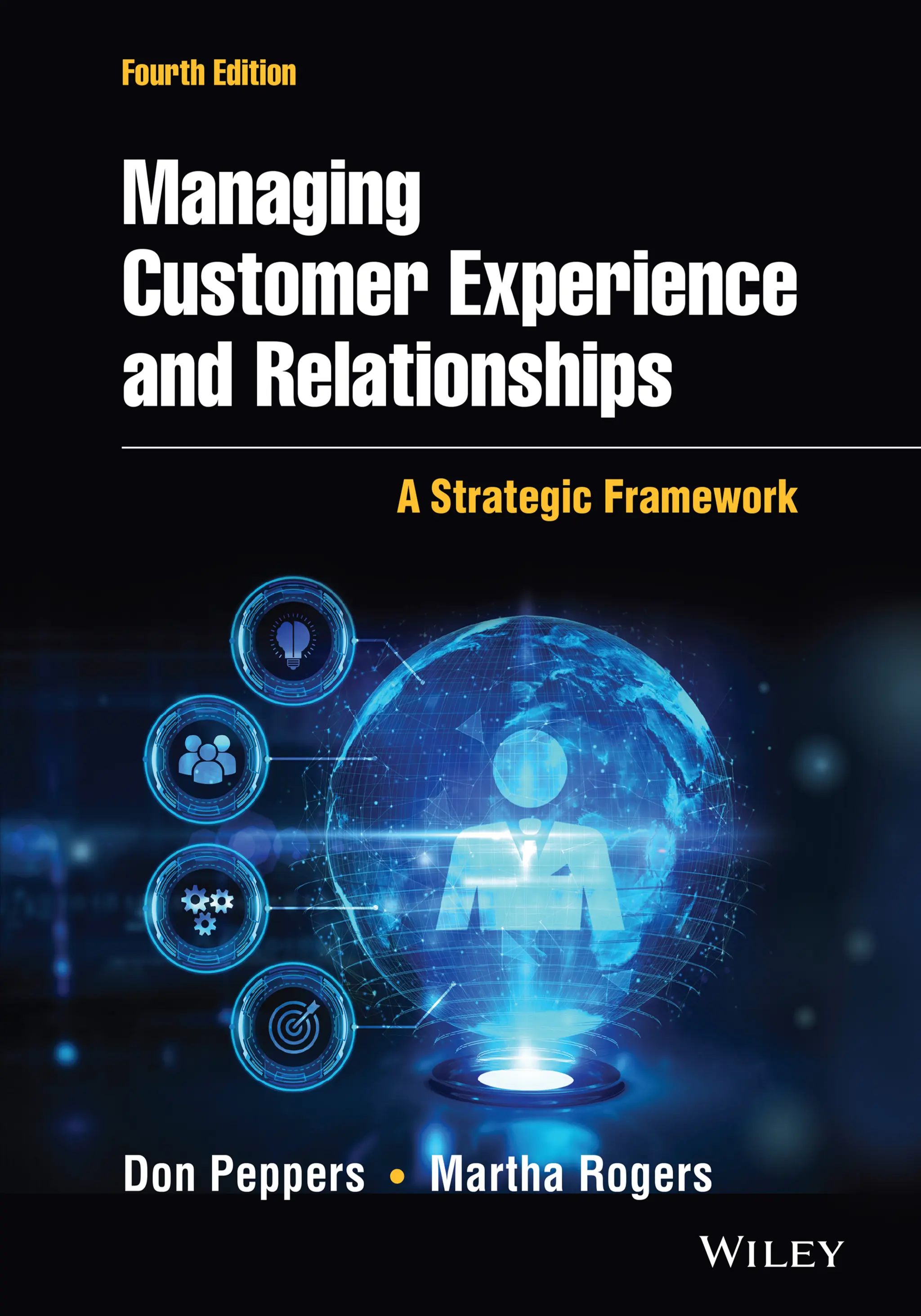
  • 1.
    Read Anytime AnywhereEasy Ebook Downloads at ebookmeta.com Managing Customer Experience and Relationships: A Strategic Framework, 4th Edition Don Peppers https://ebookmeta.com/product/managing-customer-experience- and-relationships-a-strategic-framework-4th-edition-don- peppers/ OR CLICK HERE DOWLOAD EBOOK Visit and Get More Ebook Downloads Instantly at https://ebookmeta.com

  • 4.
  • 6.
    Managing Customer Experience and Relationships AStrategic Framework FOURTH EDITION Don Peppers Martha Rogers
  • 7.
    Copyright © 2022by Don Peppers and Martha Rogers, Ph.D. All rights reserved. Published by John Wiley & Sons, Inc., Hoboken, New Jersey. Published simultaneously in Canada. No part of this publication may be reproduced, stored in a retrieval system, or transmitted in any form or by any means, electronic, mechanical, photocopying, recording, scanning, or otherwise, except as permitted under Section 107 or 108 of the 1976 United States Copyright Act, without either the prior written permission of the Publisher, or authorization through payment of the appropriate per-­ copy fee to the Copyright Clearance Center, Inc., 222 Rosewood Drive, Danvers, MA 01923, (978) 750-­ 8400, fax (978) 750-­ 4470, or on the web at www.copyright.com. Requests to the Publisher for permission should be addressed to the Permissions Department, John Wiley & Sons, Inc., 111 River Street, Hoboken, NJ 07030, (201) 748-­ 6011, fax (201) 748-­ 6008, or online at http://www.wiley.com/go/permission. Limit of Liability/Disclaimer of Warranty: While the publisher and author have used their best efforts in preparing this book, they make no representations or warranties with respect to the accuracy or completeness of the contents of this book and specifically disclaim any implied warranties of merchantability or fitness for a particular purpose. No warranty may be created or extended by sales representatives or written sales materials. The advice and strategies contained herein may not be suitable for your situation. You should consult with a professional where appropriate. Further, readers should be aware that websites listed in this work may have changed or disappeared between when this work was written and when it is read. Neither the publisher nor authors shall be liable for any loss of profit or any other commercial damages, including but not limited to special, incidental, consequential, or other damages. For general information on our other products and services or for technical support, please contact our Customer Care Department within the United States at (800) 762-­ 2974, outside the United States at (317) 572-­ 3993 or fax (317) 572-­ 4002. Wiley also publishes its books in a variety of electronic formats. Some content that appears in print may not be available in electronic formats. For more information about Wiley products, visit our web site at www.wiley.com. Library of Congress Cataloging-­ in-­ Publication Data is Available: ISBN 9781119815334 (Hardback) ISBN 9781119815358 (ePDF) ISBN 9781119815341 (ePub) Cover Design: Wiley Cover Image: © Den Rise/Shutterstock
  • 8.
    v Contents Foreword by PhilipKotler ix Preface xiii Acknowledgments xvii About the Authors xix PART I Technology’s Rainbow 1 CHAPTER 1 Evolution of Marketing and the Revolution of Customer Strategy 3 Roots of Customer Relationships and Experience 6 Initial Assessment: Where Is a Firm on the Customer Strategy Map? 14 Comparing Market-Share and Share-of-Customer Strategies 16 What Is a Relationship? Is That Different from Customer Experience? 20 Learning Relationships: The Crux of Building Customer Value 22 CHAPTER 2 Treat Different Customers Differently: How Learning Relationships Lead to Better Experiences and Higher Profit 25 Focus on Relationship Equity 25 The Strategy: Treat Different Customers Differently (TDCD) 26 The Technology Revolution and the Customer Revolution 28 What Characterizes a Relationship? 31 Customer Loyalty: Is It Emotional? Or Behavioral? 34 Customer Retention and Enterprise Profitability 37 CHAPTER 3 Better Customer Experiences for Better Shareholder Return 49 Frictionless: The Ideal Customer Experience May Be No Experience at All 49 Product Competence 56
  • 9.
    vi Contents Customer ExperienceDuality 58 Customer Competence 59 Understanding Customer Experience through Customer Journey Mapping 62 CHAPTER 4 IDIC and Trustability: Building Blocks of Customer Relationships 69 IDIC: Four Implementation Tasks for Creating and Managing Customer Experiences and Relationships 69 How Does Trust Characterize a Learning Relationship? 78 Do Things Right, Do the Right Thing, and Be Proactive 85 Relationships Require Information, but Information Comes Only with Trust 91 Behind Their Customers’ Backs 94 How Trustable Companies Operate 96 Recovering Lost Trust 97 PART I: FOOD FOR THOUGHT 101 PART II Customer Experience and Relationships: Trust Is the Foundation and IDIC the Building Blocks 105 CHAPTER 5 IDIC Step 1: Identify Individual Customers 107 Individual Information Requires Customer Recognition 108 The Real Objective of Loyalty Programs 113 What Does Identify Mean? 118 Four Ways to Integrate the Online and Contact-Center Experience 119 Customer Data Revolution 122 Cookies and Privacy 125 CHAPTER 6 IDIC Step 2: Differentiate Customers by Value 131 Customer Value Is a Future-­ Oriented Variable 133 Customer Lifetime Value 135 Recognizing the Hidden Potential Value in Customers 141 Different Customers Have Different Values 146 Customer Value Categories 149 Customer Referral Value 152 CHAPTER 7 IDIC Step 2: Differentiate Customers by Needs 167 Differentiating Customers by Need: Definitions and Examples 168 Understanding Customer Behaviors and Needs 178 Why Doesn’t Every Company Already Differentiate Its Customers by Needs? 181
  • 10.
    Contents vii Categorizing Customersby Their Needs 183 Community Knowledge 188 Using Needs Differentiation to Build Customer Value 192 CHAPTER 8 IDIC Step 3: Interact to Learn and Collaborate 197 Dialogue Requirements 199 Implicit and Explicit Bargains 200 Do Consumers Really Want One-­ to-­ One Marketing? 202 Customer Dialogue: A Unique and Valuable Asset 208 Efficient and Effective Customer Interaction 213 Complaining Customers: Hidden Assets? 215 Empowering Customers to Defend the Brand 223 Age of Transparency 228 CHAPTER 9 IDIC Step 3: Interact/Privacy Considerations 239 Protect Privacy and Earn Customer Trust to Encourage Interaction 242 General Data Protection Regulation 244 Customer Loyalty: Is A Customer Loyal to a Company, or a Company Loyal to a Customer? 250 Privacy Pledges Build Enterprise Trust 255 The Web That Might Have Been 256 CHAPTER 10 IDIC Step 4: Customize to Build Learning Relationships 263 How Mass Customization Works 264 How Can Customization Be Profitable? Answer: Configuration 268 Technology Accelerates Mass Customization 275 Customization of Standardized Products and Services 279 Value Streams 284 Customer Success Management 286 Culture Rules 291 Technology’s Real Rainbow: Collaborative Learning Relationships 291 PART II: FOOD FOR THOUGHT 293 PART III Making It Happen 301 CHAPTER 11 Measuring and Managing to Build Customer Value 303 Customer Equity 312 Customer Loyalty and Customer Equity 325 Return on Customer 329 Leading Indicators of LTV Change 343 Stats and the Single Customer 347
  • 11.
    viii Contents CHAPTER 12Customer Analytics, Martech, Critical Thinking, Data Science, and the Customer-­ Strategy Enterprise 351 Customer-­ Specific Data and Longitudinal Insight 353 Big Data 358 Likelihoods, Probabilities, and Reality 366 A/B Testing: Some Guidelines for Non-Statisticians 371 Conditional Reasoning and Bayesian Analysis 374 A Small Section on a Big Topic: Using Martech to Build Customer Value and for Marketing Tasks 383 An Analytical Fable 385 CHAPTER 13 Organizing and Managing the Profitable Customer-­ Strategy Enterprise 387 Who Owns the Customer Relationship? 387 What Is the Financial Case for Investing in Customer Experience? 390 Relationship Governance 399 Making It Happen 405 How Does Relationship Governance Affect Customer Service Management? 414 CHAPTER 14 Leading to Build Customer Value 415 How Marketers Work with the Finance Department 416 Human Resources: Managing Employees in the Customer-­ Strategy Enterprise 417 Keeping and Growing Customers is Aligned with Keeping and Growing Employees 429 Leadership Behavior of Customer Relationship Managers and Others Leading the Customer-­ Centric Organization 435 Futureproofing the Customer-­ Centric Organization 439 PART III: FOOD FOR THOUGHT 441 Glossary 445 Name Index 461 Term Index 469
  • 12.
    ix Foreword The View fromHere It’s been five decades since I first started studying and writing about marketing. Back then, the Industrial Age was in its prime. Manufacturers churned out products on massive assembly lines and stored them in huge warehouses, where they patiently waited for retailers to order and shelve boxes and bottles so that customers could buy them. Market leaders enjoyed great market shares from their carefully crafted mass-­ production, mass-­ distribution, and mass-­ advertising campaigns. What we all learned from the Industrial Age is that if an enterprise wanted to make money, it needed to be efficient at large-­ scale manufacturing and distribution. The enterprise needed to manufacture millions of standard products and distribute them in the same way to all of their customers. Mass producers relied on numerous intermediaries to finance, distribute, stock, and sell the goods to ever-­ expanding geographical markets. However, in the process, producers grew increasingly removed from any direct contact with end users. Producers tried to make up for what they didn’t know about end users by using a barrage of marketing research methods, primarily customer panels, focus groups, and large-­ scale customer surveys. The aim was not to learn about individual customers but about large customer segments, such as “women ages 30 to 55.” The exception occurred in business-­ to-­ businessmarketing,whereeachsalespersonkneweachcustomerandprospect as an individual. Well-­ trained salespeople were cognizant of each customer’s buying habits, preferences, and peculiarities. Even here, however, much of this information was never codified. When a salesperson retired or quit, the company lost a great deal of specific customer information. Only more recently, with sales automation software and loyalty-­ building programs, have business-­ to-­ business enterprises begun capturing detailed information about each customer on the company’s mainframe computer. As for the consumer market, interest in knowing consumers as individuals lagged behind the business-­ to-­ business marketplace. The exception occurred with direct mailers and catalog marketers who collected and analyzed data on individual cus- tomers. Direct marketers purchased mailing lists and kept records of their transactions with individual customers. The individual customer’s stream of transactions provided clues as to other items that might interest that customer. For example, in the case of consumer appliances, the company could at least know when a customer might be ready to replace an older appliance with a new one if the price was right. As the twentieth century progressed, direct marketers became increasingly sophis- ticated. They supplemented mail contact with the adroit use of the telephone and tele- marketing. The growing use of credit cards, and customers’ willingness to give their credit card numbers to merchants, greatly stimulated direct marketing. The emergence
  • 13.
    x Foreword of faxmachines further facilitated the exchange of information and the placing of orders. The Internet and email facilitated direct marketing. Customers could view products visually and order them easily over the phone or online, receive confirma- tion, and know when the goods would arrive. As the 21st century drove interactivity between customers and companies, and among each other, even companies that don’t really understand social networking realize they have to get on board. If 33 million people are in a room, you have to visit that room.1 But whether a company was ready for customerrelationshipmanagement depended on more than conducting numerous transactions with individual customers. Companies needed to build comprehensive customer databases. Companies had been maintaining product databases, sales force databases, and dealer databases. Now they needed to build, maintain, mine, and manage a customer database that could be used by company personnel in sales, marketing, credit, accounting, and other company functions. As customer database marketing grew, several different names came to describe it, including individualized marketing, customer intimacy, technology-­ enabled marketing, dialogue marketing, interactive marketing, permission marketing, and one-­ to-­ one marketing. Modern technology makes it possible for enterprises to learn more about individual customers, remember those needs, and shape the company’s offerings, services, mes- sages, and interactions to each valued customer. The new technologies make mass customization (otherwise an oxymoron) possible. At the same time, technology is only a partial factor in helping companies do ­ genuine one-­ to-­ one marketing. The following quote about customer relationship management (CRM) makes this point vividly: CRM is not a software package. It’s not a database. It’s not a call center or a Web site. It’s not a loyalty program, a customer service program, a customer acquisition program, or a win-­ back program. CRM is an entire philosophy. —­ Steve Silver Whereas in the Industrial Age, companies focused on winning market share and new customers, more of today’s companies are focusing on share of customer, namely, increasing their business with each existing customer. These companies are focusing on customer retention, customer loyalty, and customer satisfaction as the important marketing tasks, and customer experience management and increasing customer value as key management objectives. 1 Juliette Powell, 33 Million People in the Room (Upper Saddle River, NJ: Financial Times Press, 2009), pp. 8–9.
  • 14.
    Foreword xi Various kindredcustomer-­ focused efforts are more than just an outgrowth of direct marketing and the advent of new technology. As the Interactive Age progresses, mass marketing must give way to new principles for targeting, attracting, winning, serving, and satisfying markets. As advertising costs have risen and mass media has lost some effectiveness, mass marketing is now more costly and more wasteful. Companies are better prepared to identify meaningful segments and niches and address the individual customers within the targeted groups. They are becoming aware, however, that many customers are uncomfortable about their loss of privacy and the increase in solicitations by mail, phone, and email. Ultimately, companies will have to move from an “invasive” approach to prospects and customers to a “permis- sions” approach. On the flip side, customers—­ now in contact with millions of other customers—­ have never been more informed or empowered. Despite being introduced in enterprises large and small over two decades ago, the full potential of CRM is only beginning to be realized. Of course, every company must offer great products and services. But now, rather than pursue all types of customers at great expense only to lose many of them, the objective is to focus only on those particular customers with current and long-­ term potential in order to preserve and increase their value to the company. In this fourth edition of their widely used textbook, Peppers and Rogers offer a careful context as well as modern thinking on how to grow the value of a company by growing the value of the customer base, how to increase profits by using modern tech- nology and behaving ethically, and how to look ahead to what will be coming next. Philip Kotler S. C. Johnson Distinguished Professor of International Marketing, Kellogg School of Management, Northwestern University (Emeritus) Philip Kotler is widely known as the father of modern marketing. His textbook Marketing Management, coauthored with Kevin Keller, has become the foundational text for marketing courses around the globe. First published in 1976 by Prentice Hall, it is now in its 16th edition. In addition to his many books and university honors, Dr. Kotler has established the annual international World Marketing Summit, now in electronic format to reach audiences worldwide.
  • 16.
    xiii Preface The One toOne Future: Building Relationships One Customer at a Time was our very first book, and we sent it to the publisher in February 1993 (“paper manuscript only, please; no electronic files allowed”). During the three previous years it took us to write the book, we often referred to it as a work of “business science fiction,” in which we were trying to imagine how businesses would compete once interactive technologies became ubiquitously available. And while we thought the future we were describing was technologically inevitable, we also judged that it was still 10 or 20 years away and would most likely arrive when fiber-­ optic cables were finally connected to individual homes and offices. On p. 5 of our book, we said that in the 1:1 future: products will be increasingly tailored to individual tastes, electronic media will be inexpensively addressed to individual consumers, and many prod- ucts ordered over the phone will be delivered to the home in eight hours or less. In the 1:1 future businesses will focus less on short‑term profits derived from quarterly or annual transaction volumes, and more on the kind of profits that can be realized from long‑term customer retention and life- time values. We went on to describe some of the social implications of truly ubiquitous, always- ­ on interactivity, suggesting that our vision of the 1:1 future: holds immense implications for individual privacy, social cohesiveness, and the alienation and fractionalization that could come from the break- down of mass media. It will change forever how we seek our information, education, and entertainment, and how we pursue our happiness. In addi- tion to the “haves” and “have nots,” new class distinctions will be created between the “theres” and “there nots.” Some people will have jobs that require them to be there—­ somewhere—­ while others will be able to work mostly from their homes, without having to be anywhere. However, while we thought this future was still a decade or two away, the year after our book was published Netscape released its Navigator web browser, the first commercial product that truly allowed businesses to participate in a completely new interactive medium, the World Wide Web. And commercial interest in the World Wide Web grew explosively.There were just 130 websites at the end of 1993, most operated by
  • 17.
    xiv Preface academic orgovernment entities, but by 1997 there were more than a million, and by 2001 there were nearly 30 million, almost all of which belonged to businesses.1 These businesses all needed advice, help, answers, and suggestions. They wanted to know what the best policies would be for succeeding in a world where their cus- tomers were now just a click away from the competition. Our book took off as web- masters working for companies around the world sought out new strategies and best practices for interacting with their customers one at a time, now that they could. The management guru Tom Peters called The One to One Future the “book of the year” in 1993, and in 1994 BusinessWeek called it the “bible of the new marketing.” In 1995 Inc. magazine put us on its cover, and George Gendron, the magazine’s chief editor, said “Peters was wrong. This is not the book of the year. It’s not even the book of the decade. It’s one of the two or three most important business books ever written.”2 So we kept thinking about all this, and we wrote more books, and we began con- ducting workshops and giving presentations to businesses, associations, and confer- ences around the world. We formed a consulting company, Peppers Rogers Group, all the better to help companies come to grips with the powers and limitations of this new type of marketing. Over the years we have consulted for, spoken with, and advised literally hundreds of companies in more than 60 countries around the world, from Algeria, Argentina, and Bulgaria, to Turkey, the United Kingdom, and Vietnam. We know what works and what doesn’t, and we also know what works in some cultures but not so much in others. Moreover, when someone—­ anyone—­ comes up with a promising new idea in this discipline, we rapidly hear about it. And then we speak about this new idea, and we write about it. We created the IDIC framework (identify-­ differentiate-­ interact-­ customize) in the mid-­ 1990s as a part of our consulting methodology. We tested it and refined it during our consulting work for many different companies before it first appeared in print in our 1999 book The One to One Fieldbook: The Complete Toolkit for Implementing a 1to1 Marketing Program, which we wrote with the leader of Peppers Rogers Group’s consulting practice, Bob Dorf. The Fieldbook included checklists, questionnaires, exer- cises, and self-­ help tools to guide businesses looking to gain more of the advantages offered by the internet, mobile phones, customer databases, and mass-­ customization technologies. By 2004 this IDIC framework had clearly shown its merits, so we used it as an organizing principle for the first edition of this textbook, and it remains a highly useful organizing principle today. As we write these words, companies all over the world are hard at work on their digital transformations, customer initiatives, and customer experience programs in an effort that was largely underway, but has been greatly accelerated by the COVID-­ 19 crisis, and is likely to remain highly active even after the virus is finally gone. McKinsey estimated that e-­ commerce penetration levels alone increased so dramatically that in 1 Internet Live Stats, “Total Number of Websites,” https://www.internetlivestats.com/total-­ number-­ of-­ websites/, accessed September 23, 2021. 2 Amazon.com book description, The One to One Future, available at https://www.amazon.com/One-­ Future-­ Don-­ Peppers/dp/0385485662, accessed September 23, 2021.
  • 18.
    Preface xv just thefirst three months of the COVID-­ 19 crisis (2Q, 2020), the United States fully realized ten years’ worth of e-­ commerce growth,3 virtually at all once. Online penetra- tion in the U.S. consumer economy has increased by 35%, on average, from the onset of COVID-­ 19 through July 2021,4 and figures from around the world show similar jumps. Whether you are contemplating a career in marketing, or your own company is hustling to get its digital act together, or you’re simply trying to survive in a digital world where every quarter seems to produce a newly disruptive technology, we hope that the lessons in this revised and updated edition will be invaluable. We have dramatically increased the emphasis on the financial issues that often con- found marketers as they try to justify the business value of a better customer experience that may cost money in the short term. We’ve also radically reshaped the sections on customer analytics, to empower marketers with the knowledge they need to have intel- ligent conversations with the quantitative analysts, and to make objective, data-­ driven decisions without having to write an equation or calculate a standard deviation. 3 Amit Mathradas, “Covid-­ 19 Accelerated E-­ Commerce Adoption: What Does It Mean for the Future?” Forbes, December 29, 2020, at https://www.Forbes.Com/Sites/Forbesbusinesscouncil/ 2021/12/29/Covid-­ 19-­ Accelerated-­ E-­ Commerce-­ Adoption-­ What-­ Does-­ It-­ Mean-­ For-­ The-­ Future/?Sh=2b6c021a449d, accessed September 23, 2021. 4 “US Consumer Sentiment and Behaviors during the Coronavirus Crisis,” McKinsey Company, August 19, 2021, at https://www.mckinsey.com/business-­ functions/marketing-­ and-­ sales/our-­ insights/ survey-­ us-­ consumer-­ sentiment-­ during-­ the-­ coronavirus-­ crisis, accessed September 23, 2021. How to Use This Book Each chapter begins with an overview and includes these elements: • Glossary terms are printed in boldface the first time they appear in a chapter, and their definitions are located in the full glossary at the end of the book, and all of the glossary terms are included in the index for a broader reference of usage in the book. • Sidebars provide supplemental discussions and real-­ world examples of chapter concepts and ideas. • Food for Thought discussion questions for each chapter appear at the end of Part 1, Part II, and Part III of the book. We anticipate that this book will be used in one of two ways: Some readers will start at the beginning and read it through to the end. Others will keep it on hand and use it as a reference book. For both groups of readers, we have tried to make sure the index is useful for searching by names of people and companies as well as terms, acronyms, and concepts. If you have suggestions about how readers can use this book, please share those at peppersrogers1@gmail.com.
  • 19.
    xvi Preface One morething: In The One to One Future we did make one big prediction that has not come true, at least not yet anyway. Back then, we made this prediction in Chapter 9, which we titled “Make Money Protecting Privacy, Not Threatening It.” If anything, recent experience has shown that there are a number of giant, even monopolistic busi- nesses today that show no intention whatsoever to protect their users’ privacy. Indeed, some businesses have become very profitable, even though they were built on the premise that the private, personal data of their users is a commodity to be bought and sold to the highest bidder (quite literally). And we say users in this case because the consumers who use platforms like Facebook, Google, or even LinkedIn are not actual customers at all. Many such social media platforms’ customers are the advertisers and other businesses that pay to gain access to users’ personal data—­ data about the prod- ucts or services a user has looked at, or even about the messages a user has exchanged with friends. As the saying goes, if you think an online product is free, that means you’re not really the customer—­ you’re the product. So in this fourth edition we have also added extensively to our discussion of pri- vacy protection—­ what it means, how it can happen, how it might occur in the future, what regulations are beginning to enforce it, and so forth. But don’t get us wrong. We still think that the ultimate future will be one in which the most successful companies will be trustable—­ proactively trustworthy. They will want to act in their customers’ own interest, because in the long run this will create the most value from each cus- tomer. We believe that the moral arc of progress continues to point upward—­ that, over time, more and more enterprises will find it in their own best interest, not just ethically but financially, to embrace a more socially beneficial purpose and to act in their cus- tomers’ interest. Moreover, we predict that as more businesses embrace trustability, consumers will show less and less tolerance for privacy-­ abusing companies, even those that offer their services absolutely free to their users. In the future, we believe, business executives will strive to treat every customer the way they’d like to be treated themselves, if they were the customer. And we very much hope that you will be one of these future business executives. Enjoy our textbook and let us know what you think at peppersrogers1@gmail.com. Don Peppers and Martha Rogers Ph.D. January 2022
  • 20.
    xvii Acknowledgments We started theresearch and planning for the first edition of this book in 2001. Our goal was to provide a handbook/textbook for students of the customer-­ centric movement to focus companies on customers and to build the value of an enterprise by building the value of the customer base. We have made many friends along the way and have had some interesting debates. We can only begin to scratch the surface in naming those who have touched the current revision of this book and helped to shape it into a tool we hope our readers will find useful. We are indebted to the chorus of contributors and writers whose voices have helped to make this book what it is. As big as this book is, it is not big enough to include formally all the great thinking and contributions of the many academicians and practitioners who wrestle with deeper understanding of how to make companies more successful by serving customers better. We thank all of you, too, as well as all those at dozens of universities who have used earlier editions of the book to teach courses, and all those who have used the book as a reference work to try to make the world a better marketplace. Please keep us posted on your work! This book has been greatly strengthened by the critiques from some of the most knowledgeable minds in this field, who have taken the time to review this book as well as earlier editions and to share their insights and suggestions with us. This is an enor- mous undertaking and a huge professional favor, and we owe great thanks to Becky Carroll, Jeff Gilleland, Mary Jo Bitner, James Ward, Ray Burke, Anthony Davidson, Susan Geib, Rashi Glazer, Jim Karrh, Neil Lichtman, Charlotte Mason, Janis McFaul, Ralph Oliva, Phil Pfeifer, Marian Moore, David Reibstein, and Jag Sheth. Thanks to John Deighton, Jon Anton, Devavrat Purohit, and Preyas Desai for additional insights, and we also appreciate the support and input from Mary Gros and Corinna Gilbert. And thanks to Maureen Morrin and to Eric Greenberg, and to John Westman, ­ co-founder of Novellus, Inc. and adjunct professor at the Harvard Extension School and Boston College Carroll School of Management. Don’s class of “Markets of One” at Menlo College in Spring 2021 contributed to our insights on Facebook and trust. Thanks to Dr. Julie Edell Britton, who team-­ taught the “Managing Customer Value” course at Duke with Martha for many years, and the smart students there, and to Rick Staelin, who has always supported the work toward this text- book and the development of this field. Additional thanks to all of the marketing faculty members at Duke, especially Christine Moorman, Wagner Kamakura, Carl Mela, and Dan Ariely, and all those who have used and promoted the book and its topics. Many thanks to David Allison, CEO of Valuegraphics; to Mike Betzer, CEO of Hypergiant and formerly an executive at Khoros and Lithium; to Guy Nirpaz, founder
  • 21.
    xviii Acknowledgments and CEOof Totango; to Zeynep Manco, formerly a consultant in the Istanbul office of Peppers Rogers Group; to Roger McNamee, venture fund executive, early investor in Peppers Rogers Group, and author of the book Zucked, for his insightful comments on the threat that Facebook poses both to individual privacy and to the future of business competition itself; to Karl Wirth, founder of Evergage (now a part of Salesforce) and author of One-­ to-­ One Personalization in the Age of Machine Learning; to Steve White, president and special counsel to CEO at Comcast; to Brooks Bell, founder of Brooks Bell, a digital marketing agency; and to Karen Ganschow, head of data sciences at Aware Super in Australia and formerly General Manager Consumer Marketing and Customer Strategy at National Australia Bank. Much of this work has been based on the experiences and learning we have gleaned from our clients and the audiences we have been privileged to encounter in our work with Peppers Rogers Group. Dozens and dozens of the talented folks who have been PRGers over the past years have contributed to our thinking—­ many more than the ones whose citations appear within this book, and more than we are able to list here. Our clients, our consulting partners and consultants, and our analysts are the ones who demonstrate every day that building a customer-­ centric company is difficult but achievable and very worthwhile financially. Special thanks go to Hamit Hamutcu, Orkun Oguz, Caglar Gogus, Mounir Ariss, Ozan Bayulgen, Amine Jabali, and Onder Oguzhan for their thinking and support. We also thank Tulay Idil, Bengu Gun, and Aysegul Kuyumcu for research. And to Thomas Schmalzl, Annette Webb, Mila D’Antonio, Elizabeth Glagowski, and Mike Dandrea of the 1to1 Media team, and espe- cially Marji Chimes, our gratitude for a million things and for putting up with us gen- erally. We also appreciate the work Tom Lacki has done for this book and our thinking, as well as the work of Valerie Peck, Alan Pennington, and Deanna Lawrence. Special additional thanks for ideas in the original edition that have survived to this version to Elizabeth Stewart, Tom Shimko, Tom Niehaus, Abby Wheeler, Lisa Hayford-­ Goodmaster, Lisa Regelman, and many other Peppers Rogers Group alumni as well as professionals who are the winners of the 1to1 Impact Awards and PRG/1to1 Customer Champions, who are best in class at customer value building. Our executive editor at John Wiley Sons, Sheck Cho, has been an enthusiastic supporter of and guide for the project since day one. As always, thanks to our literary agent, Rafe Sagalyn, for his insight and patience. We thank the many professors and instructors who are teaching the first customer strategy or CRM course at their schools and who have shared their course syllabi and suggestions. By so doing, they have helped us shape what we hope will be a useful book for them, their students, and all our readers who need a ready reference as we all continue the journey toward building stronger, more profitable, and more successful organizations by focusing on growing the value of every customer. The real secret sauce to finishing the many details has been Amanda Rooker—­ a truly resourceful researcher and relentlessly encouraging and gifted content editor, who has patiently and capably assisted in winding us through the morass of secondary research and minutiae generated by a project of this scope. Cheerfully and brilliantly finding, handling, resolving, and tracking inconsistencies, errata, and potential prat- falls is just part of her genius. If there are any errors left, they are our fault, not hers. As ever, we remain grateful to our patient and supportive spouses, Pamela Devenney and Dick Cavett.
  • 22.
    xix About the Authors DonPeppers and Martha Rogers, Ph.D., are often credited with having created, or at least kickstarted, the whole customer-­ centric approach to business which became known as customer relationship management (CRM). In their first book together, The One to One Future: Building Relationships One Customer at a Time, they called the concept “one-to-one marketing.” Since then, they have written 10 more books further exploring, elucidating, and expanding the subject (see list at the end of this section). Over time, the discipline has evolved, new terminologies have been created, and many of the practices Peppers and Rogers included as elements of one-to-one marketing would today be considered to be part of the customer-­ experience-­ management disci- pline. In the B2B space they would be considered part of the account-­ based marketing (ABM) or customer success management disciplines. In 1993 they founded the Peppers Rogers Group, which became a leading customer-­ centric management consulting firm with offices and clients on six ­ continents. In 2013 they were inducted into the Direct Marketing Association Hall of Fame, and in 2016 they were jointly ranked by Satmetrix (now a unit of NICE) as the world’s number-­ one most influential authorities on customer experience management. Much sought after as public speakers, Peppers and Rogers have delivered talks or workshops in about 60 countries around the world. Whenever they speak, they make it a point to tailor and adapt their messaging for companies in virtually every business category imaginable. Today, they have once again joined forces to form CX Speakers, a business exclusively designed to deliver keynote presentations, instruction, workshops, and thought-­ leadership consulting focused exclusively on the customer experience and all its related topics, which range from digital technologies, disruption, and inno- vation to customer metrics, social selling, customer success, customer advocacy, trust, and corporate culture. Prior to his career as an authority on customer-­ centric competition, Don Peppers served as the CEO of a top-­ 20 direct marketing agency, and his book Life’s a Pitch: Then You Buy (1995) chronicles his exploits as a celebrated new-­ business rainmaker in the advertising industry. He holds a B.S. in astronautical engineering from the US Air Force Academy and a master’s in public affairs from Princeton University’s School of Public and International Affairs. He also has a popular voice in business media and is LinkedIn’s most widely followed authority on customer experience, with more than 300,000 followers.
  • 23.
    xx About theAuthors Martha Rogers is the founder of Trustability Metrix, a firm designed to help ­ companies understand how to measure and improve their levels of trust by customers, employees, and business partners. After a career in advertising copywriting and management, Rogers has taught at several universities, most recently as an adjunct professor at the Fuqua School of Business at Duke University, where she codirected the Teradata Center for Customer Strategy. Rogers has been widely published in academic and trade journals, including Harvard Business Review, Journal of Advertising Research, Journal of Public Policy and Marketing, and Journal of Applied Psychology. She has been named International Sales and Marketing Executives’ Educator of the Year. Rogers earned her Ph.D. at the University of Tennessee as a Bickel Fellow. Books by Don Peppers and Martha Rogers, Ph.D: • The One to One Future: Building Relationships One Customer at a Time (Doubleday, 1993). • Tom Peters: “Book of the Year” (1993) • BusinessWeek: “Bible of the new marketing” (1994) • Inc. Magazine: “One of the two or three most important business books ever written” (1995) • Enterprise One to One: Tools for Competing in the Interactive Age (Doubleday, 1997). • Wall Street Journal 5-­ Star Rating • The One to One Fieldbook: The Complete Toolkit for Implementing a 1 to 1 Marketing Program (Doubleday, 1999), coauthored with Bob Dorf. • The One to One Manager: Real-­ World Lessons in Customer Relationship Management (Doubleday, 1999). • One to One B2B: Customer Development Strategies for the Business-­ to-­ Business World (Doubleday, 2001). • New York Times Business Best Seller • Managing Customer Relationships: A Strategic Framework (Wiley, 2011). • Return on Customer: Creating Maximum Value from Your Scarcest Resource (Doubleday, 2005). • One of Fast Company’s “15 Most Important Reads” of 2005 • One of Fast Company’s “25 Best Business Books” in 2007 • Rules to Break Laws to Follow: How Your Business Can Beat the Crisis of Short-­ Termism (Wiley, 2008). • Inaugural title in Microsoft’s “Executive Leadership Series” • Managing Customer Relationships: A Strategic Framework, Second Edition (Wiley, 2011). • Extreme Trust: Honesty as a Competitive Advantage (Penguin, 2012).
  • 24.
    About the Authorsxxi • Managing Customer Experience and Relationships: A Strategic Framework, Third Edition (Wiley, 2016). • Extreme Trust: Turning Proactive Honesty and Flawless Execution into Long-­ Term Profits (revised and updated Penguin Paperback, 2016). Books by Don Peppers: • Life’s a Pitch: Then You Buy (Doubleday, 1995). • Customer Experience: What, How, and Why Now (BookBaby, 2016).
  • 26.
    1 P A RT I Technology’s Rainbow
  • 28.
    3 No company cansucceed without customers. If you don’t have customers, you don’t have a business. You have a hobby. —­ Don Peppers and Martha Rogers Evolution of Marketing and the Revolution of Customer Strategy C H A P T E R 1 There can be no doubt that technological progress has irreversibly transformed the nature of business competition, giving customers much greater power, making them ever more knowledgeable, connecting them seamlessly to other customers, and raising their expectations and demands significantly with respect to the prod- ucts and services they buy. New technologies also allow an enterprise to treat different customers dif- ferently, in contrast to the way business was done for virtually the entire twentieth century, when an enterprise would treat all its customers in basically the same way. Except for some high-­ end products and business-­ to-­ business (B2B) services, no enterprise could afford the time and expense required to pay attention to individual customers, one customer at a time. Instead, enterprises focused on the most com- mon needs of their “average” customer, and then publicized their product benefits and attributes in the same way to everyone, in hopes of persuading some of these average customers to buy. But because of technology, enterprises can now do busi- ness in an entirely different way. Using computer databases, an enterprise can easily identify and remember its individual customers, one customer at a time, even if it has millions of them, paying close attention to the experience it provides to each customer and to its ongoing relationship with them. Using the internet, along with technologies such as Wi-­ Fi and smartphones, an enterprise can now interact directly with each of its individual customers and prospective customers, respond- ing to inquiries, posing questions, and making different offers or suggestions to dif- ferent customers.
  • 29.
    4 Chapter 1Evolution of Marketing This relatively new task that enterprises are now taking on, treating different cus- tomers differently, goes by a number of different labels and buzzwords. Some refer to it as “customer centricity” or “customer engagement.” Others may refer to it as “cus- tomer management” or “customer focus.” But no matter what term is used, the central premise is that an enterprise should seek to engage its customers, one at a time, in long-­ lasting, mutually valuable relationships, based on trust. Moreover, to do this successfully, an enterprise must be able to see itself through a customer’s own eyes. It must learn how to experience what each different customer experiences, and then take steps to ensure that this experience becomes better, easier, more convenient, and even more enjoyable for the customer, over the lifetime of that customer’s relationship with the business. And businesses do this because their man- agers understand, intuitively, that when a customer has a better experience, the business will be creating more value, which means that the relationship with this cus- tomer now has a higher likelihood of increased profitability. The dynamics of the customer-­ enterprise relationship have changed dramatically over time. Customers have always been at the heart of an enterprise’s long-­ term growth strategies, marketing and sales efforts, product development, labor and resource allo- cation, and overall profitability directives. Historically, enterprises have encouraged the active participation of a sampling of customers in the research and development of their products and services. But until recently, enterprises have been structured and managed around the products and services they create and sell. Driven by assembly-­ line technology, mass media, and mass distribution, which appeared at the beginning of the twentieth century, the Industrial Age was dominated by businesses that sought to mass-­ produce products and to gain a competitive advantage by manufacturing a product that was perceived by most customers as better than its closest competitor. Product innovation, therefore, was the important key to business success. To increase its overall market share, the twentieth-­ century enterprise would use mass marketing and mass adver- tising to reach the greatest number of potential customers. As a result, most twentieth-­ century products and services eventually became highly commoditized. Branding emerged to offset this And now that enterprises can do these things, competition requires them to do so. The problem for today’s enterprise is that the old marketing strategies and tac- tics, having been designed to attract as many average customers as possible for whatever product or service an enterprise was selling, don’t help much when it comes to planning the best way to treat different customers differently. Instead, an enterprise needs a customer strategy, designed to meet different individual cus- tomers’ different individual needs, and to maximize the amount of business an enterprise is able to do with each different customer. The goal of this book is not just to acquaint the reader with the techniques of managing customer experiences and relationships. The more ambitious goal of this book is to help the reader understand the essence of customer strategy and how to apply it to the task of managing a successful enterprise in the 21st century. (continued)
  • 30.
    Evolution of Marketing andthe Revolution  5 competitors; in fact, branding from its beginning was, in a way, an expensive sub- stitute for relationships companies could not have with their newly blossomed masses of customers. Facilitated by lots and lots of mass-­ media advertising, brands have helped add value through familiarity, image, and trust. Historically, brands have played a critical role in helping customers distinguish what they deem to be the best productsandservices.Aprimaryenterprise goal has been to improve brand awareness of products and services and to increase brand preference and brand loyalty among consumers. For many consumers, a brand name has traditionally testified to the trustworthiness or quality of a product or service. Today, though, more and more, customers say they value brands, but their opinions are based on their “relationship with the brand.” As a result, brand reputation is becoming one and the same with customers’ experience with the brand, product, or company (including relationships).1 Indeed, consumers are often content as long as they can buy one brand of a consumer packaged good that they know and respect. For many years, enterprises depended on gaining the competitive advantage from the best brands. Brands have been untouchable, immutable, and inflexible parts of the twentieth-­ century mass-­ marketing era. But in the interactive era of the 21st century, firms are instead strategizing how to gain sustainable competitive advantage from the information they gather about customers. As a result, enterprises are creating a two-­ way brand, one that thrives on customer information and interaction. The two-­ way brand, or branded relationship, transforms itself based on the ongoing dialogue between the enterprise and the customer. The branded relationship is “aware” of the customer (giving new meaning to the term brand awareness) and constantly changes to suit the needs of that particular individual. In current discussions, the focus is on ways to redefine the brand rep- utation as more customer oriented, using phrases such as “brand engagement with customer,” “brand relationship with cus- tomer,” and the customer’s “brand 1 Vikas Kumar, “Building Customer-­ Brand Relationships through Customer Brand Engagement,” Journal of Promotion Management 26, no. 7 (July 2020), p. 986–1012, doi:http://dx.doi.org/10.1080/ 10496491.2020.1746466, accessed June 7, 2021. Also, Christof Binder and Dominique M. Hanssens report research on brand valuation of a company at the time of merger or acquisition. They discov- ered that over a 10-­ year period from 2003 to 2013, “brand valuations declined by nearly half (from 18% to 10% [of total company value]) while customer relationship values doubled (climbing from 9% to 18%). Acquirers have decisively moved from investing into businesses with strong brands to busi- nesses with strong customer relationships.” See “Why Strong Customer Relationships Trump Powerful Brands,” Harvard Business Review, April 14, 2015, available at https://hbr.org/2015/04/ why-­ strong-­ customer-­ relationships-­ trump-­ powerful-­ brands, accessed August 17, 2021. The two-­ way brand, or branded relationship, transforms itself based on the ongoing dialogue between the enterprise and the customer. The branded relationship is “aware” of the customer (giving new meaning to the term brand awareness). Companies are realizing that what customers say about them is more important than what the companies say about themselves.
  • 31.
    6 Chapter 1Evolution of Marketing experience.” Add to this the transparency for brands and rampant ratings for prod- ucts initiated by social media, and it’s clear why companies are realizing that what customers say about them is more important than what the companies say about themselves. ROOTS OF CUSTOMER RELATIONSHIPS AND EXPERIENCE Once you strip away all the activities that keep everybody busy every day, the goal of every enterprise is simply to get, keep, and grow customers (whether those are business-­ to-­ consumer [B2C] customers or enterprise business customers [B2B]). This is true for nonprofits (where the “customers” may be donors or volunteers) as well as for-­ profits, for small businesses as well as large, for public as well as private enterprises. It is true for hospitals, governments, universities, and other institutions as well. What does it mean for an enterprise to focus on its customers as the key to competitive advantage? Obviously, it does not mean giving up whatever product edge or operational effi- ciencies might have provided an advantage in the past. It does mean using new strat- egies, nearly always requiring new technologies, to focus on growing the value of the company by deliberately and strategically growing the value of the customer base. To some executives, customer relationship management (CRM) is a tech- nology or software solution that helps track data and information about customers to enable better customer service. Others think of CRM, or one-­ to-­ one, as an elaborate marketing or customer service discipline. We even recently heard CRM described as “personalized email.” But it’s far more than that. Managing customer relationships is what companies do to optimize the value of each customer, because they understand the customer’s perspective and what it is—­ and should be—­ like to be a customer. This book is about much more than setting up a business website or redirecting some of the mass-­ media budget into the call-­ center database or cloud analytics or social networking. It’s about increasing the value of the company through specific customer strategies (see Exhibit 1.1). EXHIBIT 1.1 Increasing the Value of the Customer Base Get Acquire more customers. Keep Retain profitable customers longer. Win back profitable customers. Eliminate unprofitable customers. Grow Upsell additional products in a solution. Cross-­ sell other products and services. Referrals and word-­ of-­ mouth benefits. Reduce the cost to serve customers. What does it mean for an enterprise to focus on its customers as the key to competitive advantage? It means creating new shareholder value by deliberately preserving and growing the value of the customer base.
  • 32.
    Roots of Customer Relationshipsand Experience 7 Companies determined to build suc- cessful and profitable customer relation- ships understand that the process of becoming an enterprise focused on building its value by building customer value doesn’t begin with installing tech- nology, but instead begins with: • A strategy or an ongoing process that helps shift the enterprise from a focus on traditional selling or manufacturing to a customer focus while increasing revenues and profits in both the current period and the long term. • The leadership and commitment necessary to cascade throughout the organization, and the thinking and decision-­ making capability that puts customer value and rela- tionships first as the direct path to increasing shareholder value. The reality is that becoming a customer-­ strategy enterprise is about using information to gain a competitive advantage and deliver growth and profit to the firm by increasing the value of the customer base. In its most generalized form, CRM can be thought of as a set of business practices designed, simply, to put an enterprise into closer and closer touch with its customers, in order to learn more about each one and to deliver greater and greater value to each one, with the overall goal of making each one more valuable to the firm to increase the value of the enterprise. It is an enterprise-­ wide approach to understanding and influencing customer behavior through mean- ingful analysis and communications to improve customer acquisition, customer retention, and customer profitability.2 Customer centricity is distinguishable from Customer strategy means increasingthevalueofthe customer base. CRM can be thought of as a set of business practices designed, simply, to put an enterprise into closer and closer touch with its customers, in order to learn more about each one and to deliver greater and greater value to each one, with the overall goal of making each one more valuable to the firm to increase the value of the enterprise. 2 Priyanka Meena and Praveen Sahu, “Customer Relationship Management Research from 2000 to 2020: An Academic Literature Review and Classification,” Vision 25, no. 2 (June 2021): 136–58, https://doi.org/10.1177/0972262920984550; Ju-­ Yeon Lee, Shrihari Sridhar, Conor Henderson, and Robert W. Palmatier, “Effect of Customer-­ Centric Structure on Firm Performance,” Marketing Science Institute Working Paper Series, Report No. 12–111, available at https://www.msi.org/ wp-­ content/uploads/2020/06/MSI_Report_12-­ 1111.pdf, accessed August 17, 2021; Sunil Gupta and Donald R. Lehmann, Managing Customers as Investments (Philadelphia: Wharton School Publishing, 2005); Robert S. Kaplan, “A Balanced Scorecard Approach to Measure Customer Profitability,” Harvard Business School’s Working Knowledge Web site, August 8, 2005, available at: https://hbswk .hbs.edu/item/a-­ balanced-­ scorecard-­ approach-­ to-­ measure-­ customer-­ profitability, accessed August 17, 2021; Don Peppers and Martha Rogers, The One to One Future (New York: Doubleday Books, 1993); and Fred Reichheld and Rob Markey, The Ultimate Question 2.0: How Net Promoter Companies Thrive in a Customer Driven World (Cambridge, MA: Harvard Business Review Press, 2011).
  • 33.
    8 Chapter 1Evolution of Marketing product centricity and from technology centricity. These differences will be dis- cussed more in Exhibit 1.3 later in this chapter. Defined more precisely, what makes customer centricity into a truly different model for doing business and competing in the marketplace is this: It is an enterprise-­ wide business strategy for achieving customer-­ specific objectives by taking customer-­ specific actions. It is enterprise-­ wide because it can’t merely be assigned to marketing if it is to have any hope of success. Its objectives are customer-­ specific because the goal is to increase the value of each customer. Therefore, the firm will take customer-­ specific actions for each customer, often made possible by new technologies. In essence, building the value of the customer base requires a business to treat dif- ferent customers differently. Today, there is a customer-­ focus revolution under way among businesses. It represents an inevitable—­ literally, irresistible—­ movement. All businesses will be embracing customer strategies sooner or later, with varying degrees of enthusiasm and success, for two primary reasons: 1. All customers, in all walks of life, in all industries, all over the world, want to be individually and personally served. 2. It is simply a more efficient way of doing business. We find examples of customer-­ specific behavior, and business initiatives driven by customer-­ specific insights, all around us:3 • An engaged couple receives customized mobile reminders to choose a venue, select wedding attire, hire a photographer, and other key milestones, all at the appropriate time. • A group of three friends open the web page of the same kitchenware company that they all have ordered from in the past. Each friend views a different offer featured on the company home page on their device. • A woman receives an email before her eight-­ month obstetrics appointment that gives information about what to expect at the appointment and her baby’s stage of growth. A month later, the same woman receives a notification of her baby’s immunization appointment that is triggered when she leaves the hospital with her newborn. Customer centricity: An enterprise-­ wide busi­ ness strategy that achieves customer-­ specific obje­ ct­ ives by taking customer-­ specific actions. 3 Thanks to the SalesForce Marketing Cloud website for inspiring many of these examples; “Marketing Cloud Customer Stories,” Salesforce, available at https://www.salesforce.com/products/marketing-­ cloud/customer-­ stories/, accessed April 14, 2021.
  • 34.
    Roots of Customer Relationshipsand Experience 9 • An insurance company not only handles a claim for property damage but also connects the insured party with a contractor in their area who can bypass the purchasing department and do the repairs directly. • Instead of sending out the same offer to everyone at the same time, a company waits for specific trigger behavior from a customer and increases response rates 25-­ fold. • When logging in to buy tickets from a website, a father taking his tween daughter to a concert experiences a very different customer journey than does his twenty-­ something son who logs into the same site. • Through the same phone app they used to check their flight status, an airline passenger in the airport waiting to board is offered an upgrade to business class as an apology for a 45-­ minute departure delay. • An outdoor gear company sees that their tents are being discussed on a social channel and sends a free tent as a trial sample to a consistent product supporter. • A supervisor orders more computer components by going to a web page that displays the firm’s contract terms, their own spending to date, and the depart- mental authorizations. • Sitting in the call center, a service rep sees a “smart dialogue” suggestion (see Chapter 8) pop onto a monitor during a call with a customer, suggesting a question the company wants to ask that customer. (The company is not asking all customers who call that week the same question.) • A customer service representative sees a complaint a customer has made on a social channel and, at the same time, is able to view their purchasing history and order status. The service rep uses that information to reply to the complaint via the same social channel. • An online cosmetics customer receives personalized offers when they open the company website, and promotional coupons are automatically applied to their shopping cart. • A business sees that a customer has left their website, abandoning a cart with selected products before checkout, and makes sure that when the customer calls up their news online the next day, they get a reminder or a sweetener to go back and complete the order. Takingcustomer-­ specificaction,treatingdifferentcustomersdifferently,improving each customer’s experience with the company or product, building the value of the customer base, creating and managing relationships with individual customers that go on through time to get better and deeper—­ that’s what this book is about. Note that in the case of consumers, this can be conducted in a way that is simultaneously custom- ized and yet efficiently automated. In the chapters that follow, we will look at lots of examples. The overall business goal of this strategy is to make the enterprise as profitable as possible over time by taking steps to increase the value of the customer base. The enterprise makes itself, its products, and/or its services so satisfying, convenient, or valuable to the customer that they become more willing to devote their time and
  • 35.
    10 Chapter 1Evolution of Marketing money to this enterprise than to any com- petitor. A customer-­ strategy enterprise interacts directly with an individual cus- tomer. The customer tells the enterprise about how they would like to be served. Based on this interaction, the enterprise, in turn, modifies its behavior with respect to this particular customer. In essence, the concept implies a specific, one-­ customer-­ to-­ one-­ enterprise relationship, as is the case when the customer’s input drives the enterprise’s output for that particular customer.4 A suite of buzzwords have come to surround this endeavor, in addition to cus- tomer relationship management (CRM): one-­ to-­ one marketing, customer experi- ence management, customer value management, customer focus, customer orientation, customer centricity, customer experience journey mapping, and more. You can see it in the titles on the business cards—­ chief marketing officer, of course, but also a host of others, such as: • Customer success manager (B2B) • Chief customer officer (B2C) • Chief relationship officer • Customer care leader • Customer experience manager • Customer experience advocate • Director, customer experience and digital design • Customer value management director • Chief revenue officer • Customer revolutionary As with all new initiatives, this customer approach (different from the strictly financial approach or product-­ profitability approach of the previous century) suffers when it is poorly understood, improperly applied, and incorrectly measured and managed. But by any name, strategies designed to build the value of the customer base by building relationships with one customer at a time, or with well-­ defined groups of identifiable customers, are by no means ephemeral trends or fads any more than ­ computers or connectivity are. The overall business goal of this strategy is to make the enterprise as profitable as possible over time by taking steps to increase the value of the customer base. 4 Barton Goldenberg, “CXM: Give Your Customers the Experiences They Want,” CRM Magazine 21, no. 4 (April 2017): 6; Ranjay Gulati, Reorganize for Resilience: Putting Customers at the Center of Your Business (Cambridge, MA: Harvard University Press, 2010). Also see Don Peppers and Martha Rogers, Ph.D., One to One B2B (New York: Doubleday Broadway Books, 2001).
  • 36.
    Roots of Customer Relationshipsand Experience 11 Clearly, customer strategy involves much more than marketing, and it cannot deliver optimum return on investment of money or customers without integrating individual customer information into every corporate function, from customer service to production, logistics, and channel management. A formal change in the organiza- tional structure usually is necessary to become an enterprise focused on growing cus- tomer value. As this book shows, customer strategy is both an operational and an analytical process. Operational CRM focuses on the software installations and the changes in process affecting the day-­ to-­ day operations of a firm—­ operations that will produce and deliver different treatments to different customers. Analytical CRM focuses on the strategic planning needed to build customer value as well as the cultural, measurement, and organizational changes required to implement that strategy successfully. How to Think About Relationships and Customer Experience as Key to Business Strategy The move to a customer-­ strategy business model has come of age at a critical junc- ture in business history, when managers are deeply concerned about declining cus- tomer loyalty as a result of greater transparency and universal access to information, declining trust in many large institutions and most businesses, and increasing choices for customers. As customer loyalty decreases, profit margins decline, too, because the most frequently used customer acquisition tactic is price cutting. Enterprises are fac- ing a radically different competitive landscape as the information about their cus- tomers is becoming more plentiful and as the customers themselves are demanding more interactions with companies and creating more connections with each other. Thus, a coordinated effort to get, keep, and grow valuable customers has taken on a greater and far more relevant role in forging a successful long-­ term, profitable business strategy. If the last quarter of the twentieth century heralded the dawn of a new competitive arena, in which commoditized products and services have become less reliable as the source for business profitability and success, it is the new computer technologies and A good example of a business offering that benefits from individual customer rela- tionships can be seen in online banking services, in which a consumer spends sev- eral hours, usually spread over several sessions, setting up an online account and inputting payee addresses and account numbers, in order to be able to pay bills electronically each month. If a competitor opens a branch in town offering slightly lower checking fees or higher savings rates, this consumer is unlikely to switch banks. They have invested time and energy in a relationship with the first bank, and it is simply more convenient to remain loyal to the first bank than to teach the sec- ond bank how to serve them in the same way. In this example, it should also be noted that the bank now has increased the value of the customer to the bank and has simultaneously reduced the cost of serving the customer, as it costs the bank less to serve a customer online than at the teller window or by phone.
  • 37.
    12 Chapter 1Evolution of Marketing applications that have arisen that assist companies in managing their interactions with customers. These technologies have spawned enterprise-­ wide information systems that help to harness information about customers, analyze the information, and use the data to serve customers better. Technologies such as enterprise resource planning (ERP) systems, supply chain management (SCM) software, enterprise application integration (EAI) software, data warehousing, sales force automation (SFA), marketing resource management (MRM), and a host of other enterprise software applications have helped companies to mass-­ customize their products and services, literally delivering individually configured communications, products, or services to unique customers in response to their individual feedback and specifications. The accessibility of the new technologies is motivating enterprises to reconsider how they develop and manage customer relationships and map the customer experi- ence journey. More and more chief executive officers (CEOs) of leading enterprises have identified shifting to a customer-­ strategy business model as a top business pri- ority for the 21st century. Technology is making it possible for enterprises to conduct business at an intimate, individual customer level. Indeed, technology is driving the shift. Computers can enable enterprises to remember individual customer needs and estimate the future potential revenue the customer will bring to the enterprise. What’s clear is that technology is the enabler; it’s the tail, and the one-­ to-­ one customer rela- tionship is the dog. Traditional Marketing Redux Historically, traditional marketing efforts have centered on the four Ps—­product, price, promotional activity, and place—­ popularized by marketing experts E. Jerome McCarthya and Philip Kotler.b These efforts have been enhanced by our greater (and deeper) understanding of consumer behavior, organizational behavior, market research, segmentation, and targeting. In other words, using traditional sampling and aggregate data, a broad understanding of the market has preceded the application of the four Ps, which enterprises have deployed in their marketing strategy to bring uni- form products and services to the mass market for decades.c In essence, the four Ps are all about the “get” part of “get, keep, and grow customers.” These terms have been the focal point for building market share and driving sales of products and services to consumers. The customer needed to believe that the enterprise’s offerings would be superior in delivering the “four Cs”: customer value, lower costs, better convenience, and better communication.d Marketing strategies have revolved around targeting broadlydefinedmarketsegmentsthroughheavydosesof advertisingandpromotion. This approach first began to take shape in the 1950s. Fast-­ growing living stand- ards and equally fast-­ rising consumer demand made organizations aware of the effectiveness of a supply-­ driven marketing strategy. By approaching the market on the strength of the organization’s specific abilities, and creating a product supply in accordance with those abilities, it was possible for the firm to control and guide the
  • 38.
    Roots of Customer Relationshipsand Experience 13 sales process. Central to the strategic choices taken in the area of marketing were the—­ now traditional—­ marketing instruments of product, price, place, and promotion—­ the same instruments that served as the foundation for Philip Kotler’s theory and the same instruments that still assume an important role in marketing and customer relations today. The four Ps all, of course, relate primarily to the aggregate market rather than to individual customers. The market being considered could be a large mass market or a smaller niche market, but the four Ps have helped define how an enterprise should behave toward all the customers within the aggregate market: 1. Product is defined in terms of the average customer—­ what most members of the aggregate market want or need. This is the product brought to mar- ket, and it is delivered the same way for every customer in the market. The definition of product extends to standard variations in size, color, style, and units of sale as well as customer service and aftermarket service capabilities. 2. Place is a distribution system or sales channel. How and where is the product sold? Is it sold in stores? By dealers? Through franchisees? At a single location or through widely dispersed outlets, such as fast-­ food stores and ATMs? Can it be delivered directly to the purchaser? 3. Price refers not only to the ultimate retail price a product brings but also to intermediate prices, beginning with wholesale; and it takes account of the availability of credit to a customer and the prevailing interest rate. The price is set at a level designed to “clear the market,” or the highest price that will sell the product easily and widely, assuming that everyone will pay the same price—­ which seems only fair because everyone will get the same product. And even though different customers within a market actually have different levels of desire for the same product, the market price will generally be the same for everybody. 4. Promotion has also worked traditionally in a fundamentally nonaddress- able, noninteractive way. The various customers in a mass market are all passive recipients of the promotional message, whether it is delivered through mass media or interpersonally, through salespeople. Marketers have traditionally recognized the trade-­ off between the cost of delivering a message and the benefit of personalizing it to a recipient. A sales call can cost between $300 and $500 (a 2012 Center for Exhibition Industry Research study put the average cost of a business-­ to-­ business [B2B] sales call at $596),e but at least it allows for the personalization of the promo- tion process. The cost per thousand (CPM) to reach an audience through mass media is far lower but requires that the same message be sent to everyone. Ultimately, the way a product is promoted is designed to dif- ferentiate it from all the other competitive products. Except for different messages aimed at different segments of the market, promotion doesn’t change by customer but by product. (continued)
  • 39.
    14 Chapter 1Evolution of Marketing Continuing Roles for Mass Media and Branding • Communicate to nonusers who have not yet raised their hands. • Build image and brand identity. • Establish a brand position with nonusers to help users make a statement about their own image. (continued) a E. Jerome McCarthy, Basic Marketing: A Managerial Approach (Homewood, IL: Irwin, 1958), is now in its 16th edition, and has been substantially updated. b Philip Kotler, S. C. Johnson Distinguished Professor of International Marketing, Kellogg School of Management, Northwestern University (emeritus), is widely known as the father of modern marketing. His textbook Marketing Management, coauthored with Kevin Keller, has become the foundational text for marketing courses around the globe. First published in 1976 by Prentice Hall, it is now in its 16th edition. c Philip Kotler, Marketing Management: Analysis, Planning, Implementation, and Control, 9th ed. (Upper Saddle River, NJ: Prentice Hall, 1997), pp. 92–93. d Philip Kotler, Kotler on Marketing (New York: Free Press, 1999), pp. 116–120. e Bloomberg Business, “Sales Moves Beyond Face-­ to-­ Face Deals onto the Web,” January 10, 2013, available at: https://www.bloomberg.com/news/articles/2013-­ 01-­ 10/sales-­ moves-­ beyond-­ face-­ to-­ face-­ deals-­ onto-­ the-­ web, accessed August 17, 2021; “The Cost of a Sales Call,” 4D Sales, accessed February3,2016,availableat:http://4dsales.com/the-­ cost-­ of-­ a-­ sales-­ call/,accessedAugust17,2021. INITIAL ASSESSMENT: WHERE IS A FIRM ON THE CUSTOMER STRATEGY MAP? Recognizing that two families of technology have mandated the competitive approach of building customer value by building customer relationships, we can map any organization—­ large or small, public or private, for-­ profit or nonprofit—­ by the level of its capabilities in the arenas of interacting with customers and tailoring for them. A company would be rated high on the interactivity dimension if it knows the names of its individual customers and if it can send different messages to different customers and can remember the feedback from each one. A low rating would go to a company that doesn’t know its customers’ identities, or does but continues to send the same message the same way to everybody. On the tailoring dimension, a firm would rate highly if it mass-­ customizes in lot sizes of one; it would rate low if it sells the same thing pretty much the same way to everybody. Based on its rating in these two dimen- sions, a company can be pinpointed on the Enterprise Strategy Map (see Exhibit 1.2), which includes four quadrants: Quadrant I: Traditional Mass Marketing. Companies that compete primarily on cost efficiencies based on economies of scale and low price. Companies in this quad- rant are doomed to commoditization and price competition.
  • 40.
    Initial Assessment: WhereIs a Firm on the Customer Strategy Map? 15 Quadrant II: Niche Marketing. Companies that focus on target markets, or niches, and produce goods and services designed for those defined customer groups. This more strategic and targeted method of mass marketing still offers the same thing the same way to everyone, but for a small, relatively homogeneous group. Quadrant III: Database Marketing. Companies utilize database management to get better, more efficient use of their mailing lists and other customer information. Generally focused primarily on continuation of traditional strategies but at lower costs to serve. Quadrant IV: Learning Relationships. These are based on individual analytics. Com- panies use data about customers to predict what each one needs next and then are able to treat different customers differently and increase mutual value with customers. In Quadrants I through III, the focus is still primarily on the product to be sold, with an eye to finding customers for that product. In Quadrant IV, the direction of the strategy changes; the Quadrant IV company focuses on a customer and finds products for that customer. To realize the highest possible return on the customer base, the goal of an enterprise will be to move up and to the right on the Enterprise Strategy Map. To move up on the Enterprise Strategy Map, an enterprise has to be able to recog- nize individual customers’ names and addresses, or at least coded identities, to send different messages to different customers, and to remember the responses of each. To move to the right on the Enterprise Strategy Map, an enterprise has to be able to increase its production and logistics flexibility. The most flexible production would Ability to interact with customers individually Database Marketing Mass Marketing Niche Marketing 1to1 Learning Relationships I III II IV Customers addressed only in mass media Standard products Tailored products Interacting Tailoring EXHIBIT 1.2 Enterprise Strategy Map Source: Don Peppers and Martha Rogers, Ph.D., Enterprise One to One (New York: Doubleday/ Currency, 1997).
  • 41.
    16 Chapter 1Evolution of Marketing entail customizing and delivering individual products for individual customers. The least flexible would be mass-­ producing a standardized product or service for a large market. (We talk more about customization in Chapter 10.) COMPARING MARKET-SHARE AND SHARE-OF-CUSTOMER STRATEGIES The story goes that in 1996, the executives at Barnes Noble bookstores invited Jeff Bezos, the founder of a startup named Amazon.com, to lunch, with a proposition. Amazon.com had not yet made any profit (and would not, for its first 28 quarters in a row), so the nice guys at the well-­ established bookstore offered, as a favor to Jeff, to buy him out—­ before they launched barnesandnoble.com, the online version of the book- store chain. They argued that Jeff’s relatively unknown brand would not stand up to their highly popular name and that he should make some money on his software and systems. He declined. How did that turn out? Twenty-­ five years after that lunch meeting, Barnes Noble was acquired by Elliott Management Corporation for US$683 million and Amazon. com had a market cap of US$1.7 trillion.5 When he stepped down as Amazon’s CEO in 2021, Bezos was the richest man on earth. So whether the lunch ever really took place or not, the story still serves to illustrate the fundamental difference between a very well run product-­ oriented company (Barnes Noble, which has stores to populate with products and tries to find customers for those products) and a fairly well run customer-­ oriented company (Amazon.com, which got us all as customers to buy books and DVDs, and now wants to sell each of us everything). Note: One of this book’s authors, who lives in New York City, found the best selection and service from Amazon.com when she was looking for a refrigerator to buy and have installed in her Upper West Side apartment. A lot can be understood about how traditional, market-­ driven competition is differ- ent from today’s customer-­ driven competition by examining Exhibit 1.3. The direction of success for a traditional aggregate-­ market enterprise (i.e., a traditional company that sees its customers in markets of aggregate groups) is to acquire more customers (widen the horizontal bar), whereas the direction of success for the customer-­ driven enterprise is to keep customers longer and grow them bigger (lengthen the vertical bar). The width of the horizontal bar can be thought of as an enterprise’s market share—­ the proportion of total customers who have their needs satisfied by a particular enterprise, or the percentage of total products in an industry sold by this particular firm. But the customer-­ value enterprise focuses on share of customer—­the percentage of this customer’s 5 Colin Dwyer, “Barnes Noble Set to Be Sold to Elliott Management for about $683 Million,” NPR, June 7, 2019, available at https://www.npr.org/2019/06/07/730638739/barnes-­ noble-­ set-­ to-­ be-­ sold-­ to-­ elliott-­ management-­ for-­ about-­ 683-­ million, accessed August 17, 2021; “Amazon.com, Inc. Common Stock (AMZN),” Nasdaq, available at https://www.nasdaq.com/market-­ activity/stocks/ amzn, accessed August 17, 2021.
  • 42.
    Random documents withunrelated content Scribd suggests to you:
  • 43.
    you say, anythingcould have happened. But when I make up my mind to do something I usually go through with it. It's just a matter of plain common sense. You don't toss aside a decision you've given a great deal of thought to just because the arguments against it are weighty, too. I see. So you're still determined to walk right up to the gate and tell them you're Stone. Why not? They've never laid eyes on Stone and they don't know me from Adam. I won't be wearing this uniform. I'll tell them that Henley's expecting me, that he left orders for me to join him if he failed to come back at a specified time. I'll watch the guard's face and change my story a little—if I have to—as I go along. It's a very long gamble. I hope you realize that. It's either that or no gamble at all. And we've got to gamble. We're holding at least two high cards and a joker. Henley has had the ground shot right out from under him. He's completely alone, and the only thing he has left to gamble with is his nearness to Ramsey, his ability to terrify Ramsey by making him believe that his daughter's life is still in danger. Ramsey has to be told that Helen has been freed, has to be warned in time, before he does anything foolish. Don't you see? With that threat hanging over him, Ramsey would never let us get within fifty yards of the Citadel, let alone walk through the gates. And if Henley finds out that we've got Helen, he'll know that he has nothing left to gamble with except that desperate bluff. And he may doubt his ability to win with a bluff. That would be the worst tragedy of all. He may turn on Ramsey in blind rage, and kill him. He gets a horrible, pathological pleasure out of killing. I've told you how he went berserk on the Station. Drever nodded, and, quite suddenly and unexpectedly, the look of stubborn opposition was gone from his eyes. I guess you're right, Lieutenant. You can't always tell how the cards will fall.
  • 44.
    You can nevertell, Corriston said. And there are some games where the important moves can only be made by just one player, and he usually has to be something of a reckless fool.
  • 45.
    22 Corriston left thetractor a hundred and seventy yards from the gate, well hidden behind a hundred foot dune. The other tractors had come to a halt a much greater distance from the Citadel, and were spread out across the desert in a slightly uneven, double line. He walked slowly forward across the rust-red sand, with a feeling in his bones that he was going to be lucky. Yet he knew that he'd have to be convincing, or he wouldn't stand a chance. If there was more than one guard at the gate he might never get inside. With luck he might be able to convince two guards—even three—but never four or five, for you couldn't forge words into persuasive enough weapons to disarm the suspicion of that many observant men. Not the kind of men who would be guarding Ramsey, at any rate. The massiveness of the fortified gate shook his confidence a little as he drew near to it. It was at least fifty feet in height, a solid oblong of inches-thick steel with a desert-mirroring surface. He could see his own reflection as he advanced, but it did nothing to reassure him. He knew what he'd have to do, of course. Walk right up to the gate and trust to luck that he could find some way of announcing his presence without getting himself killed. How did you gain entrance to an impregnable fortress? Surely there had to be some way by which a man could gain admittance without being instantly shot down as a hostile intruder. He was surprised by the simplicity of the answer. There was no need for him to press a bell or a buzzer, to manipulate a mechanism of any sort. There was not even any need for him to proclaim his arrival by shouting.
  • 46.
    The gate swunginward without a sound, and in the shadows cast by its moving bulk two figures silently materialized. They were guards, heavily armed, one tall with shaggy brows and piercing dark eyes, the other a wiry little man with reddish hair, his expression peculiarly bland and non-committal. It was the little man who said: All right, come inside. We've been expecting you. It was impossible, but true. There was nothing threatening in the way the words were uttered, just calm acceptance, just the matter- of-fact indifference of a man who has a duty to perform and doesn't care what happens afterwards. But it would have perhaps been better if Corriston had not moved so quickly forward, for almost instantly the second guard barred his passage and laid a firm hand on his arm. Hold on. Just a minute, the tall guard said. You're Peter Stone, aren't you? With a quick pretense of anger Corriston jerked his arm free and looked the guard up and down. Naturally I'm Stone. Who in hell did you think I was. Sorry, the guard said, shrugging. Don't take it out on me. I just had to be sure. Well, you're sure now. I guess you know why I'm here. The guard nodded. Ramsey just phoned down about you. Your friend is with him now. See that big gray building, the one on the left with the shuttered windows? There's a guard stationed at the door, but he won't stop you. He has his orders. Climb two flights of stairs and go down the long corridor on the third floor. Ramsey and your friend are in the last room on the left. Corriston drew a deep breath, wondering if the guard had noticed the tightening of his facial muscles. He turned away from the gate slowly, staring out over the interior of the fortress, letting his emotions of the moment take complete possession of him.
  • 47.
    He had enteredas if by magic a world apart, a small, shutin world of massive magnificence, of undreamed of material power and wealth. There were five buildings within the encircling wall of the fortress, each monumental in architectural sweep. Each was a citadel alone and apart, monuments to man's creative genius erected by one man with a determination to make himself unique. It was a folly almost beyond belief, a terrifying distortion of human creativeness that could lead only to ultimate disaster and defeat. But greedy and cruel and ruthless as Ramsey undoubtedly was, there still burned in him a little of the spark that had created Athens in white marble. Had it not been so, he could not have even commissioned men of creative genius to transport to Mars the materials for such a project and have taken pleasure in its completion. Your friend got here two hours ago, the tall guard said. They've been talking ever since. He came down to the gate once and said we should let you in, you and another man. Saddler, I think his name was. I see he's not with you. No, Saddler is not with me, Corriston said. What happened to him? The big gray building with the shuttered windows, you said. If the guard tries to stop me, what do I say. I told you he had his orders. Corriston looked up at the massive gate swinging shut behind him. For good or ill, he was completely trapped, completely at the mercy of the armed guards inside the citadel. They hadn't taken his gun away from him, but, nevertheless, he was trapped. What chance would one armed man have against seventy- five or a hundred guards? They were keeping out of sight, all but the two at the gate. But at any moment they could converge upon him and shoot him down. They could choose their own moment, precisely as a research medical man could choose his own moment
  • 48.
    to experiment upona laboratory animal, knowing that the creature was safe in its cage and couldn't possibly get away. Corriston's lips tightened and from a shadowed corner of his mind came a determination to brush all that aside, to ignore it completely. The guards at the gate might very well be telling the truth. It stood to reason that Ramsey would have remained secretive about his daughter. Kidnappers do not like to have their ransom demands discussed too openly. If Ramsey had been a complete fool he would have gone down to the gate and taken the guards completely into his confidence, but Corriston could not believe that Ramsey was that much of a fool. In all probability Henley had threatened Ramsey and provoked him almost beyond endurance. There had arisen the questions of how the ransom was to be paid, the girl set free. Damn it, Corriston thought, the thing for me to do now is to go straight toward that building and straight up the stairs to the third floor and straight down the corridor until I'm confronting Ramsey face to face. I'm Peter Stone. I'm one of the two men who helped Henley kidnap the girl and I've come to help Henley convince Ramsey. I've come to help him really put the screws on Ramsey. I can improvise from that point on. He moved away from the guards without looking back. Within the citadel there was silence, stillness, the five massive buildings cutting a rampart of pure, fragile design across the sky. There was a strange kind of perfection about the interior of the citadel. It was akin, somehow, to the perfection of solitude and even the sky seemed hushed, expectant, remote from reality, as if awaiting the unfolding of some impossible event, some terrifying drama of violence and retribution that could take place nowhere else. But Corriston's reason told him that to believe any such thing would have been the height of folly. The sky inside the citadel was just as real, just as cloud-flecked and palely blue as the sky outside, and the notion that architecture or scenery of any kind could influence
  • 49.
    events was absolutenonsense. Things would happen exactly as he willed them to happen, provided nothing stood in the way of immediate drastic action and the kind of luck which had saved him at the gate continued to smile upon him. The big gray building with the shuttered windows continued to occupy most of his attention, and he walked very resolutely toward it, his eyes on the glimmer of pale light which marked its wide doorway. He was still fifty feet away when he saw the guard, standing very quietly just inside the door with his hand on his gun holster. Corriston's lips tightened, but he did not moderate his stride. He had a reply ready if the guard challenged him. He preferred to believe that he would not be challenged, but he had no intention of taking anything for granted. He continued on until he reached the doorway and then he stopped abruptly. He waited for the guard to say something, but the man did not speak at all. He simply stared quietly at Corriston for an instant, and then stepped quickly back into the shadows. Corriston went on past him, and advanced along the wide corridor that stretched before him. The wide central staircase that circled up did not seem appropriate to a building that was not a residence and Corriston found himself wondering if Ramsey had turned the other four buildings into similarly unusual expressions of his own strong-willed orientation to reality. The buildings had undoubtedly been designed as administrative units of an industrial empire—a beginning empire in a new world. An empire predatory, avaricious, merciless. Yet Ramsey had seemingly allowed his desire for a home to gain dominance here, had allowed the emotions common to all men to influence his taste in interior architecture in at least one of the buildings. Chalk up that much to Ramsey's credit. In that respect at least, he was superior to Henley. In that respect at least a man of good will
  • 50.
    could take sides,all apart from the personal issues involved. Henley was a predatory vulture on all counts, his talons constantly spread, constantly crimson-tipped. Ramsey was a vulture too, but in the depths of his mind he knew it. Part of the agony was shared by him, and in one desperate, despairing part of his personality he had tried to be creative. Corriston ascended the staircase swiftly, casting one brief glance at some murals and then ignoring them. The second floor landing stretched away into shadows, bisected by a wide corridor dimly lighted by overhead lamps. The second floor had an administrative building aspect and so did the third floor, which seemed in all respects its exact duplicate. Corriston's excitement grew as he mounted the stairway. He felt like a man poised on the brink of a precipice with no assurance that he would not be hurled to his death; a man aware that tragedy would not strike him like a thunderbolt at any moment; and yet also like a man who thought and felt differently from the trapped and the desperately despairing. He felt very confident, very sure of himself, and it seemed to him that there was no danger that he could not surmount, and deep within him there was something that exulted in the thought and kept him moving steadily upward. The third floor was like the second, its long central corridor dwindling away into shadows. Down it he moved cautiously, remembering what the guard at the gate had said. The third floor, the last door on your left. Ramsey was in conference. But it wasn't a conference of industrial associates planning a division of spoils. Ramsey was talking to a killer under duress. Corriston was half way down the corridor when he heard the shot. It rang out in the stillness with a terrible clarity, sending echoes reverberating throughout the building, stopping Corriston in his tracks.
  • 51.
    For an instantthe silence remained absolute, as if the shot had somehow silenced all life within the building. Even Corriston's breathing was affected by it, so that for an instant he remained like a man horror-blasted into immobility, frozen, a statue with waxen features and widely dilated eyes. Then, abruptly, he ceased to be a statue. He broke into a run, heading for the door from which the shot had come. He came to the door and saw that it did not slide open on a panel. It was massive, with a knob jutting out from it, and when he grasped the knob it swung inward instantly and soundlessly and he found himself in a large, blank-walled room brightly illumed by three circular overhead lamps. Ramsey was sitting stiff and straight before a desk that was cluttered with reference files, manuscripts in folders, pens, pencils and other writing materials. His face was drained of all color, and his eyes were wide and staring. He was looking directly at Corriston, and yet he did not seem to see Corriston. He did not appear to be staring at anything in particular, that small, shrunken, unimpressive-looking little man with graying temples and a look of blank incomprehension in his eyes that chilled Corriston to the core of his being. Shaking, wishing that the eyes would close or brighten with relief, or do anything but remain so stonily indifferent, Corriston moved closer to the desk. He saw at once that Ramsey was close to death. He had been shot in the chest. There was a dull red stain on his chest, and even as Corriston stared it widened, a butterfly pattern of red, like a Rorschach seen through the eyes of a homicidally inclined psychotic. Suddenly Ramsey moved. He caught hold of the desk edge, and swayed a little, but his eyes remained filmed, blankly staring. Corriston was bending above him when a familiar voice said: He's done for. Nothing you can do for him. We had an argument and he
  • 52.
    lost his head.He just couldn't see it my way. So I made a mistake and shot him. It was a mistake, all right. I lost my head. Now I've got nothing to lose by killing you. Corriston raised his eyes slowly. He had one chance in a hundred perhaps. He knew it; he sensed it. Henley had somehow managed to stay out of sight for an instant. The room was very large. There were shadows in it, and Henley had apparently flattened himself against the wall behind the desk, in deep shadow. But now he was standing very straight and still behind the desk, ignoring the shuddering form of the man he had shot, little dark deathheads dancing in his eyes. Henley's nearness did not bother Corriston. Death at ten feet could be no more final than death at a hundred yards. Only one thing bothered him. Events could move fast when you were close to a killer. He didn't intend to let them move fast. Not for him, at any rate. He let his eyes rest for an instant on the gun in Henley's hand, his thoughts racing. He knew that he'd be as good as dead if he made a single concession. Don't let him know that the gun worries you. Pretend that the odds are even, even though he's got the drop on you. Corriston said: How do you know he's fatally wounded? The wound's three inches below his heart. You're taking a hell of a lot for granted. You just said you made a mistake in shooting him. If he's rushed to a hospital that mistake may not be your last. You'll have a chance to go to work on him again. Henley shook his head, his lips tightening. Don't be a fool. He'll be dead in five minutes. I'm not being a fool, Corriston said. What will you stand to gain by shooting me and letting him die? You've got his daughter, but a dead man won't be able to ransom her.
  • 53.
    For a moment,nothing happened. Henley had made no attempt to draw his gun, and he did not draw it now. He stood very quietly staring at Corriston, breathing heavily, a strange, withdrawn look in his eyes. Perhaps he was thinking over what Corriston had said. Corriston wondered about that for an instant, and then dismissed it from his mind. You did not take anything for granted when you were standing that close to a killer. It was probably too late to save Ramsey. But for the first time he was standing very near to Henley with a weapon beneath his hand. If he drew his gun instantly and shot Henley through the heart Ramsey might have a chance. Otherwise.... Somehow he couldn't do it; not without giving the other some slight warning, not without whipping his hand to his gun with a vigor that was clear and unmistakable. In matters of crime a fair man is at a disadvantage. He can only deal with a murderer in one way. He drew a split second ahead of Henley. He shot Henley three times, the gun blazing in his hands, and it did not seem important to him that Henley had also drawn his gun. A tight knot reached into his stomach as Henley's gun blazed, but he kept right on firing. Henley died missing him, not scoring at all. That was the incredible thing. Henley, an expert shot, a genius at massacre, had missed him clearly with five shots and now he was down on the floor, clutching at his stomach, dragging himself along, while beneath his fingers a dull red stain grew. His eyes turned glassy suddenly. He tried twice to raise himself but he fell back each time. He did not speak at all. Blood from his punctured lungs flooded up into his mouth, and with a terrible, convulsive trembling of his entire body he rolled over on his side and lay still. Corriston's hands began to sweat beneath the hard, cold gun. He wanted to drop the weapon, to hurl it from him, but he couldn't somehow. He had killed Saddler in immediate self-defense. This had
  • 54.
    been a littledifferent—a new experience, a frightening experience and he had been forced to grit his teeth even in firing, and now that it was all over he was tormented inwardly in a way that left him badly shaken. Henley was gone now. Dead and still and forever removed from a world he had contaminated. Henley had been warped and twisted largely by circumstances outside himself; nevertheless a deadly reptile has to be crushed when it is about to strike. Corriston looked up from the limp form sprawled out on the floor, and for a moment the tight lines of his face relaxed a little. Henley was no longer a menace; the breath of life that had sustained him had expired so completely that he had become now a kind of hollow mockery of something monstrous and distorted that could never harm anyone again. It was Ramsey who had to be considered now, Ramsey who was in peril. The light in the room seemed somehow a little dimmer than it had been. He turned slowly back to Ramsey, and for a moment could not quite believe what he saw. Ramsey's face was changing. The hollows beneath his cheekbones were deeper than they had been, and his mouth had gone completely slack, and his eyes were uprolled in a quite ghastly way, so that only the whites showed. Slowly as Corriston stared Ramsey's features began to come apart. The familiar, hideous pattern began to repeat itself on Ramsey's blanched features. The mouth widened until it turned into a shapeless, colorless gash in a face that was hardly recognizable. The nose widened and spread out, the chin receded, and the cheeks became a flattened expanse of wrinkled flesh that stubbornly refused to stop spreading. Ramsey's face became a pumpkin face, with slits for eyes and a hideous caricature of a mouth that seemed almost to pout as it expanded.
  • 55.
    Suddenly Ramsey wasno longer sitting upright before the desk. His body swayed and began to slump, tilting at first only a little sideways and then sliding completely from the chair to the floor. Ramsey did not descend to the floor with violence. It was a slow, barely perceptible gliding motion of his entire body that carried him from an upright position to a prone one in less than thirty seconds. His body seemed to collapse inward upon itself, as if he had suddenly become too skeleton-thin for his clothes, as if so much vitality had been drained from him by the shot which had put an end to his life that he had given up all hope of maintaining his dignity in death. But perhaps the man on the floor had no dignity to maintain. He wasn't Ramsey. He was a hired substitute, an impostor, and quite obviously no man would undertake to play such a role without calculating all of the risks in advance. Perhaps he expected to die without dignity. Perhaps that was one of the risks which went with the bargain—the assumption that Ramsey might very well be killed in a violent fashion, and that anyone who stepped into Ramsey's shoes and masqueraded as Ramsey might expect a similar fate. Corriston felt a nerve begin to twitch violently in his cheek. Why had Ramsey kept Henley occupied in so strange a manner, talking to a nonentity, a stand-in, a double who could never bargain and come to terms unless Ramsey ordered him to do so? Had Ramsey been incapable of dealing with Henley directly, and had taken this means of complying with the ransom demands? It seemed incredible on the face of it. Ramsey was quite obviously the kind of man who could live through any kind of private hell if he had to. He'd have stood up to Henley no matter how great his inner torment. He'd have met the ransom demands or rejected them—and it was almost inconceivable that he would have rejected them— without for an instant losing his outward composure. And even inwardly he would have kept a tight rein on his emotions. He was
  • 56.
    not the kindof man who would hire someone else to protect him from anything that vitally concerned him, even with the masks so conveniently at hand. Why then had he employed a double to bargain with Henley and keep him occupied for so long a time? It didn't matter if Ramsey had made use of doubles in the past. Probably he had, in order to protect himself in dealings with the colonists when the advantages of deception would favor him. But he would never have done so under these present circumstances—when a criminal who would stop at nothing was holding his daughter under threat of death. He would never have done so unless he had some very special reason that dominated his thinking to the exclusion of all else. Suddenly Corriston had the answer. It came to him in a lightning- swift flash of intuition, which carried with it complete credibility. It was more than a guess. Somehow he was sure; he knew. A full minute before he heard the dull rumble of the tractors as they came through the gate, and went to the window and stared down, he knew. He had the answer and yet what he saw eclipsed what he knew. It was a little like watching a rocket take off, hearing the roar and seeing the flames through all of its burning time, and seeing at the same time the men on the proving ground moving swiftly about, and the space-helmeted men at the controls of the rocket itself, each grimly intent on one particular task. Ramsey was returning into the Citadel with armed guards on both sides of him, and his daughter was walking with her head erect at his side. Five colony tractors had followed him into the Citadel and two more were just coming through the gate, moving ponderously on their caterpillar treads because each tractor weighed two tons even in the light gravity of Mars. Corriston did an almost unbelievable thing then. Standing quietly by the window he raised his right hand and saluted Ramsey in silent
  • 57.
    tribute to theman's courage at the most threatening moment of his life. What Ramsey had done in no way lessened his guilt. But Corriston would have just as readily repeated the salute in public, without caring what anyone might think. What Ramsey had done was as clear to him now as a series of moves on a chessboard laid out in advance, but hidden from the man who was to be outwitted and outplayed. Ramsey had made use of a double to keep Henley occupied—no doubt with repeated, skillful evasions, a constant insistence that more proof be forthcoming, more details supplied. Perhaps a half- dozen conferences had taken place in all, extending over many hours. And while Henley was being encouraged to believe that Ramsey was being softened up and would accept all of his demands in the end, Ramsey had gone out into the desert alone, armed, furious, and determined to rescue his daughter if it cost him his life. Or perhaps he hadn't gone alone. Perhaps he had taken a dozen armed guards with him. Somehow it didn't seem important, couldn't take away Ramsey's moment of victory. It was a moment of victory for Ramsey even though he hadn't played a major role for long, even though he had found his daughter already rescued and safe on his return. And Corriston had been the one to move out into the center of the board and deliver the coup de grace. He had kept a restless killer immobilized while the play was under way, and that was victory enough for any man. Corriston suddenly realized that neither Ramsey nor the Colonists had any way of knowing that Henley was dead. They had probably joined forces outside the Citadel for the sole purpose of rescuing him from the deadliest kind of danger. And he wasn't helping them at all. In another minute they'd be trying to get to him with tear gas. It didn't make any kind of sense, but when Corriston went down the wide central staircase he wasn't thinking about the colonists at all. He was wondering only how Helen Ramsey would look standing
  • 58.
    alone on astrange dark headland at midnight. Then the vision dissolved and another one took its place. She wasn't on a headland any more. She was standing at the door of a small, white cottage and there were a couple of kids beside her: a boy of about Freddy's age, or maybe a little younger, and a little girl with golden curls, her hair like a crown. He realized suddenly that it could never be a small, white cottage. There were no small white cottages on the Station, and never could be. But the Station would be all right for a married man with kids. The kids could come and visit him, and his wife could be with him about one-fourth of the time, both on the Station and on Earth. What more could a happily married man ask, if the Station was so much a part of him that it was never wholly absent from his thoughts? He'd have to ask her, of course—at least a dozen times to make sure—that she really wanted that kind of man for a husband. But he knew what her answer would be even before the vision dissolved, and he was soon out in the central square between the five buildings, holding her tightly in his arms. From the way she kissed him he knew that she must have endured an eternity of torment just from uncertainty, just from not knowing whether he was dead or alive. For an instant he could think of nothing else but the wonder of it, the absolute reassurance which she had brought to him with her closeness, her gratefulness, the intensity of her concern. Across the square they could see the tractors, looking in the dazzling light like massive blocks of metal standing almost end to end. There was a great deal of movement and shouting between the buildings, and Corriston knew that in another half-minute they would no longer be alone together, that the closeness couldn't last. A change was coming over her face, and he was suddenly afraid for her, afraid that when she was told the full truth about her father just the pain of knowing might make her withdraw from him, even
  • 59.
    though it couldnever really come between them or separate them for long. So there it was. He could see it in her eyes, the fear, the shadow, and because he had no way of knowing just how much she already knew he decided that only complete honesty could keep the shadow from lengthening. His hands moved slowly up over her face, and he drew her chin up and said, very gently: There's something I'd like to say now, about your father. Without his help Henley would have finished what he started out to do. There are different ways of paying off a debt, and your father— She raised her hand as if to put a stop to his words. Darling, I know he's in serious trouble. Don't try to spare me; there's no need to. There will be a trial and we both know what the outcome will be. He'll never walk out of the courtroom a free man. But he's not afraid ... and neither am I. These last few, terrible hours have changed him. He's not ashamed now to admit that he loves me. All the hardness, the coldness, is gone. Something in her voice stilled the questions he wanted to ask. She seemed to sense what was in his mind, for she said quickly. I don't think father has any enemies now on Mars. He's going to give the colonists back their land. Not because he has to, but because he wants to. They came to his assistance when they could have used the way he cheated and robbed them as an excuse for not helping him at all. There are few men who wouldn't feel grateful, who wouldn't be shaken by remorse. But I think it goes deeper than that. Even now I'm not completely sure, but I think he knows it's the only way he can free himself from the prison he's been building around himself since I was a little girl. She was silent for an instant, while the pain in her eyes seemed to deepen. Then she said, I can't leave him now, darling. Not right away. It would be too cruel a blow.
  • 60.
    Ahead now Corristoncould see three of the colonists coming toward him. They were less than forty feet away. I think I know how it is, he said. When you've been through too much, you just go dead inside. You can feel sympathy for someone very close, like your father. But that's about all.... Darling, that's not what I mean. We'll be apart, but just for a little while. It will be so short a time we won't even miss it later on ... two or three weeks, at most. And this time you won't have to wonder about me at all. Corriston noticed then for the first time that her hair had been blown in all directions by the wind. He remembered how, on their first meeting, it had been disarranged in much the same way. She'd been wearing a beret then, and just the casual tilt of her hat had done the fluffing. But wind or no wind, he'd always like the way her hair looked, the gold in it, and the way it set off the great beauty of her face. I'd be more than unreasonable if I tried to pick flaws in a promise like that, he said. You can never go home again, someone had once said. You can never go home because people change and places change with them, and familiar scenes take on an aspect of strangeness as the old, well-loved landmarks fade. But in space, the landmarks are as wide and deep as the gulfs between the stars, and it is not too difficult for a man to return to a steel-ribbed Gibraltar in space and experience again the emotions he felt when he first sighted it, and hear again the long thunder-roll of the ships berthing and taking off. The ship which was bringing Corriston back had begun to loom up behind the telemetric aerials with her bow slanting forward. She had almost berthed, and, standing with his face half in shadow, Commander Clement watched the landing lights flashing on and off and wondered just what he would say to the young lieutenant he'd
  • 61.
    never met—the veryfamous lieutenant who would be emerging from the boarding port and descending the ramp any minute now. He told himself that it ought to be something very simple and direct, accompanied by a friendly handclasp and a nod. Welcome back, Lieutenant. Welcome back. I guess you know how I feel about the scoundrels who kept us from meeting the first time. Yes, just a few words and a friendly handclasp would be best. No salutes either given or returned. No stiff-necked salutes, and damn the regulations for once. It was truly a very great occasion.
  • 62.
    *** END OFTHE PROJECT GUTENBERG EBOOK SPACE STATION 1 *** Updated editions will replace the previous one—the old editions will be renamed. Creating the works from print editions not protected by U.S. copyright law means that no one owns a United States copyright in these works, so the Foundation (and you!) can copy and distribute it in the United States without permission and without paying copyright royalties. Special rules, set forth in the General Terms of Use part of this license, apply to copying and distributing Project Gutenberg™ electronic works to protect the PROJECT GUTENBERG™ concept and trademark. Project Gutenberg is a registered trademark, and may not be used if you charge for an eBook, except by following the terms of the trademark license, including paying royalties for use of the Project Gutenberg trademark. If you do not charge anything for copies of this eBook, complying with the trademark license is very easy. You may use this eBook for nearly any purpose such as creation of derivative works, reports, performances and research. Project Gutenberg eBooks may be modified and printed and given away—you may do practically ANYTHING in the United States with eBooks not protected by U.S. copyright law. Redistribution is subject to the trademark license, especially commercial redistribution. START: FULL LICENSE
  • 63.
    THE FULL PROJECTGUTENBERG LICENSE