eternally yours
visions on product endurance
Ed van Hinte


010 publishers
Table of contents

         Preface, John Thackara 12                     Conventions 182
         Introduction 16                               Character 186
         Careers 24                                    Angling for endurance, Michael McCoy 190
         Generations 28                                Modesty 202
         Soundness 32                                  Leapfrog strategies, Ezio Manzini 206
         Rituals 36                                    Guarantee 220
         Immaterialization, Wim Hafkamp 40             Frequently yours 224
         Identity 46                                   Sharing 228
         Stories 50                                    Goodbye 232
         Advertising 54                                Bibliography 236
         Consumers, costs and choice, Tim Cooper 58
         Conservation 70
         Inventing the future 74
         Equality’s safety belt, Hans Achterhuis 78
         Morality 92
         Old and new 96
         Matter matters, Peter-Paul Verbeek & Petran
         Kockelkoren 100
         Inside out 116
         Engagement 120
         Materials 124
         Wear and care 128
         My favourite things, Maria Koskijoki 132
         Appropriation 144
         Customization 148
         Choice 152
         Exclusiveness 156
         Fashion 160
         Conscientious objects, Stuart Walker 164
Preface   For thirty years scientists , think-tanks and global


12   13
summits have measured and analysed ‘the environment’ - that is, the       It sounds confusing, but the stories told here, when
             planet where we live, our only home . They’ve produced       taken together, make sense. Innovation occurs when an
             a stream of such ghastly projections that many people        organization fosters interaction between different kinds
             have been de-motivated by deep eco-gloom.                    of people, and disparate forms of knowledge.
             As a business or social issue, the environment seems to      This describes perfectly how Eternally Yours has evolved.
             be all pain and no gain. The ‘eco problem’ leaves us with    In its original use, an ‘entrepreneur’ was someone who
             guilt, denial, despair - or a combination of all three.      brings people together. Eternally Yours exemplifies the
                                                                          entrepreneurial spirit we all need to develop in tackling
             But some innovators have actively embraced the               the many challenges that stand between us and
             concept of sustainability as a competitive weapon with       sustainability.
             which to re-position products and services in an eco-
             sensitive market. Designers are being asked to improve       John Thackara
             the eco-efficiency of products and services by four, ten     Director, Vormgevingsinstituut
             or even twenty times.                                        (The Netherlands Design Institute).
             Design for sustainability means fostering innovation - not
             just in products and services, but in work methods,
             behaviours, and in business processes.
             This takes designers into uncharted territory; they need
             new tools, new skills, new understanding.


             Eternally Yours is exemplary in this context.
             An apparently simple question - ‘how do we increase the
             durability of products?’ - proved, upon examination, to
             be complex and multi-dimensional. Confronted by a
             more complicated story than they anticipated, the
             Eternally Yours team looked further afield for fresh
             insight. An amazingly wide range of knowledge is
             focussed on the subject of product durability in this
             book - from nordic ethnology, to product aesthetics;
             from new ways to shave felt, to the reasons people
             polish their car.

             14                                                           15
Introduction   So here are the questions:


16   17
Is time long or is it wide? Laurie Anderson                                 Products themselves become waste far too quickly.
              Something very strange is going on. Industry in Western       Many products end their lives in incinerators and landfills
              civilization creates an unprecedented amount of               although they are still perfectly able to do their job.
              products, and pollution to match. We have known this          The proof is readily available. Research shows,
              for years and the efforts to solve the environmental          for instance, that about 25 per cent of vacuum cleaners,
              problem are truly gigantic. The odd thing is that             60 per cent of stereos and even 90 per cent of
              environmentalists hardly pay any attention to what the        computers still function when people get rid of them.
              enormous industrial effort is originally meant to provide:    There are several reasons why consumers do this.
              cameras, cars, lamps, solar panels, dishwashers,              They may either be bored or annoyed by the way these
              telephones, chairs, prozac, computer games, bread,            products look and feel, or development of new
              anything that brings comfort to our lives, and far more       technologies has made the ‘old’ ones obsolete. If on the
              clocks than we can possibly watch. They only consider         other hand products are discarded because of mal-
              products from the viewpoint of environmental impact by        function, it is because consumers are left out in the cold
              exploitation: energy consumption and waste emissions.         when it comes to reparability of products. It all adds up
              Knowledge on ways to increase eco-efficiency does             to a lack of what Eternally Yours calls ‘psychological life
              grow each day. Companies learn to diminish emissions          span’: the time products are able to be perceived and
              and recycle production waste. Industrial designers know       used as worthy objects. We can only make products
              how to analyse product life cycles and bear in mind to        survive year after year if we realize that they are used
              minimize the amount of electricity products use and the       and cared for by people who see them, feel them,
              number of different materials of which they consist.          understand them and dream about them. Products must
              Only a few years ago they just designed for efficient         have the material ability as well as the immaterial
              production, whereas now ‘design for disassembly’,             opportunity to age in a dignified way. The Dutch
              in order to optimize recycling logistics, is becoming         journalist Henk Hofland described the product ageing
              commonplace to industrial designers as well. Recycling        process in one of his columns. He said that objects first
              itself is quickly changing from an idealist strategy into a   become cherishable, after which they get nostalgic value.
              thriving industry. However it is not just the industrial      Finally they end up being antiques. The problem we face
              process of producing and recycling that causes all the        today is that many products don’t even make it to the
              waste. Its results play their part as well, for product       first cherishable stage. They are designed just to be new
              quality has become insubordinate to the economic              for a short while. This is the reason the Eternally Yours
              activity of material transformation. Innovation has turned    foundation wants to gather and distribute knowledge
              into a bad habit instead of a way to improve things.          and experience on designing ‘immortal’ products.

              18                                                            19
Its task is huge and complicated, as product life span is     together with everything that may help support them as
interdependent with a whole range of factors, from the        long as possible. They need a welfare state just as much
choice of paint, the shape and texture of coffee makers       as people do. The second assessment, the absence of
and fashion, all the way to the organization of services,     strict rules, stems from the simple fact that design is
advertising, and establishing guarantee conditions.           generic in nature. In the same way that ergonomic
You have to start somewhere and Eternally Yours set out       knowledge cannot possibly assert that all chair seats
in 1995 to organize graduation projects at different          should be 42 centimetres in height, insight in product life
educational institutions. Several are still going on.         extension is unable to specify universal product
Graduating students meet on a regular basis and               characteristics. There aren’t any. The only path that leads
together with the Eternally Yours team relevant themes        to improvement is by being alert to ways in which life
are discussed. Furthermore the foundation organizes           spans can be prolonged, and building up experience in
meetings with professional experts from different fields,     doing so.
economists, philosophers, designers, marketeers,              This book provides the means to be watchful, for it
publicists, to discuss and refine viewpoints and              consists of an extensive range of ways to extend product
propositions. In April this year an international Eternally   life. It can be used to judge existing products-service
Yours congress took place. In it we discussed the three       combinations as well as to support decision making in
main aspects of product life extension: Shape ‘n Surface      developing new ones. The book can be considered a
dealt with products themselves, Sales ‘n Services was         qualitative checklist. The different viewpoints may be
about organizing a system around longer lasting               confusing because some of them contradict each other.
products and Signs ‘n Scripts investigated product            The reason is that not all insights apply to all products to
meaning.                                                      the same extent. Furniture requires a service
All these activities have gained us a lot of insight into     organization that differs totally from the one that
ways to provide products with the ability to age with         television sets need. And surface quality for lemon
dignity. Hence this publication. The two most important       squeezers requires other considerations than the one we
discoveries you will find in it are that we must go all out   apply to a video camera. Every project requires its own
to reach the goal of longer lasting products and that,        harmonized combination of solutions.
paradoxically, there are no fixed rules in this game.         This book consists of edited versions of the lectures
To start with the first insight: product endurance is not a   given by key speakers at the congress, descriptions of
matter of nostalgically harking back to applying wood         graduation projects and Eternally Yours related Ph.D.
and leather instead of plastics. On the contrary it entails   research projects. In between are brief essays that
a total review of the design of products and services,        discuss, analyse and complete this information.

20                                                            21
Readers can use the book to educate their view on
product endurance and also for reference when working
on a design project.
The question people most often ask when they hear
what the foundation tries to accomplish is: can you give
me some examples of products that comply with
Eternally Yours standards? Unfortunately the answer is
still: no we can’t. There are, however, many examples
of products and services that can be considered
satisfactory in some respects.
Up until now Eternally Yours has been lifting more than
just a corner of the veil over product endurance by
collecting information from many different kinds of
projects, academic as well as in practice, and using all
the bits and pieces to construct a general framework
of visions on life span elongation. The next step will be
to create a coherent image of what product-service
combination development by Eternally Yours standards
is all about. The best way to do this is to address a small
number of complete development processes that
include all aspects of providing a product with a longer
life.


22                                                            23
Careers   Most products are incomplete. One of the


24   25
things we found out talking to experts in different fields, is that          Being alert to events like these or organizing them -
              designing long lasting products involves much more than        serious accidents excluded - and spreading the news
              just the quality of the object itself. Right from the          about them should be adopted as a strategy to support
              beginning we did consider the need to embed products           product character.
              in services, even if it were just to help industries regain    The implication is that products should not be left alone
              turnover that would decrease as a result of less products      after their market introduction. Design can be extended
              being sold. But as object identity depends on                  to include everything that happens after that.
              information that one simply knows, without being able to       The supreme moment of transfer should not be the
              derive it directly from shape or colour, we decided that       finale of development processes but just the first stage.
              organized adventures, stories and advertising had to           So besides reckoning with discarding and recycling,
              become part of the deal. For this reason Eternally Yours       product design includes setting up or adapting relevant
              is about complete product life design.                         services: cleaning, repairing, upgrading, transport, spare
              A table or a vase or a television set is not complete          parts, information desks and in some cases even facilities
              without a well planned career that starts as soon as it is     to support shared use. Of course the products them-
              thrown in at the deep end. Or at the far end.                  selves should be able to undergo these actions and not
              A fine example of a complete product is the Sojourner,         be the impenetrable boxes they usually are these days.
              the wheeled toy that roamed about on the planet Mars,          In addition to this there should be a career plan for every
              even if it was just for a month. It was not just designed to   product and a plan to bring important events to the
              perform. Its task and everything that could happen to it       public attention, maybe with a special newsletter.
              were thoroughly planned as well, including the strong          Scenarios could describe possible incidents and
              NASA public relations strategy accompanying the entire         reactions to them, but also planned future events
              project. It really is a shame that there are no people on      involving objects that may have been in use for twenty
              Earth with their own Sojourner in the garage. They would       or thirty years. Product career designers will never be
              have been ever so proud of their famous little robot.          able to foresee every possibility, but they should at least
              For that is what the information component can do.             make an effort. In the end everybody will have a
              It can be used as a reminder of quality. In real practice it   houseful of proudly used Sojourners.
              occasionally happens that newspapers and magazines
              bring stories involving certain products: an exhibition or
              a rescue operation, or a local gathering of Volkswagen
              Beetle owners.


               26                                                            27
Generations   Even Robinson Crusoe was not the only one to


28   29
use his table. And many products have more than one user through-            hooks, rubbery for safety, to which they can attach
             out their lives. Some musical instruments survive               sheets, blankets and all kinds of other things.
             generations. Stradivarius built violins that have been          Grown-ups can use them for towels and napkins.
             owned by more consecutive players than even the most            Moniek Gerner has found an interested manufacturer.
             fanatical Internet freak will ever own successive               And the product that may appear on the market consists
             computers. Some products may be designed to be                  of either the complete table or just the fasteners.
             suitable for different kinds of use, in order to enrich their   The design is unique in that it is explicitly meant to be
             career chances. Moniek Gerner graduated at the                  used by more generations. It can be considered to
             Academy for Industrial Design in Eindhoven with a clear         involve a career plan that is expressed through shape
             example. She observed, like many design students, that          and detail. From it we can derive an unconventional line
             innovation in toys is extremely rapid and that many of          of reasoning about multifunctionality.
             them are only used for a short period of time.                  The classic concept is that of the Swiss army knife.
             A not very scientific study by the Dutch VPRO                   It combines different functions that are essentially not
             broadcasting company indicated that in some cases               related to different groups of people. It has only one
             boredom even starts within a few minutes.                       kind of life as a tool.
             So Gerner decided to design an object, ‘which                   The tent-table on the other hand allows two entirely
             stimulates the curiosity of a child and can be used in          different kinds of use that address either children or
             unexpected ways to give it a better chance for a longer         adults. Thinking along the same lines designers might
             life’. The key word here is ‘unexpected’. It means that         come up with ideas for objects that concern more kinds
             designers can in some cases restrain from trying to             of use for different people, for office workers and
             foresee every possible application and instead allow            cleaners. The same object may be used by one group as
             freedom of interpretation.                                      a hatrack and by the other as a broom closet.
             Starting out from the idea of a cherishable toy                 A much more extreme example was designed by
             incorporating private storage spaces for children of            Oskar de Kiefte in the 1996 edition of Young Industrial
             different ages, she ended up adding playful features to         Designers, organized by the Sandberg Institute.
             standard furniture. The first idea was a table                  As cars pass most of their time motionless in the streets,
             incorporating small chairs attached to its feet. Inspired       he designed one that people can sit on.
             by the old fashioned box of building blocks, but thinking       Addressing different user groups seems an interesting
             in textile materials rather than wood, she finally decided      way to root products more firmly in our surroundings,
             on designing a kitchen table under which children could         thus making them last longer. Distinguishing between
             build their own tent. Underneath the top are 20 special         generations is the most obvious way to achieve this.

             30                                                              31
Soundness   Don’t put your feet up on the telly. Except of course,


32   33
when you feel like doing so. It is a matter of interpretation and career   very literally in mail order catalogues and metaphorically
              planning. As we surround ourselves with all kinds of         in shops where customers are allowed to watch without
              objects and devices, they together form the space in         touching anything. If they want to purchase a certain
              which we should be able to feel comfortable and at ease      goodie they can point at it and some salesperson will get
              with the world. They mustn’t force themselves upon us        it from the repository in a closed box with a matching
              or disturb us. Our environment should allow casual           picture on the outside. And when the object is
              interpretation and use. This is where the complex and        unwrapped at its destination, the receiver gets
              important notion of soundness comes in.                      something that is exactly good enough.The lack of
              Technical efficiency and the marketing prerequisite of       ‘soundness’ may be caused by the fact that it can hardly
              selling are gradually driving industrial product             be defined in technical terms. For it is about reliability
              developers into the habit of emphasizing visual              under unforeseen circumstances, about the ability to be
              characteristics and functional unequivocality at the cost    useful for functions other than the ones described in the
              of less superficial qualities. Products are designed         specifications, like sitting on your television or putting a
              according to painstakingly accurate specifications to        can of Coke on your laser printer. Interestingly the
              fulfil a certain task and to look good in the shop window.   quality of soundness may in some cases collide with
              There is nothing wrong with that, except for the fact that   certain technical starting points of eco-design, especially
              there is more to sound products than striking looks and      minimizing use of material.
              the ability to do exactly what they’re meant to do.          Soundness deals with perception of quality.
              Technical specifications must be met. To achieve this, all   An object, for instance a discman or a compact camera,
              defined product properties have to be ‘good enough’.         may be strong enough in technical terms and at the
              The casing has to be strong enough to withstand a force      same time fail to evoke the feeling of sturdiness
              of so many Newtons, the lacquer must be resistant            necessary to make it last long. In the end soundness can
              enough to undergo the 220 centigrade enamelling              be taken literally: objects must sound according to their
              process, power consumption has to be low enough,             looks. As the matter of fact years ago a Dutch classic oak
              resolution has to be high enough, etcetera. In the end       furniture company ‘Oisterwijk’ advertised on the radio
              you get a list of such properties with an inkling of         with the sound of knocking on wood.
              arrogance to it: if it is good enough for us makers it is
              good enough for consumers.
              The same holds true for product appearance.
              Many products are meant to suggest a certain definite
              identity. They take care of part of their own advertising,

              34                                                           35
Rituals   Eternally Yours can learn from death, despite the quest,


36   37
for immortal products. The standard way in which the deceased are           The first two examples are closely related. One is a
             being buried or cremated illustrates that western culture      rocket filled with the deceased’s ashes to be launched
             has lost many social rituals and that the ones still in use    from a concrete platform on the shore. It explodes
             no longer have their original meaning and power.               above the sea thus scattering the remains. The other one
             Most rituals only exist within the behaviour of the            is a five foot balloon that also carries the ashes over the
             individual westerner. They are not much more than              sea. It allows relatives to literally let their loved one
             personal habits, ways in which we are accustomed to do         disappear into thin air. The balloon will fade away into
             all kinds of things, from putting on our shoes to eating.      the distance and in the end crash into the water.
             Habits can be very powerful and hard to change:                Van Bommel’s third idea involves a bier made out of
             virtually everybody has experienced more than once             blocks of dry ice, which is frozen carbon dioxide.
             looking at the time and then discovering an empty wrist        It supports the body of the deceased, cooling it at the
             as one’s watch is still lying on the kitchen sink. Though      same time. As it melts during the ‘farewell days’, the
             being a meagre type of habit, it does show the strong          corpse slowly and theatrically sinks towards the earth.
             link between objects and rituals on the personal scale.        This process visualizes the stages of the ritual.
             On a collective level the relation is much more diffuse.       The bier disappears without leaving a trace.
             According to Hetty van Bommel, who graduated at the            Although the examples can certainly not be considered
             Academy for Industrial Design in Eindhoven, products           to be immortal products, they do suggest that objects
             used during events with a strong social impact can             within social rituals can give rise to a certain emotional
             possess the ability to allow new meaningful rituals to         value, which in other cases may enhance product
             arise. As in the case of ‘Soundness’ it is again a matter of   longevity. Besides the ones for birth, marriage and
             design, that facilitates interpretation rather than            death, new rituals can evolve around, for instance,
             imposing one way of using something, whether or not            luggage when going on holiday, or chairs and tables
             supported by an indecipherable manual.                         when holding a meeting. Not all rituals have died out.
             To demonstrate this Hetty van Bommel proposed three
             products that invite surviving relatives to be involved in
             the funeral service in their own way. By not providing any
             prescriptions on the way in which mourning should be
             dealt with, she hopes the ritual will regain its dynamics
             as different people can come up with different answers.
             Within every kind of ritual the products are to be
             considered ‘living symbols of integrity and poetry’.

             38                                                             39
Immaterialization              Why focus on material products? There


      hypthetical development of expenditure on                            hypthetical development of environmental
      consumption of goods & services for 1995-2030                        pressure due to goods & services for 1995-2030


            2                                                                 0.8
                                                               30%
                                                        traditional                           traditional services
                                                     (old) services
                                                                              0.6
                                                                                                                       new services
                                                            20%
                                                     new services
                                                                              0.4
            1     20%                                        20%
                                     goods / services combinations
                                                                              0.2
                                                                                           goods
                  60%                                       goods
                                                             30%

     year       1995                                                   year         1995                                              2030
                                                              2030


40                                                                    41
may be a trend towards a gradual decrease in material consumption,       to pollution has risen from 20 to 60 percent. On the other
             as Wim Hafkamp shows:                                       hand ecodesigned products are slow to appear on the
             Sustainable development is often characterized as a         market. Consumers want them but cannot find them,
             development in which society respects ecological limits.    and producers can make them but don’t know the
             Currently our economies simply aren’t doing that.           consequences. As a result they are often prohibitively
             Still, we need to prevent and repair environmental          expensive. Also they may induce the so-called ‘rebound
             damage. That is why governments and industries require      effect’. In the case of energy-efficient lighting for instance,
             environmental policies. And that is why consumers need      people appear to put lamps in places they didn’t light
             to change their behaviour.                                  before and keep them burning, the garden, the attic,
             One question hardly ever addressed is that of whether       because they use little power.
             or not current production-consumption patterns can be       At second glance I believe sustainable consumption is
             maintained. And if so, the answer is either a resounding    a real option. There are trends in the current economy
             ‘no’ from ecologists, or exactly the opposite from          which point to a ‘decoupling’ of economic activities from
             people who believe we need economic growth to be            its physical metabolism. Both production and
             able to pay for enforcing environmental policies.           consumption are going through changes that imply
             We hardly discuss what kind of economic development         a large potential towards sustainability.
             we need for sustainable development.                        To be able to explain this I will use Kotler’s distinction
             Here I will focus on one highly contentious element:        between three product elements. Together they define
             sustainable consumption.                                    the entire product. The core product is nothing more than
             At first glance sustainable consumption looks like a        the material object itself. These days many products are
             contradiction in terms. The very word consumption           sold in a box that also contains directions for use,
             implies the degradation of matter: products, materials or   a certificate of guarantee, etcetera. This is called the
             other, to a lower state. Consumption refers to an           tangible product. If all extra information, advertising,
             irretrievable loss of exergy. Sustainable consumption       company image and services are included, we arrive at
             seems unfeasible because of economic development.           the so-called intangible product. Together these elements
             Several causes can be mentioned. For one: economic          constitute the proposition that consumers decide upon.
             growth, and the retirement of ‘baby boomers’ (people        Four economic trends can be distinguished concerning
             born just after WW II), increases consumer potential.       the proposition content. For a start the share of services,
             The extra money is spent on those consumption               through design and communication, in relation to existing
             categories that have the worst environmental impact.        products is increasing. The intangible product gains
             The contribution of mobility, agriculture and households    importance. A good illustration is Coca Cola.

             42                                                          43
The next trend considers the increase in companies              This contribution is based upon my essay ‘Naar een
offering the service that the product delivers, rather          duurzame economie’ (Towards a sustainable economy),
than the product itself. In this case the core product is no    written for the final congress of the Dutch Environmental
longer necessarily identical to the tangible product.           Council in November 1996, entitled ‘Milieu als motor van
For instance several copier manufacturers offer an              de economie’ (Environment as engine for the economy).
optimum price/volume ratio instead of copy machines.
Then there is the explosive growth of industry based on         Wim Hafkamp
information technology, which is causing numerous new
economic activities. This may range from well-known
telecommunication and data transfer, to e-mail, internet,
teleworking, teleshopping and electronic commerce, to
‘infotainment’ and new media. In this case there simply is
no tangible product.
Finally there are the ‘old’ services. Intangibles are no less
real than tangible products. For years there have been
many traditional services in the economy: education,
health care, care for the elderly and the handicapped.
The demand for these services is expected to increase
strongly as the population ages and more and more
women participate in the labour market.
Our economy has some trouble dealing with these
collective systems. Queues and waiting lists are longer
than in the commercial sector.
If we want to maintain an economic growth percentage
of three percent, it implies doubling the ecological
impact over 20 years. But the trends suggest that
eco-efficiency can be enhanced by increasing the
service/product ratio. This means that consumption can
double, while the ecological impact is halved.


44                                                              45
Identity   My name is Jacques Villeneuve. I’m a


46   47
formula I racing hero. People acquire and own things to give                with a thoroughly cherished reputation of endurance and
             expression to who they are and to show what group of           Miele claims a twenty year life span for some of their
             people they feel they belong to. That is one reason why        household equipment in advertisements.
             people will always need objects chosen by themselves.          But rather than supporting old products these
             The image of identity is also a swamp in which services        arguments mainly serve to sell new ones.
             are likely to drown if they lack material representation.      Old things can in mysterious ways become objects of
             Therefore it is impossible to reduce environmental             desire too. Right now we can see a growing number of
             impact with a shift towards intangibles if no attention is     the medium-rich and not-very-famous driving vintage
             given to the material component of product/service             cars. In the Netherlands this is partly due to a road tax
             combinations.                                                  advantage for cars over twenty years old, but no doubt
             Advertising consultant Frans Lavell sees many difficulties     this is only one factor in the growing interest for
             in supporting old and experienced products with                automobiles from the sixties and seventies.
             advertising because in his view few people want to             Their more outspoken design, in comparison with the
             identify with those who surround themselves with worn          uniformity that car styling is heading for, is probably just
             objects. He illustrates this with an extremely short story:    as important. The key here seems to be that old cars
             ‘She is not really one of us’, said one nobleman to            provide a better opportunity for identification than new
             another, ‘because she didn’t inherit her furniture, but        ones. Apparently products need some kind of aid to
             bought it instead.’ ‘They are not my kind of people’,          identification, a strong reason to want it and keep it.
             thought the widowed neighbour in her half a million            According to Lavell one needs some kind of outspoken
             pound suburban bungalow, where even the earth in the           rationale for wanting objects, a set of reasons that can
             garden was new. ‘Their furniture is so old. They must          be formulated and discussed: I shall never get rid of this,
             have inherited it.’ As an experienced specialist Lavell        because... Products need to express through design a
             claims that people who want new things are the best            story that one can identify with and explain to others.
             target group for advertising, when you want to sell            That is what makes them personal. It is also what is much
             products, that is. On the other hand the widow does            more difficult to achieve with services, because whether
             derive a feeling of dignity from her heritage. Linking self-   they are good or bad, beautiful or ugly,
             esteem with old objects just might be a useful idea for        they are invisible.
             Eternally Yours. The question is: how can this be
             achieved? There are indeed instances of people
             identifying with products that claim a certain robustness,
             an ability to last long. Volvo for instance produces cars

              48                                                            49
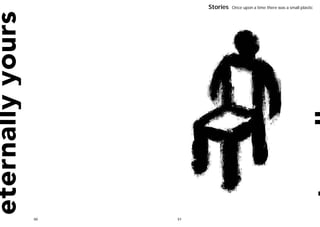
Stories   Once upon a time there was a small plastic


50   51
computer mouse. Every time its boss stroked its head it felt a strange       Besems he designed six identical pearl necklaces, each
              kind of itchy feeling go through its tail, a sensation it      with a different experience. For instance, one had a label
              never got quite used to. After that it could see things        with the name of a famous designer attached to it.
              happening on the brightly lit coloured screen nearby.          A second one was packed in a bar of chocolate and a
              Sometimes the light went out and this meant the little         third one was pictured as a weapon, to strangle
              mouse could take a nap. One evening something                  someone. Stories, true or not, can be part of a planned
              occurred that would for ever change the life of the            product career.
              simple grey mouse. As it happened the mouse’s boss             There are three types of stories. The first kind is created
              was a heavy drinker and a smoker too. On this particular       by companies around their products, like Coca Cola
              occasion he had decided he deserved a large whiskey.           commercials, or the adventurous car rally for the Camel
              While he was pushing the mouse around, changing                Trophy. Congress participants found the second kind
              things on the screen, he lit up a cigarette, but instead of    more powerful: stories that exist among users.
              throwing the burning match in the ashtray, it ended up in      Strong examples can be found around headstrong
              the booze. A burst of flame followed. The glass stood          products - the Citroen 2CV, the Apple Macintosh,
              under a shelf stacked with loads of paper. Frightened          the Harley Davidson - with true believers who sometimes
              the man quickly withdrew from his desk keeping the             establish ‘fan clubs’ for their favourite objects.
              mouse in his hand. Luckily its tail lay in a loop around the   This kind of product is often supported by magazine
              glass, which was instantly pulled to the floor.                articles. The fact that racing cyclist Van Vliet fell in a
              The fire went out quicker than it started. From that day       gorge wearing a Rolex made the watch more famous
              on alcohol was banned from the house. The mouse was            than it already was. The third kind consists of individual
              allowed to retire and got an honoured place in the             stories around mementos, valuable but hard to plan.
              former liquor cabinet.                                         The most important difference, however, appears to
              Even a story like this turns every computer mouse in a         exist between tales around products themselves and
              potential life saver. Although the chance of something         stories on brands. The question remains, why cars,
              like this really happening is remote, the product’s            motorcycles and watches produce more mythology than
              meaning is changed. Stories are an important part of           dishwashers, beds or office chairs.
              product identity. Stories can be generated by user
              experience and also artificially by ‘immaterial design’.
              The possibility of creating added value by cooking up
              associations was brought to the attention of Eternally
              Yours by designer Marcel Wanders. Together with Dinie

              52                                                             53
Advertising   Is this camera yours? If you happen to be the


54   55
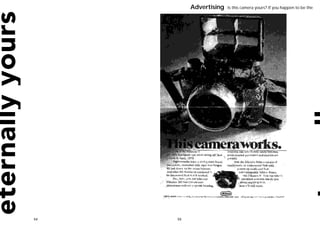
owner, of the same kind of camera, or one of the same brand, you will     however, because that is what products do after they are
             no doubt be proud. You are in possession of something        purchased and that is what producer-customer relations
             that is tough enough to withstand the most challenging       do as long as their mutual interest through the product
             circumstances. Many watches claim to be able to survive      remains intact by provision of services: providing
             the corrosive wetness of the deep, but by golly this         information, repair, and withdrawal for recycling when
             Nikon actually proves it, in an advertisement.               the period of use has ended.
             Traditionally advertising and commercials serve to sell      Communications and spreading information can support
             new products. These days, however, the emphasis is           all phases of the product life cycle and have to be
             gradually shifting towards enhancing the relationship        carefully planned. It starts of course with the origin,
             between producer and customer. Brand names are               the place where and the people by whom the product is
             becoming increasingly important. According to                made. After the introduction all kinds of things can
             Wim Hafkamp, stock prices went up sharply when               happen, some planned, like an exhibition on the
             Consolidated Foods changed its name to Sara Lee.             occasion of twenty-five year’s existence, participation in
             Companies want to promote a friendly and human               a movie, or presentation to a Nobel prize winner.
             image. Shell can no longer afford to dump large rusty oil    Some may be unplanned. Strange or spectacular
             containers in the sea. This phenomenon coincides with        incidents concerning the product or its providers can be
             the growing attention to relation management.                taken advantage of, not just to promote new articles,
             The main goal, however, is still to dispose of new           but also to make old ones more experienced and
             merchandise. In the view of Eternally Yours it would be a    dignified in the eyes of their users. And why not show
             good idea to stretch the purpose of advertising further,     what happens after discarding? Worn out objects can
             beyond the supreme moment of transaction.                    be considered heroic organ donors for new ones.
             According to communication expert Paul Mertz any             Whatever the communication content, lying or
             message can be brought across, including the kind that       concealment of the truth appears to be dangerous.
             supports the identity of products that in some cases may     Reebok claims that no children are involved in the
             have disappeared from the market years before.               production of its shoes. Other brands don’t.
             There is a story of a sick man complaining to his mate:      Eventually dishonesty will backfire on them.
             ‘Boy, am I thirsty. Boy, am I thirsty. Boy, am I thirsty.’   Still, there is no harm in fiction or fantasy.
             His friend gives him a glass of water. The man drinks it
             and after a while goes on moaning: ‘Boy, was I thirsty.
             Boy, was I thirsty.’ Until now advertising campaigns
             stopped after the glass was handed over. It could go on,

             56                                                           57
Consumers, costs and choice   Designers are capable of


58   59
creating household products which are far more durable than many          implications of sustainable development has led to a
             currently on the market. Companies claim that they           revival of interest in what we consume and how long
             would supply longer lasting products if this would           products last. For example, industrialists in the World
             enable them to maximize their profits.                       Business Council for Sustainable Development held a
             There remains doubt, however, about whether                  seminar in 1995 on what it termed ‘product life
             consumers want products that last longer and about           optimization’. Governments in Germany, the
             their willingness to pay a higher initial price.             Netherlands, Britain and Finland have recognized a need
                                                                          to increase product life spans in their waste strategies.
             As countries in Western Europe have become more              In addition, academics in a growing number of countries
             affluent there has evidently been little pressure to         are studying product life issues.
             improve the durability of products, although there have      ‘Sustainable consumption’ implies two things.
             been advances in reliability and energy efficiency.          First of all, consumers should have to pay for the full
             People tend to prefer buying more products rather than       impact of their consumption. At the moment the cost of
             better ones. Caesar Voute, a Recycling and Waste             dealing with waste generated by consumption is
             Control Officer in London, recently invited his five year    normally paid through local taxes rather than included in
             old son to count the number of electrical products that      product prices.
             he could find in a household and promised five pence for     Next, sustainable consumption requires the integration
             each one. He was rather upset - and rather less well off -   of consumption policy and waste policy, recognizing that
             after his son managed to name 237 different items!           the two are inseparable. Every act of consumption
                                                                          ultimately leads to waste. There is a need for consumers
             Interest in the life span of consumer durables started in    to be much more aware of the environmental impact of
             the late 1950s when Vance Packard in his book                their consumption, and to question the concept of
             The Waste Makers, coined the phrase ‘planned                 consumer sovereignty, the idea that whatever the
             obsolescence’. There was great interest at that time in      consumer chooses is right and appropriate for all
             the deliberate shortening of life spans by manufacturers.    citizens. As consumers, we have responsibilities as well
             Throughout the 1960s many people expressed concern           as rights. In particular, we need to recognize the
             at this trend, but not much happened in response.            cumulative effect of our acts as individual consumers.
             In 1982 the OECD produced its report ‘Product
             Durability and Product Life Extension’, but again little     In my report for the New Economics Foundation,
             practical action followed.                                   ‘Beyond Recycling: the longer life option’ I defined
             In recent years, however, debate about the practical         product durability as: ‘The ability of a product to

             60                                                           61
perform its required function over a lengthy period           Heiskanen also notes that in Finland the replacement of
under normal conditions of use without excessive              products is most often due to ‘relative obsolescence’
expenditure on maintenance or repair’.                        rather than product failure or breakage. I imagine that
What happens in practice, however, and how important          this is also the case in countries such as Britain and
to consumers are product life spans? There is a               America, but there is some contrasting evidence from
multitude of influences on consumers when they enter          the Netherlands.
shops. In Britain a market research company, Mintel,
regularly carries out surveys of the key factors that         In Britain the proportion of household income spent on
determine consumer decisions to buy particular                consumer durables has for a long time remained static,
products. It’s evident from these that durability is fairly   at just under 10 per cent. This is a growing sum in
low down their list of priorities for large appliances.       absolute terms, as incomes have been rising, but it
For example, people shopping for a washing machine            suggests that people are not putting a high priority on
are concerned about the reliability, energy efficiency and    getting better quality consumer durables as they get
how simple it is to use, but durability, though related to    richer. Many people appear content to buy relatively
reliability, does not feature on their list of primary        cheap products.
concerns. Shoppers for fridge freezers indicate concern       Affluence does not necessarily lead to environmental
about size or capacity, value for money, whether the          commitment. The influence of the so called ‘green
item is economical to run and whether there is a self         consumer’ has been somewhat overstated. It is often
defrost facility. Again durability is not considered          argued that a growing number of consumers are
especially important. When people are buying small            concerned for the environment and are willing to spend
kitchen appliances, however, key factors not only include     more on products that have a reduced environmental
how easy the product will be to use and to clean, how         impact. A survey by Gallup, for instance, found that nine
safe it is and whether it offers value for money, but also    out of ten consumers would make a special effort to buy
its likely durability. Significantly, consumers under the     products from companies trying to protect the
age of twenty-five consider durability a relatively low       environment. Surveys by Nielsen and at Oxford
priority compared to older consumers, and it has              University found that two-thirds of consumers say that
recently become less important than style and colour.         they would pay more for products with environmental
However, there appear to be significant differences in        benefits.
consumer attitudes between countries. A recent paper          In practice, however, the number of green consumers
by Eva Heiskanen suggests that consumers put                  remains relatively small. In the early 1990s evidence from
durability ahead of price in some countries.                  one supermarket suggested that only about one percent

62                                                            63
of consumers are ‘dark green’ (willing to spend                the lack of hard information about the design lives of
significantly more in order to live by their principles) and   products. In making a proper assessment it is vital to
that the market share for green labeled products was           differentiate between the cost of the product at the
only around 7 per cent. Since then, consumers have             ‘point of sale’ and the cost ‘per unit of service life’.
shown even less commitment. Some supermarkets have             A product that costs 50 per cent more than another but
actually withdrawn green products from their shelves.          lasts twice as long represents good value. One company,
                                                               ASKO, claims that its products are designed to last for
This might have happened because of the pricing policy         15 to 20 years. However, it is worth noting that its chief
of companies, which makes many greener products                executive said in a CBI seminar a couple of years ago
prohibitive to all but the more affluent consumers.            that the profit margin on an appliance that costs over
Also there is a fair amount of scepticism about the            £700 would be 18 per cent, whereas that on a budget
impact that any individual consumer can have on the            priced appliance would be just over 6 per cent.
environment, and a lack of empathy between consumers           The benefit to the consumer of a premium range
and companies, which means that consumers do not               appliance therefore does not increase in proportion to
trust advertising claims made about the environmental          the price. Higher prices are certainly no guarantee of
impact of products.                                            better quality. In recent reliability surveys carried out by
According to a Roper Organization survey, more than 40         ‘Which?’ magazine for the Consumers Association,
per cent of consumers consider green products to be            reputable companies like Philips, Bosch and Hoover did
too expensive. An acceptable ‘green premium’, the              not always have particularly good track records in terms
willingness to pay more on altruistic grounds as distinct      of reliability. In addition, premium prices are often
from self interest, is no more than 5 per cent. Only a very    charged for additional features rather than better
small number of consumers, no more than one in twenty,         intrinsic quality.
are willing to pay a larger premium of, say, 15 per cent.      Even if we assume that longer lasting products do offer
My conclusion is that the price of longer lasting products     better value, consumers may not act in an economically
must be justified to consumers on the basis of economic        rational manner. There is evidence from sales of energy-
self-interest if the market is to grow. Thus it is necessary   efficient products that consumers have a high discount
to question whether longer lasting products currently          rate: they require a relatively quick pay back for any
represent good value in purely economic terms.                 investment. Moreover, many consumers are unaware of
                                                               the total cost of consumption. Karl Kollmann has drawn
Purchase decisions are frequently arbitrary. Consumers         attention to the significance of what he terms the
often find making a reasoned choice difficult because of       ‘hidden cost of consumption’, the money spent on

64                                                             65
operating and repairing appliances, which he estimates       energy, were £11 for the Bosch and £20 for the Candy,
accounts for as much as 50 per cent of the total cost.       and the repair costs were £24 in both cases.
There are also transaction costs - driving to shops and      This meant that, with all the aforementioned qualities,
buying a product, getting rid of the old item and so         the Bosch would cost £70 per year and the Candy £73
forth.                                                       per year. The Bosch therefore appears to offer slightly
On the other hand, the recent reduction in operating         better value because of its longer life span. If the
costs for white goods, because of their increased energy     products had similar life spans, the Bosch would only be
efficiency, means that durability is assuming greater        a better buy if in addition to its lower energy costs,
significance within total costs.                             it was cheaper to repair.


In order to consider the evidence that high quality          For the freezer example, I compared a Bosch GST2617
products offer better value for money, I recently            that costs £520 and a Scandinova UF82C costing £290.
compared two washing machines and two freezers.              I assumed that the Bosch might be expected to last 20
In both cases the appliances cost significantly different    years and the Scandinova 15 years. The energy cost of
amounts, while apparently offering similar basic features.   the Bosch was £32 per year, whereas for the Scandinova
I selected the products, arbitrarily, from information       it was £61. In both cases repair costs were £25 per year.
supplied in ‘Which?’ and applied assumptions about           This meant, again with the aforementioned qualities,
their life spans, which consumers might reasonably           that the total cost of the Bosch would be £83 per year
make. It was assumed that a premium range washing            and that of the Scandinova £112. The Bosch thus
machine should last 25 per cent longer than a budget         appears to offer better value. This is true even if the
range product and a premium range freezer should last        Scandinova was to last as long as the Bosch, because of
33 per cent longer than one in the budget range. In the      the Bosch’s far superior energy efficiency. The
absence of any data it was also assumed, rather              Scandinova would only be cheaper if it lasted as long as
unrealistically, that the annual cost of repairs does not    the Bosch freezer and consumed far less energy than
change over time.                                            was the case.


The washing machine comparison was between a Bosch           These simple comparisons do not, of course, offer
WFF2000 which costs £520 and a Candy 1000DS priced           conclusive evidence, but they do indicate an economic
at £350. I assumed that a reasonable life span for the       advantage to the purchase of premium range products.
Bosch machine would be 15 years and for the Candy            Given this conclusion, I shall offer three ways in which
machine 12 years. Annual running costs, in terms of          longer lasting products might be made more attractive.

66                                                           67
First, environmental economists point out the need to         containers. In the third place, there is a need to
‘internalize’ the full costs of consumption. In other         overcome the problem that repair costs are often high
words, when a product is manufactured, transported and        relative to the cost of buying new products.
used, it has an impact that affects not only the consumer     Here, one might envisage the abolition of VAT on repair
and the producer but also the rest of society.                work, coupled with the promotion of design for
For example, global warming caused by the use of              disassembly and the standardization of parts.
energy will require protective measures around our            There are, of course, other possible changes which
coasts, discarded products require the establishment of       would be complementary, such as applying minimum
landfill sites or recycling facilities, and resources once    standards of durability to appliances, just as in some
depleted are no longer available to future generations.       countries there are minimum energy efficiency
One solution proposed by economists is ‘ecological tax        standards.
reform’, switching from taxing labour to taxing energy,       Claims that longer lasting products currently offer good
raw materials and landfill sites.                             value for money need further evidence.
Second, the total cost of a product during its service life   This will only be possible once manufacturers are more
should be made more visible to consumers, so that they        open and willing to release information about the design
appreciate that its true value is determined by how long      life of their products. In order to attract consumers any
it lasts. This will require producers to supply information   current economic advantage to the purchase of such
about each product’s design life so that consumers can        products must be increased if they are to become the
compare prices in the light of the amount of activity, or     norm rather than the preserve of a small affluent elite.
use, that they might expect from it - just as one buys        This will require wider economic reforms by government
food products per unit of weight. One option is a label       as well as much more effective marketing.
on all electrical appliances with the product’s
‘anticipated life span under normal conditions of use’.       Tim Cooper
Another, highlighted in the OECD report, is selling
products with much longer guarantees. These could
cover labour as well as parts and perhaps last for 10
years or more. This would represent a move from paying
for a product to paying for the service supplied by the
product, which might be a welcome trend. After all,
consumers buy refrigerators because they want food to
be kept fresh, not because they like rectangular white

68                                                            69
Conservation   Regular refrigerator disposal


70   71
serves the environment. ‘She remains what she has been for many            Then we have the products that do need energy but
             years, an absolute strange delight, whose gift lies           cannot be expected to improve in energy efficiency.
             outside her achievements as an actress, is not tied to a      They too are best kept away from recycling plants,
             specific time and does not depend on the taste of the         incinerators and landfill sites. The other two groups do
             moment.’                                                      have a positive expectancy of efficiency improvement, of
             This quotation from Cecil Beaton seems to be the              which one has an optimum life span that is longer than
             description of a perfect product, but is in fact about        its current one and that therefore needs extension.
             Marlene Dietrich. Researcher Gerda Zijlstra used it to        Zijlstra estimates that even for products with an energy
             question Eternally Yours’ point of departure that lasting     consumption during use as high as 80 per cent of the
             products reduce environmental impact.                         total, life extension is sensible. Life extension is wrong
             Well, it depends. Environmental damage is the complex         only for the last product category, as its optimum life
             consequence of production, use, recycling and getting         span is shorter than or the same as it is presently.
             rid of the leftovers. For some products the making            Product life extension may have detrimental effects for
             process may consume a great deal of energy and cause          what production and discarding do to the environment.
             all kinds of pollution. Other products use a lot of           In some instances the relation with manufacturing is
             electricity themselves and produce emissions indirectly,      established. For instance, pantyhose last considerably
             whereas there are also articles that misbehave in the         shorter when they are made of finer threads, according
             waste stage.                                                  to a fixed and known relation. A general statement is
             Zijlstra studied several projects on product life extension   impossible to make, however, as every separate product
             in literature. Researchers appear to disagree mostly on       requires its own decisions. The same holds true for
             the question whether or not longevity should be               prevention of environmental damage in the waste stage.
             preferred over recycling. The ever continuing innovation      According to Zijlstra the most sensible thing to do is
             process complicates things as waste production and            seek a harmonic combination of a long life span and
             especially energy consumption tends to diminish over          recyclability.
             time. This implies that there may be an optimum life          Interestingly product innovation generally appears to
             span for some kinds of products, depending on their           have a positive environmental effect and needs
             expected change in energy efficiency.                         stimulation. Combination of life span elongation and
             The researcher makes a distinction among four                 innovation through modification may be even more
             categories of products. The first kind does not use any       advantageous. The trouble is, that the market may not
             energy when in use and should theoretically go on             always appreciate efficiency improvement. For some
             existing forever to minimize environmental impact.            reason cars are becoming heavier and more powerful.

             72                                                            73
Inventing the future   Telephones should have the


74   75
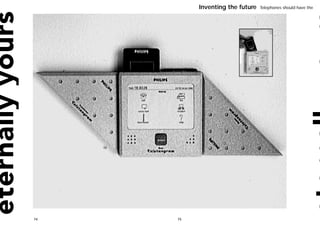
right to be puzzling. When experts discuss product life extension they      extra functions like voice mail, voice control and even a
              usually have an image of complete task performers in          room thermostat. Hardware modules include a printer, a
              their minds. So when a product is worn out, or needs to       scanner and a baby intercom. For every module added
              be replaced because of technological backwardness             an icon appears on the screen.
              compared to successors, they project this on its entirety.    Modularity is a very promising option although the
              How wrong they are. Tradition knows better.                   different elements of a system are difficult to define in
              An acquaintance in Amsterdam, for example, lives on a         view of future developments in both technology and
              wooden boat, which is over 150 years old.                     markets. Every decision bears the risk of restricting the
              This is the truth as well as a straightforward lie, because   system for many years.
              all the planks that the ship consists of have been            Still, there are many advantages. Van Nes made an
              replaced at one time or another. The vessel has been          example calculation that indicates a 30 to 40 per cent
              repaired numerous times and several parts have been           reduction in use of materials in comparison with
              substituted by improved versions. The ship literally is not   competing products over a 15 year period.
              what it used to be.                                           To consumers products like these mean greater
              Repair and upgrade can serve as a strategy to decrease        flexibility as they can adapt them to changing demands.
              material turnover and diminish environmental impact.          In addition the uniformity of the concept promotes
              When one part of a device stops doing its duty it             transparency of control. This may strengthen the bond
              shouldn’t be necessary to get rid of the whole thing.         between user and product that also has the chance to
              And when the power supply of some piece of equipment          become tighter simply because it stays in use for a
              is no longer as efficient as newer ones, it should be able    longer period of time.
              to yield its place within the product to a worthier           The same may happen to the relation between provider
             successor.                                                     and customer, especially in combination with a functional
              Nicole van Nes graduated on a study to discover the           leasing arrangement. It is a step towards providing
              possibilities of life span extension by design for repair     services rather than selling products. Van Nes suggests
              and upgrade. She considered reprogrammability, self-          follow-up projects on coffee makers and audio sets.
              diagnostics, modular composition and leasing for a            Although modularity may provide a strong grip on life
              telecommunication product she had designed and called         span extension, it has its limitations.
              Teletangram. It consists of an advanced basic telephone       It can certainly not be applied to all products.
              with a small touch screen to which the user can add
              different kinds of extension modules. Some take the
             form of a chip card and contain software to provide

              76                                                            77
Equality’s safety belt   ‘But by and by they came to my


78   79
watch, which I had hidden away in the inmost pocket that I had, and        themselves, and tickets with writing on them in a
             had forgotten when they began their search.                   character which I could not understand.
             They seemed concerned and uneasy as soon as they got          There were fragments of steam engines, all broken and
             hold of it. They than made me open it and show the            rusted; among them I saw a cylinder and piston,
             works; and when I had done so they gave signs of very         a broken fly-wheel, and part of a crank, which was laid on
             grave displeasure, which disturbed me all the more            the ground by their side. Again, there was a very old
             because I could not conceive wherein it could have            carriage whose wheels, in spite of rust and decay, I could
             offended them.’                                               see, had been designed originally for iron rails. Indeed,
             These observations stem from ‘Erewhon’, the topsy-            there were fragments of a great many of our own most
             turvey utopia of Samuel Butler, published in 1872.            advanced inventions; but they seemed all to be several
             The narrator of the story crosses a pass in a snowy           hundred years old, and to be placed where they were,
             mountain-range, and arrives in the unknown country of         not for instruction, but curiosity. As I said before, all
             Erewhon. At first the inhabitants behave friendly and         were marred and broken.’
             hospitable. Things change after the discovery of his          At last they come to a case containing several clocks and
             watch. The chief magistrate who is in charge of the           two or three old watches. These are compared with the
             investigation of the visitor, suddenly shows signs of         watch of the narrator. Again an indignant speech is
             horror and dismay. Initially the narrator surmises the        delivered but, due to the lack of mutual understanding,
             usual reaction of savages who have no experience of           it has no effect. Only when the narrator puts his watch in
             European civilization. But soon he discovers that he has      the case with the others, the magistrate calms down a
             misinterpreted the expression on the magistrate’s face.       little. He seems to understand that the narrator must
             It shows more hatred than fear. When a short and stern        have taken his watch with him without any intention of
             harangue is of no use since the visitor doesn’t               violating the laws of Erewhon. Anyway he does not get
             understand the language of the country, the magistrate        condemned but is treated generously by the inhabitants.
             conducts him to a large room, that turns out to be some       What kind of law has been violated by the narrator?
             kind of museum.                                               At first he thinks he is suspected of contrabanding:
             ‘It was filled with cases containing all manner of            maybe he has accidentally evaded the usual tolls of the
             curiosities - such as skeletons, stuffed birds and animals,   country. It is only after a long time, after having learnt
             carvings in stone (whereof I saw several that were like       the language and after getting used to manners and
             those on the saddle, only smaller), but the greater part      customs, that he discovers the real reasons of the
             of the room was occupied by broken machinery of all           magistrate’s anger. Some five hundred years before his
             descriptions. The larger specimens had a case to              arrival the Erewhonians decided to destroy all

             80                                                            81
mechanical appliances. This happened because they           In future communism things should know their place.
feared that in future machines might rule the people.       They are only produced in order to serve mankind.
The narrator discovers a copy of an old treatise,           Under communist rule only their use-value counts.
‘The Book of the Machines’, which brought about the         Being a typical Enlightenment philosopher, Marx gives
revolution. It provides the legitimation for the            man a central place in his universe. In his view things
destruction of all machines. Initially this severely        don’t occupy any place at all in the ideal future society.
diminished the welfare and conveniences for the             In Erewhon Butler expresses the same idea. But since he
Erewhonians. The narrator estimates they had reached        is telling a semi-utopian story he can present us with an
at least the economical and technical stage of              image of a society in which modern machines and
development of nineteenth century England. But finally,     products simply don’t exist. In Erewhon only people and
after a long civil war between the machinists, who          their direct relations are important. In the description of
wanted to keep the machines and the comfortable life-       Butler, which - I admit - is rather cynical, the Erewhonians
style that went along with them, and the anti-machinists,   seem happy without the presence of modern things.
the latter party prevailed and the Erewhonians found a      When you read its name backwards you will know where
new happiness in a world without mechanical devices.        to find Erewhon on a map. My claim for this lecture is,
                                                            however, that, although it may be nowhere, Erewhon still
‘The Book of the Machines’ is one of the main               depicts a general feature of our modern plight in a very
documents that allow us to catch a glimpse of the           astute way. It shows the anthropocentricity and the
uneasy relationship of modern man with his products.        contempt for things that characterizes modernity.
Its key message seems to lie in the fear that in future     Contrary to the Middle Ages, and to all traditional
products will rule mankind. It so happened that in the      cultures for that matter, things don’t have a place of
same period Samuel Butler was telling a story about this    their own anymore in modern society. The presentation
anxiety, the critical thinker Marx expressed it in a        by my two colleagues at Twente University, Peter-Paul
philosophical way.                                          Verbeek and Petran Kockelkoren (‘Matter matters’),
According to Marx, the things we make ourselves             shows that this even holds true for the discipline of
acquire all the characteristics of ancient fetishes.        designing and for some of the attempts of Eternally
They are endowed with spiritual qualities that we don’t     Yours to strengthen the bond between users and
understand and they are ruling us instead of serving our    products. I would like to illustrate this situation by
needs. Marx considers this a reversal of the normal         analysing a philosophy that many present-day designers
subject-object relationship. The deepest intention of his   deem important as a background for their work: that of
philosophy is the attempt to reverse this situation.        Jean Baudrillard. His key message, strange though it

82                                                          83
may sound, can be summarized as follows: only people         quantity of products with which we surround ourselves
matter, things are of no value at all. Even Marx’s use-      must be interpreted as a way of making the necessary
value has disappeared from this perspective.                 social distinctions in a society in which these risk getting
I will begin my analysis of Baudrillard’s philosophy with    lost with the rise of the idea of equality.
two quotations from Adam Smith, the father of the            Smith’s key message is repeated by Jean Baudrillard in
modern science of economics, in which the ideas of           his important study ‘La societé de consommation’.
Baudrillard are already foreshadowed. ‘The rich man’,        Baudrillard uses the language of semiotics to describe
Smith writes, ‘glories in his riches because he feels that   the post modern relations of man to his products.
they naturally draw upon him the attention of the world.     In semiotics signs are studied in relation to other signs.
At the thought of this, his heart seems to swell and         The reality that a sign is supposed to refer to its user, is
dilate itself within him, and he is fonder of his wealth,    deemed less important than the structure of the system
upon this account, than for all the other advantages it      of signs itself. Baudrillard takes up these ideas, which
procures him.’                                               originally stem from the science of structural linguistics,
For Adam Smith it is evident that the main reward of         in his analysis of our modern way of producing and
wealth, the products with which the rich man surrounds       consuming. He wants to understand one of the most
himself, is the envy or esteem of other people. In itself    important phenomena of modern times: the continuous
wealth seems to have little or no importance.                and ever increasing flow of products.
My next quotation from Smith makes the same point            According to Baudrillard it is impossible to grasp our
from a more societal perspective: ‘Nature has wisely         fascination for products when we assume that they
judged that the distinctions of ranks, the peace and         mainly incorporate use-value, that they are produced in
order of society, would rest more securely upon the plain    order to simply fulfil our needs. Also the Marxian
and palpable difference of birth and fortune, than upon      interpretation, that in a capitalist society, products only
the invisible difference of wisdom and virtue.’              incorporate exchange value, that they are only produced
And he continues that since in our modern society of         in order to make profit, in Baudrillard’s view does not
equality, the distinction of birth has almost disappeared,   offer an adequate explanation for modern consumer
the distinction of fortune becomes of uttermost              society. Finally, the symbolic worth of things that was
importance and should be displayed by the possession         predominant in every traditional society also cannot
and consumption of many things. Only conspicuous             explain the continuing flow of new things in modernity.
display of wealth is, according to Smith, discernible for    Use value, exchange value and symbolic value are
‘the undistinguishing eye of the great mob of mankind’.      replaced by what Baudrillard calls ‘sign value’.
In the vision of the father of economics the great           For Baudrillard this concept embraces much more than

84                                                           85
the sociopsycho-logical meaning of a product.                  In language signs also derive their differential function
Without denying its importance, Baudrillard claims that        from the fact that they are part of a system of equals.
our products more and more can be looked upon as               For the same reason the differentiations we create by
signs. Their value consists in the place they take in the      using and consuming products, repeat themselves in
total system of signs, in the way they differ from other       ever different ways. Here we also find an answer to the
signs. Their value is no longer determined by the way          question why modern societies continuously have to
they refer to reality, as is the case with symbolic value,     create the suggestion of something new.
use value and, in a certain sense, exchange value.             The mechanism of differentiation simply doesn’t stop.
Neither does value of modern products lie with the             With this theory Baudrillard can perfectly explain the
persons using them. The only value of modern products          manifold lifestyles that are emerging at present.
is their code, the difference with other signs, and            At the same time it does not offer any foothold to a
consequently with other products.                              designer who wishes to strengthen the bond between
A well known but still clarifying example is the length of     users and products, which, according to Baudrillard,
skirts. It refers far less to warm or cold weather, to what    was present in traditional societies.
is comfortable or uncomfortable to wear, to modesty or         Here equality was not the pervading idea. People were
immodesty, or even to elegance or the lack of it, than it      different by what he calls ‘opposition’. Opposition is
does to fashion. And what can be said about fashion in         based on essential inequality and plurality and this in its
the strict sense of the word, according to Baudrillard         turn allows mutual enriching exchange between people,
holds true for the greater part of our way of dealing with     in which things play an important part, not as signs but
products. I think for instance that it can easily be applied   as symbols. They are unique, like people themselves, not
to the car.                                                    part of a system of equal signs. According to Baudrillard,
The need for social differentiation that Adam Smith was        the bond between product and user or owner, which is
talking about and that characterizes all cultures, is          what Eternally Yours is looking for in the modern society
satisfied in our modern and post-modern culture by the         of today, can only be found in traditional societies.
consumer system. By their products people indicate
which groups they like to feel part of. In traditional         For the purpose of durable design Baudrillard seems to
cultures this was not necessary as it was clearly marked       have nothing to offer but the suggestion of a way out by
in a variety of ways. In the modern culture of equality        going back into the past. Since this backward direction
people continually have to construct differentiations          seems impossible to me, I have turned to two other
themselves. Here we find the main reason why                   thinkers, in order to find some positive suggestions for a
Baudrillard considers products to function as signs.           modern and durable way of dealing with things:

86                                                             87
Hannah Arendt and Bruno Latour. In her most important          products of our working activity.
study ‘The Human Condition’ Hannah Arendt makes a              When we follow Arendt’s analysis in ‘The Human
difference between three aspects of our Vita Activa,           Condition’, we discover that modernity severely
our active life: labour, work and action. In order to          endangers the activity of work. Modern man is inclined
understand our relation to our products, the distinction       to view all producing activities as labour, and all products
between labour and work is of the utmost importance.           as consumption goods. The lesson from Arendt might be
In labour we essentially reproduce our lives. We make          that only when we try to retrieve the aspects of work,
products that we have to consume in order to keep on           will we be able to create products that have a certain
living. In work we build a world in which we can live.         durability. From the viewpoint of labour this seems
We make things that are not consumed but used. And as          impossible, even if we put a lot of effort into good
we use these things, we become accustomed to them.             marketing or into weaving stories around products.
An extreme example of the difference between the               When producers and designers look at products mainly
products of labour and work is the distinction between a       as things that must be made fit for consumption, it is
loaf of bread that is eaten in about one day and a table,      extremely hard to give them an independent and
which may easily survive generations. Products of work,        durable life of their own.
being lasting things, give rise to the familiarity of the
world, its customs and habits of intercourse between           Complementary to Arendt’s viewpoint and to the critical
people and things as well as between people                    insights of Baudrillard, the French sociologist Bruno
themselves.                                                    Latour pleads the rehabilitation of things in modernity.
According to Arendt they give us our identity.                 Or rather I should say, that he focuses our attention on
‘The things of the world have the function of stabilizing      the fact that, notwithstanding the analysis of Baudrillard
human life, and their objectivity lies in the fact that - in   and partly that of Arendt, things still play an important
contradiction to the Heraclitean saying that the same          part in our modern world.
man can never enter the same stream - men, their ever          ‘We never have been modern’, the title of one of his
changing nature notwithstanding, can retrieve their            latest books, conveys this message perfectly. Latour
sameness, that is their identity, by being related to the      turns the idea that in modernity only people and their
same chair and the same table.’ Arendt maintains, that         relations matter (Butler, Smith and Baudrillard), upside-
the products of work are not just made for consumption.        down. The outstanding and distinguishing feature of the
They have an independence of their own. They are part          modern world, according to Latour, should not be
of the world that we have constructed as a place to live       looked for in the reign of mankind over blind and dead
in. The permanence of the world is guaranteed by the           matter as the Enlightenment professed, but contrarily in

88                                                             89
the proliferation of things. The ever growing networks
that modern man is building are composed of humans
and things alike. And in these endless chains things, as
much as persons, can become actors, ‘actants’ in the
words of Latour.
He takes a strictly symmetrical position between humans
and things insofar that he does not know beforehand
which kind of activity, ‘actance’, may be important in a
given situation. Sometimes the working of the thing will
carry the day, at other times human acts, for instance
rational and moral arguments may be preponderant.
But, contrary to our enlightenment beliefs, things may
also be considered moral actants, in so far as they
admonish or force us to behave morally. One of Latour’s
most famous examples is the safety-belt, that protests
when it is not clasped on before starting to drive.
It would take us too long to enter into the implications
of Latours work for designers. I only want to stress the
importance of his universe in which things get an equal
place aside persons, compared to the utopian world of
Erewhon, which envisages the abolition of all things as
the absurd consequence of modernity.


Hans Achterhuis


90                                                         91
Morality   Never mind about design classics.


92   93
It’s durability that counts. If the observation that every product reflects    a special target group to specifying energy efficiency in a
              elements of public morality is interesting, then the             dishwasher. The other option is technological
              suggestion that designers could exploit this                     manipulation. It implies that a product can only be used
              phenomenon is intriguing, because of its ‘matter over            in a responsible way, like the safety belt mentioned by
              mind’ presupposition.                                            Hans Achterhuis. This kind of moralizing is a lot more
              In the past this kind of thinking was not uncommon.              solid, because if done in the right way it leaves the user
              Baroque art in the seventeeth and eighteenth centuries,          without any decisions, for example, with regard to
              for instance, had to reemphasize Roman Catholic values           driving beyond the speed limit or opening a dangerous
              as opposed to Reformation ideas, and its exuberance              compartment in a computer. It is simply impossible
              had to impress the public with the wealth and power of           because of certain technical tricks.
              its leaders. Later on, just after the 1900s, Modernists
              sincerely believed that austere geometric shapes of              Eternally Yours morality involves not wasting any object.
              buildings and objects would uplift the masses.                   It might be interesting to explore ways to achieve this.
              The issue of built-in morality raises several questions.         The symbolic option leads us straight to the heart of
              The first one: is it at all possible to design for a different   what started off Eternally Yours in the first place.
              morality than the ruling one in order to change                  Objects should somehow express that throwing them
              behaviour? Even more pressing is the question who                away is a crying sin at all times. One way to do this is a
              decides what kind of behaviour a certain product should          simple matter of quality. If a well-made chair hardly
              enforce. It would take hours and hours of discussions            shows any traces of wear as it gets older, chances are
              just to determine responsibilities.                              that it will stay in use for a long time. And if time does
              Suppose society can solve these fundamental problems,            influence its appearance it should become more
              then designers are left with numerous issues of a more           beautiful with age. Moreover products should evoke
              practical nature. To start with, they can distinguish            care and respect.
              between expressing morality in a symbolic way, like              Technological solutions to make objects stay in one
              using the colour red or printed words to prohibit or             place or to electronically attach them to one or more
              stimulate certain actions. Something like this is manifest       individuals are feasible. It is for example possible (and
              in present American society where the extreme                    not all that expensive) to link an object to, say, a
              popularity of law suits indirectly provides all products         transponder implanted in someone’s earlobe.
              with a host of patronizing warnings. There are lots of           But such ideas don’t have the right feel to them. What
              more subtle variations on this theme, all the way from           remains is that product quality and its ability to age is a
              indicating by shape and texture that a chair is meant for        moral issue.

              94                                                               95
Old and new   We present the newest of the oldest.


96   97
Marcel Wanders designed this curious collection of contradictions in         age. They should be the bearers of ‘old metaphors’.
             the shape of a chair in 1996, as part of the Dry-tech           Droog Design founder Renny Ramakers suggested that
             project, organized by Droog Design. At first sight the          this may be the reason ageing beautifully usually is
             already famous ‘knotted chair’ cannot be associated with        associated with materials like leather and wood.
             newness, and it looks familiar, as if some small furniture      They were once alive and ageing and therefore possess
             maker made it fifty years ago. Looking closer we can see        the natural ability to deal with time. Even when new they
             that this couldn’t possibly have happened. There is             carry their oldness in them.
             simply no way that anyone can braid pieces of string into       Wanders takes an extreme standpoint. He considers all
             a chair that is strong enough to sit on. The chair is in fact   objects collections of mere information that everybody
             made out of specially twined high-quality cord consisting       can interpret at will through all their senses.
             of carbon fibres with an aramid jacket. Wanders macra-          It is the reponsibility of designers to communicate to
             més the material into a braid. The result is a slack net        people, to tell them stories by the objects they create.
             drenched with plastic resin and hung within a metal             And the information should involve respect for old age.
             frame, just like laundry. Gravity creates the chair shape,      The knotted chair illustrates some practical solutions.
             which is ultimately fixed by hardening the resin in an          For one, it possesses this strange mixture of traditional
             oven. Finally the finished chair is detached from the           craft and state of the art technology. There obviously is
             frame.                                                          no baby face metaphor involved. As for the material: it
             There is nothing fortuitous about the look of this chair.       has a friendly look that does not bear any resemblance
             Wanders observes a growing disrespect for old age in            to the plastic and the fibres it consists of. It is rich and
             western society. Old people get locked away in special          captivating because of its variation of texture, and will in
             institutions and even products appear to have no chance         all likelihood keep this property for a long time, no
             to age respectably anymore. For this he blames design-          matter how dusty it gets. The only disadvantage is that
             ers, because they are more obsessed with youth and              the chair looks more comfortable than it feels when you
             newness than any other group in western society.                sit on it. A cushion is the most obvious solution to this
             According to Wanders they suffer from ‘baby face                insignificant problem.
             fixation’. This syndrome makes them design products
             that bear no reference to old things: ‘They look like
             eggs, babies and other young images.’ Forever young,
             they lack the ability to gain quality over time, which
             makes them temporary friends that one cannot rely on.
             Instead every new object should somehow respect old

              98                                                             99
Matter Matters   A spectre is haunting design:


100   101
the spectre of platonism. When looking at the history of design, this         the object that counts, but the function it fulfils.
              paraphrase of Marx’s famous dictum forces itself upon           Of course it cannot do without matter for its
              us immediately. The very discipline that is almost entirely     embodiment, but this materiality in the end is of
              dedicated to matter and material culture, strangely             secondary importance. The physical characteristics of
              enough seems to be trapped in a way of thinking that            the product are only seen in the light of the product’s
              totally neglects materiality. We will show that this goes       function. Form follows function: matter is necessary but
              for the Eternally Yours programme as well.                      derivative. Indeed, Rietveld designed chairs as
                                                                              ‘objects for sitting in’ and Le Corbusier saw a house as
              Let’s explain this somewhat provocative statement.              ‘a machine for living in’.
              The history of design can roughly be divided in two main        Post-modern design, in its turn, is trapped within
              periods: modernism and post-modernism. After some               another form of platonism. Here products are not
              initial protests and transitional phenomena, design first       reduced to their function but to their meaning.
              developed under the regime of functionalism.                    Products become icons, symbols or signs. They do not
              Products were conceived as embodiments of function.             even need to be durable anymore, as they did for
              They had to do their job well and be durable and easy to        modernists. This indicates, that to post-modernism
              produce in large quantities, and they did not need              matter is even less important. Objects are seen as
              decoration.                                                     embodiments of meaning, and it is from this perspective
              In the Fifties modernism ended with Contemporary                that they have to be designed. The platonic anti-
              Style, when the way was paved for Pop Design and,               materialism is evident. Post-modern designers are not
              eventually, Post-modernism, some 20 years later.                primarily concerned with things, but with ideas.
              From then on not the function of the object became the
              key issue, but its meaning. Products had to fit culture,        Platonism and durability
              with all its different lifestyles. So where is the spectre?     What does all this have to do with the lifetime of
              Everywhere. In both modernism and post-modernism,               products, the topic we are supposed to be discussing?
              products are seen mainly as secondary, material shadows         Let’s start again with modernism. As the German
              of something non-material that is considered primordial.        philosopher Karl Jaspers already indicated in the early
              Apparently design has always been an idealist rather            thirties, the modernist emphasis on function results in a
              than a materialist discipline.                                  loss of attachment to products. When artifacts are
                                                                              designed mainly to fulfil a function, the individual
              The functionalist orientation of modernism, by definition       characteristics of a product become less important.
              reduced artifacts to their function. In this vision it is not   In his view functionalist products develop into ideal

              102                                                             103
types that function well and can be produced easily but         are still not ‘eternally ours’, despite the post-modern
don’t evoke individual attention: ‘When [the ideal type]        abundance of styles.The insight that design has
has been realized, attachment to one specific exemplar          developed into a platonic discipline may be of help here.
indeed has no relevance anymore; one only loves the             The neglect of materiality, implies that the very design of
form, not the specific object. Despite all artificiality, one   products up until now has been directed at most
has a strange, new nearness to the objects, ... namely to       towards attachment to the ideas they represent and not
them in their function.’                                        to the products themselves. With this statement, we do
                                                                not want to suggest that meaning doesn’t have anything
Modernism, in other words, leads us away from matter            to do with our attachment to things. We feel it does,
towards the idea of function and in doing so diminishes         a lot in fact. After all, every product carries meaning.
our attachment to products, which in its turn may well          But if our attachment only concerns this immaterial
lead to shorter product life. Because, however durable          aspect and not the object itself, it is destined to remain
products may be physically, in a culture where people           secondary. It can easily be replaced at any time by
only care for them because of what they do, they will be        another artifact with the same immaterial quality.
easily discarded and replaced.                                  In order to increase product lifetime, we therefore think
Looking at the lifetime of products from this                   designers should not only create things that are
perspective, post-modern design seems to be a giant             meaningful, but things in which meaning is firmly
improvement, because it focuses on the symbolic                 anchored in their materiality. Things should direct
character of artifacts. Jaspers’ critique appears               attention towards themselves instead of just being a
outdated: his call for meaning has become irrelevant            material embodiment of meaning. We should not be
now that post-modern design has shown a true semiotic           able to obtain meaning and objects separately.
explosion. The emphasis on function has disappeared             Only then will products themselves be durable, and not
from design and mass-produced objects can be                    just our need for meaningful objects to fit our lifestyles.
obtained in so many styles that the fear of a uniform
material culture seems unfounded.                               How does this relate to the Eternally Yours programme?
But Jaspers’ worries are not as outdated as they seem.          Let’s look at the outcome of the three expert meetings
His opinion on material culture is indeed too much              Eternally Yours organized in November and December
directed towards functionalism to be up-to-date, but his        1996. The meetings covered the three topics which
worries about a loss of attachment with material culture        Eternally Yours explores: Signs ‘n Scripts, Shape ‘n
is not irrelevant. After all, his worries are exactly the       Surface and Sales ‘n Services. We quote the summary of
same as the ones troubling Eternally Yours. Our products        the outcome of these meetings:

104                                                             105
‘In Signs ‘n Scripts the main topic was the creation and      products into account. They understand products as
control of stories around products. Shape ‘n Surface          elements of certain languages: of form, of product
provided the insight that meticulous care for quality and     meaning, of relationships between company and
detail with which new products are developed, is more         customer. But when we strip all non-material aspects of
likely to determine product longevity, than specific          products, something remains that is more than language,
geometrical characteristics, style or features. But a lot     more than symbol, meaning, function, or icon. We could
still has to be learned about the relation between            call this the ‘own weight’ of the product as an artifact. In
behaviour of product surface and change in time.              order to do justice to this ‘own weight’, the ‘materialist
The last meeting was about Sales ‘n Services.                 turn’ in design, we would like to propose here, demands
Some companies, most of them in the realm of                  an extra perspective in our thinking about things. To the
professional products, appear to already shift the            dominant semiological approach within design thinking,
emphasis in their activities from just selling new products   a second angle needs to be added: the
to maintaining a relationship with customers. In view of      phenomenological one. Phenomenology is a
this change there is a new kind of employee, called a         philosophical movement from the beginning of this
‘relations manager’. In sustaining relations the material     century, that has renewed itself and is starting to
product mainly serves as a conversation piece that keeps      become popular again in the USA. It can be viewed as
on generating turnover for years after its birth.’            philosophy’s attempt to understand everyday human
                                                              experience. Its slogan was ‘back to the things
It may be clear that materiality remains almost               themselves’1 and that seems very applicable to the
completely out of sight here. Signs ‘n Scripts is all about   subject at hand.
the stories around products and in Sales ‘n Services,         We will not tire you with the subtleties of this approach,
products are only relevant as conversation pieces.            apart from saying that phenomenology, since it tries to
Only in Shape ‘n Surface are products seen as objects,        understand our everyday relation to reality, offers lots of
but here the physical characteristics of products seem to     insight into the relationship between people and
be immediately translated into terms of attractiveness.       products. In our view, this is what we should focus on in a
Platonism evidently appears to be at work here as well.       materialist approach. After the iconological
We feel that attempts to realize ‘durable design’ should      deconstruction of products, we should not only try to
not only focus on signs, shapes, surfaces, sales and          reconstruct them and create new icons. We should also
services. However important they are, all of these issues -   try to understand what remains after this deconstruction:
we deliberately did not mention ‘scripts’ for reasons that    products as artifacts.
will become clear later - fail to take the materiality of

106                                                           107
Towards a materialist approach                                  be part of our elaboration on material aspects of
What we want to do here, is to elaborate on an                  products. For our aim was to add a perspective to the
important aspect of products that manifests itself when         part of the semiotic that concerns artifact materiality.
we take materiality seriously. This is the so-called ‘script’
of artifacts, or rather a specific kind of script: product      Materialist scripts are of a different kind. We can indicate
intentionality.                                                 them as ‘intentionalities’, like the North-American
The notion of ‘script’ is getting more and more popular         philosopher Don Ihde does. The term indicates product
in Science and Technology Studies. It indicates the ‘built-     influence on its user, but it concerns its ‘hardware’ and
in manual’ of artifacts, the implicit prescription for their    not its ‘software’. It entails the mediating role of
use. Artifacts organize their environment in certain ways.      products that arises from their functioning and being
A very obvious example is the plastic coffee cup, that          used. Ihde gives the example of different writing styles
contains the script: ‘throw me away after use’.                 that occur when using an ink dip pen, a typewriter or a
It is designed for a short lifetime because of its inability    word processor. Whereas a pen invites us to write slowly,
to survive several cleanings.                                   because it is difficult to erase mistakes, a typewriter
We think scripts provide a good starting point for              implies a closer-to-speech style of writing.
thinking about design in a more materialistic way.              Word processors by their nature promote composition
But we first have to narrow the notion down a little, for it    and lay-out quality. The coffee cup mentioned earlier, is
does not entirely fit the ‘materialist turn’ we are             another good example of intentionality. And so is the
discussing here.                                                copying machine. The default settings of most copiers
Scripts also cover the impact of non-material product           contain ‘single-sided copying’ and this is what they make
aspects. Products can, for instance, contain gender             us do. But for many, if not, most documents, it would be
scripts. The electric shaver for men usually has a high-        no problem at all if they were copied double-sided.
tech look: it is equipped with several control switches         This would reduce paper use by a factor of two.
and sometimes even a display indicating available               In all the cases mentioned, no determination is involved,
shaving minutes. The lady-shave, on the other hand,             but rather inclination. Artifacts can evoke specific
reflects the stereotype of women as technologically             treatments, by their very functioning and by the use they
incompetent, soft beings. Its shape is round, it contains       imply. Explicit attention for intentionalities in our opinion
only a few buttons, and numbers are preferably replaced         is an essential ingredient of a materialist approach.
by pictograms. These shavers clearly contain different          It focuses on the impact of the product as an artifact
scripts, and it is very important to deconstruct such           within our relationship to it, and not just as a carrier of
‘built-in biases’ in products. But this kind of script cannot   meaning or function. By focusing on the artifact’s own

108                                                             109
weight, we explicitly do not deny that meaning and              They are founded upon the ideas of two
interpretation are involved. As Don Ihde made clear,            phenomenologist philosophers: Martin Heidegger and
there are no ‘artifacts in themselves’. These would just        Albert Borgmann. For the context of product longevity
be pieces of junk lying around. Artifacts always receive        we need intentionalities that create a relation between
their identity in the context of our relation to them.          products and their users. Heidegger and Borgmann each
The telephone, for instance, was invented to assist the         explain an important aspect of this phenomenon:
hard of hearing, but the cultural context it entered gave       the capacity of objects to be ‘zuhanden’, ready-to-hand
it a much broader definition. Technologies are, to use          and their engaging capacity.
Ihde’s term, multistable. Neither of the two telephones
can claim to be the only ‘real’ one.                            Readiness-to-hand
Once a stability has developed, the artifact can show           Already in the twenties, the German philosopher Martin
intentionalities that cannot be reduced to our                  Heidegger concluded that there are two modes of
interpretation of them. A revolving door could be               relation between people and their tools or objects.
interpreted as a work of art to decorate public buildings.      They can either be present-at-hand or ready-to-hand.
But once we interpret it as a door, it has the                  When everything works all right, our involvement with
intentionality to give us access to the building - or rather,   the world takes place through the object. For instance
most of us, because it also has the intentionality to make      when hammering, our attention is not directed towards
it impossible for people in a wheelchair to enter the           the hammer but towards the nail we want to get into the
building. These intentionalities don’t stem from our            wall. There is a familiarity with the hammer that allows us
interpretation of the object, but from its functioning          to incorporate it in our engagement with the world.
once we use it as a door. In short: we don’t want to            The hammer withdraws from our relation to the world:
naively turn towards the ‘things themselves’ but to make        it becomes a medium of engagement. When something
it clear that there is more to say about artifacts than that    goes wrong, for instance when the hammer breaks in
they embody meaning and require interpretation.                 two, it suddenly is not ready-to-hand anymore but
Let’s be more concrete. The mentioned intentionalities          becomes present-at-hand. The absorbing engagement
of the plastic coffee cup and the copying machine were          with it is suddenly transformed into a distant attention to
directly connected to the pollution caused by their use.        it. The familiarity is broken. We cannot embody the
The topic at hand, however, is product lifetime and not         hammer anymore: it draws all attention towards itself
pollution.                                                      and needs to be repaired for its readiness-at-hand to be
Therefore, we would like to discuss two kinds of product        restored. For design practice the first implication is
intentionalities that might be especially relevant.             obvious: products have to be made in such way that the

110                                                             111
relation to them can be ready-to-hand, which is mainly        of more and more wants and desires. Technology
an ergonomic quality. But perhaps more important, and         promises disburdenment: we will get more for less.
more closely connected to the engaging capacity of            New devices are continually being designed to deliver
objects, is a second implication: products should allow       commodities easily, quickly and safely. In this process,
restoration to readiness-at-hand when the familiarity is      the machinery of devices necessarily disappears to the
broken. The sealed housing of many electronic products        background. It is only relevant as a supplier of
forbids repair when breakdown occurs. But a transparent       commodities and draws as little attention to itself as
product that can be opened, understood and repaired           possible. Machinery withdrawal diminishes our
would not only be sustainable in a technological sense,       engagement with material culture. Devices function well
with regard to its physical lifetime, but also entail         when they work with maximum independence from
durability in a ‘psychological’ sense. It allows us to        human involvement. They are designed in such a way,
continue our relation with it, even when it breaks down,      that they do not invoke our engagement with them as
since it can be repaired. Our involvement with a trans-       artifacts but only with the commodity they procure.
parent product does not have to end at its breakdown.         This is not wrong in itself. But, according to Borgmann,
                                                              the ongoing replacement of things that ask for
Engaging capacity                                             engagement by devices that only ask for instant
The second aspect is the engaging capacity of objects.        consumption, may eventually result in an
We borrow the notion of ‘engagement’ from Albert              impoverishment of our lives. This view does not imply
Borgmann, a contemporary philosopher from the USA             that we must romantically reject technology. Instead
whose work is about the implications of technology for        Borgmann argues for the preservation of spaces in our
our relation to material culture. According to Borgmann,      lives where engagement remains possible in what he
technological products of our time differ from pre-           calls ‘focal practices’, centred around ‘focal things’.
technological things in that they diminish our                They ask for attention and involvement, for a practice
engagement with material culture. Technological               which is not characterized by consumption but by
products - ‘devices’, as Borgmann calls them - consist of     engagement. One could also construct a different
two elements: machinery, the device as physical object,       therapy from Borgmann’s diagnosis, which is especially
and commodity, the result it produces when it functions.      relevant to design practice. His analysis can imply a
Our central heating system, for instance, is a device, with   solution for the diminishing attachment to products that
the radiators and the heating installation as machinery       fit our materialist orientation. If we want our attachment
and ‘warmth’ as commodity. Characteristic for modern          to be directed towards objects and not only towards
technology is that it develops towards commodification        their meaning, it would be wise to design them from the

112                                                           113
perspective of their engaging capacity. One way to do         artifact allows us to do. In this case, the instrument does
this, would be to bridge the gap between machinery and        not ask for our attention but in a peculiar way withdraws
commodity. This would imply a revaluation of product          from our relation to it. In other words: our relation with
machinery, which should be freed from its withdrawal          products does not have to disappear when they
and once more be visible, accessible and understand-          withdraw in readiness-at-hand.
able. Objects should depend on us instead of being
quasi-autonomous. Accessible machineries which allow          The new generation of products should be one of
participation in functioning and repair, could create a       objects, not just ideas. We hope we have made that
bond between people and products as artifacts.                clear. The materialist orientation we propose, still
The BayGen clockwork radio is a fine example of such an       requires a lot of work. We have only given a few
‘engaging’ product: it receives its current from a            preliminary ideas and thoughts about its concrete
generator that has to be wound up by hand. It simply          implications for design. But we think it deserves further
does not function without participation.                      exploration. A durable material culture, after all,
Making product machinery explicit, however, is not the        can only arise when matter matters.
only way to create engagement. Products are engaging,
when they ask for our involvement. This may concern the       Peter-Paul Verbeek & Petran Kockelkoren
machinery of products, but it does not have to be that
way. A piano for instance, certainly is engaging, even
when we are not able to tune it ourselves. And it will be     (1) We use this rather old-fashioned slogan for rhetoric reasons only.
                                                              We do not share the old belief that such a return to the ‘things themselves’
hard to find a pianist who is not attached to his or her
                                                              would be possible. Our relation to the world is always mediated by a cultural
piano. It is the involvement it calls for that counts, that   context of interpretation, and therefore the things themselves necessarily
creates a bond with us. It might seem, now, that              withdraw when we want to grasp them. Nevertheless, taking the

Heidegger’s and Borgmann’s analyses are at odds with          mediatedness of our relation to the world into account does not mean that it
                                                              becomes impossible to think about our relation to things.
each other. After all, Heidegger focuses on human-
                                                              That relation - mediated by contexts of interpretation - is exactly what is being
product relations in which the product withdraws,             studied in contemporary phenomenological studies of technology.
whereas Borgmann focuses on those relations in which
products ask for attention. But there is no real
contradiction here. In fact, we worked out Borgmann’s
ideas towards two kinds of engagement. The first one is
with the artifact itself, by being involved in its
functioning. The second kind deals with something the

114                                                           115
Inside out   Please enter and have a look around.


116   117
The writers of ‘Matter matters’ do make a point when they blame             allowed to open the plastic box and mess around with
             designers for the current literal superficiality of            the technical bits, it is not the person who owns and uses
             products. Nevertheless I have some comments on their           the product. Instead he or she is warned that opening
             statements, first of all on the supposed lack of the ability   will result in immediate loss of guarantee and in the
             of either functional or postmodern products to create a        worst case even death by electrocution.
             bond with their users. After all the first and strongest       In some instances users are indeed allowed access to
             examples of movements often do possess this capability,        parts of the technical realm, such as battery
             perhaps even because they have evolved from                    compartments or the little automatic drawers that
             outspoken ideologies.                                          swallow CDs. Usually these spaces and elements have an
             As for the lack of attention for material issues, someone      untidy engineering look to them.
             who creates a product cannot do so without being               What we observe here is carelessness in territorial
             involved in modelling and testing and deciding on nuts         questions that results not only in a lack of design quality
             and bolts and all kinds of details. She or he can only do      - which is not necessarily attractiveness, because beauty
             this on the basis of some kind of value system.                is in the eye of the beholder - but also in irreparability
             So interaction between materialism and ‘platonist’ ideas       and ill upgrade ability. The key figures who know how to
             is inevitable and the best language in which to discuss        get inside and know their way around are expensive.
             design issues can only be design itself.                       This is one reason that buying new things often is
             However, most designers can be reproached that they            cheaper than repairing or upgrading old ones.
             don’t have a critical attitude towards the value system        Of course Eternally Yours does not advocate total
             they work within, all the way from ‘I only create what the     technical accessability to all users, for there really is a
             market wants’, via deciding on injection moulded black         risk that something or someone may be damaged.
             ABS for a laptop cover, to applying standard objects for       And not everyone should be obliged to understand
             a different purpose than they are meant for, because           what goes on inside what are sometimes extremely
             that happens to be en vogue. They design according to          complicated devices. But a serious reconsideration of
             seemingly casual rules.                                        accessability and its implications for design is called for.
             Now, one of these bad habits that Eternally Yours is           It is a simple matter of designer engagement.
             (materialistically) concerned with is a lack of attention to
             the insides of products. Over time a tradition has
             developed in which they consist of two territories:
             one for the user and one for the privileged people who
             built them and know how they function. If anyone at all is

             118                                                            119
Engagement   Printers are not construction toys.


120   121
Mainstream technological development is heading for a world in which      offer a view of what happens inside chips, either because
             you wander around detached and godly without the             it is too complicated, or because of the necessity to add
             need to be in touch with matter anymore. Technology is       displays that would provide irrelevant information
             your perfect slave that obeys your every thought, except     anyway.
             of course for minor details, such as having no real          Another option was demonstrated by Maarten Scheffers
             understanding of meaning. This is why an automatic           with his graduation project at the Design Academy in
             door also opens when you’re just walking by, without         Eindhoven. He made a coffee maker, a lighter and a CD
             even the faintest intention to walk through it. Even more    player inspired by, in his words: ‘alchemy, the machine
             irritating is a computer that doesn’t do what you want it    aesthetic of the late nineteenth century and a pure
             to, like receive a fax or print a document, without          translation of functionality’. Apart from the clarity and
             attempting to clarify its refusal. Technology is a true      the somewhat nostalgic look, one of the more striking
             miracle, that by definition nobody should understand.        details is the use of classically clicking toggle switches.
             That’s why it is so difficult for users to engage with       Their engaging quality results from the real feeling of
             present day complex devices. Designers have struggled        controlling something, which is shamefully missed these
             with this problem since the origin of everything that runs   days in many keys and buttons. Scheffer’s work reminds
             on synthetic energy. No sooner had the motor appeared        one of the devices created by Eibert Draisma from
             than it was hidden under a bonnet, and it didn’t take        carefully chosen pieces of junk. The difference is that he
             more than a couple of years before radios took on the        turns small appliances into lifelike creatures that are
             guise of fashionable furniture.                              engaging because they almost behave like pets.
             Some try to oppose this trend. Even architect Gerrit         On the other hand transparency or offering insight into
             Rietveld designed a cabinet-sized glass radio in the         what happens either inside or around the product,
             Roaring Twenties. About fifteen years ago Daniel Weil        however playful, is no aim in itself, but rather one way of
             toyed with the same idea by putting all the electronic       encouraging engagement. In the end all objects serve
             components in a plastic bag. The open computer printer       some kind of purpose. They are just messengers
             that Donald Carr designed at Cranbrook Academy in            between users and what these want to accomplish.
             1992 is a noble attempt to make the mechanics of the         Current commodities almost make us forget that
             printing process fascinating to watch. Bystanders can        professional and intelligent messengers usually travel
             see everything that happens, as if they were looking at a    both ways.
             miniature railway system.
             However, visual transparency is not all that counts.
             Obviously electronic circuit boards will never be able to

             122                                                          123
Materials   This vase will probably die within 40 years.


124   125
Designer Hella Jongerius made it by hand out of rubbery polyurethane.          characteristics we know very little.
             Apart from the fact that it will not last forever, it does tell   Leather and wood can teach us one or two things that
             us a few things about the kind of material properties we          just might be applied in the development of new
             need to make them age gracefully. Moreover Jongerius’             materials. Their most important quality is that they are
             experiment shows the alchemist’s crafty way to get to             experienced. During the time they were part of living
             know plastics and composites.                                     organisms they adapted themselves to influences from
             Engagement is not just something that happens                     outside. Wounds healed and weather changed their
             momentarily when we use something. It is also a                   structure. Moreover they consist of an enormous amount
             relationship that has to grow over the years. This is a           of different elements and cells. All of this makes them
             matter of shape, ergonomics, clarity and function, but            withstand many different treatments, whereas most
             also of the feel, sound and look of the materials objects         composites and plastics have been designed for very
             are made of. The vase’s image is uniquely determined by           specific applications. Technological development has
             polyurethane. Furthermore the designer has deliberately           thus impoverished them in a certain sense.
             incorporated imperfections, such as air bubbles.                  That is why new materials need experimenting with
             When people hear that Eternally Yours investigates the            according to traditional methods. Mixing them,
             subject of ageing beautifully, their usual response is:           combining them with any other material, and above all
             oh, you mean you want to make everything out of wood              perceiving them with all the senses in different concrete
             and leather. The answer is, that it’s not as simple as all        or abstract applications: those are the only ways to get
             that. For one thing it wouldn’t be realistic to limit             acquainted with them. Apart from that, we need to find
             ourselves to nostalgia, as new materials with fantastic           out what the ravages of time do to them. One way to do
             possibilities appear every day. Only some of them can be          this might be to experiment with aged plastics.
             considered ‘natural’ in that they originate from trees,           The most important thing, of course, is to monitor the
             plants or animals, and in those cases too, we can neither         ageing process from an aesthetic point of view.
             be sure of the influence of weather, wear and tear, nor of        That may be difficult, for there is no real agreement on
             their intrinsic expression.                                       the beauty of wear.
             We find the main difficulty in composites and plastics.
             They traditionally replace other materials, today even
             old plastics. The main attention was always at
             rationalizing technology and lowering costs.
             In these areas a great deal of knowledge and experience
             is available, but when it comes to aesthetic

             126                                                               127
Wear and care   There is no surprise here.


128   129
The whole idea of design for dignified product ageing stems from the      That is, if visibility of wear is inevitable.
             obvious difference between old dignified products and        There is a cartoon in which the main character walks by a
             recent worn ones that have come to look shabby in just       shop that sells ‘Prestolen Bicycles’. Preworn fabrics are
             a few years. Influencing surface wear is a major worry for   commonplace. Wear doesn’t need to show on material
             designers. It concerns product care, wear and the issue      that is already worn. There is no jeans manufacturer in
             of the necessity of a perfect skin.                          the world who doesn’t know this. In the colourful Sixties
             Fashion designer Ann Demeulemeester for example,             youngsters started to treat their blue jeans rather
             designed three different sized working tables with a         violently by wearing them in the sea, bleaching them and
             surface made out of simple painting canvas.                  cutting holes in them. Since that time the industry wears
             By this she commented almost theatrically on                 cloth artificially under the fancy name ‘stone washing’.
             transitoriness, a property that designed objects for         Of course another obvious solution is using material that
             some unclear reason are not supposed to possess.             doesn’t show wear even when it’s new, because of its
             The tables are subject to wear and don’t object to           crude texture and indefinable colour.
             becoming dirty. If they get really mucky someone can         This leads us straight to the issue of perfection.
             paint them over in a jiffy. The canvas surfaces wear, need   Numerous car owners polish their vehicle every week.
             care and are by no means perfect.                            It is the only way in which they can hold up the illusion of
             There are several distinct ways to view surface quality.     newness. Because perfection is vulnerable.
             The first concerns wear control. Sigrid Smits did some       A small scratch on a mudguard does more harm to a car
             research on this subject when she graduated at the           than dismantling the engine. Slightly damaged products
             Design Academy in Eindhoven. She made a great deal of        are sold at half the price of perfect ones.
             velours samples that she treated with a shaver.              There are two ways to deal with perfect one-colour
             In this way she discovered that care for wear should         surfaces, and it doesn’t matter if these are glossy or
             never be a surprising gimmick. It is a slow process that     textured. It should either be possible to sustain them
             needs a certain gradualness in its appearance.               and restore them to full splendour at all times, or they
             Colours and patterns of different layers of material must    should be hard and unsusceptible to wear.
             be carefully matched. Furthermore she found out that         Many plastic and lacquered metal products don’t qualify.
             the best way to influence the character of wear is by        Ironically Ann Demeulemeester’s transient tables do.
             stitching seams on top of the fabric, preferably in
             decorative patterns. They wear off first and become
             more expressive over time. An idea like this is easily
             translated into different kinds of surfaces.

             130                                                          131
My favourite things   Eternally Yours has been emphasizing


132   133
the importance of creating bonds between consumers and their             transcendent process of the appropriation and
             possessions in order to achieve product longevity and       conversion of meaning. Consumption is thus not just
             sustainability. One solution may be to consider             consumption in the sense of ‘using up entirely’, but also
             consumption an art in itself.                               consummation: ‘to sum up’, ‘to carry to completion’.
                                                                         This line of thought is developed by the sociologist Pasi
             At the moment, the individual consumer enjoys an ever       Falk. Consumption as consummation implies also the
             increasing range of new commodities. Its volume grows       construction - or transcendental conversion - of
             in proportion to the rising scale of industry and           meaning. To limit the scope a bit, a working definition
             international exchange. Mika Pantzar, researcher of         could be used identifying consumption as involving the
             evolutionary economics, asks: ‘Are our needs created        selection, purchase, use, maintenance, repair and
             and directed exogenously, that is: are they shaped by       disposal of any product or service. If we are to
             external forces such as the press, industrial mechanisms    understand consumption as a general modality of the
             and shopping malls? Who knows what the individual           modern individual it can be perceived as a constant
             consumer ultimately needs?’ Along the lines of Pantzar’s    process of striving towards perfection, fulfilment and
             suggestion, the starting point here is that all our needs   self-building in the manner defined by several theorists
             are real and lead to use.                                   of the sociology of consumption, such as Colin
                                                                         Campbell, Pasi Falk and Grant McCracken.
             For those readers who are involved in design, I cannot      In this way the micro level - private practices and visions
             resist reminding you that the products you think of as      residing within consumers using their possessions -
             ‘yours’ do not remain yours: once you let your creations    becomes significant to understanding macro-level
             out of your hands, somebody else will start an intimate     phenomena.
             relationship with them. This somebody is the consumer,
             faceless and ambivalent, striving to be an individual.      So consumption is not only purchasing. Rather it is the
             Sometimes the consumer is a co-producer - when the          manner in which people convert things to serve their
             user is specified, or a special order is custom-made.       own ends. Things you buy are not necessarily ‘you’, but
             Professional tools are the often cited example of           need to be appropriated as personal possessions.
             successful co-production. However, the consumer of any      Grant McCracken and James Carrier, two of the leading
             given product is always in a sense a producer:              anthropologists in this field, describe appropriation work
             the consumer produces the meaning of the product by         as skilful choosing and purchasing, developing routines
             using it.                                                   and rituals of use and modifying the product concretely
             Consumption has been defined as a transformative and        or symbolically. It entails conversion of meaning and

             134                                                         135
transformation of ‘alienated’ commodities to ‘sociable’      claims a kind of personal possession of the meaning of
possessions. Appropriation allows an individual to           an object, which is beyond simple ownership.
singularize, to define an object as unexchangeable,          Possession here is not a state, but an activity.
unique and even in a sense ‘sacred’. Consumers use their
possessions in making sense of and appropriating the         Individuals have a large amount of freedom in choosing
world they live in. Appropriation and construction of        the meaning they seek from their goods in their quest
meaning in goods, commodities, or products, is a two-        for self-creation and self-completion, although their
way process, in which individual consumers play an           choice is limited to a set of culturally and socially
active role.                                                 constructed possible meanings, as well as objects.
                                                             Still, within these boundaries the consumer has the
Following the model of Nordic ethnologists, meaningful       power to make personal possessions meaningful: any
things do not only stand between oneself and the             anonymous mass-produced item can be charged with
others, but form a part of interrelating influences, which   personal values. For instance, virtually anything can be
the individual in his turn conceives as meanings.            perceived as a memento.
Self-perfecting individuals both influence and are
affected by their context: time, space, social standing      A memento or a souvenir may illustrate different
and social world. The context interacts with the material    conceptions of value and attachment, and the way in
world, which in turn affects and is affected by the          which tangible objects are employed in preserving the
individual, as a consumer, designer or producer.             past, in grasping hold of our fleeting time.
                                                             Our memories give meanings to things, and at the same
The author of the influential book ‘Culture and              time the things exist as samples of a bygone experience.
Consumption’, Canadian anthropologist Grant                  Their existence in daily life also creates new experiences,
McCracken, sees the significance of consumer goods           so it is not only the past they reflect, but the present as
largely in their ability to carry and communicate cultural   well. Things have both shared and individual meanings,
meanings. Meaning is transferred from the culturally         long-lasting as well as temporary. The memories
constituted world, through consumer goods, to the            associated with an object can give it a strong individual
individual consumer. He identifies four categories of        meaning. A souvenir, a remembrance, a memento is
‘consumer rituals’, all of which are different kinds of      attached to a bygone encounter. The event is preserved
appropriation activities. In the same way ‘possession        in a tangible form in a keepsake. The special
rituals’ involve collecting, cleaning, comparing and         remembrance value may disappear with its owner.
showing off possessions. With these rituals the owner        On the other hand, it can remain as a reminder of its

136                                                          137
previous owner to relatives, or as a memento of an           We not only experience past, present and future, but
important person in a museum. Are not actually all           also past-in-present and future-in-present. For future-in-
museum artifacts reminiscences of a known or unknown         present can be actualized through material possessions
user, maker or owner? Still, at the same time an item is a   too: for instance one can be looking forward to
very weak vessel for memories, because it can be filled      possessing a complete set several items of which are still
and refilled time and time again. There is nothing           missing, or to finding a setting where a presently out-of-
intrinsic in its memory-value, it can always be              place designer chair would look exactly right.
retranslated.                                                But objects of memory actualize the past-in-present:
Another interesting dimension of perception of meaning       whatever remains or is worth remembering.
embedded in an item is the notion of ‘displaced
meaning’ as Grant McCracken puts it. Consumer goods          To quote Susan Stewart on the antiquarian theme of the
can act as perfect vessels for the preservation of the       childhood of the nation: ‘This childhood is not a
individuals’ hopes and ideals, which, threatened in          childhood as lived. It is a childhood voluntarily
everyday life, have long been removed, in time, space        remembered, a childhood manufactured from its
and level, to the realms of the past or the future, other    material survivals. Thus it is a collage made of presents
places (exoticism) or to the spiritual level (Paradise).     rather than a reawakening of the past.’
In her influential text ‘On Longing’, Susan Stewart is       What kinds of pasts would we like to preserve in the
another to point out that objects have the capacity to       future-in-present for the actual future? What kinds of
hold the ‘authentic experience’ which needs to be            things would we love so much, that we would want to
placed beyond the horizon of the present, at a safe          keep them, eternally?
distance. As the sociologist Pasi Falk puts it: ‘In the
modern individual’s pursuit for completion it is vital to    Would it be possible to find a potential solution to the
distance the ‘authentic’, the ‘good’, since ‘good’ is        problem of materialism by taking it one step further?
defined as something that is lacking. So when we long        Perhaps if we learned to appreciate and cherish our
for the past, or for the goods signifying the past, the      material possessions, we would do all in our power to
most important factor is actually the longing, not the       keep them as long as we possibly could. The practice of
material or immaterial object that evokes it.                collecting things represents an ideology of preciousness.
                                                             In the eyes of a collector, ‘rubbish’ can be a treasure.
With the memento, heirloom or any other long-lived           As new objects are added to the collection, each
object, it is the displacement of the ideal, authentic       individual piece becomes more and more precious.
experience in time, that we put under discussion.            The collector as a kind of ‘consumer-as-artist’, uses his or

138                                                          139
her collection while reflectively rationalizing and            from my sweet Disney dreams and lift my precious head
appropriating his or her life-world (Belk 1991, 1995,          from my Lady pillow, I set aside my Goofy blanket and
Koskijoki 1994, 1995a, 1995b, 1997). The collector’s           smoothen the Br’er Bear sheets. Then I slip my toes in
relationship to the singularized possession that the           Cousin Fethry slippers and draw open the Pluto curtains.
collection is, gets more intense, solid, personal.             ‘Next I set my breakfast table with my Chip’n’Dale table
The collector has the power to define what is valuable in      cloth, Dumbo plate and Daisy glass and have a sip of
terms of the collection and thus redefine commodities,         Uncle Scrooge lemonade and a bite of Beagle cookies.
unique items and even rubbish.                                 Then I take off my Zeke Wolf pyjamas and do the dishes.
The collector loves his/her collectibles.                      ‘After washing myself with my Bambi soap and Snow
This appreciation also prevents him or her from                White shampoo I dry myself with Junior Woodchucks
purchasing un-thought, un-loved things.                        towel. On the Hiawatha hanger I find my Practical Pig
A thorough appreciation and appropriation of the world         sweater, and my Newton belt assures me that my
of goods is far from the negative views of consumerism.        trousers won’t fall down. ‘The final touch with the
Could intensification be an alternative to the dilemma of      Grumpy comb: the man is ready.’
either extensifying or moderating consumption?
                                                               I am not saying, that we all should or could be like the
Here we arrive at the joys of collecting, such as              collector, or that we could specially cherish absolutely all
experienced by Pentti Hauhiala (Koskijoki 1997):               of our personal possessions. Still, there’s a lesson to be
Pentti Hauhiala is a man in his mid-fourties. He lives         learned from the collector. Hopefully over time,
alone in a little flat of his own in the capital area of       the consumer’s relationship with commodities will
Helsinki. For years he has worked as a hall attendant at       become increasingly conscious. In today’s industrialized
the School for Polytechnics. Pentti is the ultimate Disney     societies the consumer is now in a position to analyse his
fan, which he became the minute he saw the first sample        own commodity-dependency and also to more generally
number of ‘Donald Duck’ at the age of four.                    question his materialism. Extensive literature on
Ever since that day he has been interested in anything         postmodern lifestyle might reflect the emerging theme
related to Disney. Comic books and animation films are         of the self-reflective consumer. On a collective level,
now his main interest but he has meticulously arranged         however, this third stage has yet to arrive. Pessimists
all his Disney-memorabilia in his apartment. It looks like a   would describe this phase as an era of anti-consumerist
home museum, a miniature Disney World. In an interview         criticism. Optimists would describe it as the era of the
to a Finnish newspaper Pentti Hauhiala describes his           art of consumption. (Pantzar & Koskijoki 1996).
everyday surroundings:‘Every morning when I wake up

140                                                            141
One of the ‘tricks’ in the consumer-as-artist self-                                   consumption and consumers. I believe that consumer
reflective repertoire is the collector-type of                                        criticism and the consumer society of the future will
appropriation of valued possessions. In the table by                                  revolve around ecology, ethics and aesthetics.
Mika Pantzar (1996) we can identify not only different                                The art of consumption. Consumption is, after all,
stages of the novel product’s life-cycle, but also                                    an enriching experience.
different kinds of consumption. The collector might be
guiding us to the third stage of the critical, self-reflective                        Maria Koskijoki
art of consumption.

                     Stage 1:             Stage 2:             Stage 3:
                     Consumption for      Consumption for      Critical, creative
                     its own sake         the products         Consumption
                     (PLAY)               instrumental value   (ART)
                                          (SIENCE)

collective           toy, luxury,         tool, necessity,    critique of the
conception of the    ‘wonder sience’      ‘serious’ commodity western lifestyle
product’s function                                            e.g. Latour, 1993
production           creative             standardisation      reappraisal of the
method/phase in      introduction phase                        product’s function
evolution
function             collective, shared   personal use,        deroutinized
                     experience of use    routines             necessity > luxury
                     finding the function                      e.g. Bosoni, 1995

motive               experience           satisfaction of      collecting, identity
                     pleasure             needs, routine       formation, e.g.
                     status                                    Thompson, 1979


So when thinking of an established commodity that we
wish to make as sustainable and long-lived as possible -
Eternally (Y)Ours - the critical approach could be
enriched by viewing consumption as an art and
consumers as artists. Thus the function of criticism is not
only to question the mutual inter-dependency of the
consumer and the commodity, but also to promote new
forms of consumption that enrich the consumer’s quality
of life. We need to find new perspectives on

142                                                                                   143
Appropriation   Stick it to the wall and it’s yours.


144   145
The wall that is. With the notion of ‘appropriation’ Maria Koskijoki hits    objects to suggest grades of individuality by offering
              the core of what Eternally Yours is about.                     different features, colours and extras for items that are
              Several designers have been, and still are working on          essentially the same. If choice is stretched to its limits,
              problems that involve ways in which people get to fully        consumers can determine exactly what they want.
              own things, not economically, but in the sense that the        They can for example compose their own bicycle from
              objects become an integral part of their lives.                catalogues offered by some Japanese manufacturers.
              An interesting example is a pen that was designed by           Moreover, a German web site, set up by the Hochschule
              British designer Neil Poulton. Over time it bends itself       für Gestaltung in Offenbach a few years ago,
              according to the shape of the user’s hand.                     demonstrated the idea that in the near future people will
              It was published in ‘Design’ in April 1989 under the title     be able to virtually design their own chair on the Internet.
              ‘Mass produced one-offs’, which perfectly illustrates the      The next stage is to position the object in a place in
              relevance of product individuality as well as diversity.       one’s environment, thereby more strongly appropriating
              At the design academy in Eindhoven Hetty van Bommel            this private space as well as integrating the object in
              got interested in increasing mobility and its implications     personal rituals. After this the user can get acquainted
              for appropriation of living space. She developed several       with his or her new possession. It is a slow process of
              variations of what she called ‘nomadic tapes’, that are        learning and experiencing events involving the object
              not unlike the urine traces some animals leave behind to       that will eventually lead to its familiarity. The eventual
              mark their territory, except that they carry much more         final stage involves adaptation: consciously changing the
              functionality. One of the tapes simply has the numbers 1       product or its position, to make it fit in better, and the
              through 31 printed on it over and over again and can           process of wear and tear that comes with use.
              thereby turn anything into a diary. A second type of           In current design practice most of the attention goes to
              sticky tape has small pockets built in throughout its          choice, which may take just a split second.
              length, to store all kinds of things. Then there is the kind   This seems rather unfair as the other stages of
              with herb seeds inside that start sprouting as soon as         appropriation may take years.
              they’re sprayed with water. One even involves flattened
              small hooks that pop out automatically when the tape is
              unrolled and serve to hang up clothes and towels.
              When we look at appropriation from a practical point of
              view it involves four stages. The first one is choice.
              Unless the object is a gift, choosing one can be quite
              complicated. Marketing specialists, for instance, prefer

              146                                                            147
Customization   Design should be left to consumers.


148   149
From time to time the issue arises that design stems from an elitist       responsibility, complex decision making, and visions on
              culture. Also mass production doesn’t provide us with        possible future changes of demands and circumstances.
              the options we want. Therefore it should instead be left     Apparently consumers want convenience rather than
              to consumers to make their individual wishes knowable        freedom of choice. So if an offered system or the
              to producers. The Eternally Yours idea behind this is that   possibility to have something made to measure is
              people are bound to feel more attached to their own          inconvenient, it simply won’t stand a chance.
              creations than to impersonal contraptions.                   Customers prefer not to be bothered with time
              Ironically people in poor countries opt for mass             consuming consideration of different kinds of design
              produced goods. Some products - LEGO building blocks         options, because that is essentially what they - indirectly
              are an obvious example, and so are many computer             - hire designers for.
              programs - consist of a system within which users can        What they do need is information about the products
              largely decide what they want to do with it.                 they are interested in. One of the expert meetings
              Other products, like clothes, can be bought to measure.      broached the idea of ‘Try-out shops’, where people can
              What applies to some products is, however, not               test which product serves their needs best.
              necessarily valid for all of them. Moreover, customization   Another idea that was brought up, was the new
              is no guarantee for good quality or attachment.              profession of ‘Personal consumption advisor’.
              Other factors, such as exclusiveness, good quality or        As a matter of fact there have recently been some
              branding may be more important in the establishment of       initiatives in courses for the elderly, teaching them how
              a bond between user and product. Exclusiveness is not        to deal with the idiosyncrasies of VCRs and computers.
              just a matter of being unique.An interesting example         The purpose of these courses is different from the one
              that came up in discussions are the custom-made skis         described. Nevertheless they indicate a certain potential
              sold under the name ‘My Ski’. There were doubts as to        for information services.
              whether these fashionable sports accessories would           Any change towards more customization affects the
              really last longer, as the brand name in combination with    entire supply chain. When someone buys some
              the offered feature of customization were believed to be     electronic device, part of the custom deal may be
              mere selling arguments. A serious disadvantage of tailor-    electrical cords or an earphone that she or he already
              made products may even be that they are bound to have        has. Tons of superfluous material pass the counter every
              a hard time on the second-hand market, as they are by        day, because leaving the choice open takes more effort
              definition made for someone else.                            on the part of producers, storekeepers en logistics
              The question is whether consumers really want                experts. So in customization the key is deciding who
              maximum influence in all cases, because it entails           gets the convenience.

              150                                                          151
Choice   Pick any vacuum cleaner you want.


152   153
They’re all different. The first step of appropriation is choice.            experience on perceiving a certain expression.
               If we choose well, the relationship with the object may       According to Desmet this is where we need the notion of
               last longer.                                                  meaning, which is determined by all the associations the
               On the other hand offering a choice between products is       product evokes. For instance my own old vacuum
               the one and only thing that all stores and shops have in      cleaner reminds me of the dusty experience of
               common. Some find the variety of displayed articles           redecorating my apartment. This personal meaning
               meagre because products all look alike and the                distinguishes my machine from all the other ones.
               differences can only be discovered in small print.            So in the end emotion may be triggered by products,
               Others on the contrary find the range of displayed            but it is determined by individual needs.
               products overwhelming. In either case choosing is             Desmet makes a distinction between five basic needs.
               difficult. This raises the question of whether the offered    Watching a beautiful vacuum cleaner fulfils a hedonistic
               choice sufficiently anticipates customer needs.               need and cleaning the stairs with it is utilitarian.
               Pieter Desmet graduated at the Faculty for Design             The status an expensive model represents satisfies social
               Engineering of TU Delft on this subject and is currently      requirements and the feeling of freedom to clean the
               working on his Ph.D. He discovered that very little is        floors it provides is symbolic. Finally reading vacuum
               known on emotions concerning the bond with objects,           cleaner specifications alleviates a certain cognitive
               while at the same time consumer research shows that           hunger. If a product’s meaning matches your personal
               people are by no means ‘computing morons’.                    mix of needs it will provide a pleasant feeling.
               They choose by instinct and emotion.                          In order for a product to evoke a stronger feeling of
               Apparently emotion is difficult to grasp.                     pleasantness than other products, it should better match
               According to theory, someone perceives an emotion by          a certain person’s mix of needs. In some cases the
               impression and arousal of a positive or negative feeling,     emphasis may be on hedonism and in others it may be
               and expresses it by behaviour and the look on his or her      on another need. Desmet developed an interesting
               face. Expression of grief, happiness or indifference in its   instrument to measure emotion and found out that
               turn can impress and arouse other people.                     people who prefer a trendy wireless telephone do so on
               Products cannot experience emotions themselves,               the basis of entirely different emotions than the ones
               but they do have an expression. In Desmet’s view even         that make other people prefer a middle of the road
               though a product cannot truly smile, its delighted,           model. Of course needs are not constant.
               aggressive, sad, bright or angry expression can bring         They change over time and can lead to discarding
               people in the same sort of mood.                              products as well, by instinct.
               Now, it would be simple if everyone shared the same

               154                                                           155
Exclusiveness   This watch is priceless. Well, not really


156   157
if you buy it now. Nevertheless if you carefully keep a watch like this in   product will eventually become ‘Eternally Yours’ because
              its box, to protect the special layer of rubber from           of it. The first ever Swatches have an auction price that
              wearing of, chances are it will be a great money making        may already exceed that of some Cartiers or Rolexes.
              investment within ten years. This Swatch is the proud          The other option is to make products on a small scale.
              illustrator of both ways in which objects can reach the        In pre-industrial times there was no other way.
              desirable state of exclusiveness. This happens to be an        Everything was made by hand. Because of this,
              ever returning theme in Eternally Yours discussions,           exclusiveness of craftsmanship has by now turned into a
              as nobody knowingly discards an exclusive product.             myth in which uniqueness exceeds quality in importance.
              The most important characteristic of something                 On the level of mass production the so called ‘limited
              exclusive is that it is authentic and scarce. This implies     edition’ is a straightforward strategy. Usually companies
              that it is either a carrier of personal meaning, or            merely apply a superficial set of symbolic extras that lose
              generally difficult to acquire. The more people are            their exclusive character fairly quickly. In Japan, however,
              interested in laying their hands on something unique,          a car manufacturer made limited editions of two peculiar
              the more expensive it is going to be. Fashion provides         small cars, the Bee-One and the S-Cargo. Before long
              the mechanism by which prices of rare objects go up and        second-hand ones were more expensive than new ones.
              down. Exclusiveness also relates to quality.                   This is where we enter the realm of investment.
              A unique piece of trash will always be just that.              Some extremely expensive sports cars and watches just
              The property of exclusiveness is appreciated so much           serve as an eccentric way to invest money.
              that some people don’t hesitate to fake it. For instance       Eternally Yours has to find its way amidst all these
              around the quasi Ancient Egyptian Luxor Hotel, in the          extremes. Exclusiveness no doubt is a valuable property
              ever-gambling desert city of Las Vegas, are dozens of          for enduring products. It has to evolve from producing
              identical concrete statues. They all come from the same        truly different series that are limited in size and appeal to
              mould and show exactly the same traces of wear, in             different mixes of emotions. If products start out as
              order, paradoxically, to suggest uniqueness.                   exclusive, their being able to survive can only enhances
              The natural way in which something can become                  this property. All this does not imply that all objects
              exclusive is by survival. A glass can break, which makes       should be exclusive, but it helps.
              undamaged antique glasses exclusive and costly. It gets
              more complicated with cheap mass produced objects
              that gain value because of the vast numbers that simply
              disappear, because nobody cares. Stamp collectors
              thrive on this phenomenon. One or two samples of any

              158                                                            159
Fashion   Do looks really matter? Product designers


160   161
tend to associate fashion with evil temporariness. As far as appearance      some kind of slowly changing influence on the way
             is concerned they advocate two ways of designing so             things look. Electric coffee makers haven’t changed all
              called ‘timeless products’. The first way is to reject         that much in thirty years.
              change altogether. Products should be ‘simple’,                There are two reasons why change of fashion is not as
             ‘geometric’, ‘neutral’ and without any fashionable              important to product life time as people in designer
              characteristics, in brief: according to functionalist          circles believe. The first is that products that were once
              tradition. Other designers admit that not everybody            fashionable do not necessarily disappear. They may even
              likes the style that functionalism has evolved into.           survive because they were outspoken representatives of
              They think the solution is in designing a featureless body     the spirit of some bygone age. Moreover fashion is
              that can change its casing like a reptile sheds its skin.      decentralized and has lost its universal prescriptive
              (Some years ago, for instance, GE Plastics developed           power. A person identifies with many different groups
              a scooter that featured convertible body parts with            and buys things accordingly. These days very few people
              different shapes and prints.) Both these visions consider      are ‘dedicated followers of fashion’. Fashion change has
              fashion some kind of mysterious power that forces              become diffuse. It certainly is a factor in emotion and
              people into changing all their possessions every year or so.   meaning, but not a major one. For Philips designer Khodi
              In practice fashion does not work as simply as all that.       Feiz these observations seemed to have an almost
              For one thing the whole idea of timelessness is                liberating effect. ‘They would mean’, he said, ‘that it
             nonsense. Every object can easily be traced back to the         doesn’t matter if a product looks fashionable, as long is
              time it was made - by fashion, by the state of its             it has got enough other qualities to make it survive.’
              technology and by historic knowledge.                          That is probably how it works.
              There is no compelling reason to try and hide that.            There is no harm in design according to the latest style,
              We can say, however, that some ideas on the way things         or a combination of earlier ones. It only goes wrong if
              should look have a stronger impact and longer term             fashionability serves as the only feature, if appearances
              effect than others. Change of fashion is comparable to         are the unique selling point, to put it in marketing terms.
              radio waves. There are long waves, short waves and             And that is precisely what often happens.
              microwaves and together they modulate product                  Even a telephone in the shape of a motorbike may last a
             appearance. Functionalism took 50 or 60 years to turn           long time, as long as it is a sound product.
             into a style that is still with us. Post modernism since the
              early eighties also has become a style that most people
              associate with ‘design’. On top of these major influences
              there are many smaller ones. Together they impose

              162                                                            163
Conscientious Objects: Products aesthetics


164   165
and sustainability      When we look closely at ‘product               Ivan Illich has said:
         aesthetics’ it becomes apparent that much of the              ‘Industrial design creates a world of things that resist
         aesthetic resolution of a product is derived from the         insight into their nature.’
         system of manufacturing employed to produce the
         product. Layered on top of, and to some extent                This ‘world of things’ that we have created - our material
         interwoven with, this derived aesthetic is the consciously    culture - is an accurate reflection of how far we have
         imparted detailing of specific shape and surface              wandered from ways of living where nature and
         characteristics which is possible within the manufacturing    perennial human values are inculcated in our
         system used, and which is more closely related to styling     understandings and embodied in our actions and our
         and fashion.                                                  interventions. Environmental degradation and the
                                                                       widening gap between rich and poor are, perhaps,
         Here I shall be mainly discussing the notion of derived       evidence that ethical understandings have not been
         aesthetic, which is by and large an outcome of the            given sufficient priority in developing our current
         production system. I will examine our current methods         practices. The products which emerge from these
         of manufacturing and point out how, in many respects,         practices represent and symbolize, in their very nature,
         they run counter to principles of sustainable develop-        the inherent qualities of the system which produced
         ment; and I will suggest directions for reforming these       them. To a great extent, product aesthetics are an
         systems. In doing so, it will, hopefully, become apparent     embodiment of that system - a tangible declaration of
         that the aesthetics of sustainability are not so much an      the system’s characteristics.
         objective, but more a result of systems of design and
         manufacturing which are consistent with sustainability        Our concepts of business and economics, dominated by
         principles. Of course, there will always be degrees of        bottom-line thinking, self-interest and the unquestioned
         freedom which allow for consciously imparted aesthetic        need for growth, fundamentally conflict with the ethical
         characteristics and preferences. However, the essential       frameworks which have evolved over centuries and
         basis of a product and its aesthetics are, I argue, largely   which are embedded in traditional spiritual teachings
         determined by the system of production. If the system         from around the world. The common thread in these
         of manufacturing itself adheres to sustainable precepts,      teachings is that the direction of one’s thoughts and
         then product aesthetics will embody and reflect the           actions should be outward, towards others and the
         sustainable values inherent to that system.                   world, rather than inward, and self-orientated.
         Consequently, products and their aesthetic attributes         In contrast to the self-interest inherent in much of
         will be qualitatively different from what we have today.      modern business and economic theory, the way to

         166                                                           167
gain greater spiritual - ipso facto human - development      incremental improvements; it is therefore limited
is to be found by overcoming self-interest and a desire      because the broader issues, inherent to the system of
for things.                                                  production itself, are not addressed.


On the one hand, sustainability can be viewed as a goal      It is important to recognize the critical relationship
to be achieved by addressing a set of external, objective    between sustainable development and community
issues through the implementation of principles,             based, ‘local scale’ activities and initiatives.
guidelines and methodologies, such as life cycle analysis.   At the local level it becomes possible, in ways which
In the main these approaches are based on improving          large scale industrialism can never match, to start
our current practices rather than adopting new ones.         developing products which are uniquely suited to local
On the other hand, the precepts of sustainability can        needs and environmental conditions. Over time,
also be seen as achievable through attention to one’s        knowledge accrues and products and practices evolve
own inner spiritual or ethical development.                  so that eventually a harmonious ‘fit’ is achieved which
In this respect the traditional teachings embrace our        balances utilitarian and economic imperatives with socio-
relatively recent ideas of sustainability in that they       cultural and ecological concerns. In this respect,
suggest ways of living which are oriented outward            a consideration of vernacular design can be instructive.
towards society and the world. This way of under-
standing sustainable development suggests a more             A few years ago I visited a women’s cooperative
rigorous assessment of our current practices and leads       producing baskets in rural Kenya. These baskets, which
us to a more fundamental shift in our thinking and our       were useful and culturally significant objects, were
actions. Both approaches have merit, and are, inevitably,    created from a very limited range of natural materials
interrelated. However, the ethical issues which underpin     found in the immediate vicinity. This is an example of
our actions, and their relationship to sustainability, do    design and making which is consonant with a complex
appear to require greater attention if more rapid change     set of traditions that encompass values in aesthetics,
is to be effected.                                           symbolism and function. The baskets have significance
                                                             beyond basic utilitarianism. For example, traditionally,
Although many industrial designers attempt to include        when an Akamba girl was married she was given a
environmental issues in their work, generally this has to    kyondo basket by her mother to signify her married
be done within the dominant structures of automated,         status.
mass production for international markets.                   The production of such products may be sustainable and
Within this approach change is generally restricted to       ‘communal’ but many might argue that it hardly makes

168                                                          169
for a progressive, modern society. The conflicts and           In the last two tothree decades, increasing wealth from
difficulties between achieving sustainability and the          oil revenues has allowed people to drill water wells on
pressures to attain ‘modern’ comforts and fulfil material      their properties and install pumps. Some years after the
expectations are many - both in the developed and              introduction of the pumped wells, it became evident
developing countries.                                          that their use was having a detrimental effect on the
                                                               health of the palms. The demise of the palms is
A second example comes from the Middle East.                   attributed to the increased saline content of the water
Until very recently, the communities living in the Batinah     caused by locating the wells close to the sea.
region of Oman could have been considered                      The increased salinity prevents germination and the
‘sustainable’. Within a few years, and I believe with the      production of fruit. Without the dates the primary
best of intentions, aspects of traditional ways of living      reason for tending the palms is gone, and with it goes
have changed in ways which make sustainability in this         the source material for a host of complementary local
area, in all probability a thing of the past.                  products ranging from housing and boats to baskets
The Batinah coast runs from the capital Muscat north to        and mats. And there are other consequences. Previously,
Dubai. Along this coast there are many fishing villages        water acquisition and distribution were community-
festooned with date-palm groves and gardens.                   based activities. There was a need for interdependence
Traditionally, water was brought to these villages via an      and cooperation. With the introduction of pumped wells,
intricate system of tunnels dug from the coast towards         these communal activities have inevitably eroded, and
the nearby mountains. The people depended on the               the ability to gauge the availability of water and to
palms for the date harvest, for shade, for house-building      distribute it accordingly is precluded. Thus, a way of life
materials, and for boats, basket-like structures filled with   on the Batinah has irreversibly changed. There are of
a flotation material. The aesthetics of these designs          course many arguments to support this form of
obviously have little to do with imparted styling.             development and modernization. Oman now has up-to-
Rather, they are derived from an approach to design and        date medical facilities, schools and a university, modern
making which utilizes local materials and techniques to        communications, roads and so on; and people have the
develop products uniquely suited to local needs.               opportunity to purchase products and equipment which
The aesthetic is an outcome of ways of making which are        ease the burden of human labour. However, it also has to
small scale and empathetic with local conditions.              be acknowledged that a way of life which was sensitive
Furthermore, the aesthetic experience is less about            to both neighbour and nature, and was in almost all
individual buildings or objects and more about their           respects ‘sustainable’, has come to an end.
collective resonance within the natural environment.           There are no easy solutions to this dilemma - but this

170                                                            171
example perhaps illustrates that sustainability will be       approaches with the benefits of local-scale design and
about achieving a complex and fragile balance between         production.
tradition and innovation.                                     Local-scale initiatives allow for a far greater diversity of
                                                              design approaches which cater more specifically to local
In contrast to the vernacular traditions, modern              needs and cultural and environmental conditions.
Industrial Design creates products for all cultures,          Such a transition will require significant changes in how
independent of local environments, and within a ‘global       we conceive products - what they are as things, how
marketplace’. There is a huge gap between these two           they are designed, how they work, their appearance,
approaches: vernacular design and making, which fulfils       their methods of production, how they are used and
many of the elements of sustainability, and the modern        reused, and what their meaning is in the society that
conception of industrial design which contributes to a        produces them. Our entrenched attitudes to production
system which is evidently not sustainable.                    and economies of scale are challenged, so too are our
Sustainability will be the result of fresh ways of thinking   aesthetic expectations, our notions of design, and what
that challenge our current approaches to design and           it is to be a designer. A more locally-based approach
production, and which retrieve an ethical framework and       would not necessarily mean automation on a small scale:
instil it into every level of our working practices.          high quality, innovative design services could, and in
Sustainable product design can thus be regarded as the        some cases already do, enable predominantly local
result of a diversity of processes and practices which        materials to be economically transformed into objects
combine utilitarian and economic objectives with ethical,     which are at once functional, beautiful and culturally
cultural and environmental responsibilities.                  meaningful, and which utilize human labour in a dignified
In order to do this, the basis of the products we conceive    way. Dignity of labour is itself one of the ‘new’ motives.
and manufacture has to be evaluated within the                Such an approach seems especially appropriate for
interlinked concept which Hick has described as               relatively simple products such as furniture and lighting.
‘motivated deeds’. This means questioning the motives         However, it becomes more problematic for products
behind our actions and how these motives are translated       such as dishwashers, cookers, and computers. In order
into actions, considering if the action is consistent with    to tackle these more complex products we have to first
the motive, and if the motive is ‘good’.                      question the basis of the object - for example: is it really
                                                              needed? If the answer is yes, then product substitution
If we are to embrace these notions in the practices of        may provide a solution. In one of our recent studio
design and manufacturing, we must bring together and          projects a student questioned the idea of the electric
harmonize the benefits and reality of mass production         food processor and its relationship to food preparation.

172                                                           173
He designed a raised chopping board with receptacles           unsuitable for ‘sharing’, but which are technically
for waste and for chopped food. This ‘processor’ is a          sophisticated and difficult to manufacture at the local
simple, energy conserving product that can be locally-         level. Examples might include razors, hairdryers, radios,
produced from (largely) renewable resources.                   and cookers. How do we deal with these?
And, compared to an electric gadget, it imparts to the         One approach would be to bring together the best of
user a different order of personal satisfaction and            mass production and local production; that is, marry the
engagement. Its manufacture provides local employ-             two scales so that what is best produced by mass
ment, and as an object it is easily comprehensible in          production can be wedded with locally produced
terms of its use, its materials, its maintenance and its       components and assembled and distributed locally.
presence in the life of the user. Here, I would suggest,       This notion has several advantages including increased
is a morally and aesthetically superior design.                employment, and recycling and repair at the local level.
                                                               Mass produced parts, such as electronic components,
Another approach towards sustainable design is to              can be assembled using local labour. Other parts, such
reduce the number of products by sharing.                      as casings and product envelopes, can be made locally
Product sharing has both environmental and social              using local materials. The difference we can make will
benefits and advantages - but it requires a lifestyle shift.   depend to a large extent on innovative design which
It also requires a shift in how we develop cities.             challenges conventions and introduces an ethical
One of our students used ‘sustainable community                component into both the production system and the
design’ as a framework to explore the idea of product          very concept of the object.
sharing. He focused on computer technologies and               As I have discussed, the systems of production we are
designed a community-based system for delivering               currently using to manufacture products are, in many
personal computer services. This conceptual design             respects, antithetical to the goals, principles and general
would enable users to benefit from shared products that        ethos of sustainability. Therefore, the ‘derived’ aesthetic,
are beyond the financial means of most individuals, thus       determined by these production systems, inevitably
contributing to social equity. The design also provides a      embodies and reflects these ‘counter-sustainable’
facility for learning and social interaction - a factor in     practices. In contrast, a product manufactured within a
advancing a sense of community. ‘Sharing’ means fewer          system which adheres to sustainable principles would
products, it requires fewer production resources, less         lead to a ‘derived’ component which is qualitatively
transportation and less packaging.                             different; that is: a ‘sustainable aesthetic’. By way of
Still, there will inevitably be a need for more personal       explication let us consider the task of drying clothes.
products which cannot be ‘substituted’ or would be             A number of possible product solutions would allow this

174                                                            175
task to be achieved. One example is the electric tumble-       When we examine the meaning of the term ‘aesthetic
dryer. In this case, the technologies incorporated into        experience’ the relevance of ‘derived’ and ‘imparted’
the product will include an electric motor and heating         aesthetics, and their relevance to sustainable
elements. The manufacturing processes might include            development, becomes apparent. The ‘aesthetic
die-casting for the motor components, sheet metal              experience’ involves beauty, taste, sensory response and
bending for the enclosure, and injection moulding for          contemplation. And ‘taste’ is culture-, time- and place-
the plastic control panel.                                     dependent. Therefore, as societies and cultures change,
Once the decision has been made to employ these                and as their knowledge and understandings evolve, so
technologies and processes, the fundamental                    tastes change. Furthermore, the contemplation of an
characteristics of the product and, thus, much of its          object suggests that it is studied for its significance and
essential aesthetic, have already been determined.             value: we seek understanding of what a product is,
Functional and usability factors will, of course, influence    means and/or represents. This search for understanding
the final design resolution, and detailed aesthetic            is a critical, if not determining force in our aesthetic
refinements are imparted by the designer; but the              experience of an object.
quintessential nature of the product, what it is as a thing,   A product may initially produce a positive aesthetic
is derived from the volitional selection or development        experience - outwardly it may be judged both beautiful
of particular technologies and manufacturing processes.        and tasteful. However, knowledge of the environmental
An alternative solution is the clothes-line. This employs a    degradation, social inequity and exploitation which may
completely different process for its manufacture; hence,       have gone into the production of the product may well
the aesthetic of the product is very different from that of    change this experience. We may see the object in a new
the electric dryer.                                            light - the object stays the same but now our knowledge
In both cases, the basic function of the product is the        alters our experience of it: the experience produces a
same: to dry clothes. However, the technologies and the        negative and distasteful reaction. Fur coats, cigarettes,
manufacturing processes are, in each case, very                and hand-woven carpets made by children are examples
different. In turn, the resulting products, their socio-       where, in recent years, our knowledge has changed our
environmental impacts, their use and the level of user         perceptions of them - in many circles they have moved
engagement they offer, and in particular their aesthetic       from being tasteful to distasteful. Twentieth century
qualities, which in both cases are largely ‘derived’, are      technological developments and consumerism have
also distinctly different.                                     spawned an explosion of consumer products, everything
                                                               from kitchen appliances and gardening gadgets to
                                                               stereos and personal computers. The ways these

176                                                            177
products have been defined, conceptually and                sensitive to the environment, respectful of human
aesthetically, accurately embody and reflect the            dignity and social equity, and indicative of an approach
instrumental reasoning which has dominated western-         which values diversity, harmony and equilibrium.
industrialized cultures.
The thinking behind these products - their definition and   Product aesthetics cannot be separated from the bigger
meaning - has been skewed. The essential criticism of       picture of product production and the organizational,
this state of affairs is the negation of holism and         cultural and environmental aspects of that production.
ecological propriety. This imbalanced approach has led      Designers may be hesitant to acknowledge it, but the
to the production of a plethora of trivial products with    aesthetics of a product are, to a very great extent,
marginal attributes. But trivial and transitory consumer    a result of the system which produced it.
satisfaction or advantage aside, too often the aesthetic    The definition of form and the detailing of shape and
definition of products has been driven by economic and      surface are both constrained and largely determined by
marketing priorities. Consequently, product aesthetics      the overall production system. Therefore, we should not
have been reduced to arbitrary notions of styling in the    be attempting to find a new style which we might
definition of ‘envelopes’ and ‘casings’. Through the        characterize as some form of ‘sustainable aesthetic’.
facade of fragile, glossy surfaces and indiscriminate       Rather, we should be developing products and
detailing, products are imbued with false significance      restructuring our manufacturing systems so they are
and ambiguous meaning and cultural value.                   conceptually and pragmatically aligned with sustainable
                                                            principles. As we do so, new types of products will
The key point here is that our current notions of product   emerge whose aesthetics go deeper than shape and
aesthetics are the result of a system of industrial         surface and which start to embody ethics and to reflect
production which has evolved in a way which is seriously    these new sensitivities and understandings.
flawed; much more seriously flawed than we could have
anticipated earlier in the century when the practice of     It is clear that our approaches to design and
industrial design developed as a professional discipline.   manufacturing have to encompass many more
If our production systems were to be aligned with           considerations than we have, to this point, included in
sustainable precepts and ethical principles of ‘outward’    our thinking. In order to do this we have to break out of
relationships and cooperation, then the products            our narrow specialisms and start seeing the whole
themselves would be qualitatively different from what       picture, every aspect of a product - its making, its use, its
we have today: product aesthetics would start to            disposal, its meaning, its environmental consequences,
embody and reflect a system of production which is          and its cultural significance. We cannot do this within our

178                                                         179
traditional disciplinary boundaries, and our conventional
notions of what it is to be a designer.
Sustainable product design, and therefore sustainable
aesthetics, will be derived from diversity, place, and local
knowledge and cultural values.
How we mesh these notions with mass production is our
current dilemma and opportunity.


Stuart Walker


180                                                            181
Conventions   Everything should look like this chest of drawers.


182   183
Furniture can be confusing to some when Tejo Remy is the designer.           a matter of adding a set of new constraints, but of
             The Museum Boymans van Beuningen in Rotterdam                   judging every separate decision on whether it evolves
             bought the belted bunch of drawers, and it took the             from implicit conventions that may be questionable.
             employees responsible one whole afternoon to                    There are many conventions. For instance every item in
             reconstruct it exactly according to the picture they had.       consumer electronics consists of a slick plastic
             Tejo Remy felt insulted, because the idea behind the            impenetrable box that contains boards with components
             chest is that users themselves determine what the belt          and has connectors on the back. The buttons are on the
             will contain and how the elements are stacked up, and           front and they’re getting more and more abstract over
             not the designer. As far as he’s concerned anything can         the years. The first convention is slickness, the second is
             take part in the composition, including empty old shoe          the plastic material, the third is the composition of
             boxes and television sets.                                      electronic parts on print boards, the fourth is the
             The incident illustrates the important role of convention       placement of connectors and buttons and the fifth is that
             in design. Conventions go a long way.                           buttons are obsolescent. Apart from that all computers
             Stuart Walker states in ‘Conscientious Objects’ that a          are grey and all audiovisual equipment is black.
             product’s aesthetics to a large extent evolves from the         These are just the basic tacit conceptual rules.
             characteristics of the system that produces it.                 There are also conventions for production, division of
             The consequence is that, if the system produces a               components, fastening, accessibility (as mentioned in
             gigantic overload of articles to keep the affluent              ‘Inside Out’), graphics, finish and packaging.
             economy growing, this will show in every product detail         It is unrealistic to try and break all conventions at once.
             as well as in its entire concept. It is another aspect of       However, there is one important trend that may support
             products reflecting morality, as Hans Achterhuis says in        change towards a better system. Producers tend to farm
             his lecture.                                                    out more and more activities. This implies that designers
             For designers and companies who want to develop                 become more flexible in choosing technologies and
             enduring products, the implications of systemic                 materials. So it is up to them to view their own work
             conventions are quite far reaching.Product development          more critically. They can propose contracting a
             is a complicated process as it is, but now it will get really   woodworker instead of a plastic injection moulder, or
             difficult, as every decision is going to be suspect.            the other way around, as long as their decisions are
             If it is based on ‘business-as-usual’ considerations,           feasible and favourable to the longer life system.
             it might improve the longevity of some product part but
             at the same time be inadequate to change the whole
             system in the long run. The longer life option is not just

             184                                                             185
Character   Fine feathers don’t make fine birds.


186   187
Everybody agrees, that long lasting products should have character.        perfect in all respects, but has to be very good in one
             The only problem is that product character is a true          thing. For instance the red and blue chair by
             mystery. Wooden spoons have character and so do Swiss         Gerrit Rietveld is not particularly comfortable, but it
             army knives and Wurlitzer juke-boxes. There is an old         does express ideas on design with inescapable power.
             saying from the world of architecture that is of some         This one strong feature can be an expressive style or an
             help: a building with character fulfils its pretensions.      image. This could be clear and well balanced like the
             So the main way to reach the noble goal of creating           early Braun products, but also romantic and flamboyant,
             things with character is not through applying certain         such as Coca Cola or Harley Davidson.
             shape characteristics.                                        The importance of brands should not be underestimated.
             According to designer and teacher Michael McCoy the           In special shops you can buy totally trodden-down
             intention with which designers create products seems to       second-hand Nike sneakers that may cost three or four
             be an important factor. Character depends on the aim of       times as much as new ones. But when you get to know
             product development. If the new product just serves to        your new old shoes you learn to love ‘em.
             apply new technology or to keep up with changes in            Imperfections can be endearing and help to create a
             fashion, this is not enough. The designer should always       bond with the user.
             be aware of the future user.                                  It is one of the charms of old British sport cars.
             The only practical means of determining character is to       Another aspect that emerged is the appeal to other
             sum up its possible manifestations by intuitively             senses than just the visual. Car manufacturers spend vast
             analysing existing products. There was a discussion of        amounts of money on acoustic research that could profit
             character during the Eternally Yours congress and it          the development of other products. Apart from high
             generated a list of properties. Some of the items             resolution the Swedish Hasselblatt produces a beautiful
             mentioned in the list may be found in different chapters      sound when the photographer pushes the shutter
             in this book.                                                 button. If all these options are considered it still comes
             Some products allow the user’s perception of them to          down to the Golden Rule that came out of the congress
             change over time, either by a certain richness of detail or   discussion: the designer has to put his integrity,
             by slowly unfolding, thus displaying more sides of their      commitment and soul into the product, provided of
             personalities. They reveal their layers like an onion.        course that he is an honourable professional.
             A student described this phenomenon as products
             slowly conquering the beholder. Of course if a product
             has made itself known it shouldn’t stop being attractive.
             An interesting observation is that a product needn’t be

             188                                                           189
Angling for endurance   There are many factors which


190   191
determine how long we desire to retain an object. They may not              It evolved from certain branches of modernism and it
             always relate to its actual form. A friend gives us            seems to have some validity. We can look at the work of
             something we may keep forever as a memento, we may             Mies van der Rohe today and feel that it is very
             keep souvenirs of trips or events of significance to us, or    contemporary even though it was designed in the
             we may desire luxury objects or things made of materials       Twenties. Of course, in the case of Mies, and minimalism
             that give us pleasure. There is an increase in the             in general, the success of this strategy lies in exquisite
             phenomena of collectibles, or objects that remind us of        detailing, sublime proportion and rich materials that
             certain periods, perhaps as a counterbalance to the            wear well over time. The problem with minimal form is
             insecure times we live in. For their quality I prefer to use   that it depends on perfection and if it deteriorates it can
             the term ‘enduring’ rather than durable, because I think       look worse than other less perfect form languages.
             it better expresses what Eternally Yours is looking for.       So a polished granite cube will endure but a thin skinned
             Especially enduring are those things that belonged to or       plastic cube will not. Minimalism’s enduring power is that
             were given to us by a loved one or a friend. Enduring          it is non-specific and allows the viewer to read many
             objects of this kind possess the special condition of          things into it. And its meaning can change over time as
             having been touched or chosen by someone close to              one lives with and experiences the object.
             you. A sense of their presence is triggered. Apart from
             this symbolic capacity, objects of the sort we most            Another enduring quality is the coherence of form, way
             cherish often have a special character or quality of craft     of making and material. The Eames Chair is certainly not
             that sets them apart from less desirable objects.              minimal in the Miesian sense, but it is a very durable
                                                                            form, as is the Bertoia wire chair. Both of these chairs are
             So, what makes an enduring (and endearing) form?               organic and figural in nature, not Euclidean, but they
             Several aspects can be considered. The first one is            gain their power from the way the form tells us about
             imposition by nature. Clearly those artifacts that are         their making and their purpose. The Eames chair
             shaped in response to natural forces like the plough -         resulted from many years of experimenting with
             shaped to move efficiently through the soil without            moulded plywood. The Bertoia is composed of thin wires
             clogging - or the airplane - shaped for lift and control in    welded together to create a rigid basket-like structure.
             the air - are enduring forms that are both pleasing and        We can read these forms as statements of the essence of
             deeply understandable.                                         the material and the making process and that makes
                                                                            them satisfying to us.
             An accepted strategy for designing products that               I want to particularly focus on the challenge that
             endure is to keep the form very simple and minimal.            designers face in designing the new artifacts of the

             192                                                            193
information age, electronic products, because for those       multifunctional computer incorporating a digital camera.
we cannot rely so much on things like the shaping of          The material is stainless steel which wears extremely well
natural forces or beautiful mechanical geometries to          over time. The folding action allows the screen to be
make a product enduring. With electronic or smart             easily slipped in and out.
products, which are a growing part of every designer’s        Another nomadic object is a tourist guide and camera,
work these days, the forces and process are invisible.        designed by Sven Adolph. Of particular interest here is
The designer’s task is often to interpret these invisible     the way in which leather is used for the control surfaces.
processes to make them both understandable and                Some of the switches are bumps in the leather that will
satisfying to the user. It involves shape, colour, texture    take on a patina of use over time. Getting better with
and composition as well as text, symbols and imagery. It      age as the oils from the skin darken the leather.
is important for the designer to do this well, because if a   This demonstrates that, to make technological objects
user is confused or can’t use all of the built-in             more enduring, designers can vastly broaden the palette
performance of the product, he or she might discard it        of materials they are currently using. Kelly Deines
prematurely, thus contributing to waste and resource          created an electronic work desk. It is meant for a
consumption. The more the product enables and                 commodity trader so it uses a stratification of materials,
empowers the user, and the more satisfying it is to use,      from rough concrete to stainless steel ball bearings to
the longer it may be retained. But it can also be             wood and glass to support electronic communications
confusing and discouraging, and that is what designers        activities. It is a rich choice of materials resulting in an
need to contend with.                                         electronic product that stands alone as fine furniture.
                                                              The use of craft and materials is even more important as
We have reached a point in technology where it may be         electronics become smaller and worn on the body.
necessary to return to traditional crafts and materials to    Wireless communications make it possible to wear a
satisfy users. Some design students have used materials       powerful computing and communications device,
and a high level of craft normally not found in mass          enabling you to work or communicate anywhere.
produced products to impart a rich haptic, kinaesthetic       Designers can study the history of bodily ornament and
experience.                                                   body care for ideas about form, decoration and
For instance Andi Storiko designed a Personal Digital         materials in designing such devices.
Assistant inspired by the precision and the exquisite         An example is a headwear computer that uses the
mechanical motions of the Swiss Army knife (left              traditional materials and forms of haircare devices, like
thumbnail). The designer is an avid fisherman and used        tortoiseshell combs and barrettes, to link it to its
his experience with well crafted knives to create a small     context: the head. The designer, incidentally, was

194                                                           195
subsequently commissioned by Hollywood to design               The electronic display is held on a pilgrim’s wooden staff,
the headware for the film ‘Strange Days’ starring              bound to it by iron straps. In this way the wonder of
Ralph Fiennes.                                                 satellite navigation, that allows you to know your position
                                                               anywhere on the planet, is expressed through an ancient
If a product does not fit its situation it may be discarded.   image.
Therefore it is important to consider the context of use if    The same kind of idea is behind an illuminated cushion,
we wish to have people use products longer, especially if      designed by Howard Montgomery. Too often we design
they are complex electronic devices.                           lighting as though it were about the hardware rather than
A computer terminal can be designed to fit the domestic        the psychological qualities of light. The pillow refers to the
context far better than current products which often           archetypal habit of waking up to the sunrise and going to
have a cold, hard institutional and formal quality to the      sleep at sunset. The internal light in the pillow gradually
form and materials.                                            turns up or down electronically to wake you or put you to
Another well-known example that won a Braun award              sleep. Of course you can also read with it.
some years ago is a CD-ROM repair manual. It shows
instructive videos to explain how to make repairs, and is      Artifacts and devices which allow us to access and
manufactured out of robust aluminum castings which             manipulate electronic information will become dominant
make it fit in well with the cast metal tools of the repair    in our lives in the next century. As we begin to deal with
shop environment. Unlike delicate plastic it takes on the      the fact of the Internet and of information surrounding
character of tools.                                            and defining our living and working spaces, designers
                                                               should begin to integrate information devices more
Rather than styling products to the current fashion,           organically and naturally into our lives. Some projects
we can think about their true meaning in our lives.            already demonstrate strategies for doing this. The goal is
Designing an electric heater could start out from the          to display and control information in a way that is
oldest archetype of a manmade campfire with people             satisfying and compelling as well was empowering and
huddled around in a circle. The example I’m referring to       enabling. The ‘information tapestry’, for instance,explores
is the work of Sven Adolph (middle thumbnail) It involves      the idea of an architecture of information. Flexible panels
ceramic shells that can be re-arranged like a campfire to      are comprised of many flat colour screens woven together
send the heat in different patterns into the room.             into a quilt, which can be hung between ceiling and floor,
The archetype of the pilgrim seeking his way in the            creating a surround of images and ideas. It sets out to
wilderness can be a very powerful myth to determine the        challenge the notion of electronic information in a box and
shape of an advanced global positioning device.                pulls it out into the environment. Even more flexible is the

196                                                            197
‘media blanket’, a hybrid between electronics, clothing       your table top, along with your cup of coffee and books
and furniture. You wrap yourself up in it like a blanket to   and other physical, personal things. That’s why I
listen to music, watch video, surf the internet or just       designed an electronic meeting table, together with
read. It can be wrapped tight around you like a cocoon        Dale Fahnstrom. An information projector might beam
or opened for viewing with a group of friends.                the computer display down onto your desk where it co-
It is responsive to the social situation or the               mingles with your stuff. It further dematerializes the
informational need. The circuitry is woven into the           information hardware and fits it in with your daily routine
blanket, exploring the affinity of woven textiles and         (large picture).
electronic circuits. The advent of conducting flexible
polymers and fibre optics makes such smart textiles           Because the world is becoming dematerialized through
quite possible in the future. According to designer Scott     electronic information, it is important to bring back the
Klinrer a video projector may be built into a bean bag        haptic, the sense of touch, to information work.
base (covered with a fabric used in bedding), which           The device should allow you to literally gather
allows it to be pointed up to the ceiling or to a wall at     information with hand gestures, manipulate it and then
any comfortable angle (right thumbnail). Since all the        push it off into a gathering basket. In 1989 student
parts that one touches are soft, including the translucent    William Wurz designed a computer to look like a pond
rubber lens guard, it invites very easy interaction. For      from which information can be caught by hand.
example you could lie in bed and surf the world wide          Gestures can embody a great deal of subtlety and
web using a wireless 6-D mouse with the projector laying      complexity, as we know from social situations.
on the floor and pointed up at the ceiling, or just project   It is important to recapture this power of human
an image of the sky. The trend for highly mobile nomadic      expression in the information world.
work groups in corporations is addressed in the design
of a video display which was inspired by seeing the glow      One strategy for dealing with the fact that some
of light inside nylon backpacking tents at night. Rip stop    components of computers (like memory and processors)
nylon tent fabric is held in tension by carbon fibre tent     change very rapidly and some things don’t change at all
poles. In the wheeled base (which can be rolled around        (like the keyboard) is to treat them differently in terms of
to different positions) there is a video projector which      materials and design. In the last proposal I would like to
projects its image up to a mirror and onto the screen.        mention - Don Carr designed it - the memory and
The tents can be grouped around a team workspace to           processors can be ordered by express mail and delivered
create an information space. Of course, it would              in their cardboard shipping boxes which are also their
bewonderful if electronic information just appeared on        housings. A tab is ripped open and the cardboard box is

198                                                           199
jacked into the power supply and bus system.
When it is no longer needed, it is shipped back to the
manufacturer in the same box (which includes a return
address). The things that one touches everyday, like the
keyboard and mouse, might then be made in haptically
satisfying materials like leather and wood.
These are just some of the strategies that we have been
exploring. There may be many more. What they have in
common is thorough attention to use and context in the
broadest sense of the words.


Michael McCoy


200                                                        201
Modesty   Computers are invisible. When asked what a computer


202   203
looks like, most people claim that it consists of a box with a screen on     the usual browse software. It is more simple to use, as
              top and a keyboard and a mouse in front of it.                 unimportant features are left out and the control spots
              They’re all wrong. A computer really is just a logic circuit   are much bigger than usual. This provides users with
              with memory functions that can take many different             more freedom to move around with the cursor.
              forms. It doesn’t even have to be electronic.                  These days couples come in to see if e-mail has arrived in
              And it can have all sorts of functions.                        their free mailbox. All kinds of visitors surf the Internet
              Michael McCoy provided us with interesting viewpoints          and communicate with other people in the meantime.
              regarding the design of information technology.                There is no isolation as in many so called Internet cafes,
              Now that he has made a start, continuation of the list is      which seem fairly unsuccessful in offering web access.
              not all that difficult. History could for instance be added    The interior designer Jaap Dijkman included the table’s
              as an inspiration, when accessing archives of ancient          appearance in the design for the pub, thereby ensuring
              Egyptian documents, and if we want to play games,              its accessibility. A new company called ‘neturalobjects’
              we can use entertainment metaphors. The instrument of          is now producing more reading tables. They will all look
              comparison should not in most cases be a matter of             different depending on the context, all the way from the
              slavish imitation. Metaphors should serve as a means to        shape of the table to the interaction design. The main
              create clarity and not just be used for the sake of effect.    quality of the high-tech reading table is its modesty,
              An excellent example can be found at a public house            which is still very controversial in design circles.
              inside De Waag, an old castle in Amsterdam. It is called       An object with an indefinite appearance that changes
              ‘reading table for old and new media’ and won the 1996         according to circumstances is not considered to be
              Rotterdam Design Prize. Its original idea stems from           ‘design’. The table will not change any faster than the
              Caroline Nevejan and Marleen Stikker and its aim is to         pub’s interior, although components will be replaced
              integrate the use of the Internet in everyday life,            whenever necessary. Because of this the reading table
              in which it succeeds with unprecedented ease.                  may be the first computing object with the true ability
              The media table is modelled in the Dutch tradition of          to age.
              tables with newspapers and magazines that can be
              found in many cafes. Visitors buy a drink and have free
              access to whatever they want to read while
              communicating with others. This particular reading table
              has several screens, keyboards and touch pads built in.
              One screen is inside the base near the floor for children
              to play with. The carefully designed user interface hides

              204                                                            205
Leapfrog strategies   Towards new


206   207
service combinations.                                                     investments, both economic and political.
                                                                          And it is equally clear that for this very reason, despite
             The following pages summarize the extensive document         their importance, they are very difficult to implement as
             written for the Joint Research Centre of the European        they collide with the culture of the ‘immediate’ which
             Commission ‘Institute for Perspective Technologies in        characterizes contemporary society.
             Seville’ (IPTS) and they are part of the ‘conceptual
             background’ prepared for the Expert Group on                 At this point we could give a preliminary working
             Sustainable Services, recently established by                definition of the expression ‘short term strategies for
             UNEP,WG/SPD in Amsterdam.                                    sustainability’: these are a set of initiatives promoting a
                                                                          direct shift from a non-sustainable mix of products and
             Sustainability, in its strong sense, implies such a deep     services to a (more) sustainable one.
             transformation of production and consumption activities      This definition requires some explanation. In particular
             that it implies a ‘systemic discontinuity’: a change so      some implicit assumptions have to be made explicit:
             formidable that it cannot be imagined as the result of
             the incremental innovation of technologies in use or as a   • What    users demand is not products or services, but the
             partial modification of the existing non-sustainable way     ‘results’ that these products and services permit them to
             in which industrial societies produce and consume.           achieve. The same demand of results may change in
             Therefore, achieving sustainability has to be considered     time, when new results take the place of the old ones.
             a transition towards nothing less than a new economy
             and a new culture, in the way that is most acceptable to    • Given   a result, it can be achieved thanks to different
             society: assuring both production continuity and social      combinations of products and services (and user
             democracy.                                                   ‘self-help’). Some of these combinations could be
             The most direct and immediate way of tackling the            more coherent from the perspective of sustainability
             transition towards sustainability is that of proposing       than others.
             broad and long term initiatives, resulting in a change of
             the ‘rules of the game’: the creation of an economic,       •A   possible step toward sustainability consists in
             political and cultural context likely to orient technical    moving from a given combination of products and
             and social innovation towards steadily more sustainable      services to another one. The required change in the
             measures.                                                    consumption and behaviour pattern, taking the form of a
                                                                          direct shift from one system to another, can be seen as a
             Indeed, these long term strategies imply heavy               ‘systemic discontinuity’.

             208                                                          209
•   A shift in consumption and behaviour patterns takes             Leapfrog strategies in practice
    place if users recognize new combinations of products           In order to discuss the characteristics and the potential
    and services to either be better answers than existing          of ‘short term strategies for sustainability’ I will present
    ones, or to meet a previously unanswered demand.                some examples of their implementation. In all the
                                                                    presented cases the business idea is such that the more
    In this conceptual framework, short term strategies for         successful it is, the more the consumption of energy and
    sustainability can be sketched out as being light, in           physical goods is reduced. They are real and relatively
    terms of outlay and of their implementation deadlines,          well known initiatives with two common denominators:
    and immediately practicable, because they rely on
    existing technologies and refer to the present                 • They   all are based on new business ideas that, to be
    socio-cultural context. Their relevance stems not so            implemented, have required changing the traditional
    much from the quantitative importance of the results            concept of ‘product’ (the physical result of an industrial
    attainable today, as from their capacity to make some           production process) to a new one in which the ‘product’
    direct ‘leap’, on a local and partial scale, from one given     of a firm is a product-service.
    mix of products and services to another. And for this
    reason they can be defined as ‘leapfrog strategies’.           • They   all present very interesting environmental
    Leapfrog is an English term that, at least for an Italian       performances which are the often unintended result of a
    like me, suggests frogs hopping in and out of a pond.           leap out of the traditional ways of thinking and making
    In reality, it refers to a children’s game in which children    business. In fact these examples demonstrate that,
    jump over each others’ backs.                                   breaking the business-as-usual attitude,
    The expression is used figuratively to indicate a rapid         it becomes possible to put the slogan ‘do business while
    passage, indeed a ‘leap’, from one given situation to           reducing consumption’ into practice.
    another. Personally, I like the idea of using the term
    ‘leapfrog’, with its image of frogs in a pond and of            Result and utility
    children’s playground games, because it enables us to           The examples are grouped on the ground of their being
    talk about the environmental problem in a lighter way,          ‘result-oriented’ or ‘utility-oriented’. Within the ‘result-
    and because it helps us see the systemic discontinuity          oriented’ approach the objective of a business becomes
    not so much as an unavoidable catastrophe, but rather           to sell ‘results’ rather than physical products.
    as the opening of a new game. If we play it well, it could      The ‘discontinuity’ that these initiatives put into effect,
    even be won.                                                    lies mainly on the producer’s side. In fact, the shift from
                                                                    selling products to offering articulated (and often

    210                                                             211
tailored) mixes of products and services asks for a deep   strategy. One of the results, particularly significant from
change in the company mission and organization.            our point of view, is the influence this approach has had
In the thermal management of buildings there are types     on production and products: for Rank-Xerox, the design
of contracts, Demand Side Management (DSM) and             principles of commonality and component standard-
Least Cost Planning (LCP), whereby what is offered and     ization have resulted in significantly longer and more
guaranteed is the ‘thermal comfort service’, and not the   intensive service-life of components and materials.
actual quantity of heating fuel supplied.                  The Dutch copier manufacturer Océ operates according
What is interesting in our point of view is, that in all   to the same kind of strategy. Deals with their customers
these cases the producer’s economic interest has           focus on an optimum price-copy volume ratio and
become guaranteeing the best possible service by           according to Wim Hafkamp the copying machines are
reducing his own costs, that is, by reducing the           reduced to mere conversation pieces.
consumption of fuel. A similar approach has been
followed in other fields. In engineering materials, the    Within the ‘utility-oriented’ approach the objective of a
Cookson Group PLC’s central strategy is to retain the      business becomes that of promoting the leasing, pooling
‘ownership’ of its product throughout its life cycle.      or sharing of certain goods, with the environmental
Alpha-Fry, a Cookson subsidiary in Germany, developed      advantage of optimizing their use and reducing their
a take back system for their solder paste packaging and    quantity. The ‘leap’ which this approach puts into effect
a new kind of jar. It consists of pure tin which, upon     lies mainly on the user side. It consists of the required
return, is thrown into a melting pot (including the left   change in behaviour and consumption patterns.
over paste residues) and used as raw material in the       The examples of new leasing services could be related to
manufacturing of solder bars.                              some specific activities, such as do-it-yourself tools,
The same attitude to sell results rather than products     sport equipment, and electronic devices. These improve
can be found in the realm of durable goods and             the traditional situation. Sometimes they are a different
appliances. The most well known case is the one of Rank-   way of presenting specific products on the market,
Xerox. It is some time ago that Rank-Xerox GmbH            opening up new opportunities.
proposed the introduction of a surrounding copy-           Black & Decker GmbH in Germany, for instance, offers
machine: a function compound consisting of the copier,     an eco-leasing service for a relatively expensive
its maintenance and repairs, copying and the collection    professional series of mechanical saws, thus creating the
and delivery of the original documents. This concept,      possibility even for the private handyman to use
realized for the first time in the head office of the      professional machines. However, regarding the
German Henkel KGaA, is now a Rank-Xerox fundamental        initiatives for shared use of products, the two most

212                                                        213
discussed are related to laundry services and car sharing.      groups (for the ‘user services’). The second limit is, for
Laundry services, traditionally offered to hotels and           most of them, their economic scale, which may make
other ‘big users’, effect both service quality and eco-         them feasible only for small businesses or for socially
efficiency. Moreover, new concepts of friendly and eco-         motivated operators. All this is true. Nevertheless, these
efficient public ‘wash centres’ have been realized.             experiments have an importance beyond their present
‘Friendliness’ is achieved by integrating the function of       shortcomings and dimensions. If they are successful,
washing with a variety of other services, such as a bar,        the ‘novelties’ which they represent may spread and,
reading rooms and video games. Car sharing initiatives          perhaps, become the new cultural, behavioural or
also have a long (and sometime successful) story and            productive standards of a sustainable future society.
have to be considered new forms of entrepreneurial              Considering the proposed initiatives, it is clear, that
activities. For instance, a car sharing system is offered in    there is a need for innovation, the radicality of which is
Leiden under the name of ‘Huur-op-Maat’, as a colla-            not based on technical development, but on the way
boration by a couple of car rental companies and car            different available technologies have been ‘systemized’,
dealers, with the support of the local government.              and most of all on the manner in which the innovation is
In Germany there are 40 organizations which promote             rooted in a social and spatial context. In other words,
car-sharing, of which Stattauto, in Berlin, is the oldest       the proposed innovation arises in society, rather than in
and largest.                                                    laboratories, and its protagonists are the social actors
                                                                involved (not just ‘people in the trade’). Moreover, it is a
System innovation as strategic design                           matter of design projects rather than of techno-scientific
The given examples have a number of relevant features           research. In fact, each of the examples given is the fruit
in common. Each of them has required a notable                  of ‘strategic design’ activity, the aim of which is not a
entrepreneurial capacity (both in the traditional sense of      product or family of products, but a mix of products and
the term and in the new sense of ‘social entrepreneur-          services situated in a place and in a community.
ship’) and a particular propensity to get away from the
stagnation of business-as-usual. Each has generated a           The proposed cases enlighten a new kind of enterprises.
new product-service combination. It may, on the other           Their main features are as follows:
hand, be legitimately pointed out that the examples
quoted also have a few limits in common. The first one is      • They   mobilize skills, creativity and entrepreneurial
their (present) acceptability: for the moment they appear       ability to achieve solutions that, to be successful in
restricted to some particular application (for the              economic terms, need to reduce the use of material
‘producer services’) and to a few minor socio-cultural          resources.

214                                                             215
• They   imply complex relationships among the different         and communication technologies represent a funda-
 social actors involved. This means a closer relation with       mental empowering tool. However, given the fact that
 customers and, sometimes, the definition of partner-            information and communication technologies are very
 ships with public bodies and volunteer associations.            adaptable to different user demands (at least with
                                                                 regard to their ‘soft’ component), they are suitable for
• They   break down the business-as-usual attitude, leave        the design of ‘ad hoc’ solutions.
 out the saturated markets and ‘create’ new ones.                From the proposed cases a family of new electronic
 That is, they look at consumers and society with new            devices has consistently emerged. Examples include
 eyes, identifying and enlightening unanswered and               remote control systems (such as heating systems
 unexpressed demands.                                            monitoring, used within the Demand Side Management
                                                                 initiatives), devices for access and accounting of
 New products                                                    collective appliances (such as displays that monitor levels
 As we have seen, the mentioned examples don’t need              of individual use in car-sharing systems) and appliances
 strong technological innovations: their main tendency,          for improving maintenance (such as computers installed
 in fact, is towards a different utilization of ‘what exists’.   in vehicles to provide more data to maintenance service
 Nevertheless, in the process of developing new product-         providers).
 services, several new products have been designed and           Finally, depending on each case, other particular
 produced, and a demand for new functions has emerged            products can be conceptualized already or even
 in order to improve their potential economic and                developed: new packaging, within the framework of
 environmental benefits.                                         service activities aimed at product reuse and recycling.
 It has to be underlined that this demand also represents        With reference to product-services based on collective
 a potential new market for enterprises that are not             use of goods, the products utilized, such as cars,
 directly involved in the promotion of the final product-        washing machines and do-it-yourself tools, could be
 service, but that will be sufficiently innovative in their      developed and designed ‘ad hoc’ and become real
 management approach: the openness to recognize new              ‘utility products’ by adapting existing models to new
 opportunities and the ability to seize them and to offer        requirements.
 the required products.
 All the proposed cases each in a different way, require         Leapfrog strategies as win-win solutions
 information and telecommunication products.                     By taking the theme of transition towards sustainability
 In fact, being essentially service activities and being         seriously, it is therefore possible to spark new and
 based on a complex system of relationships, information         hitherto unthinkable opportunities. There is certainly

 216                                                             217
nothing new in this statement as far as the debate on the    Their existence is certainly tricky, at least until certain
relation between environment, design and products is         aspects of their economic and socio-economic context
concerned, but downstream of the arguments set out on        change. But this does not mean, as we have seen from
these pages, its direction is different from the more        the examples given earlier, that they cannot be imagined
usual one. The opportunities that we are talking about       and put into effect. The real problem is how to read the
now are not economic savings which are sometimes             signals which society is sending us and to recognize the
obtainable by using environmental resources a little         ‘new’ wherever it is emerging: at a point on the horizon
better, nor the bargains that can be struck by ‘greening’    different from the one that people have so far been
traditional products into a few market niches.               gazing at for the most part. In my view it is precisely
The opportunities that emerge from leapfrog strategies       these product-services with a low material intensity and
open up new markets and call for different mixes of          high social involvement, that point in the right direction.
products and services. And if they are successful it is
simply because, as we have seen, they are recognized as
better answers than existing ones or because they meet       This paper is based on the work-in-progress of the
a previously unanswered demand. So they are real win-        Research Product services and complex innovation,
win solutions: entrepreneurial initiatives in which          developed by the author and by E. Pacenti, S. Pizzocaro
‘everybody wins’ - the maker, the user and the               and C. Vezzoli at CIR.IS, Politecnico di Milano.
environment.
Of course, the fact that when these solutions are            Between the many papers that have been utilized, the
successful they present a win-win nature does not imply      most useful and inspiring one has been ‘Internalizing the
that any proposal intended to move in this direction will    Product’, written by Tania Van Leynseele. It is a report
automatically be successful. But this risk factor is among   presenting the results of a workshop and a research
the inherent inner elements of skills of the entrepreneur    project, published in the context of INSEAD’s Centre for
when facing the possibility of starting a new activity.      the Management of Environmental Resources.
Now that markets are saturated and there is a relevant
need for virgin ones, we must see that this could be an      Ezio Manzini
outstanding ground for a new generation of products
and services?
Is it naive or utopian to think that these win-win
measures will develop, growing in number and
importance? In my opinion, the answer is no.

218                                                          219
Guarantee   You can’t get rid of things such as these.


220   221
Some products have lifelong guarantee. Ezio Manzini’s lecture doesn’t        shopkeeper will exchange it for a new one, just like that.
             focus on the products themselves, but on the results            The leapfrog strategy might be a slight change in
             they accomplish and on sharing them. It proposes an             guarantee conditions: the buyer should always be
             immaterialistic view, a derivative of classic functionalism     entitled to the same article he brought in for repair.
             in which function is more important than the object that        This would force the producer to manufacture things
             fulfils it. There is nothing wrong with that, except that it    that will not break down during the guarantee period
             cannot apply to all product categories.                         and that can easily and cheaply be repaired if something
             Owning tangible things is an undeniable human need.             still does go wrong with them.
             Products provide symbols of identity to their users and         Other strategies are necessary to further improve
             the people around them. They carry meaning and are              guarantee policy. They concern the duration of the
             constant reminders of who we are, where we are, our             period and the repair conditions. How long a product is
             activities, our history and our future. Very few persons        guaranteed for might become subject to law
             are so disengaged with the world that they don’t care           enforcement. There could be rules that define
             about their surroundings. Lack of material stability turns      compulsory guarantee periods for different categories
             us into strangers in our own life story.                        of products, with a minimum duration of say twelve
             Nevertheless Manzini’s concept of leapfrog strategies           years. Another option is to leave the choice to the
             may prove very useful for changes in materiality.               customer. In that case there would have to be a financial
             To illustrate this, let us take Maria Koskijoki’s notion of     benefit that increases with the length of the guarantee
             appropriation. In the way that a car is crucial for finding a   period. So, for instance if he would have to borrow
             parking place - a Dutch stand-up comedian once said             money, interest rates would have to be lower for a
             this - appropriation is impossible without an object.           product with a longer guarantee duration.
             In a certain sense, being someone’s property is the result      Also, repair arrangements could be made to be more
             of the product’s function. So there just might be a way to      flexible. To divide the risk of breakdown more evenly
             define appropriation as the goal of a leapfrog result           between owner and manufacturer the cost of repair
             strategy.                                                       could gradually increase according to the age of the
             It implies that steps must be undertaken to enhance             product or if repetitive product maltreatment is evident.
             appropriation in order to make products last longer.            Endurance needs caring consumers as well as producers.
             The most obvious instrument to achieve this is
             guarantee policy. Current practice does not serve
             appropriation, for if, for example, you buy a discman and
             it breaks down after a month or so, chances are the

             222                                                             223
Frequently Yours   Car sharing may be hazardous


224   225
to car health. Manzini’s utility strategy, according to which people           succeed in conquering the market, it has implications for
              share products instead of owning them, has interesting           the perception of product longevity. Rens Meijkamp
              implications for product life extension. Rens Meijkamp,          proposes that optimization of product utility over time is
              who is currently researching consumer acceptance of car          crucial to improve eco-efficiency. This is an important
              sharing at the Faculty of Industrial Design Engineering of       notion as extending the life of a useless product is futile.
              TU Delft, has made some intriguing remarks on this               There is a rumour - and it is not entirely improbable - that
              subject.                                                         DIY power drills actually drill holes for no more than
              Several car sharing schemes are being offered in the             seven minutes during their life. Dad gets one as a
              Netherlands. They differ in price, number of participants,       birthday gift, hangs a painting on the wall, and that’s it.
              intricacy and the way in which reservations can be made.         Making such products ‘immortal’ is just as ridiculous as
              Although the projects are limited in size, they are what         limiting their quality to fit the seven minutes use.
              you might call ‘eco-promising’.                                  The only way out is extending the period of use, by
              The results show a decrease in car ownership.                    either obliging dad to hang more paintings or sharing
              Some participants have even renounced the resolution             the machine.
              to buy one. Moreover, if participants use the shared             This is where an interesting observation of Meijkamp’s
              vehicle they tend to do so in a well-considered manner,          comes in. If the average utilization of a car (or any other
              partly because it is no longer directly available - it takes a   product) is intensified in terms of mileage (or whatever
              call to make a reservation - and partly because the costs        the output), its lifetime in years becomes substantially
              of use are readily fed back to them. Therefore the               shorter. Now this could be interpreted as match product
              mileage decreases as well as the number of times people          lifetime with utility by shortening is more beneficial to
              take the car out for a drive, in favour of the bicycle and       the environment. On the other hand one can also argue,
              public transport.                                                bearing in mind Gerda Zijlstra’s findings (see
              The study is strictly utilitarian. Meijkamp admits he does       ‘Conservation’) that current cars (products) are not
              not consider that a car may have a meaning to users that         suitable for sharing. Extending their life would give them
              goes beyond mere transportation. There is a catch in the         the chance to be useful for a longer period of time at a
              observation that car sharing may be a lifestyle option           lower price. It depends on the product-service
              with a certain meaning to some, in the same way that             combination at hand.
              owning a four-wheel drive with a spoiler on top is
              something that others identify with. This may prove a
              serious drawback in the evolution of the new product-
              service combination. Nevertheless, if car sharing does

              226                                                              227
Sharing   Come and see me in my beautiful launderette.


228   229
Doing the laundry takes much energy and water, and the polluting           The change on the level of services looks quite different.
             effect of detergent was cause for alarm in the recent         Whereas energy use will decrease with about the same
             past. So there are three reasons to explore ways in which     percentage as in household washing machines, use of
             washing can be made more sustainable. Robert van den          water may diminish by a factor of ten, compared to the
             Hoed graduated at the Faculty of Design Engineering at        normal 1995 washing machine. This is due to the
             TU Delft with a study entitled ‘Sustainable washing of        development of recycling systems and use of alternative
             clothes’. It shows that true ‘factor 20’ sustainability is    water sources. Moreover, recycling and dosage systems
             very hard to achieve, even if the current system of           will cause the use of detergents to even decrease by a
             washing at home is transformed into a centralized             factor of sixteen.
             service. The utility strategy is no guarantee for             Unfortunately there is a snag. Energy use in centralized
             development towards sufficient eco-efficiency.                washing services may decrease, though it will still be
             There appears to be a maximum, which will be reached          much higher than in household washing machines.
             sometime around the year 2025.                                The cause is threefold. Clothes need to be washed at
             Sharing laundry facilities is not a revolutionary idea.       higher temperatures for hygienic reasons. Furthermore
             There is a modernist apartment building in The Hague          all the clothes must be machine dryed to make the
             dating from around the 1920s called Nirwana and it used       process feasible and fast. The last cause is the
             to have a communal laundry room and kitchen. Now the          inevitability of transportation. Whether the decrease in
             building is updated and every apartment has its own.          the use of water and detergent compensates for energy
             This illustrates that readiness to share facilities has its   consumption is difficult to assess. It is a classic dilemma
             limits. On the other hand there are successful dry            in environmental analysis.
             cleaning services and launderettes as well as large scale     Van den Hoed’s research project didn’t involve washing
             professional cleaning facilities for hospitals.               machine endurance, as the energy use for production is
             With the help of qualified experts Van den Hoed made          of minor importance. However, as machine efficiency
             an estimation of the changes in the environmental             improves far more than production efficiency, the
             impact of washing drying and ironing. If we just look at      relative share of production in the total energy
             washing machines, starting from 1995, energy use is           consumption is bound to grow considerably. This is all
             expected to decrease by 42 per cent by the year 2005          the more reason to pay attention to machine life
             and by an additional 21 per cent by 2025. Water use and       extension. If the service option doesn’t help, endurance
             the use of detergent are expected to decrease slightly        might relieve the pain.
             more. All in all we can say that washing will become less
             unsustainable by a factor of about three.

             230                                                           231
Goodbye A weak bond is strong enough. At the


232   233
Eternally Yours congress Ezio Manzini made a strong point on stage.       indeed able to enhance strong attachment.
             He said: ‘You learn to like some people, and there are       Aesthetics may cause an irrational preference because of
             others you don’t care about.’ Wielding the golden            the colour, shape, feel, sound and even smell.
             congress folder with pictures of a couple in love inside,    Other characteristics, such as style and ingenuity are
             he added: ‘There may be someone special that you really      valued on an intellectual level. Of course keeping
             love, and maybe there is more than one, but it is            something can also be strictly rational from a social point
             impossible to love everybody on the world in the same        of view. Sometimes you do this simply because you are
             way. That is true for products as well. One cannot           supposed to, like a terrible looking vase you got as a gift
             possibly feel attached to each and every product.            from your cousin and that you quickly put on the table
             I don’t agree that all products must be Eternally Yours.’    every time she turns up. This type of attachment is
             This may have come as a surprise to some participants,       closely related to owning an object as a generator of
             but of course Ezio Manzini was right. He felt provoked       prestige. Moreover, one can safekeep an object for
             by the way in which Eternally Yours had presented itself,    economic reasons, as an investment, waiting for the best
             with golden folders, pictures of lovebirds and a wedding     moment to get the money pouring in.
             ring around the congress invitation. In fact the bond that   However, the most obvious quality to create a more
             people should have with products is not a question of        casual bond is that the product has to do its job without
             deep sentimentality and plunging people into an Ingrid-      evoking unforgivable annoyance. The bond has to be of
             Bergman-in-Casablanca kind of grief whenever they            an intuitive nature in the sense that you’re not aware of
             decide they have to say goodbye forever to one of their      its presence, but that you miss it when it’s gone, in the
             dear possessions.                                            same way that you only notice a good bass player when
             Eternally Yours discussed this subject matter almost two     he or she stops playing. Familiar products take part in
             years earlier and published it in its first newsletter in    everyday rituals and habits which have the chance to
             Dutch. The main outcome was that a number of different       evolve in time.
             types of user-product bonds can exist. Only one of them
             is sentimental, caused as it is by strong memories.
             That is precisely the kind of bond that designers cannot
             influence. For personal reasons one can feel emotionally
             attached even to a turnip or a hubcap. However, people
             use and own most things without giving special
             attention to them. They’re just there, as tools and as
             carriers of signs. Some rare product properties are

             234                                                          235
Bibliography


236   237
Equality’s safety belt,                • McDermott, C., Essential Design,         • Kopytoff, Igot, ‘The cultural             Indiana University Press,
 Hans Achterhuis:                        Bloomsbury, London, 1992                   biography of things:                       Bloomington and Indianapolis, 1988
                                        • Sparke, P., Industriële vormgeving        commoditization as process’,              • Noro, Arto, ‘Uudemman

• Arendt, H., The Human Condition,       en cultuur in de 20e eeuw,                 The social life of things, Arjun           kulutussosiologian mallit ja figuurit’
 University of Chicago Press,            Cantecleer, De Bilt, 1989 (translation     Appadurai (ed.), Cambridge                 Sosiologia 32:1, 1995, pp 1-11
 Chicago, 1958                           of: An introduction to design &            University Press, Cambridge,              • Pantzar, Mika, Kuinka teknologia

• Baudrillard, J., La Société de         culture in the twentieth century,          1986, pp 64-91                             kesyyntyy? Hanki ja Jää, Helsinki,
 consommation, Paris, De NoNl, 1970      Allen & Unwin Ltd, London, 1986)          • Koskijoki, Maria, ‘Etsin kunnes           1996
• Butler, S., Erewhon, Ambo Baarn,                                                  löydän sun’: Luonnos keräilijän           • Pantzar, Mika, Koskijoki, Maria,

 1993 [1872]                             My favourite things,                       muotokuvaksi,Unpublished master’s          ‘Consumers as players, consumers
• Latour, B.,De Berlijnse Sleutel,       Maria Koskijoki:                           thesis in cultural anthropology,           as scientists and consumers as
 Van Gennep Amsterdam, 1997                                                         University of Helsinki, 1994               artists; looking for valid
• Latour, B., Wij zijn nooit modern     • Belk, Russell W., Collecting in a        • Koskijoki, Maria, Mementos and            consumption critique’, Take a Look
 geweest, Van Gennep Amsterdam.          Consumer Society, Routledge,               recollections - the remembered and         at the User; Perspectives on Users
 1994                                    London & New York, 1995                    imagined in things, Paper presented        and Usefulness, Seminar papers,
• Smith, A., The Theory of Moral        • Belk, Russell W., Holbrook, Morris B.,    in the International Summer School         Työselosteita ja esitelmiä 31/96,
 Sentiments, Clarendon Press,            Sherry, John F. Jr., Wallendorf,           of Cultural Studies Muisto-                National Consumer Research Center,
 Oxford, 1976 [1759]                     Melanie,‘Collecting in a Consumer          Reminscence, Jyväskylä, 1995               Helsinki, 1996
                                         Culture’, Highways and Buyways:            Koskijoki, Maria, ‘Keräilijän             • Rogan, Bjarne, ‘Fra tommestokken

                                         Naturalistic Research from the             muotokuva’, Sosiologia:3, 1995.            til semiotiken’, SAMDOK bulletinen,
 Matter matters,                         Consumer Behavior Odyssey, Russell         pp 179-190                                 1987, p 40
 Peter-Paul Verbeek and                  W. Belk (ed.), Association for            • Koskijoki, Maria, ‘The practise of       • Silverstone, Roger & Hirsch, Eric

 Petran Kockelkoren:                     Consumer Research, Privo (Utah),           collecting/ The spirit of a collection/    1992: Introduction. In Roger
                                         1991, pp 178-215                           The life of the collector’, Tangible       Silverstone and Eric Hirsch (eds.)
• Borgmann, A., Technology and the      • Bosoni, Giampiero,                        cosmologies, Veli Granö, Pasi Falk         Consuming Technologies: Media and
 Character of Contemporary Life,         ‘The automobile and the city’,             and Maria Koskijoki, Pohjoinen,            Information in Domestic Spaces,
 Chicago University Press, 1984          Ottagono 113, 1995, pp 54-57               Oulu, 1997                                 Routledge, London and New York,
• Eternally Yours, Report of three      • Campbell, Colin, The Romantic Ethic      • Latour, Bruno, ‘We have never been        pp 1-11
 Eternally Yours Expert Meetings,        and the Spirit of Modern                   modern’, Translation: Porter,             • Stewart, Susan On Longing;

 1996                                    Consumerism, Blackwell, Oxford,            C. Harvester Wheatsheaf,                   Narratives of the Miniature, the
• Heidegger, M., Sein und Zeit,          1987                                       New York, 1993                             Gigantic, the Souvenir, the
 Niemeyer, Tübingen, 1986 {1926}        • Carrier, James G., ‘Reconciling          • Londos, Eva, UppÂt väggarna i             Collection, The John Hopkins
• Ihde, D., Technology and the           commodities and personal relations         svenska hem: En etnologisk studie av       University Press, Baltimore and
 Lifeworld, Indiana University Press,    in industrial society’, Theory and         bildbruk, Carlssons, Stockholm, 1993       London, 1984
 Bloomington and Indianapolis, 1990      Society 19:5, 1990, pp 579-598            • McCracken, Grant, Culture and            • Thompson, M., Rubbish Theory; The

• Jaspers, K., Die Geistige Situation   • Falk, Pasi, The Consuming Body.           Consumption: New Approaches to             Creation and Destruction of Values,
 der Zeit, Göschen, Berlin, 1931         Sage, London, 1994                         the Symbolic Character of                  Oxford University Press, Oxford,
                                                                                    Consumer Goods and Activities,             1979


  238                                                                               239
Conscientious Objects,                      of Christmas toys, The Times Online,    Project, Faculty of Environmental           Municipal and Local Governments,
 Stuart Walker:                              December 20 1996, Far East,             Design, The University of Calgary,          National Roundtable on the
                                             http://www.thetimes.co.uk               1995                                        Environment and the Economy,
• Burall, P., Green Design, The Design       /news/pages/interactive/tim/inter-     • Nozick, M., No Place Like Home:            Ottawa, 1992, pp 7-9
 Council, London, 1991                       active1.html?000999                     Building Sustainable Communities,         • Ryn, S. van der, Cowan, S.,
• Chomsky, N., The Prosperous Few           • MacKenzie, D, Design for the           Canadian Council On Social                  Ecological Design,Island Press,
 and the Restless Many, Odonian              Environment, Rizzoli, New York,         Development, Ottawa, 1992, p 23             Washington, 1996, pp 63 & 68
 Press, Berkeley, California,                1991                                   • Nozick, M., No Place Like Home:          • Schwab, K., & Smadja, C.,
 1993, p 21                                 • Manitoba Round Table on                Building Sustainable Communities,           Globalisation backlash is serious,
• Chomsky, N., How Free Is The Free          Environment & Economy. ‘Schedule        p 155                                       Globe and Mail, Toronto, February
 Market?, Resurgence, UK, No.173,            1: Principles and guidelines of        • Papanek, V., The Green Imperative -        18, 1996, B10
 Nov./Dec. 1995, pp 6-9                      sustainable development.’, p 13         Natural Design for the Real World,        • Sylvester, R. & Smith, J.S., Exposed:
• Coals, A., Letter from Muscat: Dates       In A discussion paper for a             Thames and Hudson, New York,                shame of Gap’s child labour sweat-
 to Remember, Guardian Weekly, UK,           sustainable development act.            1995, pp 223-235 & 183-202                  shops,The Electronic Telegraph,
 July 17, 1995, p 25                         Winnipeg: Manitoba Round Table for     • Perks, W. T., Van Vliet, D.               Monday January 22 1996,
• Durning, A. T., How Much is Enough         Environment & Economy, 1994.            Assessment of Built Projects for           Home News
 - The Consumer Society and the             • Meadows, D.H., Meadows, D.L.,          Sustainable Communities,                  • Sylvester, R.,Sweatshop tarnishes
 Future of the Earth, W.W.Norton and         Randers, J., Beyond the Limits,         The University of Calgary, 1993             the image of Disney, The Electronic
 Co., New York 1992                          McClelland & Stewart Inc.,             • Perks, W. T., Van Vliet, D. Innovative    Telegraph, Monday February 26,
• Frey, D.E.,The Good Samaritan as           Toronto, 1992, p 192                    Site Development Standards Review,          1996
 Bad Economist: Self- Interest in           • Merton, T. The Way of Chuang Tzu,      The University of Calgary, Centre for     • United Church of Canada General
 Economics and Theology, Cross               New Directions Publishing               Livable Communities and Faculty of          Council. ‘One Earth Community:
 Currents, Online Magazine,                  Corporation, New York, 1965,            Environmental Design, 1991                  A statement of ethical principles for
 Fall 1996, http://aril.org/frey2.html       pp 136-137 & 142                       • Perks, W.T., Kirby, R., Wilton-Clark,     environment and development.’ -
• Hick, John, Faith and Knowledge,          • Ministry of Water Resources, Sea       A., Edgemont II - A Study in                pp. 3-13. Ethical principles for
 Fontana Books, Glasgow, second              water intrusion in the Sultanate of     Sustainable Community Form,                 environment and development:
 edition, 1966, p 240                        Oman: an introductory guide,            The University of Calgary, Centre for       a statement of the 34th general
• Illich, I., Deschooling Society, Harrow    Ministry of Water Resources,            Livable Communities and Faculty of          council of the United Church of
 Books, Harper & Row, New York,              Sultanate of Oman, p 6                  Environmental Design, 1996                  Canada August 1992 issued in
 1970, p 114                                • Morrison, R., We Build the Road As    • Porritt, J., Where On Earth Are We         response to the United Nations
• Lansley, S., After The Gold Rush -         We Travel, New Society Publishers,      Going?, BBC Books, London, 1990,            Conference on Environment and
 The Trouble with Affluence:                 Santa Cruz, 1991, pp 55-56              p.125                                       Development (UNCED) Rio de
 ‘Consumer Capitalism’ and the Way          • Nelder, C., Measuring Genuine         • Postman, N., Technopoly - The              Janeiro June 1992. Toronto, ON:
 Forward, The Henley Centre,                 Progress, Better World Online           Surrender of Culture to Technology,         United Church of Canada, 1992
 Century Business Books, Random              Magazine, Issue No. 6, Oct/Nov/Dec      Vintage Books, Random House,              • Vergragt, P., Van der Wel, M.,
 House, London, 1994, p 73                   1996, http://www.betterworld.           New York 1993                               Meykamp, R., Tassoul, M., Involving
• Lloyd-Roberts, S., Thai factory girls      com/BWZ/9610/learn.htm                 • Roseland, M., Toward Sustainable          Industry in Backcasting Scenario
 tell a different story about the cost      • Nielsen, R., Master’s Degree           Communities - A Resource Book for           Building, Workshop Document


 240                                                                                 241
presented at the 4th Greening of           Energy efficiency in,                     • Hawken, P., The Ecology of              • Manzini, E., ‘Green goods:
 Industry Conference, Toronto,              a Service Economy, Wuppertal               Commerce, Phoenix, London, 1994           Contribution to the Discussion’ ,
 November 12-14, 1995, p 4                  Institute Workshop on Eco-efficient       • Hennicke, P., Least-cost planning in     Green Goods, E. Ryden, J. Strhal,
• Walker, S., Superficial Evidence:         Services, Wuppertal, 1994                  the FRG.: Concepts and Experiences        (eds), Kretsloppsdelegationes,
 The Environment, Product                  • Borlin, M., Financial Instrument for      Wuppertal Institute Workshop on            Stockholm, ‘95
 Aesthetics and Surface,Design              promoting a strategy of long-life          Eco-efficient Services, Wuppertal,       • Manzini, E., Sustainable Product-
 Issues, USA, Volume 11, No.3,              products, product-life extension and       1994                                       Services, Development, workshop
 Autumn 1995, pp 15-27                      more efficient product utilization        • Hockerts, K, Konzeptualisierung           organized by UNEP-WG-SPD on
• Were, G. S. (ed.), Machakos District -    (LEXU), for OECD Workshop,                 Ökologischer Dienstleistungen,            Pioneer Industries on Sustainable
 Socio-Cultural Profile ,Draft Report,      Paris, june 1993, pp 29-30                 St.Gallen: Diskussionspapier Nr. 29,      Services , in the INES Conference
 1987, pp 215-216                          • Cooper, T., Product durability : how      Institut fur Wirtshaft und Ökologie       Challenge of Sustainable
• Young, S.B. & Vanderburg, W.H.            to achieve it, Wuppertal Institute         der Universität St. Gallen, 1995           Development, Amsterdam, 1996
 ‘A Materials Life Cycle Framework          Workshop on Eco-efficient Services,       • Hollins, G.,Hollins,B.,Managing the     • Manzini, E., Pacenti, E.
 for Preventative Engineering’, IEEE        Wuppertal, 1994                            Design Process in the Services            Sustainability as a ‘scenario of
 Technology and Society Magazine,          • Cova, B., Beyond Marketing: from          Sector, Pitman, London, 1991               services’, Design Recherche,
 Fall, 1992, pp 26-31 websites:             Marketing to Societing, in Brownlie,      • Holt, L., ‘Integrated materials          n° 7, 1995
 Credibility Gap - How a politically        D. Saren, M. Wensley, R.,                  management at Cookson PLC’,              • Manzini, E., Susani, M.,
 correct clothes company uses cheap         Whittington, R. (eds.), New                WBCSD, Achieving Eco-Efficiency           The Solid Side, V+K Publishing,
 child labour, The Electronic               Perspectives on the Discipline and         in Business, Report of the World           The Netherlands, 1995
 Telegraph, Monday January 22 1996,         Profession, Coventry: Warwick              Business Centre for Sustainable          • Meijkamp, R., Theunissen, R, Car
 Home News, http://www.                     Business School, 1993                      Development Second Antwerp                Sharing: consumer acceptance and
 telegraph.co.uk/et?ac=0001440550          • Cova, B.,Au-delà du marché : quand        Eco-Efficiency Workshop, ‘95              changes on mobility behavior,
 15112& pg=/home.html Is Eco-               le lien importe plus que le bien,         • Jansen, J.L.A., (CLTM),Toward a          PTRC, 24th European Transport
 efficiency Enough?, Ecocycle, Issue        L’Harmattan, Paris, 1995                   sustainable Oikos. En Route with           Forum, London, 1996
 No.4, Summer/Fall 1996,                   • ERL, Environmental Resources              Technology!,(doc.), 23 april 1993        • Oosterhuis, F., Rubick, F., Scholl,
 http://www.ec.gc.ca/ecocycle/issue         Limited, The Best of Both Worlds:         • Leynseele, T. van , Internalizing the     G., Product Policy in Europe :
 s/index.html                               Sustainability and Quality Lifestyles      Product, Working Papers of the            New Environmental Perspective,
                                            in the 21st Century, Final Report,         INSEAD’s Centre for the                   Kluwer Academic Publishers,
 Leapfrog strategies,                       Ministry of Housing, Physical              Manage-ment of Environmental              Dordrecht, Boston, London, 1996
 Ezio Manzini:                              Planning and Environment, 1993             Resources, 1996                          • Ottman, J.A., Enlisting the
                                           • Giarini, O.; Stahel, W., The Limits to   • Manzini, E., ‘Values, Quality,           Consumer in Support of Product-
• Axt, Ph., Hauch, S., Hockerts, K.,        Certainty, facing risks in the new         Sustainable Development’,                 Services, DTP and TU Delft
 Petmecky, A., (Bayreuther Initiative),     service Economy, Kluwer Academic           Clean Production Strategies,              workshop on Service Products and
 Eco-efficient Services, Wuppertal          Publishers, Dordrecht, Boston,             developing preventive                     Sustainable Development,
 Institute Workshop on Eco-efficient        London, 1989/1993 (tr. it. I limiti        environmental management in the           Delft, 1994
 Services, Wuppertal, 1994                  della certezza, affrontare i rischi        industrial economy, T. Jackson,          • Pacenti, E., Info-eco communities,
• Bergsma, G., Kroese, M,                   della nuova economia di servizio,          (ed.), Lewis Publishers,                   working papers for Doors of
 Entrepreneurial Approaches to              Etaslibri, Milano, 1993)                   London, 1993                               Perception 3, NDI, Amsterdam, 1995


 242                                                                                   243
• Pacenti, E.,New services, working        • Weizsacker, E.U. von, Lovins, A.,
 papers for the research : Product-         Lovins,H.,Factor Vier, Dromer-Knaur,
 services and complex innovation,           Münich, 1995
 CIR.IS, Milan Polytechnic, 1996
• Porter, M. E., Linde, C. van der,
 Green and Competitive,
 Harvard Business Review,
 September-October 1995
• Schmidt-Bleek, F., MIPS Re-visited,
 Fresenius Environmental Bulletin,
 vol.2, n°8, Birkhauser Werlag, Basel,
 August 1993
• Stahel, R. W., Product innovation in
 the service economy, The Product-
 Life Institute, Geneva, 1991
• Stahel, R. W., Durability and optimal
 utilization - product-life extension in
 the Service Economy, in T. Jackson,
 (ed.), Clean Production Strategies,
 developing preventive
 environmental management in the
 industrial economy, Lewis
 Publishers, London, 1993
• UNEP, Achieving Sustainable
 Consumption Patterns: the Role of
 the Industry, UNEP IE/PAC,
 Paris, 1993
• Walley, N., Whitehead, B., It’s not
 Easy Being Green, Harvard Business
 Review, May-June 1994
• WBCSD, Getting Eco-Efficient,
 Report of the World Business
 Council For Sustainable
 Development,
 First Antwerp Eco-Efficiency
 Workshop, November 1993
• Weizsacker, E.U. von, Earth Politics,
 Zed Books, London, 1994


 244                                                                               245
Acknowledgements                                                  The Netherlands
                                                                  Robert van den Hoed, Delft University of Technology,
       Eternally Yours Foundation Team:                           Faculty of Industrial Design
       Henk Muis, Arnoud Odding, Liesbeth Bonekamp,               Petran Kockelkoren, University of Twente, Department
       Ed van Hinte.                                              of Systematic Philosophy, The Netherlands
       Laan van Meerdervoort 133a                                 Maria Koskijoki, National Consumers Research Centre,
       2517 AW The Hague                                          Finland
       The Netherlands                                            Frans Lavell, Lavell’s Schrijversstal, The Netherlands
       T: ++31 70 365 873 0, F: ++31 70 356 372 1                 Rens Meijkamp, Delft University of Technology,
       Website: http://www.ecomarket.net/EternallyYours           Faculty of Industrial Design, The Netherlands
                                                                  Nicole van Nes, Delft University of Technology,
       Advisory board:                                            Faculty of Industrial Design, The Netherlands
       Hans Achterhuis, University of Twente, Department of       Yvette Sprado, Lavell’s Schrijversstal, The Netherlands
       Systematic Philosophy, The Netherlands                     Peter-Paul Verbeek, University of Twente, Department of
       Ezio Manzini, Polytechnic of Milan, Domus Academy, Italy   Systematic Philosophy, The Netherlands
       John Thackara, Netherlands Design Institute,               Stuart Walker, University of Calgary, Alberta, Canada
       The Netherlands                                            Marcel Wanders, Wanders Wonders, The Netherlands
                                                                  Gerda Zijlstra, Delft University of Technology, Faculty of
       The Eternally Yours team wishes to thank                   Industrial Design, The Netherlands
       the following contributors:                                and everybody else who supported us.
       Conny Bakker, Netherlands Design Institute,                Special thanks to Gert Staal of the Netherlands Design
       The Netherlands                                            Institute for moderating the congress discussions
       Hetty van Bommel, Studio Hetty van Bommel
       Michael McCoy, Cranbrook University, Chicago, U.S.A        The publication of this book could not have been
       Tim Cooper, Sheffield Hallam University, England           achieved without the financial support of:
       Pieter Desmet, Delft University of Technology, Faculty     Stichting IKEA Foundation
       of Industrial Design, The Netherlands                      Mondriaan Stichting
       Khodi Feiz, Philips Corporate Design, The Netherlands      VSB Fonds
       Moniek Gerner, De Bock & Dekker                            Prins Bernhard Fonds
       Wim Hafkamp, Rotterdam Erasmus University,                 Ministerie van Vrom


       246                                                        247
colophon

       Editorial board
       Liesbeth Bonekamp, Henk Muis, Ed van Hinte,
       Arnoud Odding


       Contributors
       Hans Achterhuis, Tim Cooper, Wim Hafkamp,
       Maria Koskijoki, Ezio Manzini, Michael McCoy,
       Peter-Paul Verbeek & Petran Kockelkoren, Stuart Walker


       Illustrations
       Ron Van Roon


       Photography
       Jaap Oldenkamp, (pp 46,70,78, 116, 152)
       Veli Granö, (p 132)
       Janine Huizenga, (p 202)
       Louis Psihoyos, (p 228)


       Graphic Design
       Gonnissen & Widdershoven


       © 1997 The authors and 010 Publishers, Rotterdam


       ISBN 90 6450 313 3


           248                                                  249
256

Eternally Yours

  • 2.
    eternally yours visions onproduct endurance Ed van Hinte 010 publishers
  • 7.
    Table of contents Preface, John Thackara 12 Conventions 182 Introduction 16 Character 186 Careers 24 Angling for endurance, Michael McCoy 190 Generations 28 Modesty 202 Soundness 32 Leapfrog strategies, Ezio Manzini 206 Rituals 36 Guarantee 220 Immaterialization, Wim Hafkamp 40 Frequently yours 224 Identity 46 Sharing 228 Stories 50 Goodbye 232 Advertising 54 Bibliography 236 Consumers, costs and choice, Tim Cooper 58 Conservation 70 Inventing the future 74 Equality’s safety belt, Hans Achterhuis 78 Morality 92 Old and new 96 Matter matters, Peter-Paul Verbeek & Petran Kockelkoren 100 Inside out 116 Engagement 120 Materials 124 Wear and care 128 My favourite things, Maria Koskijoki 132 Appropriation 144 Customization 148 Choice 152 Exclusiveness 156 Fashion 160 Conscientious objects, Stuart Walker 164
  • 8.
    Preface For thirty years scientists , think-tanks and global 12 13
  • 9.
    summits have measuredand analysed ‘the environment’ - that is, the It sounds confusing, but the stories told here, when planet where we live, our only home . They’ve produced taken together, make sense. Innovation occurs when an a stream of such ghastly projections that many people organization fosters interaction between different kinds have been de-motivated by deep eco-gloom. of people, and disparate forms of knowledge. As a business or social issue, the environment seems to This describes perfectly how Eternally Yours has evolved. be all pain and no gain. The ‘eco problem’ leaves us with In its original use, an ‘entrepreneur’ was someone who guilt, denial, despair - or a combination of all three. brings people together. Eternally Yours exemplifies the entrepreneurial spirit we all need to develop in tackling But some innovators have actively embraced the the many challenges that stand between us and concept of sustainability as a competitive weapon with sustainability. which to re-position products and services in an eco- sensitive market. Designers are being asked to improve John Thackara the eco-efficiency of products and services by four, ten Director, Vormgevingsinstituut or even twenty times. (The Netherlands Design Institute). Design for sustainability means fostering innovation - not just in products and services, but in work methods, behaviours, and in business processes. This takes designers into uncharted territory; they need new tools, new skills, new understanding. Eternally Yours is exemplary in this context. An apparently simple question - ‘how do we increase the durability of products?’ - proved, upon examination, to be complex and multi-dimensional. Confronted by a more complicated story than they anticipated, the Eternally Yours team looked further afield for fresh insight. An amazingly wide range of knowledge is focussed on the subject of product durability in this book - from nordic ethnology, to product aesthetics; from new ways to shave felt, to the reasons people polish their car. 14 15
  • 10.
    Introduction So here are the questions: 16 17
  • 11.
    Is time longor is it wide? Laurie Anderson Products themselves become waste far too quickly. Something very strange is going on. Industry in Western Many products end their lives in incinerators and landfills civilization creates an unprecedented amount of although they are still perfectly able to do their job. products, and pollution to match. We have known this The proof is readily available. Research shows, for years and the efforts to solve the environmental for instance, that about 25 per cent of vacuum cleaners, problem are truly gigantic. The odd thing is that 60 per cent of stereos and even 90 per cent of environmentalists hardly pay any attention to what the computers still function when people get rid of them. enormous industrial effort is originally meant to provide: There are several reasons why consumers do this. cameras, cars, lamps, solar panels, dishwashers, They may either be bored or annoyed by the way these telephones, chairs, prozac, computer games, bread, products look and feel, or development of new anything that brings comfort to our lives, and far more technologies has made the ‘old’ ones obsolete. If on the clocks than we can possibly watch. They only consider other hand products are discarded because of mal- products from the viewpoint of environmental impact by function, it is because consumers are left out in the cold exploitation: energy consumption and waste emissions. when it comes to reparability of products. It all adds up Knowledge on ways to increase eco-efficiency does to a lack of what Eternally Yours calls ‘psychological life grow each day. Companies learn to diminish emissions span’: the time products are able to be perceived and and recycle production waste. Industrial designers know used as worthy objects. We can only make products how to analyse product life cycles and bear in mind to survive year after year if we realize that they are used minimize the amount of electricity products use and the and cared for by people who see them, feel them, number of different materials of which they consist. understand them and dream about them. Products must Only a few years ago they just designed for efficient have the material ability as well as the immaterial production, whereas now ‘design for disassembly’, opportunity to age in a dignified way. The Dutch in order to optimize recycling logistics, is becoming journalist Henk Hofland described the product ageing commonplace to industrial designers as well. Recycling process in one of his columns. He said that objects first itself is quickly changing from an idealist strategy into a become cherishable, after which they get nostalgic value. thriving industry. However it is not just the industrial Finally they end up being antiques. The problem we face process of producing and recycling that causes all the today is that many products don’t even make it to the waste. Its results play their part as well, for product first cherishable stage. They are designed just to be new quality has become insubordinate to the economic for a short while. This is the reason the Eternally Yours activity of material transformation. Innovation has turned foundation wants to gather and distribute knowledge into a bad habit instead of a way to improve things. and experience on designing ‘immortal’ products. 18 19
  • 12.
    Its task ishuge and complicated, as product life span is together with everything that may help support them as interdependent with a whole range of factors, from the long as possible. They need a welfare state just as much choice of paint, the shape and texture of coffee makers as people do. The second assessment, the absence of and fashion, all the way to the organization of services, strict rules, stems from the simple fact that design is advertising, and establishing guarantee conditions. generic in nature. In the same way that ergonomic You have to start somewhere and Eternally Yours set out knowledge cannot possibly assert that all chair seats in 1995 to organize graduation projects at different should be 42 centimetres in height, insight in product life educational institutions. Several are still going on. extension is unable to specify universal product Graduating students meet on a regular basis and characteristics. There aren’t any. The only path that leads together with the Eternally Yours team relevant themes to improvement is by being alert to ways in which life are discussed. Furthermore the foundation organizes spans can be prolonged, and building up experience in meetings with professional experts from different fields, doing so. economists, philosophers, designers, marketeers, This book provides the means to be watchful, for it publicists, to discuss and refine viewpoints and consists of an extensive range of ways to extend product propositions. In April this year an international Eternally life. It can be used to judge existing products-service Yours congress took place. In it we discussed the three combinations as well as to support decision making in main aspects of product life extension: Shape ‘n Surface developing new ones. The book can be considered a dealt with products themselves, Sales ‘n Services was qualitative checklist. The different viewpoints may be about organizing a system around longer lasting confusing because some of them contradict each other. products and Signs ‘n Scripts investigated product The reason is that not all insights apply to all products to meaning. the same extent. Furniture requires a service All these activities have gained us a lot of insight into organization that differs totally from the one that ways to provide products with the ability to age with television sets need. And surface quality for lemon dignity. Hence this publication. The two most important squeezers requires other considerations than the one we discoveries you will find in it are that we must go all out apply to a video camera. Every project requires its own to reach the goal of longer lasting products and that, harmonized combination of solutions. paradoxically, there are no fixed rules in this game. This book consists of edited versions of the lectures To start with the first insight: product endurance is not a given by key speakers at the congress, descriptions of matter of nostalgically harking back to applying wood graduation projects and Eternally Yours related Ph.D. and leather instead of plastics. On the contrary it entails research projects. In between are brief essays that a total review of the design of products and services, discuss, analyse and complete this information. 20 21
  • 13.
    Readers can usethe book to educate their view on product endurance and also for reference when working on a design project. The question people most often ask when they hear what the foundation tries to accomplish is: can you give me some examples of products that comply with Eternally Yours standards? Unfortunately the answer is still: no we can’t. There are, however, many examples of products and services that can be considered satisfactory in some respects. Up until now Eternally Yours has been lifting more than just a corner of the veil over product endurance by collecting information from many different kinds of projects, academic as well as in practice, and using all the bits and pieces to construct a general framework of visions on life span elongation. The next step will be to create a coherent image of what product-service combination development by Eternally Yours standards is all about. The best way to do this is to address a small number of complete development processes that include all aspects of providing a product with a longer life. 22 23
  • 14.
    Careers Most products are incomplete. One of the 24 25
  • 15.
    things we foundout talking to experts in different fields, is that Being alert to events like these or organizing them - designing long lasting products involves much more than serious accidents excluded - and spreading the news just the quality of the object itself. Right from the about them should be adopted as a strategy to support beginning we did consider the need to embed products product character. in services, even if it were just to help industries regain The implication is that products should not be left alone turnover that would decrease as a result of less products after their market introduction. Design can be extended being sold. But as object identity depends on to include everything that happens after that. information that one simply knows, without being able to The supreme moment of transfer should not be the derive it directly from shape or colour, we decided that finale of development processes but just the first stage. organized adventures, stories and advertising had to So besides reckoning with discarding and recycling, become part of the deal. For this reason Eternally Yours product design includes setting up or adapting relevant is about complete product life design. services: cleaning, repairing, upgrading, transport, spare A table or a vase or a television set is not complete parts, information desks and in some cases even facilities without a well planned career that starts as soon as it is to support shared use. Of course the products them- thrown in at the deep end. Or at the far end. selves should be able to undergo these actions and not A fine example of a complete product is the Sojourner, be the impenetrable boxes they usually are these days. the wheeled toy that roamed about on the planet Mars, In addition to this there should be a career plan for every even if it was just for a month. It was not just designed to product and a plan to bring important events to the perform. Its task and everything that could happen to it public attention, maybe with a special newsletter. were thoroughly planned as well, including the strong Scenarios could describe possible incidents and NASA public relations strategy accompanying the entire reactions to them, but also planned future events project. It really is a shame that there are no people on involving objects that may have been in use for twenty Earth with their own Sojourner in the garage. They would or thirty years. Product career designers will never be have been ever so proud of their famous little robot. able to foresee every possibility, but they should at least For that is what the information component can do. make an effort. In the end everybody will have a It can be used as a reminder of quality. In real practice it houseful of proudly used Sojourners. occasionally happens that newspapers and magazines bring stories involving certain products: an exhibition or a rescue operation, or a local gathering of Volkswagen Beetle owners. 26 27
  • 16.
    Generations Even Robinson Crusoe was not the only one to 28 29
  • 17.
    use his table.And many products have more than one user through- hooks, rubbery for safety, to which they can attach out their lives. Some musical instruments survive sheets, blankets and all kinds of other things. generations. Stradivarius built violins that have been Grown-ups can use them for towels and napkins. owned by more consecutive players than even the most Moniek Gerner has found an interested manufacturer. fanatical Internet freak will ever own successive And the product that may appear on the market consists computers. Some products may be designed to be of either the complete table or just the fasteners. suitable for different kinds of use, in order to enrich their The design is unique in that it is explicitly meant to be career chances. Moniek Gerner graduated at the used by more generations. It can be considered to Academy for Industrial Design in Eindhoven with a clear involve a career plan that is expressed through shape example. She observed, like many design students, that and detail. From it we can derive an unconventional line innovation in toys is extremely rapid and that many of of reasoning about multifunctionality. them are only used for a short period of time. The classic concept is that of the Swiss army knife. A not very scientific study by the Dutch VPRO It combines different functions that are essentially not broadcasting company indicated that in some cases related to different groups of people. It has only one boredom even starts within a few minutes. kind of life as a tool. So Gerner decided to design an object, ‘which The tent-table on the other hand allows two entirely stimulates the curiosity of a child and can be used in different kinds of use that address either children or unexpected ways to give it a better chance for a longer adults. Thinking along the same lines designers might life’. The key word here is ‘unexpected’. It means that come up with ideas for objects that concern more kinds designers can in some cases restrain from trying to of use for different people, for office workers and foresee every possible application and instead allow cleaners. The same object may be used by one group as freedom of interpretation. a hatrack and by the other as a broom closet. Starting out from the idea of a cherishable toy A much more extreme example was designed by incorporating private storage spaces for children of Oskar de Kiefte in the 1996 edition of Young Industrial different ages, she ended up adding playful features to Designers, organized by the Sandberg Institute. standard furniture. The first idea was a table As cars pass most of their time motionless in the streets, incorporating small chairs attached to its feet. Inspired he designed one that people can sit on. by the old fashioned box of building blocks, but thinking Addressing different user groups seems an interesting in textile materials rather than wood, she finally decided way to root products more firmly in our surroundings, on designing a kitchen table under which children could thus making them last longer. Distinguishing between build their own tent. Underneath the top are 20 special generations is the most obvious way to achieve this. 30 31
  • 18.
    Soundness Don’t put your feet up on the telly. Except of course, 32 33
  • 19.
    when you feellike doing so. It is a matter of interpretation and career very literally in mail order catalogues and metaphorically planning. As we surround ourselves with all kinds of in shops where customers are allowed to watch without objects and devices, they together form the space in touching anything. If they want to purchase a certain which we should be able to feel comfortable and at ease goodie they can point at it and some salesperson will get with the world. They mustn’t force themselves upon us it from the repository in a closed box with a matching or disturb us. Our environment should allow casual picture on the outside. And when the object is interpretation and use. This is where the complex and unwrapped at its destination, the receiver gets important notion of soundness comes in. something that is exactly good enough.The lack of Technical efficiency and the marketing prerequisite of ‘soundness’ may be caused by the fact that it can hardly selling are gradually driving industrial product be defined in technical terms. For it is about reliability developers into the habit of emphasizing visual under unforeseen circumstances, about the ability to be characteristics and functional unequivocality at the cost useful for functions other than the ones described in the of less superficial qualities. Products are designed specifications, like sitting on your television or putting a according to painstakingly accurate specifications to can of Coke on your laser printer. Interestingly the fulfil a certain task and to look good in the shop window. quality of soundness may in some cases collide with There is nothing wrong with that, except for the fact that certain technical starting points of eco-design, especially there is more to sound products than striking looks and minimizing use of material. the ability to do exactly what they’re meant to do. Soundness deals with perception of quality. Technical specifications must be met. To achieve this, all An object, for instance a discman or a compact camera, defined product properties have to be ‘good enough’. may be strong enough in technical terms and at the The casing has to be strong enough to withstand a force same time fail to evoke the feeling of sturdiness of so many Newtons, the lacquer must be resistant necessary to make it last long. In the end soundness can enough to undergo the 220 centigrade enamelling be taken literally: objects must sound according to their process, power consumption has to be low enough, looks. As the matter of fact years ago a Dutch classic oak resolution has to be high enough, etcetera. In the end furniture company ‘Oisterwijk’ advertised on the radio you get a list of such properties with an inkling of with the sound of knocking on wood. arrogance to it: if it is good enough for us makers it is good enough for consumers. The same holds true for product appearance. Many products are meant to suggest a certain definite identity. They take care of part of their own advertising, 34 35
  • 20.
    Rituals Eternally Yours can learn from death, despite the quest, 36 37
  • 21.
    for immortal products.The standard way in which the deceased are The first two examples are closely related. One is a being buried or cremated illustrates that western culture rocket filled with the deceased’s ashes to be launched has lost many social rituals and that the ones still in use from a concrete platform on the shore. It explodes no longer have their original meaning and power. above the sea thus scattering the remains. The other one Most rituals only exist within the behaviour of the is a five foot balloon that also carries the ashes over the individual westerner. They are not much more than sea. It allows relatives to literally let their loved one personal habits, ways in which we are accustomed to do disappear into thin air. The balloon will fade away into all kinds of things, from putting on our shoes to eating. the distance and in the end crash into the water. Habits can be very powerful and hard to change: Van Bommel’s third idea involves a bier made out of virtually everybody has experienced more than once blocks of dry ice, which is frozen carbon dioxide. looking at the time and then discovering an empty wrist It supports the body of the deceased, cooling it at the as one’s watch is still lying on the kitchen sink. Though same time. As it melts during the ‘farewell days’, the being a meagre type of habit, it does show the strong corpse slowly and theatrically sinks towards the earth. link between objects and rituals on the personal scale. This process visualizes the stages of the ritual. On a collective level the relation is much more diffuse. The bier disappears without leaving a trace. According to Hetty van Bommel, who graduated at the Although the examples can certainly not be considered Academy for Industrial Design in Eindhoven, products to be immortal products, they do suggest that objects used during events with a strong social impact can within social rituals can give rise to a certain emotional possess the ability to allow new meaningful rituals to value, which in other cases may enhance product arise. As in the case of ‘Soundness’ it is again a matter of longevity. Besides the ones for birth, marriage and design, that facilitates interpretation rather than death, new rituals can evolve around, for instance, imposing one way of using something, whether or not luggage when going on holiday, or chairs and tables supported by an indecipherable manual. when holding a meeting. Not all rituals have died out. To demonstrate this Hetty van Bommel proposed three products that invite surviving relatives to be involved in the funeral service in their own way. By not providing any prescriptions on the way in which mourning should be dealt with, she hopes the ritual will regain its dynamics as different people can come up with different answers. Within every kind of ritual the products are to be considered ‘living symbols of integrity and poetry’. 38 39
  • 22.
    Immaterialization Why focus on material products? There hypthetical development of expenditure on hypthetical development of environmental consumption of goods & services for 1995-2030 pressure due to goods & services for 1995-2030 2 0.8 30% traditional traditional services (old) services 0.6 new services 20% new services 0.4 1 20% 20% goods / services combinations 0.2 goods 60% goods 30% year 1995 year 1995 2030 2030 40 41
  • 23.
    may be atrend towards a gradual decrease in material consumption, to pollution has risen from 20 to 60 percent. On the other as Wim Hafkamp shows: hand ecodesigned products are slow to appear on the Sustainable development is often characterized as a market. Consumers want them but cannot find them, development in which society respects ecological limits. and producers can make them but don’t know the Currently our economies simply aren’t doing that. consequences. As a result they are often prohibitively Still, we need to prevent and repair environmental expensive. Also they may induce the so-called ‘rebound damage. That is why governments and industries require effect’. In the case of energy-efficient lighting for instance, environmental policies. And that is why consumers need people appear to put lamps in places they didn’t light to change their behaviour. before and keep them burning, the garden, the attic, One question hardly ever addressed is that of whether because they use little power. or not current production-consumption patterns can be At second glance I believe sustainable consumption is maintained. And if so, the answer is either a resounding a real option. There are trends in the current economy ‘no’ from ecologists, or exactly the opposite from which point to a ‘decoupling’ of economic activities from people who believe we need economic growth to be its physical metabolism. Both production and able to pay for enforcing environmental policies. consumption are going through changes that imply We hardly discuss what kind of economic development a large potential towards sustainability. we need for sustainable development. To be able to explain this I will use Kotler’s distinction Here I will focus on one highly contentious element: between three product elements. Together they define sustainable consumption. the entire product. The core product is nothing more than At first glance sustainable consumption looks like a the material object itself. These days many products are contradiction in terms. The very word consumption sold in a box that also contains directions for use, implies the degradation of matter: products, materials or a certificate of guarantee, etcetera. This is called the other, to a lower state. Consumption refers to an tangible product. If all extra information, advertising, irretrievable loss of exergy. Sustainable consumption company image and services are included, we arrive at seems unfeasible because of economic development. the so-called intangible product. Together these elements Several causes can be mentioned. For one: economic constitute the proposition that consumers decide upon. growth, and the retirement of ‘baby boomers’ (people Four economic trends can be distinguished concerning born just after WW II), increases consumer potential. the proposition content. For a start the share of services, The extra money is spent on those consumption through design and communication, in relation to existing categories that have the worst environmental impact. products is increasing. The intangible product gains The contribution of mobility, agriculture and households importance. A good illustration is Coca Cola. 42 43
  • 24.
    The next trendconsiders the increase in companies This contribution is based upon my essay ‘Naar een offering the service that the product delivers, rather duurzame economie’ (Towards a sustainable economy), than the product itself. In this case the core product is no written for the final congress of the Dutch Environmental longer necessarily identical to the tangible product. Council in November 1996, entitled ‘Milieu als motor van For instance several copier manufacturers offer an de economie’ (Environment as engine for the economy). optimum price/volume ratio instead of copy machines. Then there is the explosive growth of industry based on Wim Hafkamp information technology, which is causing numerous new economic activities. This may range from well-known telecommunication and data transfer, to e-mail, internet, teleworking, teleshopping and electronic commerce, to ‘infotainment’ and new media. In this case there simply is no tangible product. Finally there are the ‘old’ services. Intangibles are no less real than tangible products. For years there have been many traditional services in the economy: education, health care, care for the elderly and the handicapped. The demand for these services is expected to increase strongly as the population ages and more and more women participate in the labour market. Our economy has some trouble dealing with these collective systems. Queues and waiting lists are longer than in the commercial sector. If we want to maintain an economic growth percentage of three percent, it implies doubling the ecological impact over 20 years. But the trends suggest that eco-efficiency can be enhanced by increasing the service/product ratio. This means that consumption can double, while the ecological impact is halved. 44 45
  • 25.
    Identity My name is Jacques Villeneuve. I’m a 46 47
  • 26.
    formula I racinghero. People acquire and own things to give with a thoroughly cherished reputation of endurance and expression to who they are and to show what group of Miele claims a twenty year life span for some of their people they feel they belong to. That is one reason why household equipment in advertisements. people will always need objects chosen by themselves. But rather than supporting old products these The image of identity is also a swamp in which services arguments mainly serve to sell new ones. are likely to drown if they lack material representation. Old things can in mysterious ways become objects of Therefore it is impossible to reduce environmental desire too. Right now we can see a growing number of impact with a shift towards intangibles if no attention is the medium-rich and not-very-famous driving vintage given to the material component of product/service cars. In the Netherlands this is partly due to a road tax combinations. advantage for cars over twenty years old, but no doubt Advertising consultant Frans Lavell sees many difficulties this is only one factor in the growing interest for in supporting old and experienced products with automobiles from the sixties and seventies. advertising because in his view few people want to Their more outspoken design, in comparison with the identify with those who surround themselves with worn uniformity that car styling is heading for, is probably just objects. He illustrates this with an extremely short story: as important. The key here seems to be that old cars ‘She is not really one of us’, said one nobleman to provide a better opportunity for identification than new another, ‘because she didn’t inherit her furniture, but ones. Apparently products need some kind of aid to bought it instead.’ ‘They are not my kind of people’, identification, a strong reason to want it and keep it. thought the widowed neighbour in her half a million According to Lavell one needs some kind of outspoken pound suburban bungalow, where even the earth in the rationale for wanting objects, a set of reasons that can garden was new. ‘Their furniture is so old. They must be formulated and discussed: I shall never get rid of this, have inherited it.’ As an experienced specialist Lavell because... Products need to express through design a claims that people who want new things are the best story that one can identify with and explain to others. target group for advertising, when you want to sell That is what makes them personal. It is also what is much products, that is. On the other hand the widow does more difficult to achieve with services, because whether derive a feeling of dignity from her heritage. Linking self- they are good or bad, beautiful or ugly, esteem with old objects just might be a useful idea for they are invisible. Eternally Yours. The question is: how can this be achieved? There are indeed instances of people identifying with products that claim a certain robustness, an ability to last long. Volvo for instance produces cars 48 49
  • 27.
    Stories Once upon a time there was a small plastic 50 51
  • 28.
    computer mouse. Everytime its boss stroked its head it felt a strange Besems he designed six identical pearl necklaces, each kind of itchy feeling go through its tail, a sensation it with a different experience. For instance, one had a label never got quite used to. After that it could see things with the name of a famous designer attached to it. happening on the brightly lit coloured screen nearby. A second one was packed in a bar of chocolate and a Sometimes the light went out and this meant the little third one was pictured as a weapon, to strangle mouse could take a nap. One evening something someone. Stories, true or not, can be part of a planned occurred that would for ever change the life of the product career. simple grey mouse. As it happened the mouse’s boss There are three types of stories. The first kind is created was a heavy drinker and a smoker too. On this particular by companies around their products, like Coca Cola occasion he had decided he deserved a large whiskey. commercials, or the adventurous car rally for the Camel While he was pushing the mouse around, changing Trophy. Congress participants found the second kind things on the screen, he lit up a cigarette, but instead of more powerful: stories that exist among users. throwing the burning match in the ashtray, it ended up in Strong examples can be found around headstrong the booze. A burst of flame followed. The glass stood products - the Citroen 2CV, the Apple Macintosh, under a shelf stacked with loads of paper. Frightened the Harley Davidson - with true believers who sometimes the man quickly withdrew from his desk keeping the establish ‘fan clubs’ for their favourite objects. mouse in his hand. Luckily its tail lay in a loop around the This kind of product is often supported by magazine glass, which was instantly pulled to the floor. articles. The fact that racing cyclist Van Vliet fell in a The fire went out quicker than it started. From that day gorge wearing a Rolex made the watch more famous on alcohol was banned from the house. The mouse was than it already was. The third kind consists of individual allowed to retire and got an honoured place in the stories around mementos, valuable but hard to plan. former liquor cabinet. The most important difference, however, appears to Even a story like this turns every computer mouse in a exist between tales around products themselves and potential life saver. Although the chance of something stories on brands. The question remains, why cars, like this really happening is remote, the product’s motorcycles and watches produce more mythology than meaning is changed. Stories are an important part of dishwashers, beds or office chairs. product identity. Stories can be generated by user experience and also artificially by ‘immaterial design’. The possibility of creating added value by cooking up associations was brought to the attention of Eternally Yours by designer Marcel Wanders. Together with Dinie 52 53
  • 29.
    Advertising Is this camera yours? If you happen to be the 54 55
  • 30.
    owner, of thesame kind of camera, or one of the same brand, you will however, because that is what products do after they are no doubt be proud. You are in possession of something purchased and that is what producer-customer relations that is tough enough to withstand the most challenging do as long as their mutual interest through the product circumstances. Many watches claim to be able to survive remains intact by provision of services: providing the corrosive wetness of the deep, but by golly this information, repair, and withdrawal for recycling when Nikon actually proves it, in an advertisement. the period of use has ended. Traditionally advertising and commercials serve to sell Communications and spreading information can support new products. These days, however, the emphasis is all phases of the product life cycle and have to be gradually shifting towards enhancing the relationship carefully planned. It starts of course with the origin, between producer and customer. Brand names are the place where and the people by whom the product is becoming increasingly important. According to made. After the introduction all kinds of things can Wim Hafkamp, stock prices went up sharply when happen, some planned, like an exhibition on the Consolidated Foods changed its name to Sara Lee. occasion of twenty-five year’s existence, participation in Companies want to promote a friendly and human a movie, or presentation to a Nobel prize winner. image. Shell can no longer afford to dump large rusty oil Some may be unplanned. Strange or spectacular containers in the sea. This phenomenon coincides with incidents concerning the product or its providers can be the growing attention to relation management. taken advantage of, not just to promote new articles, The main goal, however, is still to dispose of new but also to make old ones more experienced and merchandise. In the view of Eternally Yours it would be a dignified in the eyes of their users. And why not show good idea to stretch the purpose of advertising further, what happens after discarding? Worn out objects can beyond the supreme moment of transaction. be considered heroic organ donors for new ones. According to communication expert Paul Mertz any Whatever the communication content, lying or message can be brought across, including the kind that concealment of the truth appears to be dangerous. supports the identity of products that in some cases may Reebok claims that no children are involved in the have disappeared from the market years before. production of its shoes. Other brands don’t. There is a story of a sick man complaining to his mate: Eventually dishonesty will backfire on them. ‘Boy, am I thirsty. Boy, am I thirsty. Boy, am I thirsty.’ Still, there is no harm in fiction or fantasy. His friend gives him a glass of water. The man drinks it and after a while goes on moaning: ‘Boy, was I thirsty. Boy, was I thirsty.’ Until now advertising campaigns stopped after the glass was handed over. It could go on, 56 57
  • 31.
    Consumers, costs andchoice Designers are capable of 58 59
  • 32.
    creating household productswhich are far more durable than many implications of sustainable development has led to a currently on the market. Companies claim that they revival of interest in what we consume and how long would supply longer lasting products if this would products last. For example, industrialists in the World enable them to maximize their profits. Business Council for Sustainable Development held a There remains doubt, however, about whether seminar in 1995 on what it termed ‘product life consumers want products that last longer and about optimization’. Governments in Germany, the their willingness to pay a higher initial price. Netherlands, Britain and Finland have recognized a need to increase product life spans in their waste strategies. As countries in Western Europe have become more In addition, academics in a growing number of countries affluent there has evidently been little pressure to are studying product life issues. improve the durability of products, although there have ‘Sustainable consumption’ implies two things. been advances in reliability and energy efficiency. First of all, consumers should have to pay for the full People tend to prefer buying more products rather than impact of their consumption. At the moment the cost of better ones. Caesar Voute, a Recycling and Waste dealing with waste generated by consumption is Control Officer in London, recently invited his five year normally paid through local taxes rather than included in old son to count the number of electrical products that product prices. he could find in a household and promised five pence for Next, sustainable consumption requires the integration each one. He was rather upset - and rather less well off - of consumption policy and waste policy, recognizing that after his son managed to name 237 different items! the two are inseparable. Every act of consumption ultimately leads to waste. There is a need for consumers Interest in the life span of consumer durables started in to be much more aware of the environmental impact of the late 1950s when Vance Packard in his book their consumption, and to question the concept of The Waste Makers, coined the phrase ‘planned consumer sovereignty, the idea that whatever the obsolescence’. There was great interest at that time in consumer chooses is right and appropriate for all the deliberate shortening of life spans by manufacturers. citizens. As consumers, we have responsibilities as well Throughout the 1960s many people expressed concern as rights. In particular, we need to recognize the at this trend, but not much happened in response. cumulative effect of our acts as individual consumers. In 1982 the OECD produced its report ‘Product Durability and Product Life Extension’, but again little In my report for the New Economics Foundation, practical action followed. ‘Beyond Recycling: the longer life option’ I defined In recent years, however, debate about the practical product durability as: ‘The ability of a product to 60 61
  • 33.
    perform its requiredfunction over a lengthy period Heiskanen also notes that in Finland the replacement of under normal conditions of use without excessive products is most often due to ‘relative obsolescence’ expenditure on maintenance or repair’. rather than product failure or breakage. I imagine that What happens in practice, however, and how important this is also the case in countries such as Britain and to consumers are product life spans? There is a America, but there is some contrasting evidence from multitude of influences on consumers when they enter the Netherlands. shops. In Britain a market research company, Mintel, regularly carries out surveys of the key factors that In Britain the proportion of household income spent on determine consumer decisions to buy particular consumer durables has for a long time remained static, products. It’s evident from these that durability is fairly at just under 10 per cent. This is a growing sum in low down their list of priorities for large appliances. absolute terms, as incomes have been rising, but it For example, people shopping for a washing machine suggests that people are not putting a high priority on are concerned about the reliability, energy efficiency and getting better quality consumer durables as they get how simple it is to use, but durability, though related to richer. Many people appear content to buy relatively reliability, does not feature on their list of primary cheap products. concerns. Shoppers for fridge freezers indicate concern Affluence does not necessarily lead to environmental about size or capacity, value for money, whether the commitment. The influence of the so called ‘green item is economical to run and whether there is a self consumer’ has been somewhat overstated. It is often defrost facility. Again durability is not considered argued that a growing number of consumers are especially important. When people are buying small concerned for the environment and are willing to spend kitchen appliances, however, key factors not only include more on products that have a reduced environmental how easy the product will be to use and to clean, how impact. A survey by Gallup, for instance, found that nine safe it is and whether it offers value for money, but also out of ten consumers would make a special effort to buy its likely durability. Significantly, consumers under the products from companies trying to protect the age of twenty-five consider durability a relatively low environment. Surveys by Nielsen and at Oxford priority compared to older consumers, and it has University found that two-thirds of consumers say that recently become less important than style and colour. they would pay more for products with environmental However, there appear to be significant differences in benefits. consumer attitudes between countries. A recent paper In practice, however, the number of green consumers by Eva Heiskanen suggests that consumers put remains relatively small. In the early 1990s evidence from durability ahead of price in some countries. one supermarket suggested that only about one percent 62 63
  • 34.
    of consumers are‘dark green’ (willing to spend the lack of hard information about the design lives of significantly more in order to live by their principles) and products. In making a proper assessment it is vital to that the market share for green labeled products was differentiate between the cost of the product at the only around 7 per cent. Since then, consumers have ‘point of sale’ and the cost ‘per unit of service life’. shown even less commitment. Some supermarkets have A product that costs 50 per cent more than another but actually withdrawn green products from their shelves. lasts twice as long represents good value. One company, ASKO, claims that its products are designed to last for This might have happened because of the pricing policy 15 to 20 years. However, it is worth noting that its chief of companies, which makes many greener products executive said in a CBI seminar a couple of years ago prohibitive to all but the more affluent consumers. that the profit margin on an appliance that costs over Also there is a fair amount of scepticism about the £700 would be 18 per cent, whereas that on a budget impact that any individual consumer can have on the priced appliance would be just over 6 per cent. environment, and a lack of empathy between consumers The benefit to the consumer of a premium range and companies, which means that consumers do not appliance therefore does not increase in proportion to trust advertising claims made about the environmental the price. Higher prices are certainly no guarantee of impact of products. better quality. In recent reliability surveys carried out by According to a Roper Organization survey, more than 40 ‘Which?’ magazine for the Consumers Association, per cent of consumers consider green products to be reputable companies like Philips, Bosch and Hoover did too expensive. An acceptable ‘green premium’, the not always have particularly good track records in terms willingness to pay more on altruistic grounds as distinct of reliability. In addition, premium prices are often from self interest, is no more than 5 per cent. Only a very charged for additional features rather than better small number of consumers, no more than one in twenty, intrinsic quality. are willing to pay a larger premium of, say, 15 per cent. Even if we assume that longer lasting products do offer My conclusion is that the price of longer lasting products better value, consumers may not act in an economically must be justified to consumers on the basis of economic rational manner. There is evidence from sales of energy- self-interest if the market is to grow. Thus it is necessary efficient products that consumers have a high discount to question whether longer lasting products currently rate: they require a relatively quick pay back for any represent good value in purely economic terms. investment. Moreover, many consumers are unaware of the total cost of consumption. Karl Kollmann has drawn Purchase decisions are frequently arbitrary. Consumers attention to the significance of what he terms the often find making a reasoned choice difficult because of ‘hidden cost of consumption’, the money spent on 64 65
  • 35.
    operating and repairingappliances, which he estimates energy, were £11 for the Bosch and £20 for the Candy, accounts for as much as 50 per cent of the total cost. and the repair costs were £24 in both cases. There are also transaction costs - driving to shops and This meant that, with all the aforementioned qualities, buying a product, getting rid of the old item and so the Bosch would cost £70 per year and the Candy £73 forth. per year. The Bosch therefore appears to offer slightly On the other hand, the recent reduction in operating better value because of its longer life span. If the costs for white goods, because of their increased energy products had similar life spans, the Bosch would only be efficiency, means that durability is assuming greater a better buy if in addition to its lower energy costs, significance within total costs. it was cheaper to repair. In order to consider the evidence that high quality For the freezer example, I compared a Bosch GST2617 products offer better value for money, I recently that costs £520 and a Scandinova UF82C costing £290. compared two washing machines and two freezers. I assumed that the Bosch might be expected to last 20 In both cases the appliances cost significantly different years and the Scandinova 15 years. The energy cost of amounts, while apparently offering similar basic features. the Bosch was £32 per year, whereas for the Scandinova I selected the products, arbitrarily, from information it was £61. In both cases repair costs were £25 per year. supplied in ‘Which?’ and applied assumptions about This meant, again with the aforementioned qualities, their life spans, which consumers might reasonably that the total cost of the Bosch would be £83 per year make. It was assumed that a premium range washing and that of the Scandinova £112. The Bosch thus machine should last 25 per cent longer than a budget appears to offer better value. This is true even if the range product and a premium range freezer should last Scandinova was to last as long as the Bosch, because of 33 per cent longer than one in the budget range. In the the Bosch’s far superior energy efficiency. The absence of any data it was also assumed, rather Scandinova would only be cheaper if it lasted as long as unrealistically, that the annual cost of repairs does not the Bosch freezer and consumed far less energy than change over time. was the case. The washing machine comparison was between a Bosch These simple comparisons do not, of course, offer WFF2000 which costs £520 and a Candy 1000DS priced conclusive evidence, but they do indicate an economic at £350. I assumed that a reasonable life span for the advantage to the purchase of premium range products. Bosch machine would be 15 years and for the Candy Given this conclusion, I shall offer three ways in which machine 12 years. Annual running costs, in terms of longer lasting products might be made more attractive. 66 67
  • 36.
    First, environmental economistspoint out the need to containers. In the third place, there is a need to ‘internalize’ the full costs of consumption. In other overcome the problem that repair costs are often high words, when a product is manufactured, transported and relative to the cost of buying new products. used, it has an impact that affects not only the consumer Here, one might envisage the abolition of VAT on repair and the producer but also the rest of society. work, coupled with the promotion of design for For example, global warming caused by the use of disassembly and the standardization of parts. energy will require protective measures around our There are, of course, other possible changes which coasts, discarded products require the establishment of would be complementary, such as applying minimum landfill sites or recycling facilities, and resources once standards of durability to appliances, just as in some depleted are no longer available to future generations. countries there are minimum energy efficiency One solution proposed by economists is ‘ecological tax standards. reform’, switching from taxing labour to taxing energy, Claims that longer lasting products currently offer good raw materials and landfill sites. value for money need further evidence. Second, the total cost of a product during its service life This will only be possible once manufacturers are more should be made more visible to consumers, so that they open and willing to release information about the design appreciate that its true value is determined by how long life of their products. In order to attract consumers any it lasts. This will require producers to supply information current economic advantage to the purchase of such about each product’s design life so that consumers can products must be increased if they are to become the compare prices in the light of the amount of activity, or norm rather than the preserve of a small affluent elite. use, that they might expect from it - just as one buys This will require wider economic reforms by government food products per unit of weight. One option is a label as well as much more effective marketing. on all electrical appliances with the product’s ‘anticipated life span under normal conditions of use’. Tim Cooper Another, highlighted in the OECD report, is selling products with much longer guarantees. These could cover labour as well as parts and perhaps last for 10 years or more. This would represent a move from paying for a product to paying for the service supplied by the product, which might be a welcome trend. After all, consumers buy refrigerators because they want food to be kept fresh, not because they like rectangular white 68 69
  • 37.
    Conservation Regular refrigerator disposal 70 71
  • 38.
    serves the environment.‘She remains what she has been for many Then we have the products that do need energy but years, an absolute strange delight, whose gift lies cannot be expected to improve in energy efficiency. outside her achievements as an actress, is not tied to a They too are best kept away from recycling plants, specific time and does not depend on the taste of the incinerators and landfill sites. The other two groups do moment.’ have a positive expectancy of efficiency improvement, of This quotation from Cecil Beaton seems to be the which one has an optimum life span that is longer than description of a perfect product, but is in fact about its current one and that therefore needs extension. Marlene Dietrich. Researcher Gerda Zijlstra used it to Zijlstra estimates that even for products with an energy question Eternally Yours’ point of departure that lasting consumption during use as high as 80 per cent of the products reduce environmental impact. total, life extension is sensible. Life extension is wrong Well, it depends. Environmental damage is the complex only for the last product category, as its optimum life consequence of production, use, recycling and getting span is shorter than or the same as it is presently. rid of the leftovers. For some products the making Product life extension may have detrimental effects for process may consume a great deal of energy and cause what production and discarding do to the environment. all kinds of pollution. Other products use a lot of In some instances the relation with manufacturing is electricity themselves and produce emissions indirectly, established. For instance, pantyhose last considerably whereas there are also articles that misbehave in the shorter when they are made of finer threads, according waste stage. to a fixed and known relation. A general statement is Zijlstra studied several projects on product life extension impossible to make, however, as every separate product in literature. Researchers appear to disagree mostly on requires its own decisions. The same holds true for the question whether or not longevity should be prevention of environmental damage in the waste stage. preferred over recycling. The ever continuing innovation According to Zijlstra the most sensible thing to do is process complicates things as waste production and seek a harmonic combination of a long life span and especially energy consumption tends to diminish over recyclability. time. This implies that there may be an optimum life Interestingly product innovation generally appears to span for some kinds of products, depending on their have a positive environmental effect and needs expected change in energy efficiency. stimulation. Combination of life span elongation and The researcher makes a distinction among four innovation through modification may be even more categories of products. The first kind does not use any advantageous. The trouble is, that the market may not energy when in use and should theoretically go on always appreciate efficiency improvement. For some existing forever to minimize environmental impact. reason cars are becoming heavier and more powerful. 72 73
  • 39.
    Inventing the future Telephones should have the 74 75
  • 40.
    right to bepuzzling. When experts discuss product life extension they extra functions like voice mail, voice control and even a usually have an image of complete task performers in room thermostat. Hardware modules include a printer, a their minds. So when a product is worn out, or needs to scanner and a baby intercom. For every module added be replaced because of technological backwardness an icon appears on the screen. compared to successors, they project this on its entirety. Modularity is a very promising option although the How wrong they are. Tradition knows better. different elements of a system are difficult to define in An acquaintance in Amsterdam, for example, lives on a view of future developments in both technology and wooden boat, which is over 150 years old. markets. Every decision bears the risk of restricting the This is the truth as well as a straightforward lie, because system for many years. all the planks that the ship consists of have been Still, there are many advantages. Van Nes made an replaced at one time or another. The vessel has been example calculation that indicates a 30 to 40 per cent repaired numerous times and several parts have been reduction in use of materials in comparison with substituted by improved versions. The ship literally is not competing products over a 15 year period. what it used to be. To consumers products like these mean greater Repair and upgrade can serve as a strategy to decrease flexibility as they can adapt them to changing demands. material turnover and diminish environmental impact. In addition the uniformity of the concept promotes When one part of a device stops doing its duty it transparency of control. This may strengthen the bond shouldn’t be necessary to get rid of the whole thing. between user and product that also has the chance to And when the power supply of some piece of equipment become tighter simply because it stays in use for a is no longer as efficient as newer ones, it should be able longer period of time. to yield its place within the product to a worthier The same may happen to the relation between provider successor. and customer, especially in combination with a functional Nicole van Nes graduated on a study to discover the leasing arrangement. It is a step towards providing possibilities of life span extension by design for repair services rather than selling products. Van Nes suggests and upgrade. She considered reprogrammability, self- follow-up projects on coffee makers and audio sets. diagnostics, modular composition and leasing for a Although modularity may provide a strong grip on life telecommunication product she had designed and called span extension, it has its limitations. Teletangram. It consists of an advanced basic telephone It can certainly not be applied to all products. with a small touch screen to which the user can add different kinds of extension modules. Some take the form of a chip card and contain software to provide 76 77
  • 41.
    Equality’s safety belt ‘But by and by they came to my 78 79
  • 42.
    watch, which Ihad hidden away in the inmost pocket that I had, and themselves, and tickets with writing on them in a had forgotten when they began their search. character which I could not understand. They seemed concerned and uneasy as soon as they got There were fragments of steam engines, all broken and hold of it. They than made me open it and show the rusted; among them I saw a cylinder and piston, works; and when I had done so they gave signs of very a broken fly-wheel, and part of a crank, which was laid on grave displeasure, which disturbed me all the more the ground by their side. Again, there was a very old because I could not conceive wherein it could have carriage whose wheels, in spite of rust and decay, I could offended them.’ see, had been designed originally for iron rails. Indeed, These observations stem from ‘Erewhon’, the topsy- there were fragments of a great many of our own most turvey utopia of Samuel Butler, published in 1872. advanced inventions; but they seemed all to be several The narrator of the story crosses a pass in a snowy hundred years old, and to be placed where they were, mountain-range, and arrives in the unknown country of not for instruction, but curiosity. As I said before, all Erewhon. At first the inhabitants behave friendly and were marred and broken.’ hospitable. Things change after the discovery of his At last they come to a case containing several clocks and watch. The chief magistrate who is in charge of the two or three old watches. These are compared with the investigation of the visitor, suddenly shows signs of watch of the narrator. Again an indignant speech is horror and dismay. Initially the narrator surmises the delivered but, due to the lack of mutual understanding, usual reaction of savages who have no experience of it has no effect. Only when the narrator puts his watch in European civilization. But soon he discovers that he has the case with the others, the magistrate calms down a misinterpreted the expression on the magistrate’s face. little. He seems to understand that the narrator must It shows more hatred than fear. When a short and stern have taken his watch with him without any intention of harangue is of no use since the visitor doesn’t violating the laws of Erewhon. Anyway he does not get understand the language of the country, the magistrate condemned but is treated generously by the inhabitants. conducts him to a large room, that turns out to be some What kind of law has been violated by the narrator? kind of museum. At first he thinks he is suspected of contrabanding: ‘It was filled with cases containing all manner of maybe he has accidentally evaded the usual tolls of the curiosities - such as skeletons, stuffed birds and animals, country. It is only after a long time, after having learnt carvings in stone (whereof I saw several that were like the language and after getting used to manners and those on the saddle, only smaller), but the greater part customs, that he discovers the real reasons of the of the room was occupied by broken machinery of all magistrate’s anger. Some five hundred years before his descriptions. The larger specimens had a case to arrival the Erewhonians decided to destroy all 80 81
  • 43.
    mechanical appliances. Thishappened because they In future communism things should know their place. feared that in future machines might rule the people. They are only produced in order to serve mankind. The narrator discovers a copy of an old treatise, Under communist rule only their use-value counts. ‘The Book of the Machines’, which brought about the Being a typical Enlightenment philosopher, Marx gives revolution. It provides the legitimation for the man a central place in his universe. In his view things destruction of all machines. Initially this severely don’t occupy any place at all in the ideal future society. diminished the welfare and conveniences for the In Erewhon Butler expresses the same idea. But since he Erewhonians. The narrator estimates they had reached is telling a semi-utopian story he can present us with an at least the economical and technical stage of image of a society in which modern machines and development of nineteenth century England. But finally, products simply don’t exist. In Erewhon only people and after a long civil war between the machinists, who their direct relations are important. In the description of wanted to keep the machines and the comfortable life- Butler, which - I admit - is rather cynical, the Erewhonians style that went along with them, and the anti-machinists, seem happy without the presence of modern things. the latter party prevailed and the Erewhonians found a When you read its name backwards you will know where new happiness in a world without mechanical devices. to find Erewhon on a map. My claim for this lecture is, however, that, although it may be nowhere, Erewhon still ‘The Book of the Machines’ is one of the main depicts a general feature of our modern plight in a very documents that allow us to catch a glimpse of the astute way. It shows the anthropocentricity and the uneasy relationship of modern man with his products. contempt for things that characterizes modernity. Its key message seems to lie in the fear that in future Contrary to the Middle Ages, and to all traditional products will rule mankind. It so happened that in the cultures for that matter, things don’t have a place of same period Samuel Butler was telling a story about this their own anymore in modern society. The presentation anxiety, the critical thinker Marx expressed it in a by my two colleagues at Twente University, Peter-Paul philosophical way. Verbeek and Petran Kockelkoren (‘Matter matters’), According to Marx, the things we make ourselves shows that this even holds true for the discipline of acquire all the characteristics of ancient fetishes. designing and for some of the attempts of Eternally They are endowed with spiritual qualities that we don’t Yours to strengthen the bond between users and understand and they are ruling us instead of serving our products. I would like to illustrate this situation by needs. Marx considers this a reversal of the normal analysing a philosophy that many present-day designers subject-object relationship. The deepest intention of his deem important as a background for their work: that of philosophy is the attempt to reverse this situation. Jean Baudrillard. His key message, strange though it 82 83
  • 44.
    may sound, canbe summarized as follows: only people quantity of products with which we surround ourselves matter, things are of no value at all. Even Marx’s use- must be interpreted as a way of making the necessary value has disappeared from this perspective. social distinctions in a society in which these risk getting I will begin my analysis of Baudrillard’s philosophy with lost with the rise of the idea of equality. two quotations from Adam Smith, the father of the Smith’s key message is repeated by Jean Baudrillard in modern science of economics, in which the ideas of his important study ‘La societé de consommation’. Baudrillard are already foreshadowed. ‘The rich man’, Baudrillard uses the language of semiotics to describe Smith writes, ‘glories in his riches because he feels that the post modern relations of man to his products. they naturally draw upon him the attention of the world. In semiotics signs are studied in relation to other signs. At the thought of this, his heart seems to swell and The reality that a sign is supposed to refer to its user, is dilate itself within him, and he is fonder of his wealth, deemed less important than the structure of the system upon this account, than for all the other advantages it of signs itself. Baudrillard takes up these ideas, which procures him.’ originally stem from the science of structural linguistics, For Adam Smith it is evident that the main reward of in his analysis of our modern way of producing and wealth, the products with which the rich man surrounds consuming. He wants to understand one of the most himself, is the envy or esteem of other people. In itself important phenomena of modern times: the continuous wealth seems to have little or no importance. and ever increasing flow of products. My next quotation from Smith makes the same point According to Baudrillard it is impossible to grasp our from a more societal perspective: ‘Nature has wisely fascination for products when we assume that they judged that the distinctions of ranks, the peace and mainly incorporate use-value, that they are produced in order of society, would rest more securely upon the plain order to simply fulfil our needs. Also the Marxian and palpable difference of birth and fortune, than upon interpretation, that in a capitalist society, products only the invisible difference of wisdom and virtue.’ incorporate exchange value, that they are only produced And he continues that since in our modern society of in order to make profit, in Baudrillard’s view does not equality, the distinction of birth has almost disappeared, offer an adequate explanation for modern consumer the distinction of fortune becomes of uttermost society. Finally, the symbolic worth of things that was importance and should be displayed by the possession predominant in every traditional society also cannot and consumption of many things. Only conspicuous explain the continuing flow of new things in modernity. display of wealth is, according to Smith, discernible for Use value, exchange value and symbolic value are ‘the undistinguishing eye of the great mob of mankind’. replaced by what Baudrillard calls ‘sign value’. In the vision of the father of economics the great For Baudrillard this concept embraces much more than 84 85
  • 45.
    the sociopsycho-logical meaningof a product. In language signs also derive their differential function Without denying its importance, Baudrillard claims that from the fact that they are part of a system of equals. our products more and more can be looked upon as For the same reason the differentiations we create by signs. Their value consists in the place they take in the using and consuming products, repeat themselves in total system of signs, in the way they differ from other ever different ways. Here we also find an answer to the signs. Their value is no longer determined by the way question why modern societies continuously have to they refer to reality, as is the case with symbolic value, create the suggestion of something new. use value and, in a certain sense, exchange value. The mechanism of differentiation simply doesn’t stop. Neither does value of modern products lie with the With this theory Baudrillard can perfectly explain the persons using them. The only value of modern products manifold lifestyles that are emerging at present. is their code, the difference with other signs, and At the same time it does not offer any foothold to a consequently with other products. designer who wishes to strengthen the bond between A well known but still clarifying example is the length of users and products, which, according to Baudrillard, skirts. It refers far less to warm or cold weather, to what was present in traditional societies. is comfortable or uncomfortable to wear, to modesty or Here equality was not the pervading idea. People were immodesty, or even to elegance or the lack of it, than it different by what he calls ‘opposition’. Opposition is does to fashion. And what can be said about fashion in based on essential inequality and plurality and this in its the strict sense of the word, according to Baudrillard turn allows mutual enriching exchange between people, holds true for the greater part of our way of dealing with in which things play an important part, not as signs but products. I think for instance that it can easily be applied as symbols. They are unique, like people themselves, not to the car. part of a system of equal signs. According to Baudrillard, The need for social differentiation that Adam Smith was the bond between product and user or owner, which is talking about and that characterizes all cultures, is what Eternally Yours is looking for in the modern society satisfied in our modern and post-modern culture by the of today, can only be found in traditional societies. consumer system. By their products people indicate which groups they like to feel part of. In traditional For the purpose of durable design Baudrillard seems to cultures this was not necessary as it was clearly marked have nothing to offer but the suggestion of a way out by in a variety of ways. In the modern culture of equality going back into the past. Since this backward direction people continually have to construct differentiations seems impossible to me, I have turned to two other themselves. Here we find the main reason why thinkers, in order to find some positive suggestions for a Baudrillard considers products to function as signs. modern and durable way of dealing with things: 86 87
  • 46.
    Hannah Arendt andBruno Latour. In her most important products of our working activity. study ‘The Human Condition’ Hannah Arendt makes a When we follow Arendt’s analysis in ‘The Human difference between three aspects of our Vita Activa, Condition’, we discover that modernity severely our active life: labour, work and action. In order to endangers the activity of work. Modern man is inclined understand our relation to our products, the distinction to view all producing activities as labour, and all products between labour and work is of the utmost importance. as consumption goods. The lesson from Arendt might be In labour we essentially reproduce our lives. We make that only when we try to retrieve the aspects of work, products that we have to consume in order to keep on will we be able to create products that have a certain living. In work we build a world in which we can live. durability. From the viewpoint of labour this seems We make things that are not consumed but used. And as impossible, even if we put a lot of effort into good we use these things, we become accustomed to them. marketing or into weaving stories around products. An extreme example of the difference between the When producers and designers look at products mainly products of labour and work is the distinction between a as things that must be made fit for consumption, it is loaf of bread that is eaten in about one day and a table, extremely hard to give them an independent and which may easily survive generations. Products of work, durable life of their own. being lasting things, give rise to the familiarity of the world, its customs and habits of intercourse between Complementary to Arendt’s viewpoint and to the critical people and things as well as between people insights of Baudrillard, the French sociologist Bruno themselves. Latour pleads the rehabilitation of things in modernity. According to Arendt they give us our identity. Or rather I should say, that he focuses our attention on ‘The things of the world have the function of stabilizing the fact that, notwithstanding the analysis of Baudrillard human life, and their objectivity lies in the fact that - in and partly that of Arendt, things still play an important contradiction to the Heraclitean saying that the same part in our modern world. man can never enter the same stream - men, their ever ‘We never have been modern’, the title of one of his changing nature notwithstanding, can retrieve their latest books, conveys this message perfectly. Latour sameness, that is their identity, by being related to the turns the idea that in modernity only people and their same chair and the same table.’ Arendt maintains, that relations matter (Butler, Smith and Baudrillard), upside- the products of work are not just made for consumption. down. The outstanding and distinguishing feature of the They have an independence of their own. They are part modern world, according to Latour, should not be of the world that we have constructed as a place to live looked for in the reign of mankind over blind and dead in. The permanence of the world is guaranteed by the matter as the Enlightenment professed, but contrarily in 88 89
  • 47.
    the proliferation ofthings. The ever growing networks that modern man is building are composed of humans and things alike. And in these endless chains things, as much as persons, can become actors, ‘actants’ in the words of Latour. He takes a strictly symmetrical position between humans and things insofar that he does not know beforehand which kind of activity, ‘actance’, may be important in a given situation. Sometimes the working of the thing will carry the day, at other times human acts, for instance rational and moral arguments may be preponderant. But, contrary to our enlightenment beliefs, things may also be considered moral actants, in so far as they admonish or force us to behave morally. One of Latour’s most famous examples is the safety-belt, that protests when it is not clasped on before starting to drive. It would take us too long to enter into the implications of Latours work for designers. I only want to stress the importance of his universe in which things get an equal place aside persons, compared to the utopian world of Erewhon, which envisages the abolition of all things as the absurd consequence of modernity. Hans Achterhuis 90 91
  • 48.
    Morality Never mind about design classics. 92 93
  • 49.
    It’s durability thatcounts. If the observation that every product reflects a special target group to specifying energy efficiency in a elements of public morality is interesting, then the dishwasher. The other option is technological suggestion that designers could exploit this manipulation. It implies that a product can only be used phenomenon is intriguing, because of its ‘matter over in a responsible way, like the safety belt mentioned by mind’ presupposition. Hans Achterhuis. This kind of moralizing is a lot more In the past this kind of thinking was not uncommon. solid, because if done in the right way it leaves the user Baroque art in the seventeeth and eighteenth centuries, without any decisions, for example, with regard to for instance, had to reemphasize Roman Catholic values driving beyond the speed limit or opening a dangerous as opposed to Reformation ideas, and its exuberance compartment in a computer. It is simply impossible had to impress the public with the wealth and power of because of certain technical tricks. its leaders. Later on, just after the 1900s, Modernists sincerely believed that austere geometric shapes of Eternally Yours morality involves not wasting any object. buildings and objects would uplift the masses. It might be interesting to explore ways to achieve this. The issue of built-in morality raises several questions. The symbolic option leads us straight to the heart of The first one: is it at all possible to design for a different what started off Eternally Yours in the first place. morality than the ruling one in order to change Objects should somehow express that throwing them behaviour? Even more pressing is the question who away is a crying sin at all times. One way to do this is a decides what kind of behaviour a certain product should simple matter of quality. If a well-made chair hardly enforce. It would take hours and hours of discussions shows any traces of wear as it gets older, chances are just to determine responsibilities. that it will stay in use for a long time. And if time does Suppose society can solve these fundamental problems, influence its appearance it should become more then designers are left with numerous issues of a more beautiful with age. Moreover products should evoke practical nature. To start with, they can distinguish care and respect. between expressing morality in a symbolic way, like Technological solutions to make objects stay in one using the colour red or printed words to prohibit or place or to electronically attach them to one or more stimulate certain actions. Something like this is manifest individuals are feasible. It is for example possible (and in present American society where the extreme not all that expensive) to link an object to, say, a popularity of law suits indirectly provides all products transponder implanted in someone’s earlobe. with a host of patronizing warnings. There are lots of But such ideas don’t have the right feel to them. What more subtle variations on this theme, all the way from remains is that product quality and its ability to age is a indicating by shape and texture that a chair is meant for moral issue. 94 95
  • 50.
    Old and new We present the newest of the oldest. 96 97
  • 51.
    Marcel Wanders designedthis curious collection of contradictions in age. They should be the bearers of ‘old metaphors’. the shape of a chair in 1996, as part of the Dry-tech Droog Design founder Renny Ramakers suggested that project, organized by Droog Design. At first sight the this may be the reason ageing beautifully usually is already famous ‘knotted chair’ cannot be associated with associated with materials like leather and wood. newness, and it looks familiar, as if some small furniture They were once alive and ageing and therefore possess maker made it fifty years ago. Looking closer we can see the natural ability to deal with time. Even when new they that this couldn’t possibly have happened. There is carry their oldness in them. simply no way that anyone can braid pieces of string into Wanders takes an extreme standpoint. He considers all a chair that is strong enough to sit on. The chair is in fact objects collections of mere information that everybody made out of specially twined high-quality cord consisting can interpret at will through all their senses. of carbon fibres with an aramid jacket. Wanders macra- It is the reponsibility of designers to communicate to més the material into a braid. The result is a slack net people, to tell them stories by the objects they create. drenched with plastic resin and hung within a metal And the information should involve respect for old age. frame, just like laundry. Gravity creates the chair shape, The knotted chair illustrates some practical solutions. which is ultimately fixed by hardening the resin in an For one, it possesses this strange mixture of traditional oven. Finally the finished chair is detached from the craft and state of the art technology. There obviously is frame. no baby face metaphor involved. As for the material: it There is nothing fortuitous about the look of this chair. has a friendly look that does not bear any resemblance Wanders observes a growing disrespect for old age in to the plastic and the fibres it consists of. It is rich and western society. Old people get locked away in special captivating because of its variation of texture, and will in institutions and even products appear to have no chance all likelihood keep this property for a long time, no to age respectably anymore. For this he blames design- matter how dusty it gets. The only disadvantage is that ers, because they are more obsessed with youth and the chair looks more comfortable than it feels when you newness than any other group in western society. sit on it. A cushion is the most obvious solution to this According to Wanders they suffer from ‘baby face insignificant problem. fixation’. This syndrome makes them design products that bear no reference to old things: ‘They look like eggs, babies and other young images.’ Forever young, they lack the ability to gain quality over time, which makes them temporary friends that one cannot rely on. Instead every new object should somehow respect old 98 99
  • 52.
    Matter Matters A spectre is haunting design: 100 101
  • 53.
    the spectre ofplatonism. When looking at the history of design, this the object that counts, but the function it fulfils. paraphrase of Marx’s famous dictum forces itself upon Of course it cannot do without matter for its us immediately. The very discipline that is almost entirely embodiment, but this materiality in the end is of dedicated to matter and material culture, strangely secondary importance. The physical characteristics of enough seems to be trapped in a way of thinking that the product are only seen in the light of the product’s totally neglects materiality. We will show that this goes function. Form follows function: matter is necessary but for the Eternally Yours programme as well. derivative. Indeed, Rietveld designed chairs as ‘objects for sitting in’ and Le Corbusier saw a house as Let’s explain this somewhat provocative statement. ‘a machine for living in’. The history of design can roughly be divided in two main Post-modern design, in its turn, is trapped within periods: modernism and post-modernism. After some another form of platonism. Here products are not initial protests and transitional phenomena, design first reduced to their function but to their meaning. developed under the regime of functionalism. Products become icons, symbols or signs. They do not Products were conceived as embodiments of function. even need to be durable anymore, as they did for They had to do their job well and be durable and easy to modernists. This indicates, that to post-modernism produce in large quantities, and they did not need matter is even less important. Objects are seen as decoration. embodiments of meaning, and it is from this perspective In the Fifties modernism ended with Contemporary that they have to be designed. The platonic anti- Style, when the way was paved for Pop Design and, materialism is evident. Post-modern designers are not eventually, Post-modernism, some 20 years later. primarily concerned with things, but with ideas. From then on not the function of the object became the key issue, but its meaning. Products had to fit culture, Platonism and durability with all its different lifestyles. So where is the spectre? What does all this have to do with the lifetime of Everywhere. In both modernism and post-modernism, products, the topic we are supposed to be discussing? products are seen mainly as secondary, material shadows Let’s start again with modernism. As the German of something non-material that is considered primordial. philosopher Karl Jaspers already indicated in the early Apparently design has always been an idealist rather thirties, the modernist emphasis on function results in a than a materialist discipline. loss of attachment to products. When artifacts are designed mainly to fulfil a function, the individual The functionalist orientation of modernism, by definition characteristics of a product become less important. reduced artifacts to their function. In this vision it is not In his view functionalist products develop into ideal 102 103
  • 54.
    types that functionwell and can be produced easily but are still not ‘eternally ours’, despite the post-modern don’t evoke individual attention: ‘When [the ideal type] abundance of styles.The insight that design has has been realized, attachment to one specific exemplar developed into a platonic discipline may be of help here. indeed has no relevance anymore; one only loves the The neglect of materiality, implies that the very design of form, not the specific object. Despite all artificiality, one products up until now has been directed at most has a strange, new nearness to the objects, ... namely to towards attachment to the ideas they represent and not them in their function.’ to the products themselves. With this statement, we do not want to suggest that meaning doesn’t have anything Modernism, in other words, leads us away from matter to do with our attachment to things. We feel it does, towards the idea of function and in doing so diminishes a lot in fact. After all, every product carries meaning. our attachment to products, which in its turn may well But if our attachment only concerns this immaterial lead to shorter product life. Because, however durable aspect and not the object itself, it is destined to remain products may be physically, in a culture where people secondary. It can easily be replaced at any time by only care for them because of what they do, they will be another artifact with the same immaterial quality. easily discarded and replaced. In order to increase product lifetime, we therefore think Looking at the lifetime of products from this designers should not only create things that are perspective, post-modern design seems to be a giant meaningful, but things in which meaning is firmly improvement, because it focuses on the symbolic anchored in their materiality. Things should direct character of artifacts. Jaspers’ critique appears attention towards themselves instead of just being a outdated: his call for meaning has become irrelevant material embodiment of meaning. We should not be now that post-modern design has shown a true semiotic able to obtain meaning and objects separately. explosion. The emphasis on function has disappeared Only then will products themselves be durable, and not from design and mass-produced objects can be just our need for meaningful objects to fit our lifestyles. obtained in so many styles that the fear of a uniform material culture seems unfounded. How does this relate to the Eternally Yours programme? But Jaspers’ worries are not as outdated as they seem. Let’s look at the outcome of the three expert meetings His opinion on material culture is indeed too much Eternally Yours organized in November and December directed towards functionalism to be up-to-date, but his 1996. The meetings covered the three topics which worries about a loss of attachment with material culture Eternally Yours explores: Signs ‘n Scripts, Shape ‘n is not irrelevant. After all, his worries are exactly the Surface and Sales ‘n Services. We quote the summary of same as the ones troubling Eternally Yours. Our products the outcome of these meetings: 104 105
  • 55.
    ‘In Signs ‘nScripts the main topic was the creation and products into account. They understand products as control of stories around products. Shape ‘n Surface elements of certain languages: of form, of product provided the insight that meticulous care for quality and meaning, of relationships between company and detail with which new products are developed, is more customer. But when we strip all non-material aspects of likely to determine product longevity, than specific products, something remains that is more than language, geometrical characteristics, style or features. But a lot more than symbol, meaning, function, or icon. We could still has to be learned about the relation between call this the ‘own weight’ of the product as an artifact. In behaviour of product surface and change in time. order to do justice to this ‘own weight’, the ‘materialist The last meeting was about Sales ‘n Services. turn’ in design, we would like to propose here, demands Some companies, most of them in the realm of an extra perspective in our thinking about things. To the professional products, appear to already shift the dominant semiological approach within design thinking, emphasis in their activities from just selling new products a second angle needs to be added: the to maintaining a relationship with customers. In view of phenomenological one. Phenomenology is a this change there is a new kind of employee, called a philosophical movement from the beginning of this ‘relations manager’. In sustaining relations the material century, that has renewed itself and is starting to product mainly serves as a conversation piece that keeps become popular again in the USA. It can be viewed as on generating turnover for years after its birth.’ philosophy’s attempt to understand everyday human experience. Its slogan was ‘back to the things It may be clear that materiality remains almost themselves’1 and that seems very applicable to the completely out of sight here. Signs ‘n Scripts is all about subject at hand. the stories around products and in Sales ‘n Services, We will not tire you with the subtleties of this approach, products are only relevant as conversation pieces. apart from saying that phenomenology, since it tries to Only in Shape ‘n Surface are products seen as objects, understand our everyday relation to reality, offers lots of but here the physical characteristics of products seem to insight into the relationship between people and be immediately translated into terms of attractiveness. products. In our view, this is what we should focus on in a Platonism evidently appears to be at work here as well. materialist approach. After the iconological We feel that attempts to realize ‘durable design’ should deconstruction of products, we should not only try to not only focus on signs, shapes, surfaces, sales and reconstruct them and create new icons. We should also services. However important they are, all of these issues - try to understand what remains after this deconstruction: we deliberately did not mention ‘scripts’ for reasons that products as artifacts. will become clear later - fail to take the materiality of 106 107
  • 56.
    Towards a materialistapproach be part of our elaboration on material aspects of What we want to do here, is to elaborate on an products. For our aim was to add a perspective to the important aspect of products that manifests itself when part of the semiotic that concerns artifact materiality. we take materiality seriously. This is the so-called ‘script’ of artifacts, or rather a specific kind of script: product Materialist scripts are of a different kind. We can indicate intentionality. them as ‘intentionalities’, like the North-American The notion of ‘script’ is getting more and more popular philosopher Don Ihde does. The term indicates product in Science and Technology Studies. It indicates the ‘built- influence on its user, but it concerns its ‘hardware’ and in manual’ of artifacts, the implicit prescription for their not its ‘software’. It entails the mediating role of use. Artifacts organize their environment in certain ways. products that arises from their functioning and being A very obvious example is the plastic coffee cup, that used. Ihde gives the example of different writing styles contains the script: ‘throw me away after use’. that occur when using an ink dip pen, a typewriter or a It is designed for a short lifetime because of its inability word processor. Whereas a pen invites us to write slowly, to survive several cleanings. because it is difficult to erase mistakes, a typewriter We think scripts provide a good starting point for implies a closer-to-speech style of writing. thinking about design in a more materialistic way. Word processors by their nature promote composition But we first have to narrow the notion down a little, for it and lay-out quality. The coffee cup mentioned earlier, is does not entirely fit the ‘materialist turn’ we are another good example of intentionality. And so is the discussing here. copying machine. The default settings of most copiers Scripts also cover the impact of non-material product contain ‘single-sided copying’ and this is what they make aspects. Products can, for instance, contain gender us do. But for many, if not, most documents, it would be scripts. The electric shaver for men usually has a high- no problem at all if they were copied double-sided. tech look: it is equipped with several control switches This would reduce paper use by a factor of two. and sometimes even a display indicating available In all the cases mentioned, no determination is involved, shaving minutes. The lady-shave, on the other hand, but rather inclination. Artifacts can evoke specific reflects the stereotype of women as technologically treatments, by their very functioning and by the use they incompetent, soft beings. Its shape is round, it contains imply. Explicit attention for intentionalities in our opinion only a few buttons, and numbers are preferably replaced is an essential ingredient of a materialist approach. by pictograms. These shavers clearly contain different It focuses on the impact of the product as an artifact scripts, and it is very important to deconstruct such within our relationship to it, and not just as a carrier of ‘built-in biases’ in products. But this kind of script cannot meaning or function. By focusing on the artifact’s own 108 109
  • 57.
    weight, we explicitlydo not deny that meaning and They are founded upon the ideas of two interpretation are involved. As Don Ihde made clear, phenomenologist philosophers: Martin Heidegger and there are no ‘artifacts in themselves’. These would just Albert Borgmann. For the context of product longevity be pieces of junk lying around. Artifacts always receive we need intentionalities that create a relation between their identity in the context of our relation to them. products and their users. Heidegger and Borgmann each The telephone, for instance, was invented to assist the explain an important aspect of this phenomenon: hard of hearing, but the cultural context it entered gave the capacity of objects to be ‘zuhanden’, ready-to-hand it a much broader definition. Technologies are, to use and their engaging capacity. Ihde’s term, multistable. Neither of the two telephones can claim to be the only ‘real’ one. Readiness-to-hand Once a stability has developed, the artifact can show Already in the twenties, the German philosopher Martin intentionalities that cannot be reduced to our Heidegger concluded that there are two modes of interpretation of them. A revolving door could be relation between people and their tools or objects. interpreted as a work of art to decorate public buildings. They can either be present-at-hand or ready-to-hand. But once we interpret it as a door, it has the When everything works all right, our involvement with intentionality to give us access to the building - or rather, the world takes place through the object. For instance most of us, because it also has the intentionality to make when hammering, our attention is not directed towards it impossible for people in a wheelchair to enter the the hammer but towards the nail we want to get into the building. These intentionalities don’t stem from our wall. There is a familiarity with the hammer that allows us interpretation of the object, but from its functioning to incorporate it in our engagement with the world. once we use it as a door. In short: we don’t want to The hammer withdraws from our relation to the world: naively turn towards the ‘things themselves’ but to make it becomes a medium of engagement. When something it clear that there is more to say about artifacts than that goes wrong, for instance when the hammer breaks in they embody meaning and require interpretation. two, it suddenly is not ready-to-hand anymore but Let’s be more concrete. The mentioned intentionalities becomes present-at-hand. The absorbing engagement of the plastic coffee cup and the copying machine were with it is suddenly transformed into a distant attention to directly connected to the pollution caused by their use. it. The familiarity is broken. We cannot embody the The topic at hand, however, is product lifetime and not hammer anymore: it draws all attention towards itself pollution. and needs to be repaired for its readiness-at-hand to be Therefore, we would like to discuss two kinds of product restored. For design practice the first implication is intentionalities that might be especially relevant. obvious: products have to be made in such way that the 110 111
  • 58.
    relation to themcan be ready-to-hand, which is mainly of more and more wants and desires. Technology an ergonomic quality. But perhaps more important, and promises disburdenment: we will get more for less. more closely connected to the engaging capacity of New devices are continually being designed to deliver objects, is a second implication: products should allow commodities easily, quickly and safely. In this process, restoration to readiness-at-hand when the familiarity is the machinery of devices necessarily disappears to the broken. The sealed housing of many electronic products background. It is only relevant as a supplier of forbids repair when breakdown occurs. But a transparent commodities and draws as little attention to itself as product that can be opened, understood and repaired possible. Machinery withdrawal diminishes our would not only be sustainable in a technological sense, engagement with material culture. Devices function well with regard to its physical lifetime, but also entail when they work with maximum independence from durability in a ‘psychological’ sense. It allows us to human involvement. They are designed in such a way, continue our relation with it, even when it breaks down, that they do not invoke our engagement with them as since it can be repaired. Our involvement with a trans- artifacts but only with the commodity they procure. parent product does not have to end at its breakdown. This is not wrong in itself. But, according to Borgmann, the ongoing replacement of things that ask for Engaging capacity engagement by devices that only ask for instant The second aspect is the engaging capacity of objects. consumption, may eventually result in an We borrow the notion of ‘engagement’ from Albert impoverishment of our lives. This view does not imply Borgmann, a contemporary philosopher from the USA that we must romantically reject technology. Instead whose work is about the implications of technology for Borgmann argues for the preservation of spaces in our our relation to material culture. According to Borgmann, lives where engagement remains possible in what he technological products of our time differ from pre- calls ‘focal practices’, centred around ‘focal things’. technological things in that they diminish our They ask for attention and involvement, for a practice engagement with material culture. Technological which is not characterized by consumption but by products - ‘devices’, as Borgmann calls them - consist of engagement. One could also construct a different two elements: machinery, the device as physical object, therapy from Borgmann’s diagnosis, which is especially and commodity, the result it produces when it functions. relevant to design practice. His analysis can imply a Our central heating system, for instance, is a device, with solution for the diminishing attachment to products that the radiators and the heating installation as machinery fit our materialist orientation. If we want our attachment and ‘warmth’ as commodity. Characteristic for modern to be directed towards objects and not only towards technology is that it develops towards commodification their meaning, it would be wise to design them from the 112 113
  • 59.
    perspective of theirengaging capacity. One way to do artifact allows us to do. In this case, the instrument does this, would be to bridge the gap between machinery and not ask for our attention but in a peculiar way withdraws commodity. This would imply a revaluation of product from our relation to it. In other words: our relation with machinery, which should be freed from its withdrawal products does not have to disappear when they and once more be visible, accessible and understand- withdraw in readiness-at-hand. able. Objects should depend on us instead of being quasi-autonomous. Accessible machineries which allow The new generation of products should be one of participation in functioning and repair, could create a objects, not just ideas. We hope we have made that bond between people and products as artifacts. clear. The materialist orientation we propose, still The BayGen clockwork radio is a fine example of such an requires a lot of work. We have only given a few ‘engaging’ product: it receives its current from a preliminary ideas and thoughts about its concrete generator that has to be wound up by hand. It simply implications for design. But we think it deserves further does not function without participation. exploration. A durable material culture, after all, Making product machinery explicit, however, is not the can only arise when matter matters. only way to create engagement. Products are engaging, when they ask for our involvement. This may concern the Peter-Paul Verbeek & Petran Kockelkoren machinery of products, but it does not have to be that way. A piano for instance, certainly is engaging, even when we are not able to tune it ourselves. And it will be (1) We use this rather old-fashioned slogan for rhetoric reasons only. We do not share the old belief that such a return to the ‘things themselves’ hard to find a pianist who is not attached to his or her would be possible. Our relation to the world is always mediated by a cultural piano. It is the involvement it calls for that counts, that context of interpretation, and therefore the things themselves necessarily creates a bond with us. It might seem, now, that withdraw when we want to grasp them. Nevertheless, taking the Heidegger’s and Borgmann’s analyses are at odds with mediatedness of our relation to the world into account does not mean that it becomes impossible to think about our relation to things. each other. After all, Heidegger focuses on human- That relation - mediated by contexts of interpretation - is exactly what is being product relations in which the product withdraws, studied in contemporary phenomenological studies of technology. whereas Borgmann focuses on those relations in which products ask for attention. But there is no real contradiction here. In fact, we worked out Borgmann’s ideas towards two kinds of engagement. The first one is with the artifact itself, by being involved in its functioning. The second kind deals with something the 114 115
  • 60.
    Inside out Please enter and have a look around. 116 117
  • 61.
    The writers of‘Matter matters’ do make a point when they blame allowed to open the plastic box and mess around with designers for the current literal superficiality of the technical bits, it is not the person who owns and uses products. Nevertheless I have some comments on their the product. Instead he or she is warned that opening statements, first of all on the supposed lack of the ability will result in immediate loss of guarantee and in the of either functional or postmodern products to create a worst case even death by electrocution. bond with their users. After all the first and strongest In some instances users are indeed allowed access to examples of movements often do possess this capability, parts of the technical realm, such as battery perhaps even because they have evolved from compartments or the little automatic drawers that outspoken ideologies. swallow CDs. Usually these spaces and elements have an As for the lack of attention for material issues, someone untidy engineering look to them. who creates a product cannot do so without being What we observe here is carelessness in territorial involved in modelling and testing and deciding on nuts questions that results not only in a lack of design quality and bolts and all kinds of details. She or he can only do - which is not necessarily attractiveness, because beauty this on the basis of some kind of value system. is in the eye of the beholder - but also in irreparability So interaction between materialism and ‘platonist’ ideas and ill upgrade ability. The key figures who know how to is inevitable and the best language in which to discuss get inside and know their way around are expensive. design issues can only be design itself. This is one reason that buying new things often is However, most designers can be reproached that they cheaper than repairing or upgrading old ones. don’t have a critical attitude towards the value system Of course Eternally Yours does not advocate total they work within, all the way from ‘I only create what the technical accessability to all users, for there really is a market wants’, via deciding on injection moulded black risk that something or someone may be damaged. ABS for a laptop cover, to applying standard objects for And not everyone should be obliged to understand a different purpose than they are meant for, because what goes on inside what are sometimes extremely that happens to be en vogue. They design according to complicated devices. But a serious reconsideration of seemingly casual rules. accessability and its implications for design is called for. Now, one of these bad habits that Eternally Yours is It is a simple matter of designer engagement. (materialistically) concerned with is a lack of attention to the insides of products. Over time a tradition has developed in which they consist of two territories: one for the user and one for the privileged people who built them and know how they function. If anyone at all is 118 119
  • 62.
    Engagement Printers are not construction toys. 120 121
  • 63.
    Mainstream technological developmentis heading for a world in which offer a view of what happens inside chips, either because you wander around detached and godly without the it is too complicated, or because of the necessity to add need to be in touch with matter anymore. Technology is displays that would provide irrelevant information your perfect slave that obeys your every thought, except anyway. of course for minor details, such as having no real Another option was demonstrated by Maarten Scheffers understanding of meaning. This is why an automatic with his graduation project at the Design Academy in door also opens when you’re just walking by, without Eindhoven. He made a coffee maker, a lighter and a CD even the faintest intention to walk through it. Even more player inspired by, in his words: ‘alchemy, the machine irritating is a computer that doesn’t do what you want it aesthetic of the late nineteenth century and a pure to, like receive a fax or print a document, without translation of functionality’. Apart from the clarity and attempting to clarify its refusal. Technology is a true the somewhat nostalgic look, one of the more striking miracle, that by definition nobody should understand. details is the use of classically clicking toggle switches. That’s why it is so difficult for users to engage with Their engaging quality results from the real feeling of present day complex devices. Designers have struggled controlling something, which is shamefully missed these with this problem since the origin of everything that runs days in many keys and buttons. Scheffer’s work reminds on synthetic energy. No sooner had the motor appeared one of the devices created by Eibert Draisma from than it was hidden under a bonnet, and it didn’t take carefully chosen pieces of junk. The difference is that he more than a couple of years before radios took on the turns small appliances into lifelike creatures that are guise of fashionable furniture. engaging because they almost behave like pets. Some try to oppose this trend. Even architect Gerrit On the other hand transparency or offering insight into Rietveld designed a cabinet-sized glass radio in the what happens either inside or around the product, Roaring Twenties. About fifteen years ago Daniel Weil however playful, is no aim in itself, but rather one way of toyed with the same idea by putting all the electronic encouraging engagement. In the end all objects serve components in a plastic bag. The open computer printer some kind of purpose. They are just messengers that Donald Carr designed at Cranbrook Academy in between users and what these want to accomplish. 1992 is a noble attempt to make the mechanics of the Current commodities almost make us forget that printing process fascinating to watch. Bystanders can professional and intelligent messengers usually travel see everything that happens, as if they were looking at a both ways. miniature railway system. However, visual transparency is not all that counts. Obviously electronic circuit boards will never be able to 122 123
  • 64.
    Materials This vase will probably die within 40 years. 124 125
  • 65.
    Designer Hella Jongeriusmade it by hand out of rubbery polyurethane. characteristics we know very little. Apart from the fact that it will not last forever, it does tell Leather and wood can teach us one or two things that us a few things about the kind of material properties we just might be applied in the development of new need to make them age gracefully. Moreover Jongerius’ materials. Their most important quality is that they are experiment shows the alchemist’s crafty way to get to experienced. During the time they were part of living know plastics and composites. organisms they adapted themselves to influences from Engagement is not just something that happens outside. Wounds healed and weather changed their momentarily when we use something. It is also a structure. Moreover they consist of an enormous amount relationship that has to grow over the years. This is a of different elements and cells. All of this makes them matter of shape, ergonomics, clarity and function, but withstand many different treatments, whereas most also of the feel, sound and look of the materials objects composites and plastics have been designed for very are made of. The vase’s image is uniquely determined by specific applications. Technological development has polyurethane. Furthermore the designer has deliberately thus impoverished them in a certain sense. incorporated imperfections, such as air bubbles. That is why new materials need experimenting with When people hear that Eternally Yours investigates the according to traditional methods. Mixing them, subject of ageing beautifully, their usual response is: combining them with any other material, and above all oh, you mean you want to make everything out of wood perceiving them with all the senses in different concrete and leather. The answer is, that it’s not as simple as all or abstract applications: those are the only ways to get that. For one thing it wouldn’t be realistic to limit acquainted with them. Apart from that, we need to find ourselves to nostalgia, as new materials with fantastic out what the ravages of time do to them. One way to do possibilities appear every day. Only some of them can be this might be to experiment with aged plastics. considered ‘natural’ in that they originate from trees, The most important thing, of course, is to monitor the plants or animals, and in those cases too, we can neither ageing process from an aesthetic point of view. be sure of the influence of weather, wear and tear, nor of That may be difficult, for there is no real agreement on their intrinsic expression. the beauty of wear. We find the main difficulty in composites and plastics. They traditionally replace other materials, today even old plastics. The main attention was always at rationalizing technology and lowering costs. In these areas a great deal of knowledge and experience is available, but when it comes to aesthetic 126 127
  • 66.
    Wear and care There is no surprise here. 128 129
  • 67.
    The whole ideaof design for dignified product ageing stems from the That is, if visibility of wear is inevitable. obvious difference between old dignified products and There is a cartoon in which the main character walks by a recent worn ones that have come to look shabby in just shop that sells ‘Prestolen Bicycles’. Preworn fabrics are a few years. Influencing surface wear is a major worry for commonplace. Wear doesn’t need to show on material designers. It concerns product care, wear and the issue that is already worn. There is no jeans manufacturer in of the necessity of a perfect skin. the world who doesn’t know this. In the colourful Sixties Fashion designer Ann Demeulemeester for example, youngsters started to treat their blue jeans rather designed three different sized working tables with a violently by wearing them in the sea, bleaching them and surface made out of simple painting canvas. cutting holes in them. Since that time the industry wears By this she commented almost theatrically on cloth artificially under the fancy name ‘stone washing’. transitoriness, a property that designed objects for Of course another obvious solution is using material that some unclear reason are not supposed to possess. doesn’t show wear even when it’s new, because of its The tables are subject to wear and don’t object to crude texture and indefinable colour. becoming dirty. If they get really mucky someone can This leads us straight to the issue of perfection. paint them over in a jiffy. The canvas surfaces wear, need Numerous car owners polish their vehicle every week. care and are by no means perfect. It is the only way in which they can hold up the illusion of There are several distinct ways to view surface quality. newness. Because perfection is vulnerable. The first concerns wear control. Sigrid Smits did some A small scratch on a mudguard does more harm to a car research on this subject when she graduated at the than dismantling the engine. Slightly damaged products Design Academy in Eindhoven. She made a great deal of are sold at half the price of perfect ones. velours samples that she treated with a shaver. There are two ways to deal with perfect one-colour In this way she discovered that care for wear should surfaces, and it doesn’t matter if these are glossy or never be a surprising gimmick. It is a slow process that textured. It should either be possible to sustain them needs a certain gradualness in its appearance. and restore them to full splendour at all times, or they Colours and patterns of different layers of material must should be hard and unsusceptible to wear. be carefully matched. Furthermore she found out that Many plastic and lacquered metal products don’t qualify. the best way to influence the character of wear is by Ironically Ann Demeulemeester’s transient tables do. stitching seams on top of the fabric, preferably in decorative patterns. They wear off first and become more expressive over time. An idea like this is easily translated into different kinds of surfaces. 130 131
  • 68.
    My favourite things Eternally Yours has been emphasizing 132 133
  • 69.
    the importance ofcreating bonds between consumers and their transcendent process of the appropriation and possessions in order to achieve product longevity and conversion of meaning. Consumption is thus not just sustainability. One solution may be to consider consumption in the sense of ‘using up entirely’, but also consumption an art in itself. consummation: ‘to sum up’, ‘to carry to completion’. This line of thought is developed by the sociologist Pasi At the moment, the individual consumer enjoys an ever Falk. Consumption as consummation implies also the increasing range of new commodities. Its volume grows construction - or transcendental conversion - of in proportion to the rising scale of industry and meaning. To limit the scope a bit, a working definition international exchange. Mika Pantzar, researcher of could be used identifying consumption as involving the evolutionary economics, asks: ‘Are our needs created selection, purchase, use, maintenance, repair and and directed exogenously, that is: are they shaped by disposal of any product or service. If we are to external forces such as the press, industrial mechanisms understand consumption as a general modality of the and shopping malls? Who knows what the individual modern individual it can be perceived as a constant consumer ultimately needs?’ Along the lines of Pantzar’s process of striving towards perfection, fulfilment and suggestion, the starting point here is that all our needs self-building in the manner defined by several theorists are real and lead to use. of the sociology of consumption, such as Colin Campbell, Pasi Falk and Grant McCracken. For those readers who are involved in design, I cannot In this way the micro level - private practices and visions resist reminding you that the products you think of as residing within consumers using their possessions - ‘yours’ do not remain yours: once you let your creations becomes significant to understanding macro-level out of your hands, somebody else will start an intimate phenomena. relationship with them. This somebody is the consumer, faceless and ambivalent, striving to be an individual. So consumption is not only purchasing. Rather it is the Sometimes the consumer is a co-producer - when the manner in which people convert things to serve their user is specified, or a special order is custom-made. own ends. Things you buy are not necessarily ‘you’, but Professional tools are the often cited example of need to be appropriated as personal possessions. successful co-production. However, the consumer of any Grant McCracken and James Carrier, two of the leading given product is always in a sense a producer: anthropologists in this field, describe appropriation work the consumer produces the meaning of the product by as skilful choosing and purchasing, developing routines using it. and rituals of use and modifying the product concretely Consumption has been defined as a transformative and or symbolically. It entails conversion of meaning and 134 135
  • 70.
    transformation of ‘alienated’commodities to ‘sociable’ claims a kind of personal possession of the meaning of possessions. Appropriation allows an individual to an object, which is beyond simple ownership. singularize, to define an object as unexchangeable, Possession here is not a state, but an activity. unique and even in a sense ‘sacred’. Consumers use their possessions in making sense of and appropriating the Individuals have a large amount of freedom in choosing world they live in. Appropriation and construction of the meaning they seek from their goods in their quest meaning in goods, commodities, or products, is a two- for self-creation and self-completion, although their way process, in which individual consumers play an choice is limited to a set of culturally and socially active role. constructed possible meanings, as well as objects. Still, within these boundaries the consumer has the Following the model of Nordic ethnologists, meaningful power to make personal possessions meaningful: any things do not only stand between oneself and the anonymous mass-produced item can be charged with others, but form a part of interrelating influences, which personal values. For instance, virtually anything can be the individual in his turn conceives as meanings. perceived as a memento. Self-perfecting individuals both influence and are affected by their context: time, space, social standing A memento or a souvenir may illustrate different and social world. The context interacts with the material conceptions of value and attachment, and the way in world, which in turn affects and is affected by the which tangible objects are employed in preserving the individual, as a consumer, designer or producer. past, in grasping hold of our fleeting time. Our memories give meanings to things, and at the same The author of the influential book ‘Culture and time the things exist as samples of a bygone experience. Consumption’, Canadian anthropologist Grant Their existence in daily life also creates new experiences, McCracken, sees the significance of consumer goods so it is not only the past they reflect, but the present as largely in their ability to carry and communicate cultural well. Things have both shared and individual meanings, meanings. Meaning is transferred from the culturally long-lasting as well as temporary. The memories constituted world, through consumer goods, to the associated with an object can give it a strong individual individual consumer. He identifies four categories of meaning. A souvenir, a remembrance, a memento is ‘consumer rituals’, all of which are different kinds of attached to a bygone encounter. The event is preserved appropriation activities. In the same way ‘possession in a tangible form in a keepsake. The special rituals’ involve collecting, cleaning, comparing and remembrance value may disappear with its owner. showing off possessions. With these rituals the owner On the other hand, it can remain as a reminder of its 136 137
  • 71.
    previous owner torelatives, or as a memento of an We not only experience past, present and future, but important person in a museum. Are not actually all also past-in-present and future-in-present. For future-in- museum artifacts reminiscences of a known or unknown present can be actualized through material possessions user, maker or owner? Still, at the same time an item is a too: for instance one can be looking forward to very weak vessel for memories, because it can be filled possessing a complete set several items of which are still and refilled time and time again. There is nothing missing, or to finding a setting where a presently out-of- intrinsic in its memory-value, it can always be place designer chair would look exactly right. retranslated. But objects of memory actualize the past-in-present: Another interesting dimension of perception of meaning whatever remains or is worth remembering. embedded in an item is the notion of ‘displaced meaning’ as Grant McCracken puts it. Consumer goods To quote Susan Stewart on the antiquarian theme of the can act as perfect vessels for the preservation of the childhood of the nation: ‘This childhood is not a individuals’ hopes and ideals, which, threatened in childhood as lived. It is a childhood voluntarily everyday life, have long been removed, in time, space remembered, a childhood manufactured from its and level, to the realms of the past or the future, other material survivals. Thus it is a collage made of presents places (exoticism) or to the spiritual level (Paradise). rather than a reawakening of the past.’ In her influential text ‘On Longing’, Susan Stewart is What kinds of pasts would we like to preserve in the another to point out that objects have the capacity to future-in-present for the actual future? What kinds of hold the ‘authentic experience’ which needs to be things would we love so much, that we would want to placed beyond the horizon of the present, at a safe keep them, eternally? distance. As the sociologist Pasi Falk puts it: ‘In the modern individual’s pursuit for completion it is vital to Would it be possible to find a potential solution to the distance the ‘authentic’, the ‘good’, since ‘good’ is problem of materialism by taking it one step further? defined as something that is lacking. So when we long Perhaps if we learned to appreciate and cherish our for the past, or for the goods signifying the past, the material possessions, we would do all in our power to most important factor is actually the longing, not the keep them as long as we possibly could. The practice of material or immaterial object that evokes it. collecting things represents an ideology of preciousness. In the eyes of a collector, ‘rubbish’ can be a treasure. With the memento, heirloom or any other long-lived As new objects are added to the collection, each object, it is the displacement of the ideal, authentic individual piece becomes more and more precious. experience in time, that we put under discussion. The collector as a kind of ‘consumer-as-artist’, uses his or 138 139
  • 72.
    her collection whilereflectively rationalizing and from my sweet Disney dreams and lift my precious head appropriating his or her life-world (Belk 1991, 1995, from my Lady pillow, I set aside my Goofy blanket and Koskijoki 1994, 1995a, 1995b, 1997). The collector’s smoothen the Br’er Bear sheets. Then I slip my toes in relationship to the singularized possession that the Cousin Fethry slippers and draw open the Pluto curtains. collection is, gets more intense, solid, personal. ‘Next I set my breakfast table with my Chip’n’Dale table The collector has the power to define what is valuable in cloth, Dumbo plate and Daisy glass and have a sip of terms of the collection and thus redefine commodities, Uncle Scrooge lemonade and a bite of Beagle cookies. unique items and even rubbish. Then I take off my Zeke Wolf pyjamas and do the dishes. The collector loves his/her collectibles. ‘After washing myself with my Bambi soap and Snow This appreciation also prevents him or her from White shampoo I dry myself with Junior Woodchucks purchasing un-thought, un-loved things. towel. On the Hiawatha hanger I find my Practical Pig A thorough appreciation and appropriation of the world sweater, and my Newton belt assures me that my of goods is far from the negative views of consumerism. trousers won’t fall down. ‘The final touch with the Could intensification be an alternative to the dilemma of Grumpy comb: the man is ready.’ either extensifying or moderating consumption? I am not saying, that we all should or could be like the Here we arrive at the joys of collecting, such as collector, or that we could specially cherish absolutely all experienced by Pentti Hauhiala (Koskijoki 1997): of our personal possessions. Still, there’s a lesson to be Pentti Hauhiala is a man in his mid-fourties. He lives learned from the collector. Hopefully over time, alone in a little flat of his own in the capital area of the consumer’s relationship with commodities will Helsinki. For years he has worked as a hall attendant at become increasingly conscious. In today’s industrialized the School for Polytechnics. Pentti is the ultimate Disney societies the consumer is now in a position to analyse his fan, which he became the minute he saw the first sample own commodity-dependency and also to more generally number of ‘Donald Duck’ at the age of four. question his materialism. Extensive literature on Ever since that day he has been interested in anything postmodern lifestyle might reflect the emerging theme related to Disney. Comic books and animation films are of the self-reflective consumer. On a collective level, now his main interest but he has meticulously arranged however, this third stage has yet to arrive. Pessimists all his Disney-memorabilia in his apartment. It looks like a would describe this phase as an era of anti-consumerist home museum, a miniature Disney World. In an interview criticism. Optimists would describe it as the era of the to a Finnish newspaper Pentti Hauhiala describes his art of consumption. (Pantzar & Koskijoki 1996). everyday surroundings:‘Every morning when I wake up 140 141
  • 73.
    One of the‘tricks’ in the consumer-as-artist self- consumption and consumers. I believe that consumer reflective repertoire is the collector-type of criticism and the consumer society of the future will appropriation of valued possessions. In the table by revolve around ecology, ethics and aesthetics. Mika Pantzar (1996) we can identify not only different The art of consumption. Consumption is, after all, stages of the novel product’s life-cycle, but also an enriching experience. different kinds of consumption. The collector might be guiding us to the third stage of the critical, self-reflective Maria Koskijoki art of consumption. Stage 1: Stage 2: Stage 3: Consumption for Consumption for Critical, creative its own sake the products Consumption (PLAY) instrumental value (ART) (SIENCE) collective toy, luxury, tool, necessity, critique of the conception of the ‘wonder sience’ ‘serious’ commodity western lifestyle product’s function e.g. Latour, 1993 production creative standardisation reappraisal of the method/phase in introduction phase product’s function evolution function collective, shared personal use, deroutinized experience of use routines necessity > luxury finding the function e.g. Bosoni, 1995 motive experience satisfaction of collecting, identity pleasure needs, routine formation, e.g. status Thompson, 1979 So when thinking of an established commodity that we wish to make as sustainable and long-lived as possible - Eternally (Y)Ours - the critical approach could be enriched by viewing consumption as an art and consumers as artists. Thus the function of criticism is not only to question the mutual inter-dependency of the consumer and the commodity, but also to promote new forms of consumption that enrich the consumer’s quality of life. We need to find new perspectives on 142 143
  • 74.
    Appropriation Stick it to the wall and it’s yours. 144 145
  • 75.
    The wall thatis. With the notion of ‘appropriation’ Maria Koskijoki hits objects to suggest grades of individuality by offering the core of what Eternally Yours is about. different features, colours and extras for items that are Several designers have been, and still are working on essentially the same. If choice is stretched to its limits, problems that involve ways in which people get to fully consumers can determine exactly what they want. own things, not economically, but in the sense that the They can for example compose their own bicycle from objects become an integral part of their lives. catalogues offered by some Japanese manufacturers. An interesting example is a pen that was designed by Moreover, a German web site, set up by the Hochschule British designer Neil Poulton. Over time it bends itself für Gestaltung in Offenbach a few years ago, according to the shape of the user’s hand. demonstrated the idea that in the near future people will It was published in ‘Design’ in April 1989 under the title be able to virtually design their own chair on the Internet. ‘Mass produced one-offs’, which perfectly illustrates the The next stage is to position the object in a place in relevance of product individuality as well as diversity. one’s environment, thereby more strongly appropriating At the design academy in Eindhoven Hetty van Bommel this private space as well as integrating the object in got interested in increasing mobility and its implications personal rituals. After this the user can get acquainted for appropriation of living space. She developed several with his or her new possession. It is a slow process of variations of what she called ‘nomadic tapes’, that are learning and experiencing events involving the object not unlike the urine traces some animals leave behind to that will eventually lead to its familiarity. The eventual mark their territory, except that they carry much more final stage involves adaptation: consciously changing the functionality. One of the tapes simply has the numbers 1 product or its position, to make it fit in better, and the through 31 printed on it over and over again and can process of wear and tear that comes with use. thereby turn anything into a diary. A second type of In current design practice most of the attention goes to sticky tape has small pockets built in throughout its choice, which may take just a split second. length, to store all kinds of things. Then there is the kind This seems rather unfair as the other stages of with herb seeds inside that start sprouting as soon as appropriation may take years. they’re sprayed with water. One even involves flattened small hooks that pop out automatically when the tape is unrolled and serve to hang up clothes and towels. When we look at appropriation from a practical point of view it involves four stages. The first one is choice. Unless the object is a gift, choosing one can be quite complicated. Marketing specialists, for instance, prefer 146 147
  • 76.
    Customization Design should be left to consumers. 148 149
  • 77.
    From time totime the issue arises that design stems from an elitist responsibility, complex decision making, and visions on culture. Also mass production doesn’t provide us with possible future changes of demands and circumstances. the options we want. Therefore it should instead be left Apparently consumers want convenience rather than to consumers to make their individual wishes knowable freedom of choice. So if an offered system or the to producers. The Eternally Yours idea behind this is that possibility to have something made to measure is people are bound to feel more attached to their own inconvenient, it simply won’t stand a chance. creations than to impersonal contraptions. Customers prefer not to be bothered with time Ironically people in poor countries opt for mass consuming consideration of different kinds of design produced goods. Some products - LEGO building blocks options, because that is essentially what they - indirectly are an obvious example, and so are many computer - hire designers for. programs - consist of a system within which users can What they do need is information about the products largely decide what they want to do with it. they are interested in. One of the expert meetings Other products, like clothes, can be bought to measure. broached the idea of ‘Try-out shops’, where people can What applies to some products is, however, not test which product serves their needs best. necessarily valid for all of them. Moreover, customization Another idea that was brought up, was the new is no guarantee for good quality or attachment. profession of ‘Personal consumption advisor’. Other factors, such as exclusiveness, good quality or As a matter of fact there have recently been some branding may be more important in the establishment of initiatives in courses for the elderly, teaching them how a bond between user and product. Exclusiveness is not to deal with the idiosyncrasies of VCRs and computers. just a matter of being unique.An interesting example The purpose of these courses is different from the one that came up in discussions are the custom-made skis described. Nevertheless they indicate a certain potential sold under the name ‘My Ski’. There were doubts as to for information services. whether these fashionable sports accessories would Any change towards more customization affects the really last longer, as the brand name in combination with entire supply chain. When someone buys some the offered feature of customization were believed to be electronic device, part of the custom deal may be mere selling arguments. A serious disadvantage of tailor- electrical cords or an earphone that she or he already made products may even be that they are bound to have has. Tons of superfluous material pass the counter every a hard time on the second-hand market, as they are by day, because leaving the choice open takes more effort definition made for someone else. on the part of producers, storekeepers en logistics The question is whether consumers really want experts. So in customization the key is deciding who maximum influence in all cases, because it entails gets the convenience. 150 151
  • 78.
    Choice Pick any vacuum cleaner you want. 152 153
  • 79.
    They’re all different.The first step of appropriation is choice. experience on perceiving a certain expression. If we choose well, the relationship with the object may According to Desmet this is where we need the notion of last longer. meaning, which is determined by all the associations the On the other hand offering a choice between products is product evokes. For instance my own old vacuum the one and only thing that all stores and shops have in cleaner reminds me of the dusty experience of common. Some find the variety of displayed articles redecorating my apartment. This personal meaning meagre because products all look alike and the distinguishes my machine from all the other ones. differences can only be discovered in small print. So in the end emotion may be triggered by products, Others on the contrary find the range of displayed but it is determined by individual needs. products overwhelming. In either case choosing is Desmet makes a distinction between five basic needs. difficult. This raises the question of whether the offered Watching a beautiful vacuum cleaner fulfils a hedonistic choice sufficiently anticipates customer needs. need and cleaning the stairs with it is utilitarian. Pieter Desmet graduated at the Faculty for Design The status an expensive model represents satisfies social Engineering of TU Delft on this subject and is currently requirements and the feeling of freedom to clean the working on his Ph.D. He discovered that very little is floors it provides is symbolic. Finally reading vacuum known on emotions concerning the bond with objects, cleaner specifications alleviates a certain cognitive while at the same time consumer research shows that hunger. If a product’s meaning matches your personal people are by no means ‘computing morons’. mix of needs it will provide a pleasant feeling. They choose by instinct and emotion. In order for a product to evoke a stronger feeling of Apparently emotion is difficult to grasp. pleasantness than other products, it should better match According to theory, someone perceives an emotion by a certain person’s mix of needs. In some cases the impression and arousal of a positive or negative feeling, emphasis may be on hedonism and in others it may be and expresses it by behaviour and the look on his or her on another need. Desmet developed an interesting face. Expression of grief, happiness or indifference in its instrument to measure emotion and found out that turn can impress and arouse other people. people who prefer a trendy wireless telephone do so on Products cannot experience emotions themselves, the basis of entirely different emotions than the ones but they do have an expression. In Desmet’s view even that make other people prefer a middle of the road though a product cannot truly smile, its delighted, model. Of course needs are not constant. aggressive, sad, bright or angry expression can bring They change over time and can lead to discarding people in the same sort of mood. products as well, by instinct. Now, it would be simple if everyone shared the same 154 155
  • 80.
    Exclusiveness This watch is priceless. Well, not really 156 157
  • 81.
    if you buyit now. Nevertheless if you carefully keep a watch like this in product will eventually become ‘Eternally Yours’ because its box, to protect the special layer of rubber from of it. The first ever Swatches have an auction price that wearing of, chances are it will be a great money making may already exceed that of some Cartiers or Rolexes. investment within ten years. This Swatch is the proud The other option is to make products on a small scale. illustrator of both ways in which objects can reach the In pre-industrial times there was no other way. desirable state of exclusiveness. This happens to be an Everything was made by hand. Because of this, ever returning theme in Eternally Yours discussions, exclusiveness of craftsmanship has by now turned into a as nobody knowingly discards an exclusive product. myth in which uniqueness exceeds quality in importance. The most important characteristic of something On the level of mass production the so called ‘limited exclusive is that it is authentic and scarce. This implies edition’ is a straightforward strategy. Usually companies that it is either a carrier of personal meaning, or merely apply a superficial set of symbolic extras that lose generally difficult to acquire. The more people are their exclusive character fairly quickly. In Japan, however, interested in laying their hands on something unique, a car manufacturer made limited editions of two peculiar the more expensive it is going to be. Fashion provides small cars, the Bee-One and the S-Cargo. Before long the mechanism by which prices of rare objects go up and second-hand ones were more expensive than new ones. down. Exclusiveness also relates to quality. This is where we enter the realm of investment. A unique piece of trash will always be just that. Some extremely expensive sports cars and watches just The property of exclusiveness is appreciated so much serve as an eccentric way to invest money. that some people don’t hesitate to fake it. For instance Eternally Yours has to find its way amidst all these around the quasi Ancient Egyptian Luxor Hotel, in the extremes. Exclusiveness no doubt is a valuable property ever-gambling desert city of Las Vegas, are dozens of for enduring products. It has to evolve from producing identical concrete statues. They all come from the same truly different series that are limited in size and appeal to mould and show exactly the same traces of wear, in different mixes of emotions. If products start out as order, paradoxically, to suggest uniqueness. exclusive, their being able to survive can only enhances The natural way in which something can become this property. All this does not imply that all objects exclusive is by survival. A glass can break, which makes should be exclusive, but it helps. undamaged antique glasses exclusive and costly. It gets more complicated with cheap mass produced objects that gain value because of the vast numbers that simply disappear, because nobody cares. Stamp collectors thrive on this phenomenon. One or two samples of any 158 159
  • 82.
    Fashion Do looks really matter? Product designers 160 161
  • 83.
    tend to associatefashion with evil temporariness. As far as appearance some kind of slowly changing influence on the way is concerned they advocate two ways of designing so things look. Electric coffee makers haven’t changed all called ‘timeless products’. The first way is to reject that much in thirty years. change altogether. Products should be ‘simple’, There are two reasons why change of fashion is not as ‘geometric’, ‘neutral’ and without any fashionable important to product life time as people in designer characteristics, in brief: according to functionalist circles believe. The first is that products that were once tradition. Other designers admit that not everybody fashionable do not necessarily disappear. They may even likes the style that functionalism has evolved into. survive because they were outspoken representatives of They think the solution is in designing a featureless body the spirit of some bygone age. Moreover fashion is that can change its casing like a reptile sheds its skin. decentralized and has lost its universal prescriptive (Some years ago, for instance, GE Plastics developed power. A person identifies with many different groups a scooter that featured convertible body parts with and buys things accordingly. These days very few people different shapes and prints.) Both these visions consider are ‘dedicated followers of fashion’. Fashion change has fashion some kind of mysterious power that forces become diffuse. It certainly is a factor in emotion and people into changing all their possessions every year or so. meaning, but not a major one. For Philips designer Khodi In practice fashion does not work as simply as all that. Feiz these observations seemed to have an almost For one thing the whole idea of timelessness is liberating effect. ‘They would mean’, he said, ‘that it nonsense. Every object can easily be traced back to the doesn’t matter if a product looks fashionable, as long is time it was made - by fashion, by the state of its it has got enough other qualities to make it survive.’ technology and by historic knowledge. That is probably how it works. There is no compelling reason to try and hide that. There is no harm in design according to the latest style, We can say, however, that some ideas on the way things or a combination of earlier ones. It only goes wrong if should look have a stronger impact and longer term fashionability serves as the only feature, if appearances effect than others. Change of fashion is comparable to are the unique selling point, to put it in marketing terms. radio waves. There are long waves, short waves and And that is precisely what often happens. microwaves and together they modulate product Even a telephone in the shape of a motorbike may last a appearance. Functionalism took 50 or 60 years to turn long time, as long as it is a sound product. into a style that is still with us. Post modernism since the early eighties also has become a style that most people associate with ‘design’. On top of these major influences there are many smaller ones. Together they impose 162 163
  • 84.
  • 85.
    and sustainability When we look closely at ‘product Ivan Illich has said: aesthetics’ it becomes apparent that much of the ‘Industrial design creates a world of things that resist aesthetic resolution of a product is derived from the insight into their nature.’ system of manufacturing employed to produce the product. Layered on top of, and to some extent This ‘world of things’ that we have created - our material interwoven with, this derived aesthetic is the consciously culture - is an accurate reflection of how far we have imparted detailing of specific shape and surface wandered from ways of living where nature and characteristics which is possible within the manufacturing perennial human values are inculcated in our system used, and which is more closely related to styling understandings and embodied in our actions and our and fashion. interventions. Environmental degradation and the widening gap between rich and poor are, perhaps, Here I shall be mainly discussing the notion of derived evidence that ethical understandings have not been aesthetic, which is by and large an outcome of the given sufficient priority in developing our current production system. I will examine our current methods practices. The products which emerge from these of manufacturing and point out how, in many respects, practices represent and symbolize, in their very nature, they run counter to principles of sustainable develop- the inherent qualities of the system which produced ment; and I will suggest directions for reforming these them. To a great extent, product aesthetics are an systems. In doing so, it will, hopefully, become apparent embodiment of that system - a tangible declaration of that the aesthetics of sustainability are not so much an the system’s characteristics. objective, but more a result of systems of design and manufacturing which are consistent with sustainability Our concepts of business and economics, dominated by principles. Of course, there will always be degrees of bottom-line thinking, self-interest and the unquestioned freedom which allow for consciously imparted aesthetic need for growth, fundamentally conflict with the ethical characteristics and preferences. However, the essential frameworks which have evolved over centuries and basis of a product and its aesthetics are, I argue, largely which are embedded in traditional spiritual teachings determined by the system of production. If the system from around the world. The common thread in these of manufacturing itself adheres to sustainable precepts, teachings is that the direction of one’s thoughts and then product aesthetics will embody and reflect the actions should be outward, towards others and the sustainable values inherent to that system. world, rather than inward, and self-orientated. Consequently, products and their aesthetic attributes In contrast to the self-interest inherent in much of will be qualitatively different from what we have today. modern business and economic theory, the way to 166 167
  • 86.
    gain greater spiritual- ipso facto human - development incremental improvements; it is therefore limited is to be found by overcoming self-interest and a desire because the broader issues, inherent to the system of for things. production itself, are not addressed. On the one hand, sustainability can be viewed as a goal It is important to recognize the critical relationship to be achieved by addressing a set of external, objective between sustainable development and community issues through the implementation of principles, based, ‘local scale’ activities and initiatives. guidelines and methodologies, such as life cycle analysis. At the local level it becomes possible, in ways which In the main these approaches are based on improving large scale industrialism can never match, to start our current practices rather than adopting new ones. developing products which are uniquely suited to local On the other hand, the precepts of sustainability can needs and environmental conditions. Over time, also be seen as achievable through attention to one’s knowledge accrues and products and practices evolve own inner spiritual or ethical development. so that eventually a harmonious ‘fit’ is achieved which In this respect the traditional teachings embrace our balances utilitarian and economic imperatives with socio- relatively recent ideas of sustainability in that they cultural and ecological concerns. In this respect, suggest ways of living which are oriented outward a consideration of vernacular design can be instructive. towards society and the world. This way of under- standing sustainable development suggests a more A few years ago I visited a women’s cooperative rigorous assessment of our current practices and leads producing baskets in rural Kenya. These baskets, which us to a more fundamental shift in our thinking and our were useful and culturally significant objects, were actions. Both approaches have merit, and are, inevitably, created from a very limited range of natural materials interrelated. However, the ethical issues which underpin found in the immediate vicinity. This is an example of our actions, and their relationship to sustainability, do design and making which is consonant with a complex appear to require greater attention if more rapid change set of traditions that encompass values in aesthetics, is to be effected. symbolism and function. The baskets have significance beyond basic utilitarianism. For example, traditionally, Although many industrial designers attempt to include when an Akamba girl was married she was given a environmental issues in their work, generally this has to kyondo basket by her mother to signify her married be done within the dominant structures of automated, status. mass production for international markets. The production of such products may be sustainable and Within this approach change is generally restricted to ‘communal’ but many might argue that it hardly makes 168 169
  • 87.
    for a progressive,modern society. The conflicts and In the last two tothree decades, increasing wealth from difficulties between achieving sustainability and the oil revenues has allowed people to drill water wells on pressures to attain ‘modern’ comforts and fulfil material their properties and install pumps. Some years after the expectations are many - both in the developed and introduction of the pumped wells, it became evident developing countries. that their use was having a detrimental effect on the health of the palms. The demise of the palms is A second example comes from the Middle East. attributed to the increased saline content of the water Until very recently, the communities living in the Batinah caused by locating the wells close to the sea. region of Oman could have been considered The increased salinity prevents germination and the ‘sustainable’. Within a few years, and I believe with the production of fruit. Without the dates the primary best of intentions, aspects of traditional ways of living reason for tending the palms is gone, and with it goes have changed in ways which make sustainability in this the source material for a host of complementary local area, in all probability a thing of the past. products ranging from housing and boats to baskets The Batinah coast runs from the capital Muscat north to and mats. And there are other consequences. Previously, Dubai. Along this coast there are many fishing villages water acquisition and distribution were community- festooned with date-palm groves and gardens. based activities. There was a need for interdependence Traditionally, water was brought to these villages via an and cooperation. With the introduction of pumped wells, intricate system of tunnels dug from the coast towards these communal activities have inevitably eroded, and the nearby mountains. The people depended on the the ability to gauge the availability of water and to palms for the date harvest, for shade, for house-building distribute it accordingly is precluded. Thus, a way of life materials, and for boats, basket-like structures filled with on the Batinah has irreversibly changed. There are of a flotation material. The aesthetics of these designs course many arguments to support this form of obviously have little to do with imparted styling. development and modernization. Oman now has up-to- Rather, they are derived from an approach to design and date medical facilities, schools and a university, modern making which utilizes local materials and techniques to communications, roads and so on; and people have the develop products uniquely suited to local needs. opportunity to purchase products and equipment which The aesthetic is an outcome of ways of making which are ease the burden of human labour. However, it also has to small scale and empathetic with local conditions. be acknowledged that a way of life which was sensitive Furthermore, the aesthetic experience is less about to both neighbour and nature, and was in almost all individual buildings or objects and more about their respects ‘sustainable’, has come to an end. collective resonance within the natural environment. There are no easy solutions to this dilemma - but this 170 171
  • 88.
    example perhaps illustratesthat sustainability will be approaches with the benefits of local-scale design and about achieving a complex and fragile balance between production. tradition and innovation. Local-scale initiatives allow for a far greater diversity of design approaches which cater more specifically to local In contrast to the vernacular traditions, modern needs and cultural and environmental conditions. Industrial Design creates products for all cultures, Such a transition will require significant changes in how independent of local environments, and within a ‘global we conceive products - what they are as things, how marketplace’. There is a huge gap between these two they are designed, how they work, their appearance, approaches: vernacular design and making, which fulfils their methods of production, how they are used and many of the elements of sustainability, and the modern reused, and what their meaning is in the society that conception of industrial design which contributes to a produces them. Our entrenched attitudes to production system which is evidently not sustainable. and economies of scale are challenged, so too are our Sustainability will be the result of fresh ways of thinking aesthetic expectations, our notions of design, and what that challenge our current approaches to design and it is to be a designer. A more locally-based approach production, and which retrieve an ethical framework and would not necessarily mean automation on a small scale: instil it into every level of our working practices. high quality, innovative design services could, and in Sustainable product design can thus be regarded as the some cases already do, enable predominantly local result of a diversity of processes and practices which materials to be economically transformed into objects combine utilitarian and economic objectives with ethical, which are at once functional, beautiful and culturally cultural and environmental responsibilities. meaningful, and which utilize human labour in a dignified In order to do this, the basis of the products we conceive way. Dignity of labour is itself one of the ‘new’ motives. and manufacture has to be evaluated within the Such an approach seems especially appropriate for interlinked concept which Hick has described as relatively simple products such as furniture and lighting. ‘motivated deeds’. This means questioning the motives However, it becomes more problematic for products behind our actions and how these motives are translated such as dishwashers, cookers, and computers. In order into actions, considering if the action is consistent with to tackle these more complex products we have to first the motive, and if the motive is ‘good’. question the basis of the object - for example: is it really needed? If the answer is yes, then product substitution If we are to embrace these notions in the practices of may provide a solution. In one of our recent studio design and manufacturing, we must bring together and projects a student questioned the idea of the electric harmonize the benefits and reality of mass production food processor and its relationship to food preparation. 172 173
  • 89.
    He designed araised chopping board with receptacles unsuitable for ‘sharing’, but which are technically for waste and for chopped food. This ‘processor’ is a sophisticated and difficult to manufacture at the local simple, energy conserving product that can be locally- level. Examples might include razors, hairdryers, radios, produced from (largely) renewable resources. and cookers. How do we deal with these? And, compared to an electric gadget, it imparts to the One approach would be to bring together the best of user a different order of personal satisfaction and mass production and local production; that is, marry the engagement. Its manufacture provides local employ- two scales so that what is best produced by mass ment, and as an object it is easily comprehensible in production can be wedded with locally produced terms of its use, its materials, its maintenance and its components and assembled and distributed locally. presence in the life of the user. Here, I would suggest, This notion has several advantages including increased is a morally and aesthetically superior design. employment, and recycling and repair at the local level. Mass produced parts, such as electronic components, Another approach towards sustainable design is to can be assembled using local labour. Other parts, such reduce the number of products by sharing. as casings and product envelopes, can be made locally Product sharing has both environmental and social using local materials. The difference we can make will benefits and advantages - but it requires a lifestyle shift. depend to a large extent on innovative design which It also requires a shift in how we develop cities. challenges conventions and introduces an ethical One of our students used ‘sustainable community component into both the production system and the design’ as a framework to explore the idea of product very concept of the object. sharing. He focused on computer technologies and As I have discussed, the systems of production we are designed a community-based system for delivering currently using to manufacture products are, in many personal computer services. This conceptual design respects, antithetical to the goals, principles and general would enable users to benefit from shared products that ethos of sustainability. Therefore, the ‘derived’ aesthetic, are beyond the financial means of most individuals, thus determined by these production systems, inevitably contributing to social equity. The design also provides a embodies and reflects these ‘counter-sustainable’ facility for learning and social interaction - a factor in practices. In contrast, a product manufactured within a advancing a sense of community. ‘Sharing’ means fewer system which adheres to sustainable principles would products, it requires fewer production resources, less lead to a ‘derived’ component which is qualitatively transportation and less packaging. different; that is: a ‘sustainable aesthetic’. By way of Still, there will inevitably be a need for more personal explication let us consider the task of drying clothes. products which cannot be ‘substituted’ or would be A number of possible product solutions would allow this 174 175
  • 90.
    task to beachieved. One example is the electric tumble- When we examine the meaning of the term ‘aesthetic dryer. In this case, the technologies incorporated into experience’ the relevance of ‘derived’ and ‘imparted’ the product will include an electric motor and heating aesthetics, and their relevance to sustainable elements. The manufacturing processes might include development, becomes apparent. The ‘aesthetic die-casting for the motor components, sheet metal experience’ involves beauty, taste, sensory response and bending for the enclosure, and injection moulding for contemplation. And ‘taste’ is culture-, time- and place- the plastic control panel. dependent. Therefore, as societies and cultures change, Once the decision has been made to employ these and as their knowledge and understandings evolve, so technologies and processes, the fundamental tastes change. Furthermore, the contemplation of an characteristics of the product and, thus, much of its object suggests that it is studied for its significance and essential aesthetic, have already been determined. value: we seek understanding of what a product is, Functional and usability factors will, of course, influence means and/or represents. This search for understanding the final design resolution, and detailed aesthetic is a critical, if not determining force in our aesthetic refinements are imparted by the designer; but the experience of an object. quintessential nature of the product, what it is as a thing, A product may initially produce a positive aesthetic is derived from the volitional selection or development experience - outwardly it may be judged both beautiful of particular technologies and manufacturing processes. and tasteful. However, knowledge of the environmental An alternative solution is the clothes-line. This employs a degradation, social inequity and exploitation which may completely different process for its manufacture; hence, have gone into the production of the product may well the aesthetic of the product is very different from that of change this experience. We may see the object in a new the electric dryer. light - the object stays the same but now our knowledge In both cases, the basic function of the product is the alters our experience of it: the experience produces a same: to dry clothes. However, the technologies and the negative and distasteful reaction. Fur coats, cigarettes, manufacturing processes are, in each case, very and hand-woven carpets made by children are examples different. In turn, the resulting products, their socio- where, in recent years, our knowledge has changed our environmental impacts, their use and the level of user perceptions of them - in many circles they have moved engagement they offer, and in particular their aesthetic from being tasteful to distasteful. Twentieth century qualities, which in both cases are largely ‘derived’, are technological developments and consumerism have also distinctly different. spawned an explosion of consumer products, everything from kitchen appliances and gardening gadgets to stereos and personal computers. The ways these 176 177
  • 91.
    products have beendefined, conceptually and sensitive to the environment, respectful of human aesthetically, accurately embody and reflect the dignity and social equity, and indicative of an approach instrumental reasoning which has dominated western- which values diversity, harmony and equilibrium. industrialized cultures. The thinking behind these products - their definition and Product aesthetics cannot be separated from the bigger meaning - has been skewed. The essential criticism of picture of product production and the organizational, this state of affairs is the negation of holism and cultural and environmental aspects of that production. ecological propriety. This imbalanced approach has led Designers may be hesitant to acknowledge it, but the to the production of a plethora of trivial products with aesthetics of a product are, to a very great extent, marginal attributes. But trivial and transitory consumer a result of the system which produced it. satisfaction or advantage aside, too often the aesthetic The definition of form and the detailing of shape and definition of products has been driven by economic and surface are both constrained and largely determined by marketing priorities. Consequently, product aesthetics the overall production system. Therefore, we should not have been reduced to arbitrary notions of styling in the be attempting to find a new style which we might definition of ‘envelopes’ and ‘casings’. Through the characterize as some form of ‘sustainable aesthetic’. facade of fragile, glossy surfaces and indiscriminate Rather, we should be developing products and detailing, products are imbued with false significance restructuring our manufacturing systems so they are and ambiguous meaning and cultural value. conceptually and pragmatically aligned with sustainable principles. As we do so, new types of products will The key point here is that our current notions of product emerge whose aesthetics go deeper than shape and aesthetics are the result of a system of industrial surface and which start to embody ethics and to reflect production which has evolved in a way which is seriously these new sensitivities and understandings. flawed; much more seriously flawed than we could have anticipated earlier in the century when the practice of It is clear that our approaches to design and industrial design developed as a professional discipline. manufacturing have to encompass many more If our production systems were to be aligned with considerations than we have, to this point, included in sustainable precepts and ethical principles of ‘outward’ our thinking. In order to do this we have to break out of relationships and cooperation, then the products our narrow specialisms and start seeing the whole themselves would be qualitatively different from what picture, every aspect of a product - its making, its use, its we have today: product aesthetics would start to disposal, its meaning, its environmental consequences, embody and reflect a system of production which is and its cultural significance. We cannot do this within our 178 179
  • 92.
    traditional disciplinary boundaries,and our conventional notions of what it is to be a designer. Sustainable product design, and therefore sustainable aesthetics, will be derived from diversity, place, and local knowledge and cultural values. How we mesh these notions with mass production is our current dilemma and opportunity. Stuart Walker 180 181
  • 93.
    Conventions Everything should look like this chest of drawers. 182 183
  • 94.
    Furniture can beconfusing to some when Tejo Remy is the designer. a matter of adding a set of new constraints, but of The Museum Boymans van Beuningen in Rotterdam judging every separate decision on whether it evolves bought the belted bunch of drawers, and it took the from implicit conventions that may be questionable. employees responsible one whole afternoon to There are many conventions. For instance every item in reconstruct it exactly according to the picture they had. consumer electronics consists of a slick plastic Tejo Remy felt insulted, because the idea behind the impenetrable box that contains boards with components chest is that users themselves determine what the belt and has connectors on the back. The buttons are on the will contain and how the elements are stacked up, and front and they’re getting more and more abstract over not the designer. As far as he’s concerned anything can the years. The first convention is slickness, the second is take part in the composition, including empty old shoe the plastic material, the third is the composition of boxes and television sets. electronic parts on print boards, the fourth is the The incident illustrates the important role of convention placement of connectors and buttons and the fifth is that in design. Conventions go a long way. buttons are obsolescent. Apart from that all computers Stuart Walker states in ‘Conscientious Objects’ that a are grey and all audiovisual equipment is black. product’s aesthetics to a large extent evolves from the These are just the basic tacit conceptual rules. characteristics of the system that produces it. There are also conventions for production, division of The consequence is that, if the system produces a components, fastening, accessibility (as mentioned in gigantic overload of articles to keep the affluent ‘Inside Out’), graphics, finish and packaging. economy growing, this will show in every product detail It is unrealistic to try and break all conventions at once. as well as in its entire concept. It is another aspect of However, there is one important trend that may support products reflecting morality, as Hans Achterhuis says in change towards a better system. Producers tend to farm his lecture. out more and more activities. This implies that designers For designers and companies who want to develop become more flexible in choosing technologies and enduring products, the implications of systemic materials. So it is up to them to view their own work conventions are quite far reaching.Product development more critically. They can propose contracting a is a complicated process as it is, but now it will get really woodworker instead of a plastic injection moulder, or difficult, as every decision is going to be suspect. the other way around, as long as their decisions are If it is based on ‘business-as-usual’ considerations, feasible and favourable to the longer life system. it might improve the longevity of some product part but at the same time be inadequate to change the whole system in the long run. The longer life option is not just 184 185
  • 95.
    Character Fine feathers don’t make fine birds. 186 187
  • 96.
    Everybody agrees, thatlong lasting products should have character. perfect in all respects, but has to be very good in one The only problem is that product character is a true thing. For instance the red and blue chair by mystery. Wooden spoons have character and so do Swiss Gerrit Rietveld is not particularly comfortable, but it army knives and Wurlitzer juke-boxes. There is an old does express ideas on design with inescapable power. saying from the world of architecture that is of some This one strong feature can be an expressive style or an help: a building with character fulfils its pretensions. image. This could be clear and well balanced like the So the main way to reach the noble goal of creating early Braun products, but also romantic and flamboyant, things with character is not through applying certain such as Coca Cola or Harley Davidson. shape characteristics. The importance of brands should not be underestimated. According to designer and teacher Michael McCoy the In special shops you can buy totally trodden-down intention with which designers create products seems to second-hand Nike sneakers that may cost three or four be an important factor. Character depends on the aim of times as much as new ones. But when you get to know product development. If the new product just serves to your new old shoes you learn to love ‘em. apply new technology or to keep up with changes in Imperfections can be endearing and help to create a fashion, this is not enough. The designer should always bond with the user. be aware of the future user. It is one of the charms of old British sport cars. The only practical means of determining character is to Another aspect that emerged is the appeal to other sum up its possible manifestations by intuitively senses than just the visual. Car manufacturers spend vast analysing existing products. There was a discussion of amounts of money on acoustic research that could profit character during the Eternally Yours congress and it the development of other products. Apart from high generated a list of properties. Some of the items resolution the Swedish Hasselblatt produces a beautiful mentioned in the list may be found in different chapters sound when the photographer pushes the shutter in this book. button. If all these options are considered it still comes Some products allow the user’s perception of them to down to the Golden Rule that came out of the congress change over time, either by a certain richness of detail or discussion: the designer has to put his integrity, by slowly unfolding, thus displaying more sides of their commitment and soul into the product, provided of personalities. They reveal their layers like an onion. course that he is an honourable professional. A student described this phenomenon as products slowly conquering the beholder. Of course if a product has made itself known it shouldn’t stop being attractive. An interesting observation is that a product needn’t be 188 189
  • 97.
    Angling for endurance There are many factors which 190 191
  • 98.
    determine how longwe desire to retain an object. They may not It evolved from certain branches of modernism and it always relate to its actual form. A friend gives us seems to have some validity. We can look at the work of something we may keep forever as a memento, we may Mies van der Rohe today and feel that it is very keep souvenirs of trips or events of significance to us, or contemporary even though it was designed in the we may desire luxury objects or things made of materials Twenties. Of course, in the case of Mies, and minimalism that give us pleasure. There is an increase in the in general, the success of this strategy lies in exquisite phenomena of collectibles, or objects that remind us of detailing, sublime proportion and rich materials that certain periods, perhaps as a counterbalance to the wear well over time. The problem with minimal form is insecure times we live in. For their quality I prefer to use that it depends on perfection and if it deteriorates it can the term ‘enduring’ rather than durable, because I think look worse than other less perfect form languages. it better expresses what Eternally Yours is looking for. So a polished granite cube will endure but a thin skinned Especially enduring are those things that belonged to or plastic cube will not. Minimalism’s enduring power is that were given to us by a loved one or a friend. Enduring it is non-specific and allows the viewer to read many objects of this kind possess the special condition of things into it. And its meaning can change over time as having been touched or chosen by someone close to one lives with and experiences the object. you. A sense of their presence is triggered. Apart from this symbolic capacity, objects of the sort we most Another enduring quality is the coherence of form, way cherish often have a special character or quality of craft of making and material. The Eames Chair is certainly not that sets them apart from less desirable objects. minimal in the Miesian sense, but it is a very durable form, as is the Bertoia wire chair. Both of these chairs are So, what makes an enduring (and endearing) form? organic and figural in nature, not Euclidean, but they Several aspects can be considered. The first one is gain their power from the way the form tells us about imposition by nature. Clearly those artifacts that are their making and their purpose. The Eames chair shaped in response to natural forces like the plough - resulted from many years of experimenting with shaped to move efficiently through the soil without moulded plywood. The Bertoia is composed of thin wires clogging - or the airplane - shaped for lift and control in welded together to create a rigid basket-like structure. the air - are enduring forms that are both pleasing and We can read these forms as statements of the essence of deeply understandable. the material and the making process and that makes them satisfying to us. An accepted strategy for designing products that I want to particularly focus on the challenge that endure is to keep the form very simple and minimal. designers face in designing the new artifacts of the 192 193
  • 99.
    information age, electronicproducts, because for those multifunctional computer incorporating a digital camera. we cannot rely so much on things like the shaping of The material is stainless steel which wears extremely well natural forces or beautiful mechanical geometries to over time. The folding action allows the screen to be make a product enduring. With electronic or smart easily slipped in and out. products, which are a growing part of every designer’s Another nomadic object is a tourist guide and camera, work these days, the forces and process are invisible. designed by Sven Adolph. Of particular interest here is The designer’s task is often to interpret these invisible the way in which leather is used for the control surfaces. processes to make them both understandable and Some of the switches are bumps in the leather that will satisfying to the user. It involves shape, colour, texture take on a patina of use over time. Getting better with and composition as well as text, symbols and imagery. It age as the oils from the skin darken the leather. is important for the designer to do this well, because if a This demonstrates that, to make technological objects user is confused or can’t use all of the built-in more enduring, designers can vastly broaden the palette performance of the product, he or she might discard it of materials they are currently using. Kelly Deines prematurely, thus contributing to waste and resource created an electronic work desk. It is meant for a consumption. The more the product enables and commodity trader so it uses a stratification of materials, empowers the user, and the more satisfying it is to use, from rough concrete to stainless steel ball bearings to the longer it may be retained. But it can also be wood and glass to support electronic communications confusing and discouraging, and that is what designers activities. It is a rich choice of materials resulting in an need to contend with. electronic product that stands alone as fine furniture. The use of craft and materials is even more important as We have reached a point in technology where it may be electronics become smaller and worn on the body. necessary to return to traditional crafts and materials to Wireless communications make it possible to wear a satisfy users. Some design students have used materials powerful computing and communications device, and a high level of craft normally not found in mass enabling you to work or communicate anywhere. produced products to impart a rich haptic, kinaesthetic Designers can study the history of bodily ornament and experience. body care for ideas about form, decoration and For instance Andi Storiko designed a Personal Digital materials in designing such devices. Assistant inspired by the precision and the exquisite An example is a headwear computer that uses the mechanical motions of the Swiss Army knife (left traditional materials and forms of haircare devices, like thumbnail). The designer is an avid fisherman and used tortoiseshell combs and barrettes, to link it to its his experience with well crafted knives to create a small context: the head. The designer, incidentally, was 194 195
  • 100.
    subsequently commissioned byHollywood to design The electronic display is held on a pilgrim’s wooden staff, the headware for the film ‘Strange Days’ starring bound to it by iron straps. In this way the wonder of Ralph Fiennes. satellite navigation, that allows you to know your position anywhere on the planet, is expressed through an ancient If a product does not fit its situation it may be discarded. image. Therefore it is important to consider the context of use if The same kind of idea is behind an illuminated cushion, we wish to have people use products longer, especially if designed by Howard Montgomery. Too often we design they are complex electronic devices. lighting as though it were about the hardware rather than A computer terminal can be designed to fit the domestic the psychological qualities of light. The pillow refers to the context far better than current products which often archetypal habit of waking up to the sunrise and going to have a cold, hard institutional and formal quality to the sleep at sunset. The internal light in the pillow gradually form and materials. turns up or down electronically to wake you or put you to Another well-known example that won a Braun award sleep. Of course you can also read with it. some years ago is a CD-ROM repair manual. It shows instructive videos to explain how to make repairs, and is Artifacts and devices which allow us to access and manufactured out of robust aluminum castings which manipulate electronic information will become dominant make it fit in well with the cast metal tools of the repair in our lives in the next century. As we begin to deal with shop environment. Unlike delicate plastic it takes on the the fact of the Internet and of information surrounding character of tools. and defining our living and working spaces, designers should begin to integrate information devices more Rather than styling products to the current fashion, organically and naturally into our lives. Some projects we can think about their true meaning in our lives. already demonstrate strategies for doing this. The goal is Designing an electric heater could start out from the to display and control information in a way that is oldest archetype of a manmade campfire with people satisfying and compelling as well was empowering and huddled around in a circle. The example I’m referring to enabling. The ‘information tapestry’, for instance,explores is the work of Sven Adolph (middle thumbnail) It involves the idea of an architecture of information. Flexible panels ceramic shells that can be re-arranged like a campfire to are comprised of many flat colour screens woven together send the heat in different patterns into the room. into a quilt, which can be hung between ceiling and floor, The archetype of the pilgrim seeking his way in the creating a surround of images and ideas. It sets out to wilderness can be a very powerful myth to determine the challenge the notion of electronic information in a box and shape of an advanced global positioning device. pulls it out into the environment. Even more flexible is the 196 197
  • 101.
    ‘media blanket’, ahybrid between electronics, clothing your table top, along with your cup of coffee and books and furniture. You wrap yourself up in it like a blanket to and other physical, personal things. That’s why I listen to music, watch video, surf the internet or just designed an electronic meeting table, together with read. It can be wrapped tight around you like a cocoon Dale Fahnstrom. An information projector might beam or opened for viewing with a group of friends. the computer display down onto your desk where it co- It is responsive to the social situation or the mingles with your stuff. It further dematerializes the informational need. The circuitry is woven into the information hardware and fits it in with your daily routine blanket, exploring the affinity of woven textiles and (large picture). electronic circuits. The advent of conducting flexible polymers and fibre optics makes such smart textiles Because the world is becoming dematerialized through quite possible in the future. According to designer Scott electronic information, it is important to bring back the Klinrer a video projector may be built into a bean bag haptic, the sense of touch, to information work. base (covered with a fabric used in bedding), which The device should allow you to literally gather allows it to be pointed up to the ceiling or to a wall at information with hand gestures, manipulate it and then any comfortable angle (right thumbnail). Since all the push it off into a gathering basket. In 1989 student parts that one touches are soft, including the translucent William Wurz designed a computer to look like a pond rubber lens guard, it invites very easy interaction. For from which information can be caught by hand. example you could lie in bed and surf the world wide Gestures can embody a great deal of subtlety and web using a wireless 6-D mouse with the projector laying complexity, as we know from social situations. on the floor and pointed up at the ceiling, or just project It is important to recapture this power of human an image of the sky. The trend for highly mobile nomadic expression in the information world. work groups in corporations is addressed in the design of a video display which was inspired by seeing the glow One strategy for dealing with the fact that some of light inside nylon backpacking tents at night. Rip stop components of computers (like memory and processors) nylon tent fabric is held in tension by carbon fibre tent change very rapidly and some things don’t change at all poles. In the wheeled base (which can be rolled around (like the keyboard) is to treat them differently in terms of to different positions) there is a video projector which materials and design. In the last proposal I would like to projects its image up to a mirror and onto the screen. mention - Don Carr designed it - the memory and The tents can be grouped around a team workspace to processors can be ordered by express mail and delivered create an information space. Of course, it would in their cardboard shipping boxes which are also their bewonderful if electronic information just appeared on housings. A tab is ripped open and the cardboard box is 198 199
  • 102.
    jacked into thepower supply and bus system. When it is no longer needed, it is shipped back to the manufacturer in the same box (which includes a return address). The things that one touches everyday, like the keyboard and mouse, might then be made in haptically satisfying materials like leather and wood. These are just some of the strategies that we have been exploring. There may be many more. What they have in common is thorough attention to use and context in the broadest sense of the words. Michael McCoy 200 201
  • 103.
    Modesty Computers are invisible. When asked what a computer 202 203
  • 104.
    looks like, mostpeople claim that it consists of a box with a screen on the usual browse software. It is more simple to use, as top and a keyboard and a mouse in front of it. unimportant features are left out and the control spots They’re all wrong. A computer really is just a logic circuit are much bigger than usual. This provides users with with memory functions that can take many different more freedom to move around with the cursor. forms. It doesn’t even have to be electronic. These days couples come in to see if e-mail has arrived in And it can have all sorts of functions. their free mailbox. All kinds of visitors surf the Internet Michael McCoy provided us with interesting viewpoints and communicate with other people in the meantime. regarding the design of information technology. There is no isolation as in many so called Internet cafes, Now that he has made a start, continuation of the list is which seem fairly unsuccessful in offering web access. not all that difficult. History could for instance be added The interior designer Jaap Dijkman included the table’s as an inspiration, when accessing archives of ancient appearance in the design for the pub, thereby ensuring Egyptian documents, and if we want to play games, its accessibility. A new company called ‘neturalobjects’ we can use entertainment metaphors. The instrument of is now producing more reading tables. They will all look comparison should not in most cases be a matter of different depending on the context, all the way from the slavish imitation. Metaphors should serve as a means to shape of the table to the interaction design. The main create clarity and not just be used for the sake of effect. quality of the high-tech reading table is its modesty, An excellent example can be found at a public house which is still very controversial in design circles. inside De Waag, an old castle in Amsterdam. It is called An object with an indefinite appearance that changes ‘reading table for old and new media’ and won the 1996 according to circumstances is not considered to be Rotterdam Design Prize. Its original idea stems from ‘design’. The table will not change any faster than the Caroline Nevejan and Marleen Stikker and its aim is to pub’s interior, although components will be replaced integrate the use of the Internet in everyday life, whenever necessary. Because of this the reading table in which it succeeds with unprecedented ease. may be the first computing object with the true ability The media table is modelled in the Dutch tradition of to age. tables with newspapers and magazines that can be found in many cafes. Visitors buy a drink and have free access to whatever they want to read while communicating with others. This particular reading table has several screens, keyboards and touch pads built in. One screen is inside the base near the floor for children to play with. The carefully designed user interface hides 204 205
  • 105.
    Leapfrog strategies Towards new 206 207
  • 106.
    service combinations. investments, both economic and political. And it is equally clear that for this very reason, despite The following pages summarize the extensive document their importance, they are very difficult to implement as written for the Joint Research Centre of the European they collide with the culture of the ‘immediate’ which Commission ‘Institute for Perspective Technologies in characterizes contemporary society. Seville’ (IPTS) and they are part of the ‘conceptual background’ prepared for the Expert Group on At this point we could give a preliminary working Sustainable Services, recently established by definition of the expression ‘short term strategies for UNEP,WG/SPD in Amsterdam. sustainability’: these are a set of initiatives promoting a direct shift from a non-sustainable mix of products and Sustainability, in its strong sense, implies such a deep services to a (more) sustainable one. transformation of production and consumption activities This definition requires some explanation. In particular that it implies a ‘systemic discontinuity’: a change so some implicit assumptions have to be made explicit: formidable that it cannot be imagined as the result of the incremental innovation of technologies in use or as a • What users demand is not products or services, but the partial modification of the existing non-sustainable way ‘results’ that these products and services permit them to in which industrial societies produce and consume. achieve. The same demand of results may change in Therefore, achieving sustainability has to be considered time, when new results take the place of the old ones. a transition towards nothing less than a new economy and a new culture, in the way that is most acceptable to • Given a result, it can be achieved thanks to different society: assuring both production continuity and social combinations of products and services (and user democracy. ‘self-help’). Some of these combinations could be The most direct and immediate way of tackling the more coherent from the perspective of sustainability transition towards sustainability is that of proposing than others. broad and long term initiatives, resulting in a change of the ‘rules of the game’: the creation of an economic, •A possible step toward sustainability consists in political and cultural context likely to orient technical moving from a given combination of products and and social innovation towards steadily more sustainable services to another one. The required change in the measures. consumption and behaviour pattern, taking the form of a direct shift from one system to another, can be seen as a Indeed, these long term strategies imply heavy ‘systemic discontinuity’. 208 209
  • 107.
    A shift in consumption and behaviour patterns takes Leapfrog strategies in practice place if users recognize new combinations of products In order to discuss the characteristics and the potential and services to either be better answers than existing of ‘short term strategies for sustainability’ I will present ones, or to meet a previously unanswered demand. some examples of their implementation. In all the presented cases the business idea is such that the more In this conceptual framework, short term strategies for successful it is, the more the consumption of energy and sustainability can be sketched out as being light, in physical goods is reduced. They are real and relatively terms of outlay and of their implementation deadlines, well known initiatives with two common denominators: and immediately practicable, because they rely on existing technologies and refer to the present • They all are based on new business ideas that, to be socio-cultural context. Their relevance stems not so implemented, have required changing the traditional much from the quantitative importance of the results concept of ‘product’ (the physical result of an industrial attainable today, as from their capacity to make some production process) to a new one in which the ‘product’ direct ‘leap’, on a local and partial scale, from one given of a firm is a product-service. mix of products and services to another. And for this reason they can be defined as ‘leapfrog strategies’. • They all present very interesting environmental Leapfrog is an English term that, at least for an Italian performances which are the often unintended result of a like me, suggests frogs hopping in and out of a pond. leap out of the traditional ways of thinking and making In reality, it refers to a children’s game in which children business. In fact these examples demonstrate that, jump over each others’ backs. breaking the business-as-usual attitude, The expression is used figuratively to indicate a rapid it becomes possible to put the slogan ‘do business while passage, indeed a ‘leap’, from one given situation to reducing consumption’ into practice. another. Personally, I like the idea of using the term ‘leapfrog’, with its image of frogs in a pond and of Result and utility children’s playground games, because it enables us to The examples are grouped on the ground of their being talk about the environmental problem in a lighter way, ‘result-oriented’ or ‘utility-oriented’. Within the ‘result- and because it helps us see the systemic discontinuity oriented’ approach the objective of a business becomes not so much as an unavoidable catastrophe, but rather to sell ‘results’ rather than physical products. as the opening of a new game. If we play it well, it could The ‘discontinuity’ that these initiatives put into effect, even be won. lies mainly on the producer’s side. In fact, the shift from selling products to offering articulated (and often 210 211
  • 108.
    tailored) mixes ofproducts and services asks for a deep strategy. One of the results, particularly significant from change in the company mission and organization. our point of view, is the influence this approach has had In the thermal management of buildings there are types on production and products: for Rank-Xerox, the design of contracts, Demand Side Management (DSM) and principles of commonality and component standard- Least Cost Planning (LCP), whereby what is offered and ization have resulted in significantly longer and more guaranteed is the ‘thermal comfort service’, and not the intensive service-life of components and materials. actual quantity of heating fuel supplied. The Dutch copier manufacturer Océ operates according What is interesting in our point of view is, that in all to the same kind of strategy. Deals with their customers these cases the producer’s economic interest has focus on an optimum price-copy volume ratio and become guaranteeing the best possible service by according to Wim Hafkamp the copying machines are reducing his own costs, that is, by reducing the reduced to mere conversation pieces. consumption of fuel. A similar approach has been followed in other fields. In engineering materials, the Within the ‘utility-oriented’ approach the objective of a Cookson Group PLC’s central strategy is to retain the business becomes that of promoting the leasing, pooling ‘ownership’ of its product throughout its life cycle. or sharing of certain goods, with the environmental Alpha-Fry, a Cookson subsidiary in Germany, developed advantage of optimizing their use and reducing their a take back system for their solder paste packaging and quantity. The ‘leap’ which this approach puts into effect a new kind of jar. It consists of pure tin which, upon lies mainly on the user side. It consists of the required return, is thrown into a melting pot (including the left change in behaviour and consumption patterns. over paste residues) and used as raw material in the The examples of new leasing services could be related to manufacturing of solder bars. some specific activities, such as do-it-yourself tools, The same attitude to sell results rather than products sport equipment, and electronic devices. These improve can be found in the realm of durable goods and the traditional situation. Sometimes they are a different appliances. The most well known case is the one of Rank- way of presenting specific products on the market, Xerox. It is some time ago that Rank-Xerox GmbH opening up new opportunities. proposed the introduction of a surrounding copy- Black & Decker GmbH in Germany, for instance, offers machine: a function compound consisting of the copier, an eco-leasing service for a relatively expensive its maintenance and repairs, copying and the collection professional series of mechanical saws, thus creating the and delivery of the original documents. This concept, possibility even for the private handyman to use realized for the first time in the head office of the professional machines. However, regarding the German Henkel KGaA, is now a Rank-Xerox fundamental initiatives for shared use of products, the two most 212 213
  • 109.
    discussed are relatedto laundry services and car sharing. groups (for the ‘user services’). The second limit is, for Laundry services, traditionally offered to hotels and most of them, their economic scale, which may make other ‘big users’, effect both service quality and eco- them feasible only for small businesses or for socially efficiency. Moreover, new concepts of friendly and eco- motivated operators. All this is true. Nevertheless, these efficient public ‘wash centres’ have been realized. experiments have an importance beyond their present ‘Friendliness’ is achieved by integrating the function of shortcomings and dimensions. If they are successful, washing with a variety of other services, such as a bar, the ‘novelties’ which they represent may spread and, reading rooms and video games. Car sharing initiatives perhaps, become the new cultural, behavioural or also have a long (and sometime successful) story and productive standards of a sustainable future society. have to be considered new forms of entrepreneurial Considering the proposed initiatives, it is clear, that activities. For instance, a car sharing system is offered in there is a need for innovation, the radicality of which is Leiden under the name of ‘Huur-op-Maat’, as a colla- not based on technical development, but on the way boration by a couple of car rental companies and car different available technologies have been ‘systemized’, dealers, with the support of the local government. and most of all on the manner in which the innovation is In Germany there are 40 organizations which promote rooted in a social and spatial context. In other words, car-sharing, of which Stattauto, in Berlin, is the oldest the proposed innovation arises in society, rather than in and largest. laboratories, and its protagonists are the social actors involved (not just ‘people in the trade’). Moreover, it is a System innovation as strategic design matter of design projects rather than of techno-scientific The given examples have a number of relevant features research. In fact, each of the examples given is the fruit in common. Each of them has required a notable of ‘strategic design’ activity, the aim of which is not a entrepreneurial capacity (both in the traditional sense of product or family of products, but a mix of products and the term and in the new sense of ‘social entrepreneur- services situated in a place and in a community. ship’) and a particular propensity to get away from the stagnation of business-as-usual. Each has generated a The proposed cases enlighten a new kind of enterprises. new product-service combination. It may, on the other Their main features are as follows: hand, be legitimately pointed out that the examples quoted also have a few limits in common. The first one is • They mobilize skills, creativity and entrepreneurial their (present) acceptability: for the moment they appear ability to achieve solutions that, to be successful in restricted to some particular application (for the economic terms, need to reduce the use of material ‘producer services’) and to a few minor socio-cultural resources. 214 215
  • 110.
    • They imply complex relationships among the different and communication technologies represent a funda- social actors involved. This means a closer relation with mental empowering tool. However, given the fact that customers and, sometimes, the definition of partner- information and communication technologies are very ships with public bodies and volunteer associations. adaptable to different user demands (at least with regard to their ‘soft’ component), they are suitable for • They break down the business-as-usual attitude, leave the design of ‘ad hoc’ solutions. out the saturated markets and ‘create’ new ones. From the proposed cases a family of new electronic That is, they look at consumers and society with new devices has consistently emerged. Examples include eyes, identifying and enlightening unanswered and remote control systems (such as heating systems unexpressed demands. monitoring, used within the Demand Side Management initiatives), devices for access and accounting of New products collective appliances (such as displays that monitor levels As we have seen, the mentioned examples don’t need of individual use in car-sharing systems) and appliances strong technological innovations: their main tendency, for improving maintenance (such as computers installed in fact, is towards a different utilization of ‘what exists’. in vehicles to provide more data to maintenance service Nevertheless, in the process of developing new product- providers). services, several new products have been designed and Finally, depending on each case, other particular produced, and a demand for new functions has emerged products can be conceptualized already or even in order to improve their potential economic and developed: new packaging, within the framework of environmental benefits. service activities aimed at product reuse and recycling. It has to be underlined that this demand also represents With reference to product-services based on collective a potential new market for enterprises that are not use of goods, the products utilized, such as cars, directly involved in the promotion of the final product- washing machines and do-it-yourself tools, could be service, but that will be sufficiently innovative in their developed and designed ‘ad hoc’ and become real management approach: the openness to recognize new ‘utility products’ by adapting existing models to new opportunities and the ability to seize them and to offer requirements. the required products. All the proposed cases each in a different way, require Leapfrog strategies as win-win solutions information and telecommunication products. By taking the theme of transition towards sustainability In fact, being essentially service activities and being seriously, it is therefore possible to spark new and based on a complex system of relationships, information hitherto unthinkable opportunities. There is certainly 216 217
  • 111.
    nothing new inthis statement as far as the debate on the Their existence is certainly tricky, at least until certain relation between environment, design and products is aspects of their economic and socio-economic context concerned, but downstream of the arguments set out on change. But this does not mean, as we have seen from these pages, its direction is different from the more the examples given earlier, that they cannot be imagined usual one. The opportunities that we are talking about and put into effect. The real problem is how to read the now are not economic savings which are sometimes signals which society is sending us and to recognize the obtainable by using environmental resources a little ‘new’ wherever it is emerging: at a point on the horizon better, nor the bargains that can be struck by ‘greening’ different from the one that people have so far been traditional products into a few market niches. gazing at for the most part. In my view it is precisely The opportunities that emerge from leapfrog strategies these product-services with a low material intensity and open up new markets and call for different mixes of high social involvement, that point in the right direction. products and services. And if they are successful it is simply because, as we have seen, they are recognized as better answers than existing ones or because they meet This paper is based on the work-in-progress of the a previously unanswered demand. So they are real win- Research Product services and complex innovation, win solutions: entrepreneurial initiatives in which developed by the author and by E. Pacenti, S. Pizzocaro ‘everybody wins’ - the maker, the user and the and C. Vezzoli at CIR.IS, Politecnico di Milano. environment. Of course, the fact that when these solutions are Between the many papers that have been utilized, the successful they present a win-win nature does not imply most useful and inspiring one has been ‘Internalizing the that any proposal intended to move in this direction will Product’, written by Tania Van Leynseele. It is a report automatically be successful. But this risk factor is among presenting the results of a workshop and a research the inherent inner elements of skills of the entrepreneur project, published in the context of INSEAD’s Centre for when facing the possibility of starting a new activity. the Management of Environmental Resources. Now that markets are saturated and there is a relevant need for virgin ones, we must see that this could be an Ezio Manzini outstanding ground for a new generation of products and services? Is it naive or utopian to think that these win-win measures will develop, growing in number and importance? In my opinion, the answer is no. 218 219
  • 112.
    Guarantee You can’t get rid of things such as these. 220 221
  • 113.
    Some products havelifelong guarantee. Ezio Manzini’s lecture doesn’t shopkeeper will exchange it for a new one, just like that. focus on the products themselves, but on the results The leapfrog strategy might be a slight change in they accomplish and on sharing them. It proposes an guarantee conditions: the buyer should always be immaterialistic view, a derivative of classic functionalism entitled to the same article he brought in for repair. in which function is more important than the object that This would force the producer to manufacture things fulfils it. There is nothing wrong with that, except that it that will not break down during the guarantee period cannot apply to all product categories. and that can easily and cheaply be repaired if something Owning tangible things is an undeniable human need. still does go wrong with them. Products provide symbols of identity to their users and Other strategies are necessary to further improve the people around them. They carry meaning and are guarantee policy. They concern the duration of the constant reminders of who we are, where we are, our period and the repair conditions. How long a product is activities, our history and our future. Very few persons guaranteed for might become subject to law are so disengaged with the world that they don’t care enforcement. There could be rules that define about their surroundings. Lack of material stability turns compulsory guarantee periods for different categories us into strangers in our own life story. of products, with a minimum duration of say twelve Nevertheless Manzini’s concept of leapfrog strategies years. Another option is to leave the choice to the may prove very useful for changes in materiality. customer. In that case there would have to be a financial To illustrate this, let us take Maria Koskijoki’s notion of benefit that increases with the length of the guarantee appropriation. In the way that a car is crucial for finding a period. So, for instance if he would have to borrow parking place - a Dutch stand-up comedian once said money, interest rates would have to be lower for a this - appropriation is impossible without an object. product with a longer guarantee duration. In a certain sense, being someone’s property is the result Also, repair arrangements could be made to be more of the product’s function. So there just might be a way to flexible. To divide the risk of breakdown more evenly define appropriation as the goal of a leapfrog result between owner and manufacturer the cost of repair strategy. could gradually increase according to the age of the It implies that steps must be undertaken to enhance product or if repetitive product maltreatment is evident. appropriation in order to make products last longer. Endurance needs caring consumers as well as producers. The most obvious instrument to achieve this is guarantee policy. Current practice does not serve appropriation, for if, for example, you buy a discman and it breaks down after a month or so, chances are the 222 223
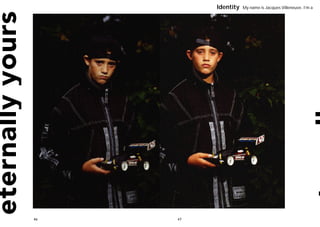
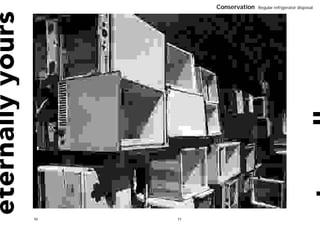
  • 114.
    Frequently Yours Car sharing may be hazardous 224 225
  • 115.
    to car health.Manzini’s utility strategy, according to which people succeed in conquering the market, it has implications for share products instead of owning them, has interesting the perception of product longevity. Rens Meijkamp implications for product life extension. Rens Meijkamp, proposes that optimization of product utility over time is who is currently researching consumer acceptance of car crucial to improve eco-efficiency. This is an important sharing at the Faculty of Industrial Design Engineering of notion as extending the life of a useless product is futile. TU Delft, has made some intriguing remarks on this There is a rumour - and it is not entirely improbable - that subject. DIY power drills actually drill holes for no more than Several car sharing schemes are being offered in the seven minutes during their life. Dad gets one as a Netherlands. They differ in price, number of participants, birthday gift, hangs a painting on the wall, and that’s it. intricacy and the way in which reservations can be made. Making such products ‘immortal’ is just as ridiculous as Although the projects are limited in size, they are what limiting their quality to fit the seven minutes use. you might call ‘eco-promising’. The only way out is extending the period of use, by The results show a decrease in car ownership. either obliging dad to hang more paintings or sharing Some participants have even renounced the resolution the machine. to buy one. Moreover, if participants use the shared This is where an interesting observation of Meijkamp’s vehicle they tend to do so in a well-considered manner, comes in. If the average utilization of a car (or any other partly because it is no longer directly available - it takes a product) is intensified in terms of mileage (or whatever call to make a reservation - and partly because the costs the output), its lifetime in years becomes substantially of use are readily fed back to them. Therefore the shorter. Now this could be interpreted as match product mileage decreases as well as the number of times people lifetime with utility by shortening is more beneficial to take the car out for a drive, in favour of the bicycle and the environment. On the other hand one can also argue, public transport. bearing in mind Gerda Zijlstra’s findings (see The study is strictly utilitarian. Meijkamp admits he does ‘Conservation’) that current cars (products) are not not consider that a car may have a meaning to users that suitable for sharing. Extending their life would give them goes beyond mere transportation. There is a catch in the the chance to be useful for a longer period of time at a observation that car sharing may be a lifestyle option lower price. It depends on the product-service with a certain meaning to some, in the same way that combination at hand. owning a four-wheel drive with a spoiler on top is something that others identify with. This may prove a serious drawback in the evolution of the new product- service combination. Nevertheless, if car sharing does 226 227
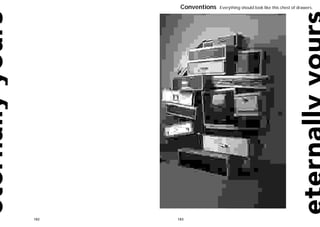
  • 116.
    Sharing Come and see me in my beautiful launderette. 228 229
  • 117.
    Doing the laundrytakes much energy and water, and the polluting The change on the level of services looks quite different. effect of detergent was cause for alarm in the recent Whereas energy use will decrease with about the same past. So there are three reasons to explore ways in which percentage as in household washing machines, use of washing can be made more sustainable. Robert van den water may diminish by a factor of ten, compared to the Hoed graduated at the Faculty of Design Engineering at normal 1995 washing machine. This is due to the TU Delft with a study entitled ‘Sustainable washing of development of recycling systems and use of alternative clothes’. It shows that true ‘factor 20’ sustainability is water sources. Moreover, recycling and dosage systems very hard to achieve, even if the current system of will cause the use of detergents to even decrease by a washing at home is transformed into a centralized factor of sixteen. service. The utility strategy is no guarantee for Unfortunately there is a snag. Energy use in centralized development towards sufficient eco-efficiency. washing services may decrease, though it will still be There appears to be a maximum, which will be reached much higher than in household washing machines. sometime around the year 2025. The cause is threefold. Clothes need to be washed at Sharing laundry facilities is not a revolutionary idea. higher temperatures for hygienic reasons. Furthermore There is a modernist apartment building in The Hague all the clothes must be machine dryed to make the dating from around the 1920s called Nirwana and it used process feasible and fast. The last cause is the to have a communal laundry room and kitchen. Now the inevitability of transportation. Whether the decrease in building is updated and every apartment has its own. the use of water and detergent compensates for energy This illustrates that readiness to share facilities has its consumption is difficult to assess. It is a classic dilemma limits. On the other hand there are successful dry in environmental analysis. cleaning services and launderettes as well as large scale Van den Hoed’s research project didn’t involve washing professional cleaning facilities for hospitals. machine endurance, as the energy use for production is With the help of qualified experts Van den Hoed made of minor importance. However, as machine efficiency an estimation of the changes in the environmental improves far more than production efficiency, the impact of washing drying and ironing. If we just look at relative share of production in the total energy washing machines, starting from 1995, energy use is consumption is bound to grow considerably. This is all expected to decrease by 42 per cent by the year 2005 the more reason to pay attention to machine life and by an additional 21 per cent by 2025. Water use and extension. If the service option doesn’t help, endurance the use of detergent are expected to decrease slightly might relieve the pain. more. All in all we can say that washing will become less unsustainable by a factor of about three. 230 231
  • 118.
    Goodbye A weakbond is strong enough. At the 232 233
  • 119.
    Eternally Yours congressEzio Manzini made a strong point on stage. indeed able to enhance strong attachment. He said: ‘You learn to like some people, and there are Aesthetics may cause an irrational preference because of others you don’t care about.’ Wielding the golden the colour, shape, feel, sound and even smell. congress folder with pictures of a couple in love inside, Other characteristics, such as style and ingenuity are he added: ‘There may be someone special that you really valued on an intellectual level. Of course keeping love, and maybe there is more than one, but it is something can also be strictly rational from a social point impossible to love everybody on the world in the same of view. Sometimes you do this simply because you are way. That is true for products as well. One cannot supposed to, like a terrible looking vase you got as a gift possibly feel attached to each and every product. from your cousin and that you quickly put on the table I don’t agree that all products must be Eternally Yours.’ every time she turns up. This type of attachment is This may have come as a surprise to some participants, closely related to owning an object as a generator of but of course Ezio Manzini was right. He felt provoked prestige. Moreover, one can safekeep an object for by the way in which Eternally Yours had presented itself, economic reasons, as an investment, waiting for the best with golden folders, pictures of lovebirds and a wedding moment to get the money pouring in. ring around the congress invitation. In fact the bond that However, the most obvious quality to create a more people should have with products is not a question of casual bond is that the product has to do its job without deep sentimentality and plunging people into an Ingrid- evoking unforgivable annoyance. The bond has to be of Bergman-in-Casablanca kind of grief whenever they an intuitive nature in the sense that you’re not aware of decide they have to say goodbye forever to one of their its presence, but that you miss it when it’s gone, in the dear possessions. same way that you only notice a good bass player when Eternally Yours discussed this subject matter almost two he or she stops playing. Familiar products take part in years earlier and published it in its first newsletter in everyday rituals and habits which have the chance to Dutch. The main outcome was that a number of different evolve in time. types of user-product bonds can exist. Only one of them is sentimental, caused as it is by strong memories. That is precisely the kind of bond that designers cannot influence. For personal reasons one can feel emotionally attached even to a turnip or a hubcap. However, people use and own most things without giving special attention to them. They’re just there, as tools and as carriers of signs. Some rare product properties are 234 235
  • 120.
  • 121.
    Equality’s safety belt, • McDermott, C., Essential Design, • Kopytoff, Igot, ‘The cultural Indiana University Press, Hans Achterhuis: Bloomsbury, London, 1992 biography of things: Bloomington and Indianapolis, 1988 • Sparke, P., Industriële vormgeving commoditization as process’, • Noro, Arto, ‘Uudemman • Arendt, H., The Human Condition, en cultuur in de 20e eeuw, The social life of things, Arjun kulutussosiologian mallit ja figuurit’ University of Chicago Press, Cantecleer, De Bilt, 1989 (translation Appadurai (ed.), Cambridge Sosiologia 32:1, 1995, pp 1-11 Chicago, 1958 of: An introduction to design & University Press, Cambridge, • Pantzar, Mika, Kuinka teknologia • Baudrillard, J., La Société de culture in the twentieth century, 1986, pp 64-91 kesyyntyy? Hanki ja Jää, Helsinki, consommation, Paris, De NoNl, 1970 Allen & Unwin Ltd, London, 1986) • Koskijoki, Maria, ‘Etsin kunnes 1996 • Butler, S., Erewhon, Ambo Baarn, löydän sun’: Luonnos keräilijän • Pantzar, Mika, Koskijoki, Maria, 1993 [1872] My favourite things, muotokuvaksi,Unpublished master’s ‘Consumers as players, consumers • Latour, B.,De Berlijnse Sleutel, Maria Koskijoki: thesis in cultural anthropology, as scientists and consumers as Van Gennep Amsterdam, 1997 University of Helsinki, 1994 artists; looking for valid • Latour, B., Wij zijn nooit modern • Belk, Russell W., Collecting in a • Koskijoki, Maria, Mementos and consumption critique’, Take a Look geweest, Van Gennep Amsterdam. Consumer Society, Routledge, recollections - the remembered and at the User; Perspectives on Users 1994 London & New York, 1995 imagined in things, Paper presented and Usefulness, Seminar papers, • Smith, A., The Theory of Moral • Belk, Russell W., Holbrook, Morris B., in the International Summer School Työselosteita ja esitelmiä 31/96, Sentiments, Clarendon Press, Sherry, John F. Jr., Wallendorf, of Cultural Studies Muisto- National Consumer Research Center, Oxford, 1976 [1759] Melanie,‘Collecting in a Consumer Reminscence, Jyväskylä, 1995 Helsinki, 1996 Culture’, Highways and Buyways: Koskijoki, Maria, ‘Keräilijän • Rogan, Bjarne, ‘Fra tommestokken Naturalistic Research from the muotokuva’, Sosiologia:3, 1995. til semiotiken’, SAMDOK bulletinen, Matter matters, Consumer Behavior Odyssey, Russell pp 179-190 1987, p 40 Peter-Paul Verbeek and W. Belk (ed.), Association for • Koskijoki, Maria, ‘The practise of • Silverstone, Roger & Hirsch, Eric Petran Kockelkoren: Consumer Research, Privo (Utah), collecting/ The spirit of a collection/ 1992: Introduction. In Roger 1991, pp 178-215 The life of the collector’, Tangible Silverstone and Eric Hirsch (eds.) • Borgmann, A., Technology and the • Bosoni, Giampiero, cosmologies, Veli Granö, Pasi Falk Consuming Technologies: Media and Character of Contemporary Life, ‘The automobile and the city’, and Maria Koskijoki, Pohjoinen, Information in Domestic Spaces, Chicago University Press, 1984 Ottagono 113, 1995, pp 54-57 Oulu, 1997 Routledge, London and New York, • Eternally Yours, Report of three • Campbell, Colin, The Romantic Ethic • Latour, Bruno, ‘We have never been pp 1-11 Eternally Yours Expert Meetings, and the Spirit of Modern modern’, Translation: Porter, • Stewart, Susan On Longing; 1996 Consumerism, Blackwell, Oxford, C. Harvester Wheatsheaf, Narratives of the Miniature, the • Heidegger, M., Sein und Zeit, 1987 New York, 1993 Gigantic, the Souvenir, the Niemeyer, Tübingen, 1986 {1926} • Carrier, James G., ‘Reconciling • Londos, Eva, UppÂt väggarna i Collection, The John Hopkins • Ihde, D., Technology and the commodities and personal relations svenska hem: En etnologisk studie av University Press, Baltimore and Lifeworld, Indiana University Press, in industrial society’, Theory and bildbruk, Carlssons, Stockholm, 1993 London, 1984 Bloomington and Indianapolis, 1990 Society 19:5, 1990, pp 579-598 • McCracken, Grant, Culture and • Thompson, M., Rubbish Theory; The • Jaspers, K., Die Geistige Situation • Falk, Pasi, The Consuming Body. Consumption: New Approaches to Creation and Destruction of Values, der Zeit, Göschen, Berlin, 1931 Sage, London, 1994 the Symbolic Character of Oxford University Press, Oxford, Consumer Goods and Activities, 1979 238 239
  • 122.
    Conscientious Objects, of Christmas toys, The Times Online, Project, Faculty of Environmental Municipal and Local Governments, Stuart Walker: December 20 1996, Far East, Design, The University of Calgary, National Roundtable on the http://www.thetimes.co.uk 1995 Environment and the Economy, • Burall, P., Green Design, The Design /news/pages/interactive/tim/inter- • Nozick, M., No Place Like Home: Ottawa, 1992, pp 7-9 Council, London, 1991 active1.html?000999 Building Sustainable Communities, • Ryn, S. van der, Cowan, S., • Chomsky, N., The Prosperous Few • MacKenzie, D, Design for the Canadian Council On Social Ecological Design,Island Press, and the Restless Many, Odonian Environment, Rizzoli, New York, Development, Ottawa, 1992, p 23 Washington, 1996, pp 63 & 68 Press, Berkeley, California, 1991 • Nozick, M., No Place Like Home: • Schwab, K., & Smadja, C., 1993, p 21 • Manitoba Round Table on Building Sustainable Communities, Globalisation backlash is serious, • Chomsky, N., How Free Is The Free Environment & Economy. ‘Schedule p 155 Globe and Mail, Toronto, February Market?, Resurgence, UK, No.173, 1: Principles and guidelines of • Papanek, V., The Green Imperative - 18, 1996, B10 Nov./Dec. 1995, pp 6-9 sustainable development.’, p 13 Natural Design for the Real World, • Sylvester, R. & Smith, J.S., Exposed: • Coals, A., Letter from Muscat: Dates In A discussion paper for a Thames and Hudson, New York, shame of Gap’s child labour sweat- to Remember, Guardian Weekly, UK, sustainable development act. 1995, pp 223-235 & 183-202 shops,The Electronic Telegraph, July 17, 1995, p 25 Winnipeg: Manitoba Round Table for • Perks, W. T., Van Vliet, D. Monday January 22 1996, • Durning, A. T., How Much is Enough Environment & Economy, 1994. Assessment of Built Projects for Home News - The Consumer Society and the • Meadows, D.H., Meadows, D.L., Sustainable Communities, • Sylvester, R.,Sweatshop tarnishes Future of the Earth, W.W.Norton and Randers, J., Beyond the Limits, The University of Calgary, 1993 the image of Disney, The Electronic Co., New York 1992 McClelland & Stewart Inc., • Perks, W. T., Van Vliet, D. Innovative Telegraph, Monday February 26, • Frey, D.E.,The Good Samaritan as Toronto, 1992, p 192 Site Development Standards Review, 1996 Bad Economist: Self- Interest in • Merton, T. The Way of Chuang Tzu, The University of Calgary, Centre for • United Church of Canada General Economics and Theology, Cross New Directions Publishing Livable Communities and Faculty of Council. ‘One Earth Community: Currents, Online Magazine, Corporation, New York, 1965, Environmental Design, 1991 A statement of ethical principles for Fall 1996, http://aril.org/frey2.html pp 136-137 & 142 • Perks, W.T., Kirby, R., Wilton-Clark, environment and development.’ - • Hick, John, Faith and Knowledge, • Ministry of Water Resources, Sea A., Edgemont II - A Study in pp. 3-13. Ethical principles for Fontana Books, Glasgow, second water intrusion in the Sultanate of Sustainable Community Form, environment and development: edition, 1966, p 240 Oman: an introductory guide, The University of Calgary, Centre for a statement of the 34th general • Illich, I., Deschooling Society, Harrow Ministry of Water Resources, Livable Communities and Faculty of council of the United Church of Books, Harper & Row, New York, Sultanate of Oman, p 6 Environmental Design, 1996 Canada August 1992 issued in 1970, p 114 • Morrison, R., We Build the Road As • Porritt, J., Where On Earth Are We response to the United Nations • Lansley, S., After The Gold Rush - We Travel, New Society Publishers, Going?, BBC Books, London, 1990, Conference on Environment and The Trouble with Affluence: Santa Cruz, 1991, pp 55-56 p.125 Development (UNCED) Rio de ‘Consumer Capitalism’ and the Way • Nelder, C., Measuring Genuine • Postman, N., Technopoly - The Janeiro June 1992. Toronto, ON: Forward, The Henley Centre, Progress, Better World Online Surrender of Culture to Technology, United Church of Canada, 1992 Century Business Books, Random Magazine, Issue No. 6, Oct/Nov/Dec Vintage Books, Random House, • Vergragt, P., Van der Wel, M., House, London, 1994, p 73 1996, http://www.betterworld. New York 1993 Meykamp, R., Tassoul, M., Involving • Lloyd-Roberts, S., Thai factory girls com/BWZ/9610/learn.htm • Roseland, M., Toward Sustainable Industry in Backcasting Scenario tell a different story about the cost • Nielsen, R., Master’s Degree Communities - A Resource Book for Building, Workshop Document 240 241
  • 123.
    presented at the4th Greening of Energy efficiency in, • Hawken, P., The Ecology of • Manzini, E., ‘Green goods: Industry Conference, Toronto, a Service Economy, Wuppertal Commerce, Phoenix, London, 1994 Contribution to the Discussion’ , November 12-14, 1995, p 4 Institute Workshop on Eco-efficient • Hennicke, P., Least-cost planning in Green Goods, E. Ryden, J. Strhal, • Walker, S., Superficial Evidence: Services, Wuppertal, 1994 the FRG.: Concepts and Experiences (eds), Kretsloppsdelegationes, The Environment, Product • Borlin, M., Financial Instrument for Wuppertal Institute Workshop on Stockholm, ‘95 Aesthetics and Surface,Design promoting a strategy of long-life Eco-efficient Services, Wuppertal, • Manzini, E., Sustainable Product- Issues, USA, Volume 11, No.3, products, product-life extension and 1994 Services, Development, workshop Autumn 1995, pp 15-27 more efficient product utilization • Hockerts, K, Konzeptualisierung organized by UNEP-WG-SPD on • Were, G. S. (ed.), Machakos District - (LEXU), for OECD Workshop, Ökologischer Dienstleistungen, Pioneer Industries on Sustainable Socio-Cultural Profile ,Draft Report, Paris, june 1993, pp 29-30 St.Gallen: Diskussionspapier Nr. 29, Services , in the INES Conference 1987, pp 215-216 • Cooper, T., Product durability : how Institut fur Wirtshaft und Ökologie Challenge of Sustainable • Young, S.B. & Vanderburg, W.H. to achieve it, Wuppertal Institute der Universität St. Gallen, 1995 Development, Amsterdam, 1996 ‘A Materials Life Cycle Framework Workshop on Eco-efficient Services, • Hollins, G.,Hollins,B.,Managing the • Manzini, E., Pacenti, E. for Preventative Engineering’, IEEE Wuppertal, 1994 Design Process in the Services Sustainability as a ‘scenario of Technology and Society Magazine, • Cova, B., Beyond Marketing: from Sector, Pitman, London, 1991 services’, Design Recherche, Fall, 1992, pp 26-31 websites: Marketing to Societing, in Brownlie, • Holt, L., ‘Integrated materials n° 7, 1995 Credibility Gap - How a politically D. Saren, M. Wensley, R., management at Cookson PLC’, • Manzini, E., Susani, M., correct clothes company uses cheap Whittington, R. (eds.), New WBCSD, Achieving Eco-Efficiency The Solid Side, V+K Publishing, child labour, The Electronic Perspectives on the Discipline and in Business, Report of the World The Netherlands, 1995 Telegraph, Monday January 22 1996, Profession, Coventry: Warwick Business Centre for Sustainable • Meijkamp, R., Theunissen, R, Car Home News, http://www. Business School, 1993 Development Second Antwerp Sharing: consumer acceptance and telegraph.co.uk/et?ac=0001440550 • Cova, B.,Au-delà du marché : quand Eco-Efficiency Workshop, ‘95 changes on mobility behavior, 15112& pg=/home.html Is Eco- le lien importe plus que le bien, • Jansen, J.L.A., (CLTM),Toward a PTRC, 24th European Transport efficiency Enough?, Ecocycle, Issue L’Harmattan, Paris, 1995 sustainable Oikos. En Route with Forum, London, 1996 No.4, Summer/Fall 1996, • ERL, Environmental Resources Technology!,(doc.), 23 april 1993 • Oosterhuis, F., Rubick, F., Scholl, http://www.ec.gc.ca/ecocycle/issue Limited, The Best of Both Worlds: • Leynseele, T. van , Internalizing the G., Product Policy in Europe : s/index.html Sustainability and Quality Lifestyles Product, Working Papers of the New Environmental Perspective, in the 21st Century, Final Report, INSEAD’s Centre for the Kluwer Academic Publishers, Leapfrog strategies, Ministry of Housing, Physical Manage-ment of Environmental Dordrecht, Boston, London, 1996 Ezio Manzini: Planning and Environment, 1993 Resources, 1996 • Ottman, J.A., Enlisting the • Giarini, O.; Stahel, W., The Limits to • Manzini, E., ‘Values, Quality, Consumer in Support of Product- • Axt, Ph., Hauch, S., Hockerts, K., Certainty, facing risks in the new Sustainable Development’, Services, DTP and TU Delft Petmecky, A., (Bayreuther Initiative), service Economy, Kluwer Academic Clean Production Strategies, workshop on Service Products and Eco-efficient Services, Wuppertal Publishers, Dordrecht, Boston, developing preventive Sustainable Development, Institute Workshop on Eco-efficient London, 1989/1993 (tr. it. I limiti environmental management in the Delft, 1994 Services, Wuppertal, 1994 della certezza, affrontare i rischi industrial economy, T. Jackson, • Pacenti, E., Info-eco communities, • Bergsma, G., Kroese, M, della nuova economia di servizio, (ed.), Lewis Publishers, working papers for Doors of Entrepreneurial Approaches to Etaslibri, Milano, 1993) London, 1993 Perception 3, NDI, Amsterdam, 1995 242 243
  • 124.
    • Pacenti, E.,Newservices, working • Weizsacker, E.U. von, Lovins, A., papers for the research : Product- Lovins,H.,Factor Vier, Dromer-Knaur, services and complex innovation, Münich, 1995 CIR.IS, Milan Polytechnic, 1996 • Porter, M. E., Linde, C. van der, Green and Competitive, Harvard Business Review, September-October 1995 • Schmidt-Bleek, F., MIPS Re-visited, Fresenius Environmental Bulletin, vol.2, n°8, Birkhauser Werlag, Basel, August 1993 • Stahel, R. W., Product innovation in the service economy, The Product- Life Institute, Geneva, 1991 • Stahel, R. W., Durability and optimal utilization - product-life extension in the Service Economy, in T. Jackson, (ed.), Clean Production Strategies, developing preventive environmental management in the industrial economy, Lewis Publishers, London, 1993 • UNEP, Achieving Sustainable Consumption Patterns: the Role of the Industry, UNEP IE/PAC, Paris, 1993 • Walley, N., Whitehead, B., It’s not Easy Being Green, Harvard Business Review, May-June 1994 • WBCSD, Getting Eco-Efficient, Report of the World Business Council For Sustainable Development, First Antwerp Eco-Efficiency Workshop, November 1993 • Weizsacker, E.U. von, Earth Politics, Zed Books, London, 1994 244 245
  • 125.
    Acknowledgements The Netherlands Robert van den Hoed, Delft University of Technology, Eternally Yours Foundation Team: Faculty of Industrial Design Henk Muis, Arnoud Odding, Liesbeth Bonekamp, Petran Kockelkoren, University of Twente, Department Ed van Hinte. of Systematic Philosophy, The Netherlands Laan van Meerdervoort 133a Maria Koskijoki, National Consumers Research Centre, 2517 AW The Hague Finland The Netherlands Frans Lavell, Lavell’s Schrijversstal, The Netherlands T: ++31 70 365 873 0, F: ++31 70 356 372 1 Rens Meijkamp, Delft University of Technology, Website: http://www.ecomarket.net/EternallyYours Faculty of Industrial Design, The Netherlands Nicole van Nes, Delft University of Technology, Advisory board: Faculty of Industrial Design, The Netherlands Hans Achterhuis, University of Twente, Department of Yvette Sprado, Lavell’s Schrijversstal, The Netherlands Systematic Philosophy, The Netherlands Peter-Paul Verbeek, University of Twente, Department of Ezio Manzini, Polytechnic of Milan, Domus Academy, Italy Systematic Philosophy, The Netherlands John Thackara, Netherlands Design Institute, Stuart Walker, University of Calgary, Alberta, Canada The Netherlands Marcel Wanders, Wanders Wonders, The Netherlands Gerda Zijlstra, Delft University of Technology, Faculty of The Eternally Yours team wishes to thank Industrial Design, The Netherlands the following contributors: and everybody else who supported us. Conny Bakker, Netherlands Design Institute, Special thanks to Gert Staal of the Netherlands Design The Netherlands Institute for moderating the congress discussions Hetty van Bommel, Studio Hetty van Bommel Michael McCoy, Cranbrook University, Chicago, U.S.A The publication of this book could not have been Tim Cooper, Sheffield Hallam University, England achieved without the financial support of: Pieter Desmet, Delft University of Technology, Faculty Stichting IKEA Foundation of Industrial Design, The Netherlands Mondriaan Stichting Khodi Feiz, Philips Corporate Design, The Netherlands VSB Fonds Moniek Gerner, De Bock & Dekker Prins Bernhard Fonds Wim Hafkamp, Rotterdam Erasmus University, Ministerie van Vrom 246 247
  • 126.
    colophon Editorial board Liesbeth Bonekamp, Henk Muis, Ed van Hinte, Arnoud Odding Contributors Hans Achterhuis, Tim Cooper, Wim Hafkamp, Maria Koskijoki, Ezio Manzini, Michael McCoy, Peter-Paul Verbeek & Petran Kockelkoren, Stuart Walker Illustrations Ron Van Roon Photography Jaap Oldenkamp, (pp 46,70,78, 116, 152) Veli Granö, (p 132) Janine Huizenga, (p 202) Louis Psihoyos, (p 228) Graphic Design Gonnissen & Widdershoven © 1997 The authors and 010 Publishers, Rotterdam ISBN 90 6450 313 3 248 249
  • 130.