ISSN 1830-7302


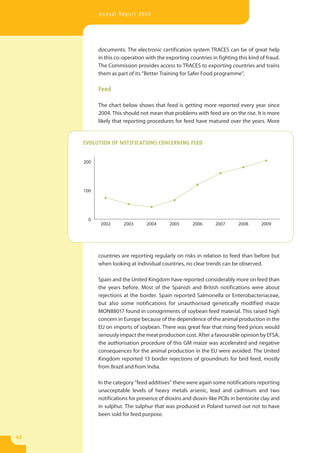
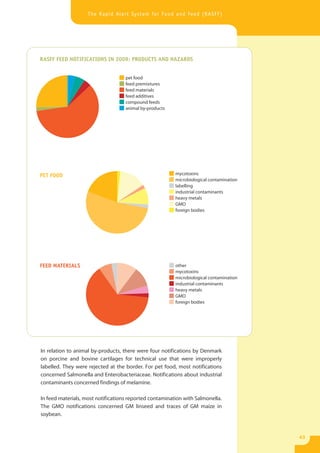
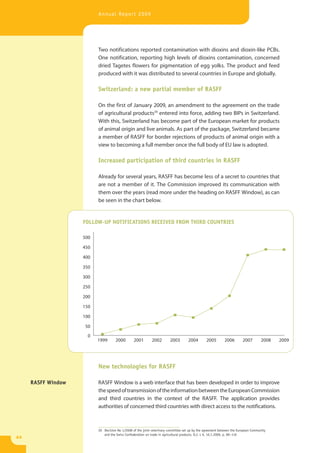
European Commission


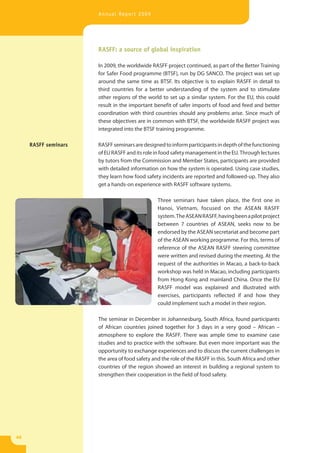
    The Rapid Alert System
    for Food and Feed (RASFF)


                        Annual Report
                                2009
The Rapid Alert System
for Food and Feed (RASFF)

 Annual Report
    2009
Annual Report 2009


The Health and Consumers Directorate-General of the European Commission manages the Rapid
Alert System for food and Feed (RASFF). This report describes the activity of the RASFF in 2009.

Neither the European Commission nor any person acting on its behalf is responsible for any use
that might be made of the following information.

© Pictures: istock, Corbis


                        Europe Direct is a service to help you find answers
                          to your questions about the European Union

                                         New freephone number (*):
                                         00 800 6 7 8 9 10 11
         *Certain mobile telephone operators do not allow access to 00800 numbers or may charge for these calls.
                     In certain cases, these calls may be chargeable from telephone boxes or hotels.


Online information about the European Union in 23 languages is available at:
http://europa.eu

Further information on the Health and Consumers Directorate-General is available at:
http://ec.europa.eu/dgs/health_consumer/index_en.htm
and on the Rapid Alert System for Food and Feed at:
http://ec.europa.eu/RASFF

Luxembourg: Publications Office of the European Union, 2010

ISBN 978-92-79-15314-3
ISSN 1830-7302
doi:10.2772/88477

© European Union, 2010
Reproduction is authorised, except for commercial purposes, provided the source
is acknowledged.

Printed in Belgium

PRINTED ON ELEMENTAL CHLORINE-FREE BLEACHED PAPER (ECF)
The Rapid Alert System for Food and Feed (RASFF)


                           FOREWORD
                           It is a great pleasure for me to provide this year’s foreword to the RASFF
                           annual report. Another year brings another report illustrating that we
                           cannot rest on our laurels when it comes to food safety, even if 2009 is
                           the first year since long without any incidents of significant proportion
                           being reported in the RASFF.

Still, the number of notifications issued by Member States in the RASFF has again reached an all
time high. And this is reassuring at the same time because it shows that Member States are very
willing to cooperate beyond their national borders to safeguard our high level of food safety in the
EU. The figures show that Member States are sending more follow-up notifications, thereby giving
other countries, including third countries, the information they need to act quickly and protect
their consumers.

Great effort was done for countries that are not member of RASFF. More than 60 countries outside
the EU connect to RASFF Window, a new online platform, to download RASFF notifications
concerning them. It is only a beginning. The Commission continues its efforts to support these
countries in setting up their alert systems, through the Better Training For Safer Food programme,
to enable them to tackle food safety incidents that gradually become more global in nature.

In 2009 the RASFF celebrated its 30th birthday. It was a memorable event celebrated not only with
Member States but with representatives of countries from all over the world. The international
conference took stock of what was achieved and identified the challenges ahead. Apart from
the global dimension of food safety, another conclusion of the conference was that involvement
of stakeholders such as professional operators and consumers needed to be increased. To
enable this, first the RASFF should become more transparent giving more detailed information
on the product.

A tool that may prove to be invaluable in reaching this objective, RASFF Portal, was inaugurated
during the opening of the 30 years-conference. Now citizens can use an online tool to find
information on any RASFF notification issued since the beginning of RASFF in 1979.
The RASFF system only works due to the strong commitment and enthusiasm of all actors involved,
both in the Member States and within the European Commission. To all, my heartfelt gratitude and
encouragement to continue on their quest to keep our consumers safe.


                                                                                     John Dalli
                                                    Commissioner for Health and Consumer Policy


                                                                                                        3
Annual Report 2009


TABLE OF CONTENTS   FOREWORD . . . . . . . . . . . . . . . . . . . . . . . . . . . . . . . . . . . . . . . . . 3


                    1. The Rapid Alert System for Food and Feed (RASFF) . . . . . . . . . . 7
                           The legal basis . . . . . . . . . . . . . . . . . . . . . . . . . . . . . . . . . . . . . . . . . . . . 8
                           The members . . . . . . . . . . . . . . . . . . . . . . . . . . . . . . . . . . . . . . . . . . . . . 9
                           The system . . . . . . . . . . . . . . . . . . . . . . . . . . . . . . . . . . . . . . . . . . . . . 12
                             market notifications . . . . . . . . . . . . . . . . . . . . . . . . . . . . . . . . . . . . . 12
                             border rejection notifications . . . . . . . . . . . . . . . . . . . . . . . . . . . . . . . 12
                             news notifications . . . . . . . . . . . . . . . . . . . . . . . . . . . . . . . . . . . . . . 12
                           Schematic representation of the information flow of the RASFF . . . . . . . . . . 13


                    2. RASFF notifications in 2009 . . . . . . . . . . . . . . . . . . . . . . . . . 15
                           2009: RASFF notifications by numbers . . . . . . . . . . . . . . . . . . . . . . . . . . .                16
                           A selection of topics recurring in the RASFF in 2009 . . . . . . . . . . . . . . . . .                    17
                              Allergenic substances . . . . . . . . . . . . . . . . . . . . . . . . . . . . . . . . . . . .          17
                              Mycotoxins . . . . . . . . . . . . . . . . . . . . . . . . . . . . . . . . . . . . . . . . . . .       19
                                 Aflatoxins . . . . . . . . . . . . . . . . . . . . . . . . . . . . . . . . . . . . . . . . . .      20
                                 Ochratoxin A . . . . . . . . . . . . . . . . . . . . . . . . . . . . . . . . . . . . . . . .        21
                              Dioxins . . . . . . . . . . . . . . . . . . . . . . . . . . . . . . . . . . . . . . . . . . . . . .    22
                              Unauthorised genetically modified food and feed . . . . . . . . . . . . . . . . . .                    22
                              Heavy metals . . . . . . . . . . . . . . . . . . . . . . . . . . . . . . . . . . . . . . . . . .       24
                              Pathogenic micro-organisms . . . . . . . . . . . . . . . . . . . . . . . . . . . . . . . .             25
                              Pesticide residues . . . . . . . . . . . . . . . . . . . . . . . . . . . . . . . . . . . . . . .       26
                              Veterinary drug residues . . . . . . . . . . . . . . . . . . . . . . . . . . . . . . . . . . .         28


                    3. Focus on … . . . . . . . . . . . . . . . . . . . . . . . . . . . . . . . . . . . . . 31
                           Border rejections . . . . . . . . . . . . . . . . . . . . . . . . . . . . . . . . . . . . . . . . .       32
                           Composition of food . . . . . . . . . . . . . . . . . . . . . . . . . . . . . . . . . . . . . . .         35
                           Food poisoning . . . . . . . . . . . . . . . . . . . . . . . . . . . . . . . . . . . . . . . . . .        36
                               Hepatitis A . . . . . . . . . . . . . . . . . . . . . . . . . . . . . . . . . . . . . . . . . . .     40
                           Fraud . . . . . . . . . . . . . . . . . . . . . . . . . . . . . . . . . . . . . . . . . . . . . . . . .   41
                           Feed . . . . . . . . . . . . . . . . . . . . . . . . . . . . . . . . . . . . . . . . . . . . . . . . .    42
                           Switzerland: a new partial member of RASFF . . . . . . . . . . . . . . . . . . . . . . .                  44
                           Increased participation of third countries in RASFF . . . . . . . . . . . . . . . . . .                   44
                           New technologies for RASFF . . . . . . . . . . . . . . . . . . . . . . . . . . . . . . . . . .            44
                              RASFF Window . . . . . . . . . . . . . . . . . . . . . . . . . . . . . . . . . . . . . . . . . .       44
                              RASFF Portal . . . . . . . . . . . . . . . . . . . . . . . . . . . . . . . . . . . . . . . . . . .     45
                              iRASFF: the “i” for “interactive” . . . . . . . . . . . . . . . . . . . . . . . . . . . . . .          45


4
The Rapid Alert System for Food and Feed (RASFF)


       RASFF: a source of global inspiration . . . . . . . . . . . . . . . . . . . . . . . . . . . . 46
         RASFF seminars . . . . . . . . . . . . . . . . . . . . . . . . . . . . . . . . . . . . . . . . . 46
         Sustained training . . . . . . . . . . . . . . . . . . . . . . . . . . . . . . . . . . . . . . . 47


4. 30 years of RASFF: a celebration . . . . . . . . . . . . . . . . . . . . . . 49
       Special celebration booklet: “30 years of keeping consumers safe” . . . . . . . . 50
       Technical meeting on 15 July 2009 . . . . . . . . . . . . . . . . . . . . . . . . . . . . . 50
       International conference “Keeping An Eye On Your Food” on 16 July 2009 . . . 50


5. More charts and tables . . . . . . . . . . . . . . . . . . . . . . . . . . . . . 55


     Acronyms used in this report

     ASEAN .................................Association of Southeast Asian Nations
     BIP.........................................Border Inspection Post
     BTSF .....................................Better Training for Safer Food
     CS .........................................Commission Services
     ECDC ...................................European Centre for Disease Prevention and Control
     EC .........................................European Commission
     EEA .......................................European Economic Area
     EFTA .....................................European Free Trade Association
     EFSA .....................................European Food Safety Authority
     EU..........................................European Union
     EMA .....................................European Medicines Agency
     EPN .......................................Ethyl p-nitrophenyl phenylphosphorothioate
     EWRS ...................................Early Warning Response System
     FSA .......................................UK Food Standards Agency
     FDA ......................................U. S. Food and Drug Administration
     FVO ......................................Food and Veterinary Office
     GMO ....................................Genetically Modified Organism
     HACCP .................................Hazard Analysis and Critical Control Points
     IHR ........................................International Health Regulations
     INFOSAN ............................International Food Safety Authorities Network
     MERCOSUR ........................Mercado Común del Sur (Southern Common Market)
     MPA .....................................Medroxyprogesterone acetate
     MRL ......................................Maximum Residue Limit
     OJ ..........................................Official Journal
     PCB .......................................Polychlorinated biphenyls
     RASFF ..................................Rapid Alert System for Food and Feed
     SEM ......................................Semicarbazide (nitrofurazone)
     TRACES ...............................Trade Control and Expert System
     TWI .......................................Total Weekly Intake
     WHO ....................................World Health Organisation


                                                                                                               5
Annual Report 2009


6
The Rapid Alert System for Food and Feed (RASFF)


1
     The Rapid Alert System
     for Food and Feed (RASFF)


                                                       7
Annual Report 2009


                  The RASFF was put in place to provide food and feed control authorities
                  with an effective tool to exchange information about measures taken
                  responding to serious risks detected in relation to food or feed. This
                  exchange of information helps Member States to act more rapidly
                  and in a coordinated manner in response to a health threat caused
                  by food or feed. Its effectiveness is ensured by keeping its structure
                  simple: it consists essentially of clearly identified contact points
                  in the Commission, EFSA1, EEA2 and at national level in member
                  countries, exchanging information in a clear and structured way by
                  means of templates.


THE LEGAL BASIS   The legal basis of the RASFF is Regulation (EC) N° 178/2002. Article 50 of this
                  Regulation establishes the Rapid Alert System for Food and Feed as a network
                  involving the Member States, the Commission as member and manager of the
                  system and the European Food Safety Authority (EFSA). Also the EEA countries:
                  Norway, Liechtenstein and Iceland, are longstanding members of the RASFF.

                                                          Whenever a member of the network has any
                                                          information relating to the existence of a serious
                                                          direct or indirect risk to human health deriving from
                                                          food or feed, this information is immediately notified
                                                          to the Commission under the RASFF. The Commission
                                                          immediately transmits this information to the
                                                          members of the network.

                                                          Article 50.3 of the Regulation lays down additional
                                                          criteria for when a RASFF notification is required.

                                                          Without prejudice to other Community legislation,
                                                          the Member States shall immediately notify the
                                                          Commission under the rapid alert system of:

                  a. any measure they adopt which is aimed at restricting the placing on the
                     market or forcing the withdrawal from the market or the recall of food or
                     feed in order to protect human health and requiring rapid action;

                  b. any recommendation or agreement with professional operators which is
                     aimed, on a voluntary or obligatory basis, at preventing, limiting or imposing
                     specific conditions on the placing on the market or the eventual use of food
                     or feed on account of a serious risk to human health requiring rapid action;

                  c. any rejection, related to a direct or indirect risk to human health, of a batch,
                     container or cargo of food or feed by a competent authority at a border
                     post within the European Union.

                  1   European Food Safety Authority, www.efsa.europa.eu
                  2   EFTA Surveillance Authority, http://www.eftasurv.int
8
The Rapid Alert System for Food and Feed (RASFF)


All members of the system have out-of-hours arrangements (7 days/7, 24
hour/24) to ensure that in case of an urgent notification being made outside
of office hours, on-duty officers can be warned, acknowledge the urgent
information and take appropriate action. All member organisations of the
RASFF are listed and their home pages can be consulted on the internet
from the following RASFF web page: http://ec.europa.eu/comm/food/food/
rapidalert/members_en.htm


            EUROPEAN UNION                                                     THE MEMBERS
            • European Commission – Health and Consumers
              Directorate-General
            • European Food Safety Authority (EFSA)

            EFTA
            • EFTA Surveillance Authority

            AUSTRIA
            • Österreichische Agentur für Gesundheit und
              Ernährungssicherheit GmbH
              und Bundesamt für Ernährungssicherheit

            BELGIUM
            • A.F.S.C.A. – Agence Fédérale pour la Sécurité de la Chaîne
              Alimentaire
            • F.A.V.V. – Federaal Agentschap voor de Veiligheid van
              de Voedselketen

            BULGARIA
            • Министерство на земеделието и горите
            • Ministry of Agriculture and Food

            CYPRUS
            • Ministry of Health – Medical and Public Health Services

            CZECH REPUBLIC
            • Státní zemědělská a potravinářská inspekce
            • Czech Agriculture And Food Inspection Authority

            DENMARK
            • Fødevaredirektorate – Ministeriet for Fødevarer,
              Landbrug og Fiskeri
            • The Danish Veterinary and Food Administration –
              Ministry of Food, Agriculture and Fisheries

            ESTONIA
            • Veterinaar- ja Toiduamet (Veterinary and Food Board)

            FINLAND
            • Elintarviketurvallisuusvirasto Evira (Finnish Food Safety
              Authority Evira)


                                                                                             9
Annual Report 2009


               FRANCE
               • Direction générale de la concurrence, de la consommation
                 et de la répression des fraudes – Ministère de l’Economie,
                 de l’Industrie et de l’Emploi
               • Ministère de l’Alimentation, de l’Agriculture et de la Pêche

               GERMANY
               • Bundesamt für Verbraucherschutz und
                 Lebensmittelsicherheit (BVL)

               GREECE
               • Hellenic Food Authority (EFET)

               HUNGARY
               • Magyar Élelmiszer-biztonsági Hivatal
               • Hungarian Food Safety Office

               ICELAND
               • The Icelandic Food and Veterinary Authority – MAST

               IRELAND
               • F.S.A.I. – Food Safety Authority of Ireland

               ITALY
               • Ministero della Salute (Ministry of Health)

               LATVIA
               • Partikas un Veterinarais Dienests
                 (Food and Veterinary Service)

               LIECHTENSTEIN
               • Amt für Lebensmittelkontrolle/Landesveterinäramt
                 (Office for Food Inspection and Veterinary Affairs)

               LITHUANIA
               • Valstybine maisto ir Veterinarijos Tarnyba
                 (State Food and Veterinary Service)

               LUXEMBOURG
               • OSQCA: Organisme pour la sécurité et la qualité
                 de la chaîne alimentaire

               MALTA
               • Food Safety Commission


10
The Rapid Alert System for Food and Feed (RASFF)


NETHERLANDS
• Voedsel en Waren Autoriteit
• Food and Consumer Product Safety Authority

NORWAY
• Statens tilsyn for planter, fisk, dyr, og Næringsmidler –
  (Norwegian Food Safety Authority)

POLAND
• Glówny Inspektorat Sanitarny (Chief Sanitary Inspectorate)

PORTUGAL
• Ministério da Agricultura, Desenvolvimento Rural e Pescas
  (MADRP)

ROMANIA
• Autoritatea Nationala Sanitar-Veterinara si pentru
  Siguranta Alimentelor
  (National Sanitary Veterinary And Food Safety Authority)

SLOVAKIA
• Státna veterinárna a potravinová správa SR

SLOVENIA
• Ministry of Agriculture, Forestry and Food

SPAIN
• Ministerio de Sanidad y Consumo –
  Ministry of Health and Consumption
• Ministry of Environment, Rural and Marine Affairs

SWEDEN
• Livsmedelsverket
• National Food Administration

SWITZERLAND
• Bundesamt für Gesundheit (BAG)

UNITED KINGDOM
• Food Standards Agency


                                                               11
Annual Report 2009


THE SYSTEM   Market notifications

             These notifications report on health risks identified in products that are placed
             on the market in the notifying country. The notifying country reports on the risks
             it has identified, the product and its traceability and the measures it has taken.
             According to the seriousness of the risks identified and the distribution of the
             product on the market, the market notification is classified after evaluation by
             the Commission Services as alert notification or information notification before
             the Commission transmits it to all network members.

             Alert notifications

             An ‘alert notification’ or ‘alert’ is sent when a food or a feed presenting a serious
             risk is on the market or when rapid action is required. Alerts are triggered by
             the member of the network that detects the problem and has initiated the
             relevant measures, such as withdrawal/recall. The notification aims at giving all
             the members of the network the information to verify whether the concerned
             product is on their market, so that they can take the necessary measures.

             Products subject to an alert notification have been withdrawn or are in the
             process of being withdrawn from the market. The Member States have their
             own mechanisms to carry out such actions, including the provision of detailed
             information through the media if necessary.

             Information notifications

             An ‘information notification’ concerns a food or a feed on the market of the
             notifying country for which a risk has been identified that does not require rapid
             action, e. g. because the food or feed has not reached the market or is no longer
             on the market (of other member countries than the notifying country).

             Border rejection notifications

             A ‘border rejection notification’ concerns a food or a feed that was refused
             entry into the Community for reason of a risk to human or animal health.

             News notifications

             A ‘news notification’ concerns any type of information related to the safety
             of food or feed which has not been communicated as an alert, information or
             border rejection notification, but which is judged interesting for the food and
             feed control authorities in the Member States.

             News notifications are often made based on information picked up in the media
             or forwarded by colleagues in food or feed authorities in third countries, EC
             delegations or international organisations, after having been verified with the
             Member States concerned.


12
The Rapid Alert System for Food and Feed (RASFF)


Two types of notifications are identified:
 • an ‘original notification’ is a notification referring to one or more
   consignments of a food or a feed that were not previously notified to
   the RASFF;
 • a ‘follow-up notification’ is a notification, which is transmitted as a follow-
   up to an original notification.

An original notification sent by a member of the RASFF network can be rejected
from transmission through the RASFF, after evaluation by the Commission,
if the criteria for notification are not met or if the information transmitted is
insufficient. The notifying country is informed of the intention not to transmit
the information through the RASFF and is invited to provide additional
information allowing the rejection to be reconsidered by the Commission.

An alert or information notification that was transmitted through the RASFF
can be withdrawn by the Commission at the request of the notifying country
if the information, upon which the measures taken are based, turns out to be
unfounded or if the transmission of the notification was made erroneously.

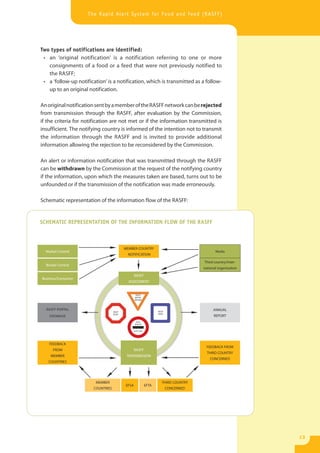
Schematic representation of the information flow of the RASFF:


SCHEMATIC REPRESENTATION OF THE INFORMATION FLOW OF THE RASFF


                                         MEMBER COUNTRY
   Market Control                                                                     Media
                                          NOTIFICATION

                                                                               Third country/inter-
   Border Control
                                                                               national organisation

                                                RASFF
 Business/Consumer
                                           ASSESSMENT


   RASFF PORTAL                                                                      ANNUAL
     DATABASE                                                                        REPORT


     FEEDBACK
                                                                                 FEEDBACK FROM
        FROM                                    RASFF
                                                                                 THIRD COUNTRY
      MEMBER                              TRANSMISSION
                                                                                   CONCERNED
     COUNTRIES


                              MEMBER                           THIRD COUNTRY
                                         EFSA           EFTA
                             COUNTRIES                          CONCERNED


Source: schema-RASFF.pdf


                                                                                                       13
Annual Report 2009


14
The Rapid Alert System for Food and Feed (RASFF)


2
    RASFF notifications in 2009


                                                       15
Annual Report 2009


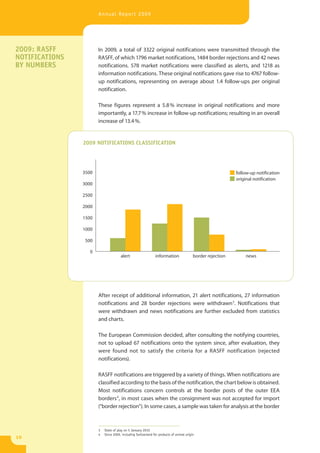
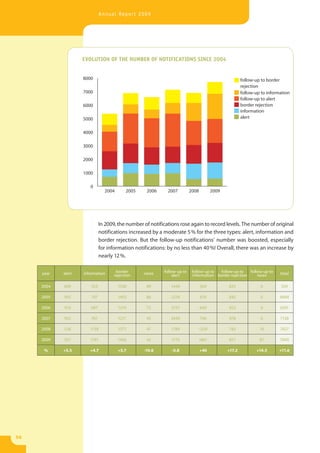
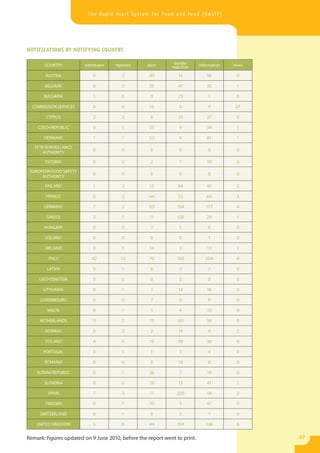
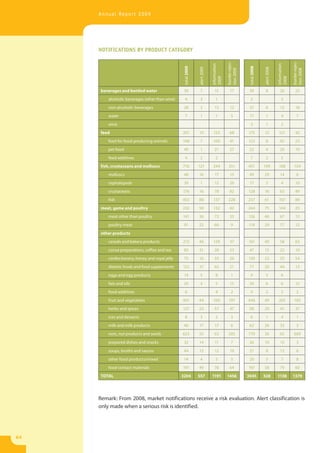
2009: RASFF            In 2009, a total of 3322 original notifications were transmitted through the
NOTIFICATIONS          RASFF, of which 1796 market notifications, 1484 border rejections and 42 news
BY NUMBERS             notifications. 578 market notifications were classified as alerts, and 1218 as
                       information notifications. These original notifications gave rise to 4767 follow-
                       up notifications, representing on average about 1.4 follow-ups per original
                       notification.

                       These figures represent a 5.8 % increase in original notifications and more
                       importantly, a 17.7 % increase in follow-up notifications; resulting in an overall
                       increase of 13.4 %.


                2009 NOTIFICATIONS CLASSIFICATION


                3500                                                                                        follow-up notification
                                                                                                            original notification
                3000

                2500

                2000

                1500

                1000

                 500

                   0
                                      alert                   information                border rejection       news


                       After receipt of additional information, 21 alert notifications, 27 information
                       notifications and 28 border rejections were withdrawn3. Notifications that
                       were withdrawn and news notifications are further excluded from statistics
                       and charts.

                       The European Commission decided, after consulting the notifying countries,
                       not to upload 67 notifications onto the system since, after evaluation, they
                       were found not to satisfy the criteria for a RASFF notification (rejected
                       notifications).

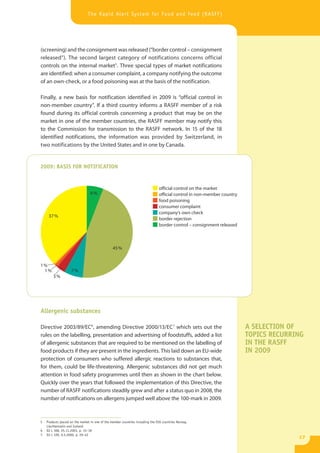
                       RASFF notifications are triggered by a variety of things. When notifications are
                       classified according to the basis of the notification, the chart below is obtained.
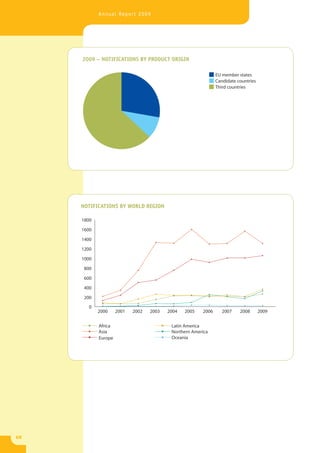
                       Most notifications concern controls at the border posts of the outer EEA
                       borders 4, in most cases when the consignment was not accepted for import
                       (“border rejection”). In some cases, a sample was taken for analysis at the border


                       3   State of play on 5 January 2010
                       4   Since 2009, including Switzerland for products of animal origin
16
The Rapid Alert System for Food and Feed (RASFF)


(screening) and the consignment was released (“border control – consignment
released”). The second largest category of notifications concerns official
controls on the internal market5. Three special types of market notifications
are identified: when a consumer complaint, a company notifying the outcome
of an own-check, or a food poisoning was at the basis of the notification.

Finally, a new basis for notification identified in 2009 is “official control in
non-member country”. If a third country informs a RASFF member of a risk
found during its official controls concerning a product that may be on the
market in one of the member countries, the RASFF member may notify this
to the Commission for transmission to the RASFF network. In 15 of the 18
identified notifications, the information was provided by Switzerland, in
two notifications by the United States and in one by Canada.


2009: BASIS FOR NOTIFICATION


                                                                                official control on the market
                                 6%                                             official control in non-member country
                                                                                food poisoning
                                                                                consumer complaint
                                                                                company’s own check
     37 %
                                                                                border rejection
                                                                                border control – consignment released


                                                 45 %


1%
 1%                 7%
        3%


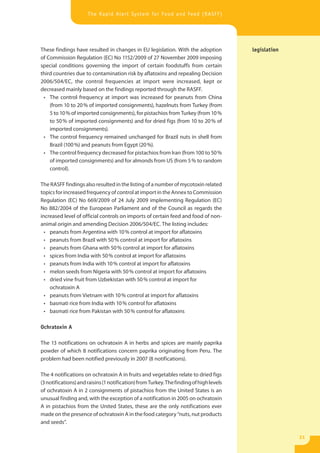
Allergenic substances

Directive 2003/89/EC 6, amending Directive 2000/13/EC 7 which sets out the                                               A SELECTION OF
rules on the labelling, presentation and advertising of foodstuffs, added a list                                         TOPICS RECURRING
of allergenic substances that are required to be mentioned on the labelling of                                           IN THE RASFF
food products if they are present in the ingredients. This laid down an EU-wide                                          IN 2009
protection of consumers who suffered allergic reactions to substances that,
for them, could be life-threatening. Allergenic substances did not get much
attention in food safety programmes until then as shown in the chart below.
Quickly over the years that followed the implementation of this Directive, the
number of RASFF notifications steadily grew and after a status quo in 2008, the
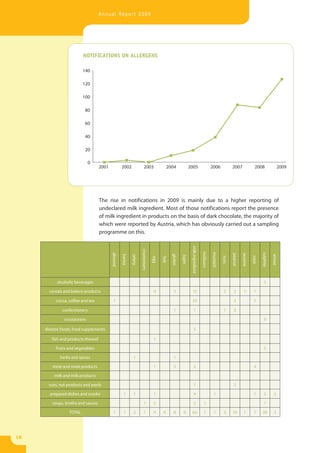
number of notifications on allergens jumped well above the 100-mark in 2009.


5   Products placed on the market in one of the member countries including the EEA countries Norway,
    Liechtenstein and Iceland
6   OJ L 308, 25.11.2003, p. 15–18
7   OJ L 109, 6.5.2000, p. 29–42
                                                                                                                                       17
Annual Report 2009


                         NOTIFICATIONS ON ALLERGENS

                         140

                         120

                         100

                          80

                          60

                          40

                          20

                             0
                                    2001            2002                  2003                 2004               2005                          2006             2007                2008                    2009


                                    The rise in notifications in 2009 is mainly due to a higher reporting of
                                    undeclared milk ingredient. Most of those notifications report the presence
                                    of milk ingredient in products on the basis of dark chocolate, the majority of
                                    which were reported by Austria, which has obviously carried out a sampling
                                    programme on this.
                                                                                                                   milk ingredient
                                                                      crustaceans


                                                                                                                                     molluscs

                                                                                                                                                mustard


                                                                                                                                                                                          sulphite
                                           almond


                                                                                                                                                                          sesame
                                                                                                                                                                 peanut
                                                                                                 gluten


                                                                                                                                                                                                     wheat
                                                    barley

                                                             celery


                                                                                                          lupin


                                                                                                                                                                                   soya
                                                                                                                                                          nuts
                                                                                    egg

                                                                                          fish


           alcoholic beverages                                                                                                                                                               3

       cereals and bakery products                                                   4             3                 12                                    2       2        1       1

          cocoa, coffee and tea              1                                                                      33                                             3                1

              confectionery                                                                        1                    1                                  1       3

               crustaceans                                                                                                                                                                   9

     dietetic foods, food supplements                                                                                   5

        fish and products thereof                                                    1

          fruits and vegetables                                                                                                                                                              5

            herbs and spices                                   1                                   1

         meat and meat products                                                      1             3                    2                                                           4

         milk and milk products

      nuts, nut products and seeds                                                                                      1                                          2

       prepared dishes and snacks                     1        1                     1                                  4                         1                                 1        2        2

        soups, broths and sauces                                          1          2                                  2               1                                                    1

                 TOTAL                       1        1        2          1          9     0       8       0        6o                  1         1        3     10         1       7     20          2


18
The Rapid Alert System for Food and Feed (RASFF)


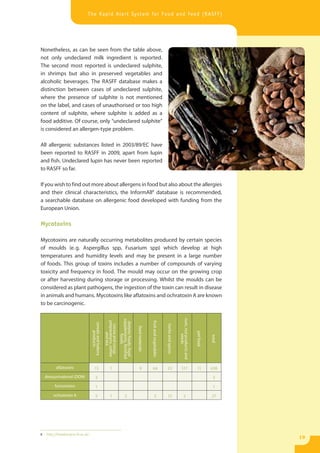
Nonetheless, as can be seen from the table above,
not only undeclared milk ingredient is reported.
The second most reported is undeclared sulphite,
in shrimps but also in preserved vegetables and
alcoholic beverages. The RASFF database makes a
distinction between cases of undeclared sulphite,
where the presence of sulphite is not mentioned
on the label, and cases of unauthorised or too high
content of sulphite, where sulphite is added as a
food additive. Of course, only “undeclared sulphite”
is considered an allergen-type problem.

All allergenic substances listed in 2003/89/EC have
been reported to RASFF in 2009, apart from lupin
and fish. Undeclared lupin has never been reported
to RASFF so far.

If you wish to find out more about allergens in food but also about the allergies
and their clinical characteristics, the InformAll8 database is recommended,
a searchable database on allergenic food developed with funding from the
European Union.

Mycotoxins

Mycotoxins are naturally occurring metabolites produced by certain species
of moulds (e. g. Aspergillus spp, Fusarium spp) which develop at high
temperatures and humidity levels and may be present in a large number
of foods. This group of toxins includes a number of compounds of varying
toxicity and frequency in food. The mould may occur on the growing crop
or after harvesting during storage or processing. Whilst the moulds can be
considered as plant pathogens, the ingestion of the toxin can result in disease
in animals and humans. Mycotoxins like aflatoxins and ochratoxin A are known
to be carcinogenic.
                                                                                                                                                                      nuts, nut products and
                                                                                  supplements, fortified
                                                           preparations, coffee


                                                                                                                            fruit and vegetables
                                                                                   dietetic foods, food
                                      cereals and bakery


                                                            cocoa and cocoa


                                                                                                                                                   herbs and spices
                                                                                                           feed materials
                                          products


                                                                                                                                                                                               pet food
                                                                 and tea


                                                                                                                                                                               seeds
                                                                                          foods


                                                                                                                                                                                                          total


          aflatoxins                       13                       1                                           9            64                     23                    517                   11        638
    deoxynivalenol (DON)                     3                                                                                                                                                             3
          fumonisins                         1                                                                                                                                                             1
        ochratoxin A                         5                      1                       2                                      5                 12                        2                          27


8   http://foodallergens.ifr.ac.uk/
                                                                                                                                                                                                                  19
Annual Report 2009


                      Aflatoxins

         in general   The number of notifications in 2009 (638) on aflatoxins has significantly
                      decreased compared to 2008 (902). The reduction can be seen in all food
                      categories, but in feed materials and pet food an increase in notifications can
                      be observed.

            cereals   The findings of aflatoxins in cereals and bakery products relate mainly to
                      findings in (basmati) rice (8) and corn meal (4) from different origins and
                      constitute a significant decrease compared to 2008 when there were 46
                      notifications on aflatoxins in cereals and bakery products of which 28 in
                      (basmati) rice and 18 in corn meal.

               figs   The 63 notifications on aflatoxins in the food category “fruit and vegetables”
                      are all on dried figs of which 60 notifications are on dried figs from Turkey.
                      Although still a high number of notifications, this is a significant decrease
                      compared to 2008 with 98 notifications on aflatoxins in dried figs from Turkey.

             spices   The 23 notifications in the category “herbs and spices” relate to different spices
                      such as chilli powder, clove powder, nutmeg, etc. of which 12 notifications
                      concern products originating from India.

     nuts and seeds   The 518 notifications on aflatoxins in nuts, nut products and seeds can be
                      subdivided into
                       • 218 notifications on groundnuts (peanuts) mainly from Argentina
                         (73 notifications), China (58 notifications), the United States (19 notifications),
                         Brazil (16 notifications), Egypt (15 notifications) and South Africa
                         (9 notifications)
                       • 136 notifications on pistachios mainly from Iran (57 notifications), Turkey
                         (35 notifications) and the United States (32 notifications)
                       • 63 notifications on hazelnuts nearly all from Turkey (61 notifications)
                       • 55 notifications on almonds mainly from the United States (46 notifications)
                         and a few from Australia (4 notifications)
                       • 7 notifications on Brazil nuts with 4 notifications on Brazil nuts in shell from
                         Brazil and 3 notifications on Brazil nut kernels from Bolivia.
                       • 12 notifications on melon seeds mainly from Nigeria (7 notifications)
                       • 6 notifications on apricot kernels from Turkey (3 notifications) and
                         Algeria (3)

              feed    The 9 notifications on aflatoxins in feed materials relate to groundnuts
                      (4 notifications), organic maize (4 notifications) and sunflower seeds
                      (1 notification).

                      The 11 notifications on aflatoxins in pet food are all on groundnuts for bird
                      feed mainly from Brazil (5 notifications) and India (4 notifications).


20
The Rapid Alert System for Food and Feed (RASFF)


These findings have resulted in changes in EU legislation. With the adoption             legislation
of Commission Regulation (EC) No 1152/2009 of 27 November 2009 imposing
special conditions governing the import of certain foodstuffs from certain
third countries due to contamination risk by aflatoxins and repealing Decision
2006/504/EC, the control frequencies at import were increased, kept or
decreased mainly based on the findings reported through the RASFF.
 • The control frequency at import was increased for peanuts from China
    (from 10 to 20 % of imported consignments), hazelnuts from Turkey (from
    5 to 10 % of imported consignments), for pistachios from Turkey (from 10 %
    to 50 % of imported consignments) and for dried figs (from 10 to 20 % of
    imported consignments).
 • The control frequency remained unchanged for Brazil nuts in shell from
    Brazil (100 %) and peanuts from Egypt (20 %).
 • The control frequency decreased for pistachios from Iran (from 100 to 50 %
    of imported consignments) and for almonds from US (from 5 % to random
    control).

The RASFF findings also resulted in the listing of a number of mycotoxin related
topics for increased frequency of control at import in the Annex to Commission
Regulation (EC) No 669/2009 of 24 July 2009 implementing Regulation (EC)
No 882/2004 of the European Parliament and of the Council as regards the
increased level of official controls on imports of certain feed and food of non-
animal origin and amending Decision 2006/504/EC. The listing includes:
  • peanuts from Argentina with 10 % control at import for aflatoxins
  • peanuts from Brazil with 50 % control at import for aflatoxins
  • peanuts from Ghana with 50 % control at import for aflatoxins
  • spices from India with 50 % control at import for aflatoxins
  • peanuts from India with 10 % control at import for aflatoxins
  • melon seeds from Nigeria with 50 % control at import for aflatoxins
  • dried vine fruit from Uzbekistan with 50 % control at import for
    ochratoxin A
  • peanuts from Vietnam with 10 % control at import for aflatoxins
  • basmati rice from India with 10 % control for aflatoxins
  • basmati rice from Pakistan with 50 % control for aflatoxins

Ochratoxin A

The 13 notifications on ochratoxin A in herbs and spices are mainly paprika
powder of which 8 notifications concern paprika originating from Peru. The
problem had been notified previously in 2007 (8 notifications).

The 4 notifications on ochratoxin A in fruits and vegetables relate to dried figs
(3 notifications) and raisins (1 notification) from Turkey. The finding of high levels
of ochratoxin A in 2 consignments of pistachios from the United States is an
unusual finding and, with the exception of a notification in 2005 on ochratoxin
A in pistachios from the United States, these are the only notifications ever
made on the presence of ochratoxin A in the food category “nuts, nut products
and seeds”.

                                                                                                       21
Annual Report 2009


               Dioxins

               In 2009, there were 13 notifications on the presence of dioxins and dioxin-like
               PCBs in feed and food.

               Six notifications related to the presence of dioxins and dioxin-like PCBs in cod
               liver of which 4 originated from Poland, 1 from Latvia and 1 from Lithuania.

               One notification concerned the presence of high levels of dioxins and dioxin-
               like PCBs in lamb liver. The presence of increased levels of dioxins and dioxin-
               like PCBs in lamb and sheep liver appears to be a more general problem and
               investigations are ongoing to identify the reasons for this.

               Furthermore there were 3 findings of dioxins and dioxin-like PCBs in unusual
               feed or food commodities: 1 in peanuts and sunflower seeds, 1 in the feed
               additive sulphur and 1 in ground dried flowers of Tagetes erecta intended for
               animal feed.

               The other 3 notifications related to a finding of dioxins in bentonite clay, in a
               feed premixture and in anglerfish liver.

               Unauthorised genetically modified food and feed

               In order to be authorised in food or feed, a new genetically modified (GM)
               ingredient needs to pass through very strict and detailed authorisation
               procedures. Sufficient proof needs to be given that the product does not pose
                              any risk to human health or the environment. Nonetheless,
                              unauthorised GM food or feed is sometimes discovered at
                              import or on the market. Usually it concerns only traces that
                              are present in a non-GM product that is imported into the EU.
                              The GM variety is often authorised in the producing country
                              but not in the EU.

                               The type of GM food or feed is characterised by the “GM event”,
                               a name given to a characteristic strand of “foreign” DNA that
                               was introduced in the genome of the plant. The table below
                               gives an overview of notifications by GM event.

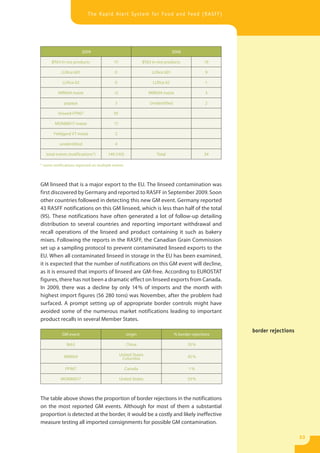
               As can be observed from the table, the number of RASFF notifications in GM
               food and feed somewhat exploded in 2009. Of the notifications, 25 concerned
               feed, the remaining 118 concerned food products. A large proportion of the
               notifications in 2009 concerned the unauthorised linseed event FP967, first
               detected in Europe in 2009, which appeared to be present in a substantial
               number of shiploads imported into the EU.

     linseed   The genetically modified linseed, called “Triffid”, had been authorised in
               Canada in the late nineties, but was never commercialised. Its authorisation
               was withdrawn in 2001 probably for fear of cross-contamination of the non-

22
The Rapid Alert System for Food and Feed (RASFF)


                         2009                                                 2008

      BT63 in rice products               17                BT63 in rice products              19

            LLRice 601                     0                     LLRice 601                    9

            LLRice 62                      0                     LLRice 62                     1

          MIR604 maize                    12                   MIR604 maize                    3

             papaya                        3                    Unidentified                   2

          linseed FP967                   95

        MON88017 maize                    17

       Yieldgard VT maize                  2

           unidentified                    4

   total events (notifications*)       149 (143)                    Total                      34

* some notifications reported on multiple events


GM linseed that is a major export to the EU. The linseed contamination was
first discovered by Germany and reported to RASFF in September 2009. Soon
other countries followed in detecting this new GM event. Germany reported
43 RASFF notifications on this GM linseed, which is less than half of the total
(95). These notifications have often generated a lot of follow-up detailing
distribution to several countries and reporting important withdrawal and
recall operations of the linseed and product containing it such as bakery
mixes. Following the reports in the RASFF, the Canadian Grain Commission
set up a sampling protocol to prevent contaminated linseed exports to the
EU. When all contaminated linseed in storage in the EU has been examined,
it is expected that the number of notifications on this GM event will decline,
as it is ensured that imports of linseed are GM-free. According to EUROSTAT
figures, there has not been a dramatic effect on linseed exports from Canada.
In 2009, there was a decline by only 14 % of imports and the month with
highest import figures (56 280 tons) was November, after the problem had
surfaced. A prompt setting up of appropriate border controls might have
avoided some of the numerous market notifications leading to important
product recalls in several Member States.

                                                                                                     border rejections
            GM event                               origin                      % border rejections

               Bt63                                China                              35 %

             MIR604                            United States                          45 %
                                                Columbia

              FP967                                Canada                             1%

           MON88017                            United States                          53 %


The table above shows the proportion of border rejections in the notifications
on the most reported GM events. Although for most of them a substantial
proportion is detected at the border, it would be a costly and likely ineffective
measure testing all imported consignments for possible GM contamination.

                                                                                                                         23
Annual Report 2009


     maize         Also the unauthorised GM events MIR604 and especially MON88017 were
                   reported more frequently in maize. EFSA adopted an opinion on 21 April 2009
                   on MON88017 and on 2 July 2009 on MIR604, concluding that these GM events
                   are unlikely to have any adverse effect on human or animal health or on the
                   environment in the context of their intended uses. After the publication of
                   these opinions, the Commission classified market notifications on the GM
                   events MIR604 and MON88017 as information notifications considering that
                   there is no serious risk associated with their presence. However, since the GM
                   events were still unauthorised, the non-compliances continued to be reported.
                   Finally, the Commission adopted Decisions on 30 October 2009 authorising
                   both GM events, which effectively put a stop to their reporting in the RASFF.

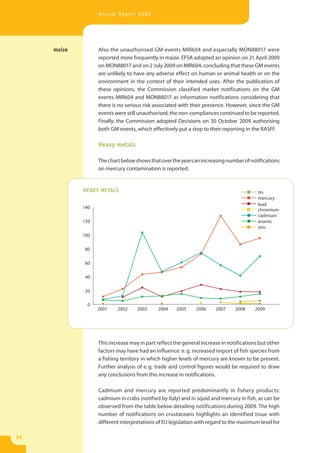
                   Heavy metals

                   The chart below shows that over the years an increasing number of notifications
                   on mercury contamination is reported.


             HEAVY METALS                                                                 tin
                                                                                          mercury
                                                                                          lead
             140                                                                          chromium
                                                                                          cadmium
             120                                                                          arsenic
                                                                                          zinc
             100

              80

              60

              40

              20

               0
                   2001    2002     2003     2004    2005     2006     2007     2008    2009


                   This increase may in part reflect the general increase in notifications but other
                   factors may have had an influence: e. g. increased import of fish species from
                   a fishing territory in which higher levels of mercury are known to be present.
                   Further analysis of e. g. trade and control figures would be required to draw
                   any conclusions from this increase in notifications.

                   Cadmium and mercury are reported predominantly in fishery products:
                   cadmium in crabs (notified by Italy) and in squid and mercury in fish, as can be
                   observed from the table below detailing notifications during 2009. The high
                   number of notifications on crustaceans highlights an identified issue with
                   different interpretations of EU legislation with regard to the maximum level for

24
The Rapid Alert System for Food and Feed (RASFF)


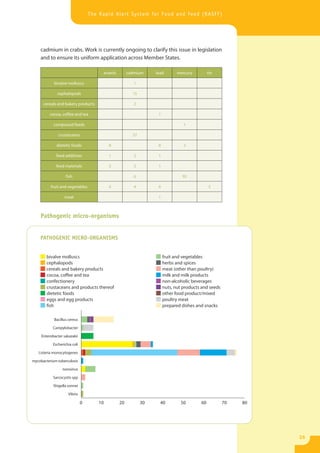
    cadmium in crabs. Work is currently ongoing to clarify this issue in legislation
    and to ensure its uniform application across Member States.

                                        arsenic        cadmium     lead        mercury         tin

            bivalve molluscs                              1

              cephalopods                                15

      cereals and bakery products                         2

          cocoa, coffee and tea                                     1

            compound feeds                                                        1

               crustaceans                               37

              dietetic foods               8                        8             2

              feed additives               1              2         1

              feed materials               2              2         1

                    fish                                  6                      92

          fruit and vegetables             4              4         6                          5

                   meat                                             1


    Pathogenic micro-organisms


    PATHOGENIC MICRO-ORGANISMS


        bivalve molluscs                                                fruit and vegetables
        cephalopods                                                     herbs and spices
        cereals and bakery products                                     meat (other than poultry)
        cocoa, coffee and tea                                           milk and milk products
        confectionery                                                   non-alcoholic beverages
        crustaceans and products thereof                                nuts, nut products and seeds
        dietetic foods                                                  other food product/mixed
        eggs and egg products                                           poultry meat
        fish                                                            prepared dishes and snacks

            Bacillus cereus

           Campylobacter

     Enterobacter sakazakii

            Escherichia coli

   Listeria monocytogenes

mycobacterium tuberculosis

                  norovirus

            Sarcocystis spp

            Shigella sonnei

                     Vibrio

                               0      10          20          30     40         50        60           70   80


                                                                                                                 25
Annual Report 2009


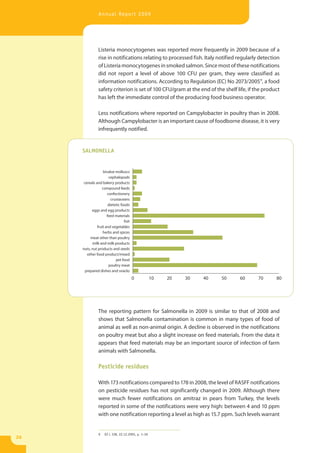
                Listeria monocytogenes was reported more frequently in 2009 because of a
                rise in notifications relating to processed fish. Italy notified regularly detection
                of Listeria monocytogenes in smoked salmon. Since most of these notifications
                did not report a level of above 100 CFU per gram, they were classified as
                information notifications. According to Regulation (EC) No 2073/2005 9, a food
                safety criterion is set of 100 CFU/gram at the end of the shelf life, if the product
                has left the immediate control of the producing food business operator.

                Less notifications where reported on Campylobacter in poultry than in 2008.
                Although Campylobacter is an important cause of foodborne disease, it is very
                infrequently notified.


     SALMONELLA


                   bivalve molluscs
                       cephalopods
      cereals and bakery products
                  compound feeds
                      confectionery
                         crustaceans
                       dietetic foods
           eggs and egg products
                      feed materials
                                  fish
               fruit and vegetables
                   herbs and spices
          meat other than poultry
           milk and milk products
     nuts, nut products and seeds
        other food product/mixed
                            pet food
                       poultry meat
       prepared dishes and snacks
                                         0          10   20   30   40    50      60       70      80


                The reporting pattern for Salmonella in 2009 is similar to that of 2008 and
                shows that Salmonella contamination is common in many types of food of
                animal as well as non-animal origin. A decline is observed in the notifications
                on poultry meat but also a slight increase on feed materials. From the data it
                appears that feed materials may be an important source of infection of farm
                animals with Salmonella.

                Pesticide residues

                With 173 notifications compared to 178 in 2008, the level of RASFF notifications
                on pesticide residues has not significantly changed in 2009. Although there
                were much fewer notifications on amitraz in pears from Turkey, the levels
                reported in some of the notifications were very high: between 4 and 10 ppm
                with one notification reporting a level as high as 15.7 ppm. Such levels warrant


                9   OJ L 338, 22.12.2005, p. 1–26
26
The Rapid Alert System for Food and Feed (RASFF)


measures to be taken to protect consumers’ health. A Commission Decision
2009/835/EC10 imposed special conditions for official controls on the import
of pears from Turkey requiring at least 10 % of the consignments to be tested
for amitraz. The decision applied until 24 January 2010, when its requirements
were taken over in Regulation (EC) No 669/2009 implementing Regulation
(EC) No 882/2004 as regards the increased level of official controls on imports
of certain feed and food of non-animal origin11. The measure clearly had an
effect: not only were fewer notifications reported, but also the levels reported
were much lower.

12 notifications were received on the active substance azinphos-methyl,
banned in the EU since 2007, in apples from the United States and from
Argentina, predominantly reported by Finland.

Dimethoate (20)/omethoate (21): both active substances, related in structure,
were found together in fresh apples from Brazil and omethoate separately in
various vegetables and herbs from Thailand.

Omethoate is more harmful to health than dimethoate and is not authorised
for usage on crops in the EU. Dimethoate was also found in fresh mint from
Morocco that was rejected at the EU border.

The unauthorised substance EPN continued
to be found in yard long beans from Thailand
(7 notifications). Oxamyl, a highly toxic active
substance, was reported 15 times in produce on
the market especially in peppers from Turkey
where repeated and sometimes very high levels
were reported. Oxamyl was also repeatedly
found in peaches from Egypt. Regulation (EC)
No 669/2009 requires, since 25/01/2010 a 10 %
check at import of consignments of peppers,
courgettes and tomatoes from Turkey for oxamyl
and methomyl. Already in 2009 however, findings
of methomyl in RASFF dropped considerably.

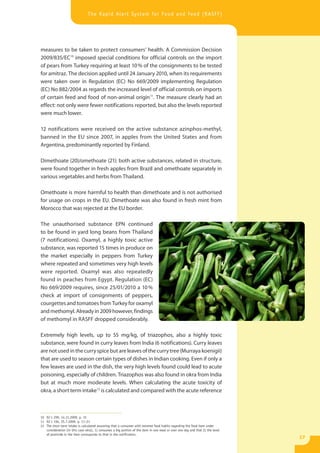
Extremely high levels, up to 55 mg/kg, of triazophos, also a highly toxic
substance, were found in curry leaves from India (6 notifications). Curry leaves
are not used in the curry spice but are leaves of the curry tree (Murraya koenigii)
that are used to season certain types of dishes in Indian cooking. Even if only a
few leaves are used in the dish, the very high levels found could lead to acute
poisoning, especially of children. Triazophos was also found in okra from India
but at much more moderate levels. When calculating the acute toxicity of
okra, a short term intake12 is calculated and compared with the acute reference


10 OJ L 299, 14.11.2009, p. 15
11 OJ L 194, 25.7.2009, p. 11–21
12 The short term intake is calculated assuming that a consumer with extreme food habits regarding the food item under
   consideration (in this case okra), 1) consumes a big portion of the item in one meal or over one day and that 2) the level
   of pesticide in the item corresponds to that in the notification.
                                                                                                                                27
Annual Report 2009


                    dose13 for triazophos. An intake above the acute reference dose could lead to
                    acute poisoning effects. Consumption data are used to calculate the short
                    term intake. For okra however, consumption data do not exist in Europe. It is
                    therefore common practice to use intake data of a comparable vegetable, in
                    this case e. g. green beans. At the levels found, the intake calculated exceeded
                    the acute reference dose considerably.

                    Another problem with the enforcement of safe pesticide residue levels in
                    food on the market is the short shelf life of fresh fruit and vegetables. When
                    samples are taken from produce, usually the produce is not detained pending
                    the results. When the results are available, the produce is often already sold
                    and consumed.

                    Market notifications are only transmitted if the levels found present a risk to
                    the consumer. A calculation is made comparing short term intake with acute
                    reference dose. However, when the product is stopped at the EU border and
                    sampled for pesticide residues, it remains blocked until results are available. If
                    the results are unfavourable, meaning that one or more residues were found
                    above the MRL, then the consignment is destroyed or redispatched according
                    to the decision of the competent authority and a border rejection notification
                    is transmitted.

                    Veterinary drug residues


       VETERINARY DRUG RESIDUES


     100                                                                                                                         poultry meat
                                                                                                                                 milk and milk products
      90                                                                                                                         meat (other than poultry)
      80                                                                                                                         honey and royal jelly
      70                                                                                                                         fish
                                                                                                                                 eggs and egg products
      60
                                                                                                                                 crustaceans
      50
      40
      30
      20
      10
       0
           other/not identified


                                  chloramphenicol


                                                    malachite green


                                                                      nitrofuran (metabolite)


                                                                                                oxytetracycline


                                                                                                                  streptomycin


                                                                                                                                     sulfonamides


                                                                                                                                                    tetracycline


                                                                                                                                                                   tylosin


                   13 The acute reference dose is the quantity of an active substance below which acute effects can be excluded.
28
The Rapid Alert System for Food and Feed (RASFF)


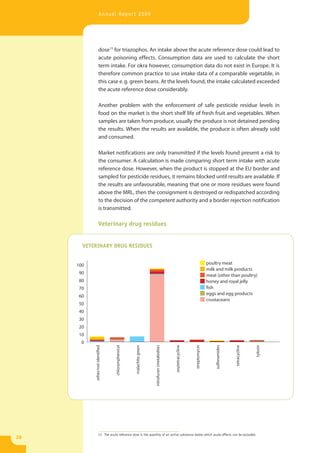
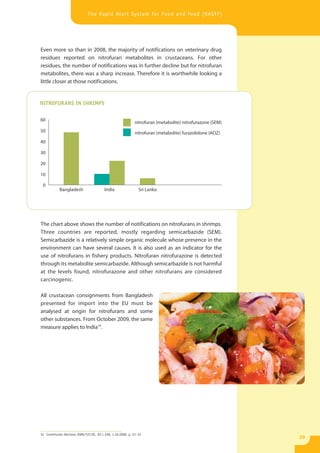
Even more so than in 2008, the majority of notifications on veterinary drug
residues reported on nitrofuran metabolites in crustaceans. For other
residues, the number of notifications was in further decline but for nitrofuran
metabolites, there was a sharp increase. Therefore it is worthwhile looking a
little closer at those notifications.


NITROFURANS IN SHRIMPS

60
                                                            nitrofuran (metabolite) nitrofurazone (SEM)
50                                                           nitrofuran (metabolite) furazolidone (AOZ)
40

30

20

10

 0
            Bangladesh                   India                 Sri Lanka


The chart above shows the number of notifications on nitrofurans in shrimps.
Three countries are reported, mostly regarding semicarbazide (SEM).
Semicarbazide is a relatively simple organic molecule whose presence in the
environment can have several causes. It is also used as an indicator for the
use of nitrofurans in fishery products. Nitrofuran nitrofurazone is detected
through its metabolite semicarbazide. Although semicarbazide is not harmful
at the levels found, nitrofurazone and other nitrofurans are considered
carcinogenic.

All crustacean consignments from Bangladesh
presented for import into the EU must be
analysed at origin for nitrofurans and some
other substances. From October 2009, the same
measure applies to India14.


14 Commission Decision 2009/727/EC, OJ L 258, 1.10.2009, p. 31–33
                                                                                                          29
Annual Report 2009


30
The Rapid Alert System for Food and Feed (RASFF)


3
     Focus on …


                                                       31
Annual Report 2009


          Border rejections

          Members of RASFF are required to notify rejections of food or feed at the border
          if the consignment is rejected for reason of a direct or indirect risk to human
          (food or feed) or animal (feed) health. This requirement was introduced with
          Regulation (EC) 178/2002 in its article 50 which sets the basis for the RASFF.

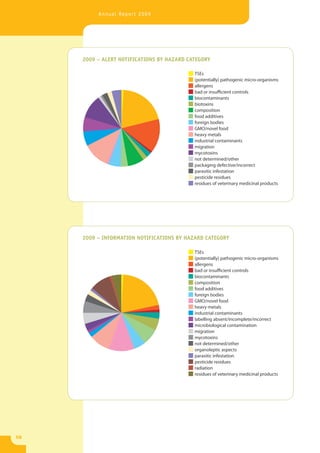
          In 2009, the number of notifications on products originating from outside the
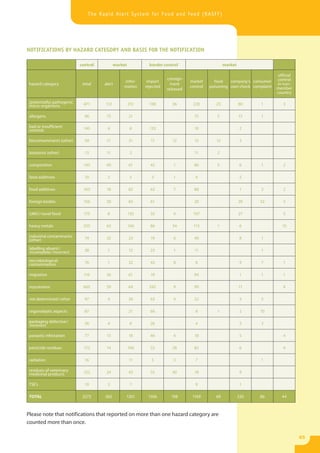
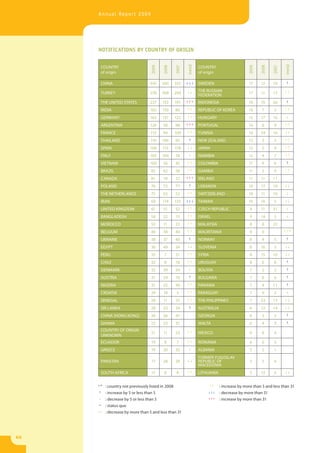
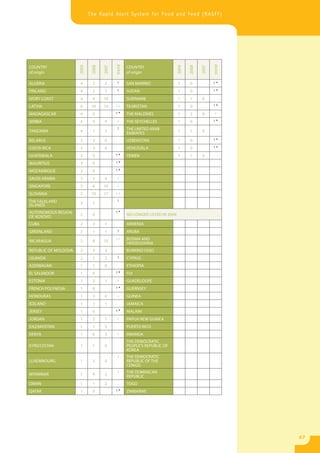
          EEA amounted to 2372, which is 75 % of the total number of notifications. This
          number is influenced by the border rejections, which obviously are all about
          products from third countries. In market notifications, still 53 % of notifications
          concern third country products.

          Border rejections represent just under half of the original notifications to
          RASFF but controls at the border generate more than border rejections alone.
          Monitoring samples taken at the border can lead to RASFF notifications,
          when the results become known after the product is released on the market
          (“border control – consignment released”). The RASFF notification is then used
          to exchange information enabling the withdrawal of the product from the
          market if this is necessary.

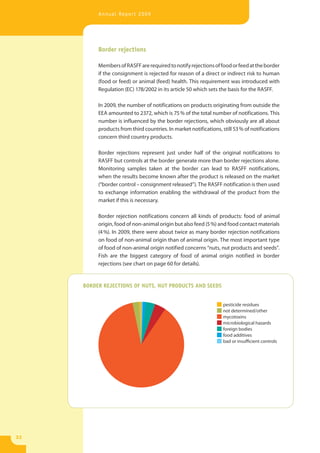
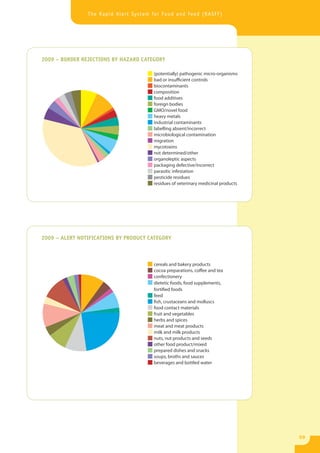
          Border rejection notifications concern all kinds of products: food of animal
          origin, food of non-animal origin but also feed (5 %) and food contact materials
          (4 %). In 2009, there were about twice as many border rejection notifications
          on food of non-animal origin than of animal origin. The most important type
          of food of non-animal origin notified concerns “nuts, nut products and seeds”.
          Fish are the biggest category of food of animal origin notified in border
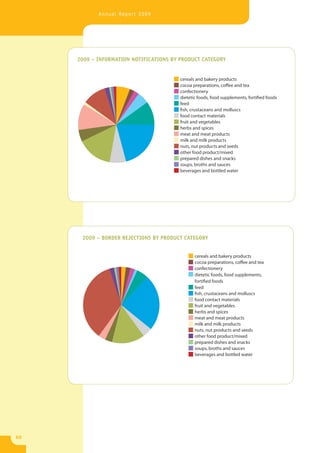
          rejections (see chart on page 60 for details).


     BORDER REJECTIONS OF NUTS, NUT PRODUCTS AND SEEDS


                                                                   pesticide residues
                                                                   not determined/other
                                                                   mycotoxins
                                                                   microbiological hazards
                                                                   foreign bodies
                                                                   food additives
                                                                   bad or insufficient controls


32
The Rapid Alert System for Food and Feed (RASFF)


BORDER REJECTIONS OF FISH AND PRODUCTS THEREOF


                                                        parasitic infestation
                                                        packaging defects
                                                        organoleptic aspects
                                                        not determined/other
                                                        microbiological hazards
                                                        labelling defects
                                                        industrial contaminants
                                                        heavy metals
                                                        compostion
                                                        biocontaminants
                                                        bad or insufficient controls


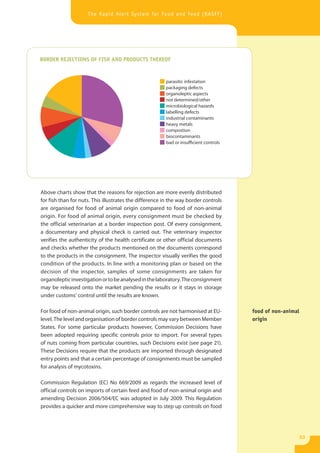
Above charts show that the reasons for rejection are more evenly distributed
for fish than for nuts. This illustrates the difference in the way border controls
are organised for food of animal origin compared to food of non-animal
origin. For food of animal origin, every consignment must be checked by
the official veterinarian at a border inspection post. Of every consignment,
a documentary and physical check is carried out. The veterinary inspector
verifies the authenticity of the health certificate or other official documents
and checks whether the products mentioned on the documents correspond
to the products in the consignment. The inspector visually verifies the good
condition of the products. In line with a monitoring plan or based on the
decision of the inspector, samples of some consignments are taken for
organoleptic investigation or to be analysed in the laboratory. The consignment
may be released onto the market pending the results or it stays in storage
under customs’ control until the results are known.

For food of non-animal origin, such border controls are not harmonised at EU-          food of non-animal
level. The level and organisation of border controls may vary between Member           origin
States. For some particular products however, Commission Decisions have
been adopted requiring specific controls prior to import. For several types
of nuts coming from particular countries, such Decisions exist (see page 21).
These Decisions require that the products are imported through designated
entry points and that a certain percentage of consignments must be sampled
for analysis of mycotoxins.

Commission Regulation (EC) No 669/2009 as regards the increased level of
official controls on imports of certain feed and food of non-animal origin and
amending Decision 2006/504/EC was adopted in July 2009. This Regulation
provides a quicker and more comprehensive way to step up controls on food


                                                                                                        33
Annual Report 2009


                         of non-animal origin or feed if an emerging risk is detected. A list of products
                         that require an increased level of official controls at import is given in Annex I
                         of the Regulation. The products will be required to enter through designated
                         entry points and will be subjected to documentary and physical checks,
                         including laboratory analysis, at a frequency related to the risk identified.
                         RASFF notifications are an important source of information to establish the
                         list, which is reviewed quarterly. Other sources include reports of the Food and
                         Veterinary Office, information from official controls and monitoring in Member
                         States, etc.

                         Apart from mycotoxins, other hazards reported in border rejections of food of
                         non-animal origin concerned:

                          • the composition of these foods, although most of these notifications are
                            made for products controlled on the market (only 36 border rejections
                            out of 129 notifications or 28 %, see also the next heading “composition
                            of food”)
                          • organoleptic aspects or microbiological contamination such as spoilage
                            or infestation with moulds
                          • foreign bodies, mostly (larvae of) insects or rodent excrements, in bulk
                            fruits, nuts, vegetables or cereals
                          • pesticide residues in fresh fruits and vegetables
                          • pathogens, especially Salmonella in sesame and pine seeds and Bacillus
                            cereus in soybean curd

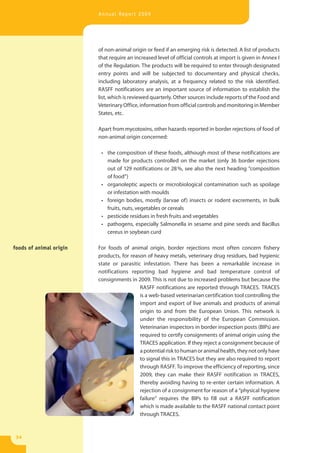
foods of animal origin   For foods of animal origin, border rejections most often concern fishery
                         products, for reason of heavy metals, veterinary drug residues, bad hygienic
                         state or parasitic infestation. There has been a remarkable increase in
                         notifications reporting bad hygiene and bad temperature control of
                         consignments in 2009. This is not due to increased problems but because the
                                           RASFF notifications are reported through TRACES. TRACES
                                           is a web-based veterinarian certification tool controlling the
                                           import and export of live animals and products of animal
                                           origin to and from the European Union. This network is
                                           under the responsibility of the European Commission.
                                           Veterinarian inspectors in border inspection posts (BIPs) are
                                           required to certify consignments of animal origin using the
                                           TRACES application. If they reject a consignment because of
                                           a potential risk to human or animal health, they not only have
                                           to signal this in TRACES but they are also required to report
                                           through RASFF. To improve the efficiency of reporting, since
                                           2009, they can make their RASFF notification in TRACES,
                                           thereby avoiding having to re-enter certain information. A
                                           rejection of a consignment for reason of a “physical hygiene
                                           failure” requires the BIPs to fill out a RASFF notification
                                           which is made available to the RASFF national contact point
                                           through TRACES.


 34
The Rapid Alert System for Food and Feed (RASFF)


Composition of food


COMPOSITION

40
                                                                                                                                                                                                                                   unauthorised substance
                                                                                                                                                                                                                                   unauthorised colour
35                                                                                                                                                                                                                                 too high level
                                                                                                                                                                                                                                   too high content
30                                                                                                                                                                                                                                 other
                                                                                                                                                                                                                                   high content
25
                            aluminium
20

                                                                                                                                     iodine                                                                                               illegal dyes
15

10

 5

 0
       cereals and bakery

                             compound feeds

                                              confectionery

                                                              dietetic foods

                                                                                 fats and oils

                                                                                                 feed additives

                                                                                                                  feed premixtures

                                                                                                                                     fish

                                                                                                                                            food contact materials

                                                                                                                                                                     fruit and vegetables

                                                                                                                                                                                            herbs and spices

                                                                                                                                                                                                               ices and desserts

                                                                                                                                                                                                                                   meat

                                                                                                                                                                                                                                            natural mineral water

                                                                                                                                                                                                                                                                    non-alcoholic beverages
                                                                                                                                                                                                                                                                                              prepared dishes
                                                                                                                                                                                                                                                                                                  and snacks
                                                                                                                                                                                                                                                                                                soups, broths
                                                                                                                                                                                                                                                                                                  and sauces


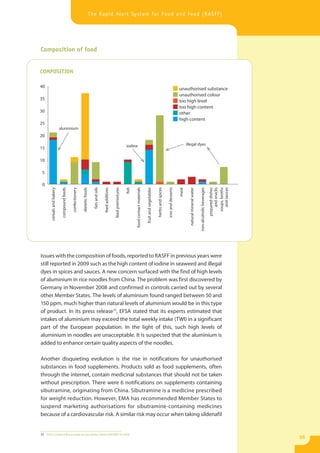
Issues with the composition of foods, reported to RASFF in previous years were
still reported in 2009 such as the high content of iodine in seaweed and illegal
dyes in spices and sauces. A new concern surfaced with the find of high levels
of aluminium in rice noodles from China. The problem was first discovered by
Germany in November 2008 and confirmed in controls carried out by several
other Member States. The levels of aluminium found ranged between 50 and
150 ppm, much higher than natural levels of aluminium would be in this type
of product. In its press release15, EFSA stated that its experts estimated that
intakes of aluminium may exceed the total weekly intake (TWI) in a significant
part of the European population. In the light of this, such high levels of
aluminium in noodles are unacceptable. It is suspected that the aluminium is
added to enhance certain quality aspects of the noodles.

Another disquieting evolution is the rise in notifications for unauthorised
substances in food supplements. Products sold as food supplements, often
through the internet, contain medicinal substances that should not be taken
without prescription. There were 6 notifications on supplements containing
sibutramine, originating from China. Sibutramine is a medicine prescribed
for weight reduction. However, EMA has recommended Member States to
suspend marketing authorisations for sibutramine-containing medicines
because of a cardiovascular risk. A similar risk may occur when taking sildenafil


15 http://www.efsa.europa.eu/en/press/news/afc080715.htm
                                                                                                                                                                                                                                                                                                                35
Annual Report 2009


                              or its analogues without a prescription. Sildenafil is the active substance of the
                              drug Viagra. Four notifications reported the presence of these substances in
                              products sold as food supplements and one in chewing gum, all originating
                              from China.

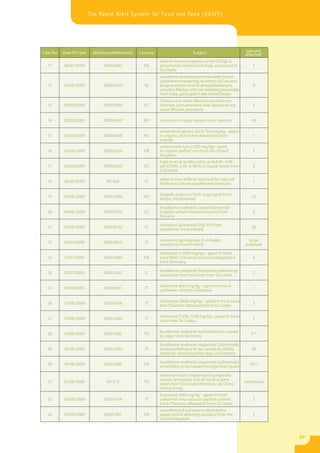
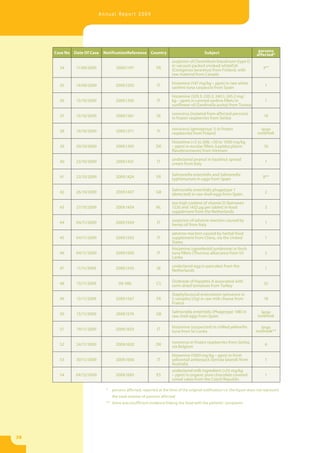
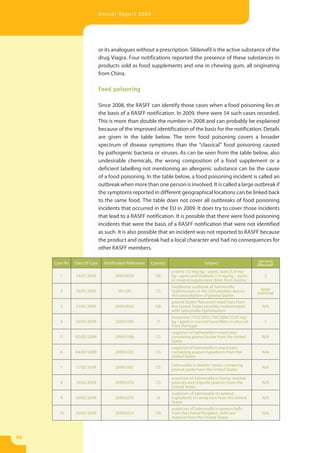
                              Food poisoning

                              Since 2008, the RASFF can identify those cases when a food poisoning lies at
                              the basis of a RASFF notification. In 2009, there were 54 such cases recorded.
                              This is more than double the number in 2008 and can probably be explained
                              because of the improved identification of the basis for the notification. Details
                              are given in the table below. The term food poisoning covers a broader
                              spectrum of disease symptoms than the “classical” food poisoning caused
                              by pathogenic bacteria or viruses. As can be seen from the table below, also
                              undesirable chemicals, the wrong composition of a food supplement or a
                              deficient labelling not mentioning an allergenic substance can be the cause
                              of a food poisoning. In the table below, a food poisoning incident is called an
                              outbreak when more than one person is involved. It is called a large outbreak if
                              the symptoms reported in different geographical locations can be linked back
                              to the same food. The table does not cover all outbreaks of food poisoning
                              incidents that occurred in the EU in 2009. It does try to cover those incidents
                              that lead to a RASFF notification. It is possible that there were food poisoning
                              incidents that were the basis of a RASFF notification that were not identified
                              as such. It is also possible that an incident was not reported to RASFF because
                              the product and outbreak had a local character and had no consequences for
                              other RASFF members.

     Case No   Date Of Case     Notification Reference   Country                      Subject                       persons
                                                                                                                   affected*
                                                                   arsenic (12 mg/kg – ppm), lead (3.8 mg/
       1       14/01/2009            2009.0039             GB      kg – ppm) and thallium (1.4 mg/kg – ppm)           2
                                                                   in mineral supplement drink from Austria
                                                                   foodborne outbreak of Salmonella
       2       16/01/2009              09-520              CS      Typhimurium in the USA possibly due to            large
                                                                                                                   outbreak
                                                                   the consumption of peanut butter
                                                                   peanut butter flavoured snack bars from
       3       21/01/2009            2009.0063             GB      the United States possibly contaminated           N/A
                                                                   with Salmonella typhimurium
                                                                   histamine (1910/2051/104/2066/2229 mg/
       4       30/01/2009             2009.0105            IT      kg – ppm) in canned tuna fillets in olive oil      1
                                                                   from Portugal
                                                                   suspicion of Salmonella in snack bars
       5       02/02/2009             2009.0108            CS      containing peanut butter from the United          N/A
                                                                   States
                                                                   suspicion of Salmonella in snack bars
       6       04/02/2009             2009.0125            CS      containing peanut ingredients from the            N/A
                                                                   United States

                                                                   Salmonella in dietetic meals containing
       7       11/02/2009             2009.0167            CS                                                        N/A
                                                                   peanut paste from the United States

                                                                   suspicion of Salmonella in honey roasted
       8       19/02/2009             2009.0210            CS      peanuts and chipotle peanuts from the             N/A
                                                                   United States
                                                                   suspicion of Salmonella (in peanut
       9       20/02/2009             2009.0219            SI      ingredient) in candy bars from the United         N/A
                                                                   States
                                                                   suspicion of Salmonella in protein balls
       10      20/02/2009             2009.0214            GB      from the United Kingdom, with raw                 N/A
                                                                   material from the United States


36
The Rapid Alert System for Food and Feed (RASFF)


Case No   Date Of Case    NotificationReference   Country                      Subject                        persons
                                                                                                             affected*
                                                            Listeria monocytogenes (2100 CFU/g) in
  11      26/02/2009           2009.0242            DE      gorgonzola cheese from Italy, processed in          1
                                                            Germany
                                                            unauthorised substance nimesulide in food
                                                            supplement containing an extract of Curcuma
  12      26/02/2009           2009.0244            SE      longa (turmeric) and DL-phenylalanine pro-          9
                                                            cessed in Mexico, with raw material presumably
                                                            from India, packaged in the United States
                                                            Chinese star anise (Illicium verum) from
  13      09/03/2009           2009.0290            ES      Vietnam contaminated with Japanese star             2
                                                            anise (Illicium anisatum)

  14      23/03/2009           2009.0340            NO      norovirus in Gigas oysters from Sweden              19

                                                            undeclared gluten (53.9; 76.5 mg/kg – ppm)
  15      14/04/2009           2009.0468            HU      in organic gluten free bread mix from               1
                                                            Ireland
                                                            undeclared nuts (>200 mg/kg – ppm)
  16      24/04/2009           2009.0524            GB      in organic puffed rice from the United              1
                                                            Kingdom
                                                            high level of acidity (citric acid:4.41–4.95;
  17      24/04/2009           2009.0520            ES      pH (D100): 2.95–2.98 %) in liquid candy from        2
                                                            Colombia

                                                            adverse liver effects reported for users of
  18      28/05/2009             09-563             FI      Hydroxycut food supplement products                 1


                                                            Shigella sonnei in fresh sugar peas from
  19      03/06/2009           2009.0696            NO                                                          12
                                                            Kenya, via Denmark

                                                            foodborne outbreak caused by escolar
  20      04/06/2009           2009.0712            ES      (Lepidocybium flavobrunneum) from                   2
                                                            Panama

                                                            norovirus (presence/25g) in frozen
  21      09/06/2009           2009.0732            FI                                                          20
                                                            raspberries from Poland

                                                            norovirus (genogroup 2) in frozen                  large
  22      03/07/2009           2009.0854            FI      raspberries from Poland                          outbreak

                                                            histamine (>1000 mg/kg – ppm) in fresh
  23      27/07/2009           2009.0984            DK      tuna fillets (Thunnus thynnus) dispatched           4
                                                            from Germany

                                                            foodborne outbreak (histamine poisoning)
  24      30/07/2009           2009.1005            IT                                                          7
                                                            caused by fresh tuna loin from Sri Lanka

                                                            histamine (643 mg/kg – ppm) in tuna in
  25      07/08/2009           2009.1041            IT                                                          1
                                                            sunflower oil from Colombia

                                                            histamine (3600 mg/kg – ppm) in fresh tuna
  26      13/08/2009           2009.1058            IT                                                          3
                                                            loin (Thunnus albacares) from Sri Lanka

                                                            histamine (1218; 1378 mg/kg – ppm) in fresh
  27      14/08/2009           2009.1064            IT                                                          2
                                                            tuna from Sri Lanka

                                                            foodborne outbreak (salmonellosis) caused
  28      14/08/2009           2009.1062            FR                                                          4**
                                                            by eggs from Germany

                                                            foodborne outbreak suspected (Salmonella
  29      19/08/2009           2009.1082            FI      bovismorbificans) to be caused by alfalfa           20
                                                            seeds for sprouting from Italy, via Sweden

  30      19/08/2009           2009.1085            FR      foodborne outbreak suspected (Salmonella           30**
                                                            enteritidis) to be caused by eggs from Spain

                                                            unknown toxin (impairment symptoms
                                                            and/or temporary loss of taste) in pine
  31      21/08/2009             09-573             FR                                                       not known
                                                            seeds from China and Pakistan, via China
                                                            (Hong Kong)
                                                            histamine (488 mg/kg – ppm) in fresh
  32      26/08/2009           2009.1104            IT      yellow fin tuna vacuum packed sashimi               2
                                                            loins (Thunnus albacares) from Sri Lanka
                                                            unauthorised substance sibutramine
  33      10/09/2009           2009.1187            DE      suspected in slimming product from the              1
                                                            United Kingdom


                                                                                                                         37
Annual Report 2009


     Case No Date Of Case    NotificationReference Country                                Subject                          persons
                                                                                                                          affected*
                                                                      suspicion of Clostridium botulinum (type E)
                                                                      in vacuum packed smoked whitefish
       34     11/09/2009            2009.1197                FR                                                               3**
                                                                      (Coregonus lavaretus) from Finland, with
                                                                      raw material from Canada

                                                                      histamine (147 mg/kg – ppm) in raw white
       35     14/09/2009            2009.1205                IT                                                                1
                                                                      sashimi tuna carpaccio from Spain

                                                                      histamine (329.3; 220.3; 240.1; 245.2 mg/
       36     13/10/2009            2009.1345                IT       kg – ppm) in canned sardine fillets in                   1
                                                                      sunflower oil (Sardinella aurita) from Tunisia

                                                                      norovirus (isolated from affected persons)
       37     15/10/2009            2009.1361                SE                                                               19
                                                                      in frozen raspberries from Serbia

                                                                      norovirus (genogroup 1) in frozen                     large
       38     19/10/2009            2009.1371                FI                                                           outbreak
                                                                      raspberries from Poland

                                                                      histamine (<5 to 208; <50 to 1000 mg/kg
       39     20/10/2009            2009.1395               DK        – ppm) in escolar fillets (Lepidocybium                 10
                                                                      flavobrunneum) from Vietnam

                                                                      undeclared peanut in hazelnut spread
       40     23/10/2009            2009.1431                IT                                                                1
                                                                      cream from Italy

                                                                      Salmonella enteritidis and Salmonella
       41     23/10/2009            2009.1424                FR       typhimurium in eggs from Spain                          8**


       42     26/10/2009            2009.1437               GB        Salmonella enteritidis phagetype 1                       2
                                                                      (detected) in raw shell eggs from Spain

                                                                      too high content of vitamin D (between
       43     27/10/2009            2009.1454               NL        1220 and 1432 μg per tablet) in food                     3
                                                                      supplement from the Netherlands

                                                                      suspicion of adverse reaction caused by
       44     04/11/2009            2009.1504                IT                                                                1
                                                                      hemp oil from Italy

                                                                      adverse reaction caused by herbal food
       45     04/11/2009            2009.1503                IT       supplement from China, via the United                    1
                                                                      States
                                                                      histamine (sgombroid syndrome) in fresh
       46     04/11/2009            2009.1500                IT       tuna fillets (Thunnus albacares) from Sri                2
                                                                      Lanka

                                                                      undeclared egg in pancakes from the
       47      11/11/2009           2009.1545                SE                                                                1
                                                                      Netherlands

                                                                      Outbreak of hepatitis A associated with
       48     13/11/2009             09-580                  CS                                                               32
                                                                      semi-dried tomatoes from Turkey

                                                                      Staphylococcal enterotoxin (presence in
       49     13/11/2009            2009.1567                FR       5 samples/25g) in raw milk cheese from                  18
                                                                      France

                                                                      Salmonella enteritidis (Phagetype 14B) in             large
       50     13/11/2009            2009.1574               GB                                                            outbreak
                                                                      raw shell eggs from Spain

                                                                      histamine (suspected) in chilled yellowfin            large
       51     19/11/2009            2009.1603                IT                                                          outbreak**
                                                                      tuna from Sri Lanka


       52     24/11/2009            2009.1620               DK        norovirus in frozen raspberries from Serbia,             6
                                                                      via Belgium

                                                                      histamine (1000 mg/kg – ppm) in fresh
       53     30/11/2009            2009.1656                IT       yellowtail amberjack (Seriola lalandi) from              1
                                                                      Australia
                                                                      undeclared milk ingredient (>25 mg/kg
       54     04/12/2009            2009.1683                ES       – ppm) in organic pure chocolate covered                 1
                                                                      cereal cakes from the Czech Republic

                              *   persons affected, reported at the time of the original notification i.e. the figure does not represent
                                  the total number of persons affected
                              ** there was insufficient evidence linking the food with the patients’ symptoms


38
The Rapid Alert System for Food and Feed (RASFF)


Case No 2 concerns a news notification based on a press release by the U.S.
Food and Drug Administration (FDA) on an outbreak in the US linked to the
consumption of peanut butter. It turned out that a major peanuts producer in
the US had a serious problem with Salmonella contamination. With information
obtained from FDA, notifications followed on diverse products containing
potentially contaminated peanuts (cases 3 and 5–10).

Case 12 concerns the presence of nimesulide, an anti-inflammatory drug, in a
food supplement. Nimesulide had previously been withdrawn as medicine for
its known toxicity to the liver. Serious cases of liver damage occurred, some
with fatal consequences. Apart from in Sweden, the supplement had also been
distributed to five other member countries and was immediately withdrawn
from the market and press releases were issued to warn consumers.

Cases 14, 21, 22, 37, 38 and 52 all are related to the presence of norovirus. Only
case 14 concerns oysters; in all five other cases frozen raspberries from Poland
and from Serbia were involved. Also in previous years, frozen raspberries were
reported as a cause for large outbreaks.

In relation to case 17, two children were reported in Spain with mouth lesions
as a consequence of consuming a roll-on liquid candy with a very high acidity.

The FDA published on 1 May 2009 a warning on their website, urging
consumers to discontinue the use of Hydroxycut food supplement products
immediately due to suspicions of serious liver injuries. Hydroxycut products
are suspected of having caused liver damage to several patients in Finland,
reported in case 18.

Case 19 reported on an unusual foodborne outbreak in Norway caused by
sugar peas from Kenya (also called snow peas) contaminated with Shigella
sonnei. These bacteria can cause serious dysentery but are killed if food is
thoroughly cooked. Faecal contamination due to bad hygienic practice usually
lies at the basis of the problem. More detailed information was published in
the Eurosurveillance journal16.

In the course of the summer, Denmark and especially Italy reported cases
of histamine poisoning (scombroid fish poisoning) after consuming tuna
(cases 23–27, 32, 35, 36, 46 and 51). High levels of histamine (>200 ppm)
will be formed in the fish if not properly chilled and stored for too long at
an unsuitable temperature. Thorough cooking of the fish will not solve the
problem as histamine is heat-resistant. Histamine can also occur in other types
of fish (e. g. case 39 and 53).

In case 31, consumers reported experiencing a bitter taste or loss of taste after
having consumed pine seeds. What is unusual and has not been explained


16 http://www.eurosurveillance.org/ViewArticle.aspx?ArticleId=19243
                                                                                     39
Annual Report 2009


                   to date is that these symptoms only occurred one or two days after having
                   consumed the pine seeds. The pine seeds in question originated from China
                   and Pakistan. In Europe, most pine seeds on the market are produced in
                   the Mediterranean area, mainly from the Pinus pinea species. The pine nuts
                   imported from Asia may be harvested from other Pinus species. The substances
                   that are responsible for the effect have however not yet been identified17.

                   Case 43 relates to high levels of vitamin D in a food supplement that has lead
                   to hypercalcaemia and kidney failure. The cause of such a high level of vitamin
                   D was a miscalculation in the production process.

                   In case 50, Salmonellosis outbreaks in various regions of the UK could be
                   linked to eggs from a particular flock in Spain, thought to be infected with
                   Salmonella. As a precaution, eggs from that flock were no longer sold as shell
                   eggs but were heat treated to destroy any possible presence of Salmonella.
                   More details in the FSA “Annual Report of Incidents 2009”18.

     Hepatitis A   Case 48: news notification 09-580

                   In November 2009, the IHR National Focal Point of Australia notified WHO
                   of a multi-jurisdictional outbreak of hepatitis A affecting over 250 people
                   linked to semi-dried tomatoes. After having received an alert through the
                   INFOSAN network, the Commission made a news notification to draw the
                   attention of RASFF contact points to this information.

                                                         On 29 January 2010, the Commission’s RASFF contact
                                                         point received information through its Public
                                                         Health Directorate and the EWRS19 about a hepatitis
                                                         A outbreak in France. 43 cases were registered
                                                         between November 2009 and February 2010; most
                                                         of the cases were epidemiologically linked to semi-
                                                         dried tomatoes.

                                                         In addition, authorities in the Netherlands reported
                                                         13 cases of hepatitis A which could also be connected
                                                         to semi-dried tomatoes. The Netherlands started a
                                                         comprehensive tracing investigation into the semi-
                                                         dried tomato products that had been consumed.

                   From the various investigations it turned out that the products at the source
                   of the outbreaks were most likely frozen semi-dried tomatoes that had not
                   undergone any pasteurisation process. The frozen product is bought as an
                   intermediate product by processors who thaw portions of the product, add
                   oil, herbs and spices to sell onwards. Samples taken of remaining product or
                   other batches could not confirm any contamination with hepatitis A in France


                   17 More information on the website of AFSSA: http://www.afssa.fr/Documents/RCCP2009sa0166.pdf
                   18 http://www.food.gov.uk/multimedia/pdfs/incidents09.pdf
                   19 Early Warning and Response System on communicable diseases
40
The Rapid Alert System for Food and Feed (RASFF)


nor in the Netherlands. In Australia, one sample of semi-dried tomatoes was
found to contain hepatitis A.

The products could mainly be traced back to exporting companies in Turkey;
in particular one company occurred in both investigations in France and in
the Netherlands. Under the co-ordination of INFOSAN, Turkey provided
feedback on the products that had been exported to the EU in the period
under investigation. It has also given details on investigations into exporters
and producers of the semi-dried tomato products and on processes, HACCP
procedures and hygiene measures in place. No hepatitis A-infected material
could however be found.

Fraud

Why fraud is also relevant for food safety is amply illustrated with examples
in recent and not so recent memory. Often the perpetrators in their search for
quick profit do not have much thought for the serious harm their actions may
cause to human health. Important food incidents in the past, such as the dioxin
crisis in Belgium in 1999, the “MPA”-crisis in 2002, the illegal dyes problems in
2005 and the melamine crisis in 2008 had in common that their root cause
was an intentional fraud for economic gain. The table below sets out fraud
incidents reported through RASFF. Because of the fraud, the safety of these
products could not be guaranteed and products needed to be withdrawn or
recalled if they were already placed on the market.

                                          2007           2008           2009

    expiry dates changed (MS*)              2              1              4

      false health mark (MS)                2              1              3

       illegal import (TC**)               16             13              13

    false health certificate (TC)           3              6              18

       meat unfit for human                 4              4              1
        consumption (MS)


   unauthorised establishment          MS: 7, TC: 4   MS: 3, TC: 8   MS: 3, TC: 10


* Member States   ** Third Countries


All above cases, except expiry date changes, concern only products of animal
origin. Such products can only be marketed if produced by authorised
establishments (both for products produced in the EU and imported) and a
health mark is placed on the packaging (only if produced in the EU). Some
important cases of fraud were uncovered with falsified health certificates for
products posing to originate from authorised establishments but most likely
having an entirely different origin. Such fraud often can only be effectively
uncovered with the assistance of the country declared as the country of
origin. This country can acknowledge or denounce the authenticity of the


                                                                                     41
Annual Report 2009


           documents. The electronic certification system TRACES can be of great help
           in this co-operation with the exporting countries in fighting this kind of fraud.
           The Commission provides access to TRACES to exporting countries and trains
           them as part of its “Better Training for Safer Food programme”.

           Feed

           The chart below shows that feed is getting more reported every year since
           2004. This should not mean that problems with feed are on the rise. It is more
           likely that reporting procedures for feed have matured over the years. More


     EVOLUTION OF NOTIFICATIONS CONCERNING FEED


     200


     100


       0
            2002      2003      2004      2005       2006      2007      2008      2009


           countries are reporting regularly on risks in relation to feed than before but
           when looking at individual countries, no clear trends can be observed.

           Spain and the United Kingdom have reported considerably more on feed than
           the years before. Most of the Spanish and British notifications were about
           rejections at the border. Spain reported Salmonella or Enterobacteriaceae,
           but also some notifications for unauthorised genetically modified maize
           MON88017 found in consignments of soybean feed material. This raised high
           concern in Europe because of the dependence of the animal production in the
           EU on imports of soybean. There was great fear that rising feed prices would
           seriously impact the meat production cost. After a favourable opinion by EFSA,
           the authorisation procedure of this GM maize was accelerated and negative
           consequences for the animal production in the EU were avoided. The United
           Kingdom reported 13 border rejections of groundnuts for bird feed, mostly
           from Brazil and from India.

           In the category “feed additives” there were again some notifications reporting
           unacceptable levels of heavy metals arsenic, lead and cadmium and two
           notifications for presence of dioxins and dioxin-like PCBs in bentonite clay and
           in sulphur. The sulphur that was produced in Poland turned out not to have
           been sold for feed purpose.


42
The Rapid Alert System for Food and Feed (RASFF)


RASFF FEED NOTIFICATIONS IN 2009: PRODUCTS AND HAZARDS


                                    pet food
                                    feed premixtures
                                    feed materials
                                    feed additives
                                    compound feeds
                                    animal by-products


PET FOOD                                                 mycotoxins
                                                         microbiological contamination
                                                         labelling
                                                         industrial contaminants
                                                         heavy metals
                                                         GMO
                                                         foreign bodies


FEED MATERIALS                                           other
                                                         mycotoxins
                                                         microbiological contamination
                                                         industrial contaminants
                                                         heavy metals
                                                         GMO
                                                         foreign bodies


In relation to animal by-products, there were four notifications by Denmark
on porcine and bovine cartilages for technical use that were improperly
labelled. They were rejected at the border. For pet food, most notifications
concerned Salmonella and Enterobacteriaceae. Notifications about industrial
contaminants concerned findings of melamine.

In feed materials, most notifications reported contamination with Salmonella.
The GMO notifications concerned GM linseed and traces of GM maize in
soybean.


                                                                                         43
Annual Report 2009


                          Two notifications reported contamination with dioxins and dioxin-like PCBs.
                          One notification, reporting high levels of dioxins contamination, concerned
                          dried Tagetes flowers for pigmentation of egg yolks. The product and feed
                          produced with it was distributed to several countries in Europe and globally.

                          Switzerland: a new partial member of RASFF

                          On the first of January 2009, an amendment to the agreement on the trade
                          of agricultural products20 entered into force, adding two BIPs in Switzerland.
                          With this, Switzerland has become part of the European market for products
                          of animal origin and live animals. As part of the package, Switzerland became
                          a member of RASFF for border rejections of products of animal origin with a
                          view to becoming a full member once the full body of EU law is adopted.

                          Increased participation of third countries in RASFF

                          Already for several years, RASFF has become less of a secret to countries that
                          are not a member of it. The Commission improved its communication with
                          them over the years (read more under the heading on RASFF Window), as can
                          be seen in the chart below.


                    FOLLOW-UP NOTIFICATIONS RECEIVED FROM THIRD COUNTRIES

                    500

                    450

                    400

                    350

                    300

                    250

                    200

                    150

                    100

                     50
                      0
                          1999       2000        2001        2002        2003        2004        2005        2006        2007        2008   2009


                          New technologies for RASFF

     RASFF Window         RASFF Window is a web interface that has been developed in order to improve
                          the speed of transmission of the information between the European Commission
                          and third countries in the context of the RASFF. The application provides
                          authorities of concerned third countries with direct access to the notifications.


                          20 Decision No 1/2008 of the joint veterinary committee set up by the agreement between the European Community
                             and the Swiss Confederation on trade in agricultural products, O.J. L 6, 10.1.2009, p. 89–116
44
The Rapid Alert System for Food and Feed (RASFF)


With a login and password to the RASFF Window, notifications are directly
available to competent authorities of a third country represented by a
nominated contact point. Also the country’s embassy in Brussels, the
delegation of the European Union in that country and desk officers responsible
for this third country at the Commission are given access to the notifications.
The transmission is rapid and effective: notifications are uploaded within 24
working hours from their issuing in the RASFF.

The condition for becoming a “RASFF Window
country” is identifying a single contact point in the
third country that is responsible for assigning logins
to the competent authorities or for monitoring the
RASFF Window itself and forwarding notifications
to the ministries or agencies involved. All the
concerned parties, that had been given a login and
password, receive automatic e-mails informing them
about new notifications or follow-up notifications in
RASFF Window for their country of interest that can
be checked online immediately.

The system became operational in 2008, but the
majority of the countries started using it in 2009.

In cases where it has not yet been possible to identify a single contact point,
as an intermediate solution, the EU delegation in the country downloads the
notifications from RASFF Window and transmits them to the appropriate
competent authority. The final goal is for all third countries to use RASFF
Window either directly or through the EU delegations.


At the celebration of RASFF’s 30th birthday (see chapter four), the new                RASFF Portal
RASFF Portal website was inaugurated. It marked the opening of the publicly
searchable RASFF Portal database. The database is identical to the RASFF
Window database, but only a limited set of data for each notification are
made available to the public. Nonetheless, all market and border rejection
notifications are searchable going back to 1979, the first year of operation of
the system.

While the systems mentioned above were finalised and put in place, work                iRASFF: the “i” for
continued on a new generation platform for RASFF member countries to                   “interactive”
transmit and work together on RASFF notifications: iRASFF.

The new software will provide an online and real-time platform allowing
countries to notify in a clear, detailed and structured way. The major novelty
in this application is the possibility for countries to add their follow up into the
original notification rather than appending it. This allows for a better overview
of the current state of a notification as it evolves. The system is foreseen to be
implemented in early 2011.

                                                                                                             45
Annual Report 2009


                      RASFF: a source of global inspiration

                      In 2009, the worldwide RASFF project continued, as part of the Better Training
                      for Safer Food programme (BTSF), run by DG SANCO. The project was set up
                      around the same time as BTSF. Its objective is to explain RASFF in detail to
                      third countries for a better understanding of the system and to stimulate
                      other regions of the world to set up a similar system. For the EU, this could
                      result in the important benefit of safer imports of food and feed and better
                      coordination with third countries should any problems arise. Since much of
                      these objectives are in common with BTSF, the worldwide RASFF project was
                      integrated into the BTSF training programme.

     RASFF seminars   RASFF seminars are designed to inform participants in depth of the functioning
                      of EU RASFF and its role in food safety management in the EU. Through lectures
                      by tutors from the Commission and Member States, participants are provided
                      with detailed information on how the system is operated. Using case studies,
                      they learn how food safety incidents are reported and followed-up. They also
                      get a hands-on experience with RASFF software systems.

                                                Three seminars have taken place, the first one in
                                                Hanoi, Vietnam, focused on the ASEAN RASFF
                                                system. The ASEAN RASFF, having been a pilot project
                                                between 7 countries of ASEAN, seeks now to be
                                                endorsed by the ASEAN secretariat and become part
                                                of the ASEAN working programme. For this, terms of
                                                reference of the ASEAN RASFF steering committee
                                                were written and revised during the meeting. At the
                                                request of the authorities in Macao, a back-to-back
                                                workshop was held in Macao, including participants
                                                from Hong Kong and mainland China. Once the EU
                                                RASFF model was explained and illustrated with
                                                exercises, participants reflected if and how they
                                                could implement such a model in their region.

                      The seminar in December in Johannesburg, South Africa, found participants
                      of African countries joined together for 3 days in a very good – African –
                      atmosphere to explore the RASFF. There was ample time to examine case
                      studies and to practice with the software. But even more important was the
                      opportunity to exchange experiences and to discuss the current challenges in
                      the area of food safety and the role of the RASFF in this. South Africa and other
                      countries of the region showed an interest in building a regional system to
                      strengthen their cooperation in the field of food safety.


46
The Rapid Alert System for Food and Feed (RASFF)


Sustained training missions are a second phase in the worldwide RASFF            Sustained training
project. After the seminars explaining RASFF, countries expressing an interest
in setting up a national RASFF system can be supported by a longer mission of
experts who can discuss with the competent services and provide their advice
on the steps to be taken for setting up the system.

In 2009, a sustained training mission on RASFF took place in Indonesia on the
request of National Agency for Food and Drug Control of Indonesia (BPOM).
The mission detected what are the main challenges for Indonesia to implement
such a system and was a way to get all parties around the table and discuss
the setting up of protocols for exchanging information between all authorities
competent for food safety.


                                                                                                      47
Annual Report 2009


48
The Rapid Alert System for Food and Feed (RASFF)


4
     30 years of RASFF: a celebration


                                                       49
Annual Report 2009


     When realising in 2009 that it was going to be exactly 30 years ago that the
     first RASFF notification was “created”, the RASFF team at DG SANCO thought it
     was the perfect occasion for a celebration. And so it was. The idea to organise
     a RASFF conference to take stock of what had been achieved in previous years
     and to look ahead to the future of RASFF had existed already for a while. Soon
     a couple of other ideas emerged: making a special publication about 30 years
     RASFF and inviting contacts in countries all over the world to celebrate with us:
     the mix was ready to be cooked. It all happened as follows:

     Special celebration booklet: “30 years of keeping consumers safe”

     Nothing better to commemorate a special date than to make a special
     publication around it. This special booklet first introduces the policy and
     procedures of RASFF, and then goes on to give an account of the history of
     30 years of RASFF, providing some background on various milestones and
     technological revolutions that not only reshaped food safety policy in the
     EU and society in general, but also boosted the RASFF to its next level. A
     recommended read!

     Technical meeting on 15 July 2009

     The three-day event kicked off with a technical meeting with RASFF members,
     contact points and representatives of third countries and WHO discussing the
     future of RASFF and other alert systems around the world and how cooperation
     between these systems could be enhanced.

     At the start of the meeting, the EC RASFF team explained the state of ongoing
     activities in RASFF and how it is preparing for the future. It also explained the
     work already done and its plans for activities under the Better Training for Safer
     Food programme to support countries and world regions outside the EU to set
     up their own alert systems inspired by the RASFF.

     Following this, two examples of regional networks were presented: in
     MERCOSUR and ASEAN. While the ASEAN RASFF is already up and running
     with 7 countries participating in the platform, the MERCOSUR RASFF is still in
     preparation. The presentation by WHO – INFOSAN brought everything together
     on a global scale. A dynamic conclusion to the technical meeting, which showed
     that work can be done in parallel at national, regional and global level.

     International conference “Keeping An Eye On Your Food”
     on 16 July 2009

     On 16 July 2009, DG Health & Consumers organised a high-level conference
     in which representatives of more than 90 countries participated to learn
     more about the role RASFF has played in the turbulent past of food safety in
     Europe and to take stock of what plans RASFF has in store for the future. The
     different speeches and presentations are available on the RASFF website at
     http://ec.europa.eu/rasff

50
The Rapid Alert System for Food and Feed (RASFF)


Commissioner Vassiliou opened the conference
remembering how RASFF has evolved over 30 years
as a communication tool on food safety. In the 21st
century, this communication needs to be extended
to global level and RASFF is ready to play an impor-
tant part in this.


Commissioner Rhoda Tumusiime of the African
Union gave her views on the challenges Africa faces
in relation to food safety. Where the safety of food
is not being taken seriously, it is often a matter of
life or death. A rapid alert system could be of great
benefit in Africa but there is a more urgent need for
infrastructure, standards, training and enforcement
to establish the required traceability of food and
feed and consumer awareness.


The following keynote speeches were delivered:


Deputy Director General Paola Testori Coggi
explained how RASFF had helped achieve in Europe
one of the highest levels of food safety in the world
and gave her views on the further developments of
the system in the years to come.


Mrs Inger Andersson, Director General of the
Swedish National Food Administration gave a
view on what RASFF meant from the national
perspective and she pleaded for more openness in
the system while ensuring that confidential informa-
tion is protected and for RASFF data to be more and
better used when deciding on future controls.


Dr Somsak Pipoppinyo, Assistant Director and
Head of the Natural Resources Unit of the
Association of Southeast Asian Nations (ASEAN)
explained how ARASFF – the ASEAN RASFF system –
fitted very well in the evolution of ASEAN from an
Association into a Community.


                                                                        51
Annual Report 2009


                                                Mrs Monique Goyens, Director General of the
                                                European Consumers’ Organisation (BEUC), was
                                                there to give the consumers’ view on the RASFF. She
                                                said that the EU is one of the safest places in the world
                                                to eat and drink and that RASFF plays a very important
                                                part in this and is trusted to deliver good work. She
                                                pleaded for more information to flow back to the
                                                consumer from the RASFF. She highlighted the use of
                                                nanotechnology as an emerging food safety concern.


                                                Dr Andrea Ellis of the World Health Organization’s
                                                International network of food safety authorities
                                                “INFOSAN” presented the conference with questions
                                                over how global alert systems should be organised
                                                in order to respond to the challenges faced at global
                                                level. She said that cooperation between public
                                                health and food safety authorities is pivotal to
                                                managing hazards in food.


Afternoon discussion       Three discussion panels were organised around the following themes:
              panels
                            • Stakeholder expectations of the RASFF
                              Mrs Beate Kettlitz of the Confederation of Food and Drink Industries (CIAA)
                              asked that food business operators should be given a role in the system as
                              they have key information regarding the food safety incidents reported.
                              She also made a case for more harmonisation between Member States in
                              the use of the system and increased global cooperation.

                              Mr. Robert Remy of the consumer organisation “Test-Achats” in Belgium
                              asked that consumers be given more information to allow them to identify
                              the products that are the subject of a RASFF notification.

                            • Global food safety and alert systems
                              Mr Sanchai Tontyaporn, team leader of the ARASFF (ASEAN RASFF) project,
                              explained the project that was run with the support of the European
                              Commission. With seven out of ten ASEAN countries participating, it has
                              a solid basis for growth, although compared to the RASFF, it is still in its
                              infancy. Implementation of the ARASFF should greatly contribute to the
                              improvement of overall food safety within the network member countries
                              and at the regional level as a whole. The next challenges for ARASFF are
                              further improvement of the ARASFF software, building stronger national
                              networks and getting the ARASFF endorsed by the ASEAN secretariat.

                              Dr Andrea Ellis of WHO – INFOSAN explained the need for collaboration
                              on food safety on a global scale. Countries have an obligation to report
                              important food safety events to INFOSAN under the International Health
                              Regulations (IHR).


52
The Rapid Alert System for Food and Feed (RASFF)


    Mr Emilio Vento of the United Nations Industrial Development Organization
    (UNIDO)’s trade building capacity (TCB) branch illustrated the usefulness
    of RASFF data in its approach to support developing country farms and
    firms to bring their products to markets by upgrading supply capacity
    and quality infrastructure. RASFF data analysis will greatly contribute to
    a better understanding of compliance challenges and ultimately to more
    effectively targeted TCB interventions.

 • Future challenges for the EU food safety system and the role
   of RASFF
   Mr. Andrea Altieri of EFSA presented a system EFSA has developed to
   analyse trends in RASFF notifications and to generate reports and charts.

    Mr. George Georgallas, head of the RASFF contact point in Cyprus, pointed
    out that new food technologies and climate change may place new
    challenges on the RASFF. An example of an area already affected is the
    problem of food allergens. Another area is food fraud.

    Mr Kim Vandrup, head of the RASFF contact point in Denmark, identified
    two internal challenges for RASFF in the future: the volume of information
    to be managed as more countries become members or exchange
    information with RASFF and another challenge is the right balance
    between transparency and confidentiality of the information in RASFF.


Director General Robert Madelin asked rappor-                                    Mr. Madelin’s
teurs of the three panels to give an account of the                              conclusions
discussions that had taken place and drew the
following summary conclusions before closing the
conference:

1. the process has to be both local to Europe and
   global in its openness;

2. involvement of stakeholders should be increased;

3. ensuring that all players at global level are
   committed to immediate sharing of information;

4. a successful RASFF is enabled by teamwork, at dif-
   ferent levels, be it political or technical and with
   dedicated teams we will together enable this
   global network we need, to ensure food safety.


This special day was closed with a festive dinner, in the presence of European
Commissioner Vassiliou, Commissioner Tumusiime of the African Union and
Commissioner Hamburg of the United States’ Food and Drug Administration.
Invited guests were contact persons of the RASFF from the past as well as the
present, from Member States as well as from third countries.


                                                                                                 53
Annual Report 2009


     Field trip   On 17 July, the event was closed with a visit to the fruit and vegetable auction
                  in Mechelen, the largest farmers’ cooperative in Europe for the sale of fresh
                  fruits and vegetables. More than one hundred participants from RASFF
                  contact points and food safety authorities from around the world could see
                  how traceability is implemented on the spot and what programs exist for
                  monitoring the safety of the products, including demonstrations and
                  presentations by the Belgian Food Safety Agency.


54
The Rapid Alert System for Food and Feed (RASFF)


5
     More charts and tables


                                                       55
Annual Report 2009


                    EVOLUTION OF THE NUMBER OF NOTIFICATIONS SINCE 2004


                    8000                                                                              follow-up to border
                                                                                                      rejection
                    7000                                                                              follow-up to information
                                                                                                      follow-up to alert
                    6000                                                                              border rejection
                                                                                                      information
                    5000                                                                              alert


                    4000

                    3000

                    2000

                    1000

                       0
                               2004       2005    2006      2007         2008          2009


                             In 2009, the number of notifications rose again to record levels. The number of original
                             notifications increased by a moderate 5 % for the three types: alert, information and
                             border rejection. But the follow-up notifications’ number was boosted, especially
                             for information notifications: by no less than 40 %! Overall, there was an increase by
                             nearly 12 %.


     year   alert   information      border      news     follow-up to    follow-up to follow-up to    follow-up to      total
                                    rejection                  alert      information border rejection     news

     2004   690        553            1338        89         1449               504           825              0         559

     2005   955        747            1453        86         2218               679           842              0         6894

     2006   910        687            1274        72         2157               640           923              0         6591

     2007   952        761            1211        43         2440               796           978              0         7138

     2008   528        1138           1377        47         1789               1329          743              76        7027

     2009   557        1191           1456        42         1775               1861          871              87        7840

      %     +5.5       +4.7           +5.7       -10.6        -0.8              +40           +17.2          +14.5      +11.6


56
The Rapid Alert System for Food and Feed (RASFF)


NOTIFICATIONS BY NOTIFYING COUNTRY

       COUNTRY          withdrawn    rejected      alert      border       information   news
                                                             rejection

        AUSTRIA             4           2           40          14             56         0

       BELGIUM              8           2           35          47             35         1

       BULGARIA             1           0           0           25             1          0

  COMMISSION SERVICES       0           0           13          0              9         27

        CYPRUS              2           2           6           20             27         0

    CZECH REPUBLIC          0           1           25          9              34         1

       DENMARK              1           7           33          9              81         1
   EFTA SURVEILLANCE
       AUTHORITY
                            0           0           0           0              0          0

       ESTONIA              0           0           2           1              10         0
 EUROPEAN FOOD SAFETY
      AUTHORITY
                            0           0           0           0              0          0

       FINLAND              1           2           15          84             42         2

        FRANCE              5           2           44          53             60         3

       GERMANY              7           2           83         154            177         4

        GREECE              3           7           11         120             29         1

       HUNGARY              0           0           3           1              6          0

       ICELAND              0           0           0           0              1          0

       IRELAND              0           1           14          3              13         1

         ITALY             42          12           70         192            204         4

        LATVIA              0           1           6           1              7          0

     LIECHTENSTEIN          0           0           0           0              0          0

       LITHUANIA            0           1           3           14             16         0

     LUXEMBOURG             0           0           7           0              9          0

        MALTA               0           1           1           4              13         0

     NETHERLANDS           11           2           13         161             38         0

       NORWAY               0           2           2           19             9          2

       POLAND               4           5           13          98             30         0

       PORTUGAL             0           1           1           3              4          0

       ROMANIA              0           6           0           10             8          0

    SLOVAK REPUBLIC         0           1           26          7              19         0

       SLOVENIA             0           0           19          13             41         1

         SPAIN              7           3           17         220             18         2

        SWEDEN              0           1           10          3              47         0

     SWITZERLAND            0           1           0           3              1          0

    UNITED KINGDOM          5           8           44         154            136         8

Remark: figures updated on 9 June 2010, before the report went to print.                        57
Annual Report 2009


     2009 – ALERT NOTIFICATIONS BY HAZARD CATEGORY

                                            TSEs
                                            (potentially) pathogenic micro-organisms
                                            allergens
                                            bad or insufficient controls
                                            biocontaminants
                                            biotoxins
                                            composition
                                            food additives
                                            foreign bodies
                                            GMO/novel food
                                            heavy metals
                                            industrial contaminants
                                            migration
                                            mycotoxins
                                            not determined/other
                                            packaging defective/incorrect
                                            parasitic infestation
                                            pesticide residues
                                            residues of veterinary medicinal products


     2009 – INFORMATION NOTIFICATIONS BY HAZARD CATEGORY

                                            TSEs
                                            (potentially) pathogenic micro-organisms
                                            allergens
                                            bad or insufficient controls
                                            biocontaminants
                                            composition
                                            food additives
                                            foreign bodies
                                            GMO/novel food
                                            heavy metals
                                            industrial contaminants
                                            labelling absent/incomplete/incorrect
                                            microbiological contamination
                                            migration
                                            mycotoxins
                                            not determined/other
                                            organoleptic aspects
                                            parasitic infestation
                                            pesticide residues
                                            radiation
                                            residues of veterinary medicinal products


58
The Rapid Alert System for Food and Feed (RASFF)


2009 – BORDER REJECTIONS BY HAZARD CATEGORY

                                       (potentially) pathogenic micro-organisms
                                       bad or insufficient controls
                                       biocontaminants
                                       composition
                                       food additives
                                       foreign bodies
                                       GMO/novel food
                                       heavy metals
                                       industrial contaminants
                                       labelling absent/incorrect
                                       microbiological contamination
                                       migration
                                       mycotoxins
                                       not determined/other
                                       organoleptic aspects
                                       packaging defective/incorrect
                                       parasitic infestation
                                       pesticide residues
                                       residues of veterinary medicinal products


2009 – ALERT NOTIFICATIONS BY PRODUCT CATEGORY


                                       cereals and bakery products
                                       cocoa preparations, coffee and tea
                                       confectionery
                                       dietetic foods, food supplements,
                                       fortified foods
                                       feed
                                       fish, crustaceans and molluscs
                                       food contact materials
                                       fruit and vegetables
                                       herbs and spices
                                       meat and meat products
                                       milk and milk products
                                       nuts, nut products and seeds
                                       other food product/mixed
                                       prepared dishes and snacks
                                       soups, broths and sauces
                                       beverages and bottled water


                                                                                   59
Annual Report 2009


     2009 – INFORMATION NOTIFICATIONS BY PRODUCT CATEGORY


                                                           cereals and bakery products
                                                           cocoa preparations, coffee and tea
                                                           confectionery
                                                           dietetic foods, food supplements, fortified foods
                                                           feed
                                                           fish, crustaceans and molluscs
                                                           food contact materials
                                                           fruit and vegetables
                                                           herbs and spices
                                                           meat and meat products
                                                           milk and milk products
                                                           nuts, nut products and seeds
                                                           other food product/mixed
                                                           prepared dishes and snacks
                                                           soups, broths and sauces
                                                           beverages and bottled water


       Source: 2009-preliminary-report data.xls#prod cat


      2009 – BORDER REJECTIONS BY PRODUCT CATEGORY


                                                                  cereals and bakery products
                                                                  cocoa preparations, coffee and tea
                                                                  confectionery
                                                                  dietetic foods, food supplements,
                                                                  fortified foods
                                                                  feed
                                                                  fish, crustaceans and molluscs
                                                                  food contact materials
                                                                  fruit and vegetables
                                                                  herbs and spices
                                                                  meat and meat products
                                                                  milk and milk products
                                                                  nuts, nut products and seeds
                                                                  other food product/mixed
                                                                  prepared dishes and snacks
                                                                  soups, broths and sauces
                                                                  beverages and bottled water


60
The Rapid Alert System for Food and Feed (RASFF)


2009 – NOTIFICATIONS BY HAZARD CATEGORY AND PRODUCT CATEGORY


                             alcoholic beverages (other than wine)


                                                                                                                                                                                                                                             dietetic foods and food supplements
                                                                                                                                                         cocoa preparations, coffee and tea


                                                                                                                                                                                                                                                                                                                                                                                                                                                                                                                                                                                                                                                                                                                                                                            (other than natural mineral water)
                                                                                                                                                                                                                                                                                                                                                                                                                                                                                                                                                                                                                                                                                                                                                                            water for human consumption
                                                                                                                                                                                                                                                                                                                                                                                                                                                                                                                                                                                                                              nuts, nut products and seeds
                                                                                                                           cereals and bakery products


                                                                                                                                                                                                                                                                                                                                                                                                                                                                                                                                                                                                                                                                                                                    prepared dishes and snacks
                                                                                                                                                                                                                                                                                                                                                                                                                                                                                                                                                                                                                                                             other food product / mixed
                                                                                                                                                                                                                                                                                                                                                                                                                                                                                                                       meat (other than poultry)


                                                                                                                                                                                                                                                                                                                                                                                                                                                                                                                                                                                                                                                                                                                                                 soups, broths and sauces
                                                                                                                                                                                                                                                                                                                                                                                                                                                                                                                                                                                                    non-alcoholic beverages
                                                                                                                                                                                                                                                                                   eggs and egg products


                                                                                                                                                                                                                                                                                                                                                                                                                                                                                                                                                   milk and milk products
                                                                                                                                                                                                                                                                                                                                                                                                        food contact materials


                                                                                                                                                                                                                                                                                                                                                                                                                                                                                                                                                                            natural mineral water
                                                                                                                                                                                                                                                                                                                                                                                                                                                                           honey and royal jelly
                                                                                                                                                                                                                                                                                                                                                                                                                                 fruit and vegetables
                                                                     animal by-products


                                                                                                                                                                                                                                                                                                                                                             feed premixtures
                                                                                                                                                                                              compound feeds


                                                                                                                                                                                                                                                                                                                                                                                                                                                                                                   ices and desserts
                                                                                                                                                                                                                                                                                                                                                                                                                                                        herbs and spices
                                                                                          bivalve molluscs


                                                                                                                                                                                                                                                                                                                                                                                       food additives
                                                                                                                                                                                                                                                                                                                                            feed materials
                                                                                                                                                                                                                                                                                                                           feed additives
                                                                                                                                                                                                               confectionery


                                                                                                                                                                                                                                                                                                                                                                                                                                                                                                                                                                                                                                                                                                     poultry meat
                                                                                                             cephalopods


                                                                                                                                                                                                                                                                                                           fats and oils
                                                                                                                                                                                                                               crustaceans


                                                                                                                                                                                                                                                                                                                                                                                                                                                                                                                                                                                                                                                                                          pet food


                                                                                                                                                                                                                                                                                                                                                                                                                                                                                                                                                                                                                                                                                                                                                                                                                 wine
                     total


                                                                                                                                                                                                                                                                                                                                                                                fish
hazard category
(potentially)
pathogenic           471                                                                  31 2                               3                             1                                   1                5              8               8                                    9                                                       69                                  54                                               29 34                                                                                 65 17                                                                            1 30                                                   1 18 70 15
micro-organisms
allergens            96                                                                                                    24 34                                                                                8                              5                                                                                                                                1                                                                        1                                                               7                          1                                                2                          3                                                                     1               7                            3
bad or
insufficient         145                                              1                                      13 2                                                                                                              12 1                                                                         2                                                 1 74                                                               17                                                                 1                    7                          1                                                                           4                              2                                      6                                            1
controls
biocontaminants      59                                                                                                      1                                                                                                                                                                                                                                                  50                                                                                                                                                                                                                                                                                                                                                                 8
biotoxins (other)    13                                                                    8                                                                                                                                                                                                                                                                                    2                                                 1                                                                                                                                                                                             1
composition          144                                                                                                   20                                                                  2                8                            37                                                             9               1                                 1 10                                       2                       19 20                                                              1                    2                                                   2                       2                                                                                                                2                            6
feed additives       10                                                                                                                                                                                                                                                             1                                                                                                                                                                                                                                                                                                                                                                                                                 9
food additives       163 2                                                                                                 10                                                                                  29 21 5                                                                                                                                                          6       1                                        34                      8                                          1                    7                                                                          22                          7                                                                                     2                            7                                                             1
foreign bodies       156 1                                                                                   2 18 22 3                                                                                          3                              4                                                                                            14                                  3                                                34                      4                                          2                    3                          4                                                                         25                                                          1           1               8                            3                                  1
GMO / novel food     175                                                                                                   49 6                                                                3                1                            23                                                                                             14                                          2                                         5                      1                                                                                                                                           2                        62                                                          8                                                        1
heavy metals         255                                                                   1 15 2                                                          9                                                                   37 12                                                                                        4                4                                  96                      60                       18                                                                                      2                                                                                                                                                                 1                                                       1
industrial
                     74                                                                                                      6                                                                                  1              1               7                                                            6               2                2                1 21 2                                     7                        2                                                                                      1                          1                                                                           4                                                         3                           1                            6
contaminants
labelling absent /
incomplete /         38                                               4                                                                                                                        1                1              2               1                                    1                                                                         1 17                                       1                        1                                                                                                                 2                                                                           1                              2                          1           1                                            1
incorrect
microbiological
                     76                                                                                                      6                             2                                                    1              2               1                                    1                                                       13                                  7                                                12                      3                                                               3                          3                                                2                        11                                                          10                          2                                                               1
contamination
migration            116                                                                                                                                                                                                                                                                                                                                                                                113                       1                                                                                                                                                                                                                                                                                                                                                   1
mycotoxins           665                                                                                                   21 2                                                                                                                2                                                                                             9                                  1                                                68 34 1                                                                                                                                                                                      515                                                         11                          1
not determined/
                     97                                                                    9                 1               2                             5                                                    8              2               5                                    2                       5                                                                   11 1                     4                        5                                         1                                          15 5                                                                          2                          8                              2                                      4
other

organoleptic
                     87                                                                    4                 5               2                                                                 1                1                4 1                                                                        1                                1                                  22                       6                       21                      5                                                               2                          3                                                1                          3                              2                                      1                                            1
aspects

packaging
defective /          36                                               4                    1                 1                                             1                                                    1              2               1                                                                                             1                                  13                       1                        4                                                                                      5                                                                                                      1
incorrect
parasitic
                     77                                                                                                                                                                                                                                                                                                                                                         69                                                                                                                                       6                                                                                                      2
infestation
pesticide
                     173                                                                                                     2                             1                                                                                                                        1                                       1                2                                  2                                                142 19                                                                                                                                                                                         3
residues
radiation            16                                                                                                                                    1                                                                                   9                                                                                                                                                                                  2                      2                                                               1                                                                                                                                                                                                                         1
residues of
veterinary
                     122                                                                                                                                                                                                       88                                                   1                                                                                           8                                                                                          12                                            7                          3                                                                                                                                                 3
medicinal
products
TSEs                 10                                                                                                                                                                                                                                                                                                                                                                                                                                                                                                10
                     3274


                                                                                                                           168


                                                                                                                                                                                                                               177
                                                                                                                                                                                                                                             121


                                                                                                                                                                                                                                                                                                                                            129


                                                                                                                                                                                                                                                                                                                                                                                467


                                                                                                                                                                                                                                                                                                                                                                                                        194

                                                                                                                                                                                                                                                                                                                                                                                                                                 414
                                                                                                                                                                                                                                                                                                                                                                                                                                                        132


                                                                                                                                                                                                                                                                                                                                                                                                                                                                                                                       146


                                                                                                                                                                                                                                                                                                                                                                                                                                                                                                                                                                                                                              680
                                                                                          54
                                                                                                             39


                                                                                                                                                         76
                                                                                                                                                                                              12
                                                                                                                                                                                                               67


                                                                                                                                                                                                                                                                                   15
                                                                                                                                                                                                                                                                                                           23


                                                                                                                                                                                                                                                                                                                                                                                                                                                                           14


                                                                                                                                                                                                                                                                                                                                                                                                                                                                                                                                                   40


                                                                                                                                                                                                                                                                                                                                                                                                                                                                                                                                                                                                    30


                                                                                                                                                                                                                                                                                                                                                                                                                                                                                                                                                                                                                                                                                          53
                                                                                                                                                                                                                                                                                                                                                                                                                                                                                                                                                                                                                                                                                                     96
                                                                                                                                                                                                                                                                                                                                                                                                                                                                                                                                                                                                                                                                                                                    38
                                                                                                                                                                                                                                                                                                                                                                                                                                                                                                                                                                                                                                                                                                                                                 39


TOTAL
                             3
                                                                     9


                                                                                                                                                                                                                                                                                                                           8


                                                                                                                                                                                                                                                                                                                                                             4


                                                                                                                                                                                                                                                                                                                                                                                       6


                                                                                                                                                                                                                                                                                                                                                                                                                                                                                                   5


                                                                                                                                                                                                                                                                                                                                                                                                                                                                                                                                                                            2


                                                                                                                                                                                                                                                                                                                                                                                                                                                                                                                                                                                                                                                             9


                                                                                                                                                                                                                                                                                                                                                                                                                                                                                                                                                                                                                                                                                                                                                                                     3

                                                                                                                                                                                                                                                                                                                                                                                                                                                                                                                                                                                                                                                                                                                                                                                                                 1


                                                                                                                                                                                                                                                                                                                                                                                                                                                                                                                                                                                                                                                                                                                                                                                                   61
Annual Report 2009


                                                                                                                                 ANALYSIS OF TRENDS IN HAZARDS NOTIFIED THROUGH THE RASFF IN 2009

                                                                                                                                                                                        food of animal origin                                                    food of plant origin


                                                                                                                                                                                                                                          poultry meat and


                                                                                                                                                                                                                                                             bakery products
                                                                                                                                                                                        honey and royal
                                                                                                                                 2009


                                                                                                                                                                                                          meat and meat


                                                                                                                                                                                                                                                                                                confectionery
                                                                                                                                                                                                                          milk and milk


                                                                                                                                                                                                                                                                               cocoa, coffee
                                                                                                                                                                                                                                                             cereals and
                                                                                                                                                                                                          (other than
                                                                                                                                                                             products


                                                                                                                                                                                                          products


                                                                                                                                                                                                                          products


                                                                                                                                                                                                                                          products
                                                                                                                                                                                                          poultry)


                                                                                                                                                                                                                                                                               and tea
                                                                                                                                                                             fishery


                                                                                                                                                                                        jelly
                                                                                                                                 (leuco)malachite green                      2005
                                                                                                                                 chloramphenicol                             2003       2005                 2003         2003
                                                                                                                                 nitrofuran metabolite SEM                                                                                2003
                                                                                                                veterinary       nitrofuran metabolite AOZ                   2003
                                                                                                               drug residues     nitrofuran metabolite AMOZ                                                                               2003
                                                                                                                                 sulphonamides                                          2007
                                                                                                                                 streptomycin                                           2003
                                                                                                                                 too high content of sulphite
                                                                                                                                 undeclared sulphite
                                                                                                                                 too high content of E 210 – benzoic acid

                                                                                                               food additives    E 452 – polyphosphates                      2007
                                                                                                                                 unauthorised food additives (other)         2004
                                                                                                                                 too high content of colour additives                                                                                                                          2007
                                                                                                                                 unauthorised use of colour additives                                                                                        2005
                                                                                                                                 high content of iodine
                                                                                                                                 aluminium                                                                                                                   new
                                                                                                                                 unauthorised colour Sudan 1                                                                                                 2004
                                                                                                                                 unauthorised colour Sudan 4
                                                                                                                composition      unauthorised colour Para Red
                                                                                                                                 unauthorised substance
                                                                                                                                 carbon monoxide treatment                   2005
                                                                                                                                 suffocation risk
                                                                                                                                 cadmium

                                                                                                               heavy metals      mercury                                     2007
                                                                                                                                 in general
                                                                                                                                 aflatoxins

                                                                                                                mycotoxins       fumonisins                                                                                                                  2006
                                                                                                                                 ochratoxin A                                                                                                                2006              2006
                                                                                                                                 pesticide residues in general
                                                                                                                                 amitraz
                                                                                                                                 azinphos-methyl

                                                                                                                 pesticide       carbendazim

                                                                                                                 residues        dimethoate + omethoate
                                                                                                                                 methomyl
                                                                                                                                 oxamyl
                                                                                                                                 unauthorised isofenphos-methyl
                                   new hazard in the RASFF system with a significant number of notifications


                                                                                                                                 migration of chromium
                                                                                                                                 migration of cadmium
                                   year in which a very high “peak” number of notifications was received


                                                                                                                                 migration of lead
                                   number of notifications follows the same trend as the year before


                                                                                                               food contact      migration of nickel

                                                                                                                 materials       migration of primary aromatic amines
                                   year in which a “peak” number of notifications was received
                                   significant decrease of the number of notifications received


                                                                                                                                 migration of formaldehyde
                                   significant increase of the number of notifications received


                                                                                                                                 phthalates
                                   small decrease of the number of notifications received
                                   small increase of the number of notifications received


                                                                                                                                 too high level of total migration
                                                                                                                                 histamine
                                                                                                                                 parasites
                                                                                                                                 Listeria monocytogenes                                                      2005                         2004
                                                                                                                                 Salmonella spp.                                                             2005                                                              2003

                                                                                                               microbiological   Campylobacter spp.                                                                                       2007

                                                                                                                  hazards
Explanation of the symbols used:


                                                                                                                                 Vibrio                                      2004
                                                                                                                                 marine biotoxins                            2006
                                                                                                                                 moulds
                                                                                                                                 too high count of Escherichia coli
                                                                                                                                 microbiological contamination               2003

                                                                                                               foreign bodies    foreign bodies

                                                                                                                                 melamine
                                                                                                                                 polycyclic aromatic hydrocarbons            2006
                                                                                                                                 allergens                                                                                                                                                     2007
                                                                                                                                 irradiation
                                                                                                                                 illegal trade / improper documents                                                                       2005
                                                                                                                                 unauthorised placing on the market
                                                                                                                                 unauthorised genetically modified                                                                                           2006
                                                                                                                   other         dioxins and dioxin-like PCBs                2007
                                                                                 2004
                                                                                 2003


                                                                                                                                 animal constituents
                                                                                                    new


                                                                                                                                 3-monochlor-1,2-propanediol (3-MCPD)
                                                                                                                                 labelling absent / incomplete / incorrect
                                                                                                                                 packaging defective / incorrect
                                                                                                                                 bad or insufficient controls

                      62                                                                                                         spoilage                                                                    2006
The Rapid Alert System for Food and Feed (RASFF)


                                                                            food of plant origin                                                             mixed                       other


                                                                            herbs and spices
                  2009


                                                                                                             non-alcoholic


                                                                                                                                                                 soups, broths
                                                                                                                             products and
                                                                                               supplements


                                                                                                                                                                                                      food contact
                                                                                                                                             fats and oils
                                                              vegetables


                                                                                                             beverages


                                                                                                                                                                                                      materials
                                                                                                                             nuts, nut


                                                                                                                                                                                           pet food
                                                              fruit and


                                                                                                                                                                 sauces
                                                                                                                             seeds
                                                                                               food


                                                                                                                                                                                  feed
                                                                                                                                                                 and
                  (leuco)malachite green
                  chloramphenicol
                  nitrofuran metabolite SEM
 veterinary       nitrofuran metabolite AOZ
drug residues     nitrofuran metabolite AMOZ
                  sulphonamides
                  streptomycin
                  too high content of sulphite
                  undeclared sulphite                         2007
                  too high content of E 210 – benzoic acid                                                   2007

food additives    E 452 – polyphosphates
                  unauthorised food additives (other)
                  too high content of colour additives
                  unauthorised use of colour additives        2006         2006
                  high content of iodine
                  aluminium
                  unauthorised colour Sudan 1                              2004                                                                                   2004
                  unauthorised colour Sudan 4                              2004                                                             2004
 composition      unauthorised colour Para Red                             2005
                  unauthorised substance
                  carbon monoxide treatment
                  suffocation risk
                  cadmium                                     2006

heavy metals      mercury
                  in general
                  aflatoxins

 mycotoxins       fumonisins
                  ochratoxin A                                2006
                  pesticide residues in general
                  amitraz
                  azinphos-methyl

  pesticide       carbendazim

  residues        dimethoate + omethoate
                  methomyl
                  oxamyl
                  unauthorised isofenphos-methyl              2007
                  migration of chromium
                  migration of cadmium
                  migration of lead                                                                                                                                                                   2005

food contact      migration of nickel

  materials       migration of primary aromatic amines
                  migration of formaldehyde
                  phthalates
                  too high level of total migration
                  histamine
                  parasites
                  Listeria monocytogenes
                  Salmonella spp.                                          2005

microbiological   Campylobacter spp.

   hazards        Vibrio
                  marine biotoxins
                  moulds                                                                                                      2007
                  too high count of Escherichia coli                       2005
                  microbiological contamination                            2005

foreign bodies    foreign bodies

                  melamine                                                                                                                                                       2007
                  polycyclic aromatic hydrocarbons                                                                                          2007
                  allergens
                  irradiation
                  illegal trade / improper documents
                  unauthorised placing on the market                                           2007
                  unauthorised genetically modified
    other         dioxins and dioxin-like PCBs                                                                                                                                   2003
                  animal constituents
                  3-monochlor-1,2-propanediol (3-MCPD)                                                                                                            2003
                  labelling absent / incomplete / incorrect
                  packaging defective / incorrect
                  bad or insufficient controls

                                                                                                                                                                                                                     63
                  spoilage
Annual Report 2009


     NOTIFICATIONS BY PRODUCT CATEGORY


                                                                                          border rejec-


                                                                                                                                                   border rejec-
                                                                            information


                                                                                                                                     information
                                                  total 2009


                                                                                                           total 2008
                                                               alert 2009


                                                                                                                        alert 2008
                                                                                          tion 2009


                                                                                                                                                   tion 2008
                                                                            2009


                                                                                                                                     2008
      beverages and bottled water                 39            7             15            17             59            8             26            25
         alcoholic beverages (other than wine)    4             3              1                           2                            2
         non-alcoholic beverages                  28            3             13            12             37            6             13            18
         water                                    7             1              1              5            17            1              9              7
         wine                                                                                              3             1              2
      feed                                       201           10           123             68            175           12            121            42
         feed for food-producing animals         148            7           100             41            123            8             92            23
         pet food                                 49            1             21            27             52            4             29            19
         feed additives                           4             2              2                           7             2              5
      fish, crustaceans and molluscs             716           121          244            351            451           109          188            154
         molluscs                                 48           16             17            15             49           29             14              6
         cephalopods                              39            1             12            26             17            3              4            10
         crustaceans                             176           16             78            82            128           16             63            49
         fish                                    453           88            137           228            257           61           107             89
      meat, game and poultry                     232           58            132            42            244           75           144             25
         meat other than poultry                 141           36             72            33            126           46             67            13
         poultry meat                             91           22             60              9           118           29             77            12
      other products
         cereals and bakery products             212           46            129            37            161           40             58            63
         cocoa preparations, coffee and tea       82           31             28            23             47           15             22            10
         confectionery, honey and royal jelly     75           16             33            26            130           23             53            54
         dietetic foods and food supplements     123           37             65            21             77           20             44            13
         eggs and egg products                    14            5              8              1            9             3              6
         fats and oils                            24            4              5            15             24            6              6            12
         food additives                           6                            4              2            9             2              5              2
         fruit and vegetables                    401           44           160            197            446           49           205            192
         herbs and spices                        127           23             57            47             98           20             41            37
         ices and desserts                        8             3              2              3            6             1              4              1
         milk and milk products                   40           17             17              6            62           26             33              3
         nuts, nut products and seeds            623           55             63           505            770           36             65          669
         prepared dishes and snacks               32           14             11              7            26           10             13              3
         soups, broths and sauces                 44           13             12            19             27            8             13              6
         other food products/mixed                14            4              5              5            20            5              7              8
         food contact materials                  191           49             78            64            197           58             79            60
      TOTAL                                      3204          557          1191          1456            3045          528          1138          1379


     Remark: From 2008, market notifications receive a risk evaluation. Alert classification is
     only made when a serious risk is identified.


64
The Rapid Alert System for Food and Feed (RASFF)


NOTIFICATIONS BY HAZARD CATEGORY AND BASIS FOR THE NOTIFICATION

                            control         market           border control                        market

                                                                                                                           official
                                                                      consign-                                             control
                                                infor-      import               market      food    company’s consumer
 hazard category             total    alert                             ment                                               in non-
                                                mation     rejected              control   poisoning own check complaint   member
                                                                      released
                                                                                                                           country

 (potentially) pathogenic    471      112            251     108        36        220         23            80     1          3
 micro-organisms

 allergens                    96       75            21                            75         5             15     1

 bad or insufficient         145       4             8       133                   10                       2
 controls

 biocontaminants (other)      59       11            31      17         12         15         12            3

 biotoxins (other)            13       11            2                             11         2

 composition                 143       40            61      42          1         86         5             6      1          2

 feed additives               10       2             5        3          1         4                        2

 food additives              163       18            82      63          7         88                       1      2          2

 foreign bodies              156       30            65      61                    20                       20    52          3

 GMO / novel food            175       8             135     32          4        107                       27                5

 heavy metals                255       63            106     86         34        113         1             6                15

 industrial contaminants      74       32            23      19          6         40                       8      1
 (other)
 labelling absent /           38       1             12      25          1         11                              1
  incomplete / incorrect
 microbiological              76       1             32      43          8         8                        9      7          1
 contamination

 migration                    116      36            61      19                    94                       1      1          1

 mycotoxins                  665       59            64      542         9         99                       11                4

 not determined / other       97       4             30      63          4         22                       3      5

 organoleptic aspects         87                     21      66                    8          1             2     10

 packaging defective /        36       4             6       26                    4                        3      3
 incorrect

 parasitic infestation        77       13            18      46          4         18                       5                 4

 pesticide residues          172       14            106     52         28         82                       6                 4

 radiation                    16                     11       5          3         7                               1

 residues of veterinary      122       24            43      55         40         18                       9
 medicinal products

 TSE’s                        10       3             7                             9                        1

 TOTAL                       3272     565        1201       1506        198       1169        69            220   86         44


Please note that notifications that reported on more than one hazard category are
counted more than once.

                                                                                                                                      65
Annual Report 2009


     NOTIFICATIONS BY COUNTRY OF ORIGIN


                                                         trend


                                                                                                                   trend
                                          2008


                                                                                                     2008
                                   2009


                                                                                              2009
                                                  2007


                                                                                                            2007
      COUNTRY                                                    COUNTRY
      of origin                                                  of origin

      CHINA                       345     500     355    ↓↓↓     SWEDEN                       17     12     10     ↑

                                                         ↓↓      THE RUSSIAN                                       ↑↑
      TURKEY                      278     308     294                                         17     11     15
                                                                 FEDERATION
      THE UNITED STATES           237     153     191    ↑↑↑     INDONESIA                    16     15     26     ↑
      INDIA                       165     159     86     ↑↑      REPUBLIC OF KOREA            16     7      3      ↑↑
      GERMANY                     163     137     122    ↑↑      HUNGARY                      15     17     16     ↓
      ARGENTINA                   124     58      48     ↑↑↑     PORTUGAL                     14     6      9      ↑↑
      FRANCE                      113     94      109    ↑↑      TUNISIA                      14     34     16     ↓↓
      THAILAND                    110     106     93      ↑      NEW ZEALAND                  13     3      2      ↑↑
      SPAIN                       106     115     178    ↓↓      JAPAN                        12     5      9      ↑↑
      ITALY                       103     104     74      ↓      NAMIBIA                      12     4      7      ↑↑
      VIETNAM                     100     56      45     ↑↑      COLOMBIA                     11     9      6      ↑
      BRAZIL                      85      62      58     ↑↑      GAMBIA                       11     5      4      ↑↑
      CANADA                      81      10      12     ↑↑↑     IRELAND                      11     11     11
      POLAND                      76      73      77      ↑      LEBANON                      10     17     19     ↓↓
      THE NETHERLANDS             75      63      52     ↑↑      SWITZERLAND                  10     11     10     ↓
      IRAN                        69      174     133    ↓↓↓     TAIWAN                       10     16     5      ↓↓
      UNITED KINGDOM              61      51      52     ↑↑      CZECH REPUBLIC               9      11     31     ↓
      BANGLADESH                  54      22      15     ↑↑      ISRAEL                       9      14     5      ↓
      MOROCCO                     53      11      22     ↑↑      MALAYSIA                     8      8      22
      BELGIUM                     46      38      40     ↑↑      MAURITANIA                   8      0             ↑↑*
      UKRAINE                     38      37      40      ↑      NORWAY                       8      4      5      ↑
      EGYPT                       36      49      34     ↓↓      SLOVENIA                     8      16     3      ↓↓
      PERU                        35       7      21     ↑↑      SYRIA                        8      15     10     ↓↓
      CHILE                       32       8      18     ↑↑      URUGUAY                      8      6      6      ↑
      DENMARK                     32      39      34      ↓      BOLIVIA                      7      2      2      ↑
      AUSTRIA                     31      29      10      ↑      BULGARIA                     7      6      6      ↑
      NIGERIA                     31      25      49     ↑↑      PANAMA                       7      4      11     ↑
      CROATIA                     29      18       5     ↑↑      PARAGUAY                     7      9      2      ↓
      SENEGAL                     28      11      15     ↑↑      THE PHILIPPINES              7      23     13     ↓↓
      SRI LANKA                   28      23      24      ↑      AUSTRALIA                    6      12     14     ↓↓
      CHINA (HONG KONG)           26      26      47             GEORGIA                      6      3      3      ↑
      GHANA                       23      23      31             MALTA                        6      4      3      ↑
      COUNTRY OF ORIGIN
                                  21      11      23     ↑↑      MEXICO                       6      6      4
      UNKNOWN
      ECUADOR                     19       8       7     ↑↑      ROMANIA                      6      6      3
      GREECE                      19      20      32      ↓      ALBANIA                      5      5      1
                                                                 FORMER YUGOSLAV
      PAKISTAN                    17      28      28     ↓↓      REPUBLIC OF                  5      5      4
                                                                 MACEDONIA
      SOUTH AFRICA                17       8       8     ↑↑      LITHUANIA                    5      13     6      ↓↓


     ↑* : country not previously listed in 2008                          ↑↑   : increase by more than 5 and less than 31
     ↑  : increase by 5 or less than 5                                ↓↓↓     : decrease by more than 31
      ↓ : decrease by 5 or less than 5                                ↑↑↑     : increase by more than 31
      = : status quo
     ↓↓ : decrease by more than 5 and less than 31


66
The Rapid Alert System for Food and Feed (RASFF)


                                            trend


                                                                                                    trend
                              2008


                                                                                      2008
                      2009


                                                                               2009
                                     2007


                                                                                             2007
COUNTRY                                             COUNTRY
of origin                                           of origin

ALGERIA               4       2      2      ↑       SAN MARINO                 1      0             ↑*
FINLAND               4       2      1      ↑       SUDAN                      1      0             ↑*
IVORY COAST           4       4      10             SURINAME                   1      1      6
LATVIA                4       10     14     ↓↓      TAJIKISTAN                 1      0             ↑*
MADAGASCAR            4       0             ↑*      THE MALDIVES               1      2      0      ↓
SERBIA                4       9      5      ↓       THE SEYCHELLES             1      0             ↑*
                                            ↑       THE UNITED ARAB
TANZANIA              4       1      5                                         1      1      0
                                                    EMIRATES
BELARUS               3       3      0              UZBEKISTAN                 1      0             ↑*
COSTA RICA            3       3      6              VENEZUELA                  1      0             ↑*
GUATEMALA             3       0             ↑*      YEMEN                      1      1      0
MAURITIUS             3       0             ↑*
MOZAMBIQUE            3       0             ↑*
SAUDI ARABIA          3       5      4      ↓
SINGAPORE             3       6      10     ↓
SLOVAKIA              3       10     17     ↓↓
THE FALKLAND                                ↑
ISLANDS               3       1

AUTONOMOUS REGION                           ↑*
                      2       0                     NO LONGER LISTED IN 2009
OF KOSOVO
CUBA                  2       2      1              ARMENIA
GREENLAND             2       1      1      ↑       ARUBA
                                            ↓↓      BOSNIA AND
NICARAGUA             2       8      10             HERZEGOVINA
REPUBLIC OF MOLDOVA   2       2      3              BURKINO FASO
UGANDA                2       1      2      ↑       CYPRUS
AZERBAIJAN            1       1      0              ETHIOPIA
EL SALVADOR           1       0             ↑*      FIJI
ESTONIA               1       3      1      ↓       GUADELOUPE
FRENCH POLYNESIA      1       0             ↑*      GUERNSEY
HONDURAS              1       2      0      ↓       GUINEA
ICELAND               1       1      1              JAMAICA
JERSEY                1       0             ↑*      MALAWI
JORDAN                1       2      1      ↓       PAPUA NEW GUINEA
KAZAKHSTAN            1       1      5              PUERTO RICO
KENYA                 1       6      3      ↓       RWANDA
                                                    THE DEMOCRATIC
KYRGYZSTAN            1       1      0              PEOPLE’S REPUBLIC OF
                                                    KOREA
                                            ↓       THE DEMOCRATIC
LUXEMBOURG            1       3      0              REPUBLIC OF THE
                                                    CONGO
                                            ↓       THE DOMINICAN
MYANMAR               1       4      2              REPUBLIC
OMAN                  1       1      2              TOGO
QATAR                 1       0             ↑*      ZIMBABWE


                                                                                                            67
Annual Report 2009


     2009 – NOTIFICATIONS BY PRODUCT ORIGIN

                                                               EU member states
                                                               Candidate countries
                                                               Third countries


     NOTIFICATIONS BY WORLD REGION

     1800

     1600

     1400

     1200

     1000

      800

      600

      400

      200
        0
            2000     2001   2002   2003   2004   2005   2006      2007    2008       2009


            Africa                         Latin America
            Asia                           Northern America
            Europe                         Oceania


68
The Rapid Alert System for Food and Feed (RASFF)


 OVERVIEW OF TOTAL EXCHANGES IN 2009
week
 no.
  53
  52
  51
  50
  49
  48
  47
  46
  45
  44
  43
  42
  41
  40
  39
  38
  37
  36
  35
  34
  33
  32
  31
  30
  29
  28
  27
  26
  25
  24
  23
  22
  21
  20
  19
  18
  17
  16
  15
  14
  13
  12
  11
  10
   9
   8
   7
   6
   5
   4
   3
   2
   1
       0             50                100              150           200


                                                                            69
The European Commission’s RASFF team, together with the director for food safety, at the occasion of 30 years of RASFF.
From left to right: José Luis de Felipe, head of sector, Anna Mlynarczyk, Albena Ilieva, Eric Poudelet, director, Nathalie De Broyer,
Adrie ten Velden, Sylvia de Jong, Jan Baele
Not in the picture, because of maternity leave: Paola Ferraro, Magdalena Havlíková.
European Commission

The Rapid Alert System for Food and Feed (RASFF) Annual Report 2009

2010 — 70 pp. — 21 x 29.7 cm

Luxembourg: Publications Office of the European Union

ISBN 978-92-79-15314-3
doi:10.2772/88477
HOW TO OBTAIN EU PUBLICATIONS
Free publications:
• via EU Bookshop (http://bookshop.europa.eu);
• at the European Union’s representations or delegations. You can obtain their
  contact details on the Internet (http://ec.europa.eu) or by sending a fax
  to +352 2929-42758.
Priced publications:
• via EU Bookshop (http://bookshop.europa.eu).
Priced subscriptions (e.g. annual series of the Official Journal of the
European Union and reports of cases before the Court of Justice
of the European Union):
• via one of the sales agents of the Publications Office of the European Union
  (http://publications.europa.eu/others/agents/index_en.htm).
ND-AC-10-001-EN-C
The Rapid Alert System
for Food and Feed (RASFF)

Annual Report
2009

Estudio anual Rasff 2009 en inglés

  • 1.
    ISSN 1830-7302 European Commission The Rapid Alert System for Food and Feed (RASFF) Annual Report 2009
  • 3.
    The Rapid AlertSystem for Food and Feed (RASFF) Annual Report 2009
  • 4.
    Annual Report 2009 TheHealth and Consumers Directorate-General of the European Commission manages the Rapid Alert System for food and Feed (RASFF). This report describes the activity of the RASFF in 2009. Neither the European Commission nor any person acting on its behalf is responsible for any use that might be made of the following information. © Pictures: istock, Corbis Europe Direct is a service to help you find answers to your questions about the European Union New freephone number (*): 00 800 6 7 8 9 10 11 *Certain mobile telephone operators do not allow access to 00800 numbers or may charge for these calls. In certain cases, these calls may be chargeable from telephone boxes or hotels. Online information about the European Union in 23 languages is available at: http://europa.eu Further information on the Health and Consumers Directorate-General is available at: http://ec.europa.eu/dgs/health_consumer/index_en.htm and on the Rapid Alert System for Food and Feed at: http://ec.europa.eu/RASFF Luxembourg: Publications Office of the European Union, 2010 ISBN 978-92-79-15314-3 ISSN 1830-7302 doi:10.2772/88477 © European Union, 2010 Reproduction is authorised, except for commercial purposes, provided the source is acknowledged. Printed in Belgium PRINTED ON ELEMENTAL CHLORINE-FREE BLEACHED PAPER (ECF)
  • 5.
    The Rapid AlertSystem for Food and Feed (RASFF) FOREWORD It is a great pleasure for me to provide this year’s foreword to the RASFF annual report. Another year brings another report illustrating that we cannot rest on our laurels when it comes to food safety, even if 2009 is the first year since long without any incidents of significant proportion being reported in the RASFF. Still, the number of notifications issued by Member States in the RASFF has again reached an all time high. And this is reassuring at the same time because it shows that Member States are very willing to cooperate beyond their national borders to safeguard our high level of food safety in the EU. The figures show that Member States are sending more follow-up notifications, thereby giving other countries, including third countries, the information they need to act quickly and protect their consumers. Great effort was done for countries that are not member of RASFF. More than 60 countries outside the EU connect to RASFF Window, a new online platform, to download RASFF notifications concerning them. It is only a beginning. The Commission continues its efforts to support these countries in setting up their alert systems, through the Better Training For Safer Food programme, to enable them to tackle food safety incidents that gradually become more global in nature. In 2009 the RASFF celebrated its 30th birthday. It was a memorable event celebrated not only with Member States but with representatives of countries from all over the world. The international conference took stock of what was achieved and identified the challenges ahead. Apart from the global dimension of food safety, another conclusion of the conference was that involvement of stakeholders such as professional operators and consumers needed to be increased. To enable this, first the RASFF should become more transparent giving more detailed information on the product. A tool that may prove to be invaluable in reaching this objective, RASFF Portal, was inaugurated during the opening of the 30 years-conference. Now citizens can use an online tool to find information on any RASFF notification issued since the beginning of RASFF in 1979. The RASFF system only works due to the strong commitment and enthusiasm of all actors involved, both in the Member States and within the European Commission. To all, my heartfelt gratitude and encouragement to continue on their quest to keep our consumers safe. John Dalli Commissioner for Health and Consumer Policy 3
  • 6.
    Annual Report 2009 TABLEOF CONTENTS FOREWORD . . . . . . . . . . . . . . . . . . . . . . . . . . . . . . . . . . . . . . . . . 3 1. The Rapid Alert System for Food and Feed (RASFF) . . . . . . . . . . 7 The legal basis . . . . . . . . . . . . . . . . . . . . . . . . . . . . . . . . . . . . . . . . . . . . 8 The members . . . . . . . . . . . . . . . . . . . . . . . . . . . . . . . . . . . . . . . . . . . . . 9 The system . . . . . . . . . . . . . . . . . . . . . . . . . . . . . . . . . . . . . . . . . . . . . 12 market notifications . . . . . . . . . . . . . . . . . . . . . . . . . . . . . . . . . . . . . 12 border rejection notifications . . . . . . . . . . . . . . . . . . . . . . . . . . . . . . . 12 news notifications . . . . . . . . . . . . . . . . . . . . . . . . . . . . . . . . . . . . . . 12 Schematic representation of the information flow of the RASFF . . . . . . . . . . 13 2. RASFF notifications in 2009 . . . . . . . . . . . . . . . . . . . . . . . . . 15 2009: RASFF notifications by numbers . . . . . . . . . . . . . . . . . . . . . . . . . . . 16 A selection of topics recurring in the RASFF in 2009 . . . . . . . . . . . . . . . . . 17 Allergenic substances . . . . . . . . . . . . . . . . . . . . . . . . . . . . . . . . . . . . 17 Mycotoxins . . . . . . . . . . . . . . . . . . . . . . . . . . . . . . . . . . . . . . . . . . . 19 Aflatoxins . . . . . . . . . . . . . . . . . . . . . . . . . . . . . . . . . . . . . . . . . . 20 Ochratoxin A . . . . . . . . . . . . . . . . . . . . . . . . . . . . . . . . . . . . . . . . 21 Dioxins . . . . . . . . . . . . . . . . . . . . . . . . . . . . . . . . . . . . . . . . . . . . . . 22 Unauthorised genetically modified food and feed . . . . . . . . . . . . . . . . . . 22 Heavy metals . . . . . . . . . . . . . . . . . . . . . . . . . . . . . . . . . . . . . . . . . . 24 Pathogenic micro-organisms . . . . . . . . . . . . . . . . . . . . . . . . . . . . . . . . 25 Pesticide residues . . . . . . . . . . . . . . . . . . . . . . . . . . . . . . . . . . . . . . . 26 Veterinary drug residues . . . . . . . . . . . . . . . . . . . . . . . . . . . . . . . . . . . 28 3. Focus on … . . . . . . . . . . . . . . . . . . . . . . . . . . . . . . . . . . . . . 31 Border rejections . . . . . . . . . . . . . . . . . . . . . . . . . . . . . . . . . . . . . . . . . 32 Composition of food . . . . . . . . . . . . . . . . . . . . . . . . . . . . . . . . . . . . . . . 35 Food poisoning . . . . . . . . . . . . . . . . . . . . . . . . . . . . . . . . . . . . . . . . . . 36 Hepatitis A . . . . . . . . . . . . . . . . . . . . . . . . . . . . . . . . . . . . . . . . . . . 40 Fraud . . . . . . . . . . . . . . . . . . . . . . . . . . . . . . . . . . . . . . . . . . . . . . . . . 41 Feed . . . . . . . . . . . . . . . . . . . . . . . . . . . . . . . . . . . . . . . . . . . . . . . . . 42 Switzerland: a new partial member of RASFF . . . . . . . . . . . . . . . . . . . . . . . 44 Increased participation of third countries in RASFF . . . . . . . . . . . . . . . . . . 44 New technologies for RASFF . . . . . . . . . . . . . . . . . . . . . . . . . . . . . . . . . . 44 RASFF Window . . . . . . . . . . . . . . . . . . . . . . . . . . . . . . . . . . . . . . . . . . 44 RASFF Portal . . . . . . . . . . . . . . . . . . . . . . . . . . . . . . . . . . . . . . . . . . . 45 iRASFF: the “i” for “interactive” . . . . . . . . . . . . . . . . . . . . . . . . . . . . . . 45 4
  • 7.
    The Rapid AlertSystem for Food and Feed (RASFF) RASFF: a source of global inspiration . . . . . . . . . . . . . . . . . . . . . . . . . . . . 46 RASFF seminars . . . . . . . . . . . . . . . . . . . . . . . . . . . . . . . . . . . . . . . . . 46 Sustained training . . . . . . . . . . . . . . . . . . . . . . . . . . . . . . . . . . . . . . . 47 4. 30 years of RASFF: a celebration . . . . . . . . . . . . . . . . . . . . . . 49 Special celebration booklet: “30 years of keeping consumers safe” . . . . . . . . 50 Technical meeting on 15 July 2009 . . . . . . . . . . . . . . . . . . . . . . . . . . . . . 50 International conference “Keeping An Eye On Your Food” on 16 July 2009 . . . 50 5. More charts and tables . . . . . . . . . . . . . . . . . . . . . . . . . . . . . 55 Acronyms used in this report ASEAN .................................Association of Southeast Asian Nations BIP.........................................Border Inspection Post BTSF .....................................Better Training for Safer Food CS .........................................Commission Services ECDC ...................................European Centre for Disease Prevention and Control EC .........................................European Commission EEA .......................................European Economic Area EFTA .....................................European Free Trade Association EFSA .....................................European Food Safety Authority EU..........................................European Union EMA .....................................European Medicines Agency EPN .......................................Ethyl p-nitrophenyl phenylphosphorothioate EWRS ...................................Early Warning Response System FSA .......................................UK Food Standards Agency FDA ......................................U. S. Food and Drug Administration FVO ......................................Food and Veterinary Office GMO ....................................Genetically Modified Organism HACCP .................................Hazard Analysis and Critical Control Points IHR ........................................International Health Regulations INFOSAN ............................International Food Safety Authorities Network MERCOSUR ........................Mercado Común del Sur (Southern Common Market) MPA .....................................Medroxyprogesterone acetate MRL ......................................Maximum Residue Limit OJ ..........................................Official Journal PCB .......................................Polychlorinated biphenyls RASFF ..................................Rapid Alert System for Food and Feed SEM ......................................Semicarbazide (nitrofurazone) TRACES ...............................Trade Control and Expert System TWI .......................................Total Weekly Intake WHO ....................................World Health Organisation 5
  • 8.
  • 9.
    The Rapid AlertSystem for Food and Feed (RASFF) 1 The Rapid Alert System for Food and Feed (RASFF) 7
  • 10.
    Annual Report 2009 The RASFF was put in place to provide food and feed control authorities with an effective tool to exchange information about measures taken responding to serious risks detected in relation to food or feed. This exchange of information helps Member States to act more rapidly and in a coordinated manner in response to a health threat caused by food or feed. Its effectiveness is ensured by keeping its structure simple: it consists essentially of clearly identified contact points in the Commission, EFSA1, EEA2 and at national level in member countries, exchanging information in a clear and structured way by means of templates. THE LEGAL BASIS The legal basis of the RASFF is Regulation (EC) N° 178/2002. Article 50 of this Regulation establishes the Rapid Alert System for Food and Feed as a network involving the Member States, the Commission as member and manager of the system and the European Food Safety Authority (EFSA). Also the EEA countries: Norway, Liechtenstein and Iceland, are longstanding members of the RASFF. Whenever a member of the network has any information relating to the existence of a serious direct or indirect risk to human health deriving from food or feed, this information is immediately notified to the Commission under the RASFF. The Commission immediately transmits this information to the members of the network. Article 50.3 of the Regulation lays down additional criteria for when a RASFF notification is required. Without prejudice to other Community legislation, the Member States shall immediately notify the Commission under the rapid alert system of: a. any measure they adopt which is aimed at restricting the placing on the market or forcing the withdrawal from the market or the recall of food or feed in order to protect human health and requiring rapid action; b. any recommendation or agreement with professional operators which is aimed, on a voluntary or obligatory basis, at preventing, limiting or imposing specific conditions on the placing on the market or the eventual use of food or feed on account of a serious risk to human health requiring rapid action; c. any rejection, related to a direct or indirect risk to human health, of a batch, container or cargo of food or feed by a competent authority at a border post within the European Union. 1 European Food Safety Authority, www.efsa.europa.eu 2 EFTA Surveillance Authority, http://www.eftasurv.int 8
  • 11.
    The Rapid AlertSystem for Food and Feed (RASFF) All members of the system have out-of-hours arrangements (7 days/7, 24 hour/24) to ensure that in case of an urgent notification being made outside of office hours, on-duty officers can be warned, acknowledge the urgent information and take appropriate action. All member organisations of the RASFF are listed and their home pages can be consulted on the internet from the following RASFF web page: http://ec.europa.eu/comm/food/food/ rapidalert/members_en.htm EUROPEAN UNION THE MEMBERS • European Commission – Health and Consumers Directorate-General • European Food Safety Authority (EFSA) EFTA • EFTA Surveillance Authority AUSTRIA • Österreichische Agentur für Gesundheit und Ernährungssicherheit GmbH und Bundesamt für Ernährungssicherheit BELGIUM • A.F.S.C.A. – Agence Fédérale pour la Sécurité de la Chaîne Alimentaire • F.A.V.V. – Federaal Agentschap voor de Veiligheid van de Voedselketen BULGARIA • Министерство на земеделието и горите • Ministry of Agriculture and Food CYPRUS • Ministry of Health – Medical and Public Health Services CZECH REPUBLIC • Státní zemědělská a potravinářská inspekce • Czech Agriculture And Food Inspection Authority DENMARK • Fødevaredirektorate – Ministeriet for Fødevarer, Landbrug og Fiskeri • The Danish Veterinary and Food Administration – Ministry of Food, Agriculture and Fisheries ESTONIA • Veterinaar- ja Toiduamet (Veterinary and Food Board) FINLAND • Elintarviketurvallisuusvirasto Evira (Finnish Food Safety Authority Evira) 9
  • 12.
    Annual Report 2009 FRANCE • Direction générale de la concurrence, de la consommation et de la répression des fraudes – Ministère de l’Economie, de l’Industrie et de l’Emploi • Ministère de l’Alimentation, de l’Agriculture et de la Pêche GERMANY • Bundesamt für Verbraucherschutz und Lebensmittelsicherheit (BVL) GREECE • Hellenic Food Authority (EFET) HUNGARY • Magyar Élelmiszer-biztonsági Hivatal • Hungarian Food Safety Office ICELAND • The Icelandic Food and Veterinary Authority – MAST IRELAND • F.S.A.I. – Food Safety Authority of Ireland ITALY • Ministero della Salute (Ministry of Health) LATVIA • Partikas un Veterinarais Dienests (Food and Veterinary Service) LIECHTENSTEIN • Amt für Lebensmittelkontrolle/Landesveterinäramt (Office for Food Inspection and Veterinary Affairs) LITHUANIA • Valstybine maisto ir Veterinarijos Tarnyba (State Food and Veterinary Service) LUXEMBOURG • OSQCA: Organisme pour la sécurité et la qualité de la chaîne alimentaire MALTA • Food Safety Commission 10
  • 13.
    The Rapid AlertSystem for Food and Feed (RASFF) NETHERLANDS • Voedsel en Waren Autoriteit • Food and Consumer Product Safety Authority NORWAY • Statens tilsyn for planter, fisk, dyr, og Næringsmidler – (Norwegian Food Safety Authority) POLAND • Glówny Inspektorat Sanitarny (Chief Sanitary Inspectorate) PORTUGAL • Ministério da Agricultura, Desenvolvimento Rural e Pescas (MADRP) ROMANIA • Autoritatea Nationala Sanitar-Veterinara si pentru Siguranta Alimentelor (National Sanitary Veterinary And Food Safety Authority) SLOVAKIA • Státna veterinárna a potravinová správa SR SLOVENIA • Ministry of Agriculture, Forestry and Food SPAIN • Ministerio de Sanidad y Consumo – Ministry of Health and Consumption • Ministry of Environment, Rural and Marine Affairs SWEDEN • Livsmedelsverket • National Food Administration SWITZERLAND • Bundesamt für Gesundheit (BAG) UNITED KINGDOM • Food Standards Agency 11
  • 14.
    Annual Report 2009 THESYSTEM Market notifications These notifications report on health risks identified in products that are placed on the market in the notifying country. The notifying country reports on the risks it has identified, the product and its traceability and the measures it has taken. According to the seriousness of the risks identified and the distribution of the product on the market, the market notification is classified after evaluation by the Commission Services as alert notification or information notification before the Commission transmits it to all network members. Alert notifications An ‘alert notification’ or ‘alert’ is sent when a food or a feed presenting a serious risk is on the market or when rapid action is required. Alerts are triggered by the member of the network that detects the problem and has initiated the relevant measures, such as withdrawal/recall. The notification aims at giving all the members of the network the information to verify whether the concerned product is on their market, so that they can take the necessary measures. Products subject to an alert notification have been withdrawn or are in the process of being withdrawn from the market. The Member States have their own mechanisms to carry out such actions, including the provision of detailed information through the media if necessary. Information notifications An ‘information notification’ concerns a food or a feed on the market of the notifying country for which a risk has been identified that does not require rapid action, e. g. because the food or feed has not reached the market or is no longer on the market (of other member countries than the notifying country). Border rejection notifications A ‘border rejection notification’ concerns a food or a feed that was refused entry into the Community for reason of a risk to human or animal health. News notifications A ‘news notification’ concerns any type of information related to the safety of food or feed which has not been communicated as an alert, information or border rejection notification, but which is judged interesting for the food and feed control authorities in the Member States. News notifications are often made based on information picked up in the media or forwarded by colleagues in food or feed authorities in third countries, EC delegations or international organisations, after having been verified with the Member States concerned. 12
  • 15.
    The Rapid AlertSystem for Food and Feed (RASFF) Two types of notifications are identified: • an ‘original notification’ is a notification referring to one or more consignments of a food or a feed that were not previously notified to the RASFF; • a ‘follow-up notification’ is a notification, which is transmitted as a follow- up to an original notification. An original notification sent by a member of the RASFF network can be rejected from transmission through the RASFF, after evaluation by the Commission, if the criteria for notification are not met or if the information transmitted is insufficient. The notifying country is informed of the intention not to transmit the information through the RASFF and is invited to provide additional information allowing the rejection to be reconsidered by the Commission. An alert or information notification that was transmitted through the RASFF can be withdrawn by the Commission at the request of the notifying country if the information, upon which the measures taken are based, turns out to be unfounded or if the transmission of the notification was made erroneously. Schematic representation of the information flow of the RASFF: SCHEMATIC REPRESENTATION OF THE INFORMATION FLOW OF THE RASFF MEMBER COUNTRY Market Control Media NOTIFICATION Third country/inter- Border Control national organisation RASFF Business/Consumer ASSESSMENT RASFF PORTAL ANNUAL DATABASE REPORT FEEDBACK FEEDBACK FROM FROM RASFF THIRD COUNTRY MEMBER TRANSMISSION CONCERNED COUNTRIES MEMBER THIRD COUNTRY EFSA EFTA COUNTRIES CONCERNED Source: schema-RASFF.pdf 13
  • 16.
  • 17.
    The Rapid AlertSystem for Food and Feed (RASFF) 2 RASFF notifications in 2009 15
  • 18.
    Annual Report 2009 2009:RASFF In 2009, a total of 3322 original notifications were transmitted through the NOTIFICATIONS RASFF, of which 1796 market notifications, 1484 border rejections and 42 news BY NUMBERS notifications. 578 market notifications were classified as alerts, and 1218 as information notifications. These original notifications gave rise to 4767 follow- up notifications, representing on average about 1.4 follow-ups per original notification. These figures represent a 5.8 % increase in original notifications and more importantly, a 17.7 % increase in follow-up notifications; resulting in an overall increase of 13.4 %. 2009 NOTIFICATIONS CLASSIFICATION 3500 follow-up notification original notification 3000 2500 2000 1500 1000 500 0 alert information border rejection news After receipt of additional information, 21 alert notifications, 27 information notifications and 28 border rejections were withdrawn3. Notifications that were withdrawn and news notifications are further excluded from statistics and charts. The European Commission decided, after consulting the notifying countries, not to upload 67 notifications onto the system since, after evaluation, they were found not to satisfy the criteria for a RASFF notification (rejected notifications). RASFF notifications are triggered by a variety of things. When notifications are classified according to the basis of the notification, the chart below is obtained. Most notifications concern controls at the border posts of the outer EEA borders 4, in most cases when the consignment was not accepted for import (“border rejection”). In some cases, a sample was taken for analysis at the border 3 State of play on 5 January 2010 4 Since 2009, including Switzerland for products of animal origin 16
  • 19.
    The Rapid AlertSystem for Food and Feed (RASFF) (screening) and the consignment was released (“border control – consignment released”). The second largest category of notifications concerns official controls on the internal market5. Three special types of market notifications are identified: when a consumer complaint, a company notifying the outcome of an own-check, or a food poisoning was at the basis of the notification. Finally, a new basis for notification identified in 2009 is “official control in non-member country”. If a third country informs a RASFF member of a risk found during its official controls concerning a product that may be on the market in one of the member countries, the RASFF member may notify this to the Commission for transmission to the RASFF network. In 15 of the 18 identified notifications, the information was provided by Switzerland, in two notifications by the United States and in one by Canada. 2009: BASIS FOR NOTIFICATION official control on the market 6% official control in non-member country food poisoning consumer complaint company’s own check 37 % border rejection border control – consignment released 45 % 1% 1% 7% 3% Allergenic substances Directive 2003/89/EC 6, amending Directive 2000/13/EC 7 which sets out the A SELECTION OF rules on the labelling, presentation and advertising of foodstuffs, added a list TOPICS RECURRING of allergenic substances that are required to be mentioned on the labelling of IN THE RASFF food products if they are present in the ingredients. This laid down an EU-wide IN 2009 protection of consumers who suffered allergic reactions to substances that, for them, could be life-threatening. Allergenic substances did not get much attention in food safety programmes until then as shown in the chart below. Quickly over the years that followed the implementation of this Directive, the number of RASFF notifications steadily grew and after a status quo in 2008, the number of notifications on allergens jumped well above the 100-mark in 2009. 5 Products placed on the market in one of the member countries including the EEA countries Norway, Liechtenstein and Iceland 6 OJ L 308, 25.11.2003, p. 15–18 7 OJ L 109, 6.5.2000, p. 29–42 17
  • 20.
    Annual Report 2009 NOTIFICATIONS ON ALLERGENS 140 120 100 80 60 40 20 0 2001 2002 2003 2004 2005 2006 2007 2008 2009 The rise in notifications in 2009 is mainly due to a higher reporting of undeclared milk ingredient. Most of those notifications report the presence of milk ingredient in products on the basis of dark chocolate, the majority of which were reported by Austria, which has obviously carried out a sampling programme on this. milk ingredient crustaceans molluscs mustard sulphite almond sesame peanut gluten wheat barley celery lupin soya nuts egg fish alcoholic beverages 3 cereals and bakery products 4 3 12 2 2 1 1 cocoa, coffee and tea 1 33 3 1 confectionery 1 1 1 3 crustaceans 9 dietetic foods, food supplements 5 fish and products thereof 1 fruits and vegetables 5 herbs and spices 1 1 meat and meat products 1 3 2 4 milk and milk products nuts, nut products and seeds 1 2 prepared dishes and snacks 1 1 1 4 1 1 2 2 soups, broths and sauces 1 2 2 1 1 TOTAL 1 1 2 1 9 0 8 0 6o 1 1 3 10 1 7 20 2 18
  • 21.
    The Rapid AlertSystem for Food and Feed (RASFF) Nonetheless, as can be seen from the table above, not only undeclared milk ingredient is reported. The second most reported is undeclared sulphite, in shrimps but also in preserved vegetables and alcoholic beverages. The RASFF database makes a distinction between cases of undeclared sulphite, where the presence of sulphite is not mentioned on the label, and cases of unauthorised or too high content of sulphite, where sulphite is added as a food additive. Of course, only “undeclared sulphite” is considered an allergen-type problem. All allergenic substances listed in 2003/89/EC have been reported to RASFF in 2009, apart from lupin and fish. Undeclared lupin has never been reported to RASFF so far. If you wish to find out more about allergens in food but also about the allergies and their clinical characteristics, the InformAll8 database is recommended, a searchable database on allergenic food developed with funding from the European Union. Mycotoxins Mycotoxins are naturally occurring metabolites produced by certain species of moulds (e. g. Aspergillus spp, Fusarium spp) which develop at high temperatures and humidity levels and may be present in a large number of foods. This group of toxins includes a number of compounds of varying toxicity and frequency in food. The mould may occur on the growing crop or after harvesting during storage or processing. Whilst the moulds can be considered as plant pathogens, the ingestion of the toxin can result in disease in animals and humans. Mycotoxins like aflatoxins and ochratoxin A are known to be carcinogenic. nuts, nut products and supplements, fortified preparations, coffee fruit and vegetables dietetic foods, food cereals and bakery cocoa and cocoa herbs and spices feed materials products pet food and tea seeds foods total aflatoxins 13 1 9 64 23 517 11 638 deoxynivalenol (DON) 3 3 fumonisins 1 1 ochratoxin A 5 1 2 5 12 2 27 8 http://foodallergens.ifr.ac.uk/ 19
  • 22.
    Annual Report 2009 Aflatoxins in general The number of notifications in 2009 (638) on aflatoxins has significantly decreased compared to 2008 (902). The reduction can be seen in all food categories, but in feed materials and pet food an increase in notifications can be observed. cereals The findings of aflatoxins in cereals and bakery products relate mainly to findings in (basmati) rice (8) and corn meal (4) from different origins and constitute a significant decrease compared to 2008 when there were 46 notifications on aflatoxins in cereals and bakery products of which 28 in (basmati) rice and 18 in corn meal. figs The 63 notifications on aflatoxins in the food category “fruit and vegetables” are all on dried figs of which 60 notifications are on dried figs from Turkey. Although still a high number of notifications, this is a significant decrease compared to 2008 with 98 notifications on aflatoxins in dried figs from Turkey. spices The 23 notifications in the category “herbs and spices” relate to different spices such as chilli powder, clove powder, nutmeg, etc. of which 12 notifications concern products originating from India. nuts and seeds The 518 notifications on aflatoxins in nuts, nut products and seeds can be subdivided into • 218 notifications on groundnuts (peanuts) mainly from Argentina (73 notifications), China (58 notifications), the United States (19 notifications), Brazil (16 notifications), Egypt (15 notifications) and South Africa (9 notifications) • 136 notifications on pistachios mainly from Iran (57 notifications), Turkey (35 notifications) and the United States (32 notifications) • 63 notifications on hazelnuts nearly all from Turkey (61 notifications) • 55 notifications on almonds mainly from the United States (46 notifications) and a few from Australia (4 notifications) • 7 notifications on Brazil nuts with 4 notifications on Brazil nuts in shell from Brazil and 3 notifications on Brazil nut kernels from Bolivia. • 12 notifications on melon seeds mainly from Nigeria (7 notifications) • 6 notifications on apricot kernels from Turkey (3 notifications) and Algeria (3) feed The 9 notifications on aflatoxins in feed materials relate to groundnuts (4 notifications), organic maize (4 notifications) and sunflower seeds (1 notification). The 11 notifications on aflatoxins in pet food are all on groundnuts for bird feed mainly from Brazil (5 notifications) and India (4 notifications). 20
  • 23.
    The Rapid AlertSystem for Food and Feed (RASFF) These findings have resulted in changes in EU legislation. With the adoption legislation of Commission Regulation (EC) No 1152/2009 of 27 November 2009 imposing special conditions governing the import of certain foodstuffs from certain third countries due to contamination risk by aflatoxins and repealing Decision 2006/504/EC, the control frequencies at import were increased, kept or decreased mainly based on the findings reported through the RASFF. • The control frequency at import was increased for peanuts from China (from 10 to 20 % of imported consignments), hazelnuts from Turkey (from 5 to 10 % of imported consignments), for pistachios from Turkey (from 10 % to 50 % of imported consignments) and for dried figs (from 10 to 20 % of imported consignments). • The control frequency remained unchanged for Brazil nuts in shell from Brazil (100 %) and peanuts from Egypt (20 %). • The control frequency decreased for pistachios from Iran (from 100 to 50 % of imported consignments) and for almonds from US (from 5 % to random control). The RASFF findings also resulted in the listing of a number of mycotoxin related topics for increased frequency of control at import in the Annex to Commission Regulation (EC) No 669/2009 of 24 July 2009 implementing Regulation (EC) No 882/2004 of the European Parliament and of the Council as regards the increased level of official controls on imports of certain feed and food of non- animal origin and amending Decision 2006/504/EC. The listing includes: • peanuts from Argentina with 10 % control at import for aflatoxins • peanuts from Brazil with 50 % control at import for aflatoxins • peanuts from Ghana with 50 % control at import for aflatoxins • spices from India with 50 % control at import for aflatoxins • peanuts from India with 10 % control at import for aflatoxins • melon seeds from Nigeria with 50 % control at import for aflatoxins • dried vine fruit from Uzbekistan with 50 % control at import for ochratoxin A • peanuts from Vietnam with 10 % control at import for aflatoxins • basmati rice from India with 10 % control for aflatoxins • basmati rice from Pakistan with 50 % control for aflatoxins Ochratoxin A The 13 notifications on ochratoxin A in herbs and spices are mainly paprika powder of which 8 notifications concern paprika originating from Peru. The problem had been notified previously in 2007 (8 notifications). The 4 notifications on ochratoxin A in fruits and vegetables relate to dried figs (3 notifications) and raisins (1 notification) from Turkey. The finding of high levels of ochratoxin A in 2 consignments of pistachios from the United States is an unusual finding and, with the exception of a notification in 2005 on ochratoxin A in pistachios from the United States, these are the only notifications ever made on the presence of ochratoxin A in the food category “nuts, nut products and seeds”. 21
  • 24.
    Annual Report 2009 Dioxins In 2009, there were 13 notifications on the presence of dioxins and dioxin-like PCBs in feed and food. Six notifications related to the presence of dioxins and dioxin-like PCBs in cod liver of which 4 originated from Poland, 1 from Latvia and 1 from Lithuania. One notification concerned the presence of high levels of dioxins and dioxin- like PCBs in lamb liver. The presence of increased levels of dioxins and dioxin- like PCBs in lamb and sheep liver appears to be a more general problem and investigations are ongoing to identify the reasons for this. Furthermore there were 3 findings of dioxins and dioxin-like PCBs in unusual feed or food commodities: 1 in peanuts and sunflower seeds, 1 in the feed additive sulphur and 1 in ground dried flowers of Tagetes erecta intended for animal feed. The other 3 notifications related to a finding of dioxins in bentonite clay, in a feed premixture and in anglerfish liver. Unauthorised genetically modified food and feed In order to be authorised in food or feed, a new genetically modified (GM) ingredient needs to pass through very strict and detailed authorisation procedures. Sufficient proof needs to be given that the product does not pose any risk to human health or the environment. Nonetheless, unauthorised GM food or feed is sometimes discovered at import or on the market. Usually it concerns only traces that are present in a non-GM product that is imported into the EU. The GM variety is often authorised in the producing country but not in the EU. The type of GM food or feed is characterised by the “GM event”, a name given to a characteristic strand of “foreign” DNA that was introduced in the genome of the plant. The table below gives an overview of notifications by GM event. As can be observed from the table, the number of RASFF notifications in GM food and feed somewhat exploded in 2009. Of the notifications, 25 concerned feed, the remaining 118 concerned food products. A large proportion of the notifications in 2009 concerned the unauthorised linseed event FP967, first detected in Europe in 2009, which appeared to be present in a substantial number of shiploads imported into the EU. linseed The genetically modified linseed, called “Triffid”, had been authorised in Canada in the late nineties, but was never commercialised. Its authorisation was withdrawn in 2001 probably for fear of cross-contamination of the non- 22
  • 25.
    The Rapid AlertSystem for Food and Feed (RASFF) 2009 2008 BT63 in rice products 17 BT63 in rice products 19 LLRice 601 0 LLRice 601 9 LLRice 62 0 LLRice 62 1 MIR604 maize 12 MIR604 maize 3 papaya 3 Unidentified 2 linseed FP967 95 MON88017 maize 17 Yieldgard VT maize 2 unidentified 4 total events (notifications*) 149 (143) Total 34 * some notifications reported on multiple events GM linseed that is a major export to the EU. The linseed contamination was first discovered by Germany and reported to RASFF in September 2009. Soon other countries followed in detecting this new GM event. Germany reported 43 RASFF notifications on this GM linseed, which is less than half of the total (95). These notifications have often generated a lot of follow-up detailing distribution to several countries and reporting important withdrawal and recall operations of the linseed and product containing it such as bakery mixes. Following the reports in the RASFF, the Canadian Grain Commission set up a sampling protocol to prevent contaminated linseed exports to the EU. When all contaminated linseed in storage in the EU has been examined, it is expected that the number of notifications on this GM event will decline, as it is ensured that imports of linseed are GM-free. According to EUROSTAT figures, there has not been a dramatic effect on linseed exports from Canada. In 2009, there was a decline by only 14 % of imports and the month with highest import figures (56 280 tons) was November, after the problem had surfaced. A prompt setting up of appropriate border controls might have avoided some of the numerous market notifications leading to important product recalls in several Member States. border rejections GM event origin % border rejections Bt63 China 35 % MIR604 United States 45 % Columbia FP967 Canada 1% MON88017 United States 53 % The table above shows the proportion of border rejections in the notifications on the most reported GM events. Although for most of them a substantial proportion is detected at the border, it would be a costly and likely ineffective measure testing all imported consignments for possible GM contamination. 23
  • 26.
    Annual Report 2009 maize Also the unauthorised GM events MIR604 and especially MON88017 were reported more frequently in maize. EFSA adopted an opinion on 21 April 2009 on MON88017 and on 2 July 2009 on MIR604, concluding that these GM events are unlikely to have any adverse effect on human or animal health or on the environment in the context of their intended uses. After the publication of these opinions, the Commission classified market notifications on the GM events MIR604 and MON88017 as information notifications considering that there is no serious risk associated with their presence. However, since the GM events were still unauthorised, the non-compliances continued to be reported. Finally, the Commission adopted Decisions on 30 October 2009 authorising both GM events, which effectively put a stop to their reporting in the RASFF. Heavy metals The chart below shows that over the years an increasing number of notifications on mercury contamination is reported. HEAVY METALS tin mercury lead 140 chromium cadmium 120 arsenic zinc 100 80 60 40 20 0 2001 2002 2003 2004 2005 2006 2007 2008 2009 This increase may in part reflect the general increase in notifications but other factors may have had an influence: e. g. increased import of fish species from a fishing territory in which higher levels of mercury are known to be present. Further analysis of e. g. trade and control figures would be required to draw any conclusions from this increase in notifications. Cadmium and mercury are reported predominantly in fishery products: cadmium in crabs (notified by Italy) and in squid and mercury in fish, as can be observed from the table below detailing notifications during 2009. The high number of notifications on crustaceans highlights an identified issue with different interpretations of EU legislation with regard to the maximum level for 24
  • 27.
    The Rapid AlertSystem for Food and Feed (RASFF) cadmium in crabs. Work is currently ongoing to clarify this issue in legislation and to ensure its uniform application across Member States. arsenic cadmium lead mercury tin bivalve molluscs 1 cephalopods 15 cereals and bakery products 2 cocoa, coffee and tea 1 compound feeds 1 crustaceans 37 dietetic foods 8 8 2 feed additives 1 2 1 feed materials 2 2 1 fish 6 92 fruit and vegetables 4 4 6 5 meat 1 Pathogenic micro-organisms PATHOGENIC MICRO-ORGANISMS bivalve molluscs fruit and vegetables cephalopods herbs and spices cereals and bakery products meat (other than poultry) cocoa, coffee and tea milk and milk products confectionery non-alcoholic beverages crustaceans and products thereof nuts, nut products and seeds dietetic foods other food product/mixed eggs and egg products poultry meat fish prepared dishes and snacks Bacillus cereus Campylobacter Enterobacter sakazakii Escherichia coli Listeria monocytogenes mycobacterium tuberculosis norovirus Sarcocystis spp Shigella sonnei Vibrio 0 10 20 30 40 50 60 70 80 25
  • 28.
    Annual Report 2009 Listeria monocytogenes was reported more frequently in 2009 because of a rise in notifications relating to processed fish. Italy notified regularly detection of Listeria monocytogenes in smoked salmon. Since most of these notifications did not report a level of above 100 CFU per gram, they were classified as information notifications. According to Regulation (EC) No 2073/2005 9, a food safety criterion is set of 100 CFU/gram at the end of the shelf life, if the product has left the immediate control of the producing food business operator. Less notifications where reported on Campylobacter in poultry than in 2008. Although Campylobacter is an important cause of foodborne disease, it is very infrequently notified. SALMONELLA bivalve molluscs cephalopods cereals and bakery products compound feeds confectionery crustaceans dietetic foods eggs and egg products feed materials fish fruit and vegetables herbs and spices meat other than poultry milk and milk products nuts, nut products and seeds other food product/mixed pet food poultry meat prepared dishes and snacks 0 10 20 30 40 50 60 70 80 The reporting pattern for Salmonella in 2009 is similar to that of 2008 and shows that Salmonella contamination is common in many types of food of animal as well as non-animal origin. A decline is observed in the notifications on poultry meat but also a slight increase on feed materials. From the data it appears that feed materials may be an important source of infection of farm animals with Salmonella. Pesticide residues With 173 notifications compared to 178 in 2008, the level of RASFF notifications on pesticide residues has not significantly changed in 2009. Although there were much fewer notifications on amitraz in pears from Turkey, the levels reported in some of the notifications were very high: between 4 and 10 ppm with one notification reporting a level as high as 15.7 ppm. Such levels warrant 9 OJ L 338, 22.12.2005, p. 1–26 26
  • 29.
    The Rapid AlertSystem for Food and Feed (RASFF) measures to be taken to protect consumers’ health. A Commission Decision 2009/835/EC10 imposed special conditions for official controls on the import of pears from Turkey requiring at least 10 % of the consignments to be tested for amitraz. The decision applied until 24 January 2010, when its requirements were taken over in Regulation (EC) No 669/2009 implementing Regulation (EC) No 882/2004 as regards the increased level of official controls on imports of certain feed and food of non-animal origin11. The measure clearly had an effect: not only were fewer notifications reported, but also the levels reported were much lower. 12 notifications were received on the active substance azinphos-methyl, banned in the EU since 2007, in apples from the United States and from Argentina, predominantly reported by Finland. Dimethoate (20)/omethoate (21): both active substances, related in structure, were found together in fresh apples from Brazil and omethoate separately in various vegetables and herbs from Thailand. Omethoate is more harmful to health than dimethoate and is not authorised for usage on crops in the EU. Dimethoate was also found in fresh mint from Morocco that was rejected at the EU border. The unauthorised substance EPN continued to be found in yard long beans from Thailand (7 notifications). Oxamyl, a highly toxic active substance, was reported 15 times in produce on the market especially in peppers from Turkey where repeated and sometimes very high levels were reported. Oxamyl was also repeatedly found in peaches from Egypt. Regulation (EC) No 669/2009 requires, since 25/01/2010 a 10 % check at import of consignments of peppers, courgettes and tomatoes from Turkey for oxamyl and methomyl. Already in 2009 however, findings of methomyl in RASFF dropped considerably. Extremely high levels, up to 55 mg/kg, of triazophos, also a highly toxic substance, were found in curry leaves from India (6 notifications). Curry leaves are not used in the curry spice but are leaves of the curry tree (Murraya koenigii) that are used to season certain types of dishes in Indian cooking. Even if only a few leaves are used in the dish, the very high levels found could lead to acute poisoning, especially of children. Triazophos was also found in okra from India but at much more moderate levels. When calculating the acute toxicity of okra, a short term intake12 is calculated and compared with the acute reference 10 OJ L 299, 14.11.2009, p. 15 11 OJ L 194, 25.7.2009, p. 11–21 12 The short term intake is calculated assuming that a consumer with extreme food habits regarding the food item under consideration (in this case okra), 1) consumes a big portion of the item in one meal or over one day and that 2) the level of pesticide in the item corresponds to that in the notification. 27
  • 30.
    Annual Report 2009 dose13 for triazophos. An intake above the acute reference dose could lead to acute poisoning effects. Consumption data are used to calculate the short term intake. For okra however, consumption data do not exist in Europe. It is therefore common practice to use intake data of a comparable vegetable, in this case e. g. green beans. At the levels found, the intake calculated exceeded the acute reference dose considerably. Another problem with the enforcement of safe pesticide residue levels in food on the market is the short shelf life of fresh fruit and vegetables. When samples are taken from produce, usually the produce is not detained pending the results. When the results are available, the produce is often already sold and consumed. Market notifications are only transmitted if the levels found present a risk to the consumer. A calculation is made comparing short term intake with acute reference dose. However, when the product is stopped at the EU border and sampled for pesticide residues, it remains blocked until results are available. If the results are unfavourable, meaning that one or more residues were found above the MRL, then the consignment is destroyed or redispatched according to the decision of the competent authority and a border rejection notification is transmitted. Veterinary drug residues VETERINARY DRUG RESIDUES 100 poultry meat milk and milk products 90 meat (other than poultry) 80 honey and royal jelly 70 fish eggs and egg products 60 crustaceans 50 40 30 20 10 0 other/not identified chloramphenicol malachite green nitrofuran (metabolite) oxytetracycline streptomycin sulfonamides tetracycline tylosin 13 The acute reference dose is the quantity of an active substance below which acute effects can be excluded. 28
  • 31.
    The Rapid AlertSystem for Food and Feed (RASFF) Even more so than in 2008, the majority of notifications on veterinary drug residues reported on nitrofuran metabolites in crustaceans. For other residues, the number of notifications was in further decline but for nitrofuran metabolites, there was a sharp increase. Therefore it is worthwhile looking a little closer at those notifications. NITROFURANS IN SHRIMPS 60 nitrofuran (metabolite) nitrofurazone (SEM) 50 nitrofuran (metabolite) furazolidone (AOZ) 40 30 20 10 0 Bangladesh India Sri Lanka The chart above shows the number of notifications on nitrofurans in shrimps. Three countries are reported, mostly regarding semicarbazide (SEM). Semicarbazide is a relatively simple organic molecule whose presence in the environment can have several causes. It is also used as an indicator for the use of nitrofurans in fishery products. Nitrofuran nitrofurazone is detected through its metabolite semicarbazide. Although semicarbazide is not harmful at the levels found, nitrofurazone and other nitrofurans are considered carcinogenic. All crustacean consignments from Bangladesh presented for import into the EU must be analysed at origin for nitrofurans and some other substances. From October 2009, the same measure applies to India14. 14 Commission Decision 2009/727/EC, OJ L 258, 1.10.2009, p. 31–33 29
  • 32.
  • 33.
    The Rapid AlertSystem for Food and Feed (RASFF) 3 Focus on … 31
  • 34.
    Annual Report 2009 Border rejections Members of RASFF are required to notify rejections of food or feed at the border if the consignment is rejected for reason of a direct or indirect risk to human (food or feed) or animal (feed) health. This requirement was introduced with Regulation (EC) 178/2002 in its article 50 which sets the basis for the RASFF. In 2009, the number of notifications on products originating from outside the EEA amounted to 2372, which is 75 % of the total number of notifications. This number is influenced by the border rejections, which obviously are all about products from third countries. In market notifications, still 53 % of notifications concern third country products. Border rejections represent just under half of the original notifications to RASFF but controls at the border generate more than border rejections alone. Monitoring samples taken at the border can lead to RASFF notifications, when the results become known after the product is released on the market (“border control – consignment released”). The RASFF notification is then used to exchange information enabling the withdrawal of the product from the market if this is necessary. Border rejection notifications concern all kinds of products: food of animal origin, food of non-animal origin but also feed (5 %) and food contact materials (4 %). In 2009, there were about twice as many border rejection notifications on food of non-animal origin than of animal origin. The most important type of food of non-animal origin notified concerns “nuts, nut products and seeds”. Fish are the biggest category of food of animal origin notified in border rejections (see chart on page 60 for details). BORDER REJECTIONS OF NUTS, NUT PRODUCTS AND SEEDS pesticide residues not determined/other mycotoxins microbiological hazards foreign bodies food additives bad or insufficient controls 32
  • 35.
    The Rapid AlertSystem for Food and Feed (RASFF) BORDER REJECTIONS OF FISH AND PRODUCTS THEREOF parasitic infestation packaging defects organoleptic aspects not determined/other microbiological hazards labelling defects industrial contaminants heavy metals compostion biocontaminants bad or insufficient controls Above charts show that the reasons for rejection are more evenly distributed for fish than for nuts. This illustrates the difference in the way border controls are organised for food of animal origin compared to food of non-animal origin. For food of animal origin, every consignment must be checked by the official veterinarian at a border inspection post. Of every consignment, a documentary and physical check is carried out. The veterinary inspector verifies the authenticity of the health certificate or other official documents and checks whether the products mentioned on the documents correspond to the products in the consignment. The inspector visually verifies the good condition of the products. In line with a monitoring plan or based on the decision of the inspector, samples of some consignments are taken for organoleptic investigation or to be analysed in the laboratory. The consignment may be released onto the market pending the results or it stays in storage under customs’ control until the results are known. For food of non-animal origin, such border controls are not harmonised at EU- food of non-animal level. The level and organisation of border controls may vary between Member origin States. For some particular products however, Commission Decisions have been adopted requiring specific controls prior to import. For several types of nuts coming from particular countries, such Decisions exist (see page 21). These Decisions require that the products are imported through designated entry points and that a certain percentage of consignments must be sampled for analysis of mycotoxins. Commission Regulation (EC) No 669/2009 as regards the increased level of official controls on imports of certain feed and food of non-animal origin and amending Decision 2006/504/EC was adopted in July 2009. This Regulation provides a quicker and more comprehensive way to step up controls on food 33
  • 36.
    Annual Report 2009 of non-animal origin or feed if an emerging risk is detected. A list of products that require an increased level of official controls at import is given in Annex I of the Regulation. The products will be required to enter through designated entry points and will be subjected to documentary and physical checks, including laboratory analysis, at a frequency related to the risk identified. RASFF notifications are an important source of information to establish the list, which is reviewed quarterly. Other sources include reports of the Food and Veterinary Office, information from official controls and monitoring in Member States, etc. Apart from mycotoxins, other hazards reported in border rejections of food of non-animal origin concerned: • the composition of these foods, although most of these notifications are made for products controlled on the market (only 36 border rejections out of 129 notifications or 28 %, see also the next heading “composition of food”) • organoleptic aspects or microbiological contamination such as spoilage or infestation with moulds • foreign bodies, mostly (larvae of) insects or rodent excrements, in bulk fruits, nuts, vegetables or cereals • pesticide residues in fresh fruits and vegetables • pathogens, especially Salmonella in sesame and pine seeds and Bacillus cereus in soybean curd foods of animal origin For foods of animal origin, border rejections most often concern fishery products, for reason of heavy metals, veterinary drug residues, bad hygienic state or parasitic infestation. There has been a remarkable increase in notifications reporting bad hygiene and bad temperature control of consignments in 2009. This is not due to increased problems but because the RASFF notifications are reported through TRACES. TRACES is a web-based veterinarian certification tool controlling the import and export of live animals and products of animal origin to and from the European Union. This network is under the responsibility of the European Commission. Veterinarian inspectors in border inspection posts (BIPs) are required to certify consignments of animal origin using the TRACES application. If they reject a consignment because of a potential risk to human or animal health, they not only have to signal this in TRACES but they are also required to report through RASFF. To improve the efficiency of reporting, since 2009, they can make their RASFF notification in TRACES, thereby avoiding having to re-enter certain information. A rejection of a consignment for reason of a “physical hygiene failure” requires the BIPs to fill out a RASFF notification which is made available to the RASFF national contact point through TRACES. 34
  • 37.
    The Rapid AlertSystem for Food and Feed (RASFF) Composition of food COMPOSITION 40 unauthorised substance unauthorised colour 35 too high level too high content 30 other high content 25 aluminium 20 iodine illegal dyes 15 10 5 0 cereals and bakery compound feeds confectionery dietetic foods fats and oils feed additives feed premixtures fish food contact materials fruit and vegetables herbs and spices ices and desserts meat natural mineral water non-alcoholic beverages prepared dishes and snacks soups, broths and sauces Issues with the composition of foods, reported to RASFF in previous years were still reported in 2009 such as the high content of iodine in seaweed and illegal dyes in spices and sauces. A new concern surfaced with the find of high levels of aluminium in rice noodles from China. The problem was first discovered by Germany in November 2008 and confirmed in controls carried out by several other Member States. The levels of aluminium found ranged between 50 and 150 ppm, much higher than natural levels of aluminium would be in this type of product. In its press release15, EFSA stated that its experts estimated that intakes of aluminium may exceed the total weekly intake (TWI) in a significant part of the European population. In the light of this, such high levels of aluminium in noodles are unacceptable. It is suspected that the aluminium is added to enhance certain quality aspects of the noodles. Another disquieting evolution is the rise in notifications for unauthorised substances in food supplements. Products sold as food supplements, often through the internet, contain medicinal substances that should not be taken without prescription. There were 6 notifications on supplements containing sibutramine, originating from China. Sibutramine is a medicine prescribed for weight reduction. However, EMA has recommended Member States to suspend marketing authorisations for sibutramine-containing medicines because of a cardiovascular risk. A similar risk may occur when taking sildenafil 15 http://www.efsa.europa.eu/en/press/news/afc080715.htm 35
  • 38.
    Annual Report 2009 or its analogues without a prescription. Sildenafil is the active substance of the drug Viagra. Four notifications reported the presence of these substances in products sold as food supplements and one in chewing gum, all originating from China. Food poisoning Since 2008, the RASFF can identify those cases when a food poisoning lies at the basis of a RASFF notification. In 2009, there were 54 such cases recorded. This is more than double the number in 2008 and can probably be explained because of the improved identification of the basis for the notification. Details are given in the table below. The term food poisoning covers a broader spectrum of disease symptoms than the “classical” food poisoning caused by pathogenic bacteria or viruses. As can be seen from the table below, also undesirable chemicals, the wrong composition of a food supplement or a deficient labelling not mentioning an allergenic substance can be the cause of a food poisoning. In the table below, a food poisoning incident is called an outbreak when more than one person is involved. It is called a large outbreak if the symptoms reported in different geographical locations can be linked back to the same food. The table does not cover all outbreaks of food poisoning incidents that occurred in the EU in 2009. It does try to cover those incidents that lead to a RASFF notification. It is possible that there were food poisoning incidents that were the basis of a RASFF notification that were not identified as such. It is also possible that an incident was not reported to RASFF because the product and outbreak had a local character and had no consequences for other RASFF members. Case No Date Of Case Notification Reference Country Subject persons affected* arsenic (12 mg/kg – ppm), lead (3.8 mg/ 1 14/01/2009 2009.0039 GB kg – ppm) and thallium (1.4 mg/kg – ppm) 2 in mineral supplement drink from Austria foodborne outbreak of Salmonella 2 16/01/2009 09-520 CS Typhimurium in the USA possibly due to large outbreak the consumption of peanut butter peanut butter flavoured snack bars from 3 21/01/2009 2009.0063 GB the United States possibly contaminated N/A with Salmonella typhimurium histamine (1910/2051/104/2066/2229 mg/ 4 30/01/2009 2009.0105 IT kg – ppm) in canned tuna fillets in olive oil 1 from Portugal suspicion of Salmonella in snack bars 5 02/02/2009 2009.0108 CS containing peanut butter from the United N/A States suspicion of Salmonella in snack bars 6 04/02/2009 2009.0125 CS containing peanut ingredients from the N/A United States Salmonella in dietetic meals containing 7 11/02/2009 2009.0167 CS N/A peanut paste from the United States suspicion of Salmonella in honey roasted 8 19/02/2009 2009.0210 CS peanuts and chipotle peanuts from the N/A United States suspicion of Salmonella (in peanut 9 20/02/2009 2009.0219 SI ingredient) in candy bars from the United N/A States suspicion of Salmonella in protein balls 10 20/02/2009 2009.0214 GB from the United Kingdom, with raw N/A material from the United States 36
  • 39.
    The Rapid AlertSystem for Food and Feed (RASFF) Case No Date Of Case NotificationReference Country Subject persons affected* Listeria monocytogenes (2100 CFU/g) in 11 26/02/2009 2009.0242 DE gorgonzola cheese from Italy, processed in 1 Germany unauthorised substance nimesulide in food supplement containing an extract of Curcuma 12 26/02/2009 2009.0244 SE longa (turmeric) and DL-phenylalanine pro- 9 cessed in Mexico, with raw material presumably from India, packaged in the United States Chinese star anise (Illicium verum) from 13 09/03/2009 2009.0290 ES Vietnam contaminated with Japanese star 2 anise (Illicium anisatum) 14 23/03/2009 2009.0340 NO norovirus in Gigas oysters from Sweden 19 undeclared gluten (53.9; 76.5 mg/kg – ppm) 15 14/04/2009 2009.0468 HU in organic gluten free bread mix from 1 Ireland undeclared nuts (>200 mg/kg – ppm) 16 24/04/2009 2009.0524 GB in organic puffed rice from the United 1 Kingdom high level of acidity (citric acid:4.41–4.95; 17 24/04/2009 2009.0520 ES pH (D100): 2.95–2.98 %) in liquid candy from 2 Colombia adverse liver effects reported for users of 18 28/05/2009 09-563 FI Hydroxycut food supplement products 1 Shigella sonnei in fresh sugar peas from 19 03/06/2009 2009.0696 NO 12 Kenya, via Denmark foodborne outbreak caused by escolar 20 04/06/2009 2009.0712 ES (Lepidocybium flavobrunneum) from 2 Panama norovirus (presence/25g) in frozen 21 09/06/2009 2009.0732 FI 20 raspberries from Poland norovirus (genogroup 2) in frozen large 22 03/07/2009 2009.0854 FI raspberries from Poland outbreak histamine (>1000 mg/kg – ppm) in fresh 23 27/07/2009 2009.0984 DK tuna fillets (Thunnus thynnus) dispatched 4 from Germany foodborne outbreak (histamine poisoning) 24 30/07/2009 2009.1005 IT 7 caused by fresh tuna loin from Sri Lanka histamine (643 mg/kg – ppm) in tuna in 25 07/08/2009 2009.1041 IT 1 sunflower oil from Colombia histamine (3600 mg/kg – ppm) in fresh tuna 26 13/08/2009 2009.1058 IT 3 loin (Thunnus albacares) from Sri Lanka histamine (1218; 1378 mg/kg – ppm) in fresh 27 14/08/2009 2009.1064 IT 2 tuna from Sri Lanka foodborne outbreak (salmonellosis) caused 28 14/08/2009 2009.1062 FR 4** by eggs from Germany foodborne outbreak suspected (Salmonella 29 19/08/2009 2009.1082 FI bovismorbificans) to be caused by alfalfa 20 seeds for sprouting from Italy, via Sweden 30 19/08/2009 2009.1085 FR foodborne outbreak suspected (Salmonella 30** enteritidis) to be caused by eggs from Spain unknown toxin (impairment symptoms and/or temporary loss of taste) in pine 31 21/08/2009 09-573 FR not known seeds from China and Pakistan, via China (Hong Kong) histamine (488 mg/kg – ppm) in fresh 32 26/08/2009 2009.1104 IT yellow fin tuna vacuum packed sashimi 2 loins (Thunnus albacares) from Sri Lanka unauthorised substance sibutramine 33 10/09/2009 2009.1187 DE suspected in slimming product from the 1 United Kingdom 37
  • 40.
    Annual Report 2009 Case No Date Of Case NotificationReference Country Subject persons affected* suspicion of Clostridium botulinum (type E) in vacuum packed smoked whitefish 34 11/09/2009 2009.1197 FR 3** (Coregonus lavaretus) from Finland, with raw material from Canada histamine (147 mg/kg – ppm) in raw white 35 14/09/2009 2009.1205 IT 1 sashimi tuna carpaccio from Spain histamine (329.3; 220.3; 240.1; 245.2 mg/ 36 13/10/2009 2009.1345 IT kg – ppm) in canned sardine fillets in 1 sunflower oil (Sardinella aurita) from Tunisia norovirus (isolated from affected persons) 37 15/10/2009 2009.1361 SE 19 in frozen raspberries from Serbia norovirus (genogroup 1) in frozen large 38 19/10/2009 2009.1371 FI outbreak raspberries from Poland histamine (<5 to 208; <50 to 1000 mg/kg 39 20/10/2009 2009.1395 DK – ppm) in escolar fillets (Lepidocybium 10 flavobrunneum) from Vietnam undeclared peanut in hazelnut spread 40 23/10/2009 2009.1431 IT 1 cream from Italy Salmonella enteritidis and Salmonella 41 23/10/2009 2009.1424 FR typhimurium in eggs from Spain 8** 42 26/10/2009 2009.1437 GB Salmonella enteritidis phagetype 1 2 (detected) in raw shell eggs from Spain too high content of vitamin D (between 43 27/10/2009 2009.1454 NL 1220 and 1432 μg per tablet) in food 3 supplement from the Netherlands suspicion of adverse reaction caused by 44 04/11/2009 2009.1504 IT 1 hemp oil from Italy adverse reaction caused by herbal food 45 04/11/2009 2009.1503 IT supplement from China, via the United 1 States histamine (sgombroid syndrome) in fresh 46 04/11/2009 2009.1500 IT tuna fillets (Thunnus albacares) from Sri 2 Lanka undeclared egg in pancakes from the 47 11/11/2009 2009.1545 SE 1 Netherlands Outbreak of hepatitis A associated with 48 13/11/2009 09-580 CS 32 semi-dried tomatoes from Turkey Staphylococcal enterotoxin (presence in 49 13/11/2009 2009.1567 FR 5 samples/25g) in raw milk cheese from 18 France Salmonella enteritidis (Phagetype 14B) in large 50 13/11/2009 2009.1574 GB outbreak raw shell eggs from Spain histamine (suspected) in chilled yellowfin large 51 19/11/2009 2009.1603 IT outbreak** tuna from Sri Lanka 52 24/11/2009 2009.1620 DK norovirus in frozen raspberries from Serbia, 6 via Belgium histamine (1000 mg/kg – ppm) in fresh 53 30/11/2009 2009.1656 IT yellowtail amberjack (Seriola lalandi) from 1 Australia undeclared milk ingredient (>25 mg/kg 54 04/12/2009 2009.1683 ES – ppm) in organic pure chocolate covered 1 cereal cakes from the Czech Republic * persons affected, reported at the time of the original notification i.e. the figure does not represent the total number of persons affected ** there was insufficient evidence linking the food with the patients’ symptoms 38
  • 41.
    The Rapid AlertSystem for Food and Feed (RASFF) Case No 2 concerns a news notification based on a press release by the U.S. Food and Drug Administration (FDA) on an outbreak in the US linked to the consumption of peanut butter. It turned out that a major peanuts producer in the US had a serious problem with Salmonella contamination. With information obtained from FDA, notifications followed on diverse products containing potentially contaminated peanuts (cases 3 and 5–10). Case 12 concerns the presence of nimesulide, an anti-inflammatory drug, in a food supplement. Nimesulide had previously been withdrawn as medicine for its known toxicity to the liver. Serious cases of liver damage occurred, some with fatal consequences. Apart from in Sweden, the supplement had also been distributed to five other member countries and was immediately withdrawn from the market and press releases were issued to warn consumers. Cases 14, 21, 22, 37, 38 and 52 all are related to the presence of norovirus. Only case 14 concerns oysters; in all five other cases frozen raspberries from Poland and from Serbia were involved. Also in previous years, frozen raspberries were reported as a cause for large outbreaks. In relation to case 17, two children were reported in Spain with mouth lesions as a consequence of consuming a roll-on liquid candy with a very high acidity. The FDA published on 1 May 2009 a warning on their website, urging consumers to discontinue the use of Hydroxycut food supplement products immediately due to suspicions of serious liver injuries. Hydroxycut products are suspected of having caused liver damage to several patients in Finland, reported in case 18. Case 19 reported on an unusual foodborne outbreak in Norway caused by sugar peas from Kenya (also called snow peas) contaminated with Shigella sonnei. These bacteria can cause serious dysentery but are killed if food is thoroughly cooked. Faecal contamination due to bad hygienic practice usually lies at the basis of the problem. More detailed information was published in the Eurosurveillance journal16. In the course of the summer, Denmark and especially Italy reported cases of histamine poisoning (scombroid fish poisoning) after consuming tuna (cases 23–27, 32, 35, 36, 46 and 51). High levels of histamine (>200 ppm) will be formed in the fish if not properly chilled and stored for too long at an unsuitable temperature. Thorough cooking of the fish will not solve the problem as histamine is heat-resistant. Histamine can also occur in other types of fish (e. g. case 39 and 53). In case 31, consumers reported experiencing a bitter taste or loss of taste after having consumed pine seeds. What is unusual and has not been explained 16 http://www.eurosurveillance.org/ViewArticle.aspx?ArticleId=19243 39
  • 42.
    Annual Report 2009 to date is that these symptoms only occurred one or two days after having consumed the pine seeds. The pine seeds in question originated from China and Pakistan. In Europe, most pine seeds on the market are produced in the Mediterranean area, mainly from the Pinus pinea species. The pine nuts imported from Asia may be harvested from other Pinus species. The substances that are responsible for the effect have however not yet been identified17. Case 43 relates to high levels of vitamin D in a food supplement that has lead to hypercalcaemia and kidney failure. The cause of such a high level of vitamin D was a miscalculation in the production process. In case 50, Salmonellosis outbreaks in various regions of the UK could be linked to eggs from a particular flock in Spain, thought to be infected with Salmonella. As a precaution, eggs from that flock were no longer sold as shell eggs but were heat treated to destroy any possible presence of Salmonella. More details in the FSA “Annual Report of Incidents 2009”18. Hepatitis A Case 48: news notification 09-580 In November 2009, the IHR National Focal Point of Australia notified WHO of a multi-jurisdictional outbreak of hepatitis A affecting over 250 people linked to semi-dried tomatoes. After having received an alert through the INFOSAN network, the Commission made a news notification to draw the attention of RASFF contact points to this information. On 29 January 2010, the Commission’s RASFF contact point received information through its Public Health Directorate and the EWRS19 about a hepatitis A outbreak in France. 43 cases were registered between November 2009 and February 2010; most of the cases were epidemiologically linked to semi- dried tomatoes. In addition, authorities in the Netherlands reported 13 cases of hepatitis A which could also be connected to semi-dried tomatoes. The Netherlands started a comprehensive tracing investigation into the semi- dried tomato products that had been consumed. From the various investigations it turned out that the products at the source of the outbreaks were most likely frozen semi-dried tomatoes that had not undergone any pasteurisation process. The frozen product is bought as an intermediate product by processors who thaw portions of the product, add oil, herbs and spices to sell onwards. Samples taken of remaining product or other batches could not confirm any contamination with hepatitis A in France 17 More information on the website of AFSSA: http://www.afssa.fr/Documents/RCCP2009sa0166.pdf 18 http://www.food.gov.uk/multimedia/pdfs/incidents09.pdf 19 Early Warning and Response System on communicable diseases 40
  • 43.
    The Rapid AlertSystem for Food and Feed (RASFF) nor in the Netherlands. In Australia, one sample of semi-dried tomatoes was found to contain hepatitis A. The products could mainly be traced back to exporting companies in Turkey; in particular one company occurred in both investigations in France and in the Netherlands. Under the co-ordination of INFOSAN, Turkey provided feedback on the products that had been exported to the EU in the period under investigation. It has also given details on investigations into exporters and producers of the semi-dried tomato products and on processes, HACCP procedures and hygiene measures in place. No hepatitis A-infected material could however be found. Fraud Why fraud is also relevant for food safety is amply illustrated with examples in recent and not so recent memory. Often the perpetrators in their search for quick profit do not have much thought for the serious harm their actions may cause to human health. Important food incidents in the past, such as the dioxin crisis in Belgium in 1999, the “MPA”-crisis in 2002, the illegal dyes problems in 2005 and the melamine crisis in 2008 had in common that their root cause was an intentional fraud for economic gain. The table below sets out fraud incidents reported through RASFF. Because of the fraud, the safety of these products could not be guaranteed and products needed to be withdrawn or recalled if they were already placed on the market. 2007 2008 2009 expiry dates changed (MS*) 2 1 4 false health mark (MS) 2 1 3 illegal import (TC**) 16 13 13 false health certificate (TC) 3 6 18 meat unfit for human 4 4 1 consumption (MS) unauthorised establishment MS: 7, TC: 4 MS: 3, TC: 8 MS: 3, TC: 10 * Member States ** Third Countries All above cases, except expiry date changes, concern only products of animal origin. Such products can only be marketed if produced by authorised establishments (both for products produced in the EU and imported) and a health mark is placed on the packaging (only if produced in the EU). Some important cases of fraud were uncovered with falsified health certificates for products posing to originate from authorised establishments but most likely having an entirely different origin. Such fraud often can only be effectively uncovered with the assistance of the country declared as the country of origin. This country can acknowledge or denounce the authenticity of the 41
  • 44.
    Annual Report 2009 documents. The electronic certification system TRACES can be of great help in this co-operation with the exporting countries in fighting this kind of fraud. The Commission provides access to TRACES to exporting countries and trains them as part of its “Better Training for Safer Food programme”. Feed The chart below shows that feed is getting more reported every year since 2004. This should not mean that problems with feed are on the rise. It is more likely that reporting procedures for feed have matured over the years. More EVOLUTION OF NOTIFICATIONS CONCERNING FEED 200 100 0 2002 2003 2004 2005 2006 2007 2008 2009 countries are reporting regularly on risks in relation to feed than before but when looking at individual countries, no clear trends can be observed. Spain and the United Kingdom have reported considerably more on feed than the years before. Most of the Spanish and British notifications were about rejections at the border. Spain reported Salmonella or Enterobacteriaceae, but also some notifications for unauthorised genetically modified maize MON88017 found in consignments of soybean feed material. This raised high concern in Europe because of the dependence of the animal production in the EU on imports of soybean. There was great fear that rising feed prices would seriously impact the meat production cost. After a favourable opinion by EFSA, the authorisation procedure of this GM maize was accelerated and negative consequences for the animal production in the EU were avoided. The United Kingdom reported 13 border rejections of groundnuts for bird feed, mostly from Brazil and from India. In the category “feed additives” there were again some notifications reporting unacceptable levels of heavy metals arsenic, lead and cadmium and two notifications for presence of dioxins and dioxin-like PCBs in bentonite clay and in sulphur. The sulphur that was produced in Poland turned out not to have been sold for feed purpose. 42
  • 45.
    The Rapid AlertSystem for Food and Feed (RASFF) RASFF FEED NOTIFICATIONS IN 2009: PRODUCTS AND HAZARDS pet food feed premixtures feed materials feed additives compound feeds animal by-products PET FOOD mycotoxins microbiological contamination labelling industrial contaminants heavy metals GMO foreign bodies FEED MATERIALS other mycotoxins microbiological contamination industrial contaminants heavy metals GMO foreign bodies In relation to animal by-products, there were four notifications by Denmark on porcine and bovine cartilages for technical use that were improperly labelled. They were rejected at the border. For pet food, most notifications concerned Salmonella and Enterobacteriaceae. Notifications about industrial contaminants concerned findings of melamine. In feed materials, most notifications reported contamination with Salmonella. The GMO notifications concerned GM linseed and traces of GM maize in soybean. 43
  • 46.
    Annual Report 2009 Two notifications reported contamination with dioxins and dioxin-like PCBs. One notification, reporting high levels of dioxins contamination, concerned dried Tagetes flowers for pigmentation of egg yolks. The product and feed produced with it was distributed to several countries in Europe and globally. Switzerland: a new partial member of RASFF On the first of January 2009, an amendment to the agreement on the trade of agricultural products20 entered into force, adding two BIPs in Switzerland. With this, Switzerland has become part of the European market for products of animal origin and live animals. As part of the package, Switzerland became a member of RASFF for border rejections of products of animal origin with a view to becoming a full member once the full body of EU law is adopted. Increased participation of third countries in RASFF Already for several years, RASFF has become less of a secret to countries that are not a member of it. The Commission improved its communication with them over the years (read more under the heading on RASFF Window), as can be seen in the chart below. FOLLOW-UP NOTIFICATIONS RECEIVED FROM THIRD COUNTRIES 500 450 400 350 300 250 200 150 100 50 0 1999 2000 2001 2002 2003 2004 2005 2006 2007 2008 2009 New technologies for RASFF RASFF Window RASFF Window is a web interface that has been developed in order to improve the speed of transmission of the information between the European Commission and third countries in the context of the RASFF. The application provides authorities of concerned third countries with direct access to the notifications. 20 Decision No 1/2008 of the joint veterinary committee set up by the agreement between the European Community and the Swiss Confederation on trade in agricultural products, O.J. L 6, 10.1.2009, p. 89–116 44
  • 47.
    The Rapid AlertSystem for Food and Feed (RASFF) With a login and password to the RASFF Window, notifications are directly available to competent authorities of a third country represented by a nominated contact point. Also the country’s embassy in Brussels, the delegation of the European Union in that country and desk officers responsible for this third country at the Commission are given access to the notifications. The transmission is rapid and effective: notifications are uploaded within 24 working hours from their issuing in the RASFF. The condition for becoming a “RASFF Window country” is identifying a single contact point in the third country that is responsible for assigning logins to the competent authorities or for monitoring the RASFF Window itself and forwarding notifications to the ministries or agencies involved. All the concerned parties, that had been given a login and password, receive automatic e-mails informing them about new notifications or follow-up notifications in RASFF Window for their country of interest that can be checked online immediately. The system became operational in 2008, but the majority of the countries started using it in 2009. In cases where it has not yet been possible to identify a single contact point, as an intermediate solution, the EU delegation in the country downloads the notifications from RASFF Window and transmits them to the appropriate competent authority. The final goal is for all third countries to use RASFF Window either directly or through the EU delegations. At the celebration of RASFF’s 30th birthday (see chapter four), the new RASFF Portal RASFF Portal website was inaugurated. It marked the opening of the publicly searchable RASFF Portal database. The database is identical to the RASFF Window database, but only a limited set of data for each notification are made available to the public. Nonetheless, all market and border rejection notifications are searchable going back to 1979, the first year of operation of the system. While the systems mentioned above were finalised and put in place, work iRASFF: the “i” for continued on a new generation platform for RASFF member countries to “interactive” transmit and work together on RASFF notifications: iRASFF. The new software will provide an online and real-time platform allowing countries to notify in a clear, detailed and structured way. The major novelty in this application is the possibility for countries to add their follow up into the original notification rather than appending it. This allows for a better overview of the current state of a notification as it evolves. The system is foreseen to be implemented in early 2011. 45
  • 48.
    Annual Report 2009 RASFF: a source of global inspiration In 2009, the worldwide RASFF project continued, as part of the Better Training for Safer Food programme (BTSF), run by DG SANCO. The project was set up around the same time as BTSF. Its objective is to explain RASFF in detail to third countries for a better understanding of the system and to stimulate other regions of the world to set up a similar system. For the EU, this could result in the important benefit of safer imports of food and feed and better coordination with third countries should any problems arise. Since much of these objectives are in common with BTSF, the worldwide RASFF project was integrated into the BTSF training programme. RASFF seminars RASFF seminars are designed to inform participants in depth of the functioning of EU RASFF and its role in food safety management in the EU. Through lectures by tutors from the Commission and Member States, participants are provided with detailed information on how the system is operated. Using case studies, they learn how food safety incidents are reported and followed-up. They also get a hands-on experience with RASFF software systems. Three seminars have taken place, the first one in Hanoi, Vietnam, focused on the ASEAN RASFF system. The ASEAN RASFF, having been a pilot project between 7 countries of ASEAN, seeks now to be endorsed by the ASEAN secretariat and become part of the ASEAN working programme. For this, terms of reference of the ASEAN RASFF steering committee were written and revised during the meeting. At the request of the authorities in Macao, a back-to-back workshop was held in Macao, including participants from Hong Kong and mainland China. Once the EU RASFF model was explained and illustrated with exercises, participants reflected if and how they could implement such a model in their region. The seminar in December in Johannesburg, South Africa, found participants of African countries joined together for 3 days in a very good – African – atmosphere to explore the RASFF. There was ample time to examine case studies and to practice with the software. But even more important was the opportunity to exchange experiences and to discuss the current challenges in the area of food safety and the role of the RASFF in this. South Africa and other countries of the region showed an interest in building a regional system to strengthen their cooperation in the field of food safety. 46
  • 49.
    The Rapid AlertSystem for Food and Feed (RASFF) Sustained training missions are a second phase in the worldwide RASFF Sustained training project. After the seminars explaining RASFF, countries expressing an interest in setting up a national RASFF system can be supported by a longer mission of experts who can discuss with the competent services and provide their advice on the steps to be taken for setting up the system. In 2009, a sustained training mission on RASFF took place in Indonesia on the request of National Agency for Food and Drug Control of Indonesia (BPOM). The mission detected what are the main challenges for Indonesia to implement such a system and was a way to get all parties around the table and discuss the setting up of protocols for exchanging information between all authorities competent for food safety. 47
  • 50.
  • 51.
    The Rapid AlertSystem for Food and Feed (RASFF) 4 30 years of RASFF: a celebration 49
  • 52.
    Annual Report 2009 When realising in 2009 that it was going to be exactly 30 years ago that the first RASFF notification was “created”, the RASFF team at DG SANCO thought it was the perfect occasion for a celebration. And so it was. The idea to organise a RASFF conference to take stock of what had been achieved in previous years and to look ahead to the future of RASFF had existed already for a while. Soon a couple of other ideas emerged: making a special publication about 30 years RASFF and inviting contacts in countries all over the world to celebrate with us: the mix was ready to be cooked. It all happened as follows: Special celebration booklet: “30 years of keeping consumers safe” Nothing better to commemorate a special date than to make a special publication around it. This special booklet first introduces the policy and procedures of RASFF, and then goes on to give an account of the history of 30 years of RASFF, providing some background on various milestones and technological revolutions that not only reshaped food safety policy in the EU and society in general, but also boosted the RASFF to its next level. A recommended read! Technical meeting on 15 July 2009 The three-day event kicked off with a technical meeting with RASFF members, contact points and representatives of third countries and WHO discussing the future of RASFF and other alert systems around the world and how cooperation between these systems could be enhanced. At the start of the meeting, the EC RASFF team explained the state of ongoing activities in RASFF and how it is preparing for the future. It also explained the work already done and its plans for activities under the Better Training for Safer Food programme to support countries and world regions outside the EU to set up their own alert systems inspired by the RASFF. Following this, two examples of regional networks were presented: in MERCOSUR and ASEAN. While the ASEAN RASFF is already up and running with 7 countries participating in the platform, the MERCOSUR RASFF is still in preparation. The presentation by WHO – INFOSAN brought everything together on a global scale. A dynamic conclusion to the technical meeting, which showed that work can be done in parallel at national, regional and global level. International conference “Keeping An Eye On Your Food” on 16 July 2009 On 16 July 2009, DG Health & Consumers organised a high-level conference in which representatives of more than 90 countries participated to learn more about the role RASFF has played in the turbulent past of food safety in Europe and to take stock of what plans RASFF has in store for the future. The different speeches and presentations are available on the RASFF website at http://ec.europa.eu/rasff 50
  • 53.
    The Rapid AlertSystem for Food and Feed (RASFF) Commissioner Vassiliou opened the conference remembering how RASFF has evolved over 30 years as a communication tool on food safety. In the 21st century, this communication needs to be extended to global level and RASFF is ready to play an impor- tant part in this. Commissioner Rhoda Tumusiime of the African Union gave her views on the challenges Africa faces in relation to food safety. Where the safety of food is not being taken seriously, it is often a matter of life or death. A rapid alert system could be of great benefit in Africa but there is a more urgent need for infrastructure, standards, training and enforcement to establish the required traceability of food and feed and consumer awareness. The following keynote speeches were delivered: Deputy Director General Paola Testori Coggi explained how RASFF had helped achieve in Europe one of the highest levels of food safety in the world and gave her views on the further developments of the system in the years to come. Mrs Inger Andersson, Director General of the Swedish National Food Administration gave a view on what RASFF meant from the national perspective and she pleaded for more openness in the system while ensuring that confidential informa- tion is protected and for RASFF data to be more and better used when deciding on future controls. Dr Somsak Pipoppinyo, Assistant Director and Head of the Natural Resources Unit of the Association of Southeast Asian Nations (ASEAN) explained how ARASFF – the ASEAN RASFF system – fitted very well in the evolution of ASEAN from an Association into a Community. 51
  • 54.
    Annual Report 2009 Mrs Monique Goyens, Director General of the European Consumers’ Organisation (BEUC), was there to give the consumers’ view on the RASFF. She said that the EU is one of the safest places in the world to eat and drink and that RASFF plays a very important part in this and is trusted to deliver good work. She pleaded for more information to flow back to the consumer from the RASFF. She highlighted the use of nanotechnology as an emerging food safety concern. Dr Andrea Ellis of the World Health Organization’s International network of food safety authorities “INFOSAN” presented the conference with questions over how global alert systems should be organised in order to respond to the challenges faced at global level. She said that cooperation between public health and food safety authorities is pivotal to managing hazards in food. Afternoon discussion Three discussion panels were organised around the following themes: panels • Stakeholder expectations of the RASFF Mrs Beate Kettlitz of the Confederation of Food and Drink Industries (CIAA) asked that food business operators should be given a role in the system as they have key information regarding the food safety incidents reported. She also made a case for more harmonisation between Member States in the use of the system and increased global cooperation. Mr. Robert Remy of the consumer organisation “Test-Achats” in Belgium asked that consumers be given more information to allow them to identify the products that are the subject of a RASFF notification. • Global food safety and alert systems Mr Sanchai Tontyaporn, team leader of the ARASFF (ASEAN RASFF) project, explained the project that was run with the support of the European Commission. With seven out of ten ASEAN countries participating, it has a solid basis for growth, although compared to the RASFF, it is still in its infancy. Implementation of the ARASFF should greatly contribute to the improvement of overall food safety within the network member countries and at the regional level as a whole. The next challenges for ARASFF are further improvement of the ARASFF software, building stronger national networks and getting the ARASFF endorsed by the ASEAN secretariat. Dr Andrea Ellis of WHO – INFOSAN explained the need for collaboration on food safety on a global scale. Countries have an obligation to report important food safety events to INFOSAN under the International Health Regulations (IHR). 52
  • 55.
    The Rapid AlertSystem for Food and Feed (RASFF) Mr Emilio Vento of the United Nations Industrial Development Organization (UNIDO)’s trade building capacity (TCB) branch illustrated the usefulness of RASFF data in its approach to support developing country farms and firms to bring their products to markets by upgrading supply capacity and quality infrastructure. RASFF data analysis will greatly contribute to a better understanding of compliance challenges and ultimately to more effectively targeted TCB interventions. • Future challenges for the EU food safety system and the role of RASFF Mr. Andrea Altieri of EFSA presented a system EFSA has developed to analyse trends in RASFF notifications and to generate reports and charts. Mr. George Georgallas, head of the RASFF contact point in Cyprus, pointed out that new food technologies and climate change may place new challenges on the RASFF. An example of an area already affected is the problem of food allergens. Another area is food fraud. Mr Kim Vandrup, head of the RASFF contact point in Denmark, identified two internal challenges for RASFF in the future: the volume of information to be managed as more countries become members or exchange information with RASFF and another challenge is the right balance between transparency and confidentiality of the information in RASFF. Director General Robert Madelin asked rappor- Mr. Madelin’s teurs of the three panels to give an account of the conclusions discussions that had taken place and drew the following summary conclusions before closing the conference: 1. the process has to be both local to Europe and global in its openness; 2. involvement of stakeholders should be increased; 3. ensuring that all players at global level are committed to immediate sharing of information; 4. a successful RASFF is enabled by teamwork, at dif- ferent levels, be it political or technical and with dedicated teams we will together enable this global network we need, to ensure food safety. This special day was closed with a festive dinner, in the presence of European Commissioner Vassiliou, Commissioner Tumusiime of the African Union and Commissioner Hamburg of the United States’ Food and Drug Administration. Invited guests were contact persons of the RASFF from the past as well as the present, from Member States as well as from third countries. 53
  • 56.
    Annual Report 2009 Field trip On 17 July, the event was closed with a visit to the fruit and vegetable auction in Mechelen, the largest farmers’ cooperative in Europe for the sale of fresh fruits and vegetables. More than one hundred participants from RASFF contact points and food safety authorities from around the world could see how traceability is implemented on the spot and what programs exist for monitoring the safety of the products, including demonstrations and presentations by the Belgian Food Safety Agency. 54
  • 57.
    The Rapid AlertSystem for Food and Feed (RASFF) 5 More charts and tables 55
  • 58.
    Annual Report 2009 EVOLUTION OF THE NUMBER OF NOTIFICATIONS SINCE 2004 8000 follow-up to border rejection 7000 follow-up to information follow-up to alert 6000 border rejection information 5000 alert 4000 3000 2000 1000 0 2004 2005 2006 2007 2008 2009 In 2009, the number of notifications rose again to record levels. The number of original notifications increased by a moderate 5 % for the three types: alert, information and border rejection. But the follow-up notifications’ number was boosted, especially for information notifications: by no less than 40 %! Overall, there was an increase by nearly 12 %. year alert information border news follow-up to follow-up to follow-up to follow-up to total rejection alert information border rejection news 2004 690 553 1338 89 1449 504 825 0 559 2005 955 747 1453 86 2218 679 842 0 6894 2006 910 687 1274 72 2157 640 923 0 6591 2007 952 761 1211 43 2440 796 978 0 7138 2008 528 1138 1377 47 1789 1329 743 76 7027 2009 557 1191 1456 42 1775 1861 871 87 7840 % +5.5 +4.7 +5.7 -10.6 -0.8 +40 +17.2 +14.5 +11.6 56
  • 59.
    The Rapid AlertSystem for Food and Feed (RASFF) NOTIFICATIONS BY NOTIFYING COUNTRY COUNTRY withdrawn rejected alert border information news rejection AUSTRIA 4 2 40 14 56 0 BELGIUM 8 2 35 47 35 1 BULGARIA 1 0 0 25 1 0 COMMISSION SERVICES 0 0 13 0 9 27 CYPRUS 2 2 6 20 27 0 CZECH REPUBLIC 0 1 25 9 34 1 DENMARK 1 7 33 9 81 1 EFTA SURVEILLANCE AUTHORITY 0 0 0 0 0 0 ESTONIA 0 0 2 1 10 0 EUROPEAN FOOD SAFETY AUTHORITY 0 0 0 0 0 0 FINLAND 1 2 15 84 42 2 FRANCE 5 2 44 53 60 3 GERMANY 7 2 83 154 177 4 GREECE 3 7 11 120 29 1 HUNGARY 0 0 3 1 6 0 ICELAND 0 0 0 0 1 0 IRELAND 0 1 14 3 13 1 ITALY 42 12 70 192 204 4 LATVIA 0 1 6 1 7 0 LIECHTENSTEIN 0 0 0 0 0 0 LITHUANIA 0 1 3 14 16 0 LUXEMBOURG 0 0 7 0 9 0 MALTA 0 1 1 4 13 0 NETHERLANDS 11 2 13 161 38 0 NORWAY 0 2 2 19 9 2 POLAND 4 5 13 98 30 0 PORTUGAL 0 1 1 3 4 0 ROMANIA 0 6 0 10 8 0 SLOVAK REPUBLIC 0 1 26 7 19 0 SLOVENIA 0 0 19 13 41 1 SPAIN 7 3 17 220 18 2 SWEDEN 0 1 10 3 47 0 SWITZERLAND 0 1 0 3 1 0 UNITED KINGDOM 5 8 44 154 136 8 Remark: figures updated on 9 June 2010, before the report went to print. 57
  • 60.
    Annual Report 2009 2009 – ALERT NOTIFICATIONS BY HAZARD CATEGORY TSEs (potentially) pathogenic micro-organisms allergens bad or insufficient controls biocontaminants biotoxins composition food additives foreign bodies GMO/novel food heavy metals industrial contaminants migration mycotoxins not determined/other packaging defective/incorrect parasitic infestation pesticide residues residues of veterinary medicinal products 2009 – INFORMATION NOTIFICATIONS BY HAZARD CATEGORY TSEs (potentially) pathogenic micro-organisms allergens bad or insufficient controls biocontaminants composition food additives foreign bodies GMO/novel food heavy metals industrial contaminants labelling absent/incomplete/incorrect microbiological contamination migration mycotoxins not determined/other organoleptic aspects parasitic infestation pesticide residues radiation residues of veterinary medicinal products 58
  • 61.
    The Rapid AlertSystem for Food and Feed (RASFF) 2009 – BORDER REJECTIONS BY HAZARD CATEGORY (potentially) pathogenic micro-organisms bad or insufficient controls biocontaminants composition food additives foreign bodies GMO/novel food heavy metals industrial contaminants labelling absent/incorrect microbiological contamination migration mycotoxins not determined/other organoleptic aspects packaging defective/incorrect parasitic infestation pesticide residues residues of veterinary medicinal products 2009 – ALERT NOTIFICATIONS BY PRODUCT CATEGORY cereals and bakery products cocoa preparations, coffee and tea confectionery dietetic foods, food supplements, fortified foods feed fish, crustaceans and molluscs food contact materials fruit and vegetables herbs and spices meat and meat products milk and milk products nuts, nut products and seeds other food product/mixed prepared dishes and snacks soups, broths and sauces beverages and bottled water 59
  • 62.
    Annual Report 2009 2009 – INFORMATION NOTIFICATIONS BY PRODUCT CATEGORY cereals and bakery products cocoa preparations, coffee and tea confectionery dietetic foods, food supplements, fortified foods feed fish, crustaceans and molluscs food contact materials fruit and vegetables herbs and spices meat and meat products milk and milk products nuts, nut products and seeds other food product/mixed prepared dishes and snacks soups, broths and sauces beverages and bottled water Source: 2009-preliminary-report data.xls#prod cat 2009 – BORDER REJECTIONS BY PRODUCT CATEGORY cereals and bakery products cocoa preparations, coffee and tea confectionery dietetic foods, food supplements, fortified foods feed fish, crustaceans and molluscs food contact materials fruit and vegetables herbs and spices meat and meat products milk and milk products nuts, nut products and seeds other food product/mixed prepared dishes and snacks soups, broths and sauces beverages and bottled water 60
  • 63.
    The Rapid AlertSystem for Food and Feed (RASFF) 2009 – NOTIFICATIONS BY HAZARD CATEGORY AND PRODUCT CATEGORY alcoholic beverages (other than wine) dietetic foods and food supplements cocoa preparations, coffee and tea (other than natural mineral water) water for human consumption nuts, nut products and seeds cereals and bakery products prepared dishes and snacks other food product / mixed meat (other than poultry) soups, broths and sauces non-alcoholic beverages eggs and egg products milk and milk products food contact materials natural mineral water honey and royal jelly fruit and vegetables animal by-products feed premixtures compound feeds ices and desserts herbs and spices bivalve molluscs food additives feed materials feed additives confectionery poultry meat cephalopods fats and oils crustaceans pet food wine total fish hazard category (potentially) pathogenic 471 31 2 3 1 1 5 8 8 9 69 54 29 34 65 17 1 30 1 18 70 15 micro-organisms allergens 96 24 34 8 5 1 1 7 1 2 3 1 7 3 bad or insufficient 145 1 13 2 12 1 2 1 74 17 1 7 1 4 2 6 1 controls biocontaminants 59 1 50 8 biotoxins (other) 13 8 2 1 1 composition 144 20 2 8 37 9 1 1 10 2 19 20 1 2 2 2 2 6 feed additives 10 1 9 food additives 163 2 10 29 21 5 6 1 34 8 1 7 22 7 2 7 1 foreign bodies 156 1 2 18 22 3 3 4 14 3 34 4 2 3 4 25 1 1 8 3 1 GMO / novel food 175 49 6 3 1 23 14 2 5 1 2 62 8 1 heavy metals 255 1 15 2 9 37 12 4 4 96 60 18 2 1 1 industrial 74 6 1 1 7 6 2 2 1 21 2 7 2 1 1 4 3 1 6 contaminants labelling absent / incomplete / 38 4 1 1 2 1 1 1 17 1 1 2 1 2 1 1 1 incorrect microbiological 76 6 2 1 2 1 1 13 7 12 3 3 3 2 11 10 2 1 contamination migration 116 113 1 1 mycotoxins 665 21 2 2 9 1 68 34 1 515 11 1 not determined/ 97 9 1 2 5 8 2 5 2 5 11 1 4 5 1 15 5 2 8 2 4 other organoleptic 87 4 5 2 1 1 4 1 1 1 22 6 21 5 2 3 1 3 2 1 1 aspects packaging defective / 36 4 1 1 1 1 2 1 1 13 1 4 5 1 incorrect parasitic 77 69 6 2 infestation pesticide 173 2 1 1 1 2 2 142 19 3 residues radiation 16 1 9 2 2 1 1 residues of veterinary 122 88 1 8 12 7 3 3 medicinal products TSEs 10 10 3274 168 177 121 129 467 194 414 132 146 680 54 39 76 12 67 15 23 14 40 30 53 96 38 39 TOTAL 3 9 8 4 6 5 2 9 3 1 61
  • 64.
    Annual Report 2009 ANALYSIS OF TRENDS IN HAZARDS NOTIFIED THROUGH THE RASFF IN 2009 food of animal origin food of plant origin poultry meat and bakery products honey and royal 2009 meat and meat confectionery milk and milk cocoa, coffee cereals and (other than products products products products poultry) and tea fishery jelly (leuco)malachite green 2005 chloramphenicol 2003 2005 2003 2003 nitrofuran metabolite SEM 2003 veterinary nitrofuran metabolite AOZ 2003 drug residues nitrofuran metabolite AMOZ 2003 sulphonamides 2007 streptomycin 2003 too high content of sulphite undeclared sulphite too high content of E 210 – benzoic acid food additives E 452 – polyphosphates 2007 unauthorised food additives (other) 2004 too high content of colour additives 2007 unauthorised use of colour additives 2005 high content of iodine aluminium new unauthorised colour Sudan 1 2004 unauthorised colour Sudan 4 composition unauthorised colour Para Red unauthorised substance carbon monoxide treatment 2005 suffocation risk cadmium heavy metals mercury 2007 in general aflatoxins mycotoxins fumonisins 2006 ochratoxin A 2006 2006 pesticide residues in general amitraz azinphos-methyl pesticide carbendazim residues dimethoate + omethoate methomyl oxamyl unauthorised isofenphos-methyl new hazard in the RASFF system with a significant number of notifications migration of chromium migration of cadmium year in which a very high “peak” number of notifications was received migration of lead number of notifications follows the same trend as the year before food contact migration of nickel materials migration of primary aromatic amines year in which a “peak” number of notifications was received significant decrease of the number of notifications received migration of formaldehyde significant increase of the number of notifications received phthalates small decrease of the number of notifications received small increase of the number of notifications received too high level of total migration histamine parasites Listeria monocytogenes 2005 2004 Salmonella spp. 2005 2003 microbiological Campylobacter spp. 2007 hazards Explanation of the symbols used: Vibrio 2004 marine biotoxins 2006 moulds too high count of Escherichia coli microbiological contamination 2003 foreign bodies foreign bodies melamine polycyclic aromatic hydrocarbons 2006 allergens 2007 irradiation illegal trade / improper documents 2005 unauthorised placing on the market unauthorised genetically modified 2006 other dioxins and dioxin-like PCBs 2007 2004 2003 animal constituents new 3-monochlor-1,2-propanediol (3-MCPD) labelling absent / incomplete / incorrect packaging defective / incorrect bad or insufficient controls 62 spoilage 2006
  • 65.
    The Rapid AlertSystem for Food and Feed (RASFF) food of plant origin mixed other herbs and spices 2009 non-alcoholic soups, broths products and supplements food contact fats and oils vegetables beverages materials nuts, nut pet food fruit and sauces seeds food feed and (leuco)malachite green chloramphenicol nitrofuran metabolite SEM veterinary nitrofuran metabolite AOZ drug residues nitrofuran metabolite AMOZ sulphonamides streptomycin too high content of sulphite undeclared sulphite 2007 too high content of E 210 – benzoic acid 2007 food additives E 452 – polyphosphates unauthorised food additives (other) too high content of colour additives unauthorised use of colour additives 2006 2006 high content of iodine aluminium unauthorised colour Sudan 1 2004 2004 unauthorised colour Sudan 4 2004 2004 composition unauthorised colour Para Red 2005 unauthorised substance carbon monoxide treatment suffocation risk cadmium 2006 heavy metals mercury in general aflatoxins mycotoxins fumonisins ochratoxin A 2006 pesticide residues in general amitraz azinphos-methyl pesticide carbendazim residues dimethoate + omethoate methomyl oxamyl unauthorised isofenphos-methyl 2007 migration of chromium migration of cadmium migration of lead 2005 food contact migration of nickel materials migration of primary aromatic amines migration of formaldehyde phthalates too high level of total migration histamine parasites Listeria monocytogenes Salmonella spp. 2005 microbiological Campylobacter spp. hazards Vibrio marine biotoxins moulds 2007 too high count of Escherichia coli 2005 microbiological contamination 2005 foreign bodies foreign bodies melamine 2007 polycyclic aromatic hydrocarbons 2007 allergens irradiation illegal trade / improper documents unauthorised placing on the market 2007 unauthorised genetically modified other dioxins and dioxin-like PCBs 2003 animal constituents 3-monochlor-1,2-propanediol (3-MCPD) 2003 labelling absent / incomplete / incorrect packaging defective / incorrect bad or insufficient controls 63 spoilage
  • 66.
    Annual Report 2009 NOTIFICATIONS BY PRODUCT CATEGORY border rejec- border rejec- information information total 2009 total 2008 alert 2009 alert 2008 tion 2009 tion 2008 2009 2008 beverages and bottled water 39 7 15 17 59 8 26 25 alcoholic beverages (other than wine) 4 3 1 2 2 non-alcoholic beverages 28 3 13 12 37 6 13 18 water 7 1 1 5 17 1 9 7 wine 3 1 2 feed 201 10 123 68 175 12 121 42 feed for food-producing animals 148 7 100 41 123 8 92 23 pet food 49 1 21 27 52 4 29 19 feed additives 4 2 2 7 2 5 fish, crustaceans and molluscs 716 121 244 351 451 109 188 154 molluscs 48 16 17 15 49 29 14 6 cephalopods 39 1 12 26 17 3 4 10 crustaceans 176 16 78 82 128 16 63 49 fish 453 88 137 228 257 61 107 89 meat, game and poultry 232 58 132 42 244 75 144 25 meat other than poultry 141 36 72 33 126 46 67 13 poultry meat 91 22 60 9 118 29 77 12 other products cereals and bakery products 212 46 129 37 161 40 58 63 cocoa preparations, coffee and tea 82 31 28 23 47 15 22 10 confectionery, honey and royal jelly 75 16 33 26 130 23 53 54 dietetic foods and food supplements 123 37 65 21 77 20 44 13 eggs and egg products 14 5 8 1 9 3 6 fats and oils 24 4 5 15 24 6 6 12 food additives 6 4 2 9 2 5 2 fruit and vegetables 401 44 160 197 446 49 205 192 herbs and spices 127 23 57 47 98 20 41 37 ices and desserts 8 3 2 3 6 1 4 1 milk and milk products 40 17 17 6 62 26 33 3 nuts, nut products and seeds 623 55 63 505 770 36 65 669 prepared dishes and snacks 32 14 11 7 26 10 13 3 soups, broths and sauces 44 13 12 19 27 8 13 6 other food products/mixed 14 4 5 5 20 5 7 8 food contact materials 191 49 78 64 197 58 79 60 TOTAL 3204 557 1191 1456 3045 528 1138 1379 Remark: From 2008, market notifications receive a risk evaluation. Alert classification is only made when a serious risk is identified. 64
  • 67.
    The Rapid AlertSystem for Food and Feed (RASFF) NOTIFICATIONS BY HAZARD CATEGORY AND BASIS FOR THE NOTIFICATION control market border control market official consign- control infor- import market food company’s consumer hazard category total alert ment in non- mation rejected control poisoning own check complaint member released country (potentially) pathogenic 471 112 251 108 36 220 23 80 1 3 micro-organisms allergens 96 75 21 75 5 15 1 bad or insufficient 145 4 8 133 10 2 controls biocontaminants (other) 59 11 31 17 12 15 12 3 biotoxins (other) 13 11 2 11 2 composition 143 40 61 42 1 86 5 6 1 2 feed additives 10 2 5 3 1 4 2 food additives 163 18 82 63 7 88 1 2 2 foreign bodies 156 30 65 61 20 20 52 3 GMO / novel food 175 8 135 32 4 107 27 5 heavy metals 255 63 106 86 34 113 1 6 15 industrial contaminants 74 32 23 19 6 40 8 1 (other) labelling absent / 38 1 12 25 1 11 1 incomplete / incorrect microbiological 76 1 32 43 8 8 9 7 1 contamination migration 116 36 61 19 94 1 1 1 mycotoxins 665 59 64 542 9 99 11 4 not determined / other 97 4 30 63 4 22 3 5 organoleptic aspects 87 21 66 8 1 2 10 packaging defective / 36 4 6 26 4 3 3 incorrect parasitic infestation 77 13 18 46 4 18 5 4 pesticide residues 172 14 106 52 28 82 6 4 radiation 16 11 5 3 7 1 residues of veterinary 122 24 43 55 40 18 9 medicinal products TSE’s 10 3 7 9 1 TOTAL 3272 565 1201 1506 198 1169 69 220 86 44 Please note that notifications that reported on more than one hazard category are counted more than once. 65
  • 68.
    Annual Report 2009 NOTIFICATIONS BY COUNTRY OF ORIGIN trend trend 2008 2008 2009 2009 2007 2007 COUNTRY COUNTRY of origin of origin CHINA 345 500 355 ↓↓↓ SWEDEN 17 12 10 ↑ ↓↓ THE RUSSIAN ↑↑ TURKEY 278 308 294 17 11 15 FEDERATION THE UNITED STATES 237 153 191 ↑↑↑ INDONESIA 16 15 26 ↑ INDIA 165 159 86 ↑↑ REPUBLIC OF KOREA 16 7 3 ↑↑ GERMANY 163 137 122 ↑↑ HUNGARY 15 17 16 ↓ ARGENTINA 124 58 48 ↑↑↑ PORTUGAL 14 6 9 ↑↑ FRANCE 113 94 109 ↑↑ TUNISIA 14 34 16 ↓↓ THAILAND 110 106 93 ↑ NEW ZEALAND 13 3 2 ↑↑ SPAIN 106 115 178 ↓↓ JAPAN 12 5 9 ↑↑ ITALY 103 104 74 ↓ NAMIBIA 12 4 7 ↑↑ VIETNAM 100 56 45 ↑↑ COLOMBIA 11 9 6 ↑ BRAZIL 85 62 58 ↑↑ GAMBIA 11 5 4 ↑↑ CANADA 81 10 12 ↑↑↑ IRELAND 11 11 11 POLAND 76 73 77 ↑ LEBANON 10 17 19 ↓↓ THE NETHERLANDS 75 63 52 ↑↑ SWITZERLAND 10 11 10 ↓ IRAN 69 174 133 ↓↓↓ TAIWAN 10 16 5 ↓↓ UNITED KINGDOM 61 51 52 ↑↑ CZECH REPUBLIC 9 11 31 ↓ BANGLADESH 54 22 15 ↑↑ ISRAEL 9 14 5 ↓ MOROCCO 53 11 22 ↑↑ MALAYSIA 8 8 22 BELGIUM 46 38 40 ↑↑ MAURITANIA 8 0 ↑↑* UKRAINE 38 37 40 ↑ NORWAY 8 4 5 ↑ EGYPT 36 49 34 ↓↓ SLOVENIA 8 16 3 ↓↓ PERU 35 7 21 ↑↑ SYRIA 8 15 10 ↓↓ CHILE 32 8 18 ↑↑ URUGUAY 8 6 6 ↑ DENMARK 32 39 34 ↓ BOLIVIA 7 2 2 ↑ AUSTRIA 31 29 10 ↑ BULGARIA 7 6 6 ↑ NIGERIA 31 25 49 ↑↑ PANAMA 7 4 11 ↑ CROATIA 29 18 5 ↑↑ PARAGUAY 7 9 2 ↓ SENEGAL 28 11 15 ↑↑ THE PHILIPPINES 7 23 13 ↓↓ SRI LANKA 28 23 24 ↑ AUSTRALIA 6 12 14 ↓↓ CHINA (HONG KONG) 26 26 47 GEORGIA 6 3 3 ↑ GHANA 23 23 31 MALTA 6 4 3 ↑ COUNTRY OF ORIGIN 21 11 23 ↑↑ MEXICO 6 6 4 UNKNOWN ECUADOR 19 8 7 ↑↑ ROMANIA 6 6 3 GREECE 19 20 32 ↓ ALBANIA 5 5 1 FORMER YUGOSLAV PAKISTAN 17 28 28 ↓↓ REPUBLIC OF 5 5 4 MACEDONIA SOUTH AFRICA 17 8 8 ↑↑ LITHUANIA 5 13 6 ↓↓ ↑* : country not previously listed in 2008 ↑↑ : increase by more than 5 and less than 31 ↑ : increase by 5 or less than 5 ↓↓↓ : decrease by more than 31 ↓ : decrease by 5 or less than 5 ↑↑↑ : increase by more than 31 = : status quo ↓↓ : decrease by more than 5 and less than 31 66
  • 69.
    The Rapid AlertSystem for Food and Feed (RASFF) trend trend 2008 2008 2009 2009 2007 2007 COUNTRY COUNTRY of origin of origin ALGERIA 4 2 2 ↑ SAN MARINO 1 0 ↑* FINLAND 4 2 1 ↑ SUDAN 1 0 ↑* IVORY COAST 4 4 10 SURINAME 1 1 6 LATVIA 4 10 14 ↓↓ TAJIKISTAN 1 0 ↑* MADAGASCAR 4 0 ↑* THE MALDIVES 1 2 0 ↓ SERBIA 4 9 5 ↓ THE SEYCHELLES 1 0 ↑* ↑ THE UNITED ARAB TANZANIA 4 1 5 1 1 0 EMIRATES BELARUS 3 3 0 UZBEKISTAN 1 0 ↑* COSTA RICA 3 3 6 VENEZUELA 1 0 ↑* GUATEMALA 3 0 ↑* YEMEN 1 1 0 MAURITIUS 3 0 ↑* MOZAMBIQUE 3 0 ↑* SAUDI ARABIA 3 5 4 ↓ SINGAPORE 3 6 10 ↓ SLOVAKIA 3 10 17 ↓↓ THE FALKLAND ↑ ISLANDS 3 1 AUTONOMOUS REGION ↑* 2 0 NO LONGER LISTED IN 2009 OF KOSOVO CUBA 2 2 1 ARMENIA GREENLAND 2 1 1 ↑ ARUBA ↓↓ BOSNIA AND NICARAGUA 2 8 10 HERZEGOVINA REPUBLIC OF MOLDOVA 2 2 3 BURKINO FASO UGANDA 2 1 2 ↑ CYPRUS AZERBAIJAN 1 1 0 ETHIOPIA EL SALVADOR 1 0 ↑* FIJI ESTONIA 1 3 1 ↓ GUADELOUPE FRENCH POLYNESIA 1 0 ↑* GUERNSEY HONDURAS 1 2 0 ↓ GUINEA ICELAND 1 1 1 JAMAICA JERSEY 1 0 ↑* MALAWI JORDAN 1 2 1 ↓ PAPUA NEW GUINEA KAZAKHSTAN 1 1 5 PUERTO RICO KENYA 1 6 3 ↓ RWANDA THE DEMOCRATIC KYRGYZSTAN 1 1 0 PEOPLE’S REPUBLIC OF KOREA ↓ THE DEMOCRATIC LUXEMBOURG 1 3 0 REPUBLIC OF THE CONGO ↓ THE DOMINICAN MYANMAR 1 4 2 REPUBLIC OMAN 1 1 2 TOGO QATAR 1 0 ↑* ZIMBABWE 67
  • 70.
    Annual Report 2009 2009 – NOTIFICATIONS BY PRODUCT ORIGIN EU member states Candidate countries Third countries NOTIFICATIONS BY WORLD REGION 1800 1600 1400 1200 1000 800 600 400 200 0 2000 2001 2002 2003 2004 2005 2006 2007 2008 2009 Africa Latin America Asia Northern America Europe Oceania 68
  • 71.
    The Rapid AlertSystem for Food and Feed (RASFF) OVERVIEW OF TOTAL EXCHANGES IN 2009 week no. 53 52 51 50 49 48 47 46 45 44 43 42 41 40 39 38 37 36 35 34 33 32 31 30 29 28 27 26 25 24 23 22 21 20 19 18 17 16 15 14 13 12 11 10 9 8 7 6 5 4 3 2 1 0 50 100 150 200 69
  • 72.
    The European Commission’sRASFF team, together with the director for food safety, at the occasion of 30 years of RASFF. From left to right: José Luis de Felipe, head of sector, Anna Mlynarczyk, Albena Ilieva, Eric Poudelet, director, Nathalie De Broyer, Adrie ten Velden, Sylvia de Jong, Jan Baele Not in the picture, because of maternity leave: Paola Ferraro, Magdalena Havlíková.
  • 73.
    European Commission The RapidAlert System for Food and Feed (RASFF) Annual Report 2009 2010 — 70 pp. — 21 x 29.7 cm Luxembourg: Publications Office of the European Union ISBN 978-92-79-15314-3 doi:10.2772/88477
  • 75.
    HOW TO OBTAINEU PUBLICATIONS Free publications: • via EU Bookshop (http://bookshop.europa.eu); • at the European Union’s representations or delegations. You can obtain their contact details on the Internet (http://ec.europa.eu) or by sending a fax to +352 2929-42758. Priced publications: • via EU Bookshop (http://bookshop.europa.eu). Priced subscriptions (e.g. annual series of the Official Journal of the European Union and reports of cases before the Court of Justice of the European Union): • via one of the sales agents of the Publications Office of the European Union (http://publications.europa.eu/others/agents/index_en.htm).
  • 76.
    ND-AC-10-001-EN-C The Rapid AlertSystem for Food and Feed (RASFF) Annual Report 2009