ISSN 1830-7302


European Commission


    The Rapid Alert System
    for Food and Feed (RASFF)


                        Annual Report
                                2010
The Rapid Alert System
for Food and Feed (RASFF)

 Annual Report
    2010
The Health and Consumers Directorate-General of the European Commission manages the Rapid
Alert System for food and Feed (RASFF). This report describes the activity of the RASFF in 2010.

Neither the European Commission nor any person acting on its behalf is responsible for any use
that might be made of the following information.

© Pictures: istock, Health and Consumers Directorate-General


                       Europe Direct is a service to help you find answers
                         to your questions about the European Union

                                       New freephone number (*):
                                       00 800 6 7 8 9 10 11
       *Certain mobile telephone operators do not allow access to 00800 numbers or may charge for these calls.
                   In certain cases, these calls may be chargeable from telephone boxes or hotels.


Online information about the European Union in 23 languages is available at:
http://europa.eu

Further information on the Health and Consumers Directorate-General is available at:
http://ec.europa.eu/dgs/health_consumer/index_en.htm
and on the Rapid Alert System for Food and Feed at:
http://ec.europa.eu/rasff

Luxembourg: Office for Official Publications of the European Communities, 2011

ISBN 978-92-79-19765-9
ISSN 1830-7302
doi:10.2772/59932

© European Communities, 2011
Reproduction is authorised, except for commercial purposes, provided the source
is acknowledged.
The Rapid Alert System for Food and Feed (RASFF)


                                   FOREWORD
                                   It is my pleasure, once again, to present the latest edition of the
                                   RASFF annual report.

                                 2009 was a memorable year in which the RASFF celebrated its
                                 30th anniversary. 2010, however will also be remembered for
                                 the fact that the number of notifications reached over 8,000, a
                                 figure which represents an 8 % increase over the previous year.
                                 This growth, for the third consecutive year is largely down to
rejections of consignments at EU borders in the light of the strengthening of border controls as
regards food of non-animal origin, through Regulation (EC) No 669/2009.

RASFF entries span an impressively diverse range of issues. Some touch directly upon consumer
health, others less so, and some not at all. Issues that are not clear-cut are circulated as “RASFF
news”. One such RASFF news item, and the subject of strong international co-operation, reported
on the diverse hepatitis A outbreaks in the Netherlands, France and Australia, associated with
the consumption of dried tomato products. Despite many efforts, no products circulating on the
market could be identified in which the risk could be demonstrated. Nonetheless, the collaboration
led to the exchange of extremely useful information in analysis and prevention of contamination.
Similar lessons will no doubt be drawn from the 2011 E. coli crisis, to help us further improve the
use of our alert and response system – a system which has regularly proved its value and efficiency
circulating necessary information rapidly, thus enabling appropriate actions to be taken without
undue delay. However thorough analysis of these events will have to wait for the 2011 report.
There is, however, much to digest in this 2010 report including of course information regarding
dioxin found in feed fat. Another matter concerns the issue of the blue mozzarella.

Facts and figures of what food and feed related risks were reported to RASFF provide a solid
and reliable picture of the controls carried out by Member States in upholding food safety and
protecting consumers from food related risks. I conclude therefore with a warm word of thanks
to all the professionals – operators, inspectors as well as legislators, analysts and scientists – who
work so hard, day in and day out, in their tireless quest to keep consumers safe.


                                                                                      John Dalli
                                                     Commissioner for Health and Consumer Policy


                                                                                                         3
Annual Report 2010


TABLE OF CONTENTS   FOREWORD . . . . . . . . . . . . . . . . . . . . . . . . . . . . . . . . . . . . . . . . . 3


                    1. The Rapid Alert System for Food and Feed (RASFF) . . . . . . . . . . 7
                           The legal basis . . . . . . . . . . . . . . . . . . . . . . . . . . . . . . . . . . . . . . . . . . . . 8
                           The members . . . . . . . . . . . . . . . . . . . . . . . . . . . . . . . . . . . . . . . . . . . . . 9
                           The system . . . . . . . . . . . . . . . . . . . . . . . . . . . . . . . . . . . . . . . . . . . . . . 12


                    2. RASFF notifications in 2010 . . . . . . . . . . . . . . . . . . . . . . . . . 15
                           2010: RASFF notifications by numbers . . . . . . . . . . . . . . . . . . . . . . . . . . .                16
                           Pesticide residues . . . . . . . . . . . . . . . . . . . . . . . . . . . . . . . . . . . . . . . . .      18
                           Residues of veterinary medicinal products . . . . . . . . . . . . . . . . . . . . . . . . .               21
                           Dioxins . . . . . . . . . . . . . . . . . . . . . . . . . . . . . . . . . . . . . . . . . . . . . . . .   22
                           Mycotoxins. . . . . . . . . . . . . . . . . . . . . . . . . . . . . . . . . . . . . . . . . . . . . .     25
                           Parasitic infestation with Anisakis . . . . . . . . . . . . . . . . . . . . . . . . . . . . . .           27
                           Marine biotoxins . . . . . . . . . . . . . . . . . . . . . . . . . . . . . . . . . . . . . . . . . .      28

                           Pathogenic micro-organisms . . . . . . . . . . . . . . . . . . . . . . . . . . . . . . . . . .            28
                           Foreign bodies . . . . . . . . . . . . . . . . . . . . . . . . . . . . . . . . . . . . . . . . . . .      32


                    3. Focus on … . . . . . . . . . . . . . . . . . . . . . . . . . . . . . . . . . . . . . 35
                           Unauthorised irradiation. . . . . . . . . . . . . . . . . . . . . . . . . . . . . . . . . . . . . 36
                           Border rejections. . . . . . . . . . . . . . . . . . . . . . . . . . . . . . . . . . . . . . . . . . 36
                           Food poisoning . . . . . . . . . . . . . . . . . . . . . . . . . . . . . . . . . . . . . . . . . . . 39


                    4. More charts and tables . . . . . . . . . . . . . . . . . . . . . . . . . . . . . 47


4
The Rapid Alert System for Food and Feed (RASFF)


Acronyms used in this report

AGES ....................................Austrian Agency for Health and Food Safety
ASP .......................................Amnesic Shellfish Poisoning
BSE........................................Bovine Spongiform Encephalopathy

CS ..........................................Commission Services
DSP .......................................Diarrhoeic Shellfish Poisoning
ECDC ....................................European Centre for Disease Prevention and Control
EC ..........................................European Commission
EEA .......................................European Economic Area
EFTA .....................................European Free Trade Association
EFSA .....................................European Food Safety Authority
EMA ......................................European Medicines Agency
EU..........................................European Union
FVO.......................................Food and Veterinary Office
FWD .....................................Food and Waterborne Diseases
GMO.....................................Genetically Modified Organism
INFOSAN ............................International Food Safety Authorities Network
MRL ......................................Maximum Residue Limit
OJ ..........................................Official Journal
PFGE.....................................Pulsed Field Gel Electrophoresis
PSP .......................................Paralytic Shellfish Poisoning
PCBs .....................................Polychlorinated biphenyls
RASFF ..................................Rapid Alert System for Food and Feed
TIAC ......................................Toxi-Infections Alimentaires Collectives
TRACES ...............................Trade Control and Expert System
US..........................................United States of America


                                                                                              5
Annual Report 2010


6
The Rapid Alert System for Food and Feed (RASFF)


1
     The Rapid Alert System
     for Food and Feed (RASFF)


                                                       7
Annual Report 2010


            The RASFF was put in place to provide food and feed control authorities
            with an effective tool to exchange information about measures taken
            responding to serious risks detected in relation to food or feed. This
            exchange of information helps Member States to act more rapidly
            and in a coordinated manner in response to a health threat caused
            by food or feed. Its effectiveness is ensured by keeping its structure
            simple: it consists essentially of clearly identified contact points
            in the Commission, EFSA1, EEA2 and at national level in member
            countries, exchanging information in a clear and structured way by
            means of templates.


THE LEGAL   The legal basis of the RASFF is Regulation (EC) N° 178/2002. Article 50 of this
BASIS       Regulation establishes the rapid alert system for food and feed as a network
            involving the Member States, the Commission as member and manager of the
            system and the European Food Safety Authority (EFSA). Also the EEA countries:
            Norway, Liechtenstein and Iceland, are longstanding members of the RASFF.

            Whenever a member of the network has any information relating to the
            existence of a serious direct or indirect risk to human health deriving from
            food or feed, this information is immediately notified to the Commission
            under the RASFF. The Commission immediately transmits this information to
            the members of the network.

            Article 50.3 of the Regulation lays down additional criteria for when a RASFF
            notification is required.

            Without prejudice to other Community legislation, the Member States shall
            immediately notify the Commission under the rapid alert system of:

            a. any measure they adopt which is aimed at restricting the placing on the
               market or forcing the withdrawal from the market or the recall of food or
               feed in order to protect human health and requiring rapid action;

            b. any recommendation or agreement with professional operators which
               is aimed, on a voluntary or obligatory basis, at preventing, limiting or
               imposing specific conditions on the placing on the market or the eventual
               use of food or feed on account of a serious risk to human health requiring
               rapid action;

            c. any rejection, related to a direct or indirect risk to human health, of a batch,
               container or cargo of food or feed by a competent authority at a border
               post within the European Union.


            1   European Food Safety Authority, www.efsa.europa.eu
            2   EFTA Surveillance Authority, http://www.eftasurv.int
8
The Rapid Alert System for Food and Feed (RASFF)


Regulation (EC) N° 16/2011 lays down implementing rules for the RASFF. It
entered into force on 31 January 2011. The Regulation lays down requirements
for members of the network and the procedure for transmission of the
different types of notifications. A difference is made between notifications
requiring rapid action (alert notifications) and other notifications (information
notifications and border rejection notifications). Therefore definitions of
these different types of notifications are added. In addition the role of the
Commission as manager of the network is detailed.

All members of the system have 24/7 out-of-hours arrangements to ensure             THE MEMBERS
that in case of an urgent notification being made outside of office hours,
on-duty officers can be warned, acknowledge the urgent information
and take appropriate action. All member organisations of the RASFF –
where contact points are identified – are listed and their home pages
can be consulted on the internet from the following RASFF web page:
http://ec.europa.eu/comm/food/food/rapidalert/members_en.htm.


             EUROPEAN UNION
             • European Commission – Health and Consumers
               Directorate-General
             • European Food Safety Authority (EFSA)

             EFTA
             • EFTA Surveillance Authority

             AUSTRIA
             • Österreichische Agentur für Gesundheit und
               Ernährungssicherheit GmbH
               und Bundesamt für Ernährungssicherheit

             BELGIUM
             • A.F.S.C.A. – Agence Fédérale pour la Sécurité de la Chaîne
               Alimentaire
             • F.A.V.V. – Federaal Agentschap voor de Veiligheid van
               de Voedselketen

             BULGARIA
             • Министерство на земеделието и горите
             • Ministry of Agriculture and Food

             CYPRUS
             • Ministry of Health – Medical and Public Health Services

             CZECH REPUBLIC
             • Státní zemědělská a potravinářská inspekce
             • Czech Agriculture And Food Inspection Authority


                                                                                                  9
Annual Report 2010


               DENMARK
               • Fødevaredirektorate – Ministeriet for Fødevarer,
                 Landbrug og Fiskeri
               • The Danish Veterinary and Food Administration –
                 Ministry of Food, Agriculture and Fisheries

               ESTONIA
               • Veterinaar- ja Toiduamet (Veterinary and Food Board)

               FINLAND
               • Elintarviketurvallisuusvirasto Evira (Finnish Food Safety
                 Authority Evira)

               FRANCE
               • Direction générale de la concurrence, de la consommation
                 et de la répression des fraudes – Ministère de l’Economie,
                 de l’Industrie et de l’Emploi
               • Ministère de l’Alimentation, de l’Agriculture et de la Pêche

               GERMANY
               • Bundesamt für Verbraucherschutz und
                 Lebensmittelsicherheit (BVL)

               GREECE
               • Hellenic Food Authority (EFET)

               HUNGARY
               • Magyar Élelmiszer-biztonsági Hivatal
               • Hungarian Food Safety Office

               ICELAND
               • The Icelandic Food and Veterinary Authority – MAST

               IRELAND
               • F.S.A.I. – Food Safety Authority of Ireland

               ITALY
               • Ministero della Salute (Ministry of Health)

               LATVIA
               • Partikas un Veterinarais Dienests
                 (Food and Veterinary Service)

               LIECHTENSTEIN
               • Amt für Lebensmittelkontrolle/Landesveterinäramt
                 (Office for Food Inspection and Veterinary Affairs)

               LITHUANIA
               • Lietuvos Respublikos Valstybine Maisto ir Veterinarijos
                 Tarnyba (State Food and Veterinary Service)


10
The Rapid Alert System for Food and Feed (RASFF)


LUXEMBOURG
• OSQCA: Organisme pour la sécurité et la qualité
  de la chaîne alimentaire

MALTA
• Food Safety Commission

NETHERLANDS
• Nieuwe Voedsel en Waren Autoriteit
• Food and Consumer Product Safety Authorit y

NORWAY
• Statens tilsyn for planter, fisk, dyr, og Næringsmidler –
  (Norwegian Food Safety Authority)

POLAND
• Glówny Inspektorat Sanitarny (Chief Sanitary Inspectorate)

PORTUGAL
• Ministério da Agricultura, do Mar, do Ambiente e do
  Ordenamento do Território (MAMAOT)

ROMANIA
• Autoritatea Nationala Sanitar-Veterinara si pentru
  Siguranta Alimentelor
  (National Sanitary Veterinary And Food Safety Authority)

SLOVAKIA
• Státna veterinárna a potravinová správa SR

SLOVENIA
• Inspectorate for Agriculture, Forestry and Food

SPAIN
• Agencia Española De Seguridad Alimentaria Y Nutrición
• Ministerio de Medio Ambiente Y Medio Rural Y Marino

SWEDEN
• Livsmedelsverket
• National Food Administration

SWITZERLAND
• Bundesamt für Gesundheit (BAG)

UNITED KINGDOM
• Food Standards Agency


                                                               11
Annual Report 2010


THE SYSTEM   RASFF notifications

             RASFF notifications usually report on risks identified in food, feed or food
             contact materials that are placed on the market in the notifying country or
             detained at an EU point of entry at the border with an EU neighbouring
             country. The notifying country reports on the risks it has identified, the
             product and its traceability and the measures it has taken.

             According to the seriousness of the risks identified and the distribution of the
             product on the market, the RASFF notification is classified after verification
             by the Commission contact point as alert, information or border rejection
             notification before the Commission contact point transmits it to all network
             members.

             Alert notifications

             An ‘alert notification’ or ‘alert’ is sent when a food, feed or food contact material
             presenting a serious risk is on the market and when rapid action is or might
             be required in another country than the notifying country. Alerts are triggered
             by the member of the network that detects the problem and has initiated the
             relevant measures, such as withdrawal or recall. The notification aims at giving
             all the members of the network the information to verify whether the concerned
             product is on their market, so that they can take the necessary measures.

             Products subject to an alert notification have been withdrawn or are in the
             process of being withdrawn from the market. Member States have their own
             mechanisms to carry out such actions, including the provision of detailed
             information through the media if necessary.

             Information notifications

             An ‘information notification’ concerns a food, feed or food contact material
             for which a risk has been identified that does not require rapid action, e.g.
             because the food or feed has not reached the market or is no longer on the
             market (of other member countries than the notifying country).

             Border rejection notifications

             A ’border rejection notification’ concerns a consignment of food, feed or food
             contact material that was refused entry into the Community for reason of a
             risk to human health and also to animal health or to the environment if it
             concerns feed.

             Two main types of RASFF notifications are identified:
             • an ‘original notification’ is a RASFF notification referring to one or more
               consignments of a food, feed or food contact material that were not
               previously notified to the RASFF;
             • a ‘follow-up notification’ is a RASFF notification, which is transmitted as a
               follow-up to an original notification.
12
The Rapid Alert System for Food and Feed (RASFF)


  An original notification sent by a member of the RASFF can be rejected from
  transmission through the RASFF system, as proposed by the Commission
  after verification and in agreement with the notifying country, if the criteria
  for notification are not met or if the information transmitted is insufficient.

  An original notification that was transmitted through the RASFF can be
  withdrawn by the Commission in agreement with the notifying country if
  the information, upon which the measures taken are based, turns out to be
  unfounded or if the transmission of the notification was made erroneously.


  RASFF news

  A ‘RASFF news’ concerns any type of information related to the safety of food
  or feed which has not been communicated as an alert, information or border
  rejection notification, but which is judged interesting for the food and feed
  control authorities in the Member States.

  RASFF news items are often made based on information picked up in the
  media or forwarded by colleagues in food or feed authorities in third countries,
  EC delegations or international organisations, after having been verified with
  the Member States concerned.


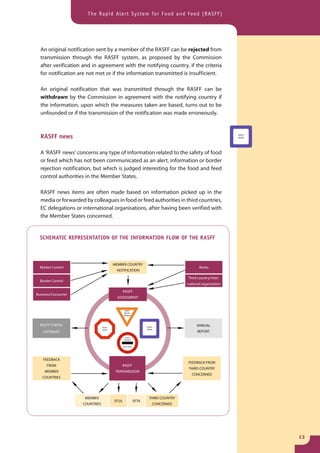
  SCHEMATIC REPRESENTATION OF THE INFORMATION FLOW OF THE RASFF


                                 MEMBER COUNTRY
  Market Control                                                               Media
                                   NOTIFICATION

                                                                        Third country/inter-
  Border Control
                                                                        national organisation

                                         RASFF
Business/Consumer
                                    ASSESSMENT


  RASFF PORTAL                                                               ANNUAL
    DATABASE                                                                  REPORT


   FEEDBACK
                                                                        FEEDBACK FROM
      FROM                               RASFF
                                                                         THIRD COUNTRY
    MEMBER                         TRANSMISSION
                                                                          CONCERNED
   COUNTRIES


                     MEMBER                             THIRD COUNTRY
                                  EFSA           EFTA
                    COUNTRIES                            CONCERNED


                                                                                                13
Annual Report 2010


14
The Rapid Alert System for Food and Feed (RASFF)


2
     RASFF notifications in 2010


                                                       15
Annual Report 2010


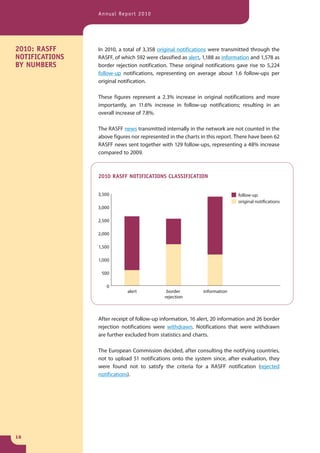
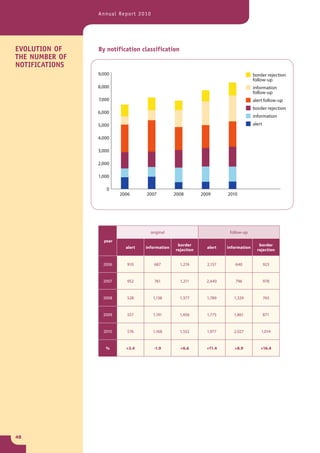
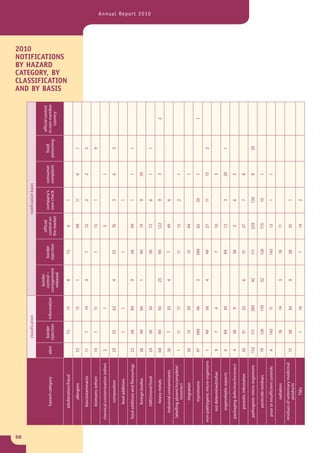
2010: RASFF     In 2010, a total of 3,358 original notifications were transmitted through the
NOTIFICATIONS   RASFF, of which 592 were classified as alert, 1,188 as information and 1,578 as
BY NUMBERS      border rejection notification. These original notifications gave rise to 5,224
                follow-up notifications, representing on average about 1.6 follow-ups per
                original notification.

                These figures represent a 2.3% increase in original notifications and more
                importantly, an 11.6% increase in follow-up notifications; resulting in an
                overall increase of 7.8%.

                The RASFF news transmitted internally in the network are not counted in the
                above figures nor represented in the charts in this report. There have been 62
                RASFF news sent together with 129 follow-ups, representing a 48% increase
                compared to 2009.


                2010 RASFF NOTIFICATIONS CLASSIFICATION


                3,500                                                        follow-up
                                                                             original notifications
                3,000

                2,500

                2,000

                1,500

                1,000

                 500

                   0
                            alert            border          information
                                            rejection


                After receipt of follow-up information, 16 alert, 20 information and 26 border
                rejection notifications were withdrawn. Notifications that were withdrawn
                are further excluded from statistics and charts.

                The European Commission decided, after consulting the notifying countries,
                not to upload 51 notifications onto the system since, after evaluation, they
                were found not to satisfy the criteria for a RASFF notification (rejected
                notifications).


16
The Rapid Alert System for Food and Feed (RASFF)


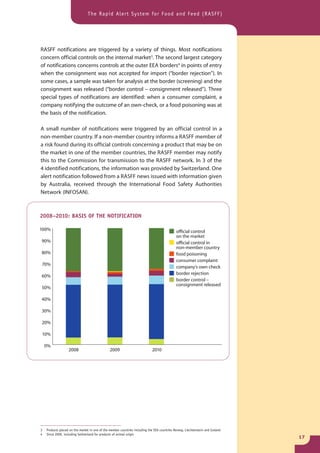
RASFF notifications are triggered by a variety of things. Most notifications
concern official controls on the internal market3. The second largest category
of notifications concerns controls at the outer EEA borders4 in points of entry
when the consignment was not accepted for import (“border rejection”). In
some cases, a sample was taken for analysis at the border (screening) and the
consignment was released (“border control – consignment released”). Three
special types of notifications are identified: when a consumer complaint, a
company notifying the outcome of an own-check, or a food poisoning was at
the basis of the notification.

A small number of notifications were triggered by an official control in a
non-member country. If a non-member country informs a RASFF member of
a risk found during its official controls concerning a product that may be on
the market in one of the member countries, the RASFF member may notify
this to the Commission for transmission to the RASFF network. In 3 of the
4 identified notifications, the information was provided by Switzerland. One
alert notification followed from a RASFF news issued with information given
by Australia, received through the International Food Safety Authorities
Network (INFOSAN).


2008–2010: BASIS OF THE NOTIFICATION

100%                                                                                          official control
                                                                                              on the market
90%                                                                                           official control in
                                                                                              non-member country
80%                                                                                           food poisoning
                                                                                              consumer complaint
70%
                                                                                              company’s own check
                                                                                              border rejection
60%
                                                                                              border control –
                                                                                              consignment released
50%

40%

30%

20%

10%

    0%
                   2008                         2009                          2010


3   Products placed on the market in one of the member countries including the EEA countries Norway, Liechtenstein and Iceland
4   Since 2009, including Switzerland for products of animal origin
                                                                                                                                 17
Annual Report 2010


PESTICIDE   With 284 notifications in 2010 compared to 172 in 2009, the notification
RESIDUES    level for pesticide residues rose by 65 %. Of these, only 19 notifications were
            classified as alert concerning a serious risk relating to a product that could
            still be on the market in another Member State than the one finding the
            pesticide residue.

                                         For products that are sampled on the market, samples
                                         are usually taken as part of a monitoring programme.
                                         The results of these programmes are collected by every
                                         Member State and transmitted to EFSA, which publishes a
                                         yearly monitoring report on pesticide residues. Notification
                                         to RASFF is only necessary and useful if the findings are
                                         more significant than merely exceeding an MRL e.g. in case
                                         of very high levels or very toxic pesticides. Nonetheless,
                                         the majority of notifications for products sampled on
                                         the market do not receive an alert classification because
                                         the product is often already expired when the results
                                         become available, e.g. for fresh vegetables. There were 139
                                         information notifications for food sampled on the market.

                                         Because findings of very high levels of pesticide residues
                                         (several times the MRL) are fortunately rather unusual, the
                                         findings would normally only present an acute risk to a
                                         consumer eating a very large portion of the contaminated
                                         food. When calculating the acute toxicity, a short term
                                         intake5 of the food is calculated and compared with the
                                         acute reference dose6 for the pesticide. An intake above
                                         the acute reference dose could lead to acute poisoning
                                         effects. Consumption data are used to calculate the short
                                         term intake.

            More sampling is done nowadays at the points of entry into the EU and results
            are awaited before the product is released for free circulation. Informed
            mainly by RASFF and FVO inspection reports, a list of reinforced controls is
            drawn up for certain types of products depending on their origin by way of
            Regulation (EC) No 669/2009 implementing Regulation (EC) No 882/2004 as
            regards the increased level of official controls on imports of certain feed and
            food of non-animal origin7.


            5   The short term intake is calculated assuming that a consumer with extreme food habits regarding the food item under
                consideration 1) consumes a big portion of the item in one meal or over one day and that 2) the level of pesticide in
                the item corresponds to that in the notification.
            6   The acute reference dose is the quantity of an active substance below which acute effects can be excluded.
            7   OJ L 194, 25.7.2009, p. 11–21
18
The Rapid Alert System for Food and Feed (RASFF)


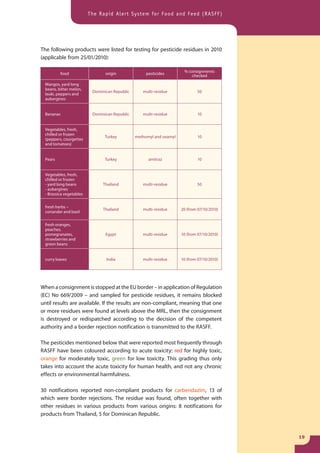
The following products were listed for testing for pesticide residues in 2010
(applicable from 25/01/2010):

                                                                      % consignments
         food                   origin              pesticides           checked

 Mangos, yard long
 beans, bitter melon,
                          Dominican Republic      multi-residue              50
 lauki, peppers and
 aubergines


 Bananas                  Dominican Republic      multi-residue              10


 Vegetables, fresh,
 chilled or frozen
                                Turkey         methomyl and oxamyl           10
 (peppers, courgettes
 and tomatoes)


 Pears                          Turkey               amitraz                 10


 Vegetables, fresh,
 chilled or frozen
 - yard long beans             Thailand           multi-residue              50
 - aubergines
 - Brassica vegetables


 fresh herbs –
                               Thailand           multi-residue      20 (from 07/10/2010)
 coriander and basil


 fresh oranges,
 peaches,
 pomegranates,                  Egypt             multi-residue      10 (from 07/10/2010)
 strawberries and
 green beans


 curry leaves                   India             multi-residue      10 (from 07/10/2010)


When a consignment is stopped at the EU border – in application of Regulation
(EC) No 669/2009 – and sampled for pesticide residues, it remains blocked
until results are available. If the results are non-compliant, meaning that one
or more residues were found at levels above the MRL, then the consignment
is destroyed or redispatched according to the decision of the competent
authority and a border rejection notification is transmitted to the RASFF.

The pesticides mentioned below that were reported most frequently through
RASFF have been coloured according to acute toxicity: red for highly toxic,
orange for moderately toxic, green for low toxicity. This grading thus only
takes into account the acute toxicity for human health, and not any chronic
effects or environmental harmfulness.

30 notifications reported non-compliant products for carbendazim, 13 of
which were border rejections. The residue was found, often together with
other residues in various products from various origins: 8 notifications for
products from Thailand, 5 for Dominican Republic.


                                                                                            19
Annual Report 2010


     15 notifications were made for findings of chlormequat in table grapes from
     India, of which 3 were classified as alert meaning that relatively high levels
     were found that could acutely harm a person consuming a very large quantity
     of grapes.

     Dimethoate and omethoate are often measured together and reported as
     the sum of both, expressed as dimethoate. 38 notifications were received,
     the majority of which concerned products from Thailand (22, for aubergines,
     yard long beans e.a.).

     Formetanate is used in the EU for certain applications but not for peppers.
     It was reported 6 times in fresh peppers from Turkey. Indoxacarb is a widely
     applied insecticide in the EU but it is not used with yard long beans for which
     7 border rejections were reported on products from Thailand. Malathion, which
     use is restricted, was reported in 5 border rejections of oranges from Argentina.
     The fungicide procymidone is no longer in use in the EU but was reported
     7 times in total, in various products from Thailand, in table grapes from the
     Former Yugoslav Republic of Macedonia and once in peppers from Turkey.

     Triazophos, an insecticide which is not applied in the EU, appears often in
     products from India (12 notifications) and from Thailand (4 notifications).
     Products from India still include okra and curry leaves (see RASFF annual
     report 2009) which are not much consumed in the EU. More worryingly, the
     pesticide was also reported a few times in vegetables such as long beans and
     aubergines.

                        A 10 percent mandatory check of consignments of
                        vegetables from Turkey was set up in Regulation (EC) No
                        669/2009 for methomyl and for oxamyl. These residues
                        were reported mostly in peppers but also in courgettes,
                        table grapes and tomatoes from Turkey (28 notifications
                        in total). There were also 16 notifications for products not
                        originating from Turkey: aubergines from Thailand, yard
                        long beans from the Dominican Republic, green beans and
                        tomatoes from Morocco (in descending notification order).

                        Fresh fruits and vegetables from Egypt were added to the
                        list of Regulation (EC) No 669/2009 with a 10 % mandatory
                        testing after several notifications were received for various
                        pesticides and products, e.g. fenitrothion in oranges.


20
The Rapid Alert System for Food and Feed (RASFF)


Whereas in 2009, the main issue notified was semicarbazide in shrimps              RESIDUES OF
(with 72 notifications), in 2010 only 7 notifications remained on this topic.      VETERINARY
In 2009 Belgium had reported as many as 56 border rejections for finding           MEDICINAL
semicarbazide in shrimps. It had been found controversial to use the               PRODUCTS
whole shrimp for analysis because this could lead to false positives due to
environmental presence of semicarbazide. The Commission services had
recommended Belgium to analyse peeled shrimps only. When Belgium had
corrected its analytical method indeed, much less non-compliances (7) were
detected and none by Belgium.

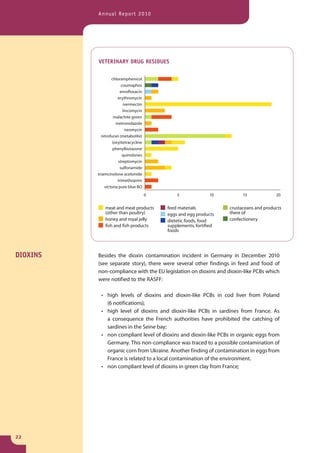
The new problem detected in 2010 with 19 notifications
is residues of ivermectin in beef from Brazil, first notified
by Italy and then also by other countries. The residues
were found in frozen cooked beef, intended to be used
in canned products. There is no EU MRL for ivermectin in
meat. Non-compliant levels of ivermectin were detected
earlier in the United States who operate an MRL of 10
μg/kg (= 10 ppb). Because of the non-existence of an EU
MRL, Italy has rejected several consignments for levels well
below 10 ppb until, at the request of the Commission, the
European Medicines Agency (EMA) provided the following
advice “While MRLs have not been established in muscle, at the
withdrawal period residue levels of 22,23-dihydroavermectin
B1a in normal (i.e. “non-injection site”) muscle should be well below the lowest
MRL value established for any of the tissues, i.e. well below 30 μg/kg.” Taking
into account that an MRL for muscle of 20 μg/kg had previously been
established (Commission Regulation (EC) No 508/1999) for farmed deer, this
level was advised to be used as an action level above which consignments
are considered non-compliant. Before the action limit was set, 7 notifications
had been sent reporting levels below the action limit and one largely above.
Nonetheless, 11 notifications followed before the end of 2010 reporting levels
above the action limit.

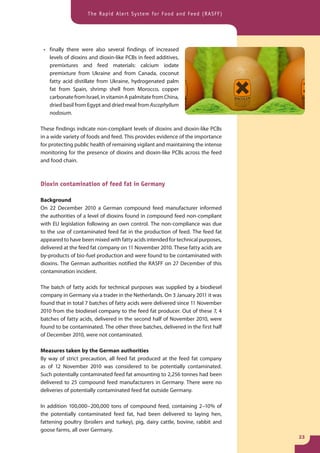
The table above shows that there was quite a variety of other substances
notified, quite a few for the first time:

 • Coumaphos was reported twice in propolis products, it is a veterinary drug
   used to treat bee diseases and an MRL is set for honey of 100 ppb.
 • Metronidazole was first reported in honey (no MRL set), trimethoprim in
   caviar from France and neomycin above the MRL of 500 ppb for fish in
   Pangasius from Vietnam. The corticosteroid triamcinolone acetonide was
   first reported in horse meat from Mexico.
 • The synthetic dye victoria pure blue BO was first reported in white fish
   fillets from Vietnam. Its use could be comparable to that of malachite
   green or crystal violet.


                                                                                                 21
Annual Report 2010


          VETERINARY DRUG RESIDUES


                  chloramphenicol
                         coumaphos
                        enrofloxacin
                      erythromycin
                          ivermectin
                          lincomycin
                    malachite green
                     metronidazole
                            neomycin
            nitrofuran (metabolite)
                   (oxy)tetracycline
                   phenylbutazone
                          quinolones
                       streptomycin
                        sulfonamide
          triamcinolone acetonide
                      trimethoprim
              victoria pure blue BO
                                       0       5              10          15             20


              meat and meat products       feed materials           crustaceans and products
              (other than poultry)         eggs and egg products    there of
              honey and royal jelly        dietetic foods, food     confectionery
              fish and fish products       supplements, fortified
                                           foods


DIOXINS   Besides the dioxin contamination incident in Germany in December 2010
          (see separate story), there were several other findings in feed and food of
          non-compliance with the EU legislation on dioxins and dioxin-like PCBs which
          were notified to the RASFF:

            • high levels of dioxins and dioxin-like PCBs in cod liver from Poland
              (6 notifications);
            • high level of dioxins and dioxin-like PCBs in sardines from France. As
              a consequence the French authorities have prohibited the catching of
              sardines in the Seine bay;
            • non compliant level of dioxins and dioxin-like PCBs in organic eggs from
              Germany. This non-compliance was traced to a possible contamination of
              organic corn from Ukraine. Another finding of contamination in eggs from
              France is related to a local contamination of the environment.
            • non compliant level of dioxins in green clay from France;


22
The Rapid Alert System for Food and Feed (RASFF)


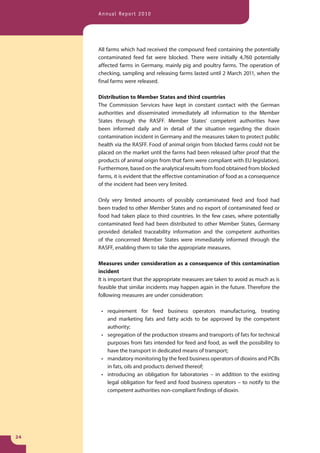
 • finally there were also several findings of increased
   levels of dioxins and dioxin-like PCBs in feed additives,
   premixtures and feed materials: calcium iodate
   premixture from Ukraine and from Canada, coconut
   fatty acid distillate from Ukraine, hydrogenated palm
   fat from Spain, shrimp shell from Morocco, copper
   carbonate from Israel, in vitamin A palmitate from China,
   dried basil from Egypt and dried meal from Ascophyllum
   nodosum.

These findings indicate non-compliant levels of dioxins and dioxin-like PCBs
in a wide variety of foods and feed. This provides evidence of the importance
for protecting public health of remaining vigilant and maintaining the intense
monitoring for the presence of dioxins and dioxin-like PCBs across the feed
and food chain.


Dioxin contamination of feed fat in Germany

Background
On 22 December 2010 a German compound feed manufacturer informed
the authorities of a level of dioxins found in compound feed non-compliant
with EU legislation following an own control. The non-compliance was due
to the use of contaminated feed fat in the production of feed. The feed fat
appeared to have been mixed with fatty acids intended for technical purposes,
delivered at the feed fat company on 11 November 2010. These fatty acids are
by-products of bio-fuel production and were found to be contaminated with
dioxins. The German authorities notified the RASFF on 27 December of this
contamination incident.

The batch of fatty acids for technical purposes was supplied by a biodiesel
company in Germany via a trader in the Netherlands. On 3 January 2011 it was
found that in total 7 batches of fatty acids were delivered since 11 November
2010 from the biodiesel company to the feed fat producer. Out of these 7, 4
batches of fatty acids, delivered in the second half of November 2010, were
found to be contaminated. The other three batches, delivered in the first half
of December 2010, were not contaminated.

Measures taken by the German authorities
By way of strict precaution, all feed fat produced at the feed fat company
as of 12 November 2010 was considered to be potentially contaminated.
Such potentially contaminated feed fat amounting to 2,256 tonnes had been
delivered to 25 compound feed manufacturers in Germany. There were no
deliveries of potentially contaminated feed fat outside Germany.

In addition 100,000 – 200,000 tons of compound feed, containing 2 –10 % of
the potentially contaminated feed fat, had been delivered to laying hen,
fattening poultry (broilers and turkey), pig, dairy cattle, bovine, rabbit and
goose farms, all over Germany.
                                                                                 23
Annual Report 2010


     All farms which had received the compound feed containing the potentially
     contaminated feed fat were blocked. There were initially 4,760 potentially
     affected farms in Germany, mainly pig and poultry farms. The operation of
     checking, sampling and releasing farms lasted until 2 March 2011, when the
     final farms were released.

     Distribution to Member States and third countries
     The Commission Services have kept in constant contact with the German
     authorities and disseminated immediately all information to the Member
     States through the RASFF. Member States’ competent authorities have
     been informed daily and in detail of the situation regarding the dioxin
     contamination incident in Germany and the measures taken to protect public
     health via the RASFF. Food of animal origin from blocked farms could not be
     placed on the market until the farms had been released (after proof that the
     products of animal origin from that farm were compliant with EU legislation).
     Furthermore, based on the analytical results from food obtained from blocked
     farms, it is evident that the effective contamination of food as a consequence
     of the incident had been very limited.

     Only very limited amounts of possibly contaminated feed and food had
     been traded to other Member States and no export of contaminated feed or
     food had taken place to third countries. In the few cases, where potentially
     contaminated feed had been distributed to other Member States, Germany
     provided detailed traceability information and the competent authorities
     of the concerned Member States were immediately informed through the
     RASFF, enabling them to take the appropriate measures.

     Measures under consideration as a consequence of this contamination
     incident
     It is important that the appropriate measures are taken to avoid as much as is
     feasible that similar incidents may happen again in the future. Therefore the
     following measures are under consideration:

      • requirement for feed business operators manufacturing, treating
        and marketing fats and fatty acids to be approved by the competent
        authority;
      • segregation of the production streams and transports of fats for technical
        purposes from fats intended for feed and food, as well the possibility to
        have the transport in dedicated means of transport;
      • mandatory monitoring by the feed business operators of dioxins and PCBs
        in fats, oils and products derived thereof;
      • introducing an obligation for laboratories – in addition to the existing
        legal obligation for feed and food business operators – to notify to the
        competent authorities non-compliant findings of dioxin.


24
The Rapid Alert System for Food and Feed (RASFF)


In general                                                                                                                 MYCOTOXINS

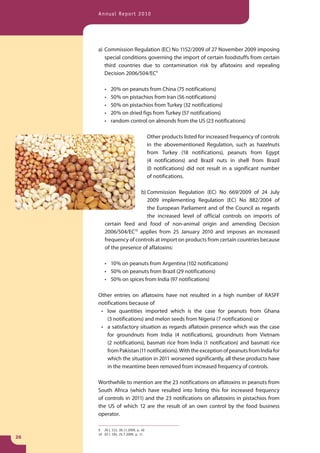
In 2010, there were 679 notifications related to mycotoxins: 640 to aflatoxins,
25 to ochratoxin A, 9 to aflatoxins and ochratoxin A, 2 to deoxynivalenol
and 3 to fumonisins. The number of RASFF notifications on mycotoxins in
2010 is in the same range as the number in 2009 but is significantly less than
in the period 2003– 2008. Comparing 2010 to 2009, there are nonetheless
some significant differences within the product categories notified. While
in 2010 there is an increase of aflatoxin notifications for groundnuts (260
notifications) compared to 2009 (233 notifications), there is a significant
reduction of notifications as regards aflatoxins in nuts and nut products in
2010 (168) compared to 2009 (283). This is certainly at least partially related
to the change in legislation whereby the maximum levels for aflatoxins in
almonds, hazelnuts and pistachios in EU legislation have been aligned with
Codex Alimentarius maximum levels8.

    hazard                2002       2003       2004       2005      2006       2007       2008       2009       2010

    aflatoxins             288        762        839        946        801       705        902        638        649

    deoxynivalenol
                                                                                  10          4         3          2
    (DON)

    fumonisins                         15         14         2         15          9          2         1          3

    ochratoxin A            14         26         27         42        54         30         20         27         34

    patulin                                                  6          7                     3

    zearalenone                                                         1          6          2


Out of the notifications on aflatoxins in peanuts, 21 relate to peanuts intended
for pet food (bird feed) (7 from Argentina, 11 from Brazil and 3 from India).

A sharp increase of RASFF notifications on aflatoxins in spices relate to the
high number of notifications on spices from India, for which an increased
frequency of control at import is in place from 25 January 2010.


Increased frequency of control related to the presence of
aflatoxins

Most notifications on aflatoxins are related to product/country of origin
combinations for which imposed increased frequencies of controls at import
are in force. As such, the number of notifications is enhanced by the increased
frequency of control which resulted from the problem identified.


8   Commission Regulation (EU) No 165/2010 of 26 February 2010 amending Commission (EC) No 1881/2006 of 19 December
    2006 setting maximum levels for certain contaminants in foodstuffs as regards aflatoxins (OJ L 50, 27,2,2010, p. 8),
    applicable from 9 March 2010.
                                                                                                                                        25
Annual Report 2010


     a) Commission Regulation (EC) No 1152/2009 of 27 November 2009 imposing
        special conditions governing the import of certain foodstuffs from certain
        third countries due to contamination risk by aflatoxins and repealing
        Decision 2006/504/EC9

        •   20 % on peanuts from China (75 notifications)
        •   50 % on pistachios from Iran (56 notifications)
        •   50 % on pistachios from Turkey (32 notifications)
        •   20 % on dried figs from Turkey (57 notifications)
        •   random control on almonds from the US (23 notifications)

                                     Other products listed for increased frequency of controls
                                     in the abovementioned Regulation, such as hazelnuts
                                     from Turkey (18 notifications), peanuts from Egypt
                                     (4 notifications) and Brazil nuts in shell from Brazil
                                     (0 notifications) did not result in a significant number
                                     of notifications.

                        b) Commission Regulation (EC) No 669/2009 of 24 July
                           2009 implementing Regulation (EC) No 882/2004 of
                           the European Parliament and of the Council as regards
                           the increased level of official controls on imports of
         certain feed and food of non-animal origin and amending Decision
         2006/504/EC10 applies from 25 January 2010 and imposes an increased
         frequency of controls at import on products from certain countries because
         of the presence of aflatoxins:

        • 10 % on peanuts from Argentina (102 notifications)
        • 50 % on peanuts from Brazil (29 notifications)
        • 50 % on spices from India (97 notifications)

     Other entries on aflatoxins have not resulted in a high number of RASFF
     notifications because of
      • low quantities imported which is the case for peanuts from Ghana
         (3 notifications) and melon seeds from Nigeria (7 notifications) or
      • a satisfactory situation as regards aflatoxin presence which was the case
         for groundnuts from India (4 notifications), groundnuts from Vietnam
         (2 notifications), basmati rice from India (1 notification) and basmati rice
         from Pakistan (11 notifications). With the exception of peanuts from India for
         which the situation in 2011 worsened significantly, all these products have
         in the meantime been removed from increased frequency of controls.

     Worthwhile to mention are the 23 notifications on aflatoxins in peanuts from
     South Africa (which have resulted into listing this for increased frequency
     of controls in 2011) and the 23 notifications on aflatoxins in pistachios from
     the US of which 12 are the result of an own control by the food business
     operator.

     9 JO L 313, 28.11.2009, p. 40
     10 OJ L 194, 25.7.2009, p. 11
26
The Rapid Alert System for Food and Feed (RASFF)


Ochratoxin A

34 notifications relate to the unacceptable presence of ochratoxin A and in
9 notifications thereof aflatoxins are occurring simultaneously at unacceptable
levels.

9 notifications relate to the unacceptable presence of ochratoxin A in dried
vine fruit from Uzbekistan (listed in the annex to Regulation (EC) No 669/2009
for an increased frequency of control at import of 50 % of all imported
consignments). There were also 6 notifications on ochratoxin A in chilli from
Peru of which 2 contained also unacceptable levels of aflatoxins. These
findings together with the unfavourable outcome of an inspection mission
by the Food and Veterinary Office in 2009 led to the inclusion of chilli from
Peru for an increased frequency of controls at import of 10 % for the presence
of aflatoxins and ochratoxin A in the annex to Regulation (EC) 669/2009 as
from 7 October 2010.

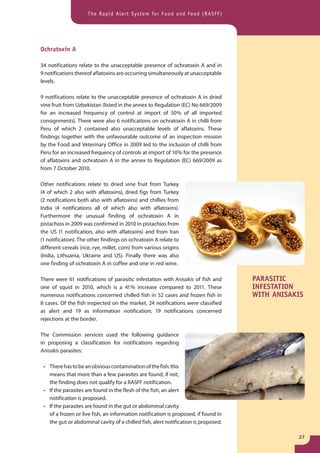
Other notifications relate to dried vine fruit from Turkey
(4 of which 2 also with aflatoxins), dried figs from Turkey
(2 notifications both also with aflatoxins) and chillies from
India (4 notifications all of which also with aflatoxins).
Furthermore the unusual finding of ochratoxin A in
pistachios in 2009 was confirmed in 2010 in pistachios from
the US (1 notification, also with aflatoxins) and from Iran
(1 notification). The other findings on ochratoxin A relate to
different cereals (rice, rye, millet, corn) from various origins
(India, Lithuania, Ukraine and US). Finally there was also
one finding of ochratoxin A in coffee and one in red wine.

There were 61 notifications of parasitic infestation with Anisakis of fish and      PARASITIC
one of squid in 2010, which is a 41 % increase compared to 2011. These              INFESTATION
numerous notifications concerned chilled fish in 52 cases and frozen fish in        WITH ANISAKIS
8 cases. Of the fish inspected on the market, 24 notifications were classified
as alert and 19 as information notification; 19 notifications concerned
rejections at the border.

The Commission services used the following guidance
in proposing a classification for notifications regarding
Anisakis parasites:

 • There has to be an obvious contamination of the fish: this
   means that more than a few parasites are found, if not,
   the finding does not qualify for a RASFF notification.
 • If the parasites are found in the flesh of the fish, an alert
   notification is proposed.
 • If the parasites are found in the gut or abdominal cavity
   of a frozen or live fish, an information notification is proposed, if found in
   the gut or abdominal cavity of a chilled fish, alert notification is proposed.

                                                                                               27
Annual Report 2010


             It cannot be deemed from this information whether the higher number of
             notifications is caused by an increase in the presence of Anisakis or by an
             increased awareness of parasites in fishery products. Furthermore, some
             notifications regarding parasites in fishery products are not so much based
             on the presence of a health risk, but are more related to a quality issue. The
             legal provision, that fishery products that are obviously contaminated with
             parasites must not be placed on the market for human consumption, appears
             to be interpreted differently among various Member States, in line with their
             traditions, type of dishes, etc. The Commission will therefore work to improve
             its guidance related to RASFF notification of parasites in fishery products.


MARINE       Amnesic shellfish poisoning (ASP) is a human illness caused by consumption
BIOTOXINS    of a marine biotoxin called domoic acid. This toxin is produced naturally by
             marine diatoms and can accumulate in bivalve molluscs that feed on the
             diatoms. In higher concentration the toxin can cause damage to the short-
             term memory, brain damage and even death. Three notifications were
             reported after market control, two for scallops from the United Kingdom and
             one for various bivalve molluscs from France.

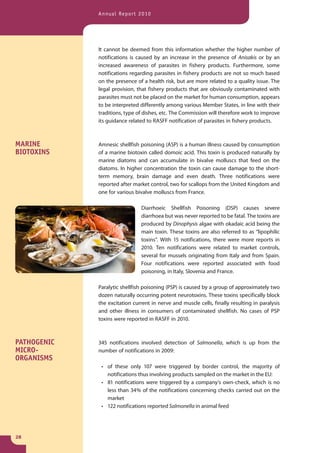
                               Diarrhoeic Shellfish Poisoning (DSP) causes severe
                               diarrhoea but was never reported to be fatal. The toxins are
                               produced by Dinophysis algae with okadaic acid being the
                               main toxin. These toxins are also referred to as “lipophilic
                               toxins”. With 15 notifications, there were more reports in
                               2010. Ten notifications were related to market controls,
                               several for mussels originating from Italy and from Spain.
                               Four notifications were reported associated with food
                               poisoning, in Italy, Slovenia and France.

             Paralytic shellfish poisoning (PSP) is caused by a group of approximately two
             dozen naturally occurring potent neurotoxins. These toxins specifically block
             the excitation current in nerve and muscle cells, finally resulting in paralysis
             and other illness in consumers of contaminated shellfish. No cases of PSP
             toxins were reported in RASFF in 2010.


PATHOGENIC   345 notifications involved detection of Salmonella, which is up from the
MICRO-       number of notifications in 2009:
ORGANISMS
              • of these only 107 were triggered by border control, the majority of
                notifications thus involving products sampled on the market in the EU:
              • 81 notifications were triggered by a company’s own-check, which is no
                less than 34 % of the notifications concerning checks carried out on the
                market
              • 122 notifications reported Salmonella in animal feed


28
The Rapid Alert System for Food and Feed (RASFF)


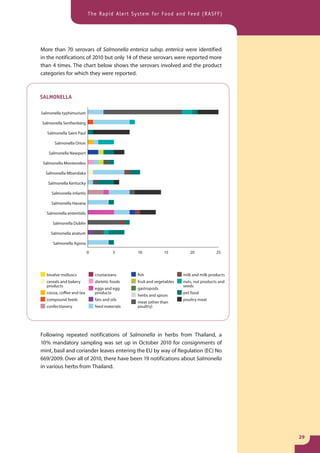
More than 70 serovars of Salmonella enterica subsp. enterica were identified
in the notifications of 2010 but only 14 of these serovars were reported more
than 4 times. The chart below shows the serovars involved and the product
categories for which they were reported.


SALMONELLA

Salmonella typhimurium

Salmonella Senftenberg

   Salmonella Saint Paul

       Salmonella Orion

   Salmonella Newport

 Salmonella Montevideo

  Salmonella Mbandaka

   Salmonella Kentucky

     Salmonella infantis

     Salmonella Havana

  Salmonella enteritidis

     Salmonella Dublin

     Salmonella anatum

      Salmonella Agona

                           0             5      10            15          20            25


  bivalve molluscs             crustaceans      fish                   milk and milk products
  cereals and bakery           dietetic foods   fruit and vegetables   nuts, nut products and
  products                                                             seeds
                               eggs and egg     gastropods
  cocoa, coffee and tea        products                                pet food
                                                herbs and spices
  compound feeds               fats and oils                           poultry meat
                                                meat (other than
  confectionery                feed materials   poultry)


Following repeated notifications of Salmonella in herbs from Thailand, a
10 % mandatory sampling was set up in October 2010 for consignments of
mint, basil and coriander leaves entering the EU by way of Regulation (EC) No
669/2009. Over all of 2010, there have been 19 notifications about Salmonella
in various herbs from Thailand.


                                                                                                29
Annual Report 2010


      Listeria monocytogenes notifications have increased in number for the second
      consecutive year. Again, a rise in notifications for fish (57 notifications) was
      noted:

        • 33 notifications for salmon (33), mostly smoked, mostly originating from
          Poland (15)
        • 12 notifications for frozen Pangasius from Vietnam, although there is no EU
          food safety criterion for such product, since it is not ready-to-eat. Nevertheless
          8 consignments were reported rejected at the border by Poland.

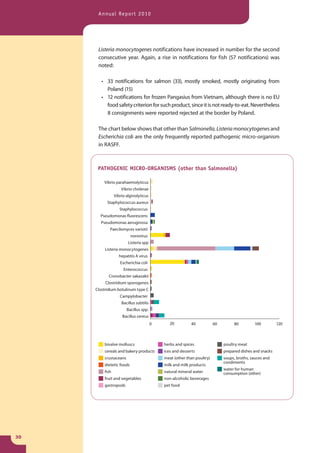
      The chart below shows that other than Salmonella, Listeria monocytogenes and
      Escherichia coli are the only frequently reported pathogenic micro-organism
      in RASFF.


      PATHOGENIC MICRO-ORGANISMS (other than Salmonella)

         Vibrio parahaemolyticus
                    Vibrio cholerae
                Vibrio alginolyticus
           Staphylococcus aureus
                   Staphylococcus
       Pseudomonas fluorescens
       Pseudomonas aeruginosa
            Paecilomyces variotii
                          norovirus
                        Listeria spp
          Listeria monocytogenes
                  hepatitis A virus
                   Escherichia coli
                     Enterococcus
            Cronobacter sakazakii
          Clostridium sporogenes
     Clostridium botulinum type C
                   Campylobacter
                    Bacillus subtilis
                       Bacillus spp.
                    Bacillus cereus
                                        0      20          40           60        80         100          120


         bivalve molluscs                   herbs and spices                 poultry meat
         cereals and bakery products        ices and desserts                prepared dishes and snacks
         crustaceans                        meat (other than poultry)        soups, broths, sauces and
                                                                             condiments
         dietetic foods                     milk and milk products
                                                                             water for human
         fish                               natural mineral water            consumption (other)
         fruit and vegetables               non-alcoholic beverages
         gastropods                         pet food


30
The Rapid Alert System for Food and Feed (RASFF)


Escherichia coli is most reported in products for which EU food safety criteria
exist: live bivalve molluscs especially (32 notifications). A too high count
of Escherichia coli indicates a purity problem of the water from which the
molluscs were harvested. Further purification of the bivalve molluscs is
required to ensure that they are safe for consumption. Verotoxin producing
E. coli was reported twice in beef and once in cheese made from raw milk.
This type of E. coli can cause serious illness and requires stringent measures
up to the slaughterhouse to avoid such contamination. The outbreaks in 2011
made it painfully clear that E. coli can also wreak havoc through certain fresh
vegetable products such as vegetable sprouts.


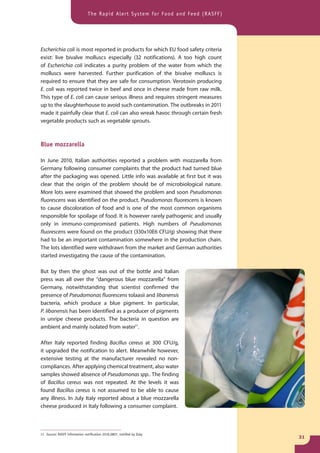
Blue mozzarella

In June 2010, Italian authorities reported a problem with mozzarella from
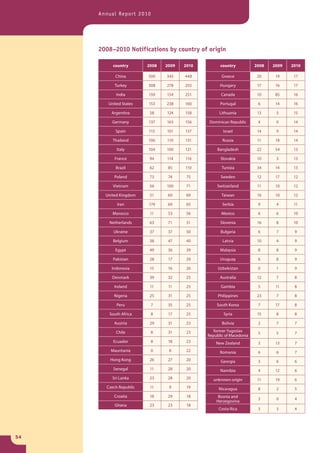
Germany following consumer complaints that the product had turned blue
after the packaging was opened. Little info was available at first but it was
clear that the origin of the problem should be of microbiological nature.
More lots were examined that showed the problem and soon Pseudomonas
fluorescens was identified on the product. Pseudomonas fluorescens is known
to cause discoloration of food and is one of the most common organisms
responsible for spoilage of food. It is however rarely pathogenic and usually
only in immuno-compromised patients. High numbers of Pseudomonas
fluorescens were found on the product (330x10E6 CFU/g) showing that there
had to be an important contamination somewhere in the production chain.
The lots identified were withdrawn from the market and German authorities
started investigating the cause of the contamination.

But by then the ghost was out of the bottle and Italian
press was all over the “dangerous blue mozzarella” from
Germany, notwithstanding that scientist confirmed the
presence of Pseudomonas fluorescens tolaasii and libanensis
bacteria, which produce a blue pigment. In particular,
P. libanensis has been identified as a producer of pigments
in unripe cheese products. The bacteria in question are
ambient and mainly isolated from water11.

After Italy reported finding Bacillus cereus at 300 CFU/g,
it upgraded the notification to alert. Meanwhile however,
extensive testing at the manufacturer revealed no non-
compliances. After applying chemical treatment, also water
samples showed absence of Pseudomonas spp.. The finding
of Bacillus cereus was not repeated. At the levels it was
found Bacillus cereus is not assumed to be able to cause
any illness. In July Italy reported about a blue mozzarella
cheese produced in Italy following a consumer complaint.


11 Source: RASFF information notification 2010.0807, notified by Italy
                                                                                   31
Annual Report 2010


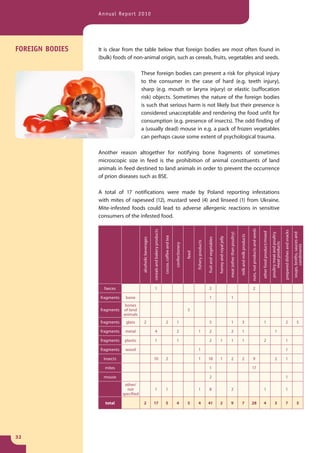
FOREIGN BODIES   It is clear from the table below that foreign bodies are most often found in
                 (bulk) foods of non-animal origin, such as cereals, fruits, vegetables and seeds.

                                         These foreign bodies can present a risk for physical injury
                                         to the consumer in the case of hard (e.g. teeth injury),
                                         sharp (e.g. mouth or larynx injury) or elastic (suffocation
                                         risk) objects. Sometimes the nature of the foreign bodies
                                         is such that serious harm is not likely but their presence is
                                         considered unacceptable and rendering the food unfit for
                                         consumption (e.g. presence of insects). The odd finding of
                                         a (usually dead) mouse in e.g. a pack of frozen vegetables
                                         can perhaps cause some extent of psychological trauma.

                 Another reason altogether for notifying bone fragments of sometimes
                 microscopic size in feed is the prohibition of animal constituents of land
                 animals in feed destined to land animals in order to prevent the occurrence
                 of prion diseases such as BSE.

                 A total of 17 notifications were made by Poland reporting infestations
                 with mites of rapeseed (12), mustard seed (4) and linseed (1) from Ukraine.
                 Mite-infested foods could lead to adverse allergenic reactions in sensitive
                 consumers of the infested food.


                                                                                                                                                                                                                                                                    nuts, nut products and seeds
                                                                cereals and bakery products


                                                                                                                                                                                                                                                                                                                                                         prepared dishes and snacks
                                                                                                                                                                                                                                                                                                   other food product/mixed


                                                                                                                                                                                                                                                                                                                                                                                      soups, broths, sauces and
                                                                                                                                                                                                               meat (other than poultry)


                                                                                                                                                                                                                                                                                                                              poultry meat and poultry
                                                                                                                                                                                                                                           milk and milk products
                                                                                              cocoa, coffee and tea


                                                                                                                                                                                       honey and royal jelly
                                                                                                                                                                fruit and vegetables
                                          alcoholic beverages


                                                                                                                                             fishery products


                                                                                                                                                                                                                                                                                                                                   meat products
                                                                                                                      confectionery


                                                                                                                                                                                                                                                                                                                                                                                             condiments
                                                                                                                                      feed


                   faeces                                         1                                                                                              2                                                                                                    2

                 fragments    bone                                                                                                                               1                                               1
                              bones
                 fragments   of land                                                                                                  5
                             animals
                 fragments     glass       2                                                   2                       1                                         5                                               1                          3                                                        1                                                     2                                 5

                 fragments    metal                               4                                                    2                      1                  2                                               2                           1                                                                                       1

                 fragments    plastic                             1                                                    1                                         2                      1                        1                           1                                                       2                                                     1

                 fragments    wood                                                                                                            1                                                                                                                                                                                                            1

                   insects                                      10                             2                                              1                 18                      1                        2                           2                        9                                                              2                     1

                   mites                                                                                                                                         1                                                                                                  17

                   mouse                                                                                                                                         2                                                                                                                                                                                         1
                              other/
                               not                                1                            1                                              1                  8                                               2                                                                                   1                                                     1
                             specified

                    total                  2                    17                             5                      4               5       4                 41                      2                       9                           7                       28                              4                                3                    7                                  5


32
The Rapid Alert System for Food and Feed (RASFF)


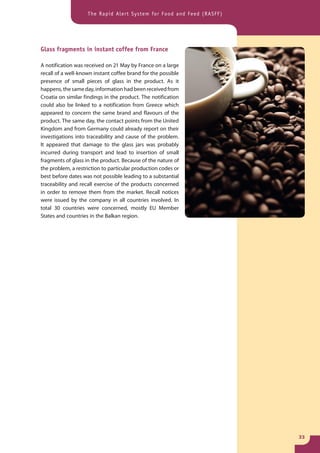
Glass fragments in instant coffee from France

A notification was received on 21 May by France on a large
recall of a well-known instant coffee brand for the possible
presence of small pieces of glass in the product. As it
happens, the same day, information had been received from
Croatia on similar findings in the product. The notification
could also be linked to a notification from Greece which
appeared to concern the same brand and flavours of the
product. The same day, the contact points from the United
Kingdom and from Germany could already report on their
investigations into traceability and cause of the problem.
It appeared that damage to the glass jars was probably
incurred during transport and lead to insertion of small
fragments of glass in the product. Because of the nature of
the problem, a restriction to particular production codes or
best before dates was not possible leading to a substantial
traceability and recall exercise of the products concerned
in order to remove them from the market. Recall notices
were issued by the company in all countries involved. In
total 30 countries were concerned, mostly EU Member
States and countries in the Balkan region.


                                                                       33
Annual Report 2010


34
The Rapid Alert System for Food and Feed (RASFF)


3
     Focus on …


                                                       35
Annual Report 2010


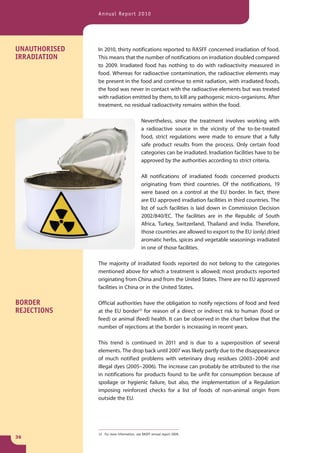
UNAUTHORISED   In 2010, thirty notifications reported to RASFF concerned irradiation of food.
IRRADIATION    This means that the number of notifications on irradiation doubled compared
               to 2009. Irradiated food has nothing to do with radioactivity measured in
               food. Whereas for radioactive contamination, the radioactive elements may
               be present in the food and continue to emit radiation, with irradiated foods,
               the food was never in contact with the radioactive elements but was treated
               with radiation emitted by them, to kill any pathogenic micro-organisms. After
               treatment, no residual radioactivity remains within the food.

                                           Nevertheless, since the treatment involves working with
                                           a radioactive source in the vicinity of the to-be-treated
                                           food, strict regulations were made to ensure that a fully
                                           safe product results from the process. Only certain food
                                           categories can be irradiated. Irradiation facilities have to be
                                           approved by the authorities according to strict criteria.

                                           All notifications of irradiated foods concerned products
                                           originating from third countries. Of the notifications, 19
                                           were based on a control at the EU border. In fact, there
                                           are EU approved irradiation facilities in third countries. The
                                           list of such facilities is laid down in Commission Decision
                                           2002/840/EC. The facilities are in the Republic of South
                                           Africa, Turkey, Switzerland, Thailand and India. Therefore,
                                           those countries are allowed to export to the EU (only) dried
                                           aromatic herbs, spices and vegetable seasonings irradiated
                                           in one of those facilities.

               The majority of irradiated foods reported do not belong to the categories
               mentioned above for which a treatment is allowed; most products reported
               originating from China and from the United States. There are no EU approved
               facilities in China or in the United States.

BORDER         Official authorities have the obligation to notify rejections of food and feed
REJECTIONS     at the EU border12 for reason of a direct or indirect risk to human (food or
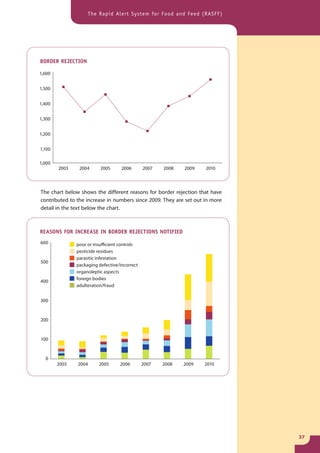
               feed) or animal (feed) health. It can be observed in the chart below that the
               number of rejections at the border is increasing in recent years.

               This trend is continued in 2011 and is due to a superposition of several
               elements. The drop back until 2007 was likely partly due to the disappearance
               of much notified problems with veterinary drug residues (2003– 2004) and
               illegal dyes (2005– 2006). The increase can probably be attributed to the rise
               in notifications for products found to be unfit for consumption because of
               spoilage or hygienic failure, but also, the implementation of a Regulation
               imposing reinforced checks for a list of foods of non-animal origin from
               outside the EU.


               12 For more information, see RASFF annual report 2009.
36
The Rapid Alert System for Food and Feed (RASFF)


BORDER REJECTION

1,600


1,500


1,400


1,300


1,200


1,100

1,000
        2003    2004      2005      2006       2007   2008   2009   2010


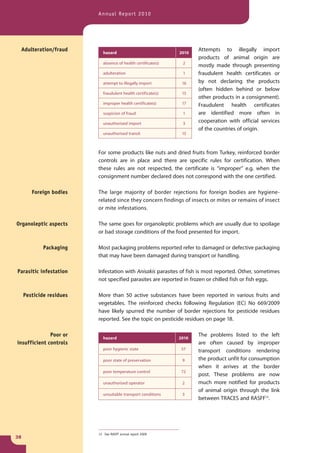
The chart below shows the different reasons for border rejection that have
contributed to the increase in numbers since 2009. They are set out in more
detail in the text below the chart.


REASONS FOR INCREASE IN BORDER REJECTIONS NOTIFIED
600            poor or insufficient controls
               pesticide residues
               parasitic infestation
500
               packaging defective/incorrect
               organoleptic aspects
               foreign bodies
400
               adulteration/fraud


300


200


100


  0
        2003   2004      2005      2006        2007   2008   2009   2010


                                                                              37
Annual Report 2010


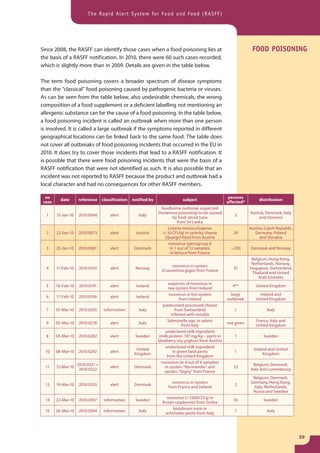
 Adulteration/fraud                                                    Attempts to illegally import
                             hazard                             2010
                                                                       products of animal origin are
                             absence of health certificate(s)    2
                                                                       mostly made through presenting
                             adulteration                        1     fraudulent health certificates or
                             attempt to illegally import         16    by not declaring the products
                                                                       (often hidden behind or below
                             fraudulent health certificate(s)    15
                                                                       other products in a consignment).
                             improper health certificate(s)      17    Fraudulent health certificates
                             suspicion of fraud                  1     are identified more often in
                             unauthorised import                 3
                                                                       cooperation with official services
                                                                       of the countries of origin.
                             unauthorised transit                15


                          For some products like nuts and dried fruits from Turkey, reinforced border
                          controls are in place and there are specific rules for certification. When
                          these rules are not respected, the certificate is “improper” e.g. when the
                          consignment number declared does not correspond with the one certified.

        Foreign bodies    The large majority of border rejections for foreign bodies are hygiene-
                          related since they concern findings of insects or mites or remains of insect
                          or mite infestations.

Organoleptic aspects      The same goes for organoleptic problems which are usually due to spoilage
                          or bad storage conditions of the food presented for import.

             Packaging    Most packaging problems reported refer to damaged or defective packaging
                          that may have been damaged during transport or handling.

Parasitic infestation     Infestation with Anisakis parasites of fish is most reported. Other, sometimes
                          not specified parasites are reported in frozen or chilled fish or fish eggs.

     Pesticide residues   More than 50 active substances have been reported in various fruits and
                          vegetables. The reinforced checks following Regulation (EC) No 669/2009
                          have likely spurred the number of border rejections for pesticide residues
                          reported. See the topic on pesticide residues on page 18.

              Poor or                                                  The problems listed to the left
                             hazard                             2010
insufficient controls                                                  are often caused by improper
                             poor hygienic state                 57    transport conditions rendering
                             poor state of preservation          9     the product unfit for consumption
                                                                       when it arrives at the border
                             poor temperature control            72
                                                                       post. These problems are now
                             unauthorised operator               2     much more notified for products
                                                                       of animal origin through the link
                             unsuitable transport conditions     3
                                                                       between TRACES and RASFF13.


                          13 See RASFF annual report 2009
38
The Rapid Alert System for Food and Feed (RASFF)


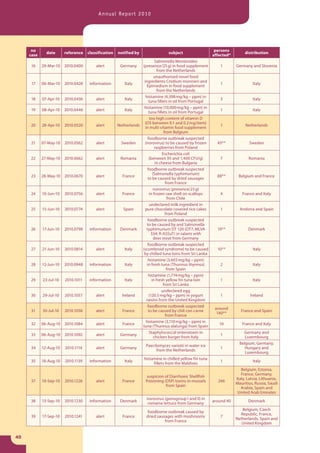
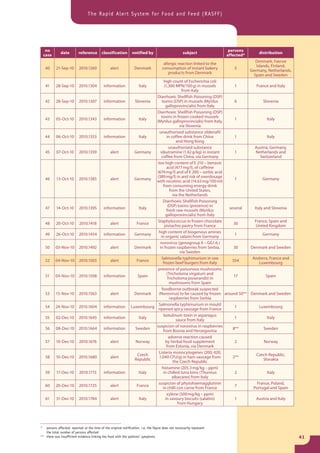
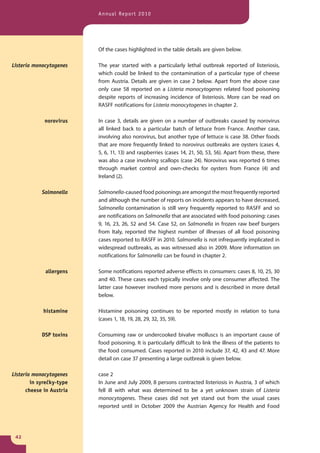
Since 2008, the RASFF can identify those cases when a food poisoning lies at                                        FOOD POISONING
the basis of a RASFF notification. In 2010, there were 60 such cases recorded,
which is slightly more than in 2009. Details are given in the table below.

The term food poisoning covers a broader spectrum of disease symptoms
than the “classical” food poisoning caused by pathogenic bacteria or viruses.
As can be seen from the table below, also undesirable chemicals, the wrong
composition of a food supplement or a deficient labelling not mentioning an
allergenic substance can be the cause of a food poisoning. In the table below,
a food poisoning incident is called an outbreak when more than one person
is involved. It is called a large outbreak if the symptoms reported in different
geographical locations can be linked back to the same food. The table does
not cover all outbreaks of food poisoning incidents that occurred in the EU in
2010. It does try to cover those incidents that lead to a RASFF notification. It
is possible that there were food poisoning incidents that were the basis of a
RASFF notification that were not identified as such. It is also possible that an
incident was not reported to RASFF because the product and outbreak had a
local character and had no consequences for other RASFF members.

  no                                                                                                    persons
          date      reference     classification   notified by                subject                                   distribution
 case                                                                                                  affected*
                                                                   foodborne outbreak suspected
                                                                 (histamine poisoning) to be caused                Austria, Denmark, Italy
  1     15-Jan-10   2010.0046         alert           Italy                                               3
                                                                           by fresh sliced tuna                        and Slovenia
                                                                              from Sri Lanka
                                                                       Listeria monocytogenes                      Austria, Czech Republic,
  2     22-Jan-10   2010.0073         alert          Austria        (< 10 CFU/g) in syrecky cheese        24          Germany, Poland
                                                                     (Quargel Käse) from Austria                         and Slovakia
                                                                        norovirus (genogroup II
  3     25-Jan-10   2010.0081         alert         Denmark              in 1 out of 12 samples)         > 200      Denmark and Norway
                                                                         in lettuce from France
                                                                                                                    Belgium, Hong Kong,
                                                                                                                    Netherlands, Norway,
                                                                         norovirus in oysters
  4     11-Feb-10   2010.0163         alert         Norway                                                37       Singapore, Switzerland,
                                                                   (Crassostrea gigas) from France
                                                                                                                     Thailand and United
                                                                                                                        Arab Emirates
                                                                       suspicion of norovirus in
  5     16-Feb-10   2010.0191         alert          Ireland                                              4**         United Kingdom
                                                                       raw oysters from Ireland
                                                                       norovirus in live oysters         large          Ireland and
  6     17-Feb-10   2010.0199         alert          Ireland
                                                                              from Ireland             outbreak       United Kingdom
                                                                    pasteurized processed cheese
  7     01-Mar-10   2010.0245      information        Italy                from Switzerland               1                 Italy
                                                                         infested with moulds
                                                                      Salmonella spp. in salami                       France, Italy and
  9     05-Mar-10   2010.0278         alert           Italy                                            not given
                                                                                from Italy                            United Kingdom
                                                                     undeclared milk ingredient
  8     05-Mar-10   2010.0282         alert         Sweden       (milk protein: 107 mg/kg – ppm) in       1               Sweden
                                                                 blueberry soy yoghurt from Austria
                                                                     undeclared milk ingredient
                                                     United                                                          Ireland and United
  10    08-Mar-10   2010.0292         alert                               in green basil pesto            1
                                                    Kingdom                                                               Kingdom
                                                                      from the United Kingdom
                                                                   norovirus (in 4 out of 4 samples)
                    2010.0321 +                                                                                      Belgium, Denmark,
  11    12-Mar-10                     alert         Denmark          in oysters “Normandie” and           23
                     2010.0322                                                                                     Italy and Luxembourg
                                                                     oysters “Isigny” from France
                                                                                                                     Belgium, Denmark,
                                                                        norovirus in oysters                        Germany, Hong Kong,
  13    19-Mar-10   2010.0353         alert         Denmark                                               2
                                                                      from France and Ireland                        Italy, Netherlands,
                                                                                                                     Russia and Sweden
                                                                      norovirus (> 7,000/25 g) in
  14    22-Mar-10   2010.0367      information      Sweden                                                55              Sweden
                                                                   frozen raspberries from Serbia
                                                                          botulinum toxin in
  15    26-Mar-10   2010.0394      information        Italy                                               1                 Italy
                                                                     artichokes pesto from Italy


                                                                                                                                              39
Annual Report 2010


      no                                                                                                   persons
              date      reference   classification   notified by                 subject                                   distribution
     case                                                                                                 affected*
                                                                            Salmonella Montevideo
      16    29-Mar-10   2010.0400       alert         Germany    (presence/25 g) in food supplement          1        Germany and Slovenia
                                                                             from the Netherlands
                                                                           unauthorised novel food
                                                                  ingredients Cnidium monnieri and
      17    06-Mar-10   2010.0428    information         Italy                                               1                  Italy
                                                                    Epimedium in food supplement
                                                                             from the Netherlands
                                                                   histamine (4,398 mg/kg – ppm) in
      18    07-Apr-10   2010.0436       alert            Italy                                               3                  Italy
                                                                      tuna fillets in oil from Portugal
                                                                  histamine (10,000 mg/kg – ppm) in
      19    08-Apr-10   2010.0446       alert            Italy                                               1                  Italy
                                                                      tuna fillets in oil from Portugal
                                                                       too high content of vitamin D
                                                                   (D3 between 0.1 and 0.2 mg/item)
     20     28-Apr-10   2010.0520       alert        Netherlands                                             1             Netherlands
                                                                   in multi vitamin food supplement
                                                                                 from Belgium
                                                                     foodborne outbreak suspected
     21     07-May-10   2010.0562       alert         Sweden      (norovirus) to be caused by frozen        43**              Sweden
                                                                            raspberries from Poland
                                                                                Escherichia coli
     22     27-May-10   2010.0662       alert         Romania         (between 95 and 1,400 CFU/g)           7               Romania
                                                                            in cheese from Bulgaria
                                                                     foodborne outbreak suspected
                                                                          (Salmonella typhimurium)
     23     28-May-10 2010.0670         alert          France                                               88**       Belgium and France
                                                                     to be caused by dried sausages
                                                                                   from France
                                                                           norovirus (presence/25 g)
     24     10-Jun-10   2010.0756       alert          France          in frozen raw shell on scallops       4            France and Italy
                                                                                    from Chile
                                                                       undeclared milk ingredient in
     25     15-Jun-10   2010.0774       alert           Spain      pure chocolate covered rice cakes         1          Andorra and Spain
                                                                                  from Poland
                                                                     foodborne outbreak suspected
                                                                     to be caused by and Salmonella
     26     17-Jun-10   2010.0798    information      Denmark       typhimurium DT 120 (DT7; MLVA           19**             Denmark
                                                                        334; R-ASSuT) in salami with
                                                                           deer meat from Germany
                                                                     foodborne outbreak suspected
     27     21-Jun-10   2010.0814       alert            Italy   (scombroid syndrome) to be caused          10**                Italy
                                                                  by chilled tuna loins from Sri Lanka
                                                                     histamine (3,603 mg/kg – ppm)
     28     12-Jun-10   2010.0948    information         Italy      in fresh tuna (Thunnus thynnus)          2                  Italy
                                                                                    from Spain
                                                                      histamine (1,774 mg/kg – ppm)
     29     23-Jul-10   2010.1011    information         Italy           in fresh yellow fin tuna loin       1                  Italy
                                                                                 from Sri Lanka
                                                                                undeclared egg
     30     29-Jul-10   2010.1057       alert          Ireland        (120.5 mg/kg – ppm) in yogurt          1                Ireland
                                                                    raisins from the United Kingdom
                                                                     foodborne outbreak suspected
                                                                                                           around
     31     30-Jul-10   2010.1058       alert          France         to be caused by chili con carne                    France and Spain
                                                                                                            140**
                                                                                   from France
                                                                    histamine (3,110 mg/kg – ppm) in
     32     06-Aug-10   2010.1084       alert          France                                                10           France and Italy
                                                                 tuna (Thunnus alalunga) from Spain
                                                                       Staphylococcal enterotoxin in                      Germany and
     33     06-Aug-10   2010.1092       alert         Germany                                                1
                                                                           chicken burger from Italy                       Luxembourg
                                                                                                                        Belgium, Germany,
                                                                    Paecilomyces variotii in water ice
     34     12-Aug-10   2010.1114       alert         Germany                                                1             Hungary and
                                                                          from the Netherlands
                                                                                                                           Luxembourg
                                                                   histamine in chilled yellow fin tuna
     35     18-Aug-10   2010.1139    information         Italy                                               1                  Italy
                                                                        fillets from the Maldives
                                                                                                                         Belgium, Estonia,
                                                                                                                         France, Germany,
                                                                    suspicion of Diarrhoeic Shellfish
                                                                                                                      Italy, Latvia, Lithuania,
     37     10-Sep-10   2010.1226       alert          France       Poisoning (DSP) toxins in mussels       246
                                                                                                                      Mauritius, Russia, Saudi
                                                                               from Spain
                                                                                                                         Arabia, Spain and
                                                                                                                       United Arab Emirates
                                                                     norovirus (genogroup I and II) in
     38     13-Sep-10   2010.1230    information      Denmark                                             around 40          Denmark
                                                                     romaine lettuce from Germany
                                                                                                                         Belgium, Czech
                                                                     foodborne outbreak caused by
                                                                                                                        Republic, France,
     39     17-Sep-10   2010.1241       alert          France        dried sausages with mushrooms           7
                                                                                                                      Netherlands, Spain and
                                                                               from France
                                                                                                                         United Kingdom


40
The Rapid Alert System for Food and Feed (RASFF)


     no                                                                                                                    persons
              date         reference        classification       notified by                          subject                             distribution
    case                                                                                                                  affected*
                                                                                                                                         Denmark, Faeroe
                                                                                        allergic reaction linked to the
                                                                                                                                         Islands, Finland,
    40     21-Sep-10       2010.1260              alert            Denmark             consumption of instant bakery         5
                                                                                                                                      Germany, Netherlands,
                                                                                           products from Denmark
                                                                                                                                        Spain and Sweden
                                                                                   high count of Escherichia coli
     41    28-Sep-10       2010.1304         information              Italy        (1,300 MPN/100 g) in mussels         1       France and Italy
                                                                                                from Italy
                                                                            Diarrhoeic Shellfish Poisoning (DSP)
    42     28-Sep-10       2010.1307         information           Slovenia      toxins (DSP) in mussels (Mytilus      6             Slovenia
                                                                                    galloprovincialis) from Italy
                                                                            Diarrhoeic Shellfish Poisoning (DSP)
                                                                                toxins in frozen cooked mussels
    43     05-Oct-10       2010.1343         information             Italy                                             1               Italy
                                                                            (Mytilus galloprovincialis) from Italy,
                                                                                               via Slovenia
                                                                              unauthorised substance sildenafil
    44     06-Oct-10       2010.1353         information             Italy           in coffee drink from China         1              Italy
                                                                                            and Hong Kong
                                                                                       unauthorised substance                  Austria, Germany,
    45     07-Oct-10       2010.1359              alert            Germany     sibutramine (1.62 g/kg) in instant      1        Netherlands and
                                                                                coffee from China, via Germany                     Switzerland
                                                                             too high content of E 210 – benzoic
                                                                                     acid (477 mg/l), of caffeine
                                                                            (674 mg/l) and of E 200 – sorbic acid
                                                                            (389 mg/l) in and risk of overdosage
    46     13-Oct-10       2010.1385              alert            Germany                                              1           Germany
                                                                            with nicotinic acid (14.63 mg/100 ml)
                                                                                  from consuming energy drink
                                                                                        from the United States,
                                                                                          via the Netherlands
                                                                                  Diarrhoeic Shellfish Poisoning
                                                                                      (DSP) toxins (presence) in
    47     14-Oct-10       2010.1395         information             Italy                                          several    Italy and Slovenia
                                                                                     fresh raw mussels (Mytilus
                                                                                    galloprovincialis) from Italy
                                                                             Staphylococcus in frozen chocolate                France, Spain and
    48     20-Oct-10       2010.1418              alert             France                                             30
                                                                                   pistachio pastry from France                 United Kingdom
                                                                             high content of biogenous amines
    49     26-Oct-10       2010.1454         information           Germany                                              1           Germany
                                                                                in organic salami from Germany
                                                                               norovirus (genogroup II – GG1.6.)
    50     03-Nov-10       2010.1492              alert            Denmark     in frozen raspberries from Serbia,      30    Denmark and Sweden
                                                                                               via Sweden
                                                                                Salmonella typhimurium in raw                 Andorra, France and
    52     04-Nov-10       2010.1503              alert             France                                            554
                                                                                  frozen beef burgers from Italy                  Luxembourg
                                                                             presence of poisonous mushrooms
                                                                                     (Tricholoma virgatum and
    51     04-Nov-10       2010.1508         information            Spain                                              17             Spain
                                                                                     Tricholoma josserandii) in
                                                                                       mushrooms from Spain
                                                                                 foodborne outbreak suspected
    53     15-Nov-10       2010.1563              alert            Denmark    (Norovirus) to be caused by frozen around 50** Denmark and Sweden
                                                                                       raspberries from Serbia
                                                                             Salmonella typhimurium in mould
    54     24-Nov-10       2010.1604         information         Luxembourg                                             1         Luxembourg
                                                                             ripened spicy sausage from France
                                                                                  botulinum toxin in asparagus
    55     02-Dec-10       2010.1645         information             Italy                                              1              Italy
                                                                                            sauce from Italy
                                                                            suspicion of norovirus in raspberries
    56     08-Dec-10       2010.1664         information           Sweden                                             8**            Sweden
                                                                                  from Bosnia and Herzegovina
                                                                                       adverse reaction caused
    57     10-Dec-10       2010.1676              alert            Norway           by herbal food supplement           2            Norway
                                                                                     from Estonia, via Denmark
                                                                              Listeria monocytogenes (200; 420;
                                                                    Czech                                                       Czech Republic,
    58     10-Dec-10       2010.1680              alert                       1,040 CFU/g) in ham sausage from        2**
                                                                   Republic                                                          Slovakia
                                                                                          the Czech Republic
                                                                                 histamine (205.3 mg/kg – ppm)
    59     17-Dec-10       2010.1715         information             Italy        in chilled tuna loins (Thunnus        2              Italy
                                                                                          albacares) from Italy
                                                                             suspicion of phytohaemagglutinin                    France, Poland,
    60     20-Dec-10       2010.1725              alert             France                                              7
                                                                                  in chilli con carne from France             Portugal and Spain
                                                                                     xylene (500 mg/kg – ppm)
     61    31-Dec-10       2010.1784              alert              Italy          in savoury biscuits (salatini)      1       Austria and Italy
                                                                                             from Hungary


*  persons affected, reported at the time of the original notification, i.e. the figure does not necessarily represent
   the total number of persons affected
** there was insufficient evidence linking the food with the patients’ symptoms                                                                               41
Annual Report 2010


                          Of the cases highlighted in the table details are given below.

Listeria monocytogenes    The year started with a particularly lethal outbreak reported of listeriosis,
                          which could be linked to the contamination of a particular type of cheese
                          from Austria. Details are given in case 2 below. Apart from the above case
                          only case 58 reported on a Listeria monocytogenes related food poisoning
                          despite reports of increasing incidence of listeriosis. More can be read on
                          RASFF notifications for Listeria monocytogenes in chapter 2.

             norovirus    In case 3, details are given on a number of outbreaks caused by norovirus
                          all linked back to a particular batch of lettuce from France. Another case,
                          involving also norovirus, but another type of lettuce is case 38. Other foods
                          that are more frequently linked to norovirus outbreaks are oysters (cases 4,
                          5, 6, 11, 13) and raspberries (cases 14, 21, 50, 53, 56). Apart from these, there
                          was also a case involving scallops (case 24). Norovirus was reported 6 times
                          through market control and own-checks for oysters from France (4) and
                          Ireland (2).

            Salmonella    Salmonella-caused food poisonings are amongst the most frequently reported
                          and although the number of reports on incidents appears to have decreased,
                          Salmonella contamination is still very frequently reported to RASFF and so
                          are notifications on Salmonella that are associated with food poisoning: cases
                          9, 16, 23, 26, 52 and 54. Case 52, on Salmonella in frozen raw beef burgers
                          from Italy, reported the highest number of illnesses of all food poisoning
                          cases reported to RASFF in 2010. Salmonella is not infrequently implicated in
                          widespread outbreaks, as was witnessed also in 2009. More information on
                          notifications for Salmonella can be found in chapter 2.

             allergens    Some notifications reported adverse effects in consumers: cases 8, 10, 25, 30
                          and 40. These cases each typically involve only one consumer affected. The
                          latter case however involved more persons and is described in more detail
                          below.

            histamine     Histamine poisoning continues to be reported mostly in relation to tuna
                          (cases 1, 18, 19, 28, 29, 32, 35, 59).

            DSP toxins    Consuming raw or undercooked bivalve molluscs is an important cause of
                          food poisoning. It is particularly difficult to link the illness of the patients to
                          the food consumed. Cases reported in 2010 include 37, 42, 43 and 47. More
                          detail on case 37 presenting a large outbreak is given below.

Listeria monocytogenes    case 2
        in syrec
               ˘ky-type   In June and July 2009, 8 persons contracted listeriosis in Austria, 3 of which
      cheese in Austria   fell ill with what was determined to be a yet unknown strain of Listeria
                          monocytogenes. These cases did not yet stand out from the usual cases
                          reported until in October 2009 the Austrian Agency for Health and Food


 42
The Rapid Alert System for Food and Feed (RASFF)


Safety (AGES) reported a cumulative occurrence of human
listeriosis cases of identical PFGE-type which seemed
to substantiate the suspicion of a food borne outbreak
concerning several federal provinces.

Until November 2009, 9 ascertained and 2 possible
outbreaks were identified. At that time no fatalities were
reported. A concrete connection between the Listeriosis
outbreaks and specific food isolates could not be
determined. Intervention epidemiological investigations
were carried out: investigations on consumed foodstuffs,
eating and shopping patterns by case-interviews and
assessments of shopping receipts.

At the beginning of January 2010 it transpired that several types of cheese
appeared to be the probable source of infection and a targeted interrogation
of the patients and 24 controls was started immediately. By the case control
study carried out between 8 and 15 January 2010, “Quargel”-type cheese could
be established epidemiologically as the most likely source of infection.

On 19 January 2010 the production and delivery of the products were stopped
by the establishment of production. On 20 January 2010 the preliminary
final report by AGES regarding the food related outbreak concerning several
federal provinces was in hand containing an epidemiological and molecular-
biological confirmation of the implicated food stuff. In order to identify
possible further outbreaks the national reference centres for Listeria of the
Czech Republic, Slovakia and Poland were contacted via the “European Food-
and Waterborne Diseases (FWD) Surveillance Network” of ECDC.

First microbiological investigation results of the samples taken on
13 January 2010 in the producing establishment showed presence of Listeria
monocytogenes at less than 10 cfu/g. On 22 January 2010 Austria informed the
European Commission via RASFF. Any distribution channels and investigation
results of samples taken under food law known at that time were notified.
On 23 January 2010 the products were withdrawn from the market and the
public was informed by the establishment of production by a press release.
Further information was provided through follow-up RASFF notifications on
distribution in Germany, the Czech Republic and Slovakia as well as further
test results of official samples. In the outbreak in Austria, 24 cases were
identified and 5 (21%) persons who contracted the disease have died.14

case 315                                                                                                                       norovirus
This notification is based on more than 11 separate incidents of larger                                                        (genogroup II in 1
foodborne outbreaks reported from caterers and a nursing home in Denmark                                                       out of 12 samples) in
in January 2010. The symptoms and duration of the illness were consistent                                                      lettuce from France


14 Source: Overview report by Austria as presented during the meeting of the Standing Committee on the Food Chain and
   Animal Health.
15 Source: RASFF alert 2010.0081 notified by Denmark and EuroSurveillance article: L. Outbreaks of gastroenteritis linked to
   lettuce, Denmark, January 2010. Euro Surveill. 2010;15(6):pii=19484. Available online: http://www.eurosurveillance.org/
   ViewArticle.aspx?ArticleId=19484
                                                                                                                                                 43
Annual Report 2010


                           with infection by norovirus. The number of outbreaks in a short period of
                           time and the fact that there was no obvious person to person infection from
                           kitchen staff to guests or between guests in some of the incidents resulted
                           in further investigations concerning a possible common food item being the
                           source of infection in the 8 incidents. In all incidents sandwiches and open
                           sandwiches with various types of meat products and vegetables had been
                           served. Only one ingredient was used in all 8 incidents: Lollo Bionda lettuce,
                           which was found positive for Norovirus genogroup II.

                           Traceability of the lettuce used revealed that all establishments had used
                           Lollo Bionda packaged by either one of two establishments in Denmark. Both
                           these establishments are supplied with Lollo Bionda from France via the same
                           importer which did not handle the lettuce but only facilitated the ordering
                           and transport from France. Further investigations into the distribution showed
                           that lettuce from one French establishment has been distributed to both
                           packaging establishments in January. Samples were taken at the caterers (no
                           stock left at the wholesale level) for analyses.

                           Two urgent inquiries were released through the European Centre for Disease
                           Prevention and Control’s food- and waterborne diseases network. In response,
                           Norway reported having three outbreaks caused by Lollo Bionda lettuce. It
                           appeared that part of two batches of lettuce which had caused disease in
                           Denmark had been exported to Norway and that this was the direct cause
                           of the Norwegian outbreaks. No countries apart from Denmark and Norway
                           have reported on outbreaks caused by Lollo Bionda lettuce.

    too high content of    case 20
vitamin D (D3 between      One patient was hospitalized with hypercalcemia (3.64 mmol/l) and vitamin
  0.1 and 0.2 mg/item)     D intoxication (1,086 nmol/l) with 2 capsules taken per day for 1 month. The
        in multi vitamin   patient recovered well. It was not known which batch of the multi-vitamin
       food supplement     supplement was taken by the patient but three batches which were brought
           from Belgium    on the market of this food supplement were analysed with two of these
                           containing an excess of vitamin D by at least 250 and 500 fold compared to
                           the declared amount.

   foodborne outbreak      case 31
       suspected to be     The chilli con carne was intended for collective catering. 11 professional
    caused by chili con    customers had lodged complaints with the manufacturer, representing
     carne from France     approximately 140 cases. Only one outbreak (40 cases) was declared to the
                           French health authorities. Symptoms appear rapidly after ingestion (approx.
                           one hour) with vomiting and diarrhoea, which ceases after four hours.
                           All test results were negative for E. coli, Staphylococcus aureus, anaerobic
                           sulfite reducers and staphylotoxins. A bacteriological cause cannot be ruled
                           out, but the vegetable included in the recipe (red kidney beans) is known
                           to be contaminated with a natural toxin (phytohemagglutinin) as a result
                           of inadequate cooking. In large quantities, this toxin may give rise to the
                           symptoms observed. A similar food poisoning was reported in case 60.


 44
The Rapid Alert System for Food and Feed (RASFF)


case 37                                                                                              suspicion of
31 outbreaks of collective food poisoning (TIAC) linked to the consumption of                        Diarrhoeic Shellfish
mussels were identified in France under the mandatory declaration system,                            Poisoning (DSP)
with 246 persons falling ill out of 353 persons exposed. The investigations of                       toxins in mussels
inspectors to date have made it possible to identify the origin of the mussels                       from Spain
in 22 out of the 31 outbreaks: Galicia was the sole place of origin.

The mussels that were consumed originated from shellfish grounds all of
which, except one, were closed following harvesting because the presence of
DSP toxin was detected. The inspectors were able to take samples of mussels
from different batches. Three out of the five batches analysed produced
unfavourable results. The symptoms (diarrhoea and vomiting) seen in the 249
people who fell ill and the incubation period were all compatible with DSP
poisoning.

case 4016                                                                                            allergic reaction
In Denmark five persons have had serious allergic reactions after having                             linked to the
eaten ‘easy to bake’ products. The products were from the same producer                              consumption of
and all contained a palm oil powder with the following ingredients: Refined                          instant bakery
palm oil (80 %), Glucose syrup (17 %), Wheat protein (2,5 %), Free flowing agent                     products from
(E341) (0,5 %). The wheat protein is acid hydrolysed gluten used as emulsifier.                      Denmark
The hydrolysed wheat protein and the glucose syrup were not listed in the
list of ingredients. Acid hydrolysed gluten is used as emulsifier in food (1–2 %
in fat powder such as coffee creamers and other non-dairy products) and in
cosmetics. The persons were not allergic to wheat flour or other well known
allergenic foods but all reacted to the acid hydrolysed gluten. There were
no reported skin problems after use of cosmetics. Similar unpublished cases
were described in Finland from 2008 where the reactions were also caused
by an ‘easy to bake’ cake mix containing acid hydrolysed gluten. The persons
may have been sensitized by eating the product or by dermal application via
cosmetics.

Hydrolysed wheat proteins are produced by acid or enzyme hydrolysis. They
are modified to have different technological functions. This could mean that
they also have different allergenic properties. At least some of the products
are used as emulsifiers but are not, for the time being, considered to be
food additives. Their non-inclusion in the ingredients lists of foods makes
diagnosis of allergy-suffering patients difficult and makes it impossible for
allergic patients to avoid (all) wheat hydrolysates in line with how other food
allergic patients have to manage their food allergy.


16 Source = Charlotte B. Madsen, National Food Institute, Technical University of Denmark 11.10.10
                                                                                                                         45
Annual Report 2010


          Salmonella   case 52
 typhimurium in raw    A retrospective study carried out of the collective food-borne outbreak in
 frozen beef burgers   schools in Département 86 in France enabled 554 out of the 1,559 exposed
          from Italy   individuals to be traced in 4 school establishments, an average attack rate
                       of 35 %. The presence of Salmonella was confirmed in the 13 hamburgers
                       sampled. The food strains exhibited a similar profile to that of the human
                       strains, determined by different subtyping techniques. All the Salmonella
                       counts showed high levels (one at 18,000 cfu/g) with a mean value of around
                       1,000 cfu/g.


46
The Rapid Alert System for Food and Feed (RASFF)


4
     More charts and tables


                                                       47
Annual Report 2010


EVOLUTION OF    By notification classification
THE NUMBER OF
NOTIFICATIONS
                9,000                                                                border rejection
                                                                                     follow-up
                8,000                                                                information
                                                                                     follow-up
                7,000                                                                alert follow-up
                                                                                     border rejection
                6,000
                                                                                     information
                5,000                                                                alert

                4,000

                3,000

                2,000

                1,000

                   0
                         2006      2007          2008        2009      2010


                                     original                           follow-up

                  year
                                                  border                                border
                           alert   information                 alert   information
                                                 rejection                             rejection


                  2006      910        687         1,274       2,157      640                923


                  2007     952         761         1,211       2,440      796                978


                  2008     528        1,138        1,377       1,789      1,329              743


                  2009     557        1,191        1,456       1,775      1,861              871


                  2010     576        1,168        1,552       1,977      2,027          1,014


                   %       +3.4       -1.9         +6.6        +11.4      +8.9           +16.4


48
The Rapid Alert System for Food and Feed (RASFF)


By notifying country

    country       2005     2006    2007     2008     2009    2010

    Austria        22       71      62       87      110      88

    Belgium        76       80      98       107      117     94

    Bulgaria                        10       22       26      33
  Commission
                            3        6       6        22      12
    Services
    Cyprus         60       41      52       65       53      52

 Czech Republic    45       76      73       55       68      90

   Denmark         48      113      130      127     122      131

    Estonia        26       25      17       11       13      18

    Finland        75       79      82       93      141      130

    France         115      94      124      137     157      171

   Germany        527      421      376      438     412      396

    Greece         89      110      168      106     160      157

    Hungary        42       33      29       17       10      20

    Iceland        13       3        4       1        1        2

    Ireland        17       14      24       27       30      33

      Italy       684      552      498      470     466      549

     Latvia        23       19      13       32       14      21

   Lithuania       58       27      40       50       33      48

  Luxembourg       7        7       10       11       16      23

     Malta         28       16      38       30       18      12

  Netherlands     147      163      156     246      212      214

    Norway        101       54      68       50       30      23

    Poland         38      103      122      156     141      140

    Portugal       17       20      24       14       8       18

   Romania                           7       13       18      25

    Slovakia       40       49      61       56       52      56

    Slovenia       82       61      47       76       73      56

     Spain         415     223      169      141     255      285

    Sweden         45       61      55       50       60      73

  Switzerland                                         4        7

United Kingdom    314      351      360     346      334      319

     total        3,154   2,869    2,923    3,040    3,176   3,296


                                                                       49
50
                                                                                                                                                                              2010
                                                classification                                                   notification basis

                                                                             border
                                                                                                      official                                             official control
                                                 border                     control –    border                    company’s      consumer      food
             hazard category            alert               information                             control on                                            in non-member


                                                                                                                                                                              BY HAZARD
                                                rejection                 consignment   rejection                  own check      complaint   poisoning
                                                                                                    the market                                                 country
                                                                            released


                                                                                                                                                                              CATEGORY, BY

                                                                                                                                                                              AND BY BASIS
                                                                                                                                                                              NOTIFICATIONS


                                                                                                                                                                              CLASSIFICATION
            adulteration/fraud                     72            15           8            72           6               1

                allergens                52                      15           1                        48              11             6          1

            biocontaminants              11        7             19           9            7           12               2             2          5

             biotoxins (other)           14        1             11                        1           15               1                        9

      chemical contamination (other)     2                        1                                     2                             1

               composition               29        55            63           4            55          76               3             6          3

              feed additives                       1             1                         1                            1

      food additives and flavourings     22        58            89           9            58          99               1             1          1

              foreign bodies             28        49            60           1            49          19               9             59
                                                                                                                                                                                               Annual Report 2010


             GMO/novel food              24        26            56                        26          72               6             1          1

              heavy metals               68        90            93           25           90          122              9             3                          2

         industrial contaminants         26        7             33           4            7           49               6
       labelling absent/incomplete/
                                         1         11            17                        11          15               2             1
                  incorrect
                migration                36        15            59                        15          94                             1

               mycotoxins                47       586            46           3           586          62              26             1                          1

     non-pathogenic micro-organisms      1         49            58           4            49          27              11             15         2

          not determined/other           9         7             4                         7           10                             3

          organoleptic aspects           6         84            30                        84          12               3             20         1

      packaging defective/incorrect      4         38            9                         38           2               6             5

           parasitic infestation         26        31            32           6            31          37               7             8

       pathogenic micro-organisms       152       111            285          42          111          229             130            8          29

            pesticide residues           19       126            139          32          126          115             10             1

       poor or insufficient controls     4        143            11                       143          13               1             1

                radiation                          18            14           3            18          11
     residues of veterinary medicinal
                                         15        28            30           9            28          35               1
                 products
                   TSEs                            1             16                        1           14               2
The Rapid Alert System for Food and Feed (RASFF)


                                      2010                             total                 2010
  product category       alert
                                     border
                                    rejection
                                                infor-
                                                mation
                                                         2010   2009           2008   2007   NOTIFICATIONS
 alcoholic beverages      2            1          4       7      3              2      3
                                                                                             BY PRODUCT
                                                                                             CATEGORY AND BY
 animal by-products       0            0          2       2      5              0      0
                                                                                             CLASSIFICATION
 bivalve molluscs and
                          36           15        26      77      52             45    68
   products thereof
   cephalopods and
                          1            34         10     45      39             18     16
   products thereof
  cereals and bakery
                          49           52         70     171    165            159    128
       products
   cocoa and cocoa
 preparations, coffee     11           9          13     33      74             48    46
        and tea
  compound feeds          0            0          7       7      12             0      2

    confectionery         17           13         18     48      60             92     77
  crustaceans and
                          11           31         37     79     176            127    124
  products thereof
   dietetic foods,
 food supplements,        30           39        72      141    119             77    123
   fortified foods
eggs and egg products     5            4          7       16     15             9      14

     fats and oils        4            12         10     26      21             23     29

    feed additives        2            1          4       7      8              7      3

    feed materials        1            38         71     110    123            122    112

  feed premixtures        3            0          1       4      4              0      0

fish and fish products   111          183        157     451    445            255    350
  food additives and
                          1            0          0       1      6              8      5
     flavourings
food contact materials    52           88         91     231    192            197    178

 fruit and vegetables     54          244        198     496    404            442    409

     gastropods           0            7          3       10     0              4      1

   herbs and spices       25          153        44      222    129            101    127

 honey and royal jelly    4            7          6       17     14             38     30

  ices and desserts       1            3          2       6      5              6      1
   meat and meat
 products (other than     49           52        102     203    137            126    121
      poultry)
milk and milk products    17           6         56      79      38             62     21

natural mineral water     1            1          4       6      2              9      7
    non-alcoholic
                          6            18         12     36      28             38     49
      beverages
  nuts, nut products
                          26          468         42     536    675            774    653
      and seeds
 other food product/
                          2            8          4       14     5              20     12
         mixed
       pet food           5            29        22      56      49             52    46
   poultry meat and
                          26           15        34      75      94            118    101
poultry meat products
 prepared dishes and
                          7            4          14     25      36             26     22
        snacks
 soups, broths, sauces
                          15           16        23      54      39             27     37
   and condiments
   water for human
                          0            1          4       5      3              6      4
 consumption (other)
         wine             1            0          0       1      1              2      4


                                                                                                        51
Annual Report 2010


2010 – TOP      By origin
10 NUMBER OF
NOTIFICATIONS            hazard             product category            country         notifications

                        aflatoxins           herbs and spices             India              96

                                            nuts, nut products
                        aflatoxins                                     Argentina             95
                                                and seeds
                                            nuts, nut products
                        aflatoxins                                       China               78
                                                and seeds

                        aflatoxins          fruit and vegetables         Turkey              58

                                            nuts, nut products
                        aflatoxins                                        Iran               56
                                                and seeds
                                            nuts, nut products
                        aflatoxins                                       Turkey              50
                                                and seeds
                                            nuts, nut products
                        aflatoxins                                  The United States        49
                                                and seeds
                      unauthorised             cereals and
                                                                         China               46
                   genetically modified      bakery products

                         mercury           fish and fish products        Spain               41

                  migration of chromium    food contact materials        China               35


                By notifying country

                         hazard             product category            country         notifications

                                             nuts, nut products
                        aflatoxins                                    Netherlands           139
                                                 and seeds
                                             nuts, nut products
                        aflatoxins                                      Germany              87
                                                 and seeds

                        aflatoxins           herbs and spices       United Kingdom           69

                         mercury           fish and fish products         Italy              52

                  migration of chromium    food contact materials         Italy              43

                   parasitic infestation
                                           fish and fish products         Italy              41
                      with Anisakis
                                             nuts, nut products
                        aflatoxins                                       Spain               35
                                                 and seeds
                                             nuts, nut products
                        aflatoxins                                       Greece              30
                                                 and seeds
                                             nuts, nut products
                        aflatoxins                                  United Kingdom           29
                                                 and seeds
                                             nuts, nut products
                        aflatoxins                                        Italy              29
                                                 and seeds


52
The Rapid Alert System for Food and Feed (RASFF)


2010 Notifications by country type (origin)                                           NOTIFICATIONS –
                                                                                      COUNTRY OF
                                                                                      ORIGIN
100%
                                                                 Third Country
 90%                                                             Member State
 80%                                                             Candidate Country

 70%
 60%
 50%
 40%
 30%
 20%
 10%
  0%
               alert            border          information
                               rejection


2000– 2010 Notifications by world region


1,800                                                              Africa
                                                                   Asia
1,600
                                                                   Europe
1,400                                                              Latin America
                                                                   Northern America
1,200
                                                                   Oceania
1,000

 800

 600

 400

 200

   0
        2000 2001 2002 2003 2004 2005 2006 2007 2008 2009 2010


                                                                                                  53
Annual Report 2010


     2008–2010 Notifications by country of origin

          country       2008   2009   2010         country           2008   2009   2010

           China        500    345    448           Greece            20     19     17

           Turkey       308    278    255          Hungary            17     16     17

            India       159    154    251          Canada             10     85     16

        United States   153    238    160          Portugal           6      14     16

         Argentina       58    124    158          Lithuania          13     5      15

          Germany       137    163    156     Dominican Republic      4      0      14

           Spain        115    101    137            Israel           14     9      14

          Thailand      106    110    131           Russia            11     18     14

            Italy       104    100    121         Bangladesh          22     54     13

           France        94    114    116          Slovakia           10     3      13

           Brazil        62     85    110           Tunisia           34     14     13

           Poland        73     74     75          Sweden             12     17     12

          Vietnam        56    100     71        Switzerland          11     10     12

       United Kingdom    51     60     69           Taiwan            16     10     12

            Iran        174     69     65           Serbia            9      4      11

          Morocco        11     53     56           Mexico            6      6      10

        Netherlands      63     71     51          Slovenia           16     8      10

          Ukraine        37     37     50          Bulgaria           6      7      9

          Belgium        38     47     40           Latvia            10     4      9

           Egypt         49     36     39          Malaysia           8      8      9

          Pakistan       28     17     29          Uruguay            6      8      9

         Indonesia       15     16     26         Uzbekistan          0      1      9

          Denmark        39     32     25          Australia          12     7      8

           Ireland       11     11     25          Gambia             5      11     8

          Nigeria        25     31     25         Philippines         23     7      8

            Peru          7     35     25        South Korea          7      17     8

        South Africa      8     17     25            Syria            15     8      8

           Austria       29     31     23           Bolivia           2      7      7

            Chile         8     31     23       former Yugoslav
                                                                      5      5      7
                                             Republic of Macedonia
          Ecuador         8     18     23        New Zealand          3      13     7
         Mauritania       0     8      22          Romania            6      6      7
         Hong Kong       26     27     20          Georgia            3      6      6
          Senegal        11     28     20          Namibia            4      12     6
          Sri Lanka      23     28     20       unknown origin        11     19     6
       Czech Republic    11     9      19         Nicaragua           8      2      5
           Croatia       18     29     18         Bosnia and
                                                                      3      0      4
                                                 Herzegovina
           Ghana         23     23     18
                                                  Costa Rica          3      3      4


54
The Rapid Alert System for Food and Feed (RASFF)


      country          2008   2009   2010         country          2008   2009   2010

    Côte d’Ivoire       4      4      4            Jersey           0      1      1

      Estonia           3      1      4            Kosovo           0      2      1

       Japan            5      13     4             Nepal           0      0      1

       Kenya            6      1      4            Oman             1      1      1

    Madagascar          0      4      4           Panama            4      8      1

     Moldova            2      2      4         Saudi Arabia        5      3      1

United Arab Emirates    1      1      4          Seychelles         0      1      1

      Algeria           2      4      3           Suriname          1      1      1

      Jordan            2      1      3             Togo            5      0      1

       Malta            4      6      3          Zimbabwe           2      0      1

     Mauritius          0      3      3           Armenia           1      0      0

   Mozambique           0      3      3            Aruba            2      0      0

      Norway            4      7      3         Burkina Faso        1      0      0

      Uganda            1      2      3      Democratic Republic
                                                                    1      0      0
                                                of the Congo
    Afghanistan         0      0      2          El Salvador        0      1      0
      Albania           5      5      2        Falkland Islands     1      3      0
    Azerbaijan          1      1      2              Fiji           1      0      0
       Benin            0      0      2       French Polynesia      0      1      0
     Cameroon           0      0      2          Greenland          1      2      0
    Cape Verde          0      0      2         Guadeloupe          2      0      0
       Cuba             2      2      2           Guernsey          1      0      0
    Kyrgyzstan          1      1      2           Jamaica           1      0      0
     Lebanon            17     10     2          Kazakhstan         1      1      0
     Maldives           2      1      2         Luxembourg          3      1      0
 Papua New Guinea       1      0      2            Malawi           1      0      0
    Sierra Leone        0      0      2           Myanmar           4      1      0
      Bahrain           0      0      1         North Korea         1      0      0
      Belarus           3      3      1           Paraguay          9      7      0
     Colombia           9      11     1          Puerto Rico        3      0      0
      Cyprus            4      0      1             Qatar           0      1      0
      Ethiopia          3      0      1           Rwanda            2      0      0
      Finland           2      4      1          Singapore          6      3      0
    Guatemala           0      3      1            Sudan            0      1      0
      Guinea            1      0      1           Tajikistan        0      1      0
     Honduras           2      1      1           Tanzania          1      4      0
      Iceland           1      1      1          Venezuela          0      1      0
        Iraq            0      0      1            Yemen            1      1      0


                                                                                        55
Annual Report 2010


2010
NOTIFICATIONS
                 52
BY WEEK AND BY   51
                                                              alert
TYPE             50
                 49
                                                              border rejection
                 48                                           information
                 47
                 46                                           follow-up
                 45
                 44
                 43
                 42
                 41
                 40
                 39
                 38
                 37
                 36
                 35
                 34
                 33
                 32
                 31
                 30
                 29
                 28
                 27
                 26
                 25
                 24
                 23
                 22
                 21
                 20
                 19
                 18
                 17
                 16
                 15
                 14
                 13
                 12
                 11
                 10
                  9
                  8
                  7
                  6
                  5
                  4
                  3
                  2
                  1
                      0   50    100   150   200   250   300     350         400


56
hazard category             AT BE BG CH CS CY CZ DE DK EE                  ES   FI   FR GB GR HU         IE   IS   IT    LT   LU LV MT NL NO PL           PT RO SE      SI   SK

            adulteration/fraud               1    2            2         14   1    1   9         8    8    1    1              25    1                 3     3   3         2   1    1
                allergens               2    2                 5    5    1    5        4    1    1    7    7         3    1    1                       1                       3    4    14
            biocontaminants                       2            1         7                       6    2    1         1         13                      1         1                  1    1
             biotoxins (other)                                           1             1         6    2                        15                                                   1
      chemical contamination (other)    1                                                                                      2
               composition              3    8             1   14   15   21   6    1   5    10   1    4    8    4    3         15    6         1       4     1   9         1        5    1
              feed additives                 1                                                                                 1
      food additives and flavourings         2         1       8    10   7    11   2   8    19   1    17   22        3         26    1         5                 2                  5    19
              foreign bodies            4    1                      2    21   6        6    4    4    13   12        2    1    17         3    2   3   1     1   28   1    1   1    3
             GMO/novel food             14   2                 2    3    17   1             23   9    5    4    1    1         6     1    3            3     1   2         1   4    1    2
              heavy metals              2    7             3   2    3    17            8    13   16   4    7                   139                 2   1         14   3        1    8    1
         industrial contaminants        5    3         1            9    16            1    2    4    7    1         2         1                       3     1   2    1             2    5
       labelling absent/incomplete/
                                        1    2    3            1              1                  2    8    2    1         1    2                   1             1         2        1
                  incorrect
                migration               6                      2    7    30        4        3    3    19   8         2         9     1                           6                  9    1
               mycotoxins               15   17   1        7   4    11 120    9        38   8    25 127 39           4         43         12   1       153   4   15   10       8    5    4
     non-pathogenic micro-organisms     1    2                      6    8    16       10   1    8    5    3                   33              4   2   1     1   6                       1
          not determined/other          2    1                      1    2             2    4    3    2    2                                                               1
          organoleptic aspects               1                 1    5    5    2        56        6    3    7         2         20                      1     1   10
      packaging defective/incorrect     1    1    1            1         3    2        18   1    2    5    4    1              4     1                 1         3         1        1
           parasitic infestation                       1                               17        1    1    1                   51    13        3                                         1
              pathogenic
                                        25   27   2            2    3    54   72   8   8    26   51   21   29   2    10        88    3    3    3       15    6   31   3    5   42   7    3
            micro-organisms
            pesticide residues          9    10   23           6    9    52   1    2   15   12   15   19   10   11             22    19   1        2   23    2   3         1   12   3    2
       poor or insufficient controls         1                 2         4    1        97        4    17   1                   14    2             2   2     2   6         2   1
                radiation                                           1    2                  11        4                        2               2                 2         8
     residues of veterinary medicinal
                                             9         4            2    8                  1    2    20   1                   18         1            1     1   2                  2    1
                 products
                                                                                                                                                                                              The Rapid Alert System for Food and Feed (RASFF)


                   TSEs                      1                           3    1        1              9                        1                                 1
                                                                                                                                                                      2010


                                                                                                                                                                      COUNTRY
                                                                                                                                                                      NOTIFYING
                                                                                                                                                                      BY HAZARD
                                                                                                                                                                      CATEGORY AND
                                                                                                                                                                      NOTIFICATIONS


57
Annual Report 2010


58
The Rapid Alert System for Food and Feed (RASFF)


The European Commission’s RASFF team.
From left to right: Adrie ten Velden, Jan Baele, Magda Havlíková, Albena Ilieva, Anna Mlynarczyk, José Luis de Felipe.


                                                                                                                         59
European Commission

The Rapid Alert System for Food and Feed (RASFF) Annual Report 2010

Luxembourg: Office for Official Publications of the European Communities

ISBN 978-92-79-19765-9
doi:10.2772/59932
ND-AC-11-001-EN-C
The Rapid Alert System
for Food and Feed (RASFF)

Annual Report
2010

Estudio anual Rasff 2010 en inglés

  • 1.
    ISSN 1830-7302 European Commission The Rapid Alert System for Food and Feed (RASFF) Annual Report 2010
  • 3.
    The Rapid AlertSystem for Food and Feed (RASFF) Annual Report 2010
  • 4.
    The Health andConsumers Directorate-General of the European Commission manages the Rapid Alert System for food and Feed (RASFF). This report describes the activity of the RASFF in 2010. Neither the European Commission nor any person acting on its behalf is responsible for any use that might be made of the following information. © Pictures: istock, Health and Consumers Directorate-General Europe Direct is a service to help you find answers to your questions about the European Union New freephone number (*): 00 800 6 7 8 9 10 11 *Certain mobile telephone operators do not allow access to 00800 numbers or may charge for these calls. In certain cases, these calls may be chargeable from telephone boxes or hotels. Online information about the European Union in 23 languages is available at: http://europa.eu Further information on the Health and Consumers Directorate-General is available at: http://ec.europa.eu/dgs/health_consumer/index_en.htm and on the Rapid Alert System for Food and Feed at: http://ec.europa.eu/rasff Luxembourg: Office for Official Publications of the European Communities, 2011 ISBN 978-92-79-19765-9 ISSN 1830-7302 doi:10.2772/59932 © European Communities, 2011 Reproduction is authorised, except for commercial purposes, provided the source is acknowledged.
  • 5.
    The Rapid AlertSystem for Food and Feed (RASFF) FOREWORD It is my pleasure, once again, to present the latest edition of the RASFF annual report. 2009 was a memorable year in which the RASFF celebrated its 30th anniversary. 2010, however will also be remembered for the fact that the number of notifications reached over 8,000, a figure which represents an 8 % increase over the previous year. This growth, for the third consecutive year is largely down to rejections of consignments at EU borders in the light of the strengthening of border controls as regards food of non-animal origin, through Regulation (EC) No 669/2009. RASFF entries span an impressively diverse range of issues. Some touch directly upon consumer health, others less so, and some not at all. Issues that are not clear-cut are circulated as “RASFF news”. One such RASFF news item, and the subject of strong international co-operation, reported on the diverse hepatitis A outbreaks in the Netherlands, France and Australia, associated with the consumption of dried tomato products. Despite many efforts, no products circulating on the market could be identified in which the risk could be demonstrated. Nonetheless, the collaboration led to the exchange of extremely useful information in analysis and prevention of contamination. Similar lessons will no doubt be drawn from the 2011 E. coli crisis, to help us further improve the use of our alert and response system – a system which has regularly proved its value and efficiency circulating necessary information rapidly, thus enabling appropriate actions to be taken without undue delay. However thorough analysis of these events will have to wait for the 2011 report. There is, however, much to digest in this 2010 report including of course information regarding dioxin found in feed fat. Another matter concerns the issue of the blue mozzarella. Facts and figures of what food and feed related risks were reported to RASFF provide a solid and reliable picture of the controls carried out by Member States in upholding food safety and protecting consumers from food related risks. I conclude therefore with a warm word of thanks to all the professionals – operators, inspectors as well as legislators, analysts and scientists – who work so hard, day in and day out, in their tireless quest to keep consumers safe. John Dalli Commissioner for Health and Consumer Policy 3
  • 6.
    Annual Report 2010 TABLEOF CONTENTS FOREWORD . . . . . . . . . . . . . . . . . . . . . . . . . . . . . . . . . . . . . . . . . 3 1. The Rapid Alert System for Food and Feed (RASFF) . . . . . . . . . . 7 The legal basis . . . . . . . . . . . . . . . . . . . . . . . . . . . . . . . . . . . . . . . . . . . . 8 The members . . . . . . . . . . . . . . . . . . . . . . . . . . . . . . . . . . . . . . . . . . . . . 9 The system . . . . . . . . . . . . . . . . . . . . . . . . . . . . . . . . . . . . . . . . . . . . . . 12 2. RASFF notifications in 2010 . . . . . . . . . . . . . . . . . . . . . . . . . 15 2010: RASFF notifications by numbers . . . . . . . . . . . . . . . . . . . . . . . . . . . 16 Pesticide residues . . . . . . . . . . . . . . . . . . . . . . . . . . . . . . . . . . . . . . . . . 18 Residues of veterinary medicinal products . . . . . . . . . . . . . . . . . . . . . . . . . 21 Dioxins . . . . . . . . . . . . . . . . . . . . . . . . . . . . . . . . . . . . . . . . . . . . . . . . 22 Mycotoxins. . . . . . . . . . . . . . . . . . . . . . . . . . . . . . . . . . . . . . . . . . . . . . 25 Parasitic infestation with Anisakis . . . . . . . . . . . . . . . . . . . . . . . . . . . . . . 27 Marine biotoxins . . . . . . . . . . . . . . . . . . . . . . . . . . . . . . . . . . . . . . . . . . 28 Pathogenic micro-organisms . . . . . . . . . . . . . . . . . . . . . . . . . . . . . . . . . . 28 Foreign bodies . . . . . . . . . . . . . . . . . . . . . . . . . . . . . . . . . . . . . . . . . . . 32 3. Focus on … . . . . . . . . . . . . . . . . . . . . . . . . . . . . . . . . . . . . . 35 Unauthorised irradiation. . . . . . . . . . . . . . . . . . . . . . . . . . . . . . . . . . . . . 36 Border rejections. . . . . . . . . . . . . . . . . . . . . . . . . . . . . . . . . . . . . . . . . . 36 Food poisoning . . . . . . . . . . . . . . . . . . . . . . . . . . . . . . . . . . . . . . . . . . . 39 4. More charts and tables . . . . . . . . . . . . . . . . . . . . . . . . . . . . . 47 4
  • 7.
    The Rapid AlertSystem for Food and Feed (RASFF) Acronyms used in this report AGES ....................................Austrian Agency for Health and Food Safety ASP .......................................Amnesic Shellfish Poisoning BSE........................................Bovine Spongiform Encephalopathy CS ..........................................Commission Services DSP .......................................Diarrhoeic Shellfish Poisoning ECDC ....................................European Centre for Disease Prevention and Control EC ..........................................European Commission EEA .......................................European Economic Area EFTA .....................................European Free Trade Association EFSA .....................................European Food Safety Authority EMA ......................................European Medicines Agency EU..........................................European Union FVO.......................................Food and Veterinary Office FWD .....................................Food and Waterborne Diseases GMO.....................................Genetically Modified Organism INFOSAN ............................International Food Safety Authorities Network MRL ......................................Maximum Residue Limit OJ ..........................................Official Journal PFGE.....................................Pulsed Field Gel Electrophoresis PSP .......................................Paralytic Shellfish Poisoning PCBs .....................................Polychlorinated biphenyls RASFF ..................................Rapid Alert System for Food and Feed TIAC ......................................Toxi-Infections Alimentaires Collectives TRACES ...............................Trade Control and Expert System US..........................................United States of America 5
  • 8.
  • 9.
    The Rapid AlertSystem for Food and Feed (RASFF) 1 The Rapid Alert System for Food and Feed (RASFF) 7
  • 10.
    Annual Report 2010 The RASFF was put in place to provide food and feed control authorities with an effective tool to exchange information about measures taken responding to serious risks detected in relation to food or feed. This exchange of information helps Member States to act more rapidly and in a coordinated manner in response to a health threat caused by food or feed. Its effectiveness is ensured by keeping its structure simple: it consists essentially of clearly identified contact points in the Commission, EFSA1, EEA2 and at national level in member countries, exchanging information in a clear and structured way by means of templates. THE LEGAL The legal basis of the RASFF is Regulation (EC) N° 178/2002. Article 50 of this BASIS Regulation establishes the rapid alert system for food and feed as a network involving the Member States, the Commission as member and manager of the system and the European Food Safety Authority (EFSA). Also the EEA countries: Norway, Liechtenstein and Iceland, are longstanding members of the RASFF. Whenever a member of the network has any information relating to the existence of a serious direct or indirect risk to human health deriving from food or feed, this information is immediately notified to the Commission under the RASFF. The Commission immediately transmits this information to the members of the network. Article 50.3 of the Regulation lays down additional criteria for when a RASFF notification is required. Without prejudice to other Community legislation, the Member States shall immediately notify the Commission under the rapid alert system of: a. any measure they adopt which is aimed at restricting the placing on the market or forcing the withdrawal from the market or the recall of food or feed in order to protect human health and requiring rapid action; b. any recommendation or agreement with professional operators which is aimed, on a voluntary or obligatory basis, at preventing, limiting or imposing specific conditions on the placing on the market or the eventual use of food or feed on account of a serious risk to human health requiring rapid action; c. any rejection, related to a direct or indirect risk to human health, of a batch, container or cargo of food or feed by a competent authority at a border post within the European Union. 1 European Food Safety Authority, www.efsa.europa.eu 2 EFTA Surveillance Authority, http://www.eftasurv.int 8
  • 11.
    The Rapid AlertSystem for Food and Feed (RASFF) Regulation (EC) N° 16/2011 lays down implementing rules for the RASFF. It entered into force on 31 January 2011. The Regulation lays down requirements for members of the network and the procedure for transmission of the different types of notifications. A difference is made between notifications requiring rapid action (alert notifications) and other notifications (information notifications and border rejection notifications). Therefore definitions of these different types of notifications are added. In addition the role of the Commission as manager of the network is detailed. All members of the system have 24/7 out-of-hours arrangements to ensure THE MEMBERS that in case of an urgent notification being made outside of office hours, on-duty officers can be warned, acknowledge the urgent information and take appropriate action. All member organisations of the RASFF – where contact points are identified – are listed and their home pages can be consulted on the internet from the following RASFF web page: http://ec.europa.eu/comm/food/food/rapidalert/members_en.htm. EUROPEAN UNION • European Commission – Health and Consumers Directorate-General • European Food Safety Authority (EFSA) EFTA • EFTA Surveillance Authority AUSTRIA • Österreichische Agentur für Gesundheit und Ernährungssicherheit GmbH und Bundesamt für Ernährungssicherheit BELGIUM • A.F.S.C.A. – Agence Fédérale pour la Sécurité de la Chaîne Alimentaire • F.A.V.V. – Federaal Agentschap voor de Veiligheid van de Voedselketen BULGARIA • Министерство на земеделието и горите • Ministry of Agriculture and Food CYPRUS • Ministry of Health – Medical and Public Health Services CZECH REPUBLIC • Státní zemědělská a potravinářská inspekce • Czech Agriculture And Food Inspection Authority 9
  • 12.
    Annual Report 2010 DENMARK • Fødevaredirektorate – Ministeriet for Fødevarer, Landbrug og Fiskeri • The Danish Veterinary and Food Administration – Ministry of Food, Agriculture and Fisheries ESTONIA • Veterinaar- ja Toiduamet (Veterinary and Food Board) FINLAND • Elintarviketurvallisuusvirasto Evira (Finnish Food Safety Authority Evira) FRANCE • Direction générale de la concurrence, de la consommation et de la répression des fraudes – Ministère de l’Economie, de l’Industrie et de l’Emploi • Ministère de l’Alimentation, de l’Agriculture et de la Pêche GERMANY • Bundesamt für Verbraucherschutz und Lebensmittelsicherheit (BVL) GREECE • Hellenic Food Authority (EFET) HUNGARY • Magyar Élelmiszer-biztonsági Hivatal • Hungarian Food Safety Office ICELAND • The Icelandic Food and Veterinary Authority – MAST IRELAND • F.S.A.I. – Food Safety Authority of Ireland ITALY • Ministero della Salute (Ministry of Health) LATVIA • Partikas un Veterinarais Dienests (Food and Veterinary Service) LIECHTENSTEIN • Amt für Lebensmittelkontrolle/Landesveterinäramt (Office for Food Inspection and Veterinary Affairs) LITHUANIA • Lietuvos Respublikos Valstybine Maisto ir Veterinarijos Tarnyba (State Food and Veterinary Service) 10
  • 13.
    The Rapid AlertSystem for Food and Feed (RASFF) LUXEMBOURG • OSQCA: Organisme pour la sécurité et la qualité de la chaîne alimentaire MALTA • Food Safety Commission NETHERLANDS • Nieuwe Voedsel en Waren Autoriteit • Food and Consumer Product Safety Authorit y NORWAY • Statens tilsyn for planter, fisk, dyr, og Næringsmidler – (Norwegian Food Safety Authority) POLAND • Glówny Inspektorat Sanitarny (Chief Sanitary Inspectorate) PORTUGAL • Ministério da Agricultura, do Mar, do Ambiente e do Ordenamento do Território (MAMAOT) ROMANIA • Autoritatea Nationala Sanitar-Veterinara si pentru Siguranta Alimentelor (National Sanitary Veterinary And Food Safety Authority) SLOVAKIA • Státna veterinárna a potravinová správa SR SLOVENIA • Inspectorate for Agriculture, Forestry and Food SPAIN • Agencia Española De Seguridad Alimentaria Y Nutrición • Ministerio de Medio Ambiente Y Medio Rural Y Marino SWEDEN • Livsmedelsverket • National Food Administration SWITZERLAND • Bundesamt für Gesundheit (BAG) UNITED KINGDOM • Food Standards Agency 11
  • 14.
    Annual Report 2010 THESYSTEM RASFF notifications RASFF notifications usually report on risks identified in food, feed or food contact materials that are placed on the market in the notifying country or detained at an EU point of entry at the border with an EU neighbouring country. The notifying country reports on the risks it has identified, the product and its traceability and the measures it has taken. According to the seriousness of the risks identified and the distribution of the product on the market, the RASFF notification is classified after verification by the Commission contact point as alert, information or border rejection notification before the Commission contact point transmits it to all network members. Alert notifications An ‘alert notification’ or ‘alert’ is sent when a food, feed or food contact material presenting a serious risk is on the market and when rapid action is or might be required in another country than the notifying country. Alerts are triggered by the member of the network that detects the problem and has initiated the relevant measures, such as withdrawal or recall. The notification aims at giving all the members of the network the information to verify whether the concerned product is on their market, so that they can take the necessary measures. Products subject to an alert notification have been withdrawn or are in the process of being withdrawn from the market. Member States have their own mechanisms to carry out such actions, including the provision of detailed information through the media if necessary. Information notifications An ‘information notification’ concerns a food, feed or food contact material for which a risk has been identified that does not require rapid action, e.g. because the food or feed has not reached the market or is no longer on the market (of other member countries than the notifying country). Border rejection notifications A ’border rejection notification’ concerns a consignment of food, feed or food contact material that was refused entry into the Community for reason of a risk to human health and also to animal health or to the environment if it concerns feed. Two main types of RASFF notifications are identified: • an ‘original notification’ is a RASFF notification referring to one or more consignments of a food, feed or food contact material that were not previously notified to the RASFF; • a ‘follow-up notification’ is a RASFF notification, which is transmitted as a follow-up to an original notification. 12
  • 15.
    The Rapid AlertSystem for Food and Feed (RASFF) An original notification sent by a member of the RASFF can be rejected from transmission through the RASFF system, as proposed by the Commission after verification and in agreement with the notifying country, if the criteria for notification are not met or if the information transmitted is insufficient. An original notification that was transmitted through the RASFF can be withdrawn by the Commission in agreement with the notifying country if the information, upon which the measures taken are based, turns out to be unfounded or if the transmission of the notification was made erroneously. RASFF news A ‘RASFF news’ concerns any type of information related to the safety of food or feed which has not been communicated as an alert, information or border rejection notification, but which is judged interesting for the food and feed control authorities in the Member States. RASFF news items are often made based on information picked up in the media or forwarded by colleagues in food or feed authorities in third countries, EC delegations or international organisations, after having been verified with the Member States concerned. SCHEMATIC REPRESENTATION OF THE INFORMATION FLOW OF THE RASFF MEMBER COUNTRY Market Control Media NOTIFICATION Third country/inter- Border Control national organisation RASFF Business/Consumer ASSESSMENT RASFF PORTAL ANNUAL DATABASE REPORT FEEDBACK FEEDBACK FROM FROM RASFF THIRD COUNTRY MEMBER TRANSMISSION CONCERNED COUNTRIES MEMBER THIRD COUNTRY EFSA EFTA COUNTRIES CONCERNED 13
  • 16.
  • 17.
    The Rapid AlertSystem for Food and Feed (RASFF) 2 RASFF notifications in 2010 15
  • 18.
    Annual Report 2010 2010:RASFF In 2010, a total of 3,358 original notifications were transmitted through the NOTIFICATIONS RASFF, of which 592 were classified as alert, 1,188 as information and 1,578 as BY NUMBERS border rejection notification. These original notifications gave rise to 5,224 follow-up notifications, representing on average about 1.6 follow-ups per original notification. These figures represent a 2.3% increase in original notifications and more importantly, an 11.6% increase in follow-up notifications; resulting in an overall increase of 7.8%. The RASFF news transmitted internally in the network are not counted in the above figures nor represented in the charts in this report. There have been 62 RASFF news sent together with 129 follow-ups, representing a 48% increase compared to 2009. 2010 RASFF NOTIFICATIONS CLASSIFICATION 3,500 follow-up original notifications 3,000 2,500 2,000 1,500 1,000 500 0 alert border information rejection After receipt of follow-up information, 16 alert, 20 information and 26 border rejection notifications were withdrawn. Notifications that were withdrawn are further excluded from statistics and charts. The European Commission decided, after consulting the notifying countries, not to upload 51 notifications onto the system since, after evaluation, they were found not to satisfy the criteria for a RASFF notification (rejected notifications). 16
  • 19.
    The Rapid AlertSystem for Food and Feed (RASFF) RASFF notifications are triggered by a variety of things. Most notifications concern official controls on the internal market3. The second largest category of notifications concerns controls at the outer EEA borders4 in points of entry when the consignment was not accepted for import (“border rejection”). In some cases, a sample was taken for analysis at the border (screening) and the consignment was released (“border control – consignment released”). Three special types of notifications are identified: when a consumer complaint, a company notifying the outcome of an own-check, or a food poisoning was at the basis of the notification. A small number of notifications were triggered by an official control in a non-member country. If a non-member country informs a RASFF member of a risk found during its official controls concerning a product that may be on the market in one of the member countries, the RASFF member may notify this to the Commission for transmission to the RASFF network. In 3 of the 4 identified notifications, the information was provided by Switzerland. One alert notification followed from a RASFF news issued with information given by Australia, received through the International Food Safety Authorities Network (INFOSAN). 2008–2010: BASIS OF THE NOTIFICATION 100% official control on the market 90% official control in non-member country 80% food poisoning consumer complaint 70% company’s own check border rejection 60% border control – consignment released 50% 40% 30% 20% 10% 0% 2008 2009 2010 3 Products placed on the market in one of the member countries including the EEA countries Norway, Liechtenstein and Iceland 4 Since 2009, including Switzerland for products of animal origin 17
  • 20.
    Annual Report 2010 PESTICIDE With 284 notifications in 2010 compared to 172 in 2009, the notification RESIDUES level for pesticide residues rose by 65 %. Of these, only 19 notifications were classified as alert concerning a serious risk relating to a product that could still be on the market in another Member State than the one finding the pesticide residue. For products that are sampled on the market, samples are usually taken as part of a monitoring programme. The results of these programmes are collected by every Member State and transmitted to EFSA, which publishes a yearly monitoring report on pesticide residues. Notification to RASFF is only necessary and useful if the findings are more significant than merely exceeding an MRL e.g. in case of very high levels or very toxic pesticides. Nonetheless, the majority of notifications for products sampled on the market do not receive an alert classification because the product is often already expired when the results become available, e.g. for fresh vegetables. There were 139 information notifications for food sampled on the market. Because findings of very high levels of pesticide residues (several times the MRL) are fortunately rather unusual, the findings would normally only present an acute risk to a consumer eating a very large portion of the contaminated food. When calculating the acute toxicity, a short term intake5 of the food is calculated and compared with the acute reference dose6 for the pesticide. An intake above the acute reference dose could lead to acute poisoning effects. Consumption data are used to calculate the short term intake. More sampling is done nowadays at the points of entry into the EU and results are awaited before the product is released for free circulation. Informed mainly by RASFF and FVO inspection reports, a list of reinforced controls is drawn up for certain types of products depending on their origin by way of Regulation (EC) No 669/2009 implementing Regulation (EC) No 882/2004 as regards the increased level of official controls on imports of certain feed and food of non-animal origin7. 5 The short term intake is calculated assuming that a consumer with extreme food habits regarding the food item under consideration 1) consumes a big portion of the item in one meal or over one day and that 2) the level of pesticide in the item corresponds to that in the notification. 6 The acute reference dose is the quantity of an active substance below which acute effects can be excluded. 7 OJ L 194, 25.7.2009, p. 11–21 18
  • 21.
    The Rapid AlertSystem for Food and Feed (RASFF) The following products were listed for testing for pesticide residues in 2010 (applicable from 25/01/2010): % consignments food origin pesticides checked Mangos, yard long beans, bitter melon, Dominican Republic multi-residue 50 lauki, peppers and aubergines Bananas Dominican Republic multi-residue 10 Vegetables, fresh, chilled or frozen Turkey methomyl and oxamyl 10 (peppers, courgettes and tomatoes) Pears Turkey amitraz 10 Vegetables, fresh, chilled or frozen - yard long beans Thailand multi-residue 50 - aubergines - Brassica vegetables fresh herbs – Thailand multi-residue 20 (from 07/10/2010) coriander and basil fresh oranges, peaches, pomegranates, Egypt multi-residue 10 (from 07/10/2010) strawberries and green beans curry leaves India multi-residue 10 (from 07/10/2010) When a consignment is stopped at the EU border – in application of Regulation (EC) No 669/2009 – and sampled for pesticide residues, it remains blocked until results are available. If the results are non-compliant, meaning that one or more residues were found at levels above the MRL, then the consignment is destroyed or redispatched according to the decision of the competent authority and a border rejection notification is transmitted to the RASFF. The pesticides mentioned below that were reported most frequently through RASFF have been coloured according to acute toxicity: red for highly toxic, orange for moderately toxic, green for low toxicity. This grading thus only takes into account the acute toxicity for human health, and not any chronic effects or environmental harmfulness. 30 notifications reported non-compliant products for carbendazim, 13 of which were border rejections. The residue was found, often together with other residues in various products from various origins: 8 notifications for products from Thailand, 5 for Dominican Republic. 19
  • 22.
    Annual Report 2010 15 notifications were made for findings of chlormequat in table grapes from India, of which 3 were classified as alert meaning that relatively high levels were found that could acutely harm a person consuming a very large quantity of grapes. Dimethoate and omethoate are often measured together and reported as the sum of both, expressed as dimethoate. 38 notifications were received, the majority of which concerned products from Thailand (22, for aubergines, yard long beans e.a.). Formetanate is used in the EU for certain applications but not for peppers. It was reported 6 times in fresh peppers from Turkey. Indoxacarb is a widely applied insecticide in the EU but it is not used with yard long beans for which 7 border rejections were reported on products from Thailand. Malathion, which use is restricted, was reported in 5 border rejections of oranges from Argentina. The fungicide procymidone is no longer in use in the EU but was reported 7 times in total, in various products from Thailand, in table grapes from the Former Yugoslav Republic of Macedonia and once in peppers from Turkey. Triazophos, an insecticide which is not applied in the EU, appears often in products from India (12 notifications) and from Thailand (4 notifications). Products from India still include okra and curry leaves (see RASFF annual report 2009) which are not much consumed in the EU. More worryingly, the pesticide was also reported a few times in vegetables such as long beans and aubergines. A 10 percent mandatory check of consignments of vegetables from Turkey was set up in Regulation (EC) No 669/2009 for methomyl and for oxamyl. These residues were reported mostly in peppers but also in courgettes, table grapes and tomatoes from Turkey (28 notifications in total). There were also 16 notifications for products not originating from Turkey: aubergines from Thailand, yard long beans from the Dominican Republic, green beans and tomatoes from Morocco (in descending notification order). Fresh fruits and vegetables from Egypt were added to the list of Regulation (EC) No 669/2009 with a 10 % mandatory testing after several notifications were received for various pesticides and products, e.g. fenitrothion in oranges. 20
  • 23.
    The Rapid AlertSystem for Food and Feed (RASFF) Whereas in 2009, the main issue notified was semicarbazide in shrimps RESIDUES OF (with 72 notifications), in 2010 only 7 notifications remained on this topic. VETERINARY In 2009 Belgium had reported as many as 56 border rejections for finding MEDICINAL semicarbazide in shrimps. It had been found controversial to use the PRODUCTS whole shrimp for analysis because this could lead to false positives due to environmental presence of semicarbazide. The Commission services had recommended Belgium to analyse peeled shrimps only. When Belgium had corrected its analytical method indeed, much less non-compliances (7) were detected and none by Belgium. The new problem detected in 2010 with 19 notifications is residues of ivermectin in beef from Brazil, first notified by Italy and then also by other countries. The residues were found in frozen cooked beef, intended to be used in canned products. There is no EU MRL for ivermectin in meat. Non-compliant levels of ivermectin were detected earlier in the United States who operate an MRL of 10 μg/kg (= 10 ppb). Because of the non-existence of an EU MRL, Italy has rejected several consignments for levels well below 10 ppb until, at the request of the Commission, the European Medicines Agency (EMA) provided the following advice “While MRLs have not been established in muscle, at the withdrawal period residue levels of 22,23-dihydroavermectin B1a in normal (i.e. “non-injection site”) muscle should be well below the lowest MRL value established for any of the tissues, i.e. well below 30 μg/kg.” Taking into account that an MRL for muscle of 20 μg/kg had previously been established (Commission Regulation (EC) No 508/1999) for farmed deer, this level was advised to be used as an action level above which consignments are considered non-compliant. Before the action limit was set, 7 notifications had been sent reporting levels below the action limit and one largely above. Nonetheless, 11 notifications followed before the end of 2010 reporting levels above the action limit. The table above shows that there was quite a variety of other substances notified, quite a few for the first time: • Coumaphos was reported twice in propolis products, it is a veterinary drug used to treat bee diseases and an MRL is set for honey of 100 ppb. • Metronidazole was first reported in honey (no MRL set), trimethoprim in caviar from France and neomycin above the MRL of 500 ppb for fish in Pangasius from Vietnam. The corticosteroid triamcinolone acetonide was first reported in horse meat from Mexico. • The synthetic dye victoria pure blue BO was first reported in white fish fillets from Vietnam. Its use could be comparable to that of malachite green or crystal violet. 21
  • 24.
    Annual Report 2010 VETERINARY DRUG RESIDUES chloramphenicol coumaphos enrofloxacin erythromycin ivermectin lincomycin malachite green metronidazole neomycin nitrofuran (metabolite) (oxy)tetracycline phenylbutazone quinolones streptomycin sulfonamide triamcinolone acetonide trimethoprim victoria pure blue BO 0 5 10 15 20 meat and meat products feed materials crustaceans and products (other than poultry) eggs and egg products there of honey and royal jelly dietetic foods, food confectionery fish and fish products supplements, fortified foods DIOXINS Besides the dioxin contamination incident in Germany in December 2010 (see separate story), there were several other findings in feed and food of non-compliance with the EU legislation on dioxins and dioxin-like PCBs which were notified to the RASFF: • high levels of dioxins and dioxin-like PCBs in cod liver from Poland (6 notifications); • high level of dioxins and dioxin-like PCBs in sardines from France. As a consequence the French authorities have prohibited the catching of sardines in the Seine bay; • non compliant level of dioxins and dioxin-like PCBs in organic eggs from Germany. This non-compliance was traced to a possible contamination of organic corn from Ukraine. Another finding of contamination in eggs from France is related to a local contamination of the environment. • non compliant level of dioxins in green clay from France; 22
  • 25.
    The Rapid AlertSystem for Food and Feed (RASFF) • finally there were also several findings of increased levels of dioxins and dioxin-like PCBs in feed additives, premixtures and feed materials: calcium iodate premixture from Ukraine and from Canada, coconut fatty acid distillate from Ukraine, hydrogenated palm fat from Spain, shrimp shell from Morocco, copper carbonate from Israel, in vitamin A palmitate from China, dried basil from Egypt and dried meal from Ascophyllum nodosum. These findings indicate non-compliant levels of dioxins and dioxin-like PCBs in a wide variety of foods and feed. This provides evidence of the importance for protecting public health of remaining vigilant and maintaining the intense monitoring for the presence of dioxins and dioxin-like PCBs across the feed and food chain. Dioxin contamination of feed fat in Germany Background On 22 December 2010 a German compound feed manufacturer informed the authorities of a level of dioxins found in compound feed non-compliant with EU legislation following an own control. The non-compliance was due to the use of contaminated feed fat in the production of feed. The feed fat appeared to have been mixed with fatty acids intended for technical purposes, delivered at the feed fat company on 11 November 2010. These fatty acids are by-products of bio-fuel production and were found to be contaminated with dioxins. The German authorities notified the RASFF on 27 December of this contamination incident. The batch of fatty acids for technical purposes was supplied by a biodiesel company in Germany via a trader in the Netherlands. On 3 January 2011 it was found that in total 7 batches of fatty acids were delivered since 11 November 2010 from the biodiesel company to the feed fat producer. Out of these 7, 4 batches of fatty acids, delivered in the second half of November 2010, were found to be contaminated. The other three batches, delivered in the first half of December 2010, were not contaminated. Measures taken by the German authorities By way of strict precaution, all feed fat produced at the feed fat company as of 12 November 2010 was considered to be potentially contaminated. Such potentially contaminated feed fat amounting to 2,256 tonnes had been delivered to 25 compound feed manufacturers in Germany. There were no deliveries of potentially contaminated feed fat outside Germany. In addition 100,000 – 200,000 tons of compound feed, containing 2 –10 % of the potentially contaminated feed fat, had been delivered to laying hen, fattening poultry (broilers and turkey), pig, dairy cattle, bovine, rabbit and goose farms, all over Germany. 23
  • 26.
    Annual Report 2010 All farms which had received the compound feed containing the potentially contaminated feed fat were blocked. There were initially 4,760 potentially affected farms in Germany, mainly pig and poultry farms. The operation of checking, sampling and releasing farms lasted until 2 March 2011, when the final farms were released. Distribution to Member States and third countries The Commission Services have kept in constant contact with the German authorities and disseminated immediately all information to the Member States through the RASFF. Member States’ competent authorities have been informed daily and in detail of the situation regarding the dioxin contamination incident in Germany and the measures taken to protect public health via the RASFF. Food of animal origin from blocked farms could not be placed on the market until the farms had been released (after proof that the products of animal origin from that farm were compliant with EU legislation). Furthermore, based on the analytical results from food obtained from blocked farms, it is evident that the effective contamination of food as a consequence of the incident had been very limited. Only very limited amounts of possibly contaminated feed and food had been traded to other Member States and no export of contaminated feed or food had taken place to third countries. In the few cases, where potentially contaminated feed had been distributed to other Member States, Germany provided detailed traceability information and the competent authorities of the concerned Member States were immediately informed through the RASFF, enabling them to take the appropriate measures. Measures under consideration as a consequence of this contamination incident It is important that the appropriate measures are taken to avoid as much as is feasible that similar incidents may happen again in the future. Therefore the following measures are under consideration: • requirement for feed business operators manufacturing, treating and marketing fats and fatty acids to be approved by the competent authority; • segregation of the production streams and transports of fats for technical purposes from fats intended for feed and food, as well the possibility to have the transport in dedicated means of transport; • mandatory monitoring by the feed business operators of dioxins and PCBs in fats, oils and products derived thereof; • introducing an obligation for laboratories – in addition to the existing legal obligation for feed and food business operators – to notify to the competent authorities non-compliant findings of dioxin. 24
  • 27.
    The Rapid AlertSystem for Food and Feed (RASFF) In general MYCOTOXINS In 2010, there were 679 notifications related to mycotoxins: 640 to aflatoxins, 25 to ochratoxin A, 9 to aflatoxins and ochratoxin A, 2 to deoxynivalenol and 3 to fumonisins. The number of RASFF notifications on mycotoxins in 2010 is in the same range as the number in 2009 but is significantly less than in the period 2003– 2008. Comparing 2010 to 2009, there are nonetheless some significant differences within the product categories notified. While in 2010 there is an increase of aflatoxin notifications for groundnuts (260 notifications) compared to 2009 (233 notifications), there is a significant reduction of notifications as regards aflatoxins in nuts and nut products in 2010 (168) compared to 2009 (283). This is certainly at least partially related to the change in legislation whereby the maximum levels for aflatoxins in almonds, hazelnuts and pistachios in EU legislation have been aligned with Codex Alimentarius maximum levels8. hazard 2002 2003 2004 2005 2006 2007 2008 2009 2010 aflatoxins 288 762 839 946 801 705 902 638 649 deoxynivalenol 10 4 3 2 (DON) fumonisins 15 14 2 15 9 2 1 3 ochratoxin A 14 26 27 42 54 30 20 27 34 patulin 6 7 3 zearalenone 1 6 2 Out of the notifications on aflatoxins in peanuts, 21 relate to peanuts intended for pet food (bird feed) (7 from Argentina, 11 from Brazil and 3 from India). A sharp increase of RASFF notifications on aflatoxins in spices relate to the high number of notifications on spices from India, for which an increased frequency of control at import is in place from 25 January 2010. Increased frequency of control related to the presence of aflatoxins Most notifications on aflatoxins are related to product/country of origin combinations for which imposed increased frequencies of controls at import are in force. As such, the number of notifications is enhanced by the increased frequency of control which resulted from the problem identified. 8 Commission Regulation (EU) No 165/2010 of 26 February 2010 amending Commission (EC) No 1881/2006 of 19 December 2006 setting maximum levels for certain contaminants in foodstuffs as regards aflatoxins (OJ L 50, 27,2,2010, p. 8), applicable from 9 March 2010. 25
  • 28.
    Annual Report 2010 a) Commission Regulation (EC) No 1152/2009 of 27 November 2009 imposing special conditions governing the import of certain foodstuffs from certain third countries due to contamination risk by aflatoxins and repealing Decision 2006/504/EC9 • 20 % on peanuts from China (75 notifications) • 50 % on pistachios from Iran (56 notifications) • 50 % on pistachios from Turkey (32 notifications) • 20 % on dried figs from Turkey (57 notifications) • random control on almonds from the US (23 notifications) Other products listed for increased frequency of controls in the abovementioned Regulation, such as hazelnuts from Turkey (18 notifications), peanuts from Egypt (4 notifications) and Brazil nuts in shell from Brazil (0 notifications) did not result in a significant number of notifications. b) Commission Regulation (EC) No 669/2009 of 24 July 2009 implementing Regulation (EC) No 882/2004 of the European Parliament and of the Council as regards the increased level of official controls on imports of certain feed and food of non-animal origin and amending Decision 2006/504/EC10 applies from 25 January 2010 and imposes an increased frequency of controls at import on products from certain countries because of the presence of aflatoxins: • 10 % on peanuts from Argentina (102 notifications) • 50 % on peanuts from Brazil (29 notifications) • 50 % on spices from India (97 notifications) Other entries on aflatoxins have not resulted in a high number of RASFF notifications because of • low quantities imported which is the case for peanuts from Ghana (3 notifications) and melon seeds from Nigeria (7 notifications) or • a satisfactory situation as regards aflatoxin presence which was the case for groundnuts from India (4 notifications), groundnuts from Vietnam (2 notifications), basmati rice from India (1 notification) and basmati rice from Pakistan (11 notifications). With the exception of peanuts from India for which the situation in 2011 worsened significantly, all these products have in the meantime been removed from increased frequency of controls. Worthwhile to mention are the 23 notifications on aflatoxins in peanuts from South Africa (which have resulted into listing this for increased frequency of controls in 2011) and the 23 notifications on aflatoxins in pistachios from the US of which 12 are the result of an own control by the food business operator. 9 JO L 313, 28.11.2009, p. 40 10 OJ L 194, 25.7.2009, p. 11 26
  • 29.
    The Rapid AlertSystem for Food and Feed (RASFF) Ochratoxin A 34 notifications relate to the unacceptable presence of ochratoxin A and in 9 notifications thereof aflatoxins are occurring simultaneously at unacceptable levels. 9 notifications relate to the unacceptable presence of ochratoxin A in dried vine fruit from Uzbekistan (listed in the annex to Regulation (EC) No 669/2009 for an increased frequency of control at import of 50 % of all imported consignments). There were also 6 notifications on ochratoxin A in chilli from Peru of which 2 contained also unacceptable levels of aflatoxins. These findings together with the unfavourable outcome of an inspection mission by the Food and Veterinary Office in 2009 led to the inclusion of chilli from Peru for an increased frequency of controls at import of 10 % for the presence of aflatoxins and ochratoxin A in the annex to Regulation (EC) 669/2009 as from 7 October 2010. Other notifications relate to dried vine fruit from Turkey (4 of which 2 also with aflatoxins), dried figs from Turkey (2 notifications both also with aflatoxins) and chillies from India (4 notifications all of which also with aflatoxins). Furthermore the unusual finding of ochratoxin A in pistachios in 2009 was confirmed in 2010 in pistachios from the US (1 notification, also with aflatoxins) and from Iran (1 notification). The other findings on ochratoxin A relate to different cereals (rice, rye, millet, corn) from various origins (India, Lithuania, Ukraine and US). Finally there was also one finding of ochratoxin A in coffee and one in red wine. There were 61 notifications of parasitic infestation with Anisakis of fish and PARASITIC one of squid in 2010, which is a 41 % increase compared to 2011. These INFESTATION numerous notifications concerned chilled fish in 52 cases and frozen fish in WITH ANISAKIS 8 cases. Of the fish inspected on the market, 24 notifications were classified as alert and 19 as information notification; 19 notifications concerned rejections at the border. The Commission services used the following guidance in proposing a classification for notifications regarding Anisakis parasites: • There has to be an obvious contamination of the fish: this means that more than a few parasites are found, if not, the finding does not qualify for a RASFF notification. • If the parasites are found in the flesh of the fish, an alert notification is proposed. • If the parasites are found in the gut or abdominal cavity of a frozen or live fish, an information notification is proposed, if found in the gut or abdominal cavity of a chilled fish, alert notification is proposed. 27
  • 30.
    Annual Report 2010 It cannot be deemed from this information whether the higher number of notifications is caused by an increase in the presence of Anisakis or by an increased awareness of parasites in fishery products. Furthermore, some notifications regarding parasites in fishery products are not so much based on the presence of a health risk, but are more related to a quality issue. The legal provision, that fishery products that are obviously contaminated with parasites must not be placed on the market for human consumption, appears to be interpreted differently among various Member States, in line with their traditions, type of dishes, etc. The Commission will therefore work to improve its guidance related to RASFF notification of parasites in fishery products. MARINE Amnesic shellfish poisoning (ASP) is a human illness caused by consumption BIOTOXINS of a marine biotoxin called domoic acid. This toxin is produced naturally by marine diatoms and can accumulate in bivalve molluscs that feed on the diatoms. In higher concentration the toxin can cause damage to the short- term memory, brain damage and even death. Three notifications were reported after market control, two for scallops from the United Kingdom and one for various bivalve molluscs from France. Diarrhoeic Shellfish Poisoning (DSP) causes severe diarrhoea but was never reported to be fatal. The toxins are produced by Dinophysis algae with okadaic acid being the main toxin. These toxins are also referred to as “lipophilic toxins”. With 15 notifications, there were more reports in 2010. Ten notifications were related to market controls, several for mussels originating from Italy and from Spain. Four notifications were reported associated with food poisoning, in Italy, Slovenia and France. Paralytic shellfish poisoning (PSP) is caused by a group of approximately two dozen naturally occurring potent neurotoxins. These toxins specifically block the excitation current in nerve and muscle cells, finally resulting in paralysis and other illness in consumers of contaminated shellfish. No cases of PSP toxins were reported in RASFF in 2010. PATHOGENIC 345 notifications involved detection of Salmonella, which is up from the MICRO- number of notifications in 2009: ORGANISMS • of these only 107 were triggered by border control, the majority of notifications thus involving products sampled on the market in the EU: • 81 notifications were triggered by a company’s own-check, which is no less than 34 % of the notifications concerning checks carried out on the market • 122 notifications reported Salmonella in animal feed 28
  • 31.
    The Rapid AlertSystem for Food and Feed (RASFF) More than 70 serovars of Salmonella enterica subsp. enterica were identified in the notifications of 2010 but only 14 of these serovars were reported more than 4 times. The chart below shows the serovars involved and the product categories for which they were reported. SALMONELLA Salmonella typhimurium Salmonella Senftenberg Salmonella Saint Paul Salmonella Orion Salmonella Newport Salmonella Montevideo Salmonella Mbandaka Salmonella Kentucky Salmonella infantis Salmonella Havana Salmonella enteritidis Salmonella Dublin Salmonella anatum Salmonella Agona 0 5 10 15 20 25 bivalve molluscs crustaceans fish milk and milk products cereals and bakery dietetic foods fruit and vegetables nuts, nut products and products seeds eggs and egg gastropods cocoa, coffee and tea products pet food herbs and spices compound feeds fats and oils poultry meat meat (other than confectionery feed materials poultry) Following repeated notifications of Salmonella in herbs from Thailand, a 10 % mandatory sampling was set up in October 2010 for consignments of mint, basil and coriander leaves entering the EU by way of Regulation (EC) No 669/2009. Over all of 2010, there have been 19 notifications about Salmonella in various herbs from Thailand. 29
  • 32.
    Annual Report 2010 Listeria monocytogenes notifications have increased in number for the second consecutive year. Again, a rise in notifications for fish (57 notifications) was noted: • 33 notifications for salmon (33), mostly smoked, mostly originating from Poland (15) • 12 notifications for frozen Pangasius from Vietnam, although there is no EU food safety criterion for such product, since it is not ready-to-eat. Nevertheless 8 consignments were reported rejected at the border by Poland. The chart below shows that other than Salmonella, Listeria monocytogenes and Escherichia coli are the only frequently reported pathogenic micro-organism in RASFF. PATHOGENIC MICRO-ORGANISMS (other than Salmonella) Vibrio parahaemolyticus Vibrio cholerae Vibrio alginolyticus Staphylococcus aureus Staphylococcus Pseudomonas fluorescens Pseudomonas aeruginosa Paecilomyces variotii norovirus Listeria spp Listeria monocytogenes hepatitis A virus Escherichia coli Enterococcus Cronobacter sakazakii Clostridium sporogenes Clostridium botulinum type C Campylobacter Bacillus subtilis Bacillus spp. Bacillus cereus 0 20 40 60 80 100 120 bivalve molluscs herbs and spices poultry meat cereals and bakery products ices and desserts prepared dishes and snacks crustaceans meat (other than poultry) soups, broths, sauces and condiments dietetic foods milk and milk products water for human fish natural mineral water consumption (other) fruit and vegetables non-alcoholic beverages gastropods pet food 30
  • 33.
    The Rapid AlertSystem for Food and Feed (RASFF) Escherichia coli is most reported in products for which EU food safety criteria exist: live bivalve molluscs especially (32 notifications). A too high count of Escherichia coli indicates a purity problem of the water from which the molluscs were harvested. Further purification of the bivalve molluscs is required to ensure that they are safe for consumption. Verotoxin producing E. coli was reported twice in beef and once in cheese made from raw milk. This type of E. coli can cause serious illness and requires stringent measures up to the slaughterhouse to avoid such contamination. The outbreaks in 2011 made it painfully clear that E. coli can also wreak havoc through certain fresh vegetable products such as vegetable sprouts. Blue mozzarella In June 2010, Italian authorities reported a problem with mozzarella from Germany following consumer complaints that the product had turned blue after the packaging was opened. Little info was available at first but it was clear that the origin of the problem should be of microbiological nature. More lots were examined that showed the problem and soon Pseudomonas fluorescens was identified on the product. Pseudomonas fluorescens is known to cause discoloration of food and is one of the most common organisms responsible for spoilage of food. It is however rarely pathogenic and usually only in immuno-compromised patients. High numbers of Pseudomonas fluorescens were found on the product (330x10E6 CFU/g) showing that there had to be an important contamination somewhere in the production chain. The lots identified were withdrawn from the market and German authorities started investigating the cause of the contamination. But by then the ghost was out of the bottle and Italian press was all over the “dangerous blue mozzarella” from Germany, notwithstanding that scientist confirmed the presence of Pseudomonas fluorescens tolaasii and libanensis bacteria, which produce a blue pigment. In particular, P. libanensis has been identified as a producer of pigments in unripe cheese products. The bacteria in question are ambient and mainly isolated from water11. After Italy reported finding Bacillus cereus at 300 CFU/g, it upgraded the notification to alert. Meanwhile however, extensive testing at the manufacturer revealed no non- compliances. After applying chemical treatment, also water samples showed absence of Pseudomonas spp.. The finding of Bacillus cereus was not repeated. At the levels it was found Bacillus cereus is not assumed to be able to cause any illness. In July Italy reported about a blue mozzarella cheese produced in Italy following a consumer complaint. 11 Source: RASFF information notification 2010.0807, notified by Italy 31
  • 34.
    Annual Report 2010 FOREIGNBODIES It is clear from the table below that foreign bodies are most often found in (bulk) foods of non-animal origin, such as cereals, fruits, vegetables and seeds. These foreign bodies can present a risk for physical injury to the consumer in the case of hard (e.g. teeth injury), sharp (e.g. mouth or larynx injury) or elastic (suffocation risk) objects. Sometimes the nature of the foreign bodies is such that serious harm is not likely but their presence is considered unacceptable and rendering the food unfit for consumption (e.g. presence of insects). The odd finding of a (usually dead) mouse in e.g. a pack of frozen vegetables can perhaps cause some extent of psychological trauma. Another reason altogether for notifying bone fragments of sometimes microscopic size in feed is the prohibition of animal constituents of land animals in feed destined to land animals in order to prevent the occurrence of prion diseases such as BSE. A total of 17 notifications were made by Poland reporting infestations with mites of rapeseed (12), mustard seed (4) and linseed (1) from Ukraine. Mite-infested foods could lead to adverse allergenic reactions in sensitive consumers of the infested food. nuts, nut products and seeds cereals and bakery products prepared dishes and snacks other food product/mixed soups, broths, sauces and meat (other than poultry) poultry meat and poultry milk and milk products cocoa, coffee and tea honey and royal jelly fruit and vegetables alcoholic beverages fishery products meat products confectionery condiments feed faeces 1 2 2 fragments bone 1 1 bones fragments of land 5 animals fragments glass 2 2 1 5 1 3 1 2 5 fragments metal 4 2 1 2 2 1 1 fragments plastic 1 1 2 1 1 1 2 1 fragments wood 1 1 insects 10 2 1 18 1 2 2 9 2 1 mites 1 17 mouse 2 1 other/ not 1 1 1 8 2 1 1 specified total 2 17 5 4 5 4 41 2 9 7 28 4 3 7 5 32
  • 35.
    The Rapid AlertSystem for Food and Feed (RASFF) Glass fragments in instant coffee from France A notification was received on 21 May by France on a large recall of a well-known instant coffee brand for the possible presence of small pieces of glass in the product. As it happens, the same day, information had been received from Croatia on similar findings in the product. The notification could also be linked to a notification from Greece which appeared to concern the same brand and flavours of the product. The same day, the contact points from the United Kingdom and from Germany could already report on their investigations into traceability and cause of the problem. It appeared that damage to the glass jars was probably incurred during transport and lead to insertion of small fragments of glass in the product. Because of the nature of the problem, a restriction to particular production codes or best before dates was not possible leading to a substantial traceability and recall exercise of the products concerned in order to remove them from the market. Recall notices were issued by the company in all countries involved. In total 30 countries were concerned, mostly EU Member States and countries in the Balkan region. 33
  • 36.
  • 37.
    The Rapid AlertSystem for Food and Feed (RASFF) 3 Focus on … 35
  • 38.
    Annual Report 2010 UNAUTHORISED In 2010, thirty notifications reported to RASFF concerned irradiation of food. IRRADIATION This means that the number of notifications on irradiation doubled compared to 2009. Irradiated food has nothing to do with radioactivity measured in food. Whereas for radioactive contamination, the radioactive elements may be present in the food and continue to emit radiation, with irradiated foods, the food was never in contact with the radioactive elements but was treated with radiation emitted by them, to kill any pathogenic micro-organisms. After treatment, no residual radioactivity remains within the food. Nevertheless, since the treatment involves working with a radioactive source in the vicinity of the to-be-treated food, strict regulations were made to ensure that a fully safe product results from the process. Only certain food categories can be irradiated. Irradiation facilities have to be approved by the authorities according to strict criteria. All notifications of irradiated foods concerned products originating from third countries. Of the notifications, 19 were based on a control at the EU border. In fact, there are EU approved irradiation facilities in third countries. The list of such facilities is laid down in Commission Decision 2002/840/EC. The facilities are in the Republic of South Africa, Turkey, Switzerland, Thailand and India. Therefore, those countries are allowed to export to the EU (only) dried aromatic herbs, spices and vegetable seasonings irradiated in one of those facilities. The majority of irradiated foods reported do not belong to the categories mentioned above for which a treatment is allowed; most products reported originating from China and from the United States. There are no EU approved facilities in China or in the United States. BORDER Official authorities have the obligation to notify rejections of food and feed REJECTIONS at the EU border12 for reason of a direct or indirect risk to human (food or feed) or animal (feed) health. It can be observed in the chart below that the number of rejections at the border is increasing in recent years. This trend is continued in 2011 and is due to a superposition of several elements. The drop back until 2007 was likely partly due to the disappearance of much notified problems with veterinary drug residues (2003– 2004) and illegal dyes (2005– 2006). The increase can probably be attributed to the rise in notifications for products found to be unfit for consumption because of spoilage or hygienic failure, but also, the implementation of a Regulation imposing reinforced checks for a list of foods of non-animal origin from outside the EU. 12 For more information, see RASFF annual report 2009. 36
  • 39.
    The Rapid AlertSystem for Food and Feed (RASFF) BORDER REJECTION 1,600 1,500 1,400 1,300 1,200 1,100 1,000 2003 2004 2005 2006 2007 2008 2009 2010 The chart below shows the different reasons for border rejection that have contributed to the increase in numbers since 2009. They are set out in more detail in the text below the chart. REASONS FOR INCREASE IN BORDER REJECTIONS NOTIFIED 600 poor or insufficient controls pesticide residues parasitic infestation 500 packaging defective/incorrect organoleptic aspects foreign bodies 400 adulteration/fraud 300 200 100 0 2003 2004 2005 2006 2007 2008 2009 2010 37
  • 40.
    Annual Report 2010 Adulteration/fraud Attempts to illegally import hazard 2010 products of animal origin are absence of health certificate(s) 2 mostly made through presenting adulteration 1 fraudulent health certificates or attempt to illegally import 16 by not declaring the products (often hidden behind or below fraudulent health certificate(s) 15 other products in a consignment). improper health certificate(s) 17 Fraudulent health certificates suspicion of fraud 1 are identified more often in unauthorised import 3 cooperation with official services of the countries of origin. unauthorised transit 15 For some products like nuts and dried fruits from Turkey, reinforced border controls are in place and there are specific rules for certification. When these rules are not respected, the certificate is “improper” e.g. when the consignment number declared does not correspond with the one certified. Foreign bodies The large majority of border rejections for foreign bodies are hygiene- related since they concern findings of insects or mites or remains of insect or mite infestations. Organoleptic aspects The same goes for organoleptic problems which are usually due to spoilage or bad storage conditions of the food presented for import. Packaging Most packaging problems reported refer to damaged or defective packaging that may have been damaged during transport or handling. Parasitic infestation Infestation with Anisakis parasites of fish is most reported. Other, sometimes not specified parasites are reported in frozen or chilled fish or fish eggs. Pesticide residues More than 50 active substances have been reported in various fruits and vegetables. The reinforced checks following Regulation (EC) No 669/2009 have likely spurred the number of border rejections for pesticide residues reported. See the topic on pesticide residues on page 18. Poor or The problems listed to the left hazard 2010 insufficient controls are often caused by improper poor hygienic state 57 transport conditions rendering poor state of preservation 9 the product unfit for consumption when it arrives at the border poor temperature control 72 post. These problems are now unauthorised operator 2 much more notified for products of animal origin through the link unsuitable transport conditions 3 between TRACES and RASFF13. 13 See RASFF annual report 2009 38
  • 41.
    The Rapid AlertSystem for Food and Feed (RASFF) Since 2008, the RASFF can identify those cases when a food poisoning lies at FOOD POISONING the basis of a RASFF notification. In 2010, there were 60 such cases recorded, which is slightly more than in 2009. Details are given in the table below. The term food poisoning covers a broader spectrum of disease symptoms than the “classical” food poisoning caused by pathogenic bacteria or viruses. As can be seen from the table below, also undesirable chemicals, the wrong composition of a food supplement or a deficient labelling not mentioning an allergenic substance can be the cause of a food poisoning. In the table below, a food poisoning incident is called an outbreak when more than one person is involved. It is called a large outbreak if the symptoms reported in different geographical locations can be linked back to the same food. The table does not cover all outbreaks of food poisoning incidents that occurred in the EU in 2010. It does try to cover those incidents that lead to a RASFF notification. It is possible that there were food poisoning incidents that were the basis of a RASFF notification that were not identified as such. It is also possible that an incident was not reported to RASFF because the product and outbreak had a local character and had no consequences for other RASFF members. no persons date reference classification notified by subject distribution case affected* foodborne outbreak suspected (histamine poisoning) to be caused Austria, Denmark, Italy 1 15-Jan-10 2010.0046 alert Italy 3 by fresh sliced tuna and Slovenia from Sri Lanka Listeria monocytogenes Austria, Czech Republic, 2 22-Jan-10 2010.0073 alert Austria (< 10 CFU/g) in syrecky cheese 24 Germany, Poland (Quargel Käse) from Austria and Slovakia norovirus (genogroup II 3 25-Jan-10 2010.0081 alert Denmark in 1 out of 12 samples) > 200 Denmark and Norway in lettuce from France Belgium, Hong Kong, Netherlands, Norway, norovirus in oysters 4 11-Feb-10 2010.0163 alert Norway 37 Singapore, Switzerland, (Crassostrea gigas) from France Thailand and United Arab Emirates suspicion of norovirus in 5 16-Feb-10 2010.0191 alert Ireland 4** United Kingdom raw oysters from Ireland norovirus in live oysters large Ireland and 6 17-Feb-10 2010.0199 alert Ireland from Ireland outbreak United Kingdom pasteurized processed cheese 7 01-Mar-10 2010.0245 information Italy from Switzerland 1 Italy infested with moulds Salmonella spp. in salami France, Italy and 9 05-Mar-10 2010.0278 alert Italy not given from Italy United Kingdom undeclared milk ingredient 8 05-Mar-10 2010.0282 alert Sweden (milk protein: 107 mg/kg – ppm) in 1 Sweden blueberry soy yoghurt from Austria undeclared milk ingredient United Ireland and United 10 08-Mar-10 2010.0292 alert in green basil pesto 1 Kingdom Kingdom from the United Kingdom norovirus (in 4 out of 4 samples) 2010.0321 + Belgium, Denmark, 11 12-Mar-10 alert Denmark in oysters “Normandie” and 23 2010.0322 Italy and Luxembourg oysters “Isigny” from France Belgium, Denmark, norovirus in oysters Germany, Hong Kong, 13 19-Mar-10 2010.0353 alert Denmark 2 from France and Ireland Italy, Netherlands, Russia and Sweden norovirus (> 7,000/25 g) in 14 22-Mar-10 2010.0367 information Sweden 55 Sweden frozen raspberries from Serbia botulinum toxin in 15 26-Mar-10 2010.0394 information Italy 1 Italy artichokes pesto from Italy 39
  • 42.
    Annual Report 2010 no persons date reference classification notified by subject distribution case affected* Salmonella Montevideo 16 29-Mar-10 2010.0400 alert Germany (presence/25 g) in food supplement 1 Germany and Slovenia from the Netherlands unauthorised novel food ingredients Cnidium monnieri and 17 06-Mar-10 2010.0428 information Italy 1 Italy Epimedium in food supplement from the Netherlands histamine (4,398 mg/kg – ppm) in 18 07-Apr-10 2010.0436 alert Italy 3 Italy tuna fillets in oil from Portugal histamine (10,000 mg/kg – ppm) in 19 08-Apr-10 2010.0446 alert Italy 1 Italy tuna fillets in oil from Portugal too high content of vitamin D (D3 between 0.1 and 0.2 mg/item) 20 28-Apr-10 2010.0520 alert Netherlands 1 Netherlands in multi vitamin food supplement from Belgium foodborne outbreak suspected 21 07-May-10 2010.0562 alert Sweden (norovirus) to be caused by frozen 43** Sweden raspberries from Poland Escherichia coli 22 27-May-10 2010.0662 alert Romania (between 95 and 1,400 CFU/g) 7 Romania in cheese from Bulgaria foodborne outbreak suspected (Salmonella typhimurium) 23 28-May-10 2010.0670 alert France 88** Belgium and France to be caused by dried sausages from France norovirus (presence/25 g) 24 10-Jun-10 2010.0756 alert France in frozen raw shell on scallops 4 France and Italy from Chile undeclared milk ingredient in 25 15-Jun-10 2010.0774 alert Spain pure chocolate covered rice cakes 1 Andorra and Spain from Poland foodborne outbreak suspected to be caused by and Salmonella 26 17-Jun-10 2010.0798 information Denmark typhimurium DT 120 (DT7; MLVA 19** Denmark 334; R-ASSuT) in salami with deer meat from Germany foodborne outbreak suspected 27 21-Jun-10 2010.0814 alert Italy (scombroid syndrome) to be caused 10** Italy by chilled tuna loins from Sri Lanka histamine (3,603 mg/kg – ppm) 28 12-Jun-10 2010.0948 information Italy in fresh tuna (Thunnus thynnus) 2 Italy from Spain histamine (1,774 mg/kg – ppm) 29 23-Jul-10 2010.1011 information Italy in fresh yellow fin tuna loin 1 Italy from Sri Lanka undeclared egg 30 29-Jul-10 2010.1057 alert Ireland (120.5 mg/kg – ppm) in yogurt 1 Ireland raisins from the United Kingdom foodborne outbreak suspected around 31 30-Jul-10 2010.1058 alert France to be caused by chili con carne France and Spain 140** from France histamine (3,110 mg/kg – ppm) in 32 06-Aug-10 2010.1084 alert France 10 France and Italy tuna (Thunnus alalunga) from Spain Staphylococcal enterotoxin in Germany and 33 06-Aug-10 2010.1092 alert Germany 1 chicken burger from Italy Luxembourg Belgium, Germany, Paecilomyces variotii in water ice 34 12-Aug-10 2010.1114 alert Germany 1 Hungary and from the Netherlands Luxembourg histamine in chilled yellow fin tuna 35 18-Aug-10 2010.1139 information Italy 1 Italy fillets from the Maldives Belgium, Estonia, France, Germany, suspicion of Diarrhoeic Shellfish Italy, Latvia, Lithuania, 37 10-Sep-10 2010.1226 alert France Poisoning (DSP) toxins in mussels 246 Mauritius, Russia, Saudi from Spain Arabia, Spain and United Arab Emirates norovirus (genogroup I and II) in 38 13-Sep-10 2010.1230 information Denmark around 40 Denmark romaine lettuce from Germany Belgium, Czech foodborne outbreak caused by Republic, France, 39 17-Sep-10 2010.1241 alert France dried sausages with mushrooms 7 Netherlands, Spain and from France United Kingdom 40
  • 43.
    The Rapid AlertSystem for Food and Feed (RASFF) no persons date reference classification notified by subject distribution case affected* Denmark, Faeroe allergic reaction linked to the Islands, Finland, 40 21-Sep-10 2010.1260 alert Denmark consumption of instant bakery 5 Germany, Netherlands, products from Denmark Spain and Sweden high count of Escherichia coli 41 28-Sep-10 2010.1304 information Italy (1,300 MPN/100 g) in mussels 1 France and Italy from Italy Diarrhoeic Shellfish Poisoning (DSP) 42 28-Sep-10 2010.1307 information Slovenia toxins (DSP) in mussels (Mytilus 6 Slovenia galloprovincialis) from Italy Diarrhoeic Shellfish Poisoning (DSP) toxins in frozen cooked mussels 43 05-Oct-10 2010.1343 information Italy 1 Italy (Mytilus galloprovincialis) from Italy, via Slovenia unauthorised substance sildenafil 44 06-Oct-10 2010.1353 information Italy in coffee drink from China 1 Italy and Hong Kong unauthorised substance Austria, Germany, 45 07-Oct-10 2010.1359 alert Germany sibutramine (1.62 g/kg) in instant 1 Netherlands and coffee from China, via Germany Switzerland too high content of E 210 – benzoic acid (477 mg/l), of caffeine (674 mg/l) and of E 200 – sorbic acid (389 mg/l) in and risk of overdosage 46 13-Oct-10 2010.1385 alert Germany 1 Germany with nicotinic acid (14.63 mg/100 ml) from consuming energy drink from the United States, via the Netherlands Diarrhoeic Shellfish Poisoning (DSP) toxins (presence) in 47 14-Oct-10 2010.1395 information Italy several Italy and Slovenia fresh raw mussels (Mytilus galloprovincialis) from Italy Staphylococcus in frozen chocolate France, Spain and 48 20-Oct-10 2010.1418 alert France 30 pistachio pastry from France United Kingdom high content of biogenous amines 49 26-Oct-10 2010.1454 information Germany 1 Germany in organic salami from Germany norovirus (genogroup II – GG1.6.) 50 03-Nov-10 2010.1492 alert Denmark in frozen raspberries from Serbia, 30 Denmark and Sweden via Sweden Salmonella typhimurium in raw Andorra, France and 52 04-Nov-10 2010.1503 alert France 554 frozen beef burgers from Italy Luxembourg presence of poisonous mushrooms (Tricholoma virgatum and 51 04-Nov-10 2010.1508 information Spain 17 Spain Tricholoma josserandii) in mushrooms from Spain foodborne outbreak suspected 53 15-Nov-10 2010.1563 alert Denmark (Norovirus) to be caused by frozen around 50** Denmark and Sweden raspberries from Serbia Salmonella typhimurium in mould 54 24-Nov-10 2010.1604 information Luxembourg 1 Luxembourg ripened spicy sausage from France botulinum toxin in asparagus 55 02-Dec-10 2010.1645 information Italy 1 Italy sauce from Italy suspicion of norovirus in raspberries 56 08-Dec-10 2010.1664 information Sweden 8** Sweden from Bosnia and Herzegovina adverse reaction caused 57 10-Dec-10 2010.1676 alert Norway by herbal food supplement 2 Norway from Estonia, via Denmark Listeria monocytogenes (200; 420; Czech Czech Republic, 58 10-Dec-10 2010.1680 alert 1,040 CFU/g) in ham sausage from 2** Republic Slovakia the Czech Republic histamine (205.3 mg/kg – ppm) 59 17-Dec-10 2010.1715 information Italy in chilled tuna loins (Thunnus 2 Italy albacares) from Italy suspicion of phytohaemagglutinin France, Poland, 60 20-Dec-10 2010.1725 alert France 7 in chilli con carne from France Portugal and Spain xylene (500 mg/kg – ppm) 61 31-Dec-10 2010.1784 alert Italy in savoury biscuits (salatini) 1 Austria and Italy from Hungary * persons affected, reported at the time of the original notification, i.e. the figure does not necessarily represent the total number of persons affected ** there was insufficient evidence linking the food with the patients’ symptoms 41
  • 44.
    Annual Report 2010 Of the cases highlighted in the table details are given below. Listeria monocytogenes The year started with a particularly lethal outbreak reported of listeriosis, which could be linked to the contamination of a particular type of cheese from Austria. Details are given in case 2 below. Apart from the above case only case 58 reported on a Listeria monocytogenes related food poisoning despite reports of increasing incidence of listeriosis. More can be read on RASFF notifications for Listeria monocytogenes in chapter 2. norovirus In case 3, details are given on a number of outbreaks caused by norovirus all linked back to a particular batch of lettuce from France. Another case, involving also norovirus, but another type of lettuce is case 38. Other foods that are more frequently linked to norovirus outbreaks are oysters (cases 4, 5, 6, 11, 13) and raspberries (cases 14, 21, 50, 53, 56). Apart from these, there was also a case involving scallops (case 24). Norovirus was reported 6 times through market control and own-checks for oysters from France (4) and Ireland (2). Salmonella Salmonella-caused food poisonings are amongst the most frequently reported and although the number of reports on incidents appears to have decreased, Salmonella contamination is still very frequently reported to RASFF and so are notifications on Salmonella that are associated with food poisoning: cases 9, 16, 23, 26, 52 and 54. Case 52, on Salmonella in frozen raw beef burgers from Italy, reported the highest number of illnesses of all food poisoning cases reported to RASFF in 2010. Salmonella is not infrequently implicated in widespread outbreaks, as was witnessed also in 2009. More information on notifications for Salmonella can be found in chapter 2. allergens Some notifications reported adverse effects in consumers: cases 8, 10, 25, 30 and 40. These cases each typically involve only one consumer affected. The latter case however involved more persons and is described in more detail below. histamine Histamine poisoning continues to be reported mostly in relation to tuna (cases 1, 18, 19, 28, 29, 32, 35, 59). DSP toxins Consuming raw or undercooked bivalve molluscs is an important cause of food poisoning. It is particularly difficult to link the illness of the patients to the food consumed. Cases reported in 2010 include 37, 42, 43 and 47. More detail on case 37 presenting a large outbreak is given below. Listeria monocytogenes case 2 in syrec ˘ky-type In June and July 2009, 8 persons contracted listeriosis in Austria, 3 of which cheese in Austria fell ill with what was determined to be a yet unknown strain of Listeria monocytogenes. These cases did not yet stand out from the usual cases reported until in October 2009 the Austrian Agency for Health and Food 42
  • 45.
    The Rapid AlertSystem for Food and Feed (RASFF) Safety (AGES) reported a cumulative occurrence of human listeriosis cases of identical PFGE-type which seemed to substantiate the suspicion of a food borne outbreak concerning several federal provinces. Until November 2009, 9 ascertained and 2 possible outbreaks were identified. At that time no fatalities were reported. A concrete connection between the Listeriosis outbreaks and specific food isolates could not be determined. Intervention epidemiological investigations were carried out: investigations on consumed foodstuffs, eating and shopping patterns by case-interviews and assessments of shopping receipts. At the beginning of January 2010 it transpired that several types of cheese appeared to be the probable source of infection and a targeted interrogation of the patients and 24 controls was started immediately. By the case control study carried out between 8 and 15 January 2010, “Quargel”-type cheese could be established epidemiologically as the most likely source of infection. On 19 January 2010 the production and delivery of the products were stopped by the establishment of production. On 20 January 2010 the preliminary final report by AGES regarding the food related outbreak concerning several federal provinces was in hand containing an epidemiological and molecular- biological confirmation of the implicated food stuff. In order to identify possible further outbreaks the national reference centres for Listeria of the Czech Republic, Slovakia and Poland were contacted via the “European Food- and Waterborne Diseases (FWD) Surveillance Network” of ECDC. First microbiological investigation results of the samples taken on 13 January 2010 in the producing establishment showed presence of Listeria monocytogenes at less than 10 cfu/g. On 22 January 2010 Austria informed the European Commission via RASFF. Any distribution channels and investigation results of samples taken under food law known at that time were notified. On 23 January 2010 the products were withdrawn from the market and the public was informed by the establishment of production by a press release. Further information was provided through follow-up RASFF notifications on distribution in Germany, the Czech Republic and Slovakia as well as further test results of official samples. In the outbreak in Austria, 24 cases were identified and 5 (21%) persons who contracted the disease have died.14 case 315 norovirus This notification is based on more than 11 separate incidents of larger (genogroup II in 1 foodborne outbreaks reported from caterers and a nursing home in Denmark out of 12 samples) in in January 2010. The symptoms and duration of the illness were consistent lettuce from France 14 Source: Overview report by Austria as presented during the meeting of the Standing Committee on the Food Chain and Animal Health. 15 Source: RASFF alert 2010.0081 notified by Denmark and EuroSurveillance article: L. Outbreaks of gastroenteritis linked to lettuce, Denmark, January 2010. Euro Surveill. 2010;15(6):pii=19484. Available online: http://www.eurosurveillance.org/ ViewArticle.aspx?ArticleId=19484 43
  • 46.
    Annual Report 2010 with infection by norovirus. The number of outbreaks in a short period of time and the fact that there was no obvious person to person infection from kitchen staff to guests or between guests in some of the incidents resulted in further investigations concerning a possible common food item being the source of infection in the 8 incidents. In all incidents sandwiches and open sandwiches with various types of meat products and vegetables had been served. Only one ingredient was used in all 8 incidents: Lollo Bionda lettuce, which was found positive for Norovirus genogroup II. Traceability of the lettuce used revealed that all establishments had used Lollo Bionda packaged by either one of two establishments in Denmark. Both these establishments are supplied with Lollo Bionda from France via the same importer which did not handle the lettuce but only facilitated the ordering and transport from France. Further investigations into the distribution showed that lettuce from one French establishment has been distributed to both packaging establishments in January. Samples were taken at the caterers (no stock left at the wholesale level) for analyses. Two urgent inquiries were released through the European Centre for Disease Prevention and Control’s food- and waterborne diseases network. In response, Norway reported having three outbreaks caused by Lollo Bionda lettuce. It appeared that part of two batches of lettuce which had caused disease in Denmark had been exported to Norway and that this was the direct cause of the Norwegian outbreaks. No countries apart from Denmark and Norway have reported on outbreaks caused by Lollo Bionda lettuce. too high content of case 20 vitamin D (D3 between One patient was hospitalized with hypercalcemia (3.64 mmol/l) and vitamin 0.1 and 0.2 mg/item) D intoxication (1,086 nmol/l) with 2 capsules taken per day for 1 month. The in multi vitamin patient recovered well. It was not known which batch of the multi-vitamin food supplement supplement was taken by the patient but three batches which were brought from Belgium on the market of this food supplement were analysed with two of these containing an excess of vitamin D by at least 250 and 500 fold compared to the declared amount. foodborne outbreak case 31 suspected to be The chilli con carne was intended for collective catering. 11 professional caused by chili con customers had lodged complaints with the manufacturer, representing carne from France approximately 140 cases. Only one outbreak (40 cases) was declared to the French health authorities. Symptoms appear rapidly after ingestion (approx. one hour) with vomiting and diarrhoea, which ceases after four hours. All test results were negative for E. coli, Staphylococcus aureus, anaerobic sulfite reducers and staphylotoxins. A bacteriological cause cannot be ruled out, but the vegetable included in the recipe (red kidney beans) is known to be contaminated with a natural toxin (phytohemagglutinin) as a result of inadequate cooking. In large quantities, this toxin may give rise to the symptoms observed. A similar food poisoning was reported in case 60. 44
  • 47.
    The Rapid AlertSystem for Food and Feed (RASFF) case 37 suspicion of 31 outbreaks of collective food poisoning (TIAC) linked to the consumption of Diarrhoeic Shellfish mussels were identified in France under the mandatory declaration system, Poisoning (DSP) with 246 persons falling ill out of 353 persons exposed. The investigations of toxins in mussels inspectors to date have made it possible to identify the origin of the mussels from Spain in 22 out of the 31 outbreaks: Galicia was the sole place of origin. The mussels that were consumed originated from shellfish grounds all of which, except one, were closed following harvesting because the presence of DSP toxin was detected. The inspectors were able to take samples of mussels from different batches. Three out of the five batches analysed produced unfavourable results. The symptoms (diarrhoea and vomiting) seen in the 249 people who fell ill and the incubation period were all compatible with DSP poisoning. case 4016 allergic reaction In Denmark five persons have had serious allergic reactions after having linked to the eaten ‘easy to bake’ products. The products were from the same producer consumption of and all contained a palm oil powder with the following ingredients: Refined instant bakery palm oil (80 %), Glucose syrup (17 %), Wheat protein (2,5 %), Free flowing agent products from (E341) (0,5 %). The wheat protein is acid hydrolysed gluten used as emulsifier. Denmark The hydrolysed wheat protein and the glucose syrup were not listed in the list of ingredients. Acid hydrolysed gluten is used as emulsifier in food (1–2 % in fat powder such as coffee creamers and other non-dairy products) and in cosmetics. The persons were not allergic to wheat flour or other well known allergenic foods but all reacted to the acid hydrolysed gluten. There were no reported skin problems after use of cosmetics. Similar unpublished cases were described in Finland from 2008 where the reactions were also caused by an ‘easy to bake’ cake mix containing acid hydrolysed gluten. The persons may have been sensitized by eating the product or by dermal application via cosmetics. Hydrolysed wheat proteins are produced by acid or enzyme hydrolysis. They are modified to have different technological functions. This could mean that they also have different allergenic properties. At least some of the products are used as emulsifiers but are not, for the time being, considered to be food additives. Their non-inclusion in the ingredients lists of foods makes diagnosis of allergy-suffering patients difficult and makes it impossible for allergic patients to avoid (all) wheat hydrolysates in line with how other food allergic patients have to manage their food allergy. 16 Source = Charlotte B. Madsen, National Food Institute, Technical University of Denmark 11.10.10 45
  • 48.
    Annual Report 2010 Salmonella case 52 typhimurium in raw A retrospective study carried out of the collective food-borne outbreak in frozen beef burgers schools in Département 86 in France enabled 554 out of the 1,559 exposed from Italy individuals to be traced in 4 school establishments, an average attack rate of 35 %. The presence of Salmonella was confirmed in the 13 hamburgers sampled. The food strains exhibited a similar profile to that of the human strains, determined by different subtyping techniques. All the Salmonella counts showed high levels (one at 18,000 cfu/g) with a mean value of around 1,000 cfu/g. 46
  • 49.
    The Rapid AlertSystem for Food and Feed (RASFF) 4 More charts and tables 47
  • 50.
    Annual Report 2010 EVOLUTIONOF By notification classification THE NUMBER OF NOTIFICATIONS 9,000 border rejection follow-up 8,000 information follow-up 7,000 alert follow-up border rejection 6,000 information 5,000 alert 4,000 3,000 2,000 1,000 0 2006 2007 2008 2009 2010 original follow-up year border border alert information alert information rejection rejection 2006 910 687 1,274 2,157 640 923 2007 952 761 1,211 2,440 796 978 2008 528 1,138 1,377 1,789 1,329 743 2009 557 1,191 1,456 1,775 1,861 871 2010 576 1,168 1,552 1,977 2,027 1,014 % +3.4 -1.9 +6.6 +11.4 +8.9 +16.4 48
  • 51.
    The Rapid AlertSystem for Food and Feed (RASFF) By notifying country country 2005 2006 2007 2008 2009 2010 Austria 22 71 62 87 110 88 Belgium 76 80 98 107 117 94 Bulgaria 10 22 26 33 Commission 3 6 6 22 12 Services Cyprus 60 41 52 65 53 52 Czech Republic 45 76 73 55 68 90 Denmark 48 113 130 127 122 131 Estonia 26 25 17 11 13 18 Finland 75 79 82 93 141 130 France 115 94 124 137 157 171 Germany 527 421 376 438 412 396 Greece 89 110 168 106 160 157 Hungary 42 33 29 17 10 20 Iceland 13 3 4 1 1 2 Ireland 17 14 24 27 30 33 Italy 684 552 498 470 466 549 Latvia 23 19 13 32 14 21 Lithuania 58 27 40 50 33 48 Luxembourg 7 7 10 11 16 23 Malta 28 16 38 30 18 12 Netherlands 147 163 156 246 212 214 Norway 101 54 68 50 30 23 Poland 38 103 122 156 141 140 Portugal 17 20 24 14 8 18 Romania 7 13 18 25 Slovakia 40 49 61 56 52 56 Slovenia 82 61 47 76 73 56 Spain 415 223 169 141 255 285 Sweden 45 61 55 50 60 73 Switzerland 4 7 United Kingdom 314 351 360 346 334 319 total 3,154 2,869 2,923 3,040 3,176 3,296 49
  • 52.
    50 2010 classification notification basis border official official control border control – border company’s consumer food hazard category alert information control on in non-member BY HAZARD rejection consignment rejection own check complaint poisoning the market country released CATEGORY, BY AND BY BASIS NOTIFICATIONS CLASSIFICATION adulteration/fraud 72 15 8 72 6 1 allergens 52 15 1 48 11 6 1 biocontaminants 11 7 19 9 7 12 2 2 5 biotoxins (other) 14 1 11 1 15 1 9 chemical contamination (other) 2 1 2 1 composition 29 55 63 4 55 76 3 6 3 feed additives 1 1 1 1 food additives and flavourings 22 58 89 9 58 99 1 1 1 foreign bodies 28 49 60 1 49 19 9 59 Annual Report 2010 GMO/novel food 24 26 56 26 72 6 1 1 heavy metals 68 90 93 25 90 122 9 3 2 industrial contaminants 26 7 33 4 7 49 6 labelling absent/incomplete/ 1 11 17 11 15 2 1 incorrect migration 36 15 59 15 94 1 mycotoxins 47 586 46 3 586 62 26 1 1 non-pathogenic micro-organisms 1 49 58 4 49 27 11 15 2 not determined/other 9 7 4 7 10 3 organoleptic aspects 6 84 30 84 12 3 20 1 packaging defective/incorrect 4 38 9 38 2 6 5 parasitic infestation 26 31 32 6 31 37 7 8 pathogenic micro-organisms 152 111 285 42 111 229 130 8 29 pesticide residues 19 126 139 32 126 115 10 1 poor or insufficient controls 4 143 11 143 13 1 1 radiation 18 14 3 18 11 residues of veterinary medicinal 15 28 30 9 28 35 1 products TSEs 1 16 1 14 2
  • 53.
    The Rapid AlertSystem for Food and Feed (RASFF) 2010 total 2010 product category alert border rejection infor- mation 2010 2009 2008 2007 NOTIFICATIONS alcoholic beverages 2 1 4 7 3 2 3 BY PRODUCT CATEGORY AND BY animal by-products 0 0 2 2 5 0 0 CLASSIFICATION bivalve molluscs and 36 15 26 77 52 45 68 products thereof cephalopods and 1 34 10 45 39 18 16 products thereof cereals and bakery 49 52 70 171 165 159 128 products cocoa and cocoa preparations, coffee 11 9 13 33 74 48 46 and tea compound feeds 0 0 7 7 12 0 2 confectionery 17 13 18 48 60 92 77 crustaceans and 11 31 37 79 176 127 124 products thereof dietetic foods, food supplements, 30 39 72 141 119 77 123 fortified foods eggs and egg products 5 4 7 16 15 9 14 fats and oils 4 12 10 26 21 23 29 feed additives 2 1 4 7 8 7 3 feed materials 1 38 71 110 123 122 112 feed premixtures 3 0 1 4 4 0 0 fish and fish products 111 183 157 451 445 255 350 food additives and 1 0 0 1 6 8 5 flavourings food contact materials 52 88 91 231 192 197 178 fruit and vegetables 54 244 198 496 404 442 409 gastropods 0 7 3 10 0 4 1 herbs and spices 25 153 44 222 129 101 127 honey and royal jelly 4 7 6 17 14 38 30 ices and desserts 1 3 2 6 5 6 1 meat and meat products (other than 49 52 102 203 137 126 121 poultry) milk and milk products 17 6 56 79 38 62 21 natural mineral water 1 1 4 6 2 9 7 non-alcoholic 6 18 12 36 28 38 49 beverages nuts, nut products 26 468 42 536 675 774 653 and seeds other food product/ 2 8 4 14 5 20 12 mixed pet food 5 29 22 56 49 52 46 poultry meat and 26 15 34 75 94 118 101 poultry meat products prepared dishes and 7 4 14 25 36 26 22 snacks soups, broths, sauces 15 16 23 54 39 27 37 and condiments water for human 0 1 4 5 3 6 4 consumption (other) wine 1 0 0 1 1 2 4 51
  • 54.
    Annual Report 2010 2010– TOP By origin 10 NUMBER OF NOTIFICATIONS hazard product category country notifications aflatoxins herbs and spices India 96 nuts, nut products aflatoxins Argentina 95 and seeds nuts, nut products aflatoxins China 78 and seeds aflatoxins fruit and vegetables Turkey 58 nuts, nut products aflatoxins Iran 56 and seeds nuts, nut products aflatoxins Turkey 50 and seeds nuts, nut products aflatoxins The United States 49 and seeds unauthorised cereals and China 46 genetically modified bakery products mercury fish and fish products Spain 41 migration of chromium food contact materials China 35 By notifying country hazard product category country notifications nuts, nut products aflatoxins Netherlands 139 and seeds nuts, nut products aflatoxins Germany 87 and seeds aflatoxins herbs and spices United Kingdom 69 mercury fish and fish products Italy 52 migration of chromium food contact materials Italy 43 parasitic infestation fish and fish products Italy 41 with Anisakis nuts, nut products aflatoxins Spain 35 and seeds nuts, nut products aflatoxins Greece 30 and seeds nuts, nut products aflatoxins United Kingdom 29 and seeds nuts, nut products aflatoxins Italy 29 and seeds 52
  • 55.
    The Rapid AlertSystem for Food and Feed (RASFF) 2010 Notifications by country type (origin) NOTIFICATIONS – COUNTRY OF ORIGIN 100% Third Country 90% Member State 80% Candidate Country 70% 60% 50% 40% 30% 20% 10% 0% alert border information rejection 2000– 2010 Notifications by world region 1,800 Africa Asia 1,600 Europe 1,400 Latin America Northern America 1,200 Oceania 1,000 800 600 400 200 0 2000 2001 2002 2003 2004 2005 2006 2007 2008 2009 2010 53
  • 56.
    Annual Report 2010 2008–2010 Notifications by country of origin country 2008 2009 2010 country 2008 2009 2010 China 500 345 448 Greece 20 19 17 Turkey 308 278 255 Hungary 17 16 17 India 159 154 251 Canada 10 85 16 United States 153 238 160 Portugal 6 14 16 Argentina 58 124 158 Lithuania 13 5 15 Germany 137 163 156 Dominican Republic 4 0 14 Spain 115 101 137 Israel 14 9 14 Thailand 106 110 131 Russia 11 18 14 Italy 104 100 121 Bangladesh 22 54 13 France 94 114 116 Slovakia 10 3 13 Brazil 62 85 110 Tunisia 34 14 13 Poland 73 74 75 Sweden 12 17 12 Vietnam 56 100 71 Switzerland 11 10 12 United Kingdom 51 60 69 Taiwan 16 10 12 Iran 174 69 65 Serbia 9 4 11 Morocco 11 53 56 Mexico 6 6 10 Netherlands 63 71 51 Slovenia 16 8 10 Ukraine 37 37 50 Bulgaria 6 7 9 Belgium 38 47 40 Latvia 10 4 9 Egypt 49 36 39 Malaysia 8 8 9 Pakistan 28 17 29 Uruguay 6 8 9 Indonesia 15 16 26 Uzbekistan 0 1 9 Denmark 39 32 25 Australia 12 7 8 Ireland 11 11 25 Gambia 5 11 8 Nigeria 25 31 25 Philippines 23 7 8 Peru 7 35 25 South Korea 7 17 8 South Africa 8 17 25 Syria 15 8 8 Austria 29 31 23 Bolivia 2 7 7 Chile 8 31 23 former Yugoslav 5 5 7 Republic of Macedonia Ecuador 8 18 23 New Zealand 3 13 7 Mauritania 0 8 22 Romania 6 6 7 Hong Kong 26 27 20 Georgia 3 6 6 Senegal 11 28 20 Namibia 4 12 6 Sri Lanka 23 28 20 unknown origin 11 19 6 Czech Republic 11 9 19 Nicaragua 8 2 5 Croatia 18 29 18 Bosnia and 3 0 4 Herzegovina Ghana 23 23 18 Costa Rica 3 3 4 54
  • 57.
    The Rapid AlertSystem for Food and Feed (RASFF) country 2008 2009 2010 country 2008 2009 2010 Côte d’Ivoire 4 4 4 Jersey 0 1 1 Estonia 3 1 4 Kosovo 0 2 1 Japan 5 13 4 Nepal 0 0 1 Kenya 6 1 4 Oman 1 1 1 Madagascar 0 4 4 Panama 4 8 1 Moldova 2 2 4 Saudi Arabia 5 3 1 United Arab Emirates 1 1 4 Seychelles 0 1 1 Algeria 2 4 3 Suriname 1 1 1 Jordan 2 1 3 Togo 5 0 1 Malta 4 6 3 Zimbabwe 2 0 1 Mauritius 0 3 3 Armenia 1 0 0 Mozambique 0 3 3 Aruba 2 0 0 Norway 4 7 3 Burkina Faso 1 0 0 Uganda 1 2 3 Democratic Republic 1 0 0 of the Congo Afghanistan 0 0 2 El Salvador 0 1 0 Albania 5 5 2 Falkland Islands 1 3 0 Azerbaijan 1 1 2 Fiji 1 0 0 Benin 0 0 2 French Polynesia 0 1 0 Cameroon 0 0 2 Greenland 1 2 0 Cape Verde 0 0 2 Guadeloupe 2 0 0 Cuba 2 2 2 Guernsey 1 0 0 Kyrgyzstan 1 1 2 Jamaica 1 0 0 Lebanon 17 10 2 Kazakhstan 1 1 0 Maldives 2 1 2 Luxembourg 3 1 0 Papua New Guinea 1 0 2 Malawi 1 0 0 Sierra Leone 0 0 2 Myanmar 4 1 0 Bahrain 0 0 1 North Korea 1 0 0 Belarus 3 3 1 Paraguay 9 7 0 Colombia 9 11 1 Puerto Rico 3 0 0 Cyprus 4 0 1 Qatar 0 1 0 Ethiopia 3 0 1 Rwanda 2 0 0 Finland 2 4 1 Singapore 6 3 0 Guatemala 0 3 1 Sudan 0 1 0 Guinea 1 0 1 Tajikistan 0 1 0 Honduras 2 1 1 Tanzania 1 4 0 Iceland 1 1 1 Venezuela 0 1 0 Iraq 0 0 1 Yemen 1 1 0 55
  • 58.
    Annual Report 2010 2010 NOTIFICATIONS 52 BY WEEK AND BY 51 alert TYPE 50 49 border rejection 48 information 47 46 follow-up 45 44 43 42 41 40 39 38 37 36 35 34 33 32 31 30 29 28 27 26 25 24 23 22 21 20 19 18 17 16 15 14 13 12 11 10 9 8 7 6 5 4 3 2 1 0 50 100 150 200 250 300 350 400 56
  • 59.
    hazard category AT BE BG CH CS CY CZ DE DK EE ES FI FR GB GR HU IE IS IT LT LU LV MT NL NO PL PT RO SE SI SK adulteration/fraud 1 2 2 14 1 1 9 8 8 1 1 25 1 3 3 3 2 1 1 allergens 2 2 5 5 1 5 4 1 1 7 7 3 1 1 1 3 4 14 biocontaminants 2 1 7 6 2 1 1 13 1 1 1 1 biotoxins (other) 1 1 6 2 15 1 chemical contamination (other) 1 2 composition 3 8 1 14 15 21 6 1 5 10 1 4 8 4 3 15 6 1 4 1 9 1 5 1 feed additives 1 1 food additives and flavourings 2 1 8 10 7 11 2 8 19 1 17 22 3 26 1 5 2 5 19 foreign bodies 4 1 2 21 6 6 4 4 13 12 2 1 17 3 2 3 1 1 28 1 1 1 3 GMO/novel food 14 2 2 3 17 1 23 9 5 4 1 1 6 1 3 3 1 2 1 4 1 2 heavy metals 2 7 3 2 3 17 8 13 16 4 7 139 2 1 14 3 1 8 1 industrial contaminants 5 3 1 9 16 1 2 4 7 1 2 1 3 1 2 1 2 5 labelling absent/incomplete/ 1 2 3 1 1 2 8 2 1 1 2 1 1 2 1 incorrect migration 6 2 7 30 4 3 3 19 8 2 9 1 6 9 1 mycotoxins 15 17 1 7 4 11 120 9 38 8 25 127 39 4 43 12 1 153 4 15 10 8 5 4 non-pathogenic micro-organisms 1 2 6 8 16 10 1 8 5 3 33 4 2 1 1 6 1 not determined/other 2 1 1 2 2 4 3 2 2 1 organoleptic aspects 1 1 5 5 2 56 6 3 7 2 20 1 1 10 packaging defective/incorrect 1 1 1 1 3 2 18 1 2 5 4 1 4 1 1 3 1 1 parasitic infestation 1 17 1 1 1 51 13 3 1 pathogenic 25 27 2 2 3 54 72 8 8 26 51 21 29 2 10 88 3 3 3 15 6 31 3 5 42 7 3 micro-organisms pesticide residues 9 10 23 6 9 52 1 2 15 12 15 19 10 11 22 19 1 2 23 2 3 1 12 3 2 poor or insufficient controls 1 2 4 1 97 4 17 1 14 2 2 2 2 6 2 1 radiation 1 2 11 4 2 2 2 8 residues of veterinary medicinal 9 4 2 8 1 2 20 1 18 1 1 1 2 2 1 products The Rapid Alert System for Food and Feed (RASFF) TSEs 1 3 1 1 9 1 1 2010 COUNTRY NOTIFYING BY HAZARD CATEGORY AND NOTIFICATIONS 57
  • 60.
  • 61.
    The Rapid AlertSystem for Food and Feed (RASFF) The European Commission’s RASFF team. From left to right: Adrie ten Velden, Jan Baele, Magda Havlíková, Albena Ilieva, Anna Mlynarczyk, José Luis de Felipe. 59
  • 63.
    European Commission The RapidAlert System for Food and Feed (RASFF) Annual Report 2010 Luxembourg: Office for Official Publications of the European Communities ISBN 978-92-79-19765-9 doi:10.2772/59932
  • 64.
    ND-AC-11-001-EN-C The Rapid AlertSystem for Food and Feed (RASFF) Annual Report 2010