Estate Planning
Steven Cruz, CCEP
Certified Estate Planner
Life and Estate Planning
Serving the High Desert and San Bernardino
County Areas
(818) 939-1656
www.yourlifeandestateplanning.com
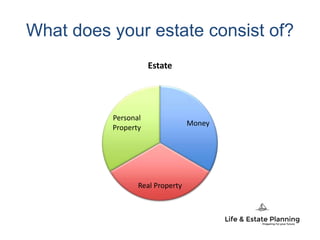
What does your estate consist of?
Money
Real Property
Personal
Property
Estate
Who benefits from estate planning?
• Just the rich?
• No… Estate planning is not just for the Rich.
The Rich benefit from advanced estate
planning, but simple estate planning can
benefit everyone, no matter their income
level.
What benefit come with an estate
plan?
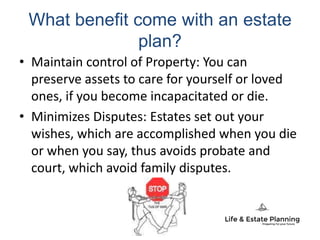
• Maintain control of Property: You can
preserve assets to care for yourself or loved
ones, if you become incapacitated or die.
• Minimizes Disputes: Estates set out your
wishes, which are accomplished when you die
or when you say, thus avoids probate and
court, which avoid family disputes.
What happens if you become
incapacitated?
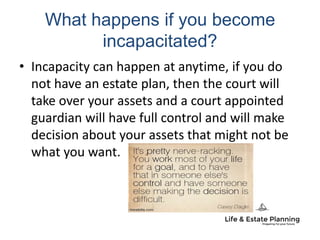
• Incapacity can happen at anytime, if you do
not have an estate plan, then the court will
take over your assets and a court appointed
guardian will have full control and will make
decision about your assets that might not be
what you want.
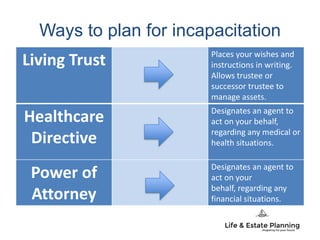
Ways to plan for incapacitation
Living Trust Places your wishes and
instructions in writing.
Allows trustee or
successor trustee to
manage assets.
Healthcare
Directive
Designates an agent to
act on your behalf,
regarding any medical or
health situations.
Power of
Attorney
Designates an agent to
act on your
behalf, regarding any
financial situations.
Real Property Management
• There are three ways to have property
transferred over without any court
interference.
• 1) Joint tenancy with the right of survivorship.
• 2) Community property with the right of
survivorship.
• 3) Place property in a trust and the successor
trustee or trustees gain the property or can
give the property.
What happens if you pass away
without an estate plan?
• Your assets will be frozen and placed in
probate court, whether married or not.
• Your property will be distributed by the Court
law, which may not be your wishes.
• Retirement Plans
(401(k), IRA’s, Pensions, Annuities) and Life
insurance will be distributed to your allocated
beneficiaries.
Basic estate plan
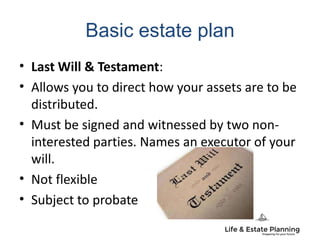
• Last Will & Testament:
• Allows you to direct how your assets are to be
distributed.
• Must be signed and witnessed by two non-
interested parties. Names an executor of your
will.
• Not flexible
• Subject to probate
Probate with a Will
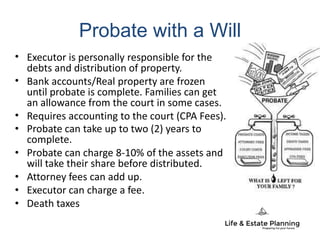
• Executor is personally responsible for the
debts and distribution of property.
• Bank accounts/Real property are frozen
until probate is complete. Families can get
an allowance from the court in some cases.
• Requires accounting to the court (CPA Fees).
• Probate can take up to two (2) years to
complete.
• Probate can charge 8-10% of the assets and
will take their share before distributed.
• Attorney fees can add up.
• Executor can charge a fee.
• Death taxes
How to avoid probate?
• Make lifetime gifts to loved ones.
• Make sure all your Beneficiaries are
designated and updated (401(k), IRA’s,
Pensions, Stocks, Life insurance).
• Hold all real property with joint tenancy with
right of survivorship.
• Create and implement a revocable trust.
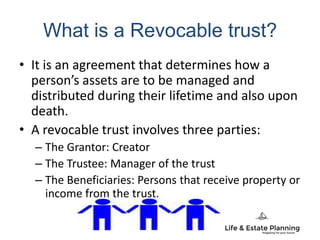
What is a Revocable trust?
• It is an agreement that determines how a
person’s assets are to be managed and
distributed during their lifetime and also upon
death.
• A revocable trust involves three parties:
– The Grantor: Creator
– The Trustee: Manager of the trust
– The Beneficiaries: Persons that receive property or
income from the trust.
Revocable Trust
• Flexible: Can be changed and amended.
• Controls property and assets.
• Protects against court interference when you
become incapacitated. Also, avoids probate, and
minimizes taxes and expenses of death (Probate
court cost, attorney fees, CPA fees etc…).
• Provides safeguards for yourself, your spouse,
your children, your parents and any other loved
one which you applied as a beneficiaries.
Lifetime Gifting
• Allows an individual to gift up to $14,000 in cash or
assets each year to each of as many individuals as they
want tax-free.
• Each individual has a maximum lifetime gift exclusion
of $5.34 million as of 2014, but will adjust each year to
inflation.
• For married couples the exclusion is $10.68 million.
• If one spouse dies, then the other spouse can use any
remaining gift tax exclusion that is left over from the
deceased spouse.
• Removes future appreciation of property from your
taxable estate.
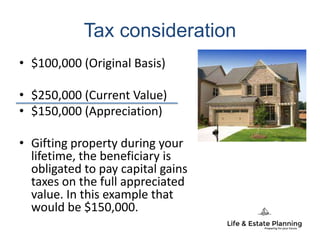
Tax consideration
• $100,000 (Original Basis)
• $250,000 (Current Value)
• $150,000 (Appreciation)
• Gifting property during your
lifetime, the beneficiary is
obligated to pay capital gains
taxes on the full appreciated
value. In this example that
would be $150,000.
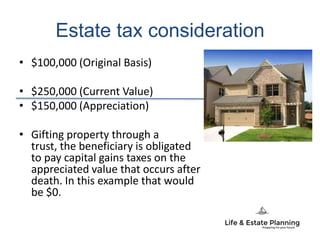
Estate tax consideration
• $100,000 (Original Basis)
• $250,000 (Current Value)
• $150,000 (Appreciation)
• Gifting property through a
trust, the beneficiary is obligated
to pay capital gains taxes on the
appreciated value that occurs after
death. In this example that would
be $0.
Many different types of strategies to
prepare for the future
• Estate planning has very easy simple strategies
and some very advanced strategies, most
people just need a simple one. Your needs
should to be assessed and evaluated by a
professional.
• Do not fail to plan, because when you fail to
plan, you plan to fail.
Ask yourself these questions
• Have I created a plan for my future?
• Have I created a plan for disability?
• Have I created a plan for incapacity?
• Have I created a proper plan to control my
assets after I pass?
• Does my current plan address all these
questions and how accurately do they reflect
my wishes?
We are profession and confidential
• Life & Estate Planning is a firm, that is focused on
educating individuals to the needs and risk of life
and the future.
• We offer free evaluations and options for all your
Life & Estate needs.
• We are a small firm and we focus on personability
& relationships.
• We wont just help you for a day, we will be here
for you for years and years.

Estate planning

  • 1.
    Estate Planning Steven Cruz,CCEP Certified Estate Planner Life and Estate Planning Serving the High Desert and San Bernardino County Areas (818) 939-1656 www.yourlifeandestateplanning.com
  • 2.
    What does yourestate consist of? Money Real Property Personal Property Estate
  • 3.
    Who benefits fromestate planning? • Just the rich? • No… Estate planning is not just for the Rich. The Rich benefit from advanced estate planning, but simple estate planning can benefit everyone, no matter their income level.
  • 4.
    What benefit comewith an estate plan? • Maintain control of Property: You can preserve assets to care for yourself or loved ones, if you become incapacitated or die. • Minimizes Disputes: Estates set out your wishes, which are accomplished when you die or when you say, thus avoids probate and court, which avoid family disputes.
  • 5.
    What happens ifyou become incapacitated? • Incapacity can happen at anytime, if you do not have an estate plan, then the court will take over your assets and a court appointed guardian will have full control and will make decision about your assets that might not be what you want.
  • 6.
    Ways to planfor incapacitation Living Trust Places your wishes and instructions in writing. Allows trustee or successor trustee to manage assets. Healthcare Directive Designates an agent to act on your behalf, regarding any medical or health situations. Power of Attorney Designates an agent to act on your behalf, regarding any financial situations.
  • 7.
    Real Property Management •There are three ways to have property transferred over without any court interference. • 1) Joint tenancy with the right of survivorship. • 2) Community property with the right of survivorship. • 3) Place property in a trust and the successor trustee or trustees gain the property or can give the property.
  • 8.
    What happens ifyou pass away without an estate plan? • Your assets will be frozen and placed in probate court, whether married or not. • Your property will be distributed by the Court law, which may not be your wishes. • Retirement Plans (401(k), IRA’s, Pensions, Annuities) and Life insurance will be distributed to your allocated beneficiaries.
  • 9.
    Basic estate plan •Last Will & Testament: • Allows you to direct how your assets are to be distributed. • Must be signed and witnessed by two non- interested parties. Names an executor of your will. • Not flexible • Subject to probate
  • 10.
    Probate with aWill • Executor is personally responsible for the debts and distribution of property. • Bank accounts/Real property are frozen until probate is complete. Families can get an allowance from the court in some cases. • Requires accounting to the court (CPA Fees). • Probate can take up to two (2) years to complete. • Probate can charge 8-10% of the assets and will take their share before distributed. • Attorney fees can add up. • Executor can charge a fee. • Death taxes
  • 11.
    How to avoidprobate? • Make lifetime gifts to loved ones. • Make sure all your Beneficiaries are designated and updated (401(k), IRA’s, Pensions, Stocks, Life insurance). • Hold all real property with joint tenancy with right of survivorship. • Create and implement a revocable trust.
  • 12.
    What is aRevocable trust? • It is an agreement that determines how a person’s assets are to be managed and distributed during their lifetime and also upon death. • A revocable trust involves three parties: – The Grantor: Creator – The Trustee: Manager of the trust – The Beneficiaries: Persons that receive property or income from the trust.
  • 13.
    Revocable Trust • Flexible:Can be changed and amended. • Controls property and assets. • Protects against court interference when you become incapacitated. Also, avoids probate, and minimizes taxes and expenses of death (Probate court cost, attorney fees, CPA fees etc…). • Provides safeguards for yourself, your spouse, your children, your parents and any other loved one which you applied as a beneficiaries.
  • 14.
    Lifetime Gifting • Allowsan individual to gift up to $14,000 in cash or assets each year to each of as many individuals as they want tax-free. • Each individual has a maximum lifetime gift exclusion of $5.34 million as of 2014, but will adjust each year to inflation. • For married couples the exclusion is $10.68 million. • If one spouse dies, then the other spouse can use any remaining gift tax exclusion that is left over from the deceased spouse. • Removes future appreciation of property from your taxable estate.
  • 15.
    Tax consideration • $100,000(Original Basis) • $250,000 (Current Value) • $150,000 (Appreciation) • Gifting property during your lifetime, the beneficiary is obligated to pay capital gains taxes on the full appreciated value. In this example that would be $150,000.
  • 16.
    Estate tax consideration •$100,000 (Original Basis) • $250,000 (Current Value) • $150,000 (Appreciation) • Gifting property through a trust, the beneficiary is obligated to pay capital gains taxes on the appreciated value that occurs after death. In this example that would be $0.
  • 17.
    Many different typesof strategies to prepare for the future • Estate planning has very easy simple strategies and some very advanced strategies, most people just need a simple one. Your needs should to be assessed and evaluated by a professional. • Do not fail to plan, because when you fail to plan, you plan to fail.
  • 18.
    Ask yourself thesequestions • Have I created a plan for my future? • Have I created a plan for disability? • Have I created a plan for incapacity? • Have I created a proper plan to control my assets after I pass? • Does my current plan address all these questions and how accurately do they reflect my wishes?
  • 19.
    We are professionand confidential • Life & Estate Planning is a firm, that is focused on educating individuals to the needs and risk of life and the future. • We offer free evaluations and options for all your Life & Estate needs. • We are a small firm and we focus on personability & relationships. • We wont just help you for a day, we will be here for you for years and years.