Essential
Complexity in
Systems
Architecture
Mark Mishaev
66% of technology
projects fail
The #1 Cause of IT Failure
Agenda
Complexity defined
Why Building Simple Systems is Hard?
Practical Advice
Conclusion
Mark Mishaev,
Core Engineering Group Lead, SAST, Checkmarx
@mark_mishaev
What is Complexity?
Complexity is generally used to
characterize something with many parts
where those parts interact with each
other in multiple ways
There is no silver
bullet
Essential Complexity
Essential complexity, according to Brooks, is anything that's caused
directly by the problem that you're trying to solve.
Whereas accidental complexity is anything that's related to details
of the implementation.
Accidental
Complexity
We’re not so good at our jobs
“That’s been one of my mantras—focus and simplicity.
Simple can be harder than complex: You have to work hard
to get your thinking clean to make it simple. But it’s worth
it in the end, because once you get there, you can move
mountains.”
—Steve Jobs
“Simplicity is a great virtue
but it requires hard work to
achieve it and education to
appreciate it. And to make
matters worse: complexity
sells better.”
— Edsger W. Dijkstra.
Developers are drawn to complexity like
moths to a flame often with the same result
Why is simple
design so hard?
To design a simple
system requires deep
technological insight and
a strong character.
Common
Reasons for
Accidental
Complexity
Reason #1 – Violating
KISS
“The KISS principle states that most
systems work best if they are kept simple
rather than made complex; therefore
simplicity should be a key goal in design
and unnecessary complexity should be
avoided.”
Reason #2 – Violating
YAGNI
It's a statement that some capability we
presume our software needs in the future
should not be built now because "you
aren't gonna need it"
Reason #3 – Premature
Optimization
Premature optimization is spending a lot
of time on something that you may not
actually need. “Premature optimization is
the root of all evil” is a famous saying
among software developers. Its source is
credited to Donald Knuth.
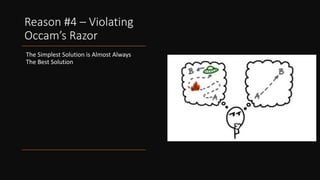
Reason #4 – Violating
Occam’s Razor
The Simplest Solution is Almost Always
The Best Solution
Complex Designs
• When the simplicity principles above
are not observed, the resulting software
systems may have complexity in the
form of:
• Unneeded features
• Over-engineering
The Power of Focus
Always ask “Why”?
• Why do we need it?
• Why it’s important?
• Why now?
• Why do we care?
Find what the software has
to do and say “no” to the
things that fall outside of it
Simplification
of a Design
“You know you have
achieved perfection in
design, not when you have
nothing more to add, but
when you have nothing
more to take away.”
— Antoine de Saint-Exupery
Evolutionary
Architectures
• The heart of doing evolutionary architecture
is to make small changes, and put in
feedback loops that allow everyone to learn
from how the system is developing
• Approach to system design that anticipates
change and evolution
Main Characteristics
• Modularity (helps to prevent Big ball of
mud)
• Organized Around Business Capabilities
(DDD to the rescue)
• Experimentation (A/B Testing, canary
releases, etc.)
Conclusion
In conclusion, we saw that building simple systems is hard.
Good starting point of doing it is to have a discipline and a strong technical knowledge.
We saw that it's often coming from our tendency to put too much focus on the future and
potential use-cases.
Obviously, it's easier said than done because we’re building systems that are inherently complex,
but if we're focusing on what is important, don't optimize early and put in practice evolutionary
design approach, we have better chances to reduce accidental complexity and build more simple
systems on time.
Thank you!

Essential Complexity in Systems Architecture

  • 1.
  • 2.
  • 3.
    The #1 Causeof IT Failure
  • 4.
    Agenda Complexity defined Why BuildingSimple Systems is Hard? Practical Advice Conclusion
  • 5.
    Mark Mishaev, Core EngineeringGroup Lead, SAST, Checkmarx @mark_mishaev
  • 6.
    What is Complexity? Complexityis generally used to characterize something with many parts where those parts interact with each other in multiple ways
  • 7.
    There is nosilver bullet
  • 8.
    Essential Complexity Essential complexity,according to Brooks, is anything that's caused directly by the problem that you're trying to solve. Whereas accidental complexity is anything that's related to details of the implementation.
  • 9.
  • 10.
    “That’s been oneof my mantras—focus and simplicity. Simple can be harder than complex: You have to work hard to get your thinking clean to make it simple. But it’s worth it in the end, because once you get there, you can move mountains.” —Steve Jobs
  • 11.
    “Simplicity is agreat virtue but it requires hard work to achieve it and education to appreciate it. And to make matters worse: complexity sells better.” — Edsger W. Dijkstra.
  • 12.
    Developers are drawnto complexity like moths to a flame often with the same result
  • 13.
  • 14.
    To design asimple system requires deep technological insight and a strong character.
  • 15.
  • 16.
    Reason #1 –Violating KISS “The KISS principle states that most systems work best if they are kept simple rather than made complex; therefore simplicity should be a key goal in design and unnecessary complexity should be avoided.”
  • 17.
    Reason #2 –Violating YAGNI It's a statement that some capability we presume our software needs in the future should not be built now because "you aren't gonna need it"
  • 18.
    Reason #3 –Premature Optimization Premature optimization is spending a lot of time on something that you may not actually need. “Premature optimization is the root of all evil” is a famous saying among software developers. Its source is credited to Donald Knuth.
  • 19.
    Reason #4 –Violating Occam’s Razor The Simplest Solution is Almost Always The Best Solution
  • 20.
    Complex Designs • Whenthe simplicity principles above are not observed, the resulting software systems may have complexity in the form of: • Unneeded features • Over-engineering
  • 21.
  • 22.
    Always ask “Why”? •Why do we need it? • Why it’s important? • Why now? • Why do we care?
  • 23.
    Find what thesoftware has to do and say “no” to the things that fall outside of it
  • 24.
  • 25.
    “You know youhave achieved perfection in design, not when you have nothing more to add, but when you have nothing more to take away.” — Antoine de Saint-Exupery
  • 26.
    Evolutionary Architectures • The heartof doing evolutionary architecture is to make small changes, and put in feedback loops that allow everyone to learn from how the system is developing • Approach to system design that anticipates change and evolution
  • 27.
    Main Characteristics • Modularity(helps to prevent Big ball of mud) • Organized Around Business Capabilities (DDD to the rescue) • Experimentation (A/B Testing, canary releases, etc.)
  • 28.
  • 29.
    In conclusion, wesaw that building simple systems is hard. Good starting point of doing it is to have a discipline and a strong technical knowledge. We saw that it's often coming from our tendency to put too much focus on the future and potential use-cases. Obviously, it's easier said than done because we’re building systems that are inherently complex, but if we're focusing on what is important, don't optimize early and put in practice evolutionary design approach, we have better chances to reduce accidental complexity and build more simple systems on time.
  • 30.