Evolutionary
Design
Adrian Bolboacă
Programmer, trainer, coach
blog.adrianbolboaca.ro
Aythor of the Coderetreat Book
https://leanpub.com/coderetreat
Why this talk?
● Continuously improve our understanding of the world
● Push the bar of software development
● Develop living systems, rather than rigid projects
● Evolve rather than change
● Research new ways of developing software
Disclaimer
● All ideas presented are in evolution (or in progress)
● This is not a basic talk
● I love philosophy and abstract thinking
● Please ask questions whenever you like
What I learned to get
Evolutionary Design
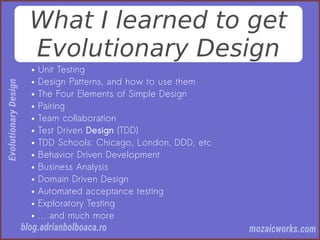
● Unit Testing
● Design Patterns, and how to use them
● The Four Elements of Simple Design
● Pairing
● Team collaboration
● Test Driven Design (TDD)
● TDD Schools: Chicago, London, DDD, etc
● Behavior Driven Development
● Business Analysis
● Domain Driven Design
● Automated acceptance testing
● Exploratory Testing
● … and much more
Contents
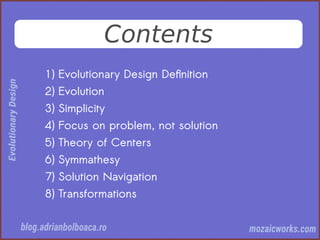
1) Evolutionary Design Defnition
2) Evolution
3) Simplicity
4) Focus on problem, not solution
5) Theory of Centers
6) Symmathesy
7) Solution Navigation
8) Transformations
1) Evolutionary Design
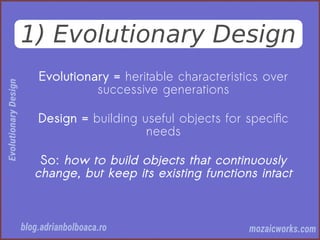
Evolutionary = heritable characteristics over
successive generations
Design = building useful objects for specifc
needs
So: how to build objects that continuously
change, but keep its existing functions intact
1) Evolutionary Design
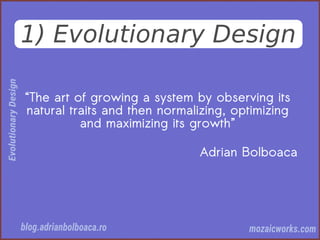
“The art of growing a system by observing its
natural traits and then normalizing, optimizing
and maximizing its growth”
Adrian Bolboaca
Why Evolutionary
Design?
● Build systems that are resilient to change
● Adapt your pace to the business needs
● Manage growing complexity
a. Normalizing Growth
● Observe irregular developments
● Refactor system’s growth to normalize it
● Balance system’s growth
● Setup practices and guidelines
● Create standards of growth
b. Optimize Growth
● Choose a growth objective
● You cannot optimize for everything
● Compromise
● Focus on business needs
● Observe, pro-act, re-act
c. Maximizing Growth
● Make the most out of each optimization
● Understand when it’s the “fertile” moment
● Observe patterns like Low Coupling,
High Cohesion, Structural Duplication, etc
● Use coherent strategies
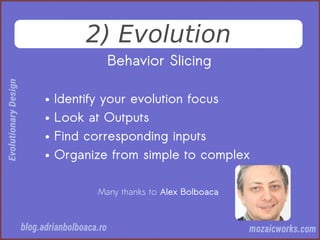
2) Evolution
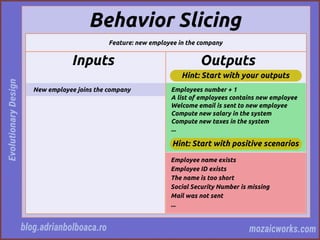
Behavior Slicing
● Identify your evolution focus
● Look at Outputs
● Find corresponding inputs
● Organize from simple to complex
Many thanks to Alex Bolboaca
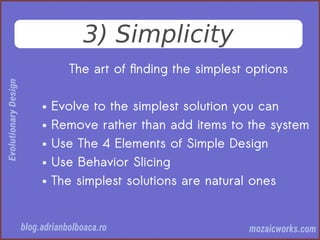
3) Simplicity
The art of fnding the simplest options
● Evolve to the simplest solution you can
● Remove rather than add items to the system
● Use The 4 Elements of Simple Design
● Use Behavior Slicing
● The simplest solutions are natural ones
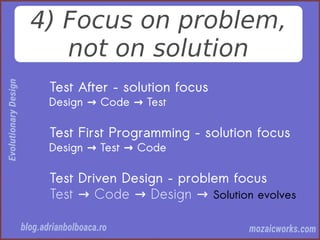
4) Focus on problem,
not on solution
Test After – solution focus
Design Code Test→ →
Test First Programming – solution focus
Design Test Code→ →
Test Driven Design – problem focus
Test Code Design→ → → Solution evolves
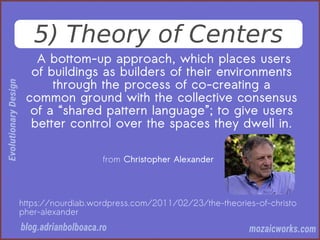
5) Theory of Centers
A bottom-up approach, which places users
of buildings as builders of their environments
through the process of co-creating a
common ground with the collective consensus
of a “shared pattern language”; to give users
better control over the spaces they dwell in.
from Christopher Alexander
https://nourdiab.wordpress.com/2011/02/23/the-theories-of-christo
pher-alexander
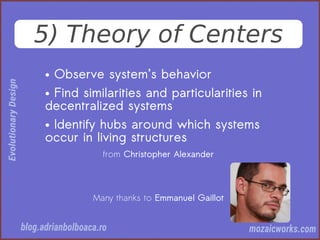
5) Theory of Centers
● Observe system’s behavior
● Find similarities and particularities in
decentralized systems
● Identify hubs around which systems
occur in living structures
from Christopher Alexander
Many thanks to Emmanuel Gaillot
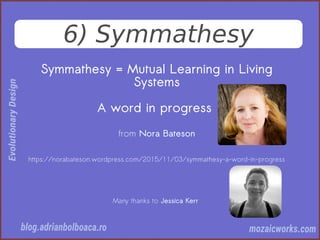
6) Symmathesy
Symmathesy = Mutual Learning in Living
Systems
A word in progress
from Nora Bateson
https://norabateson.wordpress.com/2015/11/03/symmathesy-a-word-in-progress
Many thanks to Jessica Kerr
6) Symmathesy
For Evolutionary Design
● Feedback is a learning mechanism
● The designer uses techniques to learn
from the software system
● Identify patterns and heuristics (similarities,
duplication, coherence, etc)
● Maybe in the future the system might be
able to learn from the designer
7) Solution Navigation
Navigation-related structural change in the
hippocampi of taxi drivers.
“The role of the hippocampus is to facilitate
spatial memory, in the form of navigation”
https://www.tutor2u.net/psychology/reference/maguire-2000
Many thanks to https://twitter.com/sleepyfox
7) Solution Navigation
● Practice to identify possible solutions
(Solution Seeker
http://blog.adrianbolboaca.ro/2014/02/pair-programming-game-solution-seeker )
● Pair with experienced navigators
● Extend your comfort zone for heuristics
● Work on design studies
● Read a lot of code
● Choose possible solutions based on
objective factors
● Feed your brain with practice
8) Transformations
During an evolution, transformations are the
essence:
● Transformation Priority Premise
● Levels of Abstraction
● Levels of Coupling
● Inductive vs Deductive
● ...
8) Transformations
But how do we have transformations?
We put pressure on existing design
Tests are pressure on existing design. We
need to look at the patterns and evolve the
system organically
Tests are not the only type of pressure
8) Transformations
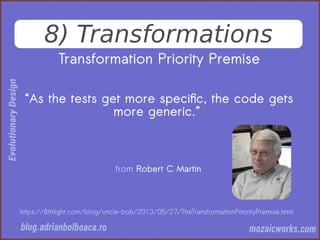
Transformation Priority Premise
“As the tests get more specifc, the code gets
more generic.”
from Robert C Martin
https://8thlight.com/blog/uncle-bob/2013/05/27/TheTransformationPriorityPremise.html
8) Transformations
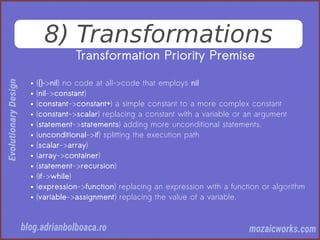
Transformation Priority Premise
● ({}–>nil) no code at all->code that employs nil
● (nil->constant)
● (constant->constant+) a simple constant to a more complex constant
● (constant->scalar) replacing a constant with a variable or an argument
● (statement->statements) adding more unconditional statements.
● (unconditional->if) splitting the execution path
● (scalar->array)
● (array->container)
● (statement->recursion)
● (if->while)
● (expression->function) replacing an expression with a function or algorithm
● (variable->assignment) replacing the value of a variable.
8) Transformations
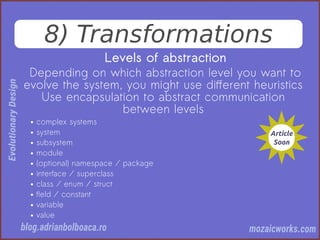
Levels of abstraction
Depending on which abstraction level you want to
evolve the system, you might use diferent heuristics
Use encapsulation to abstract communication
between levels
● complex systems
● system
● subsystem
● module
● (optional) namespace / package
● interface / superclass
● class / enum / struct
● feld / constant
● variable
● value
8) Transformations
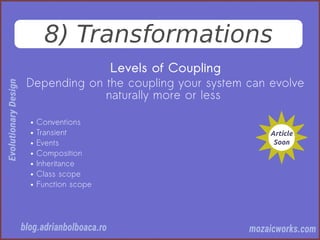
Levels of Coupling
Depending on the coupling your system can evolve
naturally more or less
● Conventions
● Transient
● Events
● Composition
● Inheritance
● Class scope
● Function scope
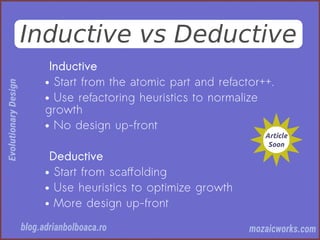
Inductive vs Deductive
Inductive
● Start from the atomic part and refactor++.
● Use refactoring heuristics to normalize
growth
● No design up-front
Deductive
● Start from scafolding
● Use heuristics to optimize growth
● More design up-front
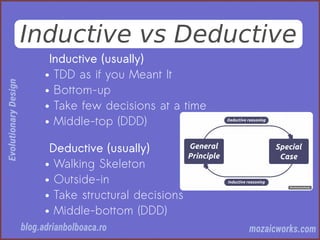
Inductive vs Deductive
Inductive (usually)
● TDD as if you Meant It
● Bottom-up
● Take few decisions at a time
● Middle-top (DDD)
Deductive (usually)
● Walking Skeleton
● Outside-in
● Take structural decisions
● Middle-bottom (DDD)
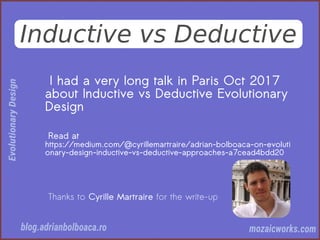
Inductive vs Deductive
I had a very long talk in Paris Oct 2017
about Inductive vs Deductive Evolutionary
Design
Read at
https://medium.com/@cyrillemartraire/adrian-bolboaca-on-evoluti
onary-design-inductive-vs-deductive-approaches-a7cead4bdd20
Thanks to Cyrille Martraire for the write-up
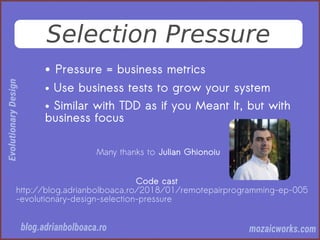
Selection Pressure
● Pressure = business metrics
● Use business tests to grow your system
● Similar with TDD as if you Meant It, but with
business focus
Many thanks to Julian Ghionoiu
Code cast
http://blog.adrianbolboaca.ro/2018/01/remotepairprogramming-ep-005
-evolutionary-design-selection-pressure
Recap
1) Evolutionary Design Defnition
2) Evolution
3) Simplicity
4) Focus on problem, not solution
5) Theory of Centers
6) Symmathesy
7) Solution Navigation
8) Transformations
What’s Next for me?
Evolve the topic
Write more articles
Publish more code casts
Write a book on Evolutionary Design
What’s Next for you?
Let’s talk about this topic
(Continuously Evolving) series of articles
and code casts
http://blog.adrianbolboaca.ro/evolutionary-design
Remote Pair with me
http://blog.adrianbolboaca.ro
Share your experiences
https://twitter.com/adibolb
About me
When not thinking about philosophical
topics I still:
Write software
Help companies and teams
Mentor, train and coach
Workshop
Join Evolutionary Design Workshop
25-26 June in Paris
https://mozaicworks.com/public-trainings-and-workshops/evolutionary-de
sign-workshop
Mozaic Works Design
School
Join the Mozaic Works Design School
How? Contact me!
Contact me
Adrian Bolboacă
Programmer, trainer, coach
adrian.bolboaca@mozaicworks.com
@adibolb

Evolutionary Design - NewCrafts Paris 18 May 2018

  • 1.
    Evolutionary Design Adrian Bolboacă Programmer, trainer,coach blog.adrianbolboaca.ro Aythor of the Coderetreat Book https://leanpub.com/coderetreat
  • 2.
    Why this talk? ●Continuously improve our understanding of the world ● Push the bar of software development ● Develop living systems, rather than rigid projects ● Evolve rather than change ● Research new ways of developing software
  • 3.
    Disclaimer ● All ideaspresented are in evolution (or in progress) ● This is not a basic talk ● I love philosophy and abstract thinking ● Please ask questions whenever you like
  • 4.
    What I learnedto get Evolutionary Design ● Unit Testing ● Design Patterns, and how to use them ● The Four Elements of Simple Design ● Pairing ● Team collaboration ● Test Driven Design (TDD) ● TDD Schools: Chicago, London, DDD, etc ● Behavior Driven Development ● Business Analysis ● Domain Driven Design ● Automated acceptance testing ● Exploratory Testing ● … and much more
  • 5.
    Contents 1) Evolutionary DesignDefnition 2) Evolution 3) Simplicity 4) Focus on problem, not solution 5) Theory of Centers 6) Symmathesy 7) Solution Navigation 8) Transformations
  • 6.
    1) Evolutionary Design Evolutionary= heritable characteristics over successive generations Design = building useful objects for specifc needs So: how to build objects that continuously change, but keep its existing functions intact
  • 7.
    1) Evolutionary Design “Theart of growing a system by observing its natural traits and then normalizing, optimizing and maximizing its growth” Adrian Bolboaca
  • 8.
    Why Evolutionary Design? ● Buildsystems that are resilient to change ● Adapt your pace to the business needs ● Manage growing complexity
  • 9.
    a. Normalizing Growth ●Observe irregular developments ● Refactor system’s growth to normalize it ● Balance system’s growth ● Setup practices and guidelines ● Create standards of growth
  • 10.
    b. Optimize Growth ●Choose a growth objective ● You cannot optimize for everything ● Compromise ● Focus on business needs ● Observe, pro-act, re-act
  • 11.
    c. Maximizing Growth ●Make the most out of each optimization ● Understand when it’s the “fertile” moment ● Observe patterns like Low Coupling, High Cohesion, Structural Duplication, etc ● Use coherent strategies
  • 13.
    2) Evolution Behavior Slicing ●Identify your evolution focus ● Look at Outputs ● Find corresponding inputs ● Organize from simple to complex Many thanks to Alex Bolboaca
  • 14.
    3) Simplicity The artof fnding the simplest options ● Evolve to the simplest solution you can ● Remove rather than add items to the system ● Use The 4 Elements of Simple Design ● Use Behavior Slicing ● The simplest solutions are natural ones
  • 15.
    4) Focus onproblem, not on solution Test After – solution focus Design Code Test→ → Test First Programming – solution focus Design Test Code→ → Test Driven Design – problem focus Test Code Design→ → → Solution evolves
  • 16.
    5) Theory ofCenters A bottom-up approach, which places users of buildings as builders of their environments through the process of co-creating a common ground with the collective consensus of a “shared pattern language”; to give users better control over the spaces they dwell in. from Christopher Alexander https://nourdiab.wordpress.com/2011/02/23/the-theories-of-christo pher-alexander
  • 17.
    5) Theory ofCenters ● Observe system’s behavior ● Find similarities and particularities in decentralized systems ● Identify hubs around which systems occur in living structures from Christopher Alexander Many thanks to Emmanuel Gaillot
  • 18.
    6) Symmathesy Symmathesy =Mutual Learning in Living Systems A word in progress from Nora Bateson https://norabateson.wordpress.com/2015/11/03/symmathesy-a-word-in-progress Many thanks to Jessica Kerr
  • 19.
    6) Symmathesy For EvolutionaryDesign ● Feedback is a learning mechanism ● The designer uses techniques to learn from the software system ● Identify patterns and heuristics (similarities, duplication, coherence, etc) ● Maybe in the future the system might be able to learn from the designer
  • 20.
    7) Solution Navigation Navigation-relatedstructural change in the hippocampi of taxi drivers. “The role of the hippocampus is to facilitate spatial memory, in the form of navigation” https://www.tutor2u.net/psychology/reference/maguire-2000 Many thanks to https://twitter.com/sleepyfox
  • 21.
    7) Solution Navigation ●Practice to identify possible solutions (Solution Seeker http://blog.adrianbolboaca.ro/2014/02/pair-programming-game-solution-seeker ) ● Pair with experienced navigators ● Extend your comfort zone for heuristics ● Work on design studies ● Read a lot of code ● Choose possible solutions based on objective factors ● Feed your brain with practice
  • 22.
    8) Transformations During anevolution, transformations are the essence: ● Transformation Priority Premise ● Levels of Abstraction ● Levels of Coupling ● Inductive vs Deductive ● ...
  • 23.
    8) Transformations But howdo we have transformations? We put pressure on existing design Tests are pressure on existing design. We need to look at the patterns and evolve the system organically Tests are not the only type of pressure
  • 24.
    8) Transformations Transformation PriorityPremise “As the tests get more specifc, the code gets more generic.” from Robert C Martin https://8thlight.com/blog/uncle-bob/2013/05/27/TheTransformationPriorityPremise.html
  • 25.
    8) Transformations Transformation PriorityPremise ● ({}–>nil) no code at all->code that employs nil ● (nil->constant) ● (constant->constant+) a simple constant to a more complex constant ● (constant->scalar) replacing a constant with a variable or an argument ● (statement->statements) adding more unconditional statements. ● (unconditional->if) splitting the execution path ● (scalar->array) ● (array->container) ● (statement->recursion) ● (if->while) ● (expression->function) replacing an expression with a function or algorithm ● (variable->assignment) replacing the value of a variable.
  • 26.
    8) Transformations Levels ofabstraction Depending on which abstraction level you want to evolve the system, you might use diferent heuristics Use encapsulation to abstract communication between levels ● complex systems ● system ● subsystem ● module ● (optional) namespace / package ● interface / superclass ● class / enum / struct ● feld / constant ● variable ● value
  • 27.
    8) Transformations Levels ofCoupling Depending on the coupling your system can evolve naturally more or less ● Conventions ● Transient ● Events ● Composition ● Inheritance ● Class scope ● Function scope
  • 28.
    Inductive vs Deductive Inductive ●Start from the atomic part and refactor++. ● Use refactoring heuristics to normalize growth ● No design up-front Deductive ● Start from scafolding ● Use heuristics to optimize growth ● More design up-front
  • 29.
    Inductive vs Deductive Inductive(usually) ● TDD as if you Meant It ● Bottom-up ● Take few decisions at a time ● Middle-top (DDD) Deductive (usually) ● Walking Skeleton ● Outside-in ● Take structural decisions ● Middle-bottom (DDD)
  • 30.
    Inductive vs Deductive Ihad a very long talk in Paris Oct 2017 about Inductive vs Deductive Evolutionary Design Read at https://medium.com/@cyrillemartraire/adrian-bolboaca-on-evoluti onary-design-inductive-vs-deductive-approaches-a7cead4bdd20 Thanks to Cyrille Martraire for the write-up
  • 31.
    Selection Pressure ● Pressure= business metrics ● Use business tests to grow your system ● Similar with TDD as if you Meant It, but with business focus Many thanks to Julian Ghionoiu Code cast http://blog.adrianbolboaca.ro/2018/01/remotepairprogramming-ep-005 -evolutionary-design-selection-pressure
  • 32.
    Recap 1) Evolutionary DesignDefnition 2) Evolution 3) Simplicity 4) Focus on problem, not solution 5) Theory of Centers 6) Symmathesy 7) Solution Navigation 8) Transformations
  • 33.
    What’s Next forme? Evolve the topic Write more articles Publish more code casts Write a book on Evolutionary Design
  • 34.
    What’s Next foryou? Let’s talk about this topic (Continuously Evolving) series of articles and code casts http://blog.adrianbolboaca.ro/evolutionary-design Remote Pair with me http://blog.adrianbolboaca.ro Share your experiences https://twitter.com/adibolb
  • 35.
    About me When notthinking about philosophical topics I still: Write software Help companies and teams Mentor, train and coach
  • 36.
    Workshop Join Evolutionary DesignWorkshop 25-26 June in Paris https://mozaicworks.com/public-trainings-and-workshops/evolutionary-de sign-workshop
  • 37.
    Mozaic Works Design School Jointhe Mozaic Works Design School How? Contact me!
  • 38.
    Contact me Adrian Bolboacă Programmer,trainer, coach adrian.bolboaca@mozaicworks.com @adibolb