Enterprise Architecture and the 
I f ti A E t iInformation Age Enterprise
Leon A. Kappelman, Ph.D.
Professor of Information Systems
Founding chair, Society for Information Management EA Working Group
http://eawg.simnet.org
fDirector Emeritus, Information Systems Research Center
Fellow, Texas Center for Digital Knowledge
Information Technology & Decision Sciences Department
College of Business University of North TexasCollege of Business, University of North Texas
Website: http://courses.unt.edu/kappelman/
Email: kapp@unt.edu     Phone: 940‐565‐4698     Fax: 940‐565‐4935
© 2010 Leon A. Kappelman CSDM 2010: Paris 28-Oct-2010
What is Architecture?
• The underlying design or structure of anything.  
– It exists whether or not it is made explicit (known)– It exists whether or not it is made explicit (known).
– If it is not explicit, assumptions must be made.
• If explicit Architecture is• If explicit, Architecture is …
–“the set of descriptive representations about an 
object ” John Zachmanobject.  – John Zachman
–a model or representation of an object created in 
order toorder to …
• “see” the object,
• “communicate” with others about the object,j ,
• “do” something with or to the object: create, manage, 
evaluate, or change it.
Why Enterprise Architecture?y p
You cannot effectively manage 
something you cannot “see” and 
nderstand (kno )!
Especially if it’s big complicated or will
understand (know)!
Especially if it’s big, complicated, or will 
grow or change at some point in time, or 
if you need to communicate accurately 
with others about it.
“The act of discovery y
consists not in finding 
new lands but in seeing 
with new eyes.”
M l P– Marcel Proust
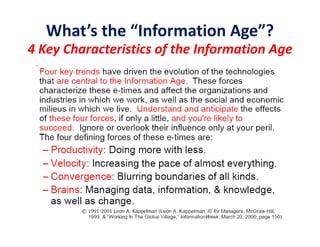
What’s the “Information Age”?
4 K Ch t i ti f th I f ti A4 Key Characteristics of the Information Age
“It is not the strongest of 
the species that survives, 
h i llinor the most intelligent, 
b t th th t i tbut the one that is most 
responsive to change ”responsive to change.”
Charles Darwin– Charles Darwin
US Federal Reserve Board Chairman Bernanke said
in June 2006 commencement speech @ MIT …p @
• “In the case of information and communication 
technologies, new economic research suggests that the 
investments in associated intangible capital ‐‐ figuring 
out what to do with the computer once it's out of the 
box ‐‐ are quite important indeed ”box  are quite important indeed.   
• “Important investments in intangible capital remain to 
be made, as much still remains to be learned about 
how to harness these technologies most effectively … 
as the full economic benefits of recent technological 
changes have not yet been completely realized ”changes have not yet been completely realized.
He’s talking about the need to invent some of the unique 
intellectual capital of the Information Age, just like quality andintellectual capital of the Information Age, just like quality and 
productivity were to the Industrial Age. “Bridging the Chasm” in The SIM Guide 
to Enterprise Architecture, 2010, edited by Leon A. Kappelman, CRC Press, NYC, (www.crcpress.com).
What is Enterprise Architecture?
•The current name given to creating and 
What is Enterprise Architecture?
utilizing some of that intangible capital.
•“The holistic set of descriptions about the 
enterprise over time.“ – SIM EA Working Groupp
•Modeling the enterprise in order to know 
d i b i ( d iand communicate about it (and its 
requirements). 
EA is about the creation of a shared 
language to communicate about thinklanguage to communicate about, think 
about, and manage the enterprise.  
If the people in the enterprise can’t communicate well 
enough to align their ideas and thoughts about the 
i ( l bj i )enterprise (e.g., strategy, goals, objectives, purpose), 
then they can’t coordinate and align the things they 
manage (e g applications data projects goods andmanage (e.g., applications, data, projects, goods and 
services, jobs, vehicles).
EA t t th f h t IS l dEA gets to the essence of what IS people do –
knowing, communicating, and delivering 
on requirements.
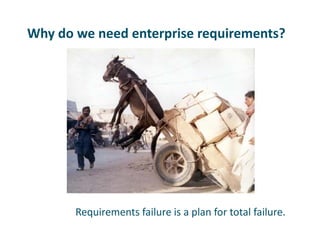
Why do we need enterprise requirements?
Requirements failure is a plan for total failure.
“We shape our buildings —
th ft th h ”thereafter they shape us.”
— Sir Winston Churchill
“We shape our enterprises andWe shape our enterprises and
their systems — thereafter they
shape us.”p
— Leon Kappelman
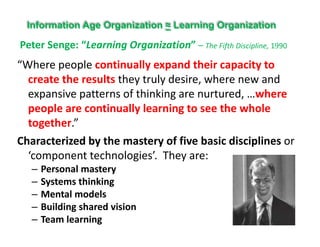
Peter Senge: “Learning Organization” – The Fifth Discipline 1990
Information Age Organization ≈ Learning Organization
“Where people continually expand their capacity to 
t th lt th t l d i h d
Peter Senge:  Learning Organization  – The Fifth Discipline, 1990
create the results they truly desire, where new and 
expansive patterns of thinking are nurtured, …where 
people are continually learning to see the wholepeople are continually learning to see the whole 
together.”
Characterized by the mastery of five basic disciplines orCharacterized by the mastery of five basic disciplines or 
‘component technologies’.  They are:
– Personal masteryPersonal mastery
– Systems thinking
– Mental models
– Building shared vision
– Team learning
• EA is about learning to see the whole 
enterprise together through system 
thinking & modeling the enterprise inthinking & modeling the enterprise in
order to understand, communicate about,
change adapt and manage itchange, adapt, and manage it.
• EA is about at least 4 of Senge’s 5:g
Systems thinking
Mental modelsMental models
Building shared vision
Team learning
EA i bEA is about 
creating the g
Information AgeInformation Age 
OrganizationOrganization.
Requirements?Requirements?  
We know how toWe know how to 
d th t d ’t ?do that, don’t we?
Fred Brooks on the difficulties of 
software development… 
“To see what rate of progress one can expectTo see what rate of progress one can expect 
in software technology, let us examine the 
diffi lti f th t t h l F ll idifficulties of that technology. Following 
Aristotle, I divide them into essence, the 
difficulties inherent in the nature of software, 
and accidents, those difficulties that today , ff y
attend its production but are not inherent.”
"N Sil B ll E & A id f S f E i i ”"No Silver Bullet ‐ Essence & Accidents of Software Engineering”1986 in Information 
Processing 86. H.J. Kugler, ed., Elsevier, 1069‐1076. (Invited paper, IFIP Congress '86, Dublin) Reprinted in The Mythical Man‐Month, 
20th Anniversary Edition, Frederick P. Brooks, Jr., Addison‐Wesley, 1995.
Fred Brooks on the difficulties of 
software development… 
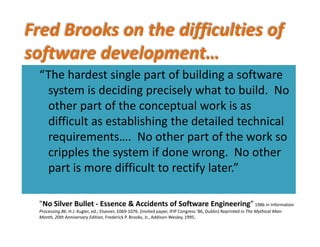
“To see what rate of progress one can expect“The hardest single part of building a softwareTo see what rate of progress one can expect 
in software technology, let us examine the 
diffi lti f th t t h l F ll i
The hardest single part of building a software 
system is deciding precisely what to build.  No 
other part of the conceptual work is as
difficulties of that technology. Following 
Aristotle, I divide them into essence, the 
other part of the conceptual work is as 
difficult as establishing the detailed technical 
requirements No other part of the work so
difficulties inherent in the nature of software, 
and accidents, those difficulties that today 
requirements….  No other part of the work so 
cripples the system if done wrong.  No other 
part is more difficult to rectify later”, y
attend its production but are not inherent.”
"N Sil B ll E & A id f S f E i i ”
part is more difficult to rectify later.
"No Silver Bullet ‐ Essence & Accidents of Software Engineering”1986 in Information 
Processing 86. H.J. Kugler, ed., Elsevier, 1069‐1076. (Invited paper, IFIP Congress '86, Dublin) Reprinted in The Mythical Man‐
Month, 20th Anniversary Edition, Frederick P. Brooks, Jr., Addison‐Wesley, 1995.
SIMEAWG
IT Management Practices Study
Averages (Scale: 1[=awful] to 5 [=superior])
• 3.67  Overall average (64 questions)
• 3.92  Purpose / function of EA (7 questions)
• 3.90  Potential benefits of EA (20 questions)
i d bili i ( i )• 3.68  ISD CMM practices and capabilities (12 questions)
• 3.53  Use of requirements artifacts (10 questions)
• 3 33 Requirements practices & capabilities (15 questions)• 3.33  Requirements practices & capabilities (15 questions)
The SIM Guide to Enterprise Architecture: Creating the 
Information Age Enterprise, 2010, edited by Leon A.Information Age Enterprise, 2010, edited by Leon A. 
Kappelman, CRC Press, Taylor and Francis Group, NYC, 
(www.crcpress.com).
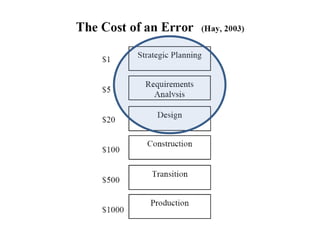
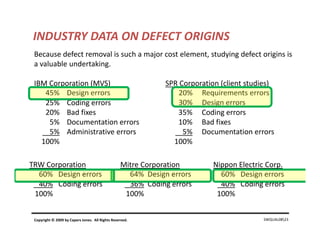
INDUSTRY DATA ON DEFECT ORIGINS
Because defect removal is such a major cost element, studying defect origins is 
a valuable undertaking.
IBM Corporation (MVS) SPR Corporation (client studies)
45% Design errors 20% Requirements errors
25% Coding errors 30% Design errors
20% Bad fixes 35% Coding errors
5% Documentation errors 10% Bad fixes
5% Administrative errors 5% Documentation errors
100% 100%100% 100%
TRW Corporation Mitre Corporation Nippon Electric Corp.
60% Design errors 64% Design errors 60% Design errors
40% Coding errors 36% Coding errors 40% Coding errors
100% 100% 100%
SWQUAL0823Copyright © 2009 by Capers Jones.  All Rights Reserved.
What is an Enterprise?What is an Organization?pg
OrganizationOrganization,
“know thyself”!y
Socrates– Socrates
OrganizationOrganizationOrganization,Organization,
“know thyself”!“know thyself”!y
Socrates
y
– Socrates Consulting– SocratesSocrates Consulting
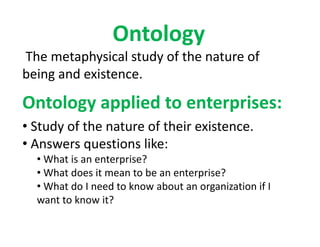
Ontology
The metaphysical study of the nature of 
being and existencebeing and existence.
Ontology applied to enterprises:Ontology applied to enterprises:
• Study of the nature of their existence.
i lik• Answers questions like: 
• What is an enterprise?
Wh t d it t b t i ?• What does it mean to be an enterprise?
• What do I need to know about an organization if I 
want to know it?want to know it?
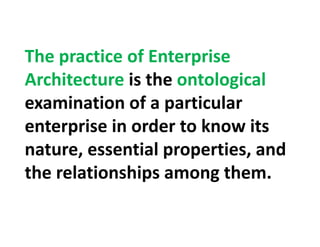
The practice of Enterprise 
Architecture is the ontologicalArchitecture is the ontological 
examination of a particularexamination of a particular 
enterprise in order to know its 
nature, essential properties, and 
the relationships among themthe relationships among them.
“Enterprise” Architecture?“Enterprise” Architecture?
What in the world areWhat in the world are 
enterprise‐wideenterprise‐wide 
requirements?requirements?
What is an Enterprise?What is an Organization?pg
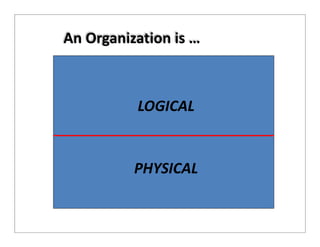
An Organization is …g
LOGICALLOGICAL
PHYSICALPHYSICAL
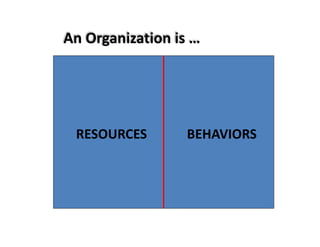
An Organization is …g
BEHAVIORSRESOURCES
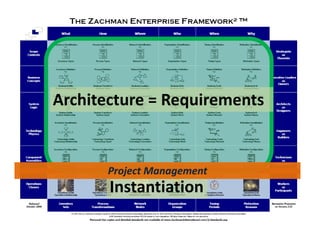
Architecture = Requirements q
Project Management
Instantiation
Project Management
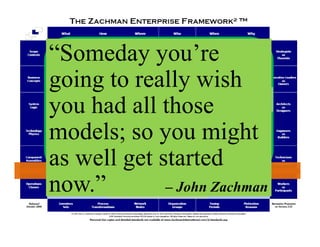
“S d ’“Someday you’re
going to really wish
Architecture = Requirements 
going to really wish
you had all thoseqyou had all those
models; so you might
Project Management
models; so you might
as well get started
Instantiation
Project Management
g
now.” – John Zachman
i t l d t d l ( h ) f ll th
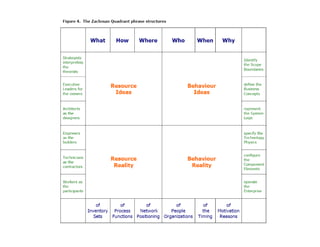
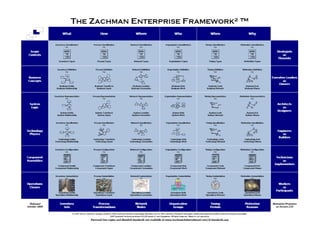
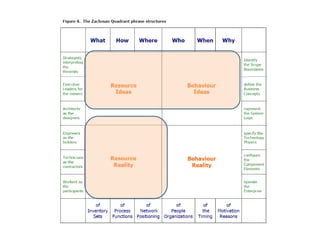
Zachman’s Enterprise Framework
… is an ontology, a data model (schema) for all the 
knowledge about the enterprise.
is process and method agnostic It doesn’t care… is process and method agnostic. It doesn t care 
how you do it.
… posits that this is the data/information/knowledge… posits that this is the data/information/knowledge
you must capture & use to effectively & efficiently …
• achieve & maintain your enterprise objectives y p j
(e.g., aligned, agile, optimized, lean, green, or 
whatever). 
h d l i• manage change and complexity.
• create and manage organizations (and their 
resources including technologies) that will surviveresources, including technologies) that will survive 
and thrive in the Information Age.
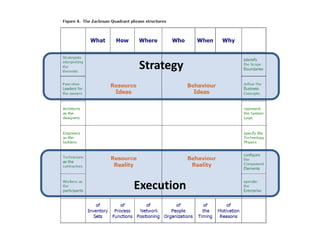
Strategy
Execution
• EA is a different way of seeing communicating about &
What is EA?
• EA is a different way of seeing, communicating about, & 
managing the enterprise & all of its assets, including IT. 
• EA gets to essence of IT success: To know, communicate, and 
deliver on the organization’s requirements. 
• EA is key to:
– achieving & keeping business‐IT alignment & other objectives.g p g g j
– helping the organization create value.
– achieving & maintaining balance among:
• Short‐term and long‐term objectivesg j
• Subsystem (BU, service, process, function) and whole (organization).
• EA includes many things you already do such as:
– requirements, analysis, design, strategic planning, network design, standard q y g g p g g
setting, data architecture, knowledge management, SOA, BPR, etc.
– BUT EA is much, much more than that.  So build on what you do.
• EA is fundamental to creating, maintaining, andEA is fundamental to creating, maintaining, and 
managing Information Age Organizations.
Implementation Guidelines: Getting Started
• Build on what you are already doing, including current projects.y y g, g p j
• Use collaborative approaches to doing and governing EA:
– Organize an EA working group or EA council. 
– Learn together & work toward agreement about language, models, methods
• Get participation & commitment from IT & business management:
– At all levels (but start as high as possible).   Leadership counts!
• Determine the goals, focus, scope, and priorities:
f l h l h d d d– Aim for completeness & comprehensiveness.   Deal with day‐to‐day needs.
• Embrace continuous change, learning, and communication:
– Remember, it’s a journey and a process.
Evangelize Have an “elevator speech” Get your “converters” one at a time– Evangelize.  Have an  elevator speech .  Get your  converters  one at a time.  
• Start small and show early success: 
– Identify EA initiatives of most value to organization.  
– Help the value creators it creates champions and wins hearts and mindsHelp the value creators, it creates champions and wins hearts and minds.
• Monitor, evaluate, and improve on a continuous basis:
– Quantify the benefits and the value created.
– Regularly take a hard look at EA cost‐value proposition, and make it better.g y p p
• Use EA in IT for CONTINUOUS IMPROVEMENT OF IT ALL and to 
COMMUNICATE WITH YOUR CUSTOMERS & STAKEHOLDERS.
Road to the Future: Institutionalizing EA
hi i f lif h k f l b ll• This is a new way of life: There is no quick fix; no silver bullet.
• This will take time and determination, as well as vision, courage and 
commitment: Do not underestimate the difficulty and complexity of 
h i lt d hit ti d i i fchanging culture and architecting and engineering one of 
humankind’s most complex objects – the Enterprise.
• Do not get discouraged: This is a revolution in thinking, a discipline, 
an engineering process Change of this magnit de takes time andan engineering process. Change of this magnitude takes time and 
perseverance.
• Set realistic expectations: Things have to be implemented and 
modified periodically so you have to accept some risk of “scrap andmodified periodically so you have to accept some risk of  scrap and 
rework."  Progress trumps perfection.
• Don't assume anything: Make executive education and technical 
training a continuous process It is easy to forget long term issues intraining a continuous process.  It is easy to forget long‐term issues in 
the short‐term stress of daily life. 
• Learn!: The state of the art is only about 25 years old and the "playing 
field" still pretty level – there is still much to learn and discover andfield  still pretty level  there is still much to learn and discover, and 
many opportunities to create advantage and value.
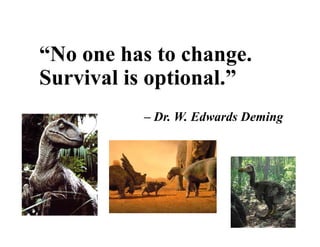
“No one has to change.
Survival is optional ”Survival is optional.”
– Dr. W. Edwards Deming
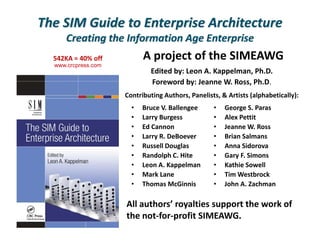
The SIM Guide to Enterprise Architecture 
Creating the Information Age Enterprise
A project of the SIMEAWG
Edited by: Leon A. Kappelman, Ph.D.
542KA = 40% off
www.crcpress.com
Foreword by: Jeanne W. Ross, Ph.D.
Contributing Authors, Panelists, & Artists (alphabetically):
• Bruce V Ballengee • George S Paras• Bruce V. Ballengee
• Larry Burgess 
• Ed Cannon
• Larry R. DeBoever
• George S. Paras
• Alex Pettit
• Jeanne W. Ross
• Brian Salmansy
• Russell Douglas
• Randolph C. Hite
• Leon A. Kappelman
• Anna Sidorova
• Gary F. Simons
• Kathie Sowell
• Mark Lane
• Thomas McGinnis
• Tim Westbrock
• John A. Zachman
All th ’ lti t th k fAll authors’ royalties support the work of 
the not‐for‐profit SIMEAWG.

"Enterprise Architecture and the Information Age Enterprise" @ CSDM2010

  • 1.
    Enterprise Architecture and the  I f tiA E t iInformation Age Enterprise Leon A. Kappelman, Ph.D. Professor of Information Systems Founding chair, Society for Information Management EA Working Group http://eawg.simnet.org fDirector Emeritus, Information Systems Research Center Fellow, Texas Center for Digital Knowledge Information Technology & Decision Sciences Department College of Business University of North TexasCollege of Business, University of North Texas Website: http://courses.unt.edu/kappelman/ Email: kapp@unt.edu     Phone: 940‐565‐4698     Fax: 940‐565‐4935 © 2010 Leon A. Kappelman CSDM 2010: Paris 28-Oct-2010
  • 2.
    What is Architecture? •The underlying design or structure of anything.   – It exists whether or not it is made explicit (known)– It exists whether or not it is made explicit (known). – If it is not explicit, assumptions must be made. • If explicit Architecture is• If explicit, Architecture is … –“the set of descriptive representations about an  object ” John Zachmanobject.  – John Zachman –a model or representation of an object created in  order toorder to … • “see” the object, • “communicate” with others about the object,j , • “do” something with or to the object: create, manage,  evaluate, or change it.
  • 3.
    Why Enterprise Architecture?yp You cannot effectively manage  something you cannot “see” and  nderstand (kno )! Especially if it’s big complicated or will understand (know)! Especially if it’s big, complicated, or will  grow or change at some point in time, or  if you need to communicate accurately  with others about it.
  • 8.
  • 9.
    What’s the “Information Age”? 4 K Cht i ti f th I f ti A4 Key Characteristics of the Information Age
  • 10.
    “It is not the strongest of  the species that survives,  h i llinor the most intelligent,  bt th th t i tbut the one that is most  responsive to change ”responsive to change.” Charles Darwin– Charles Darwin
  • 11.
    US Federal Reserve Board Chairman Bernanke said in June 2006 commencement speech @ MIT …p@ • “In the case of information and communication  technologies, new economic research suggests that the  investments in associated intangible capital ‐‐ figuring  out what to do with the computer once it's out of the  box ‐‐ are quite important indeed ”box  are quite important indeed.    • “Important investments in intangible capital remain to  be made, as much still remains to be learned about  how to harness these technologies most effectively …  as the full economic benefits of recent technological  changes have not yet been completely realized ”changes have not yet been completely realized. He’s talking about the need to invent some of the unique  intellectual capital of the Information Age, just like quality andintellectual capital of the Information Age, just like quality and  productivity were to the Industrial Age. “Bridging the Chasm” in The SIM Guide  to Enterprise Architecture, 2010, edited by Leon A. Kappelman, CRC Press, NYC, (www.crcpress.com).
  • 12.
    What is EnterpriseArchitecture? •The current name given to creating and  What is Enterprise Architecture? utilizing some of that intangible capital. •“The holistic set of descriptions about the  enterprise over time.“ – SIM EA Working Groupp •Modeling the enterprise in order to know  d i b i ( d iand communicate about it (and its  requirements). 
  • 13.
    EA is about the creation of a shared  language to communicateabout thinklanguage to communicate about, think  about, and manage the enterprise.   If the people in the enterprise can’t communicate well  enough to align their ideas and thoughts about the  i ( l bj i )enterprise (e.g., strategy, goals, objectives, purpose),  then they can’t coordinate and align the things they  manage (e g applications data projects goods andmanage (e.g., applications, data, projects, goods and  services, jobs, vehicles). EA t t th f h t IS l dEA gets to the essence of what IS people do – knowing, communicating, and delivering  on requirements.
  • 14.
  • 15.
    “We shape ourbuildings — th ft th h ”thereafter they shape us.” — Sir Winston Churchill “We shape our enterprises andWe shape our enterprises and their systems — thereafter they shape us.”p — Leon Kappelman
  • 16.
    Peter Senge: “LearningOrganization” – The Fifth Discipline 1990 Information Age Organization ≈ Learning Organization “Where people continually expand their capacity to  t th lt th t l d i h d Peter Senge:  Learning Organization  – The Fifth Discipline, 1990 create the results they truly desire, where new and  expansive patterns of thinking are nurtured, …where  people are continually learning to see the wholepeople are continually learning to see the whole  together.” Characterized by the mastery of five basic disciplines orCharacterized by the mastery of five basic disciplines or  ‘component technologies’.  They are: – Personal masteryPersonal mastery – Systems thinking – Mental models – Building shared vision – Team learning
  • 17.
    • EA is about learning to see the whole  enterprise together through system  thinking& modeling the enterprise inthinking & modeling the enterprise in order to understand, communicate about, change adapt and manage itchange, adapt, and manage it. • EA is about at least 4 of Senge’s 5:g Systems thinking Mental modelsMental models Building shared vision Team learning
  • 18.
    EA i bEA is about  creating the g InformationAgeInformation Age  OrganizationOrganization.
  • 19.
    Requirements?Requirements?   We know howtoWe know how to  d th t d ’t ?do that, don’t we?
  • 20.
    Fred Brooks on the difficulties of  software development…  “To see whatrate of progress one can expectTo see what rate of progress one can expect  in software technology, let us examine the  diffi lti f th t t h l F ll idifficulties of that technology. Following  Aristotle, I divide them into essence, the  difficulties inherent in the nature of software,  and accidents, those difficulties that today , ff y attend its production but are not inherent.” "N Sil B ll E & A id f S f E i i ”"No Silver Bullet ‐ Essence & Accidents of Software Engineering”1986 in Information  Processing 86. H.J. Kugler, ed., Elsevier, 1069‐1076. (Invited paper, IFIP Congress '86, Dublin) Reprinted in The Mythical Man‐Month,  20th Anniversary Edition, Frederick P. Brooks, Jr., Addison‐Wesley, 1995.
  • 21.
    Fred Brooks on the difficulties of  software development…  “To see whatrate of progress one can expect“The hardest single part of building a softwareTo see what rate of progress one can expect  in software technology, let us examine the  diffi lti f th t t h l F ll i The hardest single part of building a software  system is deciding precisely what to build.  No  other part of the conceptual work is as difficulties of that technology. Following  Aristotle, I divide them into essence, the  other part of the conceptual work is as  difficult as establishing the detailed technical  requirements No other part of the work so difficulties inherent in the nature of software,  and accidents, those difficulties that today  requirements….  No other part of the work so  cripples the system if done wrong.  No other  part is more difficult to rectify later”, y attend its production but are not inherent.” "N Sil B ll E & A id f S f E i i ” part is more difficult to rectify later. "No Silver Bullet ‐ Essence & Accidents of Software Engineering”1986 in Information  Processing 86. H.J. Kugler, ed., Elsevier, 1069‐1076. (Invited paper, IFIP Congress '86, Dublin) Reprinted in The Mythical Man‐ Month, 20th Anniversary Edition, Frederick P. Brooks, Jr., Addison‐Wesley, 1995.
  • 22.
    SIMEAWG IT Management Practices Study Averages (Scale: 1[=awful] to 5 [=superior]) • 3.67  Overall average (64 questions) • 3.92  Purpose / function of EA (7 questions) •3.90  Potential benefits of EA (20 questions) i d bili i ( i )• 3.68  ISD CMM practices and capabilities (12 questions) • 3.53  Use of requirements artifacts (10 questions) • 3 33 Requirements practices & capabilities (15 questions)• 3.33  Requirements practices & capabilities (15 questions) The SIM Guide to Enterprise Architecture: Creating the  Information Age Enterprise, 2010, edited by Leon A.Information Age Enterprise, 2010, edited by Leon A.  Kappelman, CRC Press, Taylor and Francis Group, NYC,  (www.crcpress.com).
  • 23.
    INDUSTRY DATA ON DEFECT ORIGINS Because defect removal is such a major cost element, studying defect origins is  a valuable undertaking. IBM Corporation (MVS) SPR Corporation (client studies) 45% Design errors20% Requirements errors 25% Coding errors 30% Design errors 20% Bad fixes 35% Coding errors 5% Documentation errors 10% Bad fixes 5% Administrative errors 5% Documentation errors 100% 100%100% 100% TRW Corporation Mitre Corporation Nippon Electric Corp. 60% Design errors 64% Design errors 60% Design errors 40% Coding errors 36% Coding errors 40% Coding errors 100% 100% 100% SWQUAL0823Copyright © 2009 by Capers Jones.  All Rights Reserved.
  • 24.
  • 25.
  • 26.
  • 27.
    Ontology The metaphysical study of the nature of  being and existencebeing and existence. Ontologyapplied to enterprises:Ontology applied to enterprises: • Study of the nature of their existence. i lik• Answers questions like:  • What is an enterprise? Wh t d it t b t i ?• What does it mean to be an enterprise? • What do I need to know about an organization if I  want to know it?want to know it?
  • 28.
    The practice of Enterprise  Architecture is theontologicalArchitecture is the ontological  examination of a particularexamination of a particular  enterprise in order to know its  nature, essential properties, and  the relationships among themthe relationships among them.
  • 29.
    “Enterprise” Architecture?“Enterprise” Architecture? What inthe world areWhat in the world are  enterprise‐wideenterprise‐wide  requirements?requirements?
  • 30.
  • 31.
  • 32.
  • 35.
  • 36.
    “S d ’“Somedayyou’re going to really wish Architecture = Requirements  going to really wish you had all thoseqyou had all those models; so you might Project Management models; so you might as well get started Instantiation Project Management g now.” – John Zachman
  • 37.
    i t ld t d l ( h ) f ll th Zachman’s Enterprise Framework … is an ontology, a data model (schema) for all the  knowledge about the enterprise. is process and method agnostic It doesn’t care… is process and method agnostic. It doesn t care  how you do it. … posits that this is the data/information/knowledge… posits that this is the data/information/knowledge you must capture & use to effectively & efficiently … • achieve & maintain your enterprise objectives y p j (e.g., aligned, agile, optimized, lean, green, or  whatever).  h d l i• manage change and complexity. • create and manage organizations (and their  resources including technologies) that will surviveresources, including technologies) that will survive  and thrive in the Information Age.
  • 39.
  • 40.
    • EA isa different way of seeing communicating about & What is EA? • EA is a different way of seeing, communicating about, &  managing the enterprise & all of its assets, including IT.  • EA gets to essence of IT success: To know, communicate, and  deliver on the organization’s requirements.  • EA is key to: – achieving & keeping business‐IT alignment & other objectives.g p g g j – helping the organization create value. – achieving & maintaining balance among: • Short‐term and long‐term objectivesg j • Subsystem (BU, service, process, function) and whole (organization). • EA includes many things you already do such as: – requirements, analysis, design, strategic planning, network design, standard q y g g p g g setting, data architecture, knowledge management, SOA, BPR, etc. – BUT EA is much, much more than that.  So build on what you do. • EA is fundamental to creating, maintaining, andEA is fundamental to creating, maintaining, and  managing Information Age Organizations.
  • 41.
    Implementation Guidelines: Getting Started • Build on what you are already doing, including current projects.y yg, g p j • Use collaborative approaches to doing and governing EA: – Organize an EA working group or EA council.  – Learn together & work toward agreement about language, models, methods • Get participation & commitment from IT & business management: – At all levels (but start as high as possible).   Leadership counts! • Determine the goals, focus, scope, and priorities: f l h l h d d d– Aim for completeness & comprehensiveness.   Deal with day‐to‐day needs. • Embrace continuous change, learning, and communication: – Remember, it’s a journey and a process. Evangelize Have an “elevator speech” Get your “converters” one at a time– Evangelize.  Have an  elevator speech .  Get your  converters  one at a time.   • Start small and show early success:  – Identify EA initiatives of most value to organization.   – Help the value creators it creates champions and wins hearts and mindsHelp the value creators, it creates champions and wins hearts and minds. • Monitor, evaluate, and improve on a continuous basis: – Quantify the benefits and the value created. – Regularly take a hard look at EA cost‐value proposition, and make it better.g y p p • Use EA in IT for CONTINUOUS IMPROVEMENT OF IT ALL and to  COMMUNICATE WITH YOUR CUSTOMERS & STAKEHOLDERS.
  • 42.
    Road to the Future: Institutionalizing EA hi i flif h k f l b ll• This is a new way of life: There is no quick fix; no silver bullet. • This will take time and determination, as well as vision, courage and  commitment: Do not underestimate the difficulty and complexity of  h i lt d hit ti d i i fchanging culture and architecting and engineering one of  humankind’s most complex objects – the Enterprise. • Do not get discouraged: This is a revolution in thinking, a discipline,  an engineering process Change of this magnit de takes time andan engineering process. Change of this magnitude takes time and  perseverance. • Set realistic expectations: Things have to be implemented and  modified periodically so you have to accept some risk of “scrap andmodified periodically so you have to accept some risk of  scrap and  rework."  Progress trumps perfection. • Don't assume anything: Make executive education and technical  training a continuous process It is easy to forget long term issues intraining a continuous process.  It is easy to forget long‐term issues in  the short‐term stress of daily life.  • Learn!: The state of the art is only about 25 years old and the "playing  field" still pretty level – there is still much to learn and discover andfield  still pretty level  there is still much to learn and discover, and  many opportunities to create advantage and value.
  • 43.
    “No one hasto change. Survival is optional ”Survival is optional.” – Dr. W. Edwards Deming
  • 44.
    The SIM Guide to Enterprise Architecture  Creating the Information Age Enterprise A project of the SIMEAWG Edited by: Leon A. Kappelman, Ph.D. 542KA = 40% off www.crcpress.com Foreword by: Jeanne W. Ross, Ph.D. Contributing Authors, Panelists, & Artists (alphabetically): • BruceV Ballengee • George S Paras• Bruce V. Ballengee • Larry Burgess  • Ed Cannon • Larry R. DeBoever • George S. Paras • Alex Pettit • Jeanne W. Ross • Brian Salmansy • Russell Douglas • Randolph C. Hite • Leon A. Kappelman • Anna Sidorova • Gary F. Simons • Kathie Sowell • Mark Lane • Thomas McGinnis • Tim Westbrock • John A. Zachman All th ’ lti t th k fAll authors’ royalties support the work of  the not‐for‐profit SIMEAWG.