Essence for Systems Engineering
(Systems Engineering Essence)
Berlin
20 June 2013
INCOSE
Russian
Chapter
Context
Roadmap (http://semat.org/?p=863):
• 1st of August 2013 – define model and architecture ontological status in
the Essence
• 1st of September 2013 – publish first draft of the Essence kernel
extension for Systems Engineering
• 1st of December 2013 – map Essence Systems Engineering kernel
elements to ISO 15926
• End of December 2013 – publish first version of the “Essence systems
engineering kernel elements (mapped to the ISO 15926)”
Achievements:
• Proposal discussed at the INCOSE Russian Chapter on 22nd of May 2013
(http://incose-ru.livejournal.com/42524.html).
• Proposal disussed at MESI conference on 6-7th of June 2013
(http://www.mesi.ru/our/events/detail/121699/) with Ivar Jacobson
and wider audience.
2
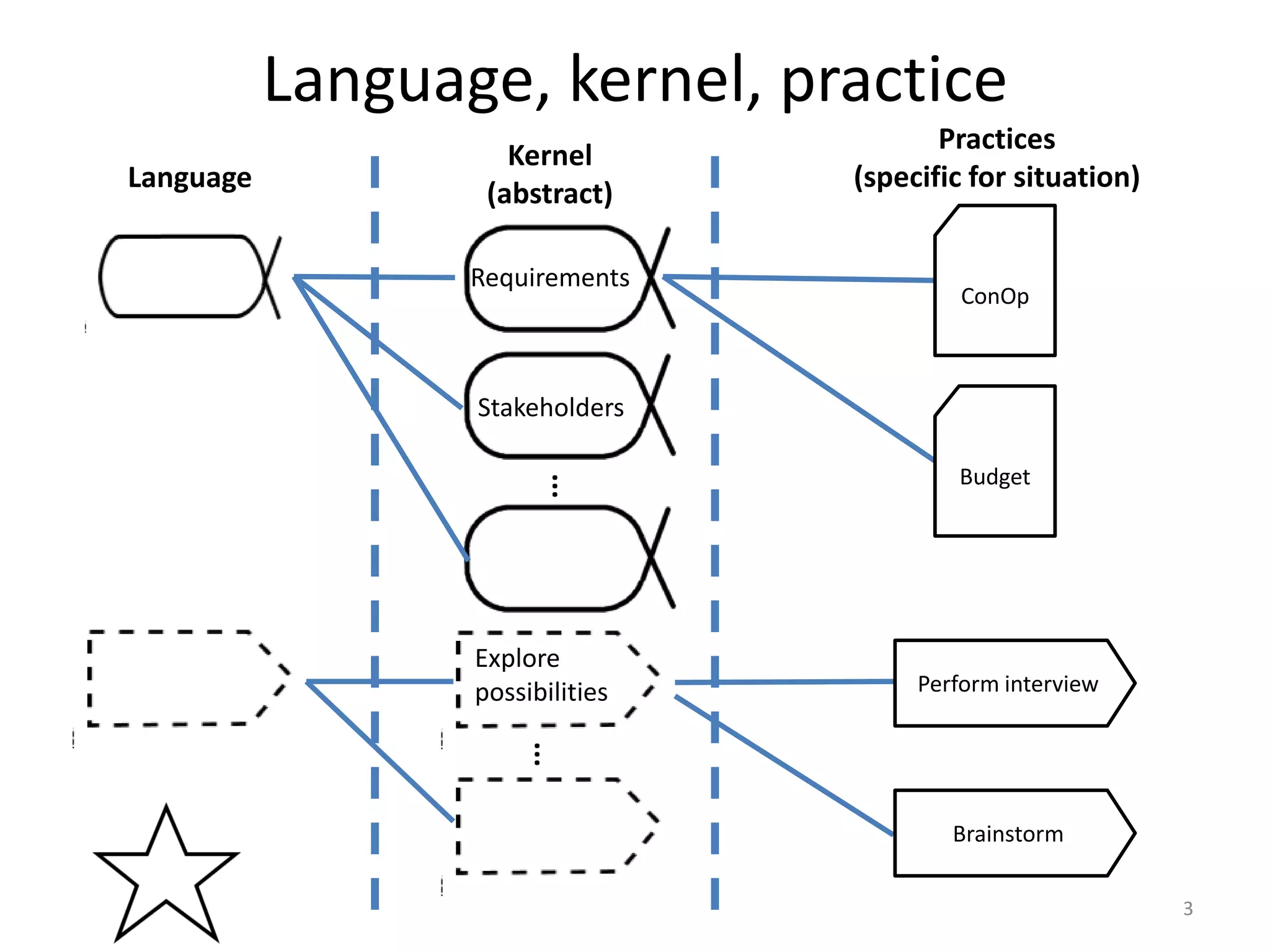
Language, kernel, practice
3
...
Language
Kernel
(abstract)
Practices
(specific for situation)
...
Requirements
Stakeholders
ConOp
Budget
Explore
possibilities Perform interview
Brainstorm
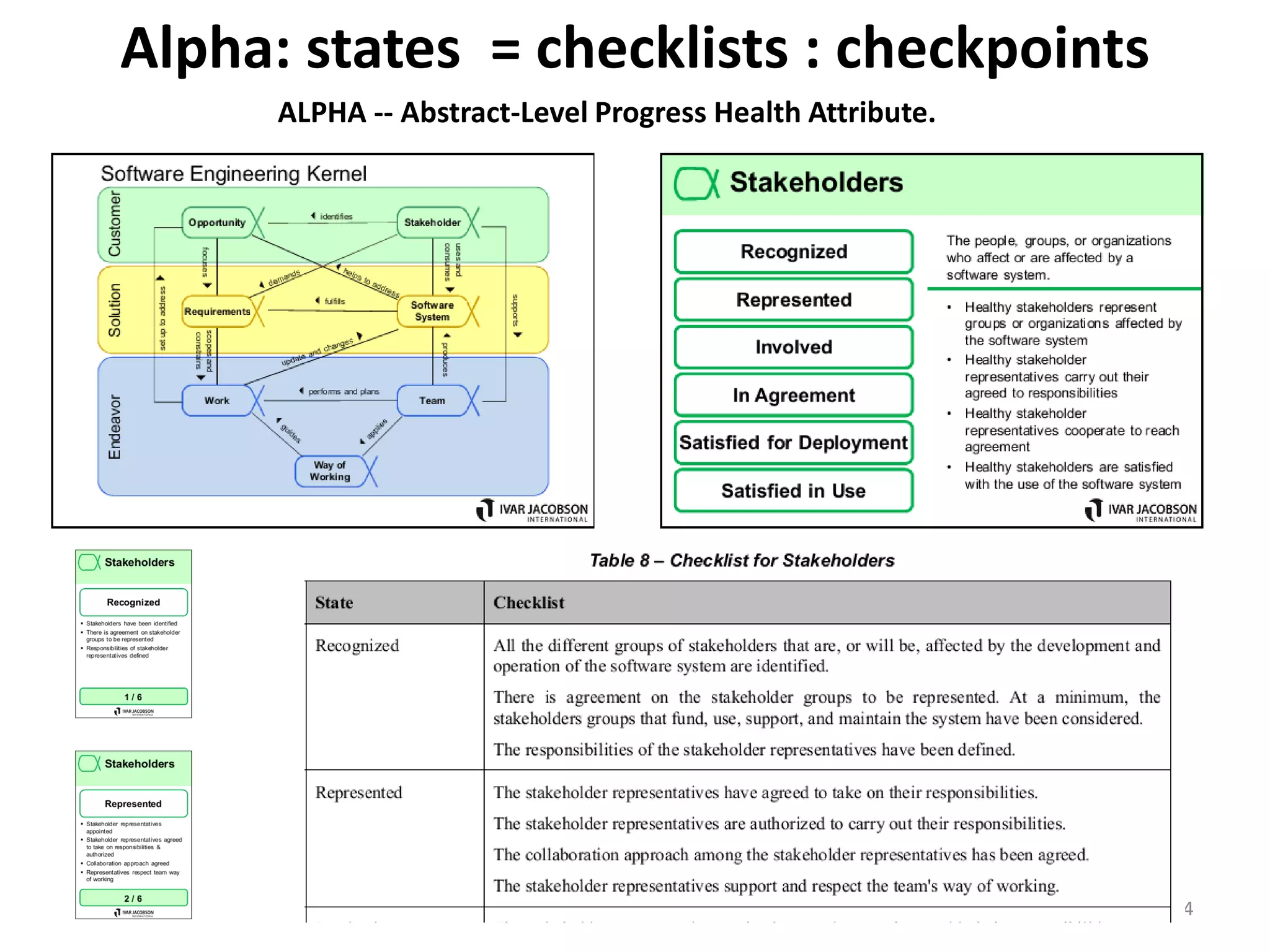
Alpha: states = checklists : checkpoints
4
ALPHA -- Abstract-Level Progress Health Attribute.
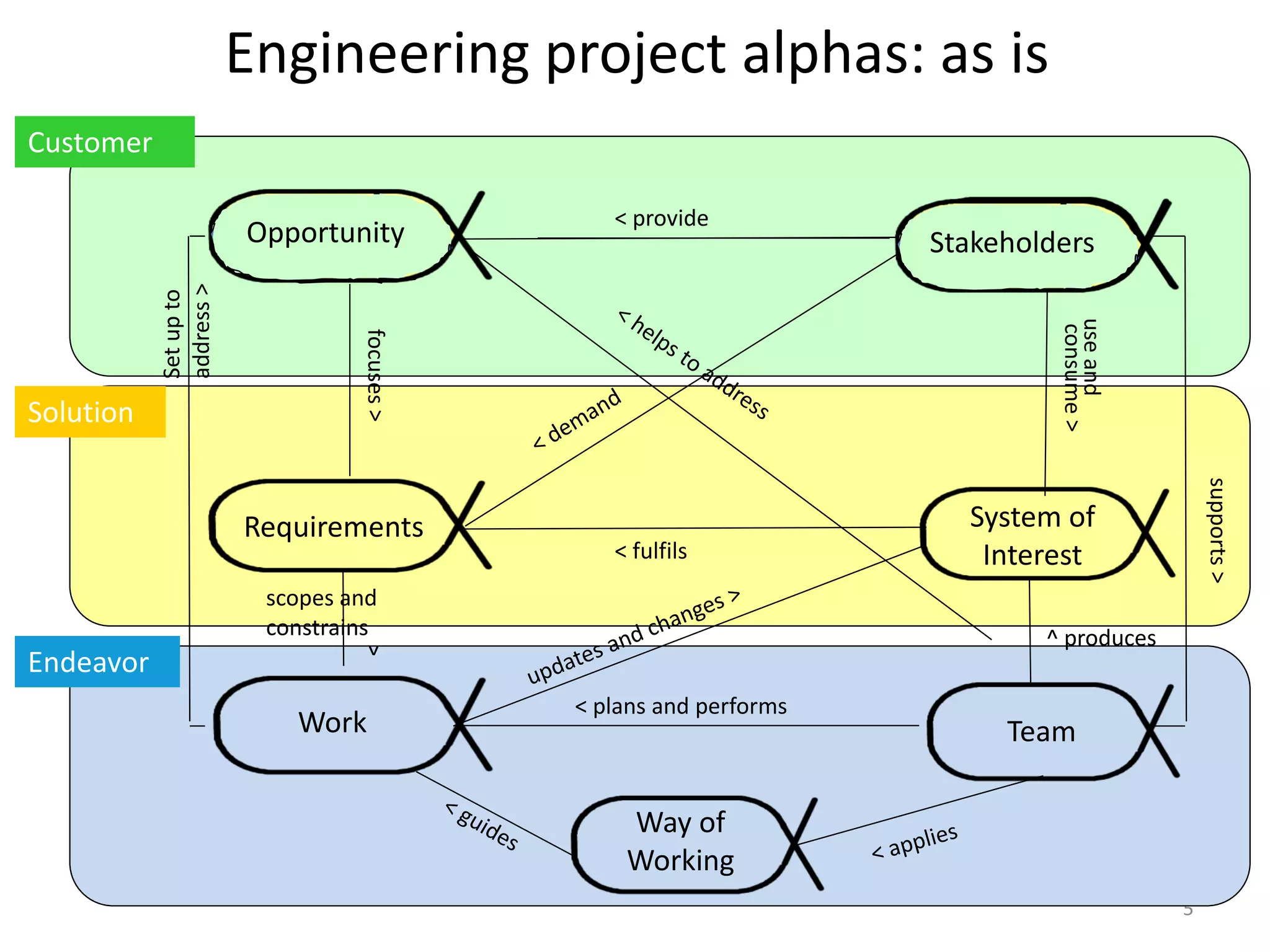
Engineering project alphas: as is
5
Essence Tutorial May 25, 2013. San Francisco CA USA 5
Customer
Solution
scopes and
constrains
< plans and performs
< fulfils
^ produces
Work Team
System of
Interest
Requirements
Way of
Working
^
< provide
StakeholdersOpportunity
focuses>
useand
consume>
supports>
Setupto
address>
Endeavor
Opportunity OpportunityStakeholders
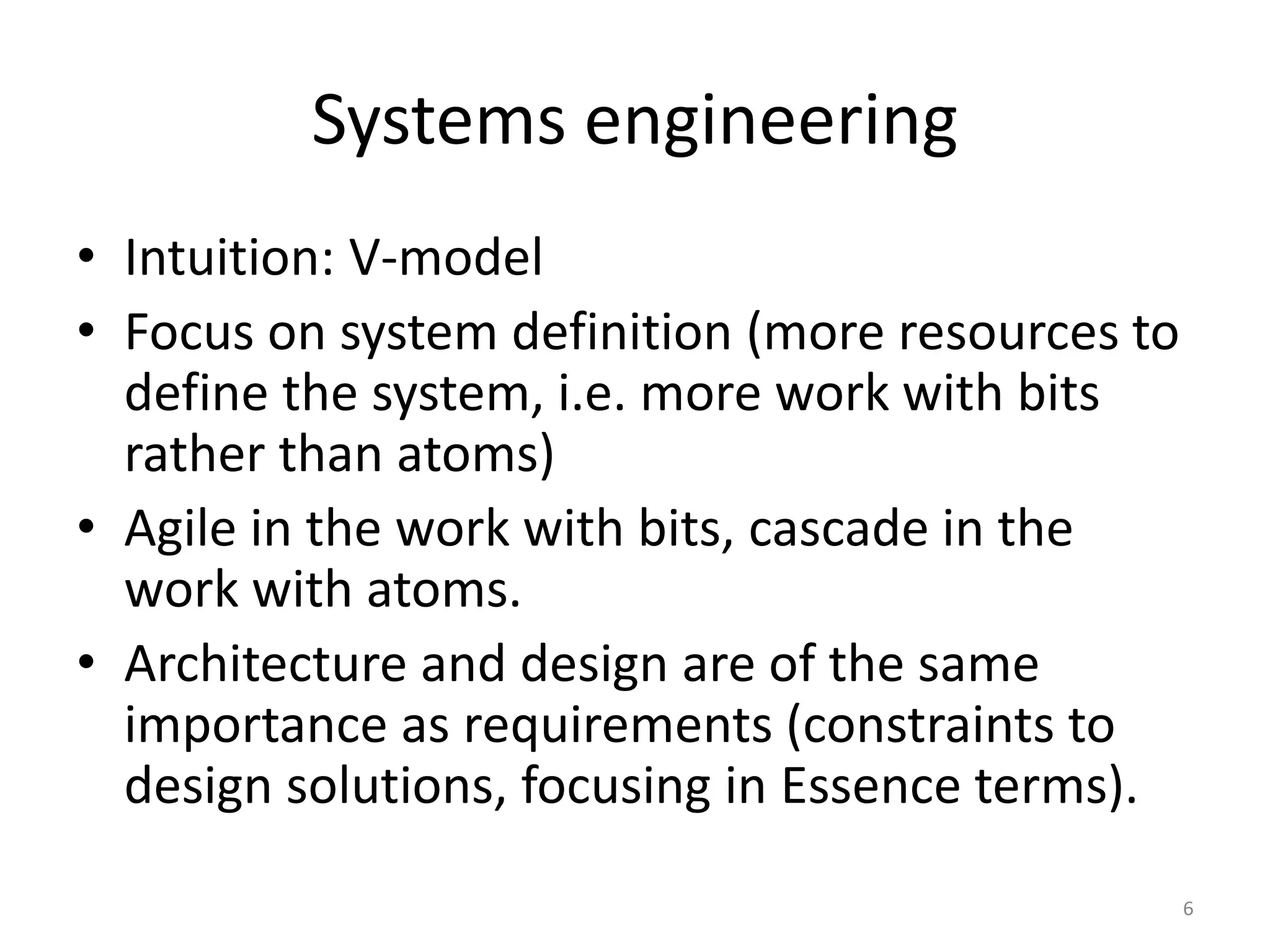
Systems engineering
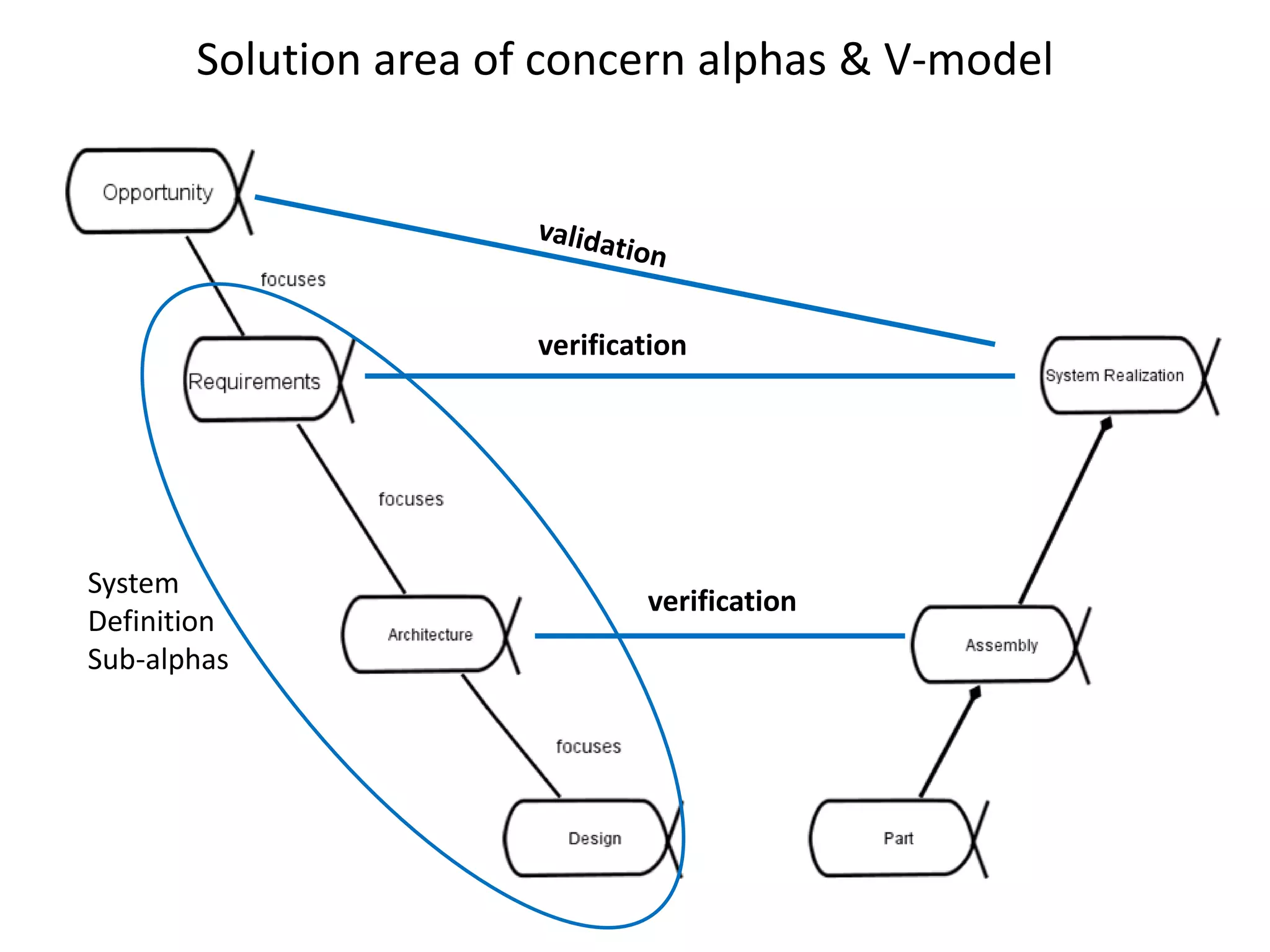
• Intuition: V-model
• Focus on system definition (more resources to
define the system, i.e. more work with bits
rather than atoms)
• Agile in the work with bits, cascade in the
work with atoms.
• Architecture and design are of the same
importance as requirements (constraints to
design solutions, focusing in Essence terms).
6
7
2D representation of Life Cycle:
practices executed in time
define needs acceptance
architecturing
design parts manufacturing
integration
validation
verification
verification
System
definition
System
realization
[System
operation]
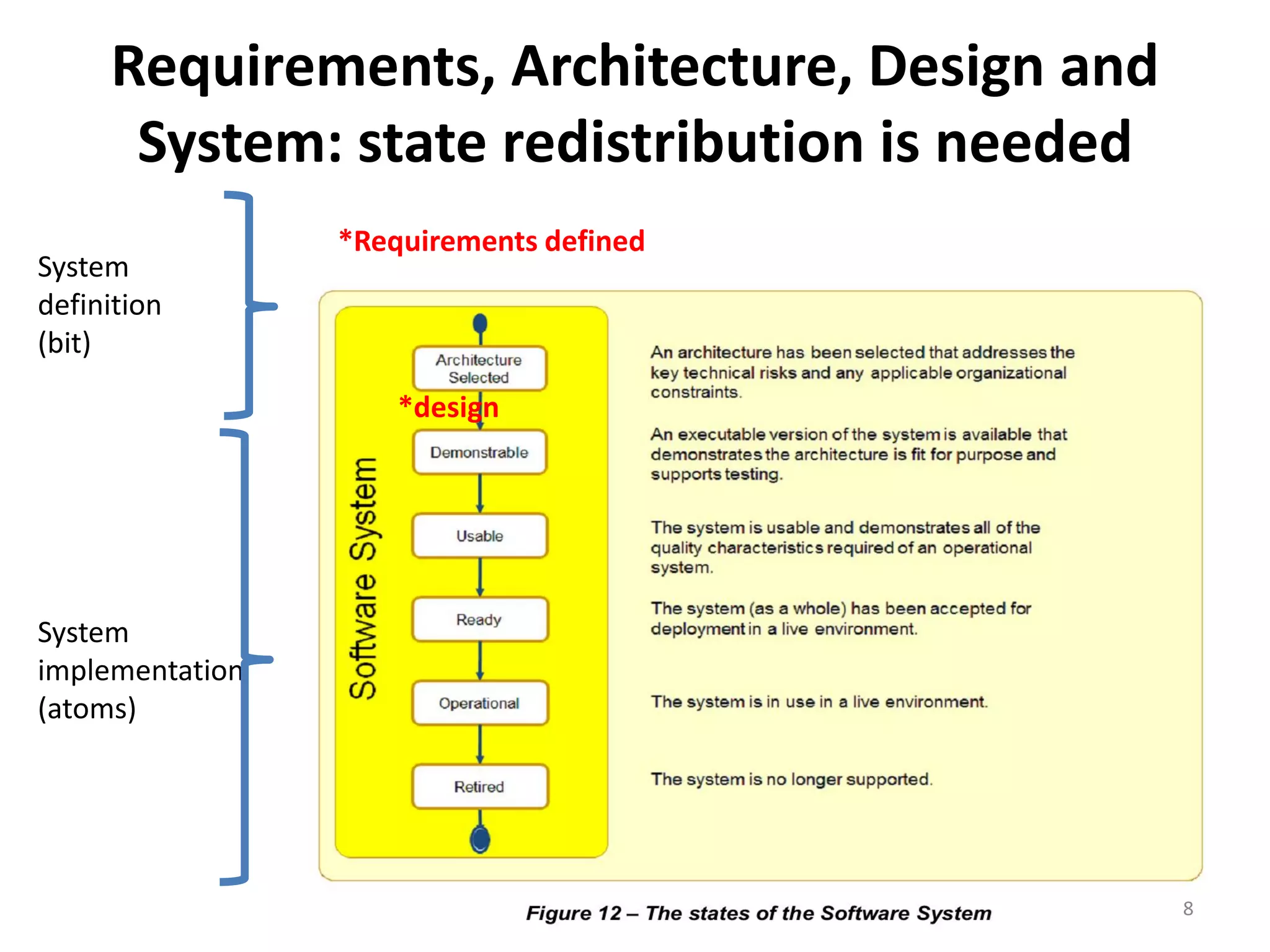
Requirements, Architecture, Design and
System: state redistribution is needed
8
*Requirements defined
System
implementation
(atoms)
System
definition
(bit)
*design
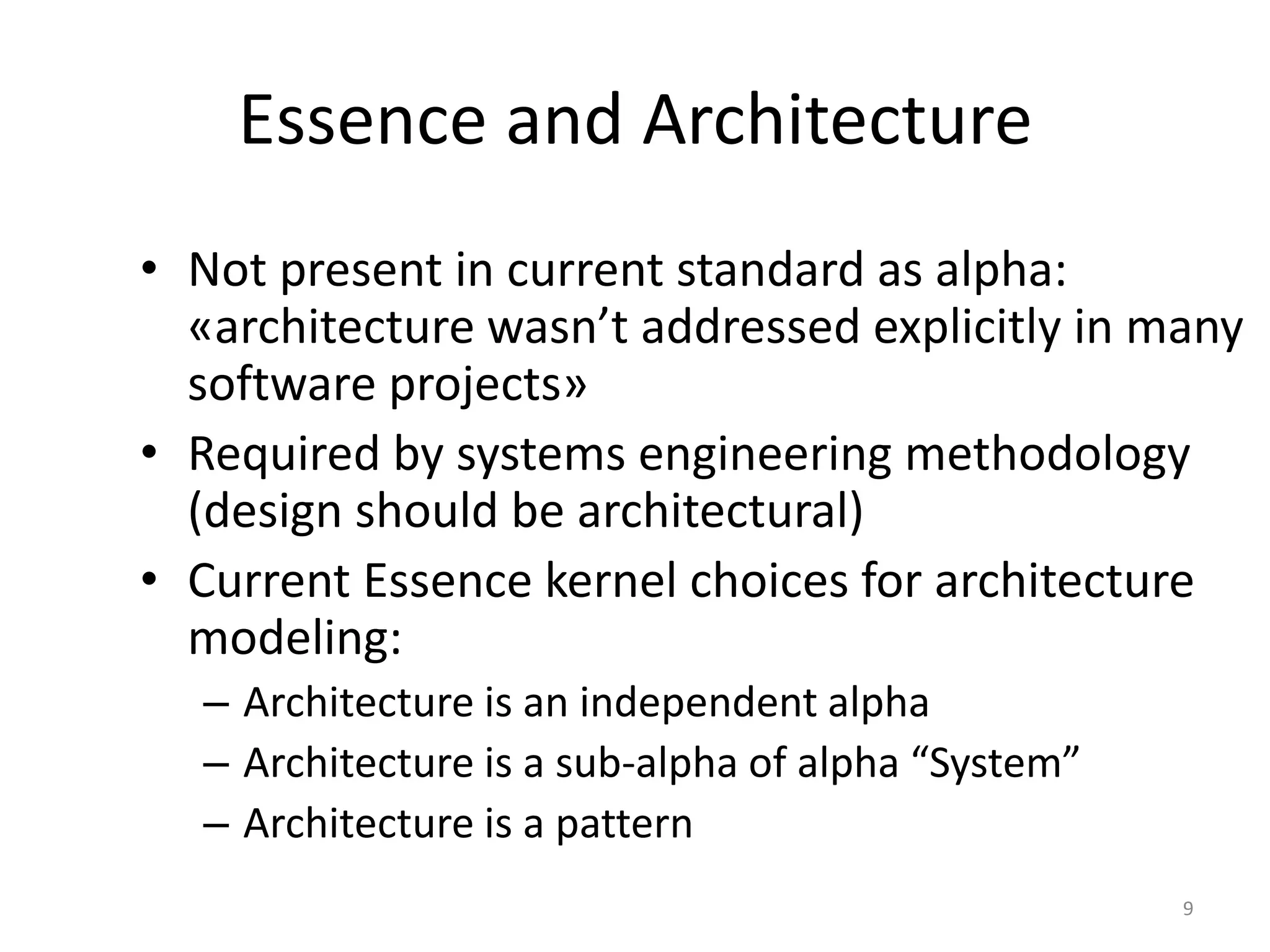
Essence and Architecture
• Not present in current standard as alpha:
«architecture wasn’t addressed explicitly in many
software projects»
• Required by systems engineering methodology
(design should be architectural)
• Current Essence kernel choices for architecture
modeling:
– Architecture is an independent alpha
– Architecture is a sub-alpha of alpha “System”
– Architecture is a pattern
9
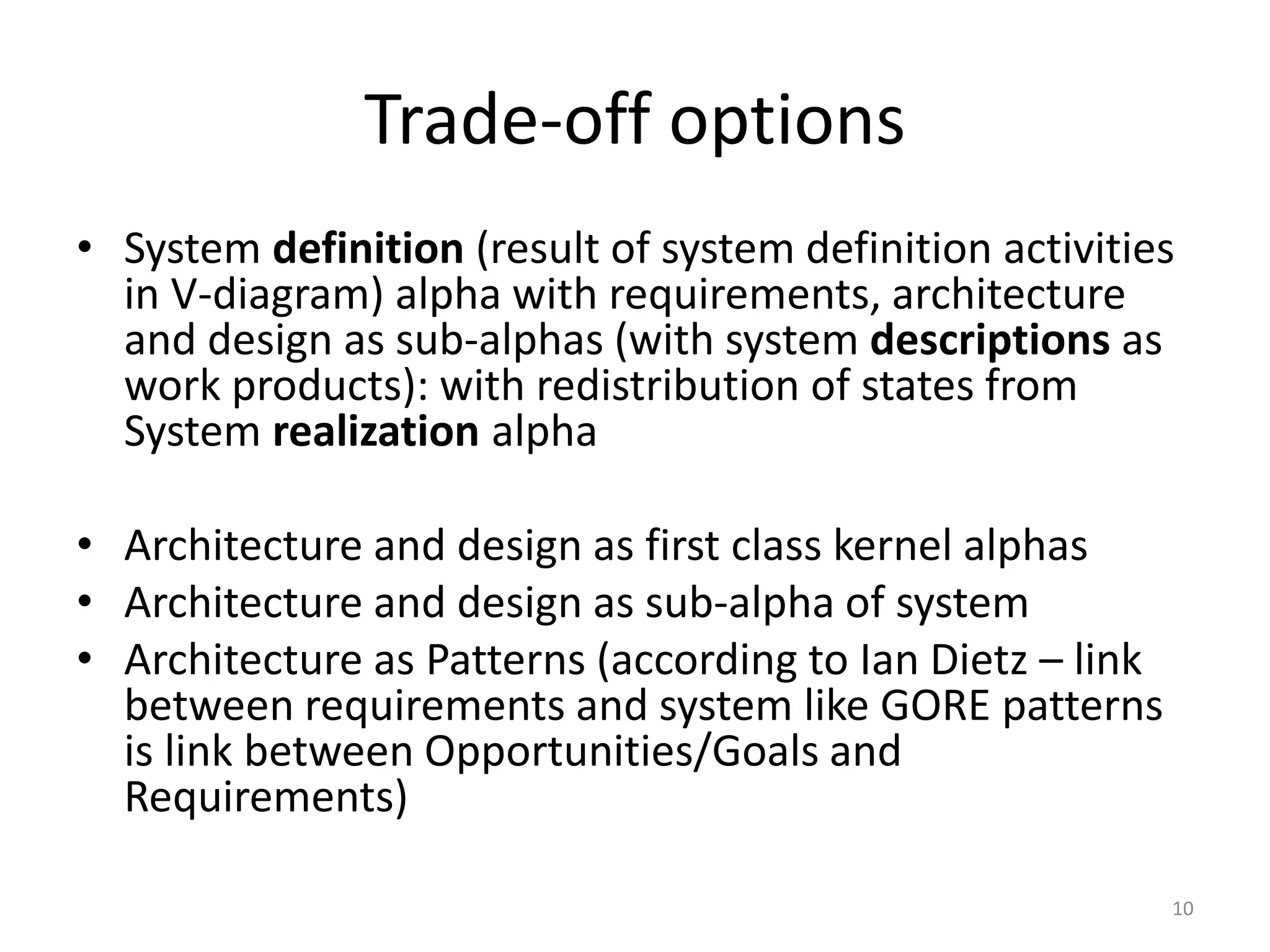
Trade-off options
• System definition (result of system definition activities
in V-diagram) alpha with requirements, architecture
and design as sub-alphas (with system descriptions as
work products): with redistribution of states from
System realization alpha
• Architecture and design as first class kernel alphas
• Architecture and design as sub-alpha of system
• Architecture as Patterns (according to Ian Dietz – link
between requirements and system like GORE patterns
is link between Opportunities/Goals and
Requirements)
10
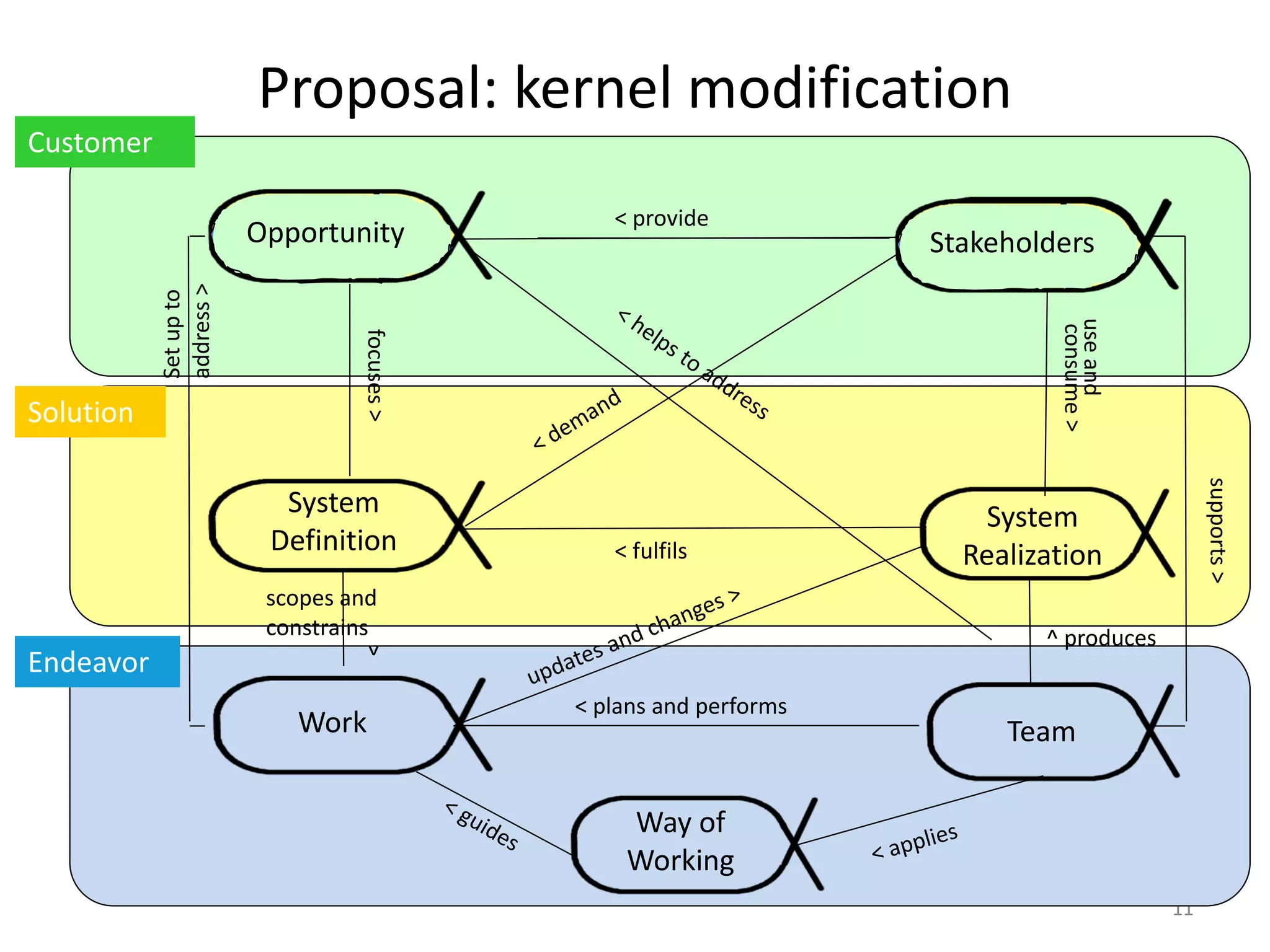
Proposal: kernel modification
1111
Essence Tutorial May 25, 2013. San Francisco CA USA 11
Customer
Solution
scopes and
constrains
< plans and performs
< fulfils
^ produces
Work Team
System
Realization
System
Definition
Way of
Working
^
< provide
StakeholdersOpportunity
focuses>
useand
consume>
supports>
Setupto
address>
Endeavor
Opportunity OpportunityStakeholders
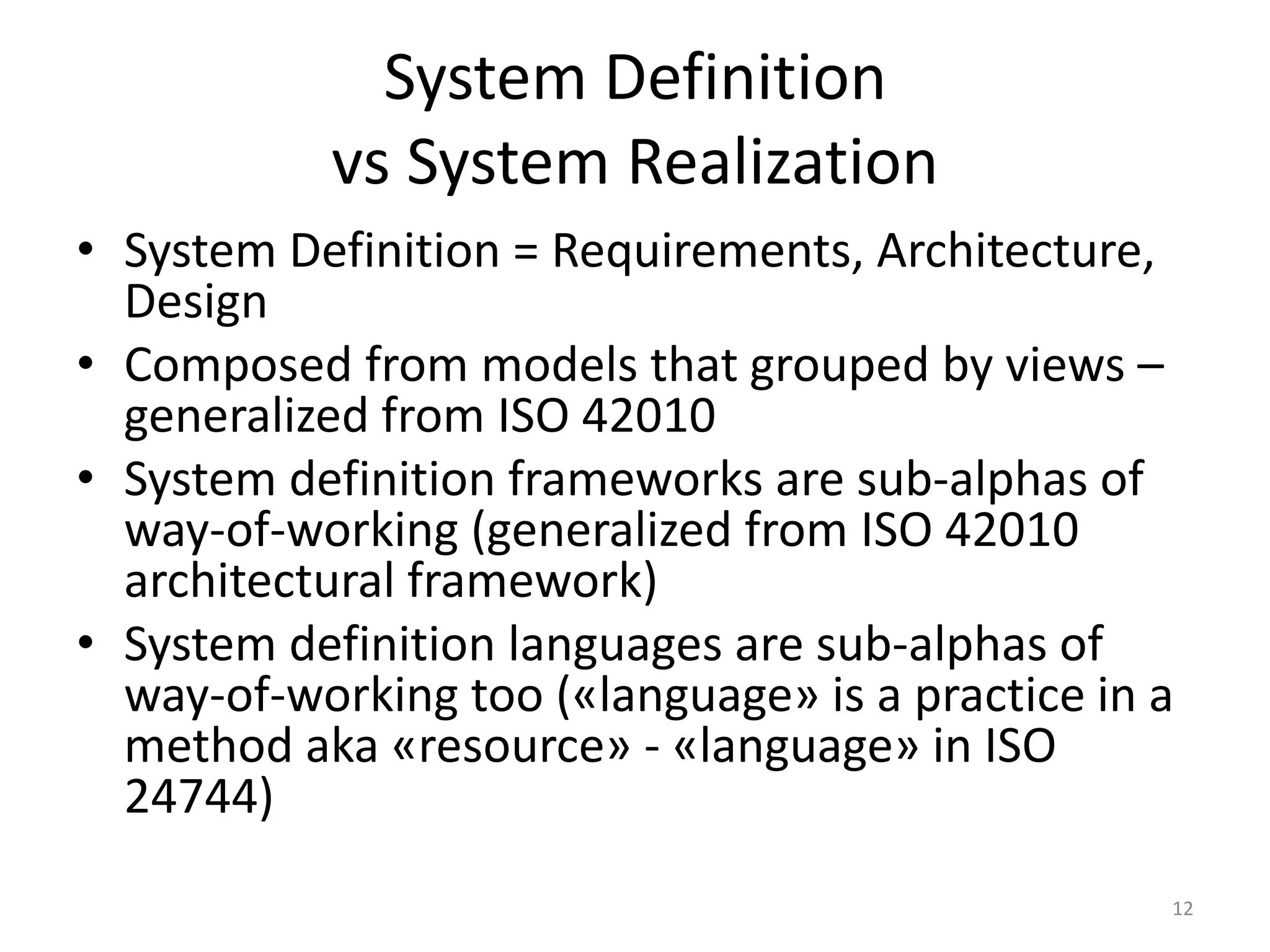
System Definition
vs System Realization
• System Definition = Requirements, Architecture,
Design
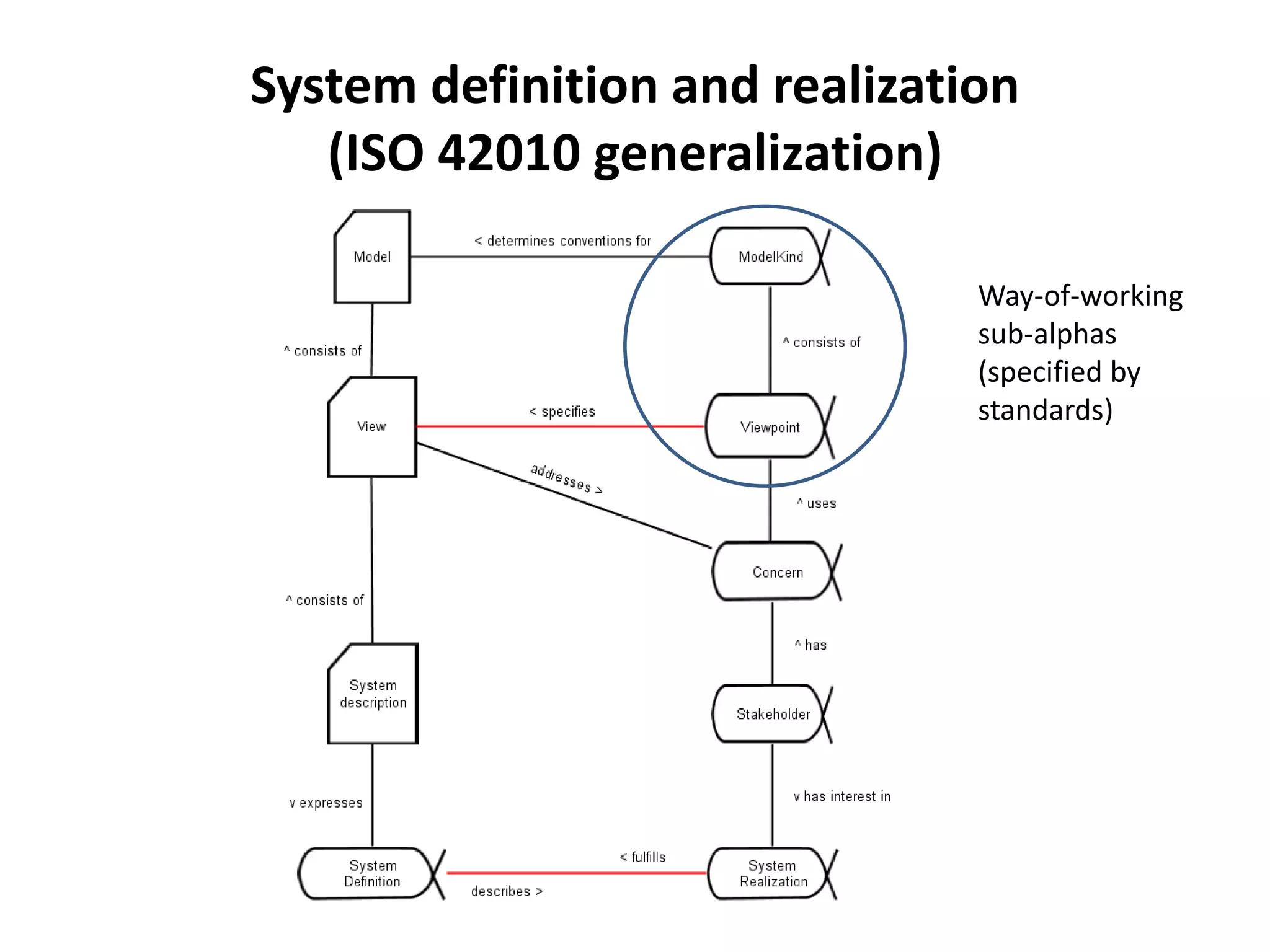
• Composed from models that grouped by views –
generalized from ISO 42010
• System definition frameworks are sub-alphas of
way-of-working (generalized from ISO 42010
architectural framework)
• System definition languages are sub-alphas of
way-of-working too («language» is a practice in a
method aka «resource» - «language» in ISO
24744)
12
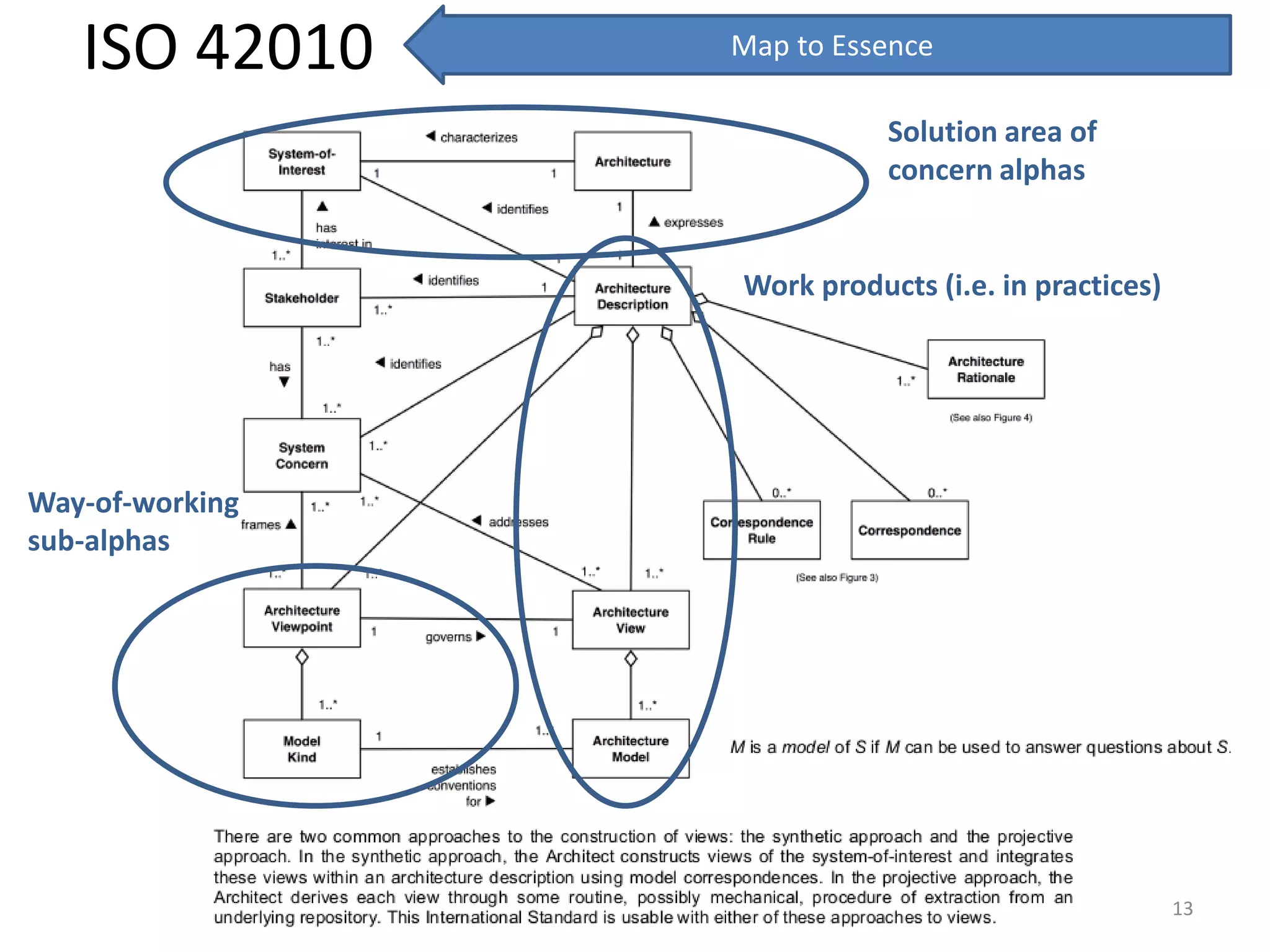
ISO 42010
13
Solution area of
concern alphas
Way-of-working
sub-alphas
Work products (i.e. in practices)
Map to Essence
System definition and realization
(ISO 42010 generalization)
Way-of-working
sub-alphas
(specified by
standards)
Solution area of concern alphas & V-model
System
Definition
Sub-alphas
verification
verification
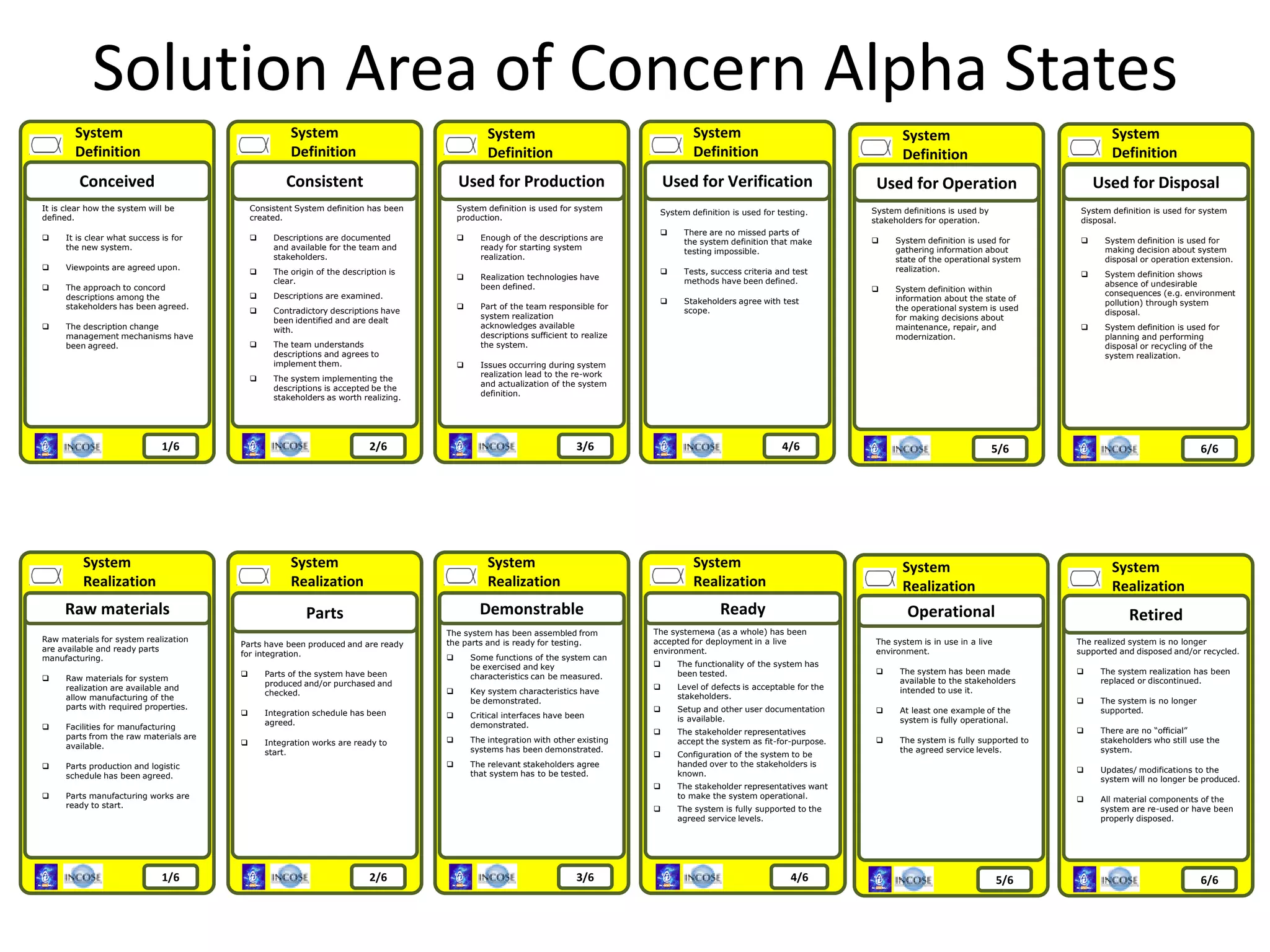
Solution Area of Concern Alpha States
16
Conceived
1/6
System
Definition
It is clear how the system will be
defined.
 It is clear what success is for
the new system.
 Viewpoints are agreed upon.
 The approach to concord
descriptions among the
stakeholders has been agreed.
 The description change
management mechanisms have
been agreed.
Consistent
2/6
Consistent System definition has been
created.
 Descriptions are documented
and available for the team and
stakeholders.
 The origin of the description is
clear.
 Descriptions are examined.
 Contradictory descriptions have
been identified and are dealt
with.
 The team understands
descriptions and agrees to
implement them.
 The system implementing the
descriptions is accepted be the
stakeholders as worth realizing.
Used for Production
3/6
System definition is used for system
production.
 Enough of the descriptions are
ready for starting system
realization.
 Realization technologies have
been defined.
 Part of the team responsible for
system realization
acknowledges available
descriptions sufficient to realize
the system.
 Issues occurring during system
realization lead to the re-work
and actualization of the system
definition.
Used for Verification
4/6
System definition is used for testing.
 There are no missed parts of
the system definition that make
testing impossible.
 Tests, success criteria and test
methods have been defined.
 Stakeholders agree with test
scope.
Used for Operation
5/6
System definitions is used by
stakeholders for operation.
 System definition is used for
gathering information about
state of the operational system
realization.
 System definition within
information about the state of
the operational system is used
for making decisions about
maintenance, repair, and
modernization.
Used for Disposal
6/6
System definition is used for system
disposal.
 System definition is used for
making decision about system
disposal or operation extension.
 System definition shows
absence of undesirable
consequences (e.g. environment
pollution) through system
disposal.
 System definition is used for
planning and performing
disposal or recycling of the
system realization.
Raw materials
1/6
Raw materials for system realization
are available and ready parts
manufacturing.
 Raw materials for system
realization are available and
allow manufacturing of the
parts with required properties.
 Facilities for manufacturing
parts from the raw materials are
available.
 Parts production and logistic
schedule has been agreed.
 Parts manufacturing works are
ready to start.
Parts
2/6
Parts have been produced and are ready
for integration.
 Parts of the system have been
produced and/or purchased and
checked.
 Integration schedule has been
agreed.
 Integration works are ready to
start.
Demonstrable
3/6
The system has been assembled from
the parts and is ready for testing.
 Some functions of the system can
be exercised and key
characteristics can be measured.
 Key system characteristics have
be demonstrated.
 Critical interfaces have been
demonstrated.
 The integration with other existing
systems has been demonstrated.
 The relevant stakeholders agree
that system has to be tested.
Ready
4/6
The systemема (as a whole) has been
accepted for deployment in a live
environment.
 The functionality of the system has
been tested.
 Level of defects is acceptable for the
stakeholders.
 Setup and other user documentation
is available.
 The stakeholder representatives
accept the system as fit-for-purpose.
 Configuration of the system to be
handed over to the stakeholders is
known.
 The stakeholder representatives want
to make the system operational.
 The system is fully supported to the
agreed service levels.
Operational
5/6
The system is in use in a live
environment.
 The system has been made
available to the stakeholders
intended to use it.
 At least one example of the
system is fully operational.
 The system is fully supported to
the agreed service levels.
Retired
6/6
The realized system is no longer
supported and disposed and/or recycled.
 The system realization has been
replaced or discontinued.
 The system is no longer
supported.
 There are no “official”
stakeholders who still use the
system.
 Updates/ modifications to the
system will no longer be produced.
 All material components of the
system are re-used or have been
properly disposed.
System
Definition
System
Definition
System
Definition
System
Definition
System
Definition
System
Realization
System
Realization
System
Realization
System
Realization
System
Realization
System
Realization
17
Thank you!
Anatoly Levenchuk (Lead scientist)
http://ailev.ru
ailev@asmp.msk.su
(President of INCOSE Russian Chapter)
Victor Agroskin (ISO 15926 liaison)
vic5784@gmail.com
Andrey Bayda (SEMAT liaison)
andrey.a.bayda@gmail.com

Essence syseng omg_20jun13_v4.1

  • 1.
    Essence for SystemsEngineering (Systems Engineering Essence) Berlin 20 June 2013 INCOSE Russian Chapter
  • 2.
    Context Roadmap (http://semat.org/?p=863): • 1stof August 2013 – define model and architecture ontological status in the Essence • 1st of September 2013 – publish first draft of the Essence kernel extension for Systems Engineering • 1st of December 2013 – map Essence Systems Engineering kernel elements to ISO 15926 • End of December 2013 – publish first version of the “Essence systems engineering kernel elements (mapped to the ISO 15926)” Achievements: • Proposal discussed at the INCOSE Russian Chapter on 22nd of May 2013 (http://incose-ru.livejournal.com/42524.html). • Proposal disussed at MESI conference on 6-7th of June 2013 (http://www.mesi.ru/our/events/detail/121699/) with Ivar Jacobson and wider audience. 2
  • 3.
    Language, kernel, practice 3 ... Language Kernel (abstract) Practices (specificfor situation) ... Requirements Stakeholders ConOp Budget Explore possibilities Perform interview Brainstorm
  • 4.
    Alpha: states =checklists : checkpoints 4 ALPHA -- Abstract-Level Progress Health Attribute.
  • 5.
    Engineering project alphas:as is 5 Essence Tutorial May 25, 2013. San Francisco CA USA 5 Customer Solution scopes and constrains < plans and performs < fulfils ^ produces Work Team System of Interest Requirements Way of Working ^ < provide StakeholdersOpportunity focuses> useand consume> supports> Setupto address> Endeavor Opportunity OpportunityStakeholders
  • 6.
    Systems engineering • Intuition:V-model • Focus on system definition (more resources to define the system, i.e. more work with bits rather than atoms) • Agile in the work with bits, cascade in the work with atoms. • Architecture and design are of the same importance as requirements (constraints to design solutions, focusing in Essence terms). 6
  • 7.
    7 2D representation ofLife Cycle: practices executed in time define needs acceptance architecturing design parts manufacturing integration validation verification verification System definition System realization [System operation]
  • 8.
    Requirements, Architecture, Designand System: state redistribution is needed 8 *Requirements defined System implementation (atoms) System definition (bit) *design
  • 9.
    Essence and Architecture •Not present in current standard as alpha: «architecture wasn’t addressed explicitly in many software projects» • Required by systems engineering methodology (design should be architectural) • Current Essence kernel choices for architecture modeling: – Architecture is an independent alpha – Architecture is a sub-alpha of alpha “System” – Architecture is a pattern 9
  • 10.
    Trade-off options • Systemdefinition (result of system definition activities in V-diagram) alpha with requirements, architecture and design as sub-alphas (with system descriptions as work products): with redistribution of states from System realization alpha • Architecture and design as first class kernel alphas • Architecture and design as sub-alpha of system • Architecture as Patterns (according to Ian Dietz – link between requirements and system like GORE patterns is link between Opportunities/Goals and Requirements) 10
  • 11.
    Proposal: kernel modification 1111 EssenceTutorial May 25, 2013. San Francisco CA USA 11 Customer Solution scopes and constrains < plans and performs < fulfils ^ produces Work Team System Realization System Definition Way of Working ^ < provide StakeholdersOpportunity focuses> useand consume> supports> Setupto address> Endeavor Opportunity OpportunityStakeholders
  • 12.
    System Definition vs SystemRealization • System Definition = Requirements, Architecture, Design • Composed from models that grouped by views – generalized from ISO 42010 • System definition frameworks are sub-alphas of way-of-working (generalized from ISO 42010 architectural framework) • System definition languages are sub-alphas of way-of-working too («language» is a practice in a method aka «resource» - «language» in ISO 24744) 12
  • 13.
    ISO 42010 13 Solution areaof concern alphas Way-of-working sub-alphas Work products (i.e. in practices) Map to Essence
  • 14.
    System definition andrealization (ISO 42010 generalization) Way-of-working sub-alphas (specified by standards)
  • 15.
    Solution area ofconcern alphas & V-model System Definition Sub-alphas verification verification
  • 16.
    Solution Area ofConcern Alpha States 16 Conceived 1/6 System Definition It is clear how the system will be defined.  It is clear what success is for the new system.  Viewpoints are agreed upon.  The approach to concord descriptions among the stakeholders has been agreed.  The description change management mechanisms have been agreed. Consistent 2/6 Consistent System definition has been created.  Descriptions are documented and available for the team and stakeholders.  The origin of the description is clear.  Descriptions are examined.  Contradictory descriptions have been identified and are dealt with.  The team understands descriptions and agrees to implement them.  The system implementing the descriptions is accepted be the stakeholders as worth realizing. Used for Production 3/6 System definition is used for system production.  Enough of the descriptions are ready for starting system realization.  Realization technologies have been defined.  Part of the team responsible for system realization acknowledges available descriptions sufficient to realize the system.  Issues occurring during system realization lead to the re-work and actualization of the system definition. Used for Verification 4/6 System definition is used for testing.  There are no missed parts of the system definition that make testing impossible.  Tests, success criteria and test methods have been defined.  Stakeholders agree with test scope. Used for Operation 5/6 System definitions is used by stakeholders for operation.  System definition is used for gathering information about state of the operational system realization.  System definition within information about the state of the operational system is used for making decisions about maintenance, repair, and modernization. Used for Disposal 6/6 System definition is used for system disposal.  System definition is used for making decision about system disposal or operation extension.  System definition shows absence of undesirable consequences (e.g. environment pollution) through system disposal.  System definition is used for planning and performing disposal or recycling of the system realization. Raw materials 1/6 Raw materials for system realization are available and ready parts manufacturing.  Raw materials for system realization are available and allow manufacturing of the parts with required properties.  Facilities for manufacturing parts from the raw materials are available.  Parts production and logistic schedule has been agreed.  Parts manufacturing works are ready to start. Parts 2/6 Parts have been produced and are ready for integration.  Parts of the system have been produced and/or purchased and checked.  Integration schedule has been agreed.  Integration works are ready to start. Demonstrable 3/6 The system has been assembled from the parts and is ready for testing.  Some functions of the system can be exercised and key characteristics can be measured.  Key system characteristics have be demonstrated.  Critical interfaces have been demonstrated.  The integration with other existing systems has been demonstrated.  The relevant stakeholders agree that system has to be tested. Ready 4/6 The systemема (as a whole) has been accepted for deployment in a live environment.  The functionality of the system has been tested.  Level of defects is acceptable for the stakeholders.  Setup and other user documentation is available.  The stakeholder representatives accept the system as fit-for-purpose.  Configuration of the system to be handed over to the stakeholders is known.  The stakeholder representatives want to make the system operational.  The system is fully supported to the agreed service levels. Operational 5/6 The system is in use in a live environment.  The system has been made available to the stakeholders intended to use it.  At least one example of the system is fully operational.  The system is fully supported to the agreed service levels. Retired 6/6 The realized system is no longer supported and disposed and/or recycled.  The system realization has been replaced or discontinued.  The system is no longer supported.  There are no “official” stakeholders who still use the system.  Updates/ modifications to the system will no longer be produced.  All material components of the system are re-used or have been properly disposed. System Definition System Definition System Definition System Definition System Definition System Realization System Realization System Realization System Realization System Realization System Realization
  • 17.
    17 Thank you! Anatoly Levenchuk(Lead scientist) http://ailev.ru ailev@asmp.msk.su (President of INCOSE Russian Chapter) Victor Agroskin (ISO 15926 liaison) vic5784@gmail.com Andrey Bayda (SEMAT liaison) andrey.a.bayda@gmail.com