ESL Composition Profile
Jacobs, H. L., Zingraft, S. A., Wormotuh, D. R., Hartfield, V. F., &
Hughey, J. B. (1981). Testing ESL Composition: A Practical Approach.
Newbury House.
Saturday, 8 February 2025
Rater Training for Research Participant
You are here because similar related
background
› Registered lecturer in PDDIKTI database;
› Have a masters and/or doctoral degree in English
language education, linguistics, and/or literature or
related fields; and
› Experienced in teaching undergraduate level students.
Our main goal today
› The book, Jacobs’ et al., (1981). Testing ESL Composition:
A Practical Approach, has been cited 2187 times in
Google Scholar
› The Jacobs’ et al. (1981) analytic rubric for English as a
second language writing appears to be a popular
choice and has been featured in several well-regarded
texts on assessing writing.
Our main goal today
› (Re)introduction to ESL Composition Profile, a rubric
for English essay writing assessment for L2 students.
› To refresh our memory on how to assess essays in each
aspect of the rubric
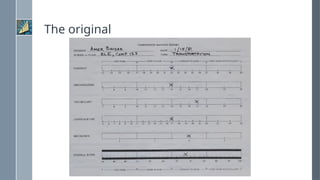
The original
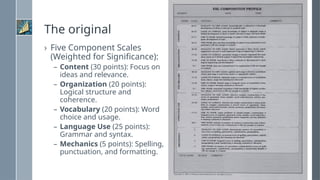
› Five Component Scales
(Weighted for Significance):
– Content (30 points): Focus on
ideas and relevance.
– Organization (20 points):
Logical structure and
coherence.
– Vocabulary (20 points): Word
choice and usage.
– Language Use (25 points):
Grammar and syntax.
– Mechanics (5 points): Spelling,
punctuation, and formatting.
The original
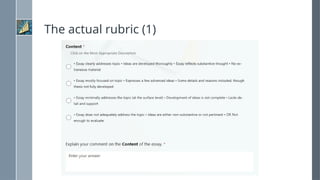
The actual rubric (1)
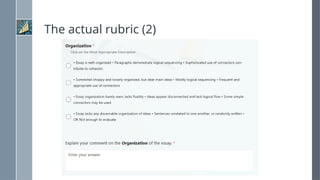
The actual rubric (2)
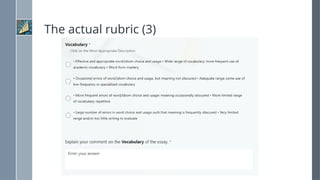
The actual rubric (3)
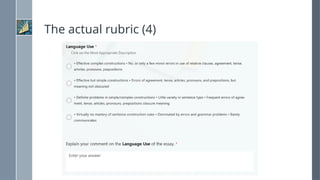
The actual rubric (4)
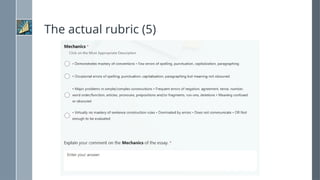
The actual rubric (5)
Descriptor for each levels mostly the same
with a few modifications
Now let’s take a look at each aspect of the
rubric
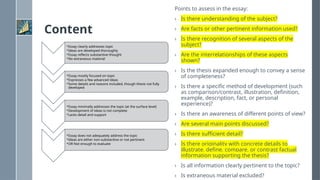
Content
•Essay clearly addresses topic
•Ideas are developed thoroughly
•Essay reflects substantive thought
•No extraneous material
•Essay mostly focused on topic
•Expresses a few advanced ideas
•Some details and reasons included, though thesis not fully
developed
•Essay minimally addresses the topic (at the surface level)
•Development of ideas is not complete
•Lacks detail and support
•Essay does not adequately address the topic
•Ideas are either non-substantive or not pertinent
•OR Not enough to evaluate
Points to assess in the essay:
› Is there understanding of the subject?
› Are facts or other pertinent information used?
› Is there recognition of several aspects of the
subject?
› Are the interrelationships of these aspects
shown?
› Is the thesis expanded enough to convey a sense
of completeness?
› Is there a specific method of development (such
as comparison/contrast, illustration, definition,
example, description, fact, or personal
experience)?
› Is there an awareness of different points of view?
› Are several main points discussed?
› Is there sufficient detail?
› Is there originality with concrete details to
illustrate, define, compare, or contrast factual
information supporting the thesis?
› Is all information clearly pertinent to the topic?
› Is extraneous material excluded?
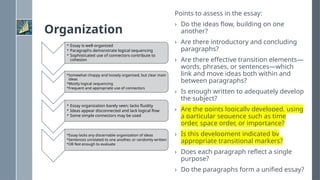
Organization
• Essay is well-organized
• Paragraphs demonstrate logical sequencing
• Sophisticated use of connectors contribute to
cohesion
•Somewhat choppy and loosely organized, but clear main
ideas
•Mostly logical sequencing
•Frequent and appropriate use of connectors
• Essay organization barely seen; lacks fluidity
• Ideas appear disconnected and lack logical flow
• Some simple connectors may be used
•Essay lacks any discernable organization of ideas
•Sentences unrelated to one another, or randomly written
•OR Not enough to evaluate
Points to assess in the essay:
› Do the ideas flow, building on one
another?
› Are there introductory and concluding
paragraphs?
› Are there effective transition elements—
words, phrases, or sentences—which
link and move ideas both within and
between paragraphs?
› Is enough written to adequately develop
the subject?
› Are the points logically developed, using
a particular sequence such as time
order, space order, or importance?
› Is this development indicated by
appropriate transitional markers?
› Does each paragraph reflect a single
purpose?
› Do the paragraphs form a unified essay?
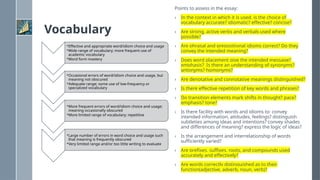
Vocabulary
•Effective and appropriate word/idiom choice and usage
•Wide range of vocabulary; more frequent use of
academic vocabulary
•Word form mastery
•Occasional errors of word/idiom choice and usage, but
meaning not obscured
•Adequate range; some use of low-frequency or
specialized vocabulary
•More frequent errors of word/idiom choice and usage;
meaning occasionally obscured
•More limited range of vocabulary; repetitive
•Large number of errors in word choice and usage such
that meaning is frequently obscured
•Very limited range and/or too little writing to evaluate
Points to assess in the essay:
› In the context in which it is used, is the choice of
vocabulary accurate? idiomatic? effective? concise?
› Are strong, active verbs and verbals used where
possible?
› Are phrasal and prepositional idioms correct? Do they
convey the intended meaning?
› Does word placement give the intended message?
emphasis? Is there an understanding of synonyms?
antonyms? homonyms?
› Are denotative and connotative meanings distinguished?
› Is there effective repetition of key words and phrases?
› Do transition elements mark shifts in thought? pace?
emphasis? tone?
› Is there facility with words and idioms to: convey
intended information, attitudes, feelings? distinguish
subtleties among ideas and intentions? convey shades
and differences of meaning? express the logic of ideas?
› Is the arrangement and interrelationship of words
sufficiently varied?
› Are prefixes, suffixes, roots, and compounds used
accurately and effectively?
› Are words correctly distinguished as to their
function(adjective, adverb, noun, verb)?
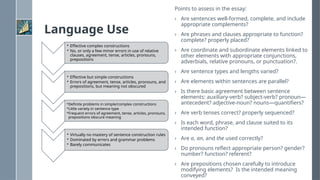
Language Use
• Effective complex constructions
• No, or only a few minor errors in use of relative
clauses, agreement, tense, articles, pronouns,
prepositions
• Effective but simple constructions
• Errors of agreement, tense, articles, pronouns, and
prepositions, but meaning not obscured
•Definite problems in simple/complex constructions
•Little variety in sentence type
•Frequent errors of agreement, tense, articles, pronouns,
prepositions obscure meaning
• Virtually no mastery of sentence construction rules
• Dominated by errors and grammar problems
• Barely communicates
Points to assess in the essay:
› Are sentences well-formed, complete, and include
appropriate complements?
› Are phrases and clauses appropriate to function?
complete? properly placed?
› Are coordinate and subordinate elements linked to
other elements with appropriate conjunctions,
adverbials, relative pronouns, or punctuation?.
› Are sentence types and lengths varied?
› Are elements within sentences are parallel?
› Is there basic agreement between sentence
elements: auxiliary-verb? subject-verb? pronoun—
antecedent? adjective-noun? nouns—quantifiers?
› Are verb tenses correct? properly sequenced?
› Is each word, phrase, and clause suited to its
intended function?
› Are a, an, and the used correctly?
› Do pronouns reflect appropriate person? gender?
number? function? referent?
› Are prepositions chosen carefully to introduce
modifying elements? Is the intended meaning
conveyed?
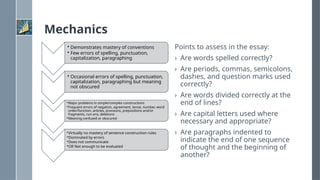
Mechanics
• Demonstrates mastery of conventions
• Few errors of spelling, punctuation,
capitalization, paragraphing
• Occasional errors of spelling, punctuation,
capitalization, paragraphing but meaning
not obscured
•Major problems in simple/complex constructions
•Frequent errors of negation, agreement, tense, number, word
order/function, articles, pronouns, prepositions and/or
fragments, run-ons, deletions
•Meaning confused or obscured
•Virtually no mastery of sentence construction rules
•Dominated by errors
•Does not communicate
•OR Not enough to be evaluated
Points to assess in the essay:
› Are words spelled correctly?
› Are periods, commas, semicolons,
dashes, and question marks used
correctly?
› Are words divided correctly at the
end of lines?
› Are capital letters used where
necessary and appropriate?
› Are paragraphs indented to
indicate the end of one sequence
of thought and the beginning of
another?
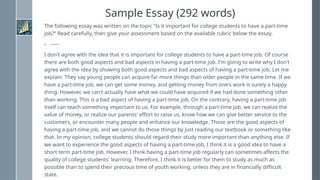
Sample Essay (292 words)
The following essay was written on the topic "Is it important for college students to have a part-time
job?“ Read carefully, then give your assessment based on the available rubric below the essay.
› -----
I don't agree with the idea that it is important for college students to have a part-time job. Of course
there are both good aspects and bad aspects in having a part-time job. I'm going to write why I don't
agree with the idea by showing both good aspects and bad aspects of having a part-time job. Let me
explain. They say young people can acquire far more things than older people in the same time. If we
have a part-time job, we can get some money, and getting money from one's work is surely a happy
thing. However, we can't actually have what we could have acquired if we had done something other
than working. This is a bad aspect of having a part-time job. On the contrary, having a part-time job
itself can teach something important to us. For example, through a part-time job, we can realize the
value of money, or realize our parents' effort to raise us, know how we can give better service to the
customers, or encounter many people and enhance our knowledge. Those are the good aspects of
having a part-time job, and we cannot do those things by just reading our textbook or something like
that. In my opinion, college students should regard their study more important than anything else. If
we want to experience the good aspects of having a part-time job, I think it is a good idea to have a
short term part-time job. However, I think having a part-time job regularly can sometimes affects the
quality of college students' learning. Therefore, I think it is better for them to study as much as
possible than to spend their precious time of youth working, unless they are in financially difficult
state.
Evaluation Process for
Rating
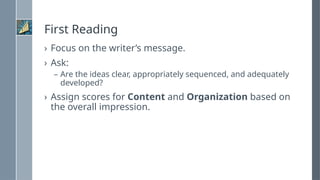
First Reading
› Focus on the writer’s message.
› Ask:
– Are the ideas clear, appropriately sequenced, and adequately
developed?
› Assign scores for Content and Organization based on
the overall impression.
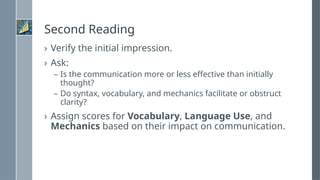
Second Reading
› Verify the initial impression.
› Ask:
– Is the communication more or less effective than initially
thought?
– Do syntax, vocabulary, and mechanics facilitate or obstruct
clarity?
› Assign scores for Vocabulary, Language Use, and
Mechanics based on their impact on communication.
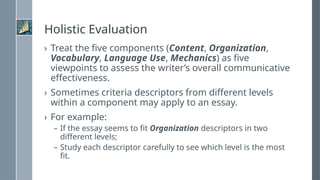
Holistic Evaluation
› Treat the five components (Content, Organization,
Vocabulary, Language Use, Mechanics) as five
viewpoints to assess the writer’s overall communicative
effectiveness.
› Sometimes criteria descriptors from different levels
within a component may apply to an essay.
› For example:
– If the essay seems to fit Organization descriptors in two
different levels;
– Study each descriptor carefully to see which level is the most
fit.
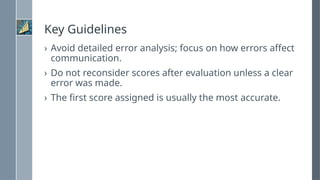
Key Guidelines
› Avoid detailed error analysis; focus on how errors affect
communication.
› Do not reconsider scores after evaluation unless a clear
error was made.
› The first score assigned is usually the most accurate.
TRIAL
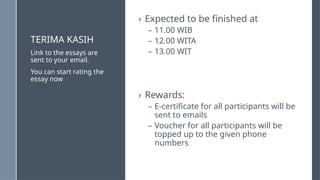
TERIMA KASIH
› Expected to be finished at
– 11.00 WIB
– 12.00 WITA
– 13.00 WIT
› Rewards:
– E-certificate for all participants will be
sent to emails
– Voucher for all participants will be
topped up to the given phone
numbers
Link to the essays are
sent to your email.
You can start rating the
essay now

ESL Composition PROFILE PRESENTATION ASSIGNMENT

  • 1.
    ESL Composition Profile Jacobs,H. L., Zingraft, S. A., Wormotuh, D. R., Hartfield, V. F., & Hughey, J. B. (1981). Testing ESL Composition: A Practical Approach. Newbury House. Saturday, 8 February 2025 Rater Training for Research Participant
  • 2.
    You are herebecause similar related background › Registered lecturer in PDDIKTI database; › Have a masters and/or doctoral degree in English language education, linguistics, and/or literature or related fields; and › Experienced in teaching undergraduate level students.
  • 3.
    Our main goaltoday › The book, Jacobs’ et al., (1981). Testing ESL Composition: A Practical Approach, has been cited 2187 times in Google Scholar › The Jacobs’ et al. (1981) analytic rubric for English as a second language writing appears to be a popular choice and has been featured in several well-regarded texts on assessing writing.
  • 4.
    Our main goaltoday › (Re)introduction to ESL Composition Profile, a rubric for English essay writing assessment for L2 students. › To refresh our memory on how to assess essays in each aspect of the rubric
  • 5.
    The original › FiveComponent Scales (Weighted for Significance): – Content (30 points): Focus on ideas and relevance. – Organization (20 points): Logical structure and coherence. – Vocabulary (20 points): Word choice and usage. – Language Use (25 points): Grammar and syntax. – Mechanics (5 points): Spelling, punctuation, and formatting.
  • 6.
  • 7.
  • 8.
  • 9.
  • 10.
  • 11.
  • 12.
    Descriptor for eachlevels mostly the same with a few modifications Now let’s take a look at each aspect of the rubric
  • 13.
    Content •Essay clearly addressestopic •Ideas are developed thoroughly •Essay reflects substantive thought •No extraneous material •Essay mostly focused on topic •Expresses a few advanced ideas •Some details and reasons included, though thesis not fully developed •Essay minimally addresses the topic (at the surface level) •Development of ideas is not complete •Lacks detail and support •Essay does not adequately address the topic •Ideas are either non-substantive or not pertinent •OR Not enough to evaluate Points to assess in the essay: › Is there understanding of the subject? › Are facts or other pertinent information used? › Is there recognition of several aspects of the subject? › Are the interrelationships of these aspects shown? › Is the thesis expanded enough to convey a sense of completeness? › Is there a specific method of development (such as comparison/contrast, illustration, definition, example, description, fact, or personal experience)? › Is there an awareness of different points of view? › Are several main points discussed? › Is there sufficient detail? › Is there originality with concrete details to illustrate, define, compare, or contrast factual information supporting the thesis? › Is all information clearly pertinent to the topic? › Is extraneous material excluded?
  • 14.
    Organization • Essay iswell-organized • Paragraphs demonstrate logical sequencing • Sophisticated use of connectors contribute to cohesion •Somewhat choppy and loosely organized, but clear main ideas •Mostly logical sequencing •Frequent and appropriate use of connectors • Essay organization barely seen; lacks fluidity • Ideas appear disconnected and lack logical flow • Some simple connectors may be used •Essay lacks any discernable organization of ideas •Sentences unrelated to one another, or randomly written •OR Not enough to evaluate Points to assess in the essay: › Do the ideas flow, building on one another? › Are there introductory and concluding paragraphs? › Are there effective transition elements— words, phrases, or sentences—which link and move ideas both within and between paragraphs? › Is enough written to adequately develop the subject? › Are the points logically developed, using a particular sequence such as time order, space order, or importance? › Is this development indicated by appropriate transitional markers? › Does each paragraph reflect a single purpose? › Do the paragraphs form a unified essay?
  • 15.
    Vocabulary •Effective and appropriateword/idiom choice and usage •Wide range of vocabulary; more frequent use of academic vocabulary •Word form mastery •Occasional errors of word/idiom choice and usage, but meaning not obscured •Adequate range; some use of low-frequency or specialized vocabulary •More frequent errors of word/idiom choice and usage; meaning occasionally obscured •More limited range of vocabulary; repetitive •Large number of errors in word choice and usage such that meaning is frequently obscured •Very limited range and/or too little writing to evaluate Points to assess in the essay: › In the context in which it is used, is the choice of vocabulary accurate? idiomatic? effective? concise? › Are strong, active verbs and verbals used where possible? › Are phrasal and prepositional idioms correct? Do they convey the intended meaning? › Does word placement give the intended message? emphasis? Is there an understanding of synonyms? antonyms? homonyms? › Are denotative and connotative meanings distinguished? › Is there effective repetition of key words and phrases? › Do transition elements mark shifts in thought? pace? emphasis? tone? › Is there facility with words and idioms to: convey intended information, attitudes, feelings? distinguish subtleties among ideas and intentions? convey shades and differences of meaning? express the logic of ideas? › Is the arrangement and interrelationship of words sufficiently varied? › Are prefixes, suffixes, roots, and compounds used accurately and effectively? › Are words correctly distinguished as to their function(adjective, adverb, noun, verb)?
  • 16.
    Language Use • Effectivecomplex constructions • No, or only a few minor errors in use of relative clauses, agreement, tense, articles, pronouns, prepositions • Effective but simple constructions • Errors of agreement, tense, articles, pronouns, and prepositions, but meaning not obscured •Definite problems in simple/complex constructions •Little variety in sentence type •Frequent errors of agreement, tense, articles, pronouns, prepositions obscure meaning • Virtually no mastery of sentence construction rules • Dominated by errors and grammar problems • Barely communicates Points to assess in the essay: › Are sentences well-formed, complete, and include appropriate complements? › Are phrases and clauses appropriate to function? complete? properly placed? › Are coordinate and subordinate elements linked to other elements with appropriate conjunctions, adverbials, relative pronouns, or punctuation?. › Are sentence types and lengths varied? › Are elements within sentences are parallel? › Is there basic agreement between sentence elements: auxiliary-verb? subject-verb? pronoun— antecedent? adjective-noun? nouns—quantifiers? › Are verb tenses correct? properly sequenced? › Is each word, phrase, and clause suited to its intended function? › Are a, an, and the used correctly? › Do pronouns reflect appropriate person? gender? number? function? referent? › Are prepositions chosen carefully to introduce modifying elements? Is the intended meaning conveyed?
  • 17.
    Mechanics • Demonstrates masteryof conventions • Few errors of spelling, punctuation, capitalization, paragraphing • Occasional errors of spelling, punctuation, capitalization, paragraphing but meaning not obscured •Major problems in simple/complex constructions •Frequent errors of negation, agreement, tense, number, word order/function, articles, pronouns, prepositions and/or fragments, run-ons, deletions •Meaning confused or obscured •Virtually no mastery of sentence construction rules •Dominated by errors •Does not communicate •OR Not enough to be evaluated Points to assess in the essay: › Are words spelled correctly? › Are periods, commas, semicolons, dashes, and question marks used correctly? › Are words divided correctly at the end of lines? › Are capital letters used where necessary and appropriate? › Are paragraphs indented to indicate the end of one sequence of thought and the beginning of another?
  • 18.
    Sample Essay (292words) The following essay was written on the topic "Is it important for college students to have a part-time job?“ Read carefully, then give your assessment based on the available rubric below the essay. › ----- I don't agree with the idea that it is important for college students to have a part-time job. Of course there are both good aspects and bad aspects in having a part-time job. I'm going to write why I don't agree with the idea by showing both good aspects and bad aspects of having a part-time job. Let me explain. They say young people can acquire far more things than older people in the same time. If we have a part-time job, we can get some money, and getting money from one's work is surely a happy thing. However, we can't actually have what we could have acquired if we had done something other than working. This is a bad aspect of having a part-time job. On the contrary, having a part-time job itself can teach something important to us. For example, through a part-time job, we can realize the value of money, or realize our parents' effort to raise us, know how we can give better service to the customers, or encounter many people and enhance our knowledge. Those are the good aspects of having a part-time job, and we cannot do those things by just reading our textbook or something like that. In my opinion, college students should regard their study more important than anything else. If we want to experience the good aspects of having a part-time job, I think it is a good idea to have a short term part-time job. However, I think having a part-time job regularly can sometimes affects the quality of college students' learning. Therefore, I think it is better for them to study as much as possible than to spend their precious time of youth working, unless they are in financially difficult state.
  • 19.
  • 20.
    First Reading › Focuson the writer’s message. › Ask: – Are the ideas clear, appropriately sequenced, and adequately developed? › Assign scores for Content and Organization based on the overall impression.
  • 21.
    Second Reading › Verifythe initial impression. › Ask: – Is the communication more or less effective than initially thought? – Do syntax, vocabulary, and mechanics facilitate or obstruct clarity? › Assign scores for Vocabulary, Language Use, and Mechanics based on their impact on communication.
  • 22.
    Holistic Evaluation › Treatthe five components (Content, Organization, Vocabulary, Language Use, Mechanics) as five viewpoints to assess the writer’s overall communicative effectiveness. › Sometimes criteria descriptors from different levels within a component may apply to an essay. › For example: – If the essay seems to fit Organization descriptors in two different levels; – Study each descriptor carefully to see which level is the most fit.
  • 23.
    Key Guidelines › Avoiddetailed error analysis; focus on how errors affect communication. › Do not reconsider scores after evaluation unless a clear error was made. › The first score assigned is usually the most accurate.
  • 24.
  • 25.
    TERIMA KASIH › Expectedto be finished at – 11.00 WIB – 12.00 WITA – 13.00 WIT › Rewards: – E-certificate for all participants will be sent to emails – Voucher for all participants will be topped up to the given phone numbers Link to the essays are sent to your email. You can start rating the essay now