DR. BR. AMBEDKAR UNIVERSITY AGRA
Institute Of Social Sciences
Department Of Social Work
Course :- Indian Labor Problems & Legislations
Topic :- Employee’s State Insurance Act - 1948
Submitted To
DR. R. K. Bharti
Submitted By
Kavita Kumari
M.S.W. 3rd Sem.
Roll NO - 14
‘The Employees’ State Insurance Act,1948
@The applicability of the Employees state Insurance Scheme
@The definition of ‘Employee’ under the act
@The various benefits payable under the scheme to the
insured persons, their dependents, and family members as per
contributory condition, duration and rate.
Industrial progress depends on the ,” Satisfied lobour
force” so in this connection the “importance of the
labour welfare” was accepted long back.
In 1931 the royal commission on labour
“stressed” the need of labour welfare because the
harsh treatment meted out to the worker.
The constitution of India Article 42 “The State
shall make provision for securing just and human
condition of work”.
Labour Laws Covers
@ Industrial Relation
@ Health & Safety
@ Holidays
@ Working Hours
@ Minimum wages
@ Layoff
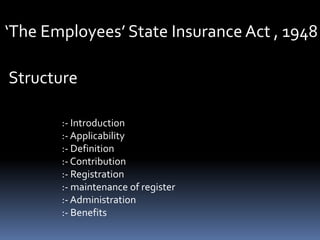
‘The Employees’ State Insurance Act , 1948
Structure
:- Introduction
:- Applicability
:- Definition
:- Contribution
:- Registration
:- maintenance of register
:- Administration
:- Benefits
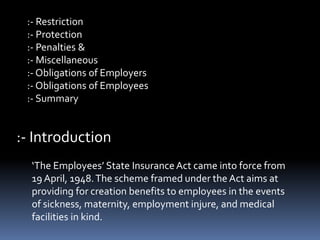
:- Restriction
:- Protection
:- Penalties &
:- Miscellaneous
:- Obligations of Employers
:- Obligations of Employees
:- Summary
:- Introduction
‘The Employees’ State InsuranceAct came into force from
19 April, 1948.The scheme framed under the Act aims at
providing for creation benefits to employees in the events
of sickness, maternity, employment injure, and medical
facilities in kind.
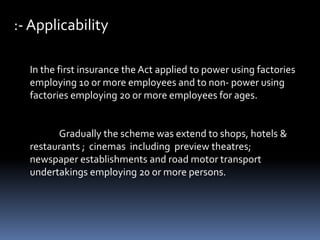
:- Applicability
In the first insurance the Act applied to power using factories
employing 10 or more employees and to non- power using
factories employing 20 or more employees for ages.
Gradually the scheme was extend to shops, hotels &
restaurants ; cinemas including preview theatres;
newspaper establishments and road motor transport
undertakings employing 20 or more persons.
:- Definitions
Employee : refers to any person employed on wages in, or in
connection with, the work of a factory or establishment to which
this Act applies.
It has a wide connotation and includes clerical, manual, technical,
and supervisory functions. Persons whose monthly salary
[excluding overtime] does not exceed RS. 10,000/- are included
under the Act.
Wages : means all remuneration paid in cash when the terms of
the contract are fulfilled. Wages paid for leave period are included
but
Contribution paid to PF or Pension Fund
Sum paid top defray expenses
Gratuity paid on discharge
:- Contributions
The scheme is financed through
contributions from employees at 1.75% of their wages
Contributions employers at 4.75% of the wages payable
one eight share of the state government towards medical
care
The Act defines “Contribution period” & “benefit period” for
making payments and deriving benefits.
:- Registration
The registration of a factory / establishment with the ESIC is a
statutory responsibility of the employer.
On registration the ESIC allots a code number to the
employer.
The forms for the registration of employees are the
declaration form and return of declaration forms.
:- maintenance of registers
Following registers t be maintained up to date :
Register of employees
Accident book to record each employment accident
Inspection Book
Certain forms have been prescribed under the Act and these are to
be filled up as &when required.
:- Administration
The scheme is administered by Employees State Insurance
Corporation [ESIC] a corporation formed under the Act with
membership from employees, employers, the parliament, the
state and central government and medical profession.
ESIC is responding for policy planning, decision making and
overseas the functioning of the scheme through a standing
committee drawn from the main corporation body.
Central Minster of Labor is ESIC chairman.
:- Benefits
[a] Sickness and Extended Sickness Benefit
[b] Maternity Benefit
[c] Disablement Benefit
[d] Dependents’ Benefit
[e] Funeral Benefit
[f] Medical Benefit – Restricted, Extended and Full
Medical care
:- Restrictions
When a person is entitled to avail of one benefit, he shall not
be entitled to other benefits.
If an employee is entitled to two or more benefits, he has an
option to select any one of them.
Thus sickness benefit & maternity benefit or sickness benefit
and temporary disablement benefit or maternity & temporary
disablement benefit cannot be received in the same period.
:- Protection
Employer cannot dismiss or discharge any employee who is in
receipt of sickness or maternity benefit or disablement benefit or is
absent from work s a result of treatment of illness arising out of
pregnancy or confinement.
If an employee stays away from work for more than six months
after completion of treatment then employer can discharge or
punish the employee after due notice.
:- Penalties and Damages
The Act provides for penalties and damages for various
offences. Stricter punishments are prescribed for repetitive
offences.
Contribution not pad by the employer can be recovered as
land revenue by the District Collector.
Interest is payable by the employer for each day of delay in
payment of contribution to ESIC.
Such damages could be levied by ESIC after giving proper
notice to the employer and through adjudication.
:- Miscellaneous
The Act provides for protection to cash benefits available
under the scheme from attachment or sale in execution of
any order of the court.
The disputes arising under the Act are to be decided not
by the civil court, but by Employees’ Insurance Court.
Aggrieved party can appeal to the High Court within 60 days.
:- Obligation of Employers
1. Get the factory /establishment registered under the act by
supplying required information in the prescribed form and
obtain employer ‘s code number which is to be used on all
document .
2. Arrange allotment of insurance number to all employees
covered by the Act.
3. Assist employees in obtaining their identity certificates
from ESIC.
4. Not to punish , discharge or dismiss any employee during
the period the employee is under medical assistance or is
absent due to illness certified under the Act.
:- Obligations of Employees
1. Assist employer in obtaining registration , insurance
number and identity cards from ESIC.
2. Obtain necessary certificates from medical authorities for
claiming benefits under the Act.
3. Give notice of accident causing employment injury.
4. Reply to ESIC any benefit received for which he was not
eligible.
5. Submit the claims for the benefits in prescribed forms and
without delay.
:- Summary
The ESI Act applies to all power using factories employing
10 or more persons and to all non- power using factories
employing 20 or more persons.
Persons whose remuneration [including overtime] per
Month does not exceed RS. 10,000/- are covered under the
Act.
The scheme provides for sickness and extended sickness
benefit, maternity benefit, disablement, dependents’ benefit
, medical benefit, funeral benefit and s on.
The scheme is administered by a corporate body
called Employees State Insurance Corporation. The
chief executive of the corporation is the Director
general.
The End !
ESI 1948

ESI 1948

  • 1.
    DR. BR. AMBEDKARUNIVERSITY AGRA Institute Of Social Sciences Department Of Social Work Course :- Indian Labor Problems & Legislations Topic :- Employee’s State Insurance Act - 1948 Submitted To DR. R. K. Bharti Submitted By Kavita Kumari M.S.W. 3rd Sem. Roll NO - 14
  • 2.
    ‘The Employees’ StateInsurance Act,1948 @The applicability of the Employees state Insurance Scheme @The definition of ‘Employee’ under the act @The various benefits payable under the scheme to the insured persons, their dependents, and family members as per contributory condition, duration and rate.
  • 3.
    Industrial progress dependson the ,” Satisfied lobour force” so in this connection the “importance of the labour welfare” was accepted long back. In 1931 the royal commission on labour “stressed” the need of labour welfare because the harsh treatment meted out to the worker. The constitution of India Article 42 “The State shall make provision for securing just and human condition of work”.
  • 4.
    Labour Laws Covers @Industrial Relation @ Health & Safety @ Holidays @ Working Hours @ Minimum wages @ Layoff
  • 5.
    ‘The Employees’ StateInsurance Act , 1948 Structure :- Introduction :- Applicability :- Definition :- Contribution :- Registration :- maintenance of register :- Administration :- Benefits
  • 6.
    :- Restriction :- Protection :-Penalties & :- Miscellaneous :- Obligations of Employers :- Obligations of Employees :- Summary :- Introduction ‘The Employees’ State InsuranceAct came into force from 19 April, 1948.The scheme framed under the Act aims at providing for creation benefits to employees in the events of sickness, maternity, employment injure, and medical facilities in kind.
  • 7.
    :- Applicability In thefirst insurance the Act applied to power using factories employing 10 or more employees and to non- power using factories employing 20 or more employees for ages. Gradually the scheme was extend to shops, hotels & restaurants ; cinemas including preview theatres; newspaper establishments and road motor transport undertakings employing 20 or more persons.
  • 8.
    :- Definitions Employee :refers to any person employed on wages in, or in connection with, the work of a factory or establishment to which this Act applies. It has a wide connotation and includes clerical, manual, technical, and supervisory functions. Persons whose monthly salary [excluding overtime] does not exceed RS. 10,000/- are included under the Act. Wages : means all remuneration paid in cash when the terms of the contract are fulfilled. Wages paid for leave period are included but Contribution paid to PF or Pension Fund Sum paid top defray expenses Gratuity paid on discharge
  • 9.
    :- Contributions The schemeis financed through contributions from employees at 1.75% of their wages Contributions employers at 4.75% of the wages payable one eight share of the state government towards medical care The Act defines “Contribution period” & “benefit period” for making payments and deriving benefits.
  • 10.
    :- Registration The registrationof a factory / establishment with the ESIC is a statutory responsibility of the employer. On registration the ESIC allots a code number to the employer. The forms for the registration of employees are the declaration form and return of declaration forms. :- maintenance of registers Following registers t be maintained up to date : Register of employees
  • 11.
    Accident book torecord each employment accident Inspection Book Certain forms have been prescribed under the Act and these are to be filled up as &when required. :- Administration The scheme is administered by Employees State Insurance Corporation [ESIC] a corporation formed under the Act with membership from employees, employers, the parliament, the state and central government and medical profession. ESIC is responding for policy planning, decision making and overseas the functioning of the scheme through a standing committee drawn from the main corporation body. Central Minster of Labor is ESIC chairman.
  • 12.
    :- Benefits [a] Sicknessand Extended Sickness Benefit [b] Maternity Benefit [c] Disablement Benefit [d] Dependents’ Benefit [e] Funeral Benefit [f] Medical Benefit – Restricted, Extended and Full Medical care :- Restrictions When a person is entitled to avail of one benefit, he shall not be entitled to other benefits.
  • 13.
    If an employeeis entitled to two or more benefits, he has an option to select any one of them. Thus sickness benefit & maternity benefit or sickness benefit and temporary disablement benefit or maternity & temporary disablement benefit cannot be received in the same period. :- Protection Employer cannot dismiss or discharge any employee who is in receipt of sickness or maternity benefit or disablement benefit or is absent from work s a result of treatment of illness arising out of pregnancy or confinement. If an employee stays away from work for more than six months after completion of treatment then employer can discharge or punish the employee after due notice.
  • 14.
    :- Penalties andDamages The Act provides for penalties and damages for various offences. Stricter punishments are prescribed for repetitive offences. Contribution not pad by the employer can be recovered as land revenue by the District Collector. Interest is payable by the employer for each day of delay in payment of contribution to ESIC. Such damages could be levied by ESIC after giving proper notice to the employer and through adjudication.
  • 15.
    :- Miscellaneous The Actprovides for protection to cash benefits available under the scheme from attachment or sale in execution of any order of the court. The disputes arising under the Act are to be decided not by the civil court, but by Employees’ Insurance Court. Aggrieved party can appeal to the High Court within 60 days.
  • 16.
    :- Obligation ofEmployers 1. Get the factory /establishment registered under the act by supplying required information in the prescribed form and obtain employer ‘s code number which is to be used on all document . 2. Arrange allotment of insurance number to all employees covered by the Act. 3. Assist employees in obtaining their identity certificates from ESIC. 4. Not to punish , discharge or dismiss any employee during the period the employee is under medical assistance or is absent due to illness certified under the Act.
  • 17.
    :- Obligations ofEmployees 1. Assist employer in obtaining registration , insurance number and identity cards from ESIC. 2. Obtain necessary certificates from medical authorities for claiming benefits under the Act. 3. Give notice of accident causing employment injury. 4. Reply to ESIC any benefit received for which he was not eligible. 5. Submit the claims for the benefits in prescribed forms and without delay.
  • 18.
    :- Summary The ESIAct applies to all power using factories employing 10 or more persons and to all non- power using factories employing 20 or more persons. Persons whose remuneration [including overtime] per Month does not exceed RS. 10,000/- are covered under the Act. The scheme provides for sickness and extended sickness benefit, maternity benefit, disablement, dependents’ benefit , medical benefit, funeral benefit and s on.
  • 19.
    The scheme isadministered by a corporate body called Employees State Insurance Corporation. The chief executive of the corporation is the Director general. The End !