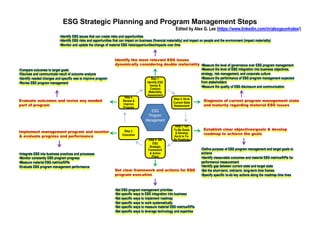
ESG Strategic Planning and Program Management Steps
Edited by Alex G. Lee (https://www.linkedin.com/in/alexgeunholee/)
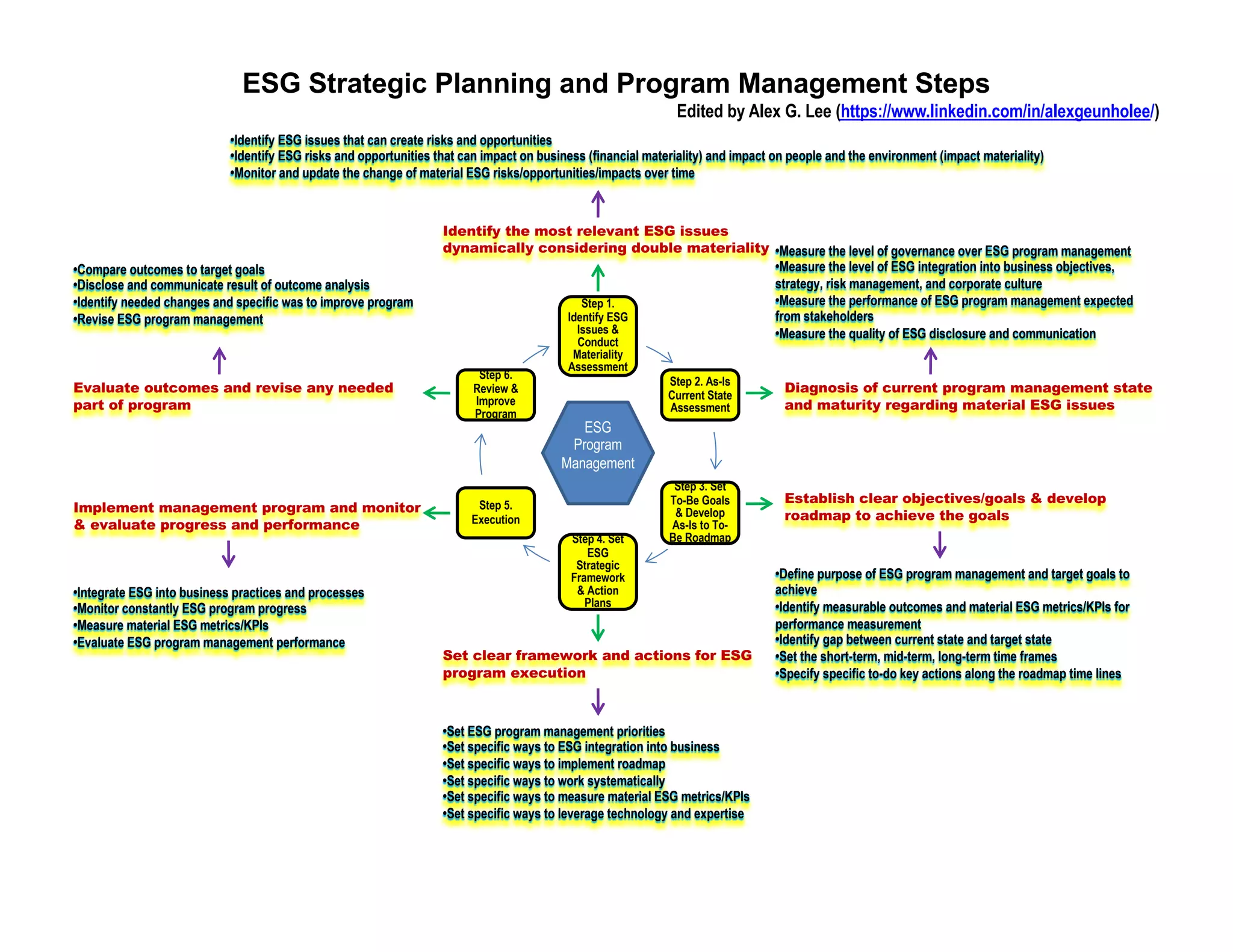
Step 1.
Identify ESG
Issues &
Conduct
Materiality
Assessment
Step 2. As-Is
Current State
Assessment
Step 3. Set
To-Be Goals
& Develop
As-Is to To-
Be Roadmap
Step 4. Set
ESG
Strategic
Framework
& Action
Plans
Step 5.
Execution
Step 6.
Review &
Improve
Program
Identify the most relevant ESG issues
dynamically considering double materiality
•Identify ESG issues that can create risks and opportunities
•Identify ESG risks and opportunities that can impact on business (financial materiality) and impact on people and the environment (impact materiality)
•Monitor and update the change of material ESG risks/opportunities/impacts over time
Diagnosis of current program management state
and maturity regarding material ESG issues
•Set ESG program management priorities
•Set specific ways to ESG integration into business
•Set specific ways to implement roadmap
•Set specific ways to work systematically
•Set specific ways to measure material ESG metrics/KPIs
•Set specific ways to leverage technology and expertise
ESG
Program
Management
•Measure the level of governance over ESG program management
•Measure the level of ESG integration into business objectives,
strategy, risk management, and corporate culture
•Measure the performance of ESG program management expected
from stakeholders
•Measure the quality of ESG disclosure and communication
Establish clear objectives/goals & develop
roadmap to achieve the goals
•Define purpose of ESG program management and target goals to
achieve
•Identify measurable outcomes and material ESG metrics/KPIs for
performance measurement
•Identify gap between current state and target state
•Set the short-term, mid-term, long-term time frames
•Specify specific to-do key actions along the roadmap time lines
Set clear framework and actions for ESG
program execution
Implement management program and monitor
& evaluate progress and performance
•Integrate ESG into business practices and processes
•Monitor constantly ESG program progress
•Measure material ESG metrics/KPIs
•Evaluate ESG program management performance
Evaluate outcomes and revise any needed
part of program
•Compare outcomes to target goals
•Disclose and communicate result of outcome analysis
•Identify needed changes and specific was to improve program
•Revise ESG program management

ESG Strategic Planning and Program Management Steps

  • 1.
    ESG Strategic Planningand Program Management Steps Edited by Alex G. Lee (https://www.linkedin.com/in/alexgeunholee/) Step 1. Identify ESG Issues & Conduct Materiality Assessment Step 2. As-Is Current State Assessment Step 3. Set To-Be Goals & Develop As-Is to To- Be Roadmap Step 4. Set ESG Strategic Framework & Action Plans Step 5. Execution Step 6. Review & Improve Program Identify the most relevant ESG issues dynamically considering double materiality •Identify ESG issues that can create risks and opportunities •Identify ESG risks and opportunities that can impact on business (financial materiality) and impact on people and the environment (impact materiality) •Monitor and update the change of material ESG risks/opportunities/impacts over time Diagnosis of current program management state and maturity regarding material ESG issues •Set ESG program management priorities •Set specific ways to ESG integration into business •Set specific ways to implement roadmap •Set specific ways to work systematically •Set specific ways to measure material ESG metrics/KPIs •Set specific ways to leverage technology and expertise ESG Program Management •Measure the level of governance over ESG program management •Measure the level of ESG integration into business objectives, strategy, risk management, and corporate culture •Measure the performance of ESG program management expected from stakeholders •Measure the quality of ESG disclosure and communication Establish clear objectives/goals & develop roadmap to achieve the goals •Define purpose of ESG program management and target goals to achieve •Identify measurable outcomes and material ESG metrics/KPIs for performance measurement •Identify gap between current state and target state •Set the short-term, mid-term, long-term time frames •Specify specific to-do key actions along the roadmap time lines Set clear framework and actions for ESG program execution Implement management program and monitor & evaluate progress and performance •Integrate ESG into business practices and processes •Monitor constantly ESG program progress •Measure material ESG metrics/KPIs •Evaluate ESG program management performance Evaluate outcomes and revise any needed part of program •Compare outcomes to target goals •Disclose and communicate result of outcome analysis •Identify needed changes and specific was to improve program •Revise ESG program management