Escherichia
Coli
Diarrhea
R E P O R T E D B Y :
P o u l e n e S a n a
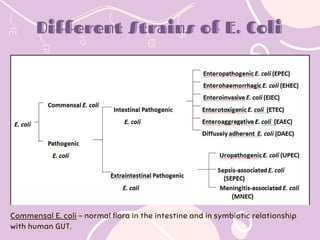
Different Strains of E. Coli
Commensal E. coli - normal flora in the intestine and in symbiotic relationship
with human GUT.
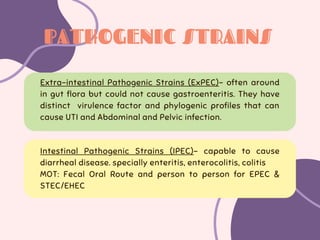
PATHOGENIC STRAINS
Extra-intestinal Pathogenic Strains (ExPEC)- often around
in gut flora but could not cause gastroenteritis. They have
distinct virulence factor and phylogenic profiles that can
cause UTI and Abdominal and Pelvic infection.
Intestinal Pathogenic Strains (IPEC)- capable to cause
diarrheal disease. specially enteritis, enterocolitis, colitis
MOT: Fecal Oral Route and person to person for EPEC &
STEC/EHEC
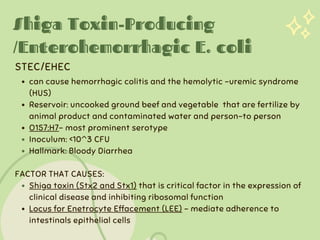
Shiga Toxin-Producing
/Enterohemorrhagic E. coli
STEC/EHEC
can cause hemorrhagic colitis and the hemolytic -uremic syndrome
(HUS)
Reservoir: uncooked ground beef and vegetable that are fertilize by
animal product and contaminated water and person-to person
O157:H7- most prominent serotype
Inoculum: <10^3 CFU
Hallmark: Bloody Diarrhea
Shiga toxin (Stx2 and Stx1) that is critical factor in the expression of
clinical disease and inhibiting ribosomal function
Locus for Enetrocyte Effacement (LEE) - mediate adherence to
intestinals epithelial cells
FACTOR THAT CAUSES:
More common in industrialize country
Infects the Young and Elderly pt.
Colonize in Colon and Ileum
Incubation period: 3-4 days
Self-limiting and last 5-10 days
S/Sx: abdominal pain, fecal leukocytes
Complication: HUS (2-14 days after diarrhea), fever,
thrombocytopenia, renal failure, and encephalopathy
Shiga Toxin-Producing
/Enterohemorrhagic E. coli
STEC/EHEC
Enterotoxigenic E. Coli
a major cause of endemic diarrhea
Common in weaning Children during 1st 3 years of life
Most common agent of Travelers Diarrhea
Inoculum: 10^6-10^10 CFU
Colonization in Small intestine over 12-72Hours
S/Sx: watery diarrhea accompanied by cramps
Self-limiting and last 3 days
Heat labile toxin (LT-1 ) and Heat-stable toxin (STa)- cause net
fluid secretion via Adenylate cyclase (LT-1) and Guanylate cyclase
(STa) in jejunum and ileum
FACTORS
ETEC
Enteropathogenic E. coli
causes primarily in young children, including neonates
responsible for outbreaks (sporadic and epidemic) of infantile
diarrhea in developing countries
MOT: Rapid person-to person spread and formula ingestion
Colonization in Small intestine
Incubation period: 1-2 days
S/Sx: Diarrheic stool containing mucus
Self-limiting and lasting 5-15 days to weeks
initial localized adherence leads to a characteristic efeacement of
mirovilli --> formation of cuplike, sctin-rich Pedestals
EPEC
Enteroinvasive E. coli
Relatively uncommon cause of diarrhea
Sporadic Disease is infrequently recognized in Children and
Travelers
shares clinical feature of Shigella (Fever, Abdominal pain, Fever,
Tenesmus, Nausea, vomiting, Malaise, dehydration)
Inoculum: 10^8-10^10 CFU
Incubation period: 1-3 days
Self-limiting and last for 7-10 days
Colonized and invades colon mucosa followed by replication in the
epithelial wall and development of inflammatory colitis
S/sx: Fever, Malaise, Abdominal pain, tenesmus, scant stool
containing mucus, blood, inflammatory cell
EIEC
Enteroagrregative E. coli
common in all ages in industrial countries
large inoculum
Clinical Manifestation: prolonged watery Diarrhea (traveler's
diarrhea)
in vitro: Diffuse or "stacked-brick" pattern of adherence to
epithelium
EAEC
Diffusely Adherent E. coli
DAEC
common 2-6 years of age in industrial countries
diarrheal disease
common in developing countries
Cholera
W O R K S M A R T E R , N O T H A R D E R ! G O S O M !
gram negative, curved bacteria
acute diarrheal disease, resulting to profound and rapid progressive
Dehydration and death.
CHOLERA GRAVIS- severe form of cholera loss of 1 liter of fluids
Natural habitat: costal salt water and brackish estuaries
Mode of Transmission:
Ingestion of contaminated food/ water - Chitinous Planktons
Human to Human -Fecal oral route & excreted in stool of
infected
Risk Factors
Decrease sanitation
Ingestion of certain foods (Rice & Shellfish)
Blood type O
Decrease gastric acidity
a.
b.
Vibrio Cholerae
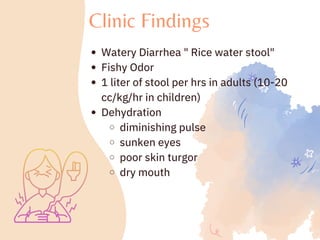
Watery Diarrhea " Rice water stool"
Fishy Odor
1 liter of stool per hrs in adults (10-20
cc/kg/hr in children)
Dehydration
diminishing pulse
sunken eyes
poor skin turgor
dry mouth
Clinic Findings
complex AB toxin
upon binding of Sub-unit B to the GM1
ganglioside on the intestinal epithelial cell
surface. Sub-unit A is allowed entry and
would activate the G-protein, which
stimulate the membranous bound
adenylate cyclase, resulting to cAMP
production. cAMP then would activate the
Na and Cl secretion and inhibits Na and Cl
reabsorption. K and HCO3 are then
followed d/t osmotic pull.
Sub unit A: enzymatic activities of the toxin
Sub unit B: Binding to receptors of the host cell
Cholera Toxin.
V. cholerae O1 and serogroup O139 - exclusively cause epidemic Cholera
and produce Cholera toxin.
Serotypes
Biotypes
Classification of
Cholera
Thank
Thank
Thank
you!
you!
you!

Escherichia-Coli.pdf

  • 1.
    Escherichia Coli Diarrhea R E PO R T E D B Y : P o u l e n e S a n a
  • 2.
    Different Strains ofE. Coli Commensal E. coli - normal flora in the intestine and in symbiotic relationship with human GUT.
  • 3.
    PATHOGENIC STRAINS Extra-intestinal PathogenicStrains (ExPEC)- often around in gut flora but could not cause gastroenteritis. They have distinct virulence factor and phylogenic profiles that can cause UTI and Abdominal and Pelvic infection. Intestinal Pathogenic Strains (IPEC)- capable to cause diarrheal disease. specially enteritis, enterocolitis, colitis MOT: Fecal Oral Route and person to person for EPEC & STEC/EHEC
  • 4.
    Shiga Toxin-Producing /Enterohemorrhagic E.coli STEC/EHEC can cause hemorrhagic colitis and the hemolytic -uremic syndrome (HUS) Reservoir: uncooked ground beef and vegetable that are fertilize by animal product and contaminated water and person-to person O157:H7- most prominent serotype Inoculum: <10^3 CFU Hallmark: Bloody Diarrhea Shiga toxin (Stx2 and Stx1) that is critical factor in the expression of clinical disease and inhibiting ribosomal function Locus for Enetrocyte Effacement (LEE) - mediate adherence to intestinals epithelial cells FACTOR THAT CAUSES:
  • 5.
    More common inindustrialize country Infects the Young and Elderly pt. Colonize in Colon and Ileum Incubation period: 3-4 days Self-limiting and last 5-10 days S/Sx: abdominal pain, fecal leukocytes Complication: HUS (2-14 days after diarrhea), fever, thrombocytopenia, renal failure, and encephalopathy Shiga Toxin-Producing /Enterohemorrhagic E. coli STEC/EHEC
  • 6.
    Enterotoxigenic E. Coli amajor cause of endemic diarrhea Common in weaning Children during 1st 3 years of life Most common agent of Travelers Diarrhea Inoculum: 10^6-10^10 CFU Colonization in Small intestine over 12-72Hours S/Sx: watery diarrhea accompanied by cramps Self-limiting and last 3 days Heat labile toxin (LT-1 ) and Heat-stable toxin (STa)- cause net fluid secretion via Adenylate cyclase (LT-1) and Guanylate cyclase (STa) in jejunum and ileum FACTORS ETEC
  • 7.
    Enteropathogenic E. coli causesprimarily in young children, including neonates responsible for outbreaks (sporadic and epidemic) of infantile diarrhea in developing countries MOT: Rapid person-to person spread and formula ingestion Colonization in Small intestine Incubation period: 1-2 days S/Sx: Diarrheic stool containing mucus Self-limiting and lasting 5-15 days to weeks initial localized adherence leads to a characteristic efeacement of mirovilli --> formation of cuplike, sctin-rich Pedestals EPEC
  • 8.
    Enteroinvasive E. coli Relativelyuncommon cause of diarrhea Sporadic Disease is infrequently recognized in Children and Travelers shares clinical feature of Shigella (Fever, Abdominal pain, Fever, Tenesmus, Nausea, vomiting, Malaise, dehydration) Inoculum: 10^8-10^10 CFU Incubation period: 1-3 days Self-limiting and last for 7-10 days Colonized and invades colon mucosa followed by replication in the epithelial wall and development of inflammatory colitis S/sx: Fever, Malaise, Abdominal pain, tenesmus, scant stool containing mucus, blood, inflammatory cell EIEC
  • 9.
    Enteroagrregative E. coli commonin all ages in industrial countries large inoculum Clinical Manifestation: prolonged watery Diarrhea (traveler's diarrhea) in vitro: Diffuse or "stacked-brick" pattern of adherence to epithelium EAEC Diffusely Adherent E. coli DAEC common 2-6 years of age in industrial countries diarrheal disease common in developing countries
  • 10.
    Cholera W O RK S M A R T E R , N O T H A R D E R ! G O S O M !
  • 11.
    gram negative, curvedbacteria acute diarrheal disease, resulting to profound and rapid progressive Dehydration and death. CHOLERA GRAVIS- severe form of cholera loss of 1 liter of fluids Natural habitat: costal salt water and brackish estuaries Mode of Transmission: Ingestion of contaminated food/ water - Chitinous Planktons Human to Human -Fecal oral route & excreted in stool of infected Risk Factors Decrease sanitation Ingestion of certain foods (Rice & Shellfish) Blood type O Decrease gastric acidity a. b. Vibrio Cholerae
  • 12.
    Watery Diarrhea "Rice water stool" Fishy Odor 1 liter of stool per hrs in adults (10-20 cc/kg/hr in children) Dehydration diminishing pulse sunken eyes poor skin turgor dry mouth Clinic Findings
  • 13.
    complex AB toxin uponbinding of Sub-unit B to the GM1 ganglioside on the intestinal epithelial cell surface. Sub-unit A is allowed entry and would activate the G-protein, which stimulate the membranous bound adenylate cyclase, resulting to cAMP production. cAMP then would activate the Na and Cl secretion and inhibits Na and Cl reabsorption. K and HCO3 are then followed d/t osmotic pull. Sub unit A: enzymatic activities of the toxin Sub unit B: Binding to receptors of the host cell Cholera Toxin.
  • 14.
    V. cholerae O1and serogroup O139 - exclusively cause epidemic Cholera and produce Cholera toxin. Serotypes Biotypes Classification of Cholera
  • 15.